2
INTRODUCTION
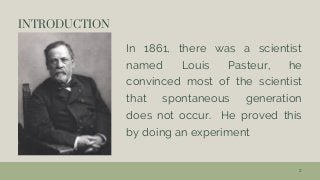
In 1861, therewas a scientist
named Louis Pasteur, he
convinced most of the scientist
that spontaneous generation
does not occur. He proved this
by doing an experiment
3.
3
PROCEDURES OF
THE EXPERIMENT
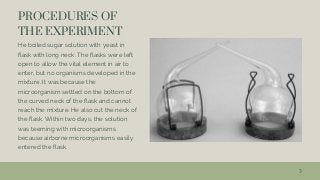
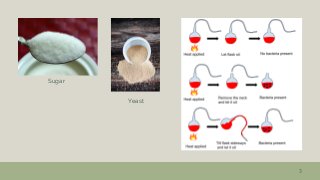
Heboiled sugar solution with yeast in
flask with long neck. The flasks were left
open to allow the vital element in air to
enter, but no organisms developed in the
mixture. It was because the
microorganism settled on the bottom of
the curved neck of the flask and cannot
reach the mixture. He also cut the neck of
the flask. Within two days, the solution
was teeming with microorganisms
because airborne microorganisms easily
entered the flask.
FACTS ABOUT LOUIS
PASTEUR
1.Louis Pasteur is one of the fathers of the germ theory
In the 19th century, people weren’t aware that germs are what cause and exacerbates illnesses. It may
seem obvious to us now that washing your hands is essential to stop the spreading of germs, but back in
Pasteur’s time, people just weren’t aware of how these things worked.
The germ theory of disease had been around since the Middle Ages, but it wasn’t widely accepted.
Although the smallpox vaccine was common in Europe by the 19th century, scientists and doctors still
didn’t really understand how it worked, or how to apply the same concept to different diseases.
Pasteur changed things when he began studying germs in 1860. He began conducting experiments on
the relationship between germs and diseases, and discovered the cause and effect of the puerperal
fever.
5
6.
FACTS ABOUT LOUIS
PASTEUR
2.Louis Pasteur is most famous for developing the pasteurization process
It is a process used to sanitize certain food products. After Pasteur realized that micro-organisms could
cause disease, he knew that he needed to develop a way to prevent these pesky little carriers from
getting inside comestible products.
His research also showed that micro-organisms were responsible for spoiling drinks like beer, wine and
milk. He developed a process in which these beverages were heated to high temperatures, killing any
sort of bacteria.
Pasteur patented his new process in 1865, and soon it was applied to wine, beer and milk. We still use
the same process today
5