Capital
Punishment is
Unnecessary
Ying Zhi, Tony, Matin
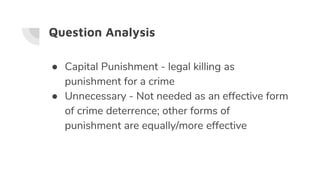
Question Analysis
● Capital Punishment - legal killing as
punishment for a crime
● Unnecessary - Not needed as an effective form
of crime deterrence; other forms of
punishment are equally/more effective
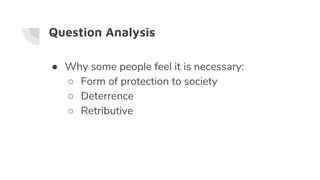
Question Analysis
● Why some people feel it is necessary:
○ Form of protection to society
○ Deterrence
○ Retributive
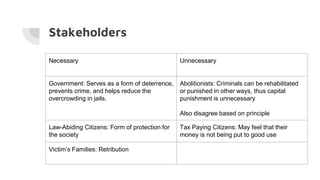
Stakeholders
Necessary Unnecessary
Government: Serves as a form of deterrence,
prevents crime, and helps reduce the
overcrowding in jails.
Abolitionists: Criminals can be rehabilitated
or punished in other ways, thus capital
punishment is unnecessary
Also disagree based on principle
Law-Abiding Citizens: Form of protection for
the society
Tax Paying Citizens: May feel that their
money is not being put to good use
Victim’s Families: Retribution
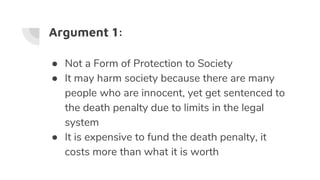
Argument 1:
● Not a Form of Protection to Society
● It may harm society because there are many
people who are innocent, yet get sentenced to
the death penalty due to limits in the legal
system
● It is expensive to fund the death penalty, it
costs more than what it is worth
Example
● Since 1976 in the USA, 138 innocent men and
women have been released from death row
due to developments in their cases, some even
minutes before their execution. This shows
how unreliable the death penalty is, especially
since there is no way to reverse the
punishment after it has been dealt.
Example
● Columbia University has found that 68% of all
death penalty cases were reversed on appeal.
This shows that the death penalty is rather
unreliable compared to how grave the
consequences of it are.
● There are better alternatives, such as life
imprisonment
Argument 2: Alternative forms of
deterrence
● Proponents of capital punishment, such as the Government, feel that
the death penalty is necessary as a form of deterrence and crime
prevention
● However, we do not agree as we believe that there are several
alternative forms of deterrence and crime prevention that have
repeatedly proven to be just as effective, if not more effective, than the
death penalty.
● People who feel that the death penalty is necessary are merely
assuming that the death penalty is the only way to deter crime and
that there are no better alternatives which may be even more effective.
Example
● Most countries in Europe have abolished capital punishment before
the start of the 21st Century. In spite of this, their murder rates remain
low. Germany has a murder rate of 0.8(2010), France 1.4(2008), UK
1.2(2009). In fact, all European States have a murder rate lower than
the global rate of 6.2.
● Belarus is the only European country that still imposes the death
penalty on criminals, however, when compared to Western European
states, such as the aforementioned few, its murder rate is significantly
higher(more than double), at 4.9(2014)
Example
● As murder is widely considered as the most heinous crime a human
can commit, and the death penalty is used primarily(in the countries
that impose it) to punish murder. Thus, murder rates are the best
assessment of the effectiveness of capital punishment. Therefore, the
evidence quoted goes to show that the death penalty may not actually
be effective.
● What makes the example more relevant and convincing is the fact that
the comparison is drawn between European states, and not with
countries that are notorious for their high murder rates. Thus, it is
reflective of the actual situation.
● With this evidence in mind, it is clear that capital punishment may not
be actually necessary, because other forms of punishment have
proven to be even more effective.
Argument 3: Retributive Theory
● The retributive theory states that society has a moral
obligation to punish a person who commits a crime. It is hence
their belief that capital punishment is necessary as some
crimes are so heinous that the only appropriate punishment is
death
● However, we believe that capital punishment is unnecessary
as criminals should mostly be rehabilitated rather than
punished, and those that do commit serious crimes can be
punished in other ways
Argument 3: Retributive Theory
● Abolition of capital punishment does not mean
impunity towards crime. There are alternative
punishments that are functionally identical to
the death penalty without being capital in
nature
Example
● Life imprisonment without parole
● The guilty cannot commit crimes ever again
● Faster justice, without a lengthy appeal process
● Cheaper version of justice
● Eventually die in prison of natural causes

Group 2_B-.pptx

  • 1.
  • 2.
    Question Analysis ● CapitalPunishment - legal killing as punishment for a crime ● Unnecessary - Not needed as an effective form of crime deterrence; other forms of punishment are equally/more effective
  • 3.
    Question Analysis ● Whysome people feel it is necessary: ○ Form of protection to society ○ Deterrence ○ Retributive
  • 4.
    Stakeholders Necessary Unnecessary Government: Servesas a form of deterrence, prevents crime, and helps reduce the overcrowding in jails. Abolitionists: Criminals can be rehabilitated or punished in other ways, thus capital punishment is unnecessary Also disagree based on principle Law-Abiding Citizens: Form of protection for the society Tax Paying Citizens: May feel that their money is not being put to good use Victim’s Families: Retribution
  • 5.
    Argument 1: ● Nota Form of Protection to Society ● It may harm society because there are many people who are innocent, yet get sentenced to the death penalty due to limits in the legal system ● It is expensive to fund the death penalty, it costs more than what it is worth
  • 6.
    Example ● Since 1976in the USA, 138 innocent men and women have been released from death row due to developments in their cases, some even minutes before their execution. This shows how unreliable the death penalty is, especially since there is no way to reverse the punishment after it has been dealt.
  • 7.
    Example ● Columbia Universityhas found that 68% of all death penalty cases were reversed on appeal. This shows that the death penalty is rather unreliable compared to how grave the consequences of it are. ● There are better alternatives, such as life imprisonment
  • 8.
    Argument 2: Alternativeforms of deterrence ● Proponents of capital punishment, such as the Government, feel that the death penalty is necessary as a form of deterrence and crime prevention ● However, we do not agree as we believe that there are several alternative forms of deterrence and crime prevention that have repeatedly proven to be just as effective, if not more effective, than the death penalty. ● People who feel that the death penalty is necessary are merely assuming that the death penalty is the only way to deter crime and that there are no better alternatives which may be even more effective.
  • 9.
    Example ● Most countriesin Europe have abolished capital punishment before the start of the 21st Century. In spite of this, their murder rates remain low. Germany has a murder rate of 0.8(2010), France 1.4(2008), UK 1.2(2009). In fact, all European States have a murder rate lower than the global rate of 6.2. ● Belarus is the only European country that still imposes the death penalty on criminals, however, when compared to Western European states, such as the aforementioned few, its murder rate is significantly higher(more than double), at 4.9(2014)
  • 10.
    Example ● As murderis widely considered as the most heinous crime a human can commit, and the death penalty is used primarily(in the countries that impose it) to punish murder. Thus, murder rates are the best assessment of the effectiveness of capital punishment. Therefore, the evidence quoted goes to show that the death penalty may not actually be effective. ● What makes the example more relevant and convincing is the fact that the comparison is drawn between European states, and not with countries that are notorious for their high murder rates. Thus, it is reflective of the actual situation. ● With this evidence in mind, it is clear that capital punishment may not be actually necessary, because other forms of punishment have proven to be even more effective.
  • 11.
    Argument 3: RetributiveTheory ● The retributive theory states that society has a moral obligation to punish a person who commits a crime. It is hence their belief that capital punishment is necessary as some crimes are so heinous that the only appropriate punishment is death ● However, we believe that capital punishment is unnecessary as criminals should mostly be rehabilitated rather than punished, and those that do commit serious crimes can be punished in other ways
  • 12.
    Argument 3: RetributiveTheory ● Abolition of capital punishment does not mean impunity towards crime. There are alternative punishments that are functionally identical to the death penalty without being capital in nature
  • 13.
    Example ● Life imprisonmentwithout parole ● The guilty cannot commit crimes ever again ● Faster justice, without a lengthy appeal process ● Cheaper version of justice ● Eventually die in prison of natural causes