Coal as a
Resource
Exploring from where Power Plant like
Dadri gets coal and put it into use and
how coalfields influence local economies
and communities, highlighting both
benefits and challenges.
Ankit Singh Gurjar 24PGDM00B005
Sukhraj Singh Sapal 24PGDM00B033
Sumitra Mitra 24PGDM00B035
Tirth Mehta 24PGDM00B036
Group - 2
CREDITS: This presentation template was created by
Slidesgo, and includes icons by Flaticon, and infographics &
images by Freepik
NTPC DADRI POWER PLANT
Introduction
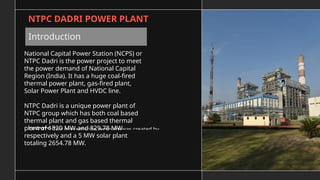
National Capital Power Station (NCPS) or
NTPC Dadri is the power project to meet
the power demand of National Capital
Region (India). It has a huge coal-fired
thermal power plant, gas-fired plant,
Solar Power Plant and HVDC line.
NTPC Dadri is a unique power plant of
NTPC group which has both coal based
thermal plant and gas based thermal
plant of 1820 MW and 829.78 MW
respectively and a 5 MW solar plant
totaling 2654.78 MW.
CREDITS: This presentation template was created by
Slidesgo, and includes icons by Flaticon, and infographics &
images by Freepik
NTPC DADRI POWER PLANT
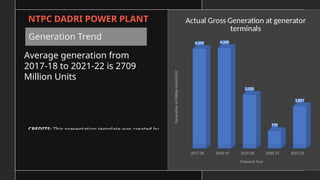
Generation Trend
Average generation from
2017-18 to 2021-22 is 2709
Million Units
2017-18 2018-19 2019-20 2020-21 2021-22
4,293 4,330
2,325
770
1,827
Actual Gross Generation at generator
terminals
Financial Year
Generation
in
Million
Units(MU)
Overview
NTPC Dadri
Source
Piparwar Block of North
Karanpura coal fields in
Bihar, about 1200
km.,Talcher fields in
Odissaabout 1446km
Singrauli fields in M.P.
about 930 km
Consumption
3.66 million tonnes per
year assuming 6500
hours of operation.Each
day about 20,000
tonnes each daya
Transportation
Indian Railways by
means of Bottom
Discharge, 58 wagons
of 56.78 tonners
capacity and
No. of rakes required
per day is 4 to 5
1 2 3 4
Grade
CCL: G7 - G10
ECL: G10 & above
BCCL: NLW coking
coal W-III & W-IV
and non-coking
coal G5 to G17 incl
washed power coal
CREDITS: This presentation template was created by
Slidesgo, and includes icons by Flaticon, and infographics &
images by Freepik
NTPC DADRI POWER PLANT
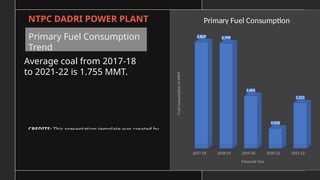
Primary Fuel Consumption
Trend
Average coal from 2017-18
to 2021-22 is 1.755 MMT.
2017-18 2018-19 2019-20 2020-21 2021-22
2.829 2.799
1.401
0.535
1.211
Primary Fuel Consumption
Financial Year
Fuel
Consumption
in
MMT
CREDITS: This presentation template was created by
Slidesgo, and includes icons by Flaticon, and infographics &
images by Freepik
NTPC DADRI POWER PLANT
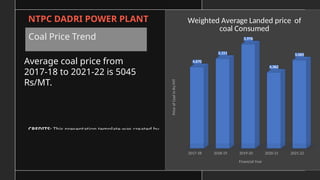
Coal Price Trend
Average coal price from
2017-18 to 2021-22 is 5045
Rs/MT.
2017-18 2018-19 2019-20 2020-21 2021-22
4,670
5,151
5,976
4,362
5,065
Weighted Average Landed price of
coal Consumed
Financial Year
Price
of
Coal
in
Rs/MT
COAL PRICING IN INDIA
● Pithead price of non-coking coal applicable on ECL, CCL, BCCL, NCL, MCL and NEC
○ Starting from 3288 Rs/te for G2 grade to 447 Rs/te for G17 grade of coal.
Basic Pithead Price of
Coal
Cost of sizing/ crushing,
Cost of loading and
unloading,
Cost of transportation
Statutory Levies,
Additional Royalty,
GST & CESS
Total Price of Coal
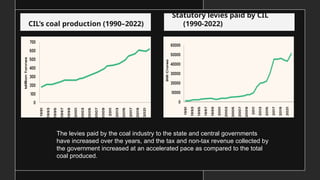
CIL’s coal production (1990–2022)
Statutory levies paid by CIL
(1990-2022)
The levies paid by the coal industry to the state and central governments
have increased over the years, and the tax and non-tax revenue collected by
the government increased at an accelerated pace as compared to the total
coal produced.
NTPC Dadri Coal
Supply in FY22 (values
are in million tonnes)
Sr. No. Parameter Arguments
1 Name of TPS NTPC Dadri
2 Total Talcher 0.15
3 Total Kranapura 0.8
4 Total Singrauli 2.02
5 Others(including the
captive and imports
0.73
6 Total consumed
(FY220
3.70
7 Estimated coal
consumption
6.65
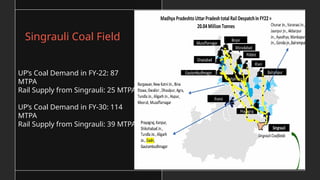
Singrauli Coal Field
UP’s Coal Demand in FY-22: 87
MTPA
Rail Supply from Singrauli: 25 MTPA
UP’s Coal Demand in FY-30: 114
MTPA
Rail Supply from Singrauli: 39 MTPA
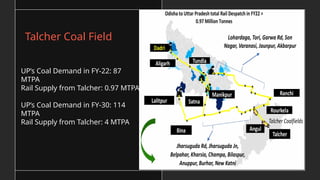
Talcher Coal Field
UP’s Coal Demand in FY-22: 87
MTPA
Rail Supply from Talcher: 0.97 MTPA
UP’s Coal Demand in FY-30: 114
MTPA
Rail Supply from Talcher: 4 MTPA
Socioeconomic
Impacts of
Singrauli and
Talcher
Coalfields
Examining the Impacts of Coal
Mining on Nearby Areas for
Sustainable Development and
Community Welfare
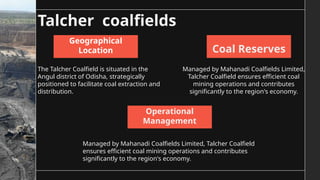
Talcher coalfields
The Talcher Coalfield is situated in the
Angul district of Odisha, strategically
positioned to facilitate coal extraction and
distribution.
Managed by Mahanadi Coalfields Limited, Talcher Coalfield
ensures efficient coal mining operations and contributes
significantly to the region's economy.
Managed by Mahanadi Coalfields Limited,
Talcher Coalfield ensures efficient coal
mining operations and contributes
significantly to the region's economy.
Geographical
Location
Operational
Management
Coal Reserves
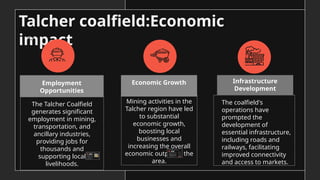
Talcher coalfield:Economic
impact
The Talcher Coalfield
generates significant
employment in mining,
transportation, and
ancillary industries,
providing jobs for
thousands and
supporting local
livelihoods.
Mining activities in the
Talcher region have led
to substantial
economic growth,
boosting local
businesses and
increasing the overall
economic output of the
area.
The coalfield's
operations have
prompted the
development of
essential infrastructure,
including roads and
railways, facilitating
improved connectivity
and access to markets.
Employment
Opportunities
Economic Growth Infrastructure
Development
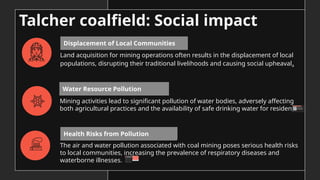
Land acquisition for mining operations often results in the displacement of local
populations, disrupting their traditional livelihoods and causing social upheaval.
Mining activities lead to significant pollution of water bodies, adversely affecting
both agricultural practices and the availability of safe drinking water for residents.
Water Resource Pollution
Displacement of Local Communities
Health Risks from Pollution
Talcher coalfield: Social impact
The air and water pollution associated with coal mining poses serious health risks
to local communities, increasing the prevalence of respiratory diseases and
waterborne illnesses.
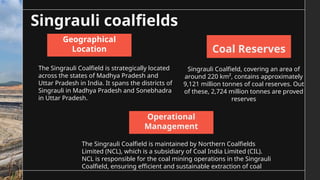
Singrauli coalfields
The Singrauli Coalfield is strategically located
across the states of Madhya Pradesh and
Uttar Pradesh in India. It spans the districts of
Singrauli in Madhya Pradesh and Sonebhadra
in Uttar Pradesh.
The Singrauli Coalfield is maintained by Northern Coalfields
Limited (NCL), which is a subsidiary of Coal India Limited (CIL).
NCL is responsible for the coal mining operations in the Singrauli
Coalfield, ensuring efficient and sustainable extraction of coal
Singrauli Coalfield, covering an area of
around 220 km², contains approximately
9,121 million tonnes of coal reserves. Out
of these, 2,724 million tonnes are proved
reserves
Geographical
Location
Operational
Management
Coal Reserves
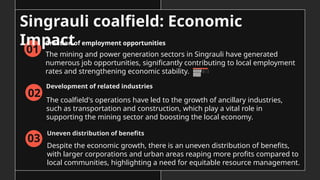
01
Singrauli coalfield: Economic
Impact
The mining and power generation sectors in Singrauli have generated
numerous job opportunities, significantly contributing to local employment
rates and strengthening economic stability.
The coalfield's operations have led to the growth of ancillary industries,
such as transportation and construction, which play a vital role in
supporting the mining sector and boosting the local economy.
05
02
Despite the economic growth, there is an uneven distribution of benefits,
with larger corporations and urban areas reaping more profits compared to
local communities, highlighting a need for equitable resource management.
06
03
Creation of employment opportunities
Development of related industries
Uneven distribution of benefits
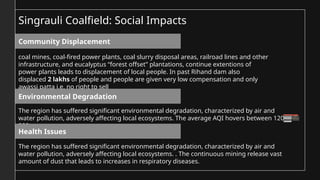
coal mines, coal-fired power plants, coal slurry disposal areas, railroad lines and other
infrastructure, and eucalyptus “forest offset” plantations, continue extentions of
power plants leads to displacement of local people. In past Rihand dam also
displaced 2 lakhs of people and people are given very low compensation and only
awassi patta i.e. no right to sell
The region has suffered significant environmental degradation, characterized by air and
water pollution, adversely affecting local ecosystems. The average AQI hovers between 120 –
300 .
The region has suffered significant environmental degradation, characterized by air and
water pollution, adversely affecting local ecosystems. . The continuous mining release vast
amount of dust that leads to increases in respiratory diseases.
Community Displacement
Environmental Degradation
Health Issues
Singrauli Coalfield: Social Impacts
Conclusion
 Therefore, coal as a resource for any thermal power plant is
having a very complex structure of the whole value chain,
though looks like a simple low hanging fruit for
comprehensive analysis.We acknowledge that while there
have been many problems with coal projects, countries need
to choose their energy mix that allows them to provide
energy access and support development, which may include
coal in some cases.
 The administration should continuously and adequately
monitor resettlement and rehabilitation packages to ensure
their proper implementation.If there is any discrepancy, the
private company and or the public sector undertaking should
be made accountable
References
 Coal Mining, Displacement and Rural Livelihoods: A Study in Mahanadi Coalfield Odisha - NITIE
Ayog
 District Sensus Handbook Singrauli & Talcher – M.P. Government,U.P. Government
 No fairy tale Report- Bretton Woods Project
 The cost of mining on local community, Talcher Coalfield -Acharya Ratan Assistant professor in
Geography, Government of Odisha (DHE
 Impact of Coal Mining on land use/landcover in Singrauli coalfield, Central India: A study using
Remote Sensing & GIS-Akram Javed, Rizwan Ahmad and Imran Khan (Department of Geology,
Aligarh Muslim University Aligarh, India )
 Economic significance of the Coal Sector Extends Beyond Energy Production – PIB
 Integrated Coal logistics plan- Ministry of coal(GOI)
THANK
YOU
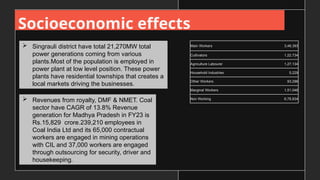
Socioeconomic effects
 Singrauli district have total 21,270MW total
power generations coming from various
plants.Most of the population is employed in
power plant at low level position. These power
plants have residential townships that creates a
local markets driving the businesses.
Main Workers 3,48,393
Cultivators 1,22,734
Agriculture Labourer 1,27,134
Household Industries 5,229
Other Workers 93,296
Marginal Workers 1,51,046
Non Working 6,78,834
 Revenues from royalty, DMF & NMET. Coal
sector have CAGR of 13.8% Revenue
generation for Madhya Pradesh in FY23 is
Rs.15,829 crore.239,210 employees in
Coal India Ltd and its 65,000 contractual
workers are engaged in mining operations
with CIL and 37,000 workers are engaged
through outsourcing for security, driver and
housekeeping.
Socioeconomic effects
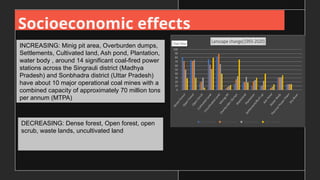
INCREASING: Minig pit area, Overburden dumps,
Settlements, Cultivated land, Ash pond, Plantation,
water body , around 14 significant coal-fired power
stations across the Singrauli district (Madhya
Pradesh) and Sonbhadra district (Uttar Pradesh)
have about 10 major operational coal mines with a
combined capacity of approximately 70 million tons
per annum (MTPA)​
DECREASING: Dense forest, Open forest, open
scrub, waste lands, uncultivated land
Talcher coalfield:Economic
impact
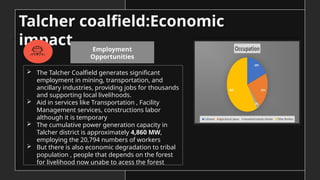
 The Talcher Coalfield generates significant
employment in mining, transportation, and
ancillary industries, providing jobs for thousands
and supporting local livelihoods.
 Aid in services like Transportation , Facility
Management services, constructions labor
although it is temporary
 The cumulative power generation capacity in
Talcher district is approximately 4,860 MW,
employing the 20,794 numbers of workers
 But there is also economic degradation to tribal
population , people that depends on the forest
for livelihood now unabe to acess the forest
Employment
Opportunities
Socioeconomic
impact
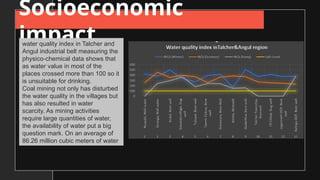
water quality index in Talcher and
Angul industrial belt measuring the
physico chemical data shows that
‐
as water value in most of the
places crossed more than 100 so it
is unsuitable for drinking.
Coal mining not only has disturbed
the water quality in the villages but
has also resulted in water
scarcity. As mining activities
require large quantities of water,
the availability of water put a big
question mark. On an average of
86.26 million cubic meters of water
Health Risks from Pollution
Talcher coalfield: Social impact
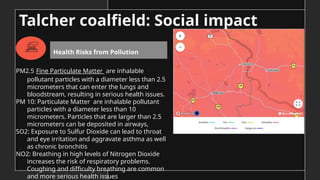
PM2.5 Fine Particulate Matter are inhalable
pollutant particles with a diameter less than 2.5
micrometers that can enter the lungs and
bloodstream, resulting in serious health issues.
PM 10: Particulate Matter are inhalable pollutant
particles with a diameter less than 10
micrometers. Particles that are larger than 2.5
micrometers can be deposited in airways,
SO2: Exposure to Sulfur Dioxide can lead to throat
and eye irritation and aggravate asthma as well
as chronic bronchitis
NO2: Breathing in high levels of Nitrogen Dioxide
increases the risk of respiratory problems.
Coughing and difficulty breathing are common
and more serious health issues
Talcher coalfield:Economic
impact
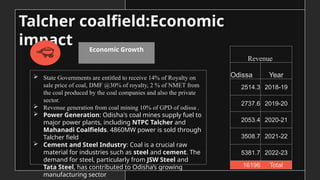
 State Governments are entitled to receive 14% of Royalty on
sale price of coal, DMF @30% of royalty, 2 % of NMET from
the coal produced by the coal companies and also the private
sector.
 Revenue generation from coal mining 10% of GPD of odissa .
 Power Generation: Odisha's coal mines supply fuel to
major power plants, including NTPC Talcher and
Mahanadi Coalfields. 4860MW power is sold through
Talcher field
 Cement and Steel Industry: Coal is a crucial raw
material for industries such as steel and cement. The
demand for steel, particularly from JSW Steel and
Tata Steel, has contributed to Odisha’s growing
manufacturing sector
Economic Growth
Revenue
Odissa Year
2514.3 2018-19
2737.6 2019-20
2053.4 2020-21
3508.7 2021-22
5381.7 2022-23
16196 Total

Group-2_Coal_as_Resource(as_presented).pptx

  • 1.
    Coal as a Resource Exploringfrom where Power Plant like Dadri gets coal and put it into use and how coalfields influence local economies and communities, highlighting both benefits and challenges. Ankit Singh Gurjar 24PGDM00B005 Sukhraj Singh Sapal 24PGDM00B033 Sumitra Mitra 24PGDM00B035 Tirth Mehta 24PGDM00B036 Group - 2
  • 2.
    CREDITS: This presentationtemplate was created by Slidesgo, and includes icons by Flaticon, and infographics & images by Freepik NTPC DADRI POWER PLANT Introduction National Capital Power Station (NCPS) or NTPC Dadri is the power project to meet the power demand of National Capital Region (India). It has a huge coal-fired thermal power plant, gas-fired plant, Solar Power Plant and HVDC line. NTPC Dadri is a unique power plant of NTPC group which has both coal based thermal plant and gas based thermal plant of 1820 MW and 829.78 MW respectively and a 5 MW solar plant totaling 2654.78 MW.
  • 3.
    CREDITS: This presentationtemplate was created by Slidesgo, and includes icons by Flaticon, and infographics & images by Freepik NTPC DADRI POWER PLANT Generation Trend Average generation from 2017-18 to 2021-22 is 2709 Million Units 2017-18 2018-19 2019-20 2020-21 2021-22 4,293 4,330 2,325 770 1,827 Actual Gross Generation at generator terminals Financial Year Generation in Million Units(MU)
  • 4.
    Overview NTPC Dadri Source Piparwar Blockof North Karanpura coal fields in Bihar, about 1200 km.,Talcher fields in Odissaabout 1446km Singrauli fields in M.P. about 930 km Consumption 3.66 million tonnes per year assuming 6500 hours of operation.Each day about 20,000 tonnes each daya Transportation Indian Railways by means of Bottom Discharge, 58 wagons of 56.78 tonners capacity and No. of rakes required per day is 4 to 5 1 2 3 4 Grade CCL: G7 - G10 ECL: G10 & above BCCL: NLW coking coal W-III & W-IV and non-coking coal G5 to G17 incl washed power coal
  • 5.
    CREDITS: This presentationtemplate was created by Slidesgo, and includes icons by Flaticon, and infographics & images by Freepik NTPC DADRI POWER PLANT Primary Fuel Consumption Trend Average coal from 2017-18 to 2021-22 is 1.755 MMT. 2017-18 2018-19 2019-20 2020-21 2021-22 2.829 2.799 1.401 0.535 1.211 Primary Fuel Consumption Financial Year Fuel Consumption in MMT
  • 6.
    CREDITS: This presentationtemplate was created by Slidesgo, and includes icons by Flaticon, and infographics & images by Freepik NTPC DADRI POWER PLANT Coal Price Trend Average coal price from 2017-18 to 2021-22 is 5045 Rs/MT. 2017-18 2018-19 2019-20 2020-21 2021-22 4,670 5,151 5,976 4,362 5,065 Weighted Average Landed price of coal Consumed Financial Year Price of Coal in Rs/MT
  • 7.
    COAL PRICING ININDIA ● Pithead price of non-coking coal applicable on ECL, CCL, BCCL, NCL, MCL and NEC ○ Starting from 3288 Rs/te for G2 grade to 447 Rs/te for G17 grade of coal. Basic Pithead Price of Coal Cost of sizing/ crushing, Cost of loading and unloading, Cost of transportation Statutory Levies, Additional Royalty, GST & CESS Total Price of Coal
  • 8.
    CIL’s coal production(1990–2022) Statutory levies paid by CIL (1990-2022) The levies paid by the coal industry to the state and central governments have increased over the years, and the tax and non-tax revenue collected by the government increased at an accelerated pace as compared to the total coal produced.
  • 9.
    NTPC Dadri Coal Supplyin FY22 (values are in million tonnes) Sr. No. Parameter Arguments 1 Name of TPS NTPC Dadri 2 Total Talcher 0.15 3 Total Kranapura 0.8 4 Total Singrauli 2.02 5 Others(including the captive and imports 0.73 6 Total consumed (FY220 3.70 7 Estimated coal consumption 6.65
  • 10.
    Singrauli Coal Field UP’sCoal Demand in FY-22: 87 MTPA Rail Supply from Singrauli: 25 MTPA UP’s Coal Demand in FY-30: 114 MTPA Rail Supply from Singrauli: 39 MTPA
  • 11.
    Talcher Coal Field UP’sCoal Demand in FY-22: 87 MTPA Rail Supply from Talcher: 0.97 MTPA UP’s Coal Demand in FY-30: 114 MTPA Rail Supply from Talcher: 4 MTPA
  • 12.
    Socioeconomic Impacts of Singrauli and Talcher Coalfields Examiningthe Impacts of Coal Mining on Nearby Areas for Sustainable Development and Community Welfare
  • 13.
    Talcher coalfields The TalcherCoalfield is situated in the Angul district of Odisha, strategically positioned to facilitate coal extraction and distribution. Managed by Mahanadi Coalfields Limited, Talcher Coalfield ensures efficient coal mining operations and contributes significantly to the region's economy. Managed by Mahanadi Coalfields Limited, Talcher Coalfield ensures efficient coal mining operations and contributes significantly to the region's economy. Geographical Location Operational Management Coal Reserves
  • 14.
    Talcher coalfield:Economic impact The TalcherCoalfield generates significant employment in mining, transportation, and ancillary industries, providing jobs for thousands and supporting local livelihoods. Mining activities in the Talcher region have led to substantial economic growth, boosting local businesses and increasing the overall economic output of the area. The coalfield's operations have prompted the development of essential infrastructure, including roads and railways, facilitating improved connectivity and access to markets. Employment Opportunities Economic Growth Infrastructure Development
  • 15.
    Land acquisition formining operations often results in the displacement of local populations, disrupting their traditional livelihoods and causing social upheaval. Mining activities lead to significant pollution of water bodies, adversely affecting both agricultural practices and the availability of safe drinking water for residents. Water Resource Pollution Displacement of Local Communities Health Risks from Pollution Talcher coalfield: Social impact The air and water pollution associated with coal mining poses serious health risks to local communities, increasing the prevalence of respiratory diseases and waterborne illnesses.
  • 16.
    Singrauli coalfields The SingrauliCoalfield is strategically located across the states of Madhya Pradesh and Uttar Pradesh in India. It spans the districts of Singrauli in Madhya Pradesh and Sonebhadra in Uttar Pradesh. The Singrauli Coalfield is maintained by Northern Coalfields Limited (NCL), which is a subsidiary of Coal India Limited (CIL). NCL is responsible for the coal mining operations in the Singrauli Coalfield, ensuring efficient and sustainable extraction of coal Singrauli Coalfield, covering an area of around 220 km², contains approximately 9,121 million tonnes of coal reserves. Out of these, 2,724 million tonnes are proved reserves Geographical Location Operational Management Coal Reserves
  • 17.
    01 Singrauli coalfield: Economic Impact Themining and power generation sectors in Singrauli have generated numerous job opportunities, significantly contributing to local employment rates and strengthening economic stability. The coalfield's operations have led to the growth of ancillary industries, such as transportation and construction, which play a vital role in supporting the mining sector and boosting the local economy. 05 02 Despite the economic growth, there is an uneven distribution of benefits, with larger corporations and urban areas reaping more profits compared to local communities, highlighting a need for equitable resource management. 06 03 Creation of employment opportunities Development of related industries Uneven distribution of benefits
  • 18.
    coal mines, coal-firedpower plants, coal slurry disposal areas, railroad lines and other infrastructure, and eucalyptus “forest offset” plantations, continue extentions of power plants leads to displacement of local people. In past Rihand dam also displaced 2 lakhs of people and people are given very low compensation and only awassi patta i.e. no right to sell The region has suffered significant environmental degradation, characterized by air and water pollution, adversely affecting local ecosystems. The average AQI hovers between 120 – 300 . The region has suffered significant environmental degradation, characterized by air and water pollution, adversely affecting local ecosystems. . The continuous mining release vast amount of dust that leads to increases in respiratory diseases. Community Displacement Environmental Degradation Health Issues Singrauli Coalfield: Social Impacts
  • 19.
    Conclusion  Therefore, coalas a resource for any thermal power plant is having a very complex structure of the whole value chain, though looks like a simple low hanging fruit for comprehensive analysis.We acknowledge that while there have been many problems with coal projects, countries need to choose their energy mix that allows them to provide energy access and support development, which may include coal in some cases.  The administration should continuously and adequately monitor resettlement and rehabilitation packages to ensure their proper implementation.If there is any discrepancy, the private company and or the public sector undertaking should be made accountable
  • 20.
    References  Coal Mining,Displacement and Rural Livelihoods: A Study in Mahanadi Coalfield Odisha - NITIE Ayog  District Sensus Handbook Singrauli & Talcher – M.P. Government,U.P. Government  No fairy tale Report- Bretton Woods Project  The cost of mining on local community, Talcher Coalfield -Acharya Ratan Assistant professor in Geography, Government of Odisha (DHE  Impact of Coal Mining on land use/landcover in Singrauli coalfield, Central India: A study using Remote Sensing & GIS-Akram Javed, Rizwan Ahmad and Imran Khan (Department of Geology, Aligarh Muslim University Aligarh, India )  Economic significance of the Coal Sector Extends Beyond Energy Production – PIB  Integrated Coal logistics plan- Ministry of coal(GOI)
  • 21.
  • 22.
    Socioeconomic effects  Singraulidistrict have total 21,270MW total power generations coming from various plants.Most of the population is employed in power plant at low level position. These power plants have residential townships that creates a local markets driving the businesses. Main Workers 3,48,393 Cultivators 1,22,734 Agriculture Labourer 1,27,134 Household Industries 5,229 Other Workers 93,296 Marginal Workers 1,51,046 Non Working 6,78,834  Revenues from royalty, DMF & NMET. Coal sector have CAGR of 13.8% Revenue generation for Madhya Pradesh in FY23 is Rs.15,829 crore.239,210 employees in Coal India Ltd and its 65,000 contractual workers are engaged in mining operations with CIL and 37,000 workers are engaged through outsourcing for security, driver and housekeeping.
  • 23.
    Socioeconomic effects INCREASING: Minigpit area, Overburden dumps, Settlements, Cultivated land, Ash pond, Plantation, water body , around 14 significant coal-fired power stations across the Singrauli district (Madhya Pradesh) and Sonbhadra district (Uttar Pradesh) have about 10 major operational coal mines with a combined capacity of approximately 70 million tons per annum (MTPA)​ DECREASING: Dense forest, Open forest, open scrub, waste lands, uncultivated land
  • 24.
    Talcher coalfield:Economic impact  TheTalcher Coalfield generates significant employment in mining, transportation, and ancillary industries, providing jobs for thousands and supporting local livelihoods.  Aid in services like Transportation , Facility Management services, constructions labor although it is temporary  The cumulative power generation capacity in Talcher district is approximately 4,860 MW, employing the 20,794 numbers of workers  But there is also economic degradation to tribal population , people that depends on the forest for livelihood now unabe to acess the forest Employment Opportunities
  • 25.
    Socioeconomic impact water quality indexin Talcher and Angul industrial belt measuring the physico chemical data shows that ‐ as water value in most of the places crossed more than 100 so it is unsuitable for drinking. Coal mining not only has disturbed the water quality in the villages but has also resulted in water scarcity. As mining activities require large quantities of water, the availability of water put a big question mark. On an average of 86.26 million cubic meters of water
  • 26.
    Health Risks fromPollution Talcher coalfield: Social impact PM2.5 Fine Particulate Matter are inhalable pollutant particles with a diameter less than 2.5 micrometers that can enter the lungs and bloodstream, resulting in serious health issues. PM 10: Particulate Matter are inhalable pollutant particles with a diameter less than 10 micrometers. Particles that are larger than 2.5 micrometers can be deposited in airways, SO2: Exposure to Sulfur Dioxide can lead to throat and eye irritation and aggravate asthma as well as chronic bronchitis NO2: Breathing in high levels of Nitrogen Dioxide increases the risk of respiratory problems. Coughing and difficulty breathing are common and more serious health issues
  • 27.
    Talcher coalfield:Economic impact  StateGovernments are entitled to receive 14% of Royalty on sale price of coal, DMF @30% of royalty, 2 % of NMET from the coal produced by the coal companies and also the private sector.  Revenue generation from coal mining 10% of GPD of odissa .  Power Generation: Odisha's coal mines supply fuel to major power plants, including NTPC Talcher and Mahanadi Coalfields. 4860MW power is sold through Talcher field  Cement and Steel Industry: Coal is a crucial raw material for industries such as steel and cement. The demand for steel, particularly from JSW Steel and Tata Steel, has contributed to Odisha’s growing manufacturing sector Economic Growth Revenue Odissa Year 2514.3 2018-19 2737.6 2019-20 2053.4 2020-21 3508.7 2021-22 5381.7 2022-23 16196 Total