Module 2:
Physical Attributes
of
Personality
Let's Play a
Game!
_ _ _ _ _ _ _ _
_ _ _ _ _ _
_ _ _ _ _ _ _
_ _ _ _ _ _ _
_ _ _ _ _ _ _ _ _
Objectives:
Identify the physical attributes of a person.
1.
Discuss the significance of good grooming to
one’s personality.
2.
Explain the importance of having a good
posture.
3.
Explain the importance of psychology of colors.
4.
Apply physical health and hygiene.
5.
Module 2:
Physical Attributes
of
Personality
Physical Attributes
- it refers to the aspects of your
physical presence that influence
how others perceive you and how
you present yourself.
These attributes include:
BODY LANGUAGE
• Posture
• Gestures
• Facial Expressions
1.
1.
These attributes include:
APPEARANCE
• Grooming
• Dress
• Overall Style
2.
2.
These attributes include:
VOICE
• Tone
• Clarity
• Volume of your Speech
3.
3.
These attributes include:
Energy Level
• Enthusiasm
• Vitality
4.
4.
External Attributes
The external attributes include physical
health and hygiene, grooming, accessories,
make up, posture, and the use of color
combinations .It refers to observable traits
and behaviors that reflect an individual's
personality. These attributes are often
seen by others. Examples of external traits
are hair color, eye color, facial features,
clothes, accessories, height and size.
GOOD
POSTURE
★What impression will you have of a newcomer in your
school who has an excellent posture?
★What impression will you have of a boy or girl with
drooping shoulders, sagging abdomen, and a depressed
chest?
★Have you ever realized how much harm a bad posture
can do to one's personality?
★What is Good posture?
-Male and female applicants are often judged by
employers by the way they stand, sit, and walk. People think
that a boy or girl who sits straight, stands tall, and walks well
is alert and will be a capable worker. Good health and good
posture go together.
Good posture is a state which enables the
body to function to the best advantage. There
is no one best posture for everyone. Everyone
is built differently from another; hence people
have different postures. Work that gives
satisfaction helps improve posture. Success
helps posture.
Good posture makes one more attractive and
graceful. It gives a feeling of confidence. Bad
posture accelerates fatigue. Rounded
shoulders and a slumped position may
interfere with the lungs in breathing and may
do harm in crowding other organs out of their
natural places. Good posture may also aid
regular bowel movement. The func- tioning of
the body system is kept normally operational
at all times with good posture.
Psychology
of
Colors
The study of how different colors affect human
mood and behavior.
In 1666, Mr.Isaac Newton discovered that pure
white light, when passed through a prism,
separates into all visible colors.
He found that each color is composed of a single
wavelength and cannot be further separated into
other colors.
Color Psychology
"Given the prevalence of color, one would expect color
psychology to be a well-developed area,"
"Surprisingly, little theoretical or empirical work has
been conducted to date on color's influence on
psychological functioning, and the work that has been
done has been driven mostly by practical concerns,
not scientific rigor."
Researchers Andrew Elliot and
Markus Maier have noted;
Colors in the red area of the color spectrum are known as warm
colors and include red, orange, and yellow.
These warm colors evoke emotions ranging from feelings of
warmth and comfort to feelings of anger and hostility.
The Psychological Effects
of Color
Colors on the blue side of the spectrum are known as cool
colors and include blue, purple, and green.
These colors are often described as calm, but can also call
to mind feelings of sadness or indifference.
Color Psychology as Therapy
Several ancient cultures, including the Egyptians and Chinese,
practiced chromotherapy.
Colorology is still used today as a holistic or alternative
treatment. In this treatment:
Red is used to stimulate the body and mind and to increase
circulation.
Yellow is thought to stimulate the nerves and purify the body.
Orange is used to heal the lungs and to increase energy levels.
Blue is believed to soothe illnesses and treat pain.
Indigo shades are thought to alleviate skin problems.
Modern Research on
Color Psychology
Colors also have different meanings in different
cultures.
Research has demonstrated in many cases that the
mood-altering effects of color may only be temporary.
Modern Research on
Color Psychology
Existing research has found that color can impact people in a variety of
surprising ways:
Warm-colored placebo pills were reported as more effective than
cool-colored placebo pills in one study.
Blue-colored streetlights can lead to reduced crime according to
anecdotal evidence.
Red causes people to react with greater speed and force, something
that might prove useful during athletic activities according to
researchers.
Black uniforms are more likely to receive penalties.
Color Can Influence
Performance
Research indicates that certain colors, such as red, can
negatively impact performance.
The color red is often described as threatening, arousing or
exciting, many previous studies on the impact of the color red
have been largely inconclusive.
Physical Health and
Hygiene
A Guide to Good Personal Hygiene
Personal hygiene habits such as washing your hands and
brushing and flossing your teeth will help keep bacteria,
viruses, and illnesses at bay. And there are mental as well as
physical benefits. “Practicing good body hygiene helps you
feel good about yourself, which is important for your mental
health,” notes Donald Novey, MD, an integrative medicine
physician with the Advocate Medical Group in Park Ridge, Ill.
People who have poor hygiene — disheveled hair and clothes,
body odor, bad breath, missing teeth, and the like — often are
seen as unhealthy and may face discrimination.
Personal Hygiene: Healthy Habits Include Good Grooming
Bathe regularly. Wash your body and your hair often.
Trim your nails. Keeping your finger and toenails trimmed and in good shape will
prevent problems such as hang nails and infected nail beds.
Brush and floss. Ideally, you should brush your teeth after every meal. At the very
least, brush your teeth twice a day and floss daily.
Wash your hands. Washing your hands before preparing or eating food, after going
to the bathroom, after coughing or sneezing, and after handling garbage, goes a long
way toward preventing the spread of bacteria and viruses.
Sleep tight. Get plenty of rest — 8 to 10 hours a night — so that you are refreshed
and are ready to take on the day every morning.
Personal Hygiene: Poor Hygiene Hints at Other Issues
If someone you know hasn’t bathed or appears unkempt, it could be a sign that he
or she is depressed. “When people are sad or depressed, they neglect themselves,”
Novey says. Talking about the importance of proper personal hygiene for
preventing illnesses and providing personal hygiene items may help some people.
Be candid but sensitive and understanding in your discussions, Novey says. Despite
your best efforts, your friend or loved one may need professional help. You should
encourage them to see a counselor or doctor if their personal hygiene doesn’t
improve.
Personal Hygiene: Good Habits Help Keep
You Healthy
For most people, good hygiene is so much a part of their daily routines that they think little about it. They
bathe, they brush their teeth, visit the dentist and doctor for regular checkups, and wash their hands when
preparing or eating food and handling unsanitary items. To keep those you care about healthy and safe, help
them learn, and be sure that they are practicing, good personal hygiene.
The Brain
A Guide to Good Personal Hygiene
The brain belongs to the central nervous system. The automobile will not
perform without thee engine, just as the brain will not function without
the central nervous system. Quality output from the machine can only be
achieved through care and maintenance of the machine. When we invest
in our brain, we invest in life as well.
Provide the brain with good food, enough sleep, fresh air, exercise,
relaxation and positive outlook.
Foods for the Brain are:
Iron. This helps deliver oxygen to the brain through the bloodstream. Some
sources are meat, fish, molasses, and soybeans.
Vitamin C deficiency causes mental sluggishness.
Vitamin B 12 deficiency results in the impairment of memory. Food rich in
Vitamin B 12 are meat, fish and dairy products.
Thiamine (Vitamin B2) deficiency results in depression, emotional instability,
and confusion.
The B-Complex vitamin is a key to memory function.
Protein keeps the brain alert.
Exercise for the brain are:
Planning and organizing ideas
Memorizing lines of poetry.
Learning a new language.
Writing about certain subjects a few minutes a day.
Reading to sharpen mental skills.
Developing skills in problem-solving through puzzles, scrabble,
and computer games.
Exercise
Benefits of Exercise
We have all heard it many times before - regular exercise is good for
you, and it can help you lose weight. But if you are like many
Americans, you are busy, you have a sedentary job, and you haven't
yet changed your exercise habits. The good news is that it's never too
late to start. You can start slowly, and find ways to fit more physical
activity into your life. To get the most benefit, you should try to get the
recommended amount of exercise for your age. If you can do it, the
payoff is that you will feel better, help prevent or control many
diseases, and likely even live longer
What are the health benefits of exercise?
Help you control your weight. Along with diet, exercise plays an
important role in controlling your weight and preventing obesity.
Reduce your risk of heart diseases. Exercise strengthens your heart
and improves your circulation.
Help your body manage blood sugar and insulin levels. Exercise can
lower your blood sugar level and help your insulin work better.
Help you quit smoking. Exercise may make it easier to quit smoking by
reducing your cravings and withdrawal symptoms.
Improve your mental health and mood. During exercise, your body
releases chemicals that can improve your mood and make you feel more
relaxed.
What are the health benefits of exercise?
Help keep your thinking, learning, and judgment skills sharp as you age.
Exercise stimulates your body to release proteins and other chemicals that
improve the structure and function of your brain.
Strengthen your bones and muscles. Regular exercise can help kids and
teens build strong bones.
Reduce your risk of some cancers, including colon, breast , uterine, and
lung cancer.
Reduce your risk of falls. For older adults, research shows that doing
balance and muscle-strengthening activities in addition to moderate-intensity
aerobic activity can help reduce your risk of falling.
What are the health benefits of exercise?
Improve your sleep. Exercise can help you to fall asleep faster and stay
asleep longer.
Improve your sexual health. Regular exercise may lower the risk of erectile
dysfunction (ED) in men. For those who already have ED, exercise may help
improve their sexual function. In women, exercise may increase sexual
arousal.
Increase your chances of living longer. Studies show that physical activity
can reduce your risk of dying early from the leading causes of death, like
heart disease and some cancers
How can I make exercise a part of my regular routine?
Make everyday activities more active.
Be active with friends and family.
Keep track of your progress.
Make exercise more fun.
Find activities that you can do even when the weather is bad.
How to build a skin care routine?
Great skin is not simply a matter of DNA — your daily habits, in fact,
have a big impact on what you see in the mirror. But depending on
which product reviews you read or doctors you consult, there is a
dizzying number of opinions on everything from how to moisturize to
how to protect yourself from UV rays. Ultimately, caring for your skin is
simply personal. Here’s what you should keep in mind to sort through
all the noise.
Skin care tips before you start
Three Main Steps
Think of your skin-care routine as consisting of three main steps:
Cleansing — Washing your face.
Toning — Balancing the skin.
Moisturizing — Hydrating and softening the skin.
The goal of any skin-care routine is to tune up your complexion so
it’s functioning at its best, and also troubleshoot or target any
areas you want to work on. “Beauty routines are an opportunity to
notice changes within yourself,” says the San Francisco skin-care
specialist Kristina Holey. As your skin needs shifts with age, so will
your products. Still, she adds, “it’s not about creating perfection.”
Allow these three steps to become your daily ritual that fortifies
your skin and grounds your day.
Give it a time
Cleansing
Washing your face is the most basic and essential step of any routine, says
the New York City dermatologist Dr. Carlos Charles. “Our skin comes in
contact with environmental pollutants, dirt and other factors each day that
should be gently removed.” Wash twice a day, morning and night, to avoid
clogged pores, dullness and acne.
Find your facial cleanser
The right formula cleanses your skin without stripping essential, healthy oils.
Take it easy with exfoliating scrubs (use once a week) and avoid those with
crushed walnut shells or abrasive ingredients.
Find your
facial
cleanser
What does non-comedogenic mean?
This term frequently appears on product labels and is used by skin-care
experts but not always defined in simple, clear language. Here’s a quick
explanation: If a product claims to be non-comedogenic it means that it
shouldn’t clog pores or trigger acne — either by occluding the skin,
blocking glands or irritating the hair follicle. The claim is not regulated by
the F.D.A., however, and many companies do their own internal tests to
determine whether a product should be considered comedogenic or not.
(Some common known comedogenic ingredients are coconut oil and
cocoa butter.) Typically, the fewer ingredients a product has, the easier it
is to determine if it will cause any reactions.
How to use toner?
For many, the word “toner” brings to mind stinging astringents from the ’80s.
“The original was an alcohol-based product that was used to dry up oily skin
and remove any leftover dirt following cleansing,” Dr. Nazarian says. Today’s
formulas, however, have evolved. Think of them as supplements — these
thin liquids deliver an extra shot of nutrients, helping the other products in
your regimen absorb better, while still balancing your complexion.
TONING
If you have the time and inclination, here are some hero ingredients to
look for:
Alpha and beta hydroxy acids to gently remove dead skin cells that can
clog pores, improve sun-damaged skin and minimize dullness.
Hyaluronic acid to boost hydration, seal in dewiness and plump skin to
subtly treat fine lines.
Rose water and green tea to calm irritation and reduce redness with
an anti-inflammatory effect.
Vitamin E and C to fight daily exposure to free radicals that can age your
skin.
TONING
What is Toner?
“Toners should be done after cleansing and before putting on
anything else,” Mattioli says. The traditional application method is to
saturate a cotton pad and pass it over your face. But, as Mattioli
points out, “You end up losing a lot of product
TONING
To handle specific issues, look for these products:
Hyaluronic acid to seal in hydration and strengthen the barrier
function (the top layer of your skin) to prevent moisture loss.
Vitamin C to help brighten dull skin and decrease dark spots with
continued use.
Retinol, vitamin B3, peptides to stimulate the production of collagen
and elastin, proteins in the body that help prevent lines and skin
sagging.
Colloidal sulfur, niacinamide to calm redness and irritation by
decreasing inflammation, and improve acne with its antimicrobial
effects
TONING
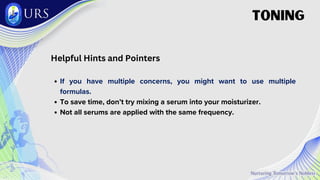
Helpful Hints and Pointers
If you have multiple concerns, you might want to use multiple
formulas.
To save time, don’t try mixing a serum into your moisturizer.
Not all serums are applied with the same frequency.
TONING
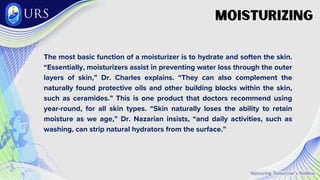
Moisturizing
The most basic function of a moisturizer is to hydrate and soften the skin.
“Essentially, moisturizers assist in preventing water loss through the outer
layers of skin,” Dr. Charles explains. “They can also complement the
naturally found protective oils and other building blocks within the skin,
such as ceramides.” This is one product that doctors recommend using
year-round, for all skin types. “Skin naturally loses the ability to retain
moisture as we age,” Dr. Nazarian insists, “and daily activities, such as
washing, can strip natural hydrators from the surface.”
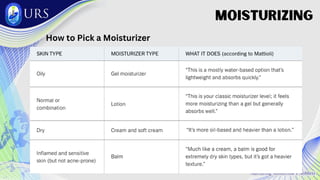
Moisturizing
How to Pick a Moisturizer
The Difference Between a Day and Night Cream
Creams you apply in the morning are equipped to protect your skin from
the environmental aggressors you’ll face when you leave the house—
many contain antioxidants to minimize pollution-based free radicals and
sunscreen to shield you from ultraviolet radiation. They typically have a
lightweight consistency. Night creams, on the other hand, focus on
repairing any damage you might have picked up with ingredients like
retinol to speed cellular turnover and counteract dark spots. These
creams also replenish moisture levels, which naturally dip in the evening,
with emollients that often create a rich, thick texture.
Eye Creams
Can you survive without an eye cream? Absolutely. But, if you have specific
concerns — like hyperpigmentation, dryness or puffiness — you might want to try
one. “The skin around the eyes is quite thin and delicate, and more likely to react
to irritating ingredients than other areas,” Dr. Nazarian says. “Therefore,
dermatologists typically recommend an eye cream that considers the potential
sensitivity and has more tolerable concentrations of active ingredients.”
For undereye bags and inflammation, caffeine, peptides and hyaluronic acid can
be soothing, Mattioli says. “Dark circles can be due to visible veins or actual
discoloration common in darker skin tones,” she says. “Look for brightening
ingredients like vitamin C, kojic acid and niacinamide
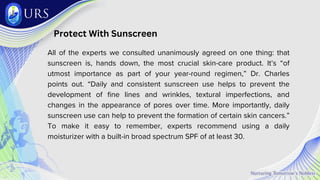
Protect With Sunscreen
All of the experts we consulted unanimously agreed on one thing: that
sunscreen is, hands down, the most crucial skin-care product. It’s “of
utmost importance as part of your year-round regimen,” Dr. Charles
points out. “Daily and consistent sunscreen use helps to prevent the
development of fine lines and wrinkles, textural imperfections, and
changes in the appearance of pores over time. More importantly, daily
sunscreen use can help to prevent the formation of certain skin cancers.”
To make it easy to remember, experts recommend using a daily
moisturizer with a built-in broad spectrum SPF of at least 30.
How to Establish the Right Hair Care Routine for You
Getting into a hair care routine is just like embarking on a skin care one.
Once you’ve found one that works for you, you’ll rarely stray.
But the process of finding that routine can seem a little daunting,
especially when there’s numerous options for people with the same hair
type.
Here’s a breakdown of everything you need to know to find the hair care
ritual that’s right for you.
Your individual routine ultimately depends on a few factors
Your natural hair texture or type
Hair types tend to be fine, thick, or coarse and fall into one of four
categories:
straight
wavy
curly
kinky
Whether your hair has been bleached, dyed, or otherwise
chemically processed
If your hair has come in contact with dye, bleach, or chemicals, you
may have to think extra hard about your routine.
People with dyed hair are advised not to wash it every day to prevent
premature color fading and dryness.
And bleached hair may require some extra nourishment in the form of
conditioner or hair masks.
Whether you have specific concerns that you want to address
It’s normal to find at least one aspect of your hair problematic,
whether it’s frizz, a flaky scalp, or dry, damaged strands.
Knowing what the problem is, is half the task. The rest involves
finding the best solution.
However, every routine shares a few basic components
Although your hair type and concerns will alter your hair care routine
in some ways, there are a few basic steps that every person can
benefit from.
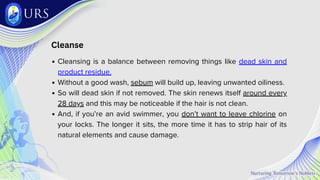
Cleanse
Cleansing is a balance between removing things like dead skin and
product residue.
Without a good wash, sebum will build up, leaving unwanted oiliness.
So will dead skin if not removed. The skin renews itself around every
28 days and this may be noticeable if the hair is not clean.
And, if you’re an avid swimmer, you don’t want to leave chlorine on
your locks. The longer it sits, the more time it has to strip hair of its
natural elements and cause damage.
Conditioner
Conditioners have myriad benefits. The main one is moisturizing, but
others include detangling, shininess, and frizz reduction.
The main ingredient of a conditioner is called a cationic
surfactantTrusted Source.
When hair is wet, this sticks to it, coating the strands to replenish the
moisture that shampoo may have removed.
Moisturize and seal
To add further hydration to the hair, you may want to embark on a
two-step process known as moisturize and seal.
This can be particularly useful for kinky or coily hair that tends to be
dry.
The aim is to seal in moisture, not to lock in dryness, using a
hydrating product and sealing oil.
Detangle
Detangling is essential for stopping breakage and for making your life
a whole lot easier.
But you need to use the right tool, such as a wide-tooth comb, to
avoid pulling hair out by mistake.
Depending on your hair type, you may need to detangle every day or
much less often.
Style and protect
Thanks to a number of tools and tricks like volumizers and gels, you
can style your hair practically any way you want.
But if you’re a fan of heated tools, you’ll need to protect those strands
with a heat protection spray.
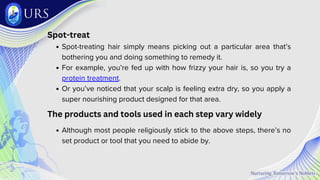
Spot-treat
Spot-treating hair simply means picking out a particular area that’s
bothering you and doing something to remedy it.
For example, you’re fed up with how frizzy your hair is, so you try a
protein treatment.
Or you’ve noticed that your scalp is feeling extra dry, so you apply a
super nourishing product designed for that area.
The products and tools used in each step vary widely
Although most people religiously stick to the above steps, there’s no
set product or tool that you need to abide by.
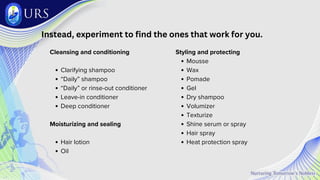
Instead, experiment to find the ones that work for you.
Cleansing and conditioning
Clarifying shampoo
“Daily” shampoo
“Daily” or rinse-out conditioner
Leave-in conditioner
Deep conditioner
Moisturizing and sealing
Hair lotion
Oil
Styling and protecting
Mousse
Wax
Pomade
Gel
Dry shampoo
Volumizer
Texturize
Shine serum or spray
Hair spray
Heat protection spray
Instead, experiment to find the ones that work for you.
Detangling
Comb
Brush
Spray
Serum
Treatments
Scalp treatment
Protein treatment
Targeted mask
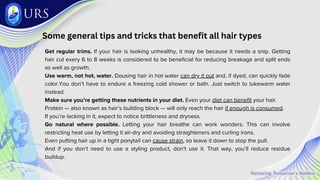
Some general tips and tricks that benefit all hair types
Get regular trims. If your hair is looking unhealthy, it may be because it needs a snip. Getting
hair cut every 6 to 8 weeks is considered to be beneficial for reducing breakage and split ends
as well as growth.
Use warm, not hot, water. Dousing hair in hot water can dry it out and, if dyed, can quickly fade
color.You don’t have to endure a freezing cold shower or bath. Just switch to lukewarm water
instead.
Make sure you’re getting these nutrients in your diet. Even your diet can benefit your hair.
Protein — also known as hair’s building block — will only reach the hair if enough is consumed.
If you’re lacking in it, expect to notice brittleness and dryness.
Go natural where possible. Letting your hair breathe can work wonders. This can involve
restricting heat use by letting it air-dry and avoiding straighteners and curling irons.
Even putting hair up in a tight ponytail can cause strain, so leave it down to stop the pull.
And if you don’t need to use a styling product, don’t use it. That way, you’ll reduce residue
buildup.
MAKE-UP
Cosmetics are used to
enhance appearance and have been utilized for
centuries, with the Egyptians being among the
first to use them. Originally, makeup was
limited to simple eye coloring and body
materials.
Today, cosmetics are significant for both
men and women, with even men becoming
more conscious of their appearance. Modern
cosmetics are available in organic and
hypoallergenic forms to cater to various
preferences and needs.
Now a days, cosmetics come in various forms,
including creams, lipsticks, perfumes, eye
shadows, nail polishes, and hair sprays. For
instance, face powder enhances skin glow,
while lipsticks, made from wax and cocoa
butter, are popular among women of all ages.
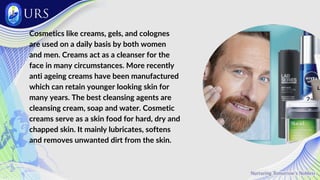
Cosmetics like creams, gels, and colognes
are used on a daily basis by both women
and men. Creams act as a cleanser for the
face in many circumstances. More recently
anti ageing creams have been manufactured
which can retain younger looking skin for
many years. The best cleansing agents are
cleansing cream, soap and water. Cosmetic
creams serve as a skin food for hard, dry and
chapped skin. It mainly lubricates, softens
and removes unwanted dirt from the skin.
Popular fat creams such as Vaseline and Lanolin
are used in skincare, while dry creams are utilized
in soap and gelatin production. The hair care
market is rapidly growing, with many young men
using oils, gels, and lotions to manage hair and
prevent issues like hair loss and dandruff. Some
professions like show business, maintaining a
polished appearance is highly emphasized.
Many personalities and artists use
makeup to enhance their appearance
under harsh lights and camera flashes,
understanding its importance in
maintaining their image. Recent
research indicates that makeup can
also offer protection from harmful sun
rays, a notable advancement since
integrating sun protection with
makeup was previously challenging.
The Importance of Cosmetics Today
Cosmetics help to enhance our
appearance and make us feel more
confident. With more cosmetics on
the market today than ever before, it
becomes obvious to us that they play
a great role in our everyday life.
GROUP 2 (PDPR).pdf physical attribute and

GROUP 2 (PDPR).pdf physical attribute and

  • 1.
  • 2.
  • 3.
    _ _ __ _ _ _ _
  • 4.
    _ _ __ _ _
  • 5.
    _ _ __ _ _ _
  • 6.
    _ _ __ _ _ _
  • 7.
    _ _ __ _ _ _ _ _
  • 8.
    Objectives: Identify the physicalattributes of a person. 1. Discuss the significance of good grooming to one’s personality. 2. Explain the importance of having a good posture. 3. Explain the importance of psychology of colors. 4. Apply physical health and hygiene. 5.
  • 9.
  • 10.
    Physical Attributes - itrefers to the aspects of your physical presence that influence how others perceive you and how you present yourself.
  • 11.
    These attributes include: BODYLANGUAGE • Posture • Gestures • Facial Expressions 1. 1.
  • 12.
    These attributes include: APPEARANCE •Grooming • Dress • Overall Style 2. 2.
  • 13.
    These attributes include: VOICE •Tone • Clarity • Volume of your Speech 3. 3.
  • 14.
    These attributes include: EnergyLevel • Enthusiasm • Vitality 4. 4.
  • 15.
    External Attributes The externalattributes include physical health and hygiene, grooming, accessories, make up, posture, and the use of color combinations .It refers to observable traits and behaviors that reflect an individual's personality. These attributes are often seen by others. Examples of external traits are hair color, eye color, facial features, clothes, accessories, height and size.
  • 24.
  • 25.
    ★What impression willyou have of a newcomer in your school who has an excellent posture? ★What impression will you have of a boy or girl with drooping shoulders, sagging abdomen, and a depressed chest? ★Have you ever realized how much harm a bad posture can do to one's personality? ★What is Good posture?
  • 26.
    -Male and femaleapplicants are often judged by employers by the way they stand, sit, and walk. People think that a boy or girl who sits straight, stands tall, and walks well is alert and will be a capable worker. Good health and good posture go together.
  • 27.
    Good posture isa state which enables the body to function to the best advantage. There is no one best posture for everyone. Everyone is built differently from another; hence people have different postures. Work that gives satisfaction helps improve posture. Success helps posture.
  • 28.
    Good posture makesone more attractive and graceful. It gives a feeling of confidence. Bad posture accelerates fatigue. Rounded shoulders and a slumped position may interfere with the lungs in breathing and may do harm in crowding other organs out of their natural places. Good posture may also aid regular bowel movement. The func- tioning of the body system is kept normally operational at all times with good posture.
  • 29.
  • 30.
    The study ofhow different colors affect human mood and behavior. In 1666, Mr.Isaac Newton discovered that pure white light, when passed through a prism, separates into all visible colors. He found that each color is composed of a single wavelength and cannot be further separated into other colors. Color Psychology
  • 32.
    "Given the prevalenceof color, one would expect color psychology to be a well-developed area," "Surprisingly, little theoretical or empirical work has been conducted to date on color's influence on psychological functioning, and the work that has been done has been driven mostly by practical concerns, not scientific rigor." Researchers Andrew Elliot and Markus Maier have noted;
  • 33.
    Colors in thered area of the color spectrum are known as warm colors and include red, orange, and yellow. These warm colors evoke emotions ranging from feelings of warmth and comfort to feelings of anger and hostility. The Psychological Effects of Color Colors on the blue side of the spectrum are known as cool colors and include blue, purple, and green. These colors are often described as calm, but can also call to mind feelings of sadness or indifference.
  • 34.
    Color Psychology asTherapy Several ancient cultures, including the Egyptians and Chinese, practiced chromotherapy. Colorology is still used today as a holistic or alternative treatment. In this treatment: Red is used to stimulate the body and mind and to increase circulation. Yellow is thought to stimulate the nerves and purify the body. Orange is used to heal the lungs and to increase energy levels. Blue is believed to soothe illnesses and treat pain. Indigo shades are thought to alleviate skin problems.
  • 35.
    Modern Research on ColorPsychology Colors also have different meanings in different cultures. Research has demonstrated in many cases that the mood-altering effects of color may only be temporary.
  • 36.
    Modern Research on ColorPsychology Existing research has found that color can impact people in a variety of surprising ways: Warm-colored placebo pills were reported as more effective than cool-colored placebo pills in one study. Blue-colored streetlights can lead to reduced crime according to anecdotal evidence. Red causes people to react with greater speed and force, something that might prove useful during athletic activities according to researchers. Black uniforms are more likely to receive penalties.
  • 37.
    Color Can Influence Performance Researchindicates that certain colors, such as red, can negatively impact performance. The color red is often described as threatening, arousing or exciting, many previous studies on the impact of the color red have been largely inconclusive.
  • 38.
  • 39.
    A Guide toGood Personal Hygiene Personal hygiene habits such as washing your hands and brushing and flossing your teeth will help keep bacteria, viruses, and illnesses at bay. And there are mental as well as physical benefits. “Practicing good body hygiene helps you feel good about yourself, which is important for your mental health,” notes Donald Novey, MD, an integrative medicine physician with the Advocate Medical Group in Park Ridge, Ill. People who have poor hygiene — disheveled hair and clothes, body odor, bad breath, missing teeth, and the like — often are seen as unhealthy and may face discrimination.
  • 40.
    Personal Hygiene: HealthyHabits Include Good Grooming Bathe regularly. Wash your body and your hair often. Trim your nails. Keeping your finger and toenails trimmed and in good shape will prevent problems such as hang nails and infected nail beds. Brush and floss. Ideally, you should brush your teeth after every meal. At the very least, brush your teeth twice a day and floss daily. Wash your hands. Washing your hands before preparing or eating food, after going to the bathroom, after coughing or sneezing, and after handling garbage, goes a long way toward preventing the spread of bacteria and viruses. Sleep tight. Get plenty of rest — 8 to 10 hours a night — so that you are refreshed and are ready to take on the day every morning.
  • 41.
    Personal Hygiene: PoorHygiene Hints at Other Issues If someone you know hasn’t bathed or appears unkempt, it could be a sign that he or she is depressed. “When people are sad or depressed, they neglect themselves,” Novey says. Talking about the importance of proper personal hygiene for preventing illnesses and providing personal hygiene items may help some people. Be candid but sensitive and understanding in your discussions, Novey says. Despite your best efforts, your friend or loved one may need professional help. You should encourage them to see a counselor or doctor if their personal hygiene doesn’t improve.
  • 42.
    Personal Hygiene: GoodHabits Help Keep You Healthy For most people, good hygiene is so much a part of their daily routines that they think little about it. They bathe, they brush their teeth, visit the dentist and doctor for regular checkups, and wash their hands when preparing or eating food and handling unsanitary items. To keep those you care about healthy and safe, help them learn, and be sure that they are practicing, good personal hygiene. The Brain
  • 43.
    A Guide toGood Personal Hygiene The brain belongs to the central nervous system. The automobile will not perform without thee engine, just as the brain will not function without the central nervous system. Quality output from the machine can only be achieved through care and maintenance of the machine. When we invest in our brain, we invest in life as well. Provide the brain with good food, enough sleep, fresh air, exercise, relaxation and positive outlook.
  • 44.
    Foods for theBrain are: Iron. This helps deliver oxygen to the brain through the bloodstream. Some sources are meat, fish, molasses, and soybeans. Vitamin C deficiency causes mental sluggishness. Vitamin B 12 deficiency results in the impairment of memory. Food rich in Vitamin B 12 are meat, fish and dairy products. Thiamine (Vitamin B2) deficiency results in depression, emotional instability, and confusion. The B-Complex vitamin is a key to memory function. Protein keeps the brain alert.
  • 45.
    Exercise for thebrain are: Planning and organizing ideas Memorizing lines of poetry. Learning a new language. Writing about certain subjects a few minutes a day. Reading to sharpen mental skills. Developing skills in problem-solving through puzzles, scrabble, and computer games.
  • 46.
    Exercise Benefits of Exercise Wehave all heard it many times before - regular exercise is good for you, and it can help you lose weight. But if you are like many Americans, you are busy, you have a sedentary job, and you haven't yet changed your exercise habits. The good news is that it's never too late to start. You can start slowly, and find ways to fit more physical activity into your life. To get the most benefit, you should try to get the recommended amount of exercise for your age. If you can do it, the payoff is that you will feel better, help prevent or control many diseases, and likely even live longer

  • 47.
    What are thehealth benefits of exercise? Help you control your weight. Along with diet, exercise plays an important role in controlling your weight and preventing obesity. Reduce your risk of heart diseases. Exercise strengthens your heart and improves your circulation. Help your body manage blood sugar and insulin levels. Exercise can lower your blood sugar level and help your insulin work better. Help you quit smoking. Exercise may make it easier to quit smoking by reducing your cravings and withdrawal symptoms. Improve your mental health and mood. During exercise, your body releases chemicals that can improve your mood and make you feel more relaxed.
  • 48.
    What are thehealth benefits of exercise? Help keep your thinking, learning, and judgment skills sharp as you age. Exercise stimulates your body to release proteins and other chemicals that improve the structure and function of your brain. Strengthen your bones and muscles. Regular exercise can help kids and teens build strong bones. Reduce your risk of some cancers, including colon, breast , uterine, and lung cancer. Reduce your risk of falls. For older adults, research shows that doing balance and muscle-strengthening activities in addition to moderate-intensity aerobic activity can help reduce your risk of falling.
  • 49.
    What are thehealth benefits of exercise? Improve your sleep. Exercise can help you to fall asleep faster and stay asleep longer. Improve your sexual health. Regular exercise may lower the risk of erectile dysfunction (ED) in men. For those who already have ED, exercise may help improve their sexual function. In women, exercise may increase sexual arousal. Increase your chances of living longer. Studies show that physical activity can reduce your risk of dying early from the leading causes of death, like heart disease and some cancers
  • 50.
    How can Imake exercise a part of my regular routine? Make everyday activities more active. Be active with friends and family. Keep track of your progress. Make exercise more fun. Find activities that you can do even when the weather is bad.
  • 51.
    How to builda skin care routine? Great skin is not simply a matter of DNA — your daily habits, in fact, have a big impact on what you see in the mirror. But depending on which product reviews you read or doctors you consult, there is a dizzying number of opinions on everything from how to moisturize to how to protect yourself from UV rays. Ultimately, caring for your skin is simply personal. Here’s what you should keep in mind to sort through all the noise.
  • 52.
    Skin care tipsbefore you start Three Main Steps Think of your skin-care routine as consisting of three main steps: Cleansing — Washing your face. Toning — Balancing the skin. Moisturizing — Hydrating and softening the skin.
  • 53.
    The goal ofany skin-care routine is to tune up your complexion so it’s functioning at its best, and also troubleshoot or target any areas you want to work on. “Beauty routines are an opportunity to notice changes within yourself,” says the San Francisco skin-care specialist Kristina Holey. As your skin needs shifts with age, so will your products. Still, she adds, “it’s not about creating perfection.” Allow these three steps to become your daily ritual that fortifies your skin and grounds your day.
  • 54.
  • 55.
    Cleansing Washing your faceis the most basic and essential step of any routine, says the New York City dermatologist Dr. Carlos Charles. “Our skin comes in contact with environmental pollutants, dirt and other factors each day that should be gently removed.” Wash twice a day, morning and night, to avoid clogged pores, dullness and acne. Find your facial cleanser The right formula cleanses your skin without stripping essential, healthy oils. Take it easy with exfoliating scrubs (use once a week) and avoid those with crushed walnut shells or abrasive ingredients.
  • 56.
  • 57.
    What does non-comedogenicmean? This term frequently appears on product labels and is used by skin-care experts but not always defined in simple, clear language. Here’s a quick explanation: If a product claims to be non-comedogenic it means that it shouldn’t clog pores or trigger acne — either by occluding the skin, blocking glands or irritating the hair follicle. The claim is not regulated by the F.D.A., however, and many companies do their own internal tests to determine whether a product should be considered comedogenic or not. (Some common known comedogenic ingredients are coconut oil and cocoa butter.) Typically, the fewer ingredients a product has, the easier it is to determine if it will cause any reactions.
  • 58.
    How to usetoner? For many, the word “toner” brings to mind stinging astringents from the ’80s. “The original was an alcohol-based product that was used to dry up oily skin and remove any leftover dirt following cleansing,” Dr. Nazarian says. Today’s formulas, however, have evolved. Think of them as supplements — these thin liquids deliver an extra shot of nutrients, helping the other products in your regimen absorb better, while still balancing your complexion. TONING
  • 59.
    If you havethe time and inclination, here are some hero ingredients to look for: Alpha and beta hydroxy acids to gently remove dead skin cells that can clog pores, improve sun-damaged skin and minimize dullness. Hyaluronic acid to boost hydration, seal in dewiness and plump skin to subtly treat fine lines. Rose water and green tea to calm irritation and reduce redness with an anti-inflammatory effect. Vitamin E and C to fight daily exposure to free radicals that can age your skin. TONING
  • 60.
    What is Toner? “Tonersshould be done after cleansing and before putting on anything else,” Mattioli says. The traditional application method is to saturate a cotton pad and pass it over your face. But, as Mattioli points out, “You end up losing a lot of product TONING
  • 61.
    To handle specificissues, look for these products: Hyaluronic acid to seal in hydration and strengthen the barrier function (the top layer of your skin) to prevent moisture loss. Vitamin C to help brighten dull skin and decrease dark spots with continued use. Retinol, vitamin B3, peptides to stimulate the production of collagen and elastin, proteins in the body that help prevent lines and skin sagging. Colloidal sulfur, niacinamide to calm redness and irritation by decreasing inflammation, and improve acne with its antimicrobial effects TONING
  • 62.
    Helpful Hints andPointers If you have multiple concerns, you might want to use multiple formulas. To save time, don’t try mixing a serum into your moisturizer. Not all serums are applied with the same frequency. TONING
  • 63.
    Moisturizing The most basicfunction of a moisturizer is to hydrate and soften the skin. “Essentially, moisturizers assist in preventing water loss through the outer layers of skin,” Dr. Charles explains. “They can also complement the naturally found protective oils and other building blocks within the skin, such as ceramides.” This is one product that doctors recommend using year-round, for all skin types. “Skin naturally loses the ability to retain moisture as we age,” Dr. Nazarian insists, “and daily activities, such as washing, can strip natural hydrators from the surface.”
  • 64.
  • 65.
    The Difference Betweena Day and Night Cream Creams you apply in the morning are equipped to protect your skin from the environmental aggressors you’ll face when you leave the house— many contain antioxidants to minimize pollution-based free radicals and sunscreen to shield you from ultraviolet radiation. They typically have a lightweight consistency. Night creams, on the other hand, focus on repairing any damage you might have picked up with ingredients like retinol to speed cellular turnover and counteract dark spots. These creams also replenish moisture levels, which naturally dip in the evening, with emollients that often create a rich, thick texture.
  • 66.
    Eye Creams Can yousurvive without an eye cream? Absolutely. But, if you have specific concerns — like hyperpigmentation, dryness or puffiness — you might want to try one. “The skin around the eyes is quite thin and delicate, and more likely to react to irritating ingredients than other areas,” Dr. Nazarian says. “Therefore, dermatologists typically recommend an eye cream that considers the potential sensitivity and has more tolerable concentrations of active ingredients.” For undereye bags and inflammation, caffeine, peptides and hyaluronic acid can be soothing, Mattioli says. “Dark circles can be due to visible veins or actual discoloration common in darker skin tones,” she says. “Look for brightening ingredients like vitamin C, kojic acid and niacinamide
  • 67.
    Protect With Sunscreen Allof the experts we consulted unanimously agreed on one thing: that sunscreen is, hands down, the most crucial skin-care product. It’s “of utmost importance as part of your year-round regimen,” Dr. Charles points out. “Daily and consistent sunscreen use helps to prevent the development of fine lines and wrinkles, textural imperfections, and changes in the appearance of pores over time. More importantly, daily sunscreen use can help to prevent the formation of certain skin cancers.” To make it easy to remember, experts recommend using a daily moisturizer with a built-in broad spectrum SPF of at least 30.
  • 68.
    How to Establishthe Right Hair Care Routine for You Getting into a hair care routine is just like embarking on a skin care one. Once you’ve found one that works for you, you’ll rarely stray. But the process of finding that routine can seem a little daunting, especially when there’s numerous options for people with the same hair type. Here’s a breakdown of everything you need to know to find the hair care ritual that’s right for you.
  • 69.
    Your individual routineultimately depends on a few factors Your natural hair texture or type Hair types tend to be fine, thick, or coarse and fall into one of four categories: straight wavy curly kinky
  • 70.
    Whether your hairhas been bleached, dyed, or otherwise chemically processed If your hair has come in contact with dye, bleach, or chemicals, you may have to think extra hard about your routine. People with dyed hair are advised not to wash it every day to prevent premature color fading and dryness. And bleached hair may require some extra nourishment in the form of conditioner or hair masks.
  • 71.
    Whether you havespecific concerns that you want to address It’s normal to find at least one aspect of your hair problematic, whether it’s frizz, a flaky scalp, or dry, damaged strands. Knowing what the problem is, is half the task. The rest involves finding the best solution. However, every routine shares a few basic components Although your hair type and concerns will alter your hair care routine in some ways, there are a few basic steps that every person can benefit from.
  • 72.
    Cleanse Cleansing is abalance between removing things like dead skin and product residue. Without a good wash, sebum will build up, leaving unwanted oiliness. So will dead skin if not removed. The skin renews itself around every 28 days and this may be noticeable if the hair is not clean. And, if you’re an avid swimmer, you don’t want to leave chlorine on your locks. The longer it sits, the more time it has to strip hair of its natural elements and cause damage.
  • 73.
    Conditioner Conditioners have myriadbenefits. The main one is moisturizing, but others include detangling, shininess, and frizz reduction. The main ingredient of a conditioner is called a cationic surfactantTrusted Source. When hair is wet, this sticks to it, coating the strands to replenish the moisture that shampoo may have removed.
  • 74.
    Moisturize and seal Toadd further hydration to the hair, you may want to embark on a two-step process known as moisturize and seal. This can be particularly useful for kinky or coily hair that tends to be dry. The aim is to seal in moisture, not to lock in dryness, using a hydrating product and sealing oil.
  • 75.
    Detangle Detangling is essentialfor stopping breakage and for making your life a whole lot easier. But you need to use the right tool, such as a wide-tooth comb, to avoid pulling hair out by mistake. Depending on your hair type, you may need to detangle every day or much less often. Style and protect Thanks to a number of tools and tricks like volumizers and gels, you can style your hair practically any way you want. But if you’re a fan of heated tools, you’ll need to protect those strands with a heat protection spray.
  • 76.
    Spot-treat Spot-treating hair simplymeans picking out a particular area that’s bothering you and doing something to remedy it. For example, you’re fed up with how frizzy your hair is, so you try a protein treatment. Or you’ve noticed that your scalp is feeling extra dry, so you apply a super nourishing product designed for that area. The products and tools used in each step vary widely Although most people religiously stick to the above steps, there’s no set product or tool that you need to abide by.
  • 77.
    Instead, experiment tofind the ones that work for you. Cleansing and conditioning Clarifying shampoo “Daily” shampoo “Daily” or rinse-out conditioner Leave-in conditioner Deep conditioner Moisturizing and sealing Hair lotion Oil Styling and protecting Mousse Wax Pomade Gel Dry shampoo Volumizer Texturize Shine serum or spray Hair spray Heat protection spray
  • 78.
    Instead, experiment tofind the ones that work for you. Detangling Comb Brush Spray Serum Treatments Scalp treatment Protein treatment Targeted mask
  • 79.
    Some general tipsand tricks that benefit all hair types Get regular trims. If your hair is looking unhealthy, it may be because it needs a snip. Getting hair cut every 6 to 8 weeks is considered to be beneficial for reducing breakage and split ends as well as growth. Use warm, not hot, water. Dousing hair in hot water can dry it out and, if dyed, can quickly fade color.You don’t have to endure a freezing cold shower or bath. Just switch to lukewarm water instead. Make sure you’re getting these nutrients in your diet. Even your diet can benefit your hair. Protein — also known as hair’s building block — will only reach the hair if enough is consumed. If you’re lacking in it, expect to notice brittleness and dryness. Go natural where possible. Letting your hair breathe can work wonders. This can involve restricting heat use by letting it air-dry and avoiding straighteners and curling irons. Even putting hair up in a tight ponytail can cause strain, so leave it down to stop the pull. And if you don’t need to use a styling product, don’t use it. That way, you’ll reduce residue buildup.
  • 80.
  • 81.
    Cosmetics are usedto enhance appearance and have been utilized for centuries, with the Egyptians being among the first to use them. Originally, makeup was limited to simple eye coloring and body materials.
  • 82.
    Today, cosmetics aresignificant for both men and women, with even men becoming more conscious of their appearance. Modern cosmetics are available in organic and hypoallergenic forms to cater to various preferences and needs.
  • 83.
    Now a days,cosmetics come in various forms, including creams, lipsticks, perfumes, eye shadows, nail polishes, and hair sprays. For instance, face powder enhances skin glow, while lipsticks, made from wax and cocoa butter, are popular among women of all ages.
  • 84.
    Cosmetics like creams,gels, and colognes are used on a daily basis by both women and men. Creams act as a cleanser for the face in many circumstances. More recently anti ageing creams have been manufactured which can retain younger looking skin for many years. The best cleansing agents are cleansing cream, soap and water. Cosmetic creams serve as a skin food for hard, dry and chapped skin. It mainly lubricates, softens and removes unwanted dirt from the skin.
  • 85.
    Popular fat creamssuch as Vaseline and Lanolin are used in skincare, while dry creams are utilized in soap and gelatin production. The hair care market is rapidly growing, with many young men using oils, gels, and lotions to manage hair and prevent issues like hair loss and dandruff. Some professions like show business, maintaining a polished appearance is highly emphasized.
  • 86.
    Many personalities andartists use makeup to enhance their appearance under harsh lights and camera flashes, understanding its importance in maintaining their image. Recent research indicates that makeup can also offer protection from harmful sun rays, a notable advancement since integrating sun protection with makeup was previously challenging.
  • 87.
    The Importance ofCosmetics Today Cosmetics help to enhance our appearance and make us feel more confident. With more cosmetics on the market today than ever before, it becomes obvious to us that they play a great role in our everyday life.