Grey Water Systems: What they are,
why their time has come and how you
can participate in converting our most
precious resource
ECO Green Group Thursday June 18, 2015
by
Tony Green
Copyright @ Tony Green 2015
Agenda
• How have we arrived at this point?
• What is Grey Water? What is in Grey Water?
• What are Grey Water Systems types/benefits of using/risks?
• What should be in our water anyway?
• What are the parts of a Grey Water System?
• Grey Water System Regulation?
• To Permit or not to Permit
• Case Study
• Takeaway/Summary
• Question and Answers
Copyright @ Tony Green 2015
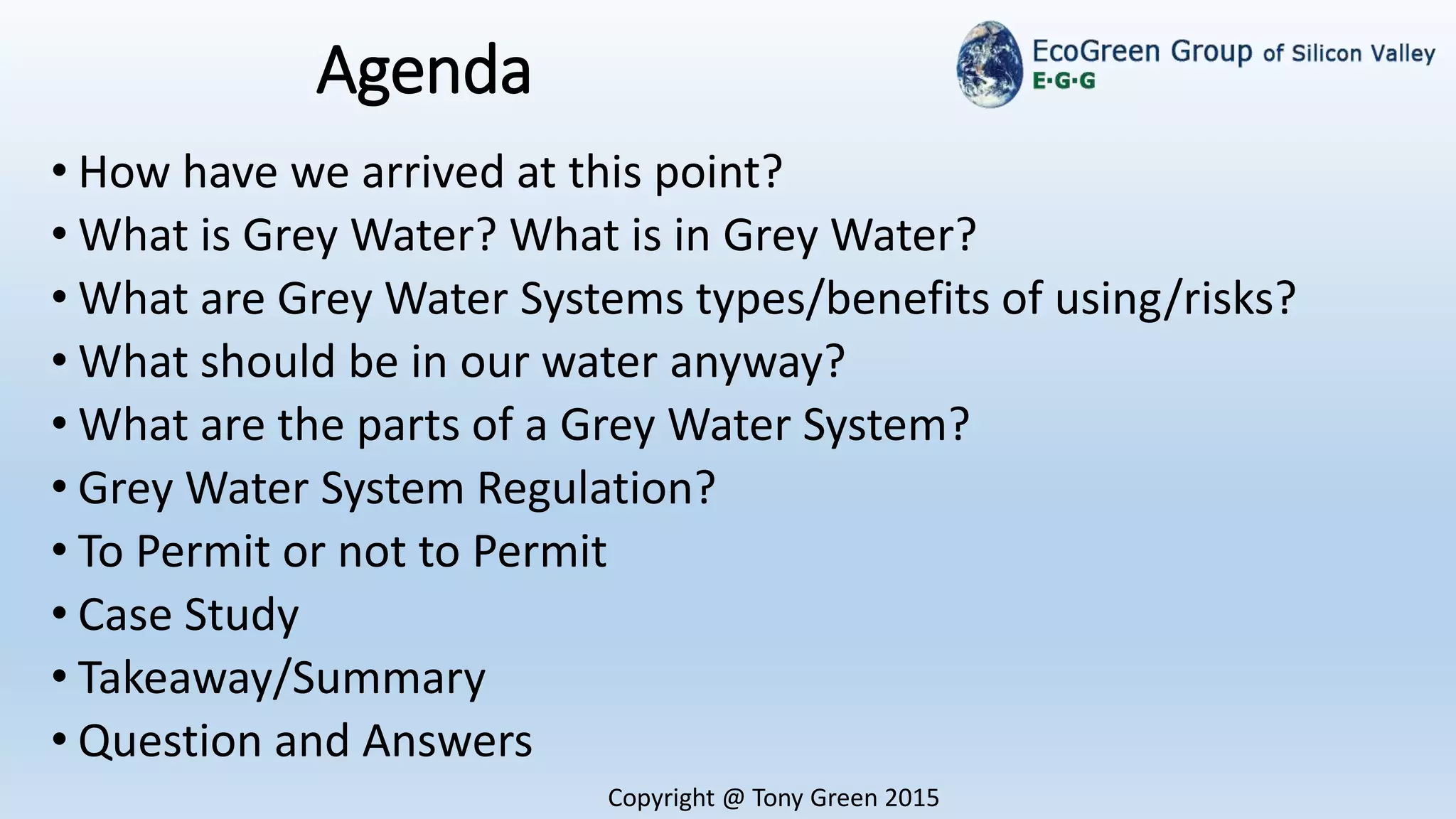
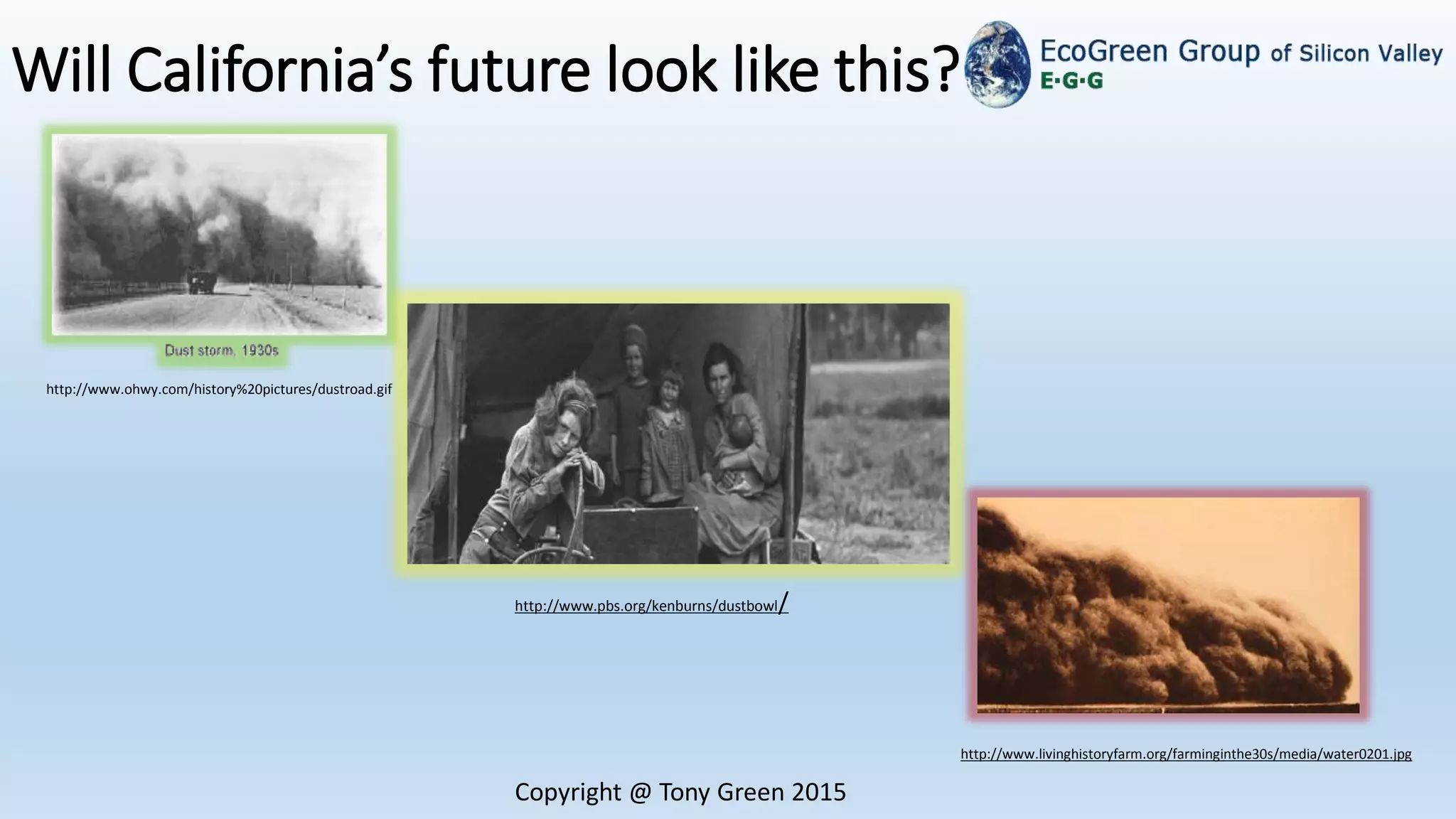
Will California’s future look like this?
http://www.ohwy.com/history%20pictures/dustroad.gif
http://www.pbs.org/kenburns/dustbowl/
http://www.livinghistoryfarm.org/farminginthe30s/media/water0201.jpg
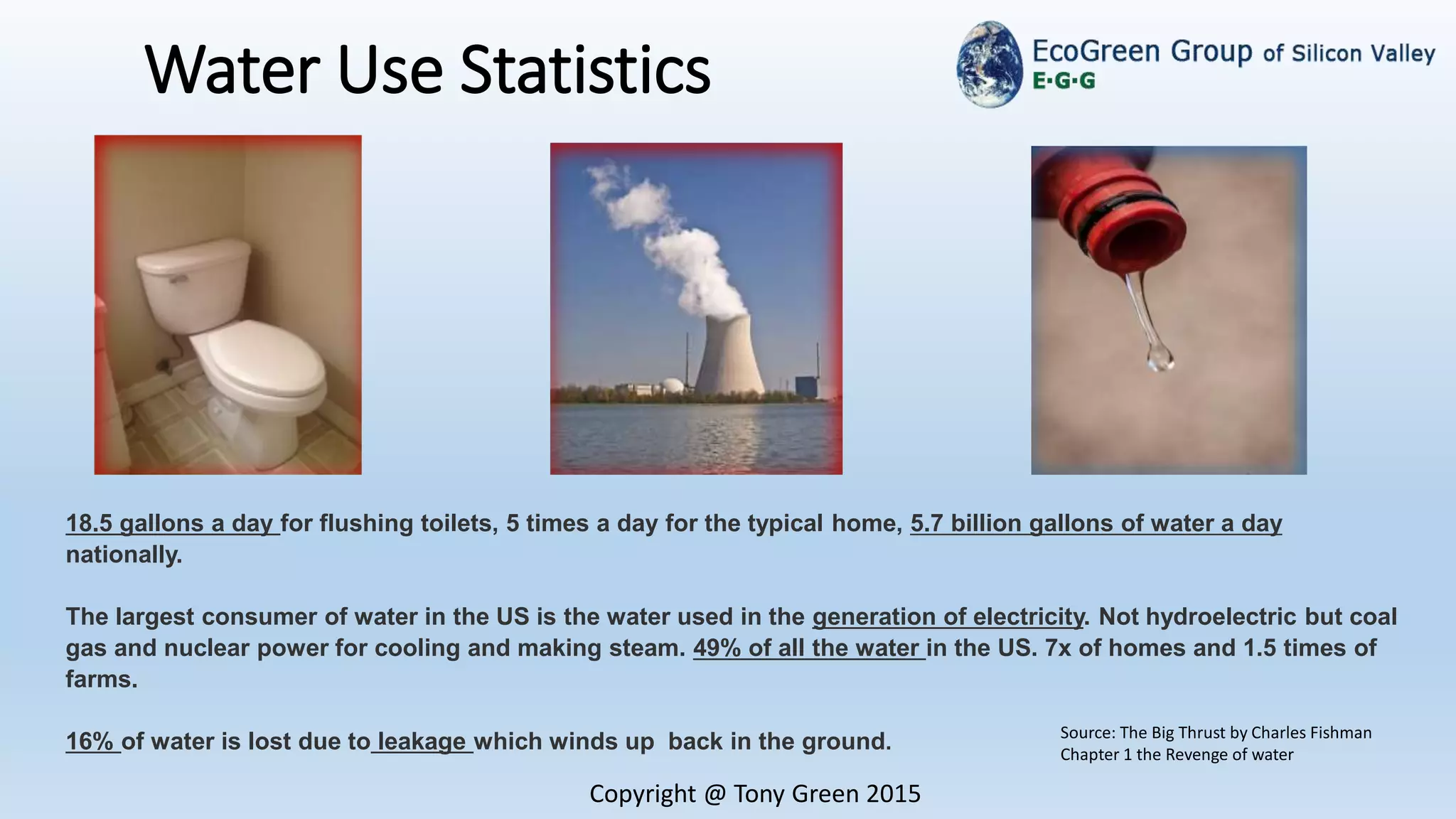
Water Use Statistics
Copyright @ Tony Green 2015
18.5 gallons a day for flushing toilets, 5 times a day for the typical home, 5.7 billion gallons of water a day
nationally.
The largest consumer of water in the US is the water used in the generation of electricity. Not hydroelectric but coal
gas and nuclear power for cooling and making steam. 49% of all the water in the US. 7x of homes and 1.5 times of
farms.
16% of water is lost due to leakage which winds up back in the ground.
Source: The Big Thrust by Charles Fishman
Chapter 1 the Revenge of water
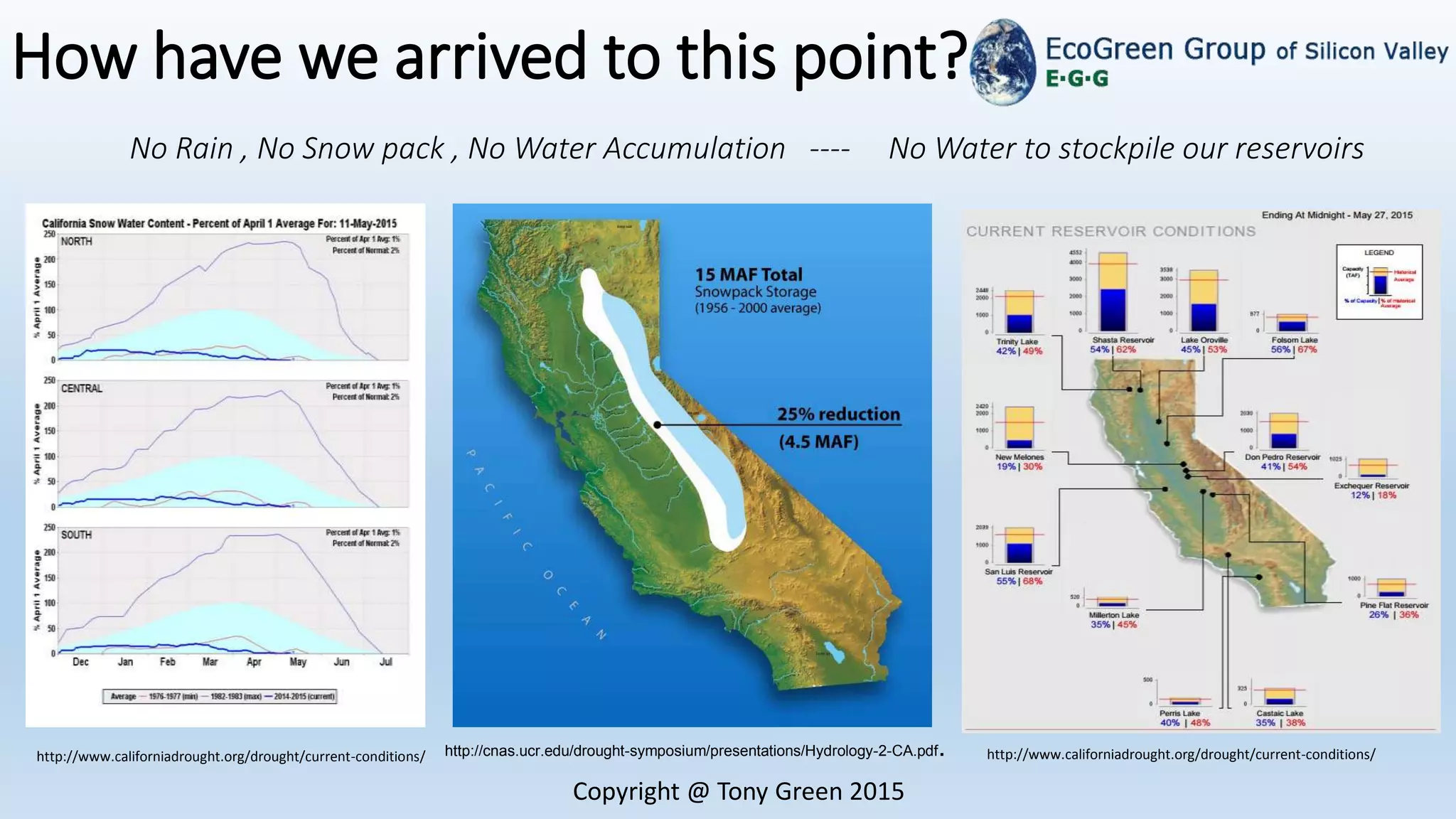
How have we arrived to this point?
Copyright @ Tony Green 2015
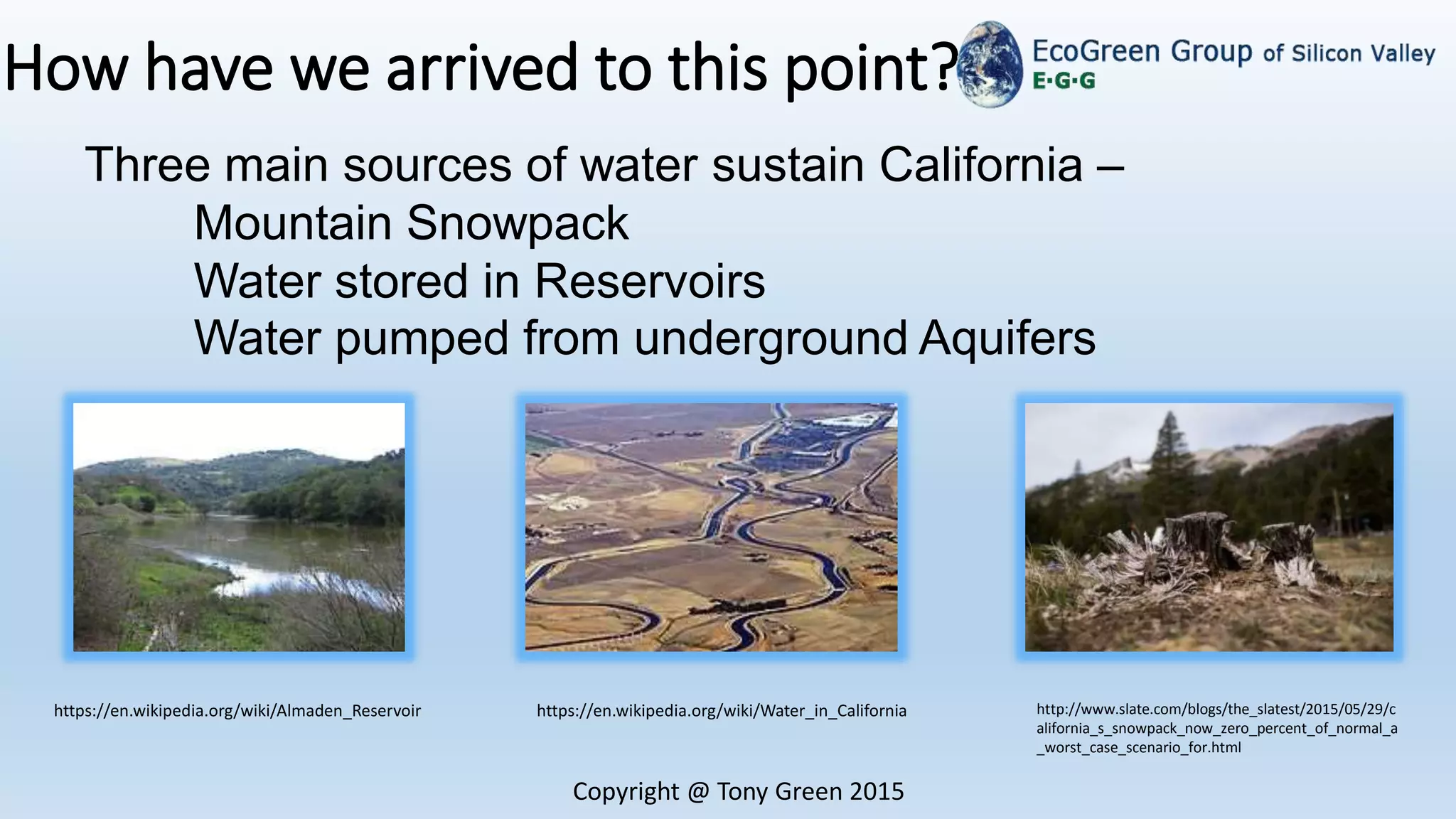
Three main sources of water sustain California –
Mountain Snowpack
Water stored in Reservoirs
Water pumped from underground Aquifers
https://en.wikipedia.org/wiki/Almaden_Reservoir https://en.wikipedia.org/wiki/Water_in_California http://www.slate.com/blogs/the_slatest/2015/05/29/c
alifornia_s_snowpack_now_zero_percent_of_normal_a
_worst_case_scenario_for.html
How have we arrived to this point?
Copyright @ Tony Green 2015
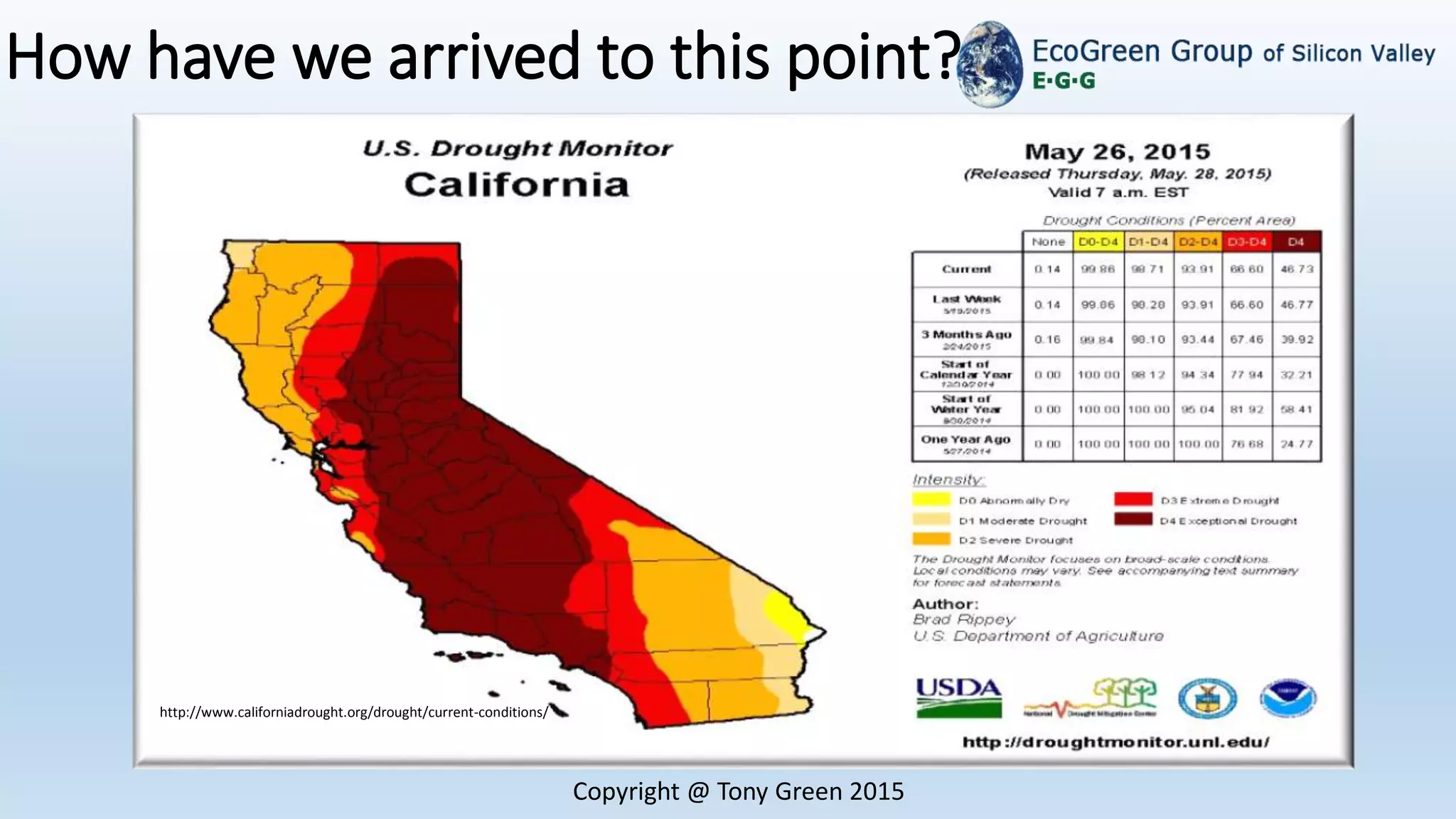
All are connected, and when the Governor declared a drought
emergency on January 17, 2014, all three had been depleted by
an extended dry period.
 The Sierra Nevada snowpack stood at 14 percent of
normal.
 The state's two biggest reservoirs held less than 40 percent
of their capacity and
 Aquifer levels from Siskiyou County to San Diego County
were in decline.
How have we arrived to this point?
Copyright @ Tony Green 2015
http://www.water.ca.gov/waterconditions/background.cfm
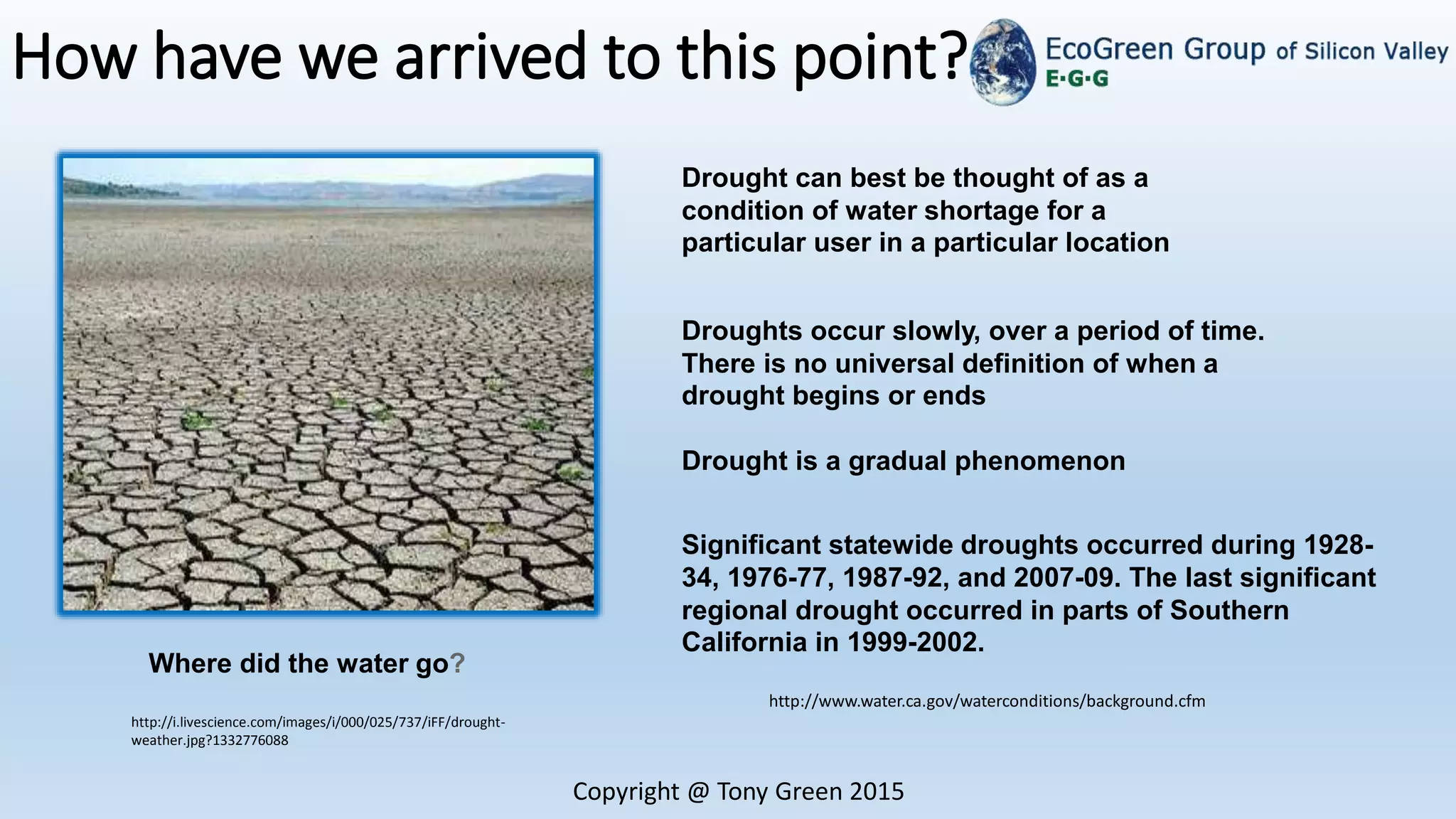
Drought can best be thought of as a
condition of water shortage for a
particular user in a particular location
Droughts occur slowly, over a period of time.
There is no universal definition of when a
drought begins or ends
Drought is a gradual phenomenon
Significant statewide droughts occurred during 1928-
34, 1976-77, 1987-92, and 2007-09. The last significant
regional drought occurred in parts of Southern
California in 1999-2002.
http://i.livescience.com/images/i/000/025/737/iFF/drought-
weather.jpg?1332776088
Where did the water go?
Copyright @ Tony Green 2015
How have we arrived to this point?
http://www.californiadrought.org/drought/current-conditions/
How have we arrived to this point?
http://www.californiadrought.org/drought/current-conditions/
Copyright @ Tony Green 2015
How have we arrived to this point?
http://www.californiadrought.org/drought/current-conditions/
Copyright @ Tony Green 2015
http://www.californiadrought.org/drought/current-conditions/http://cnas.ucr.edu/drought-symposium/presentations/Hydrology-2-CA.pdf.
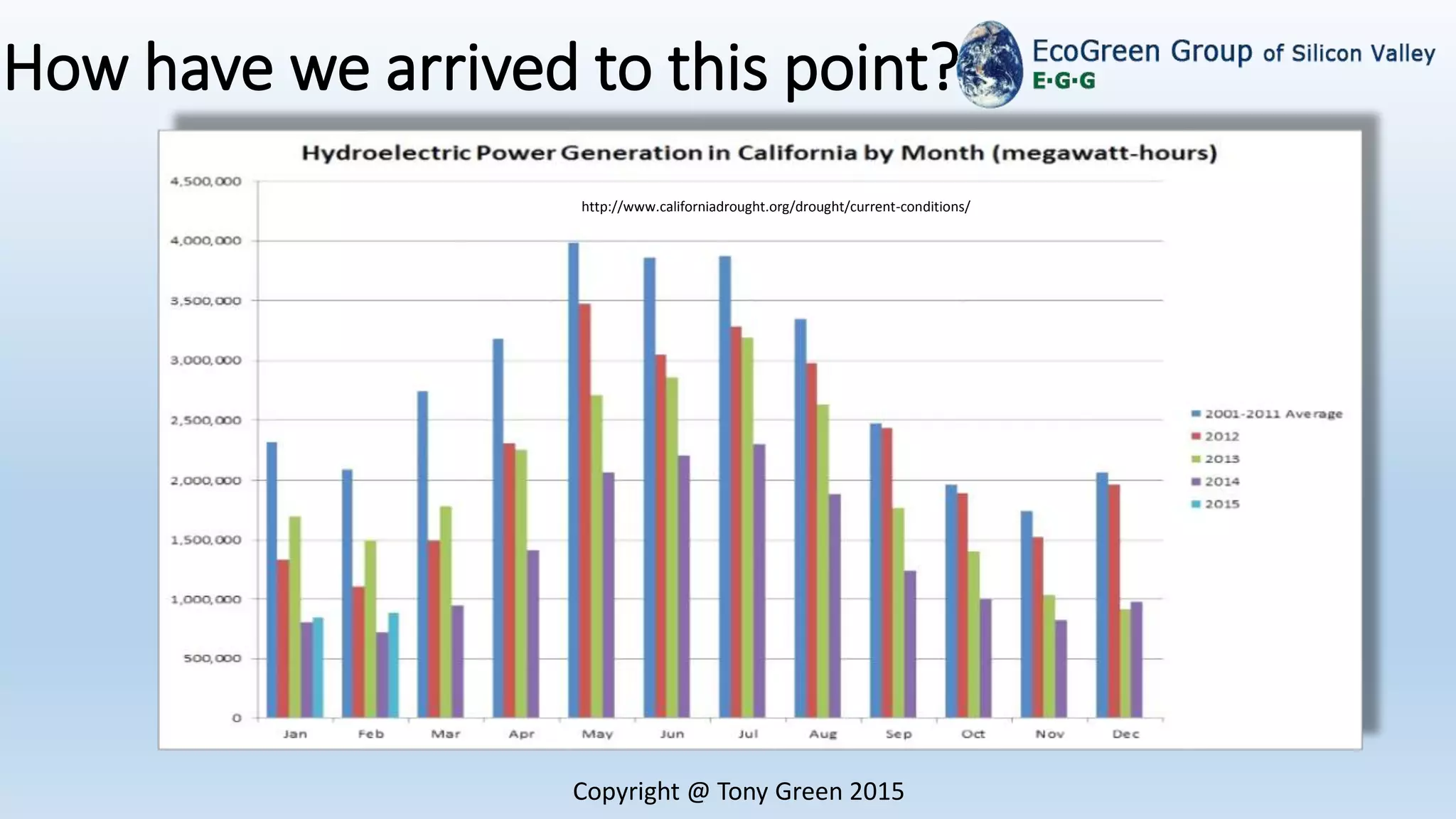
No Rain , No Snow pack , No Water Accumulation ---- No Water to stockpile our reservoirs
What Is Grey Water ?
Copyright @ Tony Green 2015
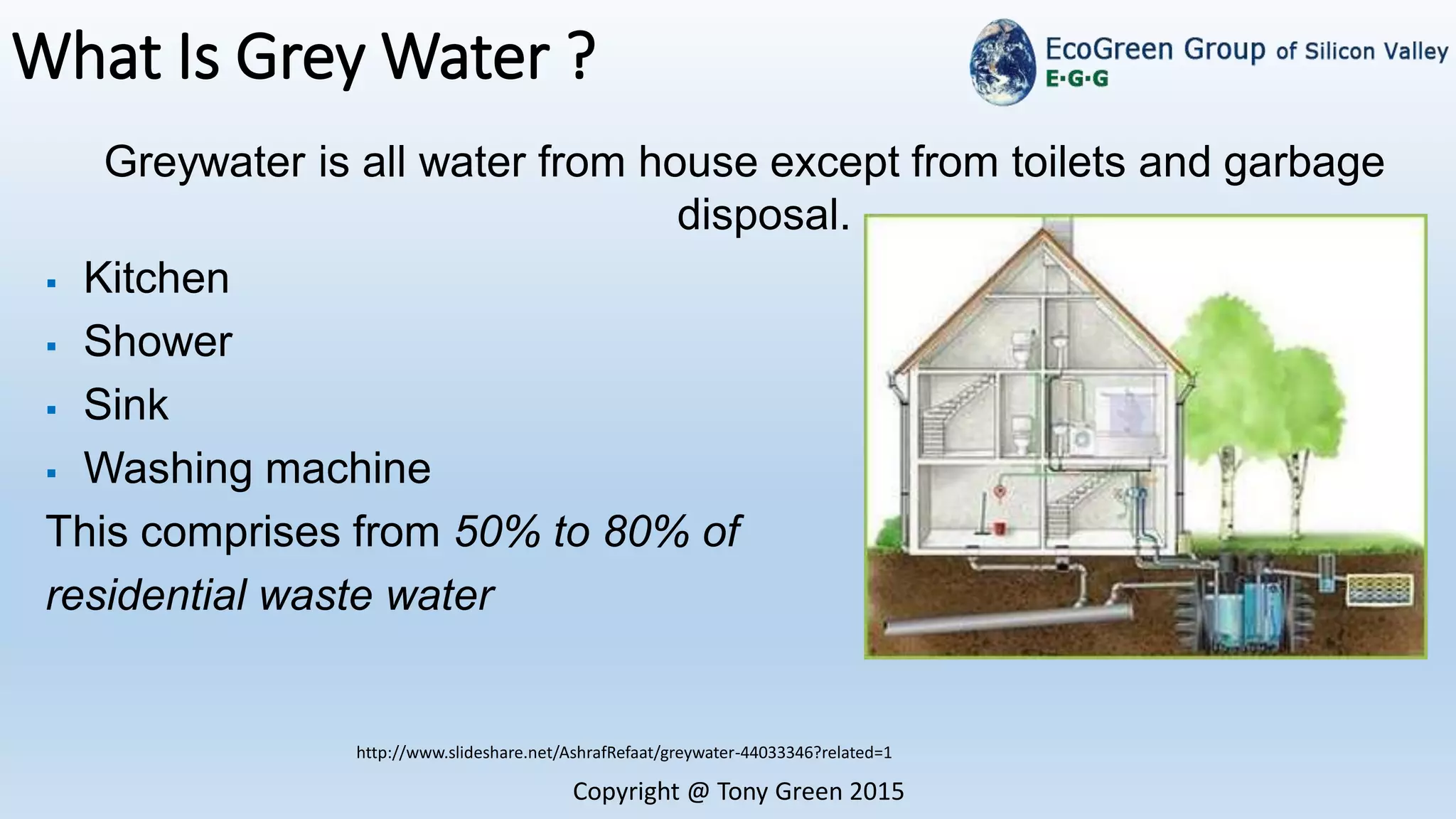
Greywater is all water from house except from toilets and garbage
disposal.
 Kitchen
 Shower
 Sink
 Washing machine
This comprises from 50% to 80% of
residential waste water
http://www.slideshare.net/AshrafRefaat/greywater-44033346?related=1
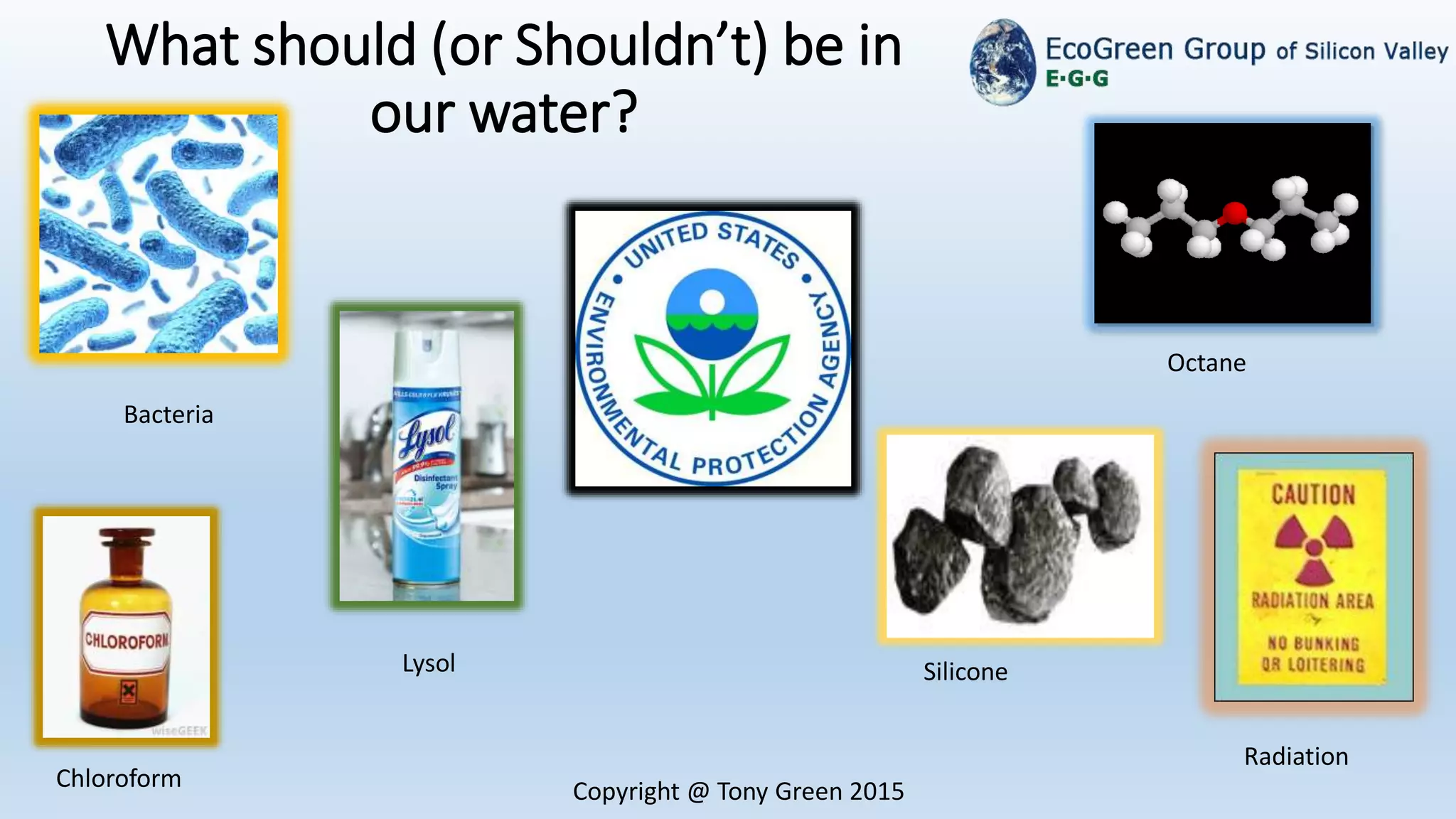
What should (or Shouldn’t) be in
our water?
Copyright @ Tony Green 2015
Radiation
Silicone
Octane
Lysol
Bacteria
Chloroform
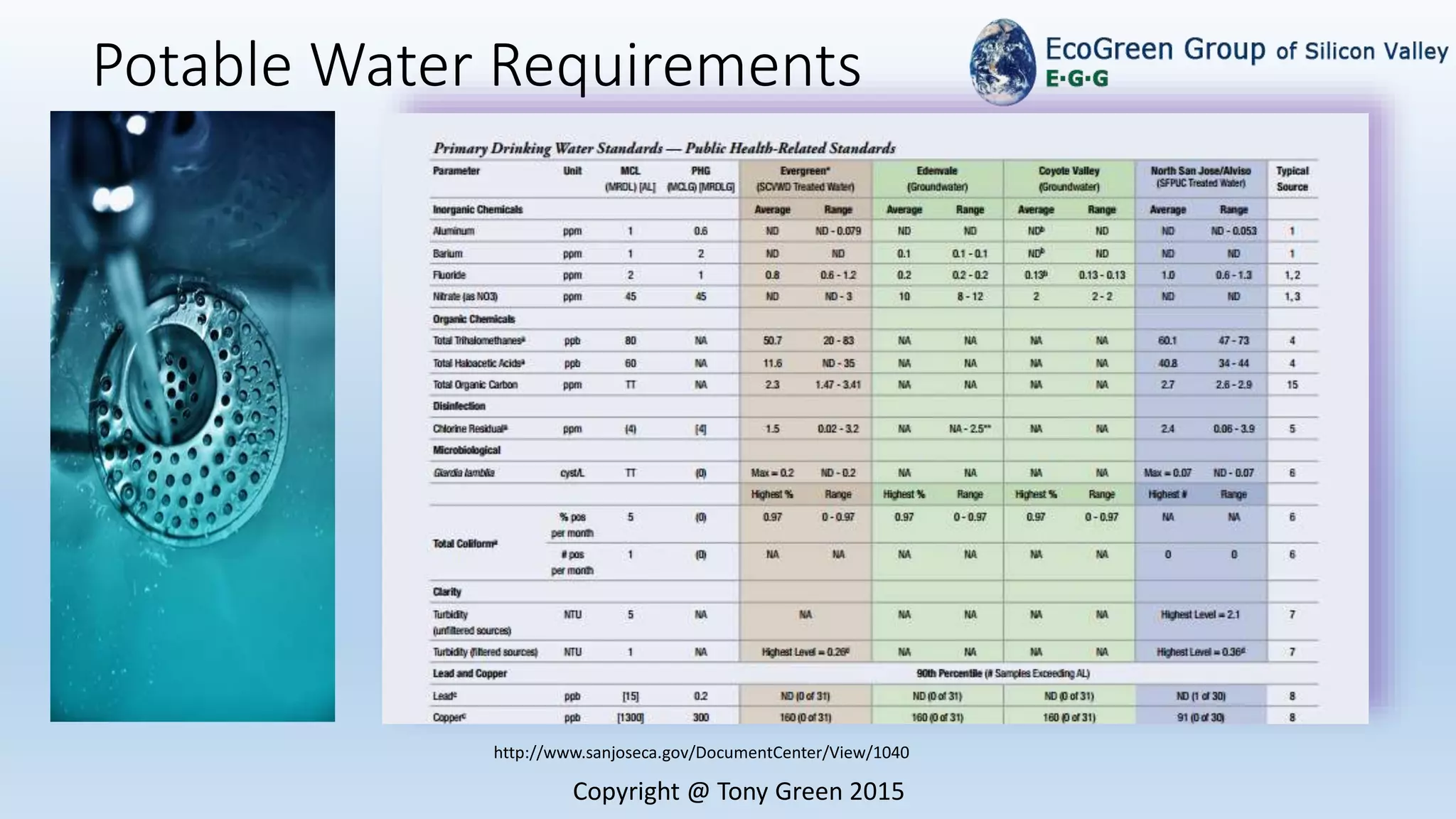
Potable Water Requirements
Copyright @ Tony Green 2015
http://www.sanjoseca.gov/DocumentCenter/View/1040
Where do we get our Potable Water ?
Copyright @ Tony Green 2015
Source : http://www.watereducation.org/all-california-water-sources
 Central Valley Project
 State Water Project
 The Colorado River
 Local Streams and
Reservoirs
Groundwater
 Other Major Water
Systems
Where do we get our Potable Water ?
Copyright @ Tony Green 2015
Source: https://www.ebmud.com/water-and-
drought/about-your-water/water-supply/ebmud-and-
delta/
Other Major Water Systems
 A number of large population centers in
California have developed their own
extensive water projects.
 The Hetch Hetchy Project transports
Tuolumne River water 156 miles from the
Central Sierra to San Francisco and
peninsula cities.
 The East Bay Municipal Utility District
supplies cities on the east side of San
Francisco Bay with Mokelumne River water.
Source: http://bawsca.org/water-supply/hetch-hetchy-
water-system/
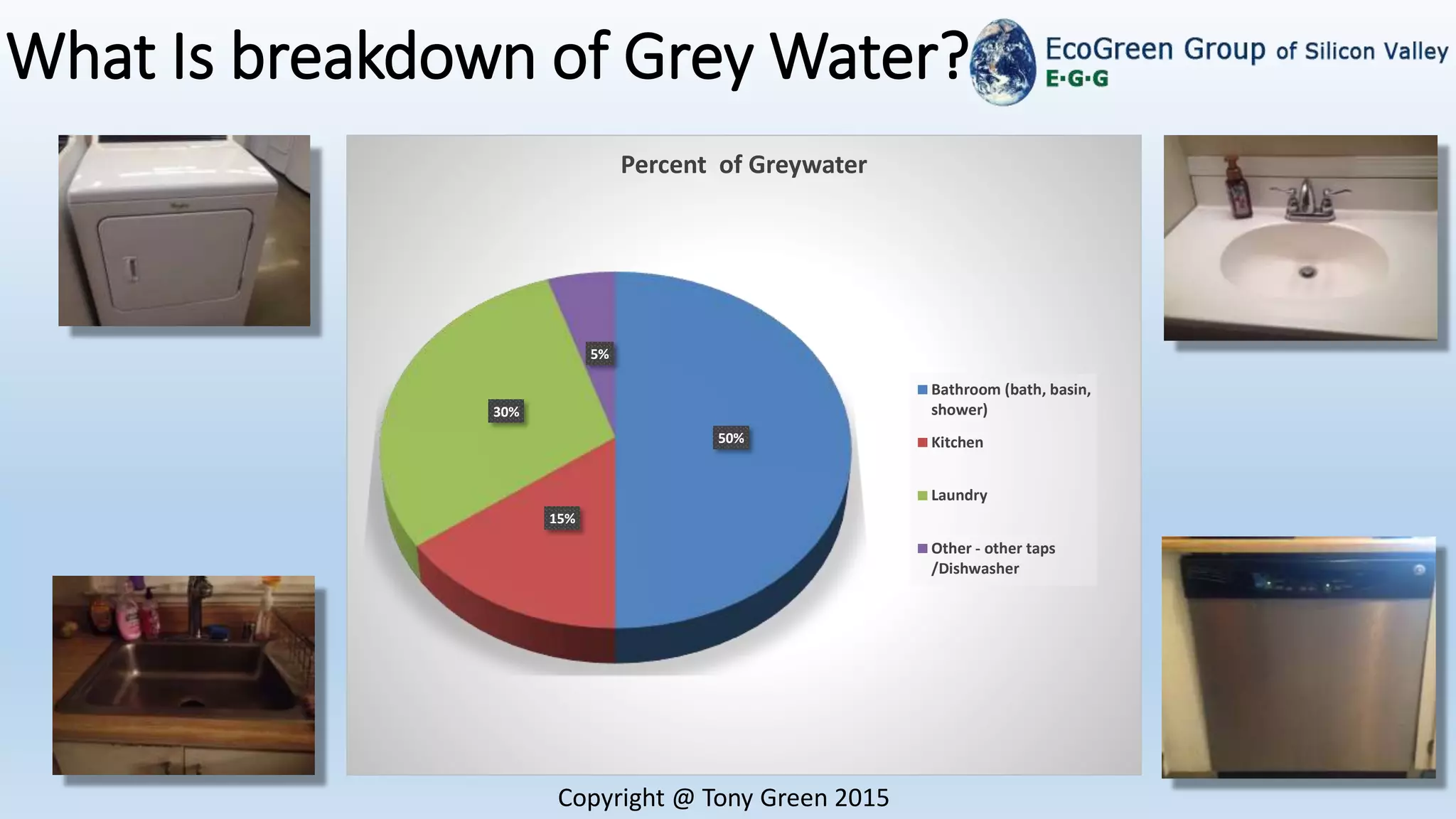
What Is breakdown of Grey Water?
Copyright @ Tony Green 2015
50%
15%
30%
5%
Percent of Greywater
Bathroom (bath, basin,
shower)
Kitchen
Laundry
Other - other taps
/Dishwasher
What is in our Grey Water?
Copyright @ Tony Green 2015
Source
Percent of
Greywater
Contaminants
Bathroom (bath,
basin, shower)
50
contaminated with hair, soaps, shampoos, hair
dyes, toothpaste, lint, nutrients, body fats, oils and
cleaning products. It may also contain some fecal
contamination (and the associated pathogens)
through body washing
Kitchen 15 food particles, oil, grease, etc.
Laundry 30
lint, oils, grease, laundry detergents, chemicals,
soaps, nutrients and other compounds. It may
also contain some fecal contamination
Other - other taps
/Dishwasher
5
food particles, oil, grease, etc.
Total 100
Copyright @ Tony Green 2015
What is in our Grey Water?
Parameter Units Minimum Maximum Typical
pH - 7.2 9 7.5
Alkalinity (as CaCO3) mg/l 75 200 100
Total Suspended Solids mg/l 20 45 30
Conductivity uS/cm 1,000 1,600 1300
TDS (measured) mg/l 500 1,000 800
BOD5 mg/l 20 45 30
COD mg/l 60 400 200
Oil & Grease mg/l 10 20 15
Calcium mg/l 50 80 65
Magnesium mg/l 10 35 20
Sodium mg/l 150 760 390
Chloride mg/l 200 1,050 520
Fluoride mg/l 0.8 5 2
Potassium mg/l 30 60 50
Sulfate mg/l 10 70 50
Silica mg/l 60 75 70
Total Silica mg/l 75 100 85
Temperature deg C 20 30 25
Source: http://www.slideshare.net/MelvinEldin/grey-water-recycling-system
Copyright @ Tony Green 2015
The Difference between Gray &
Potable?
Wastewater contains some soap, salts, hair, suspended
solids and bacteria, but that is clean enough to water plants.
- San Francisco Water Manual June 2012 Version
Copyright @ Tony Green 2015
So what are the risks of using Grey
Water ?
Human health disease-causing organisms
(human pathogens such as bacteria, viruses
and protozoa).
Environment contaminants including fats and
oils, food scraps, nutrients, salts, sodium,
phosphorus, detergents, cleaning products,
sunscreens and personal care products. Long-
term watering with greywater containing these
contaminants can affect sensitive plants and
soil
Source: Urban Greywater Design and Installation Handbook November 2008 RMIT University in Australia
Copyright @ Tony Green 2015
What are the types of Grey Water Systems?
 Laundry-to-Landscape (L to L)
 Branched Drain
 Pumped System
 Manufactured
 Sand Filter to Drip Irrigation
Source : San Francisco Water Manual June 2012 Version
More complicated systems (gravity
versus pumps), (treatment versus
application) the
cost more !
All but L to L require permit
Copyright @ Tony Green 2015
Benefits of Grey Water Systems
Source : San Francisco Water Manual June 2012 Version
Decrease potable water use by 16 to 40 percent,
depending on the site.
Decrease water and wastewater utility bills.
Diversify the water portfolio and provide an alternate
source of irrigation water, reserving treated potable
water for high-quality water needs.
.
Copyright @ Tony Green 2015
More Benefits of Grey Water Systems
 Reduce the energy (approximately 2 watt-hours per gallon
of water) and chemicals needed to treat wastewater
 Facilitates home-grown food production
 Connects people to their yards
Sources : San Francisco Water Manual June 2012 Version and Christine Bertea of Greywater Action presentation
Copyright @ Tony Green 2015
Grey Water Systems –
Government Regulation?
 In 2009, California revamped its greywater
codes. The new code allows simple
laundry to landscape systems without a
permit, but requires permits and
inspections for most greywater systems.
 Regulations vary across the US by state.
 If you’re not happy with the greywater
codes in your state, contact your
legislators about changing them!
Copyright @ Tony Green 2015
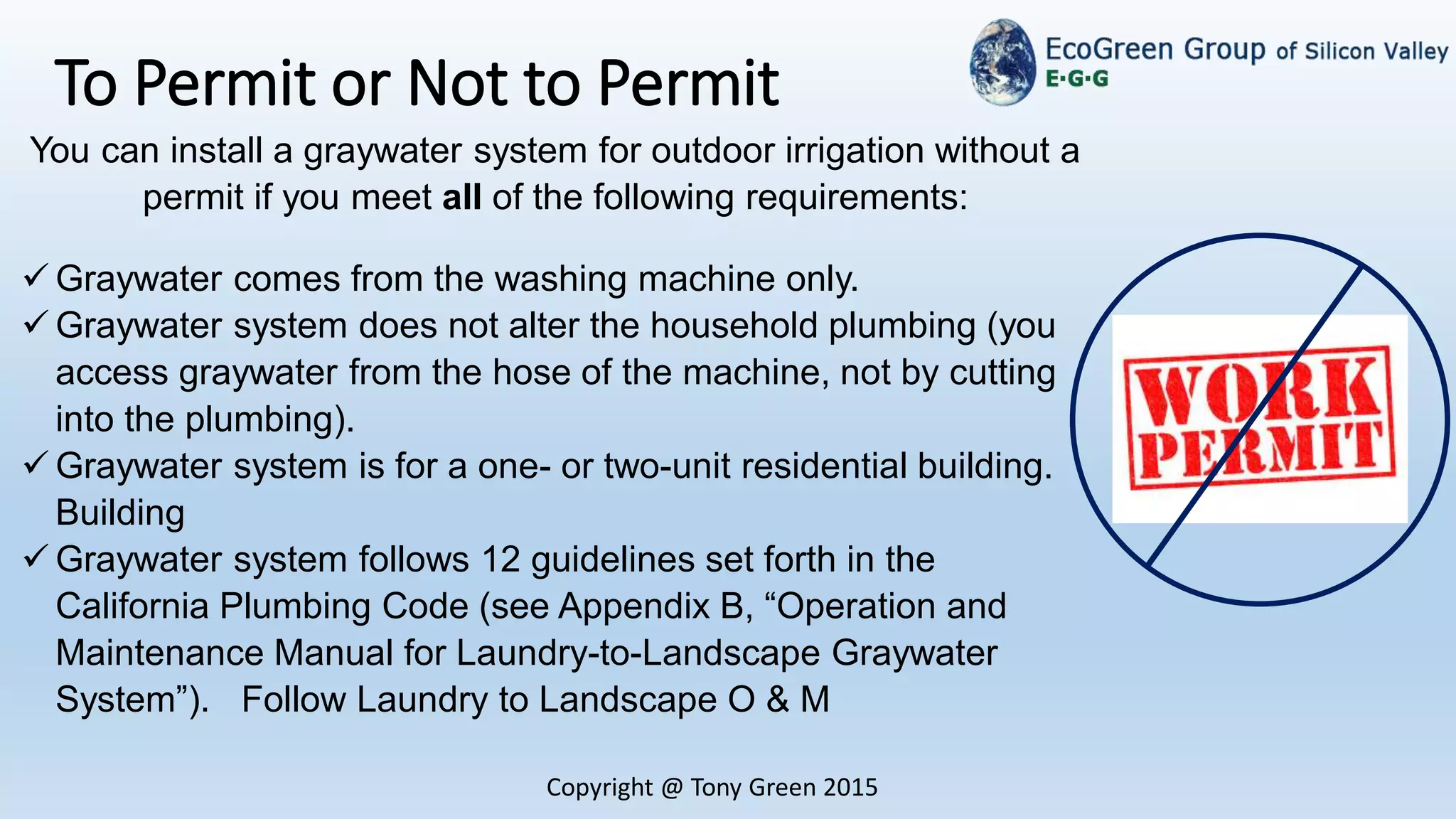
To Permit or Not to Permit
You can install a graywater system for outdoor irrigation without a
permit if you meet all of the following requirements:
 Graywater comes from the washing machine only.
 Graywater system does not alter the household plumbing (you
access graywater from the hose of the machine, not by cutting
into the plumbing).
 Graywater system is for a one- or two-unit residential building.
Building
 Graywater system follows 12 guidelines set forth in the
California Plumbing Code (see Appendix B, “Operation and
Maintenance Manual for Laundry-to-Landscape Graywater
System”). Follow Laundry to Landscape O & M
Copyright @ Tony Green 2015
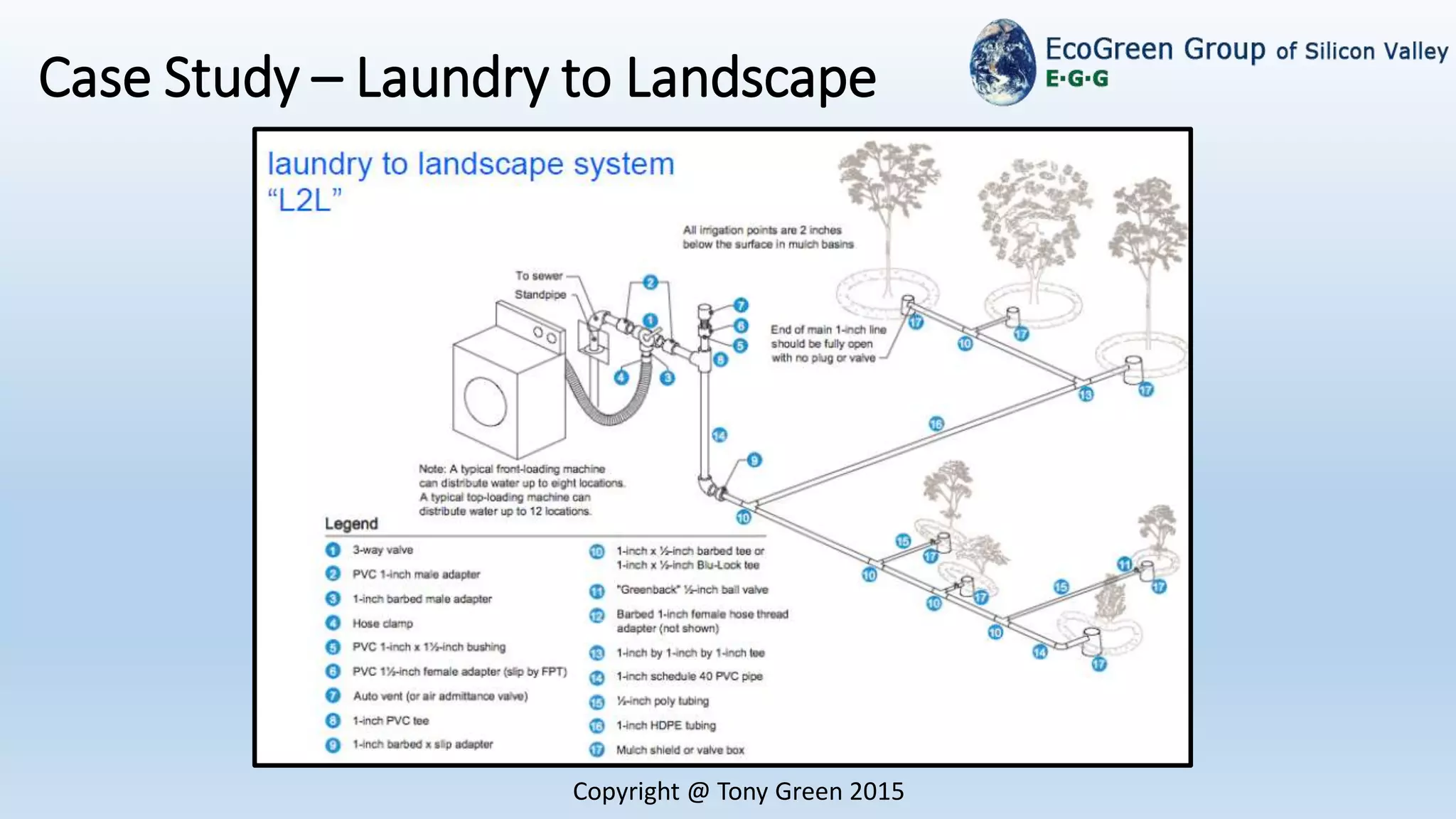
Case Study – Laundry to Landscape
Copyright @ Tony Green 2015
What do we need to Install?
Three Way Diverter Valve
Anti – Siphon Vent
Piping – PVC & HDPE
Mulch Basin
Valve Box
Copyright @ Tony Green 2015
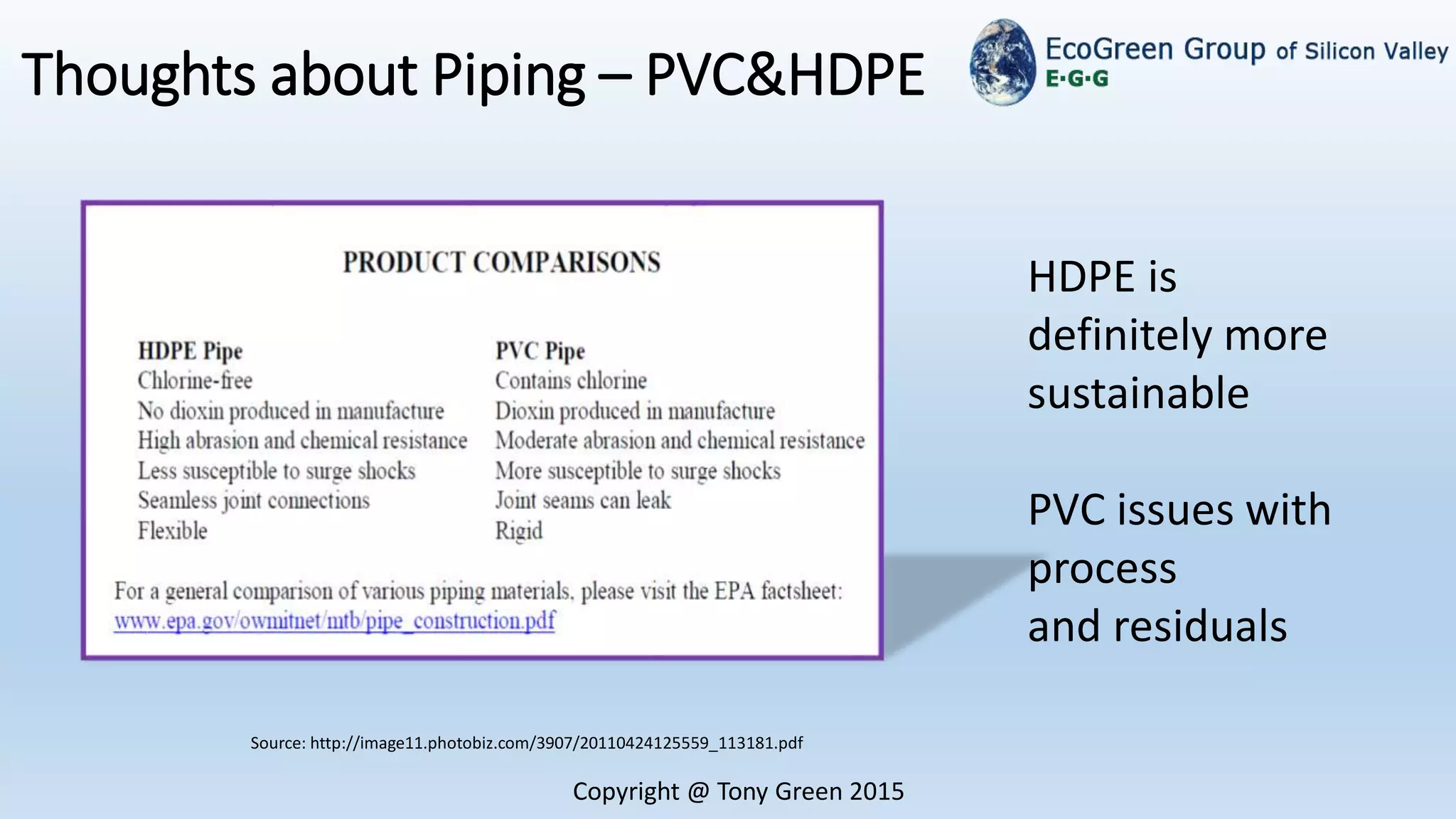
Thoughts about Piping – PVC&HDPE
PVC = Poly Vinyl Chloride
Polyvinyl Chloride (PVC) piping is the
most widely used plastic piping material.
PVC piping systems are:
 Environmentally sound.
 Provide long service life.
 Easy to install and handle.
 Corrosion resistant.
 Cost effective.
Widely accepted by codes
HDPE = High Density Polyethylene
The number one characteristic that sets
HDPE apart from other pipe types is that it
can be made to be flexible.
This quality opens HDPE pipe up to a
different world of applications than rigid
pipe.
Copyright @ Tony Green 2015
Thoughts about Piping – PVC&HDPE
Source: http://image11.photobiz.com/3907/20110424125559_113181.pdf
HDPE is
definitely more
sustainable
PVC issues with
process
and residuals
Copyright @ Tony Green 2015
Mulch Basin
A type of irrigation or disposal field
filled with mulch...of sufficient depth,
length and width to prevent ponding or runoff
Mulch. Is an organic waste material including but not
limited to leaves, pruning's, straw, pulled weeds and wood
chips.
Permeable enough to allow rapid infiltration of greywater
Copyright @ Tony Green 2015
What do we need to avoid with
our Grey Water System once installed?
Soap and Products
Salt (Sodium Compounds)
Boron (Borax)
Chlorine Bleach (H2O2 OK)
Recommended
Liquid detergent: Oasis
Soap Alternatives: Soap Nuts
Note:
Read Ingredients: Biodegradable Garden Friendly
Sodium common in fabric softeners and water softeners
Adapted from Christine Berthea Presentation
Ground Rules for our Grey Water
System once installed?
Adapted from Christine Berthea Presentation
Copyright @ Tony Green 2015
Avoid contact with people or domestic animals
No above ground spraying or sprinkling
No surfacing ponding or runoff
No storing for more then 24 hours
Irrigation or disposal field may be Mulch basin
Discard point covered by 2” of mulch, gravel, soil or solid shield
Copyright @ Tony Green 2015
Case Study – Laundry to Landscape
.
.
Why Grey Water System ?
Source: www.fotolia.us
Source: www.dreamstime.com.
Concerned Bay Area Citizen Mother of Three – two
teenage kids with single home on San Francisco. 2
years ago it became obvious that we needed to
conserve water.
Came across the Laundry to Landscape (L-
to-L) program and attended class in the city of
San Francisco - gives you the materials but the
system has to be designed for your home.
In this case she planted a lemon tree and a lime
tree to produce fruit using Grey Water since in
San Francisco these are expensive.
Copyright @ Tony Green 2015
Case Study – Laundry to Landscape
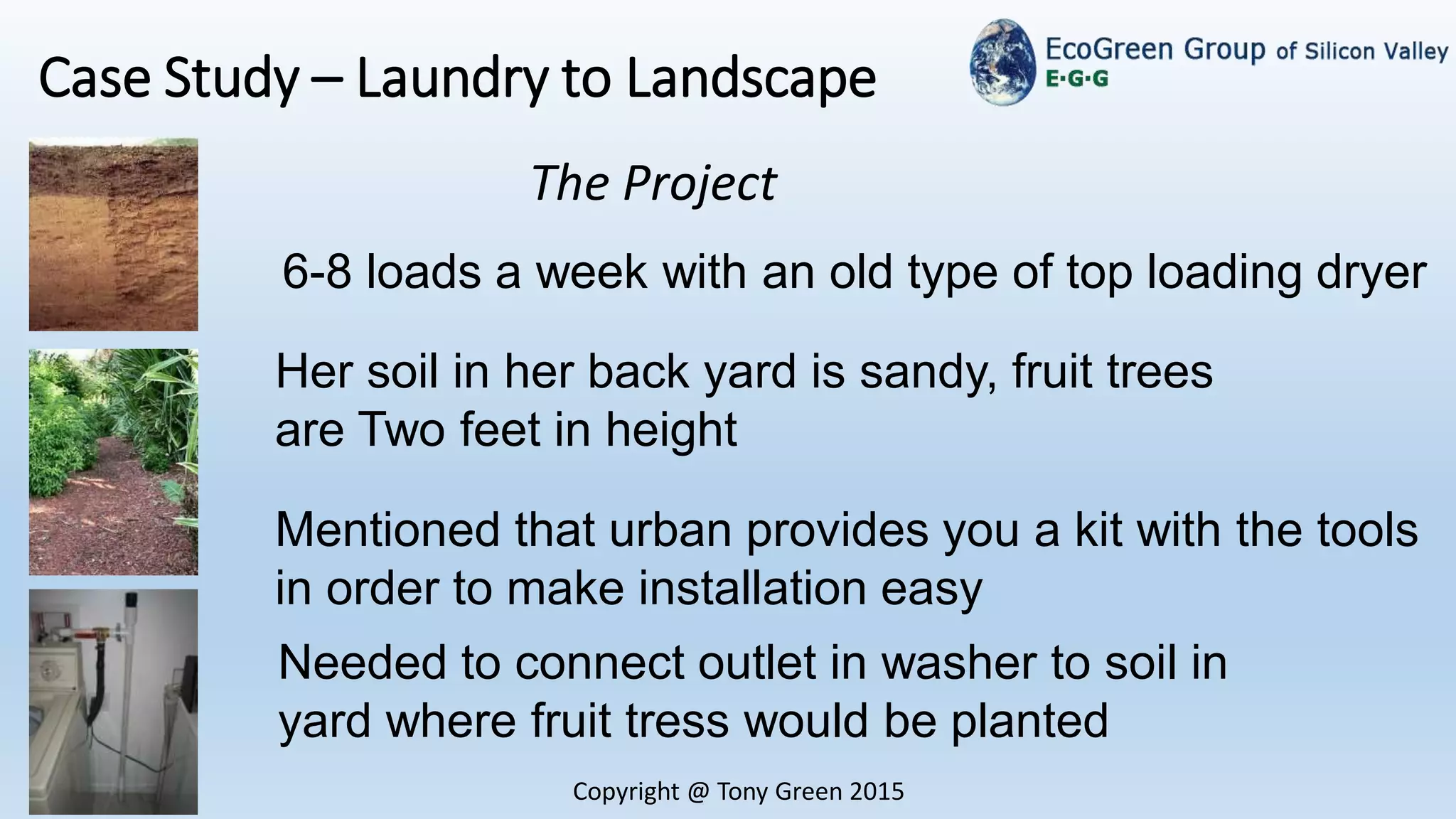
. The Project
6-8 loads a week with an old type of top loading dryer
Her soil in her back yard is sandy, fruit trees
are Two feet in height
Needed to connect outlet in washer to soil in
yard where fruit tress would be planted
Mentioned that urban provides you a kit with the tools
in order to make installation easy
Copyright @ Tony Green 2015
Case Study – Laundry to Landscape
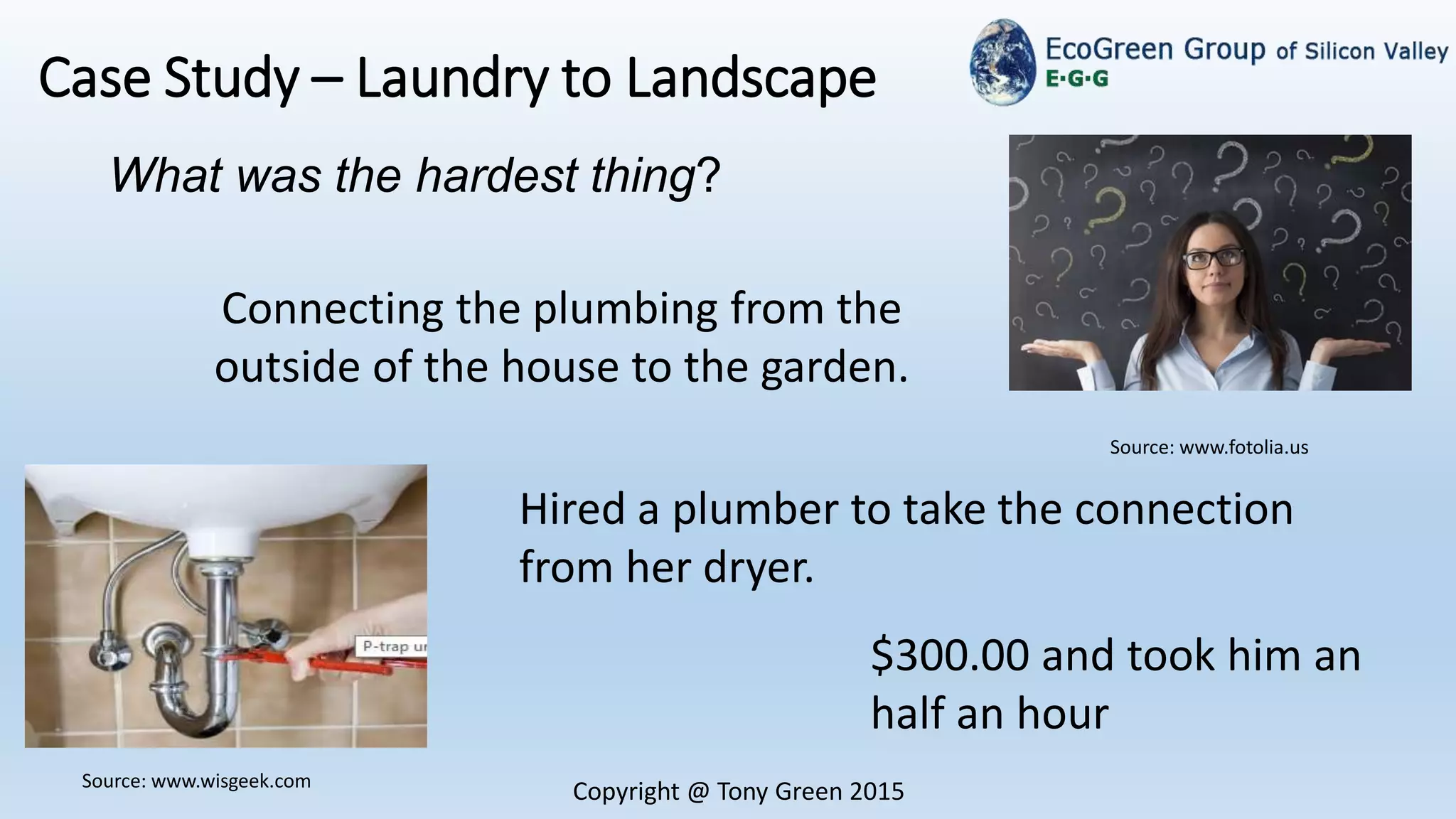
What was the hardest thing?
Source: www.wisgeek.com
Source: www.fotolia.us
Connecting the plumbing from the
outside of the house to the garden.
Hired a plumber to take the connection
from her dryer.
$300.00 and took him an
half an hour
Copyright @ Tony Green 2015
Case Study – Laundry to Landscape
Today/looking ahead
 Lemons a growing!!!!
 System installed for two months. No
maintenance requirements.
 The next job in her view should be
to convert the shower water to use
to flush the toilet
 3 way valve operated it once a
week (bleach). Otherwise all of the
water goes directly into the garden
Takeaways/Summary
1. Did I mention we need to Conserve
Water?
2. Grey Water system is achievable
help IS available
3. Parts are not expensive
4. Do not need to be technical to
install
What are you waiting for?
Copyright @ Tony Green 2015
Final Thought…………………….
Copyright @ Tony Green 2015
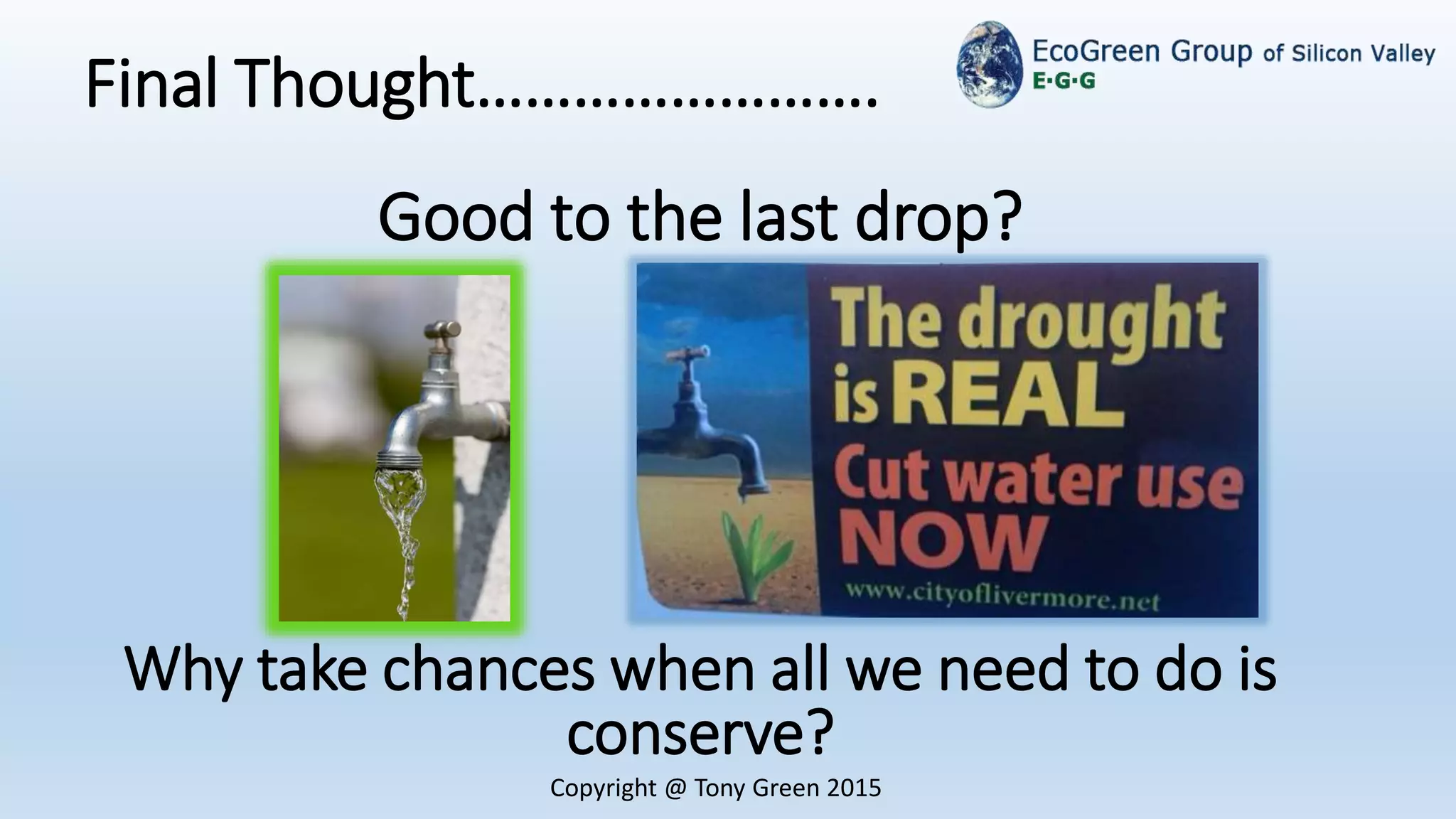
Good to the last drop?
Why take chances when all we need to do is
conserve?
Thank You!!!!!
Copyright @ Tony Green 2015

Grey water systems presentation 6 18-2015 final

  • 1.
    Grey Water Systems:What they are, why their time has come and how you can participate in converting our most precious resource ECO Green Group Thursday June 18, 2015 by Tony Green Copyright @ Tony Green 2015
  • 2.
    Agenda • How havewe arrived at this point? • What is Grey Water? What is in Grey Water? • What are Grey Water Systems types/benefits of using/risks? • What should be in our water anyway? • What are the parts of a Grey Water System? • Grey Water System Regulation? • To Permit or not to Permit • Case Study • Takeaway/Summary • Question and Answers Copyright @ Tony Green 2015
  • 3.
    Copyright @ TonyGreen 2015 Will California’s future look like this? http://www.ohwy.com/history%20pictures/dustroad.gif http://www.pbs.org/kenburns/dustbowl/ http://www.livinghistoryfarm.org/farminginthe30s/media/water0201.jpg
  • 4.
    Water Use Statistics Copyright@ Tony Green 2015 18.5 gallons a day for flushing toilets, 5 times a day for the typical home, 5.7 billion gallons of water a day nationally. The largest consumer of water in the US is the water used in the generation of electricity. Not hydroelectric but coal gas and nuclear power for cooling and making steam. 49% of all the water in the US. 7x of homes and 1.5 times of farms. 16% of water is lost due to leakage which winds up back in the ground. Source: The Big Thrust by Charles Fishman Chapter 1 the Revenge of water
  • 5.
    How have wearrived to this point? Copyright @ Tony Green 2015 Three main sources of water sustain California – Mountain Snowpack Water stored in Reservoirs Water pumped from underground Aquifers https://en.wikipedia.org/wiki/Almaden_Reservoir https://en.wikipedia.org/wiki/Water_in_California http://www.slate.com/blogs/the_slatest/2015/05/29/c alifornia_s_snowpack_now_zero_percent_of_normal_a _worst_case_scenario_for.html
  • 6.
    How have wearrived to this point? Copyright @ Tony Green 2015 All are connected, and when the Governor declared a drought emergency on January 17, 2014, all three had been depleted by an extended dry period.  The Sierra Nevada snowpack stood at 14 percent of normal.  The state's two biggest reservoirs held less than 40 percent of their capacity and  Aquifer levels from Siskiyou County to San Diego County were in decline.
  • 7.
    How have wearrived to this point? Copyright @ Tony Green 2015 http://www.water.ca.gov/waterconditions/background.cfm Drought can best be thought of as a condition of water shortage for a particular user in a particular location Droughts occur slowly, over a period of time. There is no universal definition of when a drought begins or ends Drought is a gradual phenomenon Significant statewide droughts occurred during 1928- 34, 1976-77, 1987-92, and 2007-09. The last significant regional drought occurred in parts of Southern California in 1999-2002. http://i.livescience.com/images/i/000/025/737/iFF/drought- weather.jpg?1332776088 Where did the water go?
  • 8.
    Copyright @ TonyGreen 2015 How have we arrived to this point? http://www.californiadrought.org/drought/current-conditions/
  • 9.
    How have wearrived to this point? http://www.californiadrought.org/drought/current-conditions/ Copyright @ Tony Green 2015
  • 10.
    How have wearrived to this point? http://www.californiadrought.org/drought/current-conditions/ Copyright @ Tony Green 2015 http://www.californiadrought.org/drought/current-conditions/http://cnas.ucr.edu/drought-symposium/presentations/Hydrology-2-CA.pdf. No Rain , No Snow pack , No Water Accumulation ---- No Water to stockpile our reservoirs
  • 11.
    What Is GreyWater ? Copyright @ Tony Green 2015 Greywater is all water from house except from toilets and garbage disposal.  Kitchen  Shower  Sink  Washing machine This comprises from 50% to 80% of residential waste water http://www.slideshare.net/AshrafRefaat/greywater-44033346?related=1
  • 12.
    What should (orShouldn’t) be in our water? Copyright @ Tony Green 2015 Radiation Silicone Octane Lysol Bacteria Chloroform
  • 13.
    Potable Water Requirements Copyright@ Tony Green 2015 http://www.sanjoseca.gov/DocumentCenter/View/1040
  • 14.
    Where do weget our Potable Water ? Copyright @ Tony Green 2015 Source : http://www.watereducation.org/all-california-water-sources  Central Valley Project  State Water Project  The Colorado River  Local Streams and Reservoirs Groundwater  Other Major Water Systems
  • 15.
    Where do weget our Potable Water ? Copyright @ Tony Green 2015 Source: https://www.ebmud.com/water-and- drought/about-your-water/water-supply/ebmud-and- delta/ Other Major Water Systems  A number of large population centers in California have developed their own extensive water projects.  The Hetch Hetchy Project transports Tuolumne River water 156 miles from the Central Sierra to San Francisco and peninsula cities.  The East Bay Municipal Utility District supplies cities on the east side of San Francisco Bay with Mokelumne River water. Source: http://bawsca.org/water-supply/hetch-hetchy- water-system/
  • 16.
    What Is breakdownof Grey Water? Copyright @ Tony Green 2015 50% 15% 30% 5% Percent of Greywater Bathroom (bath, basin, shower) Kitchen Laundry Other - other taps /Dishwasher
  • 17.
    What is inour Grey Water? Copyright @ Tony Green 2015 Source Percent of Greywater Contaminants Bathroom (bath, basin, shower) 50 contaminated with hair, soaps, shampoos, hair dyes, toothpaste, lint, nutrients, body fats, oils and cleaning products. It may also contain some fecal contamination (and the associated pathogens) through body washing Kitchen 15 food particles, oil, grease, etc. Laundry 30 lint, oils, grease, laundry detergents, chemicals, soaps, nutrients and other compounds. It may also contain some fecal contamination Other - other taps /Dishwasher 5 food particles, oil, grease, etc. Total 100
  • 18.
    Copyright @ TonyGreen 2015 What is in our Grey Water? Parameter Units Minimum Maximum Typical pH - 7.2 9 7.5 Alkalinity (as CaCO3) mg/l 75 200 100 Total Suspended Solids mg/l 20 45 30 Conductivity uS/cm 1,000 1,600 1300 TDS (measured) mg/l 500 1,000 800 BOD5 mg/l 20 45 30 COD mg/l 60 400 200 Oil & Grease mg/l 10 20 15 Calcium mg/l 50 80 65 Magnesium mg/l 10 35 20 Sodium mg/l 150 760 390 Chloride mg/l 200 1,050 520 Fluoride mg/l 0.8 5 2 Potassium mg/l 30 60 50 Sulfate mg/l 10 70 50 Silica mg/l 60 75 70 Total Silica mg/l 75 100 85 Temperature deg C 20 30 25 Source: http://www.slideshare.net/MelvinEldin/grey-water-recycling-system
  • 19.
    Copyright @ TonyGreen 2015 The Difference between Gray & Potable? Wastewater contains some soap, salts, hair, suspended solids and bacteria, but that is clean enough to water plants. - San Francisco Water Manual June 2012 Version
  • 20.
    Copyright @ TonyGreen 2015 So what are the risks of using Grey Water ? Human health disease-causing organisms (human pathogens such as bacteria, viruses and protozoa). Environment contaminants including fats and oils, food scraps, nutrients, salts, sodium, phosphorus, detergents, cleaning products, sunscreens and personal care products. Long- term watering with greywater containing these contaminants can affect sensitive plants and soil Source: Urban Greywater Design and Installation Handbook November 2008 RMIT University in Australia
  • 21.
    Copyright @ TonyGreen 2015 What are the types of Grey Water Systems?  Laundry-to-Landscape (L to L)  Branched Drain  Pumped System  Manufactured  Sand Filter to Drip Irrigation Source : San Francisco Water Manual June 2012 Version More complicated systems (gravity versus pumps), (treatment versus application) the cost more ! All but L to L require permit
  • 22.
    Copyright @ TonyGreen 2015 Benefits of Grey Water Systems Source : San Francisco Water Manual June 2012 Version Decrease potable water use by 16 to 40 percent, depending on the site. Decrease water and wastewater utility bills. Diversify the water portfolio and provide an alternate source of irrigation water, reserving treated potable water for high-quality water needs. .
  • 23.
    Copyright @ TonyGreen 2015 More Benefits of Grey Water Systems  Reduce the energy (approximately 2 watt-hours per gallon of water) and chemicals needed to treat wastewater  Facilitates home-grown food production  Connects people to their yards Sources : San Francisco Water Manual June 2012 Version and Christine Bertea of Greywater Action presentation
  • 24.
    Copyright @ TonyGreen 2015 Grey Water Systems – Government Regulation?  In 2009, California revamped its greywater codes. The new code allows simple laundry to landscape systems without a permit, but requires permits and inspections for most greywater systems.  Regulations vary across the US by state.  If you’re not happy with the greywater codes in your state, contact your legislators about changing them!
  • 25.
    Copyright @ TonyGreen 2015 To Permit or Not to Permit You can install a graywater system for outdoor irrigation without a permit if you meet all of the following requirements:  Graywater comes from the washing machine only.  Graywater system does not alter the household plumbing (you access graywater from the hose of the machine, not by cutting into the plumbing).  Graywater system is for a one- or two-unit residential building. Building  Graywater system follows 12 guidelines set forth in the California Plumbing Code (see Appendix B, “Operation and Maintenance Manual for Laundry-to-Landscape Graywater System”). Follow Laundry to Landscape O & M
  • 26.
    Copyright @ TonyGreen 2015 Case Study – Laundry to Landscape
  • 27.
    Copyright @ TonyGreen 2015 What do we need to Install? Three Way Diverter Valve Anti – Siphon Vent Piping – PVC & HDPE Mulch Basin Valve Box
  • 28.
    Copyright @ TonyGreen 2015 Thoughts about Piping – PVC&HDPE PVC = Poly Vinyl Chloride Polyvinyl Chloride (PVC) piping is the most widely used plastic piping material. PVC piping systems are:  Environmentally sound.  Provide long service life.  Easy to install and handle.  Corrosion resistant.  Cost effective. Widely accepted by codes HDPE = High Density Polyethylene The number one characteristic that sets HDPE apart from other pipe types is that it can be made to be flexible. This quality opens HDPE pipe up to a different world of applications than rigid pipe.
  • 29.
    Copyright @ TonyGreen 2015 Thoughts about Piping – PVC&HDPE Source: http://image11.photobiz.com/3907/20110424125559_113181.pdf HDPE is definitely more sustainable PVC issues with process and residuals
  • 30.
    Copyright @ TonyGreen 2015 Mulch Basin A type of irrigation or disposal field filled with mulch...of sufficient depth, length and width to prevent ponding or runoff Mulch. Is an organic waste material including but not limited to leaves, pruning's, straw, pulled weeds and wood chips. Permeable enough to allow rapid infiltration of greywater
  • 31.
    Copyright @ TonyGreen 2015 What do we need to avoid with our Grey Water System once installed? Soap and Products Salt (Sodium Compounds) Boron (Borax) Chlorine Bleach (H2O2 OK) Recommended Liquid detergent: Oasis Soap Alternatives: Soap Nuts Note: Read Ingredients: Biodegradable Garden Friendly Sodium common in fabric softeners and water softeners Adapted from Christine Berthea Presentation
  • 32.
    Ground Rules forour Grey Water System once installed? Adapted from Christine Berthea Presentation Copyright @ Tony Green 2015 Avoid contact with people or domestic animals No above ground spraying or sprinkling No surfacing ponding or runoff No storing for more then 24 hours Irrigation or disposal field may be Mulch basin Discard point covered by 2” of mulch, gravel, soil or solid shield
  • 33.
    Copyright @ TonyGreen 2015 Case Study – Laundry to Landscape . . Why Grey Water System ? Source: www.fotolia.us Source: www.dreamstime.com. Concerned Bay Area Citizen Mother of Three – two teenage kids with single home on San Francisco. 2 years ago it became obvious that we needed to conserve water. Came across the Laundry to Landscape (L- to-L) program and attended class in the city of San Francisco - gives you the materials but the system has to be designed for your home. In this case she planted a lemon tree and a lime tree to produce fruit using Grey Water since in San Francisco these are expensive.
  • 34.
    Copyright @ TonyGreen 2015 Case Study – Laundry to Landscape . The Project 6-8 loads a week with an old type of top loading dryer Her soil in her back yard is sandy, fruit trees are Two feet in height Needed to connect outlet in washer to soil in yard where fruit tress would be planted Mentioned that urban provides you a kit with the tools in order to make installation easy
  • 35.
    Copyright @ TonyGreen 2015 Case Study – Laundry to Landscape What was the hardest thing? Source: www.wisgeek.com Source: www.fotolia.us Connecting the plumbing from the outside of the house to the garden. Hired a plumber to take the connection from her dryer. $300.00 and took him an half an hour
  • 36.
    Copyright @ TonyGreen 2015 Case Study – Laundry to Landscape Today/looking ahead  Lemons a growing!!!!  System installed for two months. No maintenance requirements.  The next job in her view should be to convert the shower water to use to flush the toilet  3 way valve operated it once a week (bleach). Otherwise all of the water goes directly into the garden
  • 37.
    Takeaways/Summary 1. Did Imention we need to Conserve Water? 2. Grey Water system is achievable help IS available 3. Parts are not expensive 4. Do not need to be technical to install What are you waiting for? Copyright @ Tony Green 2015
  • 38.
    Final Thought……………………. Copyright @Tony Green 2015 Good to the last drop? Why take chances when all we need to do is conserve?
  • 39.