We The People-DONOW
Who makes the rules at school? Who makes the rules for our country?” Students brainstorm in
pairs.
Turn and Talk. Be prepared to share out.
3.
Learning Objective (ContentObjective)
Students will identify and explain the basic functions of the three branches of government,
describe the system of checks and balances in the U.S. Constitution, and compare the
responsibilities of national and state governments in the U.S. federal system
Language Objective
Students will use academic vocabulary (such as legislative , executive , judicial , checks and
balances , federal , state ) to orally explain and write about the functions of the three
branches of government and compare the roles of national and state governments using
sentence stems, graphic organizers, and partner discussions.
4.
Checks and Balances:
Asystem that allows each branch of government to limit the
power of the other branches so no one branch becomes too
powerful.
Citizenship:
The rights and duties of being a member of a country, such as
voting, obeying laws, and helping your community.
Compromise:
An agreement where each side gives up something to reach a
solution everyone can accept.
Constitutional Republic:
A government where people elect leaders to make laws, and
those leaders must follow a written Constitution.
Federal System:
A system of government where power is shared between the
national government and the state governments.
VOCABULARY
EXPLAIN-I DO
Let meshow you a real-life example.
Think about driving laws.
The national government sets rules that apply to all states—like making sure cars have safety
features and that highways meet certain safety standards.
But each state gets to decide things like the driving age or speed limits.
So if you drive in Texas, the speed limit might be different than in California. That’s because states
have the power to make rules that fit their own needs.
This is federalism in action: both levels of government share power, but they each have their own
jobs.”
7.
The US
Government
Adams’
presidency Marshall’scourt
EXPLORE-YOU DO
WEEK 13
Students color-code a diagram of U.S. government
levels (National, State, Local) and give one
example of each level job
EXPLOROS
MODULES
The US Government
If one personmade all the rules, what could
go wrong? Discuss briefly.
DO NOW
11.
EXPLAIN-I DO
Watch shortvideo introducing
Legislative (makes laws),
Executive (carries out laws),
Judicial (interprets laws). Students
take notes in a 3 Branches
Organizer. Remind students to take
notes, there is a review part in the
video stop the video to allow
students to choose the answer.
Three branches of
Government
VIDEO:
12.
Explain that studentswill use
what they learned to complete
each section, matching the
branch, its main job, and
examples. Encourage them to use
what they just learned. On this
Worksheet Branches of
Government
EXPLORE: YOU
DO
What would happenif one branch tried to make all the
decisions?” Students share quick responses.
DO NOW
16.
EXPLAIN: I DO
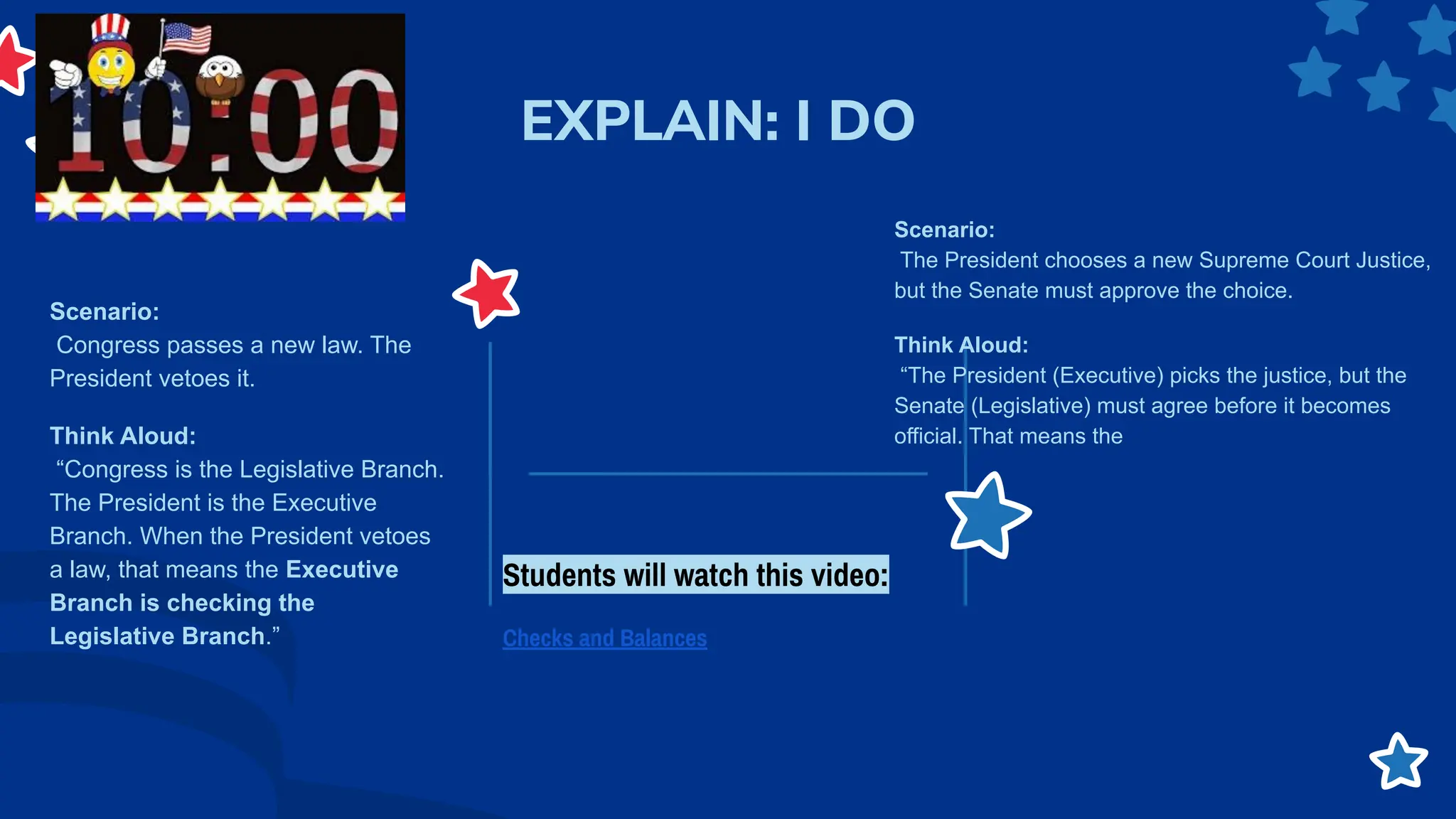
Scenario:
Congresspasses a new law. The
President vetoes it.
Think Aloud:
“Congress is the Legislative Branch.
The President is the Executive
Branch. When the President vetoes
a law, that means the Executive
Branch is checking the
Legislative Branch.”
Scenario:
The President chooses a new Supreme Court Justice,
but the Senate must approve the choice.
Think Aloud:
“The President (Executive) picks the justice, but the
Senate (Legislative) must agree before it becomes
official. That means the
Students will watch this video:
Checks and Balances
17.
EXPLORE-YOU DO
Create classanchor chart “Keeping It Fair – Checks and Balances”
with examples under Legislative, Executive, Judicial columns. Sticky
notes.
Groups draw mini comics or perform quick skits showing a
check in action.
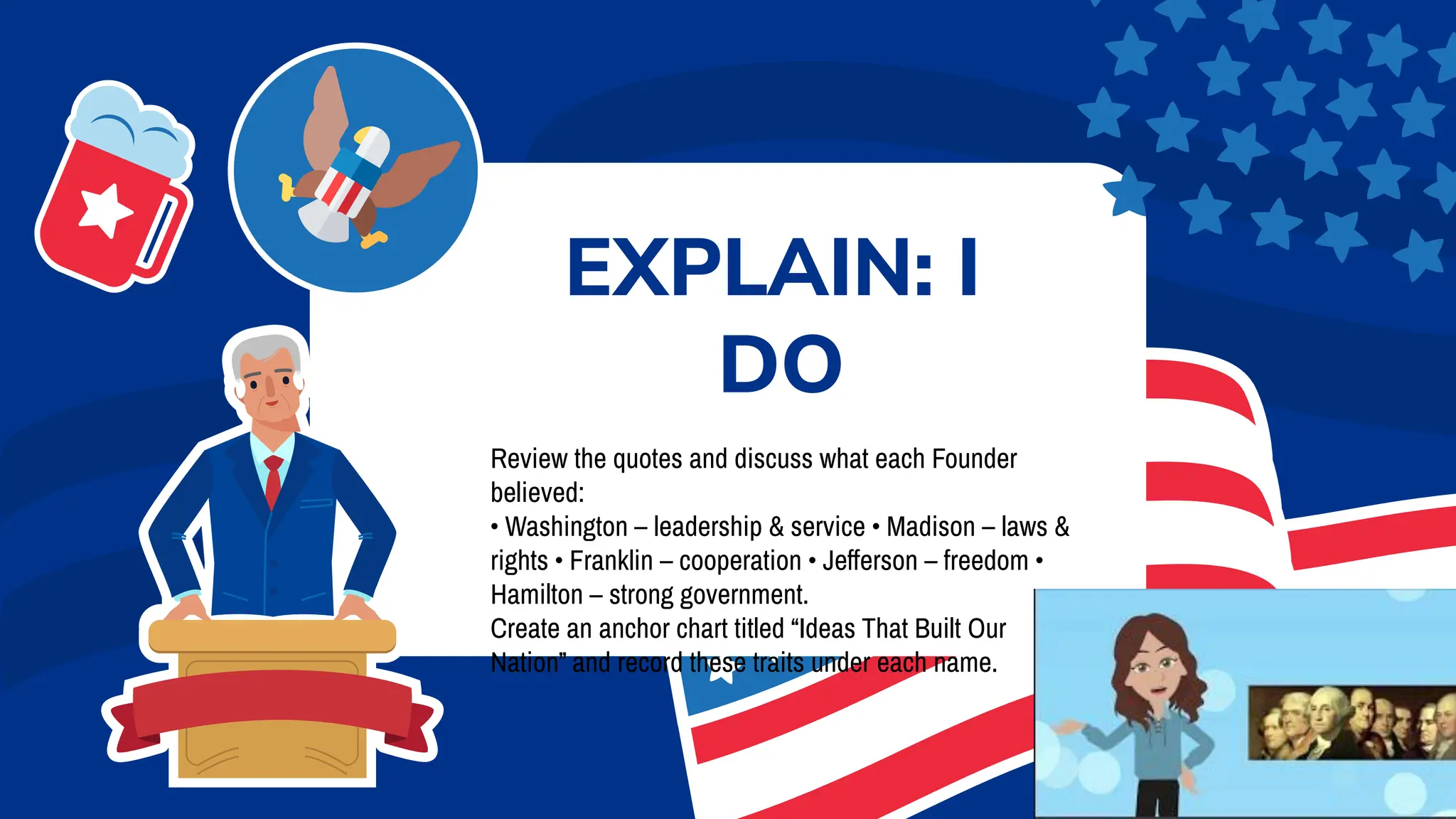
EXPLAIN: I
DO
Review thequotes and discuss what each Founder
believed:
• Washington – leadership & service • Madison – laws &
rights • Franklin – cooperation • Jefferson – freedom •
Hamilton – strong government.
Create an anchor chart titled “Ideas That Built Our
Nation” and record these traits under each name.
Complete PA 2
Rubric
Createa booklet for first graders about the government structure created by the writers
of the U.S. Constitution. The booklet should include at least five pages and explain the
duties of the three branches of government and how the system of checks and balances
works. A well-written booklet will reflect proper use of grammar and spelling.
EXPLORE: YOU DO
28.
EXIT TICKET
Which partof your booklet do you think best explains how checks and
balances keep our government fair?