This Green Labor Market Information Project was funded by a grant awarded by the U.S.
Department of Labor’s Employment and Training Administration, in partnership with the
Missouri Economic Research and Information Center (MERIC) – Missouri Department of
Economic Development and Missouri Career Center. Additional partners include the St. Louis
Regional Chamber and Growth Association and Southwestern Illinois workNet.
This workforce solution was created by the grantee and does not necessarily reflect the offi-
cial position of the U.S. Department of Labor. The Department of Labor makes no guarantees,
warranties, or assurances of any kind, express or implied, with respect to such information,
including any information on linked sites and including, but not limited to, accuracy of the
information or its completeness, timeliness, usefulness, adequacy, continued availability, or
ownership. This solution is copyrighted by the institution that created it. Internal use by an
organization and/or personal use by an individual for non-commercial purposes is permissible.
All other uses require prior authorization of the copyright owner.
ShiŌ Supervisor
Shop Superintendent
Shredder Manager
Siding Installers
Site Operators
Soil ConservaƟon Technician
Soil ConservaƟonist
Solid Waste Technician
StaƟonary Engineer
StaƟonary Engineer
Store Manager
Storm Water Management
Coordinator
Structural Engineer
Superintendent
Supervisor
Surveyors
Sustainable Design Consultant
Systems Engineer
Technical Director
Technician
Tire Vulcanizers
TransportaƟon Manager
Treatment Plant Operator
Vice President
Vice President of Energy Services
Vice President of Engineering
Vice President of OperaƟons
Vice President of ProducƟon
Vice President of Research
and Development
Vice President of Training
and Development
Warehouse Foreman
Warehouse Manager
Warehouse Worker
Waste Water CollecƟons
Waste Water Plant Operator
Waste Water Plant Supervisor
Waste Water Treatment Manager
Water and Waste Water Supervisor
Water District Operator
Water Environment Manager
Water Quality Manager
Wildlife Biologist
Wildlife Management Biologist
Window Installer
Professional Engineer
Program Manager
Project Architect
Project Coordinator
Project Designer
Project Designer/Specifier
Project Engineer
Project Manager
Project Manager LEED
Accredited Professional
Project ScienƟst
Project Superintendent
PromoƟon sales and installaƟon
Public Works Director
Purchasing Agent
Quality and Air Control
Quality Control Manager
RecepƟonist
Refuse CollecƟon Department
Regional Director
Regional Supervisor
Registered Roof Observer/
Project Manager
Research and Development
Technician
Research Microbiologist
Resource ConservaƟonist
Resource Forester
Resource Technicians
Retail Sales Associates
Retreaders
Roofer
Route Driver
Route Drivers
Sales Designer
Sales RepresentaƟve
Sanitary Engineer
Secretary
Secretary Treasurer
Senior Designer Project Manager
Senior Laboratory Analyst
Senior Microbiologist
Senior Research ScienƟst
Senior ScienƟst of Product
Development
Service Installer
Service Manager
Service ResidenƟal
Service Technician
Manager of Loss Control
Manager of Environmental
Compliance
Manufacturing Line Workers
Master Plumber
Material Handler
Mechanic
Mechanic
Mechanical Engineer
Medical Planner
Meteorologist
Methane Technician
Microbiologist
ModernizaƟon Coordinator
Municipal Clerks
Natural Resource Manager
Nature Center Manager
Office Manager
OperaƟons Manager
Operator
Owner
Park Ecologist
Park OperaƟons Manager
Parks Superintendent
Parlor Manager
Part-Ɵme Technician
Pipe Installers
Planner
Plant Material Center Manager
Plant Material Center Specialist
Plant Operator
Plant Propagator
Plant Worker
Planters
Plasterer
Plumber
Plumbing & HeaƟng Technician
Plumbing Engineer
President
President
Principal Senior Designer
Principle
Principle Geotechnical Engineer
Principle InvesƟgators
Principle Owners
Processors
Product Supervisor
ProducƟon Manager
ProducƟon Scheduler
ProducƟon Supervisor
ProducƟon Worker
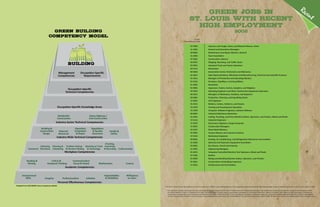
Green Job Titles from Green Employer Survey; October 1, 2010
Selected Survey
Responses
page 67
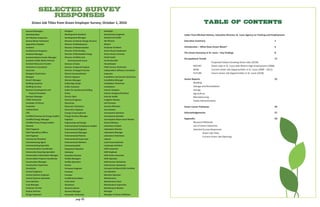
LeƩer from Michael Holmes, ExecuƟve Director, St. Louis Agency on Training and Employment
ExecuƟve Summary 1
IntroducƟon – What Does Green Mean? 6
The Green Economy in St. Louis – Key Findings 8
OccupaƟonal Trends 17
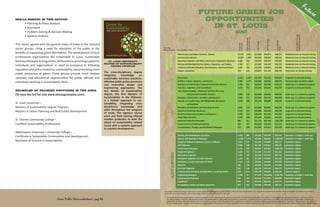
Projected Fastest Growing Green Jobs (2018)
RECENT Green Jobs in St. Louis with Recent High Employment (2008)
NOW Current Green Job OpportuniƟes in St. Louis (2009 – 2011)
FUTURE Future Green Job OpportuniƟes in St. Louis (2018)
Sector Reports 22
Building
Salvage and RemediaƟon
Energy
Agriculture
Manufacturing
Public AdministraƟon
Green Career Pathways 45
Acknowledgements 57
Appendix: 58
Research Methods
List of Green Industries
Selected Survey Responses
Green Job Titles
Current Green Job Openings
Geologist
Geotechnical engineer
Geothermal Driller
GIS Planner
Glazers
Graduate Architect
Green House Employees
Green House Foreman
Head Feeder
HorƟculturalist
Housekeeper
HVAC Service Technician
Independent SoŌware Consultant
Inspector
InstallaƟon and Service Technician
InstallaƟon Manager
InstallaƟon Technician
Insulatators
Interior Designer
Interior Designer/Architect
Internal Audits
IrrigaƟon Worker
Job Foreman
Journey Wireman
Journeyman
Journeyman plasterer
Journeyman plumber
Journeyman Sheet metal Worker
Kennel Workers
Laboratory Analyst
Laboratory Director
Laboratory Manager
Laboratory Technician
Laborer
Land ConservaƟonist
Landscape Architect
LEED Carpenter
LEED Engineer
LEED Green Associate
LEED Operator
LEED Service Technician
Licensed Architect/LEED CerƟfied
Line Workers
Machine Operator
Maintenance
Maintenance Clerk
Maintenance Supervisor
Maintenance Worker
Manager
Manager of Green IniƟaƟves
Designer
Development Assistant
Development Manager
Director of Interior Design Services
Director of Maintenance
Director of ModernizaƟon
Director of Purchasing
Director of Renewable Energy
Director of Safety and
Environmental Issues
Director of Sales
Director of Special Projects
Director of Support Service
District ConservaƟonist
District Engineer
Division Manager
Driller/Rig Tender
Driller Assistant
Driller for Geothermal Drilling
Driver
Electric Sales
Electrical Engineer
Electrician
Electronic Technician
Electronics Engineer
Energy ConservaƟonist
Energy Services Manager
Engineer
Engineering and Design
Environmental Compliance Auditor
Environmental Engineer
Environmental Manager
Environmental Planner
Environmental Supervisor
Environmental Workers
Environmentalist
Equipment Operator
EsƟmator
ExecuƟve Director
Facility Managers
Facility Operators
Farmer
Firmware Engineer
Foreman
Forester
ForkliŌ Driver/Baler
Front Desk
Gardeners
General Laborer
General Manager
Generator Technician
Account Managers
AdministraƟon
Air PolluƟon Inspectors
Animal Waste Technician
ApprenƟce Plumber
Architect
Architectural Designers
Assistant Manager
Assistant Nature Center Manager
Assistant Public Works Director
Assistant Resource Forester
Assistant to Consultant
Associate
Biological Technicians
Biologist
Branch Manager
Building Inspector
Building Services
Business Development and
Project PromoƟon
Business Manager
CADD Technician
Caretaker of Horses
Carpenter
Cashier/Sales
CEO
CerƟfied Commercial Energy Auditor
CerƟfied Energy Manager
CerƟfied Home Energy Auditor
Chemist
Chief Engineer
Chief OperaƟons Officer
Civil Engineer
Commercial Plumbers
Commissioning Agent
Commissioning Specialist
CommunicaƟons Coordinator
Community Recycling Specialist
ConservaƟon InformaƟon Manager
ConservaƟon Projects Coordinator
ConstrucƟon Manager
ConstrucƟon Supervisor
Consultant
Control Engineers
Control Systems Engineer
Control Systems Specialist
Crew Workers
Crop Manager
Customer Service
Deputy Director
Design Engineers
Green Job Titles from Green Employer Survey; October 1, 2010
Selected Survey
Responses
page 66
When the U.S. Department of Labor awarded a Labor Market Information (LMI) grant to our
state, it was an important step forward, giving our community the opportunity to develop
the capacity needed to sustain a green workforce. At the statewide level, the project involved
the Missouri Department of Economic Development as grant awardee in partnership with the
Missouri Economic Research and Information Center (MERIC). Locally, the St. Louis Regional
Chamber and Growth Association (RCGA) and The St. Louis Agency on Training and Employ-
ment (SLATE) facilitated the participation of the Workforce Investment Boards in our area,
including St. Louis, St. Louis County, St. Charles, St. Clair and Franklin/Jefferson Counties in
Missouri and Madison-Bond County and Mid-America in Illinois. The RCGA brought important
business representation to our taskforce. This represents the first time these diverse organiza-
tions throughout the region have worked together so closely for a common purpose. The river
is no boundary for our developing workforce.
This St. Louis Green Jobs Report gathers data that will ultimately allow workforce development
agencies, including SLATE, to provide valuable direction to job seekers and training provid-
ers. The depth and breadth of the LMI project has been both exciting and humbling. The St.
Louis region has a great deal of potential as a future hub of green industries. In addition to its
central location, St. Louis offers logistic capacity, a strong advanced manufacturing base and
world-class biotech research facilities. It is clear that jobs based on energy efficiency, reuse of
materials and new technologies are not simply an idea, a philosophy or an abstract goal. They
are here now and as they continue to grow, green careers will help shape the face of our local
workforce for many years to come. This information will provide us with a solid foundation on
which to build effective strategies that fully embrace emerging green jobs.
In many ways the real work has only just begun. The relationships formed during the course
of this project will take our region to the next level in regards to green talent. In particular,
we must engage disadvantaged populations and displaced auto workers, ensuring that valu-
able skills are transitioned into green industries. We must collaborate with other partners,
whether they are existing employers, relocating businesses, or entrepreneurs. Through the
website, www.stlouisgreenjobs.com, we will continue to partner with Missouri Career Source
and Illinois workNet to provide up-to-date information on green job openings and education
resources. By continuing to work together, we can and will align our workforce with the grow-
ing green economy of the St. Louis region
Sincerely,
Michael K. Holmes
Executive Director
St. Louis Agency on Training and Employment
Selected Survey
Responses
JOB TITLE # of Openings
Architect
Biologist
Building Inspector
Business Manager
Carpenter
Commissioning Agent
Commissioning Specialist
Design Engineers
Electrical Engineer
Electrician
Engineer
Geologist
HVAC Service Technician
InstallaƟon and Service Technician
InstallaƟon Technician
Insulators
Laborer
LEED Carpenter
LEED Green Associate
LEED Service Technician
Material Handler
Mechanical Engineer
Medical Planner
Microbiologist I
Microbiologist II
Part-Ɵme Technician
Planters
Plumbing Engineer
President
ProducƟon Worker
Professional Engineer
Project Engineer
Project Manager
Project Superintendent
Refuse CollecƟon Department
Research Microbiologist
Sales RepresentaƟve
Supervisor
Technician
Vice President
Current Green Job Openings in St. Louis; October 1, 2010
18
1
1
1
2
1
1
2
6
3
14
2
2
2
4
4
5
1
1
2
1
2
3
1
1
1
2
1
2
2
10
2
4
5
1
1
4
2
4
3
page 65
The following report is a final product of the Green Labor Market Information (LMI) Project funded
by the U.S. Department of Labor through the Missouri Department of Economic Development’s Mis-
souri Economic Research and Information Center. Participating Workforce Investment Boards include
the St. Louis Agency on Training and Education (MO), St. Louis County (MO), St. Charles County (MO),
Jefferson/Franklin County Employment Consortium (MO), Madison-Bond County (IL) and Mid America
Workforce Investment Board (IL). The mission of the project is to help align the St. Louis region’s work-
force to meet the growing demands of the green economy. Because workforce has no boundaries, the
goal of this project was to be inclusive of the bi-state metropolitan region as much as possible.
This project was completed by the St. Louis Regional
Chamber and Growth Association, which was selected
because of their connections between the St. Louis busi-
ness, education, and governmental communities.
The Green LMI Project has several aims:
	 1. Align the St. Louis region’s workforce to meet
	 the growing demands of the green economy;
	 2. Connect employers, workforce professionals,
	 training providers, and economic development
	 professionals;
	 3. Define and understand the St. Louis
	 green economy;
	 4. Provide relevant material to workforce
							 professionals, employers and job seekers about
							 opportunities in the green economy;
							 5. Build relationships in the St. Louis region
							 around workforce needs for a green economy.
In order to achieve these aims, the Green LMI project began with comprehensive research of area
employers. In July and August of 2010, project focus groups were held with over 50 green employers
in order to better understand the needs and skills demanded for employees who are trained for green
jobs. From August until October, a large survey of 665 employers in the St. Louis region was conducted
to learn even more about employers’ perspective on occupations in the green economy and the work-
force and skills needed to fill these positions.
Executive Summary
Executive Summary | page 1
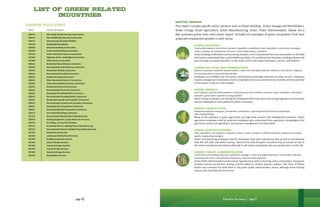
NAICS Industry DescripƟon
221330 Steam and Air-condiƟoning Supply
325412 PharmaceuƟcal PreparaƟon Manufacturing
325611 Soap and Other Detergent Manufacturing
325998 All Other Miscellaneous Chemical Product and PreparaƟon Manufacturing
333132 Oil and Gas Field Machinery and Equipment Manufacturing
333319 Other Commercial and Service Industry Machinery Manufacturing
333618 Other Engine Equipment Manufacturing
334512 AutomaƟc Environmental Control Manufacturing
334513 Industrial Process Variable Instruments
334514 Totalizing Fluid Meters and CounƟng Devices
334519 Other Measuring and Controlling Device Manufacturing
335110 Electric Lamp Bulb and Part Manufacturing
335221 Household Cooking Appliance Manufacturing
335222 Household Refrigerator and Home Freezer Manufacturing
335224 Household Laundry Equipment Manufacturing
335228 Other Major Household Appliance Manufacturing
335312 Motor and Generator Manufacturing
335911 Storage BaƩery Manufacturing
335912 Primary BaƩery Manufacturing
336111 Automobile Manufacturing
336112 Light Truck and UƟlity Vehicle Manufacturing
336120 Heavy Duty Truck Manufacturing
336213 Motor Home Manufacturing
336312 Gasoline Engine and Engine Parts Manufacturing
336350 Motor Vehicle Power Train Components Manufacturing
336411 AircraŌ Manufacturing
336412 AircraŌ Engine and Engine Parts Manufacturing
336611 Ship Building and Repairing
336612 Boat Building
336991 Motorcycle, Bicycle, and Part Manufacturing
541320 Landscape Architectural Services
541330 Engineering Services
541614 Process and LogisƟcs ConsulƟng Services
541711 Research and Development in Biotechnology
541712 Physical, Engineering, and Biological Research
GREEN MANUFACTURING
NAICS Industry DescripƟon
221310 Water Supply and IrrigaƟon Systems
221320 Sewage Treatment FaciliƟes
924110 AdministraƟon of Air Water Resource and Solid Waste Management Programs
924120 AdministraƟon of ConservaƟon Programs
925110 AdministraƟon of Housing Programs
925120 AdministraƟon of Urban Planning and Community and Rural Development
926130 RegulaƟon and Admin. of CommunicaƟons, Electric, Gas, and Other UƟliƟes
926150 RegulaƟon, Licensing, and InspecƟon of Misc. Commercial Sectors
GREEN PUBLIC ADMINISTRATION
List of Green Related
Industries
page 64
Green Economy Trends
The survey of 665 employers revealed that energy efficiency was important for their company’s
success. Half of all companies surveyed agreed with the statement that “the growth of the green
economy presents opportunities for growth for my company.” The business case for green is the most
important indicator of green adoption. If companies can save money or increase their sales of products
or services by going green, they are more likely to do so.
Green Job Trends
Green job opportunities are coming from positions that are taking on new green demands, rather than
completely new green jobs. Out of 590 green job titles listed in the survey, 530 were positions that
previously existed and were taking on new green responsibilities in addition to their other job
functions. This illustrates the importance of understanding the adaptive nature of the green economy,
jobs and skills. There may be more merging, transitioning and additions of green work to non-green
job titles rather than new distinct green positions.
However, these distinct new green jobs are expected to increase as the green economy grows. Accord-
ing to the survey of area employers, 125 job titles described as performing green work, were vacant
in October 2010. Although these positions, such as carpenters, electricians, project managers,
engineers and architects may be filling fast, it is still a reflection that green work is available in St. Louis.
They are filling fast because employers are currently finding the necessary workforce to fill these
positions, and that is often a pipeline of available, trained workers.
Skills Trends
Soft skills, such as integrity, honesty, initiative and professionalism were identified by employers as
critical for hiring. These soft skills are necessary to teach employees new skills, such as those needed
for green products and services. Many employers felt that green skills were useful and favorable; yet,
they were secondary to basic and soft skills.
Training Opportunities
Employers stated that there was an opportunity to expand training in these particular areas:
	 • Basic sustainability training is useful as employers look for employees, who can apply
	 basic skills like recycling and waste management without supervision.
	 • Soft skills such as promptness, professionalism, ability to learn are an important indicator
	 of employee success.
	 • Teamwork is often utilized in many of the companies that have green positions.
	 • Management skills are useful as many employees quickly advance from technical positions
	 to management and leadership positions.
	 • Safety training is useful and needed in most green positions. Employers stated a lack of
	 workers who were adequately trained in safety skills.
Executive Summary | page 2
NAICS Industry DescripƟon
325314 FerƟlizers (Mixing Only)
326212 Tire Retreading
423140 Motor Vehicle Parts (Used Wholesale)
423930 Recyclable Material Wholesalers
453310 Used Merchandise Stores (Excluding Pawn Shops)
541380 TesƟng Laboratories
541620 Environmental ConsulƟng services
562111 Solid Waste CollecƟon
562112 Hazardous Waste collecƟon
562119 Other Waste CollecƟon
562211 Hazardous Waste Treatment and Disposal
562212 Solid Waste Landfill
562213 Solid Waste Combustors and Incinerators
562219 Other Hazardous Waste Disposal
562910 RemediaƟon Services
562991 SepƟc Tank and Related Services
562920 Materials Recovery FaciliƟes
562998 Miscellaneous Waste Management Services
GREEN salvage and remediation
ccupaƟons ranked according to Missouri Economic Research & InformaƟon Center’s (MERIC), Missouri Career ExploraƟon Tool, Long-term occupaƟonal projecƟons.
hese projecƟons are based on occupaƟon’s job growth rate, total openings, and average wages relaƟve to other occupaƟons in the state.
workforce soluƟon was funded by a grant awarded by the U.S. Department of Labor’s Employment and Training AdministraƟon. The soluƟon was created by the grantee and
not necessarily reflect the official posiƟon of the U.S. Department of Labor. The Department of Labor makes no guarantees, warranƟes, or assurances of any kind, express or
ed, with respect to such informaƟon, including any informaƟon on linked sites and including, but not limited to, accuracy of the informaƟon or its completeness,
liness,usefulness, adequacy, conƟnued availability, or ownership. This soluƟon is copyrighted by the insƟtuƟon that created it. Internal use by an organizaƟon and/or personal
by an individual for non-commercial purposes is permissible. All other uses require prior authorizaƟon of the copyright owner.
List of Green Related
Industries
NAICS Industry DescripƟon
221111 Hydroelectric Power GeneraƟon
221119 Other Electric Power GeneraƟon
221121 Electric Bulk Power Transmission
221122 Electric Power DistribuƟon
237130 Power & CommunicaƟon Line & Related Structures ConstrucƟon
237130 Power/CommunicaƟon System ConstrucƟon
311222 Soybean Processing
325193 Ethyl Alcohol Manufacturing
333611 Turbine Generator & Generator Set Units
333911 Pump & Pumping Equipment Manufacturing
334413 Semiconductor & Related Devices
335311 Electric Power & Specialty Transformers
335999 Miscellaneous Electrical Equipment
541330 Engineering Services
GREEN ENERGY
NAICS Industry DescripƟon
111000 Crop ProducƟon
112000 Animal ProducƟon
113000 Forestry and Logging
114000 Fishing, HunƟng, and Trapping
115000 Agriculture and Forestry Support AcƟviƟes
GREEN AGRICULTURE
page 63
GREEN
ENERGY
Button
GREEN
MANUFACTURING
Button
GREEN PUBLIC
ADMINISTRATION
Button
GREEN SALVAGE
& REMEDIATION
Button
GREEN
Building
Button
GREEN
Agriculture
Button
Sector trends
This report includes specific sector sections such as Green Building , Green Salvage and Remediation,
Green Energy, Green Agriculture, Green Manufacturing, Green Public Administration. Below are a
few summary points from each sector report. Included are examples of green occupations that have
projected employment growth in each sector.
		Green Building:
		 Construction laborers, electricians, plumbers, pipefitters, steamfitters, team assemblers, construction managers,
		 roofers, heating, air conditioning mechanics, sheet metal workers, architects
		 Green building certifications are becoming standard, and it is predicted that most new workers in this field
		 will need to understand basic sustainability principles. It is predicted that the green building industry will
		 grow through increased education to the public and to real estate developers, owners, and builders.
		 Green Salvage and Remediation:
		laborers, hazardous materials removal workers, refuse and recyclable materials collectors, truck drivers, shipping
		 and receiving clerks, environmental scientists
		 Employers are confident that this sector will become increasingly important to other sectors. Employers
		 in green salvage and remediation look for employees who can understand new markets and the potential
		 of this sector to tap into new markets.
		Green Energy:
		 Civil engineers, environmental engineers, electrical power-line installers, architects, team assemblers, mechanical
		 engineers, power plant operators, energy auditors
		 Green energy employers are looking for employees who know about the energy regulatory environment
		 and are adaptable to many positions within a company.
		Green Agriculture:
		 Industrial production managers, farmworkers and laborers, agricultural and food science technicians,
		 sales representatives
		 Many of the positions in green agriculture are high-level research and development positions. Green
		 agriculture employers look for potential employees who understand farm operations, knowledge of the
		 agriculture policy and regulations, and possess management and team skills.
		Green Manufacturing:
		 Team assemblers, civil engineers, inspectors, testers, sorters, samplers, industrial engineers, laborers, purchasing
		 agents, engineering managers
		 Green manufacturing employers look for employees who have supervisory skills as well as foundational
		 skills like soft skills and safety training. Many of the skills for green manufacturing are similar to that in
		 the entire manufacturing industry, although it will require employees who can quickly learn on-the-job.
		 Green Public Administration:
		 Construction and building inspectors, operations managers, urban and regional planners, conservation scientists,
		 environmental science and protection technicians, environmental engineers
		 Green Public Administration professionals typically have skills in planning, policy and analysis, teamwork,
		 problem solving and decision making, and the ability to conduct systems analyses. The influx of federal
		 dollars has increased the work done in the green public administration sector, although these funding
		 sources will most likely be short-term.
GREEN
ENERGY
Button
GREEN
MANUFACTURING
Button
GREEN PUBLIC
ADMINISTRATION
Button
GREEN SALVAGE
& REMEDIATION
Button
GREEN
Building
Button
GREEN
Agriculture
Button
GREEN
ENERGY
Button
GREEN
MANUFACTURING
Button
GREEN PUBLIC
ADMINISTRATION
Button
GREEN SALVAGE
& REMEDIATION
Button
GREEN
Building
Button
GREEN
Agriculture
Button
GREEN
ENERGY
Button
GREEN
MANUFACTURING
Button
GREEN PUBLIC
ADMINISTRATION
Button
GREEN SALVAGE
& REMEDIATION
Button
GREEN
Building
Button
GREEN
Agriculture
Button
GREEN
ENERGY
Button
GREEN
MANUFACTURING
Button
GREEN PUBLIC
ADMINISTRATION
Button
GREEN SALVAGE
& REMEDIATION
Button
GREEN
Building
Button
GREEN
Agriculture
Button
GREEN
ENERGY
Button
GREEN
MANUFACTURING
Button
GREEN PUBLIC
ADMINISTRATION
Button
GREEN SALVAGE
& REMEDIATION
Button
GREEN
Building
Button
GREEN
Agriculture
Button
Executive Summary | page 3
List of Green Related
Industries
NAICS Industry DescripƟon
236115 New Single-Family Housing ConstrucƟon
236116 New MulƟfamily Housing ConstrucƟon
236117 New Housing OperaƟve Builders
236118 ResidenƟal Remodelers
236210 Industrial Building ConstrucƟon
236220 Commercial Building ConstrucƟon
237110 Water and Sewer System ConstrucƟon
237310 Highway, Street, and Bridge ConstrucƟon
237990 Other Heavy ConstrucƟon
238151 ResidenƟal Glass/Glazing Contractors
238152 NonresidenƟal Glass/Glazing Contractors
238161 ResidenƟal Roofing Contractors
238162 NonresidenƟal Roofing Contractors
238170 ResidenƟal Siding Contractors
238191 Other ResidenƟal Exterior Contractors
238192 Other NonresidenƟal Exterior Contractors
238211 ResidenƟal Electrical Contractors
238212 NonresidenƟal Electrical Contractors
238221 ResidenƟal Plumbing/HVAC Contractors
238222 NonresidenƟal Plumbing/HVAC Contractors
238311 ResidenƟal Drywall and InsulaƟon Contractors
238312 NonresidenƟal Drywall and InsulaƟon Contractors
238911 ResidenƟal Site PreparaƟon Contractors
238912 NonresidenƟal Site PreparaƟon Contractors
283172 NonresidenƟal Siding Contractors
321219 ReconsƟtuted Wood Product Manufacturing
333414 HeaƟng Equipment, Except Warm Air Furnaces
333415 AC, Refrig., & Forced Air HeaƟng
335121 ResidenƟal Electric LighƟng Fixture Manufacturing
335122 NonresidenƟal Electric LighƟng Fixture Manufacturing
541310 Architechtural Services
541320 Landscape Architechtural Services
541350 Building InspecƟon Services
541410 Interior Design Services
541420 Industrial Design Services
541410 Interior Design Services
541420 Industrial Design Services
562910 RemediaƟon Services
GREEN BUILDING
page 62
In the end, this report showed that there is a robust group of green businesses in St. Louis, and several
non-green companies are looking to transform their company with green practices. There will likely
be new jobs and skills that emerge from the growth of the green economy in St. Louis. in the current
economic recession, there is a surplus workforce that is trained and ready to take these green jobs.
However, employers predict that these green skills will only become more common and prevalent. In
this way, it is expected that green principles have the potential to affect positions at most companies.
The best preparation will be learning basic green principles for the desired sector and still keeping an
eye to that industry’s basic competencies.
The Green Labor Market Information Project sought to build relationships between education and
training providers, employers, job seekers, workforce professionals, and economic development pro-
fessionals. By continuing to share resources and gathering employers and workforce professionals to
discuss training needs, the St. Louis region will be in the best position for growth when the green
economy expands.
Visit StLouisGreenJobs.com to see the entire report
and view other green resources
Executive Summary | page 4
Reference
The American Association for Public Opinion Research. 1998. Standard Definitions: Final Dispositions
of Case Codes and Outcome Rates for RDD Telephone Surveys and In-Person Household Surveys. Ann
Arbor, MI: AAPPOR
TABLE I: Completed Interviews by State
			 Description of State		 Percent (%)
			 Illinois				 23.5
			 Missouri			 76.5
TABLE II: Completed Interviews by Green Business or Non-Green1
[According to the definitions of research]
			 Green or Non-Green		 Percent (%)
			 Non-Green			 23.3
			 Green				 76.7
TABLE III: Completed Interviews by State & Green Business
			 Illinois			 Missouri		 Total
Non-Green		 37 (24%)		 118 (23%)		 155
Green 			 119 (76%)		 391 (77%)		 510
Total 			 156			 509			 665
TABLE IV: Completed Interviews by Green Sector
Green Building: 			 275
Green Salvage and Remediation: 	 91
Green Energy:				 123
Green Agriculture:			 52
Green Manufacturing: 		 35
Green Public Administration: 		 54
1
Companies that answered YES to at least one of these green screening questions were labeled a green company. Screen_1: As a business, do you provide a product
or service that directly does any of these things: conserve natural and energy resources, provide clean alternatives, reduce pollution and/or repurpose waste?
Screen _2: Is your business adopting principles of sustainability, or energy efficiency, or reducing green house gas emissions?
page 61
The green economy is coming and will continue to grow in the St. Louis region. However, to expedite
growth and build an economy that utilizes locally trained green talent, a greater regional effort needs
to exist. The following are recommendations for action based on the research findings of this report.
There is always more that can be done to promote the green economy, and these were some of the
key messages that surfaced in the Green LMI Project, in which each person who reads this report may
play a role.
Promote public adoption of green products and services
A resounding theme from employers is the need to increase public education about sustainability, pri-
marily in the green building and energy fields. This will increase the consumer demand for green prod-
ucts and services that many employers said were lacking. Green building may be one of the St. Louis
region’s strongest sustainable areas, with a great deal of potential growth. Employers expressed a need
to convince developers about the cost savings that may accrue through using sustainable products and
techniques that may have greater upfront costs. It is recommended that the region begin to promote
green products and services in a unified effort.
Employers also look for employees who are able to illustrate the importance of green to their future
customers. Employers are looking for employees who are adaptable and able to understand the impor-
tance of green, even without yet mastering all the techniques and concepts.
Embed sustainability literacy into common workplace skills
Employers stated that basic skills are still the most important indicator of hiring ability. Green skills are
looked upon favorably, and in many cases, a basic understanding of green was enough for employers.
Many employers felt like they could augment a basic understanding of sustainability with on-the-job
training. As a region, St. Louis can work towards providing basic sustainability training to all workers, as
this will significantly enhance companies’ ability to find prepared green workers.
Contribute to collaborative projects like StLouisGreenJobs.com
Many business representatives spoke of a need to have access to all green training opportunities. As
part of the Green LMI Project, a new green jobs website was established, StLouisGreenJobs.com. This
website will catalog the green training opportunities for the region that will be of use to employers,
training seekers, and the training providers listed in the inventory. Through strong collaborations be-
tween employers, workforce investment boards, and higher education institutions, StLouisGreenJobs.
com can be the lasting legacy of the project and become the on-line access point for the St. Louis
region’s green job opportunities. By continuing to share resources and gathering employers and
workforce professionals to discuss training needs, the St. Louis region will be in the best position for
growth when the green economy expands.
Executive Summary | page 5
The survey was administered by the Center for Advanced Social Research (CASR) at the University
of Missouri.
Survey Instrument
The survey instrument was jointly developed by researchers of St. Louis RCGA and CASR. It was de-
signed to collect and examine the following information.
• Perception of importance of green economy
• Number of employees related to green economy
• Number of job openings related to green economy & their descriptions
• Need for training/retraining & plan for green-related jobs
• Importance of soft skills for green job holders
• Importance of academic competencies for green job holders
• Partnership with educational or training institutions
• Values in recruiting green talents
Sampling Method
The sample of the 2010 St. Louis Green Business Survey was from a database of all the businesses in
the St. Louis region. The database was provided by RCGA using a compilation of public and proprietary
business directory sources.
At least fifteen (15) attempts were made to complete an interview at every sampled telephone num-
ber. The calls were scheduled over days of the week to maximize the chances of making a contact with
a potential respondent. All refusals were recontacted at least once in order to attempt to convert them
into completed interviews.
Field Operation
Six hundred sixty-five (665) interviews were completed via telephone with business owners/managers
from August 18 to November 5, 2010, by the trained interviewing and supervising staff of CASR.
Response rate calculation
Description Telephone Numbers
A. Total number released 3,340
B. Completed surveys 665
C. Disconnected 504
D. Wrong numbers 235
E. Fax 76
F. Ineligible numbers1
183
G. Refusals (after two attempts) 314
H. Communication barriers2
12
I. Ring No Answer3
1,289
J. Callbacks5
62
Notes:
1. Ineligible numbers are defined as those in which the listing was (1) no longer in business, (2) no operation in Missouri, (3) non-business entities such as church,
(4) residential households, and etc.
2. Communication barriers are defined as those that could not be communicated in English, were hearing impaired, and etc.
3. Ring-no-answers are defined as the phone numbers in which no one answered to any of the fifteen attempts made during the period when the project was implemented.
4. Callbacks are defined as the numbers in which someone answered during the project implementation period but a callback was scheduled because the selected person
was not available.
B
Response Rate (RR) = --------------------- = 63.8%
B + G + J
page 60
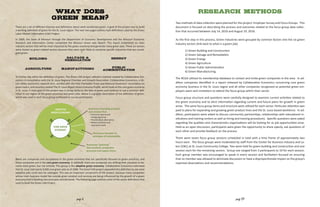
There are a lot of different theories and definitions about what constitutes green. A goal of this project was to build
a working definition of green for the St. Louis region. The next two pages outline main definitions used by the Green
Labor Market Information (LMI) Project.
In 2009, the State of Missouri through the Department of Economic Development and the Missouri Economic
Research and Information Center completed the Missouri Green Jobs Report. This report established six main
industry sectors that will be most impacted by the green economy and generate many green jobs. These six sectors
were chosen as green-related sectors because they were most likely to comprise specific industries that are consid-
ered green.
To further the refine the definition of green, The Green LMI project utilized a method created by Collaborative Eco-
nomics in consultation with the St. Louis Regional Chamber and Growth Association. Collaborative Economics, a Sili-
con Valley economics research firm, worked with the Pew Charitable Trusts and National Governors’ Association on
green topics, and recently created The St. Louis Region Green Economy Profile, which looks at the core green economy
in St. Louis. A main goal of this project was to bring clarity to the idea of green and continue to use a common defi-
nition in our region of the green economy and green jobs. Below is a graphic description of the definition of green,
which was used in each focus group and posed to survey participants.
There are companies and occupations in the green economy that are specifically focused on green practices, and
these companies are in the core green economy. In addition, there are companies are shifting their practices to be-
come more green, but not entirely. This group is the adaptive green economy. Collaborative Economics estimated
that St. Louis had nearly 9,000 core green jobs as of 2008. The Green LMI project expanded this definition to see what
adaptive jobs could also be cataloged. This was an important component of the project, because many companies
whose main business model lies outside green product and services are being influenced by the growth of a green
economy that is creating new pressures and demands. The following page outlines some of the sector definitions that
used to build the Green LMI Project.
WHAT DOES
GREEN MEAN?
BUILDING SALVAGE &
REMEDIATION ENERGY
AGRICULTURE MANUFACTURING PUBLIC
ADMINISTRATION
Two methods of data collection were planned for this project: Employer Survey and Focus Groups. This
document is focused on describing the process and outcomes related to the focus group data collec-
tion that occurred between July 14, 2010 and August 19, 2010.
As the first step in this process, Green Industries were grouped by common factors into the six green
industry sectors (link back to what is a green job)
1) Green Building and Construction
2) Green Salvage and Remediation
3) Green Energy
4) Green Agriculture
5) Green Public Administration
6) Green Manufacturing
The RCGA utilized its membership database to contact and invite green companies in the area. In ad-
dition companies identified in a report released by Collaborative Economics concerning core green
economy business in the St. Louis region and all other companies recognized as potential green em-
ployers were sent invitations to attend the focus group within their sector.
Focus group structure and questions were carefully designed to examine current activities related to
the green economy and to elicit information regarding current and future plans for growth in green
areas. The same focus group items and structure were utilized for each sector. Particular attention was
paid to plans for expanding and growing green product lines and the St. Louis based workforce. In ad-
dition, participants were asked to discuss community partnerships, relationships with educational in-
stitutions and training centers as well as hiring and training procedures. Specific questions were asked
regarding the qualities and characteristics organizations will be looking for as job opportunities arise.
Held as an open discussion, participants were given the opportunity to share openly, ask questions of
each other and provide feedback on the process.
There were seven focus group sessions scheduled in total with a time frame of approximately two
hours each. The focus groups were moderated by staff from the Center for Business Industry and La-
bor (CBIL) at St. Louis Community College. Two were held for green building and construction and one
session each for the remaining sectors. Group size ranged from 3 participants to 10 for each session.
Each group member was encouraged to speak in every session and facilitation focused on ensuring
that no member was allowed to dominate discussion or have a disproportionate impact on the group’s
reported observations and recommendations.
page 59
research methods
page 6
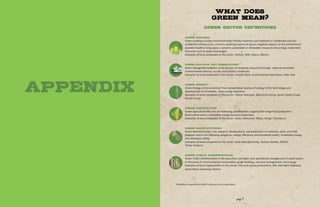
green sector definitions
green building
Green building includes environmentally friendly materials and methods for residential and non-
residential infrastructure, converts existing property to lessen negative impacts on the environment,
provides healthy living spaces, converts sustainable or renewable resources into energy, replenishes
resources such as water and oxygen.
Examples of local companies in this sector: Tarlton, HOK, Clayco, Alberici
green salvage and remediation
Green Salvage/Remediation is the process of renewing resources through: material extraction,
environmental cleanup, re-use, and product conversion.
Examples of local companies in this sector: Smurfit Stone, Environmental Operations, Hilex Poly
green energy
Green Energy is the conversion from conventional sources of energy to the technology and
development of renewable, clean energy resources.
Examples of local companies in this sector: Phycal, Abengoa, MicroGrid Energy, Wind Capital Group,
Kineta Energy
green agriculture
Green Agriculture falls into the following classifications: organic/free range food production,
forest preservation, renewable energy resource production.
Examples of local companies in this sector: Solae, Monsanto, Novus, Bunge, Divergence
green manufacturing
Green Manufacturing is the research, development, and production of materials, parts, and final
products within the following categories: energy efficiency, environmental health, renewable energy,
and workplace safety.
Examples of local companies in this sector: Duke Manufacturing, Halcyon Shades, MEMC,
Trinity Products
green public administration
Green Public Administration is the execution, oversight, and operational management of public policy
in the areas of: environmental conservation, green building, resource management, and energy.
Examples of local organizations in this sector: City and county government, EPA, East-West Gateway,
Great Rivers Greenway District
*Definitions adapted from MERIC’s Missouri Green Jobs Report
WHAT DOES
GREEN MEAN?
GREEN
ENERGY
Button
GREEN
MANUFACTURING
Button
GREEN PUBLIC
ADMINISTRATION
Button
GREEN SALVAGE
& REMEDIATION
Button
GREEN
Building
Button
GREEN
Agriculture
Button
GREEN
ENERGY
Button
GREEN
MANUFACTURING
Button
GREEN PUBLIC
ADMINISTRATION
Button
GREEN SALVAGE
& REMEDIATION
Button
GREEN
Building
Button
GREEN
Agriculture
Button
GREEN
ENERGY
Button
GREEN
MANUFACTURING
Button
GREEN PUBLIC
ADMINISTRATION
Button
GREEN SALVAGE
& REMEDIATION
Button
GREEN
Building
Button
GREEN
Agriculture
Button
GREEN
ENERGY
Button
GREEN
MANUFACTURING
Button
GREEN PUBLIC
ADMINISTRATION
Button
GREEN SALVAGE
& REMEDIATION
Button
GREEN
Building
Button
GREEN
Agriculture
Button
GREEN
ENERGY
Button
GREEN
MANUFACTURING
Button
GREEN PUBLIC
ADMINISTRATION
Button
GREEN SALVAGE
& REMEDIATION
Button
GREEN
Building
Button
GREEN
Agriculture
Button
GREEN
ENERGY
Button
GREEN
MANUFACTURING
Button
GREEN PUBLIC
ADMINISTRATION
Button
GREEN SALVAGE
& REMEDIATION
Button
GREEN
Building
Button
GREEN
Agriculture
Button
APPENDIX
page 7
Thank you to the Green Workforce Taskforce that spent several months advising the Green LMI Project.
The Green Workforce Taskforce consisted of representatives from Workforce Investment Boards and
green businesses.
Members of the Green Workforce Taskforce
Charles Juneau	 Juneau Associates, Inc.
Michael Chell		 Ameren
Jim Curran		 Electrical Connection
Leah Dettmers		 Madison County Solid Waste Department
Gene Gorden		 St. Louis County Workforce Investment Board
Janet Hogan		 Monsanto
Michael Holmes 	 St. Louis Agency on Training and Employment
Don Holt		 St. Charles Workforce Investment Board
Rick Hunter		 MicroGrid Energy
Bob Lee		 St. Louis County Workforce Development
Paul McDonald	 Smurfit-Stone
Debra Moore		 Mid America Workforce Investment Board
Matt Robinson		 Environmental Operations
Dave Stoecklin		 Madison - Bond County Workforce Investment Board
Rick Stubblefield	 Mid America Workforce Investment Board
Robert	Swartz		 Missouri Department of Economic Development
Leonard Toenjes	 Associated General Contractors of St. Louis
Catherine Werner	 Mayor’s Office, City of St. Louis
Shirley	Wilson		 Jefferson/Franklin County Workforce Investment Board
Harold 	Zinn		 Missouri Enterprise
acknowledgements
page 57
st. louis green economy
The St. Louis Region Green Economy Profile illustrated that employment growth in green has grown by
11% from 2007 to 2008 (and grown 54% from 1995), whereas the total economy employment declined
by 2% from 2007 to 2008 (and grown 4% since 1995). Although this upward trend may slow as the base
of the green economy increases, this is a remarkable increase despite a recession.
St. Louis companies are responding to a growing green economy, as was learned from both focus
groups and survey results. Businesses that were not primarily green, are often adapting their practices
based on customer demand to go green. Employers stated an increasing need to offer green alterna-
tives to consumers in a number of areas. In the end, the consumer demand and company savings are
what will drive companies to move to green products and services.
Company Attitude Toward Green
One aim of this project is to better understand how St. Louis region businesses feel the green economy
is impacting their company and bottom line, and to assess the health of the regional green economy.
In the green business survey for the Green LMI Project, 665 companies surveyed were asked basic
attitudinal questions about the green economy.
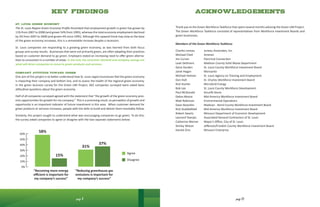
Half of all companies surveyed agreed with the statement that “the growth of the green economy pres-
ents opportunities for growth for my company.” This is a promising result, as perception of growth and
opportunity is an important indicator of future investment in this area. When customer demand for
green products or services increases, people with the skills to build and deliver them inevitably follow.
Similarly, this project sought to understand what was encouraging companies to go green. To do this,
the survey asked companies to agree or disagree with the two separate statements below:
60%
50%
40%
30%
20%
10%
0%
“Reducing greenhouse gas
emissions is important for
my company’s success”
“Becoming more energy
efficient is important for
my company’s success”
Disagree
Agree
58%
15%
31%
37%
page 8
KEY FINDINGS
page 9
Survey results illustrate that becoming energy efficient is more
important to companies than reducing green house gas emissions.
As predicted, companies are more concerned with being sustain-
able when there is a business and financial incentive in the practice.
Reducing greenhouse gas emissions is an environmental principle
rather than a business principle for most companies surveyed. This
aligns with the trend from the focus groups illustrating that energy
efficiency work in the building and construction trades will be a very important component of the bur-
geoning green economy. Energy auditors and construction professionals will be important occupations
for companies that choose to improve their energy efficiency in facility, product, and operation.
Green is Becoming Standard
Employers are moving towards a holistic model
of green integration. Many industries expect that
green will become the standard in a few years much
like safety and diversity training is now compulsory
training. Practices that formerly set providers apart
from their competition now are necessary stakes to
enter the game. Employers stated that green skills are becoming foundational skills throughout their
industries rather than supplementary skills.
Employers will be looking for employees that show “interest and
initiative” in green and sustainable practices. For many employers, green
practices are common sense in recycling and resource savings, i.e. turning
off lights, using less products, recycling more efficiently. The interest and
initiative is key, because this is what supports new practices that ultimately
permeate a company and remain long-term. Employers are looking for a
workforce that can learn and apply green practices – even in non-green
positions – with little supervision. As a result, even job-seekers who
normally would not be faced with sustainability or green principles
may be asked to be prepared by learning green practices beforehand or
as a part of an on-the-job training program. When green practices become company policy, it will
undoubtedly touch each and every position at a company.
Growing Green and Going Green
Core green businesses have grown considerably over the last few years, even through the recession.
As stated, employment in the St. Louis core green economy has grown by 54% from 1995 to 2008,
compared to 4% in the entire economy. As the business case for these core green
businesses becomes easier to make, accelerated growth is expected. Using green
alternatives is not now something clients feel is essential, therefore creating a
positive public image will accelerate growth when the green alternative becomes
the most economical option.
“The public is
more educated
about sustainable
techniques.”
— Green salvage and
remediation employer
“In building, we used to get calls
because we used green practices.
Now, sustainability and
green practices are needed to
get in the game.”
— Green building employer
“People are
asking what we
are doing to
be more
environmentally
friendly before
we get the job.”
— Green building
employer
Tasks
	 • Manage operations at biofuels power generation facilities, including production, shipping, maintenance,
	 or quality assurance activities.
	 • Adjust temperature, pressure, vacuum, level, flow rate, or transfer of biofuels to maintain processes
	 at required levels.
	 • Approve proposals for the acquisition, replacement, or repair of biofuels processing equipment or the
	 implementation of new production processes.
	 • Conduct cost, material, and efficiency studies for biofuels production plants or operations.
	 • Monitor meters, flow gauges, or other real-time data to ensure proper operation of biofuels production
	 equipment, implementing corrective measures as needed.
	 • Prepare and manage biofuels plant or unit budgets.
	 • Review logs, datasheets, or reports to ensure adequate production levels or to identify abnormalities
	 with biofuels production equipment or processes.
	 • Shut down and restart biofuels plant or equipment in emergency situations or for equipment maintenance,
	 repairs, or replacements.
	 • Supervise production employees in the manufacturing of biofuels, such as biodiesel or ethanol.
	 • Confer with technical and supervisory personnel to report or resolve conditions affecting biofuels plant safety,
	 operational efficiency, and product quality.
	 • Draw samples of biofuels products or secondary by-products for quality control testing.
	 • Monitor transportation and storage of flammable or other potentially dangerous feedstocks or products
	 to ensure adherence to safety guidelines.
	 • Provide direction to employees to ensure compliance with biofuels plant safety, environmental,
	 or operational standards and regulations.
	 • Provide training to subordinate or new employees to improve biofuels plant safety or increase the
	 production of biofuels.
Tools & Technology
	 • Air samplers or collectors — Air monitoring equipment
	 • Belt conveyors — Belt conveyor systems
	 • Control valves — Flow control valves FCV; Throttle control valves TCV
	 • Globe valves — Stop valves
	 • Plant samples analysis equipment — Sample ports
	 • Industrial control software — Distributed control systems DCS software; Human machine interface
	 HMI software
	 • Inventory management software — Inventory control software
	 • Office suite software — Microsoft Office software
	 • Presentation software — Microsoft PowerPoint
	 • Word processing software — Microsoft Word
*Source: O*NET OnLine
green
ENERGY
occupation BIOFUELS PRODUCTION MANAGERS
page 56
“We need to start thinking about buildings as
long-term investments that may be around for
decades that we continue to give to and gain
from, rather than one time structures that
cease to have value after they are built.”
— Green building employer
“When you are
talking about the
kind of scale some
consumers are
dealing with,
a few cents per
square foot is
too much
difference.”
— Green building
employer
page 10
Tasks
	 • Conduct engineering site audits to collect structural, electrical, and related site information for use
	 in the design of residential or commercial solar power systems.
	 • Design or coordinate design of photovoltaic (PV) or solar thermal systems, including system components,
	 for residential and commercial buildings.
	 • Create checklists for review or inspection of completed solar installation projects.
	 • Create electrical single-line diagrams, panel schedules, or connection diagrams for solar electric systems
	 using computer-aided design (CAD) software.
	 • Create plans for solar energy system development, monitoring, and evaluation activities.
	 • Develop design specifications and functional requirements for residential, commercial, or industrial
	 solar energy systems or components.
	 • Perform computer simulation of solar photovoltaic (PV) generation system performance or energy
	 production to optimize efficiency.
	 • Provide technical direction or support to installation teams during installation, start-up, testing,
	 system commissioning, or performance monitoring.
	 • Design or develop vacuum tube collector systems for solar applications.
	 • Develop standard operation procedures and quality or safety standards for solar installation work.
Tools & Technology
	 • Ageing ovens — Accelerated weathering machines; Solar simulators
	 • Coulometers — Flow coulometric detectors
	 • Laboratory mechanical convection ovens — Bench ovens; Humidity ovens
	 • Semiconductor process systems — Focused ion beam FIB systems; Ion beam assisted deposition IBAD systems;
	 Ion mills; Plasma enhanced chemical vapor deposition PECVD systems
	 • Spectrometers — Auger electron spectrometers; Electron energy loss spectrometers; Energy dispersive x-ray
	 spectrometers EDS; X-ray photoelectron spectrometers
	 • Analytical or scientific software — Optical Physics Technologies SUN_CHART; SOLAR-2; SolTrace;
	 The MathWorks MATLAB
	 • Computer aided design CAD software — Autodesk AutoCAD LT; Autodesk AutoCAD software; Dassault
	 Systemes SolidWorks software; IMSI Design TurboCAD software
	 • Office suite software — Microsoft Office software
	 • Presentation software — Microsoft PowerPoint
	 • Word processing software — Microsoft Word
*Source: O*NET OnLine
green
ENERGY
occupation SOLAR ENERGY SYSTEMS ENGINEERS
page 55
For some sectors (energy, building) this moment may be rapidly approaching, and for other sectors
there may be a lag before the green options are seen as the best option for consumers. When the
economic case can be objectively made, it will act as a multiplier in influencing potential customers.
Employers indicate that many of the decision makers, such as executive staff, in organizations continue
to make decisions based entirely on bottom line price. When that group
becomes convinced that green methods are going to have a positive
impact on the profitability of their organizations, we will see a dramatic
shift to green.
It is important for the public to understand that in some industries, move-
ment to green practices and products requires organizations to compete
with their own, less green offerings. Energy, salvage and remediation, and
building and construction all have legacy offerings that the public expects
them to continue to provide. It is sometimes difficult to shift resources to
more green offerings when most people do not fully understand all of the potential benefits associated
with the green alternatives. Employers struggle
with the public perception that they should be
doing more for the environment when they are
having difficulty making their product or service
more green without charging customers a great
deal more.
As a result, green employers emphasized a strong need to create a positive public image of green
standards and practices, especially when a product or service was concerned. Green businesses want
customers to see the green alternatives as the best long-term courses of action, even if the upfront
cost is marginally higher. Right now the sell to build or “go green” is a tough one, especially when few
companies are making that decision. Businesses stake a lot of value in the possibility of educating the
greater public about the benefits associated with paying just a little bit more for sustainable prac-
tices and materials. Companies that are green, or going green, need employees who can articulate
that greater benefit of a green product or service. In a way, everyone is a salesperson.
What about green jobs?
The market is currently saturated with skilled and experienced workers. Generally, employers did
not voice concern that there would be a shortage of workers to meet increasing needs in both our
focus groups and survey.
Employers are getting the green talent they need by often retraining existing employees who illustrate
interest and basic competencies. 52% of employers stated that they find the green talent they need
through retraining existing employees, and 55% promote in-house to fill green roles. This may indicate
that often the green work being done at a company is being added to an existing job description or is
a transitioning employee from one department to another. Accordingly, an overwhelming majority of
Tasks
	 • Plan and coordinate installations of photovoltaic (PV) solar and solar thermal systems to ensure
	 conformance to codes.
	 • Supervise solar installers, technicians, and subcontractors for solar installation projects to ensure
	 compliance with safety standards.
	 • Assess potential solar installation sites to determine feasibility and design requirements.
	 • Assess system performance or functionality at the system, subsystem, and component levels.
	 • Coordinate or schedule building inspections for solar installation projects.
	 • Monitor work of contractors and subcontractors to ensure projects conform to plans, specifications,
	 schedules, or budgets.
	 • Perform start-up of systems for testing or customer implementation.
	 • Provide technical assistance to installers, technicians, or other solar professionals in areas such as solar
	 electric systems, solar thermal systems, electrical systems, and mechanical systems.
	 • Visit customer sites to determine solar system needs, requirements, or specifications.
	 • Develop and maintain system architecture, including all piping, instrumentation, or process flow diagrams.
Tools & Technology
	 • Handheld refractometers or polarimeters — Digital refractometers
	 • Personal computers
	 • Pipe wrenches — Large pipe wrenches; Medium pipe wrenches
	 • Pitch measuring instruments — Inclinometers
	 • Portable data input terminals — Solar analysis systems
	 • Inventory management software — Inventory tracking software
	 • Office suite software — Microsoft Office software
	 • Presentation software — Microsoft PowerPoint
	 • Project management software — Cost estimating software; Microsoft Project
	 • Word processing software — Microsoft Word
*Source: O*NET OnLine  
green
ENERGY
occupation SOLAR ENERGY INSTALLATION MANAGERS
page 54
the green job titles identified by employers were positions where green work was “added to an exist-
ing job title.” Out of 590 green job titles listed, 530 were positions that previously existed and were
taking on new green responsibilities in addition to their other job functions. This illustrates the im-
portance of understanding the adaptive nature of the green economy, jobs and skills. There may be
more merging, transitioning and additions of green work to non-green job titles rather than new
distinct green positions.
Green Job Openings
Companies are hiring in green jobs, at least according to companies surveyed in this project. 590 green
job titles were identified from 510 green companies surveyed in the St. Louis region.1
According to the
510 green companies surveyed , there are 125 current openings for green jobs, as of October 2010.
Although this number may be rapidly changing, this is a compelling statement for need to find a work-
force that can fill positions in companies that are expanding and growing.
Although there are some current green job openings, there was also a large response from companies
that stated there were real barriers to hiring more green workers. Below are the barriers employers
feel to hiring more green workers:
Regional economic conditions – 70%
Customers not demanding enough for this product or service – 46%
Government policies and regulations – 34%
Shortage of workers with knowledge or skills – 17%
Shortage of available training programs – 7%
Training classes too full to enroll – 2%
Companies are adapting their businesses to fulfill the green model in their own ways. 94% of employ-
ers plan to use existing resources to fulfill their projected green needs. 6% percent of green compa-
nies surveyed stated that they plan to create new job titles for employees whose primary function is a
green product or service.
Close to 89% of employers stated that they currently have the workforce they need to manage their
green work, leaving 11% to state that they did not have enough workforce. When asked to explain the
reason they did not have the workforce they need to fulfill their green work, a majority of respondents
stated that they were a small business operation, had money shortages, or were on hiring freezes. Only
few referenced the lack of available trained workers, and similarly few referenced that they planned to
hire in the near future for these positions.
Relationships are key to finding a green job
Because of the nature of the economy, many employers are stating that they do not need to seek
applicants for jobs, and often have a pipeline of potential hires already waiting from other job openings
1
Companies that answered YES to at least one of these green screening questions were labeled a green company. Screen_1: As a business, do you provide a product or
service that directly does any of these things: conserve natural and energy resources, provide clean alternatives, reduce pollution and/or repurpose waste?
Screen _2: Is your business adopting principles of sustainability, or energy efficiency, or reducing green house gas emissions?
page 11
at their company. Some employers stated that they receive hundreds of unsolicited applications each
month. 77% of employers reference “relationships and referrals” as the method by which they find their
green talent. Utilizing personal relationships is often advice given to job seekers, and again this is
important with entry into the green fields.
Skills for green jobs
Basic skills (foundational academic skills and soft skills) are the
best predictor of employment success, even in the green fields.
Generally, most employers look for individuals who are familiar
with green techniques or practices, but they hire based on basic
skills and industry experience. Many report a desire to employ people who believe in sustainable
techniques and understand the concepts on a basic level. Organizations believe that there are oppor-
tunities for outside sources to teach green techniques or to familiarize potential job candidates with
the concepts of green or sustainability.
The skills for entry-level workers do not appear to have
significantly changed as a result of green or adapta-
tions to work. Going green has not changed the need
for skills in traditional training areas, but rather has
been added to the basic skills that employers seek.
Several employers state that they are trying to make use of their current employees, as long as they
have basic aptitude and show a desire to learn. Individuals that can demonstrate strong basic math
skills, general science ability, and verbal and written language skills continue to be highly valued. The
exception across sectors is found in high science jobs associated with fields that require knowledge
of advanced technology, research and development. These higher-level jobs possess a need for skills
in advanced math and specialized science, often requiring bachelor’s degrees or advanced degrees.
These high-level positions are often found in the green agriculture and green energy sector, where
research and development is leading the green movement in many companies.
Across sectors, employers seek adaptable employees, open and
ready to deal with the rapid change that defines the current and
future industrial environment. Many employers stated that they
sought employees who would be willing to learn, because as an
employer, their needs shift day-to-day as the market demand and
regulations shift in turn. Often this need for a “jack-of-all-trades”
candidate requires strong critical thinking skills in job applicants.
The ability to solve problems independently and troubleshoot
simple issues, and work in teams is looked upon very favorably.
Employers strongly value soft skills and report that these skills are often lacking in jobs applicants.
Often technical training and education programs focus exclusively on technical skills and knowledge.
“A lot of schools teach so
much technical material
that they do not have time
for anything else like soft
skills or management skills.
Even the electives strongly
recommended are in the
technical fields.”
— Green agriculture employer
“Soft skills are going
to continue to be a lot
more relevant than
anything else.”
— Green salvage and
remediation employer
“I think we can train a lot of the
people who have lost their jobs. We
have people waiting to come back.”
— Green salvage and
remediation employer
page 12
Professionalism IniƟaƟve Dependability
& Reliability
IntegrityInterpersonal
Skills
Energy & Carbon
Capture & Storage
Energy
Trading
Energy
Efficiency
Renewable
Energy GeneraƟon
Green energy
Competency Model
Management
Competencies
OccupaƟon-Specific
Requirements
Personal EffecƟveness Competencies
Academic Competencies
Workplace Competencies
Industry-Wide Technical Competencies
Industry-Sector Technical Competencies
OccupaƟon-Specific Knowledge Areas
OccupaƟon-Specific
Technical Competencies
ENERGY
Willingness to
Learn
CriƟcal &
AnalyƟcal
Thinking
Engineering &
Technology
CommunicaƟon:
Listening & Speaking
Basic Computer
Skills
MathemaƟcsReading
Safety &
Security
OperaƟons &
Maintenance
Regulatory
Compliance
Business &
Financial
Management
Industry
Concepts &
Fundamentals
Following
DirecƟons
Problem Solving
& Decision Making
Working w/ Tools
& Technology
Planning &
Organizing
Teamwork
*Adapted from 2010 MERIC Green Competency Model
Some employers in the focus groups report difficulty in gaining cooperation from learning institutions
in closing the soft skills gap. They stated that colleges, universities and other training sources often
have to saturate their programs with technical classes in order to compete for students. Employers
felt that students do not seem to value training in soft skills as strongly as potential employers desire.
Employers specified which soft skills were most important for potential job candidates at their compa-
ny . As expected, employers stated that all of the soft skills listed were important. However, the order
of their importance as surveyed is as follows:
	 1. Dependability – holding appointments; meeting deadlines
	 2. Integrity – being clear about progress on projects, honest about shortcomings and work
	 3. Ability to learn – quickly learning without repetitive guidance from supervisors, can move
	 to different types of jobs easily
	 4. Professionalism – proper attire, promptness, grammar, speech, topics of conversation,
	 positive attitude
	5. Initiative – offering ideas without prompting, questioning activities in a productive manner
	 with commitment to company growth
	 6. Interpersonal skills – team work, effective communication skills, ability to deal with
	 difficult people
Basic academic skills were important to employees as they hired for green positions in their companies.
Below are what employers responded as desired basic academic competencies in green jobs:
	 1. Reading
	 2. Oral communication
	 3. Critical & analytical thinking
	 4. Mathematics
	 5. Multi-disciplinary thinking
	 6. Writing skills
	 7. Science
	 8. Engineering & Technology
Over 50% of respondents found the most important skills or knowledge that potential employees in
green jobs at their company should know were (starting with most important):
	 1. Safety Skills
	 2. Waste Minimization
	 3. Knowledge of the Regulatory Environment
	 4. Knowledge of Building Codes
	 5. Pollution Reduction and Control
	 6. Energy Conservation
	 7. Information Technology
	 8. Knowledge of Alternative Energy
page 13
Tasks
	 • Recommend revision to methods of operation, material handling, equipment layout, or other changes
	 to increase production or improve standards.
	 • Study time, motion, methods, and speed involved in maintenance, production, and other operations
	 to establish standard production rate and improve efficiency.
	 • Interpret engineering drawings, schematic diagrams, or formulas and confer with management or engineering
	 staff to determine quality and reliability standards.
	 • Recommend modifications to existing quality or production standards to achieve optimum quality within
	 limits of equipment capability.
	 • Aid in planning work assignments in accordance with worker performance, machine capacity, production
	 schedules, and anticipated delays.
	 • Observe worker using equipment to verify that equipment is being operated and maintained according
	 to quality assurance standards.
	 • Observe workers operating equipment or performing tasks to determine time involved and fatigue rate
	 using timing devices.
	 • Prepare charts, graphs, and diagrams to illustrate workflow, routing, floor layouts, material handling,
	 and machine utilization.
	 • Evaluate data and write reports to validate or indicate deviations from existing standards.
	 • Read worker logs, product processing sheets, and specification sheets, to verify that records adhere
	 to quality assurance specifications.
Knowledge
	 • Production and Processing — Knowledge of raw materials, production processes, quality control, costs,
	 and other techniques for maximizing the effective manufacture and distribution of goods.
	 • Engineering and Technology — Knowledge of the practical application of engineering science and technology.
	 This includes applying principles, techniques, procedures, and equipment to the design and production
	 of various goods and services.
	 • Mathematics — Knowledge of arithmetic, algebra, geometry, calculus, statistics, and their applications.
	 • English Language — Knowledge of the structure and content of the English language including the meaning
	 and spelling of words, rules of composition, and grammar.
	 • Clerical — Knowledge of administrative and clerical procedures and systems such as word processing,
	 managing files and records, stenography and transcription, designing forms, and other office procedures
	 and terminology.
	 • Design — Knowledge of design techniques, tools, and principles involved in production of precision technical
	 plans, blueprints, drawings, and models.
	 • Computers and Electronics — Knowledge of circuit boards, processors, chips, electronic equipment, and
	 computer hardware and software, including applications and programming.
	 • Mechanical — Knowledge of machines and tools, including their designs, uses, repair, and maintenance.
	 • Education and Training — Knowledge of principles and methods for curriculum and training design,
	 teaching and instruction for individuals and groups, and the measurement of training effects.
	 • Administration and Management — Knowledge of business and management principles involved in strategic
	 planning, resource allocation, human resources modeling, leadership technique, production methods,
	 and coordination of people and resources.
*Source: O*NET OnLine
green
manufacturing
occupation INDUSTRIAL ENGINEERING TECHNICIANS
page 52
“Larger organizations have
internal training depart-
ments, but a lot of the
smaller companies don’t
have a training resource to
teach new techniques.”
— Green energy employer
“The local universities have
programs, but our high-level jobs
are competitive and draw from
around the country and
even the world.”
— Green agriculture employer
page 14
Tasks
	 • Rotate through all the tasks required in a particular production process.
	 • Determine work assignments and procedures.
	 • Shovel and sweep work areas.
	 • Operate heavy equipment such as forklifts.
	 • Provide assistance in the production of wiring assemblies.
Knowledge
	 • Production and Processing — Knowledge of raw materials, production processes, quality control, costs,
	 and other techniques for maximizing the effective manufacture and distribution of goods.
Skills
	 • Coordination — Adjusting actions in relation to others’ actions.
	 • Active Listening — Giving full attention to what other people are saying, taking time to understand the
	 points being made, asking questions as appropriate, and not interrupting at inappropriate times.
	 • Critical Thinking — Using logic and reasoning to identify the strengths and weaknesses of alternative
	 solutions, conclusions or approaches to problems.
	 • Speaking — Talking to others to convey information effectively.
Abilities
	 • Manual Dexterity — The ability to quickly move your hand, your hand together with your arm, or your
	 two hands to grasp, manipulate, or assemble objects.
	 • Oral Comprehension — The ability to listen to and understand information and ideas presented through
	 spoken words and sentences.
	 • Oral Expression — The ability to communicate information and ideas in speaking so others will understand.
	 • Arm-Hand Steadiness — The ability to keep your hand and arm steady while moving your arm or while
	 holding your arm and hand in one position.
	 • Finger Dexterity — The ability to make precisely coordinated movements of the fingers of one or both hands
	 to grasp, manipulate, or assemble very small objects.
	 • Information Ordering — The ability to arrange things or actions in a certain order or pattern according
	 to a specific rule or set of rules (e.g., patterns of numbers, letters, words, pictures, mathematical operations).
	 • Near Vision — The ability to see details at close range (within a few feet of the observer).
	 • Control Precision — The ability to quickly and repeatedly adjust the controls of a machine or a vehicle
	 to exact positions.
	 • Problem Sensitivity — The ability to tell when something is wrong or is likely to go wrong. It does not
	 involve solving the problem, only recognizing there is a problem.
	 • Deductive Reasoning — The ability to apply general rules to specific problems to produce answers that
	 make sense.
*Source: O*NET OnLine
green
manufacturing
occupation TEAM ASSEMBLERS
page 51
When employers were asked to explain what was most impor-
tant to them when hiring a candidate in a green position, the
resounding answers were (starting with most important) “soft
skills,” “experience in the industry,” and finally “education.”
Green Training
When asked where employers find the talent they need to fill
green jobs, 55% percent said “in-house promotion of existing
employees,” and 52% said “retrain existing employees.” These results show that companies are still
undergoing primarily an adaptive response to the green economy. Positions at companies are adapt-
ing to reflect increased or slightly altered job responsibilities in order to fulfill the company’s need
for green practices. There are less distinct and new job titles being formed that solely perform green
functions. However, employers believe that opportunities may exist to lessen the training burden on
smaller companies and/or organizations that do not have the resources for an internal training depart-
ment. The opportunity lies in offering training that provides participants general knowledge in green
practices, to offering specific training in technical skills associated with adapting current skills to meet
new, more green demands.
Employers believe that entry-level green talent exists
on the local level, and that current training institutions
have adequately prepared them for these positions. They
currently believe that there are enough displaced workers
to meet any future demand that would result from a
recovering economy and an increase in demand for their
products and services. Many do not actively recruit for positions at this level outside of the St. Louis
area. However, satisfying higher-level talent needs require widespread recruitment. Both local and out
of state universities are often utilized. In some industries, international relationships bring talent to the
area for education and training.
Green training partnerships
Close to 27% of our sampled employers stated that they do work with training institutions to find and
create the green talent they need for their companies. Of those companies that do work with train-
ing institutions, 81% stated that they feel these institutions sufficiently prepare people for green jobs
they have at their company. Across sectors, training institutions are viewed
positively when used, yet there is a training gap that can be met with the
73% of employers who do not currently use training providers to find
their green talent.
University and college partnerships exist in many sectors for both entry-
level and higher-level technical positions. Partnerships for entry-level
positions tend to focus on providing basic training and education. These
efforts often target the improvement of basic math and reading skills of
those being served. In some instances, there is a direct link from the services offered to pre-employ-
ment services or on-the-job improvement. For more specialized position needs, these partnerships
between colleges and universities and local employers become more important. They link potential
employers and participants through internships or on-the-job learning, providing opportunities for
both parties to learn more about each other.
Product providers are often training providers as well. Many new products require first-time training
to installers and product users. In many ways, this has been beneficial for both provider and end-user
as product providers can help promote the benefit of their sustainable product. This relationship may
account for some of the short-term training at workplaces.
Professional organizations are considered valuable for employers, especially when recruiting for
higher-level positions. Several employers suggested that allowing student members in professional
organizations would provide an opportunity for early introduction to local opportunities and start the
process of building valuable relationships with talent.
Partnerships are important for building a green economy
In the end, most green employers were optimistic about the St. Louis region’s potential to have a
strong green economy. However, they stressed the importance of continuing conversations between
companies, government officials, economic development professionals, and workforce professionals.
Employers in the St. Louis region who are green or looking to go green, realize the importance of in-
volving all sectors of the economy in order to make an effective public case for green. Only then will the
consumer demand increase enough to fuel the green economy in the St. Louis region.
WhAT's next?
The green economy is coming and will continue to grow in the St. Louis region. However, to expedite
growth and build an economy that utilizes locally trained green talent, a greater regional effort needs
to exist. The following are recommendations for action based on the research findings of this report.
There is always more that can be done to promote the green economy, and these were some of the
key messages that surfaced in the Green LMI Project, in which each person who reads this report may
play a role.
Promote public adoption of green products and services
A resounding theme from employers is the need to increase public education about sustainability,
primarily in the green building and energy fields. This will increase the consumer demand for green
products and services that many employers said were lacking. Green building may be one of the
St. Louis region’s strongest sustainable areas, with a great deal of potential growth. Employers
expressed a need to convince developers about the cost savings that may accrue through using sus-
tainable products and techniques that may have greater upfront costs. It is recommended that the
region begin to promote green products and services in a unified effort.
page 15
Professionalism IniƟaƟve Dependability
& Reliability
IntegrityInterpersonal
Skills
ProducƟon using
Green Manufacturing
Processes
ProducƟon of Green
Goods & Services
ProducƟon of
Green Technology
Green MANUFACTURING
Competency Model
Management
Competencies
OccupaƟon-Specific
Requirements
Personal EffecƟveness Competencies
Academic Competencies
Workplace Competencies
Industry-Wide Technical Competencies
Industry-Sector Technical Competencies
OccupaƟon-Specific Knowledge Areas
OccupaƟon-Specific
Technical Competencies
manufacturing
Health,
Safety,
Security &
Environment
Sustainable
& Green
Manufacturing
Supply Chain
LogisƟcs
Maintenance
InstallaƟon
& Repair
ProducƟonManufacturing
Process Design
& Development
Quality Assurance/
ConƟnuous
Improvement
Checking,
Examining
& Recording
Sustainable
PracƟces
Working
w/ Tools
& Technology
Problem Solving
& Decision Making
Planning &
Organizing
MarkeƟng &
Customer Focus
Adaptability
& Flexibility
TeamworkBusiness
Fundamentals
Lifelong
Learning
InformaƟon
Literacy
CriƟcal &
AnalyƟcal
Thinking
Engineering &
Technology
CommunicaƟon:
Listening & Speaking
Basic
Computer
Skills
MathemaƟcsReading &
WriƟng
*Adapted from 2010 MERIC Green Competency Model
page 16
Tasks
	 • In coordination and collaboration with the regional practice, defines, collects, analyzes and reports progress
	 on sustainable goals.
	 • Leads the definition, capture and analysis of sustainable project information.
	 • Manages the collection and distribution of sustainable resources.
	 • In coordination and collaboration with the regional practice, develops and executes strategic practice projects.
	 • Acts as mentor to project managers and other practice staff by providing technical expertise and leadership.
	 • Acts as mentor by coaching and motivating teams and individuals; fostering an environment of mutual respect
	 and trust among members of the group as it grows and develops.
	 • Creates a collaborative work environment.
	 • Participates in On Boarding training for upper-level, new hires.
	 • Participates, as needed, in LEED and Sustainable Consulting projects.
	 • Launches and manages in-house, regular projects and campaigns.
	 • May act as Project Manager of assigned projects.
	 • Participates in local or state professional associations, maintains active membership, and attends
	 conferences valued by clients as appropriate.
	 • Pursues periodic speaking and publishing opportunities.
	 • Takes personal responsibility for fostering a green workplace through sustainable work practices.
Knowledge / Skills / Abilities:
	 • Bachelor’s degree in Design or Environmental fields, or equivalent in education or experience.
	 • Three to ten years experience, preferrably in sustainable design preferred.
	 • LEED Accreditation required.
	 • Advanced knowledge of Sustainable Design Principles.
	 • Ability to understand, evaluate and communicate with new technology and programs.
	 • Ability to manage multiple projects of a complex scope.
	 • Proficiency in MS Office, including Word, Excel and PowerPoint.
	 • Proficiency in Photoshop, Illustrator, Sketchup, and InDesign graphic software preferred.
	 • Ability to communicate effectively both verbally and in writing.
	 • Ability to work in team environment and ability to supervise others.
	 • Ability to effectively meet deadlines.
	 • Ability to document and manage documentation of projects using LEED-NC v2.2 and LEED v3
	 using the LEED Online tool.
*Source: St. Louis Green employer
green
building
occupation sustainable design specialist
page 49
Employers also look for employees who are able to illustrate the importance of green to their future
customers. Employers are looking for employees who are adaptable and able to understand the impor-
tance of green, even without yet mastering all the techniques and concepts.
Embed sustainability literacy into common workplace skills
Employers stated that basic skills are still the most important indicator of hiring ability. Green skills are
looked upon favorably, and in many cases a basic understanding of green was enough for employers.
Many employers felt like they could augment a basic understanding of sustainability with on-the-job
training. As a region, St. Louis can work towards providing basic sustainability training to all workers, as
this will significantly enhance companies’ ability to find prepared green workers.
Contribute to collaborative projects like StLouisGreenJobs.com
Many business representatives spoke of a need to have access to all green training opportunities.
As part of the Green LMI Project, a new green jobs website was established, StLouisGreenJobs.
com. This website will catalog the green training opportunities for the region that will be of use to
employers, training seekers, and the training providers listed in the inventory. Through strong
collaborations between employers, workforce investment boards, and higher education institutions,
StLouisGreenJobs.comcanbethelastinglegacyoftheprojectandbecometheon-lineaccesspointforthe
St. Louis region’s green job opportunities. By continuing to share resources and gathering employers
and workforce professionals to discuss training needs, the St. Louis region will be in the best position
for growth when the green economy expands.
There are several tools that may be useful for better understanding occupational projections
now and into the future. One data source, The Occupational Information Network (O*NET)
is being developed under the sponsorship of the US Department of Labor/Employment and
Training Administration (USDOL/ETA) through a grant to the North Carolina Employment
Security Commission. The O*NET program is the nation’s primary source of occupational
information. Central to the project is the O*NET database, containing information on hundreds
of standardized and occupation-specific descriptors. The database, which is available to the
public at no cost, is continually updated by surveying a broad range of workers from each
occupation. Information from this database forms the heart of O*NET Online, an interactive
application for exploring and searching occupations. The database also provides the basis
for the Career Exploration Tools, a set of valuable assessment instruments for workers and
students looking to find or change careers.
O*NET has defined what they consider the green occupations, and The Green LMI Project used
this list in order to categorize green occupations in the St. Louis area. O*NET’s definition of
“green occupations” and the “greening of occupations” aligns nicely with the definition this
project has utilized. O*NET defines the green economy as economic activity related to reducing
the use of fossil fuels, decreasing pollution and greenhouse gas emissions, increasing the
efficiency of energy usage, recycling materials, and developing and adopting renewable sources
of energy. The “greening” of occupations refers to the extent to which green economy activities
and technologies increase the demand for existing occupations, shape the work and worker
requirements needed for occupational performance, or generate unique work and worker
requirements.
Because O*NET projections are completed on a national scale, The St. Louis Green Jobs Report
does not draw significant conclusions about St. Louis Regional trends based on O*NET informa-
tion. This report uses the O*NET green occupation list, which can be viewed online.
The green job forecasts in this section were created with public occupational information
created by the State of Missouri. The chart entitled, “Green Jobs in St. Louis with Recent High
Employment” was created by using St. Louis staffing patterns to understand which green
positions were employed most in 2008. The charts entitled, “Current Green Job Opportunities
in St. Louis (2009 – 2011)” and “Future Green Job Opportunities in St. Louis (2018)” are derived
from the Missouri Career Exploration Tool. The Missouri Career Tool ranks these occupations
and provides letter grades to occupations that are likely to be a strong according to several
factors like salary, projected growth, and predicted openings. These documents were created
by taking occupations with the highest grade rankings and cross-referencing these with green
occupational codes that O*NET defined. They were then separated into educational attain-
ment levels typically required for these positions. The document entitled “Projected Fastest
Growing Green Jobs (2018)” is also taken from the Missouri Career Tool data, which illustrates
those green occupations that are projected to have the highest percentage growth by 2018.
OCCUPATIONAL
TRENDS
page 17
Tasks
	 • Schedule the project in logical steps and budget time required to meet deadlines.
	 • Confer with supervisory personnel, owners, contractors, and design professionals to discuss and
	 resolve matters such as work procedures, complaints, and construction problems.
	 • Prepare contracts and negotiate revisions, changes and additions to contractual agreements with
	 architects, consultants, clients, suppliers and subcontractors.
	 • Prepare and submit budget estimates and progress and cost tracking reports.
	 • Interpret and explain plans and contract terms to administrative staff, workers, and clients,
	 representing the owner or developer.
	 • Plan, organize, and direct activities concerned with the construction and maintenance of structures,
	 facilities, and systems.
	 • Take actions to deal with the results of delays, bad weather, or emergencies at construction site.
	 • Inspect and review projects to monitor compliance with building and safety codes, and other regulations.
	 • Study job specifications to determine appropriate construction methods.
	 • Select, contract, and oversee workers who complete specific pieces of the project, such as painting
	 or plumbing.
Knowledge
	 • Building and Construction — Knowledge of materials, methods, and the tools involved in the construction
	 or repair of houses, buildings, or other structures such as highways and roads.
	 • Administration and Management — Knowledge of business and management principles involved in strategic
	 planning, resource allocation, human resources modeling, leadership technique, production methods, and
	 coordination of people and resources.
	 • Engineering and Technology — Knowledge of the practical application of engineering science and technology.
	 This includes applying principles, techniques, procedures, and equipment to the design and production of
	 various goods and services.
	 • Design — Knowledge of design techniques, tools, and principles involved in production of precision technical
	 plans, blueprints, drawings, and models.
	 • Public Safety and Security — Knowledge of relevant equipment, policies, procedures, and strategies to
	 promote effective local, state, or national security operations for the protection of people, data, property,
	 and institutions.
	 • Mathematics — Knowledge of arithmetic, algebra, geometry, calculus, statistics, and their applications.
	 • Mechanical — Knowledge of machines and tools, including their designs, uses, repair, and maintenance.
	 • Personnel and Human Resources — Knowledge of principles and procedures for personnel recruitment,
	 selection, training, compensation and benefits, labor relations and negotiation, and personnel
	 information systems.
Skills
	 • Time Management — Managing one’s own time and the time of others.
	 • Active Listening — Giving full attention to what other people are saying, taking time to understand the
	 points being made, asking questions as appropriate, and not interrupting at inappropriate times.
	 • Critical Thinking — Using logic and reasoning to identify the strengths and weaknesses of alternative solutions,
	 conclusions or approaches to problems.
	 • Management of Personnel Resources — Motivating, developing, and directing people as they work,
	 identifying the best people for the job.
	 • Complex Problem Solving — Identifying complex problems and reviewing related information to develop
	 and evaluate options and implement solutions.
	 • Coordination — Adjusting actions in relation to others’ actions.
	 • Monitoring — Monitoring/Assessing performance of yourself, other individuals, or organizations to
	 make improvements or take corrective action.
	 • Negotiation — Bringing others together and trying to reconcile differences.
	 • Active Learning — Understanding the implications of new information for both current and future
	 problem-solving and decision-making.
*Source: O*NET OnLine
green
building
occupation CONSTRUCTION manager
page 48
Tasks
	 • Clean or prepare construction sites to eliminate possible hazards.
	 • Read plans, instructions, or specifications to determine work activities.
	 • Control traffic passing near, in, or around work zones.
	 • Signal equipment operators to facilitate alignment, movement, or adjustment of machinery, equipment,
	 or materials.
	 • Dig ditches or trenches, backfill excavations, or compact and level earth to grade specifications, using picks,
	 shovels, pneumatic tampers, or rakes.
	 • Position, join, align, or seal structural components, such as concrete wall sections or pipes.
	 • Measure, mark, or record openings or distances to layout areas where construction work will be performed.
	 • Load, unload, or identify building materials, machinery, or tools, distributing them to the appropriate locations,
	 according to project plans or specifications.
	 • Erect or dismantle scaffolding, shoring, braces, traffic barricades, ramps, or other temporary structures.
	 • Position or dismantle forms for pouring concrete, using saws, hammers, nails, or bolts.
Knowledge
	 • Building and Construction — Knowledge of materials, methods, and the tools involved in the construction
	 or repair of houses, buildings, or other structures such as highways and roads.
	 • Design — Knowledge of design techniques, tools, and principles involved in production of precision technical 	
	 plans, blueprints, drawings, and models.
	 • Mathematics — Knowledge of arithmetic, algebra, geometry, calculus, statistics, and their applications.
	 • Mechanical — Knowledge of machines and tools, including their designs, uses, repair, and maintenance.
	 • Public Safety and Security — Knowledge of relevant equipment, policies, procedures, and strategies to
	 promote effective local, state, or national security operations for the protection of people, data, property,
	 and institutions.
	 • Engineering and Technology — Knowledge of the practical application of engineering science and technology.
	 This includes applying principles, techniques, procedures, and equipment to the design and production of
	 various goods and services.
Abilities
	 • Manual Dexterity — The ability to quickly move your hand, your hand together with your arm, or your
	 two hands to grasp, manipulate, or assemble objects.
	 • Arm-Hand Steadiness — The ability to keep your hand and arm steady while moving your arm or while
	 holding your arm and hand in one position.
	 • Multilimb Coordination — The ability to coordinate two or more limbs (for example, two arms, two legs,
	 or one leg and one arm) while sitting, standing, or lying down. It does not involve performing the activities 	
	 while the whole body is in motion.
	 • Static Strength — The ability to exert maximum muscle force to lift, push, pull, or carry objects.
	 • Oral Comprehension — The ability to listen to and understand information and ideas presented through
	 spoken words and sentences.
	 • Control Precision — The ability to quickly and repeatedly adjust the controls of a machine or a vehicle
	 to exact positions.
	 • Trunk Strength — The ability to use your abdominal and lower back muscles to support part of the body
	 repeatedly or continuously over time without ‘giving out’ or fatiguing.
	 • Near Vision — The ability to see details at close range (within a few feet of the observer).
	 • Oral Expression — The ability to communicate information and ideas in speaking so others will understand.
	 • Problem Sensitivity — The ability to tell when something is wrong or is likely to go wrong.
*Source: O*NET Online
green
building
occupation CONSTRUCTION LABORERS
page 47
GeoscienƟsts,
Except
Hydrologists
&Geographers
Environmental
ScienƟsts&
Specialists
Helpers-
Carpenters
SoilandPlant
ScienƟsts
ConstrucƟon
Managers
Environmental
Engineers
Training&
Development
Specialists
Environmental
Engineering
Technicians
Industrial
Machinery
Mechanics
Mixing&Blending
MachineSeƩers,
Operators
Thegreenoccupationsaboveareprojectedtohavethefastestgrowthratewiththelargestpercentagechange
intermsofnetnewjobsby2018.Theaveragewageforthesejobsatanexperiencedlevelwas$60,672.
Environmental
Science&
ProtecƟon
Technicians
ConstrucƟon
Laborers
Future
Green jobs in
st. louis with recent
high employment
2008
This list of Current Green OccupaƟons in St. Louis is taken from 2008 St. Louis staffing paƩerns. The occupaƟons represented had the highest percentage of green-related employment in the St. Louis region in 2008.
* This workforce soluƟon was funded by a grant awarded by the U.S. Department of Labor’s Employment and Training AdministraƟon. The soluƟon was created by the grantee and does not necessarily reflect
the official posiƟon of the U.S. Department of Labor. The Department of Labor makes no guarantees, warranƟes, or assurances of any kind, express or implied, with respect to such informaƟon, including any
informaƟon on linked sites and including, but not limited to, accuracy of the informaƟon or its completeness, Ɵmeliness, usefulness, adequacy, conƟnued availability, or ownership. This soluƟon is copyrighted
by the insƟtuƟon that created it. Internal use by an organizaƟon and/or personal use by an individual for non-commercial purposes is permissible. All other uses require prior authorizaƟon of the copyright owner.
Recent
53-7062 Laborers and Freight, Stock, and Material Movers, Hand
11-1021 General and OperaƟons Managers
49-9042 Maintenance and Repair Workers, General
51-2092 Team Assemblers
47-2061 ConstrucƟon Laborers
43-5071 Shipping, Receiving, and Traffic Clerks
53-7051 Industrial Truck and Tractor Operators
47-2111 Electricians
49-3023 AutomoƟve Service Technicians and Mechanics
41-4011 Sales RepresentaƟves, Wholesale and Manufacturing, Technical and ScienƟfic Products
51-1011 Managers of ProducƟon and OperaƟng Workers
47-2152 Plumbers, PipefiƩers, and SteamfiƩers
51-4041 Machinists
51-9061 Inspectors, Testers, Sorters, Samplers, and Weighers
47-2073 OperaƟng Engineers and Other ConstrucƟon Equipment Operators
49-1011 Managers of Mechanics, Installers, and Repairers
43-5061 ProducƟon, Planning, and ExpediƟng Clerks
17-2051 Civil Engineers
51-4121 Welders, CuƩers, Solderers, and Brazers
13-1073 Training and Development Specialists
15-1032 Computer SoŌware Engineers, Systems SoŌware
49-9041 Industrial Machinery Mechanics
51-4031 Cuƫng, Punching, and Press Machine SeƩers, Operators, and Tenders, Metal and PlasƟc
17-2112 Industrial Engineers
17-2072 Electronics Engineers, Except Computer
11-9021 ConstrucƟon Managers
47-2211 Sheet Metal Workers
47-2051 Cement Masons and Concrete Finishers
17-2141 Mechanical Engineers
49-9021 HeaƟng, Air CondiƟoning, and RefrigeraƟon Mechanics and Installers
51-2022 Electrical and Electronic Equipment Assemblers
53-3021 Bus Drivers, Transit and Intercity
11-9041 Engineering Managers
51-4011 Computer-Controlled Machine Tool Operators, Metal and PlasƟc
47-2181 Roofers
51-9023 Mixing and Blending Machine SeƩers, Operators, and Tenders
47-4011 ConstrucƟon and Building Inspectors
17-3011 Architectural and Civil DraŌers
O*NET
OccupaƟonal Code
Professionalism IniƟaƟve
Dependability
& Reliability
Willingness
to LearnIntegrity
Interpersonal
Skills
MathemaƟcs Science
CommunicaƟon:
Visual & Verbal
CriƟcal &
AnalyƟcal Thinking
Reading &
WriƟng
Planning &
Scheduling
Problem Solving
& Decision Making
Working w/ Tools
& Technology
Following
DirecƟonsTeamwork CraŌsmanship
Checking,
Examining
& Recording
Material
Resources
OperaƟon,
InstallaƟon
& Repair
RegulaƟons
& Quality
Assurance
Building &
ConstrucƟon
Design
Health &
Safety
ResidenƟal
ConstrucƟon
Heavy Highway /
Civil ConstrucƟon
Green Building
Competency Model
Management
Competencies
OccupaƟon-Specific
Requirements
Personal EffecƟveness Competencies
Academic Competencies
Workplace Competencies
Industry-Wide Technical Competencies
Industry-Sector Technical Competencies
OccupaƟon-Specific Knowledge Areas
OccupaƟon-Specific
Technical Competencies
building
*Adapted from 2010 MERIC Green Competency Model
The Future
current Green Job
opportunities
in St. Louis
2009 – 2011
ADVANCEDLONG-TERM
SHORT-
TERM
292
83
56
53
34
10
10,750
2,680
1,040
640
1,140
180
$25,190
$37,700
$22,190
$23,380
$38,420
$31,570
$38,890
$51,470
$33,960
$31,280
$52,190
$49,770
Maintenance and Repair Workers, General
OperaƟng Engineers and Other ConstrucƟon Equipment Operators
Bus Drivers, Transit and Intercity
Refuse and Recyclable Material Collectors
Roofers
InsulaƟon Workers, Floor, Ceiling, and Wall
Long-term OJT
Postsecondary vocaƟonal award
Work exp. in related occupaƟon
Long-term OJT
Work exp. in related occupaƟon
Long-term OJT
Long-term OJT
Long-term OJT
Work exp. in related occupaƟon
Long-term OJT
Work exp. in related occupaƟon
Long-term OJT
Associate degree
$62,870
$35,110
$80,670
$61,670
$61,940
$58,620
$46,930
$53,270
$54,820
$95,160
$52,550
$49,230
$81,050
ND
$49,860
$43,260
$23,650
$43,220
$43,760
$42,950
$38,670
$32,050
$34,800
$29,690
$59,640
$39,320
$37,620
$47,310
ND
$49,860
$72,680
$40,840
$99,400
$70,610
$71,440
$68,600
$54,370
$62,500
$67,380
$112,920
$59,160
$55,040
$97,930
ND
$57,060
199
199
142
126
122
103
94
76
66
57
54
44
32
28
26
4,330
3,030
3,190
3,340
2,550
3,540
1,770
1,180
1,310
770
1,860
850
580
350
320
Electricians
Welders, CuƩers, Solderers, and Brazers
Sales RepresentaƟves, Wholesale and Manufacturing,
Technical and ScienƟfic Products
Plumbers, PipefiƩers, and SteamfiƩers
Managers of Mechanics, Installers, and Repairers
Managers of ProducƟon and OperaƟng Workers
HeaƟng, Air CondiƟoning, and RefrigeraƟon Mechanics and Installers
Electrical Power-Line Installers and Repairers
Sheet Metal Workers
Industrial ProducƟon Managers
Industrial Machinery Mechanics
ConstrucƟon and Building Inspectors
TransportaƟon, Storage, and DistribuƟon Managers
Power Plant Operators
Agricultural and Food Science Technicians
Moderate-term OJT
Moderate-term OJT
Moderate-term OJT
Short-term OJT
Moderate-term OJT
Moderate-term OJT
$45,740
$58,360
$39,850
$35,230
$59,080
$58,880
Bachelor's or higher + work exp.
Bachelor's degree
Bachelor's degree
Bachelor's degree
Bachelor's degree
Bachelor's degree
Bachelor's degree
Bachelor's degree
Master's degree
Bachelor's or higher + work exp.
Bachelor's degree
Bachelor's degree
Bachelor's degree
Bachelor's degree
Bachelor's or higher + work exp.
Master's degree
$54,520
$82,33
$76,070
$75,010
$82,560
$68,340
$77,890
$68,600
$56,070
$109,650
$70,800
$88,830
$68,130
$51,800
$121,840
$55,8900
$33,740
$62,250
$54,850
$54,810
$59,220
$41,990
$55,390
$43,800
$35,780
$81,760
$49,730
$51,000
$46,990
$35,000
$80,260
$41,750
$64,910
$92,370
$86,680
$85,110
$94,240
$81,520
$89,140
$81,000
$66,210
$123,590
$81,330
$107,750
$78,700
$60,200
$142,620
$62,970
144
75
63
61
46
41
38
37
34
34
25
25
25
14
12
10
1,940
2,110
1,210
1,190
1,030
610
840
1,230
430
850
480
2,210
400
190
250
150
Training and Development Specialists
Computer SoŌware Engineers, Systems SoŌware
Mechanical Engineers
Industrial Engineers
Electronics Engineers, Except Computer
Chemists
Electrical Engineers
Architects, Except Landscape and Naval
Environmental ScienƟsts and Specialists, Including Health
Engineering Managers
Environmental Engineers
ConstrucƟon Managers
OccupaƟonal Health and Safety Specialists
OccupaƟonal Health and Safety Technicians
Natural Sciences Managers
Urban and Regional Planners
TotalOpenings
(2YearPeriod)
ProjectedTotal
Jobsin2011
EducaƟon/Training
TypicallyRequired
Experienced
Wage
AverageWage
EntryWage
Now
Training
Requirements
OccupaƟons ranked according to Missouri Economic Research & InformaƟon Center’s (MERIC), Missouri Career ExploraƟon Tool, Short-term occupaƟonal projecƟons. These projecƟons are based on occupaƟon’s
job growth rate, total openings, and average wages relaƟve to other occupaƟons in the state.
* This workforce soluƟon was funded by a grant awarded by the U.S. Department of Labor’s Employment and Training AdministraƟon. The soluƟon was created by the grantee and does not necessarily reflect
the official posiƟon of the U.S. Department of Labor. The Department of Labor makes no guarantees, warranƟes, or assurances of any kind, express or implied, with respect to such informaƟon, including any
informaƟon on linked sites and including, but not limited to, accuracy of the informaƟon or its completeness, Ɵmeliness, usefulness, adequacy, conƟnued availability, or ownership. This soluƟon is copyrighted
by the insƟtuƟon that created it. Internal use by an organizaƟon and/or personal use by an individual for non-commercial purposes is permissible. All other uses require prior authorizaƟon of the copyright owner.
Management
Competencies
OccupaƟon-Specific
Requirements
Personal EffecƟveness Competencies
Academic Competencies
Workplace Competencies
Industry-Wide Technical Competencies
Industry-Sector Technical Competencies
OccupaƟon-Specific Knowledge Areas
OccupaƟon-Specific
Technical Competencies
occupational
related
foundational
industry
related
Adapted from www.CareerOneStop.org/CompetencyModel
There are many pathways to advance through the green ca-
reers discussed in this report. This section explores the types
of knowledge, skills and tasks that are generally expected for
occupations in these sectors. This report expands upon Green
Building, Green Manufacturing, and Green Energy sectors that
are projected to have great potential for job growth in the
St. Louis Region.
The Missouri Economic Research and Information Center
(MERIC) has detailed Green competency models (see figure
below) that explore several tiers of competencies and skills
most likely important for success in a given green sector. The
competency models outline foundational competencies, which
include essential skills required for early success in school and
work life. These foundational competencies can be used for
any type of work. Next, are industry-related competencies
that are common to all jobs within a particular industry and
reflects the consensus of industry professionals. Finally, these reports outline occupational-related competen-
cies, which includes specific knowledge, education, credentials and performance needed for specific jobs within
a specific industry. As one advances towards to the top of the competency model pyramid, skills become more
specialized and specific to a particular job title.
After each competency models are example job descriptions (O*NET) within the green building, green
manufacturing, and green energy sectors.
To view the green competency models in full,
visit the MERIC website www.missourieconomy.org.
green career
pathways
BUILDING
ENERGY
a
griculture
M
a
nufacturing
salvage/remedia
tion
Public administration
page 45
Future Green Job
Opportunities
In St. Louis
2018
ADVANCEDLONG-TERM
SHORT-
TERM
2,401
1,696
783
571
350
163
12,170
10,240
3,480
1,780
1,420
550
$21,680
$23,240
$30,390
$23,890
$21,580
$19,870
$34,270
$38,620
$46,570
$35,130
$30,460
$31,120
$40,570
$46,310
$54,660
$40,760
$34,890
$36,740
Maintenance and Repair Workers, General
ConstrucƟon Laborers
OperaƟng Engineers and Other ConstrucƟon Equipment Operators
Mixing and Blending Machine SeƩers, Operators, and Tenders
Computer-Controlled Machine Tool Operators, Metal and PlasƟc
Helpers--Carpenters
Long-term on-the-job training
Postsecondary vocaƟonal award
Work exp. in a related occupaƟon
Long-term on-the-job training
Work exp. in a related occupaƟon
Long-term on-the-job training
Work exp. in a related occupaƟon
Long-term on-the-job training
Work exp. in a related occupaƟon
$63,460
$38,070
$73,110
$65,040
$94,060
$66,800
$48,260
$60,290
$50,780
$61,560
$61,360
$105,750
$51,510
$95,160
$53,110
$33,030
$62,280
$54,240
$76,070
$57,150
$40,880
$50,830
$43,550
$53,750
$49,290
$87,740
$45,050
$79,210
$32,410
$22,960
$40,620
$32,640
$40,080
$37,850
$26,120
$31,920
$29,080
$38,130
$25,140
$51,720
$32,130
$47,300
1,297
1,175
965
952
918
751
680
574
514
505
388
331
217
184
5,310
3,580
3,740
4,210
3,950
2,840
2,420
3,990
2,370
1,330
1,520
880
920
620
Electricians
Welders, CuƩers, Solderers, and Brazers
Managers of ConstrucƟon Trades and ExtracƟon Workers
Plumbers, PipefiƩers, and SteamfiƩers
Sales RepresentaƟves, Wholesale and Manufacturing,
Technical and ScienƟfic Products
Managers of Mechanics, Installers, and Repairers
HeaƟng, Air CondiƟoning, and RefrigeraƟon Mechanics
and Installers
Managers of ProducƟon and OperaƟng Workers
Industrial Machinery Mechanics
Electrical Power-Line Installers and Repairers
Sheet Metal Workers
Industrial ProducƟon Managers
ConstrucƟon and Building Inspectors
TransportaƟon, Storage, and DistribuƟon Managers
Moderate-term on-the-job training
Short-term on-the-job training
Bachelor's or higher + work exp.
Bachelor's degree
Bachelor's degree
Bachelor's degree
Bachelor's degree
Bachelor's degree
Bachelor's degree
Bachelor's degree
Bachelor's degree
Bachelor's degree
Master's degree
Bachelor's or higher + work exp.
Bachelor's degree
Bachelor's degree
Bachelor's degree
$59,140
$120,600
$89,370
$88,130
$100,850
$81,230
$83,730
$91,140
$79,180
$77,050
$90,570
$56,140
$118,790
$83,080
$76,770
$69,110
$49,530
$96,030
$78,380
$75,810
$82,580
$71,350
$73,210
$79,900
$65,800
$64,590
$79,160
$48,820
$104,880
$71,920
$65,780
$58,030
$30,320
$46,890
$56,420
$51,180
$46,050
$51,600
$52,160
$57,420
$39,050
$39,690
$56,330
$34,190
$77,070
$49,610
$43,810
$35,880
884
3,791
659
648
496
492
380
281
240
240
230
214
211
204
163
162
2,420
12,350
2,810
2,690
3,150
1,600
1,450
1,120
1,410
700
950
550
1,000
620
630
450
Training and Development Specialists
General and OperaƟons Managers
Computer SoŌware Engineers, Systems SoŌware
Civil Engineers
ConstrucƟon Managers
Industrial Engineers
Mechanical Engineers
Electronics Engineers, Except Computer
Architects, Except Landscape and Naval
Chemists
Electrical Engineers
Environmental ScienƟsts and Specialists, Including Health
Engineering Managers
Environmental Engineers
LogisƟcians
OccupaƟonal Health and Safety Specialists
TotalOpenings
(10yearPeriod)
Projected
TotalJobs
EducaƟon/Training
TypicallyRequired
Experienced
Wage
AverageWage
EntryWage
Future
OccupaƟon Title
Training
Requirements
OccupaƟons ranked according to Missouri Economic Research & InformaƟon Center’s (MERIC), Missouri Career ExploraƟon Tool, Long-term occupaƟonal projecƟons. These projecƟons are based on occupaƟon’s
job growth rate, total openings, and average wages relaƟve to other occupaƟons in the state.
* This workforce soluƟon was funded by a grant awarded by the U.S. Department of Labor’s Employment and Training AdministraƟon. The soluƟon was created by the grantee and does not necessarily reflect
the official posiƟon of the U.S. Department of Labor. The Department of Labor makes no guarantees, warranƟes, or assurances of any kind, express or implied, with respect to such informaƟon, including any
informaƟon on linked sites and including, but not limited to, accuracy of the informaƟon or its completeness, Ɵmeliness, usefulness, adequacy, conƟnued availability, or ownership. This soluƟon is copyrighted
by the insƟtuƟon that created it. Internal use by an organizaƟon and/or personal use by an individual for non-commercial purposes is permissible. All other uses require prior authorizaƟon of the copyright owner.
Skills needed in this sector:
	 • Planning & Policy Analysis
	 • Teamwork
	 • Problem Solving & Decision Making
	 • Systems Analysis
This sector agreed with the general views of those in the industry
sector groups, citing a need for education of the public in the
benefits of supporting green alternatives. The development of local
professional organizations like Sustainable St. Louis, Sustainable
BusinessNetwork,amongothers,willbeakeytoprovidingsupportto
individuals and organizations in need of assistance in following
regulation and policy related to sustainability, and promoting more
public awareness of green. These groups provide much needed
seminars and educational opportunities for public officials and
individuals working in sustainability fields.
Examples of training providers in the area
(To view the full list visit www.stlouisgreenjobs.com):
St. Louis University –
Masters of Sustainability Degree Program,
Masters in Urban Planning and Real Estate Development
St. Charles Community College –
Certified Sustainability Professional
Washington University – University College –
Certificate in Sustainable Communities and Development,
Bachelors of Science in Sustainability
ST. LOUIS UNIVERSITY
MASTER OF SUSTAINABILITY
DEGREE PROGRAM
The cross-disciplinary degree
integrates knowledge on
sustainable business practices,
effective public policy processes
and innovative design and
engineering approaches. The
SLU Master of Sustainability
degree, the first Masters of
Sustainability in the Midwest,
is a holistic approach to sus-
tainability, integrating cross
disciplinary knowledge and
skills throughout the program
of study. The rigorous course
work and field training offered
enables graduates to lead the
attack on sustainability related
issues with a systems approach
to solution development.
Green Public Administration| page 44
SECTOR
REPORTS
GREEN
ENERGY
Button
GREEN PUBLIC
ADMINISTRATION
Button
GREEN
Building
Button
GREEN
ENERGY
Button
MANUFACTURING
Button
GREEN PUBLIC
ADMINISTRATION
Button
GREEN SALVAGE
& REMEDIATION
Button
GREEN
Building
Button
Agriculture
Button
GREEN
ENERGY
Button
GREEN PUBLIC
ADMINISTRATION
Button
GREEN
Building
Button
GREEN
GREEN
MANUFACTURING
Button
GREEN SALVAGE
& REMEDIATION
Button
GREEN
GREEN
Agriculture
Button
GREEN
GREEN
MANUFACTURING
Button
GREEN SALVAGE
& REMEDIATION
Button
GREEN
GREEN
riculture
Button
GREEN
ENERGY
Button
GREEN
MANUFACTURING
Button
GREEN PUBLIC
ADMINISTRATION
Button
GREEN SALVAGE
& REMEDIATION
Button
GREEN
Building
Button
GREEN
Agriculture
Button
Green Public Administration represents the roles in and public policy and civic leadership that manage
or administer regulation setting and compliance seen today. This group involves sustainability direc-
tors, environmental health inspectors, urban planners, and public works officials. This field is wide-
ranging and difficult to categorize in the same career progression as the other technical fields. Many
of the occupations in this category require highly trained professionals, with specific knowledge of the
regulatory and lawmaking process.
The influx of federal stimulus dollars to the region has brought new opportunities and programs for
public administrators. However, these funding sources are short-term. Many employers were uncertain
about their future potential for hiring employees in green positions because of a changing and de-
manding regulatory environment. They did, however, acknowledge the increasing amount of work that
is being done at the government level.
Employers stated that knowledge of the regulatory policy and compliance was one of the most impor-
tant knowledge sets for employees in this area. With a fluctuating regulatory environment, this sector
is primarily involved in understanding and following regulatory decisions, and advocating for various
new policies. Many employees in the public administration field are tasked with understanding and
being able to connect several various sectors in their work.
Green Public Administration| page 43
Green
BUILDING
Green PUBLIC
ADMINISTRATION
The St. Louis region is a Midwestern leader in the green building industry. According to the USGBC
Missouri Gateway Chapter, ten years ago there was just one LEED certified building. Today, there are
over 80 commercial and over 50 residential LEED certified buildings in the St. Louis region. This USGBC
chapter has over 500 members, and is a central point for professional growth and career progression
in this sector. The USGBC Missouri Gateway Chapter has consistently won national and regional awards
for educational programs and community involvement.
Employers across sectors reference the importance of green building in all of their work. This sector
will affect energy, salvage and remediation, manufacturing, and public administration most directly.
As building practices develop and become more sustainable, there is a great potential to influence the
bottom line of companies and institutions. The building sector has been significantly impacted by the
green economy. It makes sense, as buildings are the largest contributors to greenhouse gas emissions.
Green building companies state now virtually every project involves considerations regarding sustain-
ability and environmental impact. In the last five years green building projects have gone from 2% of
total builds nationally to 33% nationally. Many green employers see investing in green building tech-
niques as a way to simply stay competitive in the market for projects. LEED certified techniques are
quickly becoming the new standard. Among other aspects of building, LEED now impacts external and
internal design and construction, neighborhood development, maintenance, lighting and landscaping.
The consensus is that a shift to green construction techniques will continue over the next several years
until most of these practices become standard.
Examples of Green Building Jobs in the St. Louis Region
Green Building | page 24
Below is an example of some of the main training opportunities that were expressed from employers:
Foundational Skills:
	 • Green processes in production – changes in manufacturing to greener or more sustainable
	 techniques may be taught to potential applicants prior to the increased workforce need.
	 • Safety – potential workers with recent training in basic safety would be well positioned as
	 green manufacturers experience growth. Safety specific to new and emerging green
	 manufacturing techniques would be an area of emphasis in these types of courses.
	 • Soft Skills – not directly related to green, this area remains one that all sectors see as an
	 area of training need. Technical skills and practical, hands-on training remain the emphasis
	 for training programs, while organizations continue to look for people that can get along
	 with others, handle conflict and interact effectively with customers.
	 • Life Skills – a number of participants shared with the group a need to find employees who
	 understand the importance of being on time, dressing appropriately and attending work
	 every day. They report losing an increasing number of otherwise qualified employees be
	 cause they are unable to demonstrate simple, life skills.
Industry specific skills:
	 • Supervisory skills – a great deal of manufacturing
	 requires teaching others how to perform tasks
	 and evaluating their execution. This also allows 		
	 for things like sustainability to permeate through
	 a company.
	 • Six Sigma - seeks to improve the quality of process outputs by identifying and removing
	 the causes of defects (errors) and minimizing variability in manufacturing and business
	 processes. It uses a set of quality management methods, including statistical methods,
	 and creates a special infrastructure of people within the organization (“Black Belts”,
	 “Green Belts”, etc.) who are experts in these methods.
	 • Lean Manufacturing - a production practice that considers the expenditure of resources
	 for any goal other than the creation of value for the end customer to be wasteful,
	 and thus a target for elimination.
Examples of training institutions in the area
(To view the full list visit www.stlouisgreenjobs.com):
MET Center – Manufacturing Technical Prep Program (MTPP), Computer Numerical Controlled
Operation (CNC), Computer Aided Drafting and Design (CADD), DOL Apprenticeship Program
Missouri Enterprise – Six Sigma Greenbelt Training
St. Louis Community College – The Emerson Center for Engineering and Manufacturing
“There is a lot of on-the-job training
potential for manufacturing workers.
Existing employees’ work skills can
be adapted to meet a future need for
green skills.”
— Green manufacturing employer
Green Manufacturing | page 41
Barriers to hiring more green workers
Despite the growing importance and use of green standards in
buildings, there exists a large population of clients and developers
of buildings in the St. Louis region that does not yet see the finan-
cial benefit of building green in the St. Louis region. Green building
companies struggle to convince this clientele that building green
is important, and ultimately good for their company’s profitability.
Employers across sectors state the importance of educating the
public regarding the cost and benefits of sustainable techniques.
There are some who consider green techniques an added cost
that only gains them public relations capital. When the business
case for using sustainable techniques takes hold, growth will
accelerate.
Training
As with many of the other sectors, employers believe that the
talent pool in the St. Louis metropolitan area will support future
increases in labor demand. They believe that this pool of potential
workers will be a better fit if they have an understanding of LEED
and sustainable processes. Many employers report that it is not as
important that they have mastered all of the required skills, than
that they have an understanding of the importance of sustainabil-
ity and a willingness to learn. LEED process has been compared to
safety training, in that it is becoming a pervasive principle that will
affect many positions in a company. Consistent changes in LEED
techniques create a constant need to stay up-to-date on standard
practices. Many employers stated they would like to see the LEED
practices continue to be updated and taught at the trade level.
Currently there are several trade organizations in the St. Louis regions, such as the Sheet Metal Work-
ers and the International Brotherhood of Electrical Workers that incorporate sustainability and green
practices in their training courses.
Training opportunities
Below are training opportunities that employers stated are important preparation for a strong green
building industry, and the people they employ:
	 o Sustainable construction
	 o Sustainability degree programs
	 o Shadow programs that can build into internships
	 o Continuing education opportunity for long-tenured workers in the field
	 o Safety training or certification
	 o On-the-job training
TARLTON CORPORATION
Back in 2003, Tarlton made a
corporate commitment to sus-
tainable construction. They
moved into their new LEED
Silver headquarters in 2004,
creating a healthy environment
for employees, clients, and
visitors. And more than 20
Tarlton employees are LEED-
Accredited Professionals.
They introduced sustainable
construction practices not only
on LEED-registered projects, but
on all their jobs. They recycle
construction waste and work-
er trash, and fulfill other LEED
requirements such as reducing
dust and dirt by removing mud
from trucks before they leave
the site. They have developed
a Sustainability Policy that
applies to both projects and
operations.
Green Building | page 25
The Missouri Green Jobs Report and the St. Louis Green Economy Profile identify manufacturing as a
strong potential growth area for the St. Louis region in terms of the green economy because of the re-
gion’s strong manufacturing base. However, the manufacturing sector continues to feel the impact of
the difficulties related to the downturn in the economy. In both the core and adaptive business areas,
growth has been significantly slowed and the workforce has declined.
Employers were less than optimistic about significant growth in the
immediate present, and felt that any future growth that would occur
would be easily handled by the current pool of displaced manufactur-
ing workers in the area. Employers stated the difficulty of attracting
investors in new technologies during difficult economic times.
Members of the manufacturing focus groups communicated a
reluctance to expand the workforce until demand for their products
increases significantly. Most employers are looking to become more
efficient, reengineering processes so that they are able to do more
with less. When the workforce is expanded, or called back, they will
be returning to a brand new way of doing things. Training or retrain-
ing will be an important step in expanding the workforce.
Employers stated that becoming more efficient is always profitable
for manufacturing companies. Additionally, manufacturing companies
are facing stricter policy regulations that may require them to green
their practices even more. They are looking for employees who know
basic principles of sustainability and can apply it to other parts of
the company. In general, employers stated that entry-level workers
in manufacturing will need the same basic skills for a green or non-
green position.
HALCYON SHADES
Halcyon Shades, with manu-
facturing in St. Louis, has
been making high-tech solar
control shades since 2005.
Halcyon shades produce a
“smart” window shade that
preserves natural daylight
thereby reducing the need
for artificial lighting while
reducing the energy con-
sumption needed for build-
ing cooling by as much as
15% - regardless of the size of
the building.	
Examples of Green Manufacturing Jobs in the St. Louis Region
Green Manufacturing | page 40
Examples of area training institutions
(To view the full list visit www.stlouisgreenjobs.com):
Southern Illinois University Edwardsville –
Construction Management
Washington University – College of Architecture and
Graduate School of Architecture and Design
St. Charles Community College – LEED Green Associate,
Green Fundamentals of Sustainable Buildings,
Sustainable Building Advisor
Metropolitan Training Alliance – Heating, Ventilation and
Air Conditioning Service Technician Program, Home Energy
Auditor Program, Residential Energy Efficiency Technician
St. Louis Community College – LEED Green Associate Training
The purpose of St. Louis Green
Shadow is to expose students
to green jobs in the St. Louis re-
gion through a one day shadow
of local business people. Partici-
pating companies get access to
local students interested in the
industry without the financial
commitment of an intern-
ship. USGBC-Missouri Gateway
Chapter members provide the
mentorship to area students
as they learn whether a career
in sustainability is of interest
to them. Some of the part-
ner mentors include: Missouri
Botanical Garden, S. M. Wilson
& Co., Halcyon Shades, Kozeny
Wagner, City of St. Louis,
Enterprise Holdings, Inc.,
St Louis Community College
Webster University, Stratus
Building Solutions, and Clayco.
Green Building | page 26
Green
MANUFACTURING
GREEN SALVAGE
& REMEDIATION
leveraged. There are local resources, yet many of the top level jobs are heavily desired, attracting
applicants from all over the country and the world. Even if growth accelerates, there will not be
a great deal of increase in demand for these high-level jobs. However, programs like the St. Louis
Community College Plant and The Center for Plant and Life Science at BRDG Park prepares students for
many of the lab positions that will be needed in the research field of the green agriculture sector. This
program has successfully placed students in local positions with area agriculture research companies.
There is also an increasing trend in urban farming across the nation and the region. These job oppor-
tunities tend to be less available and lower paying. However, there are apprenticeship programs in the
region that prepare one for this type of work. These types of jobs are also less common to find through
traditional job search avenues, and often involve individuals who are entrepreneurial and start their
own farms. Additionally, there are opportunities to work in the field of local food management, such
as Community Supported Agriculture (CSAs), and local grocery stores like Local Harvest, The Old North
Grocery Coop, and Sappington Farmers’ Market.
Training and Education:
To better prepare workers for green agriculture jobs, employers recommended these types of training
and education:
	 • Promote sustainability principles at a much earlier age
	 • Leadership and soft skills
	 • Job experience training through coops, internships, and externships
Examples of training institutions in the area
(To view the full list visit www.stlouisgreenjobs.com):
St. Louis Community College – Florissant Valley, Center for Plant and Life Science at BRDG Park
Washington University – Plant Biology, and Evolution, Ecology and Population Biology
EarthDance – Urban Farm Apprenticeship Program
Monsanto – Emerging Leaders in Science Program
Green Agriculture | page 38
According to the Missouri Green Jobs report, salvage and remedia-
tion is an area that has a great deal of potential for job growth.
The recycling market has grown so substantially that a number
of businesses within this sector would not exist without the
customers who are looking for greener options. In the salvage
and remediation sector there has been, and continues to be, a
shift moving towards more sustainable processes. Because there
is more reported “shifting of processes and procedures,” there
is a strong emphasis on utilizing the existing workforce to fulfill
these needs. This has created opportunities for training on new
green procedures and safety related to those procedures. New
employment opportunities largely exist in research and design of
sustainable systems and will utilize individuals with an engineering
education and background.
Shifting from waste to recycling
Employers in this sector were hesitant to state that there would
be a large influx of new green positions in this field. Several
companies report that their work has changed from waste
management to recycling. Employers stated that in fact, other jobs
may be eliminated that were traditionally dealing with waste and
transitioned to the recycling processes. There is a great opportunity
to build a supply-chain in this sector as emphasis turns from waste to recycling, which creates new
end-products that can be used for a new market.
Hilex Poly Co, LLC
Located in St. Louis, Hilex Poly,
Co. is the largest closed loop
plastic bag recycling facility in
the world with several hundred
employees. Plastic bags are
turned back into resin pellets
and then back in to bags. More
than just plastic bags, Hilex Poly
Co. is able to make bags with
levels of post consumer con-
tent. Their commitment to more
sustainable packaging reduces
shopping carbon footprint and
preserves natural resources.
Green Salvage & Remediation | page 28
General skills employers seek:
	 • Soft skills – interpersonal relationship building, effective communication
	 • Team work – ability to work on large projects with a team
	 • Leadership skills – these skills are needed as employees progress through
	 management levels
Team work is a highly valued quality of applications in this
agriculture field. Employees in this field are often tasked with large-
scale team projects. Employers expressed that many traditional
education and training programs did not prepare job applicants
adequately enough for this type of team-based work. Employers
also stated a general lack of soft skills among scientists working in
this research field, and that these skills are still very important to
acquiring a position in emerging green agriculture field.
Leadership skills are needed among new and existing workers
in green agriculture. Workers are promoted for the success they
have working as individuals into leadership roles. As leaders, the
skills that made them successful as individual contributors often
are different than the skills needed for effective leadership and
management. Employers report that many degree programs
focus exclusively on science and technical skills, and neglect
teaching soft skills that would be beneficial for leadership. Some
larger organizations have created leadership programs to close this
skills gap, but many of the mid-size to small organizations do not
have internal training departments. There may be an opportunity
to serve these organizations by providing on-the-job training for
employees.
With heavy emphasis on specific science background, recruitment
for many positions in this sector often spans the globe. Relation-
ships with universities (national and international) are strongly
Emerging Leaders in
Science Program at
Monsanto
The Emerging Leaders in
Science Program at Monsanto
is a rotational program that
consists of three, one-year
rotational assignments within
selected strategic focus areas.
Following successful completion
of the three-year program,
participants are placed in a
key role within Monsanto’s
Technology Organization. This
program recruits top scientific
talent in advanced engineering/
bioenergy, biochemistry, bio-
informatics & computational
biology,chemistry,cropscience/
seed biology, entomology,
environmental sciences, genet-
ics, plant biology (physiology
or molecular), plant breeding,
plant pathology, statistical
genetics, toxicology/pharma-
cology, and weed science.
“Some people in this field have never
even seen a real farm. You need to know
how a real farm works to be effective in
this line of work. This type of education
needs to start young.”
— Green agriculture employer
Green Agriculture | page 37
Employers stated that many companies in this industry exist in silos to complete their work. However,
they would like to see more cooperation across the industry as the green economy changes the way
companiesdobusiness.Itisbelievedthatthecompanies
that can capitalize on new sectors and markets will be
most successful. For example, some salvage and
remediationemployerstietheirindustry’sgrowthtothe
green building industry, as waste remediation and recy-
cling are important
components of
LEED certification.
Developers of buildings must comply with strict recycling standards
when constructing their buildings in order to achieve LEED status.
There is a potential for salvage and remediation companies to
expand into this consulting service for green building developers.
In turn, as green building becomes standard in the industry, the sal-
vage and remediation industry will see benefit from these effects.
Skills:
Employers in this area are seeking a range of employees from
basic-level employee with little to no work experience to an ad-
vanced environmental engineer with a professional engineering
degree and possibly more.
As is the case with other sectors, there is a reported shortage of
soft skills among entry-level workers. In many cases, employers
stated this as a major reason to hire and ultimately retain some of
the basic-skilled workers. Additionally, employers communicated
a desire for employees with an understanding of safety proce-
dures. There is a belief that local training providers can improve
the attractiveness of candidates by providing soft skills and con-
cepts associated with safety to potential job applicants. This can
be achieved by utilizing assessment and training that prepares
candidates for work-like experiences.
Systems Thinking:
Employers would also like people who understand the big
picture of how this sector can work with other sectors. Now and
even more in the future, the salvage and remediation sector will be
“There is a big market potential in
St. Louis to create companies that
effectively manage the products from
recycling processes. If we can create
value-added products locally, we will
greatly benefit.”
— Green salvage and remediation employer
remediation training
EPA selected St. Louis Community
College for a remediation job
training grant in 2009, as part
of the American Recovery and
Reinvestment Act. The training
program consisted of over 200
hours of technical training in
hazardous materials handling
and remediation techniques.
Graduatesreceivedcertifications
in HAZWOPER, OSHA 10-hour
health and safety, mold remedia-
tion, weatherization, ecosystem
restoration, and lead and as-
bestos abatement. The primary
trainers were instructors from
the college and from the Saint
Louis University Center for
Environmental Education and
Training.Thecollege’splacement
services helped graduates find
jobs with area employers and
work with an advisory group of
local employers to place gradu-
ates in environmental jobs.
Green Salvage & Remediation | page 29
St. Louis region is known as the Biobelt because of the abun-
dance of bioresearch and development, specifically in the plant
sciences. Leaders in this sector recognize a need to educate the
public regarding the important role their organizations are playing
in the green economy, and to counter misconceptions regarding
the use of chemicals and biological engineering. These industries
are moving away from chemical solutions towards more sustainable
techniques to ensuring the world population has plenty to eat
for the foreseeable future. This sector is strongly tied to green
energy and public administration work, as green agriculture
includes bio-energy, and the regulatory environment of public
administration influences a great deal of agriculture market trends.
A majority of this sector supports an employee base that is highly
educated in science and math. Employers in the groups believe
that it is important to create education opportunities at a young
age to introduce local youth to career pathways developing in the
agriculture industry. If interest can be built in the work, youth
may be more likely to pursue educational opportunities in math
and science.
Industry specific skills employers seek:
	 • Advanced science and math attainment
	 • Knowledge of farm operations
	 • Knowledge of the agriculture industry, including policy
	 and regulation
	 • Information technology
Divergence, located at BRDG
Park in Creve Coeur, is a
company focused on the
discovery of safe and
effective products for various
markets, especially crop pro-
tection. Since the company’s
inception in 1999, Divergence
has focused primarily on the
prevention and treatment of
parasitic infections, a market
that is poorly served in
agriculture due to the lack
of products that are broad-
spectrum in their activity,
flexible in their means of
application, economical to
manufacture, and safe for the
environment and non-target
organisms. Divergence has a
nematicide in development that
could meet these specifica-
tions. Additionally, Divergence
is active in the discovery of crop
biotechnology solutions to the
same parasitic infections. Diver-
gence’s novel research platform
is the source of other innovative
agrochemicals being advanced
by Divergence.
Examples of Green Agriculture Jobs in the St. Louis Region
Green Agriculture | page 36
working with the green building, green energy, and green public administration sectors to accomplish
large projects. Companies need employees who can make those important business connections to
create new work through building collaborative projects with these sectors.
When this sector grows employers would look for people who understand the life-cycle processes of
products and materials. They want to employ people who can understand without supervision how
materials, energy and costs flow through their operation. These jobs may be individualized and require
some consultation experience, such as working with businesses to provide advice for more efficient
recycling practices.
Skills employers want to see at any level:
	 • Ability to learn
	 • Soft skills
	 • Basic safety skills
Advanced skills that may be utilized:
	 • Consultation experience
	 • Ability to calculate energy efficiency
	 • LEED certification
	 • P.E. Certification
	 • Engineering
Examples of Training Providers in Salvage and Remediation
(To view the full list visit www.stlouisgreenjobs.com):
St. Louis University – Environmental Remediation Technician
Jefferson College – Waste Water Training Institute
Green Salvage & Remediation | page 30
Green
Agriculture
Green
ENERGY
Examples of Area Training Institutions
(To view the full list visit www.stlouisgreenjobs.com):
Washington University – Consortium for Clean Coal Utilization, Photosynthetic Antenna Research Center, Inter-
national Center for Advanced Renewable Energy and Sustainability (I-CARES)
East Central College – Wind Energy Technology
Ranken Technical College – Green Technology and Solar Systems
SIUE /National Corn-to-Ethanol Research Center Training Program
St. Louis Community College – Wind Energy Apprentice, Green Photovoltaic System & Design
Southwestern Illinois College – Solar Installation
Green Energy | page 34
A number of the core green energy businesses have experienced
growth, even through the recession. Advances in technology have
made green alternatives more efficient and economically attrac-
tive. Larger, mainstream energy providers report a need to balance
their desire to commit to more green technologies with the obli-
gation to provide least cost options to the public. At this point, the
general public in the St. Louis region seems to want green energy
options, yet are not interested in paying higher rates or dealing
with the added inconvenience that may come with that product.
Employers in our region see a great deal of growth opportunity
in wind energy, solar energy and electric car markets. Regulatory
changes and renewable energy portfolio standards might help to
spur growth in some energy areas, but a major factor continues to
be the difficulty in expressing the cost and benefits to consumers.
The case for large investment in areas like wind generated energy
is easier to make as advances shorten the time between invest-
ment and savings.
phycal
Phycal, Inc. is an algae biofuels
company that maintains a
molecular genetics research and
development operation located
in St. Louis, Missouri at the
BioResearch and Development
Growth (BRDG) Park facility
at the Donald Danforth Plant
Science Center. Work involves
biotechnology research and
development to improve oil
producing algae strains. Phycal
incorporates traits into algae to
facilitate their growth poten-
tial, hardiness and metabolic
efficiency and versatility with
the aim to lower costs of
producing algal biofuels. These
renewable fuels will be replace-
ments for fossil fuels in several
applications including aviation
and motor vehicle transporta-
tion, heating and electricity
production, reducing depen-
dence on foreign oil.
“Customers want green energy, but
right now are not willing to pay for it.
Our industry is highly dependent upon
customer demand, and our success is in
supplying their demands.”
— Green energy employer
Examples of Green Energy Jobs in the St. Louis Region
Green Energy | page 32
As with most sectors, this sector believes strongly that
public education regarding green energy options will
significantly impact growth. They report that a failure to
fully embrace and support green energy is currently the
biggest obstacle to growth for the sector.
Skills
A majority of the employment opportunities within this
sector are limited to areas that require a high-level of
education with an emphasis on science and engineering
with a strong technical skills emphasis as well. Broader
opportunities in manufacturing within the sector tend
to occur outside of the St. Louis area. The manufac-
turing sector is challenged to overcome a perception
that this particular labor pool is expensive and may not
be flexible or adaptable enough to perform in such a
dynamic industry. The participants believe that if the
area became more accommodating and supportive
of green energy options, the workforce would be
positively impacted.
Skills employers are seeking:
	 • Emphasis is in math and science
	 • Engineering
	 • Critical thinking
	 • Adaptibility
Training Opportunities:
	 • Focus on green alternatives and
	 how they work
	 • Long-term & short-term benefits
	 of using green energy
SIUE/NATIONAL CORN-TO-
ETHANOL RESEARCH CENTER
TRAINING PROGRAM
Workforce training at the National Corn-
to-Ethanol Research Center provides a
comprehensive overview of the skills
required of a process operator in today’s
ethanol industry. Participants receive
classroom training from industry leading
experts, process simulation training on
a distributed control system and hands-
on learning in an operating biofuels pilot
plant. Training is complimented by the lab-
oratory and pilot scale research expertise
of the Corn-to-Ethanol research staff.
The following topics are covered in a 5-day
training program, including classroom
(30 hours) and pilot plant (10 hours)
experience:
• Overview of the Corn-to-
Ethanol process
• Safety
• Grain Quality
• Cooking, liquefaction, enzymes
• Fermentation and yeast propagation
• Distillation, molecular sieves
• Quality control/lab tests
• Process Operations
• Process Controls
• Co-product production
(centrifugation, evaporation, drying)
• Maintenance
• Plant Sanitation
• Wastewater
• Biomethanators
• Future trends in biofuels
Green Energy | page 33

Green LMI Report FINAL

  • 2.
    This Green LaborMarket Information Project was funded by a grant awarded by the U.S. Department of Labor’s Employment and Training Administration, in partnership with the Missouri Economic Research and Information Center (MERIC) – Missouri Department of Economic Development and Missouri Career Center. Additional partners include the St. Louis Regional Chamber and Growth Association and Southwestern Illinois workNet. This workforce solution was created by the grantee and does not necessarily reflect the offi- cial position of the U.S. Department of Labor. The Department of Labor makes no guarantees, warranties, or assurances of any kind, express or implied, with respect to such information, including any information on linked sites and including, but not limited to, accuracy of the information or its completeness, timeliness, usefulness, adequacy, continued availability, or ownership. This solution is copyrighted by the institution that created it. Internal use by an organization and/or personal use by an individual for non-commercial purposes is permissible. All other uses require prior authorization of the copyright owner. ShiŌ Supervisor Shop Superintendent Shredder Manager Siding Installers Site Operators Soil ConservaƟon Technician Soil ConservaƟonist Solid Waste Technician StaƟonary Engineer StaƟonary Engineer Store Manager Storm Water Management Coordinator Structural Engineer Superintendent Supervisor Surveyors Sustainable Design Consultant Systems Engineer Technical Director Technician Tire Vulcanizers TransportaƟon Manager Treatment Plant Operator Vice President Vice President of Energy Services Vice President of Engineering Vice President of OperaƟons Vice President of ProducƟon Vice President of Research and Development Vice President of Training and Development Warehouse Foreman Warehouse Manager Warehouse Worker Waste Water CollecƟons Waste Water Plant Operator Waste Water Plant Supervisor Waste Water Treatment Manager Waste Water Treatment Manager Water and Waste Water Supervisor Water District Operator Water Environment Manager Water Quality Manager Wildlife Biologist Wildlife Management Biologist Window Installer Professional Engineer Professional Engineer Program Manager Project Architect Project Coordinator Project Designer Project Designer/Specifier Project Engineer Project Manager Project Manager LEED Accredited Professional Project ScienƟst Project Superintendent PromoƟon sales and installaƟon Public Works Director Purchasing Agent Quality and Air Control Quality Control Manager RecepƟonist Refuse CollecƟon Department Regional Director Regional Supervisor Registered Roof Observer/ Project Manager Research and Development Technician Research Microbiologist Resource ConservaƟonist Resource Forester Resource Technicians Retail Sales Associates Retreaders Roofer Route Driver Route Drivers Sales Designer Sales RepresentaƟve Sanitary Engineer Secretary Secretary Treasurer Senior Designer Project Manager Senior Designer Project Manager Senior Laboratory Analyst Senior Microbiologist Senior Research ScienƟst Senior ScienƟst of Product Development Service Installer Service Manager Service ResidenƟal Service Technician Manager of Loss Control Manager of Environmental Compliance Manufacturing Line Workers Master Plumber Material Handler Mechanic Mechanic Mechanical Engineer Medical Planner Meteorologist Methane Technician Microbiologist ModernizaƟon Coordinator Municipal Clerks Natural Resource Manager Nature Center Manager Office Manager OperaƟons Manager Operator Owner Park Ecologist Park OperaƟons Manager Parks Superintendent Parlor Manager Part-Ɵme Technician Pipe Installers Planner Plant Material Center Manager Plant Material Center Specialist Plant Operator Plant Propagator Plant Worker Planters Plasterer Plumber Plumbing & HeaƟng Technician Plumbing Engineer President President Principal Senior Designer Principle Principle Geotechnical Engineer Principle InvesƟgators Principle Owners Processors Product Supervisor ProducƟon Manager ProducƟon Scheduler ProducƟon Supervisor ProducƟon Worker Green Job Titles from Green Employer Survey; October 1, 2010 Selected Survey Responses page 67
  • 3.
    LeƩer from MichaelHolmes, ExecuƟve Director, St. Louis Agency on Training and Employment ExecuƟve Summary 1 IntroducƟon – What Does Green Mean? 6 The Green Economy in St. Louis – Key Findings 8 OccupaƟonal Trends 17 Projected Fastest Growing Green Jobs (2018) RECENT Green Jobs in St. Louis with Recent High Employment (2008) NOW Current Green Job OpportuniƟes in St. Louis (2009 – 2011) FUTURE Future Green Job OpportuniƟes in St. Louis (2018) Sector Reports 22 Building Salvage and RemediaƟon Energy Agriculture Manufacturing Public AdministraƟon Green Career Pathways 45 Acknowledgements 57 Appendix: 58 Research Methods List of Green Industries Selected Survey Responses Green Job Titles Current Green Job Openings Geologist Geotechnical engineer Geothermal Driller GIS Planner Glazers Graduate Architect Green House Employees Green House Foreman Head Feeder HorƟculturalist Housekeeper HVAC Service Technician Independent SoŌware Consultant Inspector InstallaƟon and Service Technician InstallaƟon Manager InstallaƟon Technician Insulatators Interior Designer Interior Designer/Architect Internal Audits IrrigaƟon Worker Job Foreman Journey Wireman Journeyman Journeyman plasterer Journeyman plumber Journeyman Sheet metal Worker Kennel Workers Laboratory Analyst Laboratory Director Laboratory Manager Laboratory Technician Laborer Land ConservaƟonist Landscape Architect LEED Carpenter LEED Engineer LEED Green Associate LEED Operator LEED Service Technician LEED Service Technician Licensed Architect/LEED CerƟfied Line Workers Machine Operator Maintenance Maintenance Clerk Maintenance Supervisor Maintenance Worker Manager Manager of Green IniƟaƟves Designer Development Assistant Development Manager Director of Interior Design Services Director of Maintenance Director of ModernizaƟon Director of Purchasing Director of Renewable Energy Director of Safety and Environmental Issues Director of Sales Director of Special Projects Director of Support Service District ConservaƟonist District Engineer Division Manager Driller/Rig Tender Driller Assistant Driller for Geothermal Drilling Driver Electric Sales Electrical Engineer Electrician Electronic Technician Electronics Engineer Energy ConservaƟonist Energy Services Manager Engineer Engineering and Design Environmental Compliance Auditor Environmental Engineer Environmental Manager Environmental Planner Environmental Supervisor Environmental Workers Environmentalist Equipment Operator EsƟmator ExecuƟve Director Facility Managers Facility Operators Farmer Firmware Engineer Foreman Forester ForkliŌ Driver/Baler Front Desk Gardeners General Laborer General Manager Generator Technician Account Managers AdministraƟon Air PolluƟon Inspectors Animal Waste Technician ApprenƟce Plumber Architect Architectural Designers Assistant Manager Assistant Nature Center Manager Assistant Public Works Director Assistant Resource Forester Assistant to Consultant Associate Biological Technicians Biologist Branch Manager Building Inspector Building Services Business Development and Project PromoƟon Business Manager CADD Technician Caretaker of Horses Carpenter Cashier/Sales CEO CerƟfied Commercial Energy Auditor CerƟfied Energy Manager CerƟfied Home Energy Auditor Chemist Chief Engineer Chief OperaƟons Officer Civil Engineer Commercial Plumbers Commissioning Agent Commissioning Specialist CommunicaƟons Coordinator Community Recycling Specialist ConservaƟon InformaƟon Manager ConservaƟon Projects Coordinator ConstrucƟon Manager ConstrucƟon Supervisor Consultant Control Engineers Control Systems Engineer Control Systems Specialist Crew Workers Crop Manager Customer Service Deputy Director Design Engineers Green Job Titles from Green Employer Survey; October 1, 2010 Selected Survey Responses page 66
  • 4.
    When the U.S.Department of Labor awarded a Labor Market Information (LMI) grant to our state, it was an important step forward, giving our community the opportunity to develop the capacity needed to sustain a green workforce. At the statewide level, the project involved the Missouri Department of Economic Development as grant awardee in partnership with the Missouri Economic Research and Information Center (MERIC). Locally, the St. Louis Regional Chamber and Growth Association (RCGA) and The St. Louis Agency on Training and Employ- ment (SLATE) facilitated the participation of the Workforce Investment Boards in our area, including St. Louis, St. Louis County, St. Charles, St. Clair and Franklin/Jefferson Counties in Missouri and Madison-Bond County and Mid-America in Illinois. The RCGA brought important business representation to our taskforce. This represents the first time these diverse organiza- tions throughout the region have worked together so closely for a common purpose. The river is no boundary for our developing workforce. This St. Louis Green Jobs Report gathers data that will ultimately allow workforce development agencies, including SLATE, to provide valuable direction to job seekers and training provid- ers. The depth and breadth of the LMI project has been both exciting and humbling. The St. Louis region has a great deal of potential as a future hub of green industries. In addition to its central location, St. Louis offers logistic capacity, a strong advanced manufacturing base and world-class biotech research facilities. It is clear that jobs based on energy efficiency, reuse of materials and new technologies are not simply an idea, a philosophy or an abstract goal. They are here now and as they continue to grow, green careers will help shape the face of our local workforce for many years to come. This information will provide us with a solid foundation on which to build effective strategies that fully embrace emerging green jobs. In many ways the real work has only just begun. The relationships formed during the course of this project will take our region to the next level in regards to green talent. In particular, we must engage disadvantaged populations and displaced auto workers, ensuring that valu- able skills are transitioned into green industries. We must collaborate with other partners, whether they are existing employers, relocating businesses, or entrepreneurs. Through the website, www.stlouisgreenjobs.com, we will continue to partner with Missouri Career Source and Illinois workNet to provide up-to-date information on green job openings and education resources. By continuing to work together, we can and will align our workforce with the grow- ing green economy of the St. Louis region Sincerely, Michael K. Holmes Executive Director St. Louis Agency on Training and Employment Selected Survey Responses JOB TITLE # of Openings Architect Biologist Building Inspector Business Manager Carpenter Commissioning Agent Commissioning Specialist Design Engineers Electrical Engineer Electrician Engineer Geologist HVAC Service Technician InstallaƟon and Service Technician InstallaƟon Technician Insulators Laborer LEED Carpenter LEED Green Associate LEED Service Technician Material Handler Mechanical Engineer Medical Planner Microbiologist I Microbiologist II Part-Ɵme Technician Planters Plumbing Engineer President ProducƟon Worker Professional Engineer Project Engineer Project Manager Project Superintendent Refuse CollecƟon Department Research Microbiologist Sales RepresentaƟve Supervisor Technician Vice President Current Green Job Openings in St. Louis; October 1, 2010 18 1 1 1 2 1 1 2 6 3 14 2 2 2 4 4 5 1 1 2 1 2 3 1 1 1 2 1 2 2 10 2 4 5 1 1 4 2 4 3 page 65
  • 5.
    The following reportis a final product of the Green Labor Market Information (LMI) Project funded by the U.S. Department of Labor through the Missouri Department of Economic Development’s Mis- souri Economic Research and Information Center. Participating Workforce Investment Boards include the St. Louis Agency on Training and Education (MO), St. Louis County (MO), St. Charles County (MO), Jefferson/Franklin County Employment Consortium (MO), Madison-Bond County (IL) and Mid America Workforce Investment Board (IL). The mission of the project is to help align the St. Louis region’s work- force to meet the growing demands of the green economy. Because workforce has no boundaries, the goal of this project was to be inclusive of the bi-state metropolitan region as much as possible. This project was completed by the St. Louis Regional Chamber and Growth Association, which was selected because of their connections between the St. Louis busi- ness, education, and governmental communities. The Green LMI Project has several aims: 1. Align the St. Louis region’s workforce to meet the growing demands of the green economy; 2. Connect employers, workforce professionals, training providers, and economic development professionals; 3. Define and understand the St. Louis green economy; 4. Provide relevant material to workforce professionals, employers and job seekers about opportunities in the green economy; 5. Build relationships in the St. Louis region around workforce needs for a green economy. In order to achieve these aims, the Green LMI project began with comprehensive research of area employers. In July and August of 2010, project focus groups were held with over 50 green employers in order to better understand the needs and skills demanded for employees who are trained for green jobs. From August until October, a large survey of 665 employers in the St. Louis region was conducted to learn even more about employers’ perspective on occupations in the green economy and the work- force and skills needed to fill these positions. Executive Summary Executive Summary | page 1 NAICS Industry DescripƟon 221330 Steam and Air-condiƟoning Supply 325412 PharmaceuƟcal PreparaƟon Manufacturing 325611 Soap and Other Detergent Manufacturing 325998 All Other Miscellaneous Chemical Product and PreparaƟon Manufacturing 333132 Oil and Gas Field Machinery and Equipment Manufacturing 333319 Other Commercial and Service Industry Machinery Manufacturing 333618 Other Engine Equipment Manufacturing 334512 AutomaƟc Environmental Control Manufacturing 334513 Industrial Process Variable Instruments 334514 Totalizing Fluid Meters and CounƟng Devices 334519 Other Measuring and Controlling Device Manufacturing 335110 Electric Lamp Bulb and Part Manufacturing 335221 Household Cooking Appliance Manufacturing 335222 Household Refrigerator and Home Freezer Manufacturing 335224 Household Laundry Equipment Manufacturing 335228 Other Major Household Appliance Manufacturing 335228 Other Major Household Appliance Manufacturing 335312 Motor and Generator Manufacturing 335911 Storage BaƩery Manufacturing 335912 Primary BaƩery Manufacturing 336111 Automobile Manufacturing 336112 Light Truck and UƟlity Vehicle Manufacturing 336120 Heavy Duty Truck Manufacturing 336213 Motor Home Manufacturing 336312 Gasoline Engine and Engine Parts Manufacturing 336350 Motor Vehicle Power Train Components Manufacturing 336411 AircraŌ Manufacturing 336412 AircraŌ Engine and Engine Parts Manufacturing 336611 Ship Building and Repairing 336612 Boat Building 336991 Motorcycle, Bicycle, and Part Manufacturing 541320 Landscape Architectural Services 541330 Engineering Services 541614 Process and LogisƟcs ConsulƟng Services 541711 Research and Development in Biotechnology 541712 Physical, Engineering, and Biological Research GREEN MANUFACTURING NAICS Industry DescripƟon 221310 Water Supply and IrrigaƟon Systems 221320 Sewage Treatment FaciliƟes 924110 AdministraƟon of Air Water Resource and Solid Waste Management Programs 924120 AdministraƟon of ConservaƟon Programs 925110 AdministraƟon of Housing Programs 925120 AdministraƟon of Urban Planning and Community and Rural Development 926130 RegulaƟon and Admin. of CommunicaƟons, Electric, Gas, and Other UƟliƟes 926150 RegulaƟon, Licensing, and InspecƟon of Misc. Commercial Sectors GREEN PUBLIC ADMINISTRATION List of Green Related Industries page 64
  • 6.
    Green Economy Trends Thesurvey of 665 employers revealed that energy efficiency was important for their company’s success. Half of all companies surveyed agreed with the statement that “the growth of the green economy presents opportunities for growth for my company.” The business case for green is the most important indicator of green adoption. If companies can save money or increase their sales of products or services by going green, they are more likely to do so. Green Job Trends Green job opportunities are coming from positions that are taking on new green demands, rather than completely new green jobs. Out of 590 green job titles listed in the survey, 530 were positions that previously existed and were taking on new green responsibilities in addition to their other job functions. This illustrates the importance of understanding the adaptive nature of the green economy, jobs and skills. There may be more merging, transitioning and additions of green work to non-green job titles rather than new distinct green positions. However, these distinct new green jobs are expected to increase as the green economy grows. Accord- ing to the survey of area employers, 125 job titles described as performing green work, were vacant in October 2010. Although these positions, such as carpenters, electricians, project managers, engineers and architects may be filling fast, it is still a reflection that green work is available in St. Louis. They are filling fast because employers are currently finding the necessary workforce to fill these positions, and that is often a pipeline of available, trained workers. Skills Trends Soft skills, such as integrity, honesty, initiative and professionalism were identified by employers as critical for hiring. These soft skills are necessary to teach employees new skills, such as those needed for green products and services. Many employers felt that green skills were useful and favorable; yet, they were secondary to basic and soft skills. Training Opportunities Employers stated that there was an opportunity to expand training in these particular areas: • Basic sustainability training is useful as employers look for employees, who can apply basic skills like recycling and waste management without supervision. • Soft skills such as promptness, professionalism, ability to learn are an important indicator of employee success. • Teamwork is often utilized in many of the companies that have green positions. • Management skills are useful as many employees quickly advance from technical positions to management and leadership positions. • Safety training is useful and needed in most green positions. Employers stated a lack of workers who were adequately trained in safety skills. Executive Summary | page 2 NAICS Industry DescripƟon 325314 FerƟlizers (Mixing Only) 326212 Tire Retreading 423140 Motor Vehicle Parts (Used Wholesale) 423930 Recyclable Material Wholesalers 453310 Used Merchandise Stores (Excluding Pawn Shops) 541380 TesƟng Laboratories 541620 Environmental ConsulƟng services 562111 Solid Waste CollecƟon 562112 Hazardous Waste collecƟon 562119 Other Waste CollecƟon 562211 Hazardous Waste Treatment and Disposal 562212 Solid Waste Landfill 562213 Solid Waste Combustors and Incinerators 562219 Other Hazardous Waste Disposal 562910 RemediaƟon Services 562991 SepƟc Tank and Related Services 562920 Materials Recovery FaciliƟes 562998 Miscellaneous Waste Management Services GREEN salvage and remediation ccupaƟons ranked according to Missouri Economic Research & InformaƟon Center’s (MERIC), Missouri Career ExploraƟon Tool, Long-term occupaƟonal projecƟons. hese projecƟons are based on occupaƟon’s job growth rate, total openings, and average wages relaƟve to other occupaƟons in the state. workforce soluƟon was funded by a grant awarded by the U.S. Department of Labor’s Employment and Training AdministraƟon. The soluƟon was created by the grantee and not necessarily reflect the official posiƟon of the U.S. Department of Labor. The Department of Labor makes no guarantees, warranƟes, or assurances of any kind, express or ed, with respect to such informaƟon, including any informaƟon on linked sites and including, but not limited to, accuracy of the informaƟon or its completeness, liness,usefulness, adequacy, conƟnued availability, or ownership. This soluƟon is copyrighted by the insƟtuƟon that created it. Internal use by an organizaƟon and/or personal by an individual for non-commercial purposes is permissible. All other uses require prior authorizaƟon of the copyright owner. List of Green Related Industries NAICS Industry DescripƟon 221111 Hydroelectric Power GeneraƟon 221119 Other Electric Power GeneraƟon 221121 Electric Bulk Power Transmission 221122 Electric Power DistribuƟon 237130 Power & CommunicaƟon Line & Related Structures ConstrucƟon 237130 Power/CommunicaƟon System ConstrucƟon 311222 Soybean Processing 325193 Ethyl Alcohol Manufacturing 333611 Turbine Generator & Generator Set Units 333911 Pump & Pumping Equipment Manufacturing 334413 Semiconductor & Related Devices 335311 Electric Power & Specialty Transformers 335999 Miscellaneous Electrical Equipment 541330 Engineering Services GREEN ENERGY NAICS Industry DescripƟon 111000 Crop ProducƟon 112000 Animal ProducƟon 113000 Forestry and Logging 114000 Fishing, HunƟng, and Trapping 115000 Agriculture and Forestry Support AcƟviƟes GREEN AGRICULTURE page 63
  • 7.
    GREEN ENERGY Button GREEN MANUFACTURING Button GREEN PUBLIC ADMINISTRATION Button GREEN SALVAGE &REMEDIATION Button GREEN Building Button GREEN Agriculture Button Sector trends This report includes specific sector sections such as Green Building , Green Salvage and Remediation, Green Energy, Green Agriculture, Green Manufacturing, Green Public Administration. Below are a few summary points from each sector report. Included are examples of green occupations that have projected employment growth in each sector. Green Building: Construction laborers, electricians, plumbers, pipefitters, steamfitters, team assemblers, construction managers, roofers, heating, air conditioning mechanics, sheet metal workers, architects Green building certifications are becoming standard, and it is predicted that most new workers in this field will need to understand basic sustainability principles. It is predicted that the green building industry will grow through increased education to the public and to real estate developers, owners, and builders. Green Salvage and Remediation: laborers, hazardous materials removal workers, refuse and recyclable materials collectors, truck drivers, shipping and receiving clerks, environmental scientists Employers are confident that this sector will become increasingly important to other sectors. Employers in green salvage and remediation look for employees who can understand new markets and the potential of this sector to tap into new markets. Green Energy: Civil engineers, environmental engineers, electrical power-line installers, architects, team assemblers, mechanical engineers, power plant operators, energy auditors Green energy employers are looking for employees who know about the energy regulatory environment and are adaptable to many positions within a company. Green Agriculture: Industrial production managers, farmworkers and laborers, agricultural and food science technicians, sales representatives Many of the positions in green agriculture are high-level research and development positions. Green agriculture employers look for potential employees who understand farm operations, knowledge of the agriculture policy and regulations, and possess management and team skills. Green Manufacturing: Team assemblers, civil engineers, inspectors, testers, sorters, samplers, industrial engineers, laborers, purchasing agents, engineering managers Green manufacturing employers look for employees who have supervisory skills as well as foundational skills like soft skills and safety training. Many of the skills for green manufacturing are similar to that in the entire manufacturing industry, although it will require employees who can quickly learn on-the-job. Green Public Administration: Construction and building inspectors, operations managers, urban and regional planners, conservation scientists, environmental science and protection technicians, environmental engineers Green Public Administration professionals typically have skills in planning, policy and analysis, teamwork, problem solving and decision making, and the ability to conduct systems analyses. The influx of federal dollars has increased the work done in the green public administration sector, although these funding sources will most likely be short-term. GREEN ENERGY Button GREEN MANUFACTURING Button GREEN PUBLIC ADMINISTRATION Button GREEN SALVAGE & REMEDIATION Button GREEN Building Button GREEN Agriculture Button GREEN ENERGY Button GREEN MANUFACTURING Button GREEN PUBLIC ADMINISTRATION Button GREEN SALVAGE & REMEDIATION Button GREEN Building Button GREEN Agriculture Button GREEN ENERGY Button GREEN MANUFACTURING Button GREEN PUBLIC ADMINISTRATION Button GREEN SALVAGE & REMEDIATION Button GREEN Building Button GREEN Agriculture Button GREEN ENERGY Button GREEN MANUFACTURING Button GREEN PUBLIC ADMINISTRATION Button GREEN SALVAGE & REMEDIATION Button GREEN Building Button GREEN Agriculture Button GREEN ENERGY Button GREEN MANUFACTURING Button GREEN PUBLIC ADMINISTRATION Button GREEN SALVAGE & REMEDIATION Button GREEN Building Button GREEN Agriculture Button Executive Summary | page 3 List of Green Related Industries NAICS Industry DescripƟon 236115 New Single-Family Housing ConstrucƟon 236116 New MulƟfamily Housing ConstrucƟon 236117 New Housing OperaƟve Builders 236118 ResidenƟal Remodelers 236210 Industrial Building ConstrucƟon 236220 Commercial Building ConstrucƟon 237110 Water and Sewer System ConstrucƟon 237310 Highway, Street, and Bridge ConstrucƟon 237990 Other Heavy ConstrucƟon 238151 ResidenƟal Glass/Glazing Contractors 238152 NonresidenƟal Glass/Glazing Contractors 238161 ResidenƟal Roofing Contractors 238162 NonresidenƟal Roofing Contractors 238170 ResidenƟal Siding Contractors 238191 Other ResidenƟal Exterior Contractors 238192 Other NonresidenƟal Exterior Contractors 238211 ResidenƟal Electrical Contractors 238212 NonresidenƟal Electrical Contractors 238221 ResidenƟal Plumbing/HVAC Contractors 238222 NonresidenƟal Plumbing/HVAC Contractors 238311 ResidenƟal Drywall and InsulaƟon Contractors 238312 NonresidenƟal Drywall and InsulaƟon Contractors 238911 ResidenƟal Site PreparaƟon Contractors 238912 NonresidenƟal Site PreparaƟon Contractors 283172 NonresidenƟal Siding Contractors 321219 ReconsƟtuted Wood Product Manufacturing 333414 HeaƟng Equipment, Except Warm Air Furnaces 333415 AC, Refrig., & Forced Air HeaƟng 335121 ResidenƟal Electric LighƟng Fixture Manufacturing 335122 NonresidenƟal Electric LighƟng Fixture Manufacturing 541310 Architechtural Services 541320 Landscape Architechtural Services 541350 Building InspecƟon Services 541410 Interior Design Services 541420 Industrial Design Services 541410 Interior Design Services 541420 Industrial Design Services 562910 RemediaƟon Services GREEN BUILDING page 62
  • 8.
    In the end,this report showed that there is a robust group of green businesses in St. Louis, and several non-green companies are looking to transform their company with green practices. There will likely be new jobs and skills that emerge from the growth of the green economy in St. Louis. in the current economic recession, there is a surplus workforce that is trained and ready to take these green jobs. However, employers predict that these green skills will only become more common and prevalent. In this way, it is expected that green principles have the potential to affect positions at most companies. The best preparation will be learning basic green principles for the desired sector and still keeping an eye to that industry’s basic competencies. The Green Labor Market Information Project sought to build relationships between education and training providers, employers, job seekers, workforce professionals, and economic development pro- fessionals. By continuing to share resources and gathering employers and workforce professionals to discuss training needs, the St. Louis region will be in the best position for growth when the green economy expands. Visit StLouisGreenJobs.com to see the entire report and view other green resources Executive Summary | page 4 Reference The American Association for Public Opinion Research. 1998. Standard Definitions: Final Dispositions of Case Codes and Outcome Rates for RDD Telephone Surveys and In-Person Household Surveys. Ann Arbor, MI: AAPPOR TABLE I: Completed Interviews by State Description of State Percent (%) Illinois 23.5 Missouri 76.5 TABLE II: Completed Interviews by Green Business or Non-Green1 [According to the definitions of research] Green or Non-Green Percent (%) Non-Green 23.3 Green 76.7 TABLE III: Completed Interviews by State & Green Business Illinois Missouri Total Non-Green 37 (24%) 118 (23%) 155 Green 119 (76%) 391 (77%) 510 Total 156 509 665 TABLE IV: Completed Interviews by Green Sector Green Building: 275 Green Salvage and Remediation: 91 Green Energy: 123 Green Agriculture: 52 Green Manufacturing: 35 Green Public Administration: 54 1 Companies that answered YES to at least one of these green screening questions were labeled a green company. Screen_1: As a business, do you provide a product or service that directly does any of these things: conserve natural and energy resources, provide clean alternatives, reduce pollution and/or repurpose waste? Screen _2: Is your business adopting principles of sustainability, or energy efficiency, or reducing green house gas emissions? page 61
  • 9.
    The green economyis coming and will continue to grow in the St. Louis region. However, to expedite growth and build an economy that utilizes locally trained green talent, a greater regional effort needs to exist. The following are recommendations for action based on the research findings of this report. There is always more that can be done to promote the green economy, and these were some of the key messages that surfaced in the Green LMI Project, in which each person who reads this report may play a role. Promote public adoption of green products and services A resounding theme from employers is the need to increase public education about sustainability, pri- marily in the green building and energy fields. This will increase the consumer demand for green prod- ucts and services that many employers said were lacking. Green building may be one of the St. Louis region’s strongest sustainable areas, with a great deal of potential growth. Employers expressed a need to convince developers about the cost savings that may accrue through using sustainable products and techniques that may have greater upfront costs. It is recommended that the region begin to promote green products and services in a unified effort. Employers also look for employees who are able to illustrate the importance of green to their future customers. Employers are looking for employees who are adaptable and able to understand the impor- tance of green, even without yet mastering all the techniques and concepts. Embed sustainability literacy into common workplace skills Employers stated that basic skills are still the most important indicator of hiring ability. Green skills are looked upon favorably, and in many cases, a basic understanding of green was enough for employers. Many employers felt like they could augment a basic understanding of sustainability with on-the-job training. As a region, St. Louis can work towards providing basic sustainability training to all workers, as this will significantly enhance companies’ ability to find prepared green workers. Contribute to collaborative projects like StLouisGreenJobs.com Many business representatives spoke of a need to have access to all green training opportunities. As part of the Green LMI Project, a new green jobs website was established, StLouisGreenJobs.com. This website will catalog the green training opportunities for the region that will be of use to employers, training seekers, and the training providers listed in the inventory. Through strong collaborations be- tween employers, workforce investment boards, and higher education institutions, StLouisGreenJobs. com can be the lasting legacy of the project and become the on-line access point for the St. Louis region’s green job opportunities. By continuing to share resources and gathering employers and workforce professionals to discuss training needs, the St. Louis region will be in the best position for growth when the green economy expands. Executive Summary | page 5 The survey was administered by the Center for Advanced Social Research (CASR) at the University of Missouri. Survey Instrument The survey instrument was jointly developed by researchers of St. Louis RCGA and CASR. It was de- signed to collect and examine the following information. • Perception of importance of green economy • Number of employees related to green economy • Number of job openings related to green economy & their descriptions • Need for training/retraining & plan for green-related jobs • Importance of soft skills for green job holders • Importance of academic competencies for green job holders • Partnership with educational or training institutions • Values in recruiting green talents Sampling Method The sample of the 2010 St. Louis Green Business Survey was from a database of all the businesses in the St. Louis region. The database was provided by RCGA using a compilation of public and proprietary business directory sources. At least fifteen (15) attempts were made to complete an interview at every sampled telephone num- ber. The calls were scheduled over days of the week to maximize the chances of making a contact with a potential respondent. All refusals were recontacted at least once in order to attempt to convert them into completed interviews. Field Operation Six hundred sixty-five (665) interviews were completed via telephone with business owners/managers from August 18 to November 5, 2010, by the trained interviewing and supervising staff of CASR. Response rate calculation Description Telephone Numbers A. Total number released 3,340 B. Completed surveys 665 C. Disconnected 504 D. Wrong numbers 235 E. Fax 76 F. Ineligible numbers1 183 G. Refusals (after two attempts) 314 H. Communication barriers2 12 I. Ring No Answer3 1,289 J. Callbacks5 62 Notes: 1. Ineligible numbers are defined as those in which the listing was (1) no longer in business, (2) no operation in Missouri, (3) non-business entities such as church, (4) residential households, and etc. 2. Communication barriers are defined as those that could not be communicated in English, were hearing impaired, and etc. 3. Ring-no-answers are defined as the phone numbers in which no one answered to any of the fifteen attempts made during the period when the project was implemented. 4. Callbacks are defined as the numbers in which someone answered during the project implementation period but a callback was scheduled because the selected person was not available. B Response Rate (RR) = --------------------- = 63.8% B + G + J page 60
  • 10.
    There are alot of different theories and definitions about what constitutes green. A goal of this project was to build a working definition of green for the St. Louis region. The next two pages outline main definitions used by the Green Labor Market Information (LMI) Project. In 2009, the State of Missouri through the Department of Economic Development and the Missouri Economic Research and Information Center completed the Missouri Green Jobs Report. This report established six main industry sectors that will be most impacted by the green economy and generate many green jobs. These six sectors were chosen as green-related sectors because they were most likely to comprise specific industries that are consid- ered green. To further the refine the definition of green, The Green LMI project utilized a method created by Collaborative Eco- nomics in consultation with the St. Louis Regional Chamber and Growth Association. Collaborative Economics, a Sili- con Valley economics research firm, worked with the Pew Charitable Trusts and National Governors’ Association on green topics, and recently created The St. Louis Region Green Economy Profile, which looks at the core green economy in St. Louis. A main goal of this project was to bring clarity to the idea of green and continue to use a common defi- nition in our region of the green economy and green jobs. Below is a graphic description of the definition of green, which was used in each focus group and posed to survey participants. There are companies and occupations in the green economy that are specifically focused on green practices, and these companies are in the core green economy. In addition, there are companies are shifting their practices to be- come more green, but not entirely. This group is the adaptive green economy. Collaborative Economics estimated that St. Louis had nearly 9,000 core green jobs as of 2008. The Green LMI project expanded this definition to see what adaptive jobs could also be cataloged. This was an important component of the project, because many companies whose main business model lies outside green product and services are being influenced by the growth of a green economy that is creating new pressures and demands. The following page outlines some of the sector definitions that used to build the Green LMI Project. WHAT DOES GREEN MEAN? BUILDING SALVAGE & REMEDIATION ENERGY AGRICULTURE MANUFACTURING PUBLIC ADMINISTRATION Two methods of data collection were planned for this project: Employer Survey and Focus Groups. This document is focused on describing the process and outcomes related to the focus group data collec- tion that occurred between July 14, 2010 and August 19, 2010. As the first step in this process, Green Industries were grouped by common factors into the six green industry sectors (link back to what is a green job) 1) Green Building and Construction 2) Green Salvage and Remediation 3) Green Energy 4) Green Agriculture 5) Green Public Administration 6) Green Manufacturing The RCGA utilized its membership database to contact and invite green companies in the area. In ad- dition companies identified in a report released by Collaborative Economics concerning core green economy business in the St. Louis region and all other companies recognized as potential green em- ployers were sent invitations to attend the focus group within their sector. Focus group structure and questions were carefully designed to examine current activities related to the green economy and to elicit information regarding current and future plans for growth in green areas. The same focus group items and structure were utilized for each sector. Particular attention was paid to plans for expanding and growing green product lines and the St. Louis based workforce. In ad- dition, participants were asked to discuss community partnerships, relationships with educational in- stitutions and training centers as well as hiring and training procedures. Specific questions were asked regarding the qualities and characteristics organizations will be looking for as job opportunities arise. Held as an open discussion, participants were given the opportunity to share openly, ask questions of each other and provide feedback on the process. There were seven focus group sessions scheduled in total with a time frame of approximately two hours each. The focus groups were moderated by staff from the Center for Business Industry and La- bor (CBIL) at St. Louis Community College. Two were held for green building and construction and one session each for the remaining sectors. Group size ranged from 3 participants to 10 for each session. Each group member was encouraged to speak in every session and facilitation focused on ensuring that no member was allowed to dominate discussion or have a disproportionate impact on the group’s reported observations and recommendations. page 59 research methods page 6
  • 11.
    green sector definitions greenbuilding Green building includes environmentally friendly materials and methods for residential and non- residential infrastructure, converts existing property to lessen negative impacts on the environment, provides healthy living spaces, converts sustainable or renewable resources into energy, replenishes resources such as water and oxygen. Examples of local companies in this sector: Tarlton, HOK, Clayco, Alberici green salvage and remediation Green Salvage/Remediation is the process of renewing resources through: material extraction, environmental cleanup, re-use, and product conversion. Examples of local companies in this sector: Smurfit Stone, Environmental Operations, Hilex Poly green energy Green Energy is the conversion from conventional sources of energy to the technology and development of renewable, clean energy resources. Examples of local companies in this sector: Phycal, Abengoa, MicroGrid Energy, Wind Capital Group, Kineta Energy green agriculture Green Agriculture falls into the following classifications: organic/free range food production, forest preservation, renewable energy resource production. Examples of local companies in this sector: Solae, Monsanto, Novus, Bunge, Divergence green manufacturing Green Manufacturing is the research, development, and production of materials, parts, and final products within the following categories: energy efficiency, environmental health, renewable energy, and workplace safety. Examples of local companies in this sector: Duke Manufacturing, Halcyon Shades, MEMC, Trinity Products green public administration Green Public Administration is the execution, oversight, and operational management of public policy in the areas of: environmental conservation, green building, resource management, and energy. Examples of local organizations in this sector: City and county government, EPA, East-West Gateway, Great Rivers Greenway District *Definitions adapted from MERIC’s Missouri Green Jobs Report WHAT DOES GREEN MEAN? GREEN ENERGY Button GREEN MANUFACTURING Button GREEN PUBLIC ADMINISTRATION Button GREEN SALVAGE & REMEDIATION Button GREEN Building Button GREEN Agriculture Button GREEN ENERGY Button GREEN MANUFACTURING Button GREEN PUBLIC ADMINISTRATION Button GREEN SALVAGE & REMEDIATION Button GREEN Building Button GREEN Agriculture Button GREEN ENERGY Button GREEN MANUFACTURING Button GREEN PUBLIC ADMINISTRATION Button GREEN SALVAGE & REMEDIATION Button GREEN Building Button GREEN Agriculture Button GREEN ENERGY Button GREEN MANUFACTURING Button GREEN PUBLIC ADMINISTRATION Button GREEN SALVAGE & REMEDIATION Button GREEN Building Button GREEN Agriculture Button GREEN ENERGY Button GREEN MANUFACTURING Button GREEN PUBLIC ADMINISTRATION Button GREEN SALVAGE & REMEDIATION Button GREEN Building Button GREEN Agriculture Button GREEN ENERGY Button GREEN MANUFACTURING Button GREEN PUBLIC ADMINISTRATION Button GREEN SALVAGE & REMEDIATION Button GREEN Building Button GREEN Agriculture Button APPENDIX page 7
  • 12.
    Thank you tothe Green Workforce Taskforce that spent several months advising the Green LMI Project. The Green Workforce Taskforce consisted of representatives from Workforce Investment Boards and green businesses. Members of the Green Workforce Taskforce Charles Juneau Juneau Associates, Inc. Michael Chell Ameren Jim Curran Electrical Connection Leah Dettmers Madison County Solid Waste Department Gene Gorden St. Louis County Workforce Investment Board Janet Hogan Monsanto Michael Holmes St. Louis Agency on Training and Employment Don Holt St. Charles Workforce Investment Board Rick Hunter MicroGrid Energy Bob Lee St. Louis County Workforce Development Paul McDonald Smurfit-Stone Debra Moore Mid America Workforce Investment Board Matt Robinson Environmental Operations Dave Stoecklin Madison - Bond County Workforce Investment Board Rick Stubblefield Mid America Workforce Investment Board Robert Swartz Missouri Department of Economic Development Leonard Toenjes Associated General Contractors of St. Louis Catherine Werner Mayor’s Office, City of St. Louis Shirley Wilson Jefferson/Franklin County Workforce Investment Board Harold Zinn Missouri Enterprise acknowledgements page 57 st. louis green economy The St. Louis Region Green Economy Profile illustrated that employment growth in green has grown by 11% from 2007 to 2008 (and grown 54% from 1995), whereas the total economy employment declined by 2% from 2007 to 2008 (and grown 4% since 1995). Although this upward trend may slow as the base of the green economy increases, this is a remarkable increase despite a recession. St. Louis companies are responding to a growing green economy, as was learned from both focus groups and survey results. Businesses that were not primarily green, are often adapting their practices based on customer demand to go green. Employers stated an increasing need to offer green alterna- tives to consumers in a number of areas. In the end, the consumer demand and company savings are what will drive companies to move to green products and services. Company Attitude Toward Green One aim of this project is to better understand how St. Louis region businesses feel the green economy is impacting their company and bottom line, and to assess the health of the regional green economy. In the green business survey for the Green LMI Project, 665 companies surveyed were asked basic attitudinal questions about the green economy. Half of all companies surveyed agreed with the statement that “the growth of the green economy pres- ents opportunities for growth for my company.” This is a promising result, as perception of growth and opportunity is an important indicator of future investment in this area. When customer demand for green products or services increases, people with the skills to build and deliver them inevitably follow. Similarly, this project sought to understand what was encouraging companies to go green. To do this, the survey asked companies to agree or disagree with the two separate statements below: 60% 50% 40% 30% 20% 10% 0% “Reducing greenhouse gas emissions is important for my company’s success” “Becoming more energy efficient is important for my company’s success” Disagree Agree 58% 15% 31% 37% page 8 KEY FINDINGS
  • 13.
    page 9 Survey resultsillustrate that becoming energy efficient is more important to companies than reducing green house gas emissions. As predicted, companies are more concerned with being sustain- able when there is a business and financial incentive in the practice. Reducing greenhouse gas emissions is an environmental principle rather than a business principle for most companies surveyed. This aligns with the trend from the focus groups illustrating that energy efficiency work in the building and construction trades will be a very important component of the bur- geoning green economy. Energy auditors and construction professionals will be important occupations for companies that choose to improve their energy efficiency in facility, product, and operation. Green is Becoming Standard Employers are moving towards a holistic model of green integration. Many industries expect that green will become the standard in a few years much like safety and diversity training is now compulsory training. Practices that formerly set providers apart from their competition now are necessary stakes to enter the game. Employers stated that green skills are becoming foundational skills throughout their industries rather than supplementary skills. Employers will be looking for employees that show “interest and initiative” in green and sustainable practices. For many employers, green practices are common sense in recycling and resource savings, i.e. turning off lights, using less products, recycling more efficiently. The interest and initiative is key, because this is what supports new practices that ultimately permeate a company and remain long-term. Employers are looking for a workforce that can learn and apply green practices – even in non-green positions – with little supervision. As a result, even job-seekers who normally would not be faced with sustainability or green principles may be asked to be prepared by learning green practices beforehand or as a part of an on-the-job training program. When green practices become company policy, it will undoubtedly touch each and every position at a company. Growing Green and Going Green Core green businesses have grown considerably over the last few years, even through the recession. As stated, employment in the St. Louis core green economy has grown by 54% from 1995 to 2008, compared to 4% in the entire economy. As the business case for these core green businesses becomes easier to make, accelerated growth is expected. Using green alternatives is not now something clients feel is essential, therefore creating a positive public image will accelerate growth when the green alternative becomes the most economical option. “The public is more educated about sustainable techniques.” — Green salvage and remediation employer “In building, we used to get calls because we used green practices. Now, sustainability and green practices are needed to get in the game.” — Green building employer “People are asking what we are doing to be more environmentally friendly before we get the job.” — Green building employer Tasks • Manage operations at biofuels power generation facilities, including production, shipping, maintenance, or quality assurance activities. • Adjust temperature, pressure, vacuum, level, flow rate, or transfer of biofuels to maintain processes at required levels. • Approve proposals for the acquisition, replacement, or repair of biofuels processing equipment or the implementation of new production processes. • Conduct cost, material, and efficiency studies for biofuels production plants or operations. • Monitor meters, flow gauges, or other real-time data to ensure proper operation of biofuels production equipment, implementing corrective measures as needed. • Prepare and manage biofuels plant or unit budgets. • Review logs, datasheets, or reports to ensure adequate production levels or to identify abnormalities with biofuels production equipment or processes. • Shut down and restart biofuels plant or equipment in emergency situations or for equipment maintenance, repairs, or replacements. • Supervise production employees in the manufacturing of biofuels, such as biodiesel or ethanol. • Confer with technical and supervisory personnel to report or resolve conditions affecting biofuels plant safety, operational efficiency, and product quality. • Draw samples of biofuels products or secondary by-products for quality control testing. • Monitor transportation and storage of flammable or other potentially dangerous feedstocks or products to ensure adherence to safety guidelines. • Provide direction to employees to ensure compliance with biofuels plant safety, environmental, or operational standards and regulations. • Provide training to subordinate or new employees to improve biofuels plant safety or increase the production of biofuels. Tools & Technology • Air samplers or collectors — Air monitoring equipment • Belt conveyors — Belt conveyor systems • Control valves — Flow control valves FCV; Throttle control valves TCV • Globe valves — Stop valves • Plant samples analysis equipment — Sample ports • Industrial control software — Distributed control systems DCS software; Human machine interface HMI software • Inventory management software — Inventory control software • Office suite software — Microsoft Office software • Presentation software — Microsoft PowerPoint • Word processing software — Microsoft Word *Source: O*NET OnLine green ENERGY occupation BIOFUELS PRODUCTION MANAGERS page 56
  • 14.
    “We need tostart thinking about buildings as long-term investments that may be around for decades that we continue to give to and gain from, rather than one time structures that cease to have value after they are built.” — Green building employer “When you are talking about the kind of scale some consumers are dealing with, a few cents per square foot is too much difference.” — Green building employer page 10 Tasks • Conduct engineering site audits to collect structural, electrical, and related site information for use in the design of residential or commercial solar power systems. • Design or coordinate design of photovoltaic (PV) or solar thermal systems, including system components, for residential and commercial buildings. • Create checklists for review or inspection of completed solar installation projects. • Create electrical single-line diagrams, panel schedules, or connection diagrams for solar electric systems using computer-aided design (CAD) software. • Create plans for solar energy system development, monitoring, and evaluation activities. • Develop design specifications and functional requirements for residential, commercial, or industrial solar energy systems or components. • Perform computer simulation of solar photovoltaic (PV) generation system performance or energy production to optimize efficiency. • Provide technical direction or support to installation teams during installation, start-up, testing, system commissioning, or performance monitoring. • Design or develop vacuum tube collector systems for solar applications. • Develop standard operation procedures and quality or safety standards for solar installation work. Tools & Technology • Ageing ovens — Accelerated weathering machines; Solar simulators • Coulometers — Flow coulometric detectors • Laboratory mechanical convection ovens — Bench ovens; Humidity ovens • Semiconductor process systems — Focused ion beam FIB systems; Ion beam assisted deposition IBAD systems; Ion mills; Plasma enhanced chemical vapor deposition PECVD systems • Spectrometers — Auger electron spectrometers; Electron energy loss spectrometers; Energy dispersive x-ray spectrometers EDS; X-ray photoelectron spectrometers • Analytical or scientific software — Optical Physics Technologies SUN_CHART; SOLAR-2; SolTrace; The MathWorks MATLAB • Computer aided design CAD software — Autodesk AutoCAD LT; Autodesk AutoCAD software; Dassault Systemes SolidWorks software; IMSI Design TurboCAD software • Office suite software — Microsoft Office software • Presentation software — Microsoft PowerPoint • Word processing software — Microsoft Word *Source: O*NET OnLine green ENERGY occupation SOLAR ENERGY SYSTEMS ENGINEERS page 55 For some sectors (energy, building) this moment may be rapidly approaching, and for other sectors there may be a lag before the green options are seen as the best option for consumers. When the economic case can be objectively made, it will act as a multiplier in influencing potential customers. Employers indicate that many of the decision makers, such as executive staff, in organizations continue to make decisions based entirely on bottom line price. When that group becomes convinced that green methods are going to have a positive impact on the profitability of their organizations, we will see a dramatic shift to green. It is important for the public to understand that in some industries, move- ment to green practices and products requires organizations to compete with their own, less green offerings. Energy, salvage and remediation, and building and construction all have legacy offerings that the public expects them to continue to provide. It is sometimes difficult to shift resources to more green offerings when most people do not fully understand all of the potential benefits associated with the green alternatives. Employers struggle with the public perception that they should be doing more for the environment when they are having difficulty making their product or service more green without charging customers a great deal more. As a result, green employers emphasized a strong need to create a positive public image of green standards and practices, especially when a product or service was concerned. Green businesses want customers to see the green alternatives as the best long-term courses of action, even if the upfront cost is marginally higher. Right now the sell to build or “go green” is a tough one, especially when few companies are making that decision. Businesses stake a lot of value in the possibility of educating the greater public about the benefits associated with paying just a little bit more for sustainable prac- tices and materials. Companies that are green, or going green, need employees who can articulate that greater benefit of a green product or service. In a way, everyone is a salesperson. What about green jobs? The market is currently saturated with skilled and experienced workers. Generally, employers did not voice concern that there would be a shortage of workers to meet increasing needs in both our focus groups and survey. Employers are getting the green talent they need by often retraining existing employees who illustrate interest and basic competencies. 52% of employers stated that they find the green talent they need through retraining existing employees, and 55% promote in-house to fill green roles. This may indicate that often the green work being done at a company is being added to an existing job description or is a transitioning employee from one department to another. Accordingly, an overwhelming majority of
  • 15.
    Tasks • Planand coordinate installations of photovoltaic (PV) solar and solar thermal systems to ensure conformance to codes. • Supervise solar installers, technicians, and subcontractors for solar installation projects to ensure compliance with safety standards. • Assess potential solar installation sites to determine feasibility and design requirements. • Assess system performance or functionality at the system, subsystem, and component levels. • Coordinate or schedule building inspections for solar installation projects. • Monitor work of contractors and subcontractors to ensure projects conform to plans, specifications, schedules, or budgets. • Perform start-up of systems for testing or customer implementation. • Provide technical assistance to installers, technicians, or other solar professionals in areas such as solar electric systems, solar thermal systems, electrical systems, and mechanical systems. • Visit customer sites to determine solar system needs, requirements, or specifications. • Develop and maintain system architecture, including all piping, instrumentation, or process flow diagrams. Tools & Technology • Handheld refractometers or polarimeters — Digital refractometers • Personal computers • Pipe wrenches — Large pipe wrenches; Medium pipe wrenches • Pitch measuring instruments — Inclinometers • Portable data input terminals — Solar analysis systems • Inventory management software — Inventory tracking software • Office suite software — Microsoft Office software • Presentation software — Microsoft PowerPoint • Project management software — Cost estimating software; Microsoft Project • Word processing software — Microsoft Word *Source: O*NET OnLine   green ENERGY occupation SOLAR ENERGY INSTALLATION MANAGERS page 54 the green job titles identified by employers were positions where green work was “added to an exist- ing job title.” Out of 590 green job titles listed, 530 were positions that previously existed and were taking on new green responsibilities in addition to their other job functions. This illustrates the im- portance of understanding the adaptive nature of the green economy, jobs and skills. There may be more merging, transitioning and additions of green work to non-green job titles rather than new distinct green positions. Green Job Openings Companies are hiring in green jobs, at least according to companies surveyed in this project. 590 green job titles were identified from 510 green companies surveyed in the St. Louis region.1 According to the 510 green companies surveyed , there are 125 current openings for green jobs, as of October 2010. Although this number may be rapidly changing, this is a compelling statement for need to find a work- force that can fill positions in companies that are expanding and growing. Although there are some current green job openings, there was also a large response from companies that stated there were real barriers to hiring more green workers. Below are the barriers employers feel to hiring more green workers: Regional economic conditions – 70% Customers not demanding enough for this product or service – 46% Government policies and regulations – 34% Shortage of workers with knowledge or skills – 17% Shortage of available training programs – 7% Training classes too full to enroll – 2% Companies are adapting their businesses to fulfill the green model in their own ways. 94% of employ- ers plan to use existing resources to fulfill their projected green needs. 6% percent of green compa- nies surveyed stated that they plan to create new job titles for employees whose primary function is a green product or service. Close to 89% of employers stated that they currently have the workforce they need to manage their green work, leaving 11% to state that they did not have enough workforce. When asked to explain the reason they did not have the workforce they need to fulfill their green work, a majority of respondents stated that they were a small business operation, had money shortages, or were on hiring freezes. Only few referenced the lack of available trained workers, and similarly few referenced that they planned to hire in the near future for these positions. Relationships are key to finding a green job Because of the nature of the economy, many employers are stating that they do not need to seek applicants for jobs, and often have a pipeline of potential hires already waiting from other job openings 1 Companies that answered YES to at least one of these green screening questions were labeled a green company. Screen_1: As a business, do you provide a product or service that directly does any of these things: conserve natural and energy resources, provide clean alternatives, reduce pollution and/or repurpose waste? Screen _2: Is your business adopting principles of sustainability, or energy efficiency, or reducing green house gas emissions? page 11
  • 16.
    at their company.Some employers stated that they receive hundreds of unsolicited applications each month. 77% of employers reference “relationships and referrals” as the method by which they find their green talent. Utilizing personal relationships is often advice given to job seekers, and again this is important with entry into the green fields. Skills for green jobs Basic skills (foundational academic skills and soft skills) are the best predictor of employment success, even in the green fields. Generally, most employers look for individuals who are familiar with green techniques or practices, but they hire based on basic skills and industry experience. Many report a desire to employ people who believe in sustainable techniques and understand the concepts on a basic level. Organizations believe that there are oppor- tunities for outside sources to teach green techniques or to familiarize potential job candidates with the concepts of green or sustainability. The skills for entry-level workers do not appear to have significantly changed as a result of green or adapta- tions to work. Going green has not changed the need for skills in traditional training areas, but rather has been added to the basic skills that employers seek. Several employers state that they are trying to make use of their current employees, as long as they have basic aptitude and show a desire to learn. Individuals that can demonstrate strong basic math skills, general science ability, and verbal and written language skills continue to be highly valued. The exception across sectors is found in high science jobs associated with fields that require knowledge of advanced technology, research and development. These higher-level jobs possess a need for skills in advanced math and specialized science, often requiring bachelor’s degrees or advanced degrees. These high-level positions are often found in the green agriculture and green energy sector, where research and development is leading the green movement in many companies. Across sectors, employers seek adaptable employees, open and ready to deal with the rapid change that defines the current and future industrial environment. Many employers stated that they sought employees who would be willing to learn, because as an employer, their needs shift day-to-day as the market demand and regulations shift in turn. Often this need for a “jack-of-all-trades” candidate requires strong critical thinking skills in job applicants. The ability to solve problems independently and troubleshoot simple issues, and work in teams is looked upon very favorably. Employers strongly value soft skills and report that these skills are often lacking in jobs applicants. Often technical training and education programs focus exclusively on technical skills and knowledge. “A lot of schools teach so much technical material that they do not have time for anything else like soft skills or management skills. Even the electives strongly recommended are in the technical fields.” — Green agriculture employer “Soft skills are going to continue to be a lot more relevant than anything else.” — Green salvage and remediation employer “I think we can train a lot of the people who have lost their jobs. We have people waiting to come back.” — Green salvage and remediation employer page 12 Professionalism IniƟaƟve Dependability & Reliability IntegrityInterpersonal Skills Energy & Carbon Capture & Storage Energy Trading Energy Efficiency Renewable Energy GeneraƟon Green energy Competency Model Management Competencies OccupaƟon-Specific Requirements Personal EffecƟveness Competencies Academic Competencies Workplace Competencies Industry-Wide Technical Competencies Industry-Sector Technical Competencies OccupaƟon-Specific Knowledge Areas OccupaƟon-Specific Technical Competencies ENERGY Willingness to Learn CriƟcal & AnalyƟcal Thinking Engineering & Technology CommunicaƟon: Listening & Speaking Basic Computer Skills MathemaƟcsReading Safety & Security OperaƟons & Maintenance Regulatory Compliance Business & Financial Management Industry Concepts & Fundamentals Following DirecƟons Problem Solving & Decision Making Working w/ Tools & Technology Planning & Organizing Teamwork *Adapted from 2010 MERIC Green Competency Model
  • 17.
    Some employers inthe focus groups report difficulty in gaining cooperation from learning institutions in closing the soft skills gap. They stated that colleges, universities and other training sources often have to saturate their programs with technical classes in order to compete for students. Employers felt that students do not seem to value training in soft skills as strongly as potential employers desire. Employers specified which soft skills were most important for potential job candidates at their compa- ny . As expected, employers stated that all of the soft skills listed were important. However, the order of their importance as surveyed is as follows: 1. Dependability – holding appointments; meeting deadlines 2. Integrity – being clear about progress on projects, honest about shortcomings and work 3. Ability to learn – quickly learning without repetitive guidance from supervisors, can move to different types of jobs easily 4. Professionalism – proper attire, promptness, grammar, speech, topics of conversation, positive attitude 5. Initiative – offering ideas without prompting, questioning activities in a productive manner with commitment to company growth 6. Interpersonal skills – team work, effective communication skills, ability to deal with difficult people Basic academic skills were important to employees as they hired for green positions in their companies. Below are what employers responded as desired basic academic competencies in green jobs: 1. Reading 2. Oral communication 3. Critical & analytical thinking 4. Mathematics 5. Multi-disciplinary thinking 6. Writing skills 7. Science 8. Engineering & Technology Over 50% of respondents found the most important skills or knowledge that potential employees in green jobs at their company should know were (starting with most important): 1. Safety Skills 2. Waste Minimization 3. Knowledge of the Regulatory Environment 4. Knowledge of Building Codes 5. Pollution Reduction and Control 6. Energy Conservation 7. Information Technology 8. Knowledge of Alternative Energy page 13 Tasks • Recommend revision to methods of operation, material handling, equipment layout, or other changes to increase production or improve standards. • Study time, motion, methods, and speed involved in maintenance, production, and other operations to establish standard production rate and improve efficiency. • Interpret engineering drawings, schematic diagrams, or formulas and confer with management or engineering staff to determine quality and reliability standards. • Recommend modifications to existing quality or production standards to achieve optimum quality within limits of equipment capability. • Aid in planning work assignments in accordance with worker performance, machine capacity, production schedules, and anticipated delays. • Observe worker using equipment to verify that equipment is being operated and maintained according to quality assurance standards. • Observe workers operating equipment or performing tasks to determine time involved and fatigue rate using timing devices. • Prepare charts, graphs, and diagrams to illustrate workflow, routing, floor layouts, material handling, and machine utilization. • Evaluate data and write reports to validate or indicate deviations from existing standards. • Read worker logs, product processing sheets, and specification sheets, to verify that records adhere to quality assurance specifications. Knowledge • Production and Processing — Knowledge of raw materials, production processes, quality control, costs, and other techniques for maximizing the effective manufacture and distribution of goods. • Engineering and Technology — Knowledge of the practical application of engineering science and technology. This includes applying principles, techniques, procedures, and equipment to the design and production of various goods and services. • Mathematics — Knowledge of arithmetic, algebra, geometry, calculus, statistics, and their applications. • English Language — Knowledge of the structure and content of the English language including the meaning and spelling of words, rules of composition, and grammar. • Clerical — Knowledge of administrative and clerical procedures and systems such as word processing, managing files and records, stenography and transcription, designing forms, and other office procedures and terminology. • Design — Knowledge of design techniques, tools, and principles involved in production of precision technical plans, blueprints, drawings, and models. • Computers and Electronics — Knowledge of circuit boards, processors, chips, electronic equipment, and computer hardware and software, including applications and programming. • Mechanical — Knowledge of machines and tools, including their designs, uses, repair, and maintenance. • Education and Training — Knowledge of principles and methods for curriculum and training design, teaching and instruction for individuals and groups, and the measurement of training effects. • Administration and Management — Knowledge of business and management principles involved in strategic planning, resource allocation, human resources modeling, leadership technique, production methods, and coordination of people and resources. *Source: O*NET OnLine green manufacturing occupation INDUSTRIAL ENGINEERING TECHNICIANS page 52
  • 18.
    “Larger organizations have internaltraining depart- ments, but a lot of the smaller companies don’t have a training resource to teach new techniques.” — Green energy employer “The local universities have programs, but our high-level jobs are competitive and draw from around the country and even the world.” — Green agriculture employer page 14 Tasks • Rotate through all the tasks required in a particular production process. • Determine work assignments and procedures. • Shovel and sweep work areas. • Operate heavy equipment such as forklifts. • Provide assistance in the production of wiring assemblies. Knowledge • Production and Processing — Knowledge of raw materials, production processes, quality control, costs, and other techniques for maximizing the effective manufacture and distribution of goods. Skills • Coordination — Adjusting actions in relation to others’ actions. • Active Listening — Giving full attention to what other people are saying, taking time to understand the points being made, asking questions as appropriate, and not interrupting at inappropriate times. • Critical Thinking — Using logic and reasoning to identify the strengths and weaknesses of alternative solutions, conclusions or approaches to problems. • Speaking — Talking to others to convey information effectively. Abilities • Manual Dexterity — The ability to quickly move your hand, your hand together with your arm, or your two hands to grasp, manipulate, or assemble objects. • Oral Comprehension — The ability to listen to and understand information and ideas presented through spoken words and sentences. • Oral Expression — The ability to communicate information and ideas in speaking so others will understand. • Arm-Hand Steadiness — The ability to keep your hand and arm steady while moving your arm or while holding your arm and hand in one position. • Finger Dexterity — The ability to make precisely coordinated movements of the fingers of one or both hands to grasp, manipulate, or assemble very small objects. • Information Ordering — The ability to arrange things or actions in a certain order or pattern according to a specific rule or set of rules (e.g., patterns of numbers, letters, words, pictures, mathematical operations). • Near Vision — The ability to see details at close range (within a few feet of the observer). • Control Precision — The ability to quickly and repeatedly adjust the controls of a machine or a vehicle to exact positions. • Problem Sensitivity — The ability to tell when something is wrong or is likely to go wrong. It does not involve solving the problem, only recognizing there is a problem. • Deductive Reasoning — The ability to apply general rules to specific problems to produce answers that make sense. *Source: O*NET OnLine green manufacturing occupation TEAM ASSEMBLERS page 51 When employers were asked to explain what was most impor- tant to them when hiring a candidate in a green position, the resounding answers were (starting with most important) “soft skills,” “experience in the industry,” and finally “education.” Green Training When asked where employers find the talent they need to fill green jobs, 55% percent said “in-house promotion of existing employees,” and 52% said “retrain existing employees.” These results show that companies are still undergoing primarily an adaptive response to the green economy. Positions at companies are adapt- ing to reflect increased or slightly altered job responsibilities in order to fulfill the company’s need for green practices. There are less distinct and new job titles being formed that solely perform green functions. However, employers believe that opportunities may exist to lessen the training burden on smaller companies and/or organizations that do not have the resources for an internal training depart- ment. The opportunity lies in offering training that provides participants general knowledge in green practices, to offering specific training in technical skills associated with adapting current skills to meet new, more green demands. Employers believe that entry-level green talent exists on the local level, and that current training institutions have adequately prepared them for these positions. They currently believe that there are enough displaced workers to meet any future demand that would result from a recovering economy and an increase in demand for their products and services. Many do not actively recruit for positions at this level outside of the St. Louis area. However, satisfying higher-level talent needs require widespread recruitment. Both local and out of state universities are often utilized. In some industries, international relationships bring talent to the area for education and training. Green training partnerships Close to 27% of our sampled employers stated that they do work with training institutions to find and create the green talent they need for their companies. Of those companies that do work with train- ing institutions, 81% stated that they feel these institutions sufficiently prepare people for green jobs they have at their company. Across sectors, training institutions are viewed positively when used, yet there is a training gap that can be met with the 73% of employers who do not currently use training providers to find their green talent. University and college partnerships exist in many sectors for both entry- level and higher-level technical positions. Partnerships for entry-level positions tend to focus on providing basic training and education. These efforts often target the improvement of basic math and reading skills of
  • 19.
    those being served.In some instances, there is a direct link from the services offered to pre-employ- ment services or on-the-job improvement. For more specialized position needs, these partnerships between colleges and universities and local employers become more important. They link potential employers and participants through internships or on-the-job learning, providing opportunities for both parties to learn more about each other. Product providers are often training providers as well. Many new products require first-time training to installers and product users. In many ways, this has been beneficial for both provider and end-user as product providers can help promote the benefit of their sustainable product. This relationship may account for some of the short-term training at workplaces. Professional organizations are considered valuable for employers, especially when recruiting for higher-level positions. Several employers suggested that allowing student members in professional organizations would provide an opportunity for early introduction to local opportunities and start the process of building valuable relationships with talent. Partnerships are important for building a green economy In the end, most green employers were optimistic about the St. Louis region’s potential to have a strong green economy. However, they stressed the importance of continuing conversations between companies, government officials, economic development professionals, and workforce professionals. Employers in the St. Louis region who are green or looking to go green, realize the importance of in- volving all sectors of the economy in order to make an effective public case for green. Only then will the consumer demand increase enough to fuel the green economy in the St. Louis region. WhAT's next? The green economy is coming and will continue to grow in the St. Louis region. However, to expedite growth and build an economy that utilizes locally trained green talent, a greater regional effort needs to exist. The following are recommendations for action based on the research findings of this report. There is always more that can be done to promote the green economy, and these were some of the key messages that surfaced in the Green LMI Project, in which each person who reads this report may play a role. Promote public adoption of green products and services A resounding theme from employers is the need to increase public education about sustainability, primarily in the green building and energy fields. This will increase the consumer demand for green products and services that many employers said were lacking. Green building may be one of the St. Louis region’s strongest sustainable areas, with a great deal of potential growth. Employers expressed a need to convince developers about the cost savings that may accrue through using sus- tainable products and techniques that may have greater upfront costs. It is recommended that the region begin to promote green products and services in a unified effort. page 15 Professionalism IniƟaƟve Dependability & Reliability IntegrityInterpersonal Skills ProducƟon using Green Manufacturing Processes ProducƟon of Green Goods & Services ProducƟon of Green Technology Green MANUFACTURING Competency Model Management Competencies OccupaƟon-Specific Requirements Personal EffecƟveness Competencies Academic Competencies Workplace Competencies Industry-Wide Technical Competencies Industry-Sector Technical Competencies OccupaƟon-Specific Knowledge Areas OccupaƟon-Specific Technical Competencies manufacturing Health, Safety, Security & Environment Sustainable & Green Manufacturing Supply Chain LogisƟcs Maintenance InstallaƟon & Repair ProducƟonManufacturing Process Design & Development Quality Assurance/ ConƟnuous Improvement Checking, Examining & Recording Sustainable PracƟces Working w/ Tools & Technology Problem Solving & Decision Making Planning & Organizing MarkeƟng & Customer Focus Adaptability & Flexibility TeamworkBusiness Fundamentals Lifelong Learning InformaƟon Literacy CriƟcal & AnalyƟcal Thinking Engineering & Technology CommunicaƟon: Listening & Speaking Basic Computer Skills MathemaƟcsReading & WriƟng *Adapted from 2010 MERIC Green Competency Model
  • 20.
    page 16 Tasks •In coordination and collaboration with the regional practice, defines, collects, analyzes and reports progress on sustainable goals. • Leads the definition, capture and analysis of sustainable project information. • Manages the collection and distribution of sustainable resources. • In coordination and collaboration with the regional practice, develops and executes strategic practice projects. • Acts as mentor to project managers and other practice staff by providing technical expertise and leadership. • Acts as mentor by coaching and motivating teams and individuals; fostering an environment of mutual respect and trust among members of the group as it grows and develops. • Creates a collaborative work environment. • Participates in On Boarding training for upper-level, new hires. • Participates, as needed, in LEED and Sustainable Consulting projects. • Launches and manages in-house, regular projects and campaigns. • May act as Project Manager of assigned projects. • Participates in local or state professional associations, maintains active membership, and attends conferences valued by clients as appropriate. • Pursues periodic speaking and publishing opportunities. • Takes personal responsibility for fostering a green workplace through sustainable work practices. Knowledge / Skills / Abilities: • Bachelor’s degree in Design or Environmental fields, or equivalent in education or experience. • Three to ten years experience, preferrably in sustainable design preferred. • LEED Accreditation required. • Advanced knowledge of Sustainable Design Principles. • Ability to understand, evaluate and communicate with new technology and programs. • Ability to manage multiple projects of a complex scope. • Proficiency in MS Office, including Word, Excel and PowerPoint. • Proficiency in Photoshop, Illustrator, Sketchup, and InDesign graphic software preferred. • Ability to communicate effectively both verbally and in writing. • Ability to work in team environment and ability to supervise others. • Ability to effectively meet deadlines. • Ability to document and manage documentation of projects using LEED-NC v2.2 and LEED v3 using the LEED Online tool. *Source: St. Louis Green employer green building occupation sustainable design specialist page 49 Employers also look for employees who are able to illustrate the importance of green to their future customers. Employers are looking for employees who are adaptable and able to understand the impor- tance of green, even without yet mastering all the techniques and concepts. Embed sustainability literacy into common workplace skills Employers stated that basic skills are still the most important indicator of hiring ability. Green skills are looked upon favorably, and in many cases a basic understanding of green was enough for employers. Many employers felt like they could augment a basic understanding of sustainability with on-the-job training. As a region, St. Louis can work towards providing basic sustainability training to all workers, as this will significantly enhance companies’ ability to find prepared green workers. Contribute to collaborative projects like StLouisGreenJobs.com Many business representatives spoke of a need to have access to all green training opportunities. As part of the Green LMI Project, a new green jobs website was established, StLouisGreenJobs. com. This website will catalog the green training opportunities for the region that will be of use to employers, training seekers, and the training providers listed in the inventory. Through strong collaborations between employers, workforce investment boards, and higher education institutions, StLouisGreenJobs.comcanbethelastinglegacyoftheprojectandbecometheon-lineaccesspointforthe St. Louis region’s green job opportunities. By continuing to share resources and gathering employers and workforce professionals to discuss training needs, the St. Louis region will be in the best position for growth when the green economy expands.
  • 21.
    There are severaltools that may be useful for better understanding occupational projections now and into the future. One data source, The Occupational Information Network (O*NET) is being developed under the sponsorship of the US Department of Labor/Employment and Training Administration (USDOL/ETA) through a grant to the North Carolina Employment Security Commission. The O*NET program is the nation’s primary source of occupational information. Central to the project is the O*NET database, containing information on hundreds of standardized and occupation-specific descriptors. The database, which is available to the public at no cost, is continually updated by surveying a broad range of workers from each occupation. Information from this database forms the heart of O*NET Online, an interactive application for exploring and searching occupations. The database also provides the basis for the Career Exploration Tools, a set of valuable assessment instruments for workers and students looking to find or change careers. O*NET has defined what they consider the green occupations, and The Green LMI Project used this list in order to categorize green occupations in the St. Louis area. O*NET’s definition of “green occupations” and the “greening of occupations” aligns nicely with the definition this project has utilized. O*NET defines the green economy as economic activity related to reducing the use of fossil fuels, decreasing pollution and greenhouse gas emissions, increasing the efficiency of energy usage, recycling materials, and developing and adopting renewable sources of energy. The “greening” of occupations refers to the extent to which green economy activities and technologies increase the demand for existing occupations, shape the work and worker requirements needed for occupational performance, or generate unique work and worker requirements. Because O*NET projections are completed on a national scale, The St. Louis Green Jobs Report does not draw significant conclusions about St. Louis Regional trends based on O*NET informa- tion. This report uses the O*NET green occupation list, which can be viewed online. The green job forecasts in this section were created with public occupational information created by the State of Missouri. The chart entitled, “Green Jobs in St. Louis with Recent High Employment” was created by using St. Louis staffing patterns to understand which green positions were employed most in 2008. The charts entitled, “Current Green Job Opportunities in St. Louis (2009 – 2011)” and “Future Green Job Opportunities in St. Louis (2018)” are derived from the Missouri Career Exploration Tool. The Missouri Career Tool ranks these occupations and provides letter grades to occupations that are likely to be a strong according to several factors like salary, projected growth, and predicted openings. These documents were created by taking occupations with the highest grade rankings and cross-referencing these with green occupational codes that O*NET defined. They were then separated into educational attain- ment levels typically required for these positions. The document entitled “Projected Fastest Growing Green Jobs (2018)” is also taken from the Missouri Career Tool data, which illustrates those green occupations that are projected to have the highest percentage growth by 2018. OCCUPATIONAL TRENDS page 17 Tasks • Schedule the project in logical steps and budget time required to meet deadlines. • Confer with supervisory personnel, owners, contractors, and design professionals to discuss and resolve matters such as work procedures, complaints, and construction problems. • Prepare contracts and negotiate revisions, changes and additions to contractual agreements with architects, consultants, clients, suppliers and subcontractors. • Prepare and submit budget estimates and progress and cost tracking reports. • Interpret and explain plans and contract terms to administrative staff, workers, and clients, representing the owner or developer. • Plan, organize, and direct activities concerned with the construction and maintenance of structures, facilities, and systems. • Take actions to deal with the results of delays, bad weather, or emergencies at construction site. • Inspect and review projects to monitor compliance with building and safety codes, and other regulations. • Study job specifications to determine appropriate construction methods. • Select, contract, and oversee workers who complete specific pieces of the project, such as painting or plumbing. Knowledge • Building and Construction — Knowledge of materials, methods, and the tools involved in the construction or repair of houses, buildings, or other structures such as highways and roads. • Administration and Management — Knowledge of business and management principles involved in strategic planning, resource allocation, human resources modeling, leadership technique, production methods, and coordination of people and resources. • Engineering and Technology — Knowledge of the practical application of engineering science and technology. This includes applying principles, techniques, procedures, and equipment to the design and production of various goods and services. • Design — Knowledge of design techniques, tools, and principles involved in production of precision technical plans, blueprints, drawings, and models. • Public Safety and Security — Knowledge of relevant equipment, policies, procedures, and strategies to promote effective local, state, or national security operations for the protection of people, data, property, and institutions. • Mathematics — Knowledge of arithmetic, algebra, geometry, calculus, statistics, and their applications. • Mechanical — Knowledge of machines and tools, including their designs, uses, repair, and maintenance. • Personnel and Human Resources — Knowledge of principles and procedures for personnel recruitment, selection, training, compensation and benefits, labor relations and negotiation, and personnel information systems. Skills • Time Management — Managing one’s own time and the time of others. • Active Listening — Giving full attention to what other people are saying, taking time to understand the points being made, asking questions as appropriate, and not interrupting at inappropriate times. • Critical Thinking — Using logic and reasoning to identify the strengths and weaknesses of alternative solutions, conclusions or approaches to problems. • Management of Personnel Resources — Motivating, developing, and directing people as they work, identifying the best people for the job. • Complex Problem Solving — Identifying complex problems and reviewing related information to develop and evaluate options and implement solutions. • Coordination — Adjusting actions in relation to others’ actions. • Monitoring — Monitoring/Assessing performance of yourself, other individuals, or organizations to make improvements or take corrective action. • Negotiation — Bringing others together and trying to reconcile differences. • Active Learning — Understanding the implications of new information for both current and future problem-solving and decision-making. *Source: O*NET OnLine green building occupation CONSTRUCTION manager page 48
  • 22.
    Tasks • Cleanor prepare construction sites to eliminate possible hazards. • Read plans, instructions, or specifications to determine work activities. • Control traffic passing near, in, or around work zones. • Signal equipment operators to facilitate alignment, movement, or adjustment of machinery, equipment, or materials. • Dig ditches or trenches, backfill excavations, or compact and level earth to grade specifications, using picks, shovels, pneumatic tampers, or rakes. • Position, join, align, or seal structural components, such as concrete wall sections or pipes. • Measure, mark, or record openings or distances to layout areas where construction work will be performed. • Load, unload, or identify building materials, machinery, or tools, distributing them to the appropriate locations, according to project plans or specifications. • Erect or dismantle scaffolding, shoring, braces, traffic barricades, ramps, or other temporary structures. • Position or dismantle forms for pouring concrete, using saws, hammers, nails, or bolts. Knowledge • Building and Construction — Knowledge of materials, methods, and the tools involved in the construction or repair of houses, buildings, or other structures such as highways and roads. • Design — Knowledge of design techniques, tools, and principles involved in production of precision technical plans, blueprints, drawings, and models. • Mathematics — Knowledge of arithmetic, algebra, geometry, calculus, statistics, and their applications. • Mechanical — Knowledge of machines and tools, including their designs, uses, repair, and maintenance. • Public Safety and Security — Knowledge of relevant equipment, policies, procedures, and strategies to promote effective local, state, or national security operations for the protection of people, data, property, and institutions. • Engineering and Technology — Knowledge of the practical application of engineering science and technology. This includes applying principles, techniques, procedures, and equipment to the design and production of various goods and services. Abilities • Manual Dexterity — The ability to quickly move your hand, your hand together with your arm, or your two hands to grasp, manipulate, or assemble objects. • Arm-Hand Steadiness — The ability to keep your hand and arm steady while moving your arm or while holding your arm and hand in one position. • Multilimb Coordination — The ability to coordinate two or more limbs (for example, two arms, two legs, or one leg and one arm) while sitting, standing, or lying down. It does not involve performing the activities while the whole body is in motion. • Static Strength — The ability to exert maximum muscle force to lift, push, pull, or carry objects. • Oral Comprehension — The ability to listen to and understand information and ideas presented through spoken words and sentences. • Control Precision — The ability to quickly and repeatedly adjust the controls of a machine or a vehicle to exact positions. • Trunk Strength — The ability to use your abdominal and lower back muscles to support part of the body repeatedly or continuously over time without ‘giving out’ or fatiguing. • Near Vision — The ability to see details at close range (within a few feet of the observer). • Oral Expression — The ability to communicate information and ideas in speaking so others will understand. • Problem Sensitivity — The ability to tell when something is wrong or is likely to go wrong. *Source: O*NET Online green building occupation CONSTRUCTION LABORERS page 47 GeoscienƟsts, Except Hydrologists &Geographers Environmental ScienƟsts& Specialists Helpers- Carpenters SoilandPlant ScienƟsts ConstrucƟon Managers Environmental Engineers Training& Development Specialists Environmental Engineering Technicians Industrial Machinery Mechanics Mixing&Blending MachineSeƩers, Operators Thegreenoccupationsaboveareprojectedtohavethefastestgrowthratewiththelargestpercentagechange intermsofnetnewjobsby2018.Theaveragewageforthesejobsatanexperiencedlevelwas$60,672. Environmental Science& ProtecƟon Technicians ConstrucƟon Laborers Future
  • 23.
    Green jobs in st.louis with recent high employment 2008 This list of Current Green OccupaƟons in St. Louis is taken from 2008 St. Louis staffing paƩerns. The occupaƟons represented had the highest percentage of green-related employment in the St. Louis region in 2008. * This workforce soluƟon was funded by a grant awarded by the U.S. Department of Labor’s Employment and Training AdministraƟon. The soluƟon was created by the grantee and does not necessarily reflect the official posiƟon of the U.S. Department of Labor. The Department of Labor makes no guarantees, warranƟes, or assurances of any kind, express or implied, with respect to such informaƟon, including any informaƟon on linked sites and including, but not limited to, accuracy of the informaƟon or its completeness, Ɵmeliness, usefulness, adequacy, conƟnued availability, or ownership. This soluƟon is copyrighted by the insƟtuƟon that created it. Internal use by an organizaƟon and/or personal use by an individual for non-commercial purposes is permissible. All other uses require prior authorizaƟon of the copyright owner. Recent 53-7062 Laborers and Freight, Stock, and Material Movers, Hand 11-1021 General and OperaƟons Managers 49-9042 Maintenance and Repair Workers, General 51-2092 Team Assemblers 47-2061 ConstrucƟon Laborers 43-5071 Shipping, Receiving, and Traffic Clerks 53-7051 Industrial Truck and Tractor Operators 47-2111 Electricians 49-3023 AutomoƟve Service Technicians and Mechanics 41-4011 Sales RepresentaƟves, Wholesale and Manufacturing, Technical and ScienƟfic Products 51-1011 Managers of ProducƟon and OperaƟng Workers 47-2152 Plumbers, PipefiƩers, and SteamfiƩers 51-4041 Machinists 51-9061 Inspectors, Testers, Sorters, Samplers, and Weighers 47-2073 OperaƟng Engineers and Other ConstrucƟon Equipment Operators 49-1011 Managers of Mechanics, Installers, and Repairers 43-5061 ProducƟon, Planning, and ExpediƟng Clerks 17-2051 Civil Engineers 51-4121 Welders, CuƩers, Solderers, and Brazers 13-1073 Training and Development Specialists 15-1032 Computer SoŌware Engineers, Systems SoŌware 49-9041 Industrial Machinery Mechanics 51-4031 Cuƫng, Punching, and Press Machine SeƩers, Operators, and Tenders, Metal and PlasƟc 17-2112 Industrial Engineers 17-2072 Electronics Engineers, Except Computer 11-9021 ConstrucƟon Managers 47-2211 Sheet Metal Workers 47-2051 Cement Masons and Concrete Finishers 17-2141 Mechanical Engineers 49-9021 HeaƟng, Air CondiƟoning, and RefrigeraƟon Mechanics and Installers 51-2022 Electrical and Electronic Equipment Assemblers 53-3021 Bus Drivers, Transit and Intercity 11-9041 Engineering Managers 51-4011 Computer-Controlled Machine Tool Operators, Metal and PlasƟc 47-2181 Roofers 51-9023 Mixing and Blending Machine SeƩers, Operators, and Tenders 47-4011 ConstrucƟon and Building Inspectors 17-3011 Architectural and Civil DraŌers O*NET OccupaƟonal Code Professionalism IniƟaƟve Dependability & Reliability Willingness to LearnIntegrity Interpersonal Skills MathemaƟcs Science CommunicaƟon: Visual & Verbal CriƟcal & AnalyƟcal Thinking Reading & WriƟng Planning & Scheduling Problem Solving & Decision Making Working w/ Tools & Technology Following DirecƟonsTeamwork CraŌsmanship Checking, Examining & Recording Material Resources OperaƟon, InstallaƟon & Repair RegulaƟons & Quality Assurance Building & ConstrucƟon Design Health & Safety ResidenƟal ConstrucƟon Heavy Highway / Civil ConstrucƟon Green Building Competency Model Management Competencies OccupaƟon-Specific Requirements Personal EffecƟveness Competencies Academic Competencies Workplace Competencies Industry-Wide Technical Competencies Industry-Sector Technical Competencies OccupaƟon-Specific Knowledge Areas OccupaƟon-Specific Technical Competencies building *Adapted from 2010 MERIC Green Competency Model
  • 24.
    The Future current GreenJob opportunities in St. Louis 2009 – 2011 ADVANCEDLONG-TERM SHORT- TERM 292 83 56 53 34 10 10,750 2,680 1,040 640 1,140 180 $25,190 $37,700 $22,190 $23,380 $38,420 $31,570 $38,890 $51,470 $33,960 $31,280 $52,190 $49,770 Maintenance and Repair Workers, General OperaƟng Engineers and Other ConstrucƟon Equipment Operators Bus Drivers, Transit and Intercity Refuse and Recyclable Material Collectors Roofers InsulaƟon Workers, Floor, Ceiling, and Wall Long-term OJT Postsecondary vocaƟonal award Work exp. in related occupaƟon Long-term OJT Work exp. in related occupaƟon Work exp. in related occupaƟon Long-term OJT Long-term OJT Long-term OJT Work exp. in related occupaƟon Long-term OJT Work exp. in related occupaƟon Work exp. in related occupaƟon Long-term OJT Associate degree $62,870 $35,110 $80,670 $61,670 $61,940 $58,620 $46,930 $53,270 $54,820 $95,160 $52,550 $49,230 $81,050 ND $49,860 $43,260 $23,650 $43,220 $43,760 $42,950 $38,670 $32,050 $34,800 $29,690 $59,640 $39,320 $37,620 $47,310 ND $49,860 $72,680 $40,840 $99,400 $70,610 $71,440 $68,600 $54,370 $62,500 $67,380 $112,920 $59,160 $55,040 $97,930 ND $57,060 199 199 142 126 122 103 94 76 66 57 54 44 32 28 26 4,330 3,030 3,190 3,340 2,550 3,540 1,770 1,180 1,310 770 1,860 850 580 350 320 Electricians Welders, CuƩers, Solderers, and Brazers Sales RepresentaƟves, Wholesale and Manufacturing, Technical and ScienƟfic Products Plumbers, PipefiƩers, and SteamfiƩers Managers of Mechanics, Installers, and Repairers Managers of ProducƟon and OperaƟng Workers HeaƟng, Air CondiƟoning, and RefrigeraƟon Mechanics and Installers Electrical Power-Line Installers and Repairers Sheet Metal Workers Industrial ProducƟon Managers Industrial Machinery Mechanics ConstrucƟon and Building Inspectors TransportaƟon, Storage, and DistribuƟon Managers Power Plant Operators Agricultural and Food Science Technicians Moderate-term OJT Moderate-term OJT Moderate-term OJT Short-term OJT Moderate-term OJT Moderate-term OJT $45,740 $58,360 $39,850 $35,230 $59,080 $58,880 Bachelor's or higher + work exp. Bachelor's degree Bachelor's degree Bachelor's degree Bachelor's degree Bachelor's degree Bachelor's degree Bachelor's degree Master's degree Bachelor's or higher + work exp. Bachelor's degree Bachelor's degree Bachelor's degree Bachelor's degree Bachelor's or higher + work exp. Master's degree $54,520 $82,33 $76,070 $75,010 $82,560 $68,340 $77,890 $68,600 $56,070 $109,650 $70,800 $88,830 $68,130 $51,800 $121,840 $55,8900 $33,740 $62,250 $54,850 $54,810 $59,220 $41,990 $55,390 $43,800 $35,780 $81,760 $49,730 $51,000 $46,990 $35,000 $80,260 $41,750 $64,910 $92,370 $86,680 $85,110 $94,240 $81,520 $89,140 $81,000 $66,210 $123,590 $81,330 $107,750 $78,700 $60,200 $142,620 $62,970 144 75 63 61 46 41 38 37 34 34 25 25 25 14 12 10 1,940 2,110 1,210 1,190 1,030 610 840 1,230 430 850 480 2,210 400 190 250 150 Training and Development Specialists Computer SoŌware Engineers, Systems SoŌware Mechanical Engineers Industrial Engineers Electronics Engineers, Except Computer Chemists Electrical Engineers Architects, Except Landscape and Naval Environmental ScienƟsts and Specialists, Including Health Engineering Managers Environmental Engineers ConstrucƟon Managers OccupaƟonal Health and Safety Specialists OccupaƟonal Health and Safety Technicians Natural Sciences Managers Urban and Regional Planners TotalOpenings (2YearPeriod) ProjectedTotal Jobsin2011 EducaƟon/Training TypicallyRequired Experienced Wage AverageWage EntryWage Now Training Requirements OccupaƟons ranked according to Missouri Economic Research & InformaƟon Center’s (MERIC), Missouri Career ExploraƟon Tool, Short-term occupaƟonal projecƟons. These projecƟons are based on occupaƟon’s job growth rate, total openings, and average wages relaƟve to other occupaƟons in the state. * This workforce soluƟon was funded by a grant awarded by the U.S. Department of Labor’s Employment and Training AdministraƟon. The soluƟon was created by the grantee and does not necessarily reflect the official posiƟon of the U.S. Department of Labor. The Department of Labor makes no guarantees, warranƟes, or assurances of any kind, express or implied, with respect to such informaƟon, including any informaƟon on linked sites and including, but not limited to, accuracy of the informaƟon or its completeness, Ɵmeliness, usefulness, adequacy, conƟnued availability, or ownership. This soluƟon is copyrighted by the insƟtuƟon that created it. Internal use by an organizaƟon and/or personal use by an individual for non-commercial purposes is permissible. All other uses require prior authorizaƟon of the copyright owner. Management Competencies OccupaƟon-Specific Requirements Personal EffecƟveness Competencies Academic Competencies Workplace Competencies Industry-Wide Technical Competencies Industry-Sector Technical Competencies OccupaƟon-Specific Knowledge Areas OccupaƟon-Specific Technical Competencies occupational related foundational industry related Adapted from www.CareerOneStop.org/CompetencyModel There are many pathways to advance through the green ca- reers discussed in this report. This section explores the types of knowledge, skills and tasks that are generally expected for occupations in these sectors. This report expands upon Green Building, Green Manufacturing, and Green Energy sectors that are projected to have great potential for job growth in the St. Louis Region. The Missouri Economic Research and Information Center (MERIC) has detailed Green competency models (see figure below) that explore several tiers of competencies and skills most likely important for success in a given green sector. The competency models outline foundational competencies, which include essential skills required for early success in school and work life. These foundational competencies can be used for any type of work. Next, are industry-related competencies that are common to all jobs within a particular industry and reflects the consensus of industry professionals. Finally, these reports outline occupational-related competen- cies, which includes specific knowledge, education, credentials and performance needed for specific jobs within a specific industry. As one advances towards to the top of the competency model pyramid, skills become more specialized and specific to a particular job title. After each competency models are example job descriptions (O*NET) within the green building, green manufacturing, and green energy sectors. To view the green competency models in full, visit the MERIC website www.missourieconomy.org. green career pathways BUILDING ENERGY a griculture M a nufacturing salvage/remedia tion Public administration page 45
  • 25.
    Future Green Job Opportunities InSt. Louis 2018 ADVANCEDLONG-TERM SHORT- TERM 2,401 1,696 783 571 350 163 12,170 10,240 3,480 1,780 1,420 550 $21,680 $23,240 $30,390 $23,890 $21,580 $19,870 $34,270 $38,620 $46,570 $35,130 $30,460 $31,120 $40,570 $46,310 $54,660 $40,760 $34,890 $36,740 Maintenance and Repair Workers, General ConstrucƟon Laborers OperaƟng Engineers and Other ConstrucƟon Equipment Operators Mixing and Blending Machine SeƩers, Operators, and Tenders Computer-Controlled Machine Tool Operators, Metal and PlasƟc Helpers--Carpenters Long-term on-the-job training Postsecondary vocaƟonal award Work exp. in a related occupaƟon Long-term on-the-job training Work exp. in a related occupaƟon Work exp. in a related occupaƟon Long-term on-the-job training Work exp. in a related occupaƟon Long-term on-the-job training Long-term on-the-job training Long-term on-the-job training Work exp. in a related occupaƟon Work exp. in a related occupaƟon Work exp. in a related occupaƟon $63,460 $38,070 $73,110 $65,040 $94,060 $66,800 $48,260 $60,290 $50,780 $61,560 $61,360 $105,750 $51,510 $95,160 $53,110 $33,030 $62,280 $54,240 $76,070 $57,150 $40,880 $50,830 $43,550 $53,750 $49,290 $87,740 $45,050 $79,210 $32,410 $22,960 $40,620 $32,640 $40,080 $37,850 $26,120 $31,920 $29,080 $38,130 $25,140 $51,720 $32,130 $47,300 1,297 1,175 965 952 918 751 680 574 514 505 388 331 217 184 5,310 3,580 3,740 4,210 3,950 2,840 2,420 3,990 2,370 1,330 1,520 880 920 620 Electricians Welders, CuƩers, Solderers, and Brazers Managers of ConstrucƟon Trades and ExtracƟon Workers Plumbers, PipefiƩers, and SteamfiƩers Sales RepresentaƟves, Wholesale and Manufacturing, Technical and ScienƟfic Products Managers of Mechanics, Installers, and Repairers HeaƟng, Air CondiƟoning, and RefrigeraƟon Mechanics and Installers Managers of ProducƟon and OperaƟng Workers Industrial Machinery Mechanics Electrical Power-Line Installers and Repairers Sheet Metal Workers Industrial ProducƟon Managers ConstrucƟon and Building Inspectors TransportaƟon, Storage, and DistribuƟon Managers Moderate-term on-the-job training Moderate-term on-the-job training Moderate-term on-the-job training Moderate-term on-the-job training Moderate-term on-the-job training Short-term on-the-job training Bachelor's or higher + work exp. Bachelor's or higher + work exp. Bachelor's degree Bachelor's degree Bachelor's degree Bachelor's degree Bachelor's degree Bachelor's degree Bachelor's degree Bachelor's degree Bachelor's degree Master's degree Bachelor's or higher + work exp. Bachelor's degree Bachelor's degree Bachelor's degree $59,140 $120,600 $89,370 $88,130 $100,850 $81,230 $83,730 $91,140 $79,180 $77,050 $90,570 $56,140 $118,790 $83,080 $76,770 $69,110 $49,530 $96,030 $78,380 $75,810 $82,580 $71,350 $73,210 $79,900 $65,800 $64,590 $79,160 $48,820 $104,880 $71,920 $65,780 $58,030 $30,320 $46,890 $56,420 $51,180 $46,050 $51,600 $52,160 $57,420 $39,050 $39,690 $56,330 $34,190 $77,070 $49,610 $43,810 $35,880 884 3,791 659 648 496 492 380 281 240 240 230 214 211 204 163 162 2,420 12,350 2,810 2,690 3,150 1,600 1,450 1,120 1,410 700 950 550 1,000 620 630 450 Training and Development Specialists General and OperaƟons Managers Computer SoŌware Engineers, Systems SoŌware Civil Engineers ConstrucƟon Managers Industrial Engineers Mechanical Engineers Electronics Engineers, Except Computer Architects, Except Landscape and Naval Chemists Electrical Engineers Environmental ScienƟsts and Specialists, Including Health Engineering Managers Environmental Engineers LogisƟcians OccupaƟonal Health and Safety Specialists TotalOpenings (10yearPeriod) Projected TotalJobs EducaƟon/Training TypicallyRequired Experienced Wage AverageWage EntryWage Future OccupaƟon Title Training Requirements OccupaƟons ranked according to Missouri Economic Research & InformaƟon Center’s (MERIC), Missouri Career ExploraƟon Tool, Long-term occupaƟonal projecƟons. These projecƟons are based on occupaƟon’s job growth rate, total openings, and average wages relaƟve to other occupaƟons in the state. * This workforce soluƟon was funded by a grant awarded by the U.S. Department of Labor’s Employment and Training AdministraƟon. The soluƟon was created by the grantee and does not necessarily reflect the official posiƟon of the U.S. Department of Labor. The Department of Labor makes no guarantees, warranƟes, or assurances of any kind, express or implied, with respect to such informaƟon, including any informaƟon on linked sites and including, but not limited to, accuracy of the informaƟon or its completeness, Ɵmeliness, usefulness, adequacy, conƟnued availability, or ownership. This soluƟon is copyrighted by the insƟtuƟon that created it. Internal use by an organizaƟon and/or personal use by an individual for non-commercial purposes is permissible. All other uses require prior authorizaƟon of the copyright owner. Skills needed in this sector: • Planning & Policy Analysis • Teamwork • Problem Solving & Decision Making • Systems Analysis This sector agreed with the general views of those in the industry sector groups, citing a need for education of the public in the benefits of supporting green alternatives. The development of local professional organizations like Sustainable St. Louis, Sustainable BusinessNetwork,amongothers,willbeakeytoprovidingsupportto individuals and organizations in need of assistance in following regulation and policy related to sustainability, and promoting more public awareness of green. These groups provide much needed seminars and educational opportunities for public officials and individuals working in sustainability fields. Examples of training providers in the area (To view the full list visit www.stlouisgreenjobs.com): St. Louis University – Masters of Sustainability Degree Program, Masters in Urban Planning and Real Estate Development St. Charles Community College – Certified Sustainability Professional Washington University – University College – Certificate in Sustainable Communities and Development, Bachelors of Science in Sustainability ST. LOUIS UNIVERSITY MASTER OF SUSTAINABILITY DEGREE PROGRAM The cross-disciplinary degree integrates knowledge on sustainable business practices, effective public policy processes and innovative design and engineering approaches. The SLU Master of Sustainability degree, the first Masters of Sustainability in the Midwest, is a holistic approach to sus- tainability, integrating cross disciplinary knowledge and skills throughout the program of study. The rigorous course work and field training offered enables graduates to lead the attack on sustainability related issues with a systems approach to solution development. Green Public Administration| page 44
  • 26.
    SECTOR REPORTS GREEN ENERGY Button GREEN PUBLIC ADMINISTRATION Button GREEN Building Button GREEN ENERGY Button MANUFACTURING Button GREEN PUBLIC ADMINISTRATION Button GREENSALVAGE & REMEDIATION Button GREEN Building Button Agriculture Button GREEN ENERGY Button GREEN PUBLIC ADMINISTRATION Button GREEN Building Button GREEN GREEN MANUFACTURING Button GREEN SALVAGE & REMEDIATION Button GREEN GREEN Agriculture Button GREEN GREEN MANUFACTURING Button GREEN SALVAGE & REMEDIATION Button GREEN GREEN riculture Button GREEN ENERGY Button GREEN MANUFACTURING Button GREEN PUBLIC ADMINISTRATION Button GREEN SALVAGE & REMEDIATION Button GREEN Building Button GREEN Agriculture Button Green Public Administration represents the roles in and public policy and civic leadership that manage or administer regulation setting and compliance seen today. This group involves sustainability direc- tors, environmental health inspectors, urban planners, and public works officials. This field is wide- ranging and difficult to categorize in the same career progression as the other technical fields. Many of the occupations in this category require highly trained professionals, with specific knowledge of the regulatory and lawmaking process. The influx of federal stimulus dollars to the region has brought new opportunities and programs for public administrators. However, these funding sources are short-term. Many employers were uncertain about their future potential for hiring employees in green positions because of a changing and de- manding regulatory environment. They did, however, acknowledge the increasing amount of work that is being done at the government level. Employers stated that knowledge of the regulatory policy and compliance was one of the most impor- tant knowledge sets for employees in this area. With a fluctuating regulatory environment, this sector is primarily involved in understanding and following regulatory decisions, and advocating for various new policies. Many employees in the public administration field are tasked with understanding and being able to connect several various sectors in their work. Green Public Administration| page 43
  • 27.
  • 28.
    The St. Louisregion is a Midwestern leader in the green building industry. According to the USGBC Missouri Gateway Chapter, ten years ago there was just one LEED certified building. Today, there are over 80 commercial and over 50 residential LEED certified buildings in the St. Louis region. This USGBC chapter has over 500 members, and is a central point for professional growth and career progression in this sector. The USGBC Missouri Gateway Chapter has consistently won national and regional awards for educational programs and community involvement. Employers across sectors reference the importance of green building in all of their work. This sector will affect energy, salvage and remediation, manufacturing, and public administration most directly. As building practices develop and become more sustainable, there is a great potential to influence the bottom line of companies and institutions. The building sector has been significantly impacted by the green economy. It makes sense, as buildings are the largest contributors to greenhouse gas emissions. Green building companies state now virtually every project involves considerations regarding sustain- ability and environmental impact. In the last five years green building projects have gone from 2% of total builds nationally to 33% nationally. Many green employers see investing in green building tech- niques as a way to simply stay competitive in the market for projects. LEED certified techniques are quickly becoming the new standard. Among other aspects of building, LEED now impacts external and internal design and construction, neighborhood development, maintenance, lighting and landscaping. The consensus is that a shift to green construction techniques will continue over the next several years until most of these practices become standard. Examples of Green Building Jobs in the St. Louis Region Green Building | page 24 Below is an example of some of the main training opportunities that were expressed from employers: Foundational Skills: • Green processes in production – changes in manufacturing to greener or more sustainable techniques may be taught to potential applicants prior to the increased workforce need. • Safety – potential workers with recent training in basic safety would be well positioned as green manufacturers experience growth. Safety specific to new and emerging green manufacturing techniques would be an area of emphasis in these types of courses. • Soft Skills – not directly related to green, this area remains one that all sectors see as an area of training need. Technical skills and practical, hands-on training remain the emphasis for training programs, while organizations continue to look for people that can get along with others, handle conflict and interact effectively with customers. • Life Skills – a number of participants shared with the group a need to find employees who understand the importance of being on time, dressing appropriately and attending work every day. They report losing an increasing number of otherwise qualified employees be cause they are unable to demonstrate simple, life skills. Industry specific skills: • Supervisory skills – a great deal of manufacturing requires teaching others how to perform tasks and evaluating their execution. This also allows for things like sustainability to permeate through a company. • Six Sigma - seeks to improve the quality of process outputs by identifying and removing the causes of defects (errors) and minimizing variability in manufacturing and business processes. It uses a set of quality management methods, including statistical methods, and creates a special infrastructure of people within the organization (“Black Belts”, “Green Belts”, etc.) who are experts in these methods. • Lean Manufacturing - a production practice that considers the expenditure of resources for any goal other than the creation of value for the end customer to be wasteful, and thus a target for elimination. Examples of training institutions in the area (To view the full list visit www.stlouisgreenjobs.com): MET Center – Manufacturing Technical Prep Program (MTPP), Computer Numerical Controlled Operation (CNC), Computer Aided Drafting and Design (CADD), DOL Apprenticeship Program Missouri Enterprise – Six Sigma Greenbelt Training St. Louis Community College – The Emerson Center for Engineering and Manufacturing “There is a lot of on-the-job training potential for manufacturing workers. Existing employees’ work skills can be adapted to meet a future need for green skills.” — Green manufacturing employer Green Manufacturing | page 41
  • 29.
    Barriers to hiringmore green workers Despite the growing importance and use of green standards in buildings, there exists a large population of clients and developers of buildings in the St. Louis region that does not yet see the finan- cial benefit of building green in the St. Louis region. Green building companies struggle to convince this clientele that building green is important, and ultimately good for their company’s profitability. Employers across sectors state the importance of educating the public regarding the cost and benefits of sustainable techniques. There are some who consider green techniques an added cost that only gains them public relations capital. When the business case for using sustainable techniques takes hold, growth will accelerate. Training As with many of the other sectors, employers believe that the talent pool in the St. Louis metropolitan area will support future increases in labor demand. They believe that this pool of potential workers will be a better fit if they have an understanding of LEED and sustainable processes. Many employers report that it is not as important that they have mastered all of the required skills, than that they have an understanding of the importance of sustainabil- ity and a willingness to learn. LEED process has been compared to safety training, in that it is becoming a pervasive principle that will affect many positions in a company. Consistent changes in LEED techniques create a constant need to stay up-to-date on standard practices. Many employers stated they would like to see the LEED practices continue to be updated and taught at the trade level. Currently there are several trade organizations in the St. Louis regions, such as the Sheet Metal Work- ers and the International Brotherhood of Electrical Workers that incorporate sustainability and green practices in their training courses. Training opportunities Below are training opportunities that employers stated are important preparation for a strong green building industry, and the people they employ: o Sustainable construction o Sustainability degree programs o Shadow programs that can build into internships o Continuing education opportunity for long-tenured workers in the field o Safety training or certification o On-the-job training TARLTON CORPORATION Back in 2003, Tarlton made a corporate commitment to sus- tainable construction. They moved into their new LEED Silver headquarters in 2004, creating a healthy environment for employees, clients, and visitors. And more than 20 Tarlton employees are LEED- Accredited Professionals. They introduced sustainable construction practices not only on LEED-registered projects, but on all their jobs. They recycle construction waste and work- er trash, and fulfill other LEED requirements such as reducing dust and dirt by removing mud from trucks before they leave the site. They have developed a Sustainability Policy that applies to both projects and operations. Green Building | page 25 The Missouri Green Jobs Report and the St. Louis Green Economy Profile identify manufacturing as a strong potential growth area for the St. Louis region in terms of the green economy because of the re- gion’s strong manufacturing base. However, the manufacturing sector continues to feel the impact of the difficulties related to the downturn in the economy. In both the core and adaptive business areas, growth has been significantly slowed and the workforce has declined. Employers were less than optimistic about significant growth in the immediate present, and felt that any future growth that would occur would be easily handled by the current pool of displaced manufactur- ing workers in the area. Employers stated the difficulty of attracting investors in new technologies during difficult economic times. Members of the manufacturing focus groups communicated a reluctance to expand the workforce until demand for their products increases significantly. Most employers are looking to become more efficient, reengineering processes so that they are able to do more with less. When the workforce is expanded, or called back, they will be returning to a brand new way of doing things. Training or retrain- ing will be an important step in expanding the workforce. Employers stated that becoming more efficient is always profitable for manufacturing companies. Additionally, manufacturing companies are facing stricter policy regulations that may require them to green their practices even more. They are looking for employees who know basic principles of sustainability and can apply it to other parts of the company. In general, employers stated that entry-level workers in manufacturing will need the same basic skills for a green or non- green position. HALCYON SHADES Halcyon Shades, with manu- facturing in St. Louis, has been making high-tech solar control shades since 2005. Halcyon shades produce a “smart” window shade that preserves natural daylight thereby reducing the need for artificial lighting while reducing the energy con- sumption needed for build- ing cooling by as much as 15% - regardless of the size of the building. Examples of Green Manufacturing Jobs in the St. Louis Region Green Manufacturing | page 40
  • 30.
    Examples of areatraining institutions (To view the full list visit www.stlouisgreenjobs.com): Southern Illinois University Edwardsville – Construction Management Washington University – College of Architecture and Graduate School of Architecture and Design St. Charles Community College – LEED Green Associate, Green Fundamentals of Sustainable Buildings, Sustainable Building Advisor Metropolitan Training Alliance – Heating, Ventilation and Air Conditioning Service Technician Program, Home Energy Auditor Program, Residential Energy Efficiency Technician St. Louis Community College – LEED Green Associate Training The purpose of St. Louis Green Shadow is to expose students to green jobs in the St. Louis re- gion through a one day shadow of local business people. Partici- pating companies get access to local students interested in the industry without the financial commitment of an intern- ship. USGBC-Missouri Gateway Chapter members provide the mentorship to area students as they learn whether a career in sustainability is of interest to them. Some of the part- ner mentors include: Missouri Botanical Garden, S. M. Wilson & Co., Halcyon Shades, Kozeny Wagner, City of St. Louis, Enterprise Holdings, Inc., St Louis Community College Webster University, Stratus Building Solutions, and Clayco. Green Building | page 26 Green MANUFACTURING
  • 31.
    GREEN SALVAGE & REMEDIATION leveraged.There are local resources, yet many of the top level jobs are heavily desired, attracting applicants from all over the country and the world. Even if growth accelerates, there will not be a great deal of increase in demand for these high-level jobs. However, programs like the St. Louis Community College Plant and The Center for Plant and Life Science at BRDG Park prepares students for many of the lab positions that will be needed in the research field of the green agriculture sector. This program has successfully placed students in local positions with area agriculture research companies. There is also an increasing trend in urban farming across the nation and the region. These job oppor- tunities tend to be less available and lower paying. However, there are apprenticeship programs in the region that prepare one for this type of work. These types of jobs are also less common to find through traditional job search avenues, and often involve individuals who are entrepreneurial and start their own farms. Additionally, there are opportunities to work in the field of local food management, such as Community Supported Agriculture (CSAs), and local grocery stores like Local Harvest, The Old North Grocery Coop, and Sappington Farmers’ Market. Training and Education: To better prepare workers for green agriculture jobs, employers recommended these types of training and education: • Promote sustainability principles at a much earlier age • Leadership and soft skills • Job experience training through coops, internships, and externships Examples of training institutions in the area (To view the full list visit www.stlouisgreenjobs.com): St. Louis Community College – Florissant Valley, Center for Plant and Life Science at BRDG Park Washington University – Plant Biology, and Evolution, Ecology and Population Biology EarthDance – Urban Farm Apprenticeship Program Monsanto – Emerging Leaders in Science Program Green Agriculture | page 38
  • 32.
    According to theMissouri Green Jobs report, salvage and remedia- tion is an area that has a great deal of potential for job growth. The recycling market has grown so substantially that a number of businesses within this sector would not exist without the customers who are looking for greener options. In the salvage and remediation sector there has been, and continues to be, a shift moving towards more sustainable processes. Because there is more reported “shifting of processes and procedures,” there is a strong emphasis on utilizing the existing workforce to fulfill these needs. This has created opportunities for training on new green procedures and safety related to those procedures. New employment opportunities largely exist in research and design of sustainable systems and will utilize individuals with an engineering education and background. Shifting from waste to recycling Employers in this sector were hesitant to state that there would be a large influx of new green positions in this field. Several companies report that their work has changed from waste management to recycling. Employers stated that in fact, other jobs may be eliminated that were traditionally dealing with waste and transitioned to the recycling processes. There is a great opportunity to build a supply-chain in this sector as emphasis turns from waste to recycling, which creates new end-products that can be used for a new market. Hilex Poly Co, LLC Located in St. Louis, Hilex Poly, Co. is the largest closed loop plastic bag recycling facility in the world with several hundred employees. Plastic bags are turned back into resin pellets and then back in to bags. More than just plastic bags, Hilex Poly Co. is able to make bags with levels of post consumer con- tent. Their commitment to more sustainable packaging reduces shopping carbon footprint and preserves natural resources. Green Salvage & Remediation | page 28 General skills employers seek: • Soft skills – interpersonal relationship building, effective communication • Team work – ability to work on large projects with a team • Leadership skills – these skills are needed as employees progress through management levels Team work is a highly valued quality of applications in this agriculture field. Employees in this field are often tasked with large- scale team projects. Employers expressed that many traditional education and training programs did not prepare job applicants adequately enough for this type of team-based work. Employers also stated a general lack of soft skills among scientists working in this research field, and that these skills are still very important to acquiring a position in emerging green agriculture field. Leadership skills are needed among new and existing workers in green agriculture. Workers are promoted for the success they have working as individuals into leadership roles. As leaders, the skills that made them successful as individual contributors often are different than the skills needed for effective leadership and management. Employers report that many degree programs focus exclusively on science and technical skills, and neglect teaching soft skills that would be beneficial for leadership. Some larger organizations have created leadership programs to close this skills gap, but many of the mid-size to small organizations do not have internal training departments. There may be an opportunity to serve these organizations by providing on-the-job training for employees. With heavy emphasis on specific science background, recruitment for many positions in this sector often spans the globe. Relation- ships with universities (national and international) are strongly Emerging Leaders in Science Program at Monsanto The Emerging Leaders in Science Program at Monsanto is a rotational program that consists of three, one-year rotational assignments within selected strategic focus areas. Following successful completion of the three-year program, participants are placed in a key role within Monsanto’s Technology Organization. This program recruits top scientific talent in advanced engineering/ bioenergy, biochemistry, bio- informatics & computational biology,chemistry,cropscience/ seed biology, entomology, environmental sciences, genet- ics, plant biology (physiology or molecular), plant breeding, plant pathology, statistical genetics, toxicology/pharma- cology, and weed science. “Some people in this field have never even seen a real farm. You need to know how a real farm works to be effective in this line of work. This type of education needs to start young.” — Green agriculture employer Green Agriculture | page 37
  • 33.
    Employers stated thatmany companies in this industry exist in silos to complete their work. However, they would like to see more cooperation across the industry as the green economy changes the way companiesdobusiness.Itisbelievedthatthecompanies that can capitalize on new sectors and markets will be most successful. For example, some salvage and remediationemployerstietheirindustry’sgrowthtothe green building industry, as waste remediation and recy- cling are important components of LEED certification. Developers of buildings must comply with strict recycling standards when constructing their buildings in order to achieve LEED status. There is a potential for salvage and remediation companies to expand into this consulting service for green building developers. In turn, as green building becomes standard in the industry, the sal- vage and remediation industry will see benefit from these effects. Skills: Employers in this area are seeking a range of employees from basic-level employee with little to no work experience to an ad- vanced environmental engineer with a professional engineering degree and possibly more. As is the case with other sectors, there is a reported shortage of soft skills among entry-level workers. In many cases, employers stated this as a major reason to hire and ultimately retain some of the basic-skilled workers. Additionally, employers communicated a desire for employees with an understanding of safety proce- dures. There is a belief that local training providers can improve the attractiveness of candidates by providing soft skills and con- cepts associated with safety to potential job applicants. This can be achieved by utilizing assessment and training that prepares candidates for work-like experiences. Systems Thinking: Employers would also like people who understand the big picture of how this sector can work with other sectors. Now and even more in the future, the salvage and remediation sector will be “There is a big market potential in St. Louis to create companies that effectively manage the products from recycling processes. If we can create value-added products locally, we will greatly benefit.” — Green salvage and remediation employer remediation training EPA selected St. Louis Community College for a remediation job training grant in 2009, as part of the American Recovery and Reinvestment Act. The training program consisted of over 200 hours of technical training in hazardous materials handling and remediation techniques. Graduatesreceivedcertifications in HAZWOPER, OSHA 10-hour health and safety, mold remedia- tion, weatherization, ecosystem restoration, and lead and as- bestos abatement. The primary trainers were instructors from the college and from the Saint Louis University Center for Environmental Education and Training.Thecollege’splacement services helped graduates find jobs with area employers and work with an advisory group of local employers to place gradu- ates in environmental jobs. Green Salvage & Remediation | page 29 St. Louis region is known as the Biobelt because of the abun- dance of bioresearch and development, specifically in the plant sciences. Leaders in this sector recognize a need to educate the public regarding the important role their organizations are playing in the green economy, and to counter misconceptions regarding the use of chemicals and biological engineering. These industries are moving away from chemical solutions towards more sustainable techniques to ensuring the world population has plenty to eat for the foreseeable future. This sector is strongly tied to green energy and public administration work, as green agriculture includes bio-energy, and the regulatory environment of public administration influences a great deal of agriculture market trends. A majority of this sector supports an employee base that is highly educated in science and math. Employers in the groups believe that it is important to create education opportunities at a young age to introduce local youth to career pathways developing in the agriculture industry. If interest can be built in the work, youth may be more likely to pursue educational opportunities in math and science. Industry specific skills employers seek: • Advanced science and math attainment • Knowledge of farm operations • Knowledge of the agriculture industry, including policy and regulation • Information technology Divergence, located at BRDG Park in Creve Coeur, is a company focused on the discovery of safe and effective products for various markets, especially crop pro- tection. Since the company’s inception in 1999, Divergence has focused primarily on the prevention and treatment of parasitic infections, a market that is poorly served in agriculture due to the lack of products that are broad- spectrum in their activity, flexible in their means of application, economical to manufacture, and safe for the environment and non-target organisms. Divergence has a nematicide in development that could meet these specifica- tions. Additionally, Divergence is active in the discovery of crop biotechnology solutions to the same parasitic infections. Diver- gence’s novel research platform is the source of other innovative agrochemicals being advanced by Divergence. Examples of Green Agriculture Jobs in the St. Louis Region Green Agriculture | page 36
  • 34.
    working with thegreen building, green energy, and green public administration sectors to accomplish large projects. Companies need employees who can make those important business connections to create new work through building collaborative projects with these sectors. When this sector grows employers would look for people who understand the life-cycle processes of products and materials. They want to employ people who can understand without supervision how materials, energy and costs flow through their operation. These jobs may be individualized and require some consultation experience, such as working with businesses to provide advice for more efficient recycling practices. Skills employers want to see at any level: • Ability to learn • Soft skills • Basic safety skills Advanced skills that may be utilized: • Consultation experience • Ability to calculate energy efficiency • LEED certification • P.E. Certification • Engineering Examples of Training Providers in Salvage and Remediation (To view the full list visit www.stlouisgreenjobs.com): St. Louis University – Environmental Remediation Technician Jefferson College – Waste Water Training Institute Green Salvage & Remediation | page 30 Green Agriculture
  • 35.
    Green ENERGY Examples of AreaTraining Institutions (To view the full list visit www.stlouisgreenjobs.com): Washington University – Consortium for Clean Coal Utilization, Photosynthetic Antenna Research Center, Inter- national Center for Advanced Renewable Energy and Sustainability (I-CARES) East Central College – Wind Energy Technology Ranken Technical College – Green Technology and Solar Systems SIUE /National Corn-to-Ethanol Research Center Training Program St. Louis Community College – Wind Energy Apprentice, Green Photovoltaic System & Design Southwestern Illinois College – Solar Installation Green Energy | page 34
  • 36.
    A number ofthe core green energy businesses have experienced growth, even through the recession. Advances in technology have made green alternatives more efficient and economically attrac- tive. Larger, mainstream energy providers report a need to balance their desire to commit to more green technologies with the obli- gation to provide least cost options to the public. At this point, the general public in the St. Louis region seems to want green energy options, yet are not interested in paying higher rates or dealing with the added inconvenience that may come with that product. Employers in our region see a great deal of growth opportunity in wind energy, solar energy and electric car markets. Regulatory changes and renewable energy portfolio standards might help to spur growth in some energy areas, but a major factor continues to be the difficulty in expressing the cost and benefits to consumers. The case for large investment in areas like wind generated energy is easier to make as advances shorten the time between invest- ment and savings. phycal Phycal, Inc. is an algae biofuels company that maintains a molecular genetics research and development operation located in St. Louis, Missouri at the BioResearch and Development Growth (BRDG) Park facility at the Donald Danforth Plant Science Center. Work involves biotechnology research and development to improve oil producing algae strains. Phycal incorporates traits into algae to facilitate their growth poten- tial, hardiness and metabolic efficiency and versatility with the aim to lower costs of producing algal biofuels. These renewable fuels will be replace- ments for fossil fuels in several applications including aviation and motor vehicle transporta- tion, heating and electricity production, reducing depen- dence on foreign oil. “Customers want green energy, but right now are not willing to pay for it. Our industry is highly dependent upon customer demand, and our success is in supplying their demands.” — Green energy employer Examples of Green Energy Jobs in the St. Louis Region Green Energy | page 32 As with most sectors, this sector believes strongly that public education regarding green energy options will significantly impact growth. They report that a failure to fully embrace and support green energy is currently the biggest obstacle to growth for the sector. Skills A majority of the employment opportunities within this sector are limited to areas that require a high-level of education with an emphasis on science and engineering with a strong technical skills emphasis as well. Broader opportunities in manufacturing within the sector tend to occur outside of the St. Louis area. The manufac- turing sector is challenged to overcome a perception that this particular labor pool is expensive and may not be flexible or adaptable enough to perform in such a dynamic industry. The participants believe that if the area became more accommodating and supportive of green energy options, the workforce would be positively impacted. Skills employers are seeking: • Emphasis is in math and science • Engineering • Critical thinking • Adaptibility Training Opportunities: • Focus on green alternatives and how they work • Long-term & short-term benefits of using green energy SIUE/NATIONAL CORN-TO- ETHANOL RESEARCH CENTER TRAINING PROGRAM Workforce training at the National Corn- to-Ethanol Research Center provides a comprehensive overview of the skills required of a process operator in today’s ethanol industry. Participants receive classroom training from industry leading experts, process simulation training on a distributed control system and hands- on learning in an operating biofuels pilot plant. Training is complimented by the lab- oratory and pilot scale research expertise of the Corn-to-Ethanol research staff. The following topics are covered in a 5-day training program, including classroom (30 hours) and pilot plant (10 hours) experience: • Overview of the Corn-to- Ethanol process • Safety • Grain Quality • Cooking, liquefaction, enzymes • Fermentation and yeast propagation • Distillation, molecular sieves • Quality control/lab tests • Process Operations • Process Controls • Co-product production (centrifugation, evaporation, drying) • Maintenance • Plant Sanitation • Wastewater • Biomethanators • Future trends in biofuels Green Energy | page 33