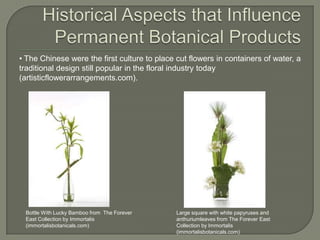
Early HistoryChinese began working with silk to create floral arrangementsItalians first started permanent botanicals as a business in the early 12th Century.French then began competing with Italians in the 14th Century with innovations in fabrics used to make floral arrangements
HistoryDuring the French Revolution of the late 1700’s, France’s top flower makers were forced to flee to EnglandThe descendants of these French craftsmen eventually brought permanent botanicals to America in the early 1800’sVictorian Age brought about unprecedented popularity in permanent botanicals in homes
20th Century Developments1920’s saw artificial flowers being sold by florists1930’s wreaths began being made with artificial fruits and flowersCelluloid was the most popular material in permanent botanicals in the 1940’sBecause of celluloid’s flammability, plastic took over as the material of choice for flower makers in the 1950’s
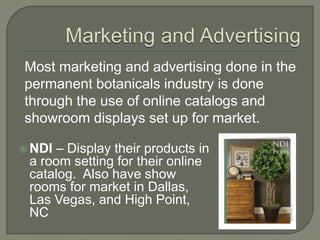
Marketing and AdvertisingMost marketing and advertising done in the permanent botanicals industry is done through the use of online catalogs and showroom displays set up for market.  NDI – Display their products in a room setting for their online catalog.  Also have show rooms for market in Dallas, Las Vegas, and High Point, NC
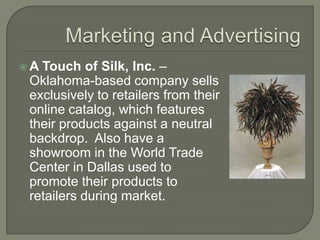
Marketing and AdvertisingA Touch of Silk, Inc. – Oklahoma-based company sells exclusively to retailers from their online catalog, which features their products against a neutral backdrop.  Also have a showroom in the World Trade Center in Dallas used to promote their products to retailers during market.
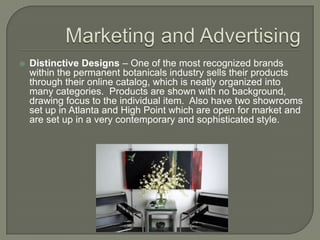
Marketing and AdvertisingDistinctive Designs – One of the most recognized brands within the permanent botanicals industry sells their products through their online catalog, which is neatly organized into many categories.  Products are shown with no background, drawing focus to the individual item.  Also have two showrooms set up in Atlanta and High Point which are open for market and are set up in a very contemporary and sophisticated style.
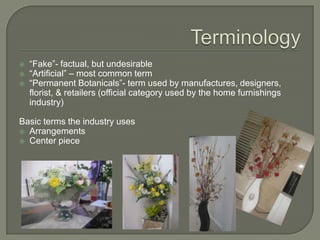
Terminology“Fake”- factual, but undesirable“Artificial” – most common term“Permanent Botanicals”- term used by manufactures, designers, florist, & retailers (official category used by the home furnishings industry)Basic terms the industry usesArrangementsCenter piece
TrendsGrowing demand for permanent botanicals in homes, restaurants, hotels, officesWhy? People are always “on the run”, fast pace & busy lifestyle
Allergies
Long lasting
Reusable
Realistic/ life-like
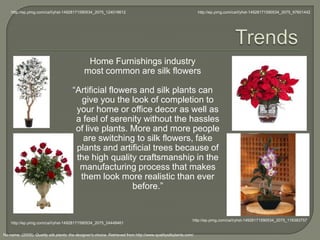
Professional & “do-it-yourself’” arrangements http://ep.yimg.com/ca/I/yhst-14928171590534_2075_97601442 http://ep.yimg.com/ca/I/yhst-14928171590534_2075_124018612 TrendsHome Furnishings industrymost common are silk flowers“Artificial flowers and silk plants can give you the look of completion to your home or office decor as well as a feel of serenity without the hassles of live plants. More and more people are switching to silk flowers, fake plants and artificial trees because of the high quality craftsmanship in the manufacturing process that makes them look more realistic than ever before.”http://ep.yimg.com/ca/I/yhst-14928171590534_2075_116383757 http://ep.yimg.com/ca/I/yhst-14928171590534_2075_24448461 No name. (2009). Quality silk plants: the designer's choice. Retrieved from http://www.qualitysilkplants.com/
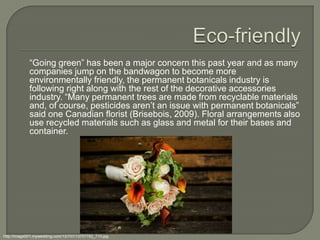
Eco-friendly	“Going green” has been a major concern this past year and as many companies jump on the bandwagon to become more environmentally friendly, the permanent botanicals industry is following right along with the rest of the decorative accessories industry. “Many permanent trees are made from recyclable materials and, of course, pesticides aren’t an issue with permanent botanicals” said one Canadian florist (Brisebois, 2009). Floral arrangements also use recycled materials such as glass and metal for their bases and container. http://image001.mywedding.com/13/707/13707782_710.jpg
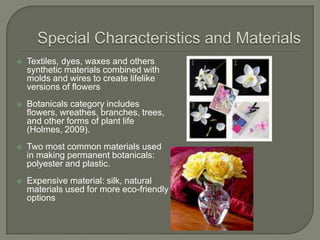
Special Characteristics and MaterialsTextiles, dyes, waxes and others synthetic materials combined with molds and wires to create lifelike versions of flowersBotanicals category includes flowers, wreathes, branches, trees, and other forms of plant life (Holmes, 2009).  Two most common materials used in making permanent botanicals: polyester and plastic. Expensive material: silk, natural materials used for more eco-friendly options
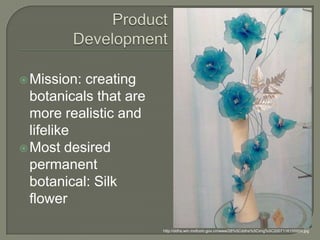
Product DevelopmentMission: creating botanicals that are more realistic and lifelikeMost desired permanent botanical: Silk flowerhttp://ddhs.win.mofcom.gov.cn/www/28%5Cddhs%5Cimg%5C2007116155955.jpg
SourcingThe largest exporter in the artificial flower industry is Hong Kong;One company in the city of Guangzhou has produced artificial flowers for over a decade. Nanhi Yasi Flower Arts Company
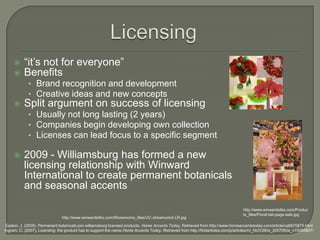
Licensing“it’s not for everyone”BenefitsBrand recognition and developmentCreative ideas and new conceptsSplit argument on success of licensingUsually not long lasting (2 years)Companies begin developing own collectionLicenses can lead focus to a specific segment2009 - Williamsburg has formed a new licensing relationship with Winward International to create permanent botanicals and seasonal accents http://www.winwardsilks.com/Products_files/Floral-tab-page-web.jpg http://www.winwardsilks.com/Showrooms_files/UC-showroom2-LR.jpg Easton, J. (2009). Permanent botanicals join williamsburg licensed products. Home Accents Today, Retrieved from http://www.homeaccentstoday.com/article/ca6670875.htmlIngram, C. (2007). Licensing: the product has to support the name.Home Accents Today, Retrieved from http://findarticles.com/p/articles/mi_hb3128/is_200705/ai_n19285807/
5 Major Competing Manufacturing CompaniesFoster’s PointManufactures flowers, trees, and greenery
Founded in 1990 in Spring, Texas
46 employees
Annual sales for 2008: $5.5 million
Each design handcrafted
Showrooms at Dallas Market Center, Atlanta Gift Mart, High Point Furniture Market, and Las Vegas World Market CenterDistinctive Designs InternationalSilk floral manufacturer and direct importer of botanical accessories
Founded over 30 years ago by designer, Emma Hoffman in Russellville, Alabama
Showrooms in Highpoint, NC and Atlanta, Georgia

Green dream presentation

  • 2.
    Early HistoryChinese beganworking with silk to create floral arrangementsItalians first started permanent botanicals as a business in the early 12th Century.French then began competing with Italians in the 14th Century with innovations in fabrics used to make floral arrangements
  • 3.
    HistoryDuring the FrenchRevolution of the late 1700’s, France’s top flower makers were forced to flee to EnglandThe descendants of these French craftsmen eventually brought permanent botanicals to America in the early 1800’sVictorian Age brought about unprecedented popularity in permanent botanicals in homes
  • 4.
    20th Century Developments1920’ssaw artificial flowers being sold by florists1930’s wreaths began being made with artificial fruits and flowersCelluloid was the most popular material in permanent botanicals in the 1940’sBecause of celluloid’s flammability, plastic took over as the material of choice for flower makers in the 1950’s
  • 5.
    Marketing and AdvertisingMostmarketing and advertising done in the permanent botanicals industry is done through the use of online catalogs and showroom displays set up for market. NDI – Display their products in a room setting for their online catalog. Also have show rooms for market in Dallas, Las Vegas, and High Point, NC
  • 6.
    Marketing and AdvertisingATouch of Silk, Inc. – Oklahoma-based company sells exclusively to retailers from their online catalog, which features their products against a neutral backdrop. Also have a showroom in the World Trade Center in Dallas used to promote their products to retailers during market.
  • 7.
    Marketing and AdvertisingDistinctiveDesigns – One of the most recognized brands within the permanent botanicals industry sells their products through their online catalog, which is neatly organized into many categories. Products are shown with no background, drawing focus to the individual item. Also have two showrooms set up in Atlanta and High Point which are open for market and are set up in a very contemporary and sophisticated style.
  • 8.
    Terminology“Fake”- factual, butundesirable“Artificial” – most common term“Permanent Botanicals”- term used by manufactures, designers, florist, & retailers (official category used by the home furnishings industry)Basic terms the industry usesArrangementsCenter piece
  • 9.
    TrendsGrowing demand forpermanent botanicals in homes, restaurants, hotels, officesWhy? People are always “on the run”, fast pace & busy lifestyle
  • 10.
  • 11.
  • 12.
  • 13.
  • 14.
    Professional & “do-it-yourself’”arrangements http://ep.yimg.com/ca/I/yhst-14928171590534_2075_97601442 http://ep.yimg.com/ca/I/yhst-14928171590534_2075_124018612 TrendsHome Furnishings industrymost common are silk flowers“Artificial flowers and silk plants can give you the look of completion to your home or office decor as well as a feel of serenity without the hassles of live plants. More and more people are switching to silk flowers, fake plants and artificial trees because of the high quality craftsmanship in the manufacturing process that makes them look more realistic than ever before.”http://ep.yimg.com/ca/I/yhst-14928171590534_2075_116383757 http://ep.yimg.com/ca/I/yhst-14928171590534_2075_24448461 No name. (2009). Quality silk plants: the designer's choice. Retrieved from http://www.qualitysilkplants.com/
  • 15.
    Eco-friendly “Going green” hasbeen a major concern this past year and as many companies jump on the bandwagon to become more environmentally friendly, the permanent botanicals industry is following right along with the rest of the decorative accessories industry. “Many permanent trees are made from recyclable materials and, of course, pesticides aren’t an issue with permanent botanicals” said one Canadian florist (Brisebois, 2009). Floral arrangements also use recycled materials such as glass and metal for their bases and container. http://image001.mywedding.com/13/707/13707782_710.jpg
  • 16.
    Special Characteristics andMaterialsTextiles, dyes, waxes and others synthetic materials combined with molds and wires to create lifelike versions of flowersBotanicals category includes flowers, wreathes, branches, trees, and other forms of plant life (Holmes, 2009).  Two most common materials used in making permanent botanicals: polyester and plastic. Expensive material: silk, natural materials used for more eco-friendly options
  • 17.
    Product DevelopmentMission: creatingbotanicals that are more realistic and lifelikeMost desired permanent botanical: Silk flowerhttp://ddhs.win.mofcom.gov.cn/www/28%5Cddhs%5Cimg%5C2007116155955.jpg
  • 18.
    SourcingThe largest exporterin the artificial flower industry is Hong Kong;One company in the city of Guangzhou has produced artificial flowers for over a decade. Nanhi Yasi Flower Arts Company
  • 19.
    Licensing“it’s not foreveryone”BenefitsBrand recognition and developmentCreative ideas and new conceptsSplit argument on success of licensingUsually not long lasting (2 years)Companies begin developing own collectionLicenses can lead focus to a specific segment2009 - Williamsburg has formed a new licensing relationship with Winward International to create permanent botanicals and seasonal accents http://www.winwardsilks.com/Products_files/Floral-tab-page-web.jpg http://www.winwardsilks.com/Showrooms_files/UC-showroom2-LR.jpg Easton, J. (2009). Permanent botanicals join williamsburg licensed products. Home Accents Today, Retrieved from http://www.homeaccentstoday.com/article/ca6670875.htmlIngram, C. (2007). Licensing: the product has to support the name.Home Accents Today, Retrieved from http://findarticles.com/p/articles/mi_hb3128/is_200705/ai_n19285807/
  • 20.
    5 Major CompetingManufacturing CompaniesFoster’s PointManufactures flowers, trees, and greenery
  • 21.
    Founded in 1990in Spring, Texas
  • 22.
  • 23.
    Annual sales for2008: $5.5 million
  • 24.
  • 25.
    Showrooms at DallasMarket Center, Atlanta Gift Mart, High Point Furniture Market, and Las Vegas World Market CenterDistinctive Designs InternationalSilk floral manufacturer and direct importer of botanical accessories
  • 26.
    Founded over 30years ago by designer, Emma Hoffman in Russellville, Alabama
  • 27.
    Showrooms in Highpoint,NC and Atlanta, Georgia

Editor's Notes

  • #13 Other materials includes plastics, silk, rayon, cotton, satin, velvet, calico, crepe and gauze; other elements include: wood, porcelain, palm leaves, metals, and wax. two common materials =Polyesters low cost, durability and lastly for aesthetic reasons. Polyester actually has the ability to take dyes and glues better than other fibers; this is crucial in making a higher quality and more life-like product. The second material, plastic is most seen in the accessories in botanicals. Parts such as stems, berries and leaves are easily and inexpensively made using plastics (Holmes, 2009).
  • #15  HK = bringing in 887 million dollars in 2002 (Emerging, 2003). Since then, Hong Kong has continued to dominate the market, especially in the United States, which accounts for 60% of Hong Kong’s total exports. They pride themselves on their professional technique, advanced equipment and management systems. They sell to many regions, such as Europe, U.S., Japan and Canada. What makes this company successful in the permanent botanical industry is their attention to detail and use of modern technology.Their website states: “produce quality, deliver promptly, offer reasonable prices, seeks prestige and sets the customer satisfaction maximization as the develop goal”(Lizhen, 2009).