NJIT_COAD | 504G-506G COMPREHENSIVE DESIGN STUDIO | SPRING 2015
COLUMN LIKE I SEE ‘EM
An Artist Retreat :Live, Work, Show.
PHILLIP GRASSO
Design Narrative
Architectural Concept
Architectural Drawings
Building Plans
Building Sections
Wall Sections
Details
Exterior and Interior Views
Model
Index
NJIT_COAD | 504G-506G COMPREHENSIVE DESIGN STUDIO | SPRING 2015
4-5
6-13
14-15
16-19
20-21
22-23
24-27
28-29
4
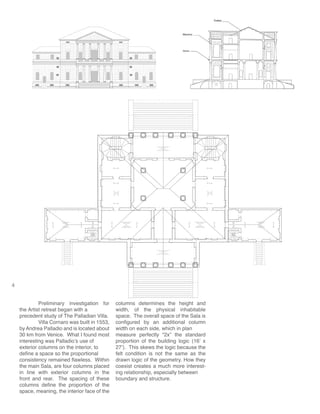
	 Preliminary investigation for
the Artist retreat began with a
precedent study of The Palladian Villa.
	 Villa Cornaro was built in 1553,
by Andrea Palladio and is located about
30 km from Venice. What I found most
interesting was Palladio’s use of
exterior columns on the interior, to
define a space so the proportional
consistency remained flawless. Within
the main Sala, are four columns placed
in line with exterior columns in the
front and rear. The spacing of these
columns define the proportion of the
space, meaning, the interior face of the
columns determines the height and
width, of the physical inhabitable
space. The overall space of the Sala is
configured by an additional column
width on each side, which in plan
measure perfectly “2x” the standard
proportion of the building logic (16’ x
27’). This skews the logic because the
felt condition is not the same as the
drawn logic of the geometry. How they
coexist creates a much more interest-
ing relationship, especially between
boundary and structure.
5
NJIT_COAD | 504G-506G COMPREHENSIVE DESIGN STUDIO | SPRING 2015
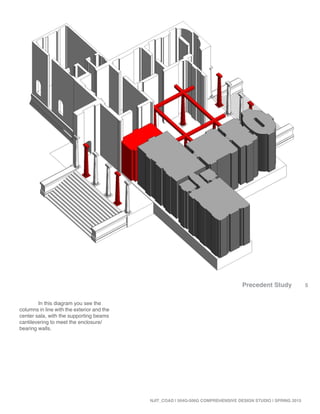
	 In this diagram you see the
columns in line with the exterior and the
center sala, with the supporting beams
cantilevering to meet the enclosure/
bearing walls.
Precedent Study
6
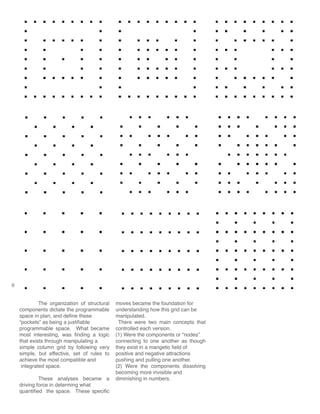
	 The organization of structural
components dictate the programmable
space in plan, and define these
“pockets” as being a justifiable
programmable space. What became
most interesting, was finding a logic
that exists through manipulating a
simple column grid by following very
simple, but effective, set of rules to
achieve the most compatible and
integrated space.
	 These analyses became a
driving force in determing what
quantified the space. These specific
moves became the foundation for
understanding how this grid can be
manipulated.
There were two main concepts that
controlled each version.
(1) Were the components or “nodes”
connecting to one another as though
they exist in a mangetic field of
positive and negative attractions
pushing and pulling one another.
(2) Were the components dissolving
becoming more invisible and
diminishing in numbers.
7
NJIT_COAD | 504G-506G COMPREHENSIVE DESIGN STUDIO | SPRING 2015
DESIGN NARRATIVE
8
9
NJIT_COAD | 504G-506G COMPREHENSIVE DESIGN STUDIO | SPRING 2015
10
11
NJIT_COAD | 504G-506G COMPREHENSIVE DESIGN STUDIO | SPRING 2015
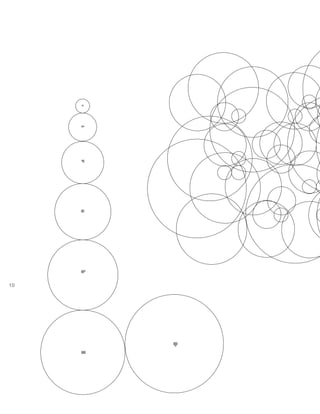
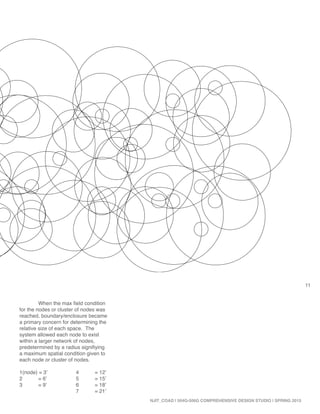
	 When the max field condition
for the nodes or cluster of nodes was
reached, boundary/enclosure became
a primary concern for determining the
relative size of each space. The
system allowed each node to exist
within a larger network of nodes,
predetermined by a radius signifiying
a maximum spatial condition given to
each node or cluster of nodes.
1(node) = 3’ 		 4	 = 12’
2	 = 6’		 5	 = 15’
3	 = 9’		 6	 = 18’
			7	= 21’
12
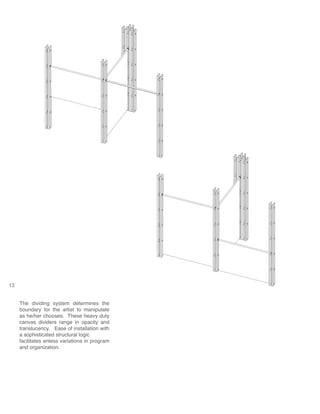
The dividing system determines the
boundary for the artist to manipulate
as he/her chooses. These heavy duty
canvas dividers range in opacity and
translucency. Ease of installation with
a sophisticated structural logic
facilitates enless variations in program
and organization.
13
NJIT_COAD | 504G-506G COMPREHENSIVE DESIGN STUDIO | SPRING 2015
maximum -> minumum dividing
conditions
N
1’
SECTION A:A
SECTION B:B
SECTION D:D
10’
14
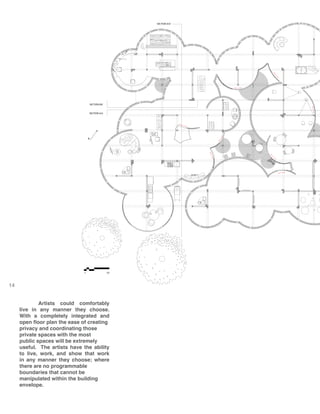
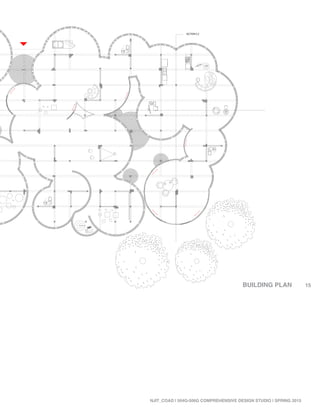
	 Artists could comfortably
live in any manner they choose.
With a completely integrated and
open floor plan the ease of creating
privacy and coordinating those
private spaces with the most
public spaces will be extremely
useful. The artists have the ability
to live, work, and show that work
in any manner they choose; where
there are no programmable
boundaries that cannot be
manipulated within the building
envelope.
SECTION C:C
15
NJIT_COAD | 504G-506G COMPREHENSIVE DESIGN STUDIO | SPRING 2015
BUILDING PLAN
SECTION C:C
1’ 10’
16
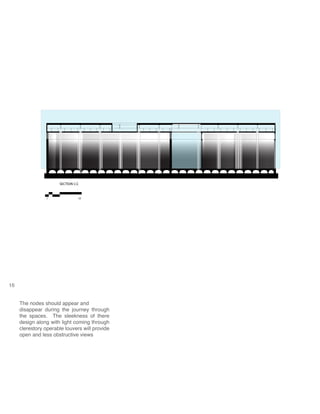
The nodes should appear and
disappear during the journey through
the spaces. The sleekness of there
design along with light coming through
clerestory operable louvers will provide
open and less obstructive views
SECTION D:D
17
NJIT_COAD | 504G-506G COMPREHENSIVE DESIGN STUDIO | SPRING 2015
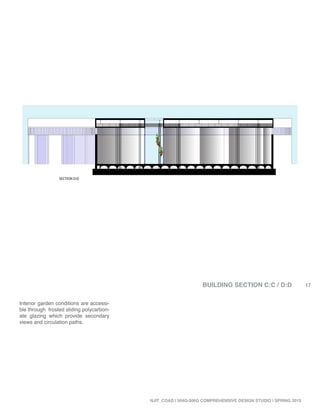
Interior garden conditions are accessi-
ble through frosted sliding polycarbon-
ate glazing which provide secondary
views and circulation paths.
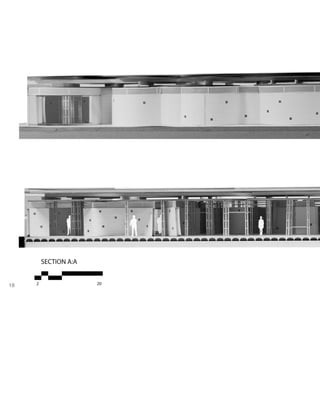
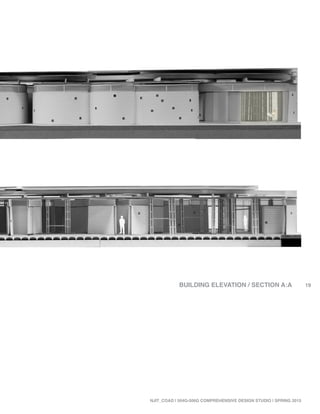
BUILDING SECTION C:C / D:D
18
19
NJIT_COAD | 504G-506G COMPREHENSIVE DESIGN STUDIO | SPRING 2015
BUILDING ELEVATION / SECTION A:A
1
2
3
4
5
6
SECTION B:B
.5’ 5’
20
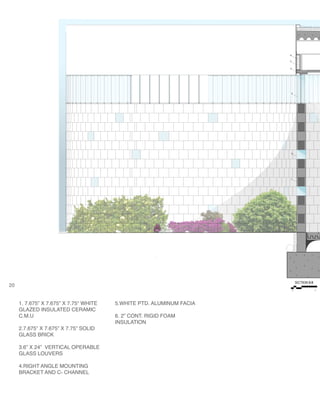
1. 7.675” X 7.675” X 7.75“ WHITE
GLAZED INSULATED CERAMIC
C.M.U
2.7.675” X 7.675” X 7.75” SOLID
GLASS BRICK
3.6” X 24” VERTICAL OPERABLE
GLASS LOUVERS
4.RIGHT ANGLE MOUNTING
BRACKET AND C- CHANNEL
5.WHITE PTD. ALUMINUM FACIA
6. 2” CONT. RIGID FOAM
INSULATION
21
NJIT_COAD | 504G-506G COMPREHENSIVE DESIGN STUDIO | SPRING 2015
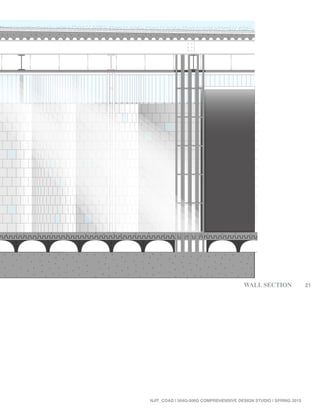
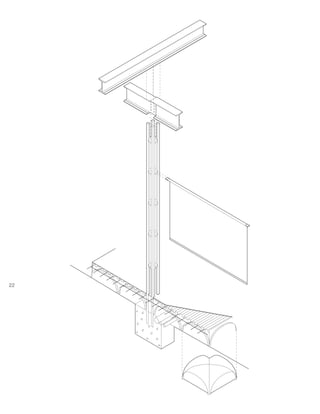
WALL SECTION
22
1 5
3”=1’0”
1
2
3
4
5
6
7
8
9
10
11 12
13
14
15
16
17
18
19
6”
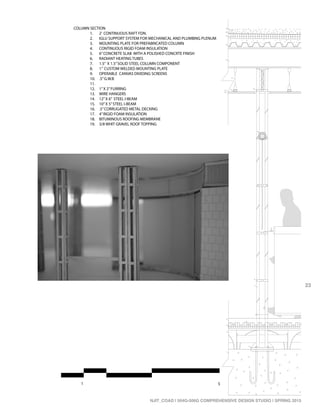
COLUMN SECTION
1. 2’ CONTINUOUS RAFT FDN.
2. IGLU SUPPORT SYSTEM FOR MECHANICAL AND PLUMBING PLENUM
3. MOUNTING PLATE FOR PREFABRICATED COLUMN
4. CONTINUOUS RIGID FOAM INSULATION
5. 6”CONCRETE SLAB WITH A POLISHED CONCRTE FINISH
6. RADIANT HEATING TUBES
7. 1.5” X 1.5”SOLID STEEL COLUMN COMPONENT
8. 1” CUSTOM WELDED MOUNTING PLATE
9. OPERABLE CANVAS DIVIDING SCREENS
10. .5”G.W.B
11.
12. 1”X 2”FURRING
13. WIRE HANGERS
14. 12”X 6” STEEL I-BEAM
15. 10”X 5”STEEL I-BEAM
16. .5”CORRUGATED METAL DECKING
17. 4”RIGID FOAM INSULATION
18. BITUMINOUS ROOFING MEMBRANE
19. 3/8 WHIT GRAVEL ROOF TOPPING
23
NJIT_COAD | 504G-506G COMPREHENSIVE DESIGN STUDIO | SPRING 2015
24
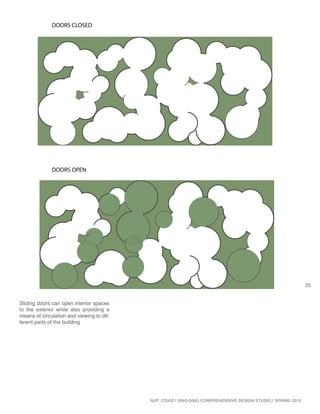
DOORS CLOSED
DOORS OPEN
25
NJIT_COAD | 504G-506G COMPREHENSIVE DESIGN STUDIO | SPRING 2015
Sliding doors can open interior spaces
to the exterior while also providing a
means of circulation and viewing to dif-
ferent parts of the building
26
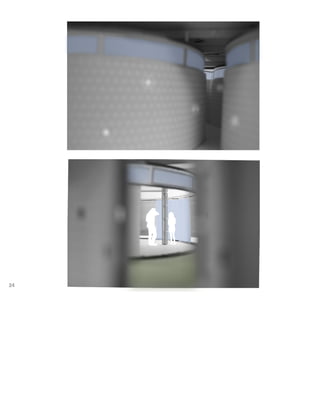
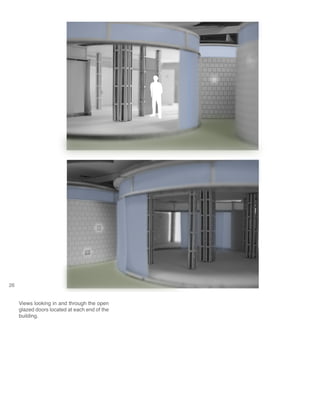
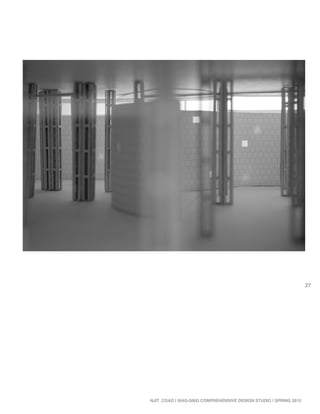
Views looking in and through the open
glazed doors located at each end of the
building.
27
NJIT_COAD | 504G-506G COMPREHENSIVE DESIGN STUDIO | SPRING 2015
28
29
NJIT_COAD | 504G-506G COMPREHENSIVE DESIGN STUDIO | SPRING 2015
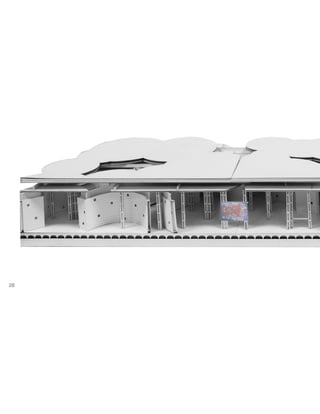
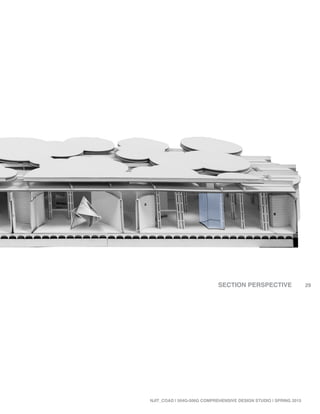
SECTION PERSPECTIVE

Grasso phillip arc504_6_g_booklet

  • 1.
    NJIT_COAD | 504G-506GCOMPREHENSIVE DESIGN STUDIO | SPRING 2015 COLUMN LIKE I SEE ‘EM An Artist Retreat :Live, Work, Show. PHILLIP GRASSO
  • 3.
    Design Narrative Architectural Concept ArchitecturalDrawings Building Plans Building Sections Wall Sections Details Exterior and Interior Views Model Index NJIT_COAD | 504G-506G COMPREHENSIVE DESIGN STUDIO | SPRING 2015 4-5 6-13 14-15 16-19 20-21 22-23 24-27 28-29
  • 4.
    4 Preliminary investigationfor the Artist retreat began with a precedent study of The Palladian Villa. Villa Cornaro was built in 1553, by Andrea Palladio and is located about 30 km from Venice. What I found most interesting was Palladio’s use of exterior columns on the interior, to define a space so the proportional consistency remained flawless. Within the main Sala, are four columns placed in line with exterior columns in the front and rear. The spacing of these columns define the proportion of the space, meaning, the interior face of the columns determines the height and width, of the physical inhabitable space. The overall space of the Sala is configured by an additional column width on each side, which in plan measure perfectly “2x” the standard proportion of the building logic (16’ x 27’). This skews the logic because the felt condition is not the same as the drawn logic of the geometry. How they coexist creates a much more interest- ing relationship, especially between boundary and structure.
  • 5.
    5 NJIT_COAD | 504G-506GCOMPREHENSIVE DESIGN STUDIO | SPRING 2015 In this diagram you see the columns in line with the exterior and the center sala, with the supporting beams cantilevering to meet the enclosure/ bearing walls. Precedent Study
  • 6.
    6 The organizationof structural components dictate the programmable space in plan, and define these “pockets” as being a justifiable programmable space. What became most interesting, was finding a logic that exists through manipulating a simple column grid by following very simple, but effective, set of rules to achieve the most compatible and integrated space. These analyses became a driving force in determing what quantified the space. These specific moves became the foundation for understanding how this grid can be manipulated. There were two main concepts that controlled each version. (1) Were the components or “nodes” connecting to one another as though they exist in a mangetic field of positive and negative attractions pushing and pulling one another. (2) Were the components dissolving becoming more invisible and diminishing in numbers.
  • 7.
    7 NJIT_COAD | 504G-506GCOMPREHENSIVE DESIGN STUDIO | SPRING 2015 DESIGN NARRATIVE
  • 8.
  • 9.
    9 NJIT_COAD | 504G-506GCOMPREHENSIVE DESIGN STUDIO | SPRING 2015
  • 10.
  • 11.
    11 NJIT_COAD | 504G-506GCOMPREHENSIVE DESIGN STUDIO | SPRING 2015 When the max field condition for the nodes or cluster of nodes was reached, boundary/enclosure became a primary concern for determining the relative size of each space. The system allowed each node to exist within a larger network of nodes, predetermined by a radius signifiying a maximum spatial condition given to each node or cluster of nodes. 1(node) = 3’ 4 = 12’ 2 = 6’ 5 = 15’ 3 = 9’ 6 = 18’ 7 = 21’
  • 12.
    12 The dividing systemdetermines the boundary for the artist to manipulate as he/her chooses. These heavy duty canvas dividers range in opacity and translucency. Ease of installation with a sophisticated structural logic facilitates enless variations in program and organization.
  • 13.
    13 NJIT_COAD | 504G-506GCOMPREHENSIVE DESIGN STUDIO | SPRING 2015 maximum -> minumum dividing conditions
  • 14.
    N 1’ SECTION A:A SECTION B:B SECTIOND:D 10’ 14 Artists could comfortably live in any manner they choose. With a completely integrated and open floor plan the ease of creating privacy and coordinating those private spaces with the most public spaces will be extremely useful. The artists have the ability to live, work, and show that work in any manner they choose; where there are no programmable boundaries that cannot be manipulated within the building envelope.
  • 15.
    SECTION C:C 15 NJIT_COAD |504G-506G COMPREHENSIVE DESIGN STUDIO | SPRING 2015 BUILDING PLAN
  • 16.
    SECTION C:C 1’ 10’ 16 Thenodes should appear and disappear during the journey through the spaces. The sleekness of there design along with light coming through clerestory operable louvers will provide open and less obstructive views
  • 17.
    SECTION D:D 17 NJIT_COAD |504G-506G COMPREHENSIVE DESIGN STUDIO | SPRING 2015 Interior garden conditions are accessi- ble through frosted sliding polycarbon- ate glazing which provide secondary views and circulation paths. BUILDING SECTION C:C / D:D
  • 18.
  • 19.
    19 NJIT_COAD | 504G-506GCOMPREHENSIVE DESIGN STUDIO | SPRING 2015 BUILDING ELEVATION / SECTION A:A
  • 20.
    1 2 3 4 5 6 SECTION B:B .5’ 5’ 20 1.7.675” X 7.675” X 7.75“ WHITE GLAZED INSULATED CERAMIC C.M.U 2.7.675” X 7.675” X 7.75” SOLID GLASS BRICK 3.6” X 24” VERTICAL OPERABLE GLASS LOUVERS 4.RIGHT ANGLE MOUNTING BRACKET AND C- CHANNEL 5.WHITE PTD. ALUMINUM FACIA 6. 2” CONT. RIGID FOAM INSULATION
  • 21.
    21 NJIT_COAD | 504G-506GCOMPREHENSIVE DESIGN STUDIO | SPRING 2015 WALL SECTION
  • 22.
  • 23.
    1 5 3”=1’0” 1 2 3 4 5 6 7 8 9 10 11 12 13 14 15 16 17 18 19 6” COLUMNSECTION 1. 2’ CONTINUOUS RAFT FDN. 2. IGLU SUPPORT SYSTEM FOR MECHANICAL AND PLUMBING PLENUM 3. MOUNTING PLATE FOR PREFABRICATED COLUMN 4. CONTINUOUS RIGID FOAM INSULATION 5. 6”CONCRETE SLAB WITH A POLISHED CONCRTE FINISH 6. RADIANT HEATING TUBES 7. 1.5” X 1.5”SOLID STEEL COLUMN COMPONENT 8. 1” CUSTOM WELDED MOUNTING PLATE 9. OPERABLE CANVAS DIVIDING SCREENS 10. .5”G.W.B 11. 12. 1”X 2”FURRING 13. WIRE HANGERS 14. 12”X 6” STEEL I-BEAM 15. 10”X 5”STEEL I-BEAM 16. .5”CORRUGATED METAL DECKING 17. 4”RIGID FOAM INSULATION 18. BITUMINOUS ROOFING MEMBRANE 19. 3/8 WHIT GRAVEL ROOF TOPPING 23 NJIT_COAD | 504G-506G COMPREHENSIVE DESIGN STUDIO | SPRING 2015
  • 24.
  • 25.
    DOORS CLOSED DOORS OPEN 25 NJIT_COAD| 504G-506G COMPREHENSIVE DESIGN STUDIO | SPRING 2015 Sliding doors can open interior spaces to the exterior while also providing a means of circulation and viewing to dif- ferent parts of the building
  • 26.
    26 Views looking inand through the open glazed doors located at each end of the building.
  • 27.
    27 NJIT_COAD | 504G-506GCOMPREHENSIVE DESIGN STUDIO | SPRING 2015
  • 28.
  • 29.
    29 NJIT_COAD | 504G-506GCOMPREHENSIVE DESIGN STUDIO | SPRING 2015 SECTION PERSPECTIVE