Graphs and Innovative Graph
Solutions for Financial Services
Christopher Upkes
Senior Field Engineer
What are we going to do?
• Why graphs?
• What do we use graphs for?
• Graph Theory explained
• Extending Practical Graph Use: The Property Graph Model Revolution
• Use Case 1: Measuring risk in corporate lending
• Use Case 2: Understanding the exposure to commodities or industries
• Use Case 3: Predicting behavior of customers
Why graphs?
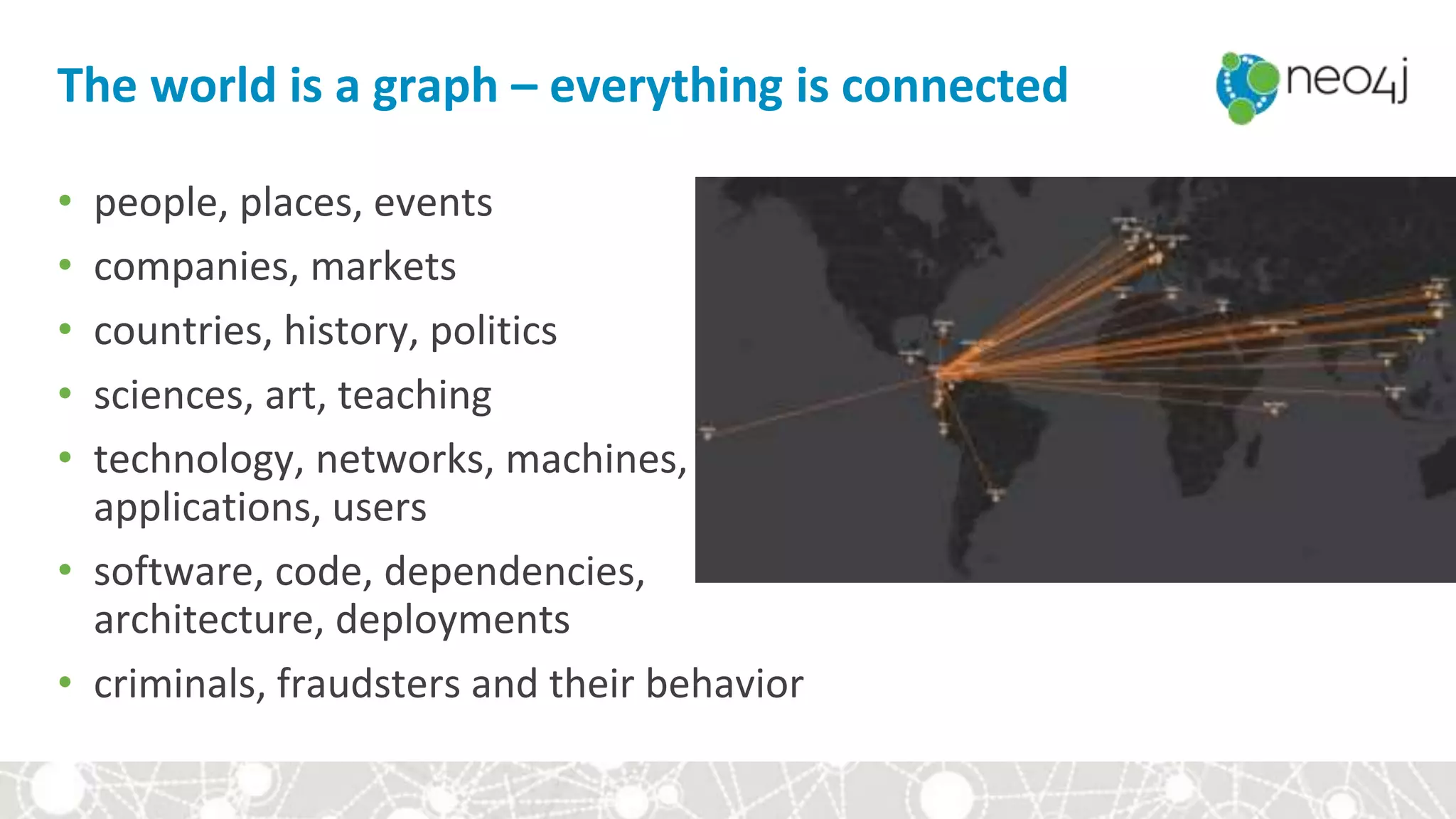
The world is a graph – everything is connected
• people, places, events
• companies, markets
• countries, history, politics
• sciences, art, teaching
• technology, networks, machines,
applications, users
• software, code, dependencies,
architecture, deployments
• criminals, fraudsters and their behavior
What Industry Analysts are Communicating
about Graph Database
• “Graph analysis is possibly the single most effective competitive
differentiator for organizations pursuing data-driven operations and
decisions after the design of data capture.”
• “Graph analysis is the true killer app for Big Data.”
• “…(Software) vendors are investing in Graph Databases.”
• “Graph repositories help MDM better connect conceptual master data
models with logical models…that RDBMS repositories often constrain.”
Private & Confidential 5
What are people using
graph databases for?
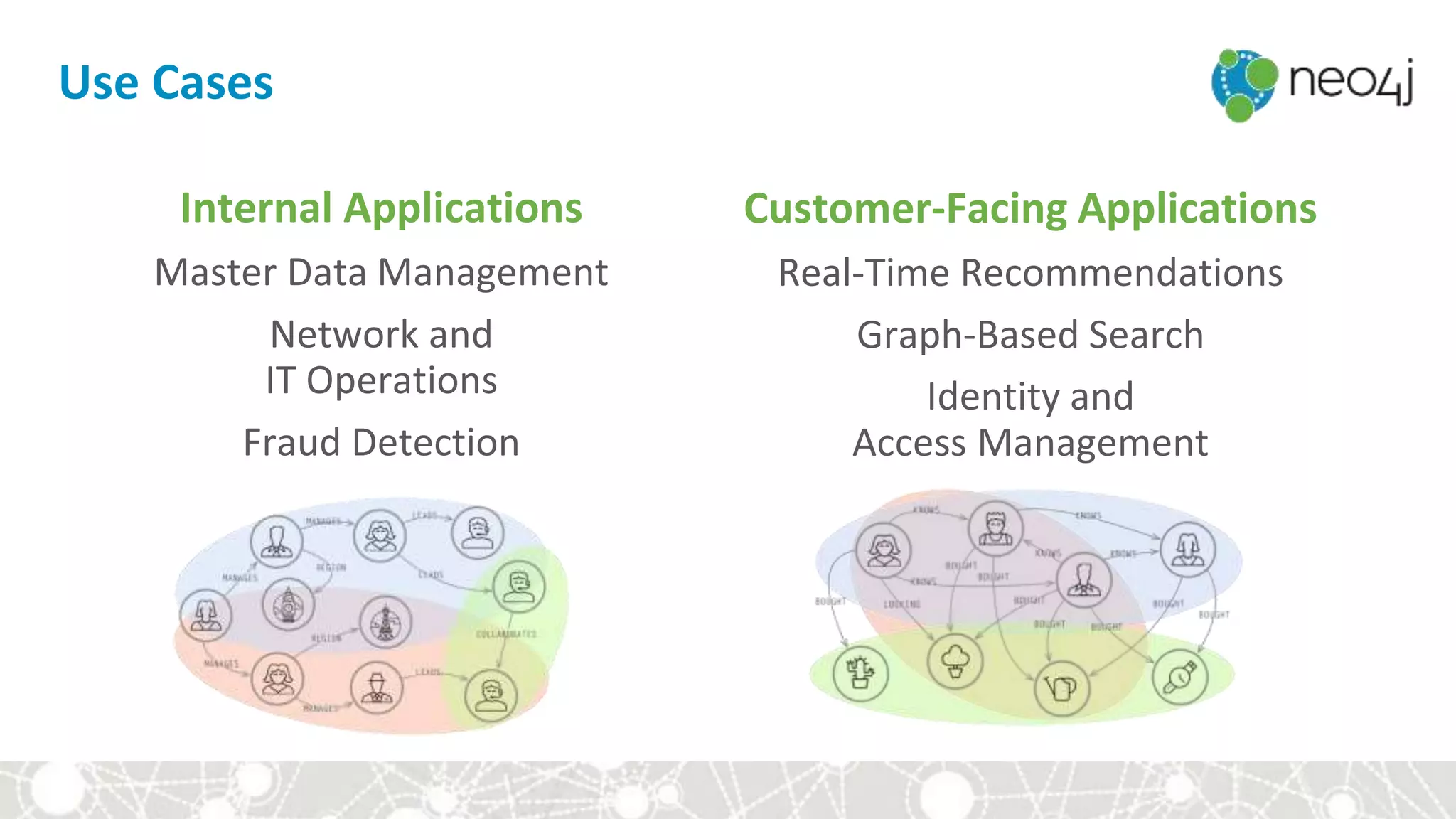
Use Cases
Internal Applications
Master Data Management
Network and
IT Operations
Fraud Detection
Customer-Facing Applications
Real-Time Recommendations
Graph-Based Search
Identity and
Access Management
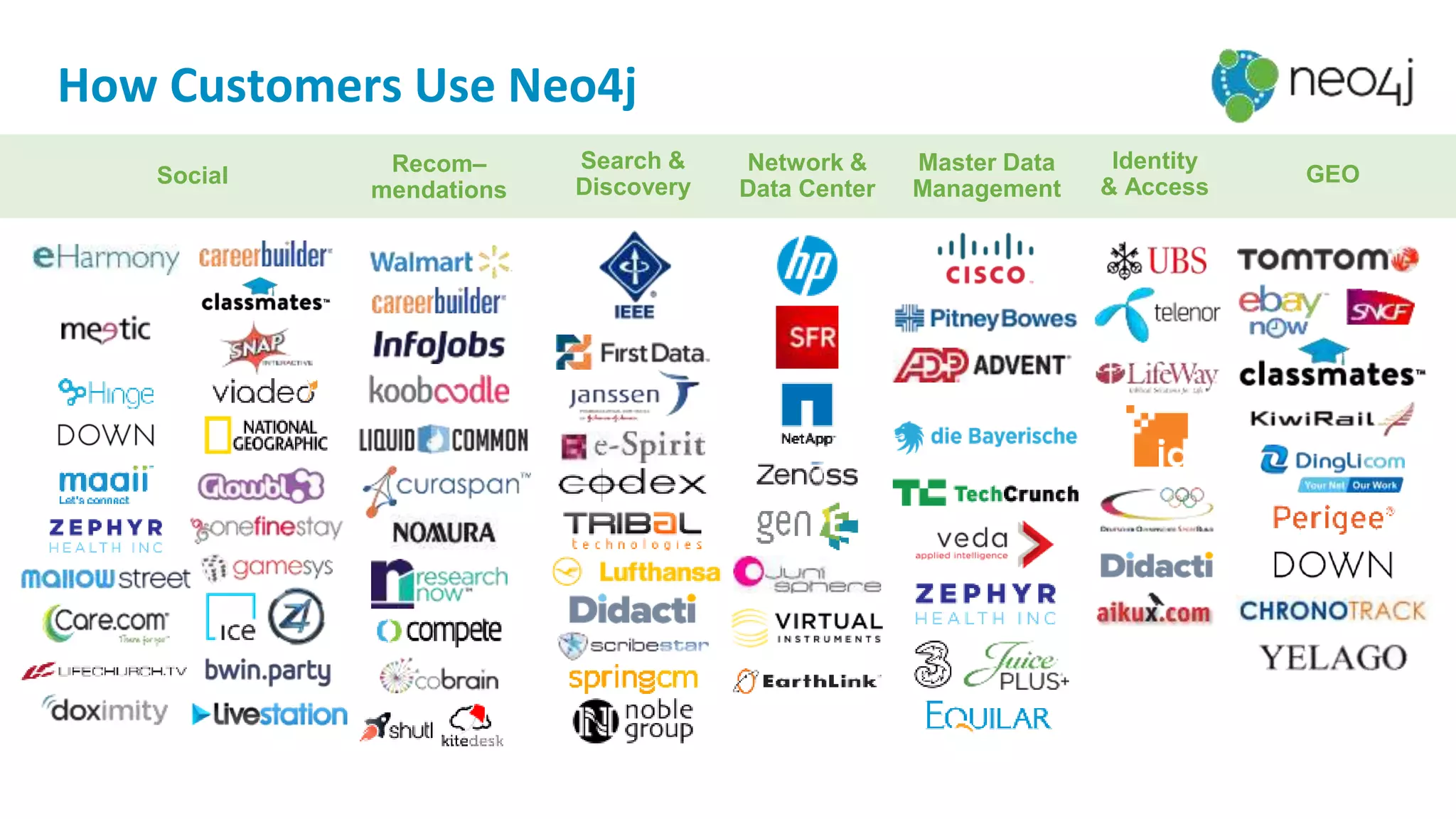
How Customers Use Neo4j
Network &
Data Center
Master Data
Management
Social Recom–
mendations
Identity
& Access
Search &
Discovery
GEO
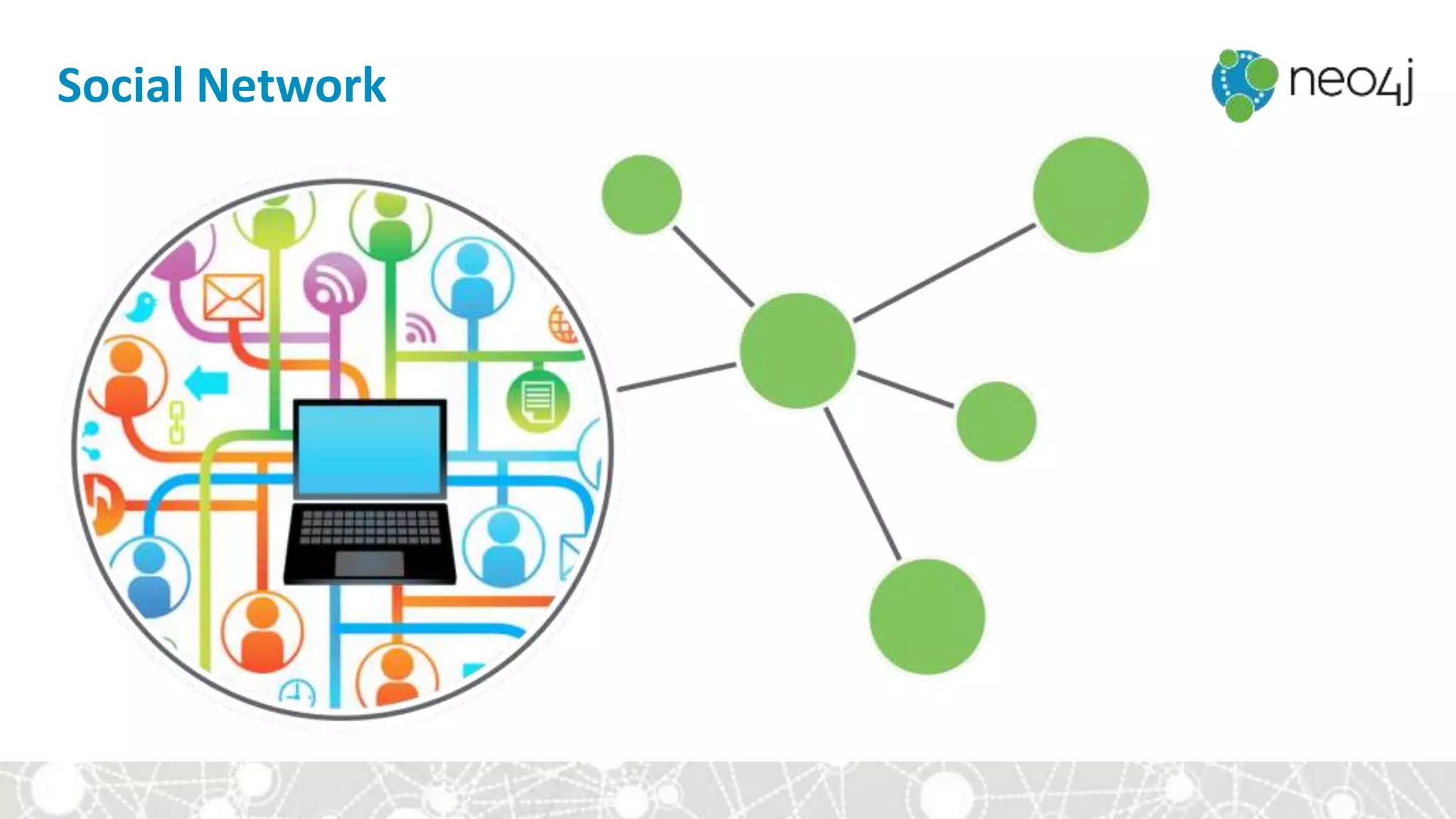
Social Network
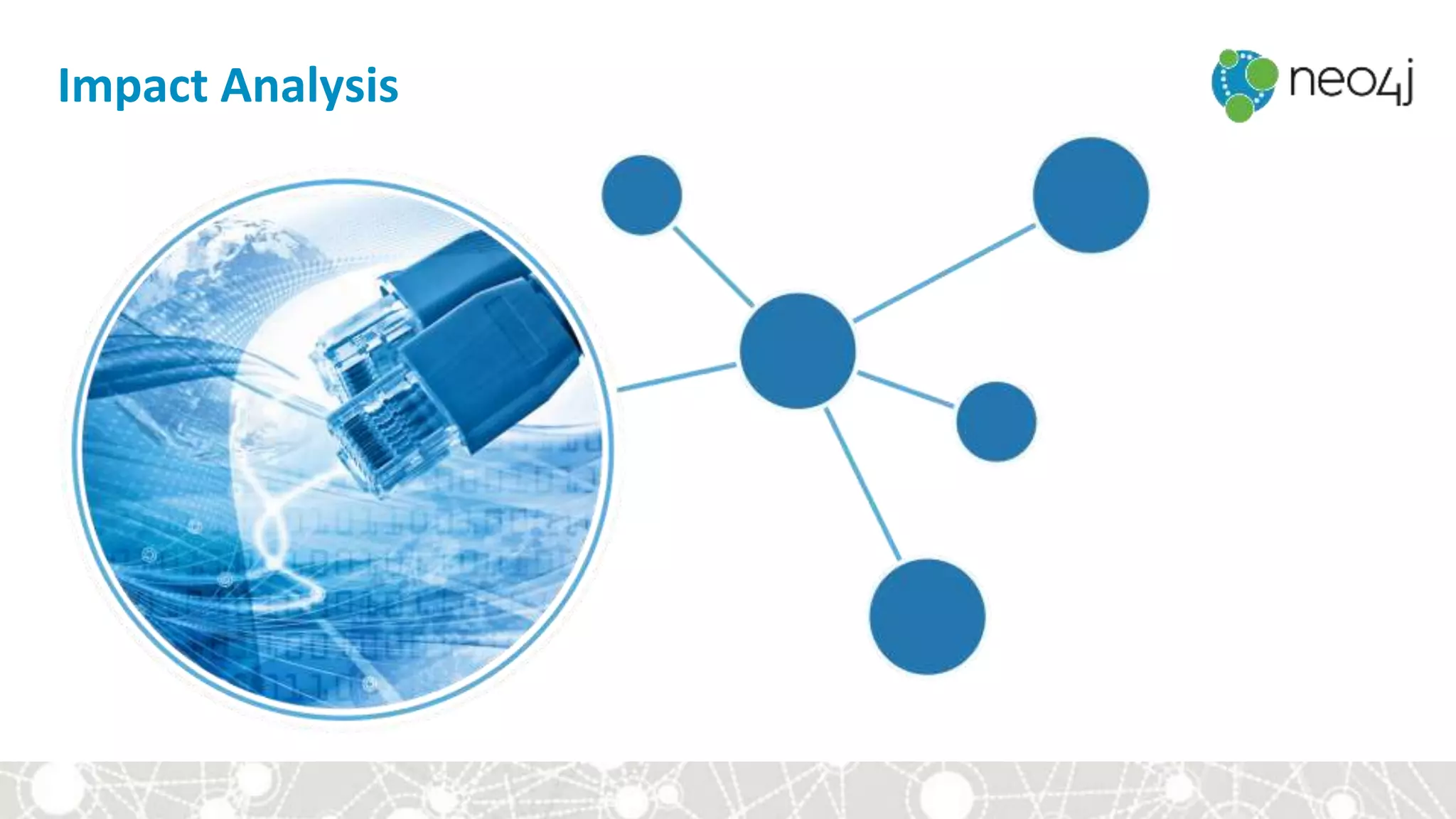
Impact Analysis
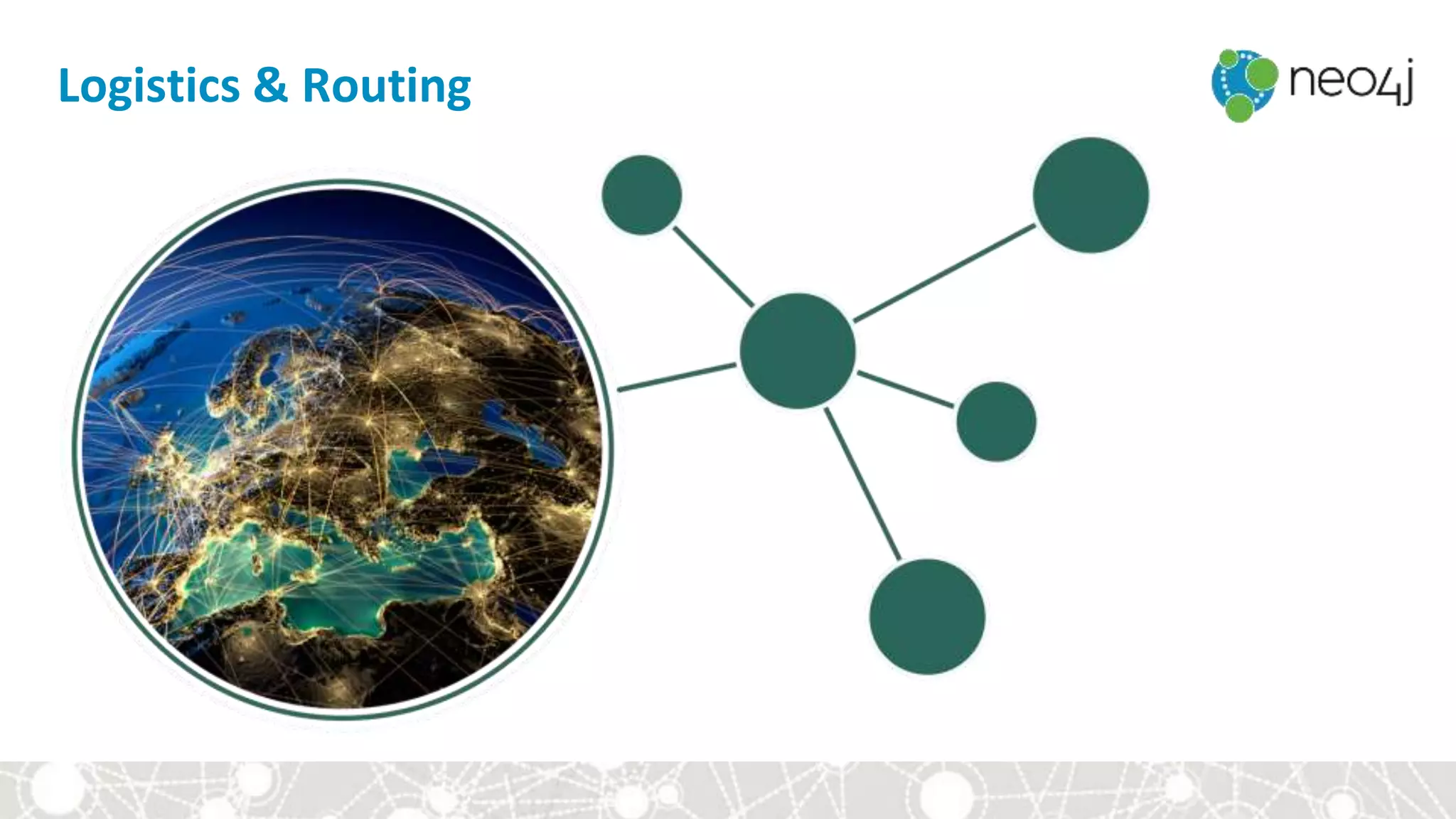
Logistics & Routing
Recommendations
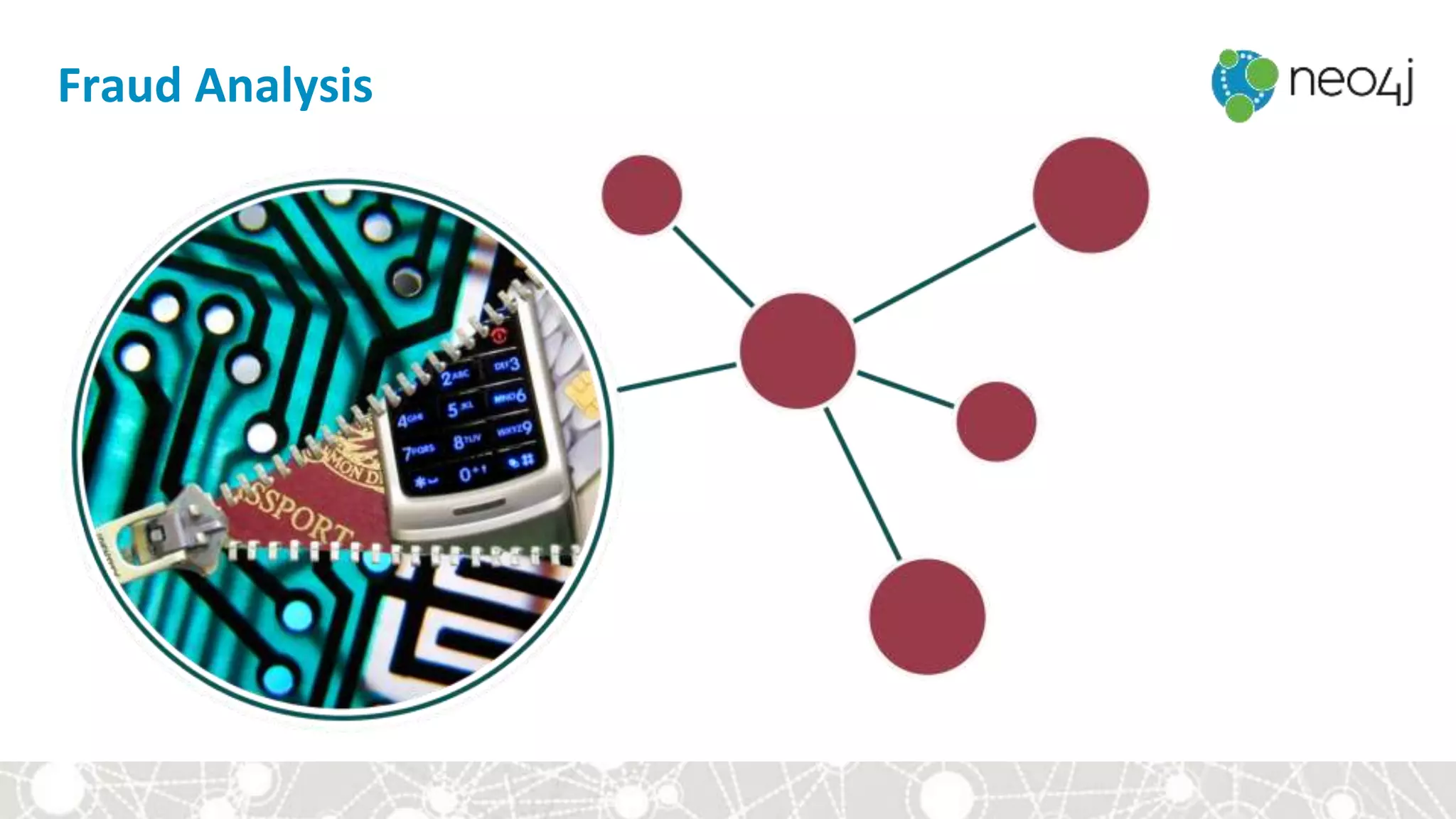
Fraud Analysis
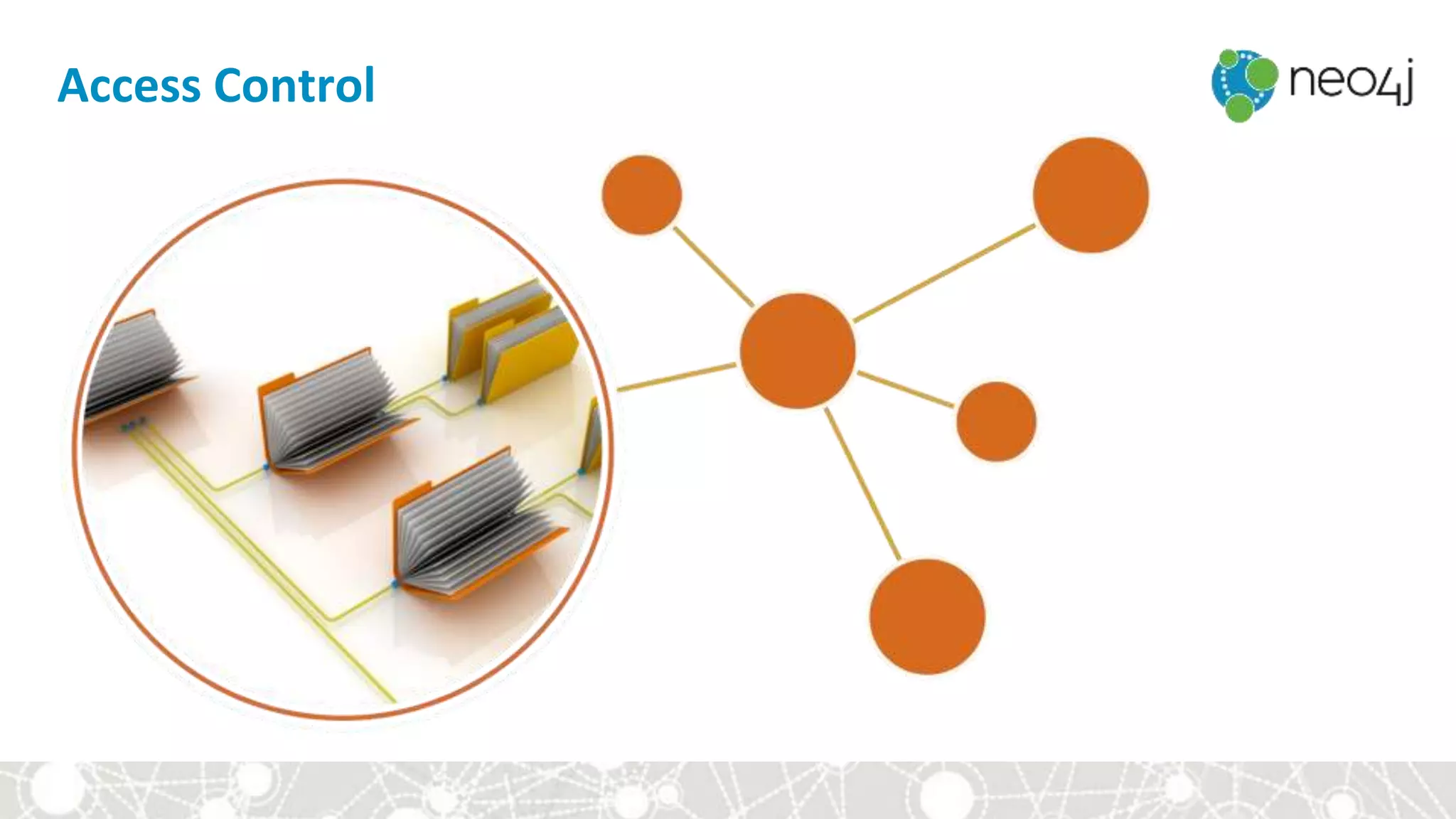
Access Control
Graph Theory
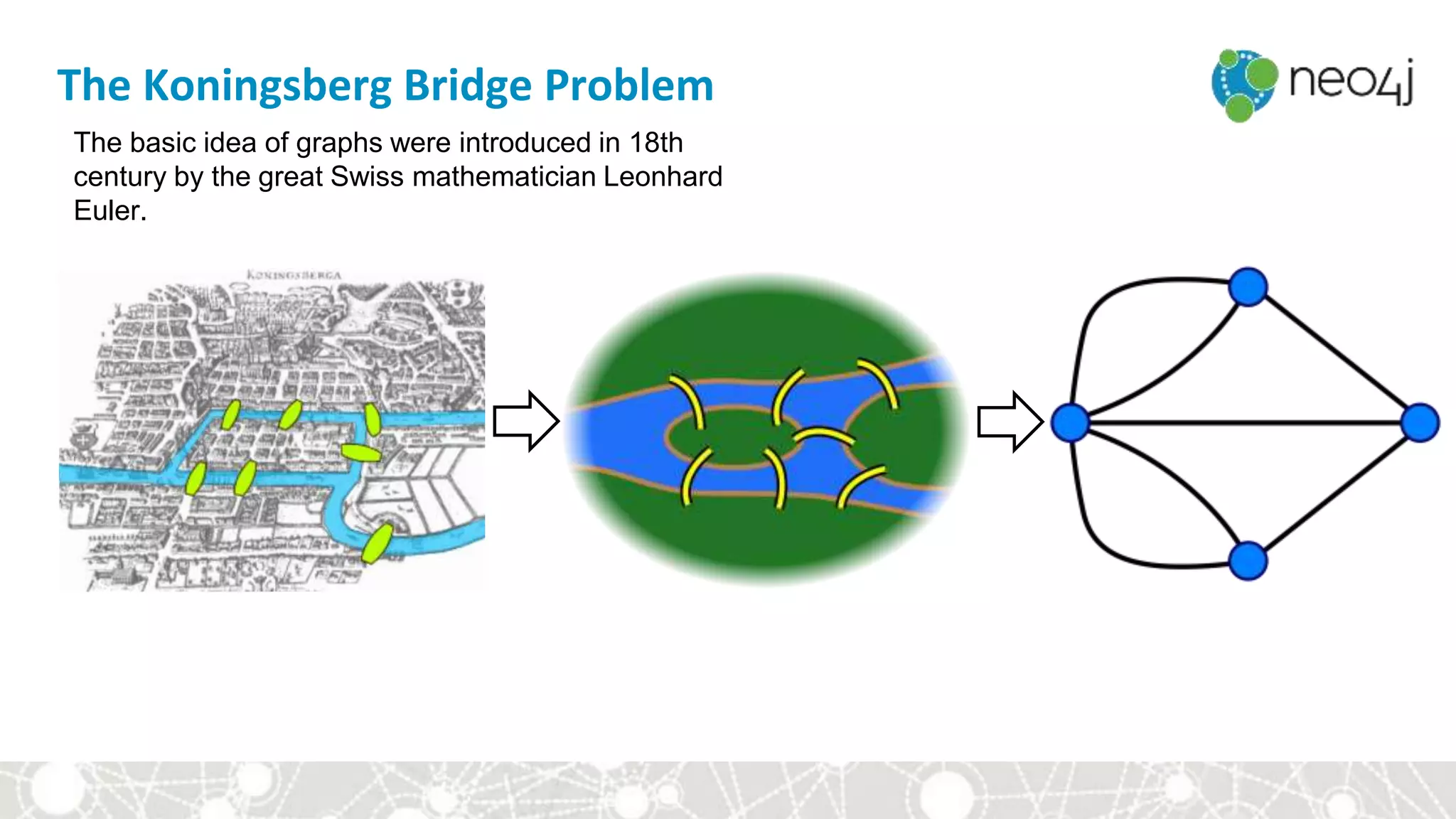
The Koningsberg Bridge Problem
The basic idea of graphs were introduced in 18th
century by the great Swiss mathematician Leonhard
Euler.
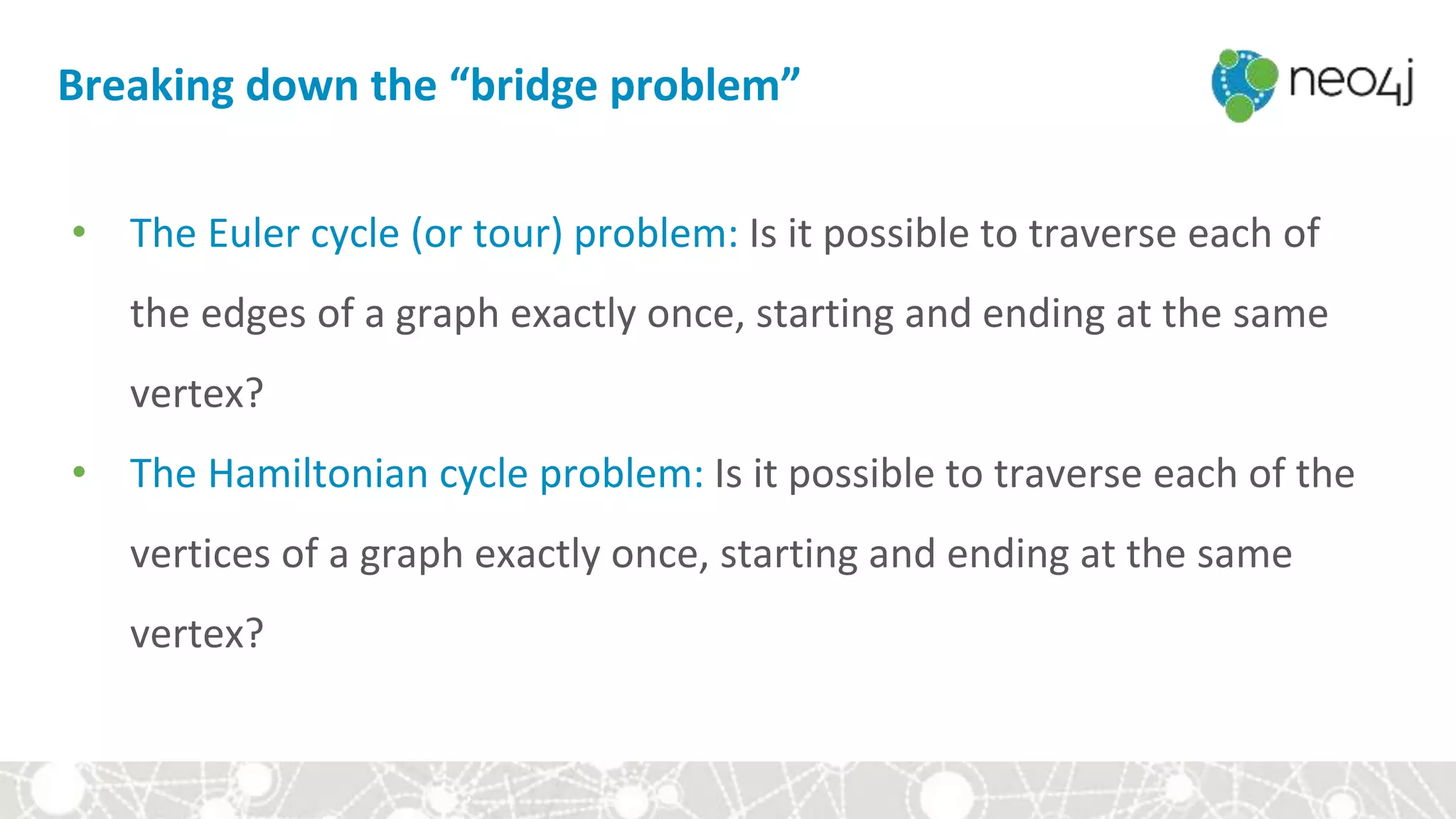
Breaking down the “bridge problem”
• The Euler cycle (or tour) problem: Is it possible to traverse each of
the edges of a graph exactly once, starting and ending at the same
vertex?
• The Hamiltonian cycle problem: Is it possible to traverse each of the
vertices of a graph exactly once, starting and ending at the same
vertex?
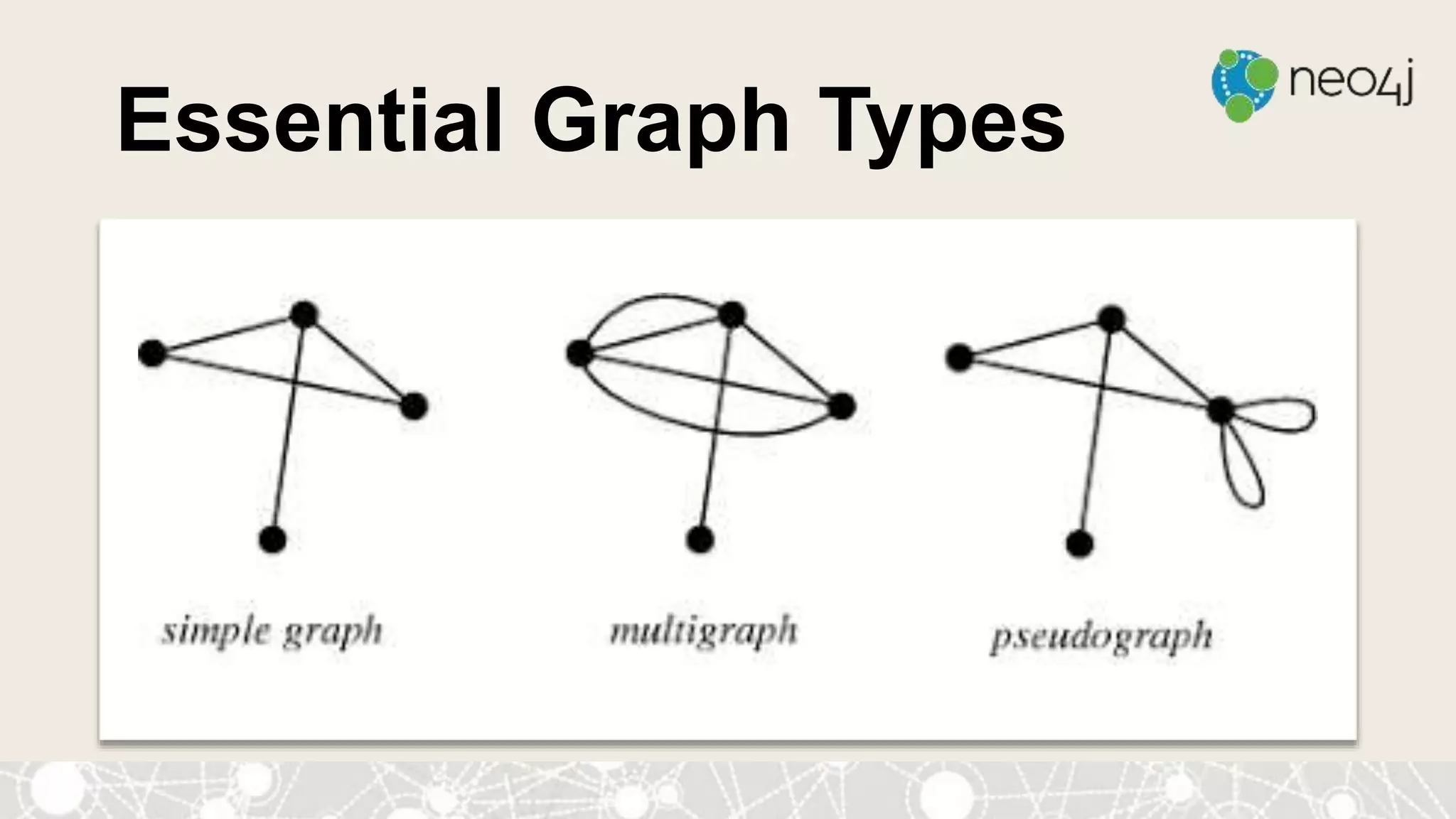
Essential Graph Types
What’s all the fuss?
• Vertex = a point where two lines meet
• Edge = lines that join to form vertices
Neo4j Fundamentals
What if?
• A vertex could represent something more concrete?
• A customer
• A business
• An asset
• What if edges could provide more context
• Cash flow
• A Transaction (withdraw, deposit)
• A meaningful interaction (borrows from, supplies to)
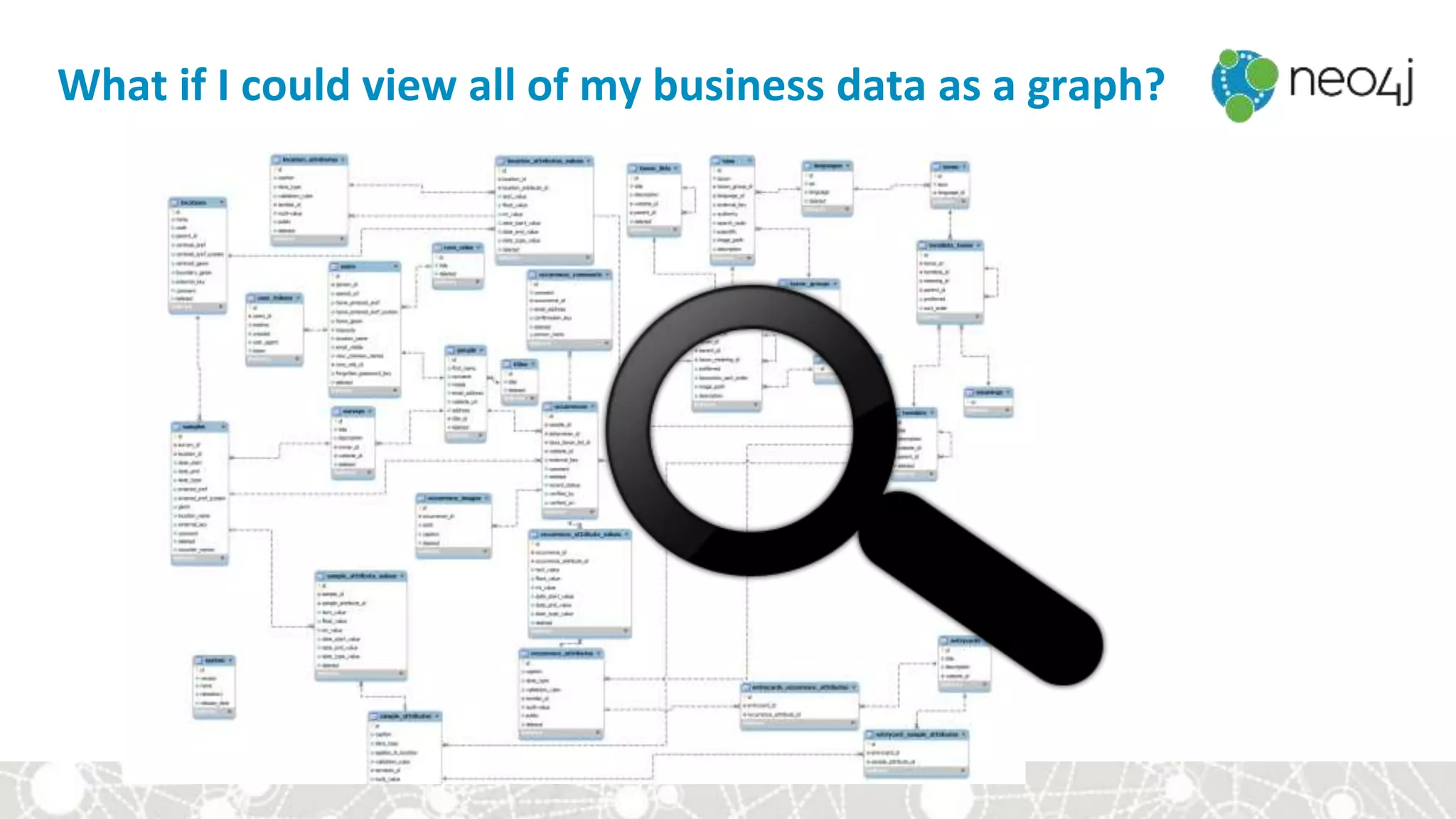
What if I could view all of my business data as a graph?
Enter the property graph model
The Neo4j Labeled Property Graph
• Nodes
• Relationships
• Properties
• Labels
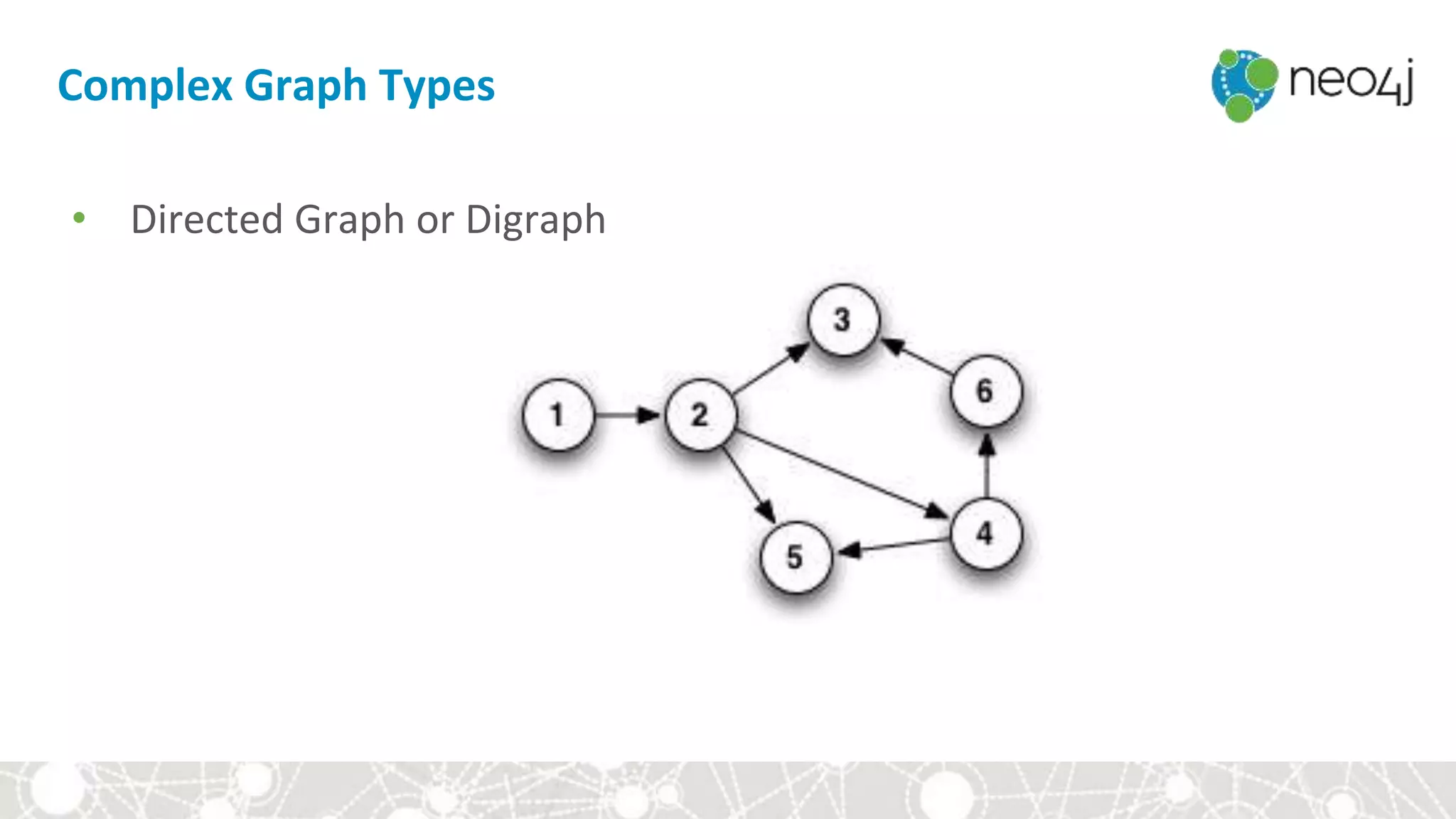
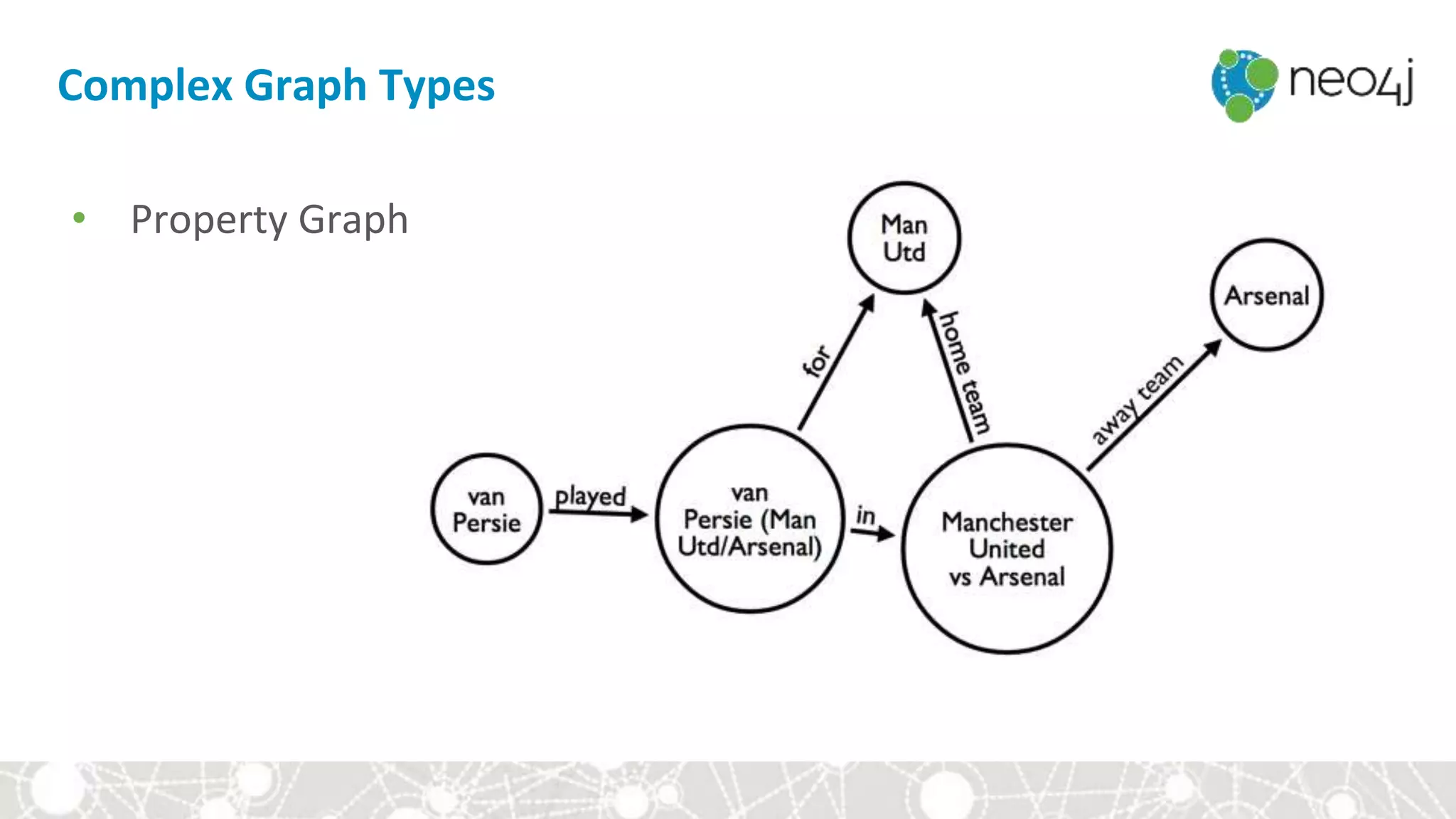
Complex Graph Types
• Directed Graph or Digraph
Complex Graph Types
• Property Graph
Car
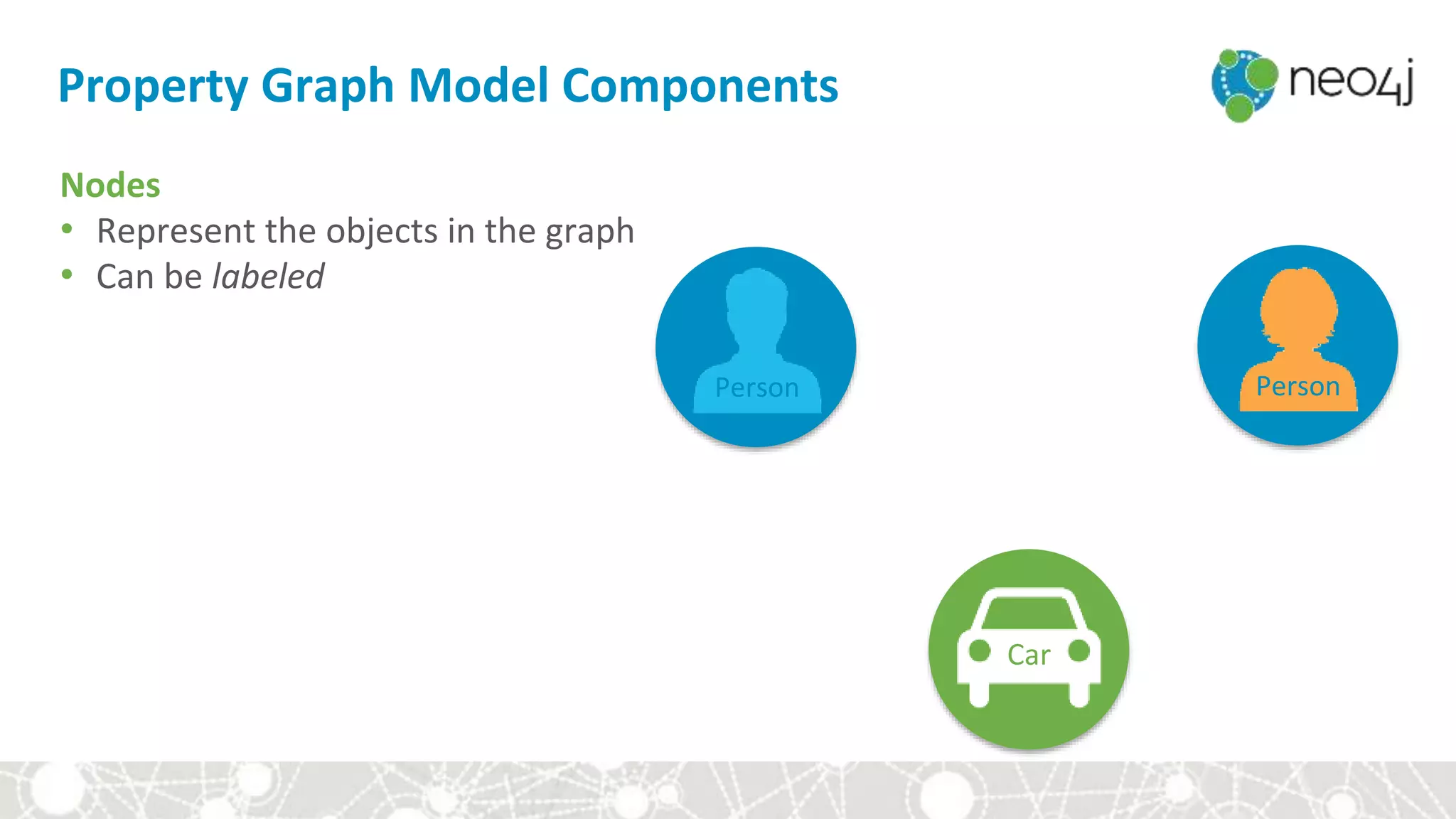
Property Graph Model Components
Nodes
• Represent the objects in the graph
• Can be labeled
Person Person
Car
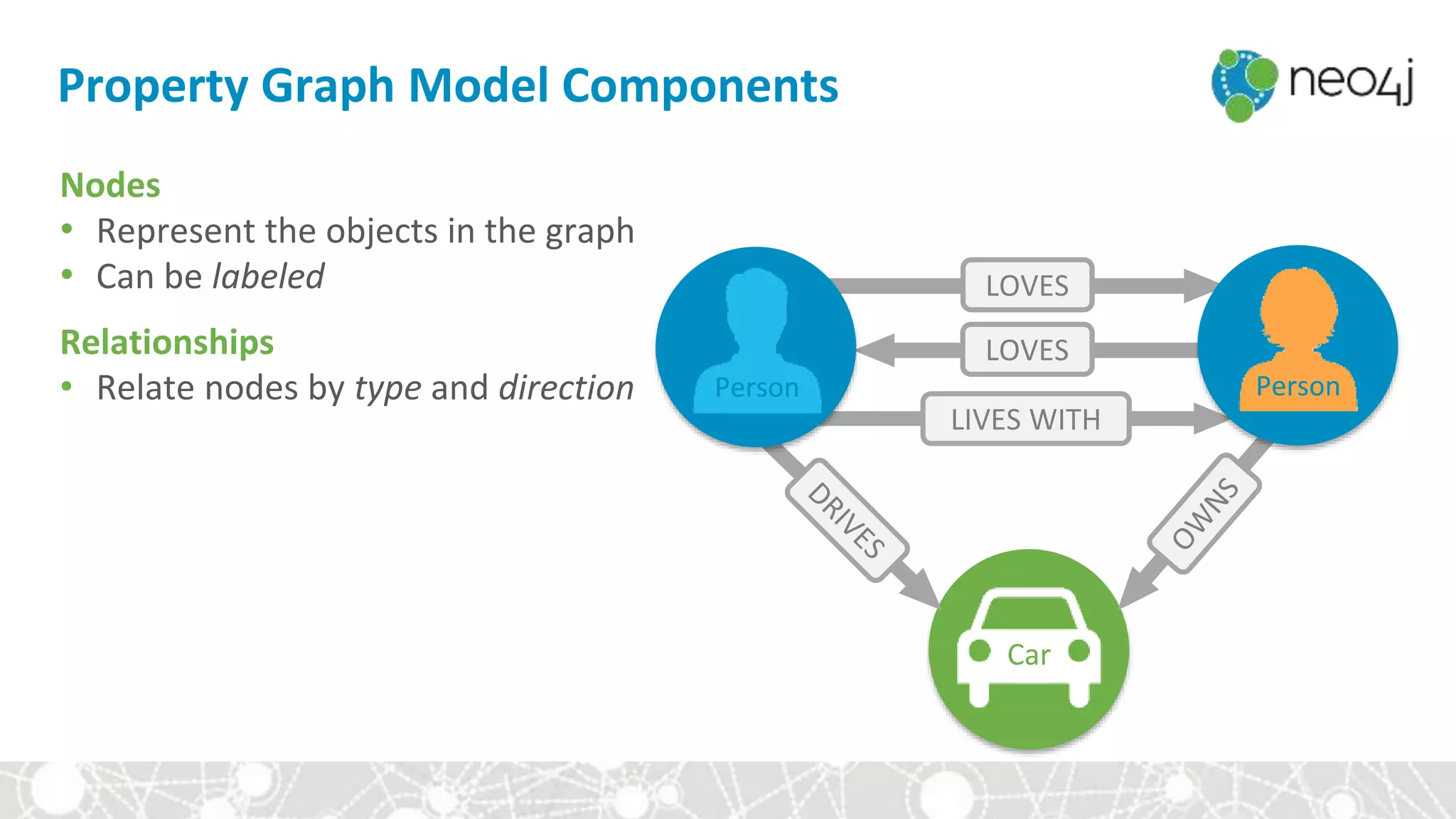
Property Graph Model Components
Nodes
• Represent the objects in the graph
• Can be labeled
Relationships
• Relate nodes by type and direction
LOVES
LOVES
LIVES WITH
Person Person
Car
name: “Dan”
born: May 29, 1970
twitter: “@dan”
name: “Ann”
born: Dec 5, 1975
since:
Jan 10, 2011
brand: “Volvo”
model: “V70”
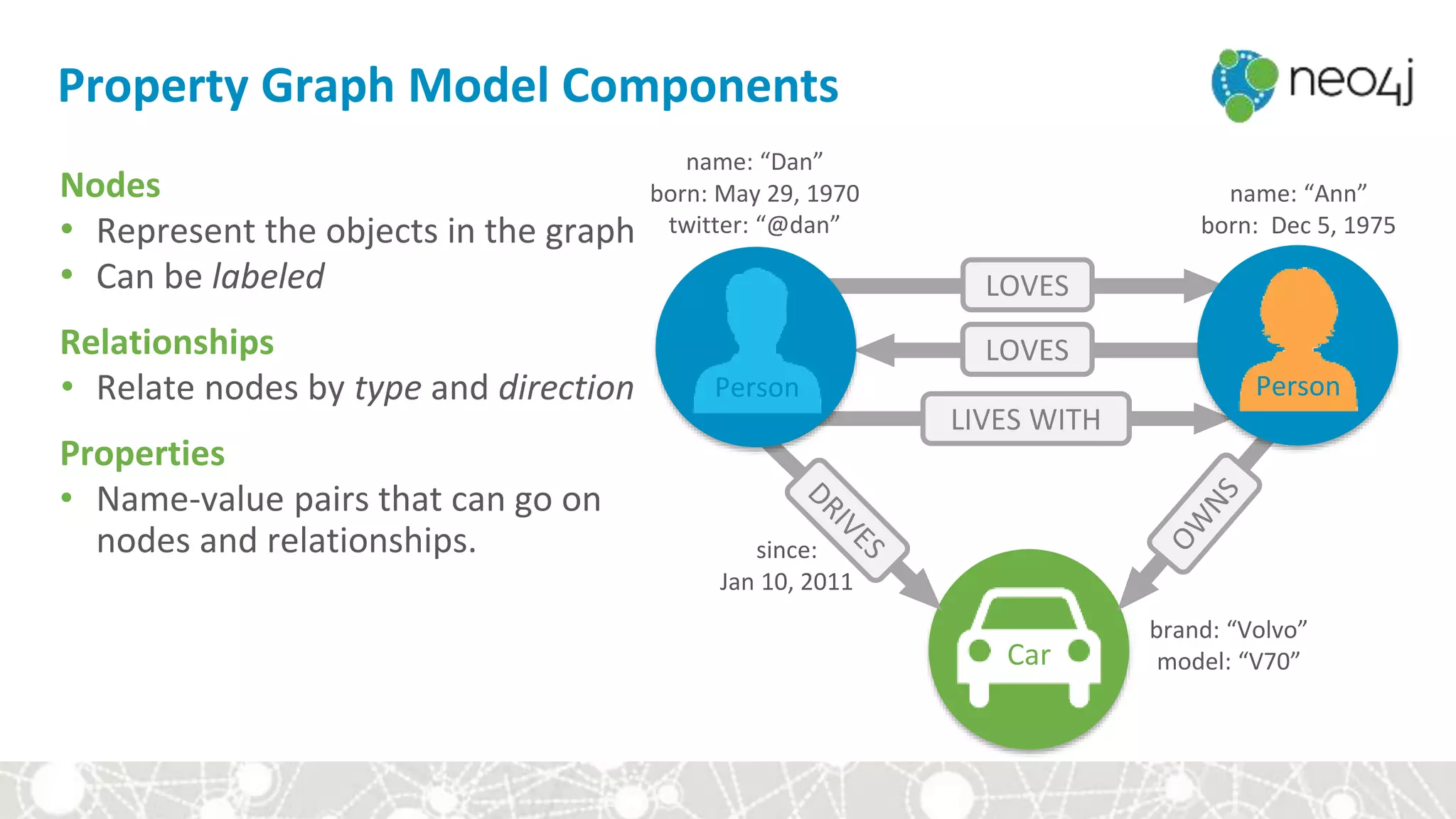
Property Graph Model Components
Nodes
• Represent the objects in the graph
• Can be labeled
Relationships
• Relate nodes by type and direction
Properties
• Name-value pairs that can go on
nodes and relationships.
LOVES
LOVES
LIVES WITH
Person Person
Commerical Lending
Risk Management
31
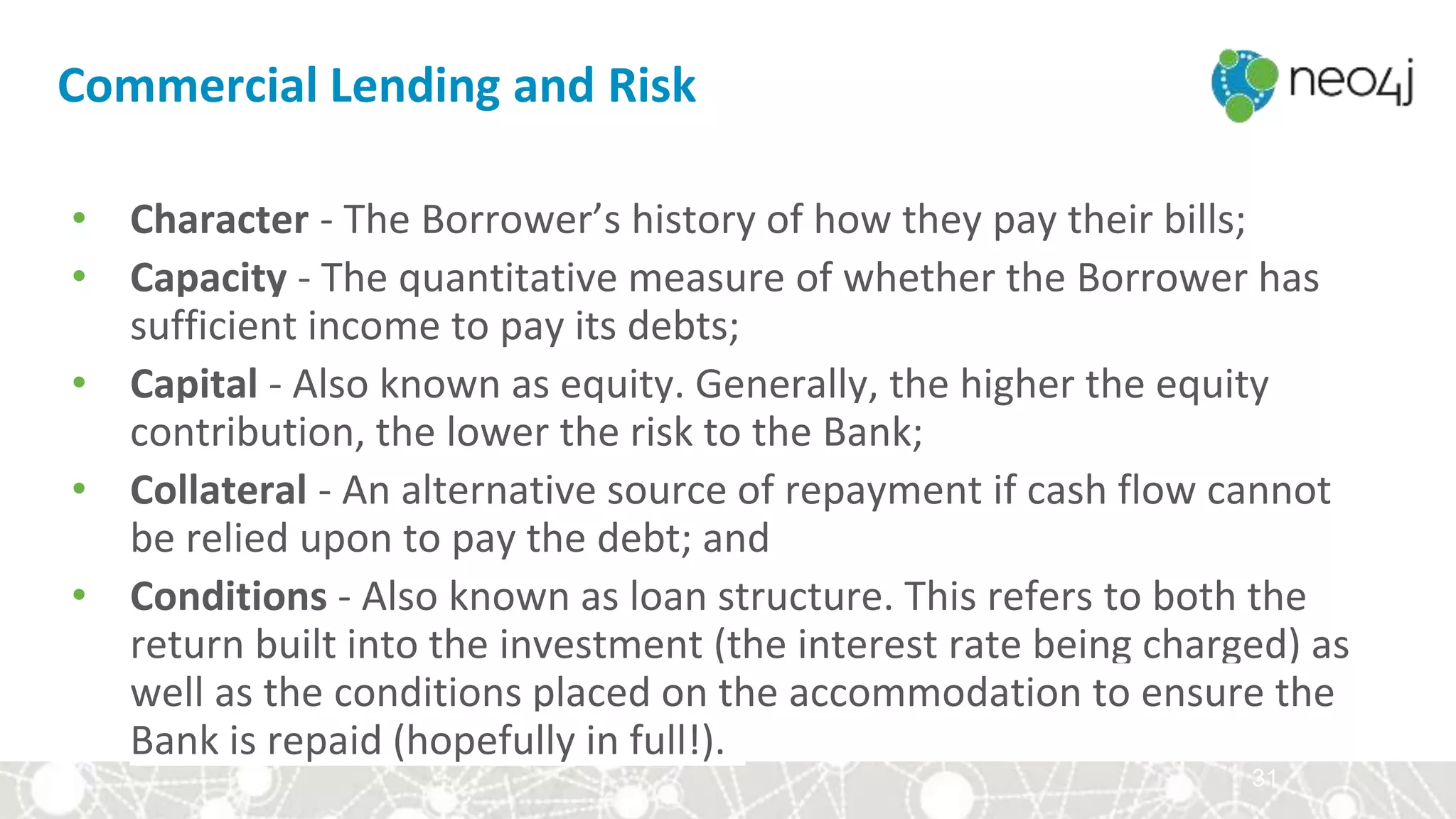
• Character - The Borrower’s history of how they pay their bills;
• Capacity - The quantitative measure of whether the Borrower has
sufficient income to pay its debts;
• Capital - Also known as equity. Generally, the higher the equity
contribution, the lower the risk to the Bank;
• Collateral - An alternative source of repayment if cash flow cannot
be relied upon to pay the debt; and
• Conditions - Also known as loan structure. This refers to both the
return built into the investment (the interest rate being charged) as
well as the conditions placed on the accommodation to ensure the
Bank is repaid (hopefully in full!).
Commercial Lending and Risk
32
We need a better understanding of the business “community” to understand
how business relationships are affecting loan risk.
Problem Statement:
33
”Knowing your customers and the markets in which they invest are two of the
simplest and most basic tools of understanding risk. Living, working and playing
in the same community as your Borrower is a surefire way to know their
business environment.”
CNB University
Problem Statement:
34
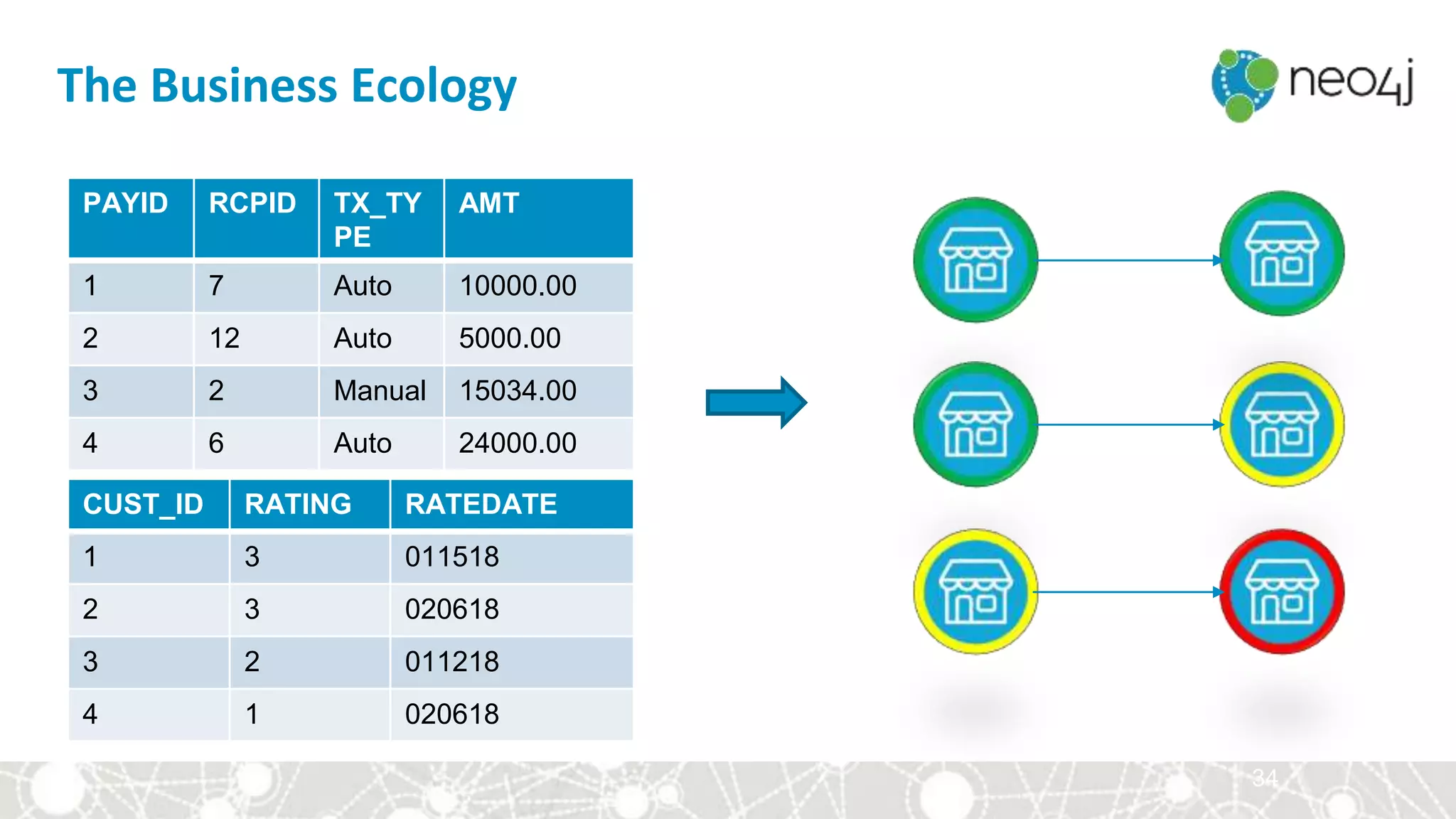
The Business Ecology
CUST_ID RATING RATEDATE
1 3 011518
2 3 020618
3 2 011218
4 1 020618
PAYID RCPID TX_TY
PE
AMT
1 7 Auto 10000.00
2 12 Auto 5000.00
3 2 Manual 15034.00
4 6 Auto 24000.00
35
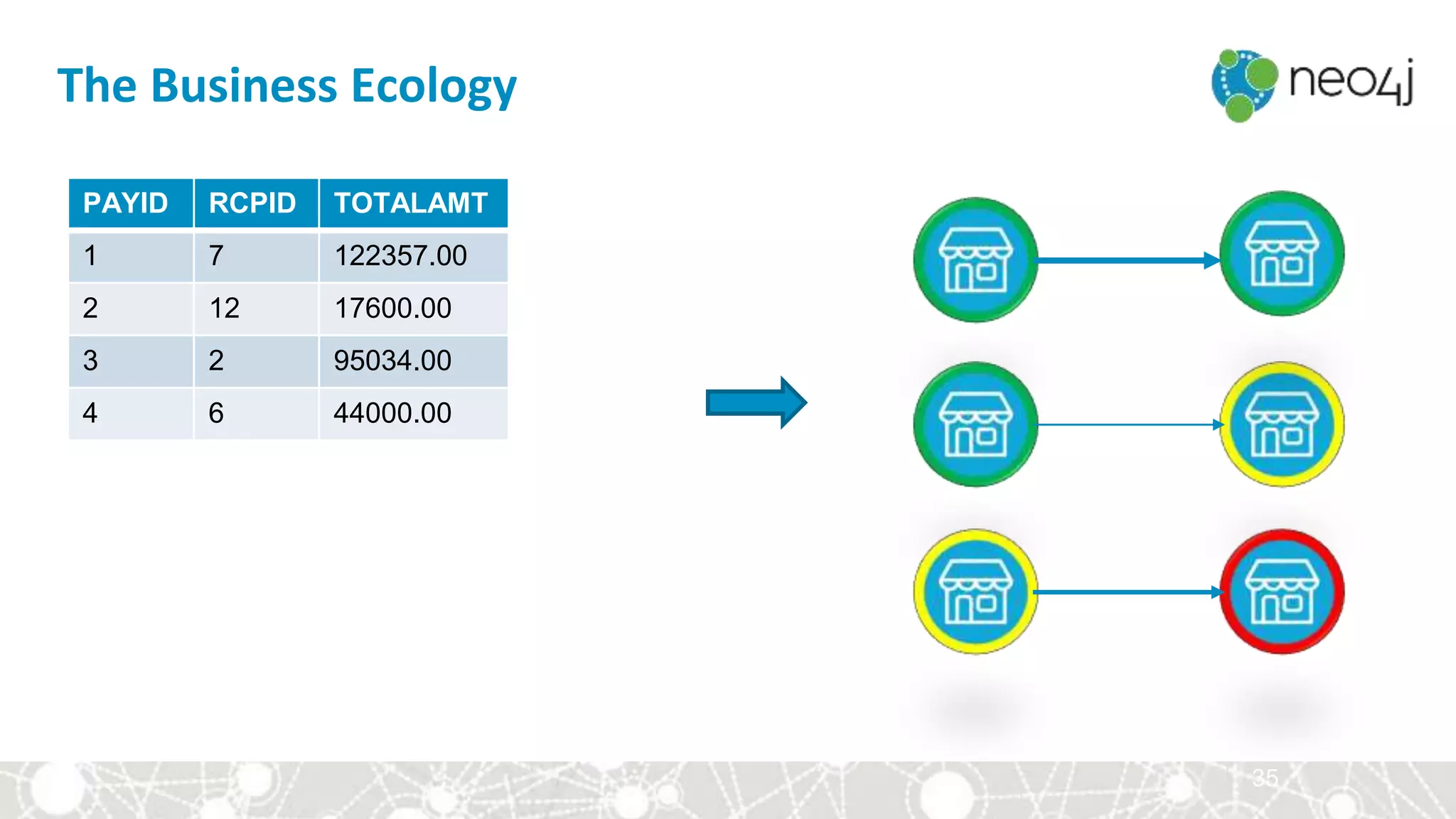
The Business Ecology
PAYID RCPID TOTALAMT
1 7 122357.00
2 12 17600.00
3 2 95034.00
4 6 44000.00
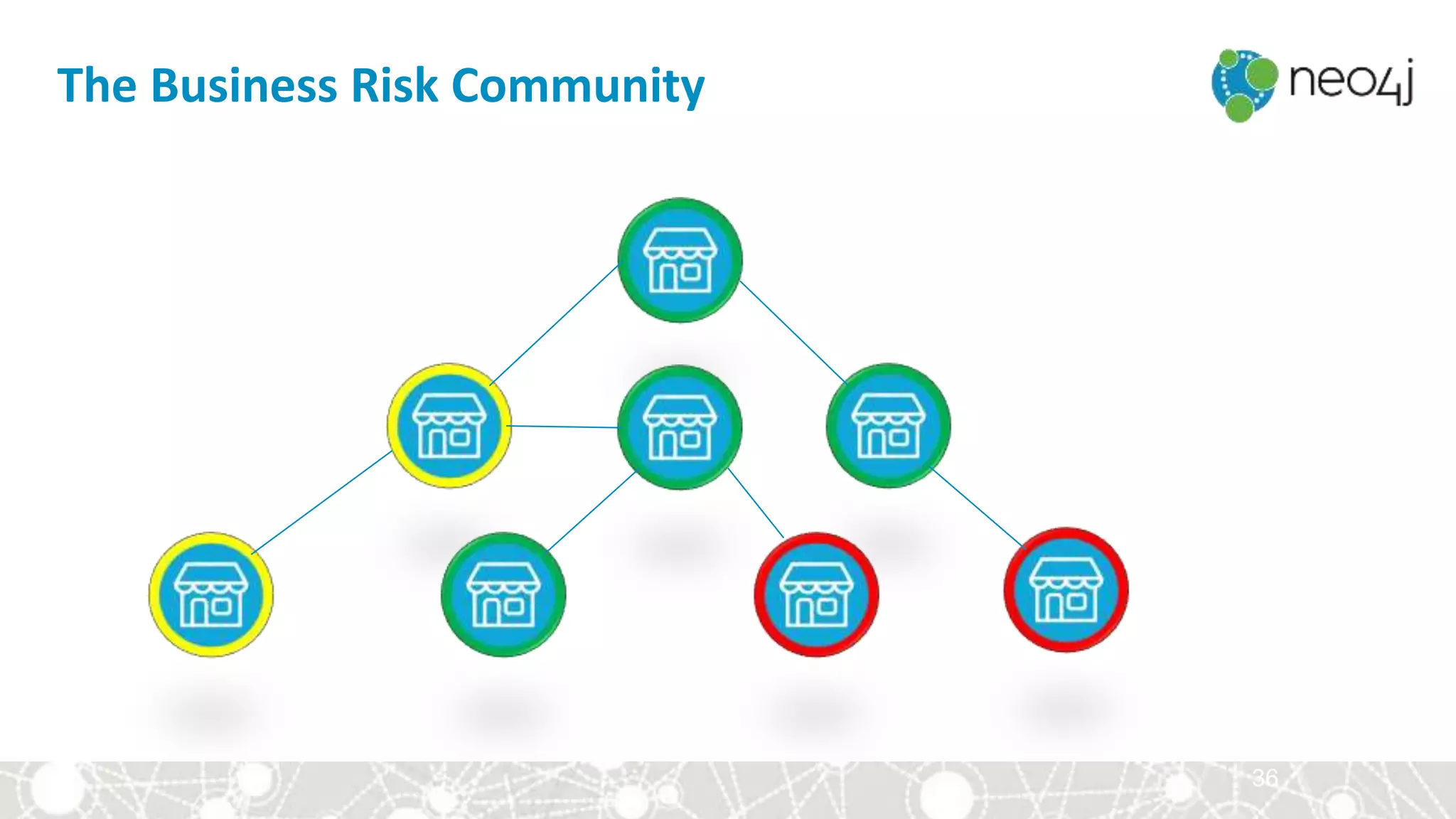
36
The Business Risk Community
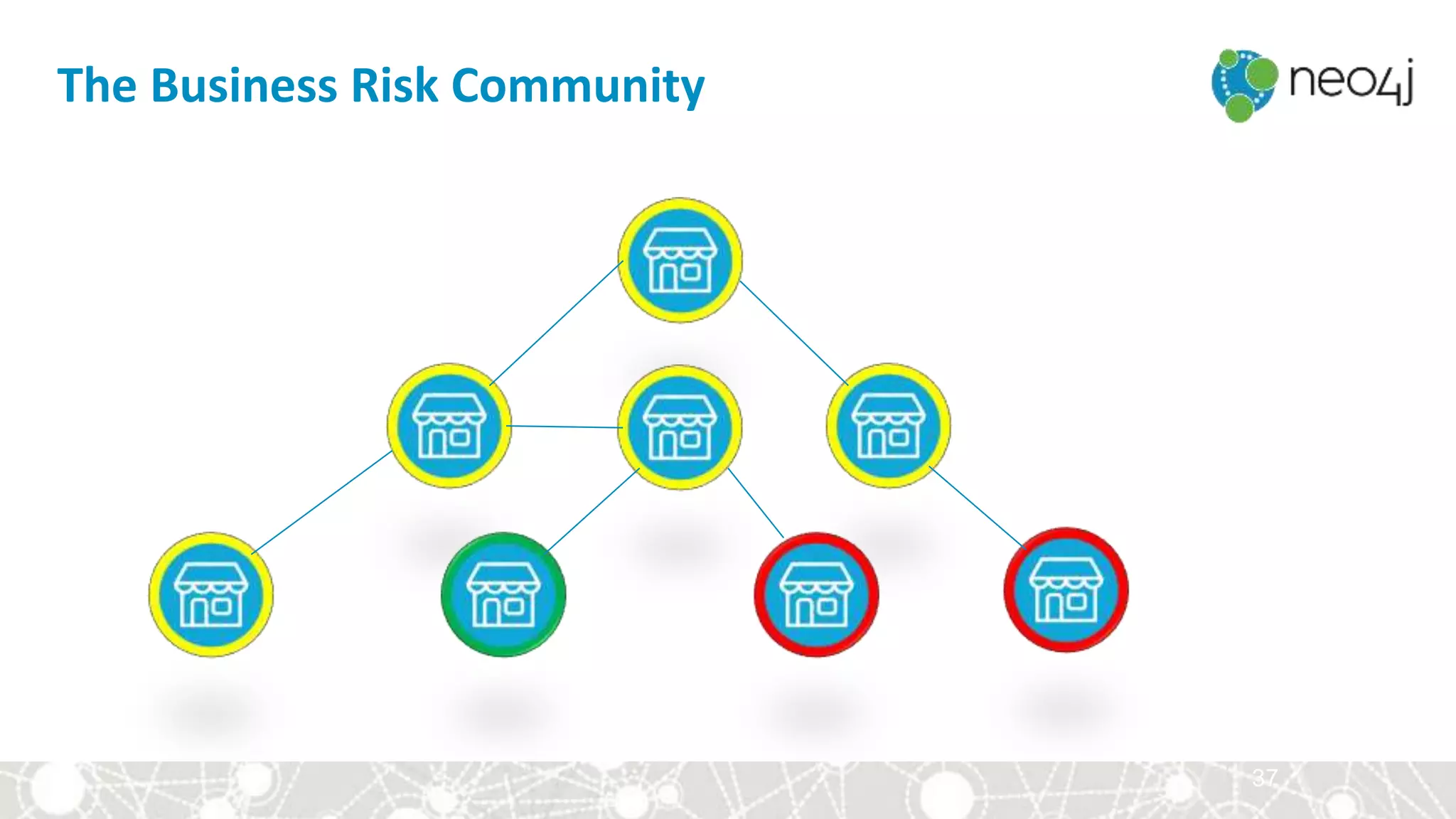
37
The Business Risk Community
38
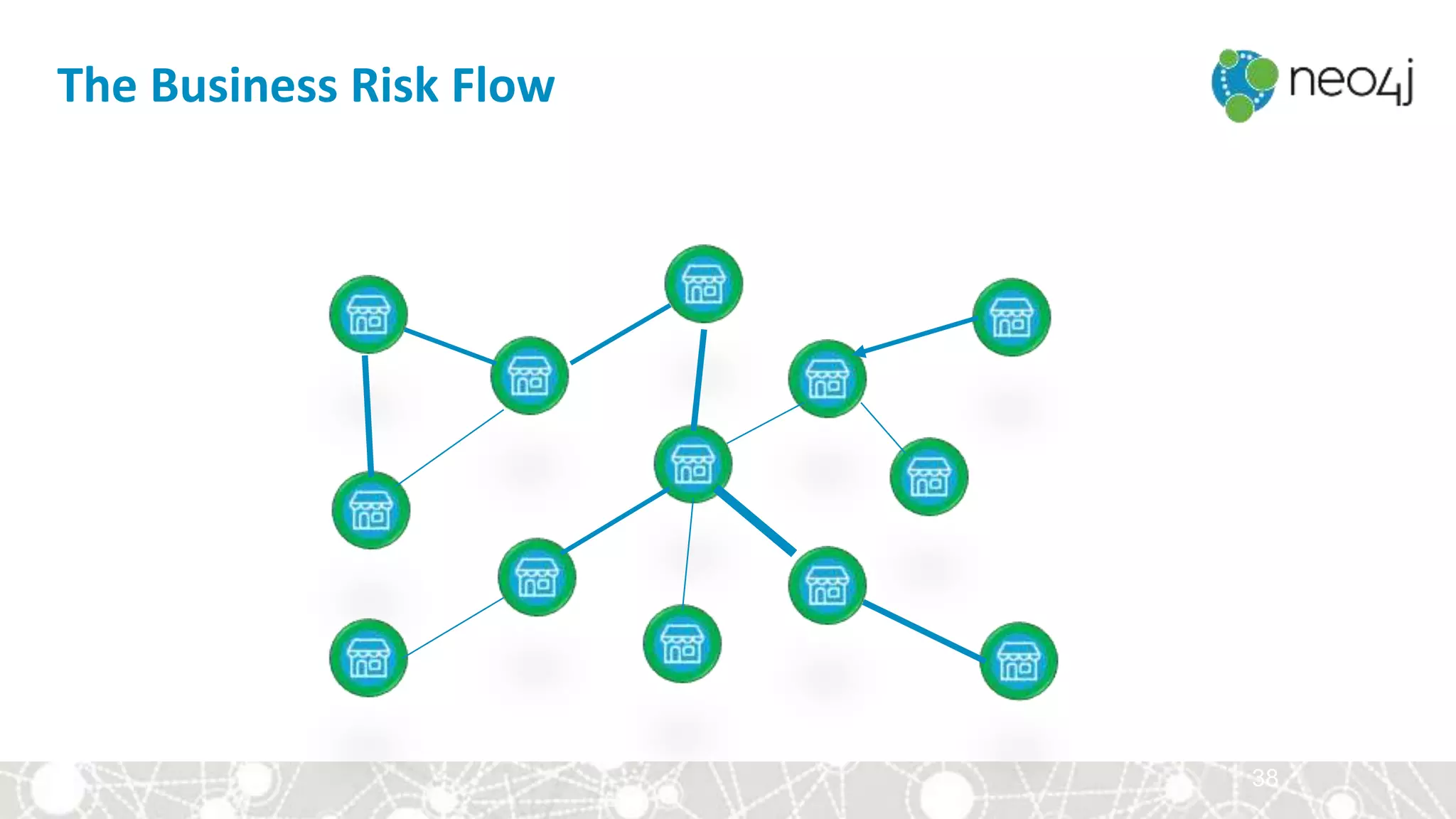
The Business Risk Flow
39
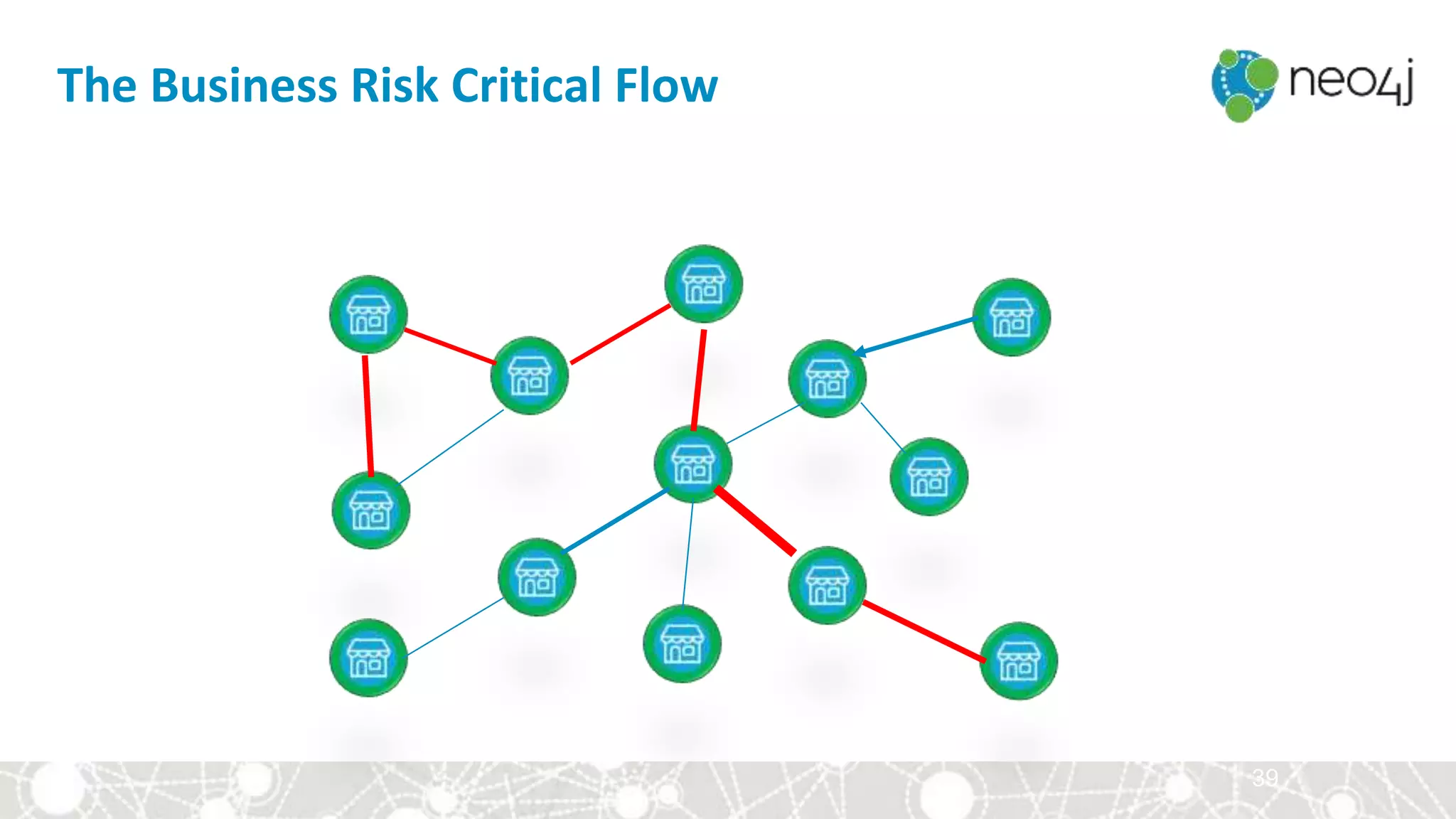
The Business Risk Critical Flow
Business Banking
Industry / Commodity Impact Analysis
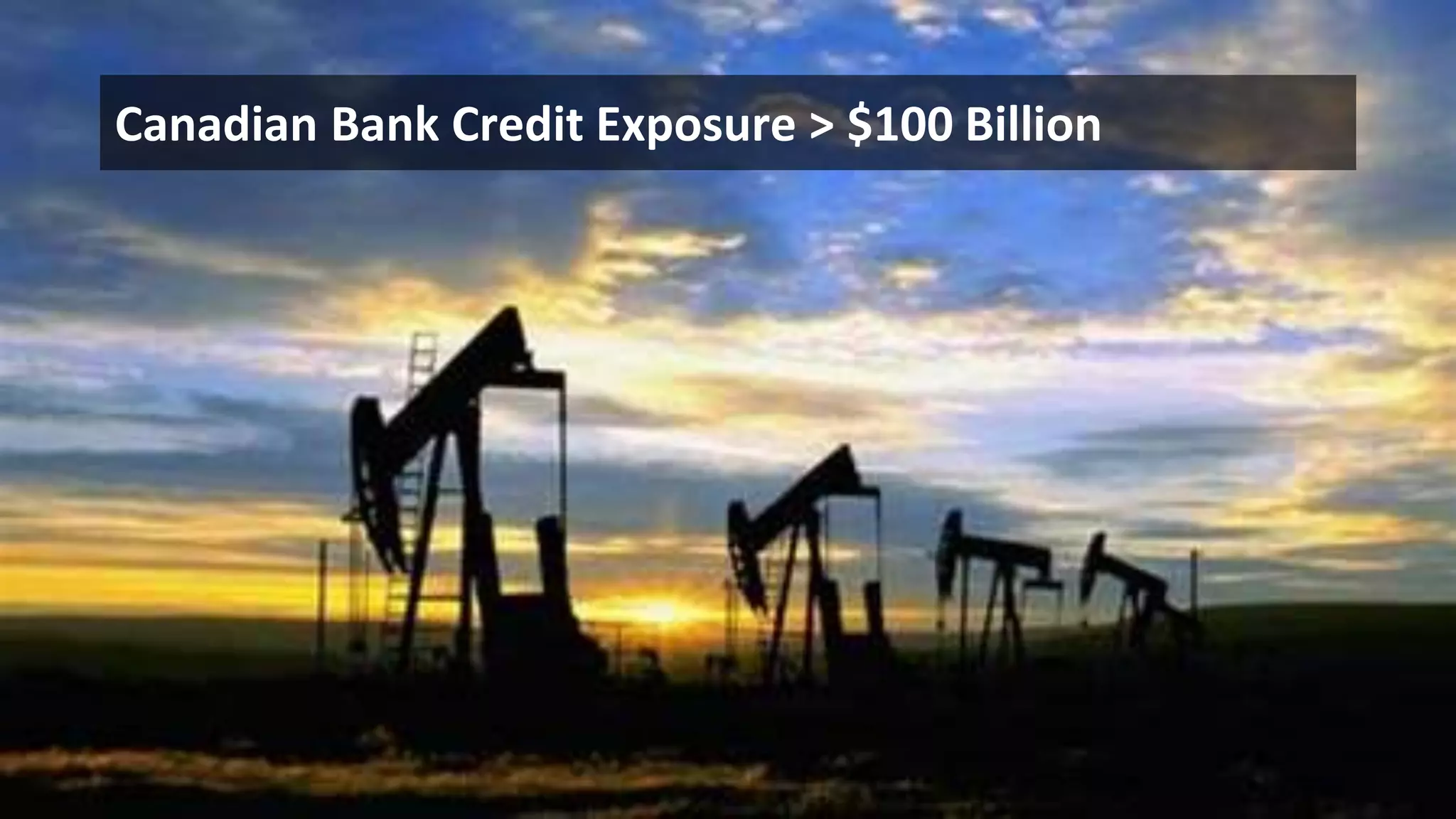
Canadian Bank Credit Exposure > $100 Billion
42
We need more ways to determine our credit exposure to commodities and oil
in particular
Problem Statement:
43
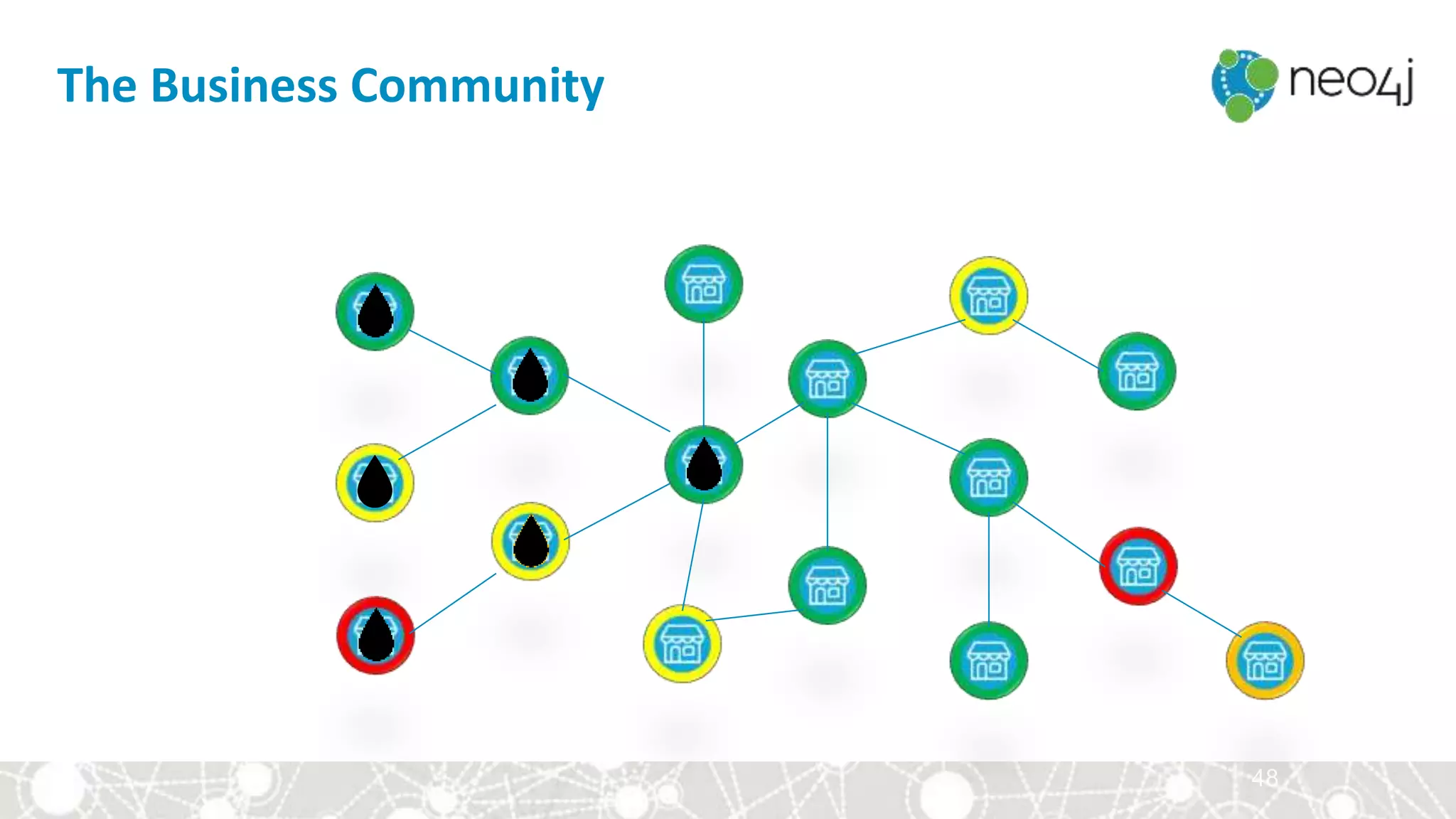
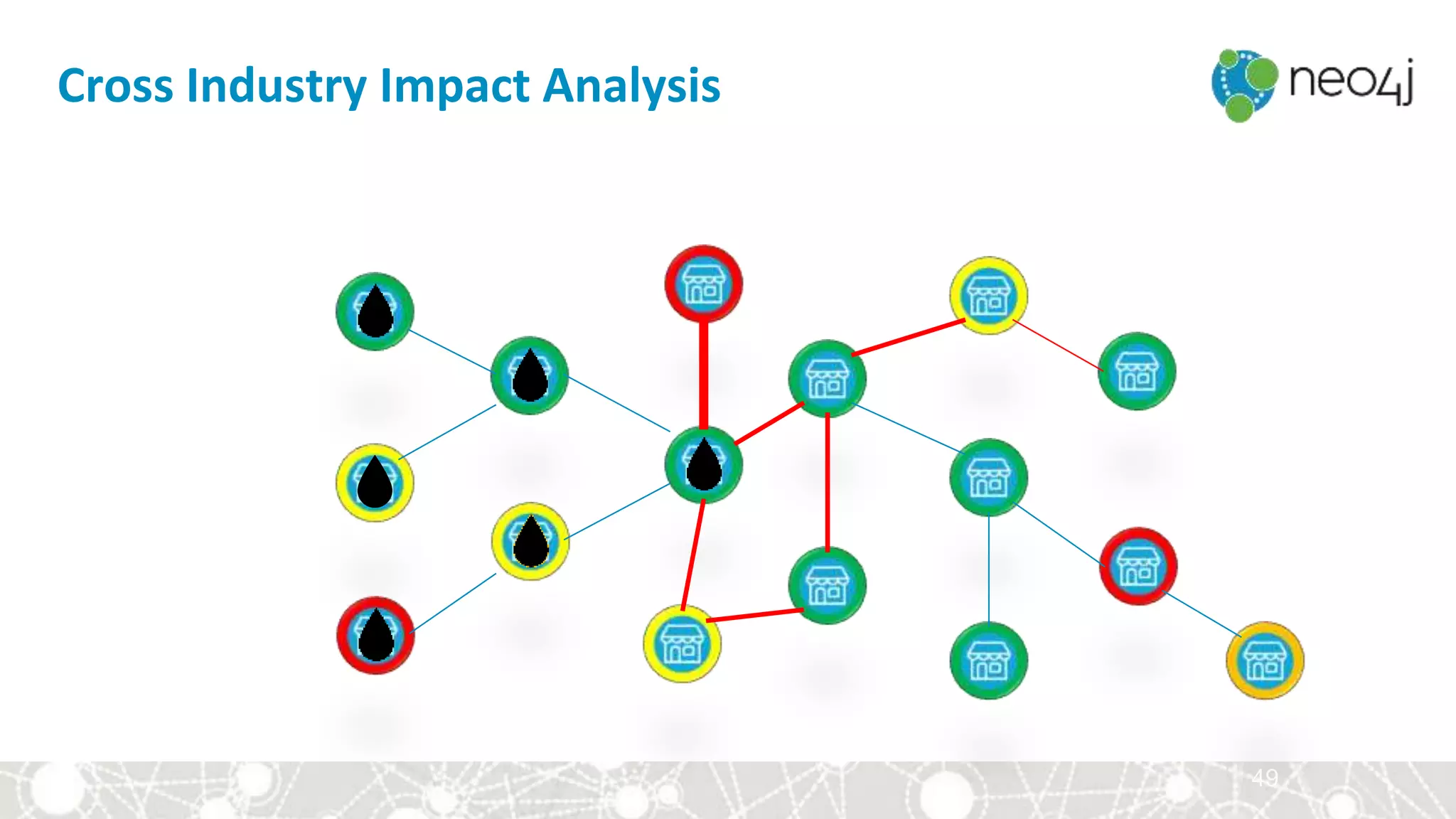
Commodities Impact Industries You Might Not Expect
• Do you know how all of your customers are connected, directly or indirectly to the
oil industry?
• How will a precipitous drop in oil prices affect the businesses that you invest in or
provide credit to?
Business Banking and Commodities
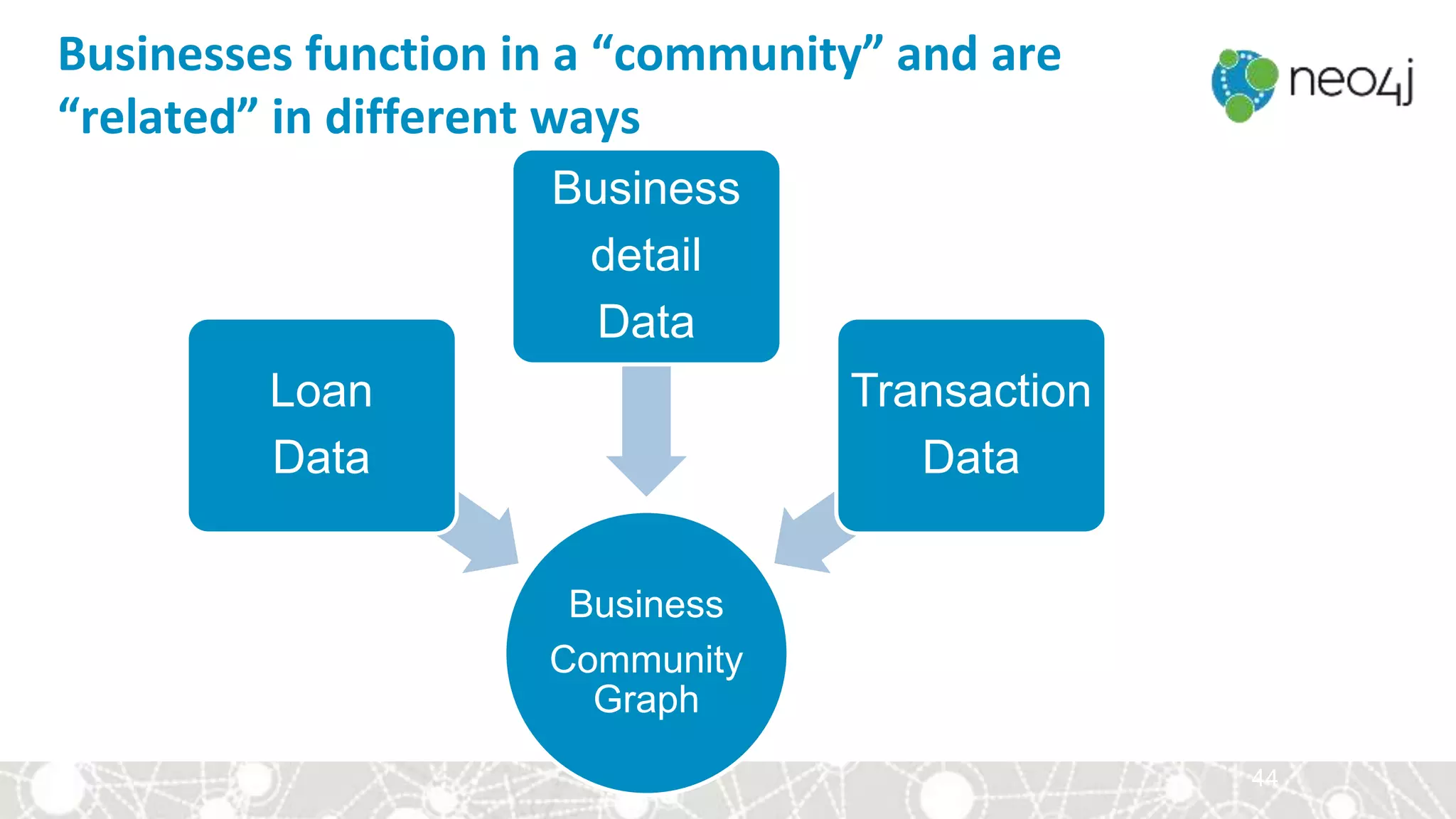
44
Businesses function in a “community” and are
“related” in different ways
Business
Community
Graph
Loan
Data
Business
detail
Data
Transaction
Data
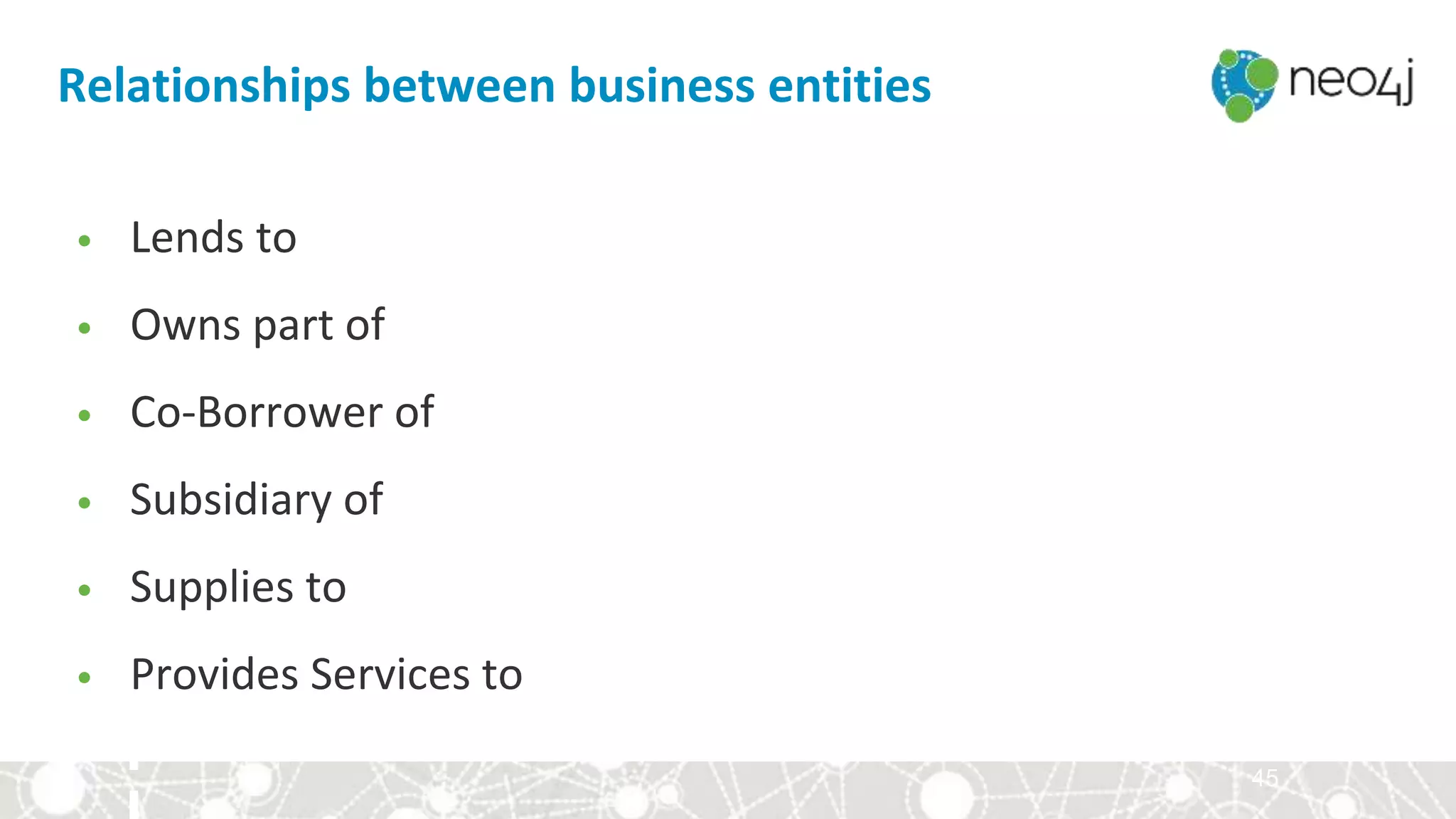
45
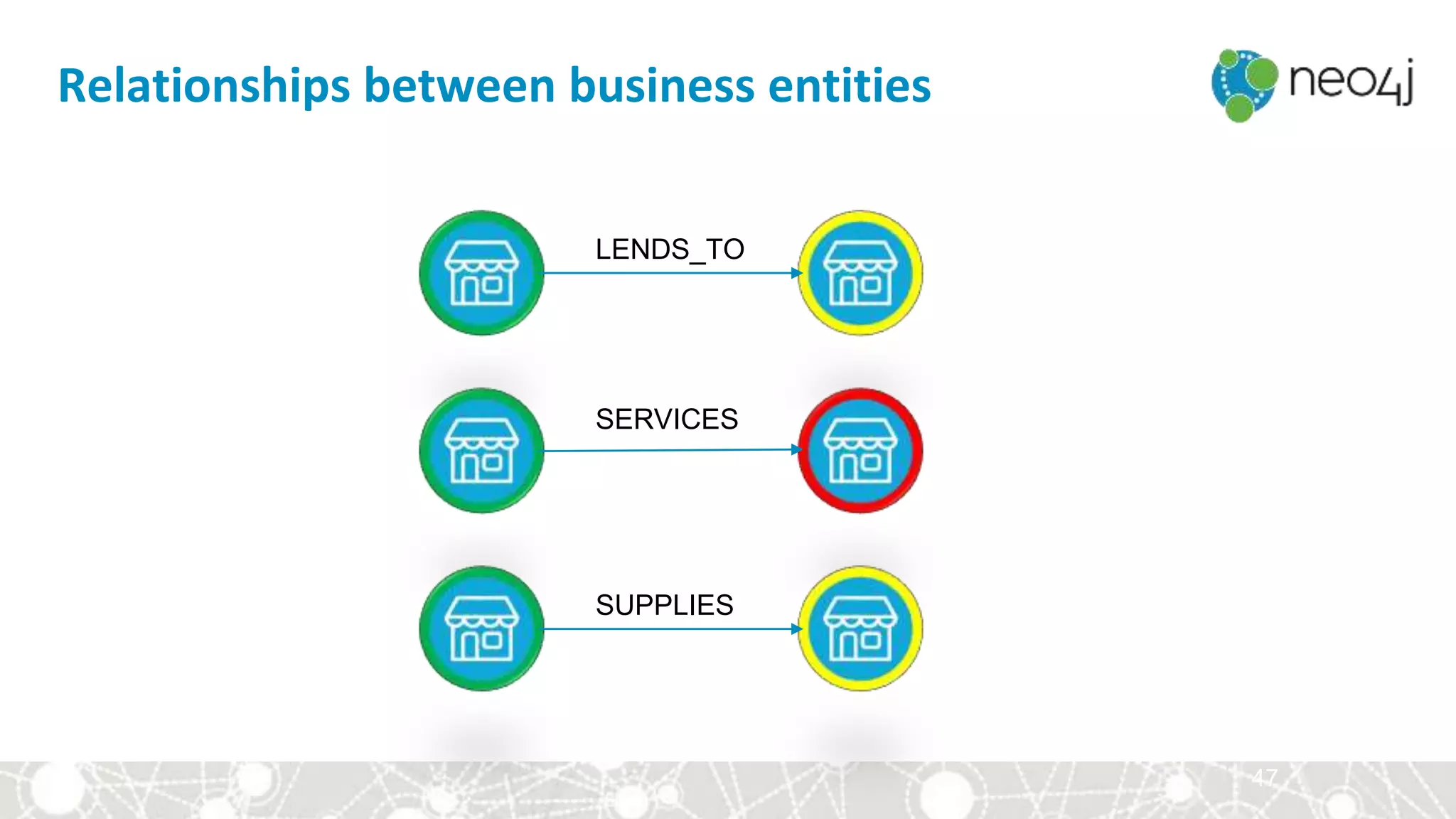
• Lends to
• Owns part of
• Co-Borrower of
• Subsidiary of
• Supplies to
• Provides Services to
Relationships between business entities
46
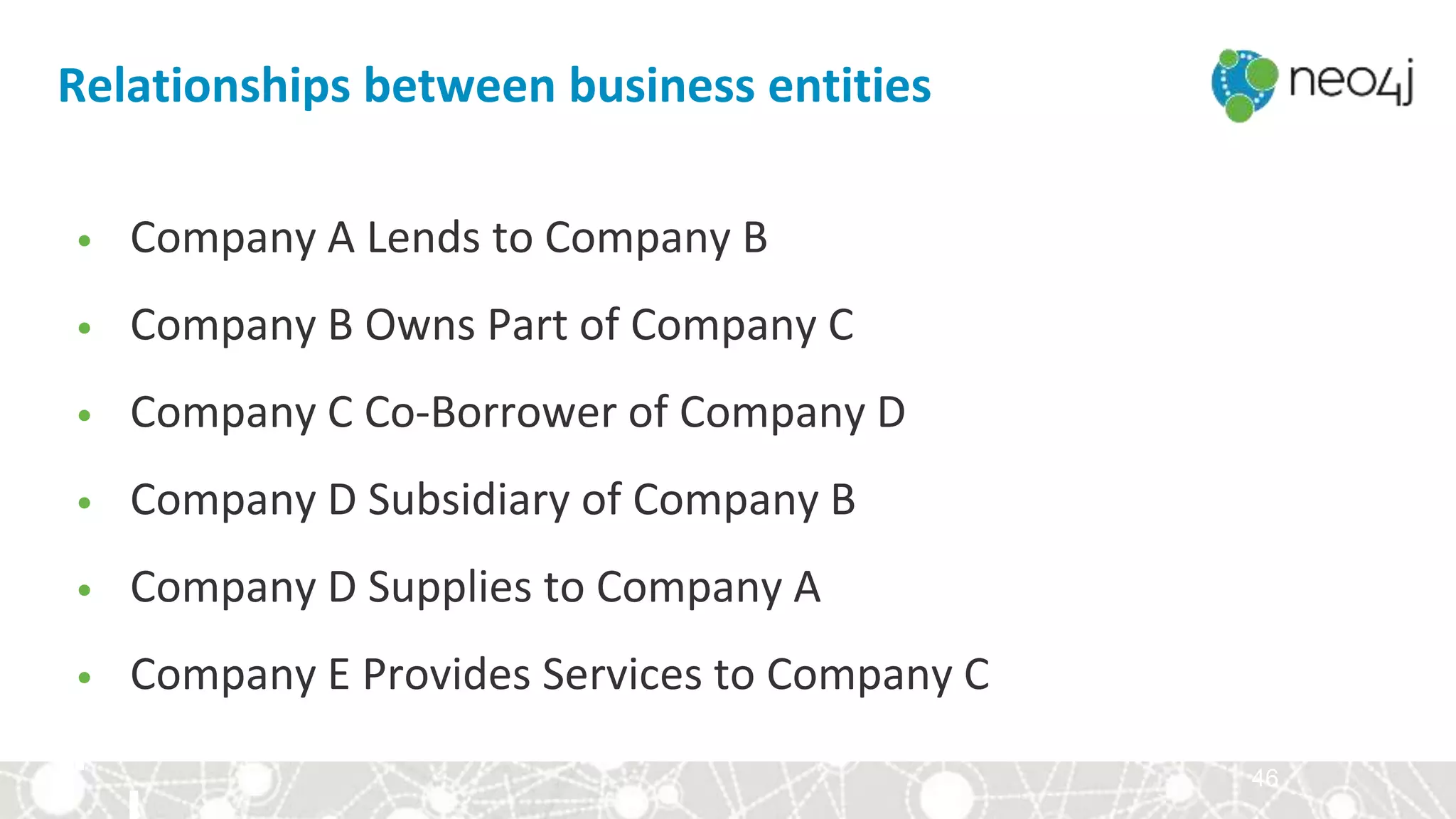
• Company A Lends to Company B
• Company B Owns Part of Company C
• Company C Co-Borrower of Company D
• Company D Subsidiary of Company B
• Company D Supplies to Company A
• Company E Provides Services to Company C
Relationships between business entities
47
Relationships between business entities
LENDS_TO
SERVICES
SUPPLIES
48
The Business Community
49
Cross Industry Impact Analysis
Investment Banking
Predicting Customer Behavior
51
“Underwriting involves assuming a risk on behalf of an investor selling securities in the
stock market. The company wants an assurance that money is raised for the stock
issued even when some shares have not been sold. Investment bankers place their
capital risk by buying all the securities from the company at a discounted price. Bankers
then mark up the securities to market retail price and sell them to the investing public.
If the sale of securities does not reach the target capital requirement, bankers are
forced to borrow from commercial banks or sell the shares at a loss. Alternatively, they
also invite other investment banks to take part in the underwriting process to share the
risk of loss in form of an underwriting syndicate.”
Joseph Petrick,
Houston Chronicle
Investment Banking / Underwriting and Selling
52
We need to be better prepared to support our customers trades so that we
are less likely to suffer a loss. To do that, we need to better predict when and
what our customers are likely to want to buy or sell.
Problem Statement:
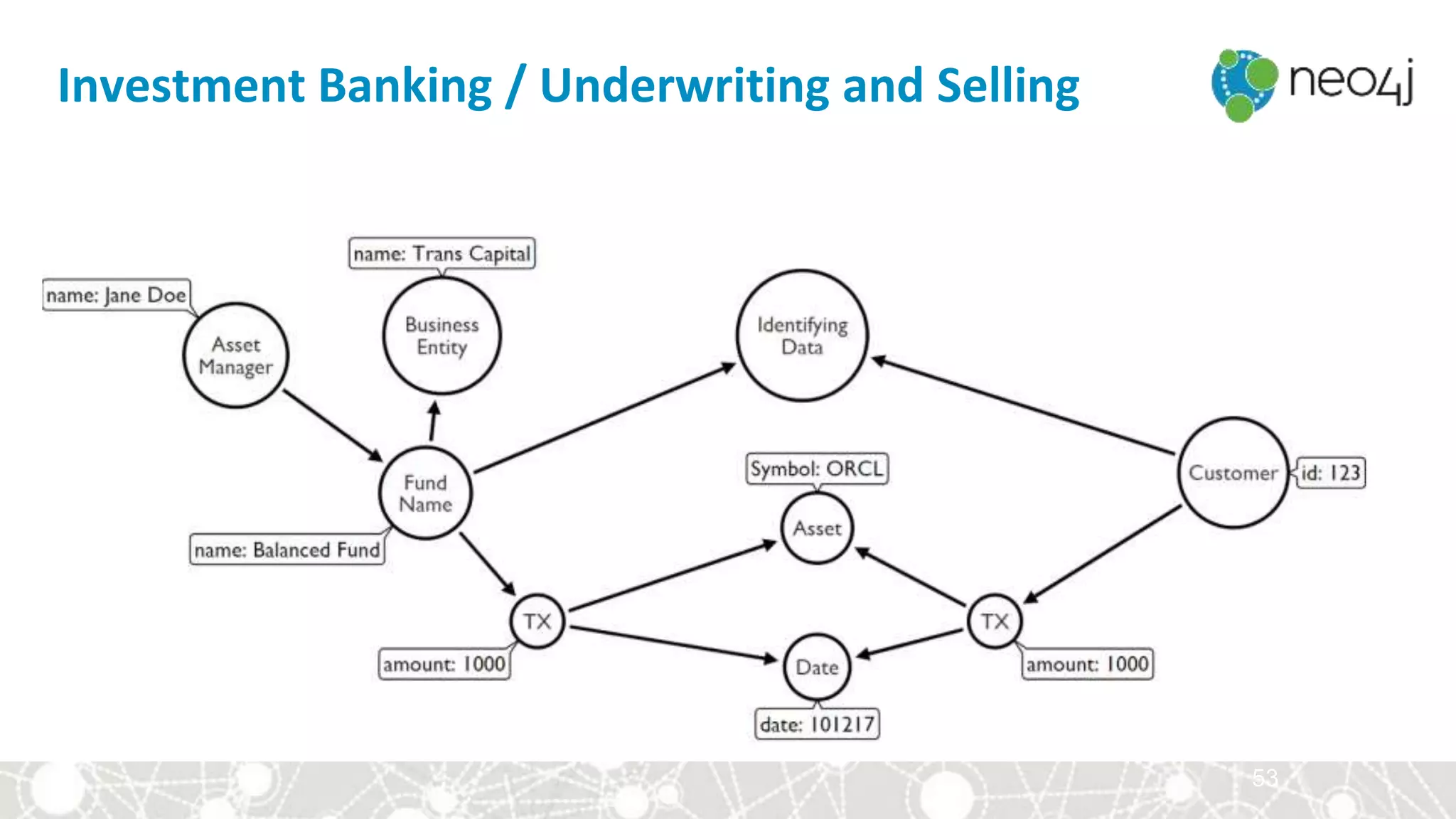
53
Investment Banking / Underwriting and Selling
54
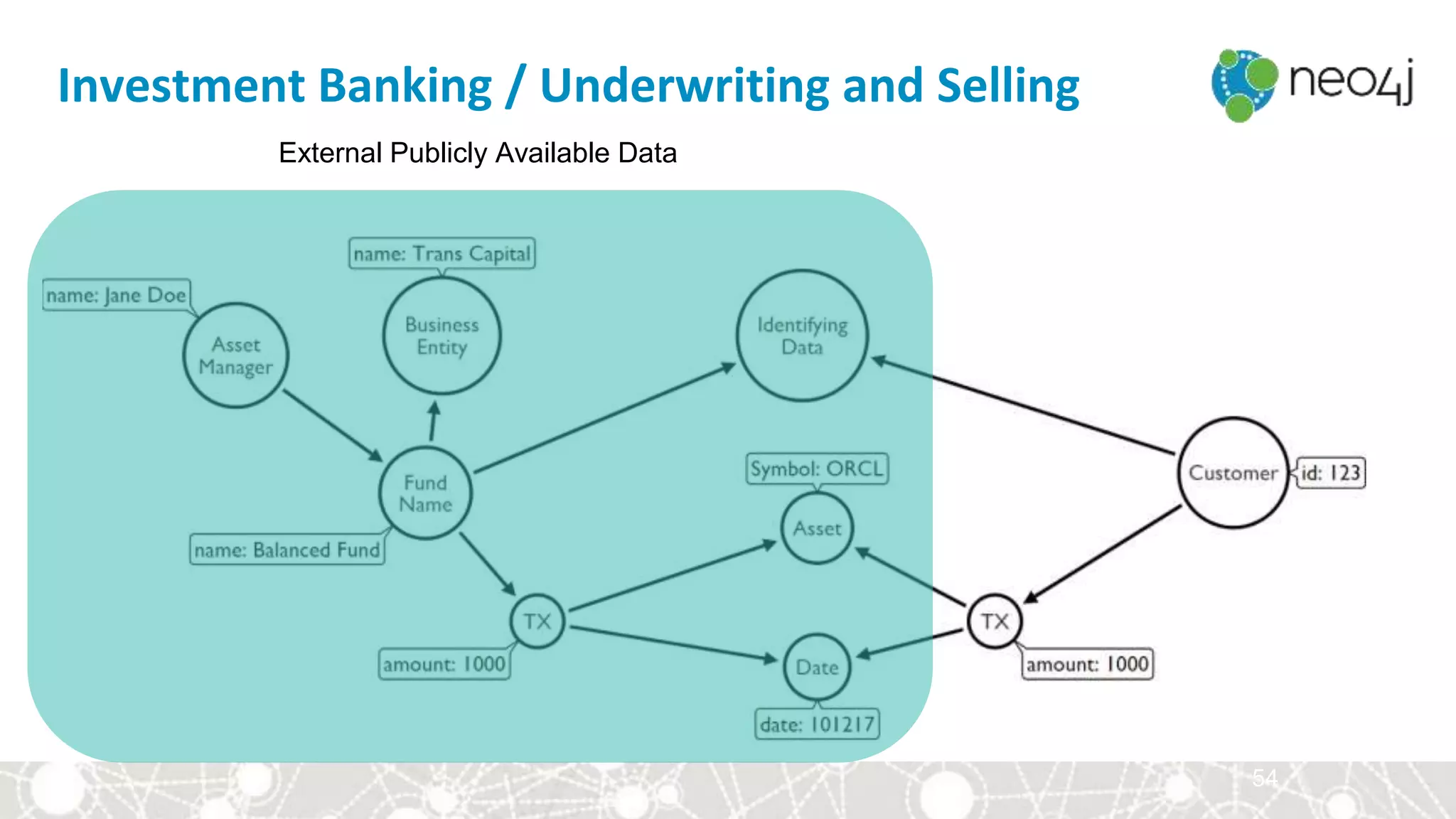
Investment Banking / Underwriting and Selling
External Publicly Available Data
55
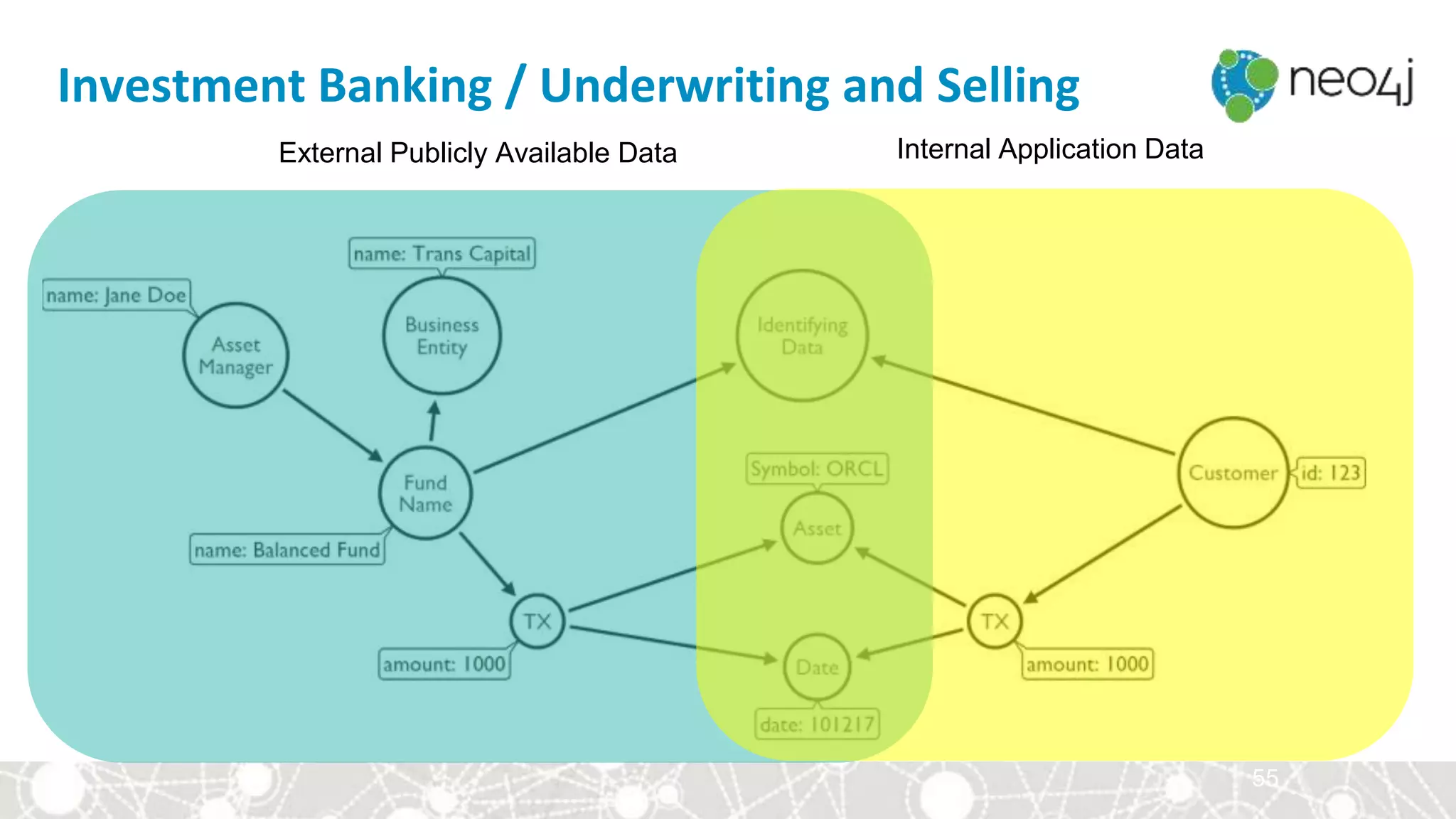
Investment Banking / Underwriting and Selling
External Publicly Available Data Internal Application Data
Thank you for your time!
Questions?

Graphs and innovative graph solutions for financial services

  • 1.
    Graphs and InnovativeGraph Solutions for Financial Services Christopher Upkes Senior Field Engineer
  • 2.
    What are wegoing to do? • Why graphs? • What do we use graphs for? • Graph Theory explained • Extending Practical Graph Use: The Property Graph Model Revolution • Use Case 1: Measuring risk in corporate lending • Use Case 2: Understanding the exposure to commodities or industries • Use Case 3: Predicting behavior of customers
  • 3.
  • 4.
    The world isa graph – everything is connected • people, places, events • companies, markets • countries, history, politics • sciences, art, teaching • technology, networks, machines, applications, users • software, code, dependencies, architecture, deployments • criminals, fraudsters and their behavior
  • 5.
    What Industry Analystsare Communicating about Graph Database • “Graph analysis is possibly the single most effective competitive differentiator for organizations pursuing data-driven operations and decisions after the design of data capture.” • “Graph analysis is the true killer app for Big Data.” • “…(Software) vendors are investing in Graph Databases.” • “Graph repositories help MDM better connect conceptual master data models with logical models…that RDBMS repositories often constrain.” Private & Confidential 5
  • 6.
    What are peopleusing graph databases for?
  • 7.
    Use Cases Internal Applications MasterData Management Network and IT Operations Fraud Detection Customer-Facing Applications Real-Time Recommendations Graph-Based Search Identity and Access Management
  • 8.
    How Customers UseNeo4j Network & Data Center Master Data Management Social Recom– mendations Identity & Access Search & Discovery GEO
  • 9.
  • 10.
  • 11.
  • 12.
  • 13.
  • 14.
  • 15.
  • 16.
    The Koningsberg BridgeProblem The basic idea of graphs were introduced in 18th century by the great Swiss mathematician Leonhard Euler.
  • 17.
    Breaking down the“bridge problem” • The Euler cycle (or tour) problem: Is it possible to traverse each of the edges of a graph exactly once, starting and ending at the same vertex? • The Hamiltonian cycle problem: Is it possible to traverse each of the vertices of a graph exactly once, starting and ending at the same vertex?
  • 18.
  • 19.
    What’s all thefuss? • Vertex = a point where two lines meet • Edge = lines that join to form vertices
  • 20.
  • 21.
    What if? • Avertex could represent something more concrete? • A customer • A business • An asset • What if edges could provide more context • Cash flow • A Transaction (withdraw, deposit) • A meaningful interaction (borrows from, supplies to)
  • 22.
    What if Icould view all of my business data as a graph?
  • 23.
    Enter the propertygraph model
  • 24.
    The Neo4j LabeledProperty Graph • Nodes • Relationships • Properties • Labels
  • 25.
    Complex Graph Types •Directed Graph or Digraph
  • 26.
  • 27.
    Car Property Graph ModelComponents Nodes • Represent the objects in the graph • Can be labeled Person Person
  • 28.
    Car Property Graph ModelComponents Nodes • Represent the objects in the graph • Can be labeled Relationships • Relate nodes by type and direction LOVES LOVES LIVES WITH Person Person
  • 29.
    Car name: “Dan” born: May29, 1970 twitter: “@dan” name: “Ann” born: Dec 5, 1975 since: Jan 10, 2011 brand: “Volvo” model: “V70” Property Graph Model Components Nodes • Represent the objects in the graph • Can be labeled Relationships • Relate nodes by type and direction Properties • Name-value pairs that can go on nodes and relationships. LOVES LOVES LIVES WITH Person Person
  • 30.
  • 31.
    31 • Character -The Borrower’s history of how they pay their bills; • Capacity - The quantitative measure of whether the Borrower has sufficient income to pay its debts; • Capital - Also known as equity. Generally, the higher the equity contribution, the lower the risk to the Bank; • Collateral - An alternative source of repayment if cash flow cannot be relied upon to pay the debt; and • Conditions - Also known as loan structure. This refers to both the return built into the investment (the interest rate being charged) as well as the conditions placed on the accommodation to ensure the Bank is repaid (hopefully in full!). Commercial Lending and Risk
  • 32.
    32 We need abetter understanding of the business “community” to understand how business relationships are affecting loan risk. Problem Statement:
  • 33.
    33 ”Knowing your customersand the markets in which they invest are two of the simplest and most basic tools of understanding risk. Living, working and playing in the same community as your Borrower is a surefire way to know their business environment.” CNB University Problem Statement:
  • 34.
    34 The Business Ecology CUST_IDRATING RATEDATE 1 3 011518 2 3 020618 3 2 011218 4 1 020618 PAYID RCPID TX_TY PE AMT 1 7 Auto 10000.00 2 12 Auto 5000.00 3 2 Manual 15034.00 4 6 Auto 24000.00
  • 35.
    35 The Business Ecology PAYIDRCPID TOTALAMT 1 7 122357.00 2 12 17600.00 3 2 95034.00 4 6 44000.00
  • 36.
  • 37.
  • 38.
  • 39.
    39 The Business RiskCritical Flow
  • 40.
    Business Banking Industry /Commodity Impact Analysis
  • 41.
    Canadian Bank CreditExposure > $100 Billion
  • 42.
    42 We need moreways to determine our credit exposure to commodities and oil in particular Problem Statement:
  • 43.
    43 Commodities Impact IndustriesYou Might Not Expect • Do you know how all of your customers are connected, directly or indirectly to the oil industry? • How will a precipitous drop in oil prices affect the businesses that you invest in or provide credit to? Business Banking and Commodities
  • 44.
    44 Businesses function ina “community” and are “related” in different ways Business Community Graph Loan Data Business detail Data Transaction Data
  • 45.
    45 • Lends to •Owns part of • Co-Borrower of • Subsidiary of • Supplies to • Provides Services to Relationships between business entities
  • 46.
    46 • Company ALends to Company B • Company B Owns Part of Company C • Company C Co-Borrower of Company D • Company D Subsidiary of Company B • Company D Supplies to Company A • Company E Provides Services to Company C Relationships between business entities
  • 47.
    47 Relationships between businessentities LENDS_TO SERVICES SUPPLIES
  • 48.
  • 49.
  • 50.
  • 51.
    51 “Underwriting involves assuminga risk on behalf of an investor selling securities in the stock market. The company wants an assurance that money is raised for the stock issued even when some shares have not been sold. Investment bankers place their capital risk by buying all the securities from the company at a discounted price. Bankers then mark up the securities to market retail price and sell them to the investing public. If the sale of securities does not reach the target capital requirement, bankers are forced to borrow from commercial banks or sell the shares at a loss. Alternatively, they also invite other investment banks to take part in the underwriting process to share the risk of loss in form of an underwriting syndicate.” Joseph Petrick, Houston Chronicle Investment Banking / Underwriting and Selling
  • 52.
    52 We need tobe better prepared to support our customers trades so that we are less likely to suffer a loss. To do that, we need to better predict when and what our customers are likely to want to buy or sell. Problem Statement:
  • 53.
    53 Investment Banking /Underwriting and Selling
  • 54.
    54 Investment Banking /Underwriting and Selling External Publicly Available Data
  • 55.
    55 Investment Banking /Underwriting and Selling External Publicly Available Data Internal Application Data
  • 56.
    Thank you foryour time! Questions?