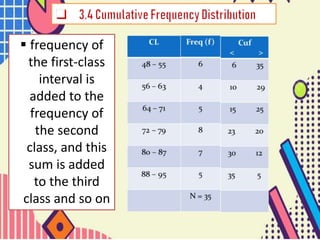
 frequency of
the first-class
interval is
added to the
frequency of
the second
class, and this
sum is added
to the third
class and so on
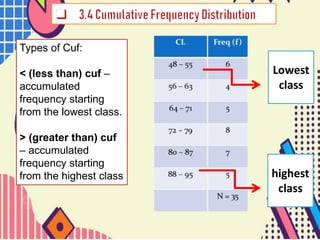
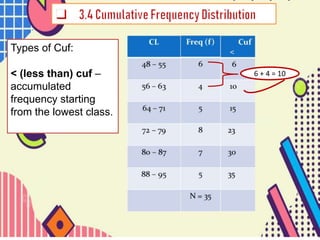
Types of Cuf:
< (less than) cuf –
accumulated
frequency starting
from the lowest class.
> (greater than) cuf
– accumulated
frequency starting
from the highest class
Lowest
class
highest
class
Types of Cuf:
< (less than) cuf –
accumulated
frequency starting
from the lowest class.
6 + 4 = 10
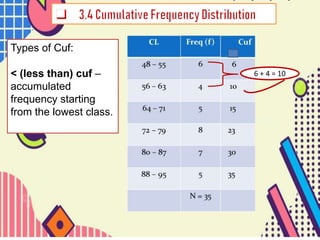
Types of Cuf:
< (less than) cuf –
accumulated
frequency starting
from the lowest class.
6 + 4 = 10
Graphical Presentation of Frequency Distribution Report.pptx

Graphical Presentation of Frequency Distribution Report.pptx

  • 3.
     frequency of thefirst-class interval is added to the frequency of the second class, and this sum is added to the third class and so on
  • 4.
    Types of Cuf: <(less than) cuf – accumulated frequency starting from the lowest class. > (greater than) cuf – accumulated frequency starting from the highest class Lowest class highest class
  • 5.
    Types of Cuf: <(less than) cuf – accumulated frequency starting from the lowest class. 6 + 4 = 10
  • 6.
    Types of Cuf: <(less than) cuf – accumulated frequency starting from the lowest class. 6 + 4 = 10