CONTENTS
● Brief Description on:
1. Grape
2. Goliath
3. Eventmachine
4. Fiber
5. Node.JS
6. Node.JS vs EM
● Grape_Goliath Gem and Usage
GRAPE
● REST-like API micro-framework for
Ruby
● Designed to run on Rack or
complement existing web application
frameworks.
● Grape APIs are Rack applications
that are created by subclassing
Grape::API.
Advantages
● No need of rails to create simple
API's.
● Grape allows you to build lightweight
APIs with Ruby when you don't need
the heavy lifting power of large
frameworks like Rails.
GOLIATH
● Non-blocking Ruby web server
● Serves to requests using a
EventMachine loop.
● Uses a Fiber to process a request.
Significance of Goliath
● Bare metal performance
● Rack API and middleware support
● Simple configuration
● Fully asynchronous processing
● Readable and maintainable code
Goliath Advantage
● Major advantage over other frameworks is
that by leveraging Ruby fibers introduced
in Ruby 1.9+, it can untangle the
complicated callback-based code into a
known format.
● Linear execution, leads to more
maintainable and readable code.
..contd
● Each HTTP request within Goliath is
executed within its own Ruby fiber and all
asynchronous I/O operations can
transparently suspend and later resume
the processing without requiring the
developer to write any additional code.
● Both request processing and response
processing can be done in fully
asynchronous fashion:
streaming uploads, firehose API's,
request/response, websockets, and so on.
Goliath compared to
other servers like Thin
● Goliath is able to run on different Ruby
platforms.
● It uses a different HTTP parser, supports
HTTP keepalive & pipelining.
● Offers a fully asynchronous API for both
request and response processing.
..contd
● Goliath claims to works its magic by
“leveraging Ruby fibers introduced in Ruby
1.9+”.
● Fibers are primitives for implementing light
weight cooperative concurrency in Ruby.
Basically they are a means of creating
code blocks that can be paused and
resumed, much like threads.
● The main difference is that they are never
preempted and that the scheduling must
be done by the programmer.
EVENTMACHINE
● EventMachine is an event-driven I/O and
lightweight concurrency library for Ruby.
● It provides event-driven I/O using the
Reactor pattern, much like JBoss Netty,
Apache MINA, Python's Twisted, Node.js,
libevent and libev.
EM Significance
● Extremely high scalability, performance and
stability for the most demanding production
environments.
● An API that eliminates the complexities of
high-performance threaded network
programming, allowing engineers to
concentrate on their application logic.
● This unique combination makes
EventMachine a premier choice for critical
networked applications, including Web
servers and proxies, email and IM production
systems, authentication/authorization
processors, and many more.
EventMachine Usage
● Scalable event-driven servers. Examples:
Thin or Goliath.
● Scalable asynchronous clients for various
protocols, RESTful APIs and so on.
Examples: em-http-request or amqp gem.
● Efficient network proxies with custom
logic. Examples: Proxymachine.
● File and network monitoring tools.
Examples: eventmachine-tail and logstash.
FIBERS
● Primitives for implementing light weight
cooperative concurrency in Ruby.
● They are never preempted and that the
scheduling must be done by the
programmer and not the VM.
● Small 4KB stack enables it to be paused
from deeply nested function calls within
the fiber block.
● Run using the Fiber#resume method. The
code running inside the fiber can give up
control by calling Fiber.yield.
Client Example
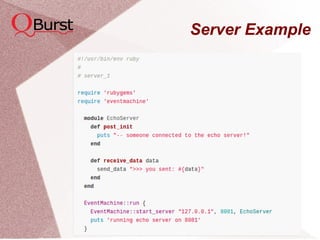
Server Example
Node.JS vs EM
Pros and Cons
EM
● Clever DSL
● Also Fast
● Its Ruby
● Mature
● Restricted EM Libraries.
● More difficult to write
than normal ruby.
Node.JS
● Shared Code
betweeen Client
and Server.
● Lightning Fast
● Javascript used
● Callback Hell
● Less Mature.
EventMachine Better
than Node.JS?
YES
● EventMachine’s concurrent processing
ability is stronger than Node.js 50%.
● When request number goes up, Node.js’s
connection rate goes down.
Gem Grape_Goliath
●
Gem which creates an application with
tree structure specified for a Goliath
application having Grape API framework.
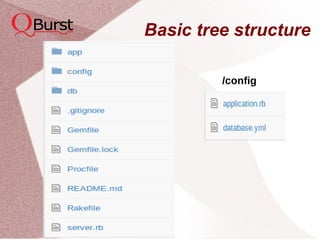
● Included Gems in tree structure :
grape, goliath, em_synchrony
● Added dependencies of rubigen included.
Basic tree structure
/config
Important Gems Used
Rubigen
● A framework to allow Ruby applications to
generate file/folder stubs.
● RubiGen will be normally integrated into
another RubyGem, such as newgem, rails or
camping.
● Here we have used newgem.
`` NewGem
● Quickly bundle any Ruby libraries into a
RubyGem and share it with the world.
Generators
● There are two types :
1. Application generators – Used by
developers for the framework to get started.
Generally used to generate a basic stub
directory files/folders.
2. Component generators - Used by
developers to extend their application.
● Here we have used application generator for
basic goliath app tree structure generation.
grape_goliath_generator.rb
● Application generator for the gem.
● Its manifest method includes the
directories that are to be created and the
files that should be inlcuded in the tree
structure.
● The files that should get added with
specified code are to be included in the
templates folder in the path
app/application_generator/grape_goliath
/templates.
Usage
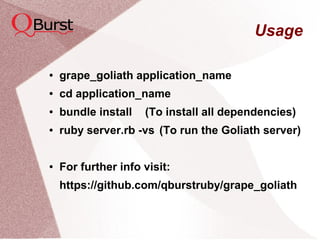
● grape_goliath application_name
● cd application_name
● bundle install (To install all dependencies)
● ruby server.rb -vs (To run the Goliath server)
● For further info visit:
https://github.com/qburstruby/grape_goliath
Enjoy Grape_Goliath!!
Thank You

Grape golilath

  • 1.
    CONTENTS ● Brief Descriptionon: 1. Grape 2. Goliath 3. Eventmachine 4. Fiber 5. Node.JS 6. Node.JS vs EM ● Grape_Goliath Gem and Usage
  • 2.
    GRAPE ● REST-like APImicro-framework for Ruby ● Designed to run on Rack or complement existing web application frameworks. ● Grape APIs are Rack applications that are created by subclassing Grape::API.
  • 3.
    Advantages ● No needof rails to create simple API's. ● Grape allows you to build lightweight APIs with Ruby when you don't need the heavy lifting power of large frameworks like Rails.
  • 4.
    GOLIATH ● Non-blocking Rubyweb server ● Serves to requests using a EventMachine loop. ● Uses a Fiber to process a request.
  • 5.
    Significance of Goliath ●Bare metal performance ● Rack API and middleware support ● Simple configuration ● Fully asynchronous processing ● Readable and maintainable code
  • 6.
    Goliath Advantage ● Majoradvantage over other frameworks is that by leveraging Ruby fibers introduced in Ruby 1.9+, it can untangle the complicated callback-based code into a known format. ● Linear execution, leads to more maintainable and readable code.
  • 7.
    ..contd ● Each HTTPrequest within Goliath is executed within its own Ruby fiber and all asynchronous I/O operations can transparently suspend and later resume the processing without requiring the developer to write any additional code. ● Both request processing and response processing can be done in fully asynchronous fashion: streaming uploads, firehose API's, request/response, websockets, and so on.
  • 8.
    Goliath compared to otherservers like Thin ● Goliath is able to run on different Ruby platforms. ● It uses a different HTTP parser, supports HTTP keepalive & pipelining. ● Offers a fully asynchronous API for both request and response processing.
  • 9.
    ..contd ● Goliath claimsto works its magic by “leveraging Ruby fibers introduced in Ruby 1.9+”. ● Fibers are primitives for implementing light weight cooperative concurrency in Ruby. Basically they are a means of creating code blocks that can be paused and resumed, much like threads. ● The main difference is that they are never preempted and that the scheduling must be done by the programmer.
  • 10.
    EVENTMACHINE ● EventMachine isan event-driven I/O and lightweight concurrency library for Ruby. ● It provides event-driven I/O using the Reactor pattern, much like JBoss Netty, Apache MINA, Python's Twisted, Node.js, libevent and libev.
  • 11.
    EM Significance ● Extremelyhigh scalability, performance and stability for the most demanding production environments. ● An API that eliminates the complexities of high-performance threaded network programming, allowing engineers to concentrate on their application logic. ● This unique combination makes EventMachine a premier choice for critical networked applications, including Web servers and proxies, email and IM production systems, authentication/authorization processors, and many more.
  • 12.
    EventMachine Usage ● Scalableevent-driven servers. Examples: Thin or Goliath. ● Scalable asynchronous clients for various protocols, RESTful APIs and so on. Examples: em-http-request or amqp gem. ● Efficient network proxies with custom logic. Examples: Proxymachine. ● File and network monitoring tools. Examples: eventmachine-tail and logstash.
  • 13.
    FIBERS ● Primitives forimplementing light weight cooperative concurrency in Ruby. ● They are never preempted and that the scheduling must be done by the programmer and not the VM. ● Small 4KB stack enables it to be paused from deeply nested function calls within the fiber block. ● Run using the Fiber#resume method. The code running inside the fiber can give up control by calling Fiber.yield.
  • 14.
  • 15.
  • 16.
  • 17.
    Pros and Cons EM ●Clever DSL ● Also Fast ● Its Ruby ● Mature ● Restricted EM Libraries. ● More difficult to write than normal ruby. Node.JS ● Shared Code betweeen Client and Server. ● Lightning Fast ● Javascript used ● Callback Hell ● Less Mature.
  • 18.
    EventMachine Better than Node.JS? YES ●EventMachine’s concurrent processing ability is stronger than Node.js 50%. ● When request number goes up, Node.js’s connection rate goes down.
  • 19.
    Gem Grape_Goliath ● Gem whichcreates an application with tree structure specified for a Goliath application having Grape API framework. ● Included Gems in tree structure : grape, goliath, em_synchrony ● Added dependencies of rubigen included.
  • 20.
  • 21.
    Important Gems Used Rubigen ●A framework to allow Ruby applications to generate file/folder stubs. ● RubiGen will be normally integrated into another RubyGem, such as newgem, rails or camping. ● Here we have used newgem. `` NewGem ● Quickly bundle any Ruby libraries into a RubyGem and share it with the world.
  • 22.
    Generators ● There aretwo types : 1. Application generators – Used by developers for the framework to get started. Generally used to generate a basic stub directory files/folders. 2. Component generators - Used by developers to extend their application. ● Here we have used application generator for basic goliath app tree structure generation.
  • 23.
    grape_goliath_generator.rb ● Application generatorfor the gem. ● Its manifest method includes the directories that are to be created and the files that should be inlcuded in the tree structure. ● The files that should get added with specified code are to be included in the templates folder in the path app/application_generator/grape_goliath /templates.
  • 24.
    Usage ● grape_goliath application_name ●cd application_name ● bundle install (To install all dependencies) ● ruby server.rb -vs (To run the Goliath server) ● For further info visit: https://github.com/qburstruby/grape_goliath
  • 25.