Developing Rich Internet
Applications with Perl and JavaScript
           San Diego.pm talk
             Apr 19 2012
Web application evolution
• Once upon a time, there was a static
  page
• Then came CGI scripts
• Then came client side scripting
• Then came AJAX and asynchronous calls
• What next?
Introducing RIA
•   One possible answer: RIAs
•   Stands for: Rich Internet Applications
•   Many ways to develop, many frameworks
•   I have been exploring Ext JS framework
    for JavaScript
How does it work?
• No (or minimal) HTML/JavaScript
  generation on server side
• All client interaction is done in JavaScript
• All middleware/database stuff is done on
  the server side (platform agnostic)
• Communication is done AJAX style, using
  Ext.Direct RPC protocol
Ext JS Advantages
• Cross browser compatibility (even IE6)
• Really good code and issue separation
• Very low overhead on server side
• Very low traffic (only data goes on wire)
• Clean MVC architecture – easier to
  develop
• But wait, where’s Perl?
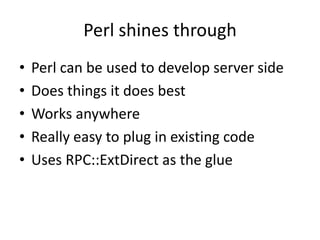
Perl shines through
•   Perl can be used to develop server side
•   Does things it does best
•   Works anywhere
•   Really easy to plug in existing code
•   Uses RPC::ExtDirect as the glue
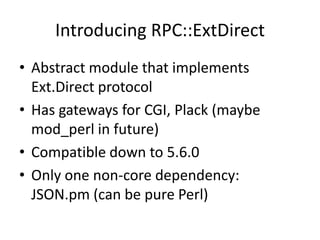
Introducing RPC::ExtDirect
• Abstract module that implements
  Ext.Direct protocol
• Has gateways for CGI, Plack (maybe
  mod_perl in future)
• Compatible down to 5.6.0
• Only one non-core dependency:
  JSON.pm (can be pure Perl)
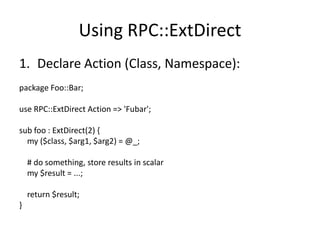
Using RPC::ExtDirect
1. Declare Action (Class, Namespace):
package Foo::Bar;

use RPC::ExtDirect Action => 'Fubar';

sub foo : ExtDirect(2) {
  my ($class, $arg1, $arg2) = @_;

    # do something, store results in scalar
    my $result = ...;

    return $result;
}
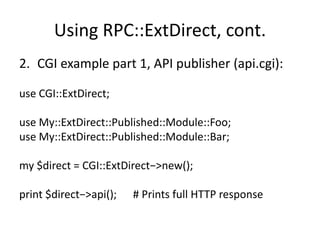
Using RPC::ExtDirect, cont.
2. CGI example part 1, API publisher (api.cgi):

use CGI::ExtDirect;

use My::ExtDirect::Published::Module::Foo;
use My::ExtDirect::Published::Module::Bar;

my $direct = CGI::ExtDirect−>new();

print $direct−>api();   # Prints full HTTP response
Using RPC::ExtDirect, cont.
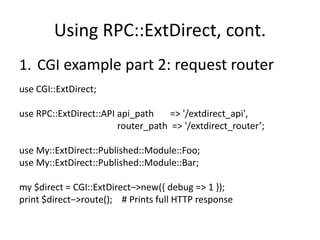
1. CGI example part 2: request router
use CGI::ExtDirect;

use RPC::ExtDirect::API api_path    => '/extdirect_api',
                        router_path => '/extdirect_router’;

use My::ExtDirect::Published::Module::Foo;
use My::ExtDirect::Published::Module::Bar;

my $direct = CGI::ExtDirect−>new({ debug => 1 });
print $direct−>route(); # Prints full HTTP response
Possible applications
• New stuff from scratch, easy and fast
• Retrofit old applications with shiny Web
  interface
• Convert terminal apps to Web apps (screen
  scraping?)
• Easily hack together Web admin apps using
  proven command line tools
• Gluing together heterogeneous applications
  (Web interface for ancient COBOL app?)
• More and more…
Conclusion
• CMS Webdash live demo (if any)
• Questions? Drop me an email:
Alex Tokarev <tokarev@cpan.org>

Developing Rich Internet Applications with Perl and JavaScript

  • 1.
    Developing Rich Internet Applicationswith Perl and JavaScript San Diego.pm talk Apr 19 2012
  • 2.
    Web application evolution •Once upon a time, there was a static page • Then came CGI scripts • Then came client side scripting • Then came AJAX and asynchronous calls • What next?
  • 3.
    Introducing RIA • One possible answer: RIAs • Stands for: Rich Internet Applications • Many ways to develop, many frameworks • I have been exploring Ext JS framework for JavaScript
  • 4.
    How does itwork? • No (or minimal) HTML/JavaScript generation on server side • All client interaction is done in JavaScript • All middleware/database stuff is done on the server side (platform agnostic) • Communication is done AJAX style, using Ext.Direct RPC protocol
  • 5.
    Ext JS Advantages •Cross browser compatibility (even IE6) • Really good code and issue separation • Very low overhead on server side • Very low traffic (only data goes on wire) • Clean MVC architecture – easier to develop • But wait, where’s Perl?
  • 6.
    Perl shines through • Perl can be used to develop server side • Does things it does best • Works anywhere • Really easy to plug in existing code • Uses RPC::ExtDirect as the glue
  • 7.
    Introducing RPC::ExtDirect • Abstractmodule that implements Ext.Direct protocol • Has gateways for CGI, Plack (maybe mod_perl in future) • Compatible down to 5.6.0 • Only one non-core dependency: JSON.pm (can be pure Perl)
  • 8.
    Using RPC::ExtDirect 1. DeclareAction (Class, Namespace): package Foo::Bar; use RPC::ExtDirect Action => 'Fubar'; sub foo : ExtDirect(2) { my ($class, $arg1, $arg2) = @_; # do something, store results in scalar my $result = ...; return $result; }
  • 9.
    Using RPC::ExtDirect, cont. 2.CGI example part 1, API publisher (api.cgi): use CGI::ExtDirect; use My::ExtDirect::Published::Module::Foo; use My::ExtDirect::Published::Module::Bar; my $direct = CGI::ExtDirect−>new(); print $direct−>api(); # Prints full HTTP response
  • 10.
    Using RPC::ExtDirect, cont. 1.CGI example part 2: request router use CGI::ExtDirect; use RPC::ExtDirect::API api_path => '/extdirect_api', router_path => '/extdirect_router’; use My::ExtDirect::Published::Module::Foo; use My::ExtDirect::Published::Module::Bar; my $direct = CGI::ExtDirect−>new({ debug => 1 }); print $direct−>route(); # Prints full HTTP response
  • 11.
    Possible applications • Newstuff from scratch, easy and fast • Retrofit old applications with shiny Web interface • Convert terminal apps to Web apps (screen scraping?) • Easily hack together Web admin apps using proven command line tools • Gluing together heterogeneous applications (Web interface for ancient COBOL app?) • More and more…
  • 12.
    Conclusion • CMS Webdashlive demo (if any) • Questions? Drop me an email: Alex Tokarev <tokarev@cpan.org>