GRAND WARD ROUND
CASE 1
HOPI
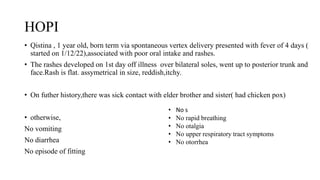
• Qistina , 1 year old, born term via spontaneous vertex delivery presented with fever of 4 days (
started on 1/12/22),associated with poor oral intake and rashes.
• The rashes developed on 1st day off illness over bilateral soles, went up to posterior trunk and
face.Rash is flat. assymetrical in size, reddish,itchy.
• On futher history,there was sick contact with elder brother and sister( had chicken pox)
• otherwise,
No vomiting
No diarrhea
No episode of fitting
• No s
• No rapid breathing
• No otalgia
• No upper respiratory tract symptoms
• No otorrhea
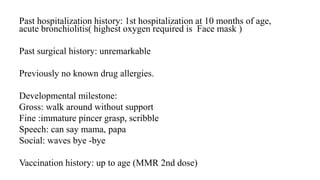
Past hospitalization history: 1st hospitalization at 10 months of age,
acute bronchiolitis( highest oxygen required is Face mask )
Past surgical history: unremarkable
Previously no known drug allergies.
Developmental milestone:
Gross: walk around without support
Fine :immature pincer grasp, scribble
Speech: can say mama, papa
Social: waves bye -bye
Vaccination history: up to age (MMR 2nd dose)
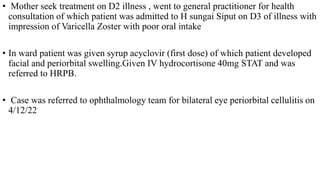
• Mother seek treatment on D2 illness , went to general practitioner for health
consultation of which patient was admitted to H sungai Siput on D3 of illness with
impression of Varicella Zoster with poor oral intake
• In ward patient was given syrup acyclovir (first dose) of which patient developed
facial and periorbital swelling.Given IV hydrocortisone 40mg STAT and was
referred to HRPB.
• Case was referred to ophthalmology team for bilateral eye periorbital cellulitis on
4/12/22
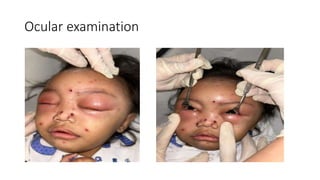
Ocular examination
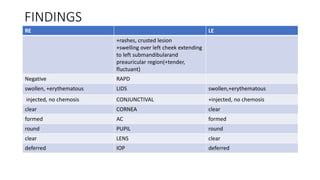
FINDINGS
RE LE
+rashes, crusted lesion
+swelling over left cheek extending
to left submandibularand
preauricular region(+tender,
fluctuant)
Negative RAPD
swollen, +erythematous LIDS swollen,+erythematous
injected, no chemosis CONJUNCTIVAL +injected, no chemosis
clear CORNEA clear
formed AC formed
round PUPIL round
clear LENS clear
deferred IOP deferred
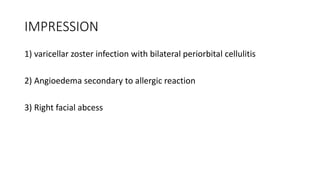
IMPRESSION
1) varicellar zoster infection with bilateral periorbital cellulitis
2) Angioedema secondary to allergic reaction
3) Right facial abcess
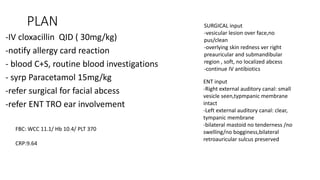
PLAN
-IV cloxacillin QID ( 30mg/kg)
-notify allergy card reaction
- blood C+S, routine blood investigations
- syrp Paracetamol 15mg/kg
-refer surgical for facial abcess
-refer ENT TRO ear involvement
SURGICAL input
-vesicular lesion over face,no
pus/clean
-overlying skin redness ver right
preauricular and submandibular
region , soft, no localized abcess
-continue IV antibiotics
ENT input
-Right external auditory canal: small
vesicle seen,typmpanic membrane
intact
-Left external auditory canal: clear,
tympanic membrane
-bilateral mastoid no tenderness /no
swelling/no bogginess,bilateral
retroauricular sulcus preserved
FBC: WCC 11.1/ Hb 10.4/ PLT 370
CRP:9.64
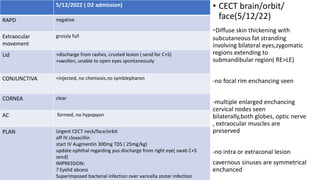
5/12/2022 ( D2 admission)
RAPD negative
Extraocular
movement
grossly full
Lid +discharge from rashes, crusted lesion ( send for C+S)
+swollen, unable to open eyes spontaneously
CONJUNCTIVA +injected, no chemosis,no symblepharon
CORNEA clear
AC formed, no hypopyon
PLAN Urgent CECT neck/face/orbit
off IV cloxacillin
start IV Augmentin 300mg TDS ( 25mg/kg)
update ophthal regarding pus discharge from right eye( swab C+S
send)
IMPRESSION:
? Eyelid abcess
Superimposed bacterial infection over varicella zoster infection
• CECT brain/orbit/
face(5/12/22)
-Diffuse skin thickening with
subcutaneous fat stranding
involving bilateral eyes,zygomatic
regions extending to
submandibular region( RE>LE)
-no focal rim enchancing seen
-multiple enlarged enchancing
cervical nodes seen
bilaterally,both globes, optic nerve
, extraocular muscles are
preserved
-no intra or extraconal lesion
cavernous sinuses are symmetrical
enchanced
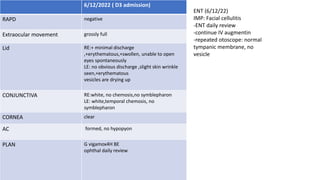
6/12/2022 ( D3 admission)
RAPD negative
Extraocular movement grossly full
Lid RE:+ minimal discharge
,+erythematous,+swollen, unable to open
eyes spontaneously
LE: no obvious discharge ,slight skin wrinkle
seen,+erythematous
vesicles are drying up
CONJUNCTIVA RE:white, no chemosis,no symblepharon
LE: white,temporal chemosis, no
symblepharon
CORNEA clear
AC formed, no hypopyon
PLAN G vigamox4H BE
ophthal daily review
ENT (6/12/22)
IMP: Facial cellulitis
-ENT daily review
-continue IV augmentin
-repeated otoscope: normal
tympanic membrane, no
vesicle
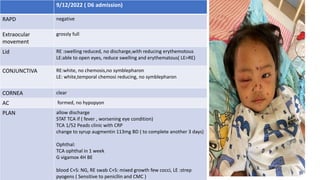
9/12/2022 ( D6 admission)
RAPD negative
Extraocular
movement
grossly full
Lid RE :swelling reduced, no discharge,with reducing erythemotous
LE:able to open eyes, reduce swelling and erythematous( LE>RE)
CONJUNCTIVA RE:white, no chemosis,no symblepharon
LE: white,temporal chemosi reducing, no symblepharon
CORNEA clear
AC formed, no hypopyon
PLAN allow discharge
STAT TCA if ( fever , worsening eye condition)
TCA 1/52 Peads clinic with CRP
change to syrup augmentin 113mg BD ( to complete another 3 days)
Ophthal:
TCA ophthal in 1 week
G vigamox 4H BE
blood C+S: NG, RE swab C+S: mixed growth few cocci, LE :strep
pyogens ( Sensitive to penicllin and CMC )
• CASE 2
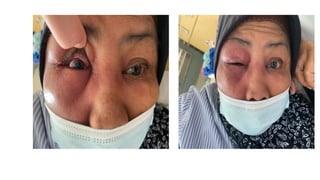
• MRs H , 60 years old, with underlying valvular heart disease, allergic to seafood,
presented with right eye upper lid swelling since 27/11/22
• .Patient had history of alleged tick bite, went to KK on 29/11/22 ,removed the
tick but no eyedrop medications were given.
• subsequently, came to eye clinic on 1/12/22( D7) to get treatment as eye swelling
increasing associated with redness , warm and itchiness.
• Patient still able to move eye without pain.
• otherwise
no blurring of vision
no eye discharge
no diplopia
no floaters
no fever
no toothache
no upper respiratory tract infection/ no early morning sneezing
no history of eye swelling( chalazion)
no history of soil contact/jungle trekking
no palpitation/ tremors/heat intolerance/mood swings/ loss of weight/ increase
appetite
denies traditional medications / recretional medications
No prior history of eye pain/ swelling / proptosis prior to this
• Past medical history:
1/ Valvular heart disease
-diagnosed >10 years ago
-under medical follow up
-on T warfarin 3g OD ( Monday-Thursday), T warfarin 3.5mg OD( Friday to Sunday)
2/ Hypertension
-diagnosed >10 years ago
-T amlodipine 10mg OD
Past ocular history:NIL
Past surgical history: NIL
Family history: married , blessed with 3 children all are healthy
Social history:Full time housewife, lives with husband.
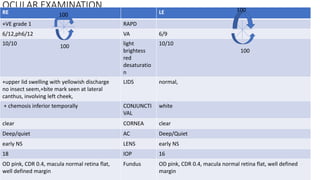
OCULAR EXAMINATION
• ocular examination
+injected, no chemosis,no symblepharon
RE LE
+VE grade 1 RAPD
6/12,ph6/12 VA 6/9
10/10 light
brightess
red
desaturatio
n
10/10
+upper lid swelling with yellowish discharge
no insect seem,+bite mark seen at lateral
canthus, involving left cheek,
LIDS normal,
+ chemosis inferior temporally CONJUNCTI
VAL
white
clear CORNEA clear
Deep/quiet AC Deep/Quiet
early NS LENS early NS
18 IOP 16
OD pink, CDR 0.4, macula normal retina flat,
well defined margin
Fundus OD pink, CDR 0.4, macula normal retina flat, well defined
margin
100
100
100
100
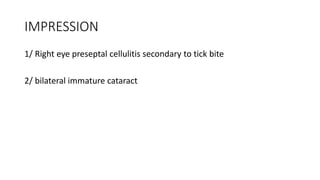
IMPRESSION
1/ Right eye preseptal cellulitis secondary to tick bite
2/ bilateral immature cataract
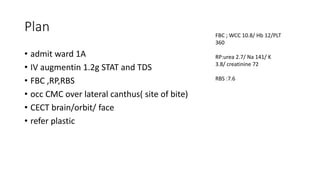
Plan
• admit ward 1A
• IV augmentin 1.2g STAT and TDS
• FBC ,RP,RBS
• occ CMC over lateral canthus( site of bite)
• CECT brain/orbit/ face
• refer plastic
FBC ; WCC 10.8/ Hb 12/PLT
360
RP:urea 2.7/ Na 141/ K
3.8/ creatinine 72
RBS :7.6
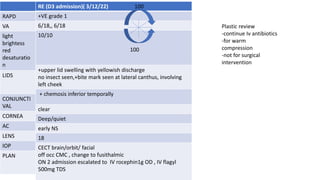
• Progression
RAPD
VA
light
brightess
red
desaturatio
n
LIDS
CONJUNCTI
VAL
CORNEA
AC
LENS
IOP
PLAN
RE (D3 admission)( 3/12/22)
+VE grade 1
6/18,, 6/18
10/10
+upper lid swelling with yellowish discharge
no insect seen,+bite mark seen at lateral canthus, involving
left cheek
+ chemosis inferior temporally
clear
Deep/quiet
early NS
18
CECT brain/orbit/ facial
off occ CMC , change to fusithalmic
ON 2 admission escalated to IV rocephin1g OD , IV flagyl
500mg TDS
100
100
Plastic review
-continue Iv antibiotics
-for warm
compression
-not for surgical
intervention
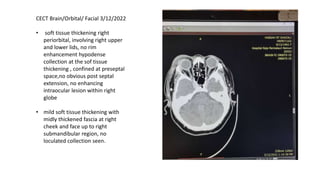
CECT Brain/Orbital/ Facial 3/12/2022
• soft tissue thickening right
periorbital, involving right upper
and lower lids, no rim
enhancement hypodense
collection at the sof tissue
thickening , confined at preseptal
space,no obvious post septal
extension, no enhancing
intraocular lesion within right
globe
• mild soft tissue thickening with
midly thickened fascia at right
cheek and face up to right
submandibular region, no
loculated collection seen.
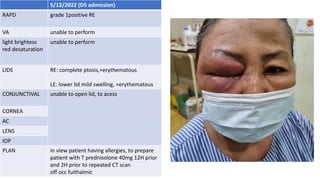
5/12/2022 (D5 admission)
RAPD grade 1positive RE
VA unable to perform
light brightess
red desaturation
unable to perform
LIDS RE: complete ptosis,+erythematous
LE: lower lid mild swelling, +erythematous
CONJUNCTIVAL unable to open lid, to acess
CORNEA
AC
LENS
IOP
PLAN in view patient having allergies, to prepare
patient with T prednisolone 40mg 12H prior
and 2H prior to repeated CT scan
off occ fuithalmic
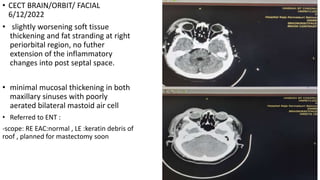
• CECT BRAIN/ORBIT/ FACIAL
6/12/2022
• slightly worsening soft tissue
thickening and fat stranding at right
periorbital region, no futher
extension of the inflammatory
changes into post septal space.
• minimal mucosal thickening in both
maxillary sinuses with poorly
aerated bilateral mastoid air cell
• Referred to ENT :
-scope: RE EAC:normal , LE :keratin debris of
roof , planned for mastectomy soon
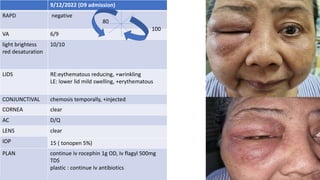
9/12/2022 (D9 admission)
RAPD negative
VA 6/9
light brightess
red desaturation
10/10
LIDS RE:eythematous reducing, +wrinkling
LE: lower lid mild swelling, +erythematous
CONJUNCTIVAL chemosis temporally, +injected
CORNEA clear
AC D/Q
LENS clear
IOP 15 ( tonopen 5%)
PLAN continue Iv rocephin 1g OD, Iv flagyl 500mg
TDS
plastic : continue Iv antibiotics
80
100
On 12/12/22
• Patient was allowed discharged with TCA on 16/12/22 as eye
condition improving
• T augmentin 625mg TDS to complete for 5 days
• G vigamox 4H RE
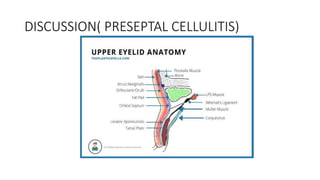
DISCUSSION( PRESEPTAL CELLULITIS)
• ETIOLOGY
1)Extension from neighbouring structures:
-Paranasal sinuses,teeth, lids, intraorbital structures: this is the commonest mode
of infection.
2)Exogenous infection:
-Foreign body, penetrating injury
3) Endogenous infection
-Septicemia,
4) Predisposing factor
-Diabetes mellitus,immunocompromised state
• Bacteria:
Children: Stap aureus,Strep pneumonia,
Adult : Stap aureus, Strep pneumonia, Ecoli
Streptococcus pneumonia predominates when infection arises from sinuses infection,
Staphylococcus aureus and Streptococcus pyogenes often accompany local trauma and may be the most important
pathology related to periocular infection
• Fungus
-Usually observed in diabetes mellitus and immunocompromised patient
-Aspergillosis,Mucormycosis
• Parasite
-Taenia sollium
-Toxoplasma Gondii
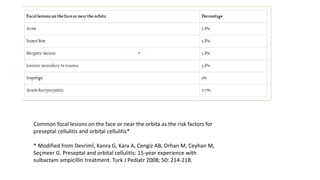
Common focal lesions on the face or near the orbita as the risk factors for
preseptal cellulitis and orbital cellulitis*
* Modified from Devrimİ, Kanra G, Kara A, Cengiz AB, Orhan M, Ceyhan M,
Seçmeer G. Preseptal and orbital cellulitis: 15-year experience with
sulbactam ampicillin treatment. Turk J Pediatr 2008; 50: 214-218.
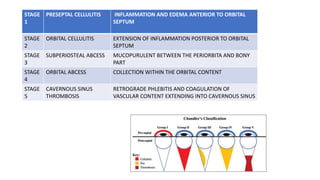
STAGE
1
PRESEPTAL CELLULITIS INFLAMMATION AND EDEMA ANTERIOR TO ORBITAL
SEPTUM
STAGE
2
ORBITAL CELLULITIS EXTENSION OF INFLAMMATION POSTERIOR TO ORBITAL
SEPTUM
STAGE
3
SUBPERIOSTEAL ABCESS MUCOPURULENT BETWEEN THE PERIORBITA AND BONY
PART
STAGE
4
ORBITAL ABCESS COLLECTION WITHIN THE ORBITAL CONTENT
STAGE
5
CAVERNOUS SINUS
THROMBOSIS
RETROGRADE PHLEBITIS AND COAGULATION OF
VASCULAR CONTENT EXTENDING INTO CAVERNOUS SINUS
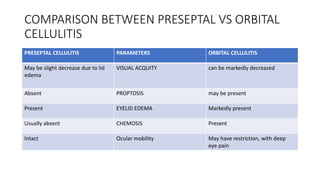
COMPARISON BETWEEN PRESEPTAL VS ORBITAL
CELLULITIS
PRESEPTAL CELLULITIS PARAMETERS ORBITAL CELLULITIS
May be slight decrease due to lid
edema
VISUAL ACQUITY can be markedly decreased
Absent PROPTOSIS may be present
Present EYELID EDEMA Markedly present
Usually absent CHEMOSIS Present
Intact Ocular mobility May have restriction, with deep
eye pain
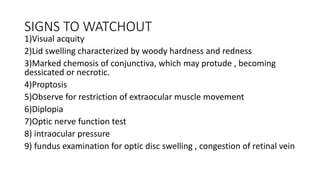
SIGNS TO WATCHOUT
1)Visual acquity
2)Lid swelling characterized by woody hardness and redness
3)Marked chemosis of conjunctiva, which may protude , becoming
dessicated or necrotic.
4)Proptosis
5)Observe for restriction of extraocular muscle movement
6)Diplopia
7)Optic nerve function test
8) intraocular pressure
9) fundus examination for optic disc swelling , congestion of retinal vein
HOW DOES CT SCAN AID IN MANAGING PATIENT?
• Swelling of the eyelid and adjacent preseptal soft tissues,proptosis
• Extent of sinus disease, detecting subperiosteal abcess /orbital abcess
that warrants immediate drainge ( operation).
• Extraconal and intraconal mass in orbital cellulitis
• Intraconal-proptosis and soft tissue obliteration
• Optic nerve thickened
• Asymmetrical Cavernous sinus enhancement
Differential diagnosis to think of?
• Endocrine dysfunction -thyroid eye disease
-symptoms of gritty sensation,photophobia,lacrimation,dysfunctional eye
motility, lid rectraction, lid lag,axial proptosis, compressive optic neuropathy
• Cavernous sinus thrombosis
-mimicks symptoms of orbital cellulitis but has addition symptoms of systemic
fever, headache ,altered sensorium, vomiting
-false localizing sign( paralysis of lateral rectus)
• Orbital pseudotumour/idiopathic orbital inflammatory disease
-presents as pain, diplopia,lid swelling, redness
-CT scan shows a diffuse thickening of extraocular muscle including tendinous
insertion in contrast to thyroid eye disease the thickening is confined to belly of
muscle and spares the tendon.
•Orbital myositis
-inflammatory process that involves the extraocular muscle (EOM)
-unilateral thickening of one or two EOM involving surrounding fat, tendon,
myotendinous junction.
-presents as diplopia, swollen eyelids,conjunctival hyperemia, proptosis,orbital
pain.
WHEN SHOULD SURGICAL INTERVENTION DONE
• suspicious of orbital abcess, foreign body
• progression of visual loss
• extraocular motility defect( worsening)
• worsening of proptosis
• non reducing size of abcess on CT scan after IV antibiotics

GRAND WARD ROUND .pptx

  • 1.
  • 2.
    HOPI • Qistina ,1 year old, born term via spontaneous vertex delivery presented with fever of 4 days ( started on 1/12/22),associated with poor oral intake and rashes. • The rashes developed on 1st day off illness over bilateral soles, went up to posterior trunk and face.Rash is flat. assymetrical in size, reddish,itchy. • On futher history,there was sick contact with elder brother and sister( had chicken pox) • otherwise, No vomiting No diarrhea No episode of fitting • No s • No rapid breathing • No otalgia • No upper respiratory tract symptoms • No otorrhea
  • 3.
    Past hospitalization history:1st hospitalization at 10 months of age, acute bronchiolitis( highest oxygen required is Face mask ) Past surgical history: unremarkable Previously no known drug allergies. Developmental milestone: Gross: walk around without support Fine :immature pincer grasp, scribble Speech: can say mama, papa Social: waves bye -bye Vaccination history: up to age (MMR 2nd dose)
  • 4.
    • Mother seektreatment on D2 illness , went to general practitioner for health consultation of which patient was admitted to H sungai Siput on D3 of illness with impression of Varicella Zoster with poor oral intake • In ward patient was given syrup acyclovir (first dose) of which patient developed facial and periorbital swelling.Given IV hydrocortisone 40mg STAT and was referred to HRPB. • Case was referred to ophthalmology team for bilateral eye periorbital cellulitis on 4/12/22
  • 5.
  • 6.
    FINDINGS RE LE +rashes, crustedlesion +swelling over left cheek extending to left submandibularand preauricular region(+tender, fluctuant) Negative RAPD swollen, +erythematous LIDS swollen,+erythematous injected, no chemosis CONJUNCTIVAL +injected, no chemosis clear CORNEA clear formed AC formed round PUPIL round clear LENS clear deferred IOP deferred
  • 7.
    IMPRESSION 1) varicellar zosterinfection with bilateral periorbital cellulitis 2) Angioedema secondary to allergic reaction 3) Right facial abcess
  • 8.
    PLAN -IV cloxacillin QID( 30mg/kg) -notify allergy card reaction - blood C+S, routine blood investigations - syrp Paracetamol 15mg/kg -refer surgical for facial abcess -refer ENT TRO ear involvement SURGICAL input -vesicular lesion over face,no pus/clean -overlying skin redness ver right preauricular and submandibular region , soft, no localized abcess -continue IV antibiotics ENT input -Right external auditory canal: small vesicle seen,typmpanic membrane intact -Left external auditory canal: clear, tympanic membrane -bilateral mastoid no tenderness /no swelling/no bogginess,bilateral retroauricular sulcus preserved FBC: WCC 11.1/ Hb 10.4/ PLT 370 CRP:9.64
  • 9.
    5/12/2022 ( D2admission) RAPD negative Extraocular movement grossly full Lid +discharge from rashes, crusted lesion ( send for C+S) +swollen, unable to open eyes spontaneously CONJUNCTIVA +injected, no chemosis,no symblepharon CORNEA clear AC formed, no hypopyon PLAN Urgent CECT neck/face/orbit off IV cloxacillin start IV Augmentin 300mg TDS ( 25mg/kg) update ophthal regarding pus discharge from right eye( swab C+S send) IMPRESSION: ? Eyelid abcess Superimposed bacterial infection over varicella zoster infection • CECT brain/orbit/ face(5/12/22) -Diffuse skin thickening with subcutaneous fat stranding involving bilateral eyes,zygomatic regions extending to submandibular region( RE>LE) -no focal rim enchancing seen -multiple enlarged enchancing cervical nodes seen bilaterally,both globes, optic nerve , extraocular muscles are preserved -no intra or extraconal lesion cavernous sinuses are symmetrical enchanced
  • 10.
    6/12/2022 ( D3admission) RAPD negative Extraocular movement grossly full Lid RE:+ minimal discharge ,+erythematous,+swollen, unable to open eyes spontaneously LE: no obvious discharge ,slight skin wrinkle seen,+erythematous vesicles are drying up CONJUNCTIVA RE:white, no chemosis,no symblepharon LE: white,temporal chemosis, no symblepharon CORNEA clear AC formed, no hypopyon PLAN G vigamox4H BE ophthal daily review ENT (6/12/22) IMP: Facial cellulitis -ENT daily review -continue IV augmentin -repeated otoscope: normal tympanic membrane, no vesicle
  • 11.
    9/12/2022 ( D6admission) RAPD negative Extraocular movement grossly full Lid RE :swelling reduced, no discharge,with reducing erythemotous LE:able to open eyes, reduce swelling and erythematous( LE>RE) CONJUNCTIVA RE:white, no chemosis,no symblepharon LE: white,temporal chemosi reducing, no symblepharon CORNEA clear AC formed, no hypopyon PLAN allow discharge STAT TCA if ( fever , worsening eye condition) TCA 1/52 Peads clinic with CRP change to syrup augmentin 113mg BD ( to complete another 3 days) Ophthal: TCA ophthal in 1 week G vigamox 4H BE blood C+S: NG, RE swab C+S: mixed growth few cocci, LE :strep pyogens ( Sensitive to penicllin and CMC )
  • 12.
  • 13.
    • MRs H, 60 years old, with underlying valvular heart disease, allergic to seafood, presented with right eye upper lid swelling since 27/11/22 • .Patient had history of alleged tick bite, went to KK on 29/11/22 ,removed the tick but no eyedrop medications were given. • subsequently, came to eye clinic on 1/12/22( D7) to get treatment as eye swelling increasing associated with redness , warm and itchiness. • Patient still able to move eye without pain.
  • 14.
    • otherwise no blurringof vision no eye discharge no diplopia no floaters no fever no toothache no upper respiratory tract infection/ no early morning sneezing no history of eye swelling( chalazion) no history of soil contact/jungle trekking no palpitation/ tremors/heat intolerance/mood swings/ loss of weight/ increase appetite denies traditional medications / recretional medications No prior history of eye pain/ swelling / proptosis prior to this
  • 15.
    • Past medicalhistory: 1/ Valvular heart disease -diagnosed >10 years ago -under medical follow up -on T warfarin 3g OD ( Monday-Thursday), T warfarin 3.5mg OD( Friday to Sunday) 2/ Hypertension -diagnosed >10 years ago -T amlodipine 10mg OD Past ocular history:NIL Past surgical history: NIL Family history: married , blessed with 3 children all are healthy Social history:Full time housewife, lives with husband.
  • 17.
    OCULAR EXAMINATION • ocularexamination +injected, no chemosis,no symblepharon RE LE +VE grade 1 RAPD 6/12,ph6/12 VA 6/9 10/10 light brightess red desaturatio n 10/10 +upper lid swelling with yellowish discharge no insect seem,+bite mark seen at lateral canthus, involving left cheek, LIDS normal, + chemosis inferior temporally CONJUNCTI VAL white clear CORNEA clear Deep/quiet AC Deep/Quiet early NS LENS early NS 18 IOP 16 OD pink, CDR 0.4, macula normal retina flat, well defined margin Fundus OD pink, CDR 0.4, macula normal retina flat, well defined margin 100 100 100 100
  • 18.
    IMPRESSION 1/ Right eyepreseptal cellulitis secondary to tick bite 2/ bilateral immature cataract
  • 19.
    Plan • admit ward1A • IV augmentin 1.2g STAT and TDS • FBC ,RP,RBS • occ CMC over lateral canthus( site of bite) • CECT brain/orbit/ face • refer plastic FBC ; WCC 10.8/ Hb 12/PLT 360 RP:urea 2.7/ Na 141/ K 3.8/ creatinine 72 RBS :7.6
  • 20.
    • Progression RAPD VA light brightess red desaturatio n LIDS CONJUNCTI VAL CORNEA AC LENS IOP PLAN RE (D3admission)( 3/12/22) +VE grade 1 6/18,, 6/18 10/10 +upper lid swelling with yellowish discharge no insect seen,+bite mark seen at lateral canthus, involving left cheek + chemosis inferior temporally clear Deep/quiet early NS 18 CECT brain/orbit/ facial off occ CMC , change to fusithalmic ON 2 admission escalated to IV rocephin1g OD , IV flagyl 500mg TDS 100 100 Plastic review -continue Iv antibiotics -for warm compression -not for surgical intervention
  • 21.
    CECT Brain/Orbital/ Facial3/12/2022 • soft tissue thickening right periorbital, involving right upper and lower lids, no rim enhancement hypodense collection at the sof tissue thickening , confined at preseptal space,no obvious post septal extension, no enhancing intraocular lesion within right globe • mild soft tissue thickening with midly thickened fascia at right cheek and face up to right submandibular region, no loculated collection seen.
  • 22.
    5/12/2022 (D5 admission) RAPDgrade 1positive RE VA unable to perform light brightess red desaturation unable to perform LIDS RE: complete ptosis,+erythematous LE: lower lid mild swelling, +erythematous CONJUNCTIVAL unable to open lid, to acess CORNEA AC LENS IOP PLAN in view patient having allergies, to prepare patient with T prednisolone 40mg 12H prior and 2H prior to repeated CT scan off occ fuithalmic
  • 23.
    • CECT BRAIN/ORBIT/FACIAL 6/12/2022 • slightly worsening soft tissue thickening and fat stranding at right periorbital region, no futher extension of the inflammatory changes into post septal space. • minimal mucosal thickening in both maxillary sinuses with poorly aerated bilateral mastoid air cell • Referred to ENT : -scope: RE EAC:normal , LE :keratin debris of roof , planned for mastectomy soon
  • 24.
    9/12/2022 (D9 admission) RAPDnegative VA 6/9 light brightess red desaturation 10/10 LIDS RE:eythematous reducing, +wrinkling LE: lower lid mild swelling, +erythematous CONJUNCTIVAL chemosis temporally, +injected CORNEA clear AC D/Q LENS clear IOP 15 ( tonopen 5%) PLAN continue Iv rocephin 1g OD, Iv flagyl 500mg TDS plastic : continue Iv antibiotics 80 100
  • 25.
    On 12/12/22 • Patientwas allowed discharged with TCA on 16/12/22 as eye condition improving • T augmentin 625mg TDS to complete for 5 days • G vigamox 4H RE
  • 26.
  • 27.
    • ETIOLOGY 1)Extension fromneighbouring structures: -Paranasal sinuses,teeth, lids, intraorbital structures: this is the commonest mode of infection. 2)Exogenous infection: -Foreign body, penetrating injury 3) Endogenous infection -Septicemia, 4) Predisposing factor -Diabetes mellitus,immunocompromised state
  • 28.
    • Bacteria: Children: Stapaureus,Strep pneumonia, Adult : Stap aureus, Strep pneumonia, Ecoli Streptococcus pneumonia predominates when infection arises from sinuses infection, Staphylococcus aureus and Streptococcus pyogenes often accompany local trauma and may be the most important pathology related to periocular infection • Fungus -Usually observed in diabetes mellitus and immunocompromised patient -Aspergillosis,Mucormycosis • Parasite -Taenia sollium -Toxoplasma Gondii
  • 29.
    Common focal lesionson the face or near the orbita as the risk factors for preseptal cellulitis and orbital cellulitis* * Modified from Devrimİ, Kanra G, Kara A, Cengiz AB, Orhan M, Ceyhan M, Seçmeer G. Preseptal and orbital cellulitis: 15-year experience with sulbactam ampicillin treatment. Turk J Pediatr 2008; 50: 214-218.
  • 30.
    STAGE 1 PRESEPTAL CELLULITIS INFLAMMATIONAND EDEMA ANTERIOR TO ORBITAL SEPTUM STAGE 2 ORBITAL CELLULITIS EXTENSION OF INFLAMMATION POSTERIOR TO ORBITAL SEPTUM STAGE 3 SUBPERIOSTEAL ABCESS MUCOPURULENT BETWEEN THE PERIORBITA AND BONY PART STAGE 4 ORBITAL ABCESS COLLECTION WITHIN THE ORBITAL CONTENT STAGE 5 CAVERNOUS SINUS THROMBOSIS RETROGRADE PHLEBITIS AND COAGULATION OF VASCULAR CONTENT EXTENDING INTO CAVERNOUS SINUS
  • 31.
    COMPARISON BETWEEN PRESEPTALVS ORBITAL CELLULITIS PRESEPTAL CELLULITIS PARAMETERS ORBITAL CELLULITIS May be slight decrease due to lid edema VISUAL ACQUITY can be markedly decreased Absent PROPTOSIS may be present Present EYELID EDEMA Markedly present Usually absent CHEMOSIS Present Intact Ocular mobility May have restriction, with deep eye pain
  • 32.
    SIGNS TO WATCHOUT 1)Visualacquity 2)Lid swelling characterized by woody hardness and redness 3)Marked chemosis of conjunctiva, which may protude , becoming dessicated or necrotic. 4)Proptosis 5)Observe for restriction of extraocular muscle movement 6)Diplopia 7)Optic nerve function test 8) intraocular pressure 9) fundus examination for optic disc swelling , congestion of retinal vein
  • 33.
    HOW DOES CTSCAN AID IN MANAGING PATIENT? • Swelling of the eyelid and adjacent preseptal soft tissues,proptosis • Extent of sinus disease, detecting subperiosteal abcess /orbital abcess that warrants immediate drainge ( operation). • Extraconal and intraconal mass in orbital cellulitis • Intraconal-proptosis and soft tissue obliteration • Optic nerve thickened • Asymmetrical Cavernous sinus enhancement
  • 34.
    Differential diagnosis tothink of? • Endocrine dysfunction -thyroid eye disease -symptoms of gritty sensation,photophobia,lacrimation,dysfunctional eye motility, lid rectraction, lid lag,axial proptosis, compressive optic neuropathy • Cavernous sinus thrombosis -mimicks symptoms of orbital cellulitis but has addition symptoms of systemic fever, headache ,altered sensorium, vomiting -false localizing sign( paralysis of lateral rectus)
  • 35.
    • Orbital pseudotumour/idiopathicorbital inflammatory disease -presents as pain, diplopia,lid swelling, redness -CT scan shows a diffuse thickening of extraocular muscle including tendinous insertion in contrast to thyroid eye disease the thickening is confined to belly of muscle and spares the tendon. •Orbital myositis -inflammatory process that involves the extraocular muscle (EOM) -unilateral thickening of one or two EOM involving surrounding fat, tendon, myotendinous junction. -presents as diplopia, swollen eyelids,conjunctival hyperemia, proptosis,orbital pain.
  • 36.
    WHEN SHOULD SURGICALINTERVENTION DONE • suspicious of orbital abcess, foreign body • progression of visual loss • extraocular motility defect( worsening) • worsening of proptosis • non reducing size of abcess on CT scan after IV antibiotics

Editor's Notes

  • #5 apa ubat peads bagi
  • #8 ada refer plastic x