VERB
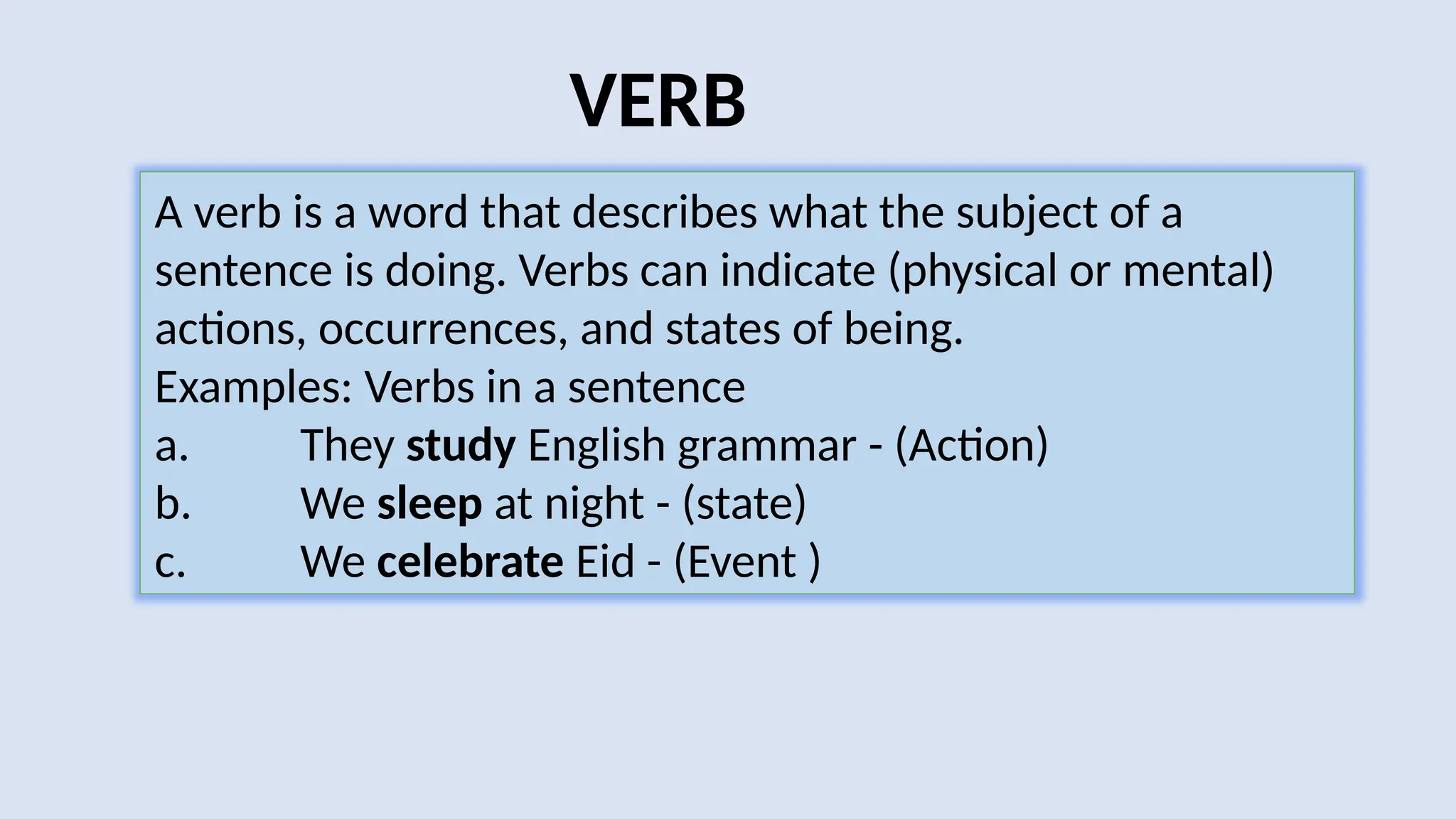
A verb is a word that describes what the subject of a
sentence is doing. Verbs can indicate (physical or mental)
actions, occurrences, and states of being.
Examples: Verbs in a sentence
a. They study English grammar - (Action)
b. We sleep at night - (state)
c. We celebrate Eid - (Event )
KINDS OF VERB
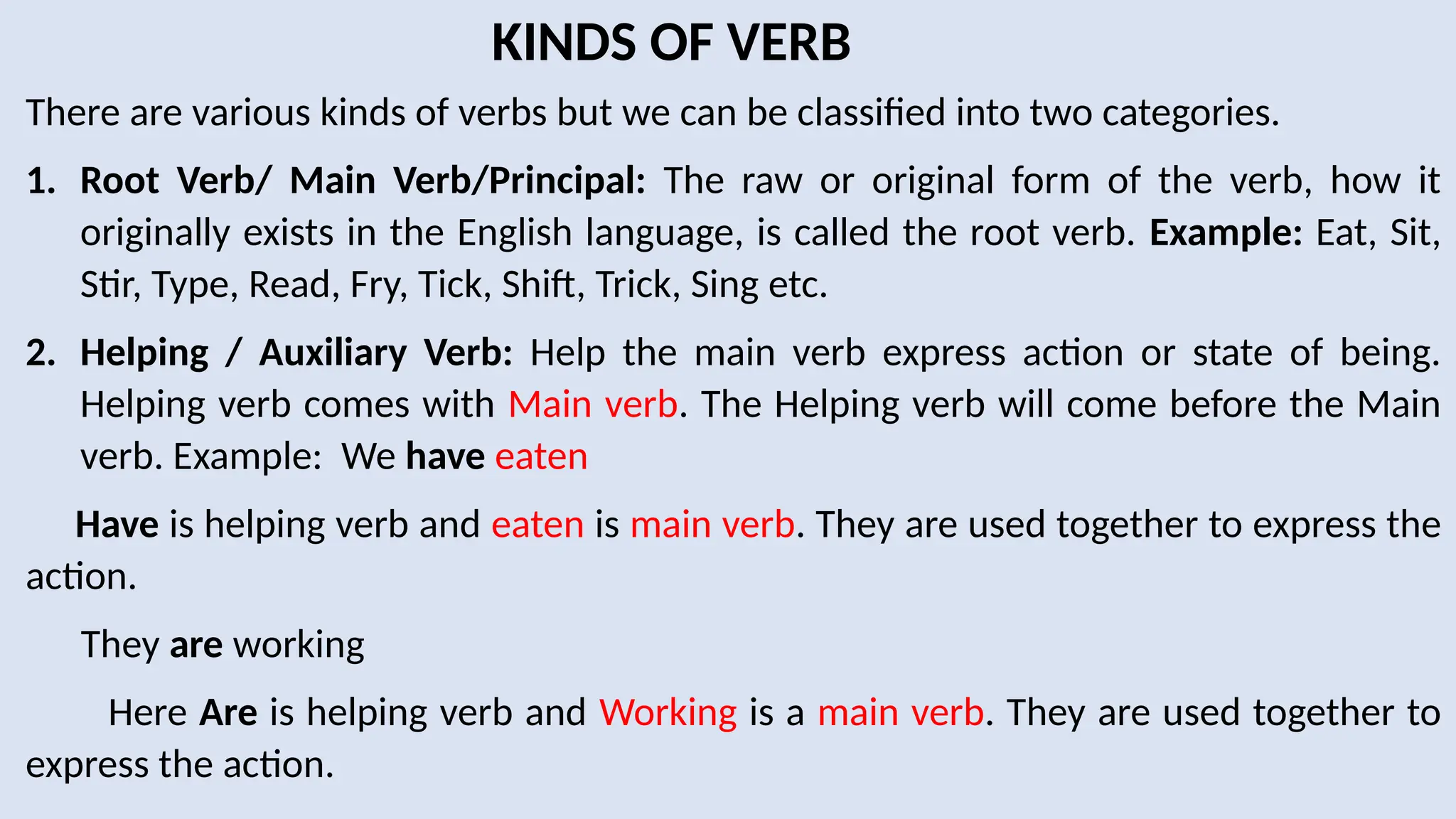
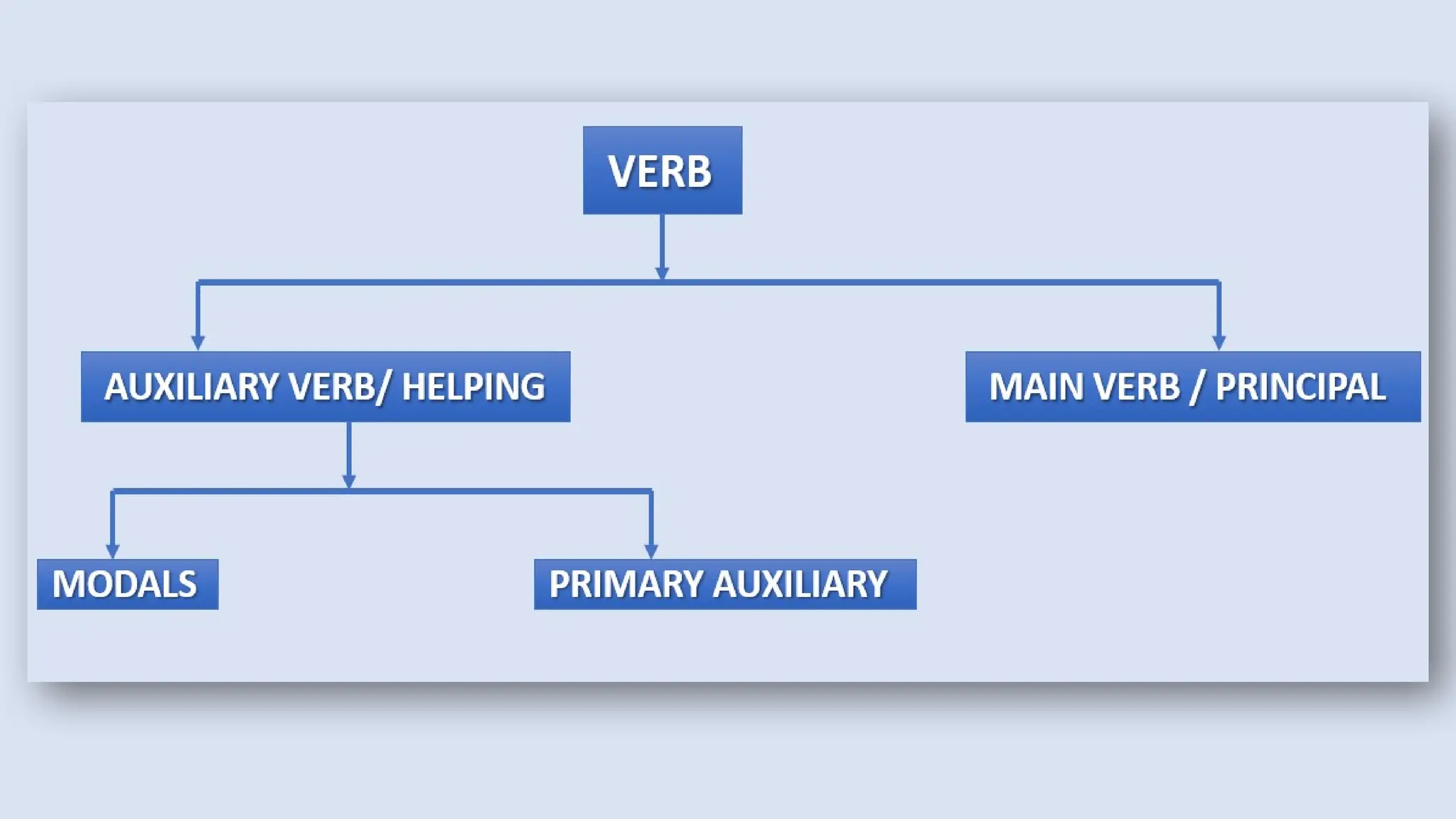
There are various kinds of verbs but we can be classified into two categories.
1. Root Verb/ Main Verb/Principal: The raw or original form of the verb, how it
originally exists in the English language, is called the root verb. Example: Eat, Sit,
Stir, Type, Read, Fry, Tick, Shift, Trick, Sing etc.
2. Helping / Auxiliary Verb: Help the main verb express action or state of being.
Helping verb comes with Main verb. The Helping verb will come before the Main
verb. Example: We have eaten
Have is helping verb and eaten is main verb. They are used together to express the
action.
They are working
Here Are is helping verb and Working is a main verb. They are used together to
express the action.
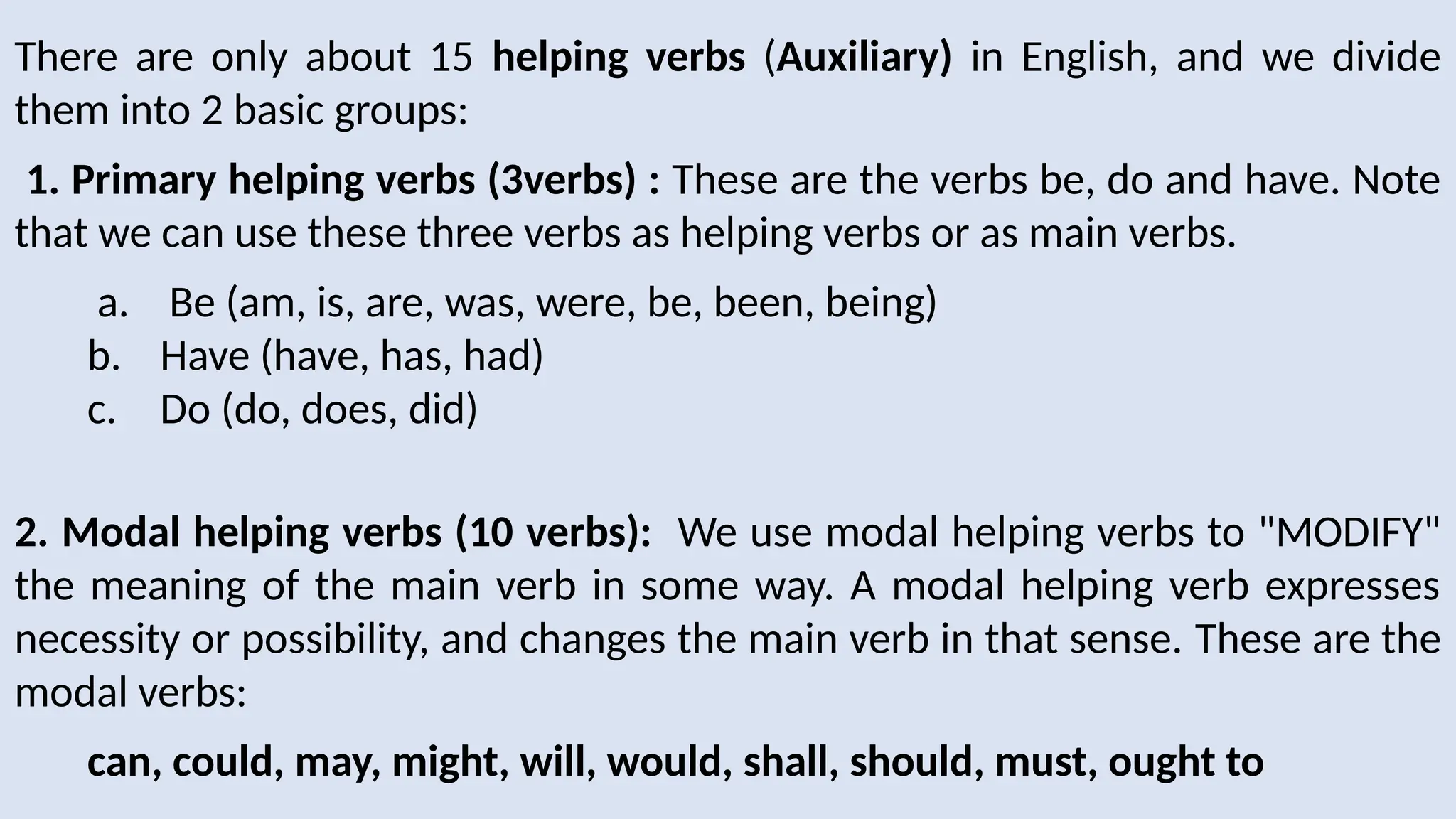
There are only about 15 helping verbs (Auxiliary) in English, and we divide
them into 2 basic groups:
1. Primary helping verbs (3verbs) : These are the verbs be, do and have. Note
that we can use these three verbs as helping verbs or as main verbs.
a. Be (am, is, are, was, were, be, been, being)
b. Have (have, has, had)
c. Do (do, does, did)
2. Modal helping verbs (10 verbs): We use modal helping verbs to "MODIFY"
the meaning of the main verb in some way. A modal helping verb expresses
necessity or possibility, and changes the main verb in that sense. These are the
modal verbs:
can, could, may, might, will, would, shall, should, must, ought to
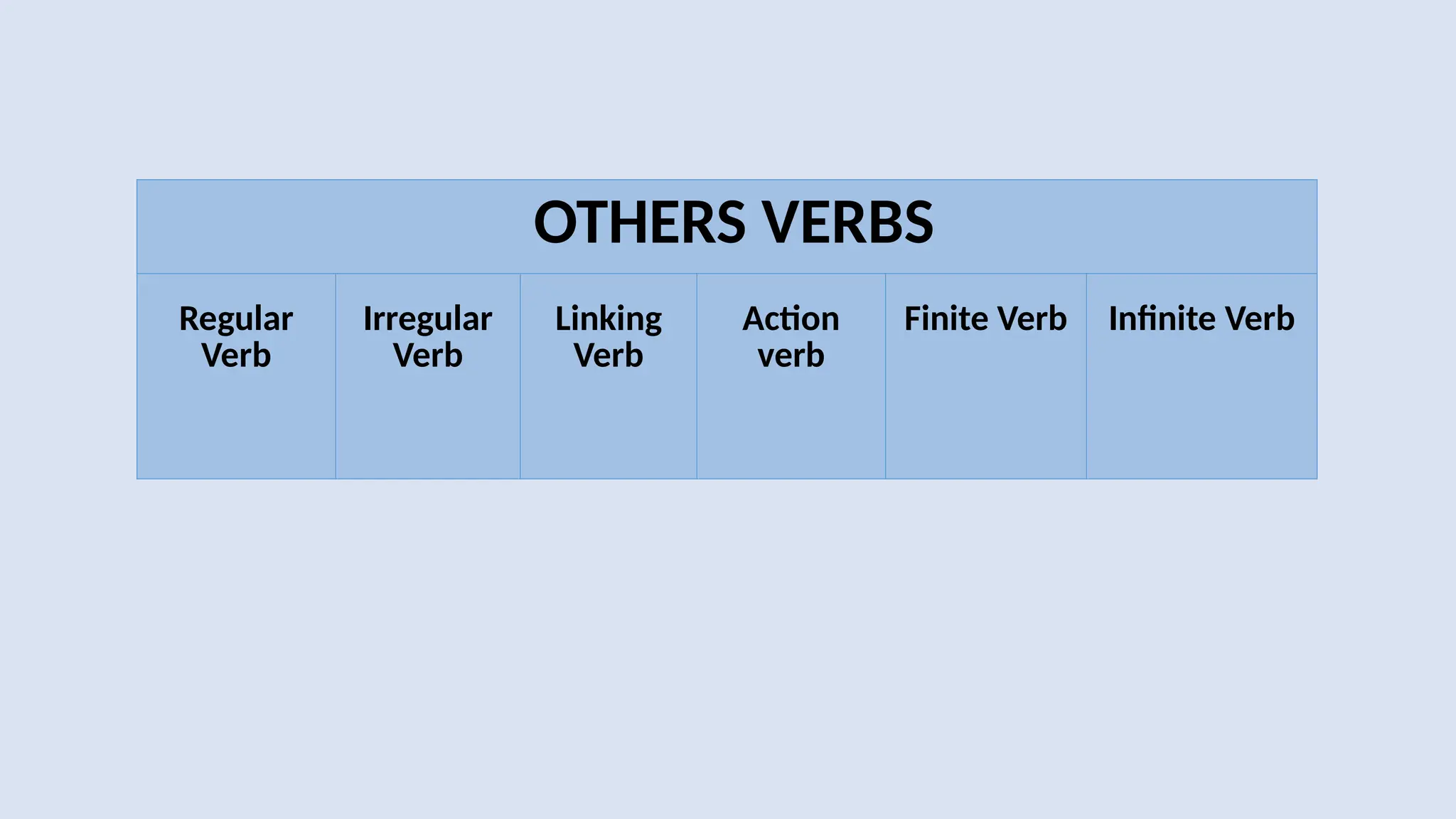
OTHERS VERBS
Regular
Verb
Irregular
Verb
Linking
Verb
Action
verb
Finite Verb Infinite Verb
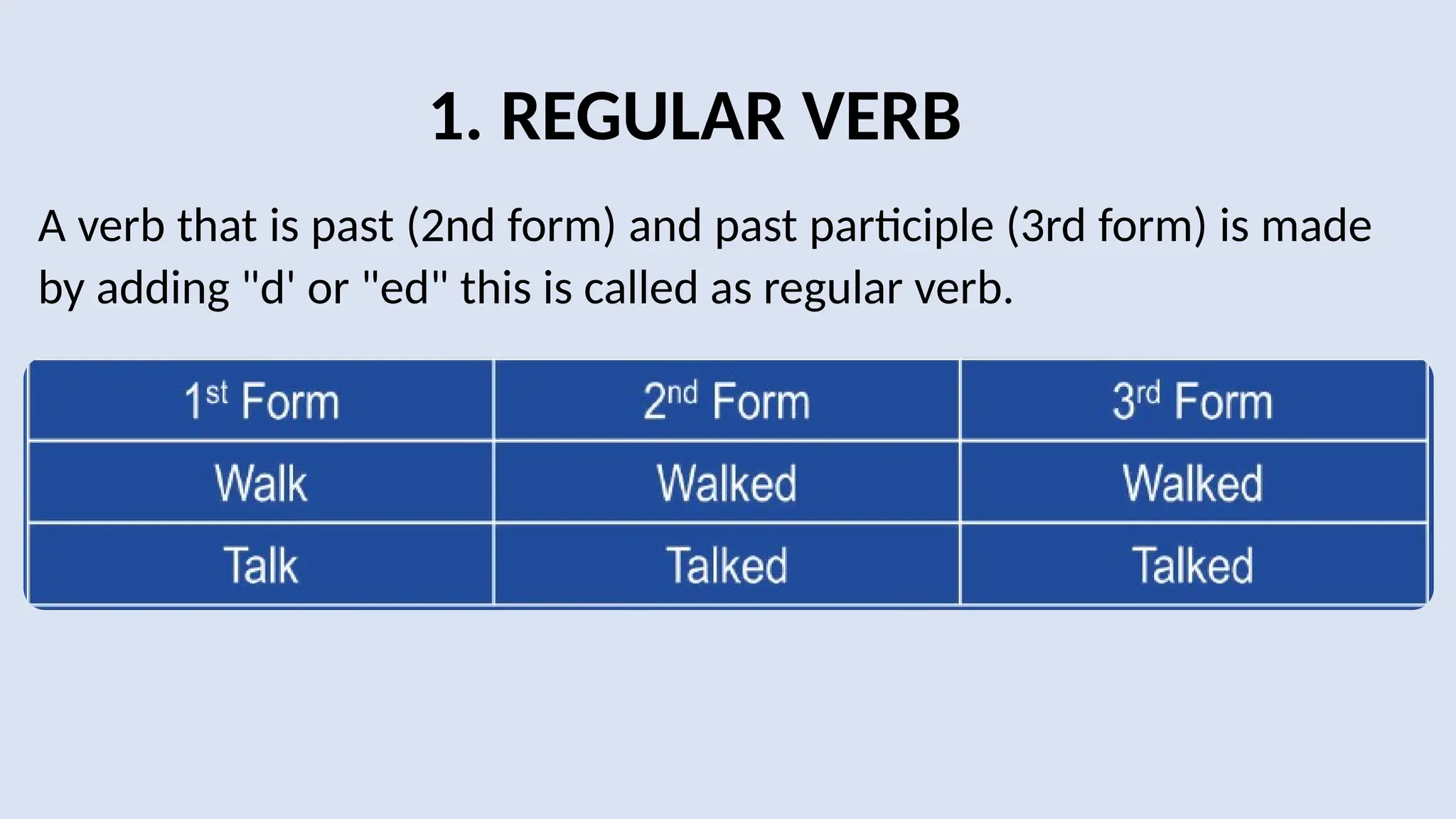
1. REGULAR VERB
A verb that is past (2nd form) and past participle (3rd form) is made
by adding "d' or "ed" this is called as regular verb.
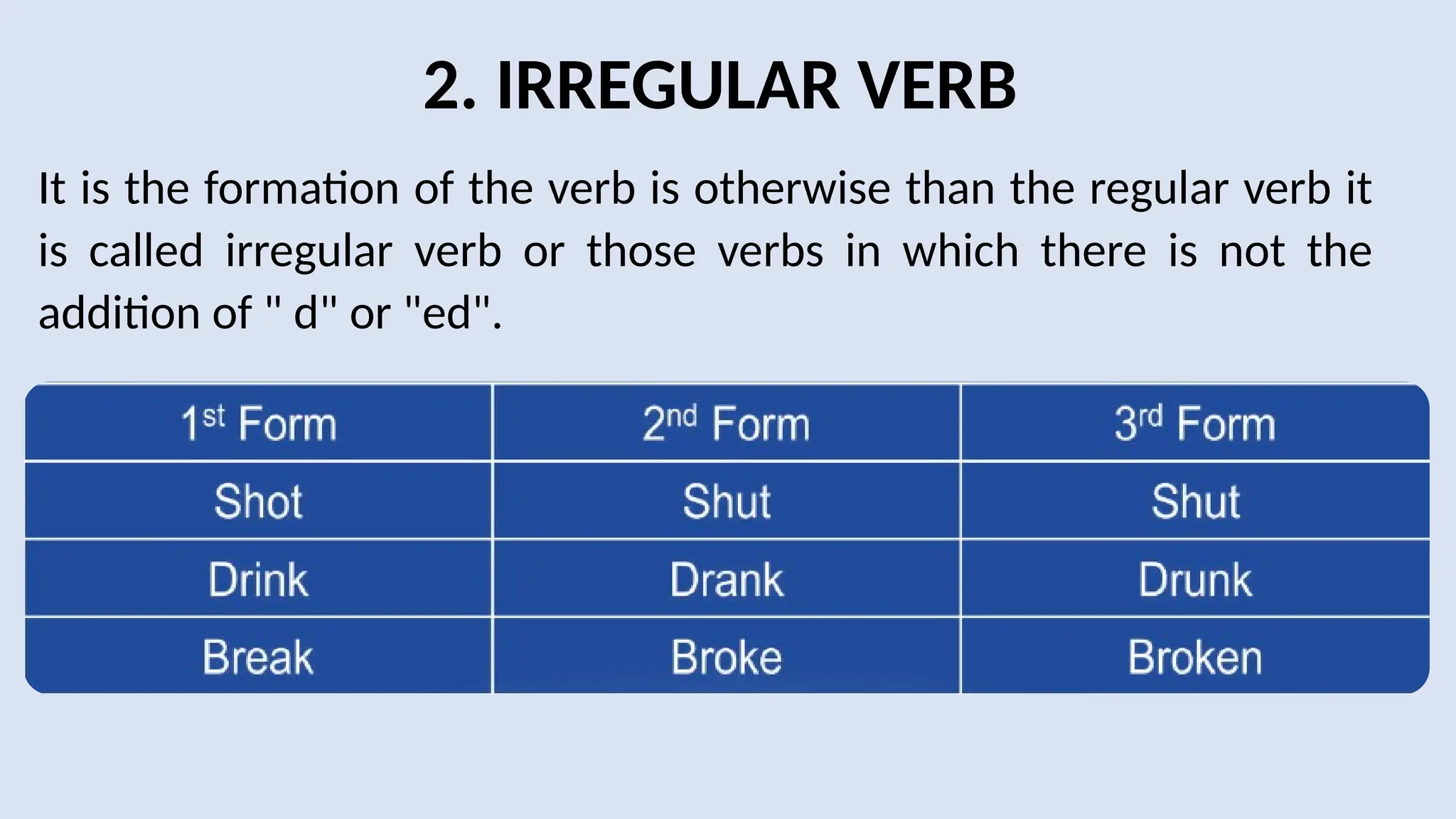
2. IRREGULAR VERB
It is the formation of the verb is otherwise than the regular verb it
is called irregular verb or those verbs in which there is not the
addition of " d" or "ed".
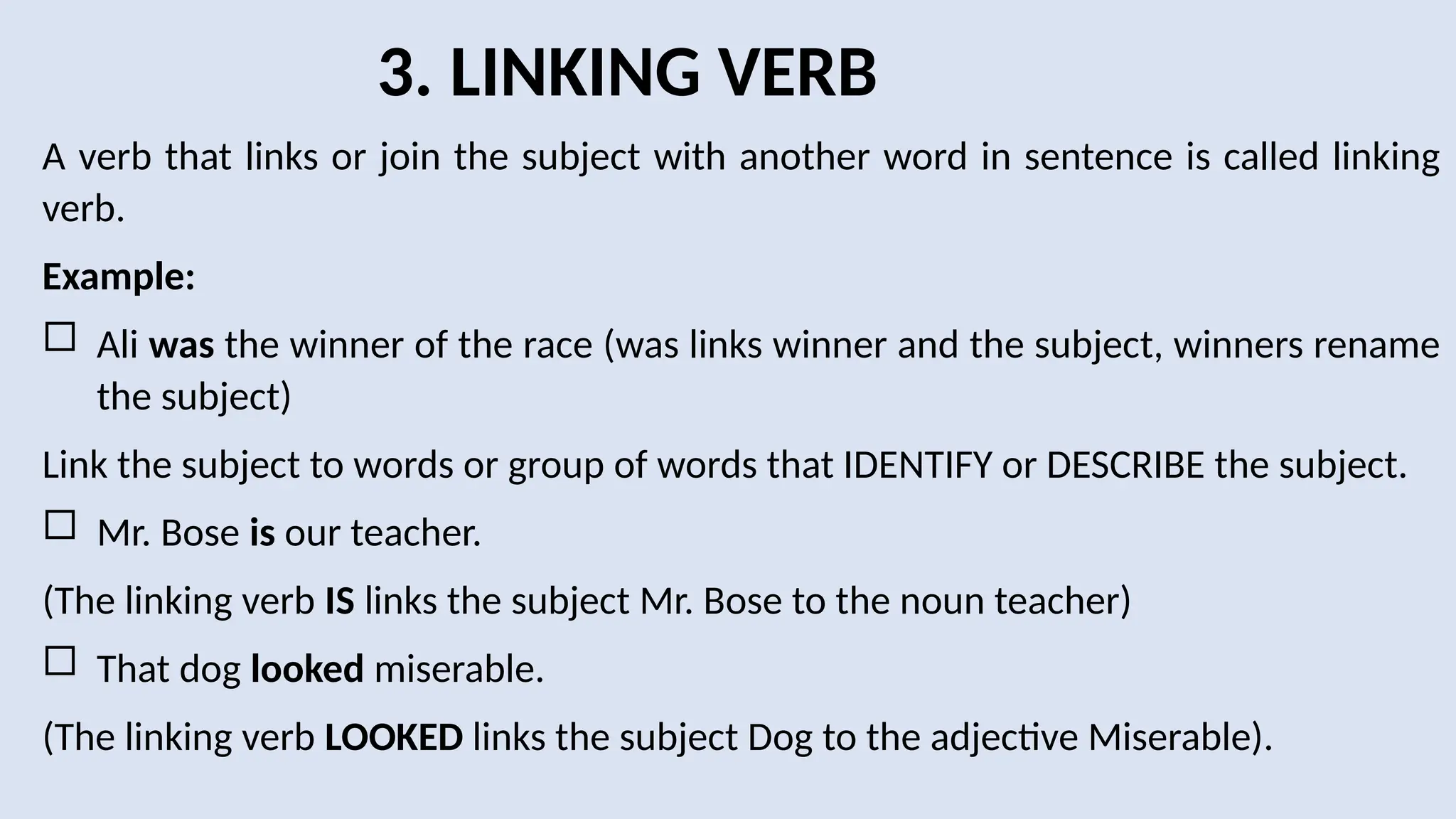
3. LINKING VERB
A verb that links or join the subject with another word in sentence is called linking
verb.
Example:
 Ali was the winner of the race (was links winner and the subject, winners rename
the subject)
Link the subject to words or group of words that IDENTIFY or DESCRIBE the subject.
 Mr. Bose is our teacher.
(The linking verb IS links the subject Mr. Bose to the noun teacher)
 That dog looked miserable.
(The linking verb LOOKED links the subject Dog to the adjective Miserable).
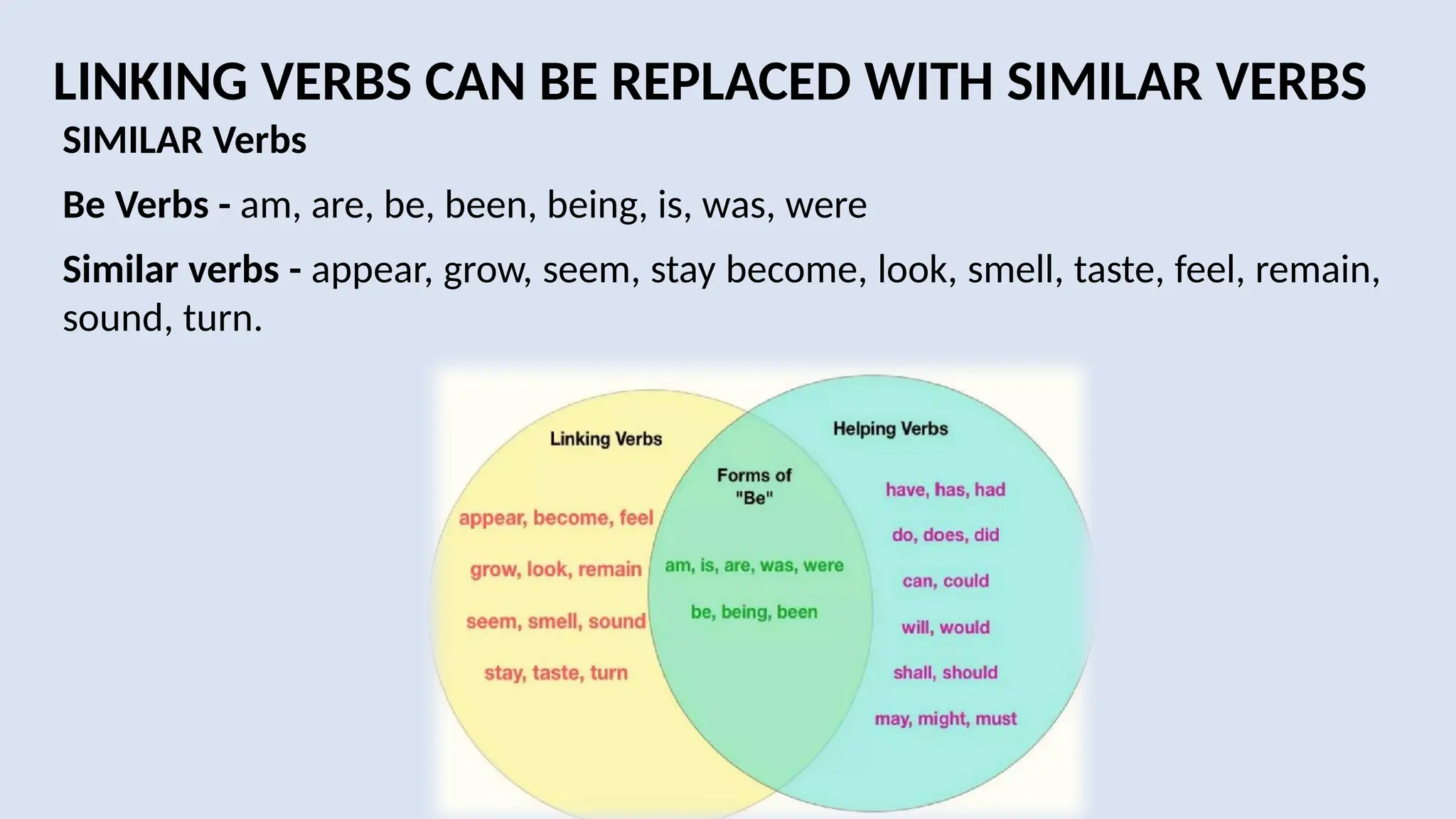
LINKING VERBS CAN BE REPLACED WITH SIMILAR VERBS
SIMILAR Verbs
Be Verbs - am, are, be, been, being, is, was, were
Similar verbs - appear, grow, seem, stay become, look, smell, taste, feel, remain,
sound, turn.
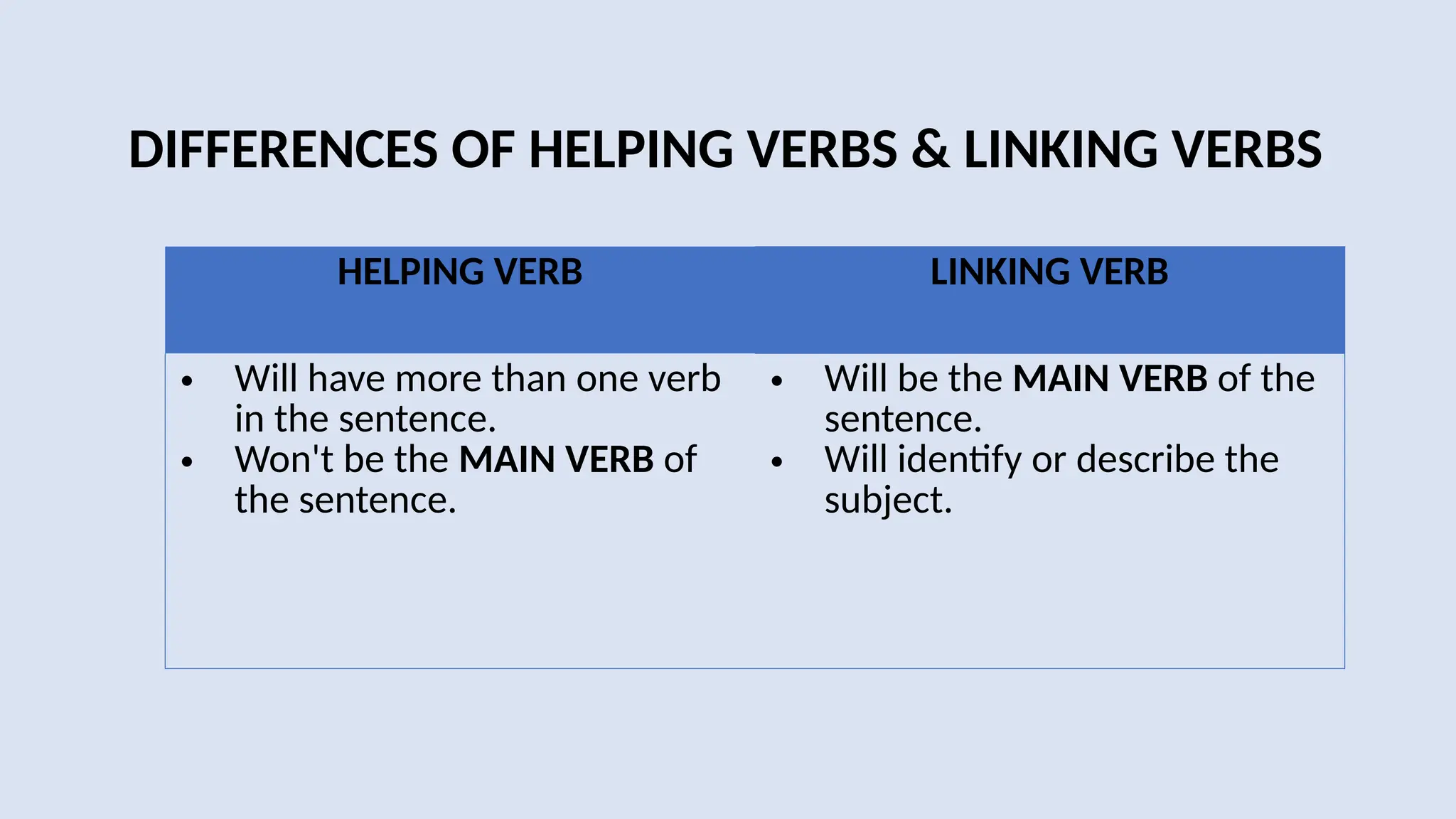
DIFFERENCES OF HELPING VERBS & LINKING VERBS
HELPING VERB LINKING VERB
• Will have more than one verb
in the sentence.
• Won't be the MAIN VERB of
the sentence.
• Will be the MAIN VERB of the
sentence.
• Will identify or describe the
subject.
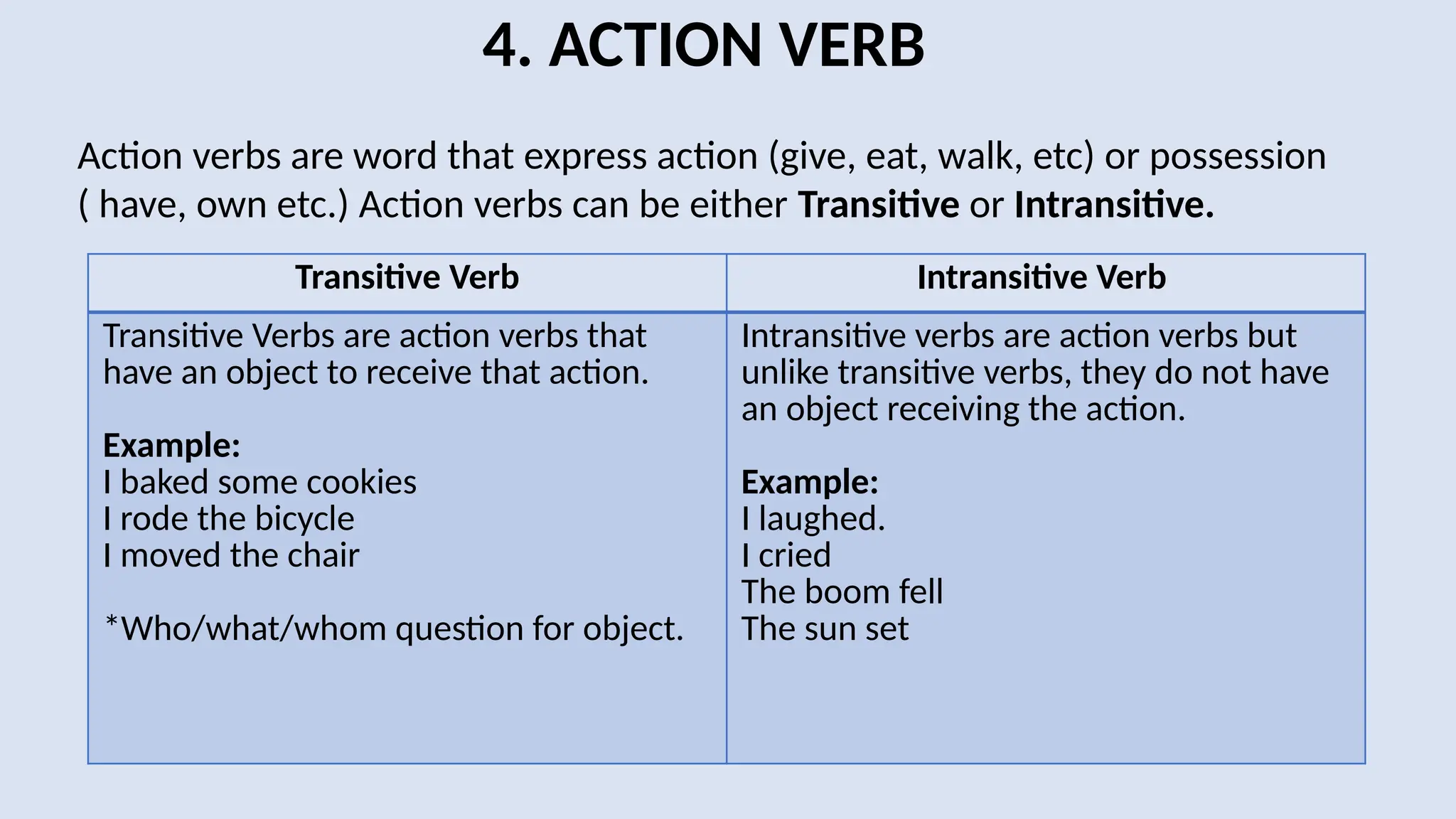
4. ACTION VERB
Action verbs are word that express action (give, eat, walk, etc) or possession
( have, own etc.) Action verbs can be either Transitive or Intransitive.
Transitive Verb Intransitive Verb
Transitive Verbs are action verbs that
have an object to receive that action.
Example:
I baked some cookies
I rode the bicycle
I moved the chair
*Who/what/whom question for object.
Intransitive verbs are action verbs but
unlike transitive verbs, they do not have
an object receiving the action.
Example:
I laughed.
I cried
The boom fell
The sun set
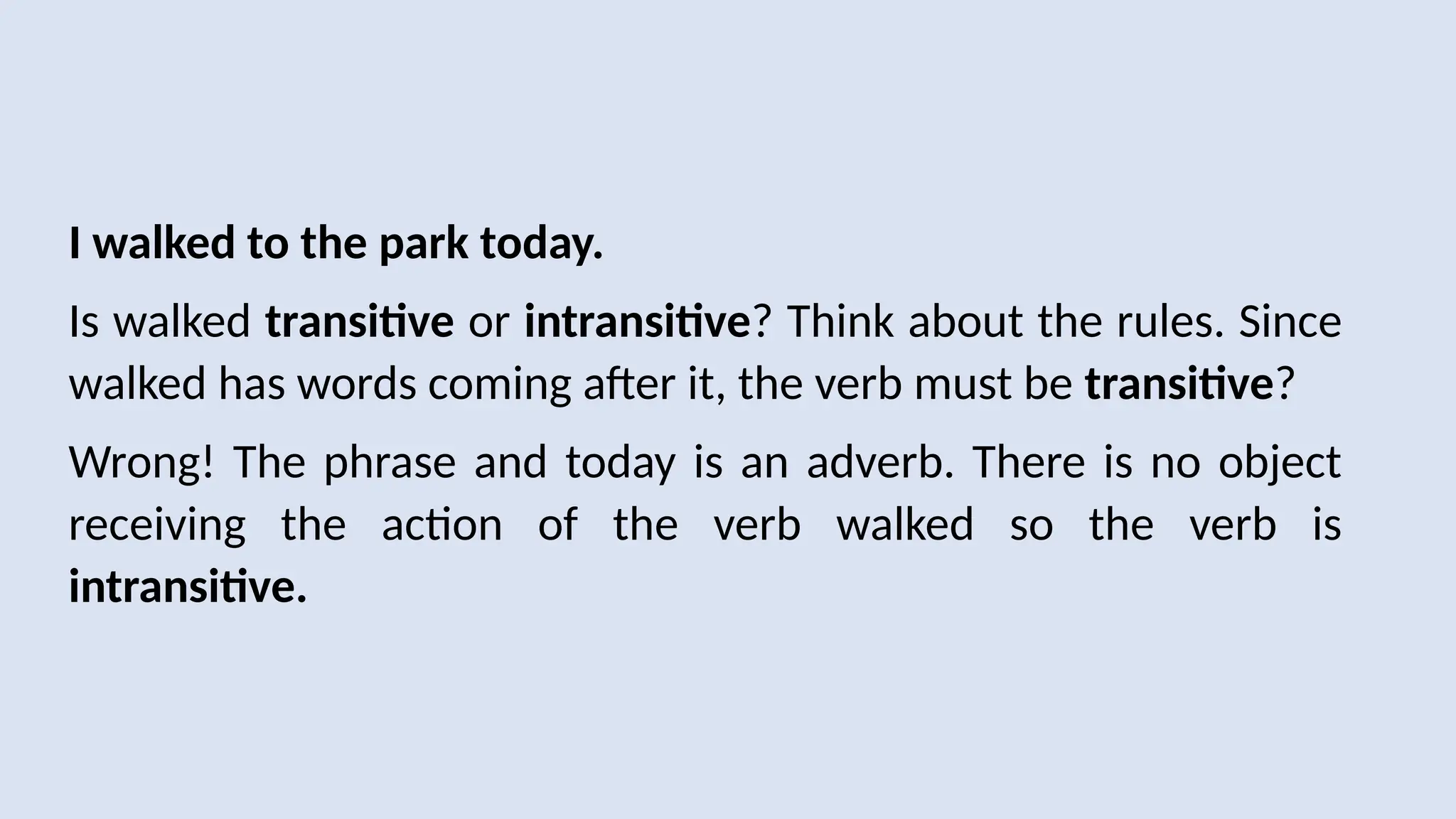
I walked to the park today.
Is walked transitive or intransitive? Think about the rules. Since
walked has words coming after it, the verb must be transitive?
Wrong! The phrase and today is an adverb. There is no object
receiving the action of the verb walked so the verb is
intransitive.
5. FINITE VERB
The verb that can make its own predicate is called Finite verb.
These verbs are limited by number and person. Finite verb can also
be Auxiliary and Principal or Main Verb.
Example:
He is playing ( here subject He decide whether use “is”. Hence “is”
is finite verb.
They open the door. (Here 'open the door' has very clear meaning
without subject. Hence, verb 'OPEN' is finite verb)
* Details about the subject in the sentence is called as Predicate.
7. INFINITE VERB (NON-FINITE)
Such verbs that can't make its predicate itself called as infinite
verb. Verbs that are not limited by number & person.
Example:
I like watching T.V.
She wants to go abroad.
Here watching & to go will not change the subject of the sentence.
This means they are not limited by person or number.
He has done the duty. ( Here "has done the duty" has no clear
meaning so "done" is an infinite verb.)
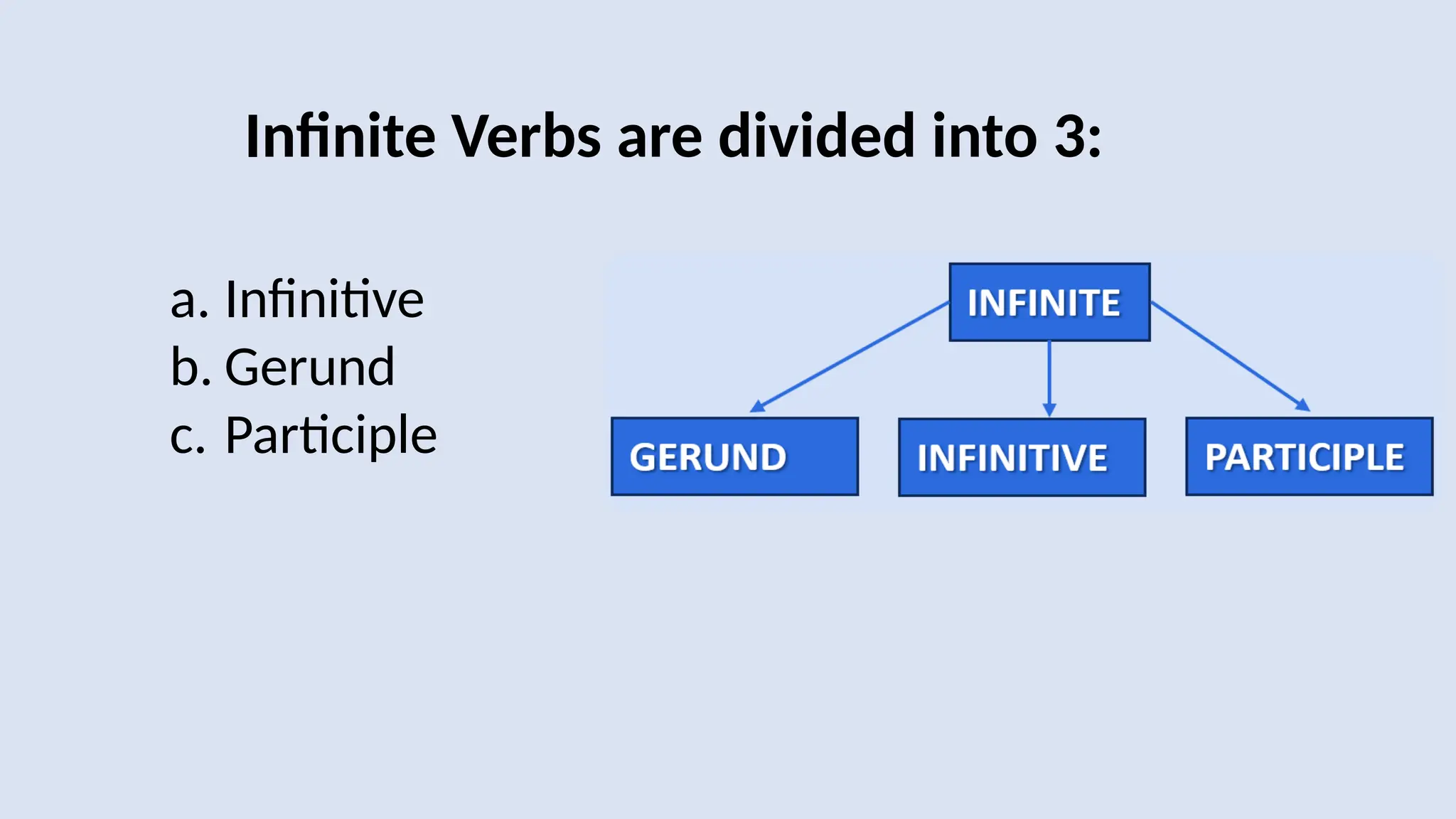
Infinite Verbs are divided into 3:
a. Infinitive
b. Gerund
c. Participle
a. INFINITIVE VERB
An infinitive is a verb form that usually begins with "to". It is used
as a noun, an adjective or an adverb. It denotes by “to+V1”.
Example:
Noun: To err is human (subject)
I want to study
Adjective: This year India is the team To beat (to beat modifies
the noun)
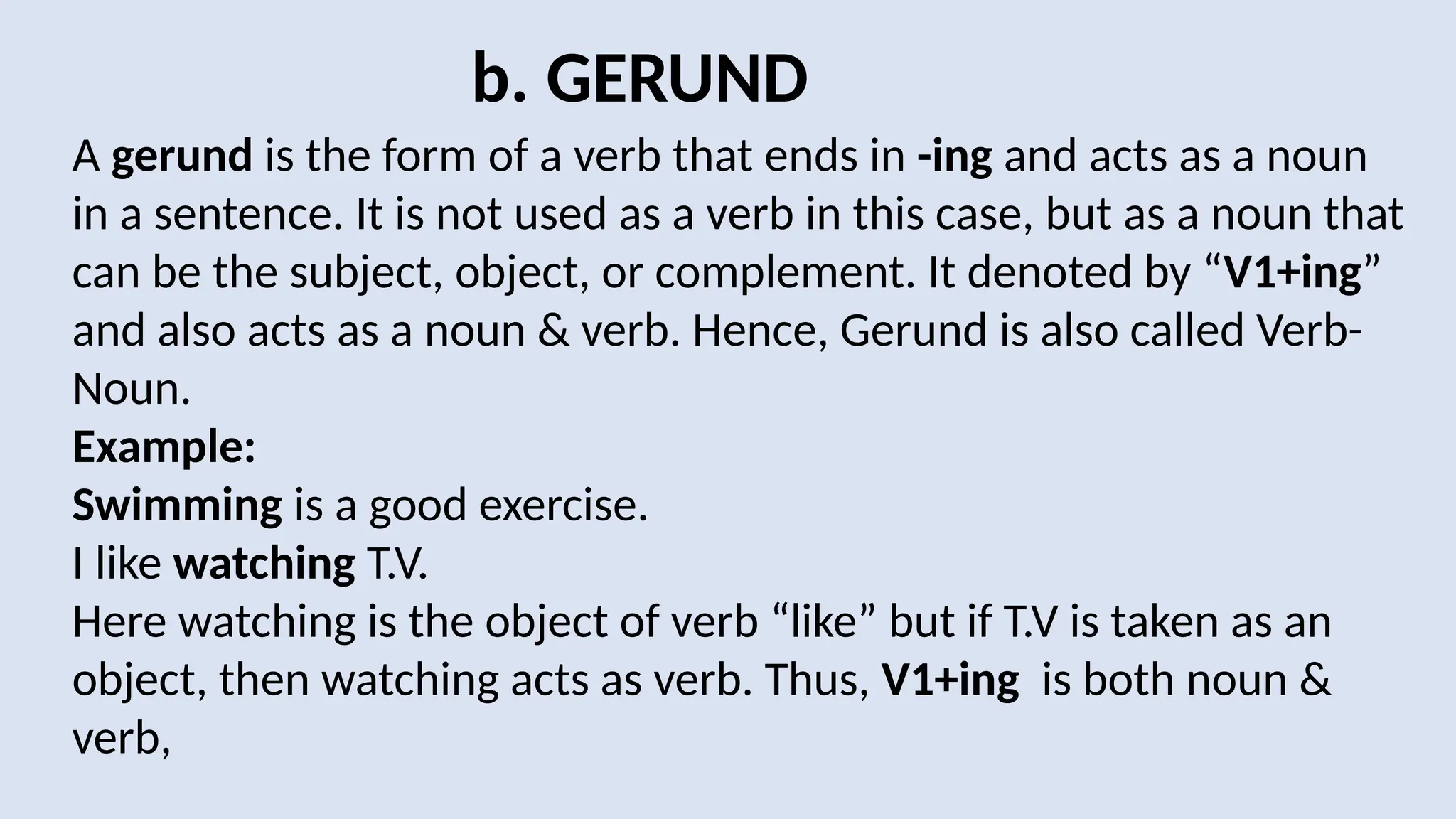
b. GERUND
A gerund is the form of a verb that ends in -ing and acts as a noun
in a sentence. It is not used as a verb in this case, but as a noun that
can be the subject, object, or complement. It denoted by “V1+ing”
and also acts as a noun & verb. Hence, Gerund is also called Verb-
Noun.
Example:
Swimming is a good exercise.
I like watching T.V.
Here watching is the object of verb “like” but if T.V is taken as an
object, then watching acts as verb. Thus, V1+ing is both noun &
verb,
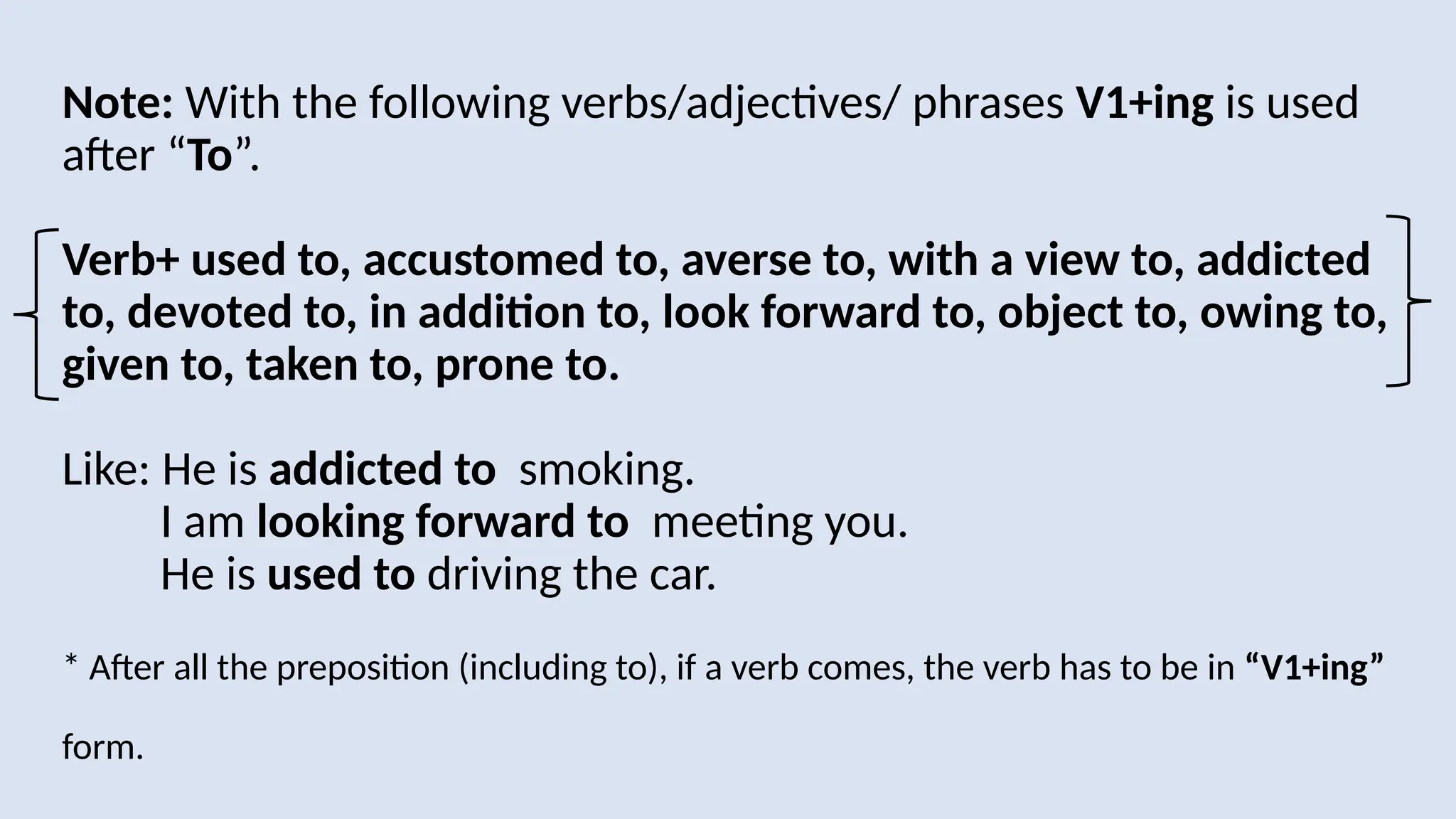
Note: With the following verbs/adjectives/ phrases V1+ing is used
after “To”.
Verb+ used to, accustomed to, averse to, with a view to, addicted
to, devoted to, in addition to, look forward to, object to, owing to,
given to, taken to, prone to.
Like: He is addicted to smoking.
I am looking forward to meeting you.
He is used to driving the car.
* After all the preposition (including to), if a verb comes, the verb has to be in “V1+ing”
form.
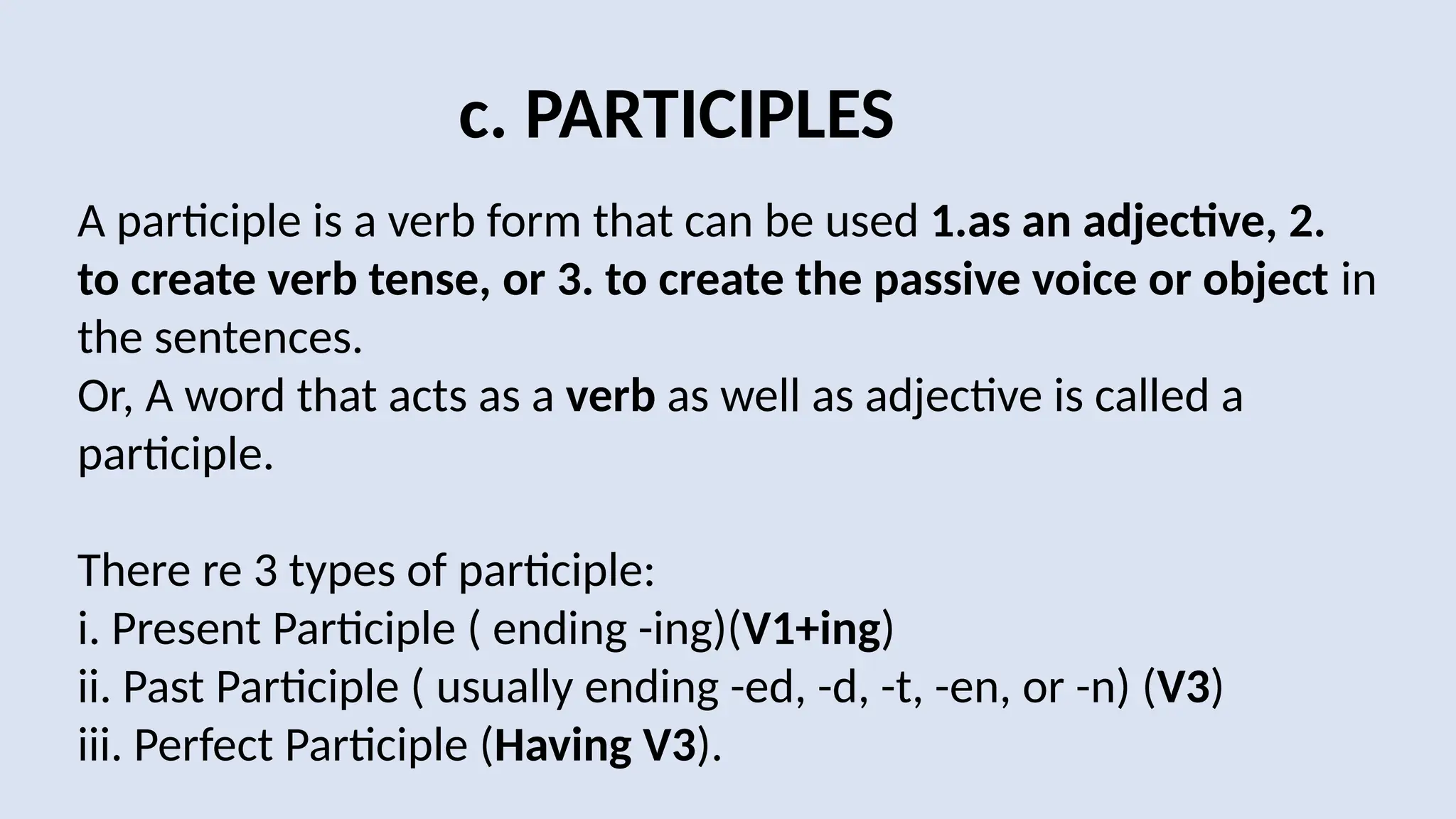
c. PARTICIPLES
A participle is a verb form that can be used 1.as an adjective, 2.
to create verb tense, or 3. to create the passive voice or object in
the sentences.
Or, A word that acts as a verb as well as adjective is called a
participle.
There re 3 types of participle:
i. Present Participle ( ending -ing)(V1+ing)
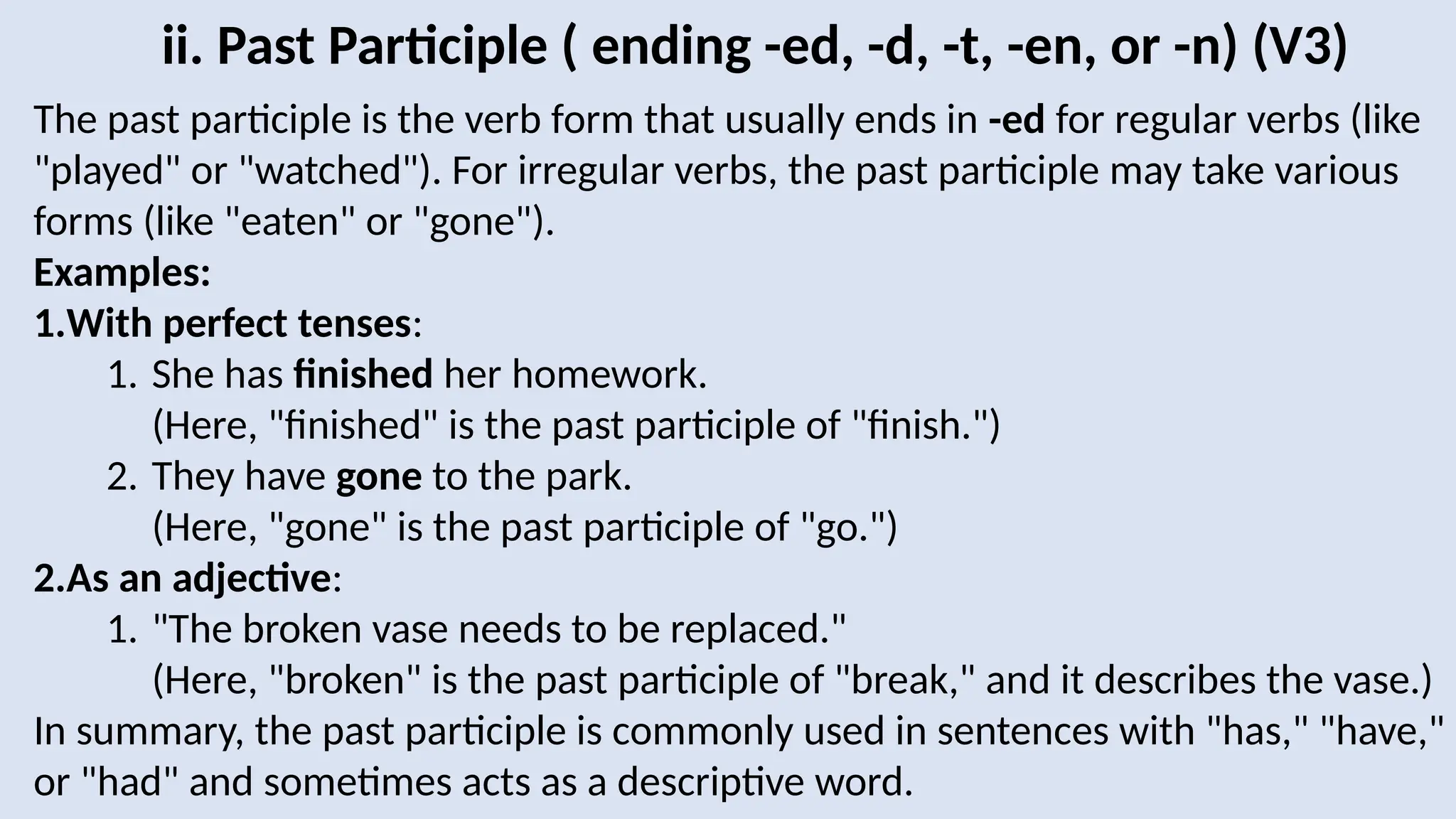
ii. Past Participle ( usually ending -ed, -d, -t, -en, or -n) (V3)
iii. Perfect Participle (Having V3).
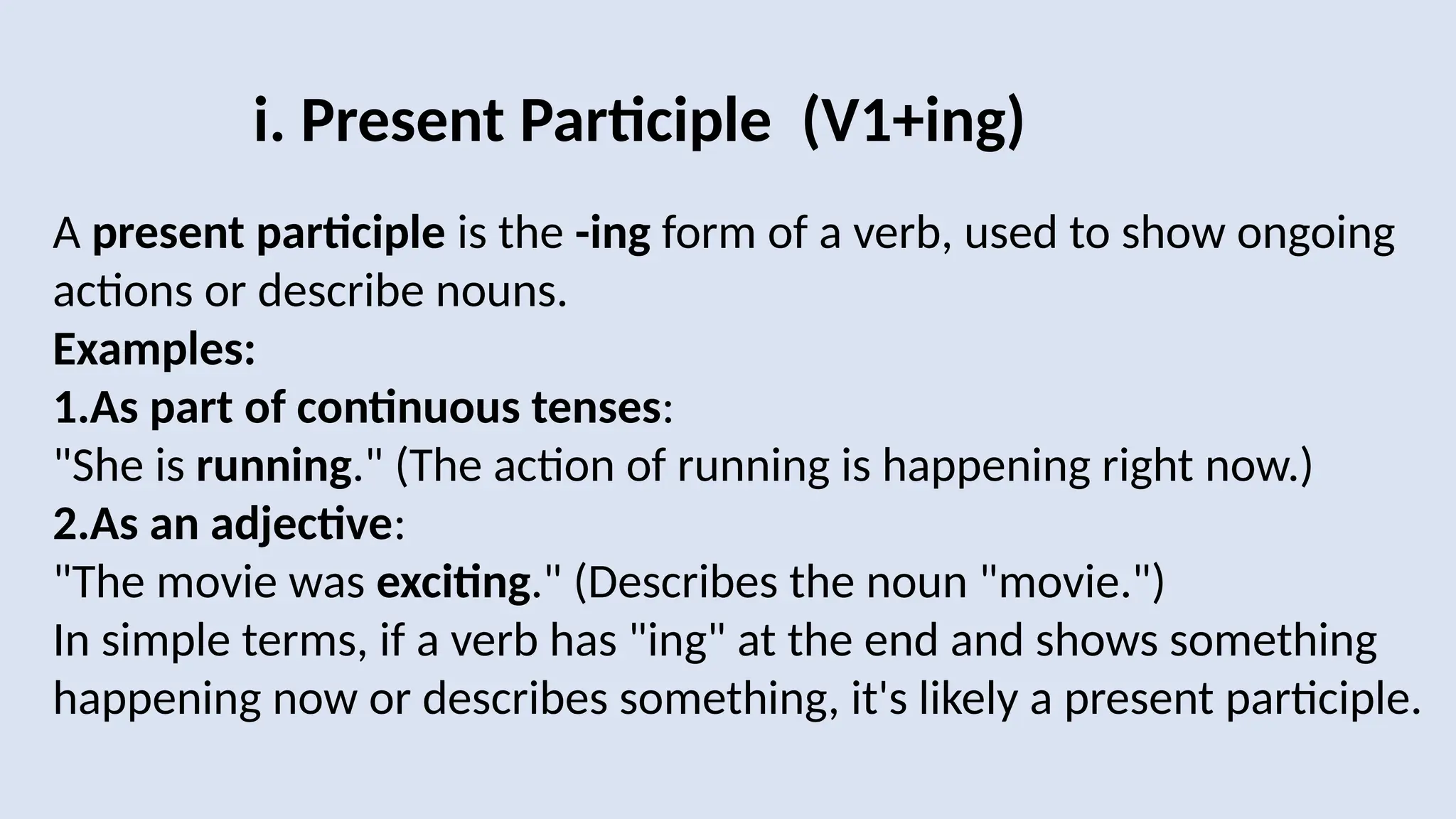
i. Present Participle (V1+ing)
A present participle is the -ing form of a verb, used to show ongoing
actions or describe nouns.
Examples:
1.As part of continuous tenses:
"She is running." (The action of running is happening right now.)
2.As an adjective:
"The movie was exciting." (Describes the noun "movie.")
In simple terms, if a verb has "ing" at the end and shows something
happening now or describes something, it's likely a present participle.
ii. Past Participle ( ending -ed, -d, -t, -en, or -n) (V3)
The past participle is the verb form that usually ends in -ed for regular verbs (like
"played" or "watched"). For irregular verbs, the past participle may take various
forms (like "eaten" or "gone").
Examples:
1.With perfect tenses:
1. She has finished her homework.
(Here, "finished" is the past participle of "finish.")
2. They have gone to the park.
(Here, "gone" is the past participle of "go.")
2.As an adjective:
1. "The broken vase needs to be replaced."
(Here, "broken" is the past participle of "break," and it describes the vase.)
In summary, the past participle is commonly used in sentences with "has," "have,"
or "had" and sometimes acts as a descriptive word.
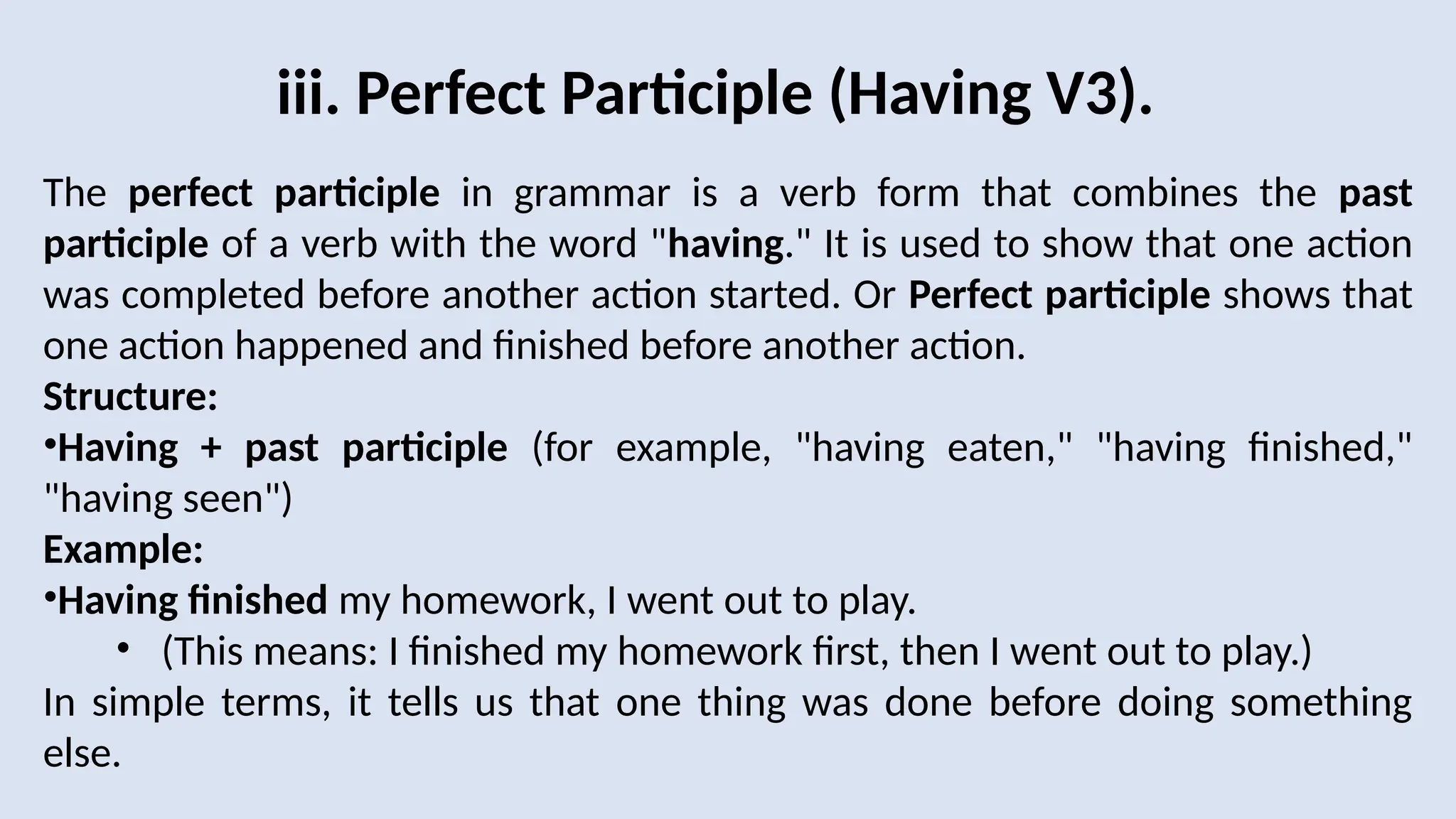
iii. Perfect Participle (Having V3).
The perfect participle in grammar is a verb form that combines the past
participle of a verb with the word "having." It is used to show that one action
was completed before another action started. Or Perfect participle shows that
one action happened and finished before another action.
Structure:
•Having + past participle (for example, "having eaten," "having finished,"
"having seen")
Example:
•Having finished my homework, I went out to play.
• (This means: I finished my homework first, then I went out to play.)
In simple terms, it tells us that one thing was done before doing something
else.
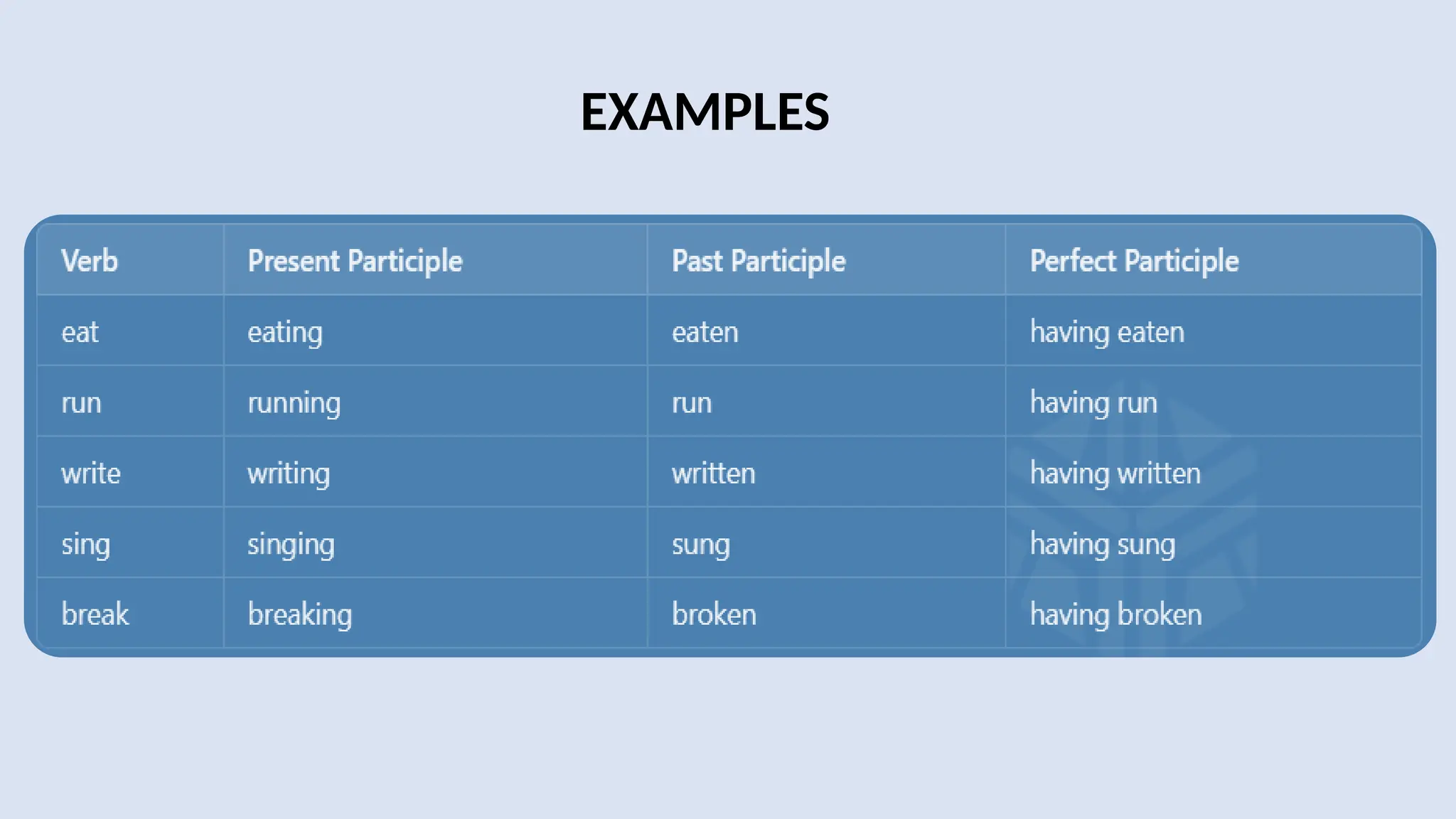
EXAMPLES
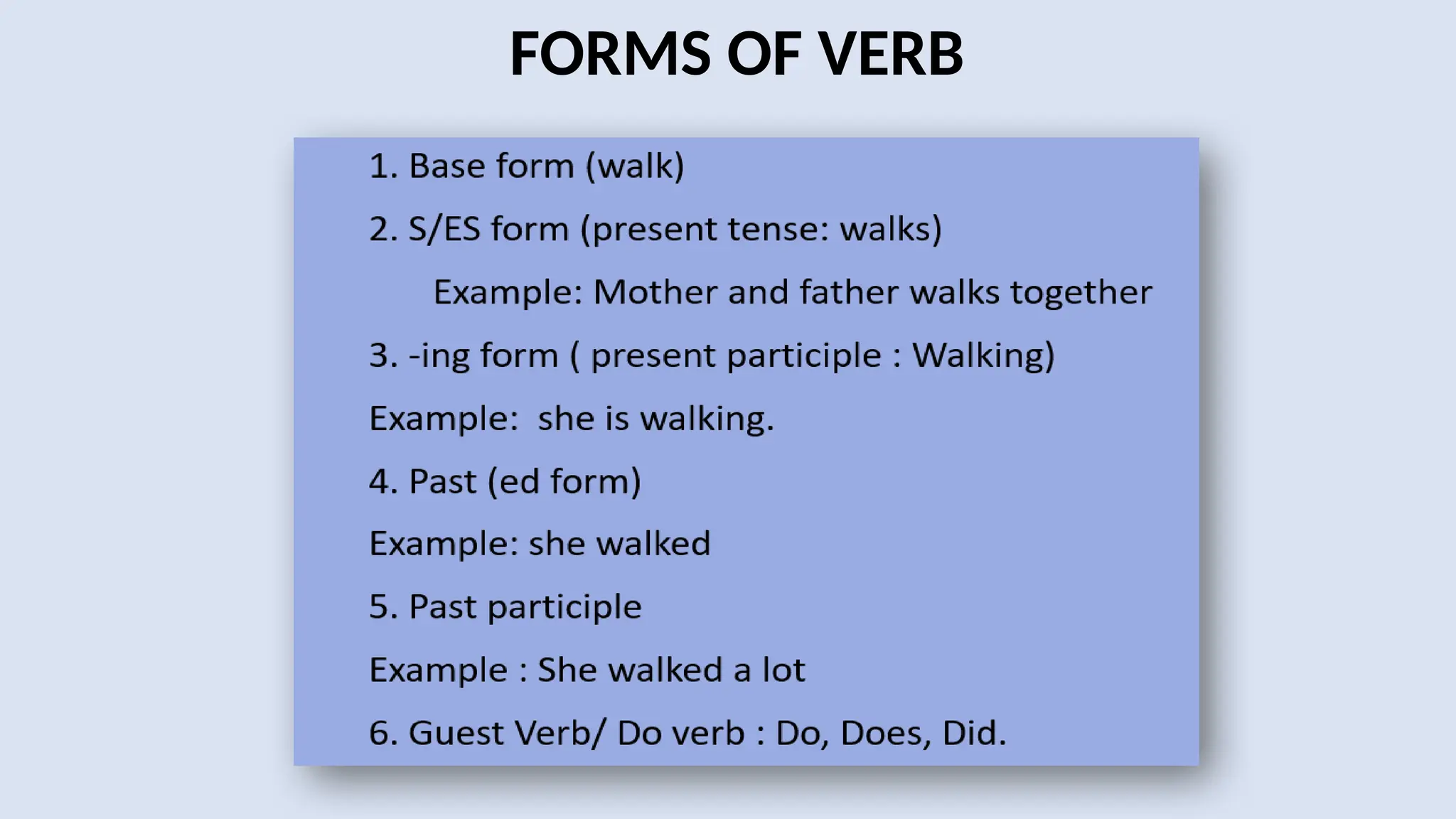
FORMS OF VERB
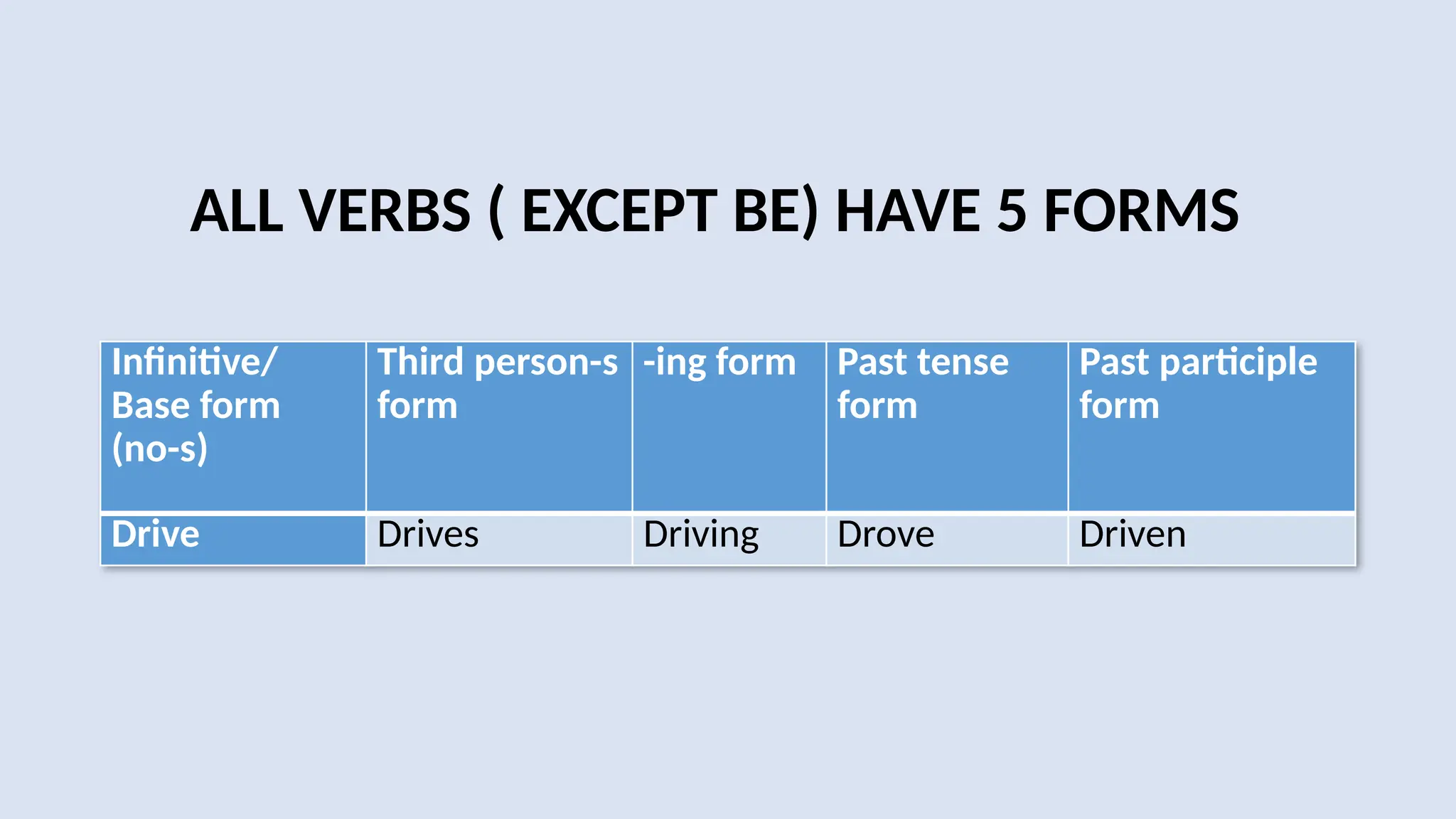
ALL VERBS ( EXCEPT BE) HAVE 5 FORMS
Infinitive/
Base form
(no-s)
Third person-s
form
-ing form Past tense
form
Past participle
form
Drive Drives Driving Drove Driven
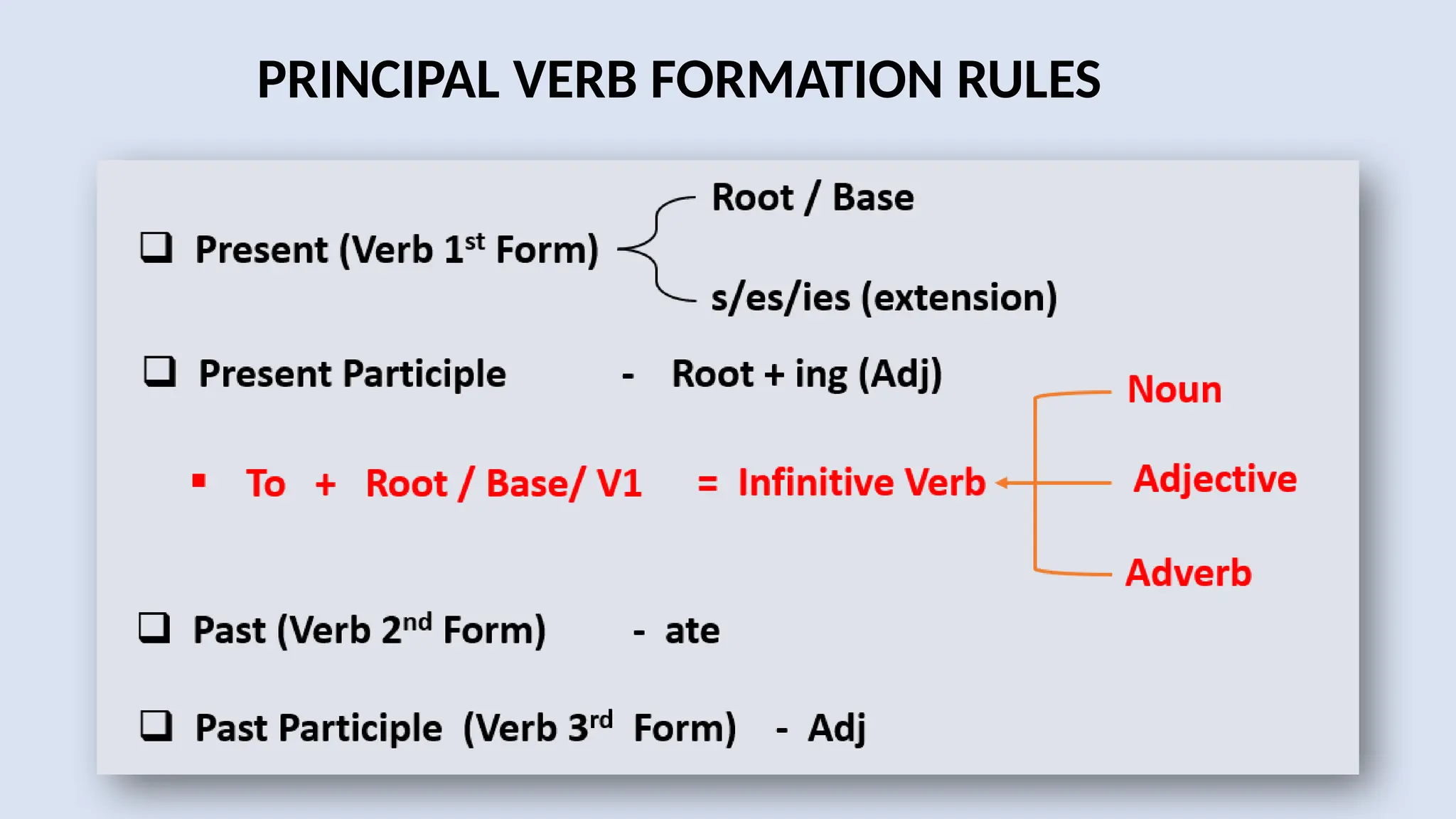
PRINCIPAL VERB FORMATION RULES
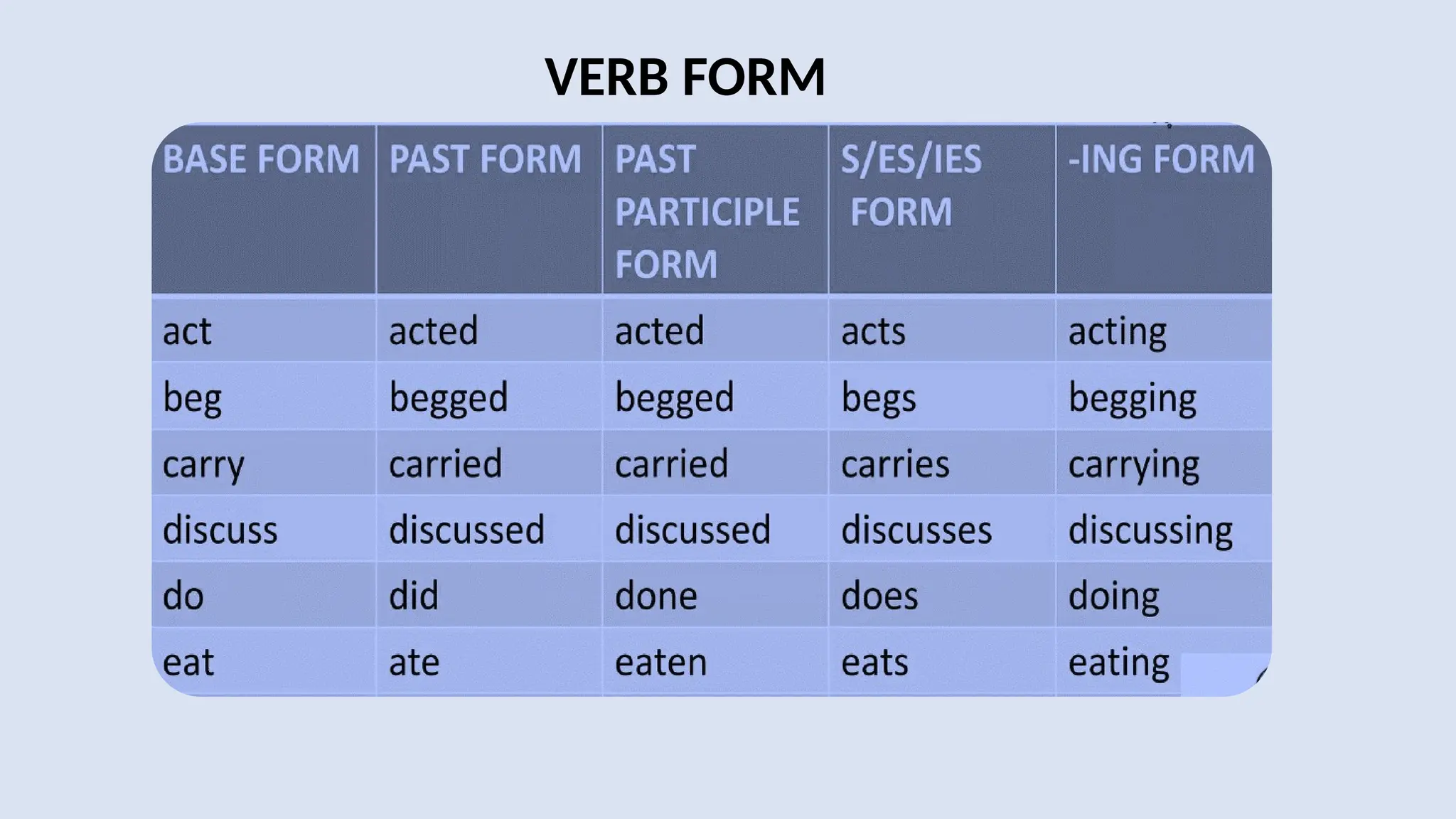
VERB FORM
Thank You
-Sarnali Paul

Verb & its types with examples : Grammar

  • 1.
    VERB A verb isa word that describes what the subject of a sentence is doing. Verbs can indicate (physical or mental) actions, occurrences, and states of being. Examples: Verbs in a sentence a. They study English grammar - (Action) b. We sleep at night - (state) c. We celebrate Eid - (Event )
  • 2.
    KINDS OF VERB Thereare various kinds of verbs but we can be classified into two categories. 1. Root Verb/ Main Verb/Principal: The raw or original form of the verb, how it originally exists in the English language, is called the root verb. Example: Eat, Sit, Stir, Type, Read, Fry, Tick, Shift, Trick, Sing etc. 2. Helping / Auxiliary Verb: Help the main verb express action or state of being. Helping verb comes with Main verb. The Helping verb will come before the Main verb. Example: We have eaten Have is helping verb and eaten is main verb. They are used together to express the action. They are working Here Are is helping verb and Working is a main verb. They are used together to express the action.
  • 3.
    There are onlyabout 15 helping verbs (Auxiliary) in English, and we divide them into 2 basic groups: 1. Primary helping verbs (3verbs) : These are the verbs be, do and have. Note that we can use these three verbs as helping verbs or as main verbs. a. Be (am, is, are, was, were, be, been, being) b. Have (have, has, had) c. Do (do, does, did) 2. Modal helping verbs (10 verbs): We use modal helping verbs to "MODIFY" the meaning of the main verb in some way. A modal helping verb expresses necessity or possibility, and changes the main verb in that sense. These are the modal verbs: can, could, may, might, will, would, shall, should, must, ought to
  • 5.
  • 6.
    1. REGULAR VERB Averb that is past (2nd form) and past participle (3rd form) is made by adding "d' or "ed" this is called as regular verb.
  • 7.
    2. IRREGULAR VERB Itis the formation of the verb is otherwise than the regular verb it is called irregular verb or those verbs in which there is not the addition of " d" or "ed".
  • 8.
    3. LINKING VERB Averb that links or join the subject with another word in sentence is called linking verb. Example:  Ali was the winner of the race (was links winner and the subject, winners rename the subject) Link the subject to words or group of words that IDENTIFY or DESCRIBE the subject.  Mr. Bose is our teacher. (The linking verb IS links the subject Mr. Bose to the noun teacher)  That dog looked miserable. (The linking verb LOOKED links the subject Dog to the adjective Miserable).
  • 9.
    LINKING VERBS CANBE REPLACED WITH SIMILAR VERBS SIMILAR Verbs Be Verbs - am, are, be, been, being, is, was, were Similar verbs - appear, grow, seem, stay become, look, smell, taste, feel, remain, sound, turn.
  • 10.
    DIFFERENCES OF HELPINGVERBS & LINKING VERBS HELPING VERB LINKING VERB • Will have more than one verb in the sentence. • Won't be the MAIN VERB of the sentence. • Will be the MAIN VERB of the sentence. • Will identify or describe the subject.
  • 11.
    4. ACTION VERB Actionverbs are word that express action (give, eat, walk, etc) or possession ( have, own etc.) Action verbs can be either Transitive or Intransitive. Transitive Verb Intransitive Verb Transitive Verbs are action verbs that have an object to receive that action. Example: I baked some cookies I rode the bicycle I moved the chair *Who/what/whom question for object. Intransitive verbs are action verbs but unlike transitive verbs, they do not have an object receiving the action. Example: I laughed. I cried The boom fell The sun set
  • 12.
    I walked tothe park today. Is walked transitive or intransitive? Think about the rules. Since walked has words coming after it, the verb must be transitive? Wrong! The phrase and today is an adverb. There is no object receiving the action of the verb walked so the verb is intransitive.
  • 13.
    5. FINITE VERB Theverb that can make its own predicate is called Finite verb. These verbs are limited by number and person. Finite verb can also be Auxiliary and Principal or Main Verb. Example: He is playing ( here subject He decide whether use “is”. Hence “is” is finite verb. They open the door. (Here 'open the door' has very clear meaning without subject. Hence, verb 'OPEN' is finite verb) * Details about the subject in the sentence is called as Predicate.
  • 14.
    7. INFINITE VERB(NON-FINITE) Such verbs that can't make its predicate itself called as infinite verb. Verbs that are not limited by number & person. Example: I like watching T.V. She wants to go abroad. Here watching & to go will not change the subject of the sentence. This means they are not limited by person or number. He has done the duty. ( Here "has done the duty" has no clear meaning so "done" is an infinite verb.)
  • 15.
    Infinite Verbs aredivided into 3: a. Infinitive b. Gerund c. Participle
  • 16.
    a. INFINITIVE VERB Aninfinitive is a verb form that usually begins with "to". It is used as a noun, an adjective or an adverb. It denotes by “to+V1”. Example: Noun: To err is human (subject) I want to study Adjective: This year India is the team To beat (to beat modifies the noun)
  • 17.
    b. GERUND A gerundis the form of a verb that ends in -ing and acts as a noun in a sentence. It is not used as a verb in this case, but as a noun that can be the subject, object, or complement. It denoted by “V1+ing” and also acts as a noun & verb. Hence, Gerund is also called Verb- Noun. Example: Swimming is a good exercise. I like watching T.V. Here watching is the object of verb “like” but if T.V is taken as an object, then watching acts as verb. Thus, V1+ing is both noun & verb,
  • 18.
    Note: With thefollowing verbs/adjectives/ phrases V1+ing is used after “To”. Verb+ used to, accustomed to, averse to, with a view to, addicted to, devoted to, in addition to, look forward to, object to, owing to, given to, taken to, prone to. Like: He is addicted to smoking. I am looking forward to meeting you. He is used to driving the car. * After all the preposition (including to), if a verb comes, the verb has to be in “V1+ing” form.
  • 19.
    c. PARTICIPLES A participleis a verb form that can be used 1.as an adjective, 2. to create verb tense, or 3. to create the passive voice or object in the sentences. Or, A word that acts as a verb as well as adjective is called a participle. There re 3 types of participle: i. Present Participle ( ending -ing)(V1+ing) ii. Past Participle ( usually ending -ed, -d, -t, -en, or -n) (V3) iii. Perfect Participle (Having V3).
  • 20.
    i. Present Participle(V1+ing) A present participle is the -ing form of a verb, used to show ongoing actions or describe nouns. Examples: 1.As part of continuous tenses: "She is running." (The action of running is happening right now.) 2.As an adjective: "The movie was exciting." (Describes the noun "movie.") In simple terms, if a verb has "ing" at the end and shows something happening now or describes something, it's likely a present participle.
  • 21.
    ii. Past Participle( ending -ed, -d, -t, -en, or -n) (V3) The past participle is the verb form that usually ends in -ed for regular verbs (like "played" or "watched"). For irregular verbs, the past participle may take various forms (like "eaten" or "gone"). Examples: 1.With perfect tenses: 1. She has finished her homework. (Here, "finished" is the past participle of "finish.") 2. They have gone to the park. (Here, "gone" is the past participle of "go.") 2.As an adjective: 1. "The broken vase needs to be replaced." (Here, "broken" is the past participle of "break," and it describes the vase.) In summary, the past participle is commonly used in sentences with "has," "have," or "had" and sometimes acts as a descriptive word.
  • 22.
    iii. Perfect Participle(Having V3). The perfect participle in grammar is a verb form that combines the past participle of a verb with the word "having." It is used to show that one action was completed before another action started. Or Perfect participle shows that one action happened and finished before another action. Structure: •Having + past participle (for example, "having eaten," "having finished," "having seen") Example: •Having finished my homework, I went out to play. • (This means: I finished my homework first, then I went out to play.) In simple terms, it tells us that one thing was done before doing something else.
  • 23.
  • 24.
  • 25.
    ALL VERBS (EXCEPT BE) HAVE 5 FORMS Infinitive/ Base form (no-s) Third person-s form -ing form Past tense form Past participle form Drive Drives Driving Drove Driven
  • 26.
  • 27.
  • 28.