VERB PATTERN
• The verb patterns are dependent upon the first verb.
There are several different types of pattern.
• Sometimes in a sentence, one verb follows another.
For example:
-They want to buy a book about verb pattern.
The first verb is 'want', the second verb is 'buy'.
What is a verb pattern?
What is a verb?
• A verb is one of the main parts of a sentence or
question in English.
• In fact, you can’t have a sentence or a question
without a verb! That’s how important these
“action” parts of speech are.
• The verb signals an action, an occurrence, or a
state of being. Whether mental, physical, or
mechanical, verbs always express activity.
VERB - overview
• Verb can be classified into two types:
- Finite Verb
- Non-finite Verb
• Verbs are a class of words used to show the
performance of an action (do, throw, run),
existence (be), possession (have), or state (know,
love) of a subject.
• To put it simply a verb shows what something or
someone does.
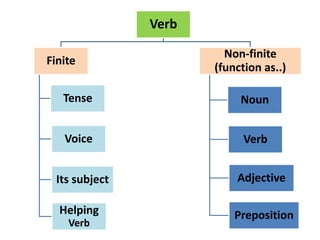
Verb
Finite
Tense
Voice
Its subject
Helping
Verb
Non-finite
(function as..)
Noun
Verb
Adjective
Preposition
Finite Verb
What are finite verbs?
• A finite verb is a verb which has a subject and shows tense.
Ex: Nana lives in Thailand.
[I is the subject, lives describes what the subject does –
lives is a finite verb]
• In short, it is a verb being a verb (i.e., a doing verb) as
opposed to a non-finite verb (verbal)
• Finite verbs are the locus of grammatical information of
gender, person, number, tense, aspect, mood, and/or voice.
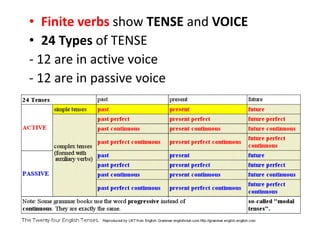
• Finite verbs show TENSE and VOICE
• 24 Types of TENSE
- 12 are in active voice
- 12 are in passive voice
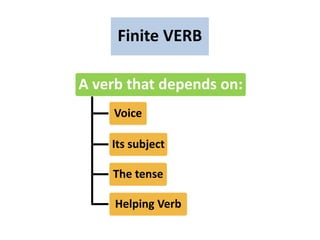
Finite VERB
A verb that depends on:
Voice
Its subject
The tense
Helping Verb
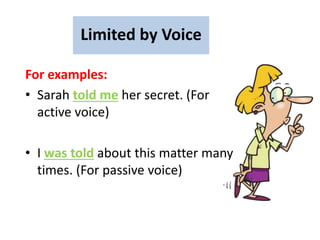
For examples:
• Sarah told me her secret. (For
active voice)
• I was told about this matter many
times. (For passive voice)
Limited by Voice
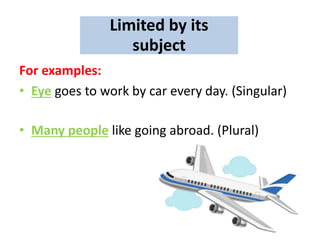
For examples:
• Eye goes to work by car every day. (Singular)
• Many people like going abroad. (Plural)
Limited by its
subject
For examples:
• I am not playing game, but I am doing
homework.
(V.ing - Present continuous tense)
• They have just finished their work.
(V.3 - Present perfect tense)
Limited by the Tense
Things to observe:
→ Each verb has its subject
→ The form of the verb depends on its subject
→ Each verb is limited by number, person of the
subject and its tense
For examples;
- She was playing football.
- They are talking in the room.
A finite verb is generally expected to
have a subject.
• For examples:
- He painted the fence.
[In this example, painted is a finite verb]
- I was excited about moving to Thailand.
[In this example, was is a finite verb]
- Everyone wanted to go to the amusement park, but
we only had four tickets.
[In this example, wanted is a finite verb]
2 TYPES of finite verbs
1. Main verbs
• Action verb
-Intransitive Verbs
-Transitive Verbs
• Linking Verb
2. Helping Verbs
• Main Helping Verb
• Modal Verb
Main Verb
1. Action Verb
• An action verb shows action.
• It tells what the subject of the sentence does
Ex. Bill hit the ball.
• 2 TYPES
-Transitive Verbs -Intransitive Verbs
→ Express an action passes from → Express an action of the
the subject to an object subject without an object
Ex: Jan greeted the visitors. Ex: The train stopped.
2. Linking Verb
- A linking verb connects the subject with a word that
gives information about the subject
- Also referred to as copulas or copular verbs
- Variously called "copulative," "equative," "intensive"
or "linking" verbs."
- Common Linking Verb:
Ex: am, is, was, been, seems, feels
• The most common linking verbs are forms of "to be,"
"to become" and "to seem.“
• These types of verbs:
→ Show a relationship between the subject and the part of
the sentence following the verb
→ Connect or link the subject with more information (words
that further identify or describe the subject)
→ Identify a relationship or existing condition
Ex: The eggs smell rotten.
All the kittens were playful.
2. Linking Verb (cont.)
The different between linking verbs and
verbs of perception!
• A linking verb is a copular (or copulative) verb. It is a verb
that connects words or clauses linked in sense or
connecting a subject to the part of the sentence following
the verb
• Verbs of perception are different. These verbs pertain to
the senses: see, hear, smell, taste, and feel as well as
variants like watch and listen.
Helping Verb (Auxiliary Verb)
• Helps a main verb; comes before the main verb
• 2 TYPES
1) Main helping verb (Primary Auxiliary Verb)
Ex. V. to be, V. to do, V. to have
2) Modal verbs + V.inf
Ex. Can, could, may, might + V.inf
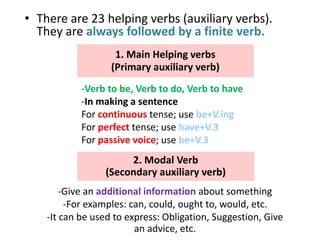
• There are 23 helping verbs (auxiliary verbs).
They are always followed by a finite verb.
1. Main Helping verbs
(Primary auxiliary verb)
-Verb to be, Verb to do, Verb to have
-In making a sentence
For continuous tense; use be+V.ing
For perfect tense; use have+V.3
For passive voice; use be+V.3
2. Modal Verb
(Secondary auxiliary verb)
-Give an additional information about something
-For examples: can, could, ought to, would, etc.
-It can be used to express: Obligation, Suggestion, Give
an advice, etc.
The best way to find a finite verb is by
eliminating it as a non-finite verb.
• So, checked:
- Is it being used as a noun?
- Is it preceded by to?
- Is it being used as an adjective?
Non-Finite
Verb
Definition
• Non-finite verb is also known as a verbal is
the term used to describe a verb that is not
showing tense.
Infinitive
• The infinitive is the base form of a verb.
• 2 Types ;
1. Infinitive with to ( to inf.)
2. Infinitive without to/ bare infinitive
Infinitive with to
• Structure : Subject + Verb + to infinitive
Ex. I want to go to London.
• Negative form of infinitive
– formed by putting not in front of any form of
the infinitive.
Ex. I decided not to go to London.
• Common verbs followed by to infinitive
– try, wait, decide, agree, want, ask, and etc.
Infinitive with to
• Function of Infinitive with to
o The to-infinitive as a noun
Ex. To forgive is to set a prisoner free.
o Use as an adjective
Ex. This is the plan to follow.
o Use as an adverb
Ex. The Advengers must reunite to stop Ultron.
o put it after the Ordinal number or Superlative
Ex. Barack Obama is the first African-American to win the U.S.
presidency.
Infinitive with to
• Structure : Subject + verb + object + to infinitive
Ex. The doctor told me to give up smoking.
• Common verbs followed by to infinitive
– advise, allow, ask, tell, instruct, get, etc.
Infinitive with to
• Function of Object + Infinitive with to ;
o Use with Perfect or Past meaning and Past Unreal
→ to have + V.3
Ex. I expect to have baked oatmeal cookies by
tonight.
Ex. I meant to tidy up the house, but the guests
arrive earlier.
Infinitive without to
• 3 TYPES
- Helping verb (modal verb) + v.inf without to
- Causative verb + something + v.inf without to
- Verb of Perception
Helping Verb
• Also called Auxiliary Verb
• Already mentioned
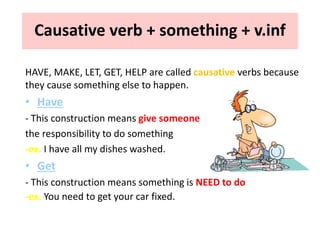
Causative verb + something + v.inf
HAVE, MAKE, LET, GET, HELP are called causative verbs because
they cause something else to happen.
• Have
- This construction means give someone
the responsibility to do something
-ex. I have all my dishes washed.
• Get
- This construction means something is NEED to do
-ex. You need to get your car fixed.
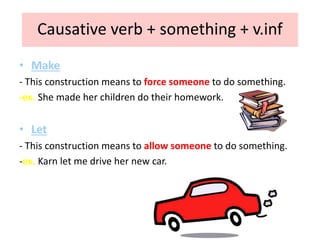
Causative verb + something + v.inf
• Make
- This construction means to force someone to do something.
-ex. She made her children do their homework.
• Let
- This construction means to allow someone to do something.
-ex. Karn let me drive her new car.
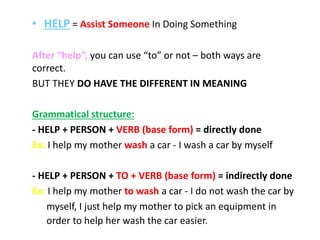
• HELP = Assist Someone In Doing Something
After “help”, you can use “to” or not – both ways are
correct.
BUT THEY DO HAVE THE DIFFERENT IN MEANING
Grammatical structure:
- HELP + PERSON + VERB (base form) = directly done
Ex: I help my mother wash a car - I wash a car by myself
- HELP + PERSON + TO + VERB (base form) = indirectly done
Ex: I help my mother to wash a car - I do not wash the car by
myself, I just help my mother to pick an equipment in
order to help her wash the car easier.
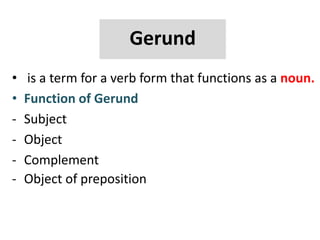
Gerund
• is a term for a verb form that functions as a noun.
• Function of Gerund
- Subject
- Object
- Complement
- Object of preposition
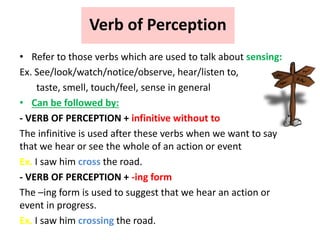
Verb of Perception
• Refer to those verbs which are used to talk about sensing:
Ex. See/look/watch/notice/observe, hear/listen to,
taste, smell, touch/feel, sense in general
• Can be followed by:
- VERB OF PERCEPTION + infinitive without to
The infinitive is used after these verbs when we want to say
that we hear or see the whole of an action or event
Ex. I saw him cross the road.
- VERB OF PERCEPTION + -ing form
The –ing form is used to suggest that we hear an action or
event in progress.
Ex. I saw him crossing the road.
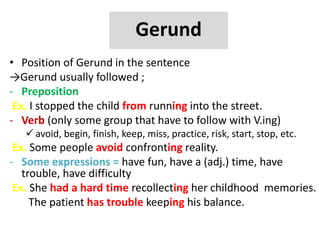
Gerund
• Position of Gerund in the sentence
→Gerund usually followed ;
- Preposition
Ex. I stopped the child from running into the street.
- Verb (only some group that have to follow with V.ing)
 avoid, begin, finish, keep, miss, practice, risk, start, stop, etc.
Ex. Some people avoid confronting reality.
- Some expressions = have fun, have a (adj.) time, have
trouble, have difficulty
Ex. She had a hard time recollecting her childhood memories.
The patient has trouble keeping his balance.
Gerund
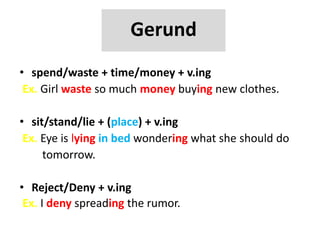
• spend/waste + time/money + v.ing
Ex. Girl waste so much money buying new clothes.
• sit/stand/lie + (place) + v.ing
Ex. Eye is lying in bed wondering what she should do
tomorrow.
• Reject/Deny + v.ing
Ex. I deny spreading the rumor.
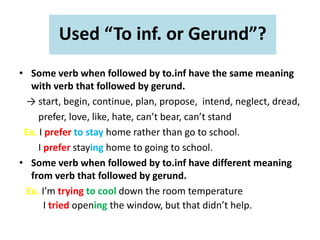
Used “To inf. or Gerund”?
• Some verb when followed by to.inf have the same meaning
with verb that followed by gerund.
→ start, begin, continue, plan, propose, intend, neglect, dread,
prefer, love, like, hate, can’t bear, can’t stand
Ex. I prefer to stay home rather than go to school.
I prefer staying home to going to school.
• Some verb when followed by to.inf have different meaning
from verb that followed by gerund.
Ex. I’m trying to cool down the room temperature
I tried opening the window, but that didn’t help.
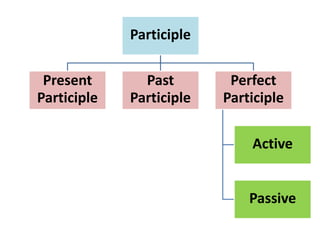
Participle
Present
Participle
Past
Participle
Perfect
Participle
Active
Passive
Participle
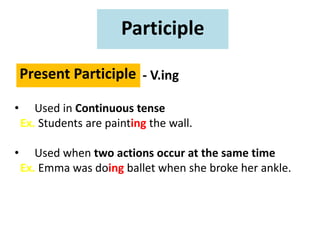
Present Participle - V.ing
• Used in Continuous tense
Ex. Students are painting the wall.
• Used when two actions occur at the same time
Ex. Emma was doing ballet when she broke her ankle.
Participle
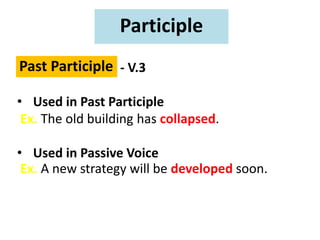
Past Participle - V.3
• Used in Past Participle
Ex. The old building has collapsed.
• Used in Passive Voice
Ex. A new strategy will be developed soon.
Participle
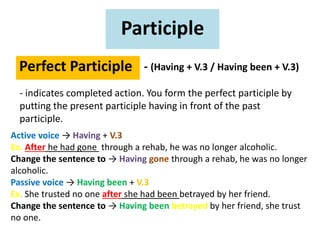
Perfect Participle - (Having + V.3 / Having been + V.3)
- indicates completed action. You form the perfect participle by
putting the present participle having in front of the past
participle.
Active voice → Having + V.3
Ex. After he had gone through a rehab, he was no longer alcoholic.
Change the sentence to → Having gone through a rehab, he was no longer
alcoholic.
Passive voice → Having been + V.3
Ex. She trusted no one after she had been betrayed by her friend.
Change the sentence to → Having been betrayed by her friend, she trust
no one.
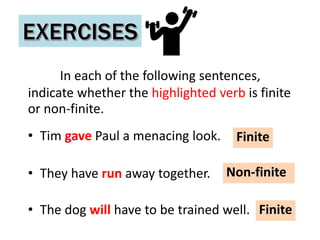
In each of the following sentences,
indicate whether the highlighted verb is finite
or non-finite.
• Tim gave Paul a menacing look.
• They have run away together.
• The dog will have to be trained well.
Finite
Non-finite
Finite
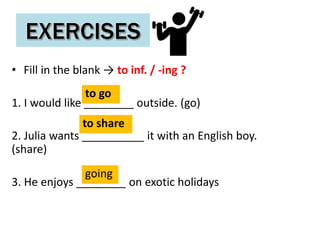
• Fill in the blank → to inf. / -ing ?
1. I would like ________ outside. (go)
2. Julia wants __________ it with an English boy.
(share)
3. He enjoys ________ on exotic holidays
to go
to share
going
Thank you
By:
Pimpisa Phatrapunpong M.4/1 No.5
Tanasorn Pajchim M.4/1 No.7

Verb Pattern

  • 1.
  • 2.
    • The verbpatterns are dependent upon the first verb. There are several different types of pattern. • Sometimes in a sentence, one verb follows another. For example: -They want to buy a book about verb pattern. The first verb is 'want', the second verb is 'buy'. What is a verb pattern?
  • 3.
    What is averb? • A verb is one of the main parts of a sentence or question in English. • In fact, you can’t have a sentence or a question without a verb! That’s how important these “action” parts of speech are. • The verb signals an action, an occurrence, or a state of being. Whether mental, physical, or mechanical, verbs always express activity.
  • 4.
    VERB - overview •Verb can be classified into two types: - Finite Verb - Non-finite Verb • Verbs are a class of words used to show the performance of an action (do, throw, run), existence (be), possession (have), or state (know, love) of a subject. • To put it simply a verb shows what something or someone does.
  • 5.
  • 6.
  • 7.
    What are finiteverbs? • A finite verb is a verb which has a subject and shows tense. Ex: Nana lives in Thailand. [I is the subject, lives describes what the subject does – lives is a finite verb] • In short, it is a verb being a verb (i.e., a doing verb) as opposed to a non-finite verb (verbal) • Finite verbs are the locus of grammatical information of gender, person, number, tense, aspect, mood, and/or voice.
  • 8.
    • Finite verbsshow TENSE and VOICE • 24 Types of TENSE - 12 are in active voice - 12 are in passive voice
  • 9.
    Finite VERB A verbthat depends on: Voice Its subject The tense Helping Verb
  • 10.
    For examples: • Sarahtold me her secret. (For active voice) • I was told about this matter many times. (For passive voice) Limited by Voice
  • 11.
    For examples: • Eyegoes to work by car every day. (Singular) • Many people like going abroad. (Plural) Limited by its subject
  • 12.
    For examples: • Iam not playing game, but I am doing homework. (V.ing - Present continuous tense) • They have just finished their work. (V.3 - Present perfect tense) Limited by the Tense
  • 13.
    Things to observe: →Each verb has its subject → The form of the verb depends on its subject → Each verb is limited by number, person of the subject and its tense For examples; - She was playing football. - They are talking in the room.
  • 14.
    A finite verbis generally expected to have a subject. • For examples: - He painted the fence. [In this example, painted is a finite verb] - I was excited about moving to Thailand. [In this example, was is a finite verb] - Everyone wanted to go to the amusement park, but we only had four tickets. [In this example, wanted is a finite verb]
  • 15.
    2 TYPES offinite verbs 1. Main verbs • Action verb -Intransitive Verbs -Transitive Verbs • Linking Verb 2. Helping Verbs • Main Helping Verb • Modal Verb
  • 16.
    Main Verb 1. ActionVerb • An action verb shows action. • It tells what the subject of the sentence does Ex. Bill hit the ball. • 2 TYPES -Transitive Verbs -Intransitive Verbs → Express an action passes from → Express an action of the the subject to an object subject without an object Ex: Jan greeted the visitors. Ex: The train stopped.
  • 17.
    2. Linking Verb -A linking verb connects the subject with a word that gives information about the subject - Also referred to as copulas or copular verbs - Variously called "copulative," "equative," "intensive" or "linking" verbs." - Common Linking Verb: Ex: am, is, was, been, seems, feels • The most common linking verbs are forms of "to be," "to become" and "to seem.“
  • 18.
    • These typesof verbs: → Show a relationship between the subject and the part of the sentence following the verb → Connect or link the subject with more information (words that further identify or describe the subject) → Identify a relationship or existing condition Ex: The eggs smell rotten. All the kittens were playful. 2. Linking Verb (cont.)
  • 19.
    The different betweenlinking verbs and verbs of perception! • A linking verb is a copular (or copulative) verb. It is a verb that connects words or clauses linked in sense or connecting a subject to the part of the sentence following the verb • Verbs of perception are different. These verbs pertain to the senses: see, hear, smell, taste, and feel as well as variants like watch and listen.
  • 20.
    Helping Verb (AuxiliaryVerb) • Helps a main verb; comes before the main verb • 2 TYPES 1) Main helping verb (Primary Auxiliary Verb) Ex. V. to be, V. to do, V. to have 2) Modal verbs + V.inf Ex. Can, could, may, might + V.inf
  • 21.
    • There are23 helping verbs (auxiliary verbs). They are always followed by a finite verb. 1. Main Helping verbs (Primary auxiliary verb) -Verb to be, Verb to do, Verb to have -In making a sentence For continuous tense; use be+V.ing For perfect tense; use have+V.3 For passive voice; use be+V.3 2. Modal Verb (Secondary auxiliary verb) -Give an additional information about something -For examples: can, could, ought to, would, etc. -It can be used to express: Obligation, Suggestion, Give an advice, etc.
  • 22.
    The best wayto find a finite verb is by eliminating it as a non-finite verb. • So, checked: - Is it being used as a noun? - Is it preceded by to? - Is it being used as an adjective?
  • 23.
  • 24.
    Definition • Non-finite verbis also known as a verbal is the term used to describe a verb that is not showing tense.
  • 25.
    Infinitive • The infinitiveis the base form of a verb. • 2 Types ; 1. Infinitive with to ( to inf.) 2. Infinitive without to/ bare infinitive
  • 26.
    Infinitive with to •Structure : Subject + Verb + to infinitive Ex. I want to go to London. • Negative form of infinitive – formed by putting not in front of any form of the infinitive. Ex. I decided not to go to London. • Common verbs followed by to infinitive – try, wait, decide, agree, want, ask, and etc.
  • 27.
    Infinitive with to •Function of Infinitive with to o The to-infinitive as a noun Ex. To forgive is to set a prisoner free. o Use as an adjective Ex. This is the plan to follow. o Use as an adverb Ex. The Advengers must reunite to stop Ultron. o put it after the Ordinal number or Superlative Ex. Barack Obama is the first African-American to win the U.S. presidency.
  • 28.
    Infinitive with to •Structure : Subject + verb + object + to infinitive Ex. The doctor told me to give up smoking. • Common verbs followed by to infinitive – advise, allow, ask, tell, instruct, get, etc.
  • 29.
    Infinitive with to •Function of Object + Infinitive with to ; o Use with Perfect or Past meaning and Past Unreal → to have + V.3 Ex. I expect to have baked oatmeal cookies by tonight. Ex. I meant to tidy up the house, but the guests arrive earlier.
  • 30.
    Infinitive without to •3 TYPES - Helping verb (modal verb) + v.inf without to - Causative verb + something + v.inf without to - Verb of Perception
  • 31.
    Helping Verb • Alsocalled Auxiliary Verb • Already mentioned
  • 32.
    Causative verb +something + v.inf HAVE, MAKE, LET, GET, HELP are called causative verbs because they cause something else to happen. • Have - This construction means give someone the responsibility to do something -ex. I have all my dishes washed. • Get - This construction means something is NEED to do -ex. You need to get your car fixed.
  • 33.
    Causative verb +something + v.inf • Make - This construction means to force someone to do something. -ex. She made her children do their homework. • Let - This construction means to allow someone to do something. -ex. Karn let me drive her new car.
  • 34.
    • HELP =Assist Someone In Doing Something After “help”, you can use “to” or not – both ways are correct. BUT THEY DO HAVE THE DIFFERENT IN MEANING Grammatical structure: - HELP + PERSON + VERB (base form) = directly done Ex: I help my mother wash a car - I wash a car by myself - HELP + PERSON + TO + VERB (base form) = indirectly done Ex: I help my mother to wash a car - I do not wash the car by myself, I just help my mother to pick an equipment in order to help her wash the car easier.
  • 35.
    Gerund • is aterm for a verb form that functions as a noun. • Function of Gerund - Subject - Object - Complement - Object of preposition
  • 36.
    Verb of Perception •Refer to those verbs which are used to talk about sensing: Ex. See/look/watch/notice/observe, hear/listen to, taste, smell, touch/feel, sense in general • Can be followed by: - VERB OF PERCEPTION + infinitive without to The infinitive is used after these verbs when we want to say that we hear or see the whole of an action or event Ex. I saw him cross the road. - VERB OF PERCEPTION + -ing form The –ing form is used to suggest that we hear an action or event in progress. Ex. I saw him crossing the road.
  • 37.
    Gerund • Position ofGerund in the sentence →Gerund usually followed ; - Preposition Ex. I stopped the child from running into the street. - Verb (only some group that have to follow with V.ing)  avoid, begin, finish, keep, miss, practice, risk, start, stop, etc. Ex. Some people avoid confronting reality. - Some expressions = have fun, have a (adj.) time, have trouble, have difficulty Ex. She had a hard time recollecting her childhood memories. The patient has trouble keeping his balance.
  • 38.
    Gerund • spend/waste +time/money + v.ing Ex. Girl waste so much money buying new clothes. • sit/stand/lie + (place) + v.ing Ex. Eye is lying in bed wondering what she should do tomorrow. • Reject/Deny + v.ing Ex. I deny spreading the rumor.
  • 39.
    Used “To inf.or Gerund”? • Some verb when followed by to.inf have the same meaning with verb that followed by gerund. → start, begin, continue, plan, propose, intend, neglect, dread, prefer, love, like, hate, can’t bear, can’t stand Ex. I prefer to stay home rather than go to school. I prefer staying home to going to school. • Some verb when followed by to.inf have different meaning from verb that followed by gerund. Ex. I’m trying to cool down the room temperature I tried opening the window, but that didn’t help.
  • 40.
  • 41.
    Participle Present Participle -V.ing • Used in Continuous tense Ex. Students are painting the wall. • Used when two actions occur at the same time Ex. Emma was doing ballet when she broke her ankle.
  • 42.
    Participle Past Participle -V.3 • Used in Past Participle Ex. The old building has collapsed. • Used in Passive Voice Ex. A new strategy will be developed soon.
  • 43.
    Participle Perfect Participle -(Having + V.3 / Having been + V.3) - indicates completed action. You form the perfect participle by putting the present participle having in front of the past participle. Active voice → Having + V.3 Ex. After he had gone through a rehab, he was no longer alcoholic. Change the sentence to → Having gone through a rehab, he was no longer alcoholic. Passive voice → Having been + V.3 Ex. She trusted no one after she had been betrayed by her friend. Change the sentence to → Having been betrayed by her friend, she trust no one.
  • 45.
    In each ofthe following sentences, indicate whether the highlighted verb is finite or non-finite. • Tim gave Paul a menacing look. • They have run away together. • The dog will have to be trained well. Finite Non-finite Finite
  • 46.
    • Fill inthe blank → to inf. / -ing ? 1. I would like ________ outside. (go) 2. Julia wants __________ it with an English boy. (share) 3. He enjoys ________ on exotic holidays to go to share going
  • 47.
    Thank you By: Pimpisa PhatrapunpongM.4/1 No.5 Tanasorn Pajchim M.4/1 No.7