Dell Youth Learning
Implemented by

Learning Links Foundation

1

DELL YOUTH LEARNING
www.learninglinksindia.org
What is Verb?
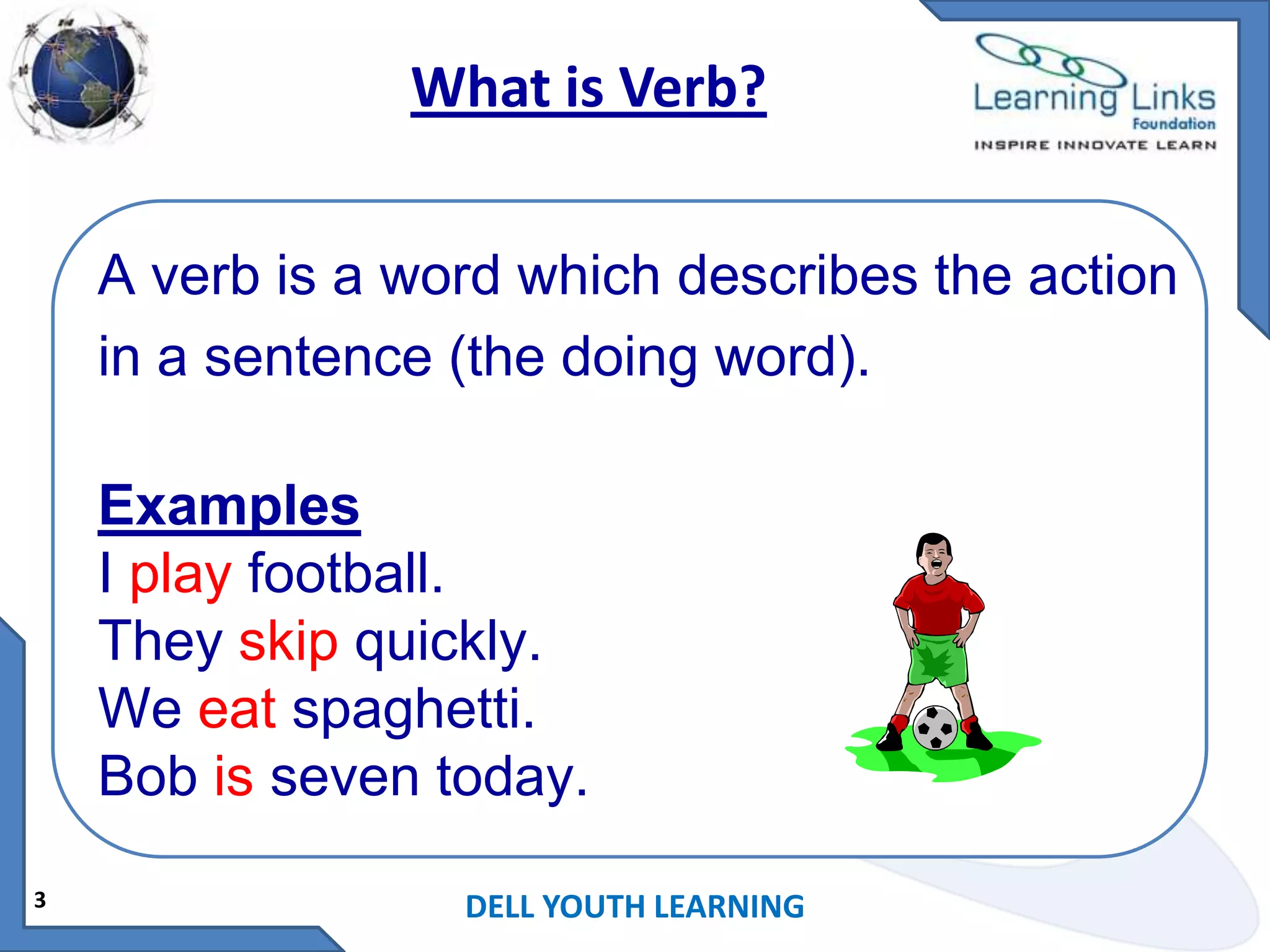
A verb is a word which describes the action
in a sentence (the doing word).
Examples
I play football.
They skip quickly.
We eat spaghetti.
Bob is seven today.
3

DELL YOUTH LEARNING
Let’s Practice:
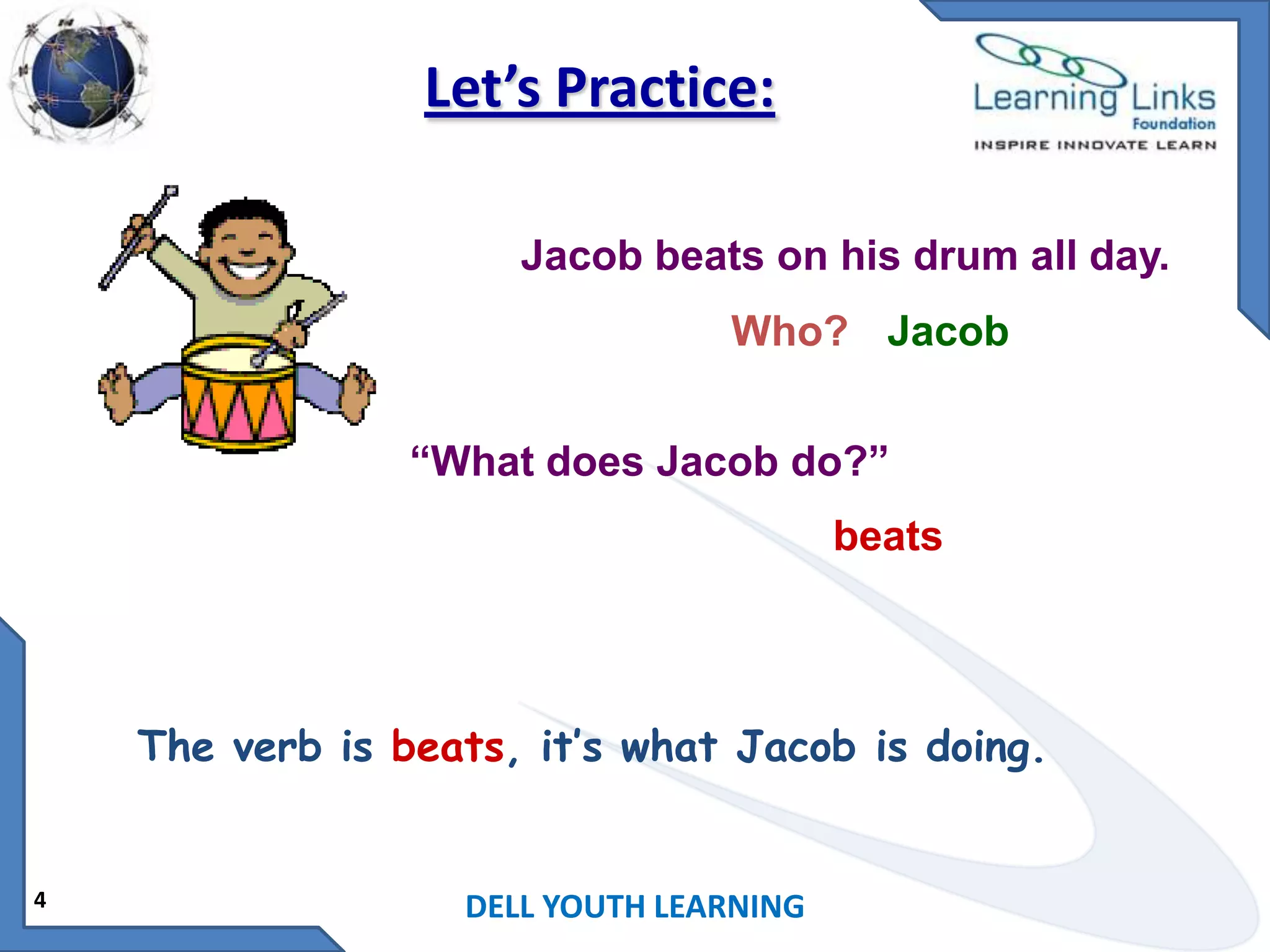
Jacob beats on his drum all day.

Who? Jacob
“What does Jacob do?”

beats

The verb is beats, it’s what Jacob is doing.

4

DELL YOUTH LEARNING
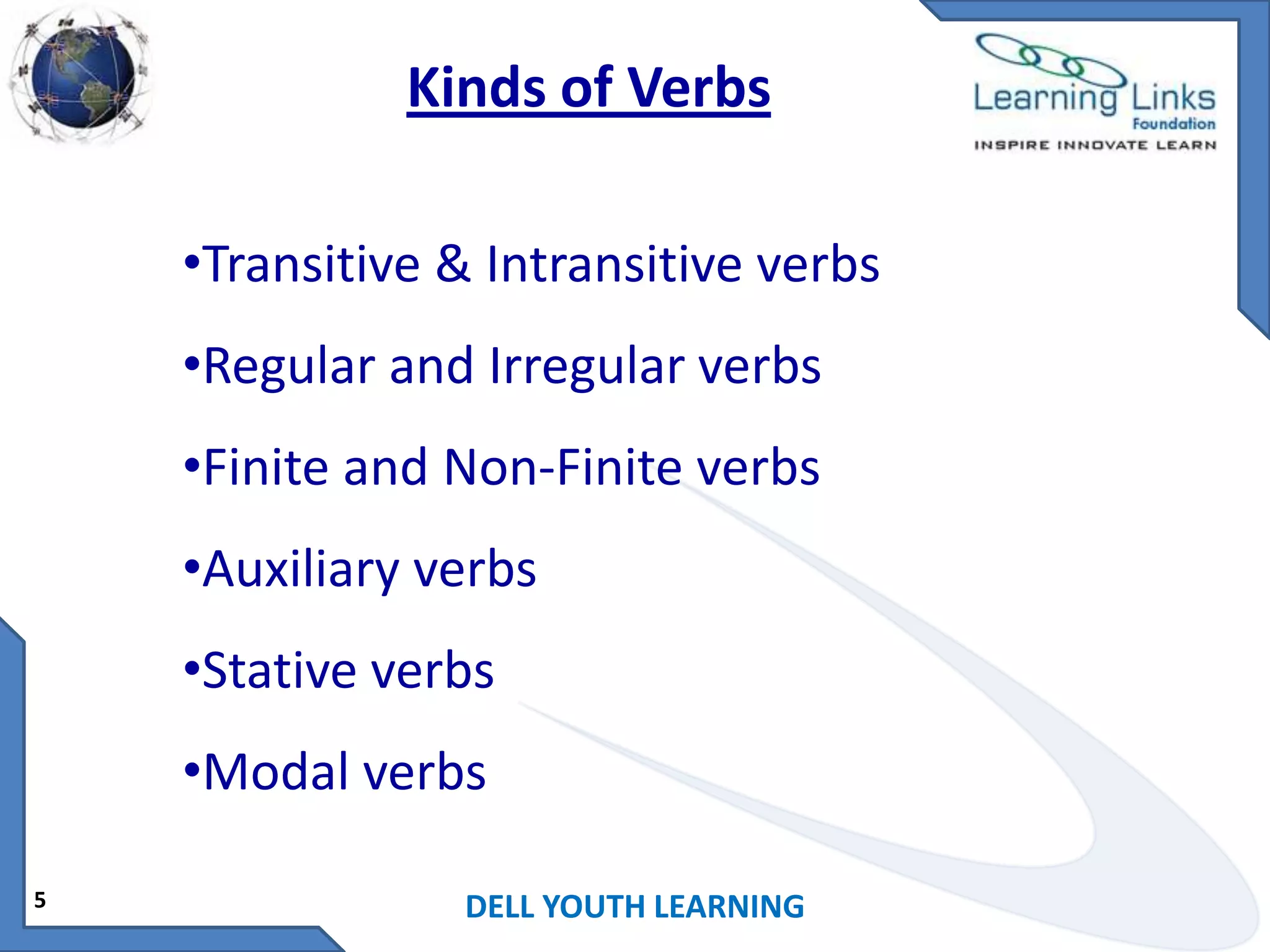
Kinds of Verbs
•Transitive & Intransitive verbs

•Regular and Irregular verbs
•Finite and Non-Finite verbs

•Auxiliary verbs
•Stative verbs

•Modal verbs
5

DELL YOUTH LEARNING
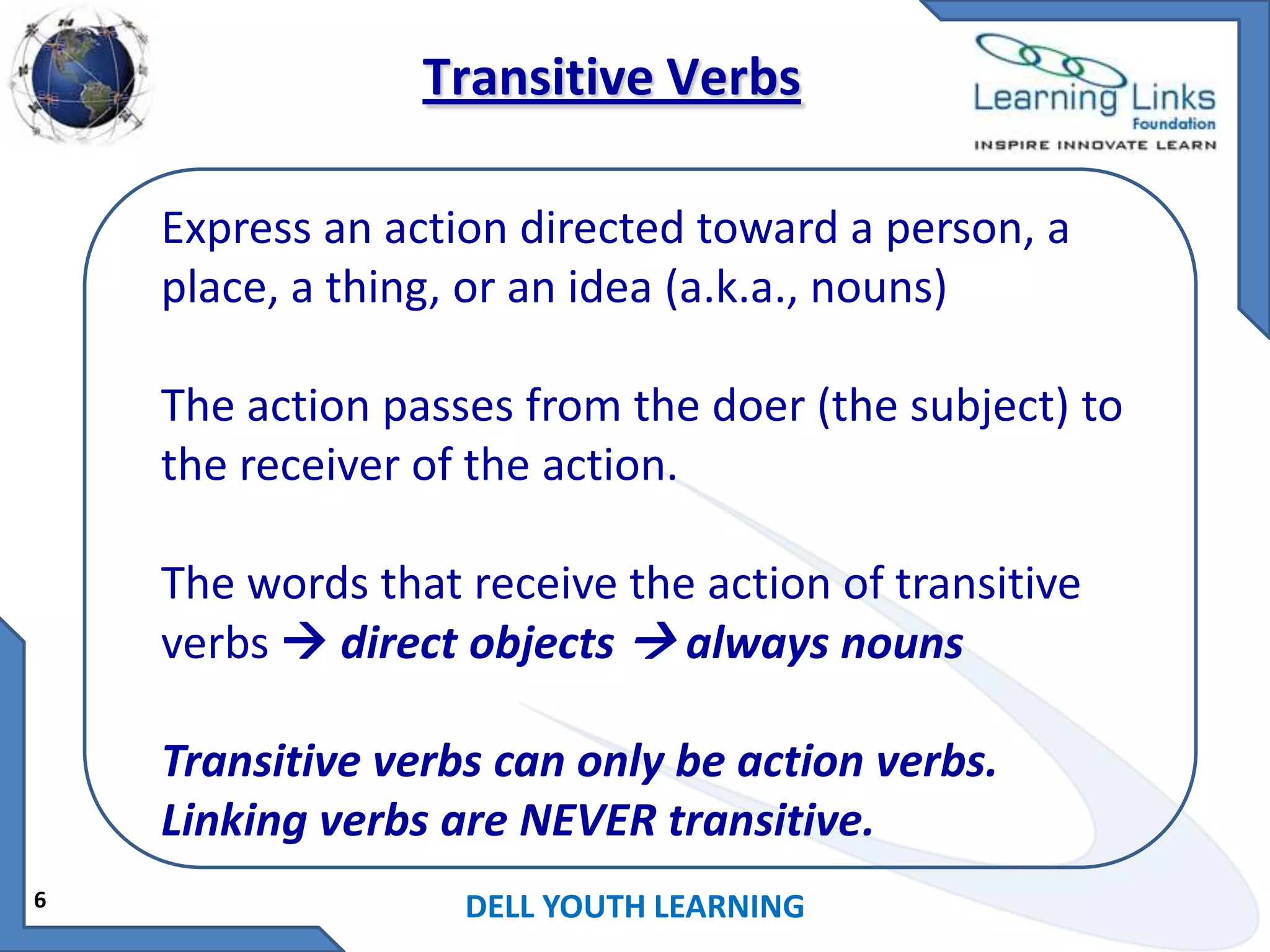
Transitive Verbs
Express an action directed toward a person, a
place, a thing, or an idea (a.k.a., nouns)
The action passes from the doer (the subject) to
the receiver of the action.
The words that receive the action of transitive
verbs  direct objects  always nouns

Transitive verbs can only be action verbs.
Linking verbs are NEVER transitive.
6

DELL YOUTH LEARNING
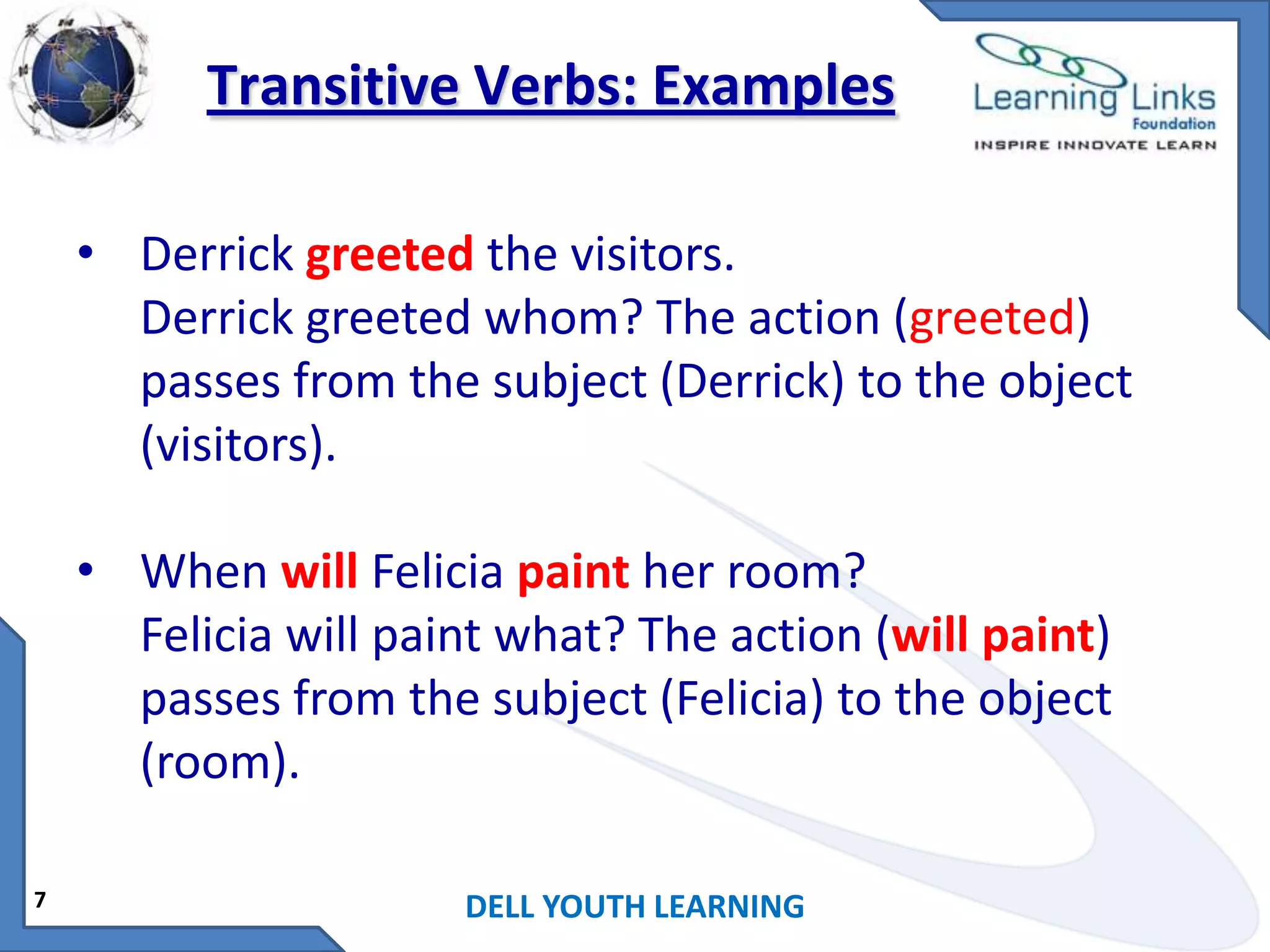
Transitive Verbs: Examples
• Derrick greeted the visitors.
Derrick greeted whom? The action (greeted)
passes from the subject (Derrick) to the object
(visitors).
• When will Felicia paint her room?
Felicia will paint what? The action (will paint)
passes from the subject (Felicia) to the object
(room).
7

DELL YOUTH LEARNING
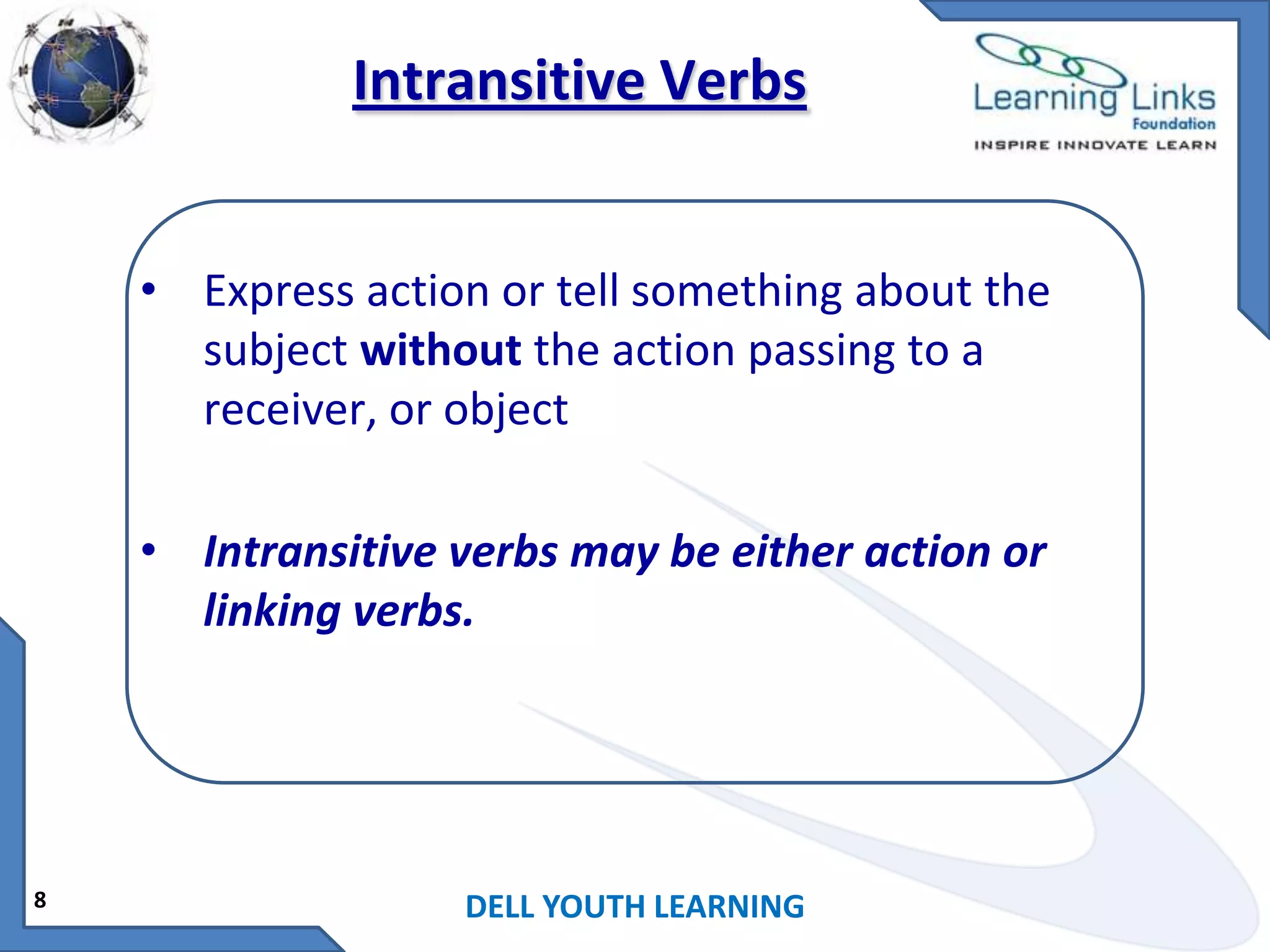
Intransitive Verbs
• Express action or tell something about the
subject without the action passing to a
receiver, or object
• Intransitive verbs may be either action or
linking verbs.

8

DELL YOUTH LEARNING
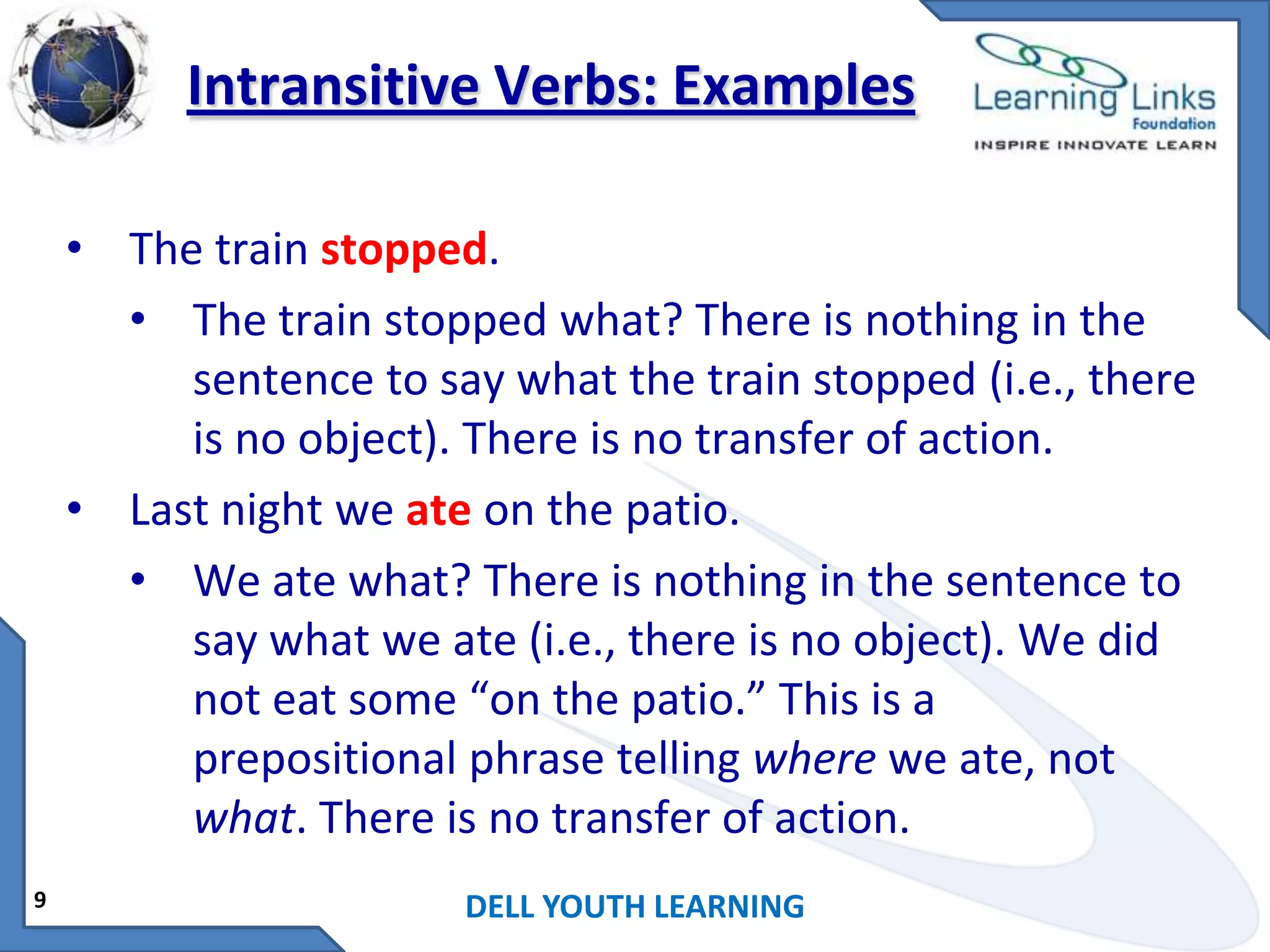
Intransitive Verbs: Examples
• The train stopped.
• The train stopped what? There is nothing in the
sentence to say what the train stopped (i.e., there
is no object). There is no transfer of action.
• Last night we ate on the patio.
• We ate what? There is nothing in the sentence to
say what we ate (i.e., there is no object). We did
not eat some “on the patio.” This is a
prepositional phrase telling where we ate, not
what. There is no transfer of action.
9

DELL YOUTH LEARNING
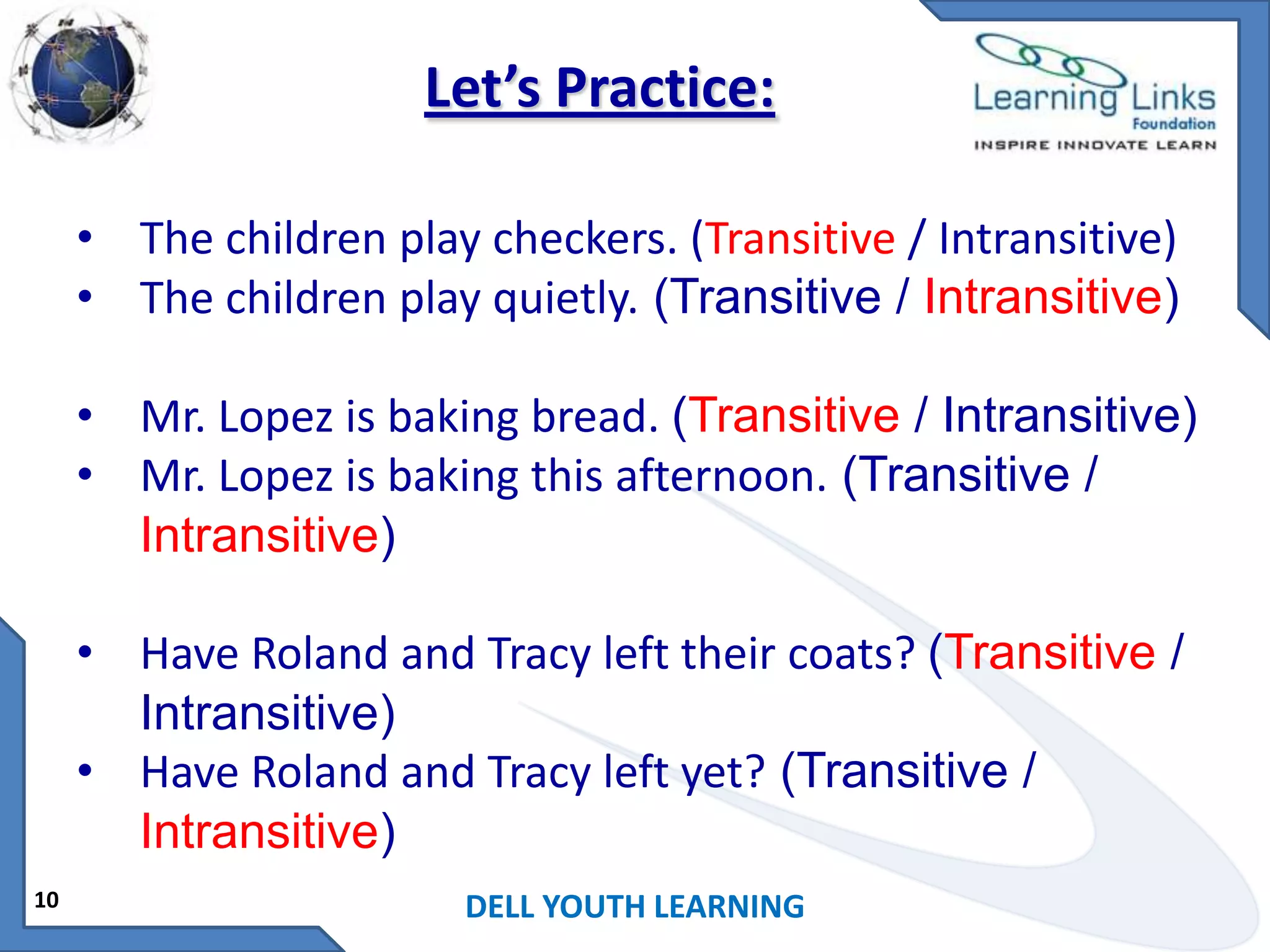
Let’s Practice:
• The children play checkers. (Transitive / Intransitive)
• The children play quietly. (Transitive / Intransitive)
• Mr. Lopez is baking bread. (Transitive / Intransitive)
• Mr. Lopez is baking this afternoon. (Transitive /
Intransitive)
• Have Roland and Tracy left their coats? (Transitive /
Intransitive)
• Have Roland and Tracy left yet? (Transitive /
Intransitive)
10

DELL YOUTH LEARNING
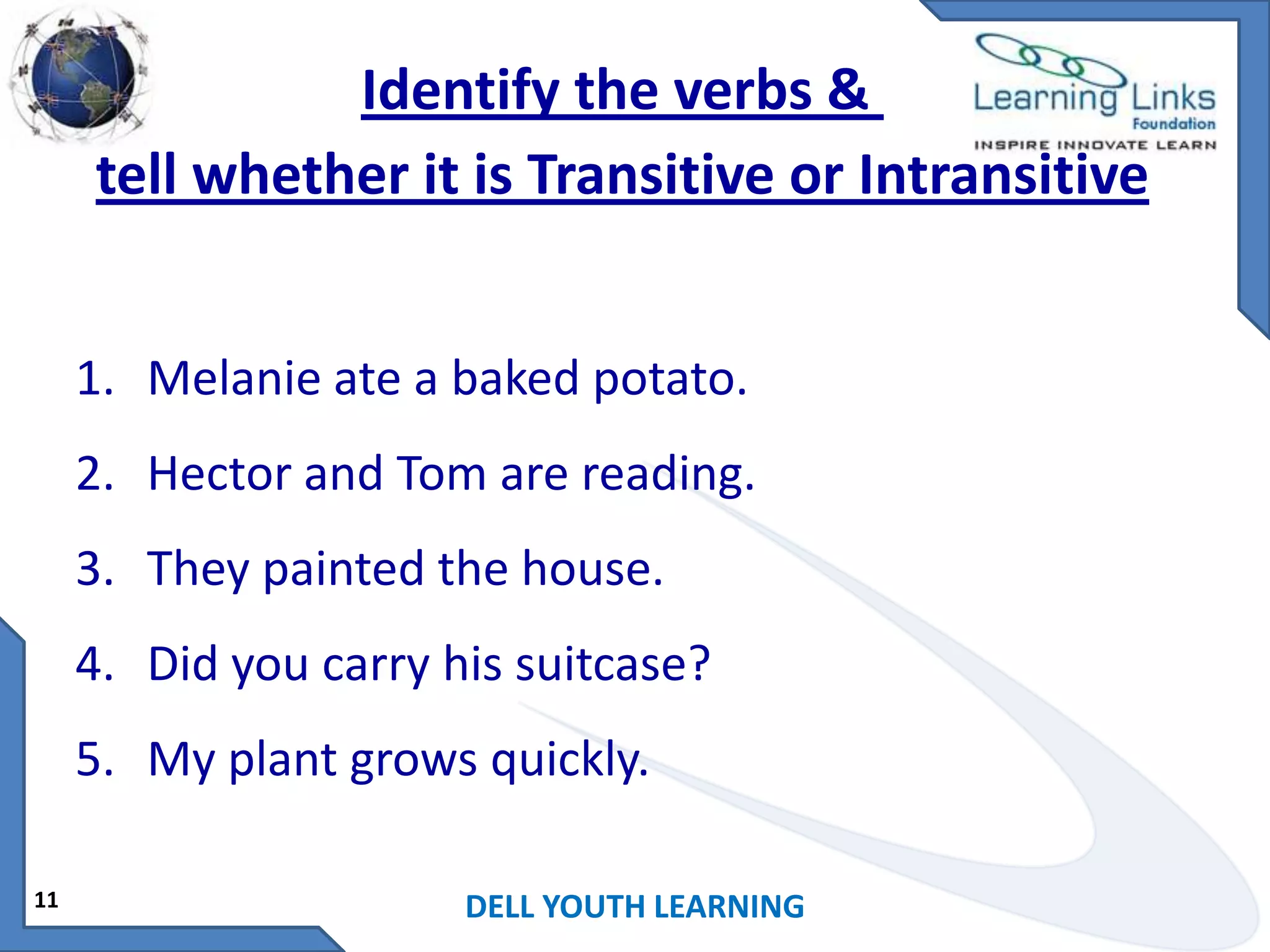
Identify the verbs &
tell whether it is Transitive or Intransitive
1. Melanie ate a baked potato.
2. Hector and Tom are reading.

3. They painted the house.
4. Did you carry his suitcase?
5. My plant grows quickly.
11

DELL YOUTH LEARNING
Regular Verb

• A verb that forms its past tense & present
participle by adding.
–d or –ed
• Or in some cases –t to the base form (which
is known as weak verb).

12

DELL YOUTH LEARNING
Example of Base Form

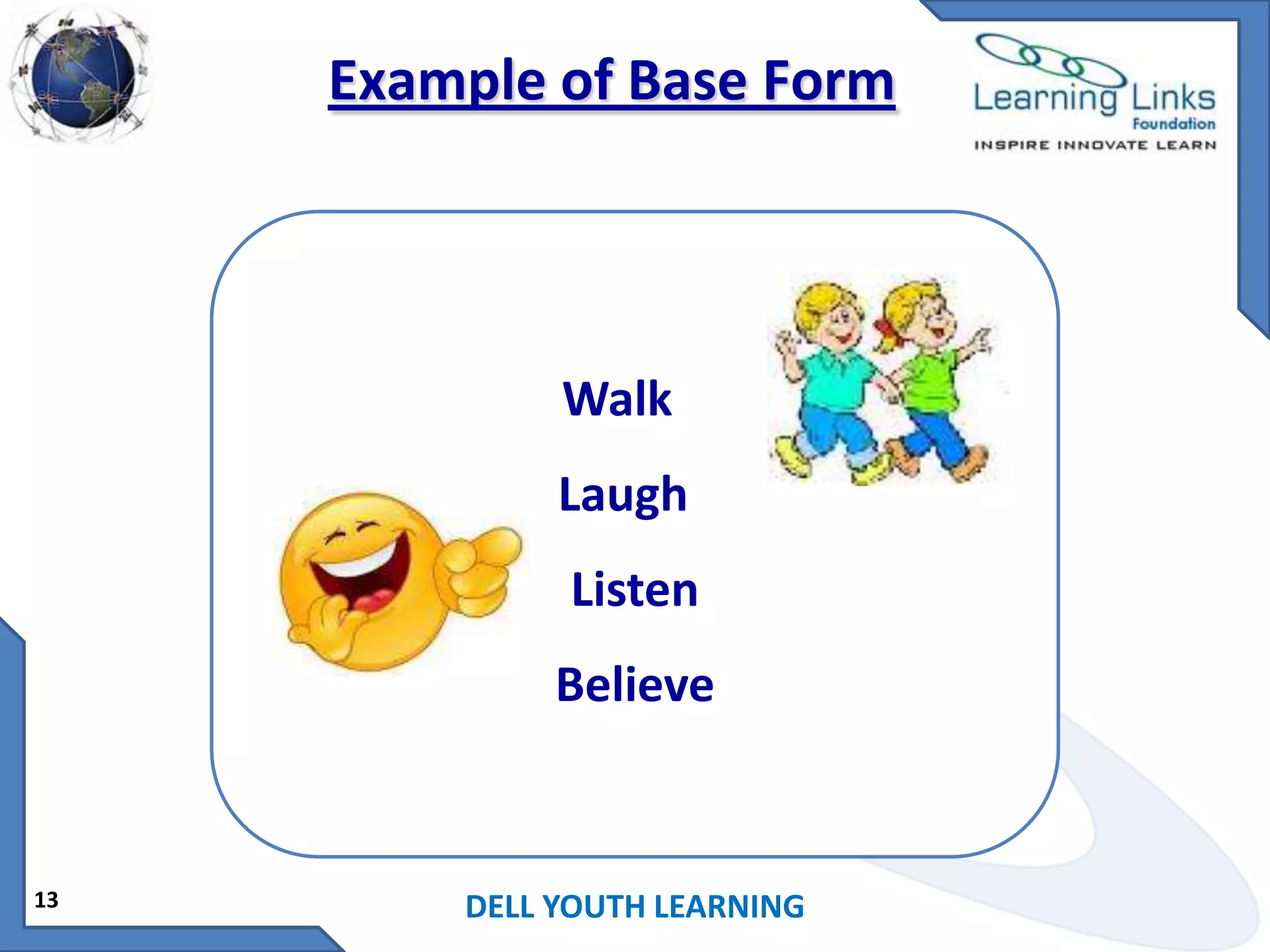
Walk
Laugh
Listen
Believe

13

DELL YOUTH LEARNING
Examples of –s form
If I have a thousand ideas and only one turns out
to be good, I am satisfied.“
Examples of –ed Form
I've searched all the parks in all the cities and
found no statues of committees.
Examples of –ing Form

I've always been trying hard to give the best and
got the best result after being rewarded.
14

DELL YOUTH LEARNING
Irregular Verb
A verb that does not follow the usual rules
for verb forms

Verbs in English are irregular if they don't
have a conventional -ed ending (like asked or
ended)
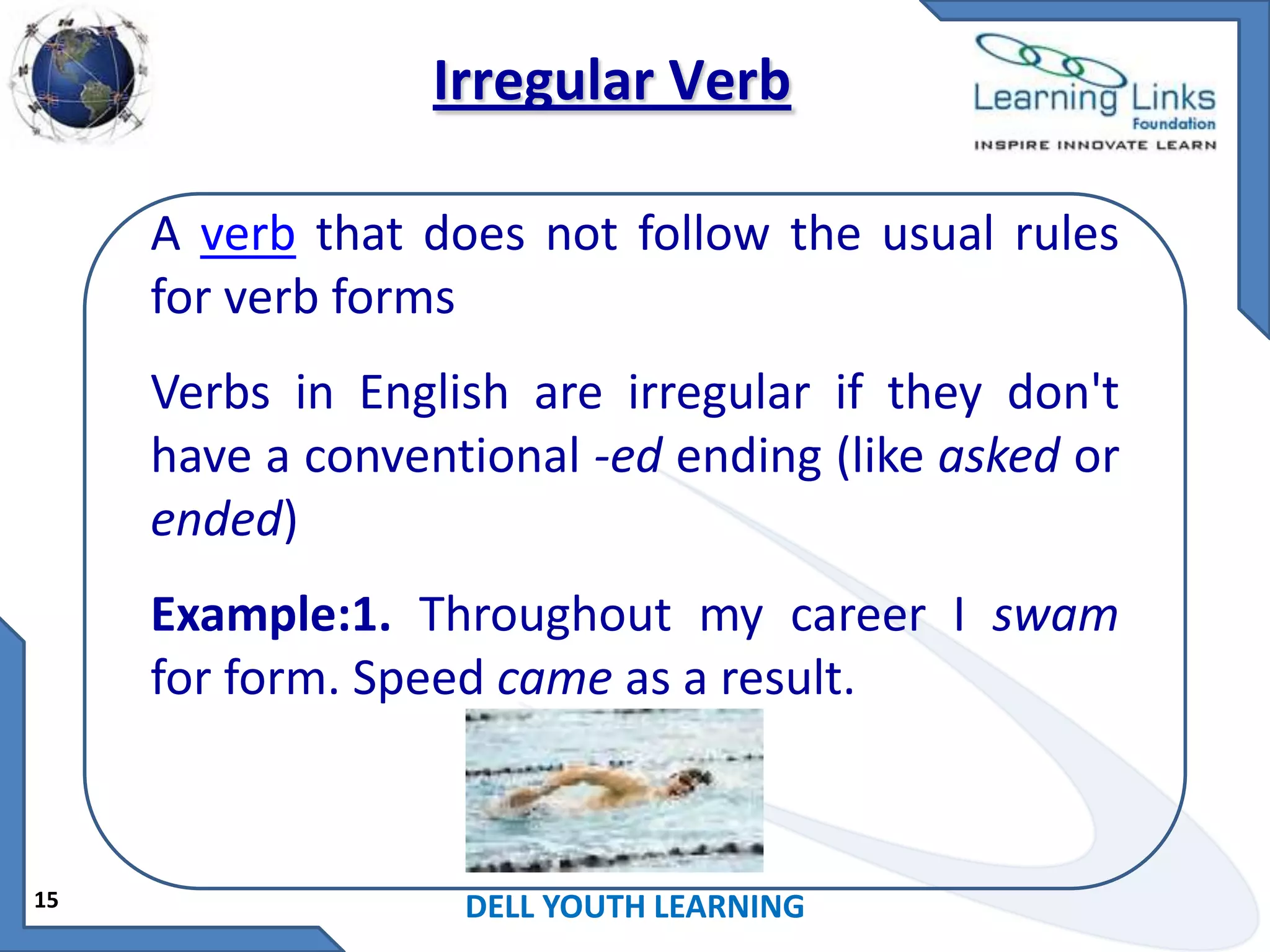
Example:1. Throughout my career I swam
for form. Speed came as a result.

15

DELL YOUTH LEARNING
Difference between Regular
& Irregular Verbs
Those verbs that form their past participle with ‘d’
or ‘ed’ are regular verbs.

PRESENT TENSE
Share
Scare
16

PAST TENSE
Shared
Scared
DELL YOUTH LEARNING
Past Verb
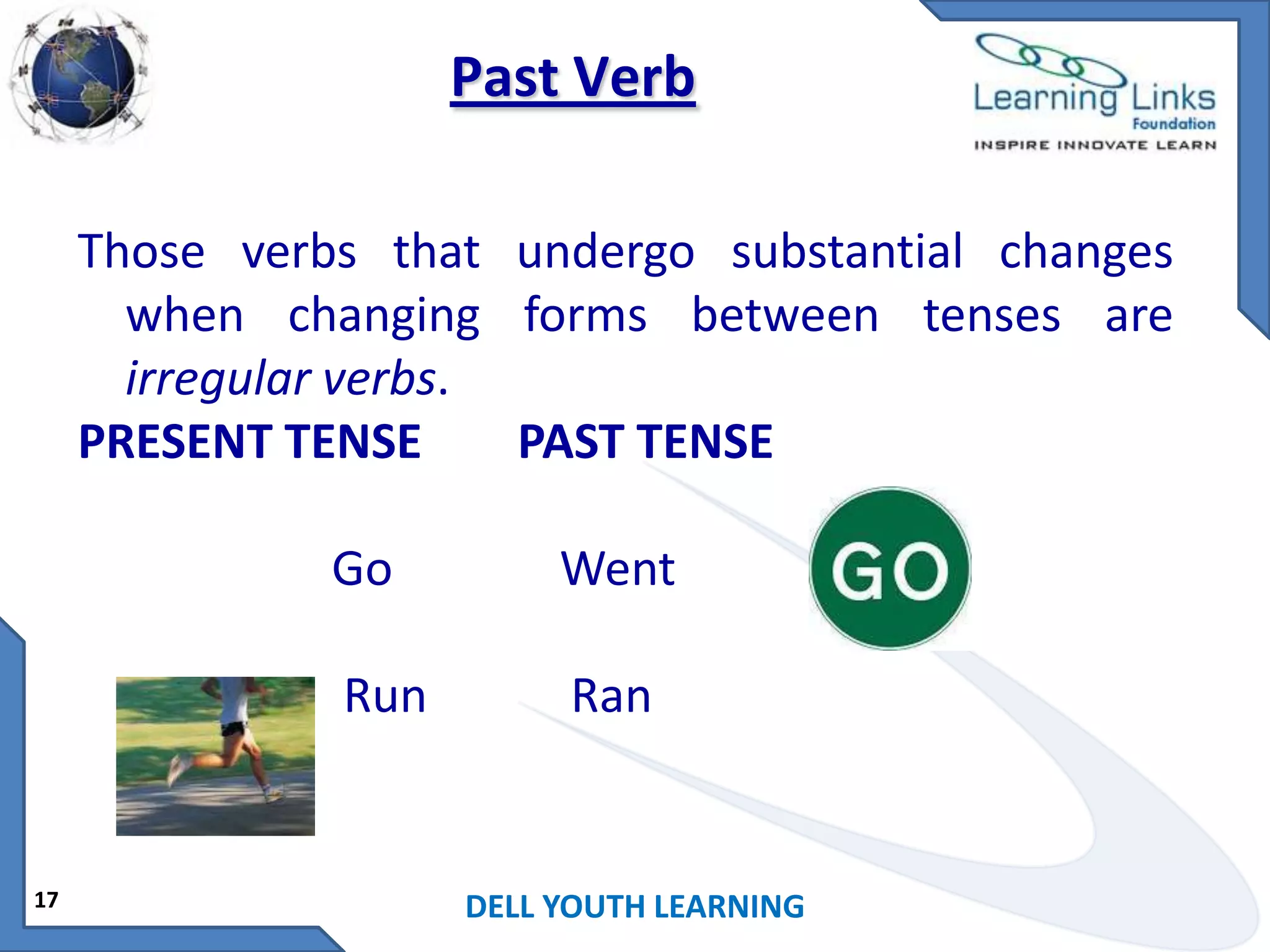
Those verbs that undergo substantial changes
when changing forms between tenses are
irregular verbs.
PRESENT TENSE
PAST TENSE
Go
Run

17

Went
Ran

DELL YOUTH LEARNING
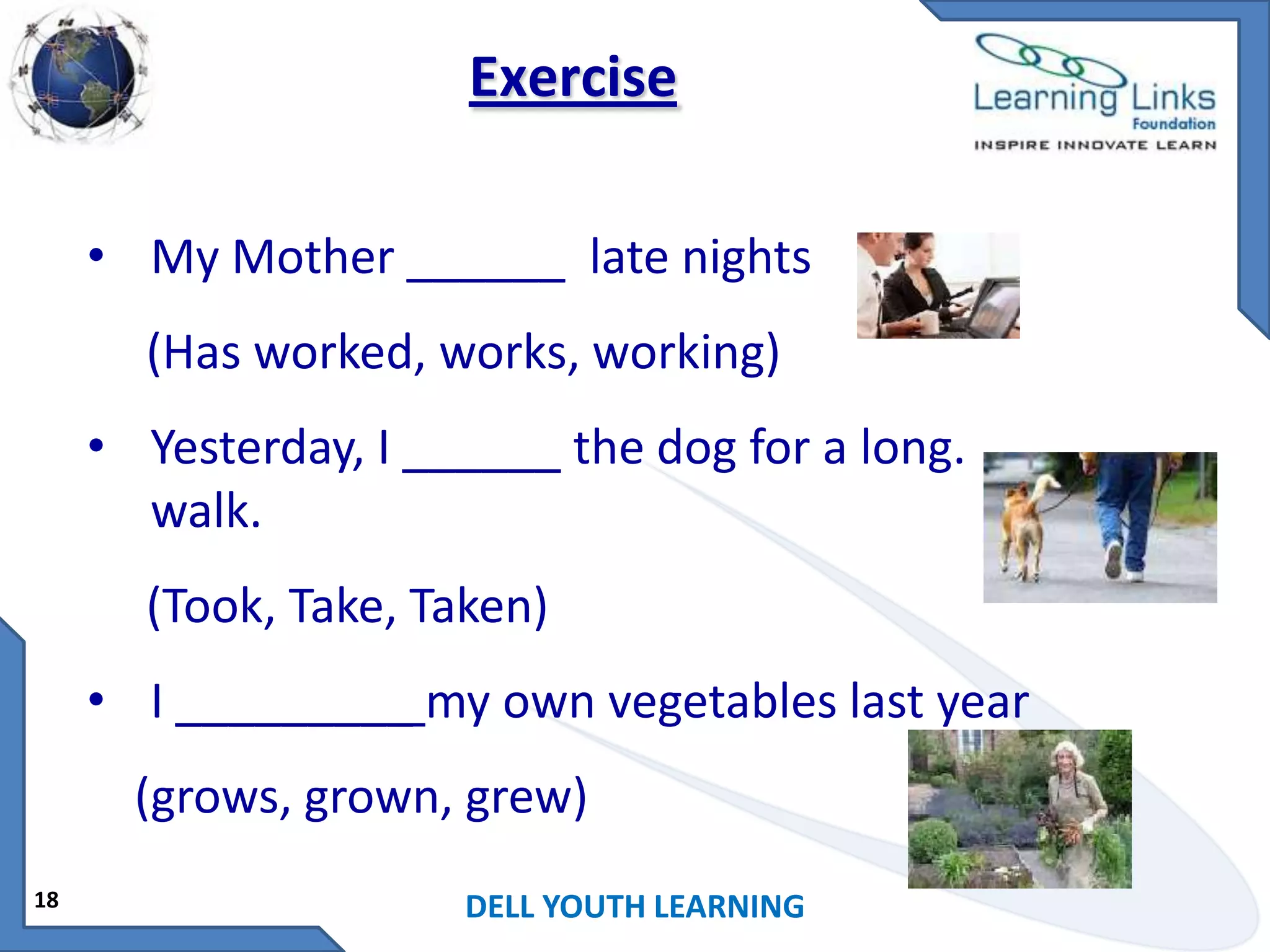
Exercise
• My Mother ______ late nights
(Has worked, works, working)
• Yesterday, I ______ the dog for a long.
walk.
(Took, Take, Taken)
• I _________ my own vegetables last year
(grows, grown, grew)
18

DELL YOUTH LEARNING
Finite Verb
Verbs which have the past or the present

form are called FINITE verbs
If there is just one verb in a sentence, it is finite.
Finite verbs are sometimes called tensed verbs.
Examples of Finite Verb

1.Drive a car. [1st person, singular, present tense]
2. He drives a car. [3rd person, singular. present
tense]
19

DELL YOUTH LEARNING
Infinite Verb

Verbs in any other form (infinitive, -ing or
-ed) are called Infinite Verbs.

20

DELL YOUTH LEARNING
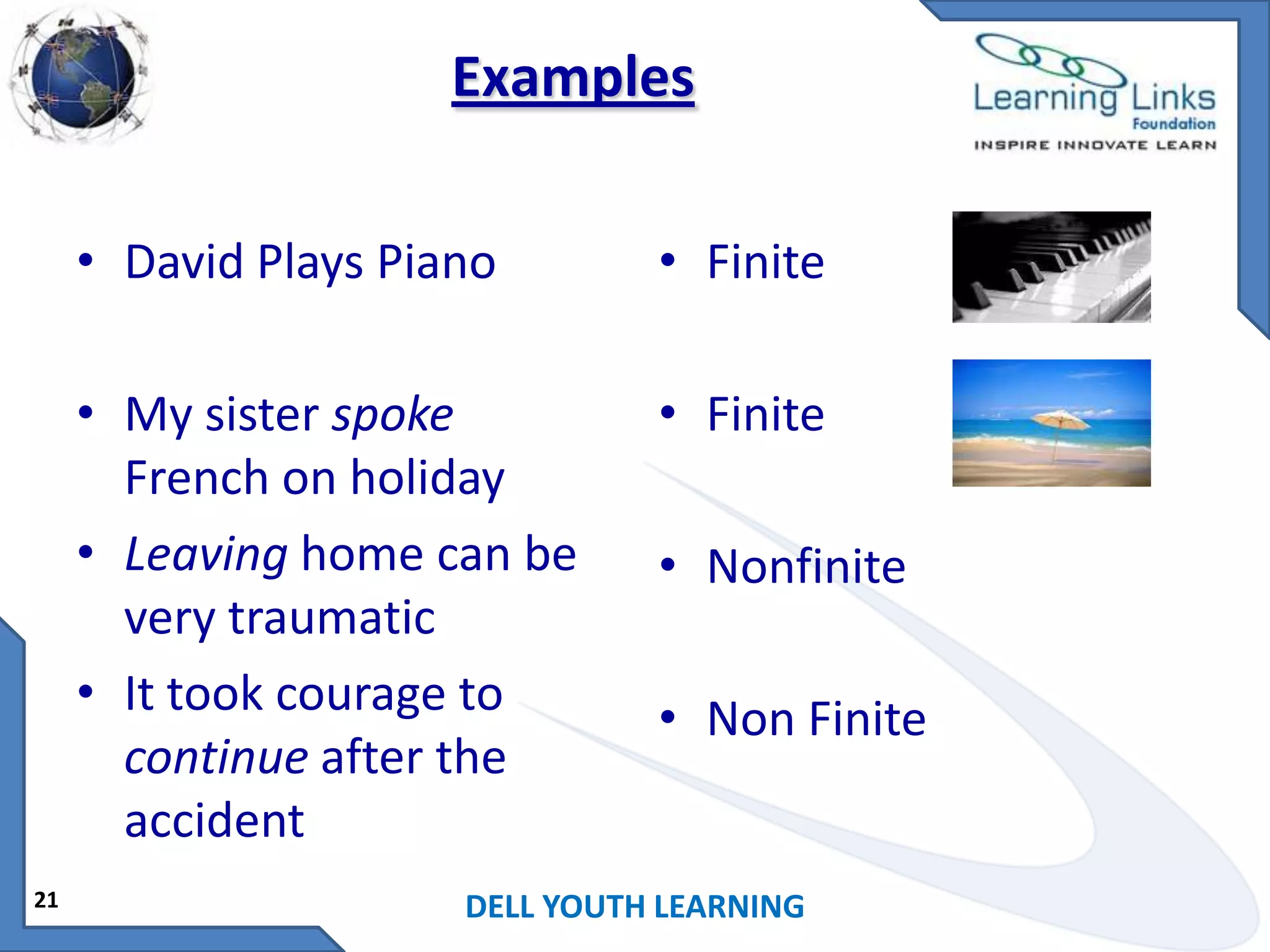
Examples
• David Plays Piano
• My sister spoke
French on holiday
• Leaving home can be
very traumatic
• It took courage to
continue after the
accident
21

• Finite
• Finite

• Nonfinite
• Non Finite

DELL YOUTH LEARNING
Exercise on Finite
& Infinite Verbs
• Paul runs to work
every day
• They have run away
together

• Finite
• Infinite

• Katie was watching TV
when the phone rang
22

• Finite
• Infinite

• Finite
• Infinite

DELL YOUTH LEARNING
Auxiliary Verbs
•

•
•
•

23

Also called helping verbs. They have no meaning on their
own. They are necessary for the grammatical structure of
a sentence, but they do not tell us very much alone. We
usually use helping verbs with main verbs. They "help"
the main verb (which has the real meaning).
There are only about 15 helping verbs in English, and we
divide them into two basic groups:
Primary helping verbs (3 verbs). These are the verbs be,
do, and have.
Note that we can use these three verbs as helping verbs
or as main verbs.
DELL YOUTH LEARNING
Primary Auxiliary Verbs
Uses of “be”

1. Simple Questions
•

•
•
•
•
•
24

We create simple yes/no questions by inverting the
order of subject and the “To be” verb.
Is your brother taller than you?
Were they embarrassed by the comedian?
The same inversion takes place when “To be” is
combined with verbs in the progressive:
Is it snowing in the mountains?
Were your children driving home this weekend?
DELL YOUTH LEARNING
Let’s Practice using ‘Be’

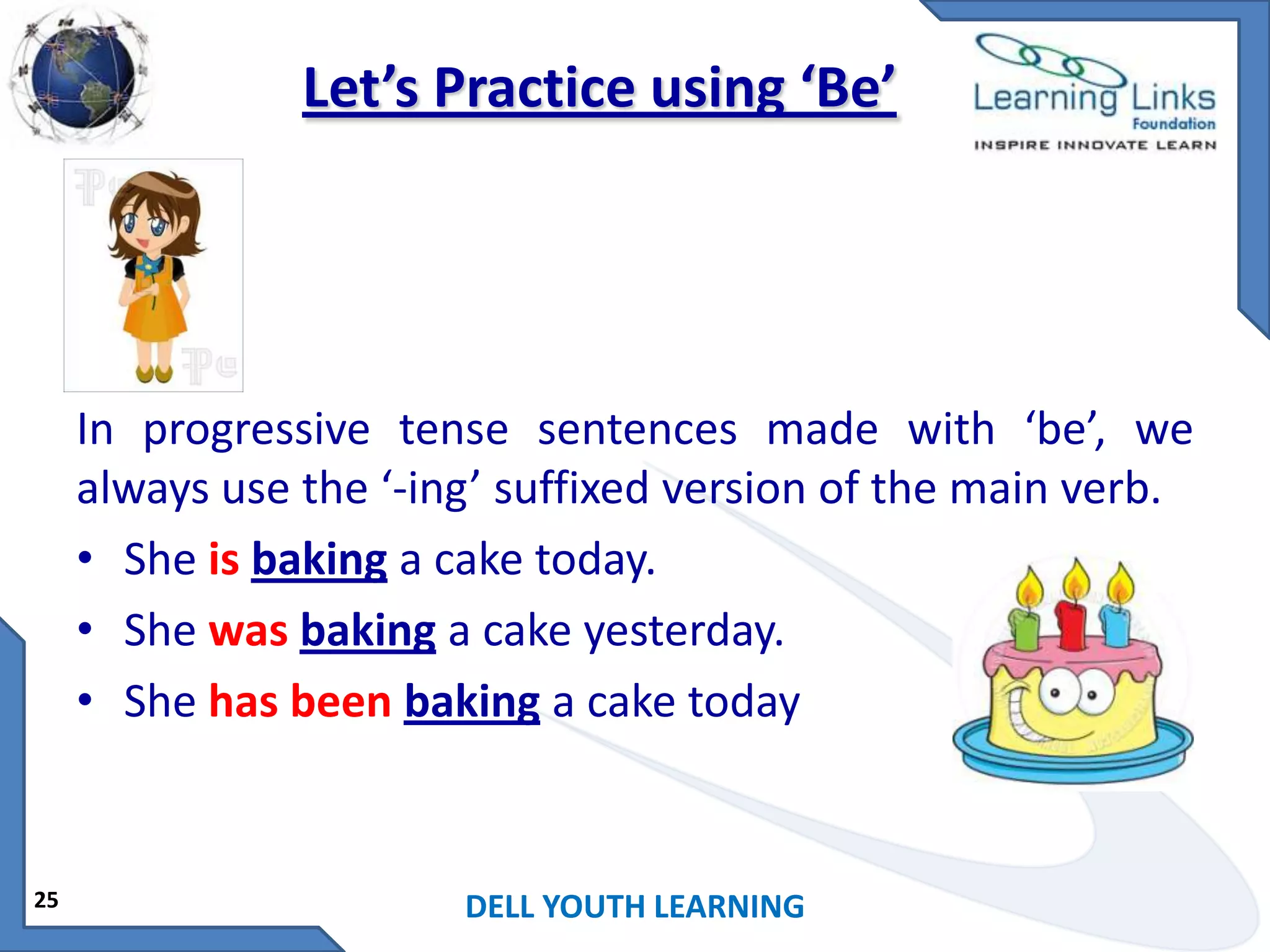
In progressive tense sentences made with ‘be’, we
always use the ‘-ing’ suffixed version of the main verb.
• She is baking a cake today.
• She was baking a cake yesterday.
• She has been baking a cake today

25

DELL YOUTH LEARNING
Exercise on Auxiliary Verbs

• ______ you want tea?
(Do / Does)
• He _______ given his all. (have / has)
• She _______ the boss.
(have / is)

26

DELL YOUTH LEARNING
Stative Verbs
A stative verb is one that describes a state of
being, in contrast to a dynamic verb which
describes an action. The difference can be
categorized by saying that stative verbs are static
or unchanging throughout their entire duration,
whereas dynamic verbs describe a process that
changes over time. Many languages distinguish
between these two types in terms of how they
can be used grammatically.
27

DELL YOUTH LEARNING
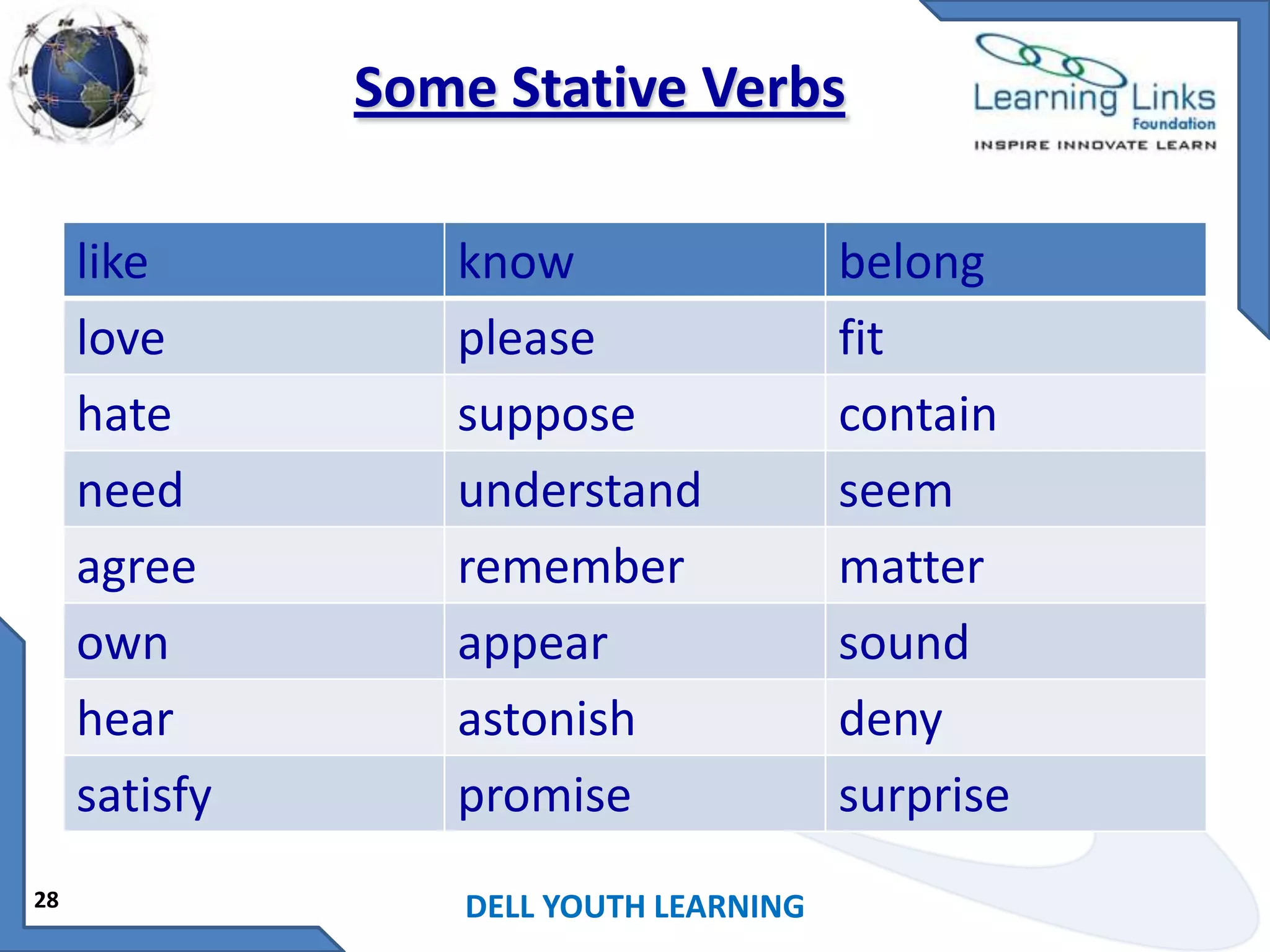
Some Stative Verbs
like
love
hate
need
agree
own
hear
satisfy
28

know
please
suppose
understand
remember
appear
astonish
promise
DELL YOUTH LEARNING

belong
fit
contain
seem
matter
sound
deny
surprise
Examples
•
•
•
•
•
•
•
•
•
•
•
•
•
•
•
29

Some verbs can be both stative and dynamic:
Be
be is usually a stative verb, but when it is used in the continuous it means
‘behaving’ or ‘acting’
 are stupid = it’s part of your personality
you
 are being stupid = only now, not usually
you
Think

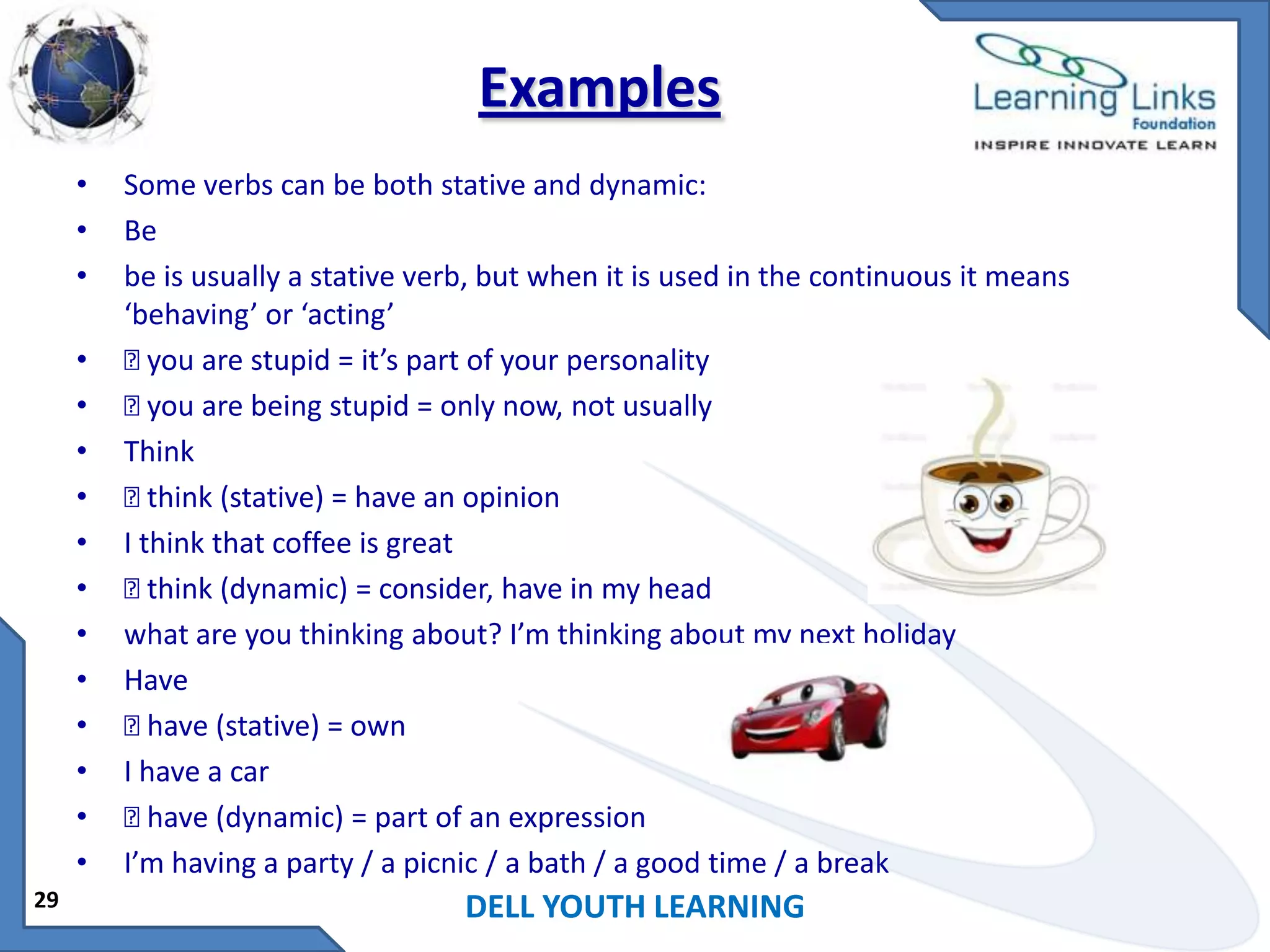
think (stative) = have an opinion
I think that coffee is great

think (dynamic) = consider, have in my head
what are you thinking about? I’m thinking about my next holiday
Have

have (stative) = own
I have a car

have (dynamic) = part of an expression
I’m having a party / a picnic / a bath / a good time / a break

DELL YOUTH LEARNING
Stative Verbs – Exercise 1
A.-Put the verb into the correct form. Use either the
present simple or the present continuous.
• 1. Please don't make so much noise. I
__________________ (study).
• 2. How many languages __________________ (Tom
speak).
• 3. I __________________ (not/belong) to a political
party.
30

DELL YOUTH LEARNING
Stative Verbs – Exercise 2

• Right now they (think/are thinking) about buying a new
car.
• Pete (has been knowing/has known) Jane for many years.
• She told me that she (had always loved/had always been
loving) the theatre.
• It (is depending/depends) on what the weather (is
being/is) like on the weekend.
• Pierre (has owned/has been owning) that car for over ten
years.
31

DELL YOUTH LEARNING
Modal Verbs

A modal verb (also modal, modal auxiliary verb,
modal auxiliary) is a type of auxiliary verb that is
used to indicate modality – that is, likelihood,
ability, permission, and obligation.

32

DELL YOUTH LEARNING
Meaning of Modal Verbs
• Two typical sequences of evolution of modal
meanings are:
• Internal mental ability → internal ability → root
possibility (internal or external ability) →
permission and epistemic possibility
• obligation → probability

33

DELL YOUTH LEARNING
Examples
Examples include the English verbs can/could,
may/might, must, will/would, and shall/should.
•
•
•
•
•
34

You shall not pass.
You should stop that.
She can really sing.
That may be a problem
Sam must go to school.
DELL YOUTH LEARNING
Exercise on Modal Verbs
Use the below Modal verbs :
can/could, may/might, must, will/would &
shall/should
•
•
•
•

35

Sam …… have done his homework.
Jim ……. be helped.
It ……. be hot outside.
That ……… be a problem.

DELL YOUTH LEARNING
36

www.learninglinksindia.org

Verb & kinds of verbs

  • 1.
    Dell Youth Learning Implementedby Learning Links Foundation 1 DELL YOUTH LEARNING
  • 2.
  • 3.
    What is Verb? Averb is a word which describes the action in a sentence (the doing word). Examples I play football. They skip quickly. We eat spaghetti. Bob is seven today. 3 DELL YOUTH LEARNING
  • 4.
    Let’s Practice: Jacob beatson his drum all day. Who? Jacob “What does Jacob do?” beats The verb is beats, it’s what Jacob is doing. 4 DELL YOUTH LEARNING
  • 5.
    Kinds of Verbs •Transitive& Intransitive verbs •Regular and Irregular verbs •Finite and Non-Finite verbs •Auxiliary verbs •Stative verbs •Modal verbs 5 DELL YOUTH LEARNING
  • 6.
    Transitive Verbs Express anaction directed toward a person, a place, a thing, or an idea (a.k.a., nouns) The action passes from the doer (the subject) to the receiver of the action. The words that receive the action of transitive verbs  direct objects  always nouns Transitive verbs can only be action verbs. Linking verbs are NEVER transitive. 6 DELL YOUTH LEARNING
  • 7.
    Transitive Verbs: Examples •Derrick greeted the visitors. Derrick greeted whom? The action (greeted) passes from the subject (Derrick) to the object (visitors). • When will Felicia paint her room? Felicia will paint what? The action (will paint) passes from the subject (Felicia) to the object (room). 7 DELL YOUTH LEARNING
  • 8.
    Intransitive Verbs • Expressaction or tell something about the subject without the action passing to a receiver, or object • Intransitive verbs may be either action or linking verbs. 8 DELL YOUTH LEARNING
  • 9.
    Intransitive Verbs: Examples •The train stopped. • The train stopped what? There is nothing in the sentence to say what the train stopped (i.e., there is no object). There is no transfer of action. • Last night we ate on the patio. • We ate what? There is nothing in the sentence to say what we ate (i.e., there is no object). We did not eat some “on the patio.” This is a prepositional phrase telling where we ate, not what. There is no transfer of action. 9 DELL YOUTH LEARNING
  • 10.
    Let’s Practice: • Thechildren play checkers. (Transitive / Intransitive) • The children play quietly. (Transitive / Intransitive) • Mr. Lopez is baking bread. (Transitive / Intransitive) • Mr. Lopez is baking this afternoon. (Transitive / Intransitive) • Have Roland and Tracy left their coats? (Transitive / Intransitive) • Have Roland and Tracy left yet? (Transitive / Intransitive) 10 DELL YOUTH LEARNING
  • 11.
    Identify the verbs& tell whether it is Transitive or Intransitive 1. Melanie ate a baked potato. 2. Hector and Tom are reading. 3. They painted the house. 4. Did you carry his suitcase? 5. My plant grows quickly. 11 DELL YOUTH LEARNING
  • 12.
    Regular Verb • Averb that forms its past tense & present participle by adding. –d or –ed • Or in some cases –t to the base form (which is known as weak verb). 12 DELL YOUTH LEARNING
  • 13.
    Example of BaseForm Walk Laugh Listen Believe 13 DELL YOUTH LEARNING
  • 14.
    Examples of –sform If I have a thousand ideas and only one turns out to be good, I am satisfied.“ Examples of –ed Form I've searched all the parks in all the cities and found no statues of committees. Examples of –ing Form I've always been trying hard to give the best and got the best result after being rewarded. 14 DELL YOUTH LEARNING
  • 15.
    Irregular Verb A verbthat does not follow the usual rules for verb forms Verbs in English are irregular if they don't have a conventional -ed ending (like asked or ended) Example:1. Throughout my career I swam for form. Speed came as a result. 15 DELL YOUTH LEARNING
  • 16.
    Difference between Regular &Irregular Verbs Those verbs that form their past participle with ‘d’ or ‘ed’ are regular verbs. PRESENT TENSE Share Scare 16 PAST TENSE Shared Scared DELL YOUTH LEARNING
  • 17.
    Past Verb Those verbsthat undergo substantial changes when changing forms between tenses are irregular verbs. PRESENT TENSE PAST TENSE Go Run 17 Went Ran DELL YOUTH LEARNING
  • 18.
    Exercise • My Mother______ late nights (Has worked, works, working) • Yesterday, I ______ the dog for a long. walk. (Took, Take, Taken) • I _________ my own vegetables last year (grows, grown, grew) 18 DELL YOUTH LEARNING
  • 19.
    Finite Verb Verbs whichhave the past or the present form are called FINITE verbs If there is just one verb in a sentence, it is finite. Finite verbs are sometimes called tensed verbs. Examples of Finite Verb 1.Drive a car. [1st person, singular, present tense] 2. He drives a car. [3rd person, singular. present tense] 19 DELL YOUTH LEARNING
  • 20.
    Infinite Verb Verbs inany other form (infinitive, -ing or -ed) are called Infinite Verbs. 20 DELL YOUTH LEARNING
  • 21.
    Examples • David PlaysPiano • My sister spoke French on holiday • Leaving home can be very traumatic • It took courage to continue after the accident 21 • Finite • Finite • Nonfinite • Non Finite DELL YOUTH LEARNING
  • 22.
    Exercise on Finite &Infinite Verbs • Paul runs to work every day • They have run away together • Finite • Infinite • Katie was watching TV when the phone rang 22 • Finite • Infinite • Finite • Infinite DELL YOUTH LEARNING
  • 23.
    Auxiliary Verbs • • • • 23 Also calledhelping verbs. They have no meaning on their own. They are necessary for the grammatical structure of a sentence, but they do not tell us very much alone. We usually use helping verbs with main verbs. They "help" the main verb (which has the real meaning). There are only about 15 helping verbs in English, and we divide them into two basic groups: Primary helping verbs (3 verbs). These are the verbs be, do, and have. Note that we can use these three verbs as helping verbs or as main verbs. DELL YOUTH LEARNING
  • 24.
    Primary Auxiliary Verbs Usesof “be” 1. Simple Questions • • • • • • 24 We create simple yes/no questions by inverting the order of subject and the “To be” verb. Is your brother taller than you? Were they embarrassed by the comedian? The same inversion takes place when “To be” is combined with verbs in the progressive: Is it snowing in the mountains? Were your children driving home this weekend? DELL YOUTH LEARNING
  • 25.
    Let’s Practice using‘Be’ In progressive tense sentences made with ‘be’, we always use the ‘-ing’ suffixed version of the main verb. • She is baking a cake today. • She was baking a cake yesterday. • She has been baking a cake today 25 DELL YOUTH LEARNING
  • 26.
    Exercise on AuxiliaryVerbs • ______ you want tea? (Do / Does) • He _______ given his all. (have / has) • She _______ the boss. (have / is) 26 DELL YOUTH LEARNING
  • 27.
    Stative Verbs A stativeverb is one that describes a state of being, in contrast to a dynamic verb which describes an action. The difference can be categorized by saying that stative verbs are static or unchanging throughout their entire duration, whereas dynamic verbs describe a process that changes over time. Many languages distinguish between these two types in terms of how they can be used grammatically. 27 DELL YOUTH LEARNING
  • 28.
  • 29.
    Examples • • • • • • • • • • • • • • • 29 Some verbs canbe both stative and dynamic: Be be is usually a stative verb, but when it is used in the continuous it means ‘behaving’ or ‘acting’  are stupid = it’s part of your personality you  are being stupid = only now, not usually you Think  think (stative) = have an opinion I think that coffee is great  think (dynamic) = consider, have in my head what are you thinking about? I’m thinking about my next holiday Have  have (stative) = own I have a car  have (dynamic) = part of an expression I’m having a party / a picnic / a bath / a good time / a break DELL YOUTH LEARNING
  • 30.
    Stative Verbs –Exercise 1 A.-Put the verb into the correct form. Use either the present simple or the present continuous. • 1. Please don't make so much noise. I __________________ (study). • 2. How many languages __________________ (Tom speak). • 3. I __________________ (not/belong) to a political party. 30 DELL YOUTH LEARNING
  • 31.
    Stative Verbs –Exercise 2 • Right now they (think/are thinking) about buying a new car. • Pete (has been knowing/has known) Jane for many years. • She told me that she (had always loved/had always been loving) the theatre. • It (is depending/depends) on what the weather (is being/is) like on the weekend. • Pierre (has owned/has been owning) that car for over ten years. 31 DELL YOUTH LEARNING
  • 32.
    Modal Verbs A modalverb (also modal, modal auxiliary verb, modal auxiliary) is a type of auxiliary verb that is used to indicate modality – that is, likelihood, ability, permission, and obligation. 32 DELL YOUTH LEARNING
  • 33.
    Meaning of ModalVerbs • Two typical sequences of evolution of modal meanings are: • Internal mental ability → internal ability → root possibility (internal or external ability) → permission and epistemic possibility • obligation → probability 33 DELL YOUTH LEARNING
  • 34.
    Examples Examples include theEnglish verbs can/could, may/might, must, will/would, and shall/should. • • • • • 34 You shall not pass. You should stop that. She can really sing. That may be a problem Sam must go to school. DELL YOUTH LEARNING
  • 35.
    Exercise on ModalVerbs Use the below Modal verbs : can/could, may/might, must, will/would & shall/should • • • • 35 Sam …… have done his homework. Jim ……. be helped. It ……. be hot outside. That ……… be a problem. DELL YOUTH LEARNING
  • 36.