DEVELOPMENT OF
SELF IN THE
SOCIETY
Types of goals, steps in planning and
goal-setting, problem-solving skills,
perseverance and persistence.
GRADE: 11
Learners should be able to:
1. Identify and differentiate between short-term, medium-
term, and long-term goals.
2. Create a SMART goal related to personal or academic
development.
3. Demonstrate problem-solving skills relevant to overcoming
obstacles in goal pursuit.
4. Identify at least three strategies for maintaining
perseverance and persistence in the face of obstacles.
LESSON OBJECTIVES:
TYPES OF GOALS
1. Short-Term Goals: Achievable in a short time frame, typically within weeks or a month.
Example: Completing a group project by the end of the month.
2. Medium-Term Goals: Require more time to accomplish, typically within one to five years.
Example: Saving money for a vacation within six months.
3. Long-Term Goals: Take the longest time to achieve, typically beyond five years.
Example: Securing a job in your desired profession within 6 years after completing your degree.
Steps
in
Goal
Setting
5 Monitor progress
4. Create an action plan
3. Set deadlines
2. Break it down into smaller tasks
1. Identify the goal
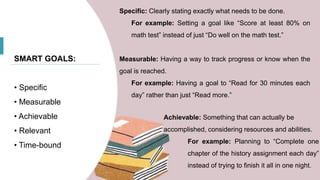
SMART GOALS:
• Specific
• Measurable
• Achievable
• Relevant
• Time-bound
Specific: Clearly stating exactly what needs to be done.
For example: Setting a goal like “Score at least 80% on
math test” instead of just “Do well on the math test.”
Measurable: Having a way to track progress or know when the
goal is reached.
For example: Having a goal to “Read for 30 minutes each
day” rather than just “Read more.”
Achievable: Something that can actually be
accomplished, considering resources and abilities.
For example: Planning to “Complete one
chapter of the history assignment each day”
instead of trying to finish it all in one night.
CONT…
Relevant: Meaningful and related to what you want to achieve.
For example: Selecting to “Volunteer at a local animal shelter
to gain experience for a future veterinary career” instead of
engaging in activities unrelated to career interests.
Time-bound: Setting a deadline or timeframe for when
the goal should be completed.
For example: Deciding to “Finish writing the
essay by Friday evening” instead of leaving it
open-ended.
Sarah plans to set aside one hour each day after school to study
math, breaks down complex math problems into smaller,
manageable steps to understand them better, ensures that her
math study sessions align with her overall goal of improving her
grades, aims to achieve an average score of 85% or higher on her
math assignments and tests, and sets a deadline of three months
to see significant improvement in her math grades.
CLASS ACTIVITY
problem-solving
skills relevant to
overcoming
obstacles in goal
pursuit.
• Identify the problem
• Brainstorm solutions
• Evaluate options
• Take action
• Reflect on outcomes
PERSEVERANCE
&
PERSISTENCE
.
Perseverance is the ability to keep going
despite difficulties or obstacles.
Persistence, on the other hand, is the act
of continuing to do something even when
it’s tough or takes a long time.
- In essence, perseverance is the
mindset, while persistence is the action
that comes from it.
EXAMPLES:
Perseverance:
1. Despite failing his driving test twice, Alex kept practicing until he finally passed on
the third attempt.
2. Even though she faced criticism from classmates, Maria continued to pursue her
passion for art and improved her skills over time.
Persistence:
1. After struggling to solve a challenging math problem, Sarah didn’t give up until she
found the solution, trying different approaches until she succeeded.
2. Despite facing rejection from publishers, Emily kept writing and submitting her
stories until she finally got her book published.
GRADE 11 WIL L.O SLIDES….pdf…..

GRADE 11 WIL L.O SLIDES….pdf…..

  • 1.
    DEVELOPMENT OF SELF INTHE SOCIETY Types of goals, steps in planning and goal-setting, problem-solving skills, perseverance and persistence. GRADE: 11
  • 2.
    Learners should beable to: 1. Identify and differentiate between short-term, medium- term, and long-term goals. 2. Create a SMART goal related to personal or academic development. 3. Demonstrate problem-solving skills relevant to overcoming obstacles in goal pursuit. 4. Identify at least three strategies for maintaining perseverance and persistence in the face of obstacles. LESSON OBJECTIVES:
  • 3.
    TYPES OF GOALS 1.Short-Term Goals: Achievable in a short time frame, typically within weeks or a month. Example: Completing a group project by the end of the month. 2. Medium-Term Goals: Require more time to accomplish, typically within one to five years. Example: Saving money for a vacation within six months. 3. Long-Term Goals: Take the longest time to achieve, typically beyond five years. Example: Securing a job in your desired profession within 6 years after completing your degree.
  • 4.
    Steps in Goal Setting 5 Monitor progress 4.Create an action plan 3. Set deadlines 2. Break it down into smaller tasks 1. Identify the goal
  • 5.
    SMART GOALS: • Specific •Measurable • Achievable • Relevant • Time-bound Specific: Clearly stating exactly what needs to be done. For example: Setting a goal like “Score at least 80% on math test” instead of just “Do well on the math test.” Measurable: Having a way to track progress or know when the goal is reached. For example: Having a goal to “Read for 30 minutes each day” rather than just “Read more.” Achievable: Something that can actually be accomplished, considering resources and abilities. For example: Planning to “Complete one chapter of the history assignment each day” instead of trying to finish it all in one night.
  • 6.
    CONT… Relevant: Meaningful andrelated to what you want to achieve. For example: Selecting to “Volunteer at a local animal shelter to gain experience for a future veterinary career” instead of engaging in activities unrelated to career interests. Time-bound: Setting a deadline or timeframe for when the goal should be completed. For example: Deciding to “Finish writing the essay by Friday evening” instead of leaving it open-ended.
  • 7.
    Sarah plans toset aside one hour each day after school to study math, breaks down complex math problems into smaller, manageable steps to understand them better, ensures that her math study sessions align with her overall goal of improving her grades, aims to achieve an average score of 85% or higher on her math assignments and tests, and sets a deadline of three months to see significant improvement in her math grades. CLASS ACTIVITY
  • 8.
    problem-solving skills relevant to overcoming obstaclesin goal pursuit. • Identify the problem • Brainstorm solutions • Evaluate options • Take action • Reflect on outcomes
  • 9.
    PERSEVERANCE & PERSISTENCE . Perseverance is theability to keep going despite difficulties or obstacles. Persistence, on the other hand, is the act of continuing to do something even when it’s tough or takes a long time. - In essence, perseverance is the mindset, while persistence is the action that comes from it.
  • 10.
    EXAMPLES: Perseverance: 1. Despite failinghis driving test twice, Alex kept practicing until he finally passed on the third attempt. 2. Even though she faced criticism from classmates, Maria continued to pursue her passion for art and improved her skills over time. Persistence: 1. After struggling to solve a challenging math problem, Sarah didn’t give up until she found the solution, trying different approaches until she succeeded. 2. Despite facing rejection from publishers, Emily kept writing and submitting her stories until she finally got her book published.