26VIT
1984-2010
Creating Stars
26VIT
1984-2010
Creating Stars
A Place to Learn ; A Chance To Grow
26VIT
1984-2010
Creating Stars
ncmowli@hotmail.com
N.Chandramowliswaran
Applied Algebra Division
School of Advanced Sciences
VIT University
26VIT
1984-2010
Creating Stars
ncmowli@hotmail.com
Claude Berge Bill Tutte
Generation of Graceful Trees through
Graceful Codes
Abstract
Graceful Code is a way to represent graceful graph in terms
of sequence of non-negative integers. Given a graceful
graph G on “q” edges, we can generate its graceful code in
the form of (a1, a2, a3, …., aq-1, aq=0) to represent the
graph. Similarly, we can easily draw the graph from the
given graceful code.
Graceful codes are classified into two categories, namely,
α-valuable code and gracious code based on their
properties. Graceful code provides an useful and efficient
techniques to study and analyze graphs using computer.
Here we discuss generation of infinitely many graceful
codes, α-valuable codes and gracious codes for a given
graceful code, α-valuable code and a gracious code.
Introduction
A simple graph G(V,E) on “p” vertices and “q”
edges is said to be graceful if there exist
an injection f: V→{0, 1, 2,….,q} such that the
induced function g: E→{1, 2, 3, …, q} which is
defined by g(u, v)=|f(u)-f(v)| for every edge
(u, v), is a bijective function; then “f” is called
graceful labelling of G.
Graceful Code
Let G be any graceful graph on “q” edges then
(a1, a2, a3, …, aq -1, aq) is called a graceful code of G,
if 0 ≤ ai ≤ q - i; 1 ≤ i ≤ q.
Here ai is the lower end vertex of the edge label “i”.
It is important to note that aq is always zero
 For every graceful graph G we can write its code.
Conversely, for every given graceful code we can draw
the corresponding graceful graph as follows.
Join edges:(a1,1+a1),(a2,2+a2),...,(aq - 1,q-1+aq-1), (aq, q+aq)
Example 1
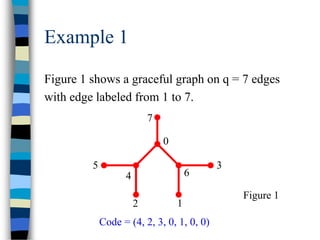
Figure 1 shows a graceful graph on q = 7 edges
with edge labeled from 1 to 7.
7
0
6
3
12
4
5
Code = (4, 2, 3, 0, 1, 0, 0)
Figure 1
- valuable Code
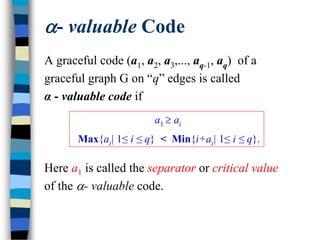
A graceful code (a1, a2, a3,..., aq-1, aq) of a
graceful graph G on “q” edges is called
α - valuable code if
Here a1 is called the separator or critical value
of the - valuable code.
a1  ai
Max{ai| 1≤ i ≤ q} < Min{i+ai| 1≤ i ≤ q}.
Proposition
(a1, a2, a3, …,aq-1,aq) represents -valuable code if
and only if
0  (a1 – aq - i + 1) / q – i) ≤ 1
for all i , 1 ≤ i ≤ q - 1
 Equivalently (a1, a2, a3, …,aq-1,aq) represents an
- valuable code if and only if
(a1 - aq, a1 - aq -1, …, a1 - a3, a1 - a2, 0) represents a
code of a Graceful Graph.
Properties of Graceful Codes
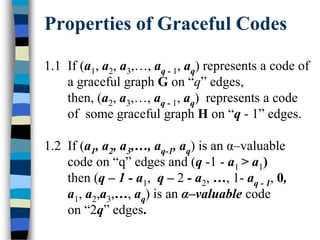
1.1 If (a1, a2, a3,…, aq - 1, aq) represents a code of
a graceful graph G on “q” edges,
then, (a2, a3,…, aq - 1, aq) represents a code
of some graceful graph H on “q - 1” edges.
1.2 If (a1, a2, a3,…, aq-1, aq) is an α–valuable
code on “q” edges and (q -1 - a1 > a1)
then (q – 1 - a1, q – 2 - a2, …, 1- aq - 1, 0,
a1, a2,a3,…, aq) is an α–valuable code
on “2q” edges.
1.3. If (a1, a2, a3,…, aq - 1, aq) is an α–valuable
code on “q” edges and (a1> q -1 - a1) then,
(a1, a2, a3,…, aq, q - 1- a1, q – 2 - a2, …,1 – aq - 1, 0)
is an α–valuable code on “2q” edges.
1.4. If (a1, a2, a3,…, aq1 - 1, aq1) and
(b1, b2, b3, …, bq2 - 1, bq2) represents
α–valuable codes on “q1” and “q2” edges
respectively and a1 ≥ b1 then,
(a1, a2, a3,…, aq1 - 1, aq1, b1, b2, b3,…, bq2 - 1, bq2)
represents an α–valuable code
on “q1 + q2” edges.
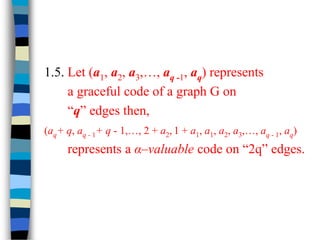
1.5. Let (a1, a2, a3,…, aq -1, aq) represents
a graceful code of a graph G on
“q” edges then,
(aq+ q, aq - 1+ q - 1,…, 2 + a2, 1 + a1, a1, a2, a3,…, aq - 1, aq)
represents a α–valuable code on “2q” edges.
Properties of Graceful Codes
 If (a1, a2, a3,…, aq - 1, aq) represents a graceful
code of a graceful graph G on “q” edges then,
(aq+ q, aq – 1 + q - 1,…,2 + a2, 1 + a1, x, a1, a2, a3…, aq - 1, aq),
[0 ≤ x ≤ q] represents an α–valuable code
on “2q + 1” edges.
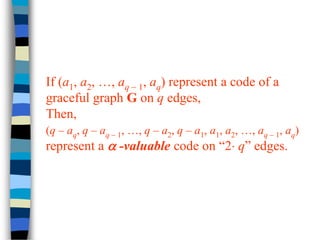
If (a1, a2, …, aq  1, aq) represent a code of a
graceful graph G on q edges,
Then,
(q – aq, q – aq  1, …, q – a2, q – a1, a1, a2, …, aq  1, aq)
represent a  -valuable code on “2 q” edges.
Properties of Graceful Codes
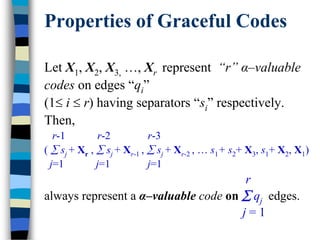
Let X1, X2, X3, …, Xr represent “r” α–valuable
codes on edges “qi”
(1 i  r) having separators “si” respectively.
Then,
r-1 r-2 r-3
(  sj + Xr ,  sj + Xr-1 ,  sj + Xr-2 , … s1+ s2+ X3, s1+ X2, X1)
j=1 j=1 j=1
r
always represent a α–valuable code on  qj edges.
j = 1
Tree Generation Theorems
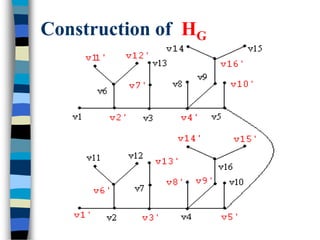
Let G be any simple graph on “n” vertices and “q”
edges.
Define a bipartite graph HG as follows:
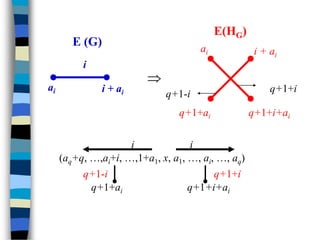
(vi, vj)  E(G) <=> (vi, vj’)  E(HG) and
(vi’, vj)  E(HG).
Join any vk  V(G)  V(HG),
[1 ≤ k ≤ n] to vk’  V(HG).
Here |V(HG)| = 2|V(G)| and |E(HG)| = 2 | E(G)| +1.
Tree Generation Theorems
Moreover if G has a code (a1, a2, a3,…, aq - 1, aq)
then HG has an α–valuable code
(aq+ q, aq-1+q - 1,…, 2+a2, 1 + a1, x, a1, a2, a3, …, aq - 1, aq)
[0 ≤ x ≤ q].
If G happens to be a bipartite graph, then HG
contains two copies of G
together with an edge connecting vk to vk’
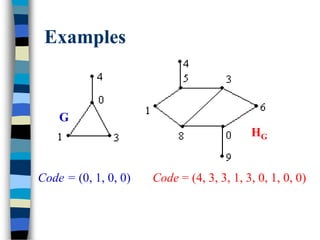
Examples
Code = (0, 1, 0, 0)
G
HG
Code = (4, 3, 3, 1, 3, 0, 1, 0, 0)
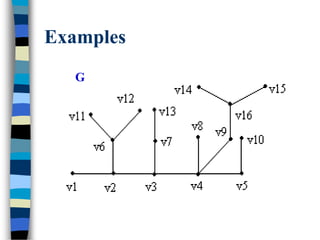
Examples
G
Construction of HG
ai i + ai
i
E (G)

ai i + ai
q+1+ai q+1+i+ai
E(HG)
q+1+i
q+1-i
(aq+q, …,ai+i, …,1+a1, x, a1, …, ai, …, aq)
q+1+ai q+1+i+ai
q+1-i q+1+i
i i
Tree Generation Theorems
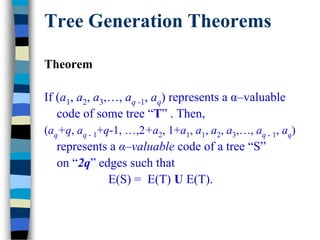
Theorem
If (a1, a2, a3,…, aq -1, aq) represents a α–valuable
code of some tree “T” . Then,
(aq+q, aq - 1+q-1, …,2+a2, 1+a1, a1, a2, a3,…, aq - 1, aq)
represents a α–valuable code of a tree “S”
on “2q” edges such that
E(S) = E(T) U E(T).
Tree Generation Theorems
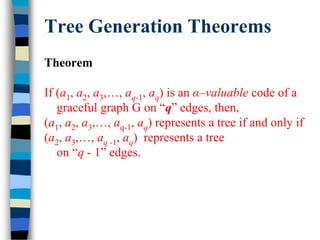
Theorem
If (a1, a2, a3,…, aq-1, aq) is an α–valuable code of a
graceful graph G on “q” edges, then,
(a1, a2, a3,…, aq-1, aq) represents a tree if and only if
(a2, a3,…, aq -1, aq) represents a tree
on “q - 1” edges.
Tree Generation Theorems
If (a1, a2, …, aq-2, aq-1, aq ) represents a code of a
graceful tree on ‘q’ edges, then
1. (qk - 1, ka1, (q –1) k –1, ka2, …, 2 k - 1, kaq - 1, 1k - 1, kaq)
represent a tree code on “kq” edges (k  2).
2. (qk - 1, ka1+r, (q –1) k – 1, ka2+r, …, 2k - 1, kaq-1+r, 1k - 1,
kaq+r, 0r) ;1 ≤ r ≤ k, k ≥ 2 represent a tree code
on “kq+r” edges.
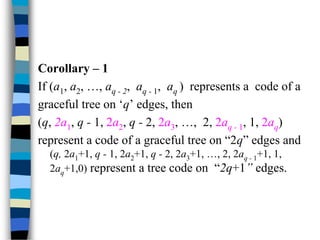
Corollary – 1
If (a1, a2, …, aq - 2, aq - 1, aq ) represents a code of a
graceful tree on ‘q’ edges, then
(q, 2a1, q - 1, 2a2, q - 2, 2a3, …, 2, 2aq - 1, 1, 2aq)
represent a code of a graceful tree on “2q” edges and
(q, 2a1+1, q - 1, 2a2+1, q - 2, 2a3+1, …, 2, 2aq - 1+1, 1,
2aq+1,0) represent a tree code on “2q+1” edges.
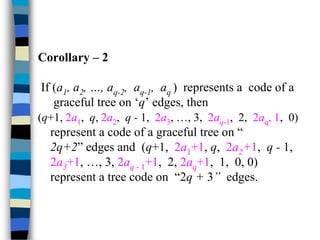
Corollary – 2
If (a1, a2, …, aq-2, aq-1, aq ) represents a code of a
graceful tree on ‘q’ edges, then
(q+1, 2a1, q, 2a2, q - 1, 2a3, …, 3, 2aq-1, 2, 2aq, 1, 0)
represent a code of a graceful tree on “
2q+2” edges and (q+1, 2a1+1, q, 2a2+1, q - 1,
2a3+1, …, 3, 2aq - 1+1, 2, 2aq+1, 1, 0, 0)
represent a tree code on “2q + 3” edges.
Tree Generation Theorems
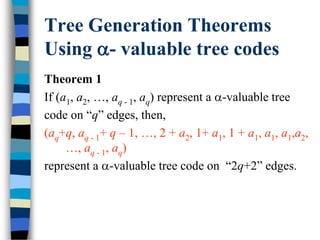
Using - valuable tree codes
Theorem 1
If (a1, a2, …, aq - 1, aq) represent a -valuable tree
code on “q” edges, then,
(aq+q, aq - 1+ q – 1, …, 2 + a2, 1+ a1, 1 + a1, a1, a1,a2,
…, aq - 1, aq)
represent a -valuable tree code on “2q+2” edges.
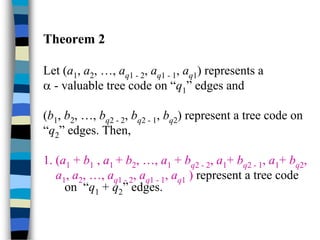
Theorem 2
Let (a1, a2, …, aq1 - 2, aq1 - 1, aq1) represents a
 - valuable tree code on “q1” edges and
(b1, b2, …, bq2 - 2, bq2 - 1, bq2) represent a tree code on
“q2” edges. Then,
1. (a1 + b1 , a1 + b2, …, a1 + bq2 - 2, a1+ bq2 - 1, a1+ bq2,
a1, a2, …, aq1 - 2, aq1 - 1, aq1 ) represent a tree code
on “q1 + q2” edges.
Tree Generation Theorems Using
- valuable tree codes
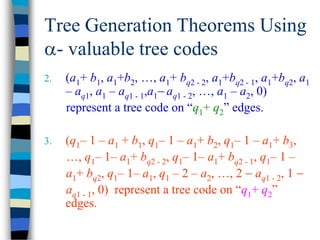
2. (a1+ b1, a1+b2, …, a1+ bq2 - 2, a1+bq2 - 1, a1+bq2, a1
– aq1, a1 – aq1 - 1,a1 aq1 - 2, …, a1 – a2, 0)
represent a tree code on “q1+ q2” edges.
3. (q1– 1 – a1 + b1, q1– 1 – a1+ b2, q1– 1 – a1+ b3,
…, q1– 1– a1+ bq2 - 2, q1– 1– a1+ bq2 - 1, q1– 1 –
a1+ bq2, q1– 1– a1, q1 – 2 – a2, …, 2  aq1 - 2, 1 
aq1 - 1, 0) represent a tree code on “q1+ q2”
edges.
Tree Generation Theorems Using
- valuable tree codes
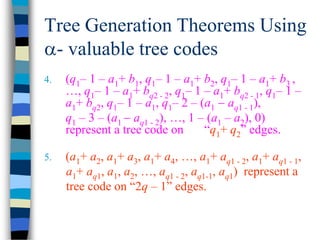
4. (q1– 1 – a1+ b1, q1– 1 – a1+ b2, q1– 1 – a1+ b3 ,
…, q1– 1 – a1+ bq2 - 2, q1– 1 – a1+ bq2 - 1, q1– 1 –
a1+ bq2, q1– 1 – a1, q1– 2 – (a1  aq1 - 1),
q1 – 3 – (a1  aq1 - 2), …, 1 – (a1 – a2), 0)
represent a tree code on “q1+ q2” edges.
5. (a1+ a2, a1+ a3, a1+ a4, …, a1+ aq1 - 2, a1+ aq1 - 1,
a1+ aq1, a1, a2, …, aq1 - 2, aq1-1, aq1) represent a
tree code on “2q – 1” edges.
Tree Generation Theorems Using
- valuable tree codes
Corollary 1
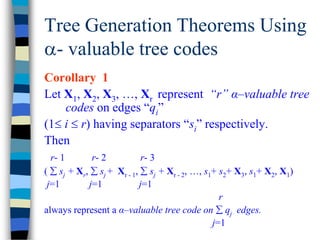
Let X1, X2, X3, …, Xr represent “r” α–valuable tree
codes on edges “qi”
(1 i  r) having separators “si” respectively.
Then
r- 1 r- 2 r- 3
(  sj + Xr,  sj + Xr - 1,  sj + Xr - 2, …, s1+ s2+ X3, s1+ X2, X1)
j=1 j=1 j=1
r
always represent a α–valuable tree code on  qj edges.
j=1

graceful Trees through Graceful codes (1)

  • 1.
  • 2.
    26VIT 1984-2010 Creating Stars A Placeto Learn ; A Chance To Grow
  • 3.
    26VIT 1984-2010 Creating Stars ncmowli@hotmail.com N.Chandramowliswaran Applied AlgebraDivision School of Advanced Sciences VIT University 26VIT 1984-2010 Creating Stars ncmowli@hotmail.com Claude Berge Bill Tutte Generation of Graceful Trees through Graceful Codes
  • 4.
    Abstract Graceful Code isa way to represent graceful graph in terms of sequence of non-negative integers. Given a graceful graph G on “q” edges, we can generate its graceful code in the form of (a1, a2, a3, …., aq-1, aq=0) to represent the graph. Similarly, we can easily draw the graph from the given graceful code. Graceful codes are classified into two categories, namely, α-valuable code and gracious code based on their properties. Graceful code provides an useful and efficient techniques to study and analyze graphs using computer. Here we discuss generation of infinitely many graceful codes, α-valuable codes and gracious codes for a given graceful code, α-valuable code and a gracious code.
  • 5.
    Introduction A simple graphG(V,E) on “p” vertices and “q” edges is said to be graceful if there exist an injection f: V→{0, 1, 2,….,q} such that the induced function g: E→{1, 2, 3, …, q} which is defined by g(u, v)=|f(u)-f(v)| for every edge (u, v), is a bijective function; then “f” is called graceful labelling of G.
  • 6.
    Graceful Code Let Gbe any graceful graph on “q” edges then (a1, a2, a3, …, aq -1, aq) is called a graceful code of G, if 0 ≤ ai ≤ q - i; 1 ≤ i ≤ q. Here ai is the lower end vertex of the edge label “i”. It is important to note that aq is always zero  For every graceful graph G we can write its code. Conversely, for every given graceful code we can draw the corresponding graceful graph as follows. Join edges:(a1,1+a1),(a2,2+a2),...,(aq - 1,q-1+aq-1), (aq, q+aq)
  • 7.
    Example 1 Figure 1shows a graceful graph on q = 7 edges with edge labeled from 1 to 7. 7 0 6 3 12 4 5 Code = (4, 2, 3, 0, 1, 0, 0) Figure 1
  • 8.
    - valuable Code Agraceful code (a1, a2, a3,..., aq-1, aq) of a graceful graph G on “q” edges is called α - valuable code if Here a1 is called the separator or critical value of the - valuable code. a1  ai Max{ai| 1≤ i ≤ q} < Min{i+ai| 1≤ i ≤ q}.
  • 9.
    Proposition (a1, a2, a3,…,aq-1,aq) represents -valuable code if and only if 0  (a1 – aq - i + 1) / q – i) ≤ 1 for all i , 1 ≤ i ≤ q - 1  Equivalently (a1, a2, a3, …,aq-1,aq) represents an - valuable code if and only if (a1 - aq, a1 - aq -1, …, a1 - a3, a1 - a2, 0) represents a code of a Graceful Graph.
  • 10.
    Properties of GracefulCodes 1.1 If (a1, a2, a3,…, aq - 1, aq) represents a code of a graceful graph G on “q” edges, then, (a2, a3,…, aq - 1, aq) represents a code of some graceful graph H on “q - 1” edges. 1.2 If (a1, a2, a3,…, aq-1, aq) is an α–valuable code on “q” edges and (q -1 - a1 > a1) then (q – 1 - a1, q – 2 - a2, …, 1- aq - 1, 0, a1, a2,a3,…, aq) is an α–valuable code on “2q” edges.
  • 11.
    1.3. If (a1,a2, a3,…, aq - 1, aq) is an α–valuable code on “q” edges and (a1> q -1 - a1) then, (a1, a2, a3,…, aq, q - 1- a1, q – 2 - a2, …,1 – aq - 1, 0) is an α–valuable code on “2q” edges. 1.4. If (a1, a2, a3,…, aq1 - 1, aq1) and (b1, b2, b3, …, bq2 - 1, bq2) represents α–valuable codes on “q1” and “q2” edges respectively and a1 ≥ b1 then, (a1, a2, a3,…, aq1 - 1, aq1, b1, b2, b3,…, bq2 - 1, bq2) represents an α–valuable code on “q1 + q2” edges.
  • 12.
    1.5. Let (a1,a2, a3,…, aq -1, aq) represents a graceful code of a graph G on “q” edges then, (aq+ q, aq - 1+ q - 1,…, 2 + a2, 1 + a1, a1, a2, a3,…, aq - 1, aq) represents a α–valuable code on “2q” edges.
  • 13.
    Properties of GracefulCodes  If (a1, a2, a3,…, aq - 1, aq) represents a graceful code of a graceful graph G on “q” edges then, (aq+ q, aq – 1 + q - 1,…,2 + a2, 1 + a1, x, a1, a2, a3…, aq - 1, aq), [0 ≤ x ≤ q] represents an α–valuable code on “2q + 1” edges.
  • 14.
    If (a1, a2,…, aq  1, aq) represent a code of a graceful graph G on q edges, Then, (q – aq, q – aq  1, …, q – a2, q – a1, a1, a2, …, aq  1, aq) represent a  -valuable code on “2 q” edges.
  • 15.
    Properties of GracefulCodes Let X1, X2, X3, …, Xr represent “r” α–valuable codes on edges “qi” (1 i  r) having separators “si” respectively. Then, r-1 r-2 r-3 (  sj + Xr ,  sj + Xr-1 ,  sj + Xr-2 , … s1+ s2+ X3, s1+ X2, X1) j=1 j=1 j=1 r always represent a α–valuable code on  qj edges. j = 1
  • 16.
    Tree Generation Theorems LetG be any simple graph on “n” vertices and “q” edges. Define a bipartite graph HG as follows: (vi, vj)  E(G) <=> (vi, vj’)  E(HG) and (vi’, vj)  E(HG). Join any vk  V(G)  V(HG), [1 ≤ k ≤ n] to vk’  V(HG). Here |V(HG)| = 2|V(G)| and |E(HG)| = 2 | E(G)| +1.
  • 17.
    Tree Generation Theorems Moreoverif G has a code (a1, a2, a3,…, aq - 1, aq) then HG has an α–valuable code (aq+ q, aq-1+q - 1,…, 2+a2, 1 + a1, x, a1, a2, a3, …, aq - 1, aq) [0 ≤ x ≤ q]. If G happens to be a bipartite graph, then HG contains two copies of G together with an edge connecting vk to vk’
  • 18.
    Examples Code = (0,1, 0, 0) G HG Code = (4, 3, 3, 1, 3, 0, 1, 0, 0)
  • 19.
  • 20.
  • 21.
    ai i +ai i E (G)  ai i + ai q+1+ai q+1+i+ai E(HG) q+1+i q+1-i (aq+q, …,ai+i, …,1+a1, x, a1, …, ai, …, aq) q+1+ai q+1+i+ai q+1-i q+1+i i i
  • 22.
    Tree Generation Theorems Theorem If(a1, a2, a3,…, aq -1, aq) represents a α–valuable code of some tree “T” . Then, (aq+q, aq - 1+q-1, …,2+a2, 1+a1, a1, a2, a3,…, aq - 1, aq) represents a α–valuable code of a tree “S” on “2q” edges such that E(S) = E(T) U E(T).
  • 23.
    Tree Generation Theorems Theorem If(a1, a2, a3,…, aq-1, aq) is an α–valuable code of a graceful graph G on “q” edges, then, (a1, a2, a3,…, aq-1, aq) represents a tree if and only if (a2, a3,…, aq -1, aq) represents a tree on “q - 1” edges.
  • 24.
    Tree Generation Theorems If(a1, a2, …, aq-2, aq-1, aq ) represents a code of a graceful tree on ‘q’ edges, then 1. (qk - 1, ka1, (q –1) k –1, ka2, …, 2 k - 1, kaq - 1, 1k - 1, kaq) represent a tree code on “kq” edges (k  2). 2. (qk - 1, ka1+r, (q –1) k – 1, ka2+r, …, 2k - 1, kaq-1+r, 1k - 1, kaq+r, 0r) ;1 ≤ r ≤ k, k ≥ 2 represent a tree code on “kq+r” edges.
  • 25.
    Corollary – 1 If(a1, a2, …, aq - 2, aq - 1, aq ) represents a code of a graceful tree on ‘q’ edges, then (q, 2a1, q - 1, 2a2, q - 2, 2a3, …, 2, 2aq - 1, 1, 2aq) represent a code of a graceful tree on “2q” edges and (q, 2a1+1, q - 1, 2a2+1, q - 2, 2a3+1, …, 2, 2aq - 1+1, 1, 2aq+1,0) represent a tree code on “2q+1” edges.
  • 26.
    Corollary – 2 If(a1, a2, …, aq-2, aq-1, aq ) represents a code of a graceful tree on ‘q’ edges, then (q+1, 2a1, q, 2a2, q - 1, 2a3, …, 3, 2aq-1, 2, 2aq, 1, 0) represent a code of a graceful tree on “ 2q+2” edges and (q+1, 2a1+1, q, 2a2+1, q - 1, 2a3+1, …, 3, 2aq - 1+1, 2, 2aq+1, 1, 0, 0) represent a tree code on “2q + 3” edges.
  • 27.
    Tree Generation Theorems Using- valuable tree codes Theorem 1 If (a1, a2, …, aq - 1, aq) represent a -valuable tree code on “q” edges, then, (aq+q, aq - 1+ q – 1, …, 2 + a2, 1+ a1, 1 + a1, a1, a1,a2, …, aq - 1, aq) represent a -valuable tree code on “2q+2” edges.
  • 28.
    Theorem 2 Let (a1,a2, …, aq1 - 2, aq1 - 1, aq1) represents a  - valuable tree code on “q1” edges and (b1, b2, …, bq2 - 2, bq2 - 1, bq2) represent a tree code on “q2” edges. Then, 1. (a1 + b1 , a1 + b2, …, a1 + bq2 - 2, a1+ bq2 - 1, a1+ bq2, a1, a2, …, aq1 - 2, aq1 - 1, aq1 ) represent a tree code on “q1 + q2” edges.
  • 29.
    Tree Generation TheoremsUsing - valuable tree codes 2. (a1+ b1, a1+b2, …, a1+ bq2 - 2, a1+bq2 - 1, a1+bq2, a1 – aq1, a1 – aq1 - 1,a1 aq1 - 2, …, a1 – a2, 0) represent a tree code on “q1+ q2” edges. 3. (q1– 1 – a1 + b1, q1– 1 – a1+ b2, q1– 1 – a1+ b3, …, q1– 1– a1+ bq2 - 2, q1– 1– a1+ bq2 - 1, q1– 1 – a1+ bq2, q1– 1– a1, q1 – 2 – a2, …, 2  aq1 - 2, 1  aq1 - 1, 0) represent a tree code on “q1+ q2” edges.
  • 30.
    Tree Generation TheoremsUsing - valuable tree codes 4. (q1– 1 – a1+ b1, q1– 1 – a1+ b2, q1– 1 – a1+ b3 , …, q1– 1 – a1+ bq2 - 2, q1– 1 – a1+ bq2 - 1, q1– 1 – a1+ bq2, q1– 1 – a1, q1– 2 – (a1  aq1 - 1), q1 – 3 – (a1  aq1 - 2), …, 1 – (a1 – a2), 0) represent a tree code on “q1+ q2” edges. 5. (a1+ a2, a1+ a3, a1+ a4, …, a1+ aq1 - 2, a1+ aq1 - 1, a1+ aq1, a1, a2, …, aq1 - 2, aq1-1, aq1) represent a tree code on “2q – 1” edges.
  • 31.
    Tree Generation TheoremsUsing - valuable tree codes Corollary 1 Let X1, X2, X3, …, Xr represent “r” α–valuable tree codes on edges “qi” (1 i  r) having separators “si” respectively. Then r- 1 r- 2 r- 3 (  sj + Xr,  sj + Xr - 1,  sj + Xr - 2, …, s1+ s2+ X3, s1+ X2, X1) j=1 j=1 j=1 r always represent a α–valuable tree code on  qj edges. j=1