GraalVM
Thomas Wuerthinger
GraalVM Project Lead
Oracle Labs
@thomaswue
December 2019
Safe harbor statement
The following is intended to outline our general product direction. It is intended for information
purposes only, and may not be incorporated into any contract. It is not a commitment to deliver
any material, code, or functionality, and should not be relied upon in making purchasing decisions.
The development, release, timing, and pricing of any features or functionality described for Oracle’s
products may change and remains at the sole discretion of Oracle Corporation.
GraalVM Native Image technology (including SubstrateVM) is Early Adopter technology. It is
available only under an early adopter license and remains subject to potentially significant further
changes, compatibility testing and certification.
2 © 2019 Oracle
~8 years ago, we started a little research project…
© 2019 Oracle3
Java
C
C++
Python
C#
VB.NET
JavaScript
Assembly
languagePHP
PerlRubyVBSwift
R
Objective-C
Go
MATLAB
Delphi/Object
Pascal
PL/SQL
Scratch
Others
Programming Language Popularity
(TOP 20 Languages From May 2018 Tiobe INDEX)
© 2019 Oracle4
GraalVM will be the Universal VM
© 2019 Oracle
ubiquitous across the cloud stack
1. run programs more efficient
2. make developers more productive
5
What is Graal VM?
• Drop-in replacement for Oracle Java 8 (and soon Java 11)
• Run your Java application faster
• Ahead-of-time compilation for Java
• Create standalone binaries with low footprint
• High-performance JavaScript, Python, Ruby, R, ...
• The first VM for true polyglot programming
• Implement your own language or DSL
© 2019 Oracle6
Native Image
© 2019 Oracle7
© 2019 Oracle8
FREE on Oracle Cloud!
GraalVM Open Source
© 2019 Oracle9
Open Source LOC actively maintained by GraalVM team
Total: 3,640,000 lines of code
GraalVM Vision:
Abstractions should be without performance regret!
© 2019 Oracle10
GraalVM JIT Performance: Renaissance.dev
1.02
1.27
1.53
1.1
1.36
1.37
1.17
1.49
1.14
1.14
1.96
1.03
1.03
3.08
1.35
1.1
1.12
1.13
1.66
1.17
1.59
1.32
0.97
0.99
1
1
1.09
1.2
0.79
0.93
1.03
1.09
0.94
0.83
0.97
2.78
1.02
0.98
1.12
0.98
1.16
1.04
1.09
1.06
0
0.5
1
1.5
2
2.5
3
3.5
akka-uct
alschi-squaredb-shootout
dec-tree
dotty
finagle-chirperfinagle-httpfj-km
eans
future-geneticgauss-m
ix
log-regressionm
ovie-lensnaive-bayes
neo4j-analyticspage-rank
philosophersrx-scrabble
scrabblestm
-bench7
stream
s-m
nem
onicsgeom
ean
SpeedupvsJDK8
EE/C2 CE/C2
© 2019 Oracle11
More Benchmarks…
Optimizing for too few benchmarks is like overfitting a machine learning
algorithm.
Therefore we started together with academic collaborators
https://renaissance.dev
All benchmark data can be interesting; careful with conclusions though.
© 2019 Oracle12
Java Flight Recorder Compilation Information
© 2019 Oracle13
GraalVM Native Image
© 2019 Oracle14
native-image MyMainClass
./mymainclass
JIT AOT
java MyMainClass
© 2019 Oracle15
Native Image Architecture
© 2019 Oracle
Ahead-of-Time
Compilation
Application
Libraries
JDK
Substrate VM
Points-to Analysis
Run Initializations
Heap Snapshotting
Input:
All classes from application,
libraries, and VM
Iterative analysis until
fixed point is reached
Code in
Text Section
Image Heap in
Data SectionImage Heap
Writing
Output:
Native executable
16
Paper with Details, Examples, Benchmarks
© 2019 Oracle17
http://www.christianwimmer.at/Publications/Wimmer19a/Wimmer19a.pdf
Closed World Assumption
• The points-to analysis needs to see all bytecode
• Otherwise aggressive AOT optimizations are not possible
• Otherwise unused classes, methods, and fields cannot be removed
• Otherwise a class loader / bytecode interpreter is necessary at run time
•
• Dynamic parts of Java require configuration at build time
• Reflection, JNI, Proxy, resources, ...
• That’s what this talk is about
• No loading of new classes at run time
© 2019 Oracle18
Image Heap
• Execution at run time starts with an initial heap: the “image heap”
• Objects are allocated in the Java VM that runs the image generator
• Heap snapshotting gathers all objects that are reachable at run time
• Do things once at build time instead at every application startup
• Class initializers, initializers for static and static final fields
• Explicit code that is part of a so-called “Feature”
• Examples for objects in the image heap
• java.lang.Class objects, Enum constants
© 2019 Oracle19
Benefits of the Image Heap
© 2019 Oracle
Without GraalVM
Native Image
Build time
Run time
GraalVM Native Image
(default)
Build time
Run time
GraalVM Native Image:
Load configuration file
at build time
Build time
Run time
Load Classes
Load Configuration File
Run Workload
Compile Sources
Load Classes
Load Configuration File
Run Workload
Compile Sources
Load Classes
Load Configuration File
Run Workload
Compile Sources
20
Get VMs Ready for the Cloud and Microservices
Important evaluation metrics:
• Startup time
• Memory footprint
• Peak requests per MByte-second
© 2019 Oracle21
Bruno Borges,
Microsoft Azure Advocate
Currently
Startup Speed
Peak
Throughput
Memory
Footprint
Max LatencyPackaging Size
AOT JIT
© 2019 Oracle22
Goal
Startup Speed
Memory
Footprint
Max LatencyPackaging Size
AOT JIT
© 2019 Oracle23
Peak
Throughput
Java Microservice Frameworks with GraalVM Native Image Support
https://micronaut.io
https://helidon.io
https://quarkus.io
Soon also Spring support
https://github.com/spring-projects-experimental/spring-graal-native
© 2019 Oracle24
Startup Time
© 2019 Oracle
983 ms
1967 ms
979 ms
10.5
30 ms
23 ms
0 ms 500 ms 1000 ms 1500 ms 2000 ms
Quarkus
Micronaut
Helidon
GraalVM Native Image
JDK 8
25
Memory Footprint
© 2019 Oracle26
160 MByte
198 MByte
107 MByte
16 MByte
37 MByte
26 MByte
0 MByte 50 MByte 100 MByte 150 MByte 200 MByte 250 MByte
Quarkus
Micronaut
Helidon
GraalVM Native Image
JDK 8
Native Image vs. Java HotSpot VM
• Use GraalVM Native Image when
• Startup time matters
• Memory footprint matters
• Small to medium-sized heaps (100 MByte – a few GByte)
• All code is known ahead of time
• Use Java HotSpot VM when
• Heaps size is large
• Multiple GByte – TByte heap size
• Classes are only known at run time
© 2019 Oracle27
Jump Start Your Project
• How do I know quickly if my application will run as a native image?
• Disable fallback image generation
• --no-fallback
• Report unsupported features at run time
• --report-unsupported-elements-at-runtime
• Allow incomplete class path: throw linking errors at run time
• --allow-incomplete-classpath
• Trace reflection, JNI, resource, ... usage on Java HotSpot VM
• java -agentlib:native-image-agent=config-output-dir=META-INF/native-image ...
• Initialize all application classes at run time: default since GraalVM 19.0
© 2019 Oracle28
Reflection and JNI
• Need configuration at image build time
• Classes, methods, and fields that are reflectively visible
• Necessary to keep the metadata small and to avoid too conservative points-to analysis
•
© 2019 Oracle
class Element {
String value;
}
[
{
"name" : "com.oracle.test.Element",
"fields" : [
{ "name" : "value" }
],
"methods" : [
{ "name" : "<init>" }
]
}
]
Data class:
Element element = new Element();
element.value = "Hello World";
String json = new Gson().toJson(element);
Serialize Java object to JSON:
String json = "{"value":"Hello World"}";
Element element = new Gson().fromJson(json, Element.class);
Deserialize JSON to Java object:
Reflection configuration:
Example: Gson library to serialize / deserialize Java objects
29
Tracing Agent
• Trace reflection, JNI, resource usage on Java HotSpot VM
• Agent to record usage and produce configuration files for native images
• java -agentlib:native-image-agent=config-output-dir=META-INF/native-image ...
• Simplify the getting-started process
• Everything that was executed on the Java HotSpot VM also works in the native image
• Manual adjustment / addition will still be necessary
• Unless you have an excellent test suite for your application
• Fun fact: Agent is a Java Native Image
• JVMTI interface implemented using the low-level C interface of Native Image
© 2019 Oracle30
Blog Article with Details and Examples
© 2019 Oracle31
https://medium.com/graalvm/c3b56c486271
Class Initialization
• Class initialization at image build time improves application startup
• Configurable per class / package / package prefix
• --initialize-at-build-time=... --initialize-at-run-time=...
• By default, application classes are initialized at run time
• Most JDK classes are initialized at image build time
• Static analysis finds class initializers that can run at image build time
• Performance implications of class initialization at run time
• If a class is initialized at run time, no instances can be in the image heap
• Runtime checks before static method calls, static field accesses, and allocations
© 2019 Oracle32
Blog Article with Details and Examples
© 2019 Oracle33
https://medium.com/graalvm/c61faca461f7
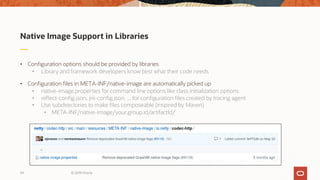
Native Image Support in Libraries
• Configuration options should be provided by libraries
• Library and framework developers know best what their code needs
• Configuration files in META-INF/native-image are automatically picked up
• native-image.properties for command line options like class initialization options
• reflect-config.json, jni-config.json, ... for configuration files created by tracing agent
• Use subdirectories to make files composeable (inspired by Maven)
• META-INF/native-image/your.group.id/artifactId/
© 2019 Oracle34
Profile-Guided Optimizations (PGO)
• AOT compiled code cannot optimize itself at run time
• No dynamic “hot spot” compilation
• PGO requires relevant workloads at build time
• Optimized code runs immediately at startup, no “warmup” curve
© 2019 Oracle
native-image
--pgo-instrument
Instrumented
Binary
native-image
--pgo
Optimized
BinaryWorkloads Profiles
35
AOT JIT
© 2019 Oracle36
Tuning Native Image Footprint
-Xmx (maximum memory), default infinite
-Xmn (new generation size), default 256m
© 2019 Oracle37
Native Image:
Support any Platform via LLVM
• Implemented an LLVM backend for GraalVM Native Image
• In case Apple starts requiring LLVM for their apps
• Easy to port Scala to niche architectures
• Using LLVM comes with a price
• Moving GC in LLVM is still experimental
• Slow at compilation
• Slower run-time generated code
© 2019 Oracle38
Cross-Platform GraalVM
© 2019 Oracle
IDE
Plugin
GluonTools
JavaFX
mobile
Graal VM
Native ImageGluon
Mobile
• JavaFX extensions for mobile
• Integration with mobile functionality (e.g. GPS/camera)
• Mobile-specific connectivity
Java static
libs
39
Key Performance Takeaways
• Write small methods
• Local allocations are free, global data structures expensive
• Don’t hand optimize, unless you have studied the compiler graph
• Make a pull request (or at least an issue) for the GraalVM project!
• For best throughput use GraalVM JIT,
for best startup & footprint use GraalVM AOT (native images)
© 2019 Oracle40
Polyglot and Embeddability
© 2019 Oracle41
© 2019 Oracle42
U
U U
U
U I
I I
G
G I
I I
G
G
Node Rewriting
for Profiling Feedback
AST Interpreter
Rewritten Nodes
AST Interpreter
Uninitialized Nodes
Compilation using
Partial Evaluation
Compiled Code
Node Transitions
S
U
I
D
G
Uninitialized Integer
Generic
DoubleString
Optimization and Speculation…
© 2019 Oracle43
I
I I
G
G I
I I
G
G
Deoptimization
to AST Interpreter
D
I D
G
G D
I D
G
G
Node Rewriting to Update
Profiling Feedback
Recompilation using
Partial Evaluation
And Deoptimization!
© 2019 Oracle44
Simple Embeddability
© 2019 Oracle45
© 2019 Oracle
Full separation of logical and
physical data layout, enabling
virtual data structures
46
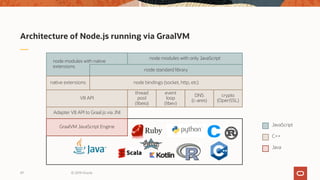
node modules with only JavaScript
node modules with native
extensions
node standard library
node bindings (socket, http, etc)
V8 API
thread
pool
(libeio)
event
loop
(libev)
DNS
(c-ares)
crypto
(OpenSSL)
JavaScript
C++
Java
Adapter V8 API to Graal.js via JNI
native extensions
Architecture of Node.js running via GraalVM
© 2019 Oracle
GraalVM JavaScript Engine
47
© 2019 Oracle48
https://kangax.github.io
https://www.graalvm.org/docs/reference-manual/compatibility/
© 2019 Oracle49
Trade-Offs
Advantages
• Java interoperability: Use any Java library or framework
• Polyglot capabilities (Python, Ruby, R)
• Run with large heaps and JVM garbage collectors
Disadvantages
• Longer start-up time
• Higher memory footprint
© 2019 Oracle50
Graal.js Performance (versus V8)
© 2019 Oracle51
0
0.2
0.4
0.6
0.8
1
1.2
1.4
Box2D
Crypto
Deltablue
EarleyBoyer
Gam
eboy
M
andreel
N
avierStokes
PdfJS
RayTrace
RegExp
Richards
Splay
Typescript
Zlib
Com
posite
GraalVM 19.3.0-dev V8 7.2.502
FastR
• GNU-R compatible R implementation
• Including the C/Fortran interface
• Built on top of the GraalVM platform
• Leverages GraalVM optimizing compiler
• Integration with GraalVM dev tools
• Zero overhead interop with other GraalVM languages
© 2019 Oracle52
fastRCluster package
© 2019 Oracle
Python Polyglot
• Use code from Java or any other GraalVM
language
• Embed into JVM languages using GraalVM
Embedder API
© 2019 Oracle54
Python Package Support
• Pip installer is not available, yet (c.f.: no sockets)
• We ship our own installer ginstall
• Pandas and NumPy can be installed work for a wide range of code in the latest builds
• More and more pure Python packages “just work” and compatibility is improving
© 2019 Oracle55
© 2019 Oracle
Enable Polyglot interoperability:
node --polyglot
56
Polyglot Stack Trace
© 2019 Oracle57
Polyglot Heap Dump
© 2019 Oracle58
© 2019 Oracle59
© 2019 Oracle60
61 © 2019 Oracle
The rich ecosystem of CUDA-X libraries is now available for
GraalVM applications.
GPU kernels can be directly launched from GraalVM languages
such as R, JavaScript, Scala and other JVM-based languages.
https://github.com/NVIDIA/grcuda
© 2019 Oracle61
Summary
© 2019 Oracle62
© 2019 Oracle
Java
Scala, Groovy, Kotlin
JavaScript
Node.js
Native Image
VisualVM
Production-Ready Experimental Visionary
Ruby
R
LLVM Toolchain
Python
VSCode Plugin
GPU Integration
Webassembly
LLVM Backend
63
64 © 2019 Oracle
Twitter uses GraalVM compiler in
production to run their Scala
microservices
© 2019 Oracle64
65 © 2019 Oracle
• Peak performance: +10%
• Garbage collection
time: -25%
• Seamless migration
© 2019 Oracle65
Oracle GraalVM Enterprise Edition
• Higher performance
• Smaller footprint
• Enhanced security for native code
• Oracle Enterprise Support 7x24x365
• Support directly from the GraalVM Team
© 2019 Oracle66
Versioning
• Major release every 3 months named YEAR.x
• Both major and CPU releases on predictable dates
• Last major release of a year receives patches for the following year
© 2019 Oracle67
GraalVM Value Proposition
1. High performance for abstractions of any language
2. Low footprint ahead-of-time mode for JVM-based languages
3. Convenient language interoperability and polyglot tooling
4. Simple embeddability in native and managed programs
© 2019 Oracle68
Multiplicative Value-Add of GraalVM Ecosystem
• Languages GraalVM Embeddings* *
Java
JavaScript
Ruby
R
Python
C/C++, FORTRAN, …
HotSpot JVM
Oracle RDBMS
Node.js
Standalone
Spark
…
Optimizations
Tooling
Interoperability
Security
Add your own language or embedding or language-agnostic tools!
© 2019 Oracle69
Download and use it for your application!
• 100% production ready
• https://www.graalvm.org
• https://github.com/graalvm/
• @graalvm
© 2019 Oracle70

GraalVM Overview Compact version

  • 1.
    GraalVM Thomas Wuerthinger GraalVM ProjectLead Oracle Labs @thomaswue December 2019
  • 2.
    Safe harbor statement Thefollowing is intended to outline our general product direction. It is intended for information purposes only, and may not be incorporated into any contract. It is not a commitment to deliver any material, code, or functionality, and should not be relied upon in making purchasing decisions. The development, release, timing, and pricing of any features or functionality described for Oracle’s products may change and remains at the sole discretion of Oracle Corporation. GraalVM Native Image technology (including SubstrateVM) is Early Adopter technology. It is available only under an early adopter license and remains subject to potentially significant further changes, compatibility testing and certification. 2 © 2019 Oracle
  • 3.
    ~8 years ago,we started a little research project… © 2019 Oracle3
  • 4.
  • 5.
    GraalVM will bethe Universal VM © 2019 Oracle ubiquitous across the cloud stack 1. run programs more efficient 2. make developers more productive 5
  • 6.
    What is GraalVM? • Drop-in replacement for Oracle Java 8 (and soon Java 11) • Run your Java application faster • Ahead-of-time compilation for Java • Create standalone binaries with low footprint • High-performance JavaScript, Python, Ruby, R, ... • The first VM for true polyglot programming • Implement your own language or DSL © 2019 Oracle6
  • 7.
  • 8.
    © 2019 Oracle8 FREEon Oracle Cloud!
  • 9.
    GraalVM Open Source ©2019 Oracle9 Open Source LOC actively maintained by GraalVM team Total: 3,640,000 lines of code
  • 10.
    GraalVM Vision: Abstractions shouldbe without performance regret! © 2019 Oracle10
  • 11.
    GraalVM JIT Performance:Renaissance.dev 1.02 1.27 1.53 1.1 1.36 1.37 1.17 1.49 1.14 1.14 1.96 1.03 1.03 3.08 1.35 1.1 1.12 1.13 1.66 1.17 1.59 1.32 0.97 0.99 1 1 1.09 1.2 0.79 0.93 1.03 1.09 0.94 0.83 0.97 2.78 1.02 0.98 1.12 0.98 1.16 1.04 1.09 1.06 0 0.5 1 1.5 2 2.5 3 3.5 akka-uct alschi-squaredb-shootout dec-tree dotty finagle-chirperfinagle-httpfj-km eans future-geneticgauss-m ix log-regressionm ovie-lensnaive-bayes neo4j-analyticspage-rank philosophersrx-scrabble scrabblestm -bench7 stream s-m nem onicsgeom ean SpeedupvsJDK8 EE/C2 CE/C2 © 2019 Oracle11
  • 12.
    More Benchmarks… Optimizing fortoo few benchmarks is like overfitting a machine learning algorithm. Therefore we started together with academic collaborators https://renaissance.dev All benchmark data can be interesting; careful with conclusions though. © 2019 Oracle12
  • 13.
    Java Flight RecorderCompilation Information © 2019 Oracle13
  • 14.
  • 15.
  • 16.
    Native Image Architecture ©2019 Oracle Ahead-of-Time Compilation Application Libraries JDK Substrate VM Points-to Analysis Run Initializations Heap Snapshotting Input: All classes from application, libraries, and VM Iterative analysis until fixed point is reached Code in Text Section Image Heap in Data SectionImage Heap Writing Output: Native executable 16
  • 17.
    Paper with Details,Examples, Benchmarks © 2019 Oracle17 http://www.christianwimmer.at/Publications/Wimmer19a/Wimmer19a.pdf
  • 18.
    Closed World Assumption •The points-to analysis needs to see all bytecode • Otherwise aggressive AOT optimizations are not possible • Otherwise unused classes, methods, and fields cannot be removed • Otherwise a class loader / bytecode interpreter is necessary at run time • • Dynamic parts of Java require configuration at build time • Reflection, JNI, Proxy, resources, ... • That’s what this talk is about • No loading of new classes at run time © 2019 Oracle18
  • 19.
    Image Heap • Executionat run time starts with an initial heap: the “image heap” • Objects are allocated in the Java VM that runs the image generator • Heap snapshotting gathers all objects that are reachable at run time • Do things once at build time instead at every application startup • Class initializers, initializers for static and static final fields • Explicit code that is part of a so-called “Feature” • Examples for objects in the image heap • java.lang.Class objects, Enum constants © 2019 Oracle19
  • 20.
    Benefits of theImage Heap © 2019 Oracle Without GraalVM Native Image Build time Run time GraalVM Native Image (default) Build time Run time GraalVM Native Image: Load configuration file at build time Build time Run time Load Classes Load Configuration File Run Workload Compile Sources Load Classes Load Configuration File Run Workload Compile Sources Load Classes Load Configuration File Run Workload Compile Sources 20
  • 21.
    Get VMs Readyfor the Cloud and Microservices Important evaluation metrics: • Startup time • Memory footprint • Peak requests per MByte-second © 2019 Oracle21 Bruno Borges, Microsoft Azure Advocate
  • 22.
  • 23.
    Goal Startup Speed Memory Footprint Max LatencyPackagingSize AOT JIT © 2019 Oracle23 Peak Throughput
  • 24.
    Java Microservice Frameworkswith GraalVM Native Image Support https://micronaut.io https://helidon.io https://quarkus.io Soon also Spring support https://github.com/spring-projects-experimental/spring-graal-native © 2019 Oracle24
  • 25.
    Startup Time © 2019Oracle 983 ms 1967 ms 979 ms 10.5 30 ms 23 ms 0 ms 500 ms 1000 ms 1500 ms 2000 ms Quarkus Micronaut Helidon GraalVM Native Image JDK 8 25
  • 26.
    Memory Footprint © 2019Oracle26 160 MByte 198 MByte 107 MByte 16 MByte 37 MByte 26 MByte 0 MByte 50 MByte 100 MByte 150 MByte 200 MByte 250 MByte Quarkus Micronaut Helidon GraalVM Native Image JDK 8
  • 27.
    Native Image vs.Java HotSpot VM • Use GraalVM Native Image when • Startup time matters • Memory footprint matters • Small to medium-sized heaps (100 MByte – a few GByte) • All code is known ahead of time • Use Java HotSpot VM when • Heaps size is large • Multiple GByte – TByte heap size • Classes are only known at run time © 2019 Oracle27
  • 28.
    Jump Start YourProject • How do I know quickly if my application will run as a native image? • Disable fallback image generation • --no-fallback • Report unsupported features at run time • --report-unsupported-elements-at-runtime • Allow incomplete class path: throw linking errors at run time • --allow-incomplete-classpath • Trace reflection, JNI, resource, ... usage on Java HotSpot VM • java -agentlib:native-image-agent=config-output-dir=META-INF/native-image ... • Initialize all application classes at run time: default since GraalVM 19.0 © 2019 Oracle28
  • 29.
    Reflection and JNI •Need configuration at image build time • Classes, methods, and fields that are reflectively visible • Necessary to keep the metadata small and to avoid too conservative points-to analysis • © 2019 Oracle class Element { String value; } [ { "name" : "com.oracle.test.Element", "fields" : [ { "name" : "value" } ], "methods" : [ { "name" : "<init>" } ] } ] Data class: Element element = new Element(); element.value = "Hello World"; String json = new Gson().toJson(element); Serialize Java object to JSON: String json = "{"value":"Hello World"}"; Element element = new Gson().fromJson(json, Element.class); Deserialize JSON to Java object: Reflection configuration: Example: Gson library to serialize / deserialize Java objects 29
  • 30.
    Tracing Agent • Tracereflection, JNI, resource usage on Java HotSpot VM • Agent to record usage and produce configuration files for native images • java -agentlib:native-image-agent=config-output-dir=META-INF/native-image ... • Simplify the getting-started process • Everything that was executed on the Java HotSpot VM also works in the native image • Manual adjustment / addition will still be necessary • Unless you have an excellent test suite for your application • Fun fact: Agent is a Java Native Image • JVMTI interface implemented using the low-level C interface of Native Image © 2019 Oracle30
  • 31.
    Blog Article withDetails and Examples © 2019 Oracle31 https://medium.com/graalvm/c3b56c486271
  • 32.
    Class Initialization • Classinitialization at image build time improves application startup • Configurable per class / package / package prefix • --initialize-at-build-time=... --initialize-at-run-time=... • By default, application classes are initialized at run time • Most JDK classes are initialized at image build time • Static analysis finds class initializers that can run at image build time • Performance implications of class initialization at run time • If a class is initialized at run time, no instances can be in the image heap • Runtime checks before static method calls, static field accesses, and allocations © 2019 Oracle32
  • 33.
    Blog Article withDetails and Examples © 2019 Oracle33 https://medium.com/graalvm/c61faca461f7
  • 34.
    Native Image Supportin Libraries • Configuration options should be provided by libraries • Library and framework developers know best what their code needs • Configuration files in META-INF/native-image are automatically picked up • native-image.properties for command line options like class initialization options • reflect-config.json, jni-config.json, ... for configuration files created by tracing agent • Use subdirectories to make files composeable (inspired by Maven) • META-INF/native-image/your.group.id/artifactId/ © 2019 Oracle34
  • 35.
    Profile-Guided Optimizations (PGO) •AOT compiled code cannot optimize itself at run time • No dynamic “hot spot” compilation • PGO requires relevant workloads at build time • Optimized code runs immediately at startup, no “warmup” curve © 2019 Oracle native-image --pgo-instrument Instrumented Binary native-image --pgo Optimized BinaryWorkloads Profiles 35
  • 36.
  • 37.
    Tuning Native ImageFootprint -Xmx (maximum memory), default infinite -Xmn (new generation size), default 256m © 2019 Oracle37
  • 38.
    Native Image: Support anyPlatform via LLVM • Implemented an LLVM backend for GraalVM Native Image • In case Apple starts requiring LLVM for their apps • Easy to port Scala to niche architectures • Using LLVM comes with a price • Moving GC in LLVM is still experimental • Slow at compilation • Slower run-time generated code © 2019 Oracle38
  • 39.
    Cross-Platform GraalVM © 2019Oracle IDE Plugin GluonTools JavaFX mobile Graal VM Native ImageGluon Mobile • JavaFX extensions for mobile • Integration with mobile functionality (e.g. GPS/camera) • Mobile-specific connectivity Java static libs 39
  • 40.
    Key Performance Takeaways •Write small methods • Local allocations are free, global data structures expensive • Don’t hand optimize, unless you have studied the compiler graph • Make a pull request (or at least an issue) for the GraalVM project! • For best throughput use GraalVM JIT, for best startup & footprint use GraalVM AOT (native images) © 2019 Oracle40
  • 41.
  • 42.
  • 43.
    U U U U U I II G G I I I G G Node Rewriting for Profiling Feedback AST Interpreter Rewritten Nodes AST Interpreter Uninitialized Nodes Compilation using Partial Evaluation Compiled Code Node Transitions S U I D G Uninitialized Integer Generic DoubleString Optimization and Speculation… © 2019 Oracle43
  • 44.
    I I I G G I II G G Deoptimization to AST Interpreter D I D G G D I D G G Node Rewriting to Update Profiling Feedback Recompilation using Partial Evaluation And Deoptimization! © 2019 Oracle44
  • 45.
  • 46.
    © 2019 Oracle Fullseparation of logical and physical data layout, enabling virtual data structures 46
  • 47.
    node modules withonly JavaScript node modules with native extensions node standard library node bindings (socket, http, etc) V8 API thread pool (libeio) event loop (libev) DNS (c-ares) crypto (OpenSSL) JavaScript C++ Java Adapter V8 API to Graal.js via JNI native extensions Architecture of Node.js running via GraalVM © 2019 Oracle GraalVM JavaScript Engine 47
  • 48.
  • 49.
  • 50.
    Trade-Offs Advantages • Java interoperability:Use any Java library or framework • Polyglot capabilities (Python, Ruby, R) • Run with large heaps and JVM garbage collectors Disadvantages • Longer start-up time • Higher memory footprint © 2019 Oracle50
  • 51.
    Graal.js Performance (versusV8) © 2019 Oracle51 0 0.2 0.4 0.6 0.8 1 1.2 1.4 Box2D Crypto Deltablue EarleyBoyer Gam eboy M andreel N avierStokes PdfJS RayTrace RegExp Richards Splay Typescript Zlib Com posite GraalVM 19.3.0-dev V8 7.2.502
  • 52.
    FastR • GNU-R compatibleR implementation • Including the C/Fortran interface • Built on top of the GraalVM platform • Leverages GraalVM optimizing compiler • Integration with GraalVM dev tools • Zero overhead interop with other GraalVM languages © 2019 Oracle52
  • 53.
  • 54.
    Python Polyglot • Usecode from Java or any other GraalVM language • Embed into JVM languages using GraalVM Embedder API © 2019 Oracle54
  • 55.
    Python Package Support •Pip installer is not available, yet (c.f.: no sockets) • We ship our own installer ginstall • Pandas and NumPy can be installed work for a wide range of code in the latest builds • More and more pure Python packages “just work” and compatibility is improving © 2019 Oracle55
  • 56.
    © 2019 Oracle EnablePolyglot interoperability: node --polyglot 56
  • 57.
  • 58.
    Polyglot Heap Dump ©2019 Oracle58
  • 59.
  • 60.
  • 61.
    61 © 2019Oracle The rich ecosystem of CUDA-X libraries is now available for GraalVM applications. GPU kernels can be directly launched from GraalVM languages such as R, JavaScript, Scala and other JVM-based languages. https://github.com/NVIDIA/grcuda © 2019 Oracle61
  • 62.
  • 63.
    © 2019 Oracle Java Scala,Groovy, Kotlin JavaScript Node.js Native Image VisualVM Production-Ready Experimental Visionary Ruby R LLVM Toolchain Python VSCode Plugin GPU Integration Webassembly LLVM Backend 63
  • 64.
    64 © 2019Oracle Twitter uses GraalVM compiler in production to run their Scala microservices © 2019 Oracle64
  • 65.
    65 © 2019Oracle • Peak performance: +10% • Garbage collection time: -25% • Seamless migration © 2019 Oracle65
  • 66.
    Oracle GraalVM EnterpriseEdition • Higher performance • Smaller footprint • Enhanced security for native code • Oracle Enterprise Support 7x24x365 • Support directly from the GraalVM Team © 2019 Oracle66
  • 67.
    Versioning • Major releaseevery 3 months named YEAR.x • Both major and CPU releases on predictable dates • Last major release of a year receives patches for the following year © 2019 Oracle67
  • 68.
    GraalVM Value Proposition 1.High performance for abstractions of any language 2. Low footprint ahead-of-time mode for JVM-based languages 3. Convenient language interoperability and polyglot tooling 4. Simple embeddability in native and managed programs © 2019 Oracle68
  • 69.
    Multiplicative Value-Add ofGraalVM Ecosystem • Languages GraalVM Embeddings* * Java JavaScript Ruby R Python C/C++, FORTRAN, … HotSpot JVM Oracle RDBMS Node.js Standalone Spark … Optimizations Tooling Interoperability Security Add your own language or embedding or language-agnostic tools! © 2019 Oracle69
  • 70.
    Download and useit for your application! • 100% production ready • https://www.graalvm.org • https://github.com/graalvm/ • @graalvm © 2019 Oracle70