Government at a Glance 2017
Country Fact Sheet
www.oecd.org/gov/govataglance.htm
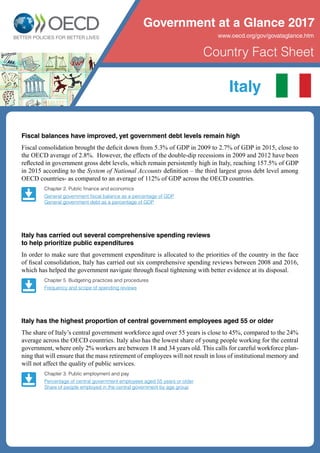
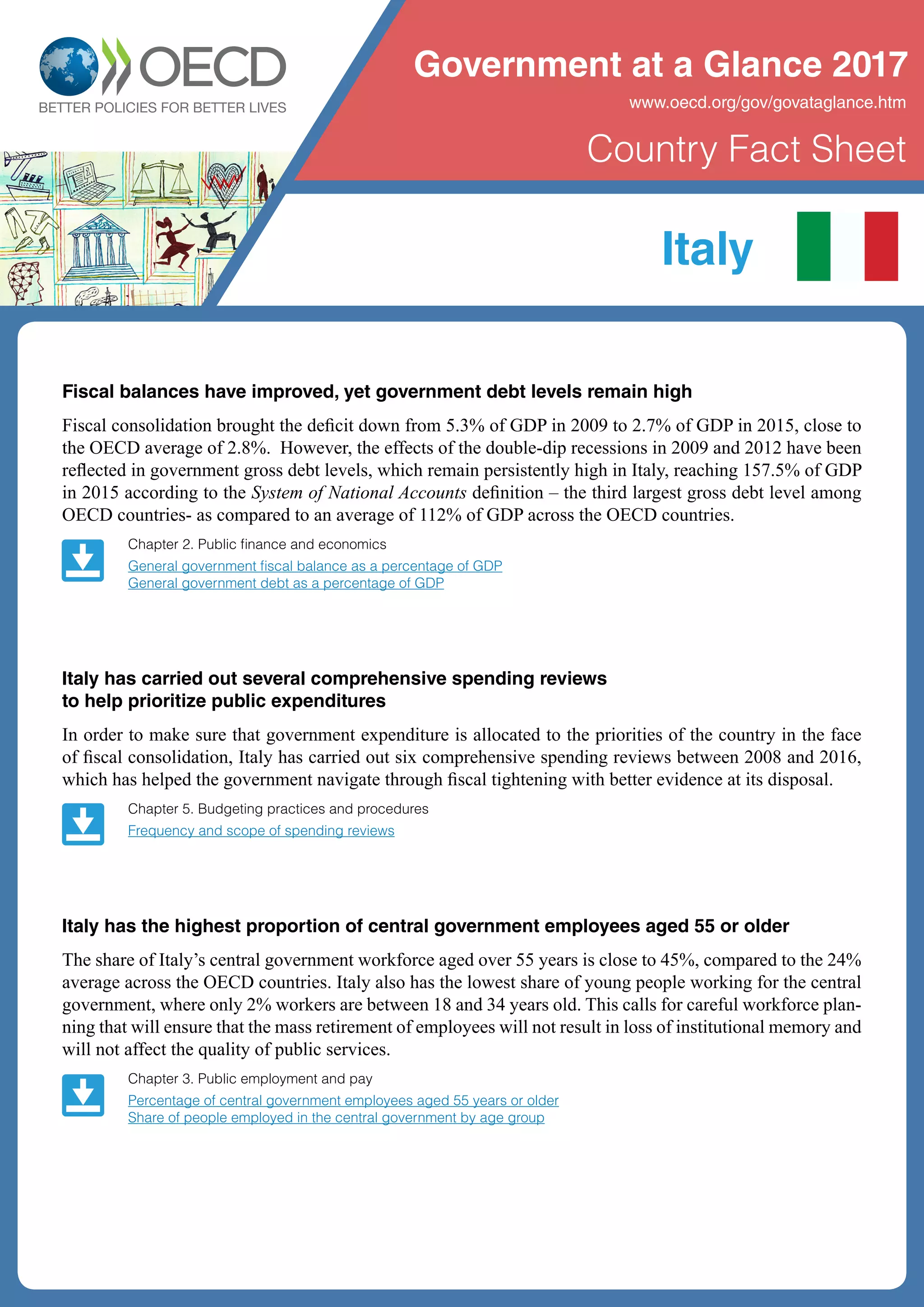
Fiscal balances have improved, yet government debt levels remain high
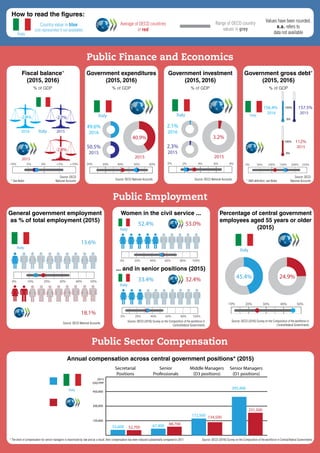
Fiscal consolidation brought the deficit down from 5.3% of GDP in 2009 to 2.7% of GDP in 2015, close to
the OECD average of 2.8%. However, the effects of the double-dip recessions in 2009 and 2012 have been
reflected in government gross debt levels, which remain persistently high in Italy, reaching 157.5% of GDP
in 2015 according to the System of National Accounts definition – the third largest gross debt level among
OECD countries- as compared to an average of 112% of GDP across the OECD countries.
Chapter 2. Public finance and economics
General government fiscal balance as a percentage of GDP
General government debt as a percentage of GDP
Italy has carried out several comprehensive spending reviews
to help prioritize public expenditures
In order to make sure that government expenditure is allocated to the priorities of the country in the face
of fiscal consolidation, Italy has carried out six comprehensive spending reviews between 2008 and 2016,
which has helped the government navigate through fiscal tightening with better evidence at its disposal.
Chapter 5. Budgeting practices and procedures
Frequency and scope of spending reviews
Italy has the highest proportion of central government employees aged 55 or older
The share of Italy’s central government workforce aged over 55 years is close to 45%, compared to the 24%
average across the OECD countries. Italy also has the lowest share of young people working for the central
government, where only 2% workers are between 18 and 34 years old. This calls for careful workforce plan-
ning that will ensure that the mass retirement of employees will not result in loss of institutional memory and
will not affect the quality of public services.
Chapter 3. Public employment and pay
Percentage of central government employees aged 55 years or older
Share of people employed in the central government by age group
Italy
Fiscal balance*
(2015, 2016)
Government expenditures
(2015, 2016)
Government gross debt*
(2015, 2016)
% of GDP % of GDP % of GDP
Source: OECD National Accounts Source: OECD National Accounts
G@G /dataG@G /data
26134,500
88,700
52,700
Middle Managers
(D3 positions)
Senior Managers
(D1 positions)
Senior
Professionals
Secretarial
Positions
2015
USD PPP
150,000
300,000
450,000
231,500
55,600
Italy
67,900
172,500
395,400
Annual compensation across central government positions* (2015)
Government investment
(2015, 2016)
How to read the figures:
Italy
Country value in blue
(not represented if not available)
Average of OECD countries
in red
Range of OECD country
values in grey
Public Finance and Economics
10% 20% 30% 40% 50%
24.9%45.4%
Italy
20% 30% 40% 50% 60%
2015
40.9%
49.6%
2016
50.5%
2015
Italy
2015
3.2%
2.1%
2016
2.3%
2015
0% 2% 4% 6% 8%
Italy
157.5%
2015
156.4% 100%
0%
2016
112%100%
0%
2015
0% 50% 100% 150% 200% 250%
Italy
Values have been rounded.
n.a. refers to
data not available
% of GDP
Public Employment
Source: OECD (2016) Survey on the Composition of the workforce in
Central/federal Governments
* The level of compensation for senior managers is maximized by law and as a result, their compensation has been reduced substantially compared to 2011. Source: OECD (2016) Survey on the Composition of the workforce in Central/federal Governments
... and in senior positions (2015)
Source: OECD
* See Notes National Accounts
Source: OECD
* SNA definition, see Notes National Accounts
Public Sector Compensation
53.0%52.4%
Italy
0% 20% 40% 60% 80% 100%
32.4%33.4%
Italy
0% 20% 40% 60% 80% 100%
Women in the civil service ...
Source: OECD (2016) Survey on the Composition of the workforce in
Central/federal Governments
Percentage of central government
employees aged 55 years or older
(2015)
General government employment
as % of total employment (2015)
18.1%
13.6%
Italy
0% 10% 20% 30% 40% 50%
Source: OECD National Accounts
-10% 0%-5% +5% +10%
-2.8%
Italy2016
-2.4% -2.7%
2015
2015
Budgeting
Women in Government
Extent of delegation
of HRM practices
in line ministries
0.77
0.64
Extent of the use
of performance
assessments
in HR decisions
0.70
0.64
Extent of the use
of performance
related pay
0.78
0.66
Use of separate
HRM practices
for senior
civil servants
0.58
0.55
Collection
of administrative
data
0.77 0.68
Composite index
from 0 lowest to 1 highest
0
0.25
0.50
0.75
1
Italy
G@G /data
Source: OECD (2016) Strategic Human Resources Management Survey
Composite indicators on HRM practices in central government (2016)
Human Resource Management
Composite indices on regulatory governance for primary laws*
(2014)
G@G /data
Regulatory governance
0% 10% 20% 30% 40%
29.1%
50%
20.5%
Italy
Source: OECD National Accounts
General government
procurement expenditures
(2015)
% of government expenditures
Public Procurement
Support for green
public procurement
Some procuring entities have developed an internal strategy/policy
A strategy/policy has been developed at a central level
Support for
SMEs
Support for innovative
goods and services
A strategy/policy has been rescinded
There has never been a strategy/policy in place
11 25 1 0 8 24 0 1 9 19 0 6
Italy
Strategic public procurement - Objectives
(2016)
Source: OECD (2016) Survey on Public Procurement
* See Notes Source: OECD Indicators of Regulatory Policy and Governance (iREG)
0.41
0
0.2
0.4
0.6
0.8
1
0.27
Italy
Composite index
from 0 lowest to 1 highest
Performance budgeting
practices at the central level
of government (2016)
Source: OECD (2016) Survey of Performance Budgeting
Stakeholder
engagement in
developing regulations
1.43
2.09
Regulatory Impact
Assessment for
developing regulations
1.69 2.05
Ex post evaluation
of regulations
1.45
1.54
Composite index
from 0 lowest to 4 highest
0
0.25
0.50
0.75
1
Italy
Notes
 Fiscal balance as reported in the System of National Accounts (SNA) framework, also referred to as net lending (+) or net borrowing (-) of government, is calculated as total government revenues minus total government expenditures.
 Regulatory governance indicators: The results for stakeholder engagement and Regulatory Impact Assessment apply exclusively to processes for developing primary laws initiated by the executive. Data is not applicable to the
United States, where all primary laws are initiated by Congress. In the majority of countries, most primary laws are initiated by the executive, except for Mexico and Korea, where a higher share of primary laws are initiated by parliament/
congress (respectively 90.6% and 84%).
 Government gross debt is reported according to the SNA definition, which differs from the definition applied under the Maastricht Treaty. It is defined as all liabilities that require payment or payments of interest or principal by the
debtor to the creditor at a date or dates in the future. All debt instruments are liabilities, but some liabilities such as shares, equity and financial derivatives are not debt.
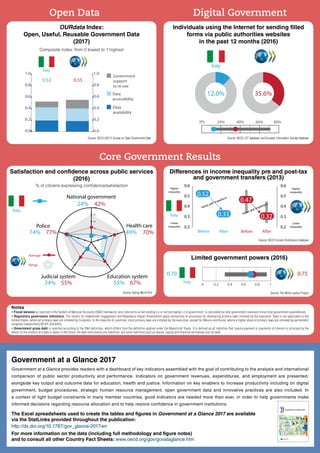
Open Data Digital Government
0% 20% 40% 60% 80%
35.6%12.0%
Italy
Individuals using the Internet for sending filled
forms via public authorities websites
in the past 12 months (2016)
Source: OECD, ICT database; and Eurostat, Information Society database
OURdata Index:
Open, Useful, Reusable Government Data
(2017)
Composite index: from 0 lowest to 1 highest
Source: OECD (2017) Survey on Open Government Data
0.0
0.2
0.4
0.6
0.8
1.0
0.52
0.0
0.2
0.4
0.6
0.8
1.0
0.55
Italy
Data
availability
Data
accessibility
Government
support
to re-use
Differences in income inequality pre and post-tax
and government transfers (2013)
Italy
0.2
0.3
0.4
0.5
0.6
Higher
inequality
Lower
inequality
Before After
0.52
0.33
taxes and transfers
0.2
0.3
0.4
0.5
0.6
Before After
0.47
0.32
taxes and transfers
Higher
inequality
Lower
inequality
Source: OECD Income Distribution Database
Limited government powers (2016)
0.75
0 0.2 0.4 0.6 0.8 1
0.70
Italy
Source: The World Justice Project
Core Government Results
Satisfaction and confidence across public services
(2016)
70%
Judicial system Education system
49%20
40
60
80
100
Health care
67%55%55%24%
National government
42%24%
Italy
Average
Range
Police
77%74%
Source: Gallup World Poll
% of citizens expressing confidence/satisfaction
Government at a Glance 2017
Government at a Glance provides readers with a dashboard of key indicators assembled with the goal of contributing to the analysis and international
comparison of public sector productivity and performance. Indicators on government revenues, expenditures, and employment are presented,
alongside key output and outcome data for education, health and justice. Information on key enablers to increase productivity including on digital
government, budget procedures, strategic human resource management, open government data and innovative practices are also included. In
a context of tight budget constraints in many member countries, good indicators are needed more than ever, in order to help governments make
informed decisions regarding resource allocation and to help restore confidence in government institutions.
http://dx.doi.org/10.1787/gov_glance-2017-en
The Excel spreadsheets used to create the tables and figures in Government at a Glance 2017 are available
via the StatLinks provided throughout the publication:
For more information on the data (including full methodology and figure notes)
and to consult all other Country Fact Sheets: www.oecd.org/gov/govataglance.htm

Italy - Government at a Glance 2017

  • 1.
    Government at aGlance 2017 Country Fact Sheet www.oecd.org/gov/govataglance.htm Fiscal balances have improved, yet government debt levels remain high Fiscal consolidation brought the deficit down from 5.3% of GDP in 2009 to 2.7% of GDP in 2015, close to the OECD average of 2.8%. However, the effects of the double-dip recessions in 2009 and 2012 have been reflected in government gross debt levels, which remain persistently high in Italy, reaching 157.5% of GDP in 2015 according to the System of National Accounts definition – the third largest gross debt level among OECD countries- as compared to an average of 112% of GDP across the OECD countries. Chapter 2. Public finance and economics General government fiscal balance as a percentage of GDP General government debt as a percentage of GDP Italy has carried out several comprehensive spending reviews to help prioritize public expenditures In order to make sure that government expenditure is allocated to the priorities of the country in the face of fiscal consolidation, Italy has carried out six comprehensive spending reviews between 2008 and 2016, which has helped the government navigate through fiscal tightening with better evidence at its disposal. Chapter 5. Budgeting practices and procedures Frequency and scope of spending reviews Italy has the highest proportion of central government employees aged 55 or older The share of Italy’s central government workforce aged over 55 years is close to 45%, compared to the 24% average across the OECD countries. Italy also has the lowest share of young people working for the central government, where only 2% workers are between 18 and 34 years old. This calls for careful workforce plan- ning that will ensure that the mass retirement of employees will not result in loss of institutional memory and will not affect the quality of public services. Chapter 3. Public employment and pay Percentage of central government employees aged 55 years or older Share of people employed in the central government by age group Italy
  • 2.
    Fiscal balance* (2015, 2016) Governmentexpenditures (2015, 2016) Government gross debt* (2015, 2016) % of GDP % of GDP % of GDP Source: OECD National Accounts Source: OECD National Accounts G@G /dataG@G /data 26134,500 88,700 52,700 Middle Managers (D3 positions) Senior Managers (D1 positions) Senior Professionals Secretarial Positions 2015 USD PPP 150,000 300,000 450,000 231,500 55,600 Italy 67,900 172,500 395,400 Annual compensation across central government positions* (2015) Government investment (2015, 2016) How to read the figures: Italy Country value in blue (not represented if not available) Average of OECD countries in red Range of OECD country values in grey Public Finance and Economics 10% 20% 30% 40% 50% 24.9%45.4% Italy 20% 30% 40% 50% 60% 2015 40.9% 49.6% 2016 50.5% 2015 Italy 2015 3.2% 2.1% 2016 2.3% 2015 0% 2% 4% 6% 8% Italy 157.5% 2015 156.4% 100% 0% 2016 112%100% 0% 2015 0% 50% 100% 150% 200% 250% Italy Values have been rounded. n.a. refers to data not available % of GDP Public Employment Source: OECD (2016) Survey on the Composition of the workforce in Central/federal Governments * The level of compensation for senior managers is maximized by law and as a result, their compensation has been reduced substantially compared to 2011. Source: OECD (2016) Survey on the Composition of the workforce in Central/federal Governments ... and in senior positions (2015) Source: OECD * See Notes National Accounts Source: OECD * SNA definition, see Notes National Accounts Public Sector Compensation 53.0%52.4% Italy 0% 20% 40% 60% 80% 100% 32.4%33.4% Italy 0% 20% 40% 60% 80% 100% Women in the civil service ... Source: OECD (2016) Survey on the Composition of the workforce in Central/federal Governments Percentage of central government employees aged 55 years or older (2015) General government employment as % of total employment (2015) 18.1% 13.6% Italy 0% 10% 20% 30% 40% 50% Source: OECD National Accounts -10% 0%-5% +5% +10% -2.8% Italy2016 -2.4% -2.7% 2015 2015
  • 3.
    Budgeting Women in Government Extentof delegation of HRM practices in line ministries 0.77 0.64 Extent of the use of performance assessments in HR decisions 0.70 0.64 Extent of the use of performance related pay 0.78 0.66 Use of separate HRM practices for senior civil servants 0.58 0.55 Collection of administrative data 0.77 0.68 Composite index from 0 lowest to 1 highest 0 0.25 0.50 0.75 1 Italy G@G /data Source: OECD (2016) Strategic Human Resources Management Survey Composite indicators on HRM practices in central government (2016) Human Resource Management Composite indices on regulatory governance for primary laws* (2014) G@G /data Regulatory governance 0% 10% 20% 30% 40% 29.1% 50% 20.5% Italy Source: OECD National Accounts General government procurement expenditures (2015) % of government expenditures Public Procurement Support for green public procurement Some procuring entities have developed an internal strategy/policy A strategy/policy has been developed at a central level Support for SMEs Support for innovative goods and services A strategy/policy has been rescinded There has never been a strategy/policy in place 11 25 1 0 8 24 0 1 9 19 0 6 Italy Strategic public procurement - Objectives (2016) Source: OECD (2016) Survey on Public Procurement * See Notes Source: OECD Indicators of Regulatory Policy and Governance (iREG) 0.41 0 0.2 0.4 0.6 0.8 1 0.27 Italy Composite index from 0 lowest to 1 highest Performance budgeting practices at the central level of government (2016) Source: OECD (2016) Survey of Performance Budgeting Stakeholder engagement in developing regulations 1.43 2.09 Regulatory Impact Assessment for developing regulations 1.69 2.05 Ex post evaluation of regulations 1.45 1.54 Composite index from 0 lowest to 4 highest 0 0.25 0.50 0.75 1 Italy
  • 4.
    Notes  Fiscal balanceas reported in the System of National Accounts (SNA) framework, also referred to as net lending (+) or net borrowing (-) of government, is calculated as total government revenues minus total government expenditures.  Regulatory governance indicators: The results for stakeholder engagement and Regulatory Impact Assessment apply exclusively to processes for developing primary laws initiated by the executive. Data is not applicable to the United States, where all primary laws are initiated by Congress. In the majority of countries, most primary laws are initiated by the executive, except for Mexico and Korea, where a higher share of primary laws are initiated by parliament/ congress (respectively 90.6% and 84%).  Government gross debt is reported according to the SNA definition, which differs from the definition applied under the Maastricht Treaty. It is defined as all liabilities that require payment or payments of interest or principal by the debtor to the creditor at a date or dates in the future. All debt instruments are liabilities, but some liabilities such as shares, equity and financial derivatives are not debt. Open Data Digital Government 0% 20% 40% 60% 80% 35.6%12.0% Italy Individuals using the Internet for sending filled forms via public authorities websites in the past 12 months (2016) Source: OECD, ICT database; and Eurostat, Information Society database OURdata Index: Open, Useful, Reusable Government Data (2017) Composite index: from 0 lowest to 1 highest Source: OECD (2017) Survey on Open Government Data 0.0 0.2 0.4 0.6 0.8 1.0 0.52 0.0 0.2 0.4 0.6 0.8 1.0 0.55 Italy Data availability Data accessibility Government support to re-use Differences in income inequality pre and post-tax and government transfers (2013) Italy 0.2 0.3 0.4 0.5 0.6 Higher inequality Lower inequality Before After 0.52 0.33 taxes and transfers 0.2 0.3 0.4 0.5 0.6 Before After 0.47 0.32 taxes and transfers Higher inequality Lower inequality Source: OECD Income Distribution Database Limited government powers (2016) 0.75 0 0.2 0.4 0.6 0.8 1 0.70 Italy Source: The World Justice Project Core Government Results Satisfaction and confidence across public services (2016) 70% Judicial system Education system 49%20 40 60 80 100 Health care 67%55%55%24% National government 42%24% Italy Average Range Police 77%74% Source: Gallup World Poll % of citizens expressing confidence/satisfaction Government at a Glance 2017 Government at a Glance provides readers with a dashboard of key indicators assembled with the goal of contributing to the analysis and international comparison of public sector productivity and performance. Indicators on government revenues, expenditures, and employment are presented, alongside key output and outcome data for education, health and justice. Information on key enablers to increase productivity including on digital government, budget procedures, strategic human resource management, open government data and innovative practices are also included. In a context of tight budget constraints in many member countries, good indicators are needed more than ever, in order to help governments make informed decisions regarding resource allocation and to help restore confidence in government institutions. http://dx.doi.org/10.1787/gov_glance-2017-en The Excel spreadsheets used to create the tables and figures in Government at a Glance 2017 are available via the StatLinks provided throughout the publication: For more information on the data (including full methodology and figure notes) and to consult all other Country Fact Sheets: www.oecd.org/gov/govataglance.htm