Google App Engine
A comprehensive overview of Google's
web application hosting service
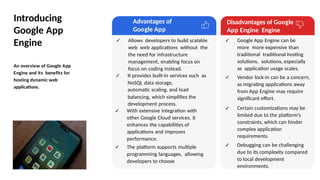
Introducing
Google App
Engine
An overview of Google App
Engine and its benefits for
hosting dynamic web
applications.
Advantages of
Google App
Engine
Disadvantages of Google
App Engine Engine
✓ Allows developers to build scalable
web web applications without the
the need for infrastructure
management, enabling focus on
focus on coding instead.
✓ It provides built-in services such as
NoSQL data storage,
automatic scaling, and load
balancing, which simplifies the
development process.
✓ With extensive integration with
other Google Cloud services, it
enhances the capabilities of
applications and improves
performance.
✓ The platform supports multiple
programming languages, allowing
developers to choose
✓ Google App Engine can be
more more expensive than
traditional traditional hosting
solutions, solutions, especially
as application usage scales.
✓ Vendor lock-in can be a concern,
as migrating applications away
from App Engine may require
significant effort.
✓ Certain customizations may be
limited due to the platform’s
constraints, which can hinder
complex application
requirements.
✓ Debugging can be challenging
due to its complexity compared
to local development
environments.
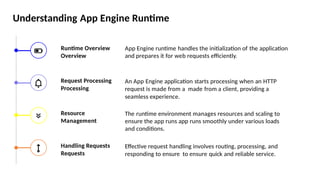
Understanding App Engine Runtime
Runtime Overview
Overview
Request Processing
Processing
Resource
Management
Handling Requests
Requests
App Engine runtime handles the initialization of the application
and prepares it for web requests efficiently.
An App Engine application starts processing when an HTTP
request is made from a made from a client, providing a
seamless experience.
The runtime environment manages resources and scaling to
ensure the app runs app runs smoothly under various loads
and conditions.
Effective request handling involves routing, processing, and
responding to ensure to ensure quick and reliable service.
Serving Static Files Fast
Speedy File Delivery
Static file servers like Google App Engine provide a robust platform
for hosting traditional web content. They ensure rapid access to
documents, images, and multimedia files for users worldwide.
With a focus on efficiency, these servers optimize delivery using
caching mechanisms and content distribution networks (CDNs). This
enhances load times, offering users a seamless experience when
accessing web content.
App Engine handles file requests intelligently, managing traffic and
scaling automatically. It supports a wide range of file types, ensuring
versatility in content delivery without compromising performance.
Deploying static content on App Engine simplifies management and
reduces overhead. Developers can focus on creating engaging
content while relying on the platform's reliability for serving files
efficiently.
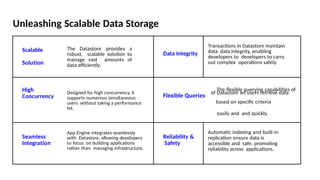
Unleashing Scalable Data Storage
Scalable
Solution
The Datastore provides a
robust, scalable solution to
manage vast amounts of
data efficiently.
Data Integrity
Transactions in Datastore maintain
data data integrity, enabling
developers to developers to carry
out complex operations safely.
High
Concurrency
Designed for high concurrency, it
supports numerous simultaneous
users without taking a performance
hit.
The flexible querying capabilities of
Flexible Queries
of Datastore let users retrieve data
based on specific criteria
easily and and quickly.
Seamless
Integration
App Engine integrates seamlessly
with Datastore, allowing developers
to focus on building applications
rather than managing infrastructure.
Reliability &
Safety
Automatic indexing and built-in
replication ensure data is
accessible and safe, promoting
reliability across applications.
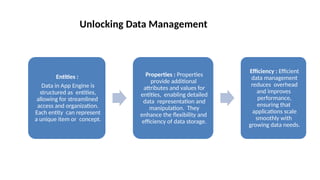
Unlocking Data Management
Entities :
Data in App Engine is
structured as entities,
allowing for streamlined
access and organization.
Each entity can represent
a unique item or concept.
Properties : Properties
provide additional
attributes and values for
entities, enabling detailed
data representation and
manipulation. They
enhance the flexibility and
efficiency of data storage.
Efficiency : Efficient
data management
reduces overhead
and improves
performance,
ensuring that
applications scale
smoothly with
growing data needs.
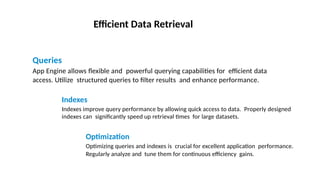
Efficient Data Retrieval
Queries
App Engine allows flexible and powerful querying capabilities for efficient data
access. Utilize structured queries to filter results and enhance performance.
Indexes
Indexes improve query performance by allowing quick access to data. Properly designed
indexes can significantly speed up retrieval times for large datasets.
Optimization
Optimizing queries and indexes is crucial for excellent application performance.
Regularly analyze and tune them for continuous efficiency gains.
Photo by Pexels Photo by Pexels Photo by Pexels
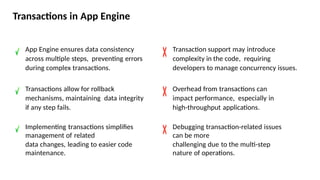
Transactions in App Engine
App Engine ensures data consistency
across multiple steps, preventing errors
during complex transactions.
Transactions allow for rollback
mechanisms, maintaining data integrity
if any step fails.
Implementing transactions simplifies
management of related
data changes, leading to easier code
maintenance.
Transaction support may introduce
complexity in the code, requiring
developers to manage concurrency issues.
Overhead from transactions can
impact performance, especially in
high-throughput applications.
Debugging transaction-related issues
can be more
challenging due to the multi-step
nature of operations.
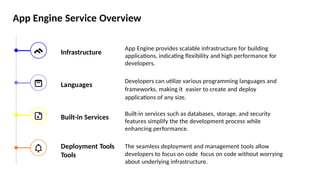
App Engine Service Overview
Infrastructure
Languages
Built-in Services
Deployment Tools
Tools
App Engine provides scalable infrastructure for building
applications, indicating flexibility and high performance for
developers.
Developers can utilize various programming languages and
frameworks, making it easier to create and deploy
applications of any size.
Built-in services such as databases, storage, and security
features simplify the the development process while
enhancing performance.
The seamless deployment and management tools allow
developers to focus on code focus on code without worrying
about underlying infrastructure.
Organizing Data with Namespaces in App
Engine
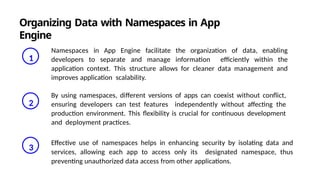
Namespaces in App Engine facilitate the organization of data, enabling
developers to separate and manage information efficiently within the
application context. This structure allows for cleaner data management and
improves application scalability.
By using namespaces, different versions of apps can coexist without conflict,
ensuring developers can test features independently without affecting the
production environment. This flexibility is crucial for continuous development
and deployment practices.
Effective use of namespaces helps in enhancing security by isolating data and
services, allowing each app to access only its designated namespace, thus
preventing unauthorized data access from other applications.
1
2
3
Unlocking User Access
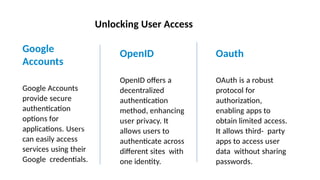
Google
Accounts
Google Accounts
provide secure
authentication
options for
applications. Users
can easily access
services using their
Google credentials.
OpenID
OpenID offers a
decentralized
authentication
method, enhancing
user privacy. It
allows users to
authenticate across
different sites with
one identity.
Oauth
OAuth is a robust
protocol for
authorization,
enabling apps to
obtain limited access.
It allows third- party
apps to access user
data without sharing
passwords.
Photo by Pexels Photo by Pexels Photo by Pexels
Task Queues and Cron Jobs in App
Engine
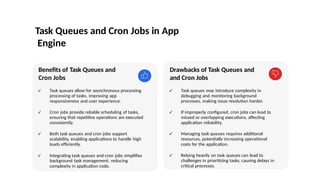
Benefits of Task Queues and
Cron Jobs
✓ Task queues allow for asynchronous processing
processing of tasks, improving app
responsiveness and user experience.
✓ Cron jobs provide reliable scheduling of tasks,
ensuring that repetitive operations are executed
consistently.
✓ Both task queues and cron jobs support
scalability, enabling applications to handle high
loads efficiently.
✓ Integrating task queues and cron jobs simplifies
background task management, reducing
complexity in application code.
Drawbacks of Task Queues and
and Cron Jobs
✓ Task queues may introduce complexity in
debugging and monitoring background
processes, making issue resolution harder.
✓ If improperly configured, cron jobs can lead to
missed or overlapping executions, affecting
application reliability.
✓ Managing task queues requires additional
resources, potentially increasing operational
costs for the application.
✓ Relying heavily on task queues can lead to
challenges in prioritizing tasks, causing delays in
critical processes.
Photo by Pexels
Boost Your Dev Skills Tools for Developers
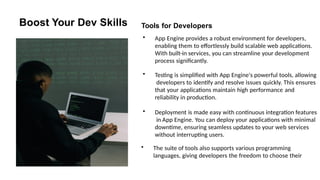
• App Engine provides a robust environment for developers,
enabling them to effortlessly build scalable web applications.
With built-in services, you can streamline your development
process significantly.
• Testing is simplified with App Engine's powerful tools, allowing
developers to identify and resolve issues quickly. This ensures
that your applications maintain high performance and
reliability in production.
• Deployment is made easy with continuous integration features
in App Engine. You can deploy your applications with minimal
downtime, ensuring seamless updates to your web services
without interrupting users.
• The suite of tools also supports various programming
languages, giving developers the freedom to choose their
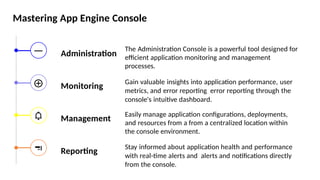
Mastering App Engine Console
Administration
Monitoring
Management
Reporting
The Administration Console is a powerful tool designed for
efficient application monitoring and management
processes.
Gain valuable insights into application performance, user
metrics, and error reporting error reporting through the
console's intuitive dashboard.
Easily manage application configurations, deployments,
and resources from a from a centralized location within
the console environment.
Stay informed about application health and performance
with real-time alerts and alerts and notifications directly
from the console.
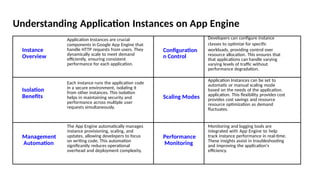
Understanding Application Instances on App Engine
Instance
Overview
Application Instances are crucial
components in Google App Engine that
handle HTTP requests from users. They
dynamically scale to meet demand
efficiently, ensuring consistent
performance for each application.
Configuration
n Control
Developers can configure instance
classes to optimize for specific
workloads, providing control over
resource allocation. This ensures that
that applications can handle varying
varying levels of traffic without
performance degradation.
Isolation
Benefits
Each instance runs the application code
in a secure environment, isolating it
from other instances. This isolation
helps in maintaining security and
performance across multiple user
requests simultaneously.
Scaling Modes
Application Instances can be set to
automatic or manual scaling mode
based on the needs of the application.
application. This flexibility provides cost
provides cost savings and resource
resource optimization as demand
fluctuates.
Management
Automation
The App Engine automatically manages
instance provisioning, scaling, and
updates, allowing developers to focus
on writing code. This automation
significantly reduces operational
overhead and deployment complexity.
Performance
Monitoring
Monitoring and logging tools are
integrated with App Engine to help
track instance performance in real-time.
These insights assist in troubleshooting
and improving the application's
efficiency.
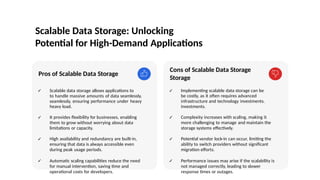
Scalable Data Storage: Unlocking
Potential for High-Demand Applications
Pros of Scalable Data Storage
✓ Scalable data storage allows applications to
to handle massive amounts of data seamlessly,
seamlessly, ensuring performance under heavy
heavy load.
✓ It provides flexibility for businesses, enabling
them to grow without worrying about data
limitations or capacity.
✓ High availability and redundancy are built-in,
ensuring that data is always accessible even
during peak usage periods.
✓ Automatic scaling capabilities reduce the need
for manual intervention, saving time and
operational costs for developers.
Cons of Scalable Data Storage
Storage
✓ Implementing scalable data storage can be
be costly, as it often requires advanced
infrastructure and technology investments.
investments.
✓ Complexity increases with scaling, making it
more challenging to manage and maintain the
storage systems effectively.
✓ Potential vendor lock-in can occur, limiting the
ability to switch providers without significant
migration efforts.
✓ Performance issues may arise if the scalability is
not managed correctly, leading to slower
response times or outages.
Photo by Pexels
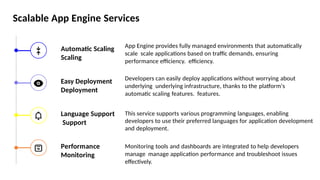
Scalable App Engine Services
Automatic Scaling
Scaling
Easy Deployment
Deployment
Language Support
Support
Performance
Monitoring
App Engine provides fully managed environments that automatically
scale scale applications based on traffic demands, ensuring
performance efficiency. efficiency.
Developers can easily deploy applications without worrying about
underlying underlying infrastructure, thanks to the platform's
automatic scaling features. features.
This service supports various programming languages, enabling
developers to use their preferred languages for application development
and deployment.
Monitoring tools and dashboards are integrated to help developers
manage manage application performance and troubleshoot issues
effectively.
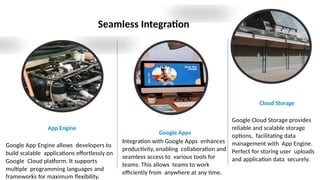
Seamless Integration
App Engine
Google App Engine allows developers to
build scalable applications effortlessly on
Google Cloud platform. It supports
multiple programming languages and
frameworks for maximum flexibility.
Google Apps
Integration with Google Apps enhances
productivity, enabling collaboration and
seamless access to various tools for
teams. This allows teams to work
efficiently from anywhere at any time.
Cloud Storage
Google Cloud Storage provides
reliable and scalable storage
options, facilitating data
management with App Engine.
Perfect for storing user uploads
and application data securely.
Smart Billing
Strategies
Pay As You Go
• In App Engine, developers are charged based on actual resource usage, such as
CPU and storage. This model ensures cost-effectiveness as you only pay for what
you consume each month.
• Understanding resource usage is crucial for optimizing expenses. Monitoring
CPU and storage metrics can help developers make informed decisions to
manage their application more efficiently.
• App Engine's billing structure provides flexibility, aligning costs directly with app
performance. This approach allows businesses to scale resources up or down
based on demand, avoiding unnecessary expenses.
• Investing in resource monitoring tools can further enhance cost management.
Developers can analyze usage trends to
Photo by Pexels
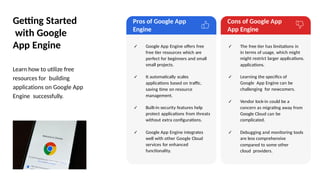
Getting Started
with Google
App Engine
Learn how to utilize free
resources for building
applications on Google App
Engine successfully.
Pros of Google App
Engine
Cons of Google App
App Engine
✓ Google App Engine offers free
free tier resources which are
perfect for beginners and small
small projects.
✓ It automatically scales
applications based on traffic,
saving time on resource
management.
✓ Built-in security features help
protect applications from threats
without extra configurations.
✓ Google App Engine integrates
well with other Google Cloud
services for enhanced
functionality.
✓ The free tier has limitations in
in terms of usage, which might
might restrict larger applications.
applications.
✓ Learning the specifics of
Google App Engine can be
challenging for newcomers.
✓ Vendor lock-in could be a
concern as migrating away from
Google Cloud can be
complicated.
✓ Debugging and monitoring tools
are less comprehensive
compared to some other
cloud providers.
Photo by Pexels
Power of Google
App
Scalable and Cost-Effective
• Google App Engine provides a robust environment for developers to create web applications
without worrying about infrastructure management. It allows for automatic scaling based on
traffic, ensuring optimal performance.
• With its pay-as-you-go pricing model, Google App Engine offers cost-effectiveness for businesses
of all sizes. Companies can manage their budgets effectively while scaling their applications
effortlessly.
• The platform supports various programming languages, including Python, Java, and Go,
making it flexible for developers. This versatility allows teams to leverage their existing skills
and frameworks efficiently.
• In conclusion, Google App Engine stands out as a reliable choice for hosting dynamic web
applications, combining Photo by Pexels

Google App Engine for Cloud Computing Tech

  • 1.
    Google App Engine Acomprehensive overview of Google's web application hosting service
  • 2.
    Introducing Google App Engine An overviewof Google App Engine and its benefits for hosting dynamic web applications. Advantages of Google App Engine Disadvantages of Google App Engine Engine ✓ Allows developers to build scalable web web applications without the the need for infrastructure management, enabling focus on focus on coding instead. ✓ It provides built-in services such as NoSQL data storage, automatic scaling, and load balancing, which simplifies the development process. ✓ With extensive integration with other Google Cloud services, it enhances the capabilities of applications and improves performance. ✓ The platform supports multiple programming languages, allowing developers to choose ✓ Google App Engine can be more more expensive than traditional traditional hosting solutions, solutions, especially as application usage scales. ✓ Vendor lock-in can be a concern, as migrating applications away from App Engine may require significant effort. ✓ Certain customizations may be limited due to the platform’s constraints, which can hinder complex application requirements. ✓ Debugging can be challenging due to its complexity compared to local development environments.
  • 3.
    Understanding App EngineRuntime Runtime Overview Overview Request Processing Processing Resource Management Handling Requests Requests App Engine runtime handles the initialization of the application and prepares it for web requests efficiently. An App Engine application starts processing when an HTTP request is made from a made from a client, providing a seamless experience. The runtime environment manages resources and scaling to ensure the app runs app runs smoothly under various loads and conditions. Effective request handling involves routing, processing, and responding to ensure to ensure quick and reliable service.
  • 4.
    Serving Static FilesFast Speedy File Delivery Static file servers like Google App Engine provide a robust platform for hosting traditional web content. They ensure rapid access to documents, images, and multimedia files for users worldwide. With a focus on efficiency, these servers optimize delivery using caching mechanisms and content distribution networks (CDNs). This enhances load times, offering users a seamless experience when accessing web content. App Engine handles file requests intelligently, managing traffic and scaling automatically. It supports a wide range of file types, ensuring versatility in content delivery without compromising performance. Deploying static content on App Engine simplifies management and reduces overhead. Developers can focus on creating engaging content while relying on the platform's reliability for serving files efficiently.
  • 5.
    Unleashing Scalable DataStorage Scalable Solution The Datastore provides a robust, scalable solution to manage vast amounts of data efficiently. Data Integrity Transactions in Datastore maintain data data integrity, enabling developers to developers to carry out complex operations safely. High Concurrency Designed for high concurrency, it supports numerous simultaneous users without taking a performance hit. The flexible querying capabilities of Flexible Queries of Datastore let users retrieve data based on specific criteria easily and and quickly. Seamless Integration App Engine integrates seamlessly with Datastore, allowing developers to focus on building applications rather than managing infrastructure. Reliability & Safety Automatic indexing and built-in replication ensure data is accessible and safe, promoting reliability across applications.
  • 6.
    Unlocking Data Management Entities: Data in App Engine is structured as entities, allowing for streamlined access and organization. Each entity can represent a unique item or concept. Properties : Properties provide additional attributes and values for entities, enabling detailed data representation and manipulation. They enhance the flexibility and efficiency of data storage. Efficiency : Efficient data management reduces overhead and improves performance, ensuring that applications scale smoothly with growing data needs.
  • 7.
    Efficient Data Retrieval Queries AppEngine allows flexible and powerful querying capabilities for efficient data access. Utilize structured queries to filter results and enhance performance. Indexes Indexes improve query performance by allowing quick access to data. Properly designed indexes can significantly speed up retrieval times for large datasets. Optimization Optimizing queries and indexes is crucial for excellent application performance. Regularly analyze and tune them for continuous efficiency gains. Photo by Pexels Photo by Pexels Photo by Pexels
  • 8.
    Transactions in AppEngine App Engine ensures data consistency across multiple steps, preventing errors during complex transactions. Transactions allow for rollback mechanisms, maintaining data integrity if any step fails. Implementing transactions simplifies management of related data changes, leading to easier code maintenance. Transaction support may introduce complexity in the code, requiring developers to manage concurrency issues. Overhead from transactions can impact performance, especially in high-throughput applications. Debugging transaction-related issues can be more challenging due to the multi-step nature of operations.
  • 9.
    App Engine ServiceOverview Infrastructure Languages Built-in Services Deployment Tools Tools App Engine provides scalable infrastructure for building applications, indicating flexibility and high performance for developers. Developers can utilize various programming languages and frameworks, making it easier to create and deploy applications of any size. Built-in services such as databases, storage, and security features simplify the the development process while enhancing performance. The seamless deployment and management tools allow developers to focus on code focus on code without worrying about underlying infrastructure.
  • 10.
    Organizing Data withNamespaces in App Engine Namespaces in App Engine facilitate the organization of data, enabling developers to separate and manage information efficiently within the application context. This structure allows for cleaner data management and improves application scalability. By using namespaces, different versions of apps can coexist without conflict, ensuring developers can test features independently without affecting the production environment. This flexibility is crucial for continuous development and deployment practices. Effective use of namespaces helps in enhancing security by isolating data and services, allowing each app to access only its designated namespace, thus preventing unauthorized data access from other applications. 1 2 3
  • 11.
    Unlocking User Access Google Accounts GoogleAccounts provide secure authentication options for applications. Users can easily access services using their Google credentials. OpenID OpenID offers a decentralized authentication method, enhancing user privacy. It allows users to authenticate across different sites with one identity. Oauth OAuth is a robust protocol for authorization, enabling apps to obtain limited access. It allows third- party apps to access user data without sharing passwords. Photo by Pexels Photo by Pexels Photo by Pexels
  • 12.
    Task Queues andCron Jobs in App Engine Benefits of Task Queues and Cron Jobs ✓ Task queues allow for asynchronous processing processing of tasks, improving app responsiveness and user experience. ✓ Cron jobs provide reliable scheduling of tasks, ensuring that repetitive operations are executed consistently. ✓ Both task queues and cron jobs support scalability, enabling applications to handle high loads efficiently. ✓ Integrating task queues and cron jobs simplifies background task management, reducing complexity in application code. Drawbacks of Task Queues and and Cron Jobs ✓ Task queues may introduce complexity in debugging and monitoring background processes, making issue resolution harder. ✓ If improperly configured, cron jobs can lead to missed or overlapping executions, affecting application reliability. ✓ Managing task queues requires additional resources, potentially increasing operational costs for the application. ✓ Relying heavily on task queues can lead to challenges in prioritizing tasks, causing delays in critical processes. Photo by Pexels
  • 13.
    Boost Your DevSkills Tools for Developers • App Engine provides a robust environment for developers, enabling them to effortlessly build scalable web applications. With built-in services, you can streamline your development process significantly. • Testing is simplified with App Engine's powerful tools, allowing developers to identify and resolve issues quickly. This ensures that your applications maintain high performance and reliability in production. • Deployment is made easy with continuous integration features in App Engine. You can deploy your applications with minimal downtime, ensuring seamless updates to your web services without interrupting users. • The suite of tools also supports various programming languages, giving developers the freedom to choose their
  • 14.
    Mastering App EngineConsole Administration Monitoring Management Reporting The Administration Console is a powerful tool designed for efficient application monitoring and management processes. Gain valuable insights into application performance, user metrics, and error reporting error reporting through the console's intuitive dashboard. Easily manage application configurations, deployments, and resources from a from a centralized location within the console environment. Stay informed about application health and performance with real-time alerts and alerts and notifications directly from the console.
  • 15.
    Understanding Application Instanceson App Engine Instance Overview Application Instances are crucial components in Google App Engine that handle HTTP requests from users. They dynamically scale to meet demand efficiently, ensuring consistent performance for each application. Configuration n Control Developers can configure instance classes to optimize for specific workloads, providing control over resource allocation. This ensures that that applications can handle varying varying levels of traffic without performance degradation. Isolation Benefits Each instance runs the application code in a secure environment, isolating it from other instances. This isolation helps in maintaining security and performance across multiple user requests simultaneously. Scaling Modes Application Instances can be set to automatic or manual scaling mode based on the needs of the application. application. This flexibility provides cost provides cost savings and resource resource optimization as demand fluctuates. Management Automation The App Engine automatically manages instance provisioning, scaling, and updates, allowing developers to focus on writing code. This automation significantly reduces operational overhead and deployment complexity. Performance Monitoring Monitoring and logging tools are integrated with App Engine to help track instance performance in real-time. These insights assist in troubleshooting and improving the application's efficiency.
  • 16.
    Scalable Data Storage:Unlocking Potential for High-Demand Applications Pros of Scalable Data Storage ✓ Scalable data storage allows applications to to handle massive amounts of data seamlessly, seamlessly, ensuring performance under heavy heavy load. ✓ It provides flexibility for businesses, enabling them to grow without worrying about data limitations or capacity. ✓ High availability and redundancy are built-in, ensuring that data is always accessible even during peak usage periods. ✓ Automatic scaling capabilities reduce the need for manual intervention, saving time and operational costs for developers. Cons of Scalable Data Storage Storage ✓ Implementing scalable data storage can be be costly, as it often requires advanced infrastructure and technology investments. investments. ✓ Complexity increases with scaling, making it more challenging to manage and maintain the storage systems effectively. ✓ Potential vendor lock-in can occur, limiting the ability to switch providers without significant migration efforts. ✓ Performance issues may arise if the scalability is not managed correctly, leading to slower response times or outages. Photo by Pexels
  • 17.
    Scalable App EngineServices Automatic Scaling Scaling Easy Deployment Deployment Language Support Support Performance Monitoring App Engine provides fully managed environments that automatically scale scale applications based on traffic demands, ensuring performance efficiency. efficiency. Developers can easily deploy applications without worrying about underlying underlying infrastructure, thanks to the platform's automatic scaling features. features. This service supports various programming languages, enabling developers to use their preferred languages for application development and deployment. Monitoring tools and dashboards are integrated to help developers manage manage application performance and troubleshoot issues effectively.
  • 18.
    Seamless Integration App Engine GoogleApp Engine allows developers to build scalable applications effortlessly on Google Cloud platform. It supports multiple programming languages and frameworks for maximum flexibility. Google Apps Integration with Google Apps enhances productivity, enabling collaboration and seamless access to various tools for teams. This allows teams to work efficiently from anywhere at any time. Cloud Storage Google Cloud Storage provides reliable and scalable storage options, facilitating data management with App Engine. Perfect for storing user uploads and application data securely.
  • 19.
    Smart Billing Strategies Pay AsYou Go • In App Engine, developers are charged based on actual resource usage, such as CPU and storage. This model ensures cost-effectiveness as you only pay for what you consume each month. • Understanding resource usage is crucial for optimizing expenses. Monitoring CPU and storage metrics can help developers make informed decisions to manage their application more efficiently. • App Engine's billing structure provides flexibility, aligning costs directly with app performance. This approach allows businesses to scale resources up or down based on demand, avoiding unnecessary expenses. • Investing in resource monitoring tools can further enhance cost management. Developers can analyze usage trends to Photo by Pexels
  • 20.
    Getting Started with Google AppEngine Learn how to utilize free resources for building applications on Google App Engine successfully. Pros of Google App Engine Cons of Google App App Engine ✓ Google App Engine offers free free tier resources which are perfect for beginners and small small projects. ✓ It automatically scales applications based on traffic, saving time on resource management. ✓ Built-in security features help protect applications from threats without extra configurations. ✓ Google App Engine integrates well with other Google Cloud services for enhanced functionality. ✓ The free tier has limitations in in terms of usage, which might might restrict larger applications. applications. ✓ Learning the specifics of Google App Engine can be challenging for newcomers. ✓ Vendor lock-in could be a concern as migrating away from Google Cloud can be complicated. ✓ Debugging and monitoring tools are less comprehensive compared to some other cloud providers. Photo by Pexels
  • 21.
    Power of Google App Scalableand Cost-Effective • Google App Engine provides a robust environment for developers to create web applications without worrying about infrastructure management. It allows for automatic scaling based on traffic, ensuring optimal performance. • With its pay-as-you-go pricing model, Google App Engine offers cost-effectiveness for businesses of all sizes. Companies can manage their budgets effectively while scaling their applications effortlessly. • The platform supports various programming languages, including Python, Java, and Go, making it flexible for developers. This versatility allows teams to leverage their existing skills and frameworks efficiently. • In conclusion, Google App Engine stands out as a reliable choice for hosting dynamic web applications, combining Photo by Pexels