GST
Contents
 What is GST ?
 Journey of GST in India.
 What are the indirect taxes that GST has replace ?
 What are the Component of GST ?
 What are the framework that the GST follows ?
 Advantages of the GST.
 Disadvantages of GST.
 Who are the taxable persons under GST ?
 What is GSTIN ?
 What is reverse charge ?
What is GST ?
 Goods and Service Tax (GST) is an indirect tax levied in India
on the supply of goods and services.
 GST replaced many indirect tax laws that previously existed in
India.
 GST is one indirect tax for the entire country.
 Definitions :
“GST is a comprehensive, multi stage, Destination
based tax that will be levied on every value
addition.”
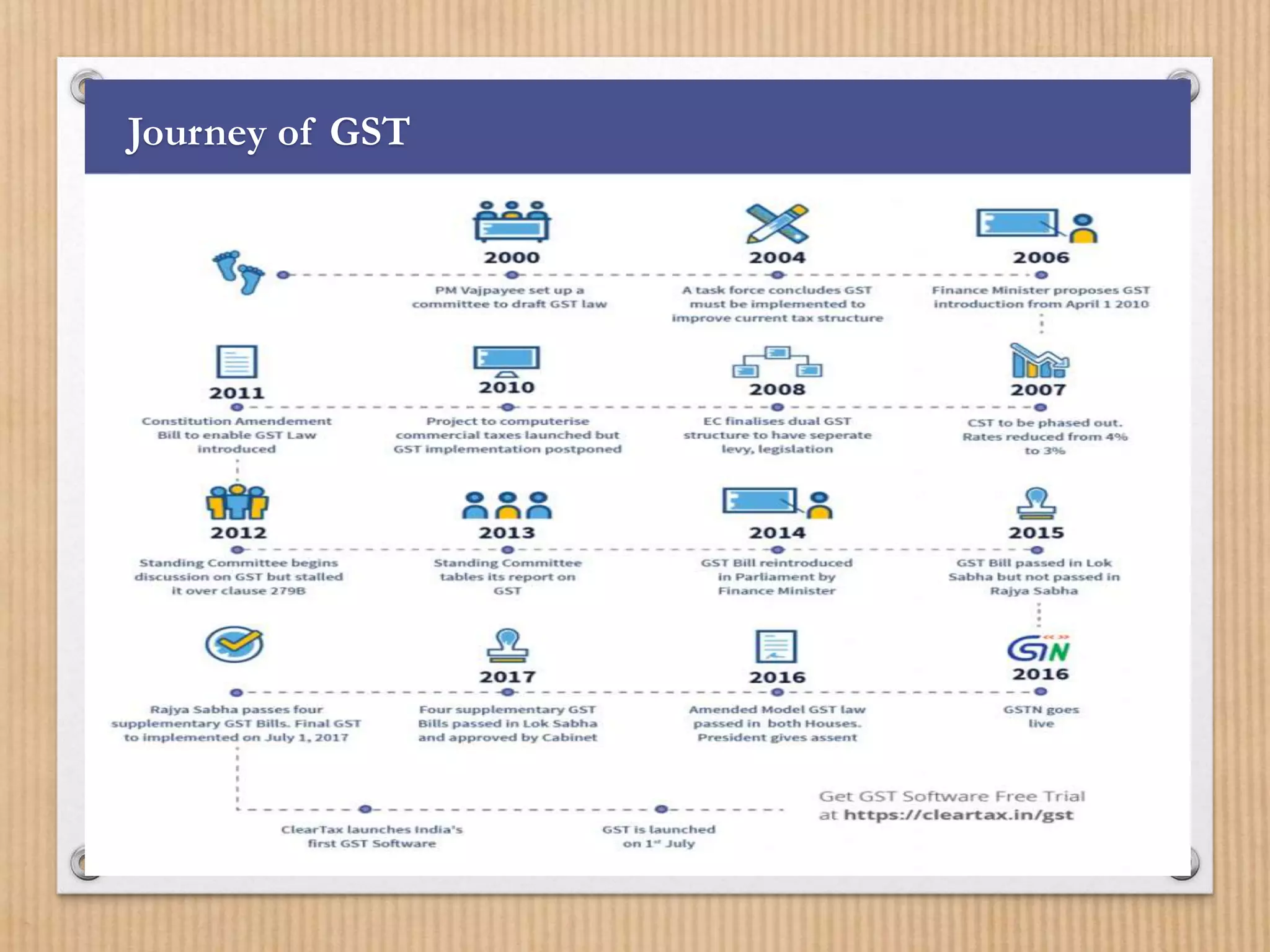
Journey of GST in India..
 The GST journey began in the year 2000, when a
committee was set up to draft law.
 It took 17 years from the law to evolve.
 In 2017 the GST Bill was passed in the Lok Sabha and
Rajya Sabha.
 On 1st July 2017 the GST law came into force.
Journey of GST
What are the indirect taxes thatGST has
replace?
• Service Tax.
• Central excise duty
• Additional Duties of Customs.
• Special additional Duty of Customs
Taxes levied
and collected
by Central:
• State VAT
• Central sales Tax.
• Entertainment and Amusement Tax.
• Taxes on lotteries, betting and gambling.
Taxes levied
and collected
by State:
What are the components of
GST?
There are 3 Taxes applicable under this System.
 Central Goods and Service Tax (CGST)
Collected by the Central Government on an intra state
sale.
 State Goods and Service Tax (SGST)
Collected by the State Government on an intra state.
 Integrated Goods and Service Tax (IGST)
Collected by the Central Government for inter state.
What are the framework that the
GST follows?
¥ India will follow the dual form of GST.
¥ At the intra state level, where goods and services are sold
within the state, CGST and SGST will be levied.
¥ When selling goods and services into other states, IGST will
be levied.
¥ GST will be devised as a four tiered tax structure with tax
slabs of 5%, 12%, 18% and 28%.
¥ 0% rate is kept for most essential goods such as rice, wheat.
What are the advantage of GST?
 GST eliminates the cascading effect of tax.
 Higher threshold for registration.
 Composition scheme for small businesses.
 Simple and easy online procedure.
 The number of compliances is lesser.
 Defined treatment for E-commerce operators.
 Improved efficiency of logistics.
 Unorganized sector is regulated under GST.
What are the disadvantages of
GST?
 Increase costs due to software purchase.
 Being GST compliant.
 GST will mean an increase in operational costs.
 GST came into effect in the middle of the
financial year.
 GST is an online taxation system.
 SMEs will have a higher tax burden.
Who are the taxable persons
under GST?
Who carries out any business at any place in India
and who is registered or required to be registered
under the GST Act. GST registration is mandatory for:
 Any business whose turnover in a financial year
exceeds Rs 20 lakhs.
 An input service distributor.
 An E-commerce operator or aggregator.
 A person who supplies via e-commerce aggregator.
What is GSTIN?
≠ GST refers to the unique GST identification number
that every business will be allotted.
≠ Every taxpayer will be allotted a state wise, PAN
based 15 digit Goods and Services Taxpayer
Identification Number (GSTIN).
What is Reverse Charge?
When the supplier supplies goods, the tax is
levied upon the supplier. In certain cases, the tax is
levied upon the buyer of the goods. This is called
reverse charge as the chargeability of tax gets
reversed.
•

Goods And Service Tax in India, Informative PPT | The all about GST.

  • 1.
  • 2.
    Contents  What isGST ?  Journey of GST in India.  What are the indirect taxes that GST has replace ?  What are the Component of GST ?  What are the framework that the GST follows ?  Advantages of the GST.  Disadvantages of GST.  Who are the taxable persons under GST ?  What is GSTIN ?  What is reverse charge ?
  • 3.
    What is GST?  Goods and Service Tax (GST) is an indirect tax levied in India on the supply of goods and services.  GST replaced many indirect tax laws that previously existed in India.  GST is one indirect tax for the entire country.  Definitions : “GST is a comprehensive, multi stage, Destination based tax that will be levied on every value addition.”
  • 4.
    Journey of GSTin India..  The GST journey began in the year 2000, when a committee was set up to draft law.  It took 17 years from the law to evolve.  In 2017 the GST Bill was passed in the Lok Sabha and Rajya Sabha.  On 1st July 2017 the GST law came into force.
  • 5.
  • 6.
    What are theindirect taxes thatGST has replace? • Service Tax. • Central excise duty • Additional Duties of Customs. • Special additional Duty of Customs Taxes levied and collected by Central: • State VAT • Central sales Tax. • Entertainment and Amusement Tax. • Taxes on lotteries, betting and gambling. Taxes levied and collected by State:
  • 7.
    What are thecomponents of GST? There are 3 Taxes applicable under this System.  Central Goods and Service Tax (CGST) Collected by the Central Government on an intra state sale.  State Goods and Service Tax (SGST) Collected by the State Government on an intra state.  Integrated Goods and Service Tax (IGST) Collected by the Central Government for inter state.
  • 8.
    What are theframework that the GST follows? ¥ India will follow the dual form of GST. ¥ At the intra state level, where goods and services are sold within the state, CGST and SGST will be levied. ¥ When selling goods and services into other states, IGST will be levied. ¥ GST will be devised as a four tiered tax structure with tax slabs of 5%, 12%, 18% and 28%. ¥ 0% rate is kept for most essential goods such as rice, wheat.
  • 9.
    What are theadvantage of GST?  GST eliminates the cascading effect of tax.  Higher threshold for registration.  Composition scheme for small businesses.  Simple and easy online procedure.  The number of compliances is lesser.  Defined treatment for E-commerce operators.  Improved efficiency of logistics.  Unorganized sector is regulated under GST.
  • 10.
    What are thedisadvantages of GST?  Increase costs due to software purchase.  Being GST compliant.  GST will mean an increase in operational costs.  GST came into effect in the middle of the financial year.  GST is an online taxation system.  SMEs will have a higher tax burden.
  • 11.
    Who are thetaxable persons under GST? Who carries out any business at any place in India and who is registered or required to be registered under the GST Act. GST registration is mandatory for:  Any business whose turnover in a financial year exceeds Rs 20 lakhs.  An input service distributor.  An E-commerce operator or aggregator.  A person who supplies via e-commerce aggregator.
  • 12.
    What is GSTIN? ≠GST refers to the unique GST identification number that every business will be allotted. ≠ Every taxpayer will be allotted a state wise, PAN based 15 digit Goods and Services Taxpayer Identification Number (GSTIN).
  • 13.
    What is ReverseCharge? When the supplier supplies goods, the tax is levied upon the supplier. In certain cases, the tax is levied upon the buyer of the goods. This is called reverse charge as the chargeability of tax gets reversed.
  • 14.