Q1 2015
PLACESGOINGA newsletter for Participants in the
Chicago Housing Authority Housing Choice Voucher Program
Message From the CEO:
1
Dear HCV Participants,
As we enter this new year, I am proud of the progress that CHA has made
as we work to help build strong, vibrant communities throughout Chicago
and support programs that improve access to education, important
information, and resources.
Building on the work of last year, we are increasing our focus on ensuring
that families have access to important program-related information and resources. To start,
we are scheduling free workshops throughout the year, featuring various topics and guest
presenters, to assist you in navigating the HCV program and to aid you in enjoying the
comfort of your home. Look for more communication about these workshops in the mail
and at our regional offices. We are also improving the materials available in our resource
centers, to provide you with information on housing options as well as health, career and
educational resources.
Let me take a moment to underscore our continued emphasis on education.
Every year, dozens of public housing and Housing Choice Voucher students prepare for
their journey into higher education at CHA’s annual “Take Flight” College Send-Off. Many
receive scholarships from CHA’s college scholarship program, to attend some of the most
prestigious schools in the nation, including Amherst, Cornell, Yale and Morehouse. This
past year, thanks to a partnership with CNA Insurance Company, it was the largest Take
Flight event ever.
Early this year, some of those students returned for “Staying Power” – a retention check-
in that focused on college resiliency, maximizing connections and building a professional
network. The CHA college students reconvened and shared their stories from the first
semester and garnered new resources before heading back to school for their second
semester.
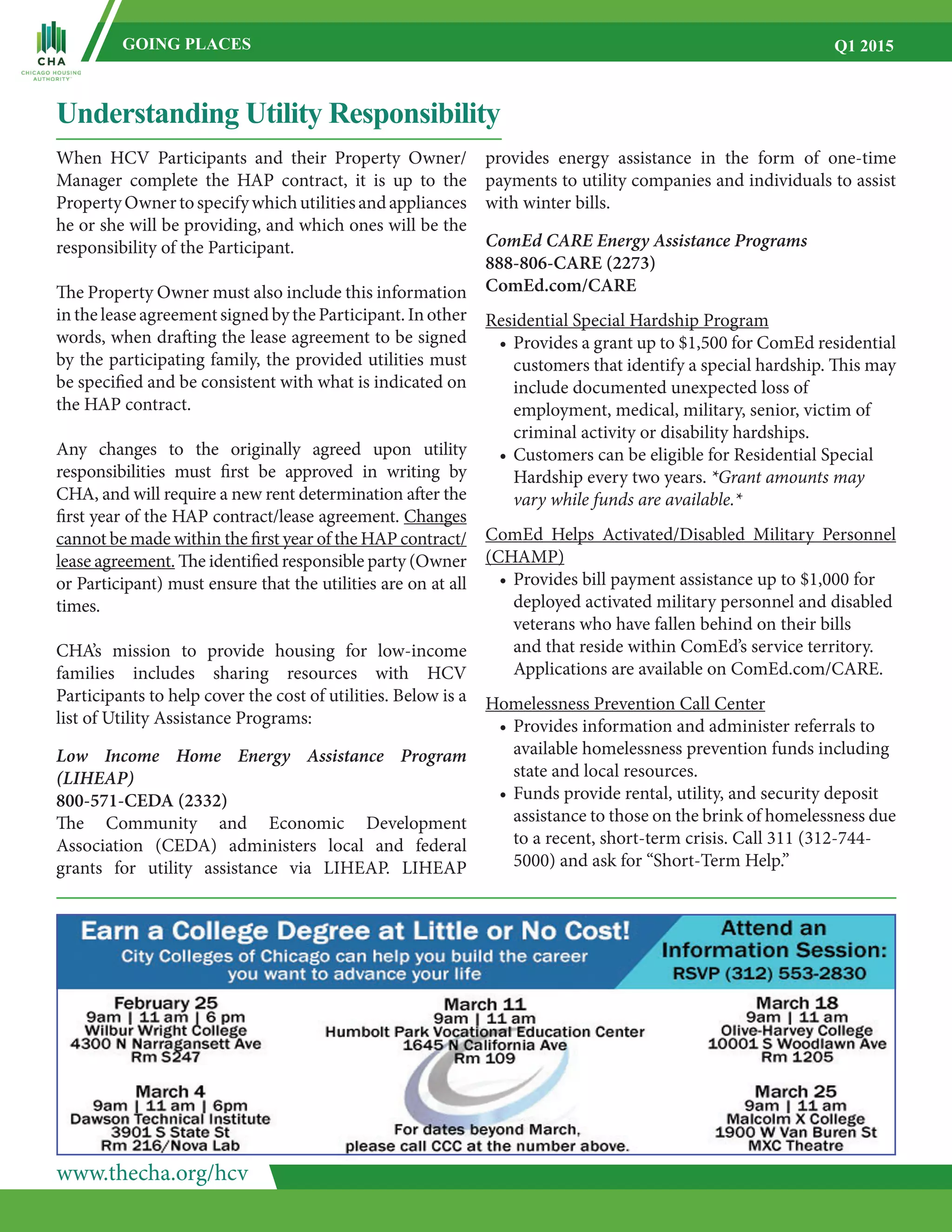
Some of the helpful topics covered at the event included: summer classes at City Colleges
of Chicago, Section 3 jobs, and maximizing financial aid. With such great enthusiasm at
this year’s inaugural event, we look forward to the 5th annual “Take Flight” slated for this
summer.
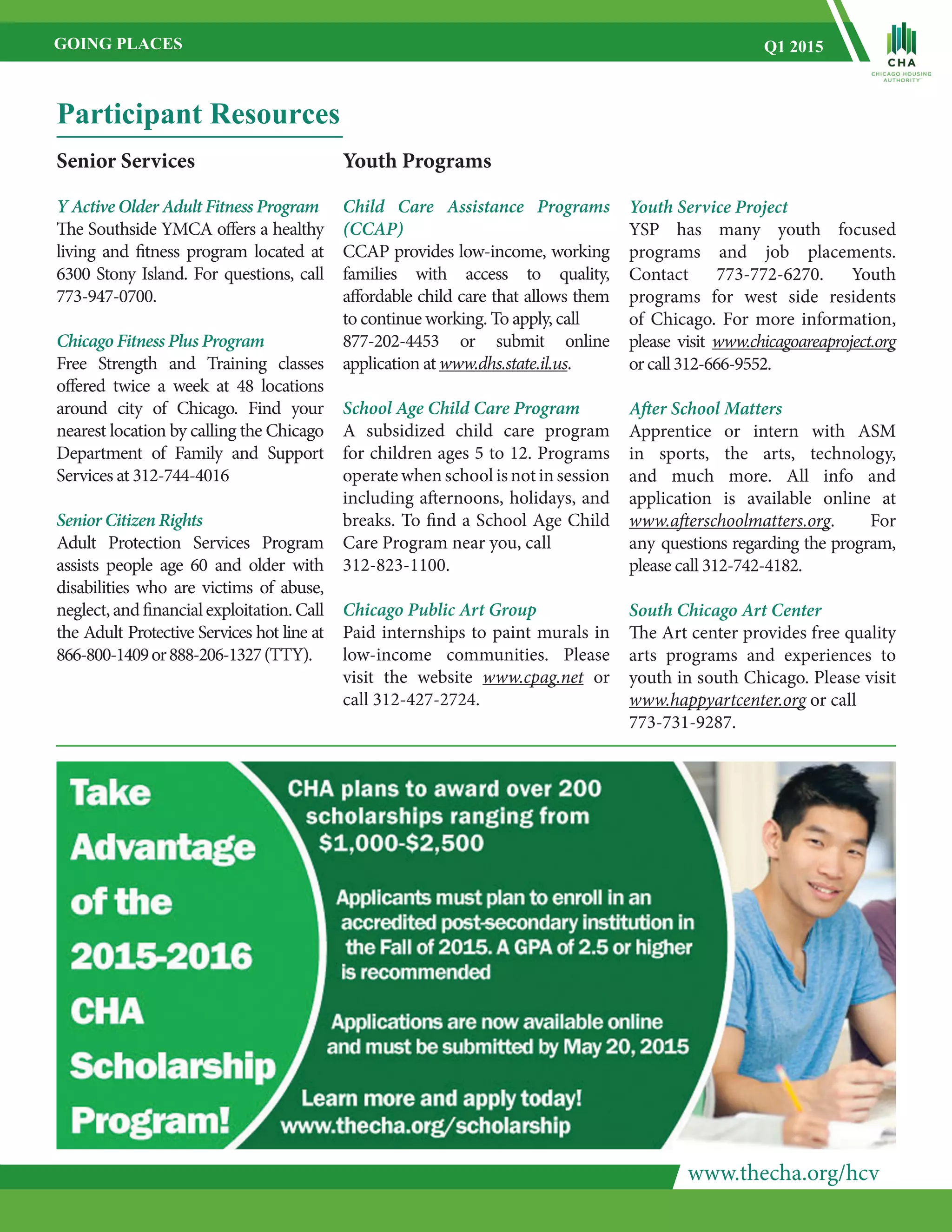
That is just one of many CHA initiatives geared toward education. Besides the aforementioned CHA college scholarship
program,whichoffersscholarshipsrangingfrom$1,000to$2,500forresidentsattendingaccreditedcollegesoruniversities,
CHA public housing residents and HCV participants can obtain a degree or certificate from City Colleges of Chicago at
low or no cost through a partnership between CHA and CCC. CHA helped almost 600 residents attend the City Colleges
of Chicago in 2014 – a 16 percent increase from 2013.
CHA also offers a range of educational and other opportunities for youth during out-of-school time.
In all, CHA engaged more than 6,000 youth in academic, career and wellness/recreational programs in 2014. We expect
to improve on that in 2015.
For more information, check out the Youth Opportunities page at www.thecha.org.
Sincerely,
Michael R. Merchant
In This Issue:
•	Message from the CEO
•	Meet New Board
	 Member Francine
	 Washington
•	Spring Cleaning Tips
•	Featured Participant
	 Council Member
•	Good Tenants are Good
	 Neighbors
•	Steps for Owner-Tenant
	 Conflict Resolution
•	Participant Resources
•	Understanding Utility
	 Responsibility
•	Resident Services Updates
•	Q1 2015 Workshop
	 Schedule
www.thecha.org/hcv
GOING PLACES Q1 2015
Francine Washington was appointed to the Chicago Housing Authority Board of
Commissioners in June 2014.
A longtime and respected voice in the Chicago resident leadership community,
Washington was recently elected as the President of the Central Advisory Council, and is
also President of the Washington Park Local Advisory Committee. She has also served on
many other important Boards in the city, including the Bronzeville Alliance, the National
Public Housing Museum, and has served as at-large president of Stateway Gardens/Park
Boulevard Local Advisory Council. She is also a member of the Stateway Associates
Working Group.
In her various roles, Washington has aggressively addressed important issues that affect communities and residents,
such as community safety, building maintenance, and the need for public housing residents to be recognized and
supported. She has also seen to it that CHA residents are healthy, serving as Director of the Summer Food Program,
in which CHA residents are provided healthy meals free-of-charge. She has selected sites for the program, hired
and trained staff, provided management and prepared applications, contracts and applications for the program.
Please join CHA in welcoming Ms. Washington to the Board of Commissioners.
Meet New Board Member Francine Washington
Spring Cleaning Tips
Though it may not seem like it, Spring will be here soon
and tenants are encouraged to organize their units to get
a fresh start with the new season and warmer weather.
Cleaning an entire apartment can be overwhelming, but
tenants can use the following tips to help make spring
cleaning more enjoyable and effective:
•	Wash windows. Pick a cloudy day to wash windows,
	 otherwise the cleaner will dry quickly and leave
	 streaks. Rubber-edged squeegees are more effective
	 than cloth or newspaper, but a paper towel will work
	 just fine. If no window cleaner is available, mild dish
	 soap will get the job done too.
•	Wash walls, cabinets, baseboards, and woodwork.
	 Dust doesn’t always go straight to the floor. In
	 addition to dusting all surfaces, walls, and ceiling
	 fixtures, give them a good scrub-down as well. Be
	 suretocleanunderneathfurnitureandappliancesaswell.
•	Clean light fixtures. Use a microfiber or lint-free
	 cloth to dust fixtures and bulbs within reach. Use a
	 damp cloth to wipe down light bulbs to ensure lights
	 are shining bright;
	 DO NOT make
	 the metal coil wet
	 – avoid that
	 section with the
	 damp cloth.
•	Get organized.
	 Gather some
	 containers and
	 clean up any
	 clutter in the bedrooms, living areas, kitchen, etc.
	 Consider having a box for “garage sale”
	 items, another box for “donation items,” and a
	 garbage bag for items to be thrown away.
•	Make it fun. Playing music while cleaning is a great
	 way to help pass the time and enjoy the chores.
	 Tenants who have children can encourage them to
	 help by making a game out of it by giving a “prize” to
	 whoever finishes the chore quickest and most clean.
By following these tips, tenants can ensure their
apartments will be like new and will help them start
fresh after winter.
www.thecha.org/hcv
GOING PLACES Q1 2015
HCV Participants search far and wide for the perfect
apartment that they can afford – and when they find
it, it almost seems like a miracle. When everything is
moved in and the tenant has settled in to the unit, the
experience could be ruined by a bad neighbor or two.
CHA encourages HCV Participants to get along with
not only their landlords, but also their neighbors. While
people cannot control the behaviors and attitudes of
others, they can control their own. HCV Participants
already have guidelines such as the Family Obligations
that can help them be great tenants – however, these
guidelines can also help them be great neighbors as well.
•	Don’t damage the unit or premises – all tenants
	 should respect the property on which they live,
	 including the unit and areas around it. If a landlord
	 cannot determine who is responsible for damaged
	 property, all tenants living in the building or on the
	 floor might be punished, and no one will be happy.
	 Refer to the CHA Family Obligations section on
	 pages 63-64 of the Participant Reference Guide for
	 more information.
Good Tenants are Good Neighbors
•	Don’t disturb the peaceful and quiet enjoyment of
	 others – keep noise and music to a minimum or
	 at least at a low volume. If pets are allowed on the
	 property, control the pet’s noise-making (i.e. barking)
	 as well. Make sure children, other family members,
	 and guests are not disturbing the safety or peaceful
	 and quiet enjoyment of others.
•	Don’t engage in criminal activity – illegal activity
	 brings unwanted attention and company to the area.
	 Tenants shouldn’t be put in danger due to the actions
	 of a neighbor.
•	Take an active role – monitor what is going on in the
	 household. Know what household members are
	 doing in the residence. Tenants should consider
	 joining or volunteering in an organization that
	 promotes building safer communities.
HCV Participants should keep in mind that CHA
cannot mediate conflicts between tenants, but rather
shares information and resources they can use to resolve
their own conflicts and make sure they are being the
best tenant they can be.
Featured Participant Council Member: Janie Wilkie
The Chicago Housing Authority
Housing Choice Voucher (HCV)
Program appointed Janie Wilke to
the Participant Council in 2009.
Ms. Wilke is involved in various
organizations, including serving on
the steering committee at Access
Living, volunteering on the Tenants’ Rights Hotline at
The Metropolitan Tenants Organization (MTO), and
servingontheplanningcommitteeforChicagoHousing
Initiative (CHI). Ms. Wilke has been recognized for her
work within the community with two certificates for
leadership and conflict resolution.
Ms. Wilke tries to help other HCV Program Participants
by reaching out to them and sharing information
whenever she can. She also volunteers her time to help
others learn more about computer use and develop
technical skills to navigate the HCV Program online via
the CHA website.
Ms. Wilke is motivated by her personal mission to make
change and learn more ways on how to accomplish that
mission, including her work on the Participant Council.
She appreciates the HCV Program for assisting low-
income families with housing options.
When asked what advice she has for first-time HCV
Program Participants, Ms. Wilke encourages them to
“Listen to what CHA is saying . . . become more of a team
member, instead of a separate group, to help make things
better.” CHA commends Ms. Wilke for her work within
the community and on the Participant Council and
supports her continued success.
www.thecha.org/hcv
GOING PLACES Q1 2015
Steps for Landlord-Tenant Conflict Resolution
A positive Landlord-Tenant relationship is important
when trying to develop a healthy and happy lifestyle.
When landlords and tenants do not get along, the
situation can be stressful for everyone involved.
Conflict can make the simplest interactions much worse
– for example, if a tenant needs repairs done to his or
her unit, communication may be difficult if he or she
does not get along with the landlord.
CHA encourages landlords and tenants to resolve their
issues whenever possible – hence, below are tips that
tenants can use if he or she needs something in the unit
repaired but are having trouble communicating with
the landlord:
•	Is the tenant being a “good tenant”? Following the
	 Family Obligations and cooperating with the
	 landlord will help foster a positive relationship,
	 which will improve understanding and
	 communication among everyone involved. Refer to
	 the article “Good Tenants are Good Neighbors” on
	 the previous page for more information on how to be
	 a good tenant.
•	Keep open lines of communication. Does the
	 landlord have the most updated contact information
	 for the tenant? Does the tenant have the most
	 updated contact information for the landlord?
	 Tenants should make sure they have the correct
	 phone number or office address for the landlord,
	 rather than assume he or she is avoiding them.
•	Keep calm. Don’t let emotions get in the way of a
	 positive interaction with the landlord. Becoming
	 angry or upset will keep both tenants and landlords
	 from accomplishing the goal.
•	Hear the landlord out. There may be a good reason
	 that the landlord hasn’t gotten around to the repair.
	 He or she could be waiting for parts, dealing with
	 other tenants, or working through a personal issue.
	 It’s possible that the landlord has a to-do list to get
	 through.
Keep the above tips in mind while interacting with the
landlord and notifying him or her of repairs needed.
Below are steps to take if/when this happens.
1.	 Contact the Landlord. If something in the unit
	 needs to be repaired, consult the landlord FIRST
	 for repairs. Explain what the problem is and
	 how important it is for this item to be repaired. For
	 example, if the stove is not in service, consider the
	 following:
•	Is it the stove? If the stove is provided by the
	 landlord, the landlord is responsible for this
	 repair.
•	Is it the gas service? On the other hand,
	 cooking gas is usually considered the tenant’s
	 responsibility – the landlord is usually not
	 responsible for this repair. If the cooking gas in
	 the unit is not working for whatever reason,
	 and both the lease and the HAP contract state
	 that the landlord is responsible for this utility,
	 then it is up to the landlord to restore service.
2.	 Contact the CHA Inspections Department. If the
	 landlord is not responding to phone calls, notes,
	 etc. or does not fix the heat at all, then the tenant
	 should request a complaint inspection. Since
	 broken heat service is considered an emergency
	 HQS fail item, CHA will send an inspector out to
	 the unit within 24 hours to inspect the complaint.
	 If the inspector determines the repair is the
	 responsibility of the landlord, then the landlord
	 will have 24 hours to repair the broken heat service
	 and resolve the issue.
3.	 Notify CHA in writing. Keep track of any problem
	 that may happen with the landlord, and how he
	 or she handles it. CHA needs to know about any
	 violations to ensure that the landlord is following
	 the rules that apply to him or her as well. Tenants
	 can also call the City of Chicago at 311.
CHA aims to provide safe and decent living conditions
for low-income families. HCV Participants can help
with this mission by trying to work together with
the landlord as a team, and resolving issues through
avoiding conflict or using conflict resolution is both
beneficial and crucial in achieving this goal.
www.thecha.org/hcv
GOING PLACES Q1 2015
Participant Resources
Youth Programs
Child Care Assistance Programs
(CCAP)
CCAP provides low-income, working
families with access to quality,
affordable child care that allows them
to continue working. To apply, call
877-202-4453 or submit online
application at www.dhs.state.il.us.
School Age Child Care Program
A subsidized child care program
for children ages 5 to 12. Programs
operate when school is not in session
including afternoons, holidays, and
breaks. To find a School Age Child
Care Program near you, call
312-823-1100.
Chicago Public Art Group
Paid internships to paint murals in
low-income communities. Please
visit the website www.cpag.net or
call 312-427-2724.
Senior Services
Y Active Older Adult Fitness Program
The Southside YMCA offers a healthy
living and fitness program located at
6300 Stony Island. For questions, call
773-947-0700.
Chicago Fitness Plus Program
Free Strength and Training classes
offered twice a week at 48 locations
around city of Chicago. Find your
nearest location by calling the Chicago
Department of Family and Support
Services at 312-744-4016
Senior Citizen Rights
Adult Protection Services Program
assists people age 60 and older with
disabilities who are victims of abuse,
neglect, and financialexploitation.Call
the Adult Protective Services hot line at
866-800-1409or888-206-1327(TTY).
Youth Service Project
YSP has many youth focused
programs and job placements.
Contact 773-772-6270. Youth
programs for west side residents
of Chicago. For more information,
please visit www.chicagoareaproject.org
orcall312-666-9552.
After School Matters
Apprentice or intern with ASM
in sports, the arts, technology,
and much more. All info and
application is available online at
www.afterschoolmatters.org. For
any questions regarding the program,
please call 312-742-4182.
South Chicago Art Center
The Art center provides free quality
arts programs and experiences to
youth in south Chicago. Please visit
www.happyartcenter.org or call
773-731-9287.
www.thecha.org/hcv
GOING PLACES Q1 2015
Understanding Utility Responsibility
When HCV Participants and their Property Owner/
Manager complete the HAP contract, it is up to the
PropertyOwnertospecifywhichutilitiesandappliances
he or she will be providing, and which ones will be the
responsibility of the Participant.
The Property Owner must also include this information
intheleaseagreementsignedbytheParticipant.Inother
words, when drafting the lease agreement to be signed
by the participating family, the provided utilities must
be specified and be consistent with what is indicated on
the HAP contract.
Any changes to the originally agreed upon utility
responsibilities must first be approved in writing by
CHA, and will require a new rent determination after the
first year of the HAP contract/lease agreement. Changes
cannot be made within the first year of the HAP contract/
lease agreement. The identified responsible party (Owner
or Participant) must ensure that the utilities are on at all
times.
CHA’s mission to provide housing for low-income
families includes sharing resources with HCV
Participants to help cover the cost of utilities. Below is a
list of Utility Assistance Programs:
Low Income Home Energy Assistance Program
(LIHEAP)
800-571-CEDA (2332)
The Community and Economic Development
Association (CEDA) administers local and federal
grants for utility assistance via LIHEAP. LIHEAP
provides energy assistance in the form of one-time
payments to utility companies and individuals to assist
with winter bills.
ComEd CARE Energy Assistance Programs
888-806-CARE (2273)
ComEd.com/CARE
Residential Special Hardship Program
•	Provides a grant up to $1,500 for ComEd residential
	 customers that identify a special hardship. This may
	 include documented unexpected loss of
	 employment, medical, military, senior, victim of
	 criminal activity or disability hardships.
•	Customers can be eligible for Residential Special
	 Hardship every two years. *Grant amounts may
	 vary while funds are available.*
ComEd Helps Activated/Disabled Military Personnel
(CHAMP)
•	Provides bill payment assistance up to $1,000 for
	 deployed activated military personnel and disabled
	 veterans who have fallen behind on their bills
	 and that reside within ComEd’s service territory.
	 Applications are available on ComEd.com/CARE.
Homelessness Prevention Call Center
•	Provides information and administer referrals to
	 available homelessness prevention funds including
	 state and local resources.
•	Funds provide rental, utility, and security deposit
	 assistance to those on the brink of homelessness due
	 to a recent, short-term crisis. Call 311 (312-744-
	 5000) and ask for “Short-Term Help.”
www.thecha.org/hcv
GOING PLACES Q1 2015
Resident Services Updates
Family Self-Sufficiency Program
Enrollment for the Family Self-Sufficiency (FSS) program is now OPEN! The FSS program is a goal setting and
savings program available to all eligible HCV and PH families. For more information about the FSS program,
contact Heartland Human Care Services at (773) 358-3854 or via email at fss@heartlandalliance.org.
Choose-To-Owner Homeownership Program
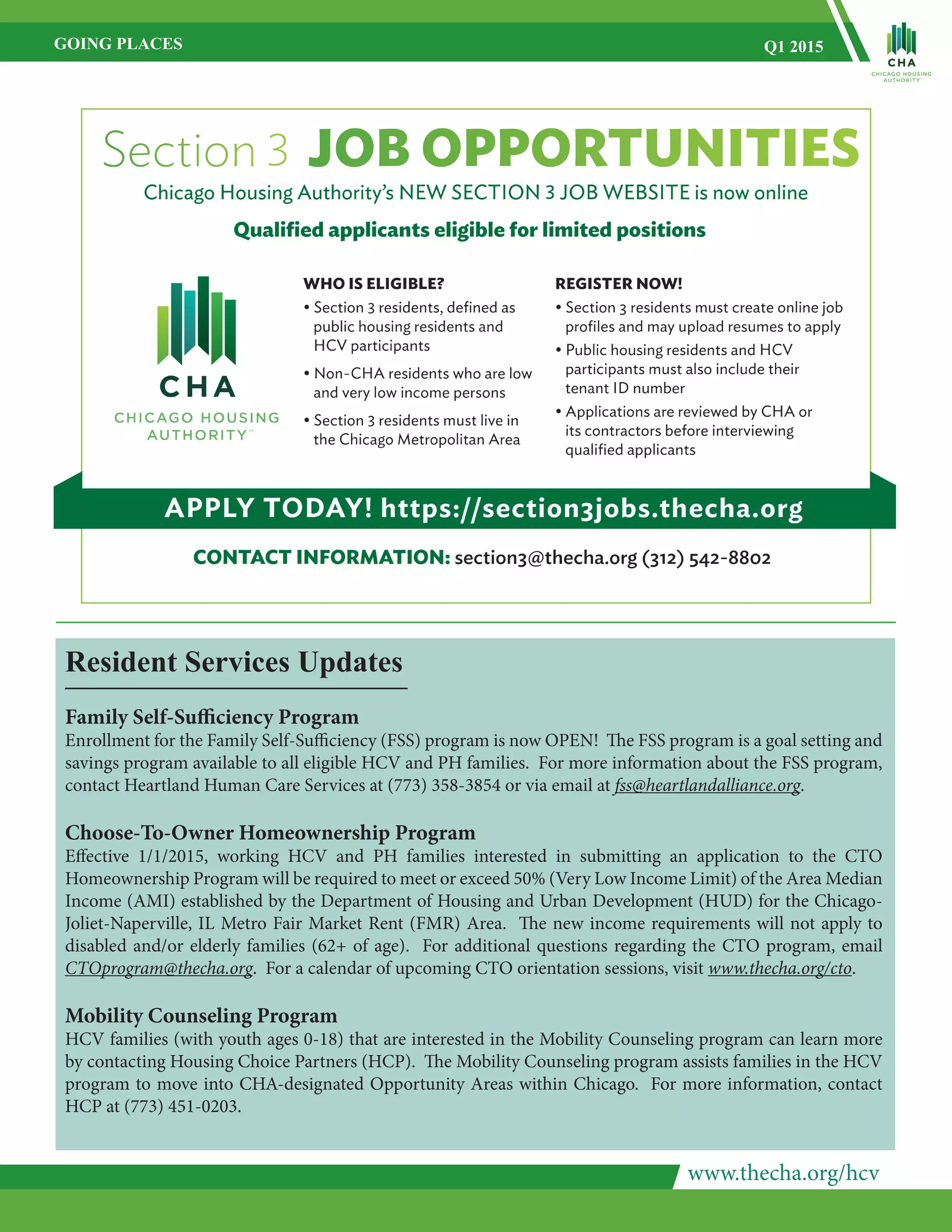
Effective 1/1/2015, working HCV and PH families interested in submitting an application to the CTO
Homeownership Program will be required to meet or exceed 50% (Very Low Income Limit) of the Area Median
Income (AMI) established by the Department of Housing and Urban Development (HUD) for the Chicago-
Joliet-Naperville, IL Metro Fair Market Rent (FMR) Area. The new income requirements will not apply to
disabled and/or elderly families (62+ of age). For additional questions regarding the CTO program, email
CTOprogram@thecha.org. For a calendar of upcoming CTO orientation sessions, visit www.thecha.org/cto.
Mobility Counseling Program
HCV families (with youth ages 0-18) that are interested in the Mobility Counseling program can learn more
by contacting Housing Choice Partners (HCP). The Mobility Counseling program assists families in the HCV
program to move into CHA-designated Opportunity Areas within Chicago. For more information, contact
HCP at (773) 451-0203.
60 E. VAN BUREN
CHICAGO, IL 60605
www.thecha.org/hcv
GOING PLACES Q1 2015
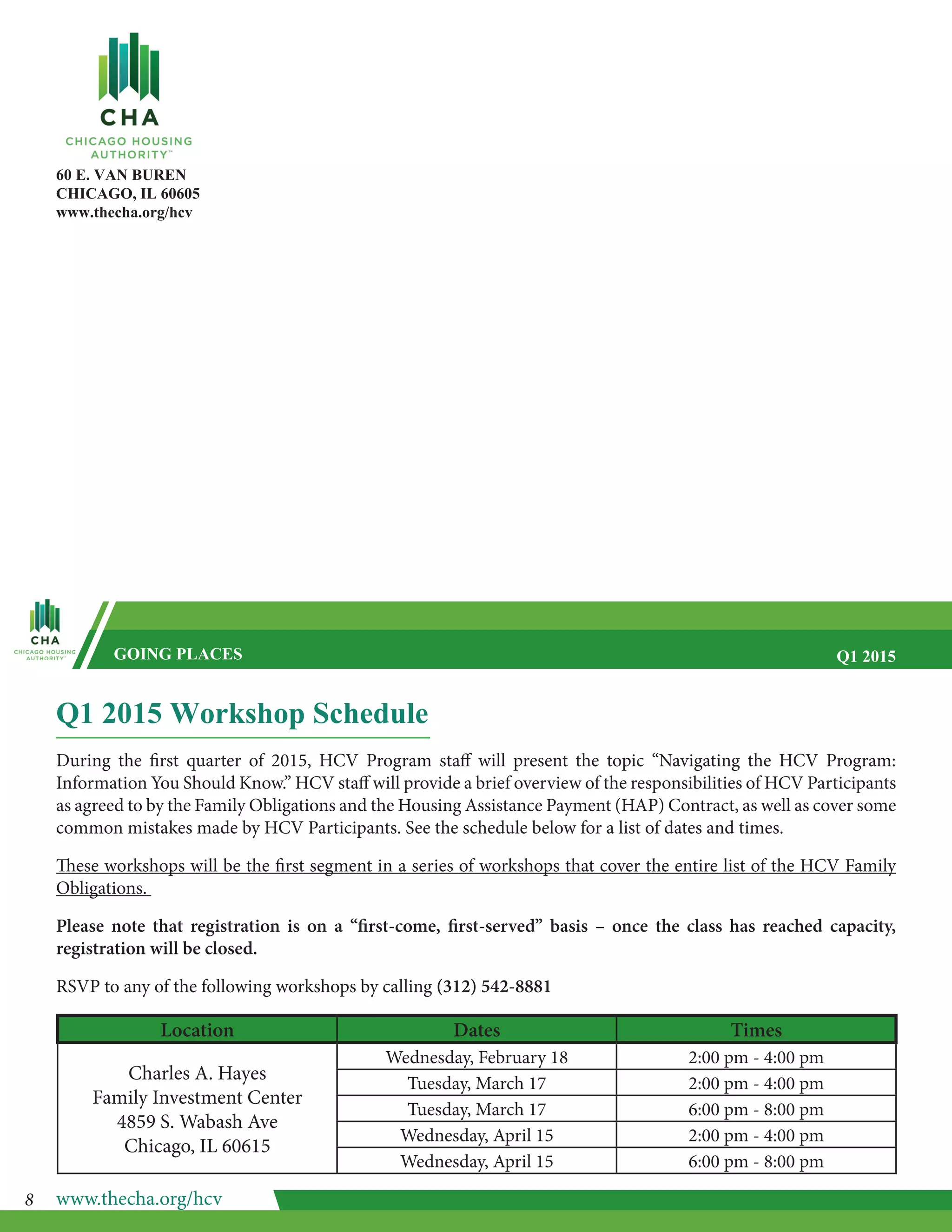
Q1 2015 Workshop Schedule
During the first quarter of 2015, HCV Program staff will present the topic “Navigating the HCV Program:
Information You Should Know.” HCV staff will provide a brief overview of the responsibilities of HCV Participants
as agreed to by the Family Obligations and the Housing Assistance Payment (HAP) Contract, as well as cover some
common mistakes made by HCV Participants. See the schedule below for a list of dates and times.
These workshops will be the first segment in a series of workshops that cover the entire list of the HCV Family
Obligations.
Please note that registration is on a “first-come, first-served” basis – once the class has reached capacity,
registration will be closed.
RSVP to any of the following workshops by calling (312) 542-8881
Location Dates Times
Charles A. Hayes
Family Investment Center
4859 S. Wabash Ave
Chicago, IL 60615
Wednesday, February 18 2:00 pm - 4:00 pm
Tuesday, March 17 2:00 pm - 4:00 pm
Tuesday, March 17 6:00 pm - 8:00 pm
Wednesday, April 15 2:00 pm - 4:00 pm
Wednesday, April 15 6:00 pm - 8:00 pm
www.thecha.org/hcv8

GoingPlacesQ12015_FINAL_CS4

  • 1.
    Q1 2015 PLACESGOINGA newsletterfor Participants in the Chicago Housing Authority Housing Choice Voucher Program Message From the CEO: 1 Dear HCV Participants, As we enter this new year, I am proud of the progress that CHA has made as we work to help build strong, vibrant communities throughout Chicago and support programs that improve access to education, important information, and resources. Building on the work of last year, we are increasing our focus on ensuring that families have access to important program-related information and resources. To start, we are scheduling free workshops throughout the year, featuring various topics and guest presenters, to assist you in navigating the HCV program and to aid you in enjoying the comfort of your home. Look for more communication about these workshops in the mail and at our regional offices. We are also improving the materials available in our resource centers, to provide you with information on housing options as well as health, career and educational resources. Let me take a moment to underscore our continued emphasis on education. Every year, dozens of public housing and Housing Choice Voucher students prepare for their journey into higher education at CHA’s annual “Take Flight” College Send-Off. Many receive scholarships from CHA’s college scholarship program, to attend some of the most prestigious schools in the nation, including Amherst, Cornell, Yale and Morehouse. This past year, thanks to a partnership with CNA Insurance Company, it was the largest Take Flight event ever. Early this year, some of those students returned for “Staying Power” – a retention check- in that focused on college resiliency, maximizing connections and building a professional network. The CHA college students reconvened and shared their stories from the first semester and garnered new resources before heading back to school for their second semester. Some of the helpful topics covered at the event included: summer classes at City Colleges of Chicago, Section 3 jobs, and maximizing financial aid. With such great enthusiasm at this year’s inaugural event, we look forward to the 5th annual “Take Flight” slated for this summer. That is just one of many CHA initiatives geared toward education. Besides the aforementioned CHA college scholarship program,whichoffersscholarshipsrangingfrom$1,000to$2,500forresidentsattendingaccreditedcollegesoruniversities, CHA public housing residents and HCV participants can obtain a degree or certificate from City Colleges of Chicago at low or no cost through a partnership between CHA and CCC. CHA helped almost 600 residents attend the City Colleges of Chicago in 2014 – a 16 percent increase from 2013. CHA also offers a range of educational and other opportunities for youth during out-of-school time. In all, CHA engaged more than 6,000 youth in academic, career and wellness/recreational programs in 2014. We expect to improve on that in 2015. For more information, check out the Youth Opportunities page at www.thecha.org. Sincerely, Michael R. Merchant In This Issue: • Message from the CEO • Meet New Board Member Francine Washington • Spring Cleaning Tips • Featured Participant Council Member • Good Tenants are Good Neighbors • Steps for Owner-Tenant Conflict Resolution • Participant Resources • Understanding Utility Responsibility • Resident Services Updates • Q1 2015 Workshop Schedule
  • 2.
    www.thecha.org/hcv GOING PLACES Q12015 Francine Washington was appointed to the Chicago Housing Authority Board of Commissioners in June 2014. A longtime and respected voice in the Chicago resident leadership community, Washington was recently elected as the President of the Central Advisory Council, and is also President of the Washington Park Local Advisory Committee. She has also served on many other important Boards in the city, including the Bronzeville Alliance, the National Public Housing Museum, and has served as at-large president of Stateway Gardens/Park Boulevard Local Advisory Council. She is also a member of the Stateway Associates Working Group. In her various roles, Washington has aggressively addressed important issues that affect communities and residents, such as community safety, building maintenance, and the need for public housing residents to be recognized and supported. She has also seen to it that CHA residents are healthy, serving as Director of the Summer Food Program, in which CHA residents are provided healthy meals free-of-charge. She has selected sites for the program, hired and trained staff, provided management and prepared applications, contracts and applications for the program. Please join CHA in welcoming Ms. Washington to the Board of Commissioners. Meet New Board Member Francine Washington Spring Cleaning Tips Though it may not seem like it, Spring will be here soon and tenants are encouraged to organize their units to get a fresh start with the new season and warmer weather. Cleaning an entire apartment can be overwhelming, but tenants can use the following tips to help make spring cleaning more enjoyable and effective: • Wash windows. Pick a cloudy day to wash windows, otherwise the cleaner will dry quickly and leave streaks. Rubber-edged squeegees are more effective than cloth or newspaper, but a paper towel will work just fine. If no window cleaner is available, mild dish soap will get the job done too. • Wash walls, cabinets, baseboards, and woodwork. Dust doesn’t always go straight to the floor. In addition to dusting all surfaces, walls, and ceiling fixtures, give them a good scrub-down as well. Be suretocleanunderneathfurnitureandappliancesaswell. • Clean light fixtures. Use a microfiber or lint-free cloth to dust fixtures and bulbs within reach. Use a damp cloth to wipe down light bulbs to ensure lights are shining bright; DO NOT make the metal coil wet – avoid that section with the damp cloth. • Get organized. Gather some containers and clean up any clutter in the bedrooms, living areas, kitchen, etc. Consider having a box for “garage sale” items, another box for “donation items,” and a garbage bag for items to be thrown away. • Make it fun. Playing music while cleaning is a great way to help pass the time and enjoy the chores. Tenants who have children can encourage them to help by making a game out of it by giving a “prize” to whoever finishes the chore quickest and most clean. By following these tips, tenants can ensure their apartments will be like new and will help them start fresh after winter.
  • 3.
    www.thecha.org/hcv GOING PLACES Q12015 HCV Participants search far and wide for the perfect apartment that they can afford – and when they find it, it almost seems like a miracle. When everything is moved in and the tenant has settled in to the unit, the experience could be ruined by a bad neighbor or two. CHA encourages HCV Participants to get along with not only their landlords, but also their neighbors. While people cannot control the behaviors and attitudes of others, they can control their own. HCV Participants already have guidelines such as the Family Obligations that can help them be great tenants – however, these guidelines can also help them be great neighbors as well. • Don’t damage the unit or premises – all tenants should respect the property on which they live, including the unit and areas around it. If a landlord cannot determine who is responsible for damaged property, all tenants living in the building or on the floor might be punished, and no one will be happy. Refer to the CHA Family Obligations section on pages 63-64 of the Participant Reference Guide for more information. Good Tenants are Good Neighbors • Don’t disturb the peaceful and quiet enjoyment of others – keep noise and music to a minimum or at least at a low volume. If pets are allowed on the property, control the pet’s noise-making (i.e. barking) as well. Make sure children, other family members, and guests are not disturbing the safety or peaceful and quiet enjoyment of others. • Don’t engage in criminal activity – illegal activity brings unwanted attention and company to the area. Tenants shouldn’t be put in danger due to the actions of a neighbor. • Take an active role – monitor what is going on in the household. Know what household members are doing in the residence. Tenants should consider joining or volunteering in an organization that promotes building safer communities. HCV Participants should keep in mind that CHA cannot mediate conflicts between tenants, but rather shares information and resources they can use to resolve their own conflicts and make sure they are being the best tenant they can be. Featured Participant Council Member: Janie Wilkie The Chicago Housing Authority Housing Choice Voucher (HCV) Program appointed Janie Wilke to the Participant Council in 2009. Ms. Wilke is involved in various organizations, including serving on the steering committee at Access Living, volunteering on the Tenants’ Rights Hotline at The Metropolitan Tenants Organization (MTO), and servingontheplanningcommitteeforChicagoHousing Initiative (CHI). Ms. Wilke has been recognized for her work within the community with two certificates for leadership and conflict resolution. Ms. Wilke tries to help other HCV Program Participants by reaching out to them and sharing information whenever she can. She also volunteers her time to help others learn more about computer use and develop technical skills to navigate the HCV Program online via the CHA website. Ms. Wilke is motivated by her personal mission to make change and learn more ways on how to accomplish that mission, including her work on the Participant Council. She appreciates the HCV Program for assisting low- income families with housing options. When asked what advice she has for first-time HCV Program Participants, Ms. Wilke encourages them to “Listen to what CHA is saying . . . become more of a team member, instead of a separate group, to help make things better.” CHA commends Ms. Wilke for her work within the community and on the Participant Council and supports her continued success.
  • 4.
    www.thecha.org/hcv GOING PLACES Q12015 Steps for Landlord-Tenant Conflict Resolution A positive Landlord-Tenant relationship is important when trying to develop a healthy and happy lifestyle. When landlords and tenants do not get along, the situation can be stressful for everyone involved. Conflict can make the simplest interactions much worse – for example, if a tenant needs repairs done to his or her unit, communication may be difficult if he or she does not get along with the landlord. CHA encourages landlords and tenants to resolve their issues whenever possible – hence, below are tips that tenants can use if he or she needs something in the unit repaired but are having trouble communicating with the landlord: • Is the tenant being a “good tenant”? Following the Family Obligations and cooperating with the landlord will help foster a positive relationship, which will improve understanding and communication among everyone involved. Refer to the article “Good Tenants are Good Neighbors” on the previous page for more information on how to be a good tenant. • Keep open lines of communication. Does the landlord have the most updated contact information for the tenant? Does the tenant have the most updated contact information for the landlord? Tenants should make sure they have the correct phone number or office address for the landlord, rather than assume he or she is avoiding them. • Keep calm. Don’t let emotions get in the way of a positive interaction with the landlord. Becoming angry or upset will keep both tenants and landlords from accomplishing the goal. • Hear the landlord out. There may be a good reason that the landlord hasn’t gotten around to the repair. He or she could be waiting for parts, dealing with other tenants, or working through a personal issue. It’s possible that the landlord has a to-do list to get through. Keep the above tips in mind while interacting with the landlord and notifying him or her of repairs needed. Below are steps to take if/when this happens. 1. Contact the Landlord. If something in the unit needs to be repaired, consult the landlord FIRST for repairs. Explain what the problem is and how important it is for this item to be repaired. For example, if the stove is not in service, consider the following: • Is it the stove? If the stove is provided by the landlord, the landlord is responsible for this repair. • Is it the gas service? On the other hand, cooking gas is usually considered the tenant’s responsibility – the landlord is usually not responsible for this repair. If the cooking gas in the unit is not working for whatever reason, and both the lease and the HAP contract state that the landlord is responsible for this utility, then it is up to the landlord to restore service. 2. Contact the CHA Inspections Department. If the landlord is not responding to phone calls, notes, etc. or does not fix the heat at all, then the tenant should request a complaint inspection. Since broken heat service is considered an emergency HQS fail item, CHA will send an inspector out to the unit within 24 hours to inspect the complaint. If the inspector determines the repair is the responsibility of the landlord, then the landlord will have 24 hours to repair the broken heat service and resolve the issue. 3. Notify CHA in writing. Keep track of any problem that may happen with the landlord, and how he or she handles it. CHA needs to know about any violations to ensure that the landlord is following the rules that apply to him or her as well. Tenants can also call the City of Chicago at 311. CHA aims to provide safe and decent living conditions for low-income families. HCV Participants can help with this mission by trying to work together with the landlord as a team, and resolving issues through avoiding conflict or using conflict resolution is both beneficial and crucial in achieving this goal.
  • 5.
    www.thecha.org/hcv GOING PLACES Q12015 Participant Resources Youth Programs Child Care Assistance Programs (CCAP) CCAP provides low-income, working families with access to quality, affordable child care that allows them to continue working. To apply, call 877-202-4453 or submit online application at www.dhs.state.il.us. School Age Child Care Program A subsidized child care program for children ages 5 to 12. Programs operate when school is not in session including afternoons, holidays, and breaks. To find a School Age Child Care Program near you, call 312-823-1100. Chicago Public Art Group Paid internships to paint murals in low-income communities. Please visit the website www.cpag.net or call 312-427-2724. Senior Services Y Active Older Adult Fitness Program The Southside YMCA offers a healthy living and fitness program located at 6300 Stony Island. For questions, call 773-947-0700. Chicago Fitness Plus Program Free Strength and Training classes offered twice a week at 48 locations around city of Chicago. Find your nearest location by calling the Chicago Department of Family and Support Services at 312-744-4016 Senior Citizen Rights Adult Protection Services Program assists people age 60 and older with disabilities who are victims of abuse, neglect, and financialexploitation.Call the Adult Protective Services hot line at 866-800-1409or888-206-1327(TTY). Youth Service Project YSP has many youth focused programs and job placements. Contact 773-772-6270. Youth programs for west side residents of Chicago. For more information, please visit www.chicagoareaproject.org orcall312-666-9552. After School Matters Apprentice or intern with ASM in sports, the arts, technology, and much more. All info and application is available online at www.afterschoolmatters.org. For any questions regarding the program, please call 312-742-4182. South Chicago Art Center The Art center provides free quality arts programs and experiences to youth in south Chicago. Please visit www.happyartcenter.org or call 773-731-9287.
  • 6.
    www.thecha.org/hcv GOING PLACES Q12015 Understanding Utility Responsibility When HCV Participants and their Property Owner/ Manager complete the HAP contract, it is up to the PropertyOwnertospecifywhichutilitiesandappliances he or she will be providing, and which ones will be the responsibility of the Participant. The Property Owner must also include this information intheleaseagreementsignedbytheParticipant.Inother words, when drafting the lease agreement to be signed by the participating family, the provided utilities must be specified and be consistent with what is indicated on the HAP contract. Any changes to the originally agreed upon utility responsibilities must first be approved in writing by CHA, and will require a new rent determination after the first year of the HAP contract/lease agreement. Changes cannot be made within the first year of the HAP contract/ lease agreement. The identified responsible party (Owner or Participant) must ensure that the utilities are on at all times. CHA’s mission to provide housing for low-income families includes sharing resources with HCV Participants to help cover the cost of utilities. Below is a list of Utility Assistance Programs: Low Income Home Energy Assistance Program (LIHEAP) 800-571-CEDA (2332) The Community and Economic Development Association (CEDA) administers local and federal grants for utility assistance via LIHEAP. LIHEAP provides energy assistance in the form of one-time payments to utility companies and individuals to assist with winter bills. ComEd CARE Energy Assistance Programs 888-806-CARE (2273) ComEd.com/CARE Residential Special Hardship Program • Provides a grant up to $1,500 for ComEd residential customers that identify a special hardship. This may include documented unexpected loss of employment, medical, military, senior, victim of criminal activity or disability hardships. • Customers can be eligible for Residential Special Hardship every two years. *Grant amounts may vary while funds are available.* ComEd Helps Activated/Disabled Military Personnel (CHAMP) • Provides bill payment assistance up to $1,000 for deployed activated military personnel and disabled veterans who have fallen behind on their bills and that reside within ComEd’s service territory. Applications are available on ComEd.com/CARE. Homelessness Prevention Call Center • Provides information and administer referrals to available homelessness prevention funds including state and local resources. • Funds provide rental, utility, and security deposit assistance to those on the brink of homelessness due to a recent, short-term crisis. Call 311 (312-744- 5000) and ask for “Short-Term Help.”
  • 7.
    www.thecha.org/hcv GOING PLACES Q12015 Resident Services Updates Family Self-Sufficiency Program Enrollment for the Family Self-Sufficiency (FSS) program is now OPEN! The FSS program is a goal setting and savings program available to all eligible HCV and PH families. For more information about the FSS program, contact Heartland Human Care Services at (773) 358-3854 or via email at fss@heartlandalliance.org. Choose-To-Owner Homeownership Program Effective 1/1/2015, working HCV and PH families interested in submitting an application to the CTO Homeownership Program will be required to meet or exceed 50% (Very Low Income Limit) of the Area Median Income (AMI) established by the Department of Housing and Urban Development (HUD) for the Chicago- Joliet-Naperville, IL Metro Fair Market Rent (FMR) Area. The new income requirements will not apply to disabled and/or elderly families (62+ of age). For additional questions regarding the CTO program, email CTOprogram@thecha.org. For a calendar of upcoming CTO orientation sessions, visit www.thecha.org/cto. Mobility Counseling Program HCV families (with youth ages 0-18) that are interested in the Mobility Counseling program can learn more by contacting Housing Choice Partners (HCP). The Mobility Counseling program assists families in the HCV program to move into CHA-designated Opportunity Areas within Chicago. For more information, contact HCP at (773) 451-0203.
  • 8.
    60 E. VANBUREN CHICAGO, IL 60605 www.thecha.org/hcv GOING PLACES Q1 2015 Q1 2015 Workshop Schedule During the first quarter of 2015, HCV Program staff will present the topic “Navigating the HCV Program: Information You Should Know.” HCV staff will provide a brief overview of the responsibilities of HCV Participants as agreed to by the Family Obligations and the Housing Assistance Payment (HAP) Contract, as well as cover some common mistakes made by HCV Participants. See the schedule below for a list of dates and times. These workshops will be the first segment in a series of workshops that cover the entire list of the HCV Family Obligations. Please note that registration is on a “first-come, first-served” basis – once the class has reached capacity, registration will be closed. RSVP to any of the following workshops by calling (312) 542-8881 Location Dates Times Charles A. Hayes Family Investment Center 4859 S. Wabash Ave Chicago, IL 60615 Wednesday, February 18 2:00 pm - 4:00 pm Tuesday, March 17 2:00 pm - 4:00 pm Tuesday, March 17 6:00 pm - 8:00 pm Wednesday, April 15 2:00 pm - 4:00 pm Wednesday, April 15 6:00 pm - 8:00 pm www.thecha.org/hcv8