The
                                      Go
                              Programming Language

                                     Part 2

                                      Rob Pike
                                   r@google.com
                                   October, 2009


Wednesday, October 21, 2009
Today’s Outline

                       Exercise
                        any questions?

                       Composite types
                        structures, arrays, slices, maps

                       Methods
                        they're not just for structs any more

                       Interfaces


Wednesday, October 21, 2009
Exercise

                Any questions?

                One nugget:
                     n0, n1 = n0+n1, n0
                or for a general binary operator
                     n0, n1 = op(n0, n1), n0


Wednesday, October 21, 2009
Composite types


Wednesday, October 21, 2009
Arrays

        Arrays are quite different from C arrays; more like
        Pascal arrays. (Slices, the next topic, act a little
        more like C arrays.)
             var ar [3]int
        declares ar to be an array of 3 integers, initially all
        set to 0.

        Size is part of the type.

        Built in function len() reports size:
             len(ar) == 3


Wednesday, October 21, 2009
Arrays are values
        Arrays are values, not implicit pointers as in C. You
        can take an array's address (for instance, to pass it
        efficiently to a function):
             func f(a [3]int) { fmt.Println(a) }
             func fp(a *[3]int) { fmt.Println(a) }

             func main() {
             
 var ar [3] int;
             
 f(ar);     // passes a copy of ar
             
 fp(&ar); // passes a pointer to ar
             }
        Output (Print[ln] knows about arrays!):
             [0 0 0]
             &[0 0 0]

Wednesday, October 21, 2009
Array literals

    All the composite types have similar syntax for
    creating values. For arrays the literal looks like this:

    Array of 3 integers:
         [3]int { 1, 2, 3 }

    Array of 10 integers, first three not zero:
         [10]int { 1, 2, 3 }

    Don't want to count? Use ... for the length:
         [...]int { 1, 2, 3 }

    Don't want to initialize them all? Use key:value pairs:
         [10]int { 2:1, 3:1, 5:1, 7:1 }

Wednesday, October 21, 2009
Pointers to array literals

   You can take the address of an array literal to get a
   pointer to a newly created instance:

       func fp(a *[3]int) { fmt.Println(a) }

       func main() {
       
 for i := 0; i < 3; i++ {


 fp(&[3]int{i, i*i, i*i*i})
       
 }
       }

   Output:
       &[0 0 0]
       &[1 1 1]
       &[2 4 8]
Wednesday, October 21, 2009
Slices
       A slice is a reference to a section of an array.
       Slices are used much more often than plain arrays.
       A slice is very cheap. (More about this soon.)
       A slice type looks like an array type without a size:
           var a []int
       len() returns the number of elements.
       Create a slice by "slicing" an array or slice:
           a = ar[7:9];
       Valid indexes of a will be 0, 1 and len(a)==2.
       Can also just assign an array pointer to a slice:
           a = &ar;           // same as a = ar[0:len(ar)]
Wednesday, October 21, 2009
A slice references an array
                   Conceptually:
                              type Slice struct {
                                base *elem_type;
                                len int;
                                cap int;
                              }

                    Array:

                        ar:        7 1 5 4 3 8 7 2 11 5 3


                     Slice:

        a=ar[7:9]: base=&ar[7] len=2                cap=4

Wednesday, October 21, 2009
Making slices
      Slice literals look like array literals without a size:
          var slice = []int{ 1,2,3,4,5 }
      What this does is create an array of length 5 and
      then create a slice to refer to it.

      We can also allocate a slice (and underlying array)
      with the built in function make():
          var s100 = make([]int, 100) // slice: 100 ints
      Why make not new? Because we need to make a slice,
      not just allocate the memory. Note make([]int)
      returns []int while new([]int) returns *[]int.

      make is used for slices, maps, and channels.
Wednesday, October 21, 2009
Slice capacity
   A slice refers to an underlying array, so there may be
   elements off the end of the slice that are present in the
   array.

   The built in function cap() (capacity) reports how long
   the slice can grow. After
       var ar = [10]int{0,1,2,3,4,5,6,7,8,9}
       var a = &ar[5:7] // reference to subarray {5,6}
   len(a) is 2 and cap(a) is 5. We can "reslice":
       a = a[0:4]             // ref of subarray {5,6,7,8}
   len(a) is now 4 but cap(a) is still 5.


Wednesday, October 21, 2009
Resizing a slice
   Slices can be used like growable arrays. Allocate one
   using make() with two numbers - length and capacity -
   and reslice as it grows:
       var sl = make([]int, 0, 100)       // len 0, cap 100

       func appendToSlice(i int, sl []int) []int {
         if len(sl) == cap(sl) { error(...) }
         n := len(sl);
         sl = sl[0:n+1]; // extend length by 1
         sl[n] = i;
         return sl
       }
   Thus sl's length is always the number of elements, but
   it grows as needed.
   This style is cheap and idiomatic in Go.
Wednesday, October 21, 2009
Slices are cheap
   Feel free to allocate and resize slices as required. They
   are cheap to pass around; no need to allocate.
   Remember they are references, so underlying storage
   can be modified.
   For instance, I/O uses slices, not counts:
       func Read(fd int, b []byte) int
       var buffer [100]byte
       for i := 0; i < 100; i++ {
         // Fill buffer one byte at a time.
         Read(fd, buffer[i:i+1]) // no allocation here
       }
   Split a buffer:
         header, data := buf[0:n], buf[n:len(buf)]
   Strings can be sliced too, with similar efficiency.

Wednesday, October 21, 2009
Maps

        Maps are another reference type. They are declared
        like this:
             var m map[string] float
        This declares a map indexed with key type string
        and value type float. It is analogous to the C++
        type *map<string,float> (note the *).

        On a map, len() returns the number of keys.


Wednesday, October 21, 2009
Map creation
       As with a slice, a map variable refers to nothing; you
       must put something in it before it can be used.

       Three ways.
       1) Literal: list of colon-separated key:value pairs
           m = map[string]float { "1":1, "pi":3.1415 }

       2) Creation
           m = make(map[string]float)    // make not new

       3) Assignment
           var m1 map[string]float
           m1 = m // m1 and m now refer to same map

Wednesday, October 21, 2009
Indexing a map

       m = map[string]float { "1":1, "pi":3.1415 }

       Access an element as a value:

           one   := m["1"]
           crash := m["not present"]       // error

       Set an element (setting twice updates value for key)

           m["2"] = 2;
           m["2"] = 3;        // mess with their heads


Wednesday, October 21, 2009
Testing existence
          To see if a key is present in the map, we use a
          multi-value assignment, the "comma ok" form:
              m = map[string]float { "1":1, "pi":3.1415 };
              var value float;
              var present bool;
              value, present = m[x];
          or idiomatically
              v, ok := m[x];      // hence, the "comma ok" form
          If x is present in the map, sets the boolean to true
          and the value to the entry for the key. If not, sets
          the boolean to false and the value to the zero for
          its type.

Wednesday, October 21, 2009
Deleting
          Deleting an entry in the map is a multi-variate
          assignment to the map entry:
              m = map[string]float { "1":1.0, "pi":3.1415 };
              var present bool;
              var value float;
              var x string = f();
              m[x] = v, present;
          If present is true, assigns v to the map; if present is
          false, deletes the entry for key x. So to delete an
          entry,

              m[x] = 0, false      // deletes entry for x


Wednesday, October 21, 2009
For and range
  The for loop has a special syntax for iterating over
  arrays, slices, maps (and more, as we'll see tomorrow).
        m := map[string]float { "1":1.0, "pi":3.1415 };
        for key, value := range m {
          fmt.Printf("key %s, value %gn", key, value)
        }
  With only one variable in the range, get the key:
        for key = range m {
          fmt.Printf("key %sn", key)
        }
  Variables can be assigned or := declared.

  For arrays and slices, get index and value.

Wednesday, October 21, 2009
Range over string
  A for using range on a string loops over Unicode code
  points, not bytes. (Use []byte for bytes). The string is
  assumed to contain UTF-8.

  The loop
        s := "[u00ffu754c]";
        for i, c := range s {
          fmt.Printf("%d:%c ", i, c)
        }

  Prints 0:[ 1:ÿ 3:              6:]

  If erroneous UTF-8 is encountered, the character is
  set to U+FFFD and the index advances by one byte.

Wednesday, October 21, 2009
Structs
          Structs should feel very familiar: simple
          declarations of data fields.

                var p struct { x, y float }

          More usual:

                type Point struct { x, y float }
                var p Point

          Structs allow the programmer to define the layout
          of memory.


Wednesday, October 21, 2009
Structs are values

        Structs are values and new(StructType) returns a
        pointer to a value.
              type Point struct { x, y float };
              var p Point;
              p.x = 7;
              p.y = 23.4;
              var pp *Point = new(Point);
              *pp = p;
              pp.x = Pi; // sugar for (*pp).x
        There is no -> notation for structure pointers. Go
        provides the indirection for you.


Wednesday, October 21, 2009
Making structs

        Structs are values so you can make a zeroed one
        just by declaring it.
        You can also allocate one with new().
              var p Point;         // zeroed value
              pp := new(Point);    // idiomatic allocation
        Struct literals have the expected syntax.
              p = Point{ 7.2, 8.4 }
              p = Point{ y:8.4, x:7.2 }
              pp := &Point{ 23.4, -1 }    // idiomatic

        As with arrays, taking the address of a struct literal
        gives the address of a newly created value.
        This last example is a constructor for *Point.
Wednesday, October 21, 2009
Exporting types and fields
         The fields (and methods, coming up soon) of a
         struct must start with an Uppercase letter to be
         visible outside the package.
         Private type and fields:
              type point struct { x, y float }
         Exported type and fields:
              type Point struct { X, Y float }
         Exported type with mix of fields:
              type Point struct {
                X, Y float;  // exported
                name string; // not exported
              }
         You may even have a private type with exported
         fields. Exercise: why is that useful?
Wednesday, October 21, 2009
Anonymous fields
      Inside a struct, you can declare fields, such as
      another struct, without giving a name for the field.
      These are called anonymous fields and they act as if
      the inner struct is simply inserted or "embedded"
      into the outer.

      This simple mechanism provides a way to derive
      some or all of your implementation from another
      type or types.

      An example follows.


Wednesday, October 21, 2009
An anonymous struct field
          type           A struct {
            ax,          ay int
          }
          type           B struct {
            A;
            bx,               by float;
          }
     B acts as if it has four fields, ax, ay, bx, and by. It's
     almost as if B is { ax, ay int; bx, by float }.
     However, literals for B must be filled out in detail:
          b := B{ A{ 1, 2 }, 3.0, 4.0 };
          fmt.Println(b.ax, b.ay, b.bx, b.by);
     Prints 1 2 3 4


Wednesday, October 21, 2009
Anonymous fields have type as name
     But it's richer than simple interpolation of the fields:
     B also has a field A. The anonymous field looks like
     a field whose name is its type.
          b := B{ A{ 1, 2 }, 3.0, 4.0 };
          fmt.Println(b.A);
     Prints {1 2}. If A came from another package, the
     field would still be called A:
          import "pkg"
          type C struct { pkg.A }
          ...
          c := C { pkg.A{ 1, 2 } };
          fmt.Println(c.A); // not c.pkg.A


Wednesday, October 21, 2009
Anonymous fields of any type
              Any named type, or pointer to one, may be
              used in an anonymous field and it may
              appear at any location in the struct.

                  type C struct {
                    x float;
                    int;
                    string;
                  }

                  c := C{ 3.5, 7, “hello” };
                  fmt.Println(c.x, c.int, c.string)

              Prints 3.5 7 hello

Wednesday, October 21, 2009
Conflicts and hiding

     If there are two fields with the same name (possibly
     a type-derived name), these rules apply:

     1) An outer name hides an inner name.
         This provides a way to override a field/method.

     2) If the same name appears twice at the same level,
     it is an error if the name is used by the program. (If
     it's not used, it doesn't matter.)
         No rules to resolve the ambiguity; it must be fixed.


Wednesday, October 21, 2009
Conflict examples
          type A struct { a int }
          type B struct { a, b int }

          type C struct { A; B }
          var c C;

      Using c.a is an error: is it c.A.a or c.B.a?

          type D struct { B; b float }
          var d D;

      Using d.b is OK: it's the float, not d.B.b
      Can get at the inner b by D.B.b.


Wednesday, October 21, 2009
Methods


Wednesday, October 21, 2009
Methods on structs

       Go has no classes, but you can attach methods to
       any type. Yes, (almost) any type. The methods are
       declared, separate from the type declaration, as
       functions with an explicit receiver. The obvious
       struct case:
           type Point struct { x, y float }
           // A method on *Point
           func (p *Point) Abs() float {
             return math.Sqrt(p.x*p.x + p.y*p.y)
           }
       Note: explicit receiver (no this), in this case of type
       *Point, used within the method.


Wednesday, October 21, 2009
Methods on struct values

     A method does not require a pointer as a receiver.
         type Point3 struct { x, y, z float }

         // A method on Point3
         func (p Point3) Abs() float {
           return math.Sqrt(p.x*p.x + p.y*p.y + p.z*p.z)
         }

     This is a bit expensive, because the Point3 will always
     be passed to the method by value, but it is valid Go.


Wednesday, October 21, 2009
Invoking a method
                   Just as you expect.
                       p := &Point{ 3, 4 };
                       fmt.Print(p.Abs()); // will print 5

                   A non-struct example:
                       type IntVector []int
                       func (v IntVector) Sum() (s int) {
                         for i, x := range v {
                           s += x
                         }
                         return
                       }

                       fmt.Println(IntVector{1, 2, 3}.Sum())

Wednesday, October 21, 2009
Ground rules for methods
     Methods are attached to a named type, say Foo, and
     are statically bound.

     The type of a receiver in a method can be either *Foo
     or Foo. You can have some Foo methods and some
     *Foo methods.

     Foo itself cannot be a pointer type, although the
     methods can have receiver type *Foo.

     The type Foo must be defined in the same package as
     all its methods.


Wednesday, October 21, 2009
Pointers and values

     Go automatically indirects/dereferences values for
     you when invoking methods.
     For instance, even though a method has receiver type
     *Point you can invoke it on an addressable value of
     type Point.
         p1 := Point{ 3, 4 };
         fmt.Print(p1.Abs());         // sugar for (&p1).Abs()
     Similarly, if methods are on Point3 you can use a
     value of type *Point3:
         p3 := &Point3{ 3, 4, 5 };
         fmt.Print(p3.Abs()); // sugar for (*p3).Abs()


Wednesday, October 21, 2009
Methods on anonymous fields

       Naturally, when an anonymous field is embedded in
       a struct, the methods of that type are embedded as
       well - in effect, it inherits the methods.

       This mechanism offers a simple way to emulate
       some of the effects of subclassing and inheritance.


Wednesday, October 21, 2009
Anonymous field example

          type Point struct { x, y float }
          func (p *Point) Abs() float { ... }

          type NamedPoint struct {
            Point;
            name string;
          }

          n := &NamedPoint{Point{3, 4}, "Pythagoras"};
          fmt.Println(n.Abs()); // prints 5


Wednesday, October 21, 2009
Overriding a method
       Overriding works just as with fields.
            type NamedPoint struct {
              Point;
              name string;
            }
            func (n *NamedPoint) Abs() float {
              return n.Point.Abs() * 100.
            }

            n := &NamedPoint{Point{3, 4}, "Pythagoras"};
            fmt.Println(n.Abs()); // prints 500
       Of course you can have multiple anonymous fields
       with various types - a simple version of multiple
       inheritance. The conflict resolution rules keep
       things simple, though.
Wednesday, October 21, 2009
Another example
     A more compelling use of an anonymous field.
         type Mutex struct { ... }
         func (m *Mutex) Lock() { ... }

         type Buffer struct {
           data [100]byte;
           Mutex; // need not be first in Buffer
         }
         var buf = new(Buffer);
         buf.Lock(); // == buf.Mutex.Lock()

     Note that Lock's receiver is (the address of) the
     Mutex field, not the surrounding structure.
     (Contrast to subclassing or Lisp mix-ins.)

Wednesday, October 21, 2009
Other types
         Methods are not just for structs. They can be
         defined for any (non-pointer) type.
         The type must be defined in your package though.
         You can't write a method for int but you can
         declare a new int type and give it methods.
              type Day int

              var dayName = []string {
                 "Monday", "Tuesday", "Wednesday", ...
               }

              func (day Day) String() string {
                return dayName[day]
              }

Wednesday, October 21, 2009
Other types
  Now we have an enum-like type that knows how to
  print itself.

      const (
        Monday Day = iota;
        Tuesday;
        Wednesday;
        ...
      )

      var day = Tuesday;
      fmt.Print(day.String());      // prints Tuesday


Wednesday, October 21, 2009
Print() understands String()
  By techniques to be divulged soon, fmt.Print[ln] can
  identify values that implement the method String()
  as we defined for type Day. Such values are
  automatically formatted by invoking the method.
  Thus:

      fmt.Println(0, Monday, 1, Tuesday)

  prints 0 Monday 1 Tuesday.

  Println can tell a plain 0 from a 0 of type Day.

  So define a String() method for your types and they
  will print nicely with no more work.

Wednesday, October 21, 2009
Visibility of fields and methods

     Go is very different from C++ in the area of visibility.
     The rules:

     1) Go has package scope (C++ has file scope).
     2) Spelling determines exported/local (pub/priv).
     3) Structs in the same package have full access to one
     another's fields and methods.
     4) Local type can export its fields and methods.
     5) No true subclassing, so no notion of protected.

     These simple rules seem to work well in practice.


Wednesday, October 21, 2009
Interfaces


Wednesday, October 21, 2009
Watch closely

         We are about to look at Go's most unusual aspect:
         the interface.

         Please leave your preconceptions at the door.


Wednesday, October 21, 2009
Introduction

         So far, all the types we have examined have been
         concrete: they implement something.

         There is one more type to consider: the interface
         type. It is completely abstract; it implements
         nothing. Instead, it specifies a set of properties an
         implementation must provide.

         Interface as a concept is very close to that of Java,
         and Java has an interface type, but the "interface
         value" of Go is novel.


Wednesday, October 21, 2009
Definition of an interface

         The word "interface" is a bit overloaded in Go:
         there is the concept of an interface, and there is
         an interface type, and then there are values of that
         type. First, the concept.

         Definition:
          An interface is a set of methods.

         To turn it around, the methods implemented by a
         concrete type such as a struct form the interface
         of that type.


Wednesday, October 21, 2009
Example
         We saw this simple type before:
             type Point struct { x, y float }
             func (p *Point) Abs() float { ... }
         The interface of type Point is just one method:
               Abs() float

         It's not
               func (p *Point) Abs() float
         because the interface abstracts away the receiver.

         We embedded Point in a new type, NamedPoint;
         NamedPoint has the same interface.


Wednesday, October 21, 2009
The interface type
   An interface type is a specification of an interface, a
   set of methods implemented by some other types.
   Here's a simple one, with only one method:
         type AbsInterface interface {
           Abs() float // receiver is implied
         }

   This is a definition of the interface implemented by
   Point, or in our terminology,
         Point implements AbsInterface
   Also,
         NamedPoint and Point3 implement AbsInterface

   Methods are listed inside the type, not outside.
Wednesday, October 21, 2009
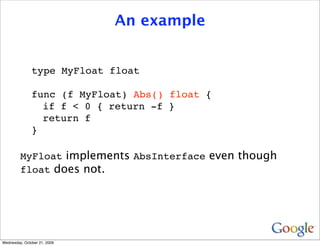
An example


               type MyFloat float

               func (f MyFloat) Abs() float {
                 if f < 0 { return -f }
                 return f
               }

         MyFloat implements AbsInterface even though
         float does not.


Wednesday, October 21, 2009
Many to many
         An interface may be implemented by an arbitrary
         number of types. AbsInterface is implemented by
         any type that has a method Abs() float,
         regardless of what other methods that type may
         have.
         A type may implement an arbitrary number of
         interfaces. Point implements at least these two:
               type AbsInterface interface { Abs() float }
               type EmptyInterface interface { }
         And perhaps more, depending on its methods.

         Every type implements EmptyInterface. That will
         come in handy.

Wednesday, October 21, 2009
Interface value
   Once a variable is declared with interface type, it may
   store any value that implements that interface.
         var ai AbsInterface;
         pp        := new(Point);
         ai        = pp; // OK: *Point has Abs()
         ai        = 7.; // compile-time err: float has no Abs()
         ai        = MyFloat(-7.); // OK: MyFloat has Abs()
         ai = &Point{ 3, 4 };
         fmt.Printf(ai.Abs());         // method call
   Prints 5.
   Note: ai is not a pointer.


Wednesday, October 21, 2009
In memory
  ai is not a pointer! It's a multiword data structure.

                                receiver    method
                          ai:
                                 value     table ptr

        At different times it has different value and type:
      ai = &Point{3,4} (==(*Point)(0xff1234)):
                                            (*Point) Abs() float
               0xff1234
                                                       ...

      ai = MyFloat(-7.):
                                            (MyFloat) Abs() float
                       -7.
                                                       ...

Wednesday, October 21, 2009
Three important facts
      1) Interfaces define sets of methods. They are pure
      and abstract: no implementation, no data fields. Go
      has a clear separation between interface and
      implementation.

      2) Interface values are just that: values. They
      contain any concrete value that implements all the
      methods defined in the interface. That value may or
      may not be a pointer.

      3) Types implement interfaces just by having
      methods. They do not have to declare that they do
      so. For instance, every type implements
      EmptyInterface.

Wednesday, October 21, 2009
Example: io.Writer
  Here is the actual signature of fmt.Fprintf:
        func Fprintf(w io.Writer, format string, a ...)
                    (n int, error os.Error)
  It doesn't write to a file, it writes to something of type
  io.Writer, that is, Writer defined in the io package:
        type Writer interface {
        
 Write(p []byte) (n int, err os.Error)
        }

  Fprintf can therefore be applied to any type that has
  a canonical Write method, including files, pipes,
  network connections, and...


Wednesday, October 21, 2009
Buffered I/O
   ... a write buffer. This is from the bufio package:
         type Writer struct { ... }
   bufio.Writer implements the canonical Write method.
         func (b *Writer) Write(p []byte)
                               (nn int, err os.Error)
   It also has a factory: give it an io.Writer, it will return
   a buffered io.Writer in the form of a bufio.Writer:
         func NewWriter(wr io.Writer)
                       (b *Writer, err os.Error)

   And of course, os.File implements Write too.


Wednesday, October 21, 2009
Putting it together
         import (
           "bufio"; "fmt"; "os"
         )
         func main() {
           // unbuffered
           fmt.Fprintf(os.Stdout, "%s, ", "hello");
           // buffered: os.Stdout implements io.Writer
           buf, err := bufio.NewWriter(os.Stdout);
           // and now so does buf.
           fmt.Fprintf(buf, "%sn", "world!");
         }

   Buffering works for anything that Writes.

   Feels almost like Unix pipes, doesn't it? The
   composability is powerful; see crypto packages.
Wednesday, October 21, 2009
Other public interfaces in io
   The io package has:

         Reader
         Writer
         ReadWriter
         ReadWriteCloser

   These are stylized interfaces but obvious: they capture
   the functionality of anything implementing the
   functions listed in their names.

   This is why we can have a buffered I/O package with
   an implementation separate from the I/O itself: it both
   accepts and provides interface values.

Wednesday, October 21, 2009
Comparison
   In C++ terms, an interface type is like a pure abstract
   class, specifying the methods but implementing none
   of them.

   In Java terms, an interface type is much like a Java
   interface.

   However, in Go there is a major difference:
    A type does not need to declare the interfaces it
    implements or to inherit from an interface type;
    if it has the methods, it implements the interface.

   Some other differences will become apparent.


Wednesday, October 21, 2009
Anonymous fields work too
         type LockedBufferedWriter struct {
           Mutex; // has Lock and Unlock methods
           bufio.Writer; // has Write method
         }

         func (l *LockedBufferedWriter) Write(p []byte)
                                (nn int, err os.Error) {
           l.Lock();
           defer l.Unlock();
           return l.Writer.Write(p); // inner Write()
         }

   LockedBufferedWriter implements io.Writer, but also,
   through the anonymous Mutex,

         type Locker interface { Lock(); Unlock() }
Wednesday, October 21, 2009
Example: HTTP service
         type Handler interface {
         
 ServeHTTP(*Conn, *Request)
         }
   This is the interface defined by the HTTP server
   package. To serve HTTP, define a type that
   implements this interface and connect it to the server
   (details omitted).
         type Counter struct {
         
 n int // or could just say type Counter int
         }

         func (ctr *Counter) ServeHTTP(c *http.Conn,
                                     req *http.Request) {
         
 fmt.Fprintf(c, "counter = %dn", ctr.n);
         
 ctr.n++;
         }
Wednesday, October 21, 2009
A function (type) that serves HTTP
         func notFound(c *Conn, req *Request) {
           c.SetHeader("Content-Type", "text/plain;"
                                       "charset=utf-8");
           c.WriteHeader(StatusNotFound);
           c.WriteString("404 page not foundn");
         }
   Now we define a type to implement ServeHTTP:
         type HandlerFunc func(*Conn, *Request)
         func (f HandlerFunc) ServeHTTP(c *Conn, req
                                        *Request) {
         
 f(c, req) // the receiver's a func; call it
         }

   Convert function to attach method, implement the
   interface:
         var Handle404 = HandlerFunc(notFound);
Wednesday, October 21, 2009
Containers & the empty interface
   Sketch of the implementation of vectors:
         type Element interface {}

         // Vector is the container itself.
         type Vector struct {
         
 a []Element
         }

         // At() returns the i'th element.
         func (p *Vector) At(i int) Element {
         
 return p.a[i]
         }
   Vectors can contain anything because any type
   implements the empty interface. (In fact every element
   could be of different type.)
Wednesday, October 21, 2009
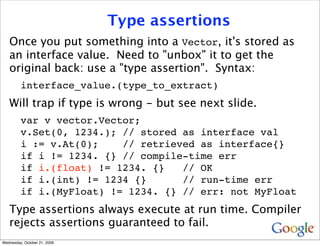
Type assertions
   Once you put something into a Vector, it's stored as
   an interface value. Need to "unbox" it to get the
   original back: use a "type assertion". Syntax:
         interface_value.(type_to_extract)
   Will trap if type is wrong - but see next slide.
         var v vector.Vector;
         v.Set(0, 1234.); // stored as interface val
         i := v.At(0);    // retrieved as interface{}
         if i != 1234. {} // compile-time err
         if i.(float) != 1234. {}   // OK
         if i.(int) != 1234 {}      // run-time err
         if i.(MyFloat) != 1234. {} // err: not MyFloat
   Type assertions always execute at run time. Compiler
   rejects assertions guaranteed to fail.
Wednesday, October 21, 2009
Interface to interface conversion

   So far we've only moved regular values into and out of
   interface values, but interface values that contain the
   appropriate methods can also be converted.

   In effect, it's the same as unboxing the interface value
   to extract the underlying concrete value, then boxing
   it again for the new interface type.

   The conversion's success depends on the underlying
   value, not the original interface type.


Wednesday, October 21, 2009
Interface to interface example
   Given
         var ai AbsInterface
         type SqrInterface interface { Sqr() float }
         var si SqrInterface
         pp := new(Point) // say *Point has Abs, Sqr
         var empty interface{}
   These are all OK
         empty = pp; // everything satisfies empty
         ai = empty.(AbsInterface); // underlying
                      // value implements Abs()
                      // (runtime failure otherwise)
         si = ai.(SqrInterface); // *Point has Sqr()
                      // even though AbsInterface doesn't
         empty = si; // *Point implements empty set
                      // Note: statically checkable
                      // so type assertion not necessary.

Wednesday, October 21, 2009
Testing with type assertions

   Can use "comma ok" type assertions to test a value for
   type.
         elem := vector.At(0);
         if i, ok := elem.(int); ok {
           fmt.Printf("int: %dn", i)
         }
         else if f, ok := elem.(float); ok {
           fmt.Printf("float: %gn", f)
         }
         else {
           fmt.Print("unknown typen")
         }


Wednesday, October 21, 2009
Testing with a type switch

   Special syntax:

         switch v := elem.(type) { // literal "type"
         case int:
           fmt.Printf("is int: %dn", v);
         case float:
           fmt.Printf("is float: %gn", v);
         default:
           fmt.Print("unknown typen");
         }


Wednesday, October 21, 2009
Does v implement m()?

   Going one step further, can test whether a value
   implements a method.

         type Stringer interface { String() string }

         if sv, ok := v.(Stringer); ok {
           fmt.Printf("implements String(): %sn",
                      sv.String()); // note: sv not v
         }

   This is how Print etc. check if type can print itself.


Wednesday, October 21, 2009
Reflection and ...

   There is a reflection package ("reflect") that builds
   on these ideas to let you examine values to discover
   their type. Too intricate to describe here but Printf
   etc. use it to unpack the ... arguments.

         func Printf(format string, args ...)
                    (n int, err os.Error)

   The ... argument inside Printf (or anywhere else) has
   type interface{}, and Printf uses the reflection
   package to unpack it and discover the argument list.


Wednesday, October 21, 2009
Reflection and Print
   As a result, Printf and its friends know the actual
   types of their arguments. Because they know if the
   argument is unsigned or long, there is no %u or %ld,
   only %d.
   This is also how Print and Println can print the
   arguments nicely without a format string.
   There is also a %v ("value") format that gives default
   nice output from Printf for values of any type.
         fmt.Printf("%v %v %v %v", -1, "hello",
                    []int{1,2,3}, uint64(456))
   Prints -1 hello [1,2,3] 456.
   In fact, %v is identical to the formatting done by Print
   and Println.

Wednesday, October 21, 2009
Exercise


Wednesday, October 21, 2009
Exercise: Day 2


               Look at the http package.

               Write an HTTP server to present pages in the
               file system, but transformed somehow,
               perhaps rot13, perhaps something more
               imaginative. Can you make the
               transformation substitutable? Can you work
               in your Fibonacci program somehow?


Wednesday, October 21, 2009
Next lesson


               Concurrency and communication


Wednesday, October 21, 2009
The
                                      Go
                              Programming Language

                                     Part 2

                                      Rob Pike
                                   r@google.com
                                   October, 2009


Wednesday, October 21, 2009

Go Course Day2

  • 1.
    The Go Programming Language Part 2 Rob Pike r@google.com October, 2009 Wednesday, October 21, 2009
  • 2.
    Today’s Outline Exercise any questions? Composite types structures, arrays, slices, maps Methods they're not just for structs any more Interfaces Wednesday, October 21, 2009
  • 3.
    Exercise Any questions? One nugget: n0, n1 = n0+n1, n0 or for a general binary operator n0, n1 = op(n0, n1), n0 Wednesday, October 21, 2009
  • 4.
  • 5.
    Arrays Arrays are quite different from C arrays; more like Pascal arrays. (Slices, the next topic, act a little more like C arrays.) var ar [3]int declares ar to be an array of 3 integers, initially all set to 0. Size is part of the type. Built in function len() reports size: len(ar) == 3 Wednesday, October 21, 2009
  • 6.
    Arrays are values Arrays are values, not implicit pointers as in C. You can take an array's address (for instance, to pass it efficiently to a function): func f(a [3]int) { fmt.Println(a) } func fp(a *[3]int) { fmt.Println(a) } func main() { var ar [3] int; f(ar); // passes a copy of ar fp(&ar); // passes a pointer to ar } Output (Print[ln] knows about arrays!): [0 0 0] &[0 0 0] Wednesday, October 21, 2009
  • 7.
    Array literals All the composite types have similar syntax for creating values. For arrays the literal looks like this: Array of 3 integers: [3]int { 1, 2, 3 } Array of 10 integers, first three not zero: [10]int { 1, 2, 3 } Don't want to count? Use ... for the length: [...]int { 1, 2, 3 } Don't want to initialize them all? Use key:value pairs: [10]int { 2:1, 3:1, 5:1, 7:1 } Wednesday, October 21, 2009
  • 8.
    Pointers to arrayliterals You can take the address of an array literal to get a pointer to a newly created instance: func fp(a *[3]int) { fmt.Println(a) } func main() { for i := 0; i < 3; i++ { fp(&[3]int{i, i*i, i*i*i}) } } Output: &[0 0 0] &[1 1 1] &[2 4 8] Wednesday, October 21, 2009
  • 9.
    Slices A slice is a reference to a section of an array. Slices are used much more often than plain arrays. A slice is very cheap. (More about this soon.) A slice type looks like an array type without a size: var a []int len() returns the number of elements. Create a slice by "slicing" an array or slice: a = ar[7:9]; Valid indexes of a will be 0, 1 and len(a)==2. Can also just assign an array pointer to a slice: a = &ar; // same as a = ar[0:len(ar)] Wednesday, October 21, 2009
  • 10.
    A slice referencesan array Conceptually: type Slice struct { base *elem_type; len int; cap int; } Array: ar: 7 1 5 4 3 8 7 2 11 5 3 Slice: a=ar[7:9]: base=&ar[7] len=2 cap=4 Wednesday, October 21, 2009
  • 11.
    Making slices Slice literals look like array literals without a size: var slice = []int{ 1,2,3,4,5 } What this does is create an array of length 5 and then create a slice to refer to it. We can also allocate a slice (and underlying array) with the built in function make(): var s100 = make([]int, 100) // slice: 100 ints Why make not new? Because we need to make a slice, not just allocate the memory. Note make([]int) returns []int while new([]int) returns *[]int. make is used for slices, maps, and channels. Wednesday, October 21, 2009
  • 12.
    Slice capacity A slice refers to an underlying array, so there may be elements off the end of the slice that are present in the array. The built in function cap() (capacity) reports how long the slice can grow. After var ar = [10]int{0,1,2,3,4,5,6,7,8,9} var a = &ar[5:7] // reference to subarray {5,6} len(a) is 2 and cap(a) is 5. We can "reslice": a = a[0:4] // ref of subarray {5,6,7,8} len(a) is now 4 but cap(a) is still 5. Wednesday, October 21, 2009
  • 13.
    Resizing a slice Slices can be used like growable arrays. Allocate one using make() with two numbers - length and capacity - and reslice as it grows: var sl = make([]int, 0, 100) // len 0, cap 100 func appendToSlice(i int, sl []int) []int { if len(sl) == cap(sl) { error(...) } n := len(sl); sl = sl[0:n+1]; // extend length by 1 sl[n] = i; return sl } Thus sl's length is always the number of elements, but it grows as needed. This style is cheap and idiomatic in Go. Wednesday, October 21, 2009
  • 14.
    Slices are cheap Feel free to allocate and resize slices as required. They are cheap to pass around; no need to allocate. Remember they are references, so underlying storage can be modified. For instance, I/O uses slices, not counts: func Read(fd int, b []byte) int var buffer [100]byte for i := 0; i < 100; i++ { // Fill buffer one byte at a time. Read(fd, buffer[i:i+1]) // no allocation here } Split a buffer: header, data := buf[0:n], buf[n:len(buf)] Strings can be sliced too, with similar efficiency. Wednesday, October 21, 2009
  • 15.
    Maps Maps are another reference type. They are declared like this: var m map[string] float This declares a map indexed with key type string and value type float. It is analogous to the C++ type *map<string,float> (note the *). On a map, len() returns the number of keys. Wednesday, October 21, 2009
  • 16.
    Map creation As with a slice, a map variable refers to nothing; you must put something in it before it can be used. Three ways. 1) Literal: list of colon-separated key:value pairs m = map[string]float { "1":1, "pi":3.1415 } 2) Creation m = make(map[string]float) // make not new 3) Assignment var m1 map[string]float m1 = m // m1 and m now refer to same map Wednesday, October 21, 2009
  • 17.
    Indexing a map m = map[string]float { "1":1, "pi":3.1415 } Access an element as a value: one := m["1"] crash := m["not present"] // error Set an element (setting twice updates value for key) m["2"] = 2; m["2"] = 3; // mess with their heads Wednesday, October 21, 2009
  • 18.
    Testing existence To see if a key is present in the map, we use a multi-value assignment, the "comma ok" form: m = map[string]float { "1":1, "pi":3.1415 }; var value float; var present bool; value, present = m[x]; or idiomatically v, ok := m[x]; // hence, the "comma ok" form If x is present in the map, sets the boolean to true and the value to the entry for the key. If not, sets the boolean to false and the value to the zero for its type. Wednesday, October 21, 2009
  • 19.
    Deleting Deleting an entry in the map is a multi-variate assignment to the map entry: m = map[string]float { "1":1.0, "pi":3.1415 }; var present bool; var value float; var x string = f(); m[x] = v, present; If present is true, assigns v to the map; if present is false, deletes the entry for key x. So to delete an entry, m[x] = 0, false // deletes entry for x Wednesday, October 21, 2009
  • 20.
    For and range The for loop has a special syntax for iterating over arrays, slices, maps (and more, as we'll see tomorrow). m := map[string]float { "1":1.0, "pi":3.1415 }; for key, value := range m { fmt.Printf("key %s, value %gn", key, value) } With only one variable in the range, get the key: for key = range m { fmt.Printf("key %sn", key) } Variables can be assigned or := declared. For arrays and slices, get index and value. Wednesday, October 21, 2009
  • 21.
    Range over string A for using range on a string loops over Unicode code points, not bytes. (Use []byte for bytes). The string is assumed to contain UTF-8. The loop s := "[u00ffu754c]"; for i, c := range s { fmt.Printf("%d:%c ", i, c) } Prints 0:[ 1:ÿ 3: 6:] If erroneous UTF-8 is encountered, the character is set to U+FFFD and the index advances by one byte. Wednesday, October 21, 2009
  • 22.
    Structs Structs should feel very familiar: simple declarations of data fields. var p struct { x, y float } More usual: type Point struct { x, y float } var p Point Structs allow the programmer to define the layout of memory. Wednesday, October 21, 2009
  • 23.
    Structs are values Structs are values and new(StructType) returns a pointer to a value. type Point struct { x, y float }; var p Point; p.x = 7; p.y = 23.4; var pp *Point = new(Point); *pp = p; pp.x = Pi; // sugar for (*pp).x There is no -> notation for structure pointers. Go provides the indirection for you. Wednesday, October 21, 2009
  • 24.
    Making structs Structs are values so you can make a zeroed one just by declaring it. You can also allocate one with new(). var p Point; // zeroed value pp := new(Point); // idiomatic allocation Struct literals have the expected syntax. p = Point{ 7.2, 8.4 } p = Point{ y:8.4, x:7.2 } pp := &Point{ 23.4, -1 } // idiomatic As with arrays, taking the address of a struct literal gives the address of a newly created value. This last example is a constructor for *Point. Wednesday, October 21, 2009
  • 25.
    Exporting types andfields The fields (and methods, coming up soon) of a struct must start with an Uppercase letter to be visible outside the package. Private type and fields: type point struct { x, y float } Exported type and fields: type Point struct { X, Y float } Exported type with mix of fields: type Point struct { X, Y float; // exported name string; // not exported } You may even have a private type with exported fields. Exercise: why is that useful? Wednesday, October 21, 2009
  • 26.
    Anonymous fields Inside a struct, you can declare fields, such as another struct, without giving a name for the field. These are called anonymous fields and they act as if the inner struct is simply inserted or "embedded" into the outer. This simple mechanism provides a way to derive some or all of your implementation from another type or types. An example follows. Wednesday, October 21, 2009
  • 27.
    An anonymous structfield type A struct { ax, ay int } type B struct { A; bx, by float; } B acts as if it has four fields, ax, ay, bx, and by. It's almost as if B is { ax, ay int; bx, by float }. However, literals for B must be filled out in detail: b := B{ A{ 1, 2 }, 3.0, 4.0 }; fmt.Println(b.ax, b.ay, b.bx, b.by); Prints 1 2 3 4 Wednesday, October 21, 2009
  • 28.
    Anonymous fields havetype as name But it's richer than simple interpolation of the fields: B also has a field A. The anonymous field looks like a field whose name is its type. b := B{ A{ 1, 2 }, 3.0, 4.0 }; fmt.Println(b.A); Prints {1 2}. If A came from another package, the field would still be called A: import "pkg" type C struct { pkg.A } ... c := C { pkg.A{ 1, 2 } }; fmt.Println(c.A); // not c.pkg.A Wednesday, October 21, 2009
  • 29.
    Anonymous fields ofany type Any named type, or pointer to one, may be used in an anonymous field and it may appear at any location in the struct. type C struct { x float; int; string; } c := C{ 3.5, 7, “hello” }; fmt.Println(c.x, c.int, c.string) Prints 3.5 7 hello Wednesday, October 21, 2009
  • 30.
    Conflicts and hiding If there are two fields with the same name (possibly a type-derived name), these rules apply: 1) An outer name hides an inner name. This provides a way to override a field/method. 2) If the same name appears twice at the same level, it is an error if the name is used by the program. (If it's not used, it doesn't matter.) No rules to resolve the ambiguity; it must be fixed. Wednesday, October 21, 2009
  • 31.
    Conflict examples type A struct { a int } type B struct { a, b int } type C struct { A; B } var c C; Using c.a is an error: is it c.A.a or c.B.a? type D struct { B; b float } var d D; Using d.b is OK: it's the float, not d.B.b Can get at the inner b by D.B.b. Wednesday, October 21, 2009
  • 32.
  • 33.
    Methods on structs Go has no classes, but you can attach methods to any type. Yes, (almost) any type. The methods are declared, separate from the type declaration, as functions with an explicit receiver. The obvious struct case: type Point struct { x, y float } // A method on *Point func (p *Point) Abs() float { return math.Sqrt(p.x*p.x + p.y*p.y) } Note: explicit receiver (no this), in this case of type *Point, used within the method. Wednesday, October 21, 2009
  • 34.
    Methods on structvalues A method does not require a pointer as a receiver. type Point3 struct { x, y, z float } // A method on Point3 func (p Point3) Abs() float { return math.Sqrt(p.x*p.x + p.y*p.y + p.z*p.z) } This is a bit expensive, because the Point3 will always be passed to the method by value, but it is valid Go. Wednesday, October 21, 2009
  • 35.
    Invoking a method Just as you expect. p := &Point{ 3, 4 }; fmt.Print(p.Abs()); // will print 5 A non-struct example: type IntVector []int func (v IntVector) Sum() (s int) { for i, x := range v { s += x } return } fmt.Println(IntVector{1, 2, 3}.Sum()) Wednesday, October 21, 2009
  • 36.
    Ground rules formethods Methods are attached to a named type, say Foo, and are statically bound. The type of a receiver in a method can be either *Foo or Foo. You can have some Foo methods and some *Foo methods. Foo itself cannot be a pointer type, although the methods can have receiver type *Foo. The type Foo must be defined in the same package as all its methods. Wednesday, October 21, 2009
  • 37.
    Pointers and values Go automatically indirects/dereferences values for you when invoking methods. For instance, even though a method has receiver type *Point you can invoke it on an addressable value of type Point. p1 := Point{ 3, 4 }; fmt.Print(p1.Abs()); // sugar for (&p1).Abs() Similarly, if methods are on Point3 you can use a value of type *Point3: p3 := &Point3{ 3, 4, 5 }; fmt.Print(p3.Abs()); // sugar for (*p3).Abs() Wednesday, October 21, 2009
  • 38.
    Methods on anonymousfields Naturally, when an anonymous field is embedded in a struct, the methods of that type are embedded as well - in effect, it inherits the methods. This mechanism offers a simple way to emulate some of the effects of subclassing and inheritance. Wednesday, October 21, 2009
  • 39.
    Anonymous field example type Point struct { x, y float } func (p *Point) Abs() float { ... } type NamedPoint struct { Point; name string; } n := &NamedPoint{Point{3, 4}, "Pythagoras"}; fmt.Println(n.Abs()); // prints 5 Wednesday, October 21, 2009
  • 40.
    Overriding a method Overriding works just as with fields. type NamedPoint struct { Point; name string; } func (n *NamedPoint) Abs() float { return n.Point.Abs() * 100. } n := &NamedPoint{Point{3, 4}, "Pythagoras"}; fmt.Println(n.Abs()); // prints 500 Of course you can have multiple anonymous fields with various types - a simple version of multiple inheritance. The conflict resolution rules keep things simple, though. Wednesday, October 21, 2009
  • 41.
    Another example A more compelling use of an anonymous field. type Mutex struct { ... } func (m *Mutex) Lock() { ... } type Buffer struct { data [100]byte; Mutex; // need not be first in Buffer } var buf = new(Buffer); buf.Lock(); // == buf.Mutex.Lock() Note that Lock's receiver is (the address of) the Mutex field, not the surrounding structure. (Contrast to subclassing or Lisp mix-ins.) Wednesday, October 21, 2009
  • 42.
    Other types Methods are not just for structs. They can be defined for any (non-pointer) type. The type must be defined in your package though. You can't write a method for int but you can declare a new int type and give it methods. type Day int var dayName = []string { "Monday", "Tuesday", "Wednesday", ... } func (day Day) String() string { return dayName[day] } Wednesday, October 21, 2009
  • 43.
    Other types Now we have an enum-like type that knows how to print itself. const ( Monday Day = iota; Tuesday; Wednesday; ... ) var day = Tuesday; fmt.Print(day.String()); // prints Tuesday Wednesday, October 21, 2009
  • 44.
    Print() understands String() By techniques to be divulged soon, fmt.Print[ln] can identify values that implement the method String() as we defined for type Day. Such values are automatically formatted by invoking the method. Thus: fmt.Println(0, Monday, 1, Tuesday) prints 0 Monday 1 Tuesday. Println can tell a plain 0 from a 0 of type Day. So define a String() method for your types and they will print nicely with no more work. Wednesday, October 21, 2009
  • 45.
    Visibility of fieldsand methods Go is very different from C++ in the area of visibility. The rules: 1) Go has package scope (C++ has file scope). 2) Spelling determines exported/local (pub/priv). 3) Structs in the same package have full access to one another's fields and methods. 4) Local type can export its fields and methods. 5) No true subclassing, so no notion of protected. These simple rules seem to work well in practice. Wednesday, October 21, 2009
  • 46.
  • 47.
    Watch closely We are about to look at Go's most unusual aspect: the interface. Please leave your preconceptions at the door. Wednesday, October 21, 2009
  • 48.
    Introduction So far, all the types we have examined have been concrete: they implement something. There is one more type to consider: the interface type. It is completely abstract; it implements nothing. Instead, it specifies a set of properties an implementation must provide. Interface as a concept is very close to that of Java, and Java has an interface type, but the "interface value" of Go is novel. Wednesday, October 21, 2009
  • 49.
    Definition of aninterface The word "interface" is a bit overloaded in Go: there is the concept of an interface, and there is an interface type, and then there are values of that type. First, the concept. Definition: An interface is a set of methods. To turn it around, the methods implemented by a concrete type such as a struct form the interface of that type. Wednesday, October 21, 2009
  • 50.
    Example We saw this simple type before: type Point struct { x, y float } func (p *Point) Abs() float { ... } The interface of type Point is just one method: Abs() float It's not func (p *Point) Abs() float because the interface abstracts away the receiver. We embedded Point in a new type, NamedPoint; NamedPoint has the same interface. Wednesday, October 21, 2009
  • 51.
    The interface type An interface type is a specification of an interface, a set of methods implemented by some other types. Here's a simple one, with only one method: type AbsInterface interface { Abs() float // receiver is implied } This is a definition of the interface implemented by Point, or in our terminology, Point implements AbsInterface Also, NamedPoint and Point3 implement AbsInterface Methods are listed inside the type, not outside. Wednesday, October 21, 2009
  • 52.
    An example type MyFloat float func (f MyFloat) Abs() float { if f < 0 { return -f } return f } MyFloat implements AbsInterface even though float does not. Wednesday, October 21, 2009
  • 53.
    Many to many An interface may be implemented by an arbitrary number of types. AbsInterface is implemented by any type that has a method Abs() float, regardless of what other methods that type may have. A type may implement an arbitrary number of interfaces. Point implements at least these two: type AbsInterface interface { Abs() float } type EmptyInterface interface { } And perhaps more, depending on its methods. Every type implements EmptyInterface. That will come in handy. Wednesday, October 21, 2009
  • 54.
    Interface value Once a variable is declared with interface type, it may store any value that implements that interface. var ai AbsInterface; pp := new(Point); ai = pp; // OK: *Point has Abs() ai = 7.; // compile-time err: float has no Abs() ai = MyFloat(-7.); // OK: MyFloat has Abs() ai = &Point{ 3, 4 }; fmt.Printf(ai.Abs()); // method call Prints 5. Note: ai is not a pointer. Wednesday, October 21, 2009
  • 55.
    In memory ai is not a pointer! It's a multiword data structure. receiver method ai: value table ptr At different times it has different value and type: ai = &Point{3,4} (==(*Point)(0xff1234)): (*Point) Abs() float 0xff1234 ... ai = MyFloat(-7.): (MyFloat) Abs() float -7. ... Wednesday, October 21, 2009
  • 56.
    Three important facts 1) Interfaces define sets of methods. They are pure and abstract: no implementation, no data fields. Go has a clear separation between interface and implementation. 2) Interface values are just that: values. They contain any concrete value that implements all the methods defined in the interface. That value may or may not be a pointer. 3) Types implement interfaces just by having methods. They do not have to declare that they do so. For instance, every type implements EmptyInterface. Wednesday, October 21, 2009
  • 57.
    Example: io.Writer Here is the actual signature of fmt.Fprintf: func Fprintf(w io.Writer, format string, a ...) (n int, error os.Error) It doesn't write to a file, it writes to something of type io.Writer, that is, Writer defined in the io package: type Writer interface { Write(p []byte) (n int, err os.Error) } Fprintf can therefore be applied to any type that has a canonical Write method, including files, pipes, network connections, and... Wednesday, October 21, 2009
  • 58.
    Buffered I/O ... a write buffer. This is from the bufio package: type Writer struct { ... } bufio.Writer implements the canonical Write method. func (b *Writer) Write(p []byte) (nn int, err os.Error) It also has a factory: give it an io.Writer, it will return a buffered io.Writer in the form of a bufio.Writer: func NewWriter(wr io.Writer) (b *Writer, err os.Error) And of course, os.File implements Write too. Wednesday, October 21, 2009
  • 59.
    Putting it together import ( "bufio"; "fmt"; "os" ) func main() { // unbuffered fmt.Fprintf(os.Stdout, "%s, ", "hello"); // buffered: os.Stdout implements io.Writer buf, err := bufio.NewWriter(os.Stdout); // and now so does buf. fmt.Fprintf(buf, "%sn", "world!"); } Buffering works for anything that Writes. Feels almost like Unix pipes, doesn't it? The composability is powerful; see crypto packages. Wednesday, October 21, 2009
  • 60.
    Other public interfacesin io The io package has: Reader Writer ReadWriter ReadWriteCloser These are stylized interfaces but obvious: they capture the functionality of anything implementing the functions listed in their names. This is why we can have a buffered I/O package with an implementation separate from the I/O itself: it both accepts and provides interface values. Wednesday, October 21, 2009
  • 61.
    Comparison In C++ terms, an interface type is like a pure abstract class, specifying the methods but implementing none of them. In Java terms, an interface type is much like a Java interface. However, in Go there is a major difference: A type does not need to declare the interfaces it implements or to inherit from an interface type; if it has the methods, it implements the interface. Some other differences will become apparent. Wednesday, October 21, 2009
  • 62.
    Anonymous fields worktoo type LockedBufferedWriter struct { Mutex; // has Lock and Unlock methods bufio.Writer; // has Write method } func (l *LockedBufferedWriter) Write(p []byte) (nn int, err os.Error) { l.Lock(); defer l.Unlock(); return l.Writer.Write(p); // inner Write() } LockedBufferedWriter implements io.Writer, but also, through the anonymous Mutex, type Locker interface { Lock(); Unlock() } Wednesday, October 21, 2009
  • 63.
    Example: HTTP service type Handler interface { ServeHTTP(*Conn, *Request) } This is the interface defined by the HTTP server package. To serve HTTP, define a type that implements this interface and connect it to the server (details omitted). type Counter struct { n int // or could just say type Counter int } func (ctr *Counter) ServeHTTP(c *http.Conn, req *http.Request) { fmt.Fprintf(c, "counter = %dn", ctr.n); ctr.n++; } Wednesday, October 21, 2009
  • 64.
    A function (type)that serves HTTP func notFound(c *Conn, req *Request) { c.SetHeader("Content-Type", "text/plain;" "charset=utf-8"); c.WriteHeader(StatusNotFound); c.WriteString("404 page not foundn"); } Now we define a type to implement ServeHTTP: type HandlerFunc func(*Conn, *Request) func (f HandlerFunc) ServeHTTP(c *Conn, req *Request) { f(c, req) // the receiver's a func; call it } Convert function to attach method, implement the interface: var Handle404 = HandlerFunc(notFound); Wednesday, October 21, 2009
  • 65.
    Containers & theempty interface Sketch of the implementation of vectors: type Element interface {} // Vector is the container itself. type Vector struct { a []Element } // At() returns the i'th element. func (p *Vector) At(i int) Element { return p.a[i] } Vectors can contain anything because any type implements the empty interface. (In fact every element could be of different type.) Wednesday, October 21, 2009
  • 66.
    Type assertions Once you put something into a Vector, it's stored as an interface value. Need to "unbox" it to get the original back: use a "type assertion". Syntax: interface_value.(type_to_extract) Will trap if type is wrong - but see next slide. var v vector.Vector; v.Set(0, 1234.); // stored as interface val i := v.At(0); // retrieved as interface{} if i != 1234. {} // compile-time err if i.(float) != 1234. {} // OK if i.(int) != 1234 {} // run-time err if i.(MyFloat) != 1234. {} // err: not MyFloat Type assertions always execute at run time. Compiler rejects assertions guaranteed to fail. Wednesday, October 21, 2009
  • 67.
    Interface to interfaceconversion So far we've only moved regular values into and out of interface values, but interface values that contain the appropriate methods can also be converted. In effect, it's the same as unboxing the interface value to extract the underlying concrete value, then boxing it again for the new interface type. The conversion's success depends on the underlying value, not the original interface type. Wednesday, October 21, 2009
  • 68.
    Interface to interfaceexample Given var ai AbsInterface type SqrInterface interface { Sqr() float } var si SqrInterface pp := new(Point) // say *Point has Abs, Sqr var empty interface{} These are all OK empty = pp; // everything satisfies empty ai = empty.(AbsInterface); // underlying // value implements Abs() // (runtime failure otherwise) si = ai.(SqrInterface); // *Point has Sqr() // even though AbsInterface doesn't empty = si; // *Point implements empty set // Note: statically checkable // so type assertion not necessary. Wednesday, October 21, 2009
  • 69.
    Testing with typeassertions Can use "comma ok" type assertions to test a value for type. elem := vector.At(0); if i, ok := elem.(int); ok { fmt.Printf("int: %dn", i) } else if f, ok := elem.(float); ok { fmt.Printf("float: %gn", f) } else { fmt.Print("unknown typen") } Wednesday, October 21, 2009
  • 70.
    Testing with atype switch Special syntax: switch v := elem.(type) { // literal "type" case int: fmt.Printf("is int: %dn", v); case float: fmt.Printf("is float: %gn", v); default: fmt.Print("unknown typen"); } Wednesday, October 21, 2009
  • 71.
    Does v implementm()? Going one step further, can test whether a value implements a method. type Stringer interface { String() string } if sv, ok := v.(Stringer); ok { fmt.Printf("implements String(): %sn", sv.String()); // note: sv not v } This is how Print etc. check if type can print itself. Wednesday, October 21, 2009
  • 72.
    Reflection and ... There is a reflection package ("reflect") that builds on these ideas to let you examine values to discover their type. Too intricate to describe here but Printf etc. use it to unpack the ... arguments. func Printf(format string, args ...) (n int, err os.Error) The ... argument inside Printf (or anywhere else) has type interface{}, and Printf uses the reflection package to unpack it and discover the argument list. Wednesday, October 21, 2009
  • 73.
    Reflection and Print As a result, Printf and its friends know the actual types of their arguments. Because they know if the argument is unsigned or long, there is no %u or %ld, only %d. This is also how Print and Println can print the arguments nicely without a format string. There is also a %v ("value") format that gives default nice output from Printf for values of any type. fmt.Printf("%v %v %v %v", -1, "hello", []int{1,2,3}, uint64(456)) Prints -1 hello [1,2,3] 456. In fact, %v is identical to the formatting done by Print and Println. Wednesday, October 21, 2009
  • 74.
  • 75.
    Exercise: Day 2 Look at the http package. Write an HTTP server to present pages in the file system, but transformed somehow, perhaps rot13, perhaps something more imaginative. Can you make the transformation substitutable? Can you work in your Fibonacci program somehow? Wednesday, October 21, 2009
  • 76.
    Next lesson Concurrency and communication Wednesday, October 21, 2009
  • 77.
    The Go Programming Language Part 2 Rob Pike r@google.com October, 2009 Wednesday, October 21, 2009