Introduction
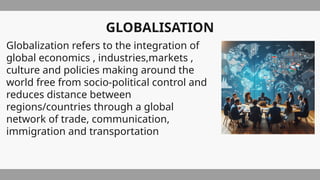
Globalisation refers to the process of interaction and integration among people, companies, and governments worldwide. It has led to increased economic interdependence among countries through the exchange of goods, services, technology, investment, information, and culture. The rapid advancement in communication and transportation has accelerated the pace of globalisation, making the world more interconnected than ever before.
Meaning of Globalisation
Globalisation is the process of expanding trade and commerce between different countries, which leads to greater connectivity and interdependence among economies. It involves the movement of goods, services, capital, technology, and labour across borders. Globalisation is facilitated by international trade agreements, technological advancements, and foreign investments.
Factors Facilitating Globalisation
Several factors contribute to globalisation, including:
Technological Advancements – Innovations in communication (such as the internet, mobile phones, and satellite communication) and transportation (such as airplanes and container shipping) have made global trade easier and faster.
Liberalisation of Trade and Investment – Many countries have reduced trade barriers such as tariffs and quotas, allowing businesses to expand internationally.
Foreign Direct Investment (FDI) – Companies invest in different countries, leading to industrial growth and job creation.
Growth of Multinational Corporations (MNCs) – Large businesses operate across multiple countries, influencing global production and trade patterns.
Global Financial Markets – The integration of financial markets enables the movement of capital and investment across borders.
Political Changes – The fall of trade restrictions and economic reforms in countries like China and India have boosted global economic activities.
Impact of Globalisation
Globalisation has both positive and negative effects on economies and societies worldwide.
Positive Impacts of Globalisation
Increased Trade and Economic Growth – Countries experience economic development due to an increase in exports and imports.
Technology Transfer – Developing countries gain access to new technologies, enhancing productivity and efficiency.
Employment Opportunities – Globalisation generates new job opportunities, particularly in emerging economies.
Better Quality Products – Due to global competition, consumers have access to better and more affordable goods and services.
Cultural Exchange – People from different cultures interact and share traditions, leading to a more interconnected world.
Improved Standard of Living – Economic growth leads to higher incomes and improved living standards.
Foreign Investment – Countries attract investments that lead to infrastructure development and industrialization.
Negative Impacts of Globalisation