GlobalFlyer: The Accomplishments & Progress Kyle Bordelon ASCI 603 Aircraft and Spacecraft Development Instructor: Mr. James Downing, CPI.  Embry-Riddle Aeronautical University This is my own work and research for this class 11/23/2011
Table of Contents Title Page (Includes: Course, Instructor, Date, & Name) Table of Contents Abstract Introduction Research Question Mission Summary Science Aircraft/Spacecraft Descriptions Development & Cost Current Outlook  Summary 12. Conclusion 13. References
Abstract The advent of composites has been warmly embraced in the aircraft community.  Composite structures create stronger structural integrity than most alloys with the  added benefit of lighter overall weight. Combining weight savings and complex  mold shapes yield the best fuel efficiencies – which is the common denominator  for sustainability in our environment. That said, we explore  Scaled Composites’  GlobalFlyer : Setting the record for the World’s fastest nonstop circumnavigation  at 67 hours and 1 minute. Undoubtedly,  Scaled Composites  advanced composite  technology and airstream designs has produced a pioneering product worthy of  praise. So the question can be posed: Can the composite structure of the  GlobalFlyer be effectively reproduced for high occupancy civilian global flight?  Is Scaled Composites working in cooperation with major aircraft manufacturers  as to share their knowledge of highly-efficient flight? The research presented  will show if the advancements made by the GlobalFlyer has been incorporated  into current or future projects in aviation. Keywords:  Burt Rutan, circumnavigation, GlobalFlyer, Scaled Composites
Introduction  1200 A.D. was a turning point for structural composition: The Mongols invented a composite bow used for hunting. It consisted of wood and bone. Both structures had inherit qualities that would prove beneficial when used in combination (Johnson, 2009). In modern times, humans have continued to utilize composition materials to even a greater extend. Today we will discuss composites integrated into aircraft structures that equate to lightweight frames and longer, more fuel efficient flight times.
Research Questions Can the composite structure of the GlobalFlyer be effectively reproduced for high occupancy civilian global flight? Is Scaled Composites’ working in cooperation with major aircraft  Manufacturers as to share their knowledge of highly-efficient flight?
Mission Summary  Accomplishments  With the expert help of Burt Rutan’s Scaled Composites and the financial backing of Richard Branson’s Virgin Atlantic, an innovative aircraft was created: In March of 2005, the aircraft called  GlobalFlyer  completed a non- stop circumnavigated flight in 67 hours (“Scaled Composites,” 2011). Science Description  A single turbofan powered experimental aircraft has proven that composite design coupled with large coverage wing areas is a step in the right direction.  Harnessing this technology for commercial use could greatly benefit our enviro- nment via the reduce in fuel consumption.
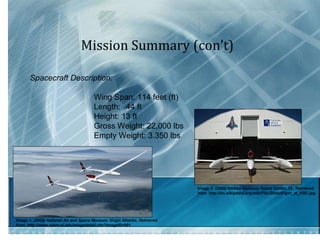
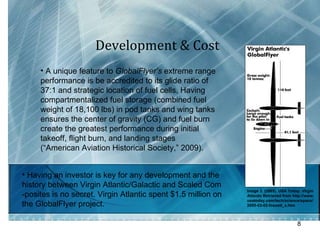
Mission Summary (con’t) Spacecraft Description:    Wing Span: 114 feet (ft) Length: 44 ft Height: 13 ft Gross Weight: 22,000 lbs Empty Weight: 3.350 lbs  Image 1.  (2009) National Air and Space Museum.  Virgin Atlantic. Retrieved  from  http://www.nasm.si.edu/imagedetail.cfm?imageID=991 Image 2. (2005) NASAs Kennedy Space Center, FL. Retrieved  from  http://en.wikipedia.org/wiki/File:GlobalFlyer_at_KSC.jpg
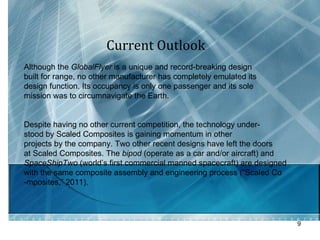
Development & Cost A unique feature to  GlobalFlyer’s  extreme range performance is be accredited to its glide ratio of 37:1 and strategic location of fuel cells. Having compartmentalized fuel storage (combined fuel weight of 18,100 lbs) in pod tanks and wing tanks ensures the center of gravity (CG) and fuel burn create the greatest performance during initial takeoff, flight burn, and landing stages (“American Aviation Historical Society,” 2009).  Image 3. (2005). USA Today.  Virgin  Atlantic  Retrieved from http://www. usatoday.com/tech/science/space/ 2005-03-02-fossett_x.htm Having an investor is key for any development and the  history between Virgin Atlantic/Galactic and Scaled Com -posites is no secret. Virgin Atlantic spent $1.5 million on the GlobalFlyer project.
Current Outlook  Although the  GlobalFlyer  is a unique and record-breaking design built for range, no other manufacturer has completely emulated its  design function. Its occupancy is only one passenger and its sole mission was to circumnavigate the Earth. Despite having no other current competition, the technology under- stood by Scaled Composites is gaining momentum in other  projects by the company. Two other recent designs have left the doors at Scaled Composites. The  bipod  (operate as a car and/or aircraft)   and   SpaceShipTwo  (world’s first commercial manned spacecraft) are designed with the same composite assembly and engineering process (“Scaled Co -mposites,” 2011).
Summary & Conclusion  The announcement and accomplishments of  GlobalFlyer  were quick and  effective tasks. Records were broken and the engineering aspects of composites and airframe designs give lesson to future usages. Gaining proficiency in how and  why certain structural designs act and weight what they do are the processes for  propelling the human race into the next millennia.  In conclusion, the practicality of single-occupancy circumnavigated flight is  Ill-advised. However, using the technologies in composite understanding on a  greater scale can eventually solve future commercial air transport -ation needs as high-efficiency becomes a much discussed topic.
References  American Aviation Historical Society. (2009). Virgin Atlantic GlobalFlyer Specifications. Retrived from  http://www.aahs-online.org/articles/globalflyer.php Business Wire. (2005). Virgin Atlantic GlobalFlyer Update; It’s a Go!  Business  and Economics,  Retrieved from http://search.proquest.com.ezproxy.libproxy.db.erau.edu/ pqcentral/docview/445460860/132FF328535431347E0/2?accountid=27203 Image 1. (2009).  National Air and Space Museum.  Virgin Atlantic. Retrieved from  http://www.nasm.si.edu/imagedetail.cfm?imageID=991 Image 2. (2005). NASAs Kennedy Space Center, FL. Retrieved from  http://en.wikipedia.org/wiki/File:GlobalFlyer_at_KSC.jpg Image 3.(2005). USA Today.  Virgin Atlantic.  Retrieved from http://www.usatoday.com/tech/science/space /2005-03-02-fossett_x.htm NASA. (2005). GlobalFlyer uses NASA-Developed Technology. Space Science &  Technology. Retrieved from http://www.nasa.gov/missions/science/global_ flyer.html
References  Plunkett Research. (2011). Company Research: Growth Plans, Divisions, Brands, &  Financials. Virgin Atlantic. Retrieved from http://www.plunkettresearchonline. com.ezproxy.libproxy.db.erau.edu/ResearchCenter/Profiles/googleSearchA llView.aspx?Company=VIRGIN+ATLANTIC+AIRWAYS&comid=1310 Presswire. (2005). Kansas State University: Scaled Composites partner to support GlobalFlyer Mission. January 24, 2005.  Normans Media Ltd.  Coventry,  U.K. Retrieved from Virgin Galactic. (n.d.). Global Flyer Overview.  The  Search is Over.  Retrieved from http://www.virgingalactic.com/overview/ Scaled Composites. (2011). Virgin Atlantic GlobalFlyer. Description. Retrieved from  http://www.scaled.com/projects/virgin_atlantic_globalflyer http://search.proquest.com.ezproxy.libproxy.db.erau.edu/pqcentral/ docview/443686146/132FF328535431347E0/18?accountid=27203 Sugar, Jim. (2006). Burt Rutan Biography.  Mojave Magic: A Turtle’s Eye View of SpaceShipOne.  Retrieved from http://www.desertturtle.com/BurtRutan.html

GlobalFlyer - Bordelon

  • 1.
    GlobalFlyer: The Accomplishments& Progress Kyle Bordelon ASCI 603 Aircraft and Spacecraft Development Instructor: Mr. James Downing, CPI. Embry-Riddle Aeronautical University This is my own work and research for this class 11/23/2011
  • 2.
    Table of ContentsTitle Page (Includes: Course, Instructor, Date, & Name) Table of Contents Abstract Introduction Research Question Mission Summary Science Aircraft/Spacecraft Descriptions Development & Cost Current Outlook Summary 12. Conclusion 13. References
  • 3.
    Abstract The adventof composites has been warmly embraced in the aircraft community. Composite structures create stronger structural integrity than most alloys with the added benefit of lighter overall weight. Combining weight savings and complex mold shapes yield the best fuel efficiencies – which is the common denominator for sustainability in our environment. That said, we explore Scaled Composites’ GlobalFlyer : Setting the record for the World’s fastest nonstop circumnavigation at 67 hours and 1 minute. Undoubtedly, Scaled Composites advanced composite technology and airstream designs has produced a pioneering product worthy of praise. So the question can be posed: Can the composite structure of the GlobalFlyer be effectively reproduced for high occupancy civilian global flight? Is Scaled Composites working in cooperation with major aircraft manufacturers as to share their knowledge of highly-efficient flight? The research presented will show if the advancements made by the GlobalFlyer has been incorporated into current or future projects in aviation. Keywords: Burt Rutan, circumnavigation, GlobalFlyer, Scaled Composites
  • 4.
    Introduction 1200A.D. was a turning point for structural composition: The Mongols invented a composite bow used for hunting. It consisted of wood and bone. Both structures had inherit qualities that would prove beneficial when used in combination (Johnson, 2009). In modern times, humans have continued to utilize composition materials to even a greater extend. Today we will discuss composites integrated into aircraft structures that equate to lightweight frames and longer, more fuel efficient flight times.
  • 5.
    Research Questions Canthe composite structure of the GlobalFlyer be effectively reproduced for high occupancy civilian global flight? Is Scaled Composites’ working in cooperation with major aircraft Manufacturers as to share their knowledge of highly-efficient flight?
  • 6.
    Mission Summary Accomplishments With the expert help of Burt Rutan’s Scaled Composites and the financial backing of Richard Branson’s Virgin Atlantic, an innovative aircraft was created: In March of 2005, the aircraft called GlobalFlyer completed a non- stop circumnavigated flight in 67 hours (“Scaled Composites,” 2011). Science Description A single turbofan powered experimental aircraft has proven that composite design coupled with large coverage wing areas is a step in the right direction. Harnessing this technology for commercial use could greatly benefit our enviro- nment via the reduce in fuel consumption.
  • 7.
    Mission Summary (con’t)Spacecraft Description: Wing Span: 114 feet (ft) Length: 44 ft Height: 13 ft Gross Weight: 22,000 lbs Empty Weight: 3.350 lbs Image 1. (2009) National Air and Space Museum. Virgin Atlantic. Retrieved from http://www.nasm.si.edu/imagedetail.cfm?imageID=991 Image 2. (2005) NASAs Kennedy Space Center, FL. Retrieved from http://en.wikipedia.org/wiki/File:GlobalFlyer_at_KSC.jpg
  • 8.
    Development & CostA unique feature to GlobalFlyer’s extreme range performance is be accredited to its glide ratio of 37:1 and strategic location of fuel cells. Having compartmentalized fuel storage (combined fuel weight of 18,100 lbs) in pod tanks and wing tanks ensures the center of gravity (CG) and fuel burn create the greatest performance during initial takeoff, flight burn, and landing stages (“American Aviation Historical Society,” 2009). Image 3. (2005). USA Today. Virgin Atlantic Retrieved from http://www. usatoday.com/tech/science/space/ 2005-03-02-fossett_x.htm Having an investor is key for any development and the history between Virgin Atlantic/Galactic and Scaled Com -posites is no secret. Virgin Atlantic spent $1.5 million on the GlobalFlyer project.
  • 9.
    Current Outlook Although the GlobalFlyer is a unique and record-breaking design built for range, no other manufacturer has completely emulated its design function. Its occupancy is only one passenger and its sole mission was to circumnavigate the Earth. Despite having no other current competition, the technology under- stood by Scaled Composites is gaining momentum in other projects by the company. Two other recent designs have left the doors at Scaled Composites. The bipod (operate as a car and/or aircraft) and SpaceShipTwo (world’s first commercial manned spacecraft) are designed with the same composite assembly and engineering process (“Scaled Co -mposites,” 2011).
  • 10.
    Summary & Conclusion The announcement and accomplishments of GlobalFlyer were quick and effective tasks. Records were broken and the engineering aspects of composites and airframe designs give lesson to future usages. Gaining proficiency in how and why certain structural designs act and weight what they do are the processes for propelling the human race into the next millennia. In conclusion, the practicality of single-occupancy circumnavigated flight is Ill-advised. However, using the technologies in composite understanding on a greater scale can eventually solve future commercial air transport -ation needs as high-efficiency becomes a much discussed topic.
  • 11.
    References AmericanAviation Historical Society. (2009). Virgin Atlantic GlobalFlyer Specifications. Retrived from http://www.aahs-online.org/articles/globalflyer.php Business Wire. (2005). Virgin Atlantic GlobalFlyer Update; It’s a Go! Business and Economics, Retrieved from http://search.proquest.com.ezproxy.libproxy.db.erau.edu/ pqcentral/docview/445460860/132FF328535431347E0/2?accountid=27203 Image 1. (2009). National Air and Space Museum. Virgin Atlantic. Retrieved from http://www.nasm.si.edu/imagedetail.cfm?imageID=991 Image 2. (2005). NASAs Kennedy Space Center, FL. Retrieved from http://en.wikipedia.org/wiki/File:GlobalFlyer_at_KSC.jpg Image 3.(2005). USA Today. Virgin Atlantic. Retrieved from http://www.usatoday.com/tech/science/space /2005-03-02-fossett_x.htm NASA. (2005). GlobalFlyer uses NASA-Developed Technology. Space Science & Technology. Retrieved from http://www.nasa.gov/missions/science/global_ flyer.html
  • 12.
    References PlunkettResearch. (2011). Company Research: Growth Plans, Divisions, Brands, & Financials. Virgin Atlantic. Retrieved from http://www.plunkettresearchonline. com.ezproxy.libproxy.db.erau.edu/ResearchCenter/Profiles/googleSearchA llView.aspx?Company=VIRGIN+ATLANTIC+AIRWAYS&comid=1310 Presswire. (2005). Kansas State University: Scaled Composites partner to support GlobalFlyer Mission. January 24, 2005. Normans Media Ltd. Coventry, U.K. Retrieved from Virgin Galactic. (n.d.). Global Flyer Overview. The Search is Over. Retrieved from http://www.virgingalactic.com/overview/ Scaled Composites. (2011). Virgin Atlantic GlobalFlyer. Description. Retrieved from http://www.scaled.com/projects/virgin_atlantic_globalflyer http://search.proquest.com.ezproxy.libproxy.db.erau.edu/pqcentral/ docview/443686146/132FF328535431347E0/18?accountid=27203 Sugar, Jim. (2006). Burt Rutan Biography. Mojave Magic: A Turtle’s Eye View of SpaceShipOne. Retrieved from http://www.desertturtle.com/BurtRutan.html