Craft and
Software Engineering
Glenn Vanderburg
InfoEther
glenn@infoether.com
@glv

Software Engineering,
Software Craftsmanship
Management
vs.
Programmers?

A Caricature of
Engineering
1. A software system can best be
designed if the testing is
interlaced with the designing
instead of being used after the
design.
2. A simulation which matches the
requirements contains the
control which organizes the
design of the system.

3. Through successive repetitions
of this process of interlaced
testing and design the model
ultimately becomes the software
system itself. [...] in effect
the testing and the replacement
of simulations with modules that
are deeper and more detailed
goes on with the simulation
model controlling, as it were,
the place and order in which
these things are done.
Unlike the first conference, at which it
was fully accepted that the term
software engineering expressed a need
rather than a reality, in Rome there was
already a slight tendency to talk as if
the subject already existed.
And it became clear during the
conference that the organizers had a
hidden agenda, namely that of
persuading NATO to fund the setting
up of an International Software
Engineering Institute.

However things did not go according to
their plan. The discussion sessions
which were meant to provide evidence
of strong and extensive support for this
proposal were instead marked by
considerable scepticism, and led one of
the participants, Tom Simpson of IBM,
to write a splendid short satire on
“Masterpiece Engineering”.
It was little surprise to any of the
participants in the Rome conference
that no attempt was made to continue
the NATO conference series, but the
software engineering bandwagon began
to roll as many people started to use
the term to describe their work, to my
mind often with very little justification.
—Brian Rande"

“Premature maturity”
[Programming] is not some kind of
engineering where all we have to do
is put something in one end and
turn the crank.
—Bruce Eckel

“A Rational Design
Process”
A. Establish and document requirements
B. Design and document the module
structure
C. Design and document the module
interfaces
D. Design and document the uses hierarchy
E. Design and document the module internal
structures
F. Write programs
G. Maintain
The conversion of an idea to an
artifact, which engages both the
designer and the maker, is a complex
and subtle process that will always be
far closer to art than to science.
(Eugene S. Ferguson,
Engineering and the Mind’s Eye)

In engineering ... people design
through documentation.
—David Parnas
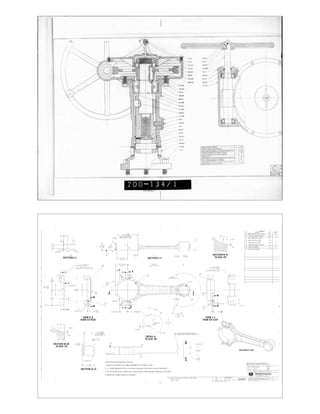
Although the drawings appear to be
exact and unequivocal, their precision
conceals many informal choices,
inarticulate judgments, acts of
intuition, and assumptions about the
way the world works.
(Eugene S. Ferguson,
Engineering and the Mind’s Eye)

The defined process control
model requires that every
piece of work be completely
understood. A defined
process can be started and
allowed to run until
completion, with the same
results every time.
The empirical process control model
provides and exercises control
through frequent inspection and
adaptation for processes that
are imperfectly defined and
generate unpredictable and
unrepeatable outputs.
Aeroplanes are not designed by science,
but by art, in spite of some pretence
and humbug to the contrary. […]
There is a big gap between scientific
research and the engineering product
which has to be bridged by
the art of the engineer.
—J. D. North
“You don’t know
it’s right if you
don’t have the
math to prove it.”

Structural analyses (indeed, any
engineering calculations) must be
employed with caution and judgment,
because mathematical models are
always less complex than actual
structures, processes, or machines.
(Eugene S. Ferguson,
Engineering and the Mind’s Eye)
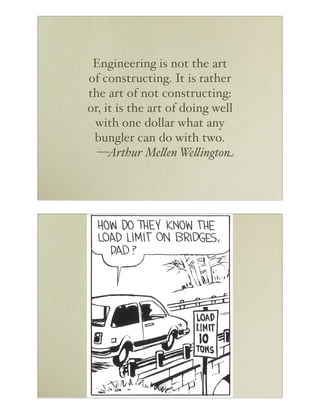
Engineering is not the art
of constructing. It is rather
the art of not constructing:
or, it is the art of doing well
with one dollar what any
bungler can do with two.
—Arthur Me"en We"ington
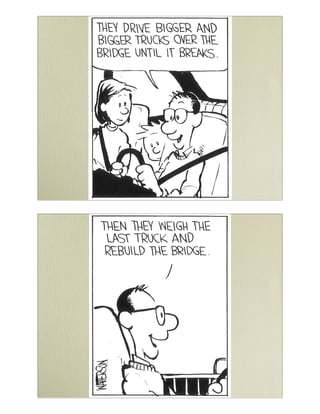
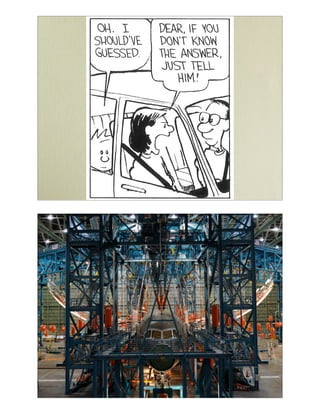
Mathematical modeling
was introduced as a
cost-saving measure.

Engineering is the art of
directing the great sources of
power in nature for the use
and convenience of man.
—Institution of Civil Engineers
Structural engineering is
the science and art
of designing and making,
with economy and elegance,
[…] structures so that they
can safely resist the forces to
which they may be subjected.
—Structural Engineer’s Association

Different Engineering
Disciplines are Different
• Different materials, physical effects, forces
• Different degrees of complexity in
requirements, designs, processes, and artifacts

• Varied reliance on formal modeling and analysis
vs. experimentation, prototyping, and testing

• Varied use of defined and empirical processes
Real
Software Engineering

Software engineering is
the science and art
of designing and making,
with economy and elegance,
[…] systems so that they can
readily adapt to the situations to
which they may be subjected.
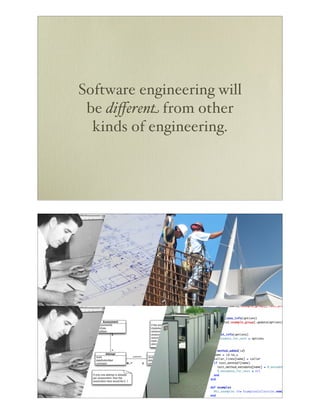
Software engineering will
be different from other
kinds of engineering.
divided by

2

3

4

7

9

4.5

3

2.5

1.29

10

5.0

3.33

2.5

1.43

11

5.5

3.66

2.75

1.57

12.6

6.3

4.2

3.15

1.8

22

11.0

7.33

5.5

3.14

100

50.0

33.33

25.0

14.29
eg.Division
Feature: Addition
In order to avoid silly mistakes
numerator
As an error-prone person
10
I want to divide two numbers
12.6

Scenario Outline: Divide two numbers
22
Given I have entered <input_1>
And I have entered <input_2> 9
When I press "divide"
11
Then the result should be <result>

100

denominator quotient?
2

5.0

3

4.2

7

~=3.14

3

<5

2

4<_<6
32

4

expected

Examples:
25 actual
| input_1 | input_2 | result |
| 10
| 2
| 5.0
|
| 12.6
| 3
| 4.2
|
describe "numbers" do
| 22 Test::Unit::TestCase "divides" do
| 7
| it
~=3.14 |
class <
| test_division
| 3
| <5
def 9
(10 / |2) .should == 5.0
assert_equal 2
5.0, | 4<_<610 |/ / 2 )
(
| 11
|
(12.6
3).should == 4.2
assert_equal 4
4.2, | 32 ( 12.6 / 3 )
| 100
|
|7) .should be_close(3.14, 0.01)
(22 /
assert_in_delta 3.14,
( 22
/ 7 ), 0.01
(9 9
assert
5
> ( / 3) / 3.should < 5
)
(11/2) / 2.should satisfy{|n| n > 4 && n < 6 }
assert
4...6 === ( 11
)
(100 / 4) 4.should == 32
assert_equal
32,
( 100 /
)
end
end
end
end

pair
programming

planning
game

40-hour
week

acceptance
testing

on-site
customer

system
metaphor

coding
standards
refactoring
unit
testing

simple
design
short
releases

collective
ownership

continuous
integration
solutions short
releases
priorities

features
architecture

planning
game

acceptance
testing

collective
ownership

on-site customer

design

continuous integration
classes and interfaces
system metaphor
statements and
methods
unit testing
pair programming

months short
releases
vanderburg.org/Writing/xpannealed.pdf

weeks

planning
game

acceptance
testing
days

hours

collective
ownership

on-site customer

continuous integration
minutes
seconds

unit testing
pair programming

system metaphor
Assumptions Once True, But
No Longer

• Code is hard to read
• Code is hard to change
• Testing is expensive

Assumptions Once Believed
But Never True
• All engineering is like structural engineering
• Programming is like building
• Modeling and analysis are about correctness
The Reality of
Software Engineering
• Software is very unlike bridges and buildings.
• Additional complexity hinders requirements,
design, and approval.

• Source code is a model.
• Building and testing our interim designs is
effectively free.

• Empirical processes are rational for software.

Software Engineering
and Craft
Design by Artisans

• Artisans may produce documents to help
themselves think.

• But they build what is in their heads.
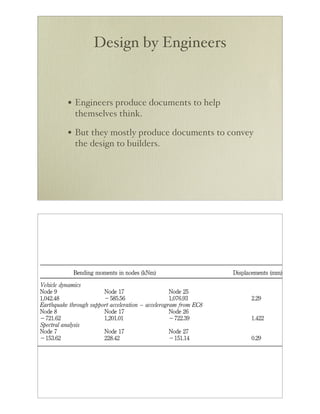
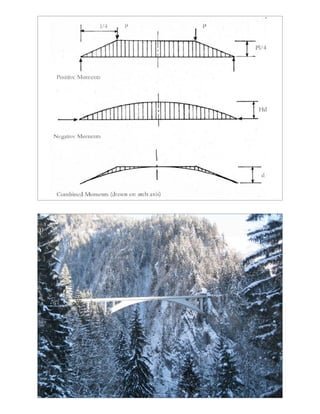
Design by Engineers

• Engineers produce documents to help
themselves think.

• But they mostly produce documents to convey
the design to builders.
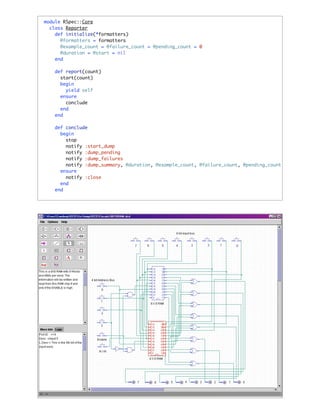
module RSpec::Core
class Reporter
def initialize(*formatters)
@formatters = formatters
@example_count = @failure_count = @pending_count = 0
@duration = @start = nil
end
def report(count)
start(count)
begin
yield self
ensure
conclude
end
end
def conclude
begin
stop
notify :start_dump
notify :dump_pending
notify :dump_failures
notify :dump_summary, @duration, @example_count, @failure_count, @pending_count
ensure
notify :close
end
end
Software Models
(i.e., source code)
• Because the artifact is abstract, model is
“concrete”.

• Model isomorphic to built artifact.
• Feels like working directly with the constructs.
• We are designers and builders

Software Models
(i.e., source code)
• Furthermore, we are also writers.
• Code must serve two purposes:
• to be the solution
• to describe the solution
Programs must be written for
people to read, and only incidentally
for machines to execute.
—Harold Abelson
and Gerald Jay Sussman

Software practitioners –
especially, ironically, the good
ones – often […] fall in love with
the software itself and start
thinking of themselves as
craftsmen of software.
—Dan North
Let us change our traditional attitude
to the construction of programs.
Instead of imagining that our main task
is to instruct a computer what to do,
let us concentrate rather on
explaining to human beings
what we want a computer to do.
—Donald Knuth

Internal vs. External

• Abstract vs. concrete
• Hidden vs. public and visible
• Potential effects vs. immediate effects
Programmers have the luxury of being both
engineers and craftsmen:

• because we are both designers and makers.
• because we are not insulated from the artifacts
we are designing.

• because, like craftsmen, we can feel the things we
build.

Programmers have the responsibility to be
craftsmen, not just engineers:

• because otherwise we inevitably lose sight of the
less tangible (but no less important) aspects of
our creations.

Glenn Vanderburg. Craft and software engineering

  • 1.
    Craft and Software Engineering GlennVanderburg InfoEther glenn@infoether.com @glv Software Engineering, Software Craftsmanship
  • 2.
  • 3.
    1. A softwaresystem can best be designed if the testing is interlaced with the designing instead of being used after the design.
  • 4.
    2. A simulationwhich matches the requirements contains the control which organizes the design of the system. 3. Through successive repetitions of this process of interlaced testing and design the model ultimately becomes the software system itself. [...] in effect the testing and the replacement of simulations with modules that are deeper and more detailed goes on with the simulation model controlling, as it were, the place and order in which these things are done.
  • 5.
    Unlike the firstconference, at which it was fully accepted that the term software engineering expressed a need rather than a reality, in Rome there was already a slight tendency to talk as if the subject already existed.
  • 6.
    And it becameclear during the conference that the organizers had a hidden agenda, namely that of persuading NATO to fund the setting up of an International Software Engineering Institute. However things did not go according to their plan. The discussion sessions which were meant to provide evidence of strong and extensive support for this proposal were instead marked by considerable scepticism, and led one of the participants, Tom Simpson of IBM, to write a splendid short satire on “Masterpiece Engineering”.
  • 7.
    It was littlesurprise to any of the participants in the Rome conference that no attempt was made to continue the NATO conference series, but the software engineering bandwagon began to roll as many people started to use the term to describe their work, to my mind often with very little justification. —Brian Rande" “Premature maturity”
  • 8.
    [Programming] is notsome kind of engineering where all we have to do is put something in one end and turn the crank. —Bruce Eckel “A Rational Design Process” A. Establish and document requirements B. Design and document the module structure C. Design and document the module interfaces D. Design and document the uses hierarchy E. Design and document the module internal structures F. Write programs G. Maintain
  • 9.
    The conversion ofan idea to an artifact, which engages both the designer and the maker, is a complex and subtle process that will always be far closer to art than to science. (Eugene S. Ferguson, Engineering and the Mind’s Eye) In engineering ... people design through documentation. —David Parnas
  • 10.
    Although the drawingsappear to be exact and unequivocal, their precision conceals many informal choices, inarticulate judgments, acts of intuition, and assumptions about the way the world works. (Eugene S. Ferguson, Engineering and the Mind’s Eye) The defined process control model requires that every piece of work be completely understood. A defined process can be started and allowed to run until completion, with the same results every time.
  • 11.
    The empirical processcontrol model provides and exercises control through frequent inspection and adaptation for processes that are imperfectly defined and generate unpredictable and unrepeatable outputs.
  • 12.
    Aeroplanes are notdesigned by science, but by art, in spite of some pretence and humbug to the contrary. […] There is a big gap between scientific research and the engineering product which has to be bridged by the art of the engineer. —J. D. North
  • 13.
    “You don’t know it’sright if you don’t have the math to prove it.” Structural analyses (indeed, any engineering calculations) must be employed with caution and judgment, because mathematical models are always less complex than actual structures, processes, or machines. (Eugene S. Ferguson, Engineering and the Mind’s Eye)
  • 14.
    Engineering is notthe art of constructing. It is rather the art of not constructing: or, it is the art of doing well with one dollar what any bungler can do with two. —Arthur Me"en We"ington
  • 17.
    Mathematical modeling was introducedas a cost-saving measure. Engineering is the art of directing the great sources of power in nature for the use and convenience of man. —Institution of Civil Engineers
  • 18.
    Structural engineering is thescience and art of designing and making, with economy and elegance, […] structures so that they can safely resist the forces to which they may be subjected. —Structural Engineer’s Association Different Engineering Disciplines are Different • Different materials, physical effects, forces • Different degrees of complexity in requirements, designs, processes, and artifacts • Varied reliance on formal modeling and analysis vs. experimentation, prototyping, and testing • Varied use of defined and empirical processes
  • 19.
    Real Software Engineering Software engineeringis the science and art of designing and making, with economy and elegance, […] systems so that they can readily adapt to the situations to which they may be subjected.
  • 20.
    Software engineering will bedifferent from other kinds of engineering.
  • 21.
  • 22.
    eg.Division Feature: Addition In orderto avoid silly mistakes numerator As an error-prone person 10 I want to divide two numbers 12.6 Scenario Outline: Divide two numbers 22 Given I have entered <input_1> And I have entered <input_2> 9 When I press "divide" 11 Then the result should be <result> 100 denominator quotient? 2 5.0 3 4.2 7 ~=3.14 3 <5 2 4<_<6 32 4 expected Examples: 25 actual | input_1 | input_2 | result | | 10 | 2 | 5.0 | | 12.6 | 3 | 4.2 | describe "numbers" do | 22 Test::Unit::TestCase "divides" do | 7 | it ~=3.14 | class < | test_division | 3 | <5 def 9 (10 / |2) .should == 5.0 assert_equal 2 5.0, | 4<_<610 |/ / 2 ) ( | 11 | (12.6 3).should == 4.2 assert_equal 4 4.2, | 32 ( 12.6 / 3 ) | 100 | |7) .should be_close(3.14, 0.01) (22 / assert_in_delta 3.14, ( 22 / 7 ), 0.01 (9 9 assert 5 > ( / 3) / 3.should < 5 ) (11/2) / 2.should satisfy{|n| n > 4 && n < 6 } assert 4...6 === ( 11 ) (100 / 4) 4.should == 32 assert_equal 32, ( 100 / ) end end end end pair programming planning game 40-hour week acceptance testing on-site customer system metaphor coding standards refactoring unit testing simple design short releases collective ownership continuous integration
  • 23.
    solutions short releases priorities features architecture planning game acceptance testing collective ownership on-site customer design continuousintegration classes and interfaces system metaphor statements and methods unit testing pair programming months short releases vanderburg.org/Writing/xpannealed.pdf weeks planning game acceptance testing days hours collective ownership on-site customer continuous integration minutes seconds unit testing pair programming system metaphor
  • 24.
    Assumptions Once True,But No Longer • Code is hard to read • Code is hard to change • Testing is expensive Assumptions Once Believed But Never True • All engineering is like structural engineering • Programming is like building • Modeling and analysis are about correctness
  • 25.
    The Reality of SoftwareEngineering • Software is very unlike bridges and buildings. • Additional complexity hinders requirements, design, and approval. • Source code is a model. • Building and testing our interim designs is effectively free. • Empirical processes are rational for software. Software Engineering and Craft
  • 26.
    Design by Artisans •Artisans may produce documents to help themselves think. • But they build what is in their heads.
  • 27.
    Design by Engineers •Engineers produce documents to help themselves think. • But they mostly produce documents to convey the design to builders.
  • 34.
    module RSpec::Core class Reporter definitialize(*formatters) @formatters = formatters @example_count = @failure_count = @pending_count = 0 @duration = @start = nil end def report(count) start(count) begin yield self ensure conclude end end def conclude begin stop notify :start_dump notify :dump_pending notify :dump_failures notify :dump_summary, @duration, @example_count, @failure_count, @pending_count ensure notify :close end end
  • 39.
    Software Models (i.e., sourcecode) • Because the artifact is abstract, model is “concrete”. • Model isomorphic to built artifact. • Feels like working directly with the constructs. • We are designers and builders Software Models (i.e., source code) • Furthermore, we are also writers. • Code must serve two purposes: • to be the solution • to describe the solution
  • 41.
    Programs must bewritten for people to read, and only incidentally for machines to execute. —Harold Abelson and Gerald Jay Sussman Software practitioners – especially, ironically, the good ones – often […] fall in love with the software itself and start thinking of themselves as craftsmen of software. —Dan North
  • 42.
    Let us changeour traditional attitude to the construction of programs. Instead of imagining that our main task is to instruct a computer what to do, let us concentrate rather on explaining to human beings what we want a computer to do. —Donald Knuth Internal vs. External • Abstract vs. concrete • Hidden vs. public and visible • Potential effects vs. immediate effects
  • 43.
    Programmers have theluxury of being both engineers and craftsmen: • because we are both designers and makers. • because we are not insulated from the artifacts we are designing. • because, like craftsmen, we can feel the things we build. Programmers have the responsibility to be craftsmen, not just engineers: • because otherwise we inevitably lose sight of the less tangible (but no less important) aspects of our creations.