Git 
Presenter: Hirantha Weerarathna
Road map 
• What is Git? 
• Version Control Systems 
• Few Useful Git Commands 
• Git Workflows 
• Git Hooks 
• Github
What is Git 
● Distributed Version Control System 
● Developed by Linus Torvalds for linux kernel developments 
● Free Software
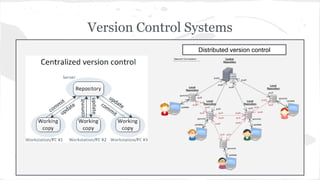
Version Control Systems 
Distributed version control
git init 
-create a local repo 
git clone /path 
-clone a repo 
Few Useful Commands 
git add [filename] 
-add file into ‘staging area’ 
git commit -m “your_message” 
-commit 
git status 
-show the status of files
Few Useful Commands 
git remote add –u [remote_repo_name] [remote_repo_url] 
git push [remote_repo_name] [branch_name] 
-push into remote repo 
git pull [remote_repo_name] [branch_name] 
-pull from remote repo 
git branch [branch_name] 
-create a branch called ‘branch_name’ 
git checkout [branch_name] 
-checkout a branch 
git merge [branch_name] 
-merge a branch
Git Workflows 
● Centralized workflow 
● Feature Branch workflow 
● GitFlow workflow 
● Forking workflow
Centralized workflow 
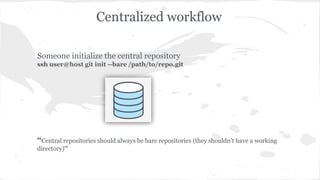
Someone initialize the central repository 
ssh user@host git init --bare /path/to/repo.git 
“Central repositories should always be bare repositories (they shouldn’t have a working 
directory)”
Centralized workflow 
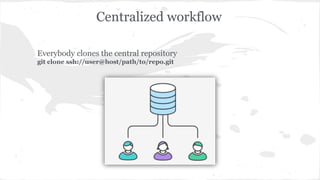
Everybody clones the central repository 
git clone ssh://user@host/path/to/repo.git
Centralized workflow 
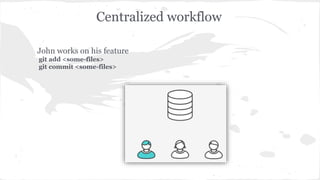
John works on his feature 
git add <some-files> 
git commit <some-files>
Centralized workflow 
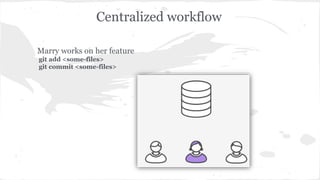
Marry works on her feature 
git add <some-files> 
git commit <some-files>
Centralized workflow 
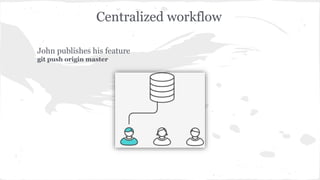
John publishes his feature 
git push origin master
Centralized workflow 
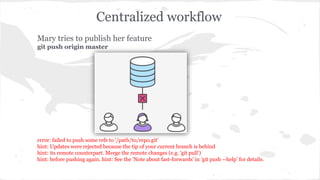
Mary tries to publish her feature 
git push origin master 
error: failed to push some refs to '/path/to/repo.git' 
hint: Updates were rejected because the tip of your current branch is behind 
hint: its remote counterpart. Merge the remote changes (e.g. 'git pull') 
hint: before pushing again. hint: See the 'Note about fast-forwards' in 'git push --help' for details.
Centralized workflow 
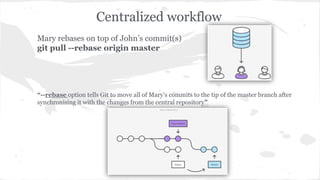
Mary rebases on top of John’s commit(s) 
git pull --rebase origin master 
“--rebase option tells Git to move all of Mary’s commits to the tip of the master branch after 
synchronising it with the changes from the central repository”
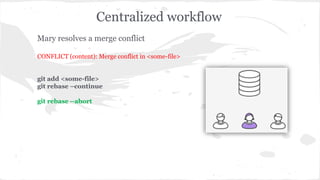
Mary resolves a merge conflict 
CONFLICT (content): Merge conflict in <some-file> 
git add <some-file> 
git rebase –continue 
git rebase --abort 
Centralized workflow
Centralized workflow 
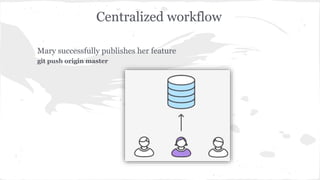
Mary successfully publishes her feature 
git push origin master
Feature Branch workflow 
•Feature Branch Workflow still uses a central repository 
•All feature development should take place in a dedicated branch 
instead of the master branch. 
•makes it possible to leverage pull requests
Feature Branch workflow 
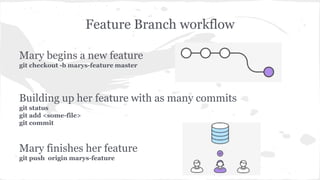
Mary begins a new feature 
git checkout -b marys-feature master 
Building up her feature with as many commits 
git status 
git add <some-file> 
git commit 
Mary finishes her feature 
git push origin marys-feature
Feature Branch workflow 
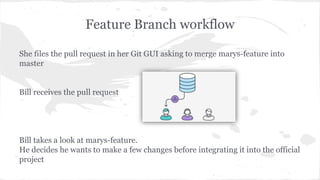
She files the pull request in her Git GUI asking to merge marys-feature into 
master 
Bill receives the pull request 
Bill takes a look at marys-feature. 
He decides he wants to make a few changes before integrating it into the official 
project
Feature Branch workflow 
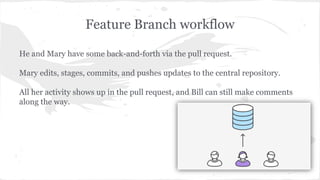
He and Mary have some back-and-forth via the pull request. 
Mary edits, stages, commits, and pushes updates to the central repository. 
All her activity shows up in the pull request, and Bill can still make comments 
along the way.
Feature Branch workflow 
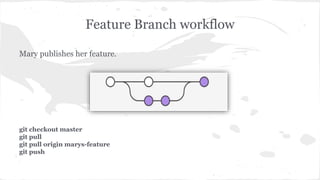
Mary publishes her feature. 
git checkout master 
git pull 
git pull origin marys-feature 
git push
Gitflow Workflow 
•Gitflow Workflow defines a strict branching model designed around the 
project release. 
•Provides a robust framework for managing larger projects. 
•Doesn’t add any new concepts or commands beyond what’s required for the 
Feature Branch Workflow. 
•In addition to feature branches, it uses individual branches for preparing, 
maintaining, and recording releases. 
•The Gitflow Workflow still uses a central repository as the communication hub 
for all developers.
Gitflow Workflow 
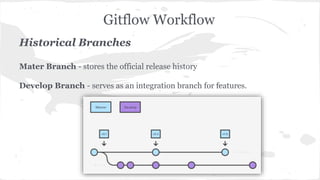
Historical Branches 
Mater Branch - stores the official release history 
Develop Branch - serves as an integration branch for features.
Gitflow Workflow 
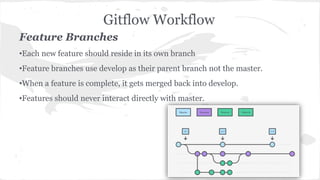
Feature Branches 
•Each new feature should reside in its own branch 
•Feature branches use develop as their parent branch not the master. 
•When a feature is complete, it gets merged back into develop. 
•Features should never interact directly with master.
Gitflow Workflow 
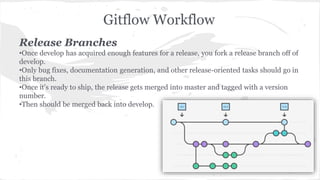
Release Branches 
•Once develop has acquired enough features for a release, you fork a release branch off of 
develop. 
•Only bug fixes, documentation generation, and other release-oriented tasks should go in 
this branch. 
•Once it's ready to ship, the release gets merged into master and tagged with a version 
number. 
•Then should be merged back into develop.
Gitflow Workflow 
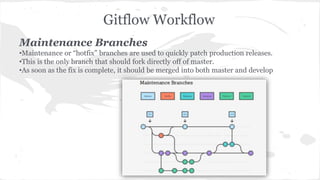
Maintenance Branches 
•Maintenance or “hotfix” branches are used to quickly patch production releases. 
•This is the only branch that should fork directly off of master. 
•As soon as the fix is complete, it should be merged into both master and develop
Git Hooks 
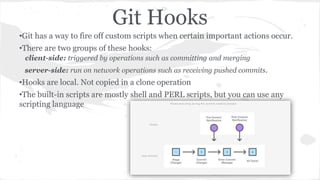
•Git has a way to fire off custom scripts when certain important actions occur. 
•There are two groups of these hooks: 
client-side: triggered by operations such as committing and merging 
server-side: run on network operations such as receiving pushed commits. 
•Hooks are local. Not copied in a clone operation 
•The built-in scripts are mostly shell and PERL scripts, but you can use any 
scripting language
Git Branching and Merging 
• SVN branches are only used to capture the occasional large-scale 
development effort 
• Git branches are an integral part of your everyday workflow. 
• Git branches is much more lightweight than SVN’s model 
• Every bug fix or feature should start in a new branch despite the size of the 
work 
• SVN branch house a copy of the trunk but it doesn't store any information 
regarding when and what things got merged back in.
Github 
GitHub provides a web-based graphical interface, desktop as well as mobile 
integration and several collaboration features such as wikis, task management, 
and bug tracking and pull requests
How Pull Request Works 
1. A developer creates the feature in a dedicated branch in their local 
repo. 
2. The developer pushes the branch to a public Github/Bitbucket 
repository. 
3. The developer files a pull request via Github. 
4. The rest of the team reviews the code, discusses it, and alters it. 
5. The project maintainer merges the feature into the official 
repository and closes the pull request.
Gists 
• Adds version control for code snippets, mini projects 
• Each “gist” is its own Git repository 
• Can be pushed and pulled using Git
References 
• https://github.com 
• https://www.atlassian.com/git 
• http://git-scm.com
Staging Area 
● aka. index 
● holding area 
● allow you to split a large commit 
● You can also commit specific lines of files if you really wanted 
● use ‘git gui’ 
● used for temporarily stashing your changes 
Go back
Rebase 
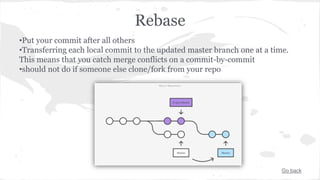
•Put your commit after all others 
•Transferring each local commit to the updated master branch one at a time. 
This means that you catch merge conflicts on a commit-by-commit 
•should not do if someone else clone/fork from your repo 
Go back
Pull Request 
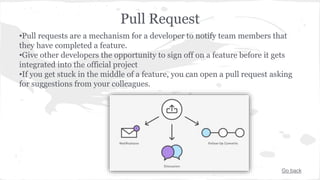
•Pull requests are a mechanism for a developer to notify team members that 
they have completed a feature. 
•Give other developers the opportunity to sign off on a feature before it gets 
integrated into the official project 
•If you get stuck in the middle of a feature, you can open a pull request asking 
for suggestions from your colleagues. 
Go back

git Technologies

  • 1.
  • 2.
    Road map •What is Git? • Version Control Systems • Few Useful Git Commands • Git Workflows • Git Hooks • Github
  • 3.
    What is Git ● Distributed Version Control System ● Developed by Linus Torvalds for linux kernel developments ● Free Software
  • 4.
    Version Control Systems Distributed version control
  • 5.
    git init -createa local repo git clone /path -clone a repo Few Useful Commands git add [filename] -add file into ‘staging area’ git commit -m “your_message” -commit git status -show the status of files
  • 6.
    Few Useful Commands git remote add –u [remote_repo_name] [remote_repo_url] git push [remote_repo_name] [branch_name] -push into remote repo git pull [remote_repo_name] [branch_name] -pull from remote repo git branch [branch_name] -create a branch called ‘branch_name’ git checkout [branch_name] -checkout a branch git merge [branch_name] -merge a branch
  • 7.
    Git Workflows ●Centralized workflow ● Feature Branch workflow ● GitFlow workflow ● Forking workflow
  • 8.
    Centralized workflow Someoneinitialize the central repository ssh user@host git init --bare /path/to/repo.git “Central repositories should always be bare repositories (they shouldn’t have a working directory)”
  • 9.
    Centralized workflow Everybodyclones the central repository git clone ssh://user@host/path/to/repo.git
  • 10.
    Centralized workflow Johnworks on his feature git add <some-files> git commit <some-files>
  • 11.
    Centralized workflow Marryworks on her feature git add <some-files> git commit <some-files>
  • 12.
    Centralized workflow Johnpublishes his feature git push origin master
  • 13.
    Centralized workflow Marytries to publish her feature git push origin master error: failed to push some refs to '/path/to/repo.git' hint: Updates were rejected because the tip of your current branch is behind hint: its remote counterpart. Merge the remote changes (e.g. 'git pull') hint: before pushing again. hint: See the 'Note about fast-forwards' in 'git push --help' for details.
  • 14.
    Centralized workflow Maryrebases on top of John’s commit(s) git pull --rebase origin master “--rebase option tells Git to move all of Mary’s commits to the tip of the master branch after synchronising it with the changes from the central repository”
  • 15.
    Mary resolves amerge conflict CONFLICT (content): Merge conflict in <some-file> git add <some-file> git rebase –continue git rebase --abort Centralized workflow
  • 16.
    Centralized workflow Marysuccessfully publishes her feature git push origin master
  • 17.
    Feature Branch workflow •Feature Branch Workflow still uses a central repository •All feature development should take place in a dedicated branch instead of the master branch. •makes it possible to leverage pull requests
  • 18.
    Feature Branch workflow Mary begins a new feature git checkout -b marys-feature master Building up her feature with as many commits git status git add <some-file> git commit Mary finishes her feature git push origin marys-feature
  • 19.
    Feature Branch workflow She files the pull request in her Git GUI asking to merge marys-feature into master Bill receives the pull request Bill takes a look at marys-feature. He decides he wants to make a few changes before integrating it into the official project
  • 20.
    Feature Branch workflow He and Mary have some back-and-forth via the pull request. Mary edits, stages, commits, and pushes updates to the central repository. All her activity shows up in the pull request, and Bill can still make comments along the way.
  • 21.
    Feature Branch workflow Mary publishes her feature. git checkout master git pull git pull origin marys-feature git push
  • 22.
    Gitflow Workflow •GitflowWorkflow defines a strict branching model designed around the project release. •Provides a robust framework for managing larger projects. •Doesn’t add any new concepts or commands beyond what’s required for the Feature Branch Workflow. •In addition to feature branches, it uses individual branches for preparing, maintaining, and recording releases. •The Gitflow Workflow still uses a central repository as the communication hub for all developers.
  • 23.
    Gitflow Workflow HistoricalBranches Mater Branch - stores the official release history Develop Branch - serves as an integration branch for features.
  • 24.
    Gitflow Workflow FeatureBranches •Each new feature should reside in its own branch •Feature branches use develop as their parent branch not the master. •When a feature is complete, it gets merged back into develop. •Features should never interact directly with master.
  • 25.
    Gitflow Workflow ReleaseBranches •Once develop has acquired enough features for a release, you fork a release branch off of develop. •Only bug fixes, documentation generation, and other release-oriented tasks should go in this branch. •Once it's ready to ship, the release gets merged into master and tagged with a version number. •Then should be merged back into develop.
  • 26.
    Gitflow Workflow MaintenanceBranches •Maintenance or “hotfix” branches are used to quickly patch production releases. •This is the only branch that should fork directly off of master. •As soon as the fix is complete, it should be merged into both master and develop
  • 27.
    Git Hooks •Githas a way to fire off custom scripts when certain important actions occur. •There are two groups of these hooks: client-side: triggered by operations such as committing and merging server-side: run on network operations such as receiving pushed commits. •Hooks are local. Not copied in a clone operation •The built-in scripts are mostly shell and PERL scripts, but you can use any scripting language
  • 28.
    Git Branching andMerging • SVN branches are only used to capture the occasional large-scale development effort • Git branches are an integral part of your everyday workflow. • Git branches is much more lightweight than SVN’s model • Every bug fix or feature should start in a new branch despite the size of the work • SVN branch house a copy of the trunk but it doesn't store any information regarding when and what things got merged back in.
  • 29.
    Github GitHub providesa web-based graphical interface, desktop as well as mobile integration and several collaboration features such as wikis, task management, and bug tracking and pull requests
  • 30.
    How Pull RequestWorks 1. A developer creates the feature in a dedicated branch in their local repo. 2. The developer pushes the branch to a public Github/Bitbucket repository. 3. The developer files a pull request via Github. 4. The rest of the team reviews the code, discusses it, and alters it. 5. The project maintainer merges the feature into the official repository and closes the pull request.
  • 31.
    Gists • Addsversion control for code snippets, mini projects • Each “gist” is its own Git repository • Can be pushed and pulled using Git
  • 32.
    References • https://github.com • https://www.atlassian.com/git • http://git-scm.com
  • 34.
    Staging Area ●aka. index ● holding area ● allow you to split a large commit ● You can also commit specific lines of files if you really wanted ● use ‘git gui’ ● used for temporarily stashing your changes Go back
  • 35.
    Rebase •Put yourcommit after all others •Transferring each local commit to the updated master branch one at a time. This means that you catch merge conflicts on a commit-by-commit •should not do if someone else clone/fork from your repo Go back
  • 36.
    Pull Request •Pullrequests are a mechanism for a developer to notify team members that they have completed a feature. •Give other developers the opportunity to sign off on a feature before it gets integrated into the official project •If you get stuck in the middle of a feature, you can open a pull request asking for suggestions from your colleagues. Go back

Editor's Notes

  • #22 Result in a merge commit. But, if you’re partial to a linear history, it’s possible to rebase the feature onto the tip of master before executing the merge, resulting in a fast-forward merge.
  • #24 It's also convenient to tag all commits in the master branch with a version number.
  • #27 Having a dedicated line of development for bug fixes lets your team address issues without interrupting the rest of the workflow or waiting for the next release cycle.
  • #28  .sample extension prevents them from executing by default. To “install” a hook, all you have to do is remove the .sample extension. The pre-commit hook is run first, before you even type in a commit message. It’s used to inspect the snapshot that’s about to be committed