PAGE 03 | GLOBALHERITAGEFUND.ORGPAGE 03 | #BEYONDMONUMENTS
BEYOND MONUMENTS®
GLOBALHERITAGEFUND.ORG
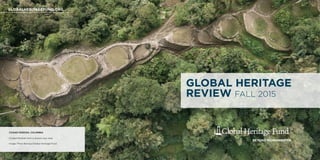
Ciudad Perdida from a drone’s eye view.
Image: Plinio Barraza/Global Heritage Fund
CIUDAD PERDIDA, COLOMBIA
GLOBAL HERITAGE
REVIEW FALL 2015
®
PAGE 02 | GLOBALHERITAGEFUND.ORGPAGE 03 | GLOBALHERTIAGEFUND.ORG
Tell us a little bit about how you came to this position.
I have always considered working with Global Heritage Fund my dream job. After ten
years of work with GHF, starting on the ground level in Kars, Turkey, I am so honored
to be in this position of leadership. I consider it a great responsibility to helm the
organization during this time of transition.
At Global Heritage Fund, things are changing. We’re only getting better and stronger
15 years down the road. 2016 is going to be a fantastic year, and I am confident that
working together, we will achieve some amazing wins for heritage.
What are the biggest challenges Global Heritage Fund faces in protecting
cultural heritage?
The greatest challenge is instilling this basic question among people: What is cultural
heritage? After people understand what this shared resource is we can begin to
address why it needs to be saved.
For this reason, we are going back to basics. We want to help people understand
both the importance of our heritage, and the powerful and yet relatively untapped
potential it can play in global development. Over 13 years of conservation work, we’ve
learned time and again that preserving cultural heritage can yield significant social,
cultural, and economic benefits.
We believe that these sites will be there in 100 years’ time precisely because of
how we preserve them today, but more importantly, because of how we instill a
sense of stewardship in local communities. For citizens and students, governments
and local organizations, we’re providing an incentive for everyone to protect and
benefit from cultural treasures. This is why GHF’s scope of work is far more than
What’s happening at GHF as we approach our 15th year? We took
some time to reflect on where we’ve come and where we’re headed.
Our new Executive Director Stefaan Poortman shares his thoughts
and experiences in this issue.
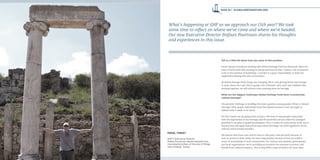
GHF’s Executive Director
Stefaa Poortman stands beneath two
monumental pillars at the site of Perge
near Antalya, Turkey.
PERGE, TURKEY
PAGE 04 | GLOBALHERITAGEFUND.ORGPAGE 03 | #BEYONDMONUMENTS
monuments, a sentiment reflected in our new brand tag line:
#BeyondMonuments.
What is changing at GHF?
Our messaging is evolving. Both internally and in how
we’re going to approach our communication strategy, the
core message we’re out to deliver is that heritage is beyond
monuments – it’s the story of a people. We’re working to
connect with a greater number and diversity of people,
because we want the world to know that every story should
have a voice. From the donors who make our work possible
to the local communities we help, the more people that get
involved with heritage, the more visible it becomes, and the
more we will be able to protect and treasure it.
A big part of that involves expanding our base. There’s a
younger audience out there that is more interested to see how
they can directly engage and help, but we haven’t effectively
courted that demographic until now. So, we’re exploring new
ways that people can help out in a more tangible way. For
instance, we’ve developed the Cultural Emergency Program to
allow people to donate in a way that is immediately impactful
in critical, time-sensitive situations.
In addition, we’re working to leverage the use of technology
to help heritage in crisis. Our program ‘AMAL in Heritage’ is a
great example of this. It allows conservators and interested
parties to do Rapid Impact Assessments of critically
endangered heritage sites, which will be immensely beneficial
for conservation efforts on the ground. “Amal” means “hope” in
Arabic, and we believe that this technology platform will help
save some of the most endangered heritage in places like Iraq
and Syria.
We’re also in transition with our projects. We’re preparing to
sign off on Banteay Chhmar (Cambodia), Pingyao (China), and
Mirador (Guatemala), and we’re beginning to identify new
projects for our portfolio. Right now, we’re looking at sites in
Greece, Nepal, Myanmar, Ethiopia, and Cuba. Personally, I’m
quite excited about expanding our presence in Africa. Having
spent part of my childhood in Zimbabwe, I am keen to see GHF
develop several African projects in the next few years.
What is GHF’s impact strategy for 2016?
We’re diversifying where and the way we operate so that
we can maximize our impact. In the past, we restricted our
work to developing countries only. Now, we’re also exploring
projects in areas of economic need, such as Greece and
Romania. The new portfolio will also include a range of urban
versus rural and archaeological versus architectural sites.
Additionally, we’re moving away from just 5-7 year long
projects, and starting to incorporate short-term projects of
a 3-5 year period as well. This shift will allow us to achieve
two key objectives: first, to expand our geographic footprint
further and protect more heritage in more places; and second,
to provide demonstrable and measurable impact in a shorter
time frame.
In tandem with this, we’re going to further leverage our
global network of experts and technology to maximize our
preservation and development efforts. This includes access
to drone technology and mobile mapping applications, which
will more easily help us to achieve our project objectives and
conduct quantitative assessments of our efforts.
Finally, we’ve taken on a new branding and messaging strategy.
We’re rolling out new channels of engagement through fresh
content across all of GHF’s communication platforms, including
web, print, social media, events, and group travel.
Who are GHF’s key partners in 2015 and in 2016?
Collaboration has always been the most critical factor in our
success. Without the tireless support of our partners and
donors, I can unequivocally state that our achievements would
not be nearly as great as they are.
So of course, we’re planning increased collaboration with our
new and existing partners as we go into 2016. In 2015, we built
a very strong partnership with the Prince Claus Fund in the
Netherlands to provide both short- and medium-term funding
to sites facing high risk. We’ve also partnered with UNESCO in
China on the development of the official preservation guidelines
for Pingyao’s Ancient City – now finalized and released. Finally,
with the help of the Arab Regional World Heritage Center
in Bahrain and the International Center for the Study of the
Restoration and Preservation of Cultural Property (ICCROM),
we are working on a technology solution for heritage in peril in
Iraq and Syria through the AMAL in Heritage program. You can
find more information about all of these programs on our new
website, www.globalheritagefund.org.
Our location in the heart of Silicon Valley places us right in the
middle of tech culture, and we’re going to capitalize on that as
we move forward. GHF is discussing innovative partnerships
with various financial entities to provide potential impact
investment funding that will help us with enterprise investment
and development around our project sites. We’ve partnered
with several local tech firms to create low-cost and innovative
solutions to heritage conservation’s most pressing issues,
whether using drones to map new sites and provide feeds on
preservation projects or advanced scanners to conduct soil
analyses.
Finally, we’re using the power of social media to connect with
more people, more often. That involves linking up with a new
generation of journalists operating in the communities where
we work and deriving new stories that will also complement
GHF’s impact strategy.
We believe that these sites will be there in 100 years’ time precisely
because of how we preserve them today, but more importantly,
because of how we instill a sense of stewardship in local communities.
PAGE 05 | #BEYONDMONUMENTS PAGE 06 | GLOBALHERITAGEFUND.ORG
Global Heritage Fund launched the Cultural Emergency Program (CEP) in 2015
to provide first aid to cultural heritage around the world. Cultural heritage is an
increasingly vulnerable resource in our society; at any given moment, a historic city is
destroyed at the hands of terror and ancient temples are crippled by natural disaster.
Gone with these treasures are also intangible legacies such art and literature, not to
mention the sense of identity for affected communities.
On our watch, we risk losing all the cultural treasures of the Middle East from the
ravages of war; compromising the safety of ancient, sacred texts in Timbuktu; and
becoming spectators to the inevitable downfall of Nepal’s heritage with the pounding
of the next earthquake. Our ability to help cannot be held back by time or a lack of
funds. The CEP makes sure that cannot happen.
What does it do, and why is it necessary?
We believe that emergency aid to cultural assets must be an essential part of every
humanitarian outreach. Over the last two years, Global Heritage Fund has answered
the call to contribute to several emergency projects worldwide. Now, it’s time to
CULTURAL
EMERGENCY
PROGRAM
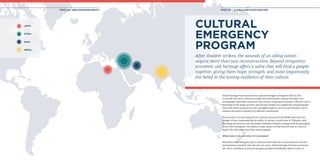
After disaster strikes, the wounds of an ailing nation
require more than just reconstruction. Beyond temporary
economic aid, heritage offers a salve that will bind a people
together, giving them hope, strength, and most importantly,
the belief in the lasting resilience of their culture.
LIBYA
NEPAL
IRAQ
SYRIA
PAGE 08 | GLOBALHERITAGEFUND.ORGPAGE 03 | #BEYONDMONUMENTS
formalize this emergency outreach into an official program.
The CEP was launched in September 2015 to combat threats to cultural heritage in
Africa, as well as severe looting and natural disaster incidents across the Middle East
and Asia. It provides an unrestricted platform for donors to assist with emergency
interventions and address the short-term, immediate needs of highly endangered
heritage in areas of conflict or natural disaster.
This means we always have the financial capacity to reach out and help communities
immediately, rather than having to wait for months until the funds are available. The
CEP allows us to apply our knowledge, experience, and global network capacity to
address the crisis as soon as possible, as events unfold, and with the dedicated efforts
of our partners on the ground.
How does it work?
Once disaster strikes a site, country or region, GHF will work with our Senior
Advisory Board and strategic partners to evaluate the highest priorities for funding
after the humanitarian crisis has passed. CEP activities could include rapid impact
assessments or comprehensive damage assessments, evacuations of heritage assets
(under extreme circumstances), emergency stabilization or conservation measures, or
procurement of international experts for assistance to heritage experts on the ground.
Do you want to help make a difference in cultural first aid? Visit our new website at
www.globalheritagefund.org/getinvolved to learn how you can help heritage in crisis
in places like Nepal or Haiti.
April 30, 2015 - A local temple in rubble after the earthquake
aftermath that devastated Kathmandu, Nepal
Kathmandu, Nepal
PAGE 03 | GLOBALHERITAGEFUND.ORGPAGE 03 | #BEYONDMONUMENTS
well as how to execute them in the field. With the addition of
supplementary training materials, professionals will also be
able to train concerned parties in RIA and dispatch them as
local impact assessment teams.
This pilot program is intended to overcome the problems
associated with pre-existing techniques for recording and data
gathering, which are too slow and expensive to be effectively
used in emergency situations. It is necessary to note that
this project is not designed to conduct comprehensive
assessments, and so cannot clarify all possible issues or
answer all possible challenges related to a heritage site. Rather,
it is intended as a simple, cost-effective tool for identifying
and addressing critical issues in the most effective manner
possible in challenging environments.
Database and Mapping System
In order to maintain records of conservation efforts both
for posterity, and to ensure the dissemination of valuable
information, AMAL in Heritage will create a database and
mapping system to record all information passed through the
website and mobile app. Through this database, we will be able
to educate, advise on, and discuss challenges related to the
preservation of cultural heritage in all its forms.
Distance Learning
Many people in conflict zones want to preserve their priceless
cultural treasures, but oftentimes they do not know how. Our
distance-learning workshops will offer basic, vital information
for disaster risk management and emergency response
techniques for movable and immovable cultural heritage. Each
workshop will be limited to a small number of students to
facilitate better interaction between them and their teachers.
This part of our program is currently in development, and we
hope to launch it as soon as possible.
With the inauguration of this pilot program, GHF and our
partners are confident that - though we cannot always be
present on the ground - we can contribute to the toolkits of
conservators in a positive and effective manner. We are filled
with hope at its promise to help stem the tide of cultural loss
in the Middle East and North Africa.
For more information about AMAL, please visit
globalheritagefund.org.
Across the Middle East and North Africa (MENA), warfare
has destabilized states, upended communal order, created a
massive refugee disaster, and caused the deaths of hundreds
of thousands of people. The recent crises in Syria and Iraq
have incurred an additional terrible cost as well. In Palmyra,
Syria or in Mosul, Iraq, priceless cultural treasures have been
irrevocably destroyed by militants in the ongoing conflict.
This upheaval has highlighted the need for a comprehensive
program of emergency response. However, regional strife
precludes any attempt at on-the-ground support. To fill
the gap created by the absence of this crucial assistance
international support, Global Heritage Fund is partnering
with the Arab Regional Centre for World Heritage (ARC-WH),
the International Centre for the Study of the Preservation
and Restoration of Cultural Property (ICCROM), and the
International Scientific Committee on Risk Preparedness of
ICOMOS (ICOMOS-ICORP) to launch the ‘AMAL in Heritage’
program. When this program is fully developed, it will provide
unprejudiced advice, supplementary training, and emergency
management and response tools to anyone seeking to provide
protection and conservation for all aspects of cultural heritage
in these regions.
Leveraging the capabilities of mobile technology and the
cloud, AMAL is a high-tech solution designed to aid in
documenting cultural assets and assessing damage to cultural
heritage during high-risk, emergency situations. AMAL will do
this by offering hands-on, distance learning tools and technical
support applications to experts and other interested parties
across the conflict-stricken countries of the MENA region.
We are confident that their ability to respond to complex
emergency situations and threats to cultural heritage will
be greatly strengthened by the toolkit we provide with this
program.
Mobile Device Application
Rapid Impact Assessment Tool
Currently, the efforts of GHF and our partners are focused
on developing a mobile-based application that will allow
conservation professionals, public institutions, members of
NGOS, and other interested parties to initiate Rapid Impact
Assessments (RIAs) of movable and immovable cultural assets.
Simple tutorials on the AMAL app will ensure that users
understand both the processes and concepts behind RIA, as
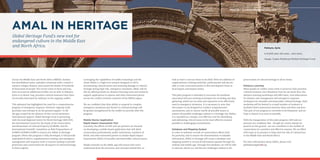
Global Heritage Fund’s new tool for
endangered culture in the Middle East
and North Africa.
AMAL IN HERITAGE
PAGE 10 | GLOBALHERITAGEFUND.ORG
A 6,000 year old oasis... and more.
Image: Csaba Moldovan/Global Heritage Fund
Palmyra, Syria
PAGE 03 | GLOBALHERTIAGEFUND.ORGPAGE 11 | #BEYONDMONUMENTS
An amin prepares to do maintenance work on his agadir. Since
the decline of the igoudar tradition, most are left to do this work
on their own.
Image: David Gouery/Global Heritage Fund
MOROCCO
PAGE 12 | GLOBALHERITAGEFUND.ORG
“The whole life,” wrote The Times correspondent Walter Harris in 1921, “was one of
warfare and gloom. Every tribe had its enemies, every family had its blood-feuds, and
every man his would-be murderer.”
Eking out an existence among such extremities, the Berber tribes inevitably
manifested a prudent caution for their lives and livelihoods. In response to the
need for a secure place to store their food and valuable possessions – everything
from barley and oil to silver, jewels, and carpets - the Berbers developed communal
granaries. These fortified igoudar (singular agadir) helped to protect the tribes from
floods, desert marauders, and factional clashes. While it is impossible to precisely
date its origin, it is assumed that the agadir tradition is more than one thousand years
old, dating from a time when the tribes of the Anti-Atlas were still nomadic.
The first igoudar were built, or more accurately found, to suit the needs of these
itinerant nomads. It may be too charitable to describe these retrofitted caves as
depositories, but the small warrens nevertheless served important storage functions
during their owners’ absences. As nomadic communities became settled into a
pastoral way of life, the igoudar followed suit, increasing in both complexity and
IN PROGRESS
MOROCCO’S
SACRED GRANARIES
It is in a country such as this that the Berbers have always made
their home. The high desert spires and sheer, imposing rock faces of
Morocco’s Anti-Atlas mountains present the perfect environment for
this rugged and hardy people, inured to the solitary mountain life and
baptized in the desert’s endless tribulations.
PAGE 13 | #BEYONDMONUMENTS
inaccessibility in tandem with the changing needs of their
makers. A 1998 article from Geographical described one
agadir as, “a telltale watchtower… hugging the cusp of a ridge.
Chambers and hives cling like swallows’ nests to its sheer face.
Though tantalizingly close, the structure remains inaccessible
to all but climbers now that many of the original walkways
have crumbled away.”
Outreach for Emergency Intervention
Such precarious conditions do not bode well for cultural
preservation. The profound beauty of these high mountain
eyries requires a level of maintenance that only skilled local
artisans can provide, but they are few in number and are
unable to take on this mission single handedly, a situation
worsened by enduring climate change and long-term neglect.
All of this came to global attention late last year. In November
2014, deadly rainstorms in the Anti-Atlas region caused entire
districts to go under water after dikes were breached. Three
days of flash floods were the worst recorded since 1986, killing
32 people and leaving six people missing. Emergency rescue
teams evacuated hundreds, and the Spanish government
was called upon to assist in the rescue effort. More than 25
centimeters of rain were recorded in just a few hours. 100
roads, including six national highways, were cut off.
The deluge claimed the lives of dozens and injured many
more, bringing widespread suffering to those left to pick up
the pieces. It was also a cultural catastrophe. Some of the
most beautiful of the Anti-Atlas’ sacred granaries were badly
damaged, and a number of them collapsed as a result of the
storm. Those that are still standing remain at high-risk of
further immediate deterioration if emergency intervention is
not provided.
GHF Project Details
Global Heritage Fund’s emergency intervention initiative
centers on the immediate restoration of two collective
granaries in Amtoudi, agadir Aguellouy and agadir Id Issa.
Representing significant - and significantly damaged -
cultural heritage centers in the region, these igoudar are
key attractions for tourism and thus prime candidates for
preservation by GHF.
With primary leadership and funding supplied by GHF, Dr.
Salima Naji will helm our efforts on the ground. A Moroccan
architect and social anthropologist specializing in built
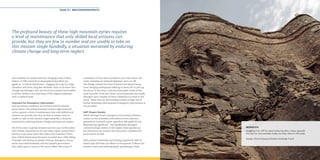
The profound beauty of these high mountain eyries requires
a level of maintenance that only skilled local artisans can
provide, but they are few in number and are unable to take on
this mission single handedly, a situation worsened by enduring
climate change and long-term neglect.
Hugging the cliff to ward away bandits, many igoudar
are just as inaccessible today as they were in the past.
Image: David Gouery/Global Heritage Fund
MOROCCO
heritage, Dr. Naji has been involved in the preservation of sacred and collective oases
in several towns across the Anti-Atlas Mountains in Morocco. Her projects extend to
four sites of impressive undertaking, from communal granaries to fortified towns. Dr
Naji’s work on the preservation of earth buildings in southern Morocco has awarded
her with the Aga Khan Award for Architecture in 2013, among many additional
accolades.
Together with Dr. Naji, Global Heritage Fund will investigate the communal granaries
of the oases of southern Morocco. GHF’s long-term goal there include:
• Stabilize and partially reconstruct the support structures of the granaries that
collapsed due to the heavy rains
• Conduct a professional, comprehensive survey of the damage, along with an
assessment of the necessary engineering and reconstructive work
• Conduct long-term site management and hydrology studies to ensure the
granaries are able to withstand future threats from the elements
• Provide training to local teams to perform the repairs by way of authentic
preservation and the use of traditional materials
• Increase the value of traditional architecture and space in the development of
sustainable cultural heritage tourism (local and foreign)
• Enhance the local quality of life through the collective conservation of
culturally meaningful places
• Promote earthen building as a sustainable and affordable technique for
contemporary living
• Promote traditional building skills at risk of disappearing
Integrating local communities in the restoration of their own cultural treasures is a
very rare experience in Morocco. Opening the door to renewed creativity, connections,
and economic opportunities, it also establishes a sense of collective ownership
of the built and intangible heritage of a country. These are the stepping-stones to
sustainable development, and the very vision shared with Global Heritage Fund.
High above its village, this agadir is protected by a series of
battlements, towers, and a gate small enough for only one man
to pass through.
Image: David Gouery/Global Heritage Fund
MOROCCO
PAGE 15 | #BEYONDMONUMENTS PAGE 03 | GLOBALHERTIAGEFUND.ORGPAGE 16 | GLOBALHERITAGEFUND.ORG
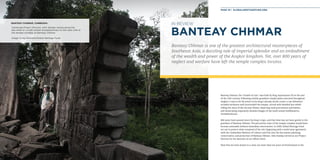
Cambodia Project Director John Sanday stands along the
bas-relief of a multi-armed Avalokiteshvara on the west side of
the temple complex at Banteay Chhmar.
Image: Craig Stennett/Global Heritage Fund
BANTEAY CHHMAR, CAMBODIA
Banteay Chhmar, the “Citadel of Cats,” was built by King Jayavarman VII at the end
of the 12th century. Following similar grandiose temple plans executed throughout
Angkor, it was to be the jewel in the king’s already lavish crown: a one-kilometer
arcaded enclosure wall surrounded the temple, carved with detailed bas-reliefs
telling the story of the Ancient Khmer, depicting royal processions and battles,
and showcasing exquisitely detailed images of the multi-armed boddhisattva
Avalokiteshvara.
800 years have passed since the king’s reign, and that time has not been gentle to the
grandeur of Banteay Chhmar. The precarious state of the temple complex would have
become untenable without immediate intervention. In 2008, Global Heritage Fund
set out to protect what remained of the site, beginning with a multi-year agreement
with the Cambodian Ministry of Culture and Fine Arts for the master planning,
conservation, and protection of Banteay Chhmar. John Sanday served as our Project
Director for the duration of our efforts there.
Now that we have drawn to a close our more than six years of involvement in the
PAGE 18 | GLOBALHERITAGEFUND.ORG
IN REVIEW
BANTEAY CHHMAR
Banteay Chhmar is one of the greatest architectural masterpieces of
Southeast Asia, a dazzling tale of imperial splendor and an embodiment
of the wealth and power of the Angkor kingdom. Yet, over 800 years of
neglect and warfare have left the temple complex inruins.
PAGE 19 | #BEYONDMONUMENTS
conservation of Banteay Chhmar, we’d like to explore the
challenges, achievements, and future vision for the stewardship
of this marvelous temple complex.
Preserving the Site
Under the direction of Mr. Sanday, we achieved the following
successes in preserving and stabilizing numerous monumental
structures:
• Monumental bas-reliefs on the Southeast Sector Wall
reassembled and conserved
• Iconic face tower 18 North disassembled and conserved
after threat of collapse
• Critically threatened sections of the temple complex
repaired
• Removal of trees affecting structural stability of complex
• Trained group of local workers in: stone conservation,
scientific sampling, and testing methods; indigenous
conservation methodology for the Banteay Chhmar site; and
photographic documentation techniques
• Completed 3D virtual reconstruction of site
Developing the Community
“We’re not just restoring a pile of old rocks, as people used to
think” Sanday muses. “It’s a community effort.” Indeed, the local
people of Banteay Chhmar were essential to the surveying,
preservation, and reconstruction of the temple complex that had
been so maimed by years of neglect and looting.
Beyond their immense assistance at the site itself, the local
people were instrumental in transforming Banteay Chhmar
into a flourishing tourist destination. With their help, and in
partnership with Heritage Watch and Agir pour le Cambodge, we
co-founded the Community-Based Tourism Board (CBT) to help
facilitate this transition. Since its founding in 2007, the CBT has
been an overwhelmingly positive force in the community, either
helping to found family-run businesses, creating new jobs for
local residents, or fostering educational opportunities.
To date, it has invested in community initiatives such as
waste collection services and cleaning of the moat, as well
as the opening of a local restaurant and a children’s library.
A team of 15 volunteer committee members manages the
allocation of these funds, as well as the training of local guides,
supplementary education for CBT members (topics include
English language, hygiene, and transport), and the initiation of
community projects. We were involved in the development of
multiple communal achievements:
• 41 community members now employed at site
• 70 community members employed with the CBT
• Workshops conducted for local craftsmen and CBT members
on conservation
• Visitor center constructed.
• 9 homestays established, offering 30 rooms for 25-50
visitors per night
Conclusions and Challenges
Our successes at Banteay Chhmar are great. That said, there are
still a number of challenges to achieving long-term sustainability
and growth:
Tourism is an increasingly large part of the local economy, but
is still a fraction compared to the market share of Angkor Wat.
According to the Phnom Penh Post, Banteay Chhmar welcomes
882 visitors in 2013, a number which rose to 1,288 in 2014 - a
period when Angkor Wat saw two million annual visitors alone.
Poor infrastructure around Banteay Chhmar is an obstacle to
increased interest in the site. Once this challenge is overcome,
the 2.5-hour drive from Angkor Wat will be easier and more
comfortable for day trips or short retreats.
Educational opportunities are limited in this part of Cambodia,
especially for women and indigenous peoples. The Ministry of
Culture and Fine Arts has identified a number of opportunities to
A woman wanders through a field of tall grass in the temple
complex.
Image: Craig Stennett/Global Heritage Fund
BANTEAY CHHMAR, CAMBODIA
PAGE 03 | GLOBALHERITAGEFUND.ORGPAGE 03 | #BEYONDMONUMENTS
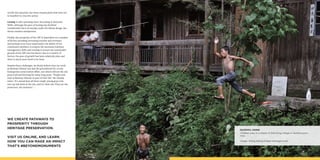
Children play in a stream in Dali Dong village in Guizhou prov-
ince.
Image: Zhang Siding/Global Heritage Fund
GUIZHOU, CHINA
rectify this situation, but these remain plans that have yet
to manifest in concrete action.
Looting is still a pressing issue. According to Deutsche
Welle, although the pace of looting has declined
considerably since its heyday under the Khmer Rouge, the
threat remains omnipresent.
Finally, the prosperity of the CBT is dependent on a number
of factors including increasing tourism and revenues,
and perhaps even more importantly, the ability of the
community members to acquire the necessary business
management skills and training to ensure the sustainable
growth of the CBT into the future. Due to a variety of
factors, the pace of growth has been relatively slow, and
there is much more work to be done.
Despite these challenges, we firmly believe that our work
at Banteay Chhmar has laid the groundwork for a truly
homegrown conservation effort, one which will see the site
preserved and thriving for many long years. “People now
look at Banteay Chhmar as part of their life,” Mr. Sanday
notes. “It’s unreal how all these tough, young guys now
turn up and work at the site, and it’s their site. They are the
protectors, the monitors.”
WE CREATE PATHWAYS TO
PROSPERITY THROUGH
HERITAGE PRESERVATION.
VISIT US ONLINE, AND LEARN
HOW YOU CAN MAKE AN IMPACT
THAT’S #BEYONDMONUMENTS

GHF_Review_006

  • 1.
    PAGE 03 |GLOBALHERITAGEFUND.ORGPAGE 03 | #BEYONDMONUMENTS BEYOND MONUMENTS® GLOBALHERITAGEFUND.ORG Ciudad Perdida from a drone’s eye view. Image: Plinio Barraza/Global Heritage Fund CIUDAD PERDIDA, COLOMBIA GLOBAL HERITAGE REVIEW FALL 2015 ®
  • 2.
    PAGE 02 |GLOBALHERITAGEFUND.ORGPAGE 03 | GLOBALHERTIAGEFUND.ORG Tell us a little bit about how you came to this position. I have always considered working with Global Heritage Fund my dream job. After ten years of work with GHF, starting on the ground level in Kars, Turkey, I am so honored to be in this position of leadership. I consider it a great responsibility to helm the organization during this time of transition. At Global Heritage Fund, things are changing. We’re only getting better and stronger 15 years down the road. 2016 is going to be a fantastic year, and I am confident that working together, we will achieve some amazing wins for heritage. What are the biggest challenges Global Heritage Fund faces in protecting cultural heritage? The greatest challenge is instilling this basic question among people: What is cultural heritage? After people understand what this shared resource is we can begin to address why it needs to be saved. For this reason, we are going back to basics. We want to help people understand both the importance of our heritage, and the powerful and yet relatively untapped potential it can play in global development. Over 13 years of conservation work, we’ve learned time and again that preserving cultural heritage can yield significant social, cultural, and economic benefits. We believe that these sites will be there in 100 years’ time precisely because of how we preserve them today, but more importantly, because of how we instill a sense of stewardship in local communities. For citizens and students, governments and local organizations, we’re providing an incentive for everyone to protect and benefit from cultural treasures. This is why GHF’s scope of work is far more than What’s happening at GHF as we approach our 15th year? We took some time to reflect on where we’ve come and where we’re headed. Our new Executive Director Stefaan Poortman shares his thoughts and experiences in this issue. GHF’s Executive Director Stefaa Poortman stands beneath two monumental pillars at the site of Perge near Antalya, Turkey. PERGE, TURKEY
  • 3.
    PAGE 04 |GLOBALHERITAGEFUND.ORGPAGE 03 | #BEYONDMONUMENTS monuments, a sentiment reflected in our new brand tag line: #BeyondMonuments. What is changing at GHF? Our messaging is evolving. Both internally and in how we’re going to approach our communication strategy, the core message we’re out to deliver is that heritage is beyond monuments – it’s the story of a people. We’re working to connect with a greater number and diversity of people, because we want the world to know that every story should have a voice. From the donors who make our work possible to the local communities we help, the more people that get involved with heritage, the more visible it becomes, and the more we will be able to protect and treasure it. A big part of that involves expanding our base. There’s a younger audience out there that is more interested to see how they can directly engage and help, but we haven’t effectively courted that demographic until now. So, we’re exploring new ways that people can help out in a more tangible way. For instance, we’ve developed the Cultural Emergency Program to allow people to donate in a way that is immediately impactful in critical, time-sensitive situations. In addition, we’re working to leverage the use of technology to help heritage in crisis. Our program ‘AMAL in Heritage’ is a great example of this. It allows conservators and interested parties to do Rapid Impact Assessments of critically endangered heritage sites, which will be immensely beneficial for conservation efforts on the ground. “Amal” means “hope” in Arabic, and we believe that this technology platform will help save some of the most endangered heritage in places like Iraq and Syria. We’re also in transition with our projects. We’re preparing to sign off on Banteay Chhmar (Cambodia), Pingyao (China), and Mirador (Guatemala), and we’re beginning to identify new projects for our portfolio. Right now, we’re looking at sites in Greece, Nepal, Myanmar, Ethiopia, and Cuba. Personally, I’m quite excited about expanding our presence in Africa. Having spent part of my childhood in Zimbabwe, I am keen to see GHF develop several African projects in the next few years. What is GHF’s impact strategy for 2016? We’re diversifying where and the way we operate so that we can maximize our impact. In the past, we restricted our work to developing countries only. Now, we’re also exploring projects in areas of economic need, such as Greece and Romania. The new portfolio will also include a range of urban versus rural and archaeological versus architectural sites. Additionally, we’re moving away from just 5-7 year long projects, and starting to incorporate short-term projects of a 3-5 year period as well. This shift will allow us to achieve two key objectives: first, to expand our geographic footprint further and protect more heritage in more places; and second, to provide demonstrable and measurable impact in a shorter time frame. In tandem with this, we’re going to further leverage our global network of experts and technology to maximize our preservation and development efforts. This includes access to drone technology and mobile mapping applications, which will more easily help us to achieve our project objectives and conduct quantitative assessments of our efforts. Finally, we’ve taken on a new branding and messaging strategy. We’re rolling out new channels of engagement through fresh content across all of GHF’s communication platforms, including web, print, social media, events, and group travel. Who are GHF’s key partners in 2015 and in 2016? Collaboration has always been the most critical factor in our success. Without the tireless support of our partners and donors, I can unequivocally state that our achievements would not be nearly as great as they are. So of course, we’re planning increased collaboration with our new and existing partners as we go into 2016. In 2015, we built a very strong partnership with the Prince Claus Fund in the Netherlands to provide both short- and medium-term funding to sites facing high risk. We’ve also partnered with UNESCO in China on the development of the official preservation guidelines for Pingyao’s Ancient City – now finalized and released. Finally, with the help of the Arab Regional World Heritage Center in Bahrain and the International Center for the Study of the Restoration and Preservation of Cultural Property (ICCROM), we are working on a technology solution for heritage in peril in Iraq and Syria through the AMAL in Heritage program. You can find more information about all of these programs on our new website, www.globalheritagefund.org. Our location in the heart of Silicon Valley places us right in the middle of tech culture, and we’re going to capitalize on that as we move forward. GHF is discussing innovative partnerships with various financial entities to provide potential impact investment funding that will help us with enterprise investment and development around our project sites. We’ve partnered with several local tech firms to create low-cost and innovative solutions to heritage conservation’s most pressing issues, whether using drones to map new sites and provide feeds on preservation projects or advanced scanners to conduct soil analyses. Finally, we’re using the power of social media to connect with more people, more often. That involves linking up with a new generation of journalists operating in the communities where we work and deriving new stories that will also complement GHF’s impact strategy. We believe that these sites will be there in 100 years’ time precisely because of how we preserve them today, but more importantly, because of how we instill a sense of stewardship in local communities.
  • 4.
    PAGE 05 |#BEYONDMONUMENTS PAGE 06 | GLOBALHERITAGEFUND.ORG Global Heritage Fund launched the Cultural Emergency Program (CEP) in 2015 to provide first aid to cultural heritage around the world. Cultural heritage is an increasingly vulnerable resource in our society; at any given moment, a historic city is destroyed at the hands of terror and ancient temples are crippled by natural disaster. Gone with these treasures are also intangible legacies such art and literature, not to mention the sense of identity for affected communities. On our watch, we risk losing all the cultural treasures of the Middle East from the ravages of war; compromising the safety of ancient, sacred texts in Timbuktu; and becoming spectators to the inevitable downfall of Nepal’s heritage with the pounding of the next earthquake. Our ability to help cannot be held back by time or a lack of funds. The CEP makes sure that cannot happen. What does it do, and why is it necessary? We believe that emergency aid to cultural assets must be an essential part of every humanitarian outreach. Over the last two years, Global Heritage Fund has answered the call to contribute to several emergency projects worldwide. Now, it’s time to CULTURAL EMERGENCY PROGRAM After disaster strikes, the wounds of an ailing nation require more than just reconstruction. Beyond temporary economic aid, heritage offers a salve that will bind a people together, giving them hope, strength, and most importantly, the belief in the lasting resilience of their culture. LIBYA NEPAL IRAQ SYRIA
  • 5.
    PAGE 08 |GLOBALHERITAGEFUND.ORGPAGE 03 | #BEYONDMONUMENTS formalize this emergency outreach into an official program. The CEP was launched in September 2015 to combat threats to cultural heritage in Africa, as well as severe looting and natural disaster incidents across the Middle East and Asia. It provides an unrestricted platform for donors to assist with emergency interventions and address the short-term, immediate needs of highly endangered heritage in areas of conflict or natural disaster. This means we always have the financial capacity to reach out and help communities immediately, rather than having to wait for months until the funds are available. The CEP allows us to apply our knowledge, experience, and global network capacity to address the crisis as soon as possible, as events unfold, and with the dedicated efforts of our partners on the ground. How does it work? Once disaster strikes a site, country or region, GHF will work with our Senior Advisory Board and strategic partners to evaluate the highest priorities for funding after the humanitarian crisis has passed. CEP activities could include rapid impact assessments or comprehensive damage assessments, evacuations of heritage assets (under extreme circumstances), emergency stabilization or conservation measures, or procurement of international experts for assistance to heritage experts on the ground. Do you want to help make a difference in cultural first aid? Visit our new website at www.globalheritagefund.org/getinvolved to learn how you can help heritage in crisis in places like Nepal or Haiti. April 30, 2015 - A local temple in rubble after the earthquake aftermath that devastated Kathmandu, Nepal Kathmandu, Nepal
  • 6.
    PAGE 03 |GLOBALHERITAGEFUND.ORGPAGE 03 | #BEYONDMONUMENTS well as how to execute them in the field. With the addition of supplementary training materials, professionals will also be able to train concerned parties in RIA and dispatch them as local impact assessment teams. This pilot program is intended to overcome the problems associated with pre-existing techniques for recording and data gathering, which are too slow and expensive to be effectively used in emergency situations. It is necessary to note that this project is not designed to conduct comprehensive assessments, and so cannot clarify all possible issues or answer all possible challenges related to a heritage site. Rather, it is intended as a simple, cost-effective tool for identifying and addressing critical issues in the most effective manner possible in challenging environments. Database and Mapping System In order to maintain records of conservation efforts both for posterity, and to ensure the dissemination of valuable information, AMAL in Heritage will create a database and mapping system to record all information passed through the website and mobile app. Through this database, we will be able to educate, advise on, and discuss challenges related to the preservation of cultural heritage in all its forms. Distance Learning Many people in conflict zones want to preserve their priceless cultural treasures, but oftentimes they do not know how. Our distance-learning workshops will offer basic, vital information for disaster risk management and emergency response techniques for movable and immovable cultural heritage. Each workshop will be limited to a small number of students to facilitate better interaction between them and their teachers. This part of our program is currently in development, and we hope to launch it as soon as possible. With the inauguration of this pilot program, GHF and our partners are confident that - though we cannot always be present on the ground - we can contribute to the toolkits of conservators in a positive and effective manner. We are filled with hope at its promise to help stem the tide of cultural loss in the Middle East and North Africa. For more information about AMAL, please visit globalheritagefund.org. Across the Middle East and North Africa (MENA), warfare has destabilized states, upended communal order, created a massive refugee disaster, and caused the deaths of hundreds of thousands of people. The recent crises in Syria and Iraq have incurred an additional terrible cost as well. In Palmyra, Syria or in Mosul, Iraq, priceless cultural treasures have been irrevocably destroyed by militants in the ongoing conflict. This upheaval has highlighted the need for a comprehensive program of emergency response. However, regional strife precludes any attempt at on-the-ground support. To fill the gap created by the absence of this crucial assistance international support, Global Heritage Fund is partnering with the Arab Regional Centre for World Heritage (ARC-WH), the International Centre for the Study of the Preservation and Restoration of Cultural Property (ICCROM), and the International Scientific Committee on Risk Preparedness of ICOMOS (ICOMOS-ICORP) to launch the ‘AMAL in Heritage’ program. When this program is fully developed, it will provide unprejudiced advice, supplementary training, and emergency management and response tools to anyone seeking to provide protection and conservation for all aspects of cultural heritage in these regions. Leveraging the capabilities of mobile technology and the cloud, AMAL is a high-tech solution designed to aid in documenting cultural assets and assessing damage to cultural heritage during high-risk, emergency situations. AMAL will do this by offering hands-on, distance learning tools and technical support applications to experts and other interested parties across the conflict-stricken countries of the MENA region. We are confident that their ability to respond to complex emergency situations and threats to cultural heritage will be greatly strengthened by the toolkit we provide with this program. Mobile Device Application Rapid Impact Assessment Tool Currently, the efforts of GHF and our partners are focused on developing a mobile-based application that will allow conservation professionals, public institutions, members of NGOS, and other interested parties to initiate Rapid Impact Assessments (RIAs) of movable and immovable cultural assets. Simple tutorials on the AMAL app will ensure that users understand both the processes and concepts behind RIA, as Global Heritage Fund’s new tool for endangered culture in the Middle East and North Africa. AMAL IN HERITAGE PAGE 10 | GLOBALHERITAGEFUND.ORG A 6,000 year old oasis... and more. Image: Csaba Moldovan/Global Heritage Fund Palmyra, Syria
  • 7.
    PAGE 03 |GLOBALHERTIAGEFUND.ORGPAGE 11 | #BEYONDMONUMENTS An amin prepares to do maintenance work on his agadir. Since the decline of the igoudar tradition, most are left to do this work on their own. Image: David Gouery/Global Heritage Fund MOROCCO PAGE 12 | GLOBALHERITAGEFUND.ORG “The whole life,” wrote The Times correspondent Walter Harris in 1921, “was one of warfare and gloom. Every tribe had its enemies, every family had its blood-feuds, and every man his would-be murderer.” Eking out an existence among such extremities, the Berber tribes inevitably manifested a prudent caution for their lives and livelihoods. In response to the need for a secure place to store their food and valuable possessions – everything from barley and oil to silver, jewels, and carpets - the Berbers developed communal granaries. These fortified igoudar (singular agadir) helped to protect the tribes from floods, desert marauders, and factional clashes. While it is impossible to precisely date its origin, it is assumed that the agadir tradition is more than one thousand years old, dating from a time when the tribes of the Anti-Atlas were still nomadic. The first igoudar were built, or more accurately found, to suit the needs of these itinerant nomads. It may be too charitable to describe these retrofitted caves as depositories, but the small warrens nevertheless served important storage functions during their owners’ absences. As nomadic communities became settled into a pastoral way of life, the igoudar followed suit, increasing in both complexity and IN PROGRESS MOROCCO’S SACRED GRANARIES It is in a country such as this that the Berbers have always made their home. The high desert spires and sheer, imposing rock faces of Morocco’s Anti-Atlas mountains present the perfect environment for this rugged and hardy people, inured to the solitary mountain life and baptized in the desert’s endless tribulations.
  • 8.
    PAGE 13 |#BEYONDMONUMENTS inaccessibility in tandem with the changing needs of their makers. A 1998 article from Geographical described one agadir as, “a telltale watchtower… hugging the cusp of a ridge. Chambers and hives cling like swallows’ nests to its sheer face. Though tantalizingly close, the structure remains inaccessible to all but climbers now that many of the original walkways have crumbled away.” Outreach for Emergency Intervention Such precarious conditions do not bode well for cultural preservation. The profound beauty of these high mountain eyries requires a level of maintenance that only skilled local artisans can provide, but they are few in number and are unable to take on this mission single handedly, a situation worsened by enduring climate change and long-term neglect. All of this came to global attention late last year. In November 2014, deadly rainstorms in the Anti-Atlas region caused entire districts to go under water after dikes were breached. Three days of flash floods were the worst recorded since 1986, killing 32 people and leaving six people missing. Emergency rescue teams evacuated hundreds, and the Spanish government was called upon to assist in the rescue effort. More than 25 centimeters of rain were recorded in just a few hours. 100 roads, including six national highways, were cut off. The deluge claimed the lives of dozens and injured many more, bringing widespread suffering to those left to pick up the pieces. It was also a cultural catastrophe. Some of the most beautiful of the Anti-Atlas’ sacred granaries were badly damaged, and a number of them collapsed as a result of the storm. Those that are still standing remain at high-risk of further immediate deterioration if emergency intervention is not provided. GHF Project Details Global Heritage Fund’s emergency intervention initiative centers on the immediate restoration of two collective granaries in Amtoudi, agadir Aguellouy and agadir Id Issa. Representing significant - and significantly damaged - cultural heritage centers in the region, these igoudar are key attractions for tourism and thus prime candidates for preservation by GHF. With primary leadership and funding supplied by GHF, Dr. Salima Naji will helm our efforts on the ground. A Moroccan architect and social anthropologist specializing in built The profound beauty of these high mountain eyries requires a level of maintenance that only skilled local artisans can provide, but they are few in number and are unable to take on this mission single handedly, a situation worsened by enduring climate change and long-term neglect. Hugging the cliff to ward away bandits, many igoudar are just as inaccessible today as they were in the past. Image: David Gouery/Global Heritage Fund MOROCCO
  • 9.
    heritage, Dr. Najihas been involved in the preservation of sacred and collective oases in several towns across the Anti-Atlas Mountains in Morocco. Her projects extend to four sites of impressive undertaking, from communal granaries to fortified towns. Dr Naji’s work on the preservation of earth buildings in southern Morocco has awarded her with the Aga Khan Award for Architecture in 2013, among many additional accolades. Together with Dr. Naji, Global Heritage Fund will investigate the communal granaries of the oases of southern Morocco. GHF’s long-term goal there include: • Stabilize and partially reconstruct the support structures of the granaries that collapsed due to the heavy rains • Conduct a professional, comprehensive survey of the damage, along with an assessment of the necessary engineering and reconstructive work • Conduct long-term site management and hydrology studies to ensure the granaries are able to withstand future threats from the elements • Provide training to local teams to perform the repairs by way of authentic preservation and the use of traditional materials • Increase the value of traditional architecture and space in the development of sustainable cultural heritage tourism (local and foreign) • Enhance the local quality of life through the collective conservation of culturally meaningful places • Promote earthen building as a sustainable and affordable technique for contemporary living • Promote traditional building skills at risk of disappearing Integrating local communities in the restoration of their own cultural treasures is a very rare experience in Morocco. Opening the door to renewed creativity, connections, and economic opportunities, it also establishes a sense of collective ownership of the built and intangible heritage of a country. These are the stepping-stones to sustainable development, and the very vision shared with Global Heritage Fund. High above its village, this agadir is protected by a series of battlements, towers, and a gate small enough for only one man to pass through. Image: David Gouery/Global Heritage Fund MOROCCO PAGE 15 | #BEYONDMONUMENTS PAGE 03 | GLOBALHERTIAGEFUND.ORGPAGE 16 | GLOBALHERITAGEFUND.ORG
  • 10.
    Cambodia Project DirectorJohn Sanday stands along the bas-relief of a multi-armed Avalokiteshvara on the west side of the temple complex at Banteay Chhmar. Image: Craig Stennett/Global Heritage Fund BANTEAY CHHMAR, CAMBODIA Banteay Chhmar, the “Citadel of Cats,” was built by King Jayavarman VII at the end of the 12th century. Following similar grandiose temple plans executed throughout Angkor, it was to be the jewel in the king’s already lavish crown: a one-kilometer arcaded enclosure wall surrounded the temple, carved with detailed bas-reliefs telling the story of the Ancient Khmer, depicting royal processions and battles, and showcasing exquisitely detailed images of the multi-armed boddhisattva Avalokiteshvara. 800 years have passed since the king’s reign, and that time has not been gentle to the grandeur of Banteay Chhmar. The precarious state of the temple complex would have become untenable without immediate intervention. In 2008, Global Heritage Fund set out to protect what remained of the site, beginning with a multi-year agreement with the Cambodian Ministry of Culture and Fine Arts for the master planning, conservation, and protection of Banteay Chhmar. John Sanday served as our Project Director for the duration of our efforts there. Now that we have drawn to a close our more than six years of involvement in the PAGE 18 | GLOBALHERITAGEFUND.ORG IN REVIEW BANTEAY CHHMAR Banteay Chhmar is one of the greatest architectural masterpieces of Southeast Asia, a dazzling tale of imperial splendor and an embodiment of the wealth and power of the Angkor kingdom. Yet, over 800 years of neglect and warfare have left the temple complex inruins.
  • 11.
    PAGE 19 |#BEYONDMONUMENTS conservation of Banteay Chhmar, we’d like to explore the challenges, achievements, and future vision for the stewardship of this marvelous temple complex. Preserving the Site Under the direction of Mr. Sanday, we achieved the following successes in preserving and stabilizing numerous monumental structures: • Monumental bas-reliefs on the Southeast Sector Wall reassembled and conserved • Iconic face tower 18 North disassembled and conserved after threat of collapse • Critically threatened sections of the temple complex repaired • Removal of trees affecting structural stability of complex • Trained group of local workers in: stone conservation, scientific sampling, and testing methods; indigenous conservation methodology for the Banteay Chhmar site; and photographic documentation techniques • Completed 3D virtual reconstruction of site Developing the Community “We’re not just restoring a pile of old rocks, as people used to think” Sanday muses. “It’s a community effort.” Indeed, the local people of Banteay Chhmar were essential to the surveying, preservation, and reconstruction of the temple complex that had been so maimed by years of neglect and looting. Beyond their immense assistance at the site itself, the local people were instrumental in transforming Banteay Chhmar into a flourishing tourist destination. With their help, and in partnership with Heritage Watch and Agir pour le Cambodge, we co-founded the Community-Based Tourism Board (CBT) to help facilitate this transition. Since its founding in 2007, the CBT has been an overwhelmingly positive force in the community, either helping to found family-run businesses, creating new jobs for local residents, or fostering educational opportunities. To date, it has invested in community initiatives such as waste collection services and cleaning of the moat, as well as the opening of a local restaurant and a children’s library. A team of 15 volunteer committee members manages the allocation of these funds, as well as the training of local guides, supplementary education for CBT members (topics include English language, hygiene, and transport), and the initiation of community projects. We were involved in the development of multiple communal achievements: • 41 community members now employed at site • 70 community members employed with the CBT • Workshops conducted for local craftsmen and CBT members on conservation • Visitor center constructed. • 9 homestays established, offering 30 rooms for 25-50 visitors per night Conclusions and Challenges Our successes at Banteay Chhmar are great. That said, there are still a number of challenges to achieving long-term sustainability and growth: Tourism is an increasingly large part of the local economy, but is still a fraction compared to the market share of Angkor Wat. According to the Phnom Penh Post, Banteay Chhmar welcomes 882 visitors in 2013, a number which rose to 1,288 in 2014 - a period when Angkor Wat saw two million annual visitors alone. Poor infrastructure around Banteay Chhmar is an obstacle to increased interest in the site. Once this challenge is overcome, the 2.5-hour drive from Angkor Wat will be easier and more comfortable for day trips or short retreats. Educational opportunities are limited in this part of Cambodia, especially for women and indigenous peoples. The Ministry of Culture and Fine Arts has identified a number of opportunities to A woman wanders through a field of tall grass in the temple complex. Image: Craig Stennett/Global Heritage Fund BANTEAY CHHMAR, CAMBODIA
  • 12.
    PAGE 03 |GLOBALHERITAGEFUND.ORGPAGE 03 | #BEYONDMONUMENTS Children play in a stream in Dali Dong village in Guizhou prov- ince. Image: Zhang Siding/Global Heritage Fund GUIZHOU, CHINA rectify this situation, but these remain plans that have yet to manifest in concrete action. Looting is still a pressing issue. According to Deutsche Welle, although the pace of looting has declined considerably since its heyday under the Khmer Rouge, the threat remains omnipresent. Finally, the prosperity of the CBT is dependent on a number of factors including increasing tourism and revenues, and perhaps even more importantly, the ability of the community members to acquire the necessary business management skills and training to ensure the sustainable growth of the CBT into the future. Due to a variety of factors, the pace of growth has been relatively slow, and there is much more work to be done. Despite these challenges, we firmly believe that our work at Banteay Chhmar has laid the groundwork for a truly homegrown conservation effort, one which will see the site preserved and thriving for many long years. “People now look at Banteay Chhmar as part of their life,” Mr. Sanday notes. “It’s unreal how all these tough, young guys now turn up and work at the site, and it’s their site. They are the protectors, the monitors.” WE CREATE PATHWAYS TO PROSPERITY THROUGH HERITAGE PRESERVATION. VISIT US ONLINE, AND LEARN HOW YOU CAN MAKE AN IMPACT THAT’S #BEYONDMONUMENTS