Getting to Why:
Ideas for Asking &
Listening
Helping
you to help
your child
Ideas for parents, carers and other
supporting adults to help get to the heart of
a child's issues
Unless we can understand why a child is
e.g. self-harming, it's very unlikely we'll
succeed in supporting them to sustainably
change this behaviour. Getting to the 'why'
can be challenging as children often don't
know what's driving their behaviour. That's
where this guide comes in.
In this guide, I've shared ideas for getting to
why through conversations with your child.
If helpful, in future guides, I can explore
other methods like journalling, play, music
or art.
Cherry-pick the ideas that you think might
work for you and give them a go. You can
always revisit others later if you need to.
Good luck!
Introduction
Unless we
understand
the 'why', it's
hard to
provide
effective help
pookyknightsmith.com | @pookyh
Pooky x
Learning to be a better listener is the first
step before we engage with any of the
other ideas in this guide. Listening is
something that we can all get a little better
at because it's very natural for us to want to
jump in and fill the gaps in conversations,
or to want to provide a solution to a
problem which hasn't been fully outlined
yet, or to make a guess at the story being
told when it's still in the process of being
told.
In short, our love and the human condition
can get in the way of brilliant listening. On
the next page are some simple tips for the
kind of listening that will enable your child
to feel safe, supported, seen and heard.
The subsequent page includes ideas for
creating listening moments with your child
at times and in places when they might be
more receptive to a deeper conversation.
pookyknightsmith.com | @pookyh
Listen to Understand
-1-
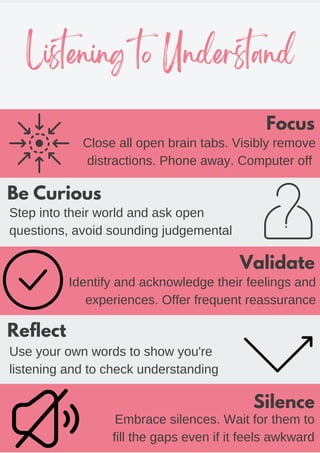
Listening to Understand
Focus
Validate
Silence
Be Curious
Reflect
Close all open brain tabs. Visibly remove
distractions. Phone away. Computer off
Identify and acknowledge their feelings and
experiences. Offer frequent reassurance
Embrace silences. Wait for them to
fill the gaps even if it feels awkward
Step into their world and ask open
questions, avoid sounding judgemental
Use your own words to show you're
listening and to check understanding
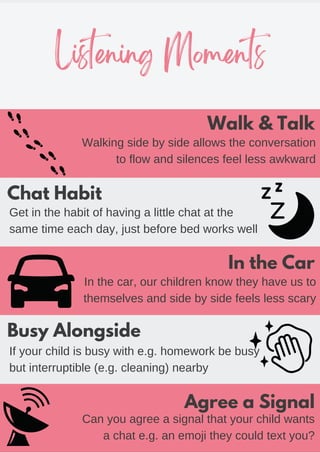
Listening Moments
Walk & Talk
In the Car
Agree a Signal
Chat Habit
Busy Alongside
Walking side by side allows the conversation
to flow and silences feel less awkward
In the car, our children know they have us to
themselves and side by side feels less scary
Can you agree a signal that your child wants
a chat e.g. an emoji they could text you?
Get in the habit of having a little chat at the
same time each day, just before bed works well
If your child is busy with e.g. homework be busy
but interruptible (e.g. cleaning) nearby
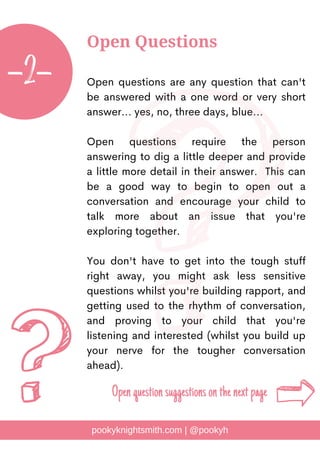
Open questions are any question that can't
be answered with a one word or very short
answer... yes, no, three days, blue...
Open questions require the person
answering to dig a little deeper and provide
a little more detail in their answer. This can
be a good way to begin to open out a
conversation and encourage your child to
talk more about an issue that you're
exploring together.
You don't have to get into the tough stuff
right away, you might ask less sensitive
questions whilst you're building rapport, and
getting used to the rhythm of conversation,
and proving to your child that you're
listening and interested (whilst you build up
your nerve for the tougher conversation
ahead).
pookyknightsmith.com | @pookyh
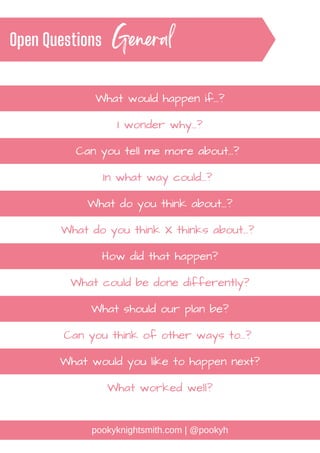
Open Questions
-2-
Openquestionsuggestionsonthenextpage
What would happen if...?
pookyknightsmith.com | @pookyh
Open Questions General
I wonder why...?
Can you tell me more about...?
In what way could...?
What do you think about...?
What do you think X thinks about...?
How did that happen?
What could be done differently?
What should our plan be?
Can you think of other ways to...?
What would you like to happen next?
What worked well?
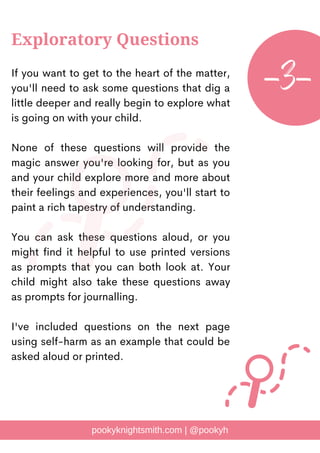
If you want to get to the heart of the matter,
you'll need to ask some questions that dig a
little deeper and really begin to explore what
is going on with your child.
None of these questions will provide the
magic answer you're looking for, but as you
and your child explore more and more about
their feelings and experiences, you'll start to
paint a rich tapestry of understanding.
You can ask these questions aloud, or you
might find it helpful to use printed versions
as prompts that you can both look at. Your
child might also take these questions away
as prompts for journalling.
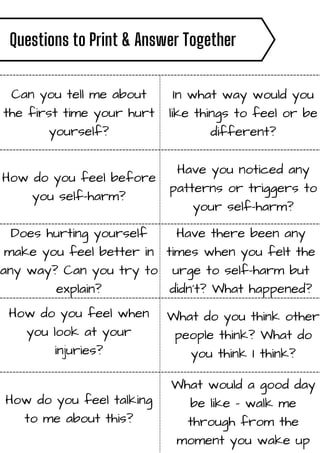
I've included questions on the next page
using self-harm as an example that could be
asked aloud or printed.
pookyknightsmith.com | @pookyh
Exploratory Questions
-3-
How do you feel talking
to me about this?
Does hurting yourself
make you feel better in
any way? Can you try to
explain?
How do you feel before
you self-harm?
Can you tell me about
the first time your hurt
yourself?
Questions to Print & Answer Together
In what way would you
like things to feel or be
different?
Have you noticed any
patterns or triggers to
your self-harm?
Have there been any
times when you felt the
urge to self-harm but
didn't? What happened?
What do you think other
people think? What do
you think I think?
What would a good day
be like - walk me
through from the
moment you wake up
How do you feel when
you look at your
injuries?
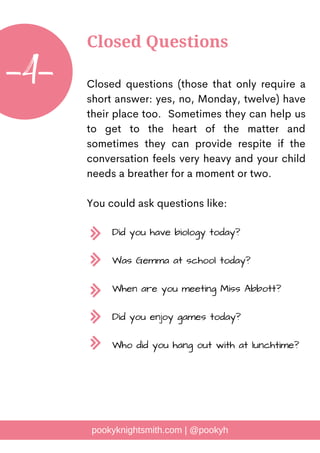
Closed questions (those that only require a
short answer: yes, no, Monday, twelve) have
their place too. Sometimes they can help us
to get to the heart of the matter and
sometimes they can provide respite if the
conversation feels very heavy and your child
needs a breather for a moment or two.
You could ask questions like:
pookyknightsmith.com | @pookyh
Closed Questions
-4-
Did you have biology today?
Was Gemma at school today?
When are you meeting Miss Abbott?
Did you enjoy games today?
Who did you hang out with at lunchtime?
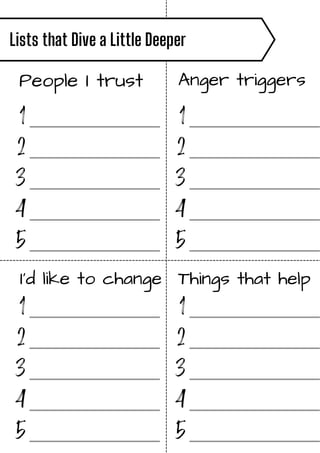
Making lists together can be a really interesting
way to explore your child's experience. Lists
can feel a bit less challenging to create than
free writing or speaking as they bring a
structure with them and feel finite.
You can make lists about anything including
some pretty light-hearted stuff that might
provide ways in, such as favourite films or ice
cream flavours.
Lists can help you get to the heart of the matter
too and can be used to explore triggers and
challenges e.g. ten things that make me angry.
Once made, lists can be re-ordered or
prioritised which can add further depth to the
conversation. Or you can make a list about
home and a list about school... there are lots of
possibilities.
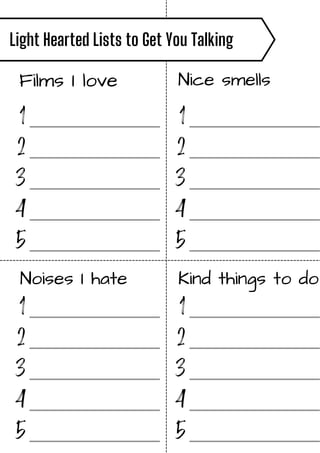
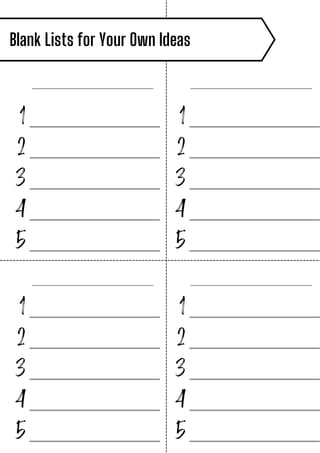
I've included some list templates to get you
started and some blank ones for your own
questions.
pookyknightsmith.com | @pookyh
Lists
-5-
Films I love Nice smells
Noises I hate Kind things to do
Light Hearted Lists to Get You Talking
1
2
3
4
5
_______________
_______________
_______________
_______________
_______________
1
2
3
4
5
_______________
_______________
_______________
_______________
_______________
1
2
3
4
5
_______________
_______________
_______________
_______________
_______________
1
2
3
4
5
_______________
_______________
_______________
_______________
_______________
People I trust Anger triggers
I'd like to change Things that help
Lists that Dive a Little Deeper
1
2
3
4
5
_______________
_______________
_______________
_______________
_______________
1
2
3
4
5
_______________
_______________
_______________
_______________
_______________
1
2
3
4
5
_______________
_______________
_______________
_______________
_______________
1
2
3
4
5
_______________
_______________
_______________
_______________
_______________
Blank Lists for Your Own Ideas
1
2
3
4
5
_______________
_______________
_______________
_______________
_______________
1
2
3
4
5
_______________
_______________
_______________
_______________
_______________
1
2
3
4
5
_______________
_______________
_______________
_______________
_______________
1
2
3
4
5
_______________
_______________
_______________
_______________
_______________
______________________ ______________________
______________________ ______________________
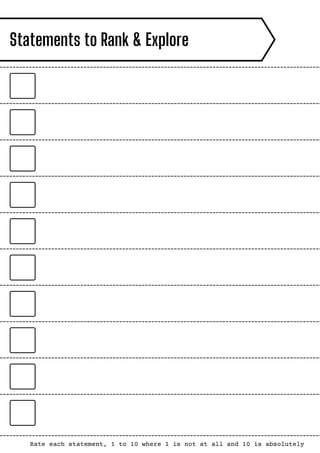
Rating and ranking exercises can help to open
a conversation out and get to the heart of
experiences and opinions.
There are lots of ways of doing these but the
simplest is to start with a range of statements
and either rank each from 1 (not at all) to 10
(totally), or to chop up a range of statements
and put them on the table and move them
around to rank them in order of importance.
Printing and sharing these kinds of statements
might feel a bit odd if you're supporting your
own child, but they can provide a useful hook
for the conversation if your child is up for it.
Some children will also appreciate how hard
you're trying. If your child doesn't engage, it
can be helpful to 'forget' to pick up the
statements, they'll often come back to them
and consider them in their own time.
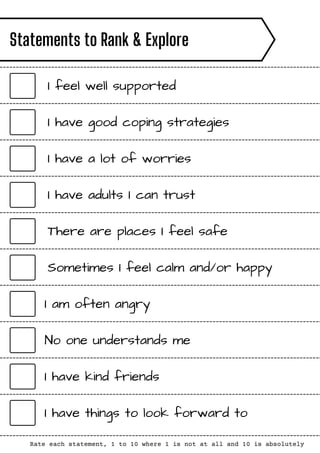
I've included some suggested statements and
some blank templates so you and your child
can write your own.
pookyknightsmith.com | @pookyh
Rating and Ranking
-6-
I have kind friends
I am often angry
There are places I feel safe
I have adults I can trust
I feel well supported
Statements to Rank & Explore
I have good coping strategies
I have a lot of worries
Sometimes I feel calm and/or happy
No one understands me
I have things to look forward to
Rate each statement, 1 to 10 where 1 is not at all and 10 is absolutely
Statements to Rank & Explore
Rate each statement, 1 to 10 where 1 is not at all and 10 is absolutely
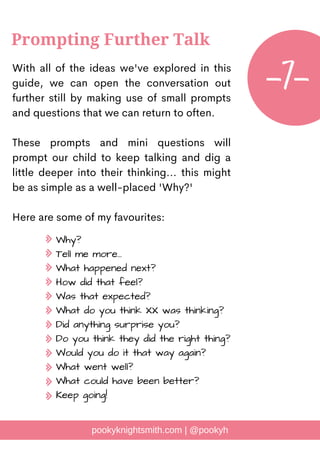
With all of the ideas we've explored in this
guide, we can open the conversation out
further still by making use of small prompts
and questions that we can return to often.
These prompts and mini questions will
prompt our child to keep talking and dig a
little deeper into their thinking... this might
be as simple as a well-placed 'Why?'
Here are some of my favourites:
pookyknightsmith.com | @pookyh
Prompting Further Talk
-7-
Why?
Tell me more...
What happened next?
How did that feel?
Was that expected?
What do you think XX was thinking?
Did anything surprise you?
Do you think they did the right thing?
Would you do it that way again?
What went well?
What could have been better?
Keep going!
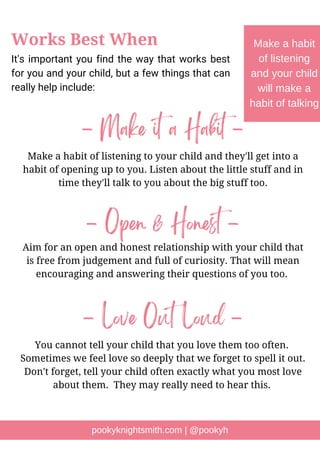
It's important you find the way that works best
for you and your child, but a few things that can
really help include:
pookyknightsmith.com | @pookyh
Works Best When Make a habit
of listening
and your child
will make a
habit of talking
- Make it a Habit -
Make a habit of listening to your child and they'll get into a
habit of opening up to you. Listen about the little stuff and in
time they'll talk to you about the big stuff too.
- Open & Honest -
Aim for an open and honest relationship with your child that
is free from judgement and full of curiosity. That will mean
encouraging and answering their questions of you too.
- Love Out Loud -
You cannot tell your child that you love them too often.
Sometimes we feel love so deeply that we forget to spell it out.
Don't forget, tell your child often exactly what you most love
about them. They may really need to hear this.
I've been able to produce this, thanks to the community
who support my work on Patreon.
If you already support me on Patreon, THANK YOU. If
you don't, please consider supporting me at
patreon.com/pookyh - you'll get instant access to a wide
range of guides and videos to help you to help your
child and you'll help to fund my future work for you
and others like you.
Helping
you to help
your child
- Thank You! -
Pooky x

Getting to Why - Ideas for asking and listening

  • 1.
    Getting to Why: Ideasfor Asking & Listening Helping you to help your child Ideas for parents, carers and other supporting adults to help get to the heart of a child's issues
  • 2.
    Unless we canunderstand why a child is e.g. self-harming, it's very unlikely we'll succeed in supporting them to sustainably change this behaviour. Getting to the 'why' can be challenging as children often don't know what's driving their behaviour. That's where this guide comes in. In this guide, I've shared ideas for getting to why through conversations with your child. If helpful, in future guides, I can explore other methods like journalling, play, music or art. Cherry-pick the ideas that you think might work for you and give them a go. You can always revisit others later if you need to. Good luck! Introduction Unless we understand the 'why', it's hard to provide effective help pookyknightsmith.com | @pookyh Pooky x
  • 3.
    Learning to bea better listener is the first step before we engage with any of the other ideas in this guide. Listening is something that we can all get a little better at because it's very natural for us to want to jump in and fill the gaps in conversations, or to want to provide a solution to a problem which hasn't been fully outlined yet, or to make a guess at the story being told when it's still in the process of being told. In short, our love and the human condition can get in the way of brilliant listening. On the next page are some simple tips for the kind of listening that will enable your child to feel safe, supported, seen and heard. The subsequent page includes ideas for creating listening moments with your child at times and in places when they might be more receptive to a deeper conversation. pookyknightsmith.com | @pookyh Listen to Understand -1-
  • 4.
    Listening to Understand Focus Validate Silence BeCurious Reflect Close all open brain tabs. Visibly remove distractions. Phone away. Computer off Identify and acknowledge their feelings and experiences. Offer frequent reassurance Embrace silences. Wait for them to fill the gaps even if it feels awkward Step into their world and ask open questions, avoid sounding judgemental Use your own words to show you're listening and to check understanding
  • 5.
    Listening Moments Walk &Talk In the Car Agree a Signal Chat Habit Busy Alongside Walking side by side allows the conversation to flow and silences feel less awkward In the car, our children know they have us to themselves and side by side feels less scary Can you agree a signal that your child wants a chat e.g. an emoji they could text you? Get in the habit of having a little chat at the same time each day, just before bed works well If your child is busy with e.g. homework be busy but interruptible (e.g. cleaning) nearby
  • 6.
    Open questions areany question that can't be answered with a one word or very short answer... yes, no, three days, blue... Open questions require the person answering to dig a little deeper and provide a little more detail in their answer. This can be a good way to begin to open out a conversation and encourage your child to talk more about an issue that you're exploring together. You don't have to get into the tough stuff right away, you might ask less sensitive questions whilst you're building rapport, and getting used to the rhythm of conversation, and proving to your child that you're listening and interested (whilst you build up your nerve for the tougher conversation ahead). pookyknightsmith.com | @pookyh Open Questions -2- Openquestionsuggestionsonthenextpage
  • 7.
    What would happenif...? pookyknightsmith.com | @pookyh Open Questions General I wonder why...? Can you tell me more about...? In what way could...? What do you think about...? What do you think X thinks about...? How did that happen? What could be done differently? What should our plan be? Can you think of other ways to...? What would you like to happen next? What worked well?
  • 8.
    If you wantto get to the heart of the matter, you'll need to ask some questions that dig a little deeper and really begin to explore what is going on with your child. None of these questions will provide the magic answer you're looking for, but as you and your child explore more and more about their feelings and experiences, you'll start to paint a rich tapestry of understanding. You can ask these questions aloud, or you might find it helpful to use printed versions as prompts that you can both look at. Your child might also take these questions away as prompts for journalling. I've included questions on the next page using self-harm as an example that could be asked aloud or printed. pookyknightsmith.com | @pookyh Exploratory Questions -3-
  • 9.
    How do youfeel talking to me about this? Does hurting yourself make you feel better in any way? Can you try to explain? How do you feel before you self-harm? Can you tell me about the first time your hurt yourself? Questions to Print & Answer Together In what way would you like things to feel or be different? Have you noticed any patterns or triggers to your self-harm? Have there been any times when you felt the urge to self-harm but didn't? What happened? What do you think other people think? What do you think I think? What would a good day be like - walk me through from the moment you wake up How do you feel when you look at your injuries?
  • 10.
    Closed questions (thosethat only require a short answer: yes, no, Monday, twelve) have their place too. Sometimes they can help us to get to the heart of the matter and sometimes they can provide respite if the conversation feels very heavy and your child needs a breather for a moment or two. You could ask questions like: pookyknightsmith.com | @pookyh Closed Questions -4- Did you have biology today? Was Gemma at school today? When are you meeting Miss Abbott? Did you enjoy games today? Who did you hang out with at lunchtime?
  • 11.
    Making lists togethercan be a really interesting way to explore your child's experience. Lists can feel a bit less challenging to create than free writing or speaking as they bring a structure with them and feel finite. You can make lists about anything including some pretty light-hearted stuff that might provide ways in, such as favourite films or ice cream flavours. Lists can help you get to the heart of the matter too and can be used to explore triggers and challenges e.g. ten things that make me angry. Once made, lists can be re-ordered or prioritised which can add further depth to the conversation. Or you can make a list about home and a list about school... there are lots of possibilities. I've included some list templates to get you started and some blank ones for your own questions. pookyknightsmith.com | @pookyh Lists -5-
  • 12.
    Films I loveNice smells Noises I hate Kind things to do Light Hearted Lists to Get You Talking 1 2 3 4 5 _______________ _______________ _______________ _______________ _______________ 1 2 3 4 5 _______________ _______________ _______________ _______________ _______________ 1 2 3 4 5 _______________ _______________ _______________ _______________ _______________ 1 2 3 4 5 _______________ _______________ _______________ _______________ _______________
  • 13.
    People I trustAnger triggers I'd like to change Things that help Lists that Dive a Little Deeper 1 2 3 4 5 _______________ _______________ _______________ _______________ _______________ 1 2 3 4 5 _______________ _______________ _______________ _______________ _______________ 1 2 3 4 5 _______________ _______________ _______________ _______________ _______________ 1 2 3 4 5 _______________ _______________ _______________ _______________ _______________
  • 14.
    Blank Lists forYour Own Ideas 1 2 3 4 5 _______________ _______________ _______________ _______________ _______________ 1 2 3 4 5 _______________ _______________ _______________ _______________ _______________ 1 2 3 4 5 _______________ _______________ _______________ _______________ _______________ 1 2 3 4 5 _______________ _______________ _______________ _______________ _______________ ______________________ ______________________ ______________________ ______________________
  • 15.
    Rating and rankingexercises can help to open a conversation out and get to the heart of experiences and opinions. There are lots of ways of doing these but the simplest is to start with a range of statements and either rank each from 1 (not at all) to 10 (totally), or to chop up a range of statements and put them on the table and move them around to rank them in order of importance. Printing and sharing these kinds of statements might feel a bit odd if you're supporting your own child, but they can provide a useful hook for the conversation if your child is up for it. Some children will also appreciate how hard you're trying. If your child doesn't engage, it can be helpful to 'forget' to pick up the statements, they'll often come back to them and consider them in their own time. I've included some suggested statements and some blank templates so you and your child can write your own. pookyknightsmith.com | @pookyh Rating and Ranking -6-
  • 16.
    I have kindfriends I am often angry There are places I feel safe I have adults I can trust I feel well supported Statements to Rank & Explore I have good coping strategies I have a lot of worries Sometimes I feel calm and/or happy No one understands me I have things to look forward to Rate each statement, 1 to 10 where 1 is not at all and 10 is absolutely
  • 17.
    Statements to Rank& Explore Rate each statement, 1 to 10 where 1 is not at all and 10 is absolutely
  • 18.
    With all ofthe ideas we've explored in this guide, we can open the conversation out further still by making use of small prompts and questions that we can return to often. These prompts and mini questions will prompt our child to keep talking and dig a little deeper into their thinking... this might be as simple as a well-placed 'Why?' Here are some of my favourites: pookyknightsmith.com | @pookyh Prompting Further Talk -7- Why? Tell me more... What happened next? How did that feel? Was that expected? What do you think XX was thinking? Did anything surprise you? Do you think they did the right thing? Would you do it that way again? What went well? What could have been better? Keep going!
  • 19.
    It's important youfind the way that works best for you and your child, but a few things that can really help include: pookyknightsmith.com | @pookyh Works Best When Make a habit of listening and your child will make a habit of talking - Make it a Habit - Make a habit of listening to your child and they'll get into a habit of opening up to you. Listen about the little stuff and in time they'll talk to you about the big stuff too. - Open & Honest - Aim for an open and honest relationship with your child that is free from judgement and full of curiosity. That will mean encouraging and answering their questions of you too. - Love Out Loud - You cannot tell your child that you love them too often. Sometimes we feel love so deeply that we forget to spell it out. Don't forget, tell your child often exactly what you most love about them. They may really need to hear this.
  • 20.
    I've been ableto produce this, thanks to the community who support my work on Patreon. If you already support me on Patreon, THANK YOU. If you don't, please consider supporting me at patreon.com/pookyh - you'll get instant access to a wide range of guides and videos to help you to help your child and you'll help to fund my future work for you and others like you. Helping you to help your child - Thank You! - Pooky x