So you’re thinking
about accepting cards
A guide to accepting card payments for small and medium sized businesses in the UK
This guide has been put together to help you understand the
entire process of taking cards, whether you already do or are
thinking of doing it so you can make the right decision for your
business. It can seem quite complicated so we’ve broken it
down into easy to follow sections.
There are also some handy tips about contactless payment,
practical working examples to help you compare one rate
from another, and a guide to some of the common contractual
pitfalls that many companies encounter, so that you can make
the right decision for you first time.
Section 1. Fees & Costs
3.	 So why take cards in the first place?
4.	 How much is taking cards going to cost me?
5.	 Basic Rates Explained
6.	 Premium charges explained
8.	 Authorisation fees explained
9.	 Minimum monthly service charges (MMSC) explained
10.	 How quickly will the money hit my bank account?
10.	 Can I refuse to take certain cards that cost me more money?
10.	 Can I pass the fees onto my customers?
Section 2. Understanding the process
11.	 Direct / Introducers / Payment Facilitators - which is right for you?
13.	 What’s the process?
Section 3. Contracts
14.	 How long do you have to sign up for?
14.	 Hidden costs to watch out for -1
14.	 I already accept cards. Is it easy to switch provider?
15.	 What’s the alternative to accepting cards?
15.	 Hidden costs to watch out for - 2
15.	 Annual fees: PCI DSS (Payment Card Industry Data Security Standard)
15.	 Too good to be true?
Section 4. Terminals & e-commerce
16.	 Which is the right terminal for me?
17.	 What about e-commerce?
Many business owners describe them as a ‘necessary evil’ because taking card
payments costs you, the “merchant”, money. “Merchant” is payment industry
terminology for a business that accepts credit and debit cards.
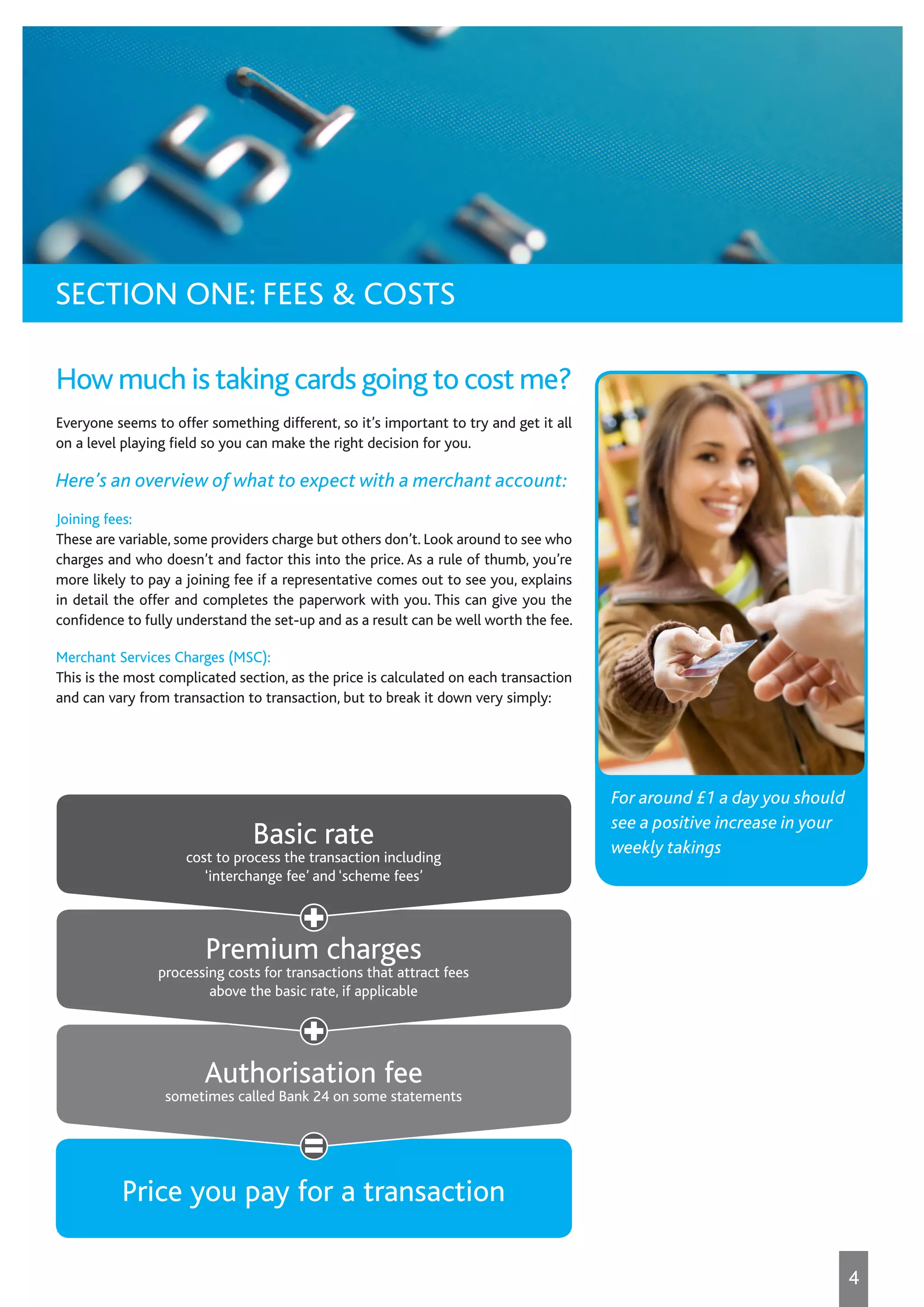
How many times have you stood in a queue and resisted picking up an extra item
or two because you’re not sure if the shop you are in takes cards? For around £1 a
day you should see a positive increase in your weekly takings.
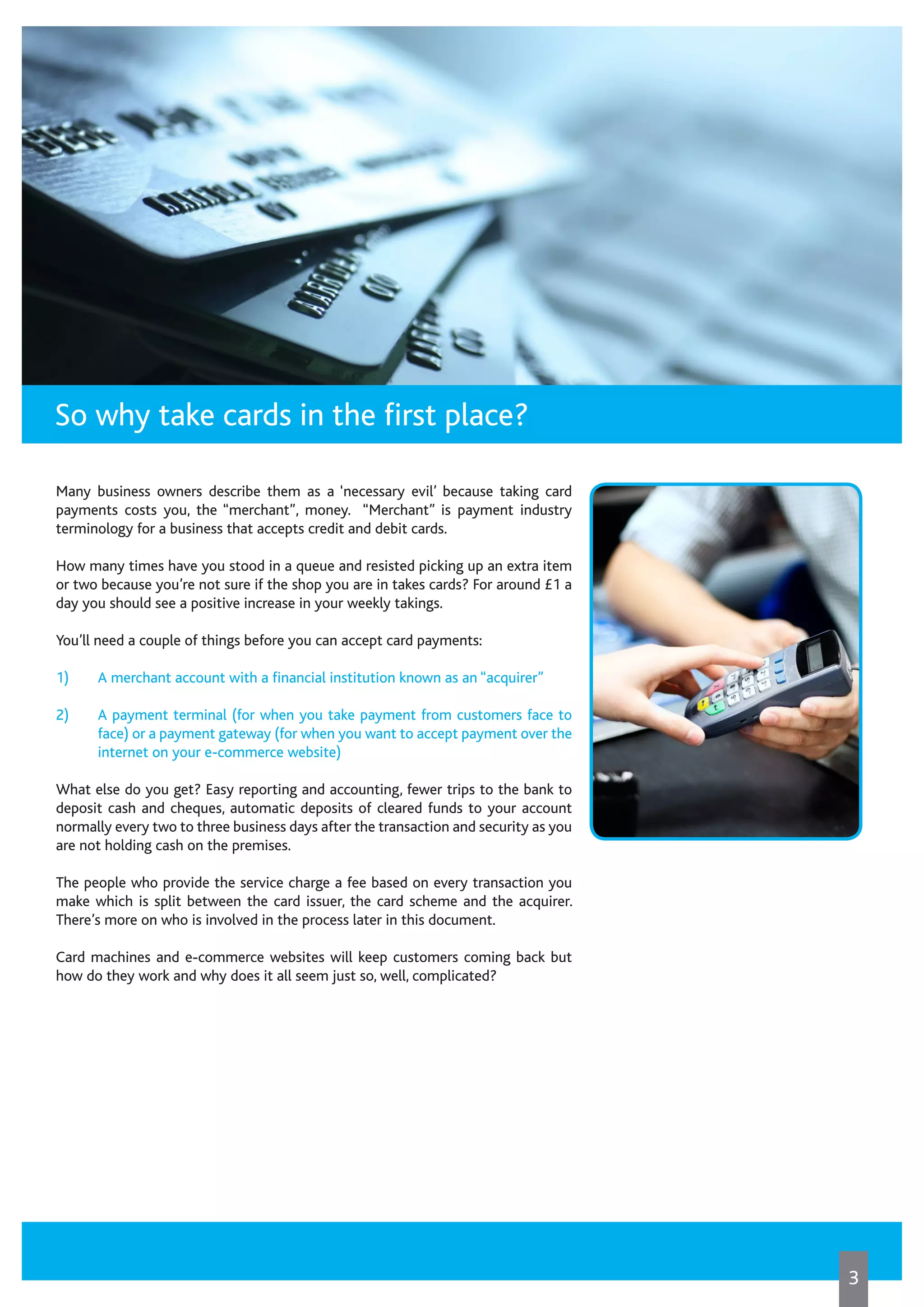
You’ll need a couple of things before you can accept card payments:
1)	 A merchant account with a financial institution known as an “acquirer”
2)	 A payment terminal (for when you take payment from customers face to
face) or a payment gateway (for when you want to accept payment over the
internet on your e-commerce website)
What else do you get? Easy reporting and accounting, fewer trips to the bank to
deposit cash and cheques, automatic deposits of cleared funds to your account
normally every two to three business days after the transaction and security as you
are not holding cash on the premises.
The people who provide the service charge a fee based on every transaction you
make which is split between the card issuer, the card scheme and the acquirer.
There’s more on who is involved in the process later in this document.
Card machines and e-commerce websites will keep customers coming back but
how do they work and why does it all seem just so, well, complicated?
So why take cards in the first place?
3
For around £1 a day you should
see a positive increase in your
weekly takings
How much is taking cards going to cost me?
Everyone seems to offer something different, so it’s important to try and get it all
on a level playing field so you can make the right decision for you.
Here’s an overview of what to expect with a merchant account:
Joining fees:
These are variable, some providers charge but others don’t. Look around to see who
charges and who doesn’t and factor this into the price. As a rule of thumb, you’re
more likely to pay a joining fee if a representative comes out to see you, explains
in detail the offer and completes the paperwork with you. This can give you the
confidence to fully understand the set-up and as a result can be well worth the fee.
Merchant Services Charges (MSC):
This is the most complicated section, as the price is calculated on each transaction
and can vary from transaction to transaction, but to break it down very simply:
Price you pay for a transaction
Authorisation fee
sometimes called Bank 24 on some statements
Premium charges
processing costs for transactions that attract fees
above the basic rate, if applicable
Basic rate
cost to process the transaction including
‘interchange fee’ and ‘scheme fees’
SECTION ONE: FEES & COSTS
4
Basic Rates Explained
Percentage or pence - which one’s for me?
This is very much dependent on the kind of transactions your business takes.
Debit cards are usually charged as a pence per transaction but can at times be
a percentage rate and credit cards are always a percentage rate. So the actual
amount you’ll pay depends on the type of card your customer presents and the
value of the transaction.
It’s important you understand the impact of the different types of fees you will
encounter and how they are affected by your average transaction value.
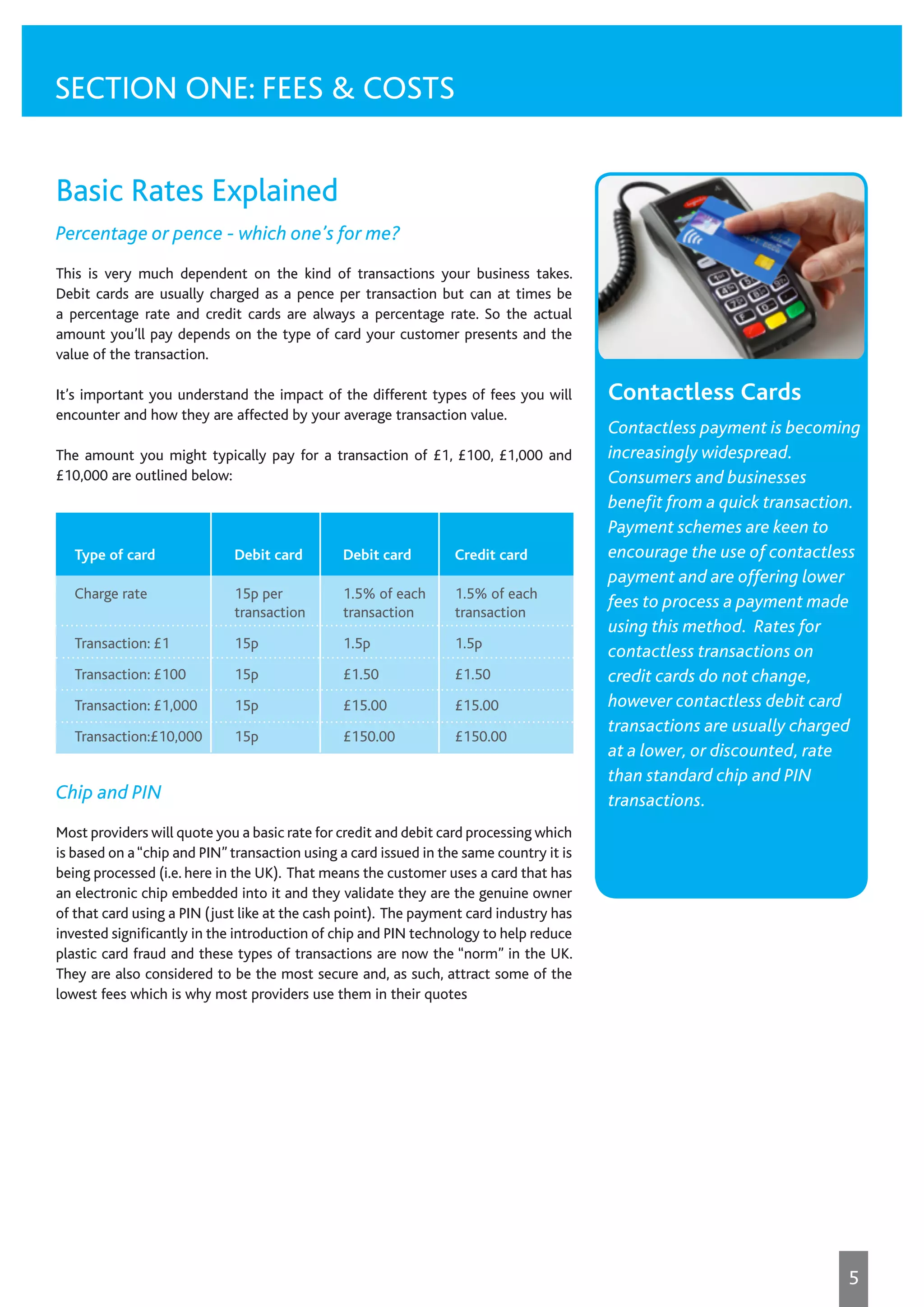
The amount you might typically pay for a transaction of £1, £100, £1,000 and
£10,000 are outlined below:
Chip and PIN
Most providers will quote you a basic rate for credit and debit card processing which
is based on a“chip and PIN” transaction using a card issued in the same country it is
being processed (i.e. here in the UK). That means the customer uses a card that has
an electronic chip embedded into it and they validate they are the genuine owner
of that card using a PIN (just like at the cash point). The payment card industry has
invested significantly in the introduction of chip and PIN technology to help reduce
plastic card fraud and these types of transactions are now the “norm” in the UK.
They are also considered to be the most secure and, as such, attract some of the
lowest fees which is why most providers use them in their quotes
SECTION ONE: FEES & COSTS
Type of card	 Debit card	 Debit card	 Credit card
Charge rate	 15p per	 1.5% of each	 1.5% of each
	 transaction	transaction	 transaction
Transaction: £1	 15p	 1.5p	 1.5p
Transaction: £100	 15p	 £1.50	 £1.50
Transaction: £1,000	 15p	 £15.00	 £15.00
Transaction:£10,000	15p	 £150.00	 £150.00
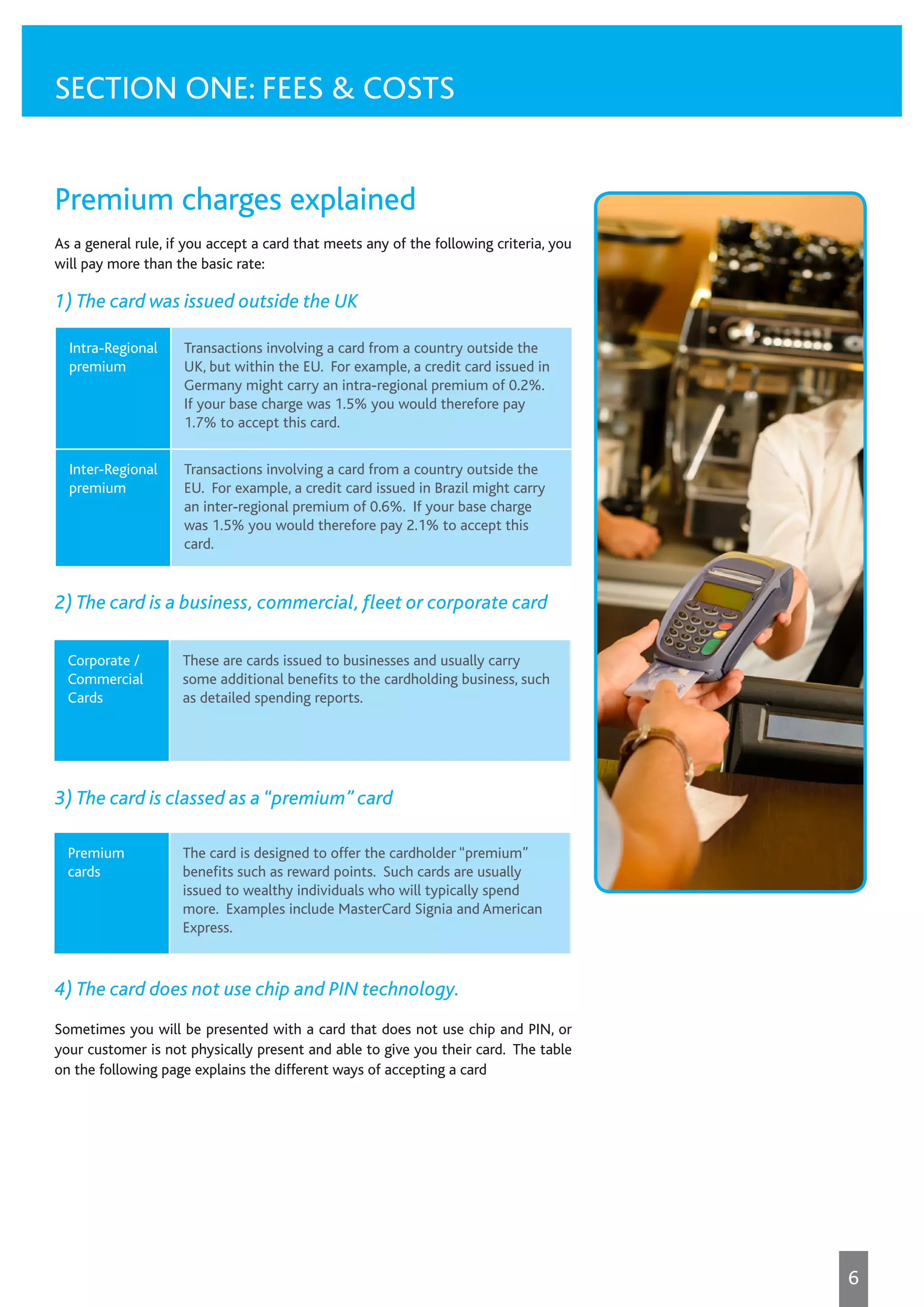
Contactless Cards
Contactless payment is becoming
increasingly widespread.
Consumers and businesses
benefit from a quick transaction.
Payment schemes are keen to
encourage the use of contactless
payment and are offering lower
fees to process a payment made
using this method. Rates for
contactless transactions on
credit cards do not change,
however contactless debit card
transactions are usually charged
at a lower, or discounted, rate
than standard chip and PIN
transactions.
5
Premium charges explained
As a general rule, if you accept a card that meets any of the following criteria, you
will pay more than the basic rate:
1) The card was issued outside the UK
2) The card is a business, commercial, fleet or corporate card
3) The card is classed as a “premium” card
4) The card does not use chip and PIN technology.
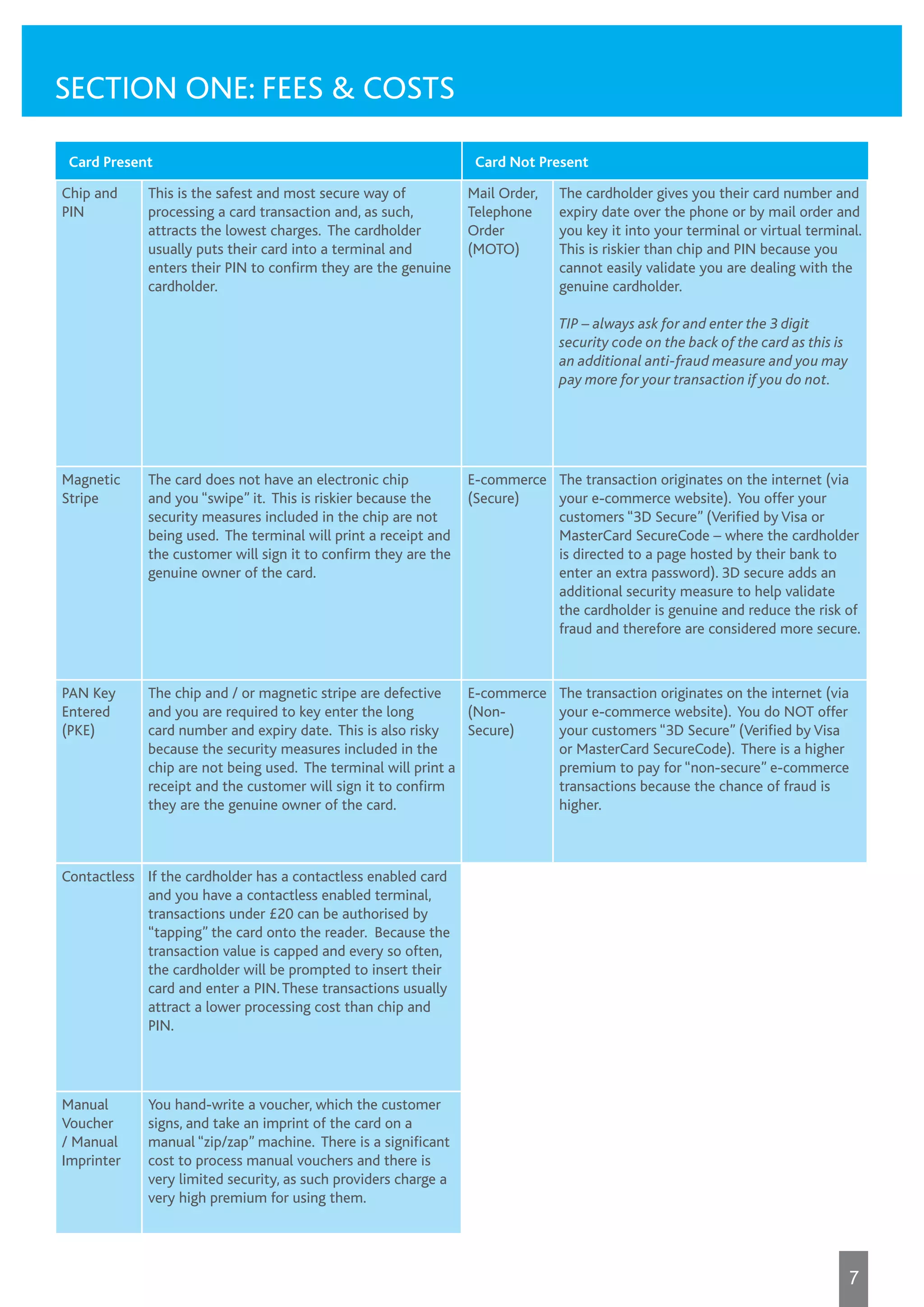
Sometimes you will be presented with a card that does not use chip and PIN, or
your customer is not physically present and able to give you their card. The table
on the following page explains the different ways of accepting a card
SECTION ONE: FEES & COSTS
Intra-Regional
premium
Transactions involving a card from a country outside the
UK, but within the EU. For example, a credit card issued in
Germany might carry an intra-regional premium of 0.2%.
If your base charge was 1.5% you would therefore pay
1.7% to accept this card.
Inter-Regional
premium
Transactions involving a card from a country outside the
EU. For example, a credit card issued in Brazil might carry
an inter-regional premium of 0.6%. If your base charge
was 1.5% you would therefore pay 2.1% to accept this
card.
Corporate /
Commercial
Cards
These are cards issued to businesses and usually carry
some additional benefits to the cardholding business, such
as detailed spending reports.
Premium
cards
The card is designed to offer the cardholder “premium”
benefits such as reward points. Such cards are usually
issued to wealthy individuals who will typically spend
more. Examples include MasterCard Signia and American
Express.
6
SECTION ONE: FEES & COSTS
Chip and
PIN
This is the safest and most secure way of
processing a card transaction and, as such,
attracts the lowest charges. The cardholder
usually puts their card into a terminal and
enters their PIN to confirm they are the genuine
cardholder.
Mail Order,
Telephone
Order
(MOTO)
The cardholder gives you their card number and
expiry date over the phone or by mail order and
you key it into your terminal or virtual terminal.
This is riskier than chip and PIN because you
cannot easily validate you are dealing with the
genuine cardholder.
TIP – always ask for and enter the 3 digit
security code on the back of the card as this is
an additional anti-fraud measure and you may
pay more for your transaction if you do not.
Magnetic
Stripe
The card does not have an electronic chip
and you “swipe” it. This is riskier because the
security measures included in the chip are not
being used. The terminal will print a receipt and
the customer will sign it to confirm they are the
genuine owner of the card.
E-commerce
(Secure)
The transaction originates on the internet (via
your e-commerce website). You offer your
customers “3D Secure” (Verified by Visa or
MasterCard SecureCode – where the cardholder
is directed to a page hosted by their bank to
enter an extra password). 3D secure adds an
additional security measure to help validate
the cardholder is genuine and reduce the risk of
fraud and therefore are considered more secure.
PAN Key
Entered
(PKE)
The chip and / or magnetic stripe are defective
and you are required to key enter the long
card number and expiry date. This is also risky
because the security measures included in the
chip are not being used. The terminal will print a
receipt and the customer will sign it to confirm
they are the genuine owner of the card.
E-commerce
(Non-
Secure)
The transaction originates on the internet (via
your e-commerce website). You do NOT offer
your customers “3D Secure” (Verified by Visa
or MasterCard SecureCode). There is a higher
premium to pay for “non-secure” e-commerce
transactions because the chance of fraud is
higher.
Card Present Card Not Present
Contactless If the cardholder has a contactless enabled card
and you have a contactless enabled terminal,
transactions under £20 can be authorised by
“tapping” the card onto the reader. Because the
transaction value is capped and every so often,
the cardholder will be prompted to insert their
card and enter a PIN.These transactions usually
attract a lower processing cost than chip and
PIN.
Manual
Voucher
/ Manual
Imprinter
You hand-write a voucher, which the customer
signs, and take an imprint of the card on a
manual “zip/zap” machine. There is a significant
cost to process manual vouchers and there is
very limited security, as such providers charge a
very high premium for using them.
7
SECTION ONE: FEES & COSTS
Authorisation fees explained
Authorisation fees are not universally charged, but where they are, expect to pay
around 3p per transaction. Not everyone charges them and rates do vary, so make
sure you ask about them and don’t be afraid to negotiate. 3p might not sound like
much, but if the average value of your transactions is low, then it can impact the
actual rate you pay quite significantly.
So, to work out the total merchant service charge and understand how much a
transaction will actually cost you, remember the table we used earlier:
In short, if you’re looking at different providers, it’s important that you understand
the details of their quotes and compare them like for like. Those that may appear
cheapest on the surface do not always represent the best value overall.
Price you pay
for a transaction
Authorisation
fee
Premium
charges
Basic rate
8
Example:
To illustrate how
an authorisation
fee impacts on
the overall charge,
here is an example:
TransactionValue = £10
Basic Credit Card Rate = 1.5%
Authorisation Fee = 3p
AmountYou Pay:
£10 transaction x 1.5%
credit card rate = 15p
15p + 3p authorisation fee = 18p
*The effective rate you are paying for this transaction because of the
authorisation fee is 1.8% - because (18p / £10) * 100 = 1.8%
Minimum Monthly Service Charges
(MMSC) explained
Your merchant account may have a MMSC applied. This is a fee that is applied if
you do not accrue a pre-determined level of card payment fees in a single month.
For example, if your minimum monthly charge is £25 and you have accrued £10 in
transaction fees, you will be charged an additional £15 to top it up to the minimum
monthly charge. If you have accrued more than £25 in transaction fees, then you
won’t need to pay a top up. Look for this on your contract and ensure it is clearly
stated.
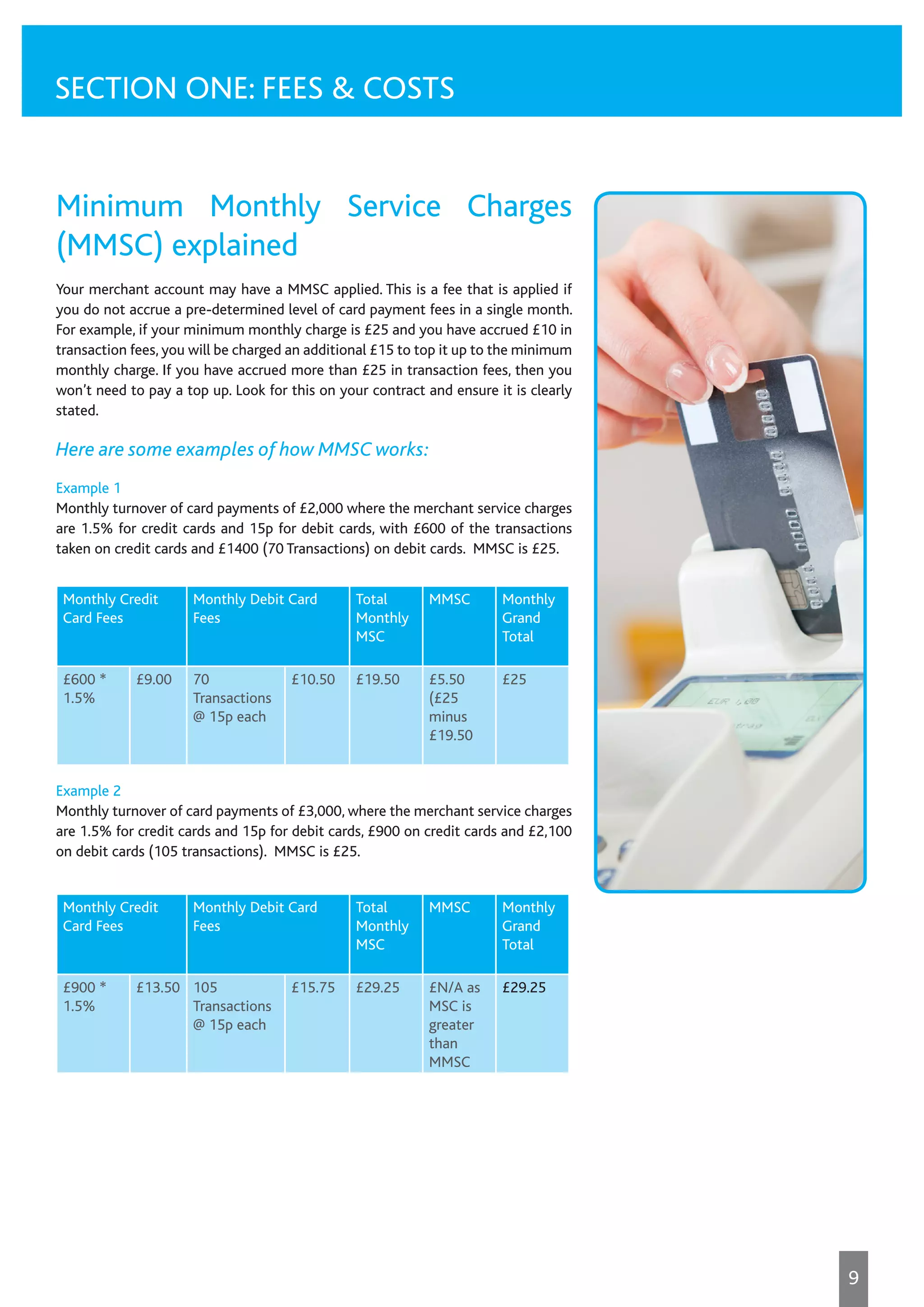
Here are some examples of how MMSC works:
Example 1
Monthly turnover of card payments of £2,000 where the merchant service charges
are 1.5% for credit cards and 15p for debit cards, with £600 of the transactions
taken on credit cards and £1400 (70 Transactions) on debit cards. MMSC is £25.
Example 2
Monthly turnover of card payments of £3,000, where the merchant service charges
are 1.5% for credit cards and 15p for debit cards, £900 on credit cards and £2,100
on debit cards (105 transactions). MMSC is £25.
Monthly Credit
Card Fees
Monthly Debit Card
Fees
Total
Monthly
MSC
MMSC Monthly
Grand
Total
£600 *
1.5%
£9.00 70
Transactions
@ 15p each
£10.50 £19.50 £5.50
(£25
minus
£19.50
£25
Monthly Credit
Card Fees
Monthly Debit Card
Fees
Total
Monthly
MSC
MMSC Monthly
Grand
Total
£900 *
1.5%
£13.50 105
Transactions
@ 15p each
£15.75 £29.25 £N/A as
MSC is
greater
than
MMSC
£29.25
SECTION ONE: FEES & COSTS
9
How quickly will the money hit my bank
account?
It depends on the terms of your agreement and where you hold your bank account,
but expect an average of two to three business days. The money is paid straight
into your bank account as cleared funds. Sometimes it is paid to you in full (known
as gross settlement) and the fees are deducted from you by Direct Debit at the end
of the month, sometimes providers deduct their charges before they send you the
money (known as net settlement).
Net settlement can sometimes cause businesses problems when reconciling their
card payment receipts with the amount that is credited to their bank account
because the amounts don’t match, so be sure you know which type of settlement
applies to you.
Can I refuse to take certain cards that
cost me more money?
MasterCard andVisa operate an “honour all cards” rule which means if you process
their cards, you are required to accept all the different types of cards carrying their
brand marks that are presented to you. For example, you could not decide to only
process Visa consumer debit cards and not Visa consumer credit cards. American
Express requires a separate processing agreement directly with them and the
charges are usually slightly higher than for Visa and MasterCard cards. It is up to
you whether you choose to accept American Express cards but if you do, under
their terms you are required to accept their cards on an equal footing withVisa and
MasterCard cards.
It’s also worth pointing out that under card scheme rules, you are not meant to
impose a minimum spend for a card transaction.
Can I pass the fees onto my customers?
There is various legislation and card scheme rules covering this topic so check your
individual circumstances to be sure, but the answer is usually yes, as long as you
do not charge more than you are being charged. The difficulty is the amount is
not always easy to know due to type of card being presented and what fees will
therefore be applied. You may also find that your customers are put off from using
cards as a payment method if you impose a fee for accepting them, which could
ultimately mean less business for you.
Although it seems to happen instantaneously, there are many different bodies
involved in processing a card transaction and the cost passed to you the“merchant”
is shared between all of the bodies involved.
The only party who doesn’t usually pay is the cardholder (unless the card is from
outside the UK,in which case the cardholder may have to pay a currency conversion
charge to their card issuer).
SECTION ONE: FEES & COSTS
10
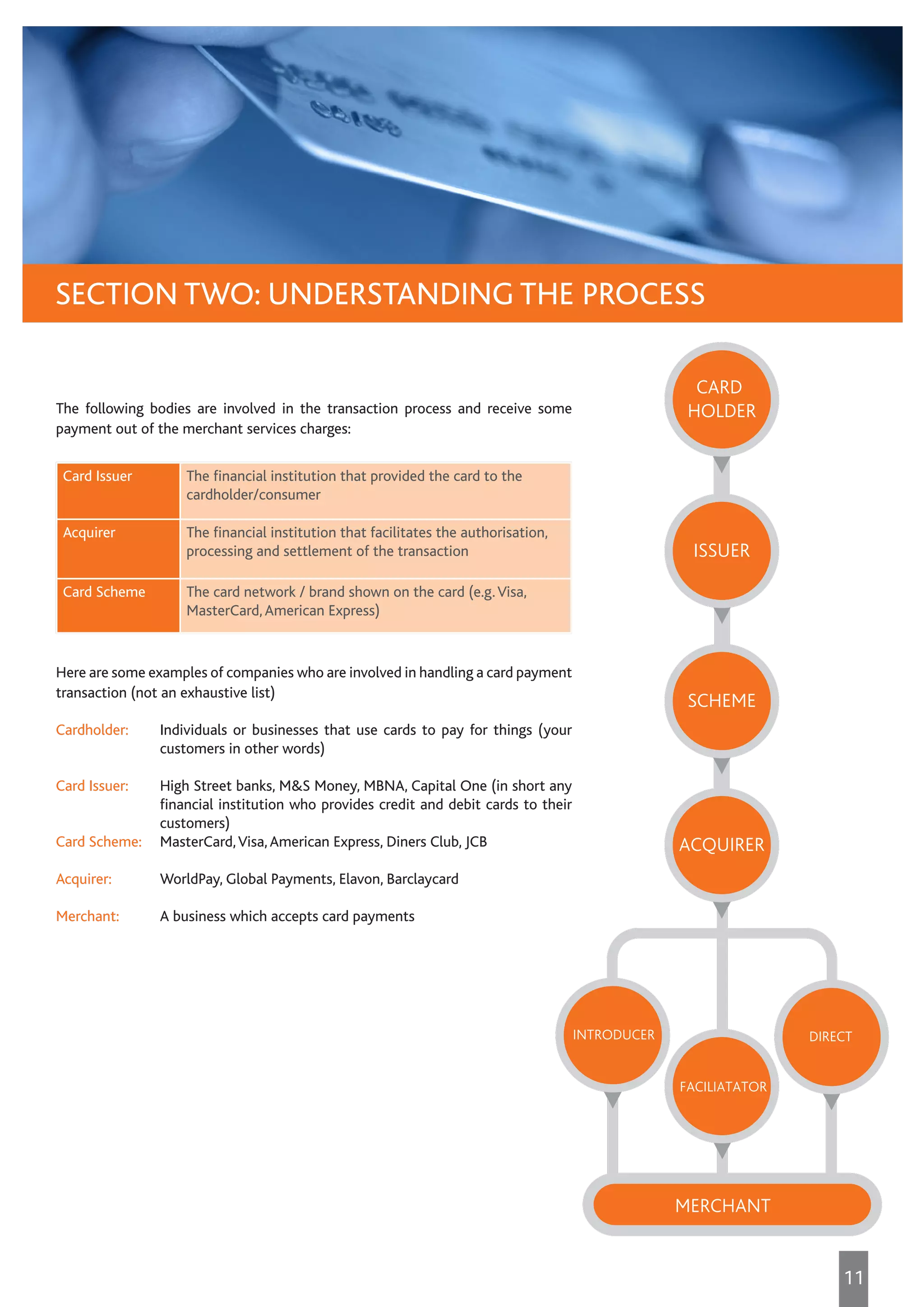
The following bodies are involved in the transaction process and receive some
payment out of the merchant services charges:
Here are some examples of companies who are involved in handling a card payment
transaction (not an exhaustive list)
Cardholder:	 Individuals or businesses that use cards to pay for things (your
customers in other words)
Card Issuer:	 High Street banks, M&S Money, MBNA, Capital One (in short any
financial institution who provides credit and debit cards to their
customers)
Card Scheme:	 MasterCard,Visa,American Express, Diners Club, JCB
Acquirer:	 WorldPay, Global Payments, Elavon, Barclaycard
Merchant:	 A business which accepts card payments
SECTION TWO: UNDERSTANDING THE PROCESS
Card Issuer The financial institution that provided the card to the
cardholder/consumer
Acquirer The financial institution that facilitates the authorisation,
processing and settlement of the transaction
Card Scheme The card network / brand shown on the card (e.g.Visa,
MasterCard,American Express)
11
SCHEME
ISSUER
CARD
HOLDER
ACQUIRER
DIRECT
MERCHANT
INTRODUCER
FACILIATATOR
DIRECT
Direct / Introducers / Payment
Facilitators - which is right for you?
Direct:
This is the most common relationship if you are a large company with a lot of
outlets processing a lot of transactions e.g. a large chain of shops, a large network
of pubs, a large online retail shop processing thousands of transactions every day
and need dedicated relationship and banking support.
The more transactions you take, the more power you have when negotiating rates
directly and the greater support you will get in terms of use of the system. Most
large national and international businesses deal direct with an acquirer.
Introducers/Resellers /
Independent Sales Organisations (ISO’s):
Introducers are authorised resellers of an acquiring service e.g. Handepay help to
give small and medium sized businesses greater buying power as they represent
over 20,000 businesses.They can often secure better rates from the acquirer than
a sole merchant can by themselves. They will also usually offer a telephone line
help service to deal with any issues with the terminal, the service etc and send a
local representative to meet you face to face to help with the application.
Payment Facilitators:
These can help very small and micro businesses to offer a card facility. They
represent a very large number of these businesses who are turning over small
amounts on cards. The acquirers treat these companies as a sole entity, and they
take a lot of the financial risk that usually rests with an acquirer on themselves.As
such they pass the cost of that risk onto their customers.
They usually charge a percentage of the value of every transaction (typically 2.75-
3.35%) and can also hold on to the money from each transaction for longer before
releasing it. Standard practice for acquirers is the transaction day, plus two to three
working days but payment facilitators have been known to wait for two weeks
or longer before the merchant receives the money which can seriously impact
cashflow. Because they charge comparatively high processing fees, they are usually
not suitable for businesses with turnover on cards above a few thousand pounds
per annum.
SECTION TWO: UNDERSTANDING THE PROCESS
12
What’s the Process?
Providers look at a range of factors to assess your business before they agree to
offer a facility, just like when you apply for any financial services. These include
checks such as what your business does, financial checks and whether you sell face
to face or over the internet.
There will usually be some paperwork to complete (although most providers will
help you with this) and you’ll be asked for some “proof” of your identity and
address. The information you provide is used to run the checks that providers need
to complete in order to comply with regulations.
Providers all have different systems for assessing applications. If you are in a
business sector that is considered “high risk”, you may find your application for
a merchant account is turned down, or that it takes longer to process than you
thought,or more information is requested from you.If you are turned down you can
always ask for your application to be reconsidered if you believe the decision was
wrong. You can also apply with a different provider and may get a different result,
because each provider has their own “appetite” for different types of business.
Most applications are processed in a few days and you can be up and running in
as little as a week from the day you sign the agreement, though you should think
about allowing more time than this to set your facility up just in case there are any
problems along the way.
SECTION TWO: UNDERSTANDING THE PROCESS
13
If you choose to have a direct or an introducer relationship you will typically have
two contracts in place:
1) With the terminal supplier
2) With the acquirer (who may also be the terminal supplier)
This does vary, so make sure you ask.
How long do you have to sign up for?
Contracts usually run from 12 to 60 months. As you would expect, the longer you
sign up for, the better the terminal fees you might be offered.
Much like mobile phone contracts, it’s up to you to know when your contract is
up and either keep it going, re-negotiate or switch. Your relationship with your
provider will include a point where you have to notify them if you want to end
the relationship or re-negotiate terms, or the contract may roll over into another
period. It’s not their responsibility to tell you - so check the notice period (usually 3
months before the contract is due to come to an end) and put a note in your diary.
I already accept cards. Is it easy to
switch provider?
Switching is easy and you can make savings as rates offered to switchers are often
better than those for new to cards or existing customers.
But beware. There will be a notice period and possibly an exit fee for terminating
your agreement(s) so always check the details of your contract.
SECTION THREE: CONTRACTS
Hidden costs to
watch out for
1. Exit fees,‘re-stocking’ fees
If you give notice as set out in your
contract, you can exit at any time.
Usually, outstanding amounts on the
contract must be paid up, just like
a mobile phone contract, but some
providers will charge you a fixed fee
which could be up to £200 per outlet to
close an account, with further charges
up to £200 to ‘re-stock’ a terminal
(that’s get it from you and get it in shape
for their next customer). So if your
business has four outlets, each with a
terminal, it could cost you up to £1,600
to close your account. Other suppliers
don’t charge anything, so again, check
your contract.
When you’re switching, some providers
may offer you incentives, such as
cashback, to move to them. You can
use this to help cover any exit costs you
might face on your previous contract.
14
What’s the alternative to accepting
cards?
If you don’t want to accept card payments from your customers, you could limit
your payment options to cash and cheque but this is unlikely to help you maximise
your sales and keep customers coming back. If you’re trading online, then other
options such as PayPal might be worth considering.
But as with any provider, make sure that what you are agreeing to is suitable for
your business. Understand the costs involved and don’t limit yourself to one type of
payment. For example, PayPal seem like a convenient option for a fledgling online
business but ask yourself if all your potential customers have a PayPal account (and
know how to use it). If they don’t, you might be missing out on valuable sales by
not offering a broader range of payment options.
Too good to be true?
Remember, some providers will only quote you the basic rate which could seem too
good to be true and does not reflect the true cost you will pay. If you have found
a deal that looks amazing make sure your check the small print. How do the rates
for different types of transactions compare to other deals around? Are they being
open about premium charges, authorisation fees, exit fees etc?
SECTION THREE: CONTRACTS
3.Annual fees: PCI DSS
(Payment Card Industry
Data Security Standard)
This is a mandated requirement by the
payment schemes (Visa, MasterCard)
that every business that accepts,
transmits or stores cardholder data
MUST comply with. It’s about the secure
storage and processing of important
cardholder data to protect against fraud
and other financial crime.There are
four categories of PCI – most small and
medium sized businesses are level 4,
small enough that they can self-certify.
If you process more than 20,000 Visa
payments via the internet, this pushes
you up a level and, if you have high card
turnover (1m+ Visa transactions per
annum) this can push you into a higher
level still.
Hidden costs to
watch out for
2. Swapout fees –
If your terminal breaks, how will it be
fixed or replaced? Some suppliers insist
on an engineer installing your terminal
and will charge you for their time.
If something goes wrong, the same
engineer must return to fix the problem
and you will be charged again, plus a
swapout fee for a new terminal. Other
suppliers will send you the terminal and
you can install it yourself (usually very
simple) and it costs you nothing.
TIP: Register your compliance status with your provider
as quickly as possible. Some companies charge in excess
of £70 every month per merchant account if you go
beyond the three month deadline without registering
yourself as compliant.
15
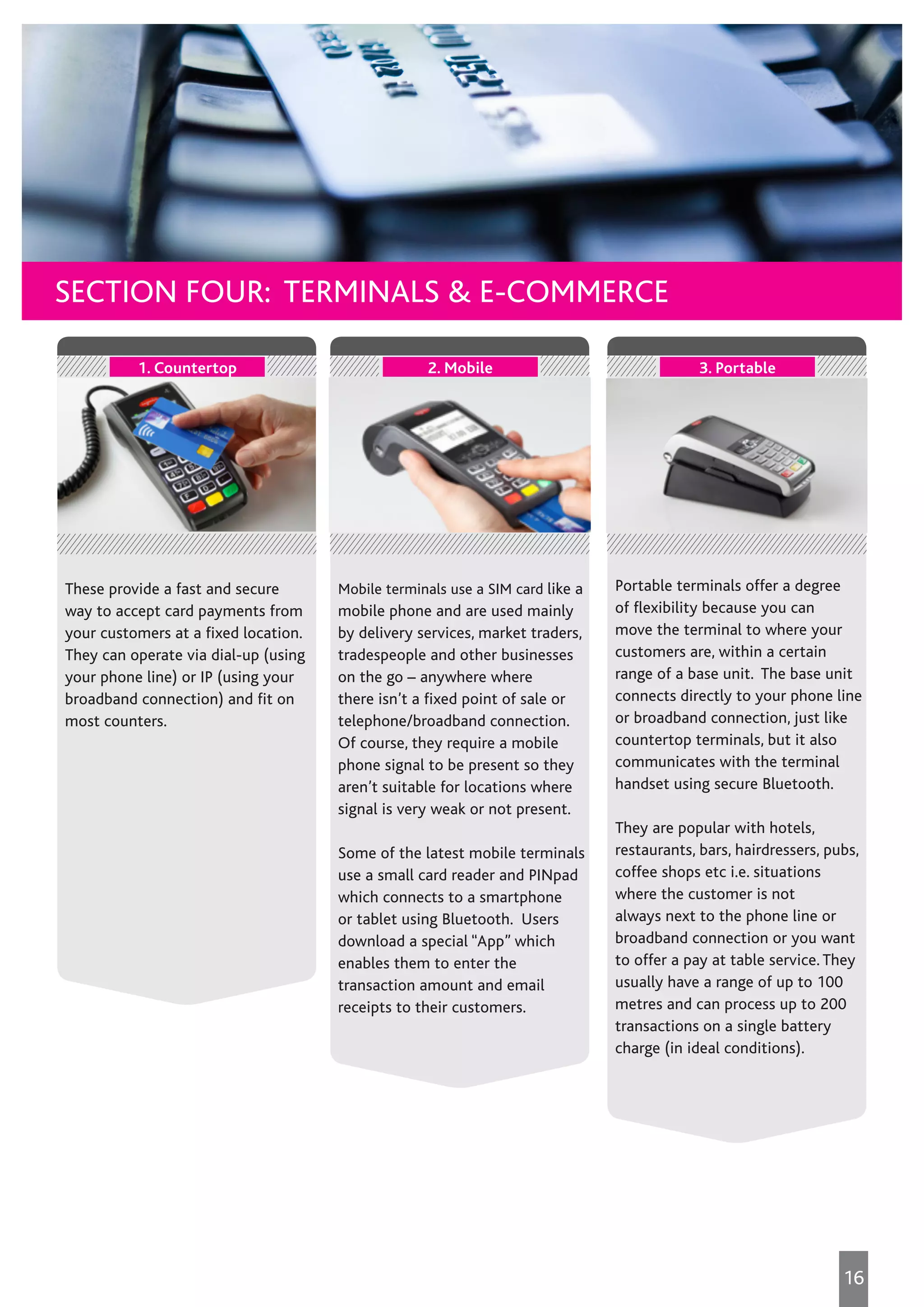
Mobile terminals use a SIM card like a
mobile phone and are used mainly
by delivery services, market traders,
tradespeople and other businesses
on the go – anywhere where
there isn’t a fixed point of sale or
telephone/broadband connection.
Of course, they require a mobile
phone signal to be present so they
aren’t suitable for locations where
signal is very weak or not present.
Some of the latest mobile terminals
use a small card reader and PINpad
which connects to a smartphone
or tablet using Bluetooth. Users
download a special “App” which
enables them to enter the
transaction amount and email
receipts to their customers.
2. Mobile
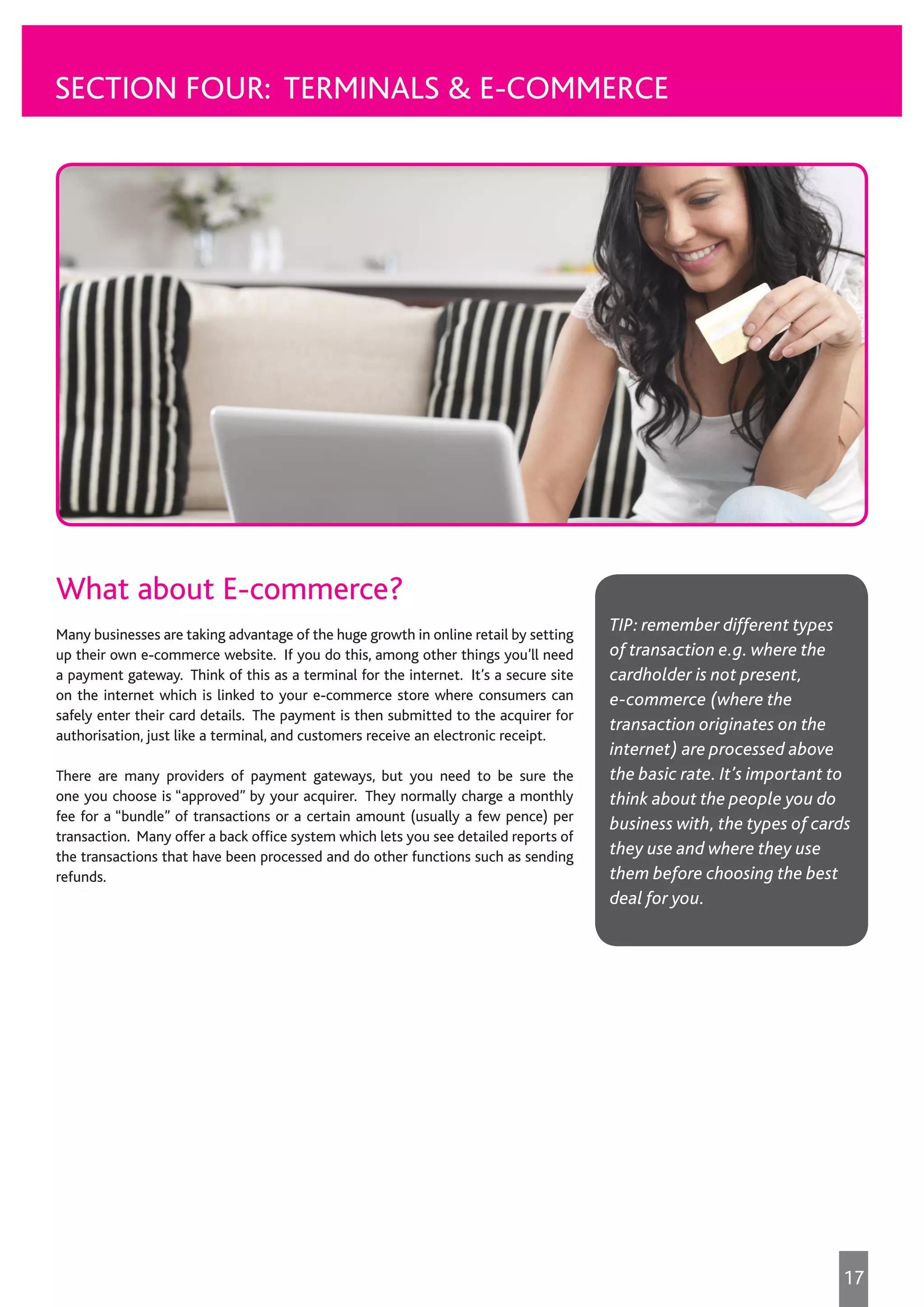
Portable terminals offer a degree
of flexibility because you can
move the terminal to where your
customers are, within a certain
range of a base unit. The base unit
connects directly to your phone line
or broadband connection, just like
countertop terminals, but it also
communicates with the terminal
handset using secure Bluetooth.
They are popular with hotels,
restaurants, bars, hairdressers, pubs,
coffee shops etc i.e. situations
where the customer is not
always next to the phone line or
broadband connection or you want
to offer a pay at table service. They
usually have a range of up to 100
metres and can process up to 200
transactions on a single battery
charge (in ideal conditions).
3. Portable
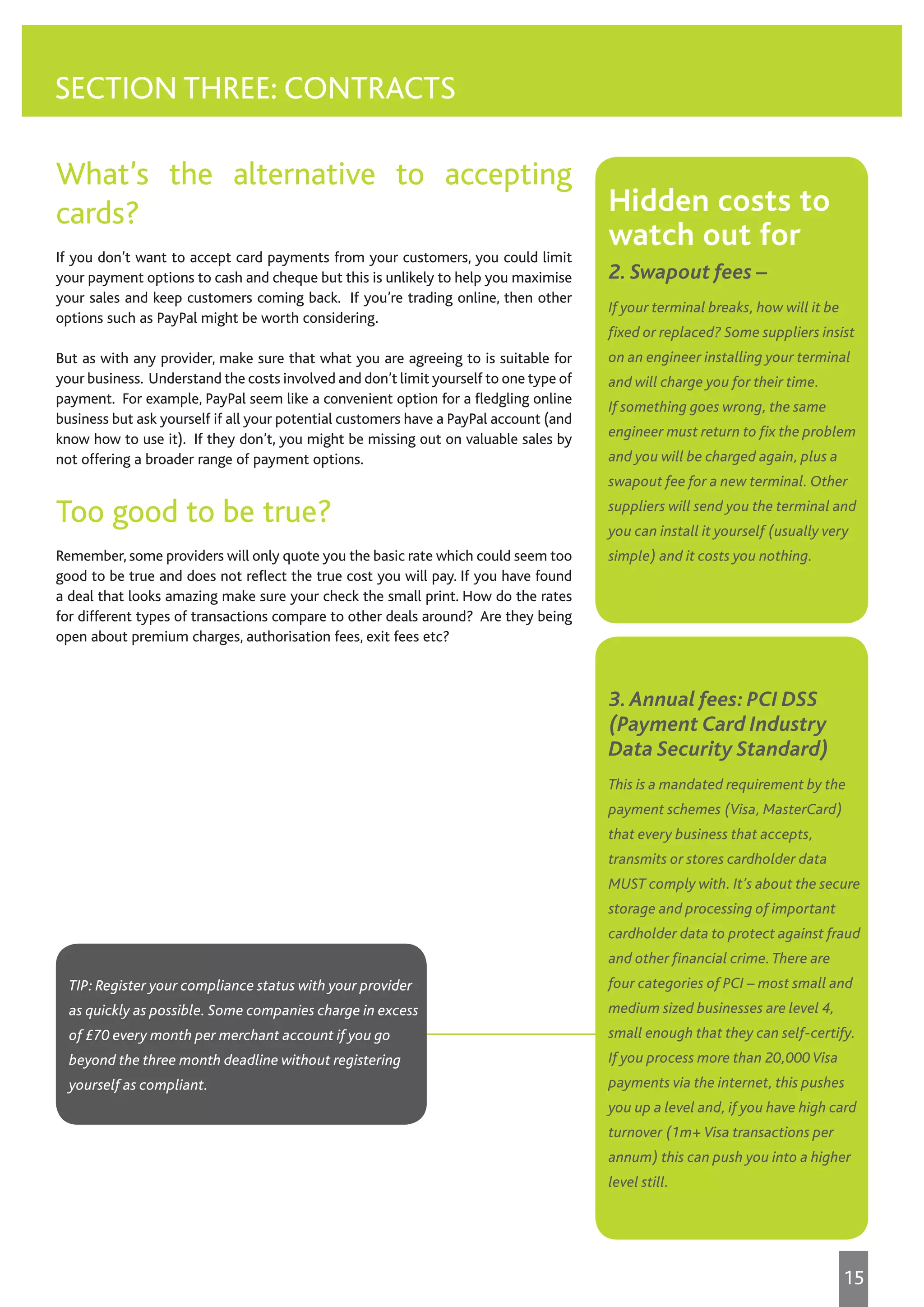
These provide a fast and secure
way to accept card payments from
your customers at a fixed location.
They can operate via dial-up (using
your phone line) or IP (using your
broadband connection) and fit on
most counters.
1. Countertop
Which is the right terminal for me
16
SECTION FOUR: TERMINALS & E-COMMERCE
What about E-commerce?
Many businesses are taking advantage of the huge growth in online retail by setting
up their own e-commerce website. If you do this, among other things you’ll need
a payment gateway. Think of this as a terminal for the internet. It’s a secure site
on the internet which is linked to your e-commerce store where consumers can
safely enter their card details. The payment is then submitted to the acquirer for
authorisation, just like a terminal, and customers receive an electronic receipt.
There are many providers of payment gateways, but you need to be sure the
one you choose is “approved” by your acquirer. They normally charge a monthly
fee for a “bundle” of transactions or a certain amount (usually a few pence) per
transaction. Many offer a back office system which lets you see detailed reports of
the transactions that have been processed and do other functions such as sending
refunds.
TIP: remember different types
of transaction e.g. where the
cardholder is not present,
e-commerce (where the
transaction originates on the
internet) are processed above
the basic rate. It’s important to
think about the people you do
business with, the types of cards
they use and where they use
them before choosing the best
deal for you.
17
What next?
You can submit your payment questions to us at paymentquestions@handepay.
co.uk We’ll aim to get back to you with an answer as soon as we can and we’ll select
the most common questions and add them to the Q&A section on our website.
We hope you found this guide useful, but the payments industry is complicated and
it would be impossible to squeeze everything into one simple guide. We’ve tried to
cover the main subjects customers tend to ask us about and we hope we’ve helped
shed light on a complicated subject.
If you’d like to talk to Handepay about getting a merchant account, please contact
us at enquiries@handepay.co.uk or call 0800 377 7382.
The content in this guide is provided for general information only. It is not intended to
amount to advice on which you should rely.You must obtain professional or specialist
advice before taking, or refraining from, any action on the basis of the content on our
site including, without limitation, entering into any contract.
Although we make reasonable efforts to update the information on our site, we make
no representations, warranties or guarantees, whether express or implied, that the
content on our site is accurate, complete or up-to-date.

Get started with card payments

  • 1.
    So you’re thinking aboutaccepting cards A guide to accepting card payments for small and medium sized businesses in the UK
  • 2.
    This guide hasbeen put together to help you understand the entire process of taking cards, whether you already do or are thinking of doing it so you can make the right decision for your business. It can seem quite complicated so we’ve broken it down into easy to follow sections. There are also some handy tips about contactless payment, practical working examples to help you compare one rate from another, and a guide to some of the common contractual pitfalls that many companies encounter, so that you can make the right decision for you first time. Section 1. Fees & Costs 3. So why take cards in the first place? 4. How much is taking cards going to cost me? 5. Basic Rates Explained 6. Premium charges explained 8. Authorisation fees explained 9. Minimum monthly service charges (MMSC) explained 10. How quickly will the money hit my bank account? 10. Can I refuse to take certain cards that cost me more money? 10. Can I pass the fees onto my customers? Section 2. Understanding the process 11. Direct / Introducers / Payment Facilitators - which is right for you? 13. What’s the process? Section 3. Contracts 14. How long do you have to sign up for? 14. Hidden costs to watch out for -1 14. I already accept cards. Is it easy to switch provider? 15. What’s the alternative to accepting cards? 15. Hidden costs to watch out for - 2 15. Annual fees: PCI DSS (Payment Card Industry Data Security Standard) 15. Too good to be true? Section 4. Terminals & e-commerce 16. Which is the right terminal for me? 17. What about e-commerce?
  • 3.
    Many business ownersdescribe them as a ‘necessary evil’ because taking card payments costs you, the “merchant”, money. “Merchant” is payment industry terminology for a business that accepts credit and debit cards. How many times have you stood in a queue and resisted picking up an extra item or two because you’re not sure if the shop you are in takes cards? For around £1 a day you should see a positive increase in your weekly takings. You’ll need a couple of things before you can accept card payments: 1) A merchant account with a financial institution known as an “acquirer” 2) A payment terminal (for when you take payment from customers face to face) or a payment gateway (for when you want to accept payment over the internet on your e-commerce website) What else do you get? Easy reporting and accounting, fewer trips to the bank to deposit cash and cheques, automatic deposits of cleared funds to your account normally every two to three business days after the transaction and security as you are not holding cash on the premises. The people who provide the service charge a fee based on every transaction you make which is split between the card issuer, the card scheme and the acquirer. There’s more on who is involved in the process later in this document. Card machines and e-commerce websites will keep customers coming back but how do they work and why does it all seem just so, well, complicated? So why take cards in the first place? 3
  • 4.
    For around £1a day you should see a positive increase in your weekly takings How much is taking cards going to cost me? Everyone seems to offer something different, so it’s important to try and get it all on a level playing field so you can make the right decision for you. Here’s an overview of what to expect with a merchant account: Joining fees: These are variable, some providers charge but others don’t. Look around to see who charges and who doesn’t and factor this into the price. As a rule of thumb, you’re more likely to pay a joining fee if a representative comes out to see you, explains in detail the offer and completes the paperwork with you. This can give you the confidence to fully understand the set-up and as a result can be well worth the fee. Merchant Services Charges (MSC): This is the most complicated section, as the price is calculated on each transaction and can vary from transaction to transaction, but to break it down very simply: Price you pay for a transaction Authorisation fee sometimes called Bank 24 on some statements Premium charges processing costs for transactions that attract fees above the basic rate, if applicable Basic rate cost to process the transaction including ‘interchange fee’ and ‘scheme fees’ SECTION ONE: FEES & COSTS 4
  • 5.
    Basic Rates Explained Percentageor pence - which one’s for me? This is very much dependent on the kind of transactions your business takes. Debit cards are usually charged as a pence per transaction but can at times be a percentage rate and credit cards are always a percentage rate. So the actual amount you’ll pay depends on the type of card your customer presents and the value of the transaction. It’s important you understand the impact of the different types of fees you will encounter and how they are affected by your average transaction value. The amount you might typically pay for a transaction of £1, £100, £1,000 and £10,000 are outlined below: Chip and PIN Most providers will quote you a basic rate for credit and debit card processing which is based on a“chip and PIN” transaction using a card issued in the same country it is being processed (i.e. here in the UK). That means the customer uses a card that has an electronic chip embedded into it and they validate they are the genuine owner of that card using a PIN (just like at the cash point). The payment card industry has invested significantly in the introduction of chip and PIN technology to help reduce plastic card fraud and these types of transactions are now the “norm” in the UK. They are also considered to be the most secure and, as such, attract some of the lowest fees which is why most providers use them in their quotes SECTION ONE: FEES & COSTS Type of card Debit card Debit card Credit card Charge rate 15p per 1.5% of each 1.5% of each transaction transaction transaction Transaction: £1 15p 1.5p 1.5p Transaction: £100 15p £1.50 £1.50 Transaction: £1,000 15p £15.00 £15.00 Transaction:£10,000 15p £150.00 £150.00 Contactless Cards Contactless payment is becoming increasingly widespread. Consumers and businesses benefit from a quick transaction. Payment schemes are keen to encourage the use of contactless payment and are offering lower fees to process a payment made using this method. Rates for contactless transactions on credit cards do not change, however contactless debit card transactions are usually charged at a lower, or discounted, rate than standard chip and PIN transactions. 5
  • 6.
    Premium charges explained Asa general rule, if you accept a card that meets any of the following criteria, you will pay more than the basic rate: 1) The card was issued outside the UK 2) The card is a business, commercial, fleet or corporate card 3) The card is classed as a “premium” card 4) The card does not use chip and PIN technology. Sometimes you will be presented with a card that does not use chip and PIN, or your customer is not physically present and able to give you their card. The table on the following page explains the different ways of accepting a card SECTION ONE: FEES & COSTS Intra-Regional premium Transactions involving a card from a country outside the UK, but within the EU. For example, a credit card issued in Germany might carry an intra-regional premium of 0.2%. If your base charge was 1.5% you would therefore pay 1.7% to accept this card. Inter-Regional premium Transactions involving a card from a country outside the EU. For example, a credit card issued in Brazil might carry an inter-regional premium of 0.6%. If your base charge was 1.5% you would therefore pay 2.1% to accept this card. Corporate / Commercial Cards These are cards issued to businesses and usually carry some additional benefits to the cardholding business, such as detailed spending reports. Premium cards The card is designed to offer the cardholder “premium” benefits such as reward points. Such cards are usually issued to wealthy individuals who will typically spend more. Examples include MasterCard Signia and American Express. 6
  • 7.
    SECTION ONE: FEES& COSTS Chip and PIN This is the safest and most secure way of processing a card transaction and, as such, attracts the lowest charges. The cardholder usually puts their card into a terminal and enters their PIN to confirm they are the genuine cardholder. Mail Order, Telephone Order (MOTO) The cardholder gives you their card number and expiry date over the phone or by mail order and you key it into your terminal or virtual terminal. This is riskier than chip and PIN because you cannot easily validate you are dealing with the genuine cardholder. TIP – always ask for and enter the 3 digit security code on the back of the card as this is an additional anti-fraud measure and you may pay more for your transaction if you do not. Magnetic Stripe The card does not have an electronic chip and you “swipe” it. This is riskier because the security measures included in the chip are not being used. The terminal will print a receipt and the customer will sign it to confirm they are the genuine owner of the card. E-commerce (Secure) The transaction originates on the internet (via your e-commerce website). You offer your customers “3D Secure” (Verified by Visa or MasterCard SecureCode – where the cardholder is directed to a page hosted by their bank to enter an extra password). 3D secure adds an additional security measure to help validate the cardholder is genuine and reduce the risk of fraud and therefore are considered more secure. PAN Key Entered (PKE) The chip and / or magnetic stripe are defective and you are required to key enter the long card number and expiry date. This is also risky because the security measures included in the chip are not being used. The terminal will print a receipt and the customer will sign it to confirm they are the genuine owner of the card. E-commerce (Non- Secure) The transaction originates on the internet (via your e-commerce website). You do NOT offer your customers “3D Secure” (Verified by Visa or MasterCard SecureCode). There is a higher premium to pay for “non-secure” e-commerce transactions because the chance of fraud is higher. Card Present Card Not Present Contactless If the cardholder has a contactless enabled card and you have a contactless enabled terminal, transactions under £20 can be authorised by “tapping” the card onto the reader. Because the transaction value is capped and every so often, the cardholder will be prompted to insert their card and enter a PIN.These transactions usually attract a lower processing cost than chip and PIN. Manual Voucher / Manual Imprinter You hand-write a voucher, which the customer signs, and take an imprint of the card on a manual “zip/zap” machine. There is a significant cost to process manual vouchers and there is very limited security, as such providers charge a very high premium for using them. 7
  • 8.
    SECTION ONE: FEES& COSTS Authorisation fees explained Authorisation fees are not universally charged, but where they are, expect to pay around 3p per transaction. Not everyone charges them and rates do vary, so make sure you ask about them and don’t be afraid to negotiate. 3p might not sound like much, but if the average value of your transactions is low, then it can impact the actual rate you pay quite significantly. So, to work out the total merchant service charge and understand how much a transaction will actually cost you, remember the table we used earlier: In short, if you’re looking at different providers, it’s important that you understand the details of their quotes and compare them like for like. Those that may appear cheapest on the surface do not always represent the best value overall. Price you pay for a transaction Authorisation fee Premium charges Basic rate 8 Example: To illustrate how an authorisation fee impacts on the overall charge, here is an example: TransactionValue = £10 Basic Credit Card Rate = 1.5% Authorisation Fee = 3p AmountYou Pay: £10 transaction x 1.5% credit card rate = 15p 15p + 3p authorisation fee = 18p *The effective rate you are paying for this transaction because of the authorisation fee is 1.8% - because (18p / £10) * 100 = 1.8%
  • 9.
    Minimum Monthly ServiceCharges (MMSC) explained Your merchant account may have a MMSC applied. This is a fee that is applied if you do not accrue a pre-determined level of card payment fees in a single month. For example, if your minimum monthly charge is £25 and you have accrued £10 in transaction fees, you will be charged an additional £15 to top it up to the minimum monthly charge. If you have accrued more than £25 in transaction fees, then you won’t need to pay a top up. Look for this on your contract and ensure it is clearly stated. Here are some examples of how MMSC works: Example 1 Monthly turnover of card payments of £2,000 where the merchant service charges are 1.5% for credit cards and 15p for debit cards, with £600 of the transactions taken on credit cards and £1400 (70 Transactions) on debit cards. MMSC is £25. Example 2 Monthly turnover of card payments of £3,000, where the merchant service charges are 1.5% for credit cards and 15p for debit cards, £900 on credit cards and £2,100 on debit cards (105 transactions). MMSC is £25. Monthly Credit Card Fees Monthly Debit Card Fees Total Monthly MSC MMSC Monthly Grand Total £600 * 1.5% £9.00 70 Transactions @ 15p each £10.50 £19.50 £5.50 (£25 minus £19.50 £25 Monthly Credit Card Fees Monthly Debit Card Fees Total Monthly MSC MMSC Monthly Grand Total £900 * 1.5% £13.50 105 Transactions @ 15p each £15.75 £29.25 £N/A as MSC is greater than MMSC £29.25 SECTION ONE: FEES & COSTS 9
  • 10.
    How quickly willthe money hit my bank account? It depends on the terms of your agreement and where you hold your bank account, but expect an average of two to three business days. The money is paid straight into your bank account as cleared funds. Sometimes it is paid to you in full (known as gross settlement) and the fees are deducted from you by Direct Debit at the end of the month, sometimes providers deduct their charges before they send you the money (known as net settlement). Net settlement can sometimes cause businesses problems when reconciling their card payment receipts with the amount that is credited to their bank account because the amounts don’t match, so be sure you know which type of settlement applies to you. Can I refuse to take certain cards that cost me more money? MasterCard andVisa operate an “honour all cards” rule which means if you process their cards, you are required to accept all the different types of cards carrying their brand marks that are presented to you. For example, you could not decide to only process Visa consumer debit cards and not Visa consumer credit cards. American Express requires a separate processing agreement directly with them and the charges are usually slightly higher than for Visa and MasterCard cards. It is up to you whether you choose to accept American Express cards but if you do, under their terms you are required to accept their cards on an equal footing withVisa and MasterCard cards. It’s also worth pointing out that under card scheme rules, you are not meant to impose a minimum spend for a card transaction. Can I pass the fees onto my customers? There is various legislation and card scheme rules covering this topic so check your individual circumstances to be sure, but the answer is usually yes, as long as you do not charge more than you are being charged. The difficulty is the amount is not always easy to know due to type of card being presented and what fees will therefore be applied. You may also find that your customers are put off from using cards as a payment method if you impose a fee for accepting them, which could ultimately mean less business for you. Although it seems to happen instantaneously, there are many different bodies involved in processing a card transaction and the cost passed to you the“merchant” is shared between all of the bodies involved. The only party who doesn’t usually pay is the cardholder (unless the card is from outside the UK,in which case the cardholder may have to pay a currency conversion charge to their card issuer). SECTION ONE: FEES & COSTS 10
  • 11.
    The following bodiesare involved in the transaction process and receive some payment out of the merchant services charges: Here are some examples of companies who are involved in handling a card payment transaction (not an exhaustive list) Cardholder: Individuals or businesses that use cards to pay for things (your customers in other words) Card Issuer: High Street banks, M&S Money, MBNA, Capital One (in short any financial institution who provides credit and debit cards to their customers) Card Scheme: MasterCard,Visa,American Express, Diners Club, JCB Acquirer: WorldPay, Global Payments, Elavon, Barclaycard Merchant: A business which accepts card payments SECTION TWO: UNDERSTANDING THE PROCESS Card Issuer The financial institution that provided the card to the cardholder/consumer Acquirer The financial institution that facilitates the authorisation, processing and settlement of the transaction Card Scheme The card network / brand shown on the card (e.g.Visa, MasterCard,American Express) 11 SCHEME ISSUER CARD HOLDER ACQUIRER DIRECT MERCHANT INTRODUCER FACILIATATOR DIRECT
  • 12.
    Direct / Introducers/ Payment Facilitators - which is right for you? Direct: This is the most common relationship if you are a large company with a lot of outlets processing a lot of transactions e.g. a large chain of shops, a large network of pubs, a large online retail shop processing thousands of transactions every day and need dedicated relationship and banking support. The more transactions you take, the more power you have when negotiating rates directly and the greater support you will get in terms of use of the system. Most large national and international businesses deal direct with an acquirer. Introducers/Resellers / Independent Sales Organisations (ISO’s): Introducers are authorised resellers of an acquiring service e.g. Handepay help to give small and medium sized businesses greater buying power as they represent over 20,000 businesses.They can often secure better rates from the acquirer than a sole merchant can by themselves. They will also usually offer a telephone line help service to deal with any issues with the terminal, the service etc and send a local representative to meet you face to face to help with the application. Payment Facilitators: These can help very small and micro businesses to offer a card facility. They represent a very large number of these businesses who are turning over small amounts on cards. The acquirers treat these companies as a sole entity, and they take a lot of the financial risk that usually rests with an acquirer on themselves.As such they pass the cost of that risk onto their customers. They usually charge a percentage of the value of every transaction (typically 2.75- 3.35%) and can also hold on to the money from each transaction for longer before releasing it. Standard practice for acquirers is the transaction day, plus two to three working days but payment facilitators have been known to wait for two weeks or longer before the merchant receives the money which can seriously impact cashflow. Because they charge comparatively high processing fees, they are usually not suitable for businesses with turnover on cards above a few thousand pounds per annum. SECTION TWO: UNDERSTANDING THE PROCESS 12
  • 13.
    What’s the Process? Providerslook at a range of factors to assess your business before they agree to offer a facility, just like when you apply for any financial services. These include checks such as what your business does, financial checks and whether you sell face to face or over the internet. There will usually be some paperwork to complete (although most providers will help you with this) and you’ll be asked for some “proof” of your identity and address. The information you provide is used to run the checks that providers need to complete in order to comply with regulations. Providers all have different systems for assessing applications. If you are in a business sector that is considered “high risk”, you may find your application for a merchant account is turned down, or that it takes longer to process than you thought,or more information is requested from you.If you are turned down you can always ask for your application to be reconsidered if you believe the decision was wrong. You can also apply with a different provider and may get a different result, because each provider has their own “appetite” for different types of business. Most applications are processed in a few days and you can be up and running in as little as a week from the day you sign the agreement, though you should think about allowing more time than this to set your facility up just in case there are any problems along the way. SECTION TWO: UNDERSTANDING THE PROCESS 13
  • 14.
    If you chooseto have a direct or an introducer relationship you will typically have two contracts in place: 1) With the terminal supplier 2) With the acquirer (who may also be the terminal supplier) This does vary, so make sure you ask. How long do you have to sign up for? Contracts usually run from 12 to 60 months. As you would expect, the longer you sign up for, the better the terminal fees you might be offered. Much like mobile phone contracts, it’s up to you to know when your contract is up and either keep it going, re-negotiate or switch. Your relationship with your provider will include a point where you have to notify them if you want to end the relationship or re-negotiate terms, or the contract may roll over into another period. It’s not their responsibility to tell you - so check the notice period (usually 3 months before the contract is due to come to an end) and put a note in your diary. I already accept cards. Is it easy to switch provider? Switching is easy and you can make savings as rates offered to switchers are often better than those for new to cards or existing customers. But beware. There will be a notice period and possibly an exit fee for terminating your agreement(s) so always check the details of your contract. SECTION THREE: CONTRACTS Hidden costs to watch out for 1. Exit fees,‘re-stocking’ fees If you give notice as set out in your contract, you can exit at any time. Usually, outstanding amounts on the contract must be paid up, just like a mobile phone contract, but some providers will charge you a fixed fee which could be up to £200 per outlet to close an account, with further charges up to £200 to ‘re-stock’ a terminal (that’s get it from you and get it in shape for their next customer). So if your business has four outlets, each with a terminal, it could cost you up to £1,600 to close your account. Other suppliers don’t charge anything, so again, check your contract. When you’re switching, some providers may offer you incentives, such as cashback, to move to them. You can use this to help cover any exit costs you might face on your previous contract. 14
  • 15.
    What’s the alternativeto accepting cards? If you don’t want to accept card payments from your customers, you could limit your payment options to cash and cheque but this is unlikely to help you maximise your sales and keep customers coming back. If you’re trading online, then other options such as PayPal might be worth considering. But as with any provider, make sure that what you are agreeing to is suitable for your business. Understand the costs involved and don’t limit yourself to one type of payment. For example, PayPal seem like a convenient option for a fledgling online business but ask yourself if all your potential customers have a PayPal account (and know how to use it). If they don’t, you might be missing out on valuable sales by not offering a broader range of payment options. Too good to be true? Remember, some providers will only quote you the basic rate which could seem too good to be true and does not reflect the true cost you will pay. If you have found a deal that looks amazing make sure your check the small print. How do the rates for different types of transactions compare to other deals around? Are they being open about premium charges, authorisation fees, exit fees etc? SECTION THREE: CONTRACTS 3.Annual fees: PCI DSS (Payment Card Industry Data Security Standard) This is a mandated requirement by the payment schemes (Visa, MasterCard) that every business that accepts, transmits or stores cardholder data MUST comply with. It’s about the secure storage and processing of important cardholder data to protect against fraud and other financial crime.There are four categories of PCI – most small and medium sized businesses are level 4, small enough that they can self-certify. If you process more than 20,000 Visa payments via the internet, this pushes you up a level and, if you have high card turnover (1m+ Visa transactions per annum) this can push you into a higher level still. Hidden costs to watch out for 2. Swapout fees – If your terminal breaks, how will it be fixed or replaced? Some suppliers insist on an engineer installing your terminal and will charge you for their time. If something goes wrong, the same engineer must return to fix the problem and you will be charged again, plus a swapout fee for a new terminal. Other suppliers will send you the terminal and you can install it yourself (usually very simple) and it costs you nothing. TIP: Register your compliance status with your provider as quickly as possible. Some companies charge in excess of £70 every month per merchant account if you go beyond the three month deadline without registering yourself as compliant. 15
  • 16.
    Mobile terminals usea SIM card like a mobile phone and are used mainly by delivery services, market traders, tradespeople and other businesses on the go – anywhere where there isn’t a fixed point of sale or telephone/broadband connection. Of course, they require a mobile phone signal to be present so they aren’t suitable for locations where signal is very weak or not present. Some of the latest mobile terminals use a small card reader and PINpad which connects to a smartphone or tablet using Bluetooth. Users download a special “App” which enables them to enter the transaction amount and email receipts to their customers. 2. Mobile Portable terminals offer a degree of flexibility because you can move the terminal to where your customers are, within a certain range of a base unit. The base unit connects directly to your phone line or broadband connection, just like countertop terminals, but it also communicates with the terminal handset using secure Bluetooth. They are popular with hotels, restaurants, bars, hairdressers, pubs, coffee shops etc i.e. situations where the customer is not always next to the phone line or broadband connection or you want to offer a pay at table service. They usually have a range of up to 100 metres and can process up to 200 transactions on a single battery charge (in ideal conditions). 3. Portable These provide a fast and secure way to accept card payments from your customers at a fixed location. They can operate via dial-up (using your phone line) or IP (using your broadband connection) and fit on most counters. 1. Countertop Which is the right terminal for me 16 SECTION FOUR: TERMINALS & E-COMMERCE
  • 17.
    SECTION FOUR: TERMINALS& E-COMMERCE What about E-commerce? Many businesses are taking advantage of the huge growth in online retail by setting up their own e-commerce website. If you do this, among other things you’ll need a payment gateway. Think of this as a terminal for the internet. It’s a secure site on the internet which is linked to your e-commerce store where consumers can safely enter their card details. The payment is then submitted to the acquirer for authorisation, just like a terminal, and customers receive an electronic receipt. There are many providers of payment gateways, but you need to be sure the one you choose is “approved” by your acquirer. They normally charge a monthly fee for a “bundle” of transactions or a certain amount (usually a few pence) per transaction. Many offer a back office system which lets you see detailed reports of the transactions that have been processed and do other functions such as sending refunds. TIP: remember different types of transaction e.g. where the cardholder is not present, e-commerce (where the transaction originates on the internet) are processed above the basic rate. It’s important to think about the people you do business with, the types of cards they use and where they use them before choosing the best deal for you. 17
  • 18.
    What next? You cansubmit your payment questions to us at paymentquestions@handepay. co.uk We’ll aim to get back to you with an answer as soon as we can and we’ll select the most common questions and add them to the Q&A section on our website. We hope you found this guide useful, but the payments industry is complicated and it would be impossible to squeeze everything into one simple guide. We’ve tried to cover the main subjects customers tend to ask us about and we hope we’ve helped shed light on a complicated subject. If you’d like to talk to Handepay about getting a merchant account, please contact us at enquiries@handepay.co.uk or call 0800 377 7382. The content in this guide is provided for general information only. It is not intended to amount to advice on which you should rely.You must obtain professional or specialist advice before taking, or refraining from, any action on the basis of the content on our site including, without limitation, entering into any contract. Although we make reasonable efforts to update the information on our site, we make no representations, warranties or guarantees, whether express or implied, that the content on our site is accurate, complete or up-to-date.