Bundestag elections:
political parties
Yonna Waltersson
News Editor, Dagens Arena
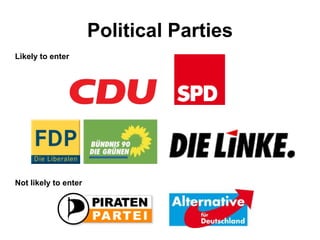
Political Parties
Not likely to enter
Likely to enter
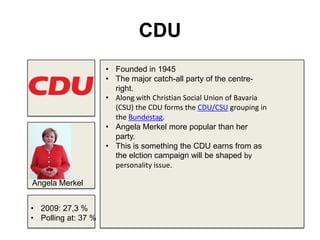
CDU
• Founded in 1945
• The major catch-all party of the centre-
right.
• Along with Christian Social Union of Bavaria
(CSU) the CDU forms the CDU/CSU grouping in
the Bundestag.
• Angela Merkel more popular than her
party.
• This is something the CDU earns from as
the elction campaign will be shaped by
personality issue.
• 2009: 27,3 %
• Polling at: 37 %
Angela Merkel
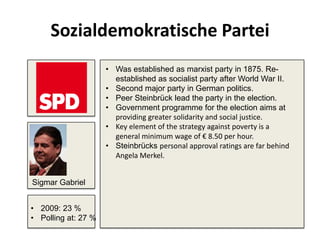
Sozialdemokratische Partei
• Was established as marxist party in 1875. Re-
established as socialist party after World War II.
• Second major party in German politics.
• Peer Steinbrück lead the party in the election.
• Government programme for the election aims at
providing greater solidarity and social justice.
• Key element of the strategy against poverty is a
general minimum wage of € 8.50 per hour.
• Steinbrücks personal approval ratings are far behind
Angela Merkel.
• 2009: 23 %
• Polling at: 27 %
Sigmar Gabriel
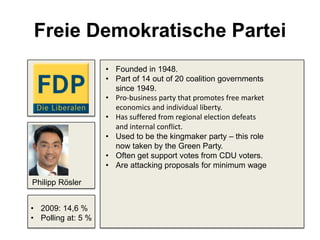
Freie Demokratische Partei
• Founded in 1948.
• Part of 14 out of 20 coalition governments
since 1949.
• Pro-business party that promotes free market
economics and individual liberty.
• Has suffered from regional election defeats
and internal conflict.
• Used to be the kingmaker party – this role
now taken by the Green Party.
• Often get support votes from CDU voters.
• Are attacking proposals for minimum wage
• 2009: 14,6 %
• Polling at: 5 %
Philipp Rösler
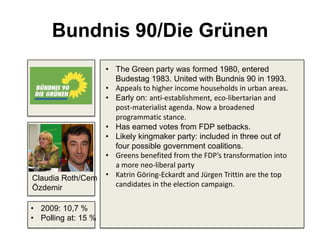
Bundnis 90/Die Grünen
• The Green party was formed 1980, entered
Budestag 1983. United with Bundnis 90 in 1993.
• Appeals to higher income households in urban areas.
• Early on: anti-establishment, eco-libertarian and
post-materialist agenda. Now a broadened
programmatic stance.
• Has earned votes from FDP setbacks.
• Likely kingmaker party: included in three out of
four possible government coalitions.
• Greens benefited from the FDP’s transformation into
a more neo-liberal party
• Katrin Göring-Eckardt and Jürgen Trittin are the top
candidates in the election campaign.
• 2009: 10,7 %
• Polling at: 15 %
Claudia Roth/Cem
Özdemir
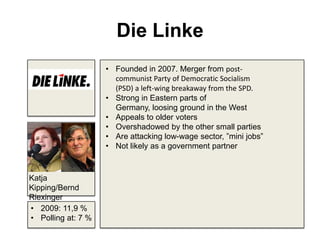
Die Linke
• Founded in 2007. Merger from post-
communist Party of Democratic Socialism
(PSD) a left-wing breakaway from the SPD.
• Strong in Eastern parts of
Germany, loosing ground in the West
• Appeals to older voters
• Overshadowed by the other small parties
• Are attacking low-wage sector, ”mini jobs”
• Not likely as a government partner
• 2009: 11,9 %
• Polling at: 7 %
Katja
Kipping/Bernd
Riexinger
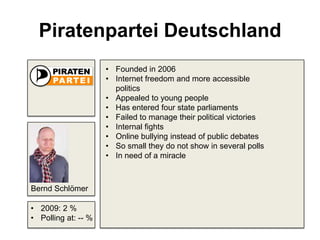
Piratenpartei Deutschland
• Founded in 2006
• Internet freedom and more accessible
politics
• Appealed to young people
• Has entered four state parliaments
• Failed to manage their political victories
• Internal fights
• Online bullying instead of public debates
• So small they do not show in several polls
• In need of a miracle
• 2009: 2 %
• Polling at: -- %
Bernd Schlömer
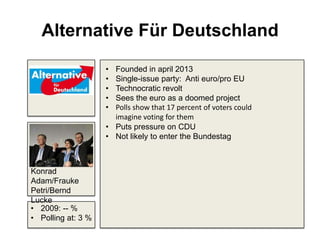
Alternative Für Deutschland
• Founded in april 2013
• Single-issue party: Anti euro/pro EU
• Technocratic revolt
• Sees the euro as a doomed project
• Polls show that 17 percent of voters could
imagine voting for them
• Puts pressure on CDU
• Not likely to enter the Bundestag
• 2009: -- %
• Polling at: 3 %
Konrad
Adam/Frauke
Petri/Bernd
Lucke

German political parties

  • 1.
    Bundestag elections: political parties YonnaWaltersson News Editor, Dagens Arena
  • 2.
    Political Parties Not likelyto enter Likely to enter
  • 3.
    CDU • Founded in1945 • The major catch-all party of the centre- right. • Along with Christian Social Union of Bavaria (CSU) the CDU forms the CDU/CSU grouping in the Bundestag. • Angela Merkel more popular than her party. • This is something the CDU earns from as the elction campaign will be shaped by personality issue. • 2009: 27,3 % • Polling at: 37 % Angela Merkel
  • 4.
    Sozialdemokratische Partei • Wasestablished as marxist party in 1875. Re- established as socialist party after World War II. • Second major party in German politics. • Peer Steinbrück lead the party in the election. • Government programme for the election aims at providing greater solidarity and social justice. • Key element of the strategy against poverty is a general minimum wage of € 8.50 per hour. • Steinbrücks personal approval ratings are far behind Angela Merkel. • 2009: 23 % • Polling at: 27 % Sigmar Gabriel
  • 5.
    Freie Demokratische Partei •Founded in 1948. • Part of 14 out of 20 coalition governments since 1949. • Pro-business party that promotes free market economics and individual liberty. • Has suffered from regional election defeats and internal conflict. • Used to be the kingmaker party – this role now taken by the Green Party. • Often get support votes from CDU voters. • Are attacking proposals for minimum wage • 2009: 14,6 % • Polling at: 5 % Philipp Rösler
  • 6.
    Bundnis 90/Die Grünen •The Green party was formed 1980, entered Budestag 1983. United with Bundnis 90 in 1993. • Appeals to higher income households in urban areas. • Early on: anti-establishment, eco-libertarian and post-materialist agenda. Now a broadened programmatic stance. • Has earned votes from FDP setbacks. • Likely kingmaker party: included in three out of four possible government coalitions. • Greens benefited from the FDP’s transformation into a more neo-liberal party • Katrin Göring-Eckardt and Jürgen Trittin are the top candidates in the election campaign. • 2009: 10,7 % • Polling at: 15 % Claudia Roth/Cem Özdemir
  • 7.
    Die Linke • Foundedin 2007. Merger from post- communist Party of Democratic Socialism (PSD) a left-wing breakaway from the SPD. • Strong in Eastern parts of Germany, loosing ground in the West • Appeals to older voters • Overshadowed by the other small parties • Are attacking low-wage sector, ”mini jobs” • Not likely as a government partner • 2009: 11,9 % • Polling at: 7 % Katja Kipping/Bernd Riexinger
  • 8.
    Piratenpartei Deutschland • Foundedin 2006 • Internet freedom and more accessible politics • Appealed to young people • Has entered four state parliaments • Failed to manage their political victories • Internal fights • Online bullying instead of public debates • So small they do not show in several polls • In need of a miracle • 2009: 2 % • Polling at: -- % Bernd Schlömer
  • 9.
    Alternative Für Deutschland •Founded in april 2013 • Single-issue party: Anti euro/pro EU • Technocratic revolt • Sees the euro as a doomed project • Polls show that 17 percent of voters could imagine voting for them • Puts pressure on CDU • Not likely to enter the Bundestag • 2009: -- % • Polling at: 3 % Konrad Adam/Frauke Petri/Bernd Lucke