Global Economy Policy

Outline the emergence and
demise of the British East
      India Company
British East India Company
                  Translation

  In French « La Compagnie anglaise des Indes Orientales »
        In German « Die Britische Ostindien-Kompanie »
In Spanish « La Compañía Británica de las Indias Orientales »
    In Italian « La Compagnia Inglese delle Indie Orientali »
What is an East India Company?
- An East India company is a merchant association(private) which receives
from the royal power the monopole of trade on some far countries and
different privileges to use it.

- Some are called Occidental India companies(the ones which go for America)
and the others East India companies.

- The main East India Companies have been: the British one, the Dutch one, the
Portuguese and the French one.

- A huge capital

- A company which was moving with its own army, so it is own employees

- Model of company: dividends, shareholders, one of the biggest capitalist
company which never existed.

- A state within the state(tribunals).
BEIC: characteristics

- Created in 1600 and disappeared in 1874.
- The first steps of the British Empire in India as a base to
export products from this region and China to Europe.
- Recruit locally

Ideas behind the BEIC:
- Enlarging the British Empire
- A 24h/24 system
- A pacific integration
- Made a lot of money for privates
- No investment in local business
Chronology
 Nb of                                                       Nb of inventions: 152
 inventions: 1             Nb of
                           inventions: 14
                   1600                            1874
1400    1500                    1700        1800      1900       2000


        Nb of
        inventions: 2             Nb of            Nb of inventions: 174
                                  inventions: 38

                        17th century
                                                      1804
A new kind of company was needed


- Partners in the company did not have to know
        each other;(not a family company)
  - The owners of the company did not directly
     control the companies;(just want a ROI)
      - The companies were designed to be
 permanent(until now such company were only
              existing for a single trip)
Idea linked to the course


Last time Professor Sherrer told us that the issue
 with Kingdom and capitalism is that they hardly
                ever fit together.
Emergence
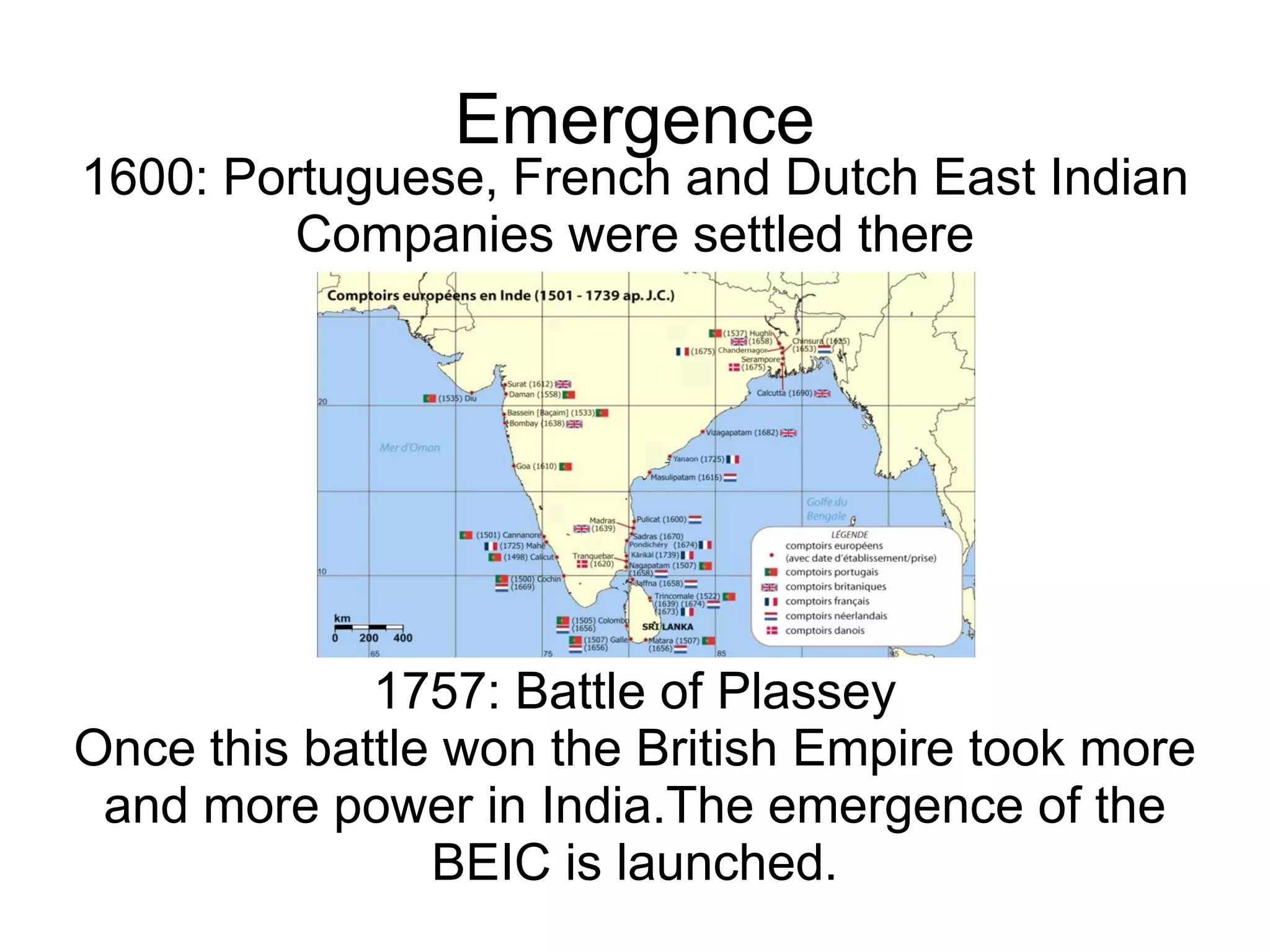
1600: Portuguese, French and Dutch East Indian
         Companies were settled there


             1757: Battle of Plassey
Once this battle won the British Empire took more
 and more power in India.The emergence of the
                BEIC is launched.
To go further


   - A good strategy(corruption, implementation,
                    good wars)
- A very competitive market but once won no one
         could go back into the competition
  - Regarding the British Empire, everything was
fine, the BEIC enriches the British Empire so why
        changing a method which is working
Demise


            - Not a single event
- First war of India independence(1857)
           - Opium war in China
         - Huge losses and debts
To go further


- They did not take in account cultural differences;
   - A short term strategy, no investment in local
            companies, creating inequalities
          - Chose the wrong product(opium)
     - They had to change their « brand » image
       - The interests of the British Empire are
    jeopardized then it took back the control of it
Conclusion

 The East India companies in general were the
beginning of the companies we know nowadays.
Even if it is true the rules and the internal way of
running the company was different, the concept
   was almost the same that we have today.
  As all the companies the British East India
Company one got up and downs situations which
              finally drove it to his end.
p68-70
http://musee.lorient.fr/Foire_aux_questions_mu.18
                      Sources
74+M5b0f47ba1bb.0.html?&tx_gsfaq_pi1[question
                          ]=102
http://usp.nus.edu.sg/victorian/history/empire/eic.h
                            tml
http://usp.nus.edu.sg/victorian/history/empire/1857
                           .html
http://en.wikipedia.org/wiki/Indian_Rebellion_of_1
                            857
http://fr.wikipedia.org/wiki/R%C3%A9volte_des_Ci
                         payes
http://www.cartage.org.lb/fr/themes/Geohis/Histoir
              e/histoire/histfr/I/india.html
   http://en.wikipedia.org/wiki/Battle_of_Plassey
http://fr.wikipedia.org/wiki/Compagnie_n%C3%A9

Gep Short Presentation Example

  • 1.
    Global Economy Policy Outlinethe emergence and demise of the British East India Company
  • 2.
    British East IndiaCompany Translation In French « La Compagnie anglaise des Indes Orientales » In German « Die Britische Ostindien-Kompanie » In Spanish « La Compañía Británica de las Indias Orientales » In Italian « La Compagnia Inglese delle Indie Orientali »
  • 3.
    What is anEast India Company? - An East India company is a merchant association(private) which receives from the royal power the monopole of trade on some far countries and different privileges to use it. - Some are called Occidental India companies(the ones which go for America) and the others East India companies. - The main East India Companies have been: the British one, the Dutch one, the Portuguese and the French one. - A huge capital - A company which was moving with its own army, so it is own employees - Model of company: dividends, shareholders, one of the biggest capitalist company which never existed. - A state within the state(tribunals).
  • 4.
    BEIC: characteristics - Createdin 1600 and disappeared in 1874. - The first steps of the British Empire in India as a base to export products from this region and China to Europe. - Recruit locally Ideas behind the BEIC: - Enlarging the British Empire - A 24h/24 system - A pacific integration - Made a lot of money for privates - No investment in local business
  • 5.
    Chronology Nb of Nb of inventions: 152 inventions: 1 Nb of inventions: 14 1600 1874 1400 1500 1700 1800 1900 2000 Nb of inventions: 2 Nb of Nb of inventions: 174 inventions: 38 17th century 1804
  • 6.
    A new kindof company was needed - Partners in the company did not have to know each other;(not a family company) - The owners of the company did not directly control the companies;(just want a ROI) - The companies were designed to be permanent(until now such company were only existing for a single trip)
  • 7.
    Idea linked tothe course Last time Professor Sherrer told us that the issue with Kingdom and capitalism is that they hardly ever fit together.
  • 8.
    Emergence 1600: Portuguese, Frenchand Dutch East Indian Companies were settled there 1757: Battle of Plassey Once this battle won the British Empire took more and more power in India.The emergence of the BEIC is launched.
  • 9.
    To go further - A good strategy(corruption, implementation, good wars) - A very competitive market but once won no one could go back into the competition - Regarding the British Empire, everything was fine, the BEIC enriches the British Empire so why changing a method which is working
  • 10.
    Demise - Not a single event - First war of India independence(1857) - Opium war in China - Huge losses and debts
  • 11.
    To go further -They did not take in account cultural differences; - A short term strategy, no investment in local companies, creating inequalities - Chose the wrong product(opium) - They had to change their « brand » image - The interests of the British Empire are jeopardized then it took back the control of it
  • 12.
    Conclusion The EastIndia companies in general were the beginning of the companies we know nowadays. Even if it is true the rules and the internal way of running the company was different, the concept was almost the same that we have today. As all the companies the British East India Company one got up and downs situations which finally drove it to his end.
  • 13.
    p68-70 http://musee.lorient.fr/Foire_aux_questions_mu.18 Sources 74+M5b0f47ba1bb.0.html?&tx_gsfaq_pi1[question ]=102 http://usp.nus.edu.sg/victorian/history/empire/eic.h tml http://usp.nus.edu.sg/victorian/history/empire/1857 .html http://en.wikipedia.org/wiki/Indian_Rebellion_of_1 857 http://fr.wikipedia.org/wiki/R%C3%A9volte_des_Ci payes http://www.cartage.org.lb/fr/themes/Geohis/Histoir e/histoire/histfr/I/india.html http://en.wikipedia.org/wiki/Battle_of_Plassey http://fr.wikipedia.org/wiki/Compagnie_n%C3%A9