Geonesis
FEBRUARY 2019
(A GEMCO KATI INITIATIVE)
Indian Mining & Exploration Updates
VOLUME 6,ISSUE 3
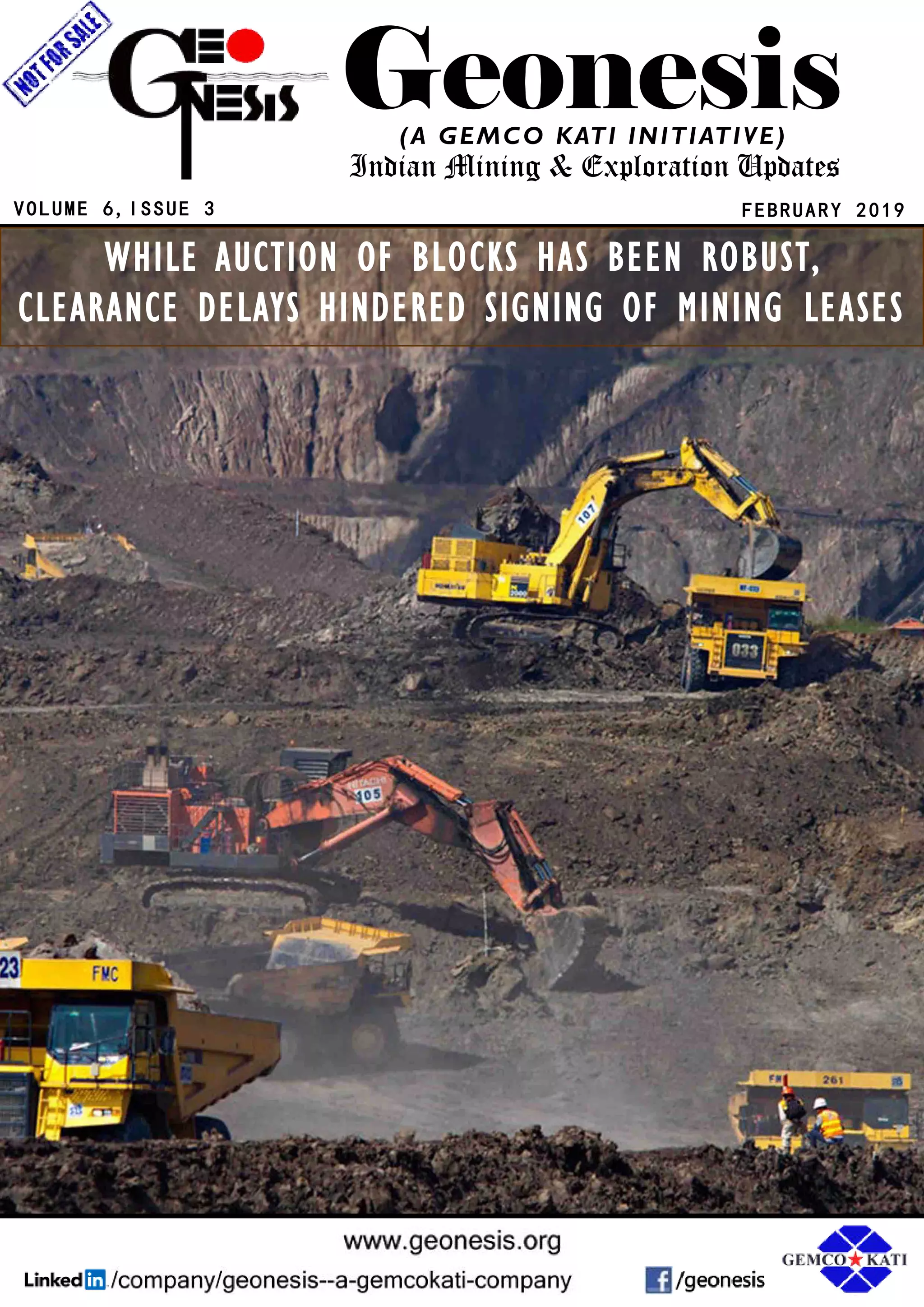
WHILE AUCTION OF BLOCKS HAS BEEN ROBUST,
CLEARANCE DELAYS HINDERED SIGNING OF MINING LEASES
VOLUME 6, ISSUE 3 — FEBRUARY 2019
Page 1
WHILE AUCTION OF BLOCKS HAS BEEN ROBUST, CLEARANCE DELAYS
HINDERED SIGNING OF MINING LEASES
In January, 2015, the amended Mines and Minerals (Development
and Regulation) Act, 2015 ushered in significant changes in the
process of allocating mineral blocks to change the game.
State governments, re-
sponsible for block prepa-
ration activities, allocation
process and other related
tasks, have already allocat-
ed 53 mineral blocks.
While mining block alloca-
tion has proceeded robust-
ly in the past four years,
actual mineral production
is lagging majorly, trigger-
ing developmental con-
cerns. In January, 2015, the
amended Mines and Min-
erals (Development and
Regulation) Act, 2015 ush-
ered in significant changes in the process of allocating mineral
blocks to change the game.
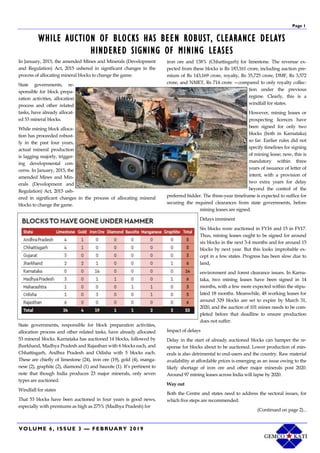
State governments, responsible for block preparation activities,
allocation process and other related tasks, have already allocated
53 mineral blocks. Karnataka has auctioned 14 blocks, followed by
Jharkhand, Madhya Pradesh and Rajasthan with 6 blocks each, and
Chhattisgarh, Andhra Pradesh and Odisha with 5 blocks each.
These are chiefly of limestone (24), iron ore (19), gold (4), manga-
nese (2), graphite (2), diamond (1) and bauxite (1). It’s pertinent to
note that though India produces 23 major minerals, only seven
types are auctioned.
Windfall for states
That 53 blocks have been auctioned in four years is good news,
especially with premiums as high as 275% (Madhya Pradesh) for
iron ore and 138% (Chhattisgarh) for limestone. The revenue ex-
pected from these blocks is Rs 183,161 crore, including auction pre-
mium of Rs 143,169 crore, royalty, Rs 35,725 crore, DMF, Rs 3,572
crore, and NMET, Rs 714 crore —compared to only royalty collec-
tion under the previous
regime. Clearly, this is a
windfall for states.
However, mining leases or
prospecting licences have
been signed for only two
blocks (both in Karnataka)
so far. Earlier rules did not
specify timelines for signing
of mining lease; now, this is
mandatory within three
years of issuance of letter of
intent, with a provision of
two extra years for delay
beyond the control of the
preferred bidder. The three-year timeframe is expected to suffice for
securing the required clearances from state governments, before
mining leases are signed.
Delays imminent
Six blocks were auctioned in FY16 and 15 in FY17.
Thus, mining leases ought to be signed for around
six blocks in the next 3-4 months and for around 15
blocks by next year. But this looks improbable ex-
cept in a few states. Progress has been slow due to
land,
environment and forest clearance issues. In Karna-
taka, two mining leases have been signed in 14
months, with a few more expected within the stipu-
lated 18 months. Meanwhile, 48 working leases for
around 329 blocks are set to expire by March 31,
2020, and the auction of 101 mines needs to be com-
pleted before that deadline to ensure production
does not suffer.
Impact of delays
Delay in the start of already auctioned blocks can hamper the re-
sponse for blocks about to be auctioned. Lower production of min-
erals is also detrimental to end-users and the country. Raw material
availability at affordable prices is emerging as an issue owing to the
likely shortage of iron ore and other major minerals post 2020.
Around 97 mining leases across India will lapse by 2020.
Way out
Both the Centre and states need to address the sectoral issues, for
which five steps are recommended:
(Continued on page 2)...
VOLUME 6, ISSUE 3 — FEBRUARY 2019
Page 2
1. States may establish a special cell headed by the chief secretary
with representation from different government agencies looking
into statutory clearances to expedite them. Block owners too can be
consulted on a regular basis to understand the issues faced by them.
2. The existing Mining Tenement System (MTS) can be utilised to
track the entire lifecycle of a mineral block, starting from the issu-
ance of letter of intent to grant of mining lease while uploading
applications for all clearances and approvals required in the MTS,
so that both the applicants and the government can monitor the
situation easily.
3. An integrated single-window clearance needs to be initiated with
integration and co-ordination of all related subjects such as land,
water, mineral, environment, forest, etc. A single agency to take
care of all such clearances will obviate inter-departmental refer-
ences and reduce delays.
4. There is a need to streamline the process of environment and
forest clearance by removing redundancies in the existing process
without compromising on environmental and forest concerns. This
is needed for preliminary and regional exploration projects—for
instance, an NOC from the forest department where no forest land
is available may be taken by the state government at the block
preparation stage.
5. Land details gathered by a state’s mining and geology depart-
ment using differential global positioning system during the auc-
tion process need to be vetted by the revenue department to avoid
any mismatch at later stages or at the time of land acquisition.
Like our official Facebook page:
https://www.facebook.com/geonesis
OVER 100 MINERAL BLOCKS READY FOR ONLINE AUCTIONS:
NARENDRA SINGH TOMAR
Mines ministry on track to auction lapsing leases
As many as 100 virgin mineral blocks across the country are
ready for online auctions, said Union minister for mines, rural
development, parliamentary affairs and Panchayati Raj Naren-
dra Singh Tomar.
“So far, 53 mines have
been auctioned. The
electronic auction of
these assets has brought
in incremental revenue
of Rs 1.43 trillion to
states. The additional
revenue generation has
been possible only be-
cause of auctions”,
Tomar told media per-
sons on the sidelines of
the seventh edition of
the International Con-
ference on Aluminium
(INCAL), 2019.
On mines headed for
expiry by March 31,
2020, he said the mines
ministry is fully prepared to auction them in the stipulated
timeframe.
Out of 288 mines due to lapse by March 31, 2020, only 59 are
operative. The lease validity of these non-captive mines was
extended till that period under Section 8 (3) of the amended
Mines and Minerals- Development & Regulation Act, 2015. The
central mines ministry has been pushing mineral bearing states
to expedite the roadmap for auctioning these leases to ensure
there is no deficit of raw materials, primarily iron ore. The laps-
able mines need to be explored up to the G2 level to be eligible
for auctions.
Earlier, addressing dele-
gates at INCAL 2019,
Tomar credited his gov-
ernment for introducing
transparency in mineral
block allotments through
online auctions. The
mines ministry has also
initiated the District
Mineral Foundation
(DMF) to take up pro-
jects for the benefit of
people affected by min-
ing activities. “We have
collected Rs 23,000 crore
as proceeds to the Pra-
dhan Mantri Khanij
Kshetra Kalyan Yojana.
More than 100,000 pro-
grammes have been ini-
tiated drawing funds from this scheme”, the minister said.
Tomar hailed aluminium as the metal of the future, noting that
its applications have been diversifying. He applauded the state-
run National Aluminium Company (Nalco) for its export per-
formance while underscoring the need for ramping up domestic
production. “The country’s aluminium demand is going to
(Continued on Page 3)...
Page 3
VOLUME 6, ISSUE 3 — FEBRUARY 2019
Follow us On
Or Scan This
QR Code
reach 10 million tonnes by 2030 and so, aluminium production
has to be raised. Our per capita aluminium consumption is
about 2.5 kg but we have plans to scale it up”, he said.
Speaking on the occasion, TK Chand, chairman & managing
director (CMD) at Nalco and president, Aluminium Associa-
tion of India (AAI) said, the aluminium industry was passing
a challenging phase in the backdrop of tumbling LME
(London Metal Exchange) prices and rising production costs.
To substantiate, Chand said LME prices have dropped to a
point where 40 per cent of the smelters across the world are
bleeding losses.
Offering a recipe to the aluminium industry, he said, “The indus-
try needs to focus on three Ss- speed, savings and sustainability.
The focus should also be on cost reduction to remain competi-
tive.”
Subroto Bagchi, chairman of Odisha Skills Development Author-
ity (OSDA) suggested to the Indian aluminium industry to
sharpen the focus on quality, cost and delivery and implement
the Six Sigma programme on the lines of global aluminium giant
Alcoa.
MINERAL BLOCK AUCTION: GOVT MULLS SINGLE WINDOW FOR GREEN
CLEARANCES
The government had said that the ministries of mines, steel
and environment were working together in this regard
Stating that there were issues in obtaining environment and
other clearances for mineral blocks, the government Wednes-
day said it is trying to put a single window clearance system
in place.
"Clearances like environ-
ment, forest and land
rights ...are an issue. Its not
very easy to get clearances.
There are delays in the pro-
cess...We are trying to
put single window clear-
ance in place," Mines Joint
Secretary Anil Kumar
Nayak said while address-
ing the Fourth India Copper
Forum here.
In June, Nayak, had said
that unless issues related
to green clearances and land
rights were addressed up-
front, India may not make
much progress in auctioning of mineral blocks in the future.
Earlier, the steel ministry had said that it was totally in favour
of a single window system.
The government had said that the ministries of mines, steel
and environment were working together in this regard.
Addressing the event here, Sterlite Copper CEO P Ramnath said
that demand of copper in future would go up but posed a ques-
tion as to how will the increasing need of the metal in India will
be met when the expansion projects and currents plants in the
country were being shutdown "for no reason at all".
The Tamil Nadu govern-
ment had in May ordered
the pollution control
board to seal and
"permanently" close Ve-
danta's Sterlite Copper
unit in the state, following
violent protests over pol-
lution concerns.
"It is very very clear that
the copper demand in the
future is going to rise
on...But to make a ques-
tion now is how we are
going to cater to this in-
creasing demand of cop-
per in our country when
the expansion projects and
current plants in the coun-
try are being shutdown for no reason at all," Ramnath said.
Around 50 mineral blocks have been auctioned so far since 2015.
The government will earn a revenue of Rs 1.81 lakh crore over
the lease period from these blocks.
Page 4
VOLUME 6, ISSUE 3 — FEBRUARY 2019
NO AMENDMENT FOR GOA OR LEASES LAPSING IN 2020:
NARENDRA SINGH TOMAR
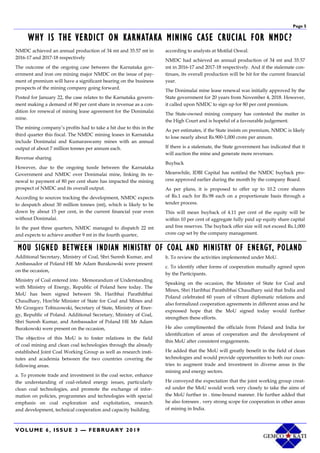
Union Minister for Mines Narendra Singh Tomar has ruled
out any amendment to extend the leases of mines which will
lapse in less than two years and said that the Centre will not
intervene in Goa’s mining crisis either.
Nearly 300 mining leases across the country are set to lapse in
2020 under provisions in an amendment introduced by the
Narendra Modi government in January 2015 making eauctions
mandatory in the grant of mining licences.
The amendment led to Goa
ending up in a Catch-22
situation when the Supreme
Court, on February 7, 2018,
ruled that the BJP-led state
government’s renewals of
88 leases, including that of
Sesa Goa’s, was illegal. The
court concluded that it (the
renewals) had been done to
circumvent the Centre’s
2015 Amendment.
Manohar Parrikar’s coali-
tion government has since
been lobbying with the Cen-
tre for an amendment to
extend these mines’ terms.
However, Tomar has ruled out this possibility.
“The Goa situation was brought about after a Supreme Court
order. That this should be something that the court decides, is
the view of the state government and the Centre. This con-
cerns the state and the court –– minerals are the state’s proper-
ty, the court order was directed at them -- they will have to do
it…the Centre can’t intervene. Goa is working on placing its
view before the court,” he said.
In the city to attend an international conference of aluminium
producers on Saturday, Tomar said his government had inher-
ited a sector mired in uncertainties. “We were determined to
tackle these challenges and introduced legislation that brings
in transparency. As these five years come to an end, not one of
those questions (uncertainties) remains unresolved,” said Tomar.
“Neither the state nor Centre can allocate any lease today, unless
it is through e-auction,” the minister said.
As concerns of a shortfall in 2020 looms – specifically in the iron
ore for steelmakers- ministry has been pushing for the explora-
tion of the remaining resources so that the auction of these de-
posits to new owners can be done without delay.
“Only those mines whose terms end in 2020 will be auctioned.
To ensure that there isn’t any
shortage of ore, the ministry is
working with the Environment
Ministry so that these leases
can be auctioned seamlessly
with environment clearances
remaining valid (for the new
lessee),” said Tomar. The min-
ister ruled out the possibility of
extending their terms to 2030,
the cut-off granted to captive
mines under the amendment.
Meanwhile, while the ministry
claims that nearly a hundred
virgin deposits are ready to be
auctioned, Odisha, one of the
most important mineral-
bearing states, is still waiting for either the Centre, or the courts,
to clear a roadblock. The current cap of 10 sq kilometre (for iron
ore) is keeping Tata Steel, whose plants (within and outside the
state) depend on Odisha’s iron ore, from participating in the
auctions.
The Centre’s view that environmental violation was tantamount
to illegal mining resulted in Odisha’s iron ore and manganese
miners paying Rs 13,000 crore as fines.
However, on the subject of Coal India being slapped with similar
steep recovery notices, the minister said: “Coal India is operating
as per legal procedures. Until they get a stay (from the coal tribu-
nal) they can work. It’s an SC order and there’s nothing we can
do about it under the circumstances.”
Azira Mining Private Limited is a wholly owned Subsidiary of Gemco Kati
Exploration P Ltd formed in March 2015 as a Junior Exploration company with the
aim to provide green field as well as brown field exploration services with major
focus on High value minerals and metallic minerals.
We have exclusive tie up with Geological Survey of Finland for exploration of deep
seated precious minerals. Empanelled with NMET as Explorers for Precious metals,
Base metals and Metallic Minerals.
VOLUME 6, ISSUE 3 — FEBRUARY 2019
Page 5
WHY IS THE VERDICT ON KARNATAKA MINING CASE CRUCIAL FOR NMDC?
NMDC achieved an annual production of 34 mt and 35.57 mt in
2016-17 and 2017-18 respectively
The outcome of the ongoing case between the Karnataka gov-
ernment and iron ore mining major NMDC on the issue of pay-
ment of premium will have a significant bearing on the business
prospects of the mining company going forward.
Posted for January 22, the case relates to the Karnataka govern-
ment making a demand of 80 per cent share in revenue as a con-
dition for renewal of mining lease agreement for the Donimalai
mine.
The mining company’s profits had to take a hit due to this in the
third quarter this fiscal. The NMDC mining leases in Karnataka
include Donimalai and Kumaraswamy mines with an annual
output of about 7 million tonnes per annum each.
Revenue sharing
However, due to the ongoing tussle between the Karnataka
Government and NMDC over Donimalai mine, linking its re-
newal to payment of 80 per cent share has impacted the mining
prospect of NMDC and its overall output.
According to sources tracking the development, NMDC expects
to despatch about 30 million tonnes (mt), which is likely to be
down by about 15 per cent, in the current financial year even
without Donimalai.
In the past three quarters, NMDC managed to dispatch 22 mt
and expects to achieve another 9 mt in the fourth quarter,
according to analysts at Motilal Oswal.
NMDC had achieved an annual production of 34 mt and 35.57
mt in 2016-17 and 2017-18 respectively. And if the stalemate con-
tinues, its overall production will be hit for the current financial
year.
The Donimalai mine lease renewal was initially approved by the
State government for 20 years from November 4, 2018. However,
it called upon NMDC to sign up for 80 per cent premium.
The State-owned mining company has contested the matter in
the High Court and is hopeful of a favourable judgement.
As per estimates, if the State insists on premium, NMDC is likely
to lose nearly about Rs.900-1,000 crore per annum.
If there is a stalemate, the State government has indicated that it
will auction the mine and generate more revenues.
Buyback
Meanwhile, IDBI Capital has notified the NMDC buyback pro-
cess approved earlier during the month by the company Board.
As per plans, it is proposed to offer up to 10.2 crore shares
of Rs.1 each for Rs.98 each on a proportionate basis through a
tender process.
This will mean buyback of 4.11 per cent of the equity will be
within 10 per cent of aggregate fully paid up equity share capital
and free reserves. The buyback offer size will not exceed Rs.1,000
crore cap set by the company management.
MOU SIGNED BETWEEN INDIAN MINISTRY OF COAL AND MINISTRY OF ENERGY, POLAND
Additional Secretary, Ministry of Coal, Shri Suresh Kumar, and
Ambassador of Poland HE Mr Adam Burakowski were present
on the occasion,
Ministry of Coal entered into . Memorandum of Understanding
with Ministry of Energy, Republic of Poland here today. The
MoU has been signed between Sh. Haribhai Parathibhai
Chaudhary, Hon'ble Minister of State for Coal and Mines and
Mr Grzegorz Tobiszowski, Secretary of State, Ministry of Ener-
gy, Republic of Poland. Additional Secretary, Ministry of Coal,
Shri Suresh Kumar, and Ambassador of Poland HE Mr Adam
Burakowski were present on the occasion,
The objective of this MoU is to foster relations in the field
of coal mining and clean coal technologies through the already
established Joint Coal Working Group as well as research insti-
tutes and academia between the two countries covering the
following areas.
a. To promote trade and investment in the coal sector, enhance
the understanding of coal-related energy issues, particularly
clean coal technologies, and promote the exchange of infor-
mation on policies, programmes and technologies with special
emphasis on coal exploration and exploitation, research
and development, technical cooperation and capacity building.
b. To review the activities implemented under MoU.
c. To identify other forms of cooperation mutually agreed upon
by the Participants.
Speaking on the occasion, the Minister of State for Coal and
Mines, Shri Haribhai Parathibhai Chaudhary said that India and
Poland celebrated 60 years of vibrant diplomatic relations and
also formalized cooperation agreements in different areas and he
expressed hope that the MoU signed today would further
strengthen these efforts.
He also complimented the officials from Poland and India for
identification of areas of cooperation and the development of
this MoU after consistent engagements.
He added that the MoU will greatly benefit in the field of clean
technologies and would provide opportunities to both our coun-
tries to augment trade and investment in diverse areas in the
mining and energy sectors.
He conveyed the expectation that the joint working group creat-
ed under the MoU would work very closely to take the aims of
the MoU further in . time-bound manner. He further added that
he also foresees . very strong scope for cooperation in other areas
of mining in India.
VOLUME 6, ISSUE 3 — FEBRUARY 2019
Page 6
In series of amending policies, the new government in state is
in process to bring a new mining policy. As the new policy
remains under deliberation, officials of the mining department
are reluctant to discuss on details, however, they assure that it
will help in achieving balanced development in state. “The
new policy will promote ‘scientific’ methods of mining, envi-
ronment sustainability and balanced development,” said a
senior officer at mining department.
The new policy is also expected to address the issue of Bajri
(river sand) mining that for now stands on hold in most areas
following the Supreme Court orders. The Congress had often
alleged the former BJP government as ‘unfair’ keeping the
issue suspended in court to promote illegal mining. Soon after
the Congress formed government, the new industry minister
Pramod Jain Bhaya had assure to get the issue solved and pro-
vision for issue of land mining leases from private fields.
Goals envisaged of the new policy are much similar to those
assured by the present mining policy implemented by the pre-
vious state government in 2015. The current policy at time of
its implementation was upheld by the state government as a
‘futuristic’ document, however, a change in the state government
has apparently made it outdated within couple of years.
Officials at the department assure that the new policy would not
come with any upsetting surprises for the investors and indicate
of inclusion of provision for recent innovations to reduce mining
waste.
In the direction, the department has on offing the techniques for
alternate use of stone slurry from Kota stone and marble indus-
tries. The mines department has recently introduced a new policy
for manufactured construction sand to be prepared from stone
slurry as an alternative to river sand.
Bajri Issue
The new policy is also expected to address the issue of Bajri (river
sand) mining that for now stands on hold in most areas following
the Supreme Court orders. The Congress had often accused the
former BJP government of being ‘unfair’ keeping the issue sus-
pended in court to promote illegal mining.
RAJASTHAN GOVERNMENT PLANS TO BRING NEW MINING POLICY
INDIA TO LOOK AT MINING AGREEMENTS DURING ARGENTINE PRESIDENT'S VISIT
India is preparing the groundwork to sign a slew of bilateral
agreements with Argentina encompassing nuclear energy, and
the mining of copper, lithium and cobalt during the visit of Ar-
gentine President Mauricio Marci, next month.
The Argentine President will be leading a high-level business
delegation to New Delhi in February, and hold meetings with
Indian Prime Minister Narendra Modi. Indian foreign office
mandarins would also be addressing Indian business leaders in
Mumbai.
The Indian foreign office was working to lay down drafts of a
number of bilateral trade agreements and a roadmap for collab-
orations with government-owned companies aiming to achieve
an incremental export boost of $1.5-billion, up from $700-million
at present, government officials here said.
The officials said that the focus on India-Argentina talks would
be the strengthening of the 121-member International Solar Alli-
ance - the brain-child of Prime Minister Modi - in which both
countries were members, and which promotes South-South
cooperation in the renewable energy sector.
It was pointed out that any uptick in renewable energy as well
as the Indian push toward electric mobility solutions hinged on
the storage battery and the country’s lack of critical inputs like lithi-
um and cobalt could be addressed through greater collaboration
with Argentina, part of the so-called “Lithium Triangle”.
While the Marci-led government has opened itself up to foreign
direct investment (FDI) in its mining sector, the Indian foreign of-
fice is expecting to conclude agreements during Marci’s forthcom-
ing visit that would likely be followed by Indian mining companies
investing in the mining sector in Argentina.
In fact, the newly approved joint ventures of Indian State-run min-
eral companies – National Aluminium Company, Hindustan Cop-
per and Mineral Exploration Corporation – christened Khanij
Bidesh, or Kabil, were preparing a team to visit Argentina next
month, to follow up any bilateral agreement that might be conclud-
ed during the Argentine President’s India visit.
Other areas of bilateral cooperation included the oil and gas sector
and proposed agreements would aim for greater access for ONGC
Videsh, the overseas arm of India’s national exploration and pro-
duction (E&P) major, ONGC, in the Argentine energy sector. OVL
already had an existing agreement with YPF, the Argentine E&P
major, for exploration of several blocks in the Latin American na-
tion.
GLOBAL DEMAND FOR COAL RISES DESPITE UNCERTAINTY
Despite a move to renewable energy, particularly in Europe,
demand for coalglobally soared in 2018, led by low calorific
value (CV) coal demand. The strongest import markets
were China and India, while Indonesia performed extremely
strongly on the supply side.
China’s demand for coal strengthened in the first half of 2018,
and eased towards the end of the year. This year, however,
looks "deeply uncertain", says IHS Markit research and analysis
manager Sareena Patel.
“The situation has changed in China. A lot of local producers are
starting to improve their output, which will facilitate local supply.
A lot more nuclear power is also coming on line this year in China,
making China a little less attractive as an import destination,” Patel
(Continued on Page 7)...
VOLUME 6, ISSUE 3 — FEBRUARY 2019
Page 7
told the Southern African CoalConference, in Cape Town, on Fri-
day.
Coal consumption in India ramped up in the second half of last
year, and is expected to do the same this year.
“This year is an election year in India. Power supply is usually
used as a political tool to appease the public,” said Patel.
Most of the growth outside of China and India was driven by
South and South East Asia, where new power plants were coming
on line. Europe continued to decline, in line with its shift to re-
newables and legislation aimed at phasing out coalgeneration.
Exports to Turkey – Europe’s last remaining growth market
for coal – declined on the back of the country’s political and eco-
nomic situation last year.
Patel said supply side growth in 2018 was led by a boom in Indo-
nesian volumes. South Africa had some capacity constraints, alt-
hough it had the potential to grow, said Patel.
“A lot more junior miners are coming into the playing fields and
are interested in getting into the export market in South Africa.”
Columbia, a traditionally strong coal exporter, experienced severe
weather issues, which had an impact on its core markets.
Patel anticipated that demand for coal would continue over the
next decade.
“Coal accounts for 40% of power generation globally today, and
you are not going to see that disappear.”
However, major markets like China could eventually shift policies
towards cleaner energy.
“In the short term, prices look set for a China-driven rollercoaster.
Expect prices to rise over this next year. They should remain quite
strong over the next few years, but as China changes policies, you
will see a lot more volatility.”
Patel said steam coal price volatility had been increasing since 2017.
The other big trend was that differentials for lower quality coals
had widened.
Supplies of genuine 6 000 kcal/kg coal tightened, due to fewer sup-
pliers being able to meet the quality and supply issues. Producing 6
000 kcal coals involves a degree of washing, which adds to the cost.
“People are being creative in the way they look at the markets. On
the supply side they are looking at whether it is worth wash-
ing coal anymore.” Many producers in countries-
like Australia, Columbia and South Africa could also not afford to
produce a 6 000 kcal spec anymore, said Patel.
Patel said buyers, even some more conservative Japanese produc-
ers, were increasingly testing lower CV coals. She said most new
boilers had the ability to use a wide range of CVsglobally.
RE-GRASSING TO BE PART OF GOVERNMENT’S MINING POLICY
Senior advocate Ashok Kumar Panda, appearing for the Centre,
informed the court that this would be included as part of the
2019 national mining policy that was being formulated.
The Centre is all set to introduce
re-grassing — a technique to
reclaim land by growing grass on
land affected by mining activity
— as a mandatory condition for
mining leaseholders in the Na-
tional Mining Policy, 2019, which
is being drawn up.
This is being considered on a
suggestion made by the Supreme
Court on Thursday.
Hearing a case of environmental
violations by Odisha miners, a
bench comprising justice SA Bob-
de and justice Deepak Gupta
suggested, “In the course of hear-
ing, the issue of deleterious effect of mining on vegetation in the
area came up before us. In particular, it is well known that min-
ing results in a complete elimination of grass in the area, which
results in denial of fodder to herbivores...re-grassing technology
is in existence today and it should be used.”
The court then directed the Odisha government “to look into
the matter and make appropriate suggestions for implementing
this proposal of re-grassing after termination of mining activi-
ties.”
Senior advocate Ashok Kumar Panda, appearing for the Centre,
informed the court that this would be included as part of the
2019 national mining policy that was being formulated.
Earlier, by its 2017 judgement
in the Odisha mining case,
the top court had imposed a
fine of Rs 19,174.83 crores on
mining leaseholders for envi-
ronmental and forest clear-
ance violations.
It had also directed the Cen-
tre to “revisit the National
Mineral Policy, 2008” as it
was then almost a decade old.
“...it is high time that the Un-
ion of India revisits the Na-
tional Mineral Policy...and
announces a fresh and more
effective, meaningful and
implementable policy within the next few months ...before 31st
December, 2017.”
Justice Bobde, while hearing the matter on Thursday, remarked,
“When mining happens, there is large-scale de-grassing, due to
which the habitat is destroyed and the fodder for bovines, which
is freely available, is lost forever...”
“...One should be clear as to how a mining site will be utilised
after closure of the mine....” said Kanchi Kohli, legal researcher
with Centre for Policy Research.
VOLUME 6, ISSUE 3 — FEBRUARY 2019
Page 8
NMDC MAY TIE UP WITH STAMICO FOR MINERAL EXPLORATION IN TANZANIA
NMDC is holding four mining licences covering over 38. 8
square kilometres in Tanzania.
State-owned NMDC Limited which is currently developing a
gold mine and is in the process of setting up a pilot gold refin-
ing facility in Tanzania is likely to enter into a MoU with that
country's State Mining Corporation (Stamico), for mineral ex-
ploration there, sources said.
NMDC is holding four mining licences covering over 38. 8
square kilometres in Tanzania.
NMDC has carried out some portion of exploration work and
completed it.
The Indian miner is also putting up a four-tonne per hour ca-
pacity processing plant in the African country.
"A high-level delegation from NMDC and the Ministry of Steel
met the directors of Tanzania State Mining Development Cor-
poration in the recent visit to Tanzania. Both the parties have
shared their knowledge with each other," sources told PTI.
Tanzania is ready to make a JV or some sort of understanding
with NMDC for developing new mines there. As NMDC has
vast knowledge of mineral development, they want to collaborate
with us. Stamico is also holding some licence is there in that
country, the sources added.
Two tender processes are on- one is for carrying out the detailed
exploration work in the remaining area which was not explored
earlier and the second for setting up four ton per hour processing
pilot plant as part of the forward integration, sources said.
Tanzania's Ministry of Energy and Minerals had granted NMDC
four mining leases at the Bulyang'Ombe gold prospect in 2012
having a total area of 38.83 sq km for 10 years.
A top official of NMDC had earlier said the miner was planning
to invest about US USD 50 million in the Tanzanian mining pro-
ject.
According to a communication from the Indian Steel Ministry,
there may be opportunities for both NMDC and Stamico in the
long run.
The communication also advised the top brass of the PSU to look
for "possible collaboration opportunities" in Tanzania, with Stam-
ico.
MINING INDUSTRY PUSHES FOR SINGLE GST TO SUPERSEDE MULTIPLE LEVIES
Royalty rates on minerals are the highest among resource-rich
nations and a cocktail of levies makes India top the list of na-
tions with steep effective taxation rate on mining
The country’s mining sector, distressed by a multitude of lev-
ies like royalty and contributions to the District Mineral Foun-
dation (DMF) and National Mineral Exploration
Trust (NMET), has advocated a uniform Goods & Services Tax
(GST) to overcome the multiplicity of taxes.
Royalty rates on minerals in the country are the highest among
resource-rich nations and a cocktail of levies makes India top
the list of nations with steep effective taxation rate (ETR) on
mining.
The cumulative effect of royalty, DMF and NMET amounts to
19.8 per cent of the IBM (Indian Bureau of Mines) sales price,
blunting the competitive edge of mining. Miners also feel this
is a case of double taxation since royalty is calculated on the
average iron ore sales price published by IBM.
The besieged mining sector has now appealed to the 15th Fi-
nance Commission, flagging its case for a unified tax regime
where all levies are subsumed by GST.
“The overall taxation on mining industry should be rational-
ised and aligned to the world standard and graded based up-
on the level of value addition done on the primary ore by the
concerned lessee. The value addition can be in the form of
beneficiation, pelletisation and steel production. The direct
and indirect taxes so paid should be allowed to be set off as
applicable to GST," said Manish Kharbanda, executive director
and acting legal head at Jindal Steel & Power Ltd (JSPL).
In the case of iron ore, the royalty rate is 15 per cent of the aver-
age sale price published by IBM. The rate is the highest in the
world, eminently surpassing Australia (6.5-7.5 per cent), Brazil
(two per cent), South Africa (0.5-7 per cent) and China (0.5-4 per
cent). Besides, the miners are lumbered with DMF charged at 30
per cent of the royalty for older mines and 10 per cent for mines
granted through auctions, NMET at two per cent of royalty and
a GST of five per cent.
Federation of Indian Chambers of Commerce & Industry (Ficci)
in a submission to the 15th Finance Commission, has asked for
bringing mining levies at par with other mineral-rich economies
like South Africa, Australia and Kazakhstan.
Subhrakant Panda, chairman of Ficci’s Odisha council and man-
aging director, Indian Metals & Ferro Alloys (IMFA) Ltd said,
“Ficci Odisha has made certain suggestions to the 15th Finance
Commission which will help augment economic activity in Od-
isha and boost growth & employment. We have sought prioriti-
sation of value addition to minerals, policy intervention for
global competitiveness, and augmenting infrastructure which
will help the state broad base industrialisation.”
Mining is the most taxed activity in India compared to any-
where in the world. The ETR on mines granted before the new
Mines and Minerals- Development & Regulation (MMDR) Act,
2015 is 64 per cent while for mines won through auctions, it
stands at 60 per cent. On a comparative note, the ETR for Mon-
golia at 31.3 per cent is half of India's. Other mineral-rich nations
also boast of attractive ETR rates- Canada (34 per cent), Chile
(37.6 per cent), Indonesia (38.1 per cent), Australia (39.7 per cent)
and South Africa (39.7 per cent).
(Continued on Page 9)...
VOLUME 6, ISSUE 3 — FEBRUARY 2019
Page 9
Countries competing for mineral sector investments usually offer
ETRs in the range of 40-50 per cent. But a previous report by
PricewaterhouseCoopers (PwC) established that India has the
highest government cost of investing in a mining operation.
VALE FORCED TO HALT OPERATIONS AT BRUCUTU, LARGEST MINE IN MINAS GERAIS
With an annual capacity of 30 million tonnes of iron ore, Brucu-
tu is Brazil's second largest mine.
A Brazilian court has ordered mining giant Vale (NYSE:VALE)
to halt operations at its Brucutu iron ore mine, the largest in
Minas Gerais state, following last month’s tailings dam disaster
at Brumadinho, which left at least 134 dead.
The veredict, quoted by O Globo, one of the most respected Bra-
zilian publications, includes an injunction that bans Vale from
storing tailings in the Laranjeiras dam at Brucutu, part of the
firm's Minas Centrais complex.
The court order also prevents Vale from disposing tailings or
practicing any activity potentially capable of increasing the risks
of Menezes II, Capitão do Mato, Dique B, Taquaras, Forquilha I,
Forquilha II and Forquilha III dams, Vale said in a statement.
The Rio de Janeiro-based company added that only three of
those facilities, Forquilha I, II and III, where built by the up-
stream method, adding they were already scheduled to shut
down.
Vale noted it will take all legal measures necessary to overturn
the decision, as the dams affected by the order have the correct
licenses and documentation attesting to their stability and there
is no technical reason that requires their closure.
The court decision comes the same day it was brought to light
that Germany’s TUV SUD, the company that certified the safety
of Córrego do Feijão mine’s tailing, had worked as both
a consultant and an independent safety evaluator for Vale, rais-
ing questions among experts over potential conflicts of interest.
The president of the Mariana Metabase Union, Angelo Eleuté-
rio, who represents workers at the Brucutu mine, confirmed the
information to Estado de Minas, adding that the shutdown was
not part of the decommissioning plan announced by Vale last
week.
On Jan. 29, the company said it would take as much as 10% of
its ore output offline in order to decommission of all its up-
stream dams, such as the one that burst in Brumadinho.
Brucutu, which has an annual capacity of 30 million tonnes of
iron ore and has been in operations for 13 years, is the second
largest mine in the country, behind Vale’s Carajás.
The operation does not have an upstream type of dam.
DISCLAIMER: This is a compilation of various news appeared in different sources. In this issue we have tried to do an hon-
est compilation. This edition is exclusively for information purpose and not for any commercial use. Your suggestions are
most valuable.
Your suggestions and feedback is awaited at :-
editor@geonesis.org
 Topographical Survey & Geological Mapping
 Diamond Core Drilling
 Preparation of plans & section
 Turnkey projects (PL to ML)
 Geomagnetic Survey
 Reserve and Grade estimation
 Preparation of Geological reports
 Marine exploration
SERVICES OFFERED

Geonesis February 2019

  • 1.
    Geonesis FEBRUARY 2019 (A GEMCOKATI INITIATIVE) Indian Mining & Exploration Updates VOLUME 6,ISSUE 3 WHILE AUCTION OF BLOCKS HAS BEEN ROBUST, CLEARANCE DELAYS HINDERED SIGNING OF MINING LEASES
  • 2.
    VOLUME 6, ISSUE3 — FEBRUARY 2019 Page 1 WHILE AUCTION OF BLOCKS HAS BEEN ROBUST, CLEARANCE DELAYS HINDERED SIGNING OF MINING LEASES In January, 2015, the amended Mines and Minerals (Development and Regulation) Act, 2015 ushered in significant changes in the process of allocating mineral blocks to change the game. State governments, re- sponsible for block prepa- ration activities, allocation process and other related tasks, have already allocat- ed 53 mineral blocks. While mining block alloca- tion has proceeded robust- ly in the past four years, actual mineral production is lagging majorly, trigger- ing developmental con- cerns. In January, 2015, the amended Mines and Min- erals (Development and Regulation) Act, 2015 ush- ered in significant changes in the process of allocating mineral blocks to change the game. State governments, responsible for block preparation activities, allocation process and other related tasks, have already allocated 53 mineral blocks. Karnataka has auctioned 14 blocks, followed by Jharkhand, Madhya Pradesh and Rajasthan with 6 blocks each, and Chhattisgarh, Andhra Pradesh and Odisha with 5 blocks each. These are chiefly of limestone (24), iron ore (19), gold (4), manga- nese (2), graphite (2), diamond (1) and bauxite (1). It’s pertinent to note that though India produces 23 major minerals, only seven types are auctioned. Windfall for states That 53 blocks have been auctioned in four years is good news, especially with premiums as high as 275% (Madhya Pradesh) for iron ore and 138% (Chhattisgarh) for limestone. The revenue ex- pected from these blocks is Rs 183,161 crore, including auction pre- mium of Rs 143,169 crore, royalty, Rs 35,725 crore, DMF, Rs 3,572 crore, and NMET, Rs 714 crore —compared to only royalty collec- tion under the previous regime. Clearly, this is a windfall for states. However, mining leases or prospecting licences have been signed for only two blocks (both in Karnataka) so far. Earlier rules did not specify timelines for signing of mining lease; now, this is mandatory within three years of issuance of letter of intent, with a provision of two extra years for delay beyond the control of the preferred bidder. The three-year timeframe is expected to suffice for securing the required clearances from state governments, before mining leases are signed. Delays imminent Six blocks were auctioned in FY16 and 15 in FY17. Thus, mining leases ought to be signed for around six blocks in the next 3-4 months and for around 15 blocks by next year. But this looks improbable ex- cept in a few states. Progress has been slow due to land, environment and forest clearance issues. In Karna- taka, two mining leases have been signed in 14 months, with a few more expected within the stipu- lated 18 months. Meanwhile, 48 working leases for around 329 blocks are set to expire by March 31, 2020, and the auction of 101 mines needs to be com- pleted before that deadline to ensure production does not suffer. Impact of delays Delay in the start of already auctioned blocks can hamper the re- sponse for blocks about to be auctioned. Lower production of min- erals is also detrimental to end-users and the country. Raw material availability at affordable prices is emerging as an issue owing to the likely shortage of iron ore and other major minerals post 2020. Around 97 mining leases across India will lapse by 2020. Way out Both the Centre and states need to address the sectoral issues, for which five steps are recommended: (Continued on page 2)...
  • 3.
    VOLUME 6, ISSUE3 — FEBRUARY 2019 Page 2 1. States may establish a special cell headed by the chief secretary with representation from different government agencies looking into statutory clearances to expedite them. Block owners too can be consulted on a regular basis to understand the issues faced by them. 2. The existing Mining Tenement System (MTS) can be utilised to track the entire lifecycle of a mineral block, starting from the issu- ance of letter of intent to grant of mining lease while uploading applications for all clearances and approvals required in the MTS, so that both the applicants and the government can monitor the situation easily. 3. An integrated single-window clearance needs to be initiated with integration and co-ordination of all related subjects such as land, water, mineral, environment, forest, etc. A single agency to take care of all such clearances will obviate inter-departmental refer- ences and reduce delays. 4. There is a need to streamline the process of environment and forest clearance by removing redundancies in the existing process without compromising on environmental and forest concerns. This is needed for preliminary and regional exploration projects—for instance, an NOC from the forest department where no forest land is available may be taken by the state government at the block preparation stage. 5. Land details gathered by a state’s mining and geology depart- ment using differential global positioning system during the auc- tion process need to be vetted by the revenue department to avoid any mismatch at later stages or at the time of land acquisition. Like our official Facebook page: https://www.facebook.com/geonesis OVER 100 MINERAL BLOCKS READY FOR ONLINE AUCTIONS: NARENDRA SINGH TOMAR Mines ministry on track to auction lapsing leases As many as 100 virgin mineral blocks across the country are ready for online auctions, said Union minister for mines, rural development, parliamentary affairs and Panchayati Raj Naren- dra Singh Tomar. “So far, 53 mines have been auctioned. The electronic auction of these assets has brought in incremental revenue of Rs 1.43 trillion to states. The additional revenue generation has been possible only be- cause of auctions”, Tomar told media per- sons on the sidelines of the seventh edition of the International Con- ference on Aluminium (INCAL), 2019. On mines headed for expiry by March 31, 2020, he said the mines ministry is fully prepared to auction them in the stipulated timeframe. Out of 288 mines due to lapse by March 31, 2020, only 59 are operative. The lease validity of these non-captive mines was extended till that period under Section 8 (3) of the amended Mines and Minerals- Development & Regulation Act, 2015. The central mines ministry has been pushing mineral bearing states to expedite the roadmap for auctioning these leases to ensure there is no deficit of raw materials, primarily iron ore. The laps- able mines need to be explored up to the G2 level to be eligible for auctions. Earlier, addressing dele- gates at INCAL 2019, Tomar credited his gov- ernment for introducing transparency in mineral block allotments through online auctions. The mines ministry has also initiated the District Mineral Foundation (DMF) to take up pro- jects for the benefit of people affected by min- ing activities. “We have collected Rs 23,000 crore as proceeds to the Pra- dhan Mantri Khanij Kshetra Kalyan Yojana. More than 100,000 pro- grammes have been ini- tiated drawing funds from this scheme”, the minister said. Tomar hailed aluminium as the metal of the future, noting that its applications have been diversifying. He applauded the state- run National Aluminium Company (Nalco) for its export per- formance while underscoring the need for ramping up domestic production. “The country’s aluminium demand is going to (Continued on Page 3)...
  • 4.
    Page 3 VOLUME 6,ISSUE 3 — FEBRUARY 2019 Follow us On Or Scan This QR Code reach 10 million tonnes by 2030 and so, aluminium production has to be raised. Our per capita aluminium consumption is about 2.5 kg but we have plans to scale it up”, he said. Speaking on the occasion, TK Chand, chairman & managing director (CMD) at Nalco and president, Aluminium Associa- tion of India (AAI) said, the aluminium industry was passing a challenging phase in the backdrop of tumbling LME (London Metal Exchange) prices and rising production costs. To substantiate, Chand said LME prices have dropped to a point where 40 per cent of the smelters across the world are bleeding losses. Offering a recipe to the aluminium industry, he said, “The indus- try needs to focus on three Ss- speed, savings and sustainability. The focus should also be on cost reduction to remain competi- tive.” Subroto Bagchi, chairman of Odisha Skills Development Author- ity (OSDA) suggested to the Indian aluminium industry to sharpen the focus on quality, cost and delivery and implement the Six Sigma programme on the lines of global aluminium giant Alcoa. MINERAL BLOCK AUCTION: GOVT MULLS SINGLE WINDOW FOR GREEN CLEARANCES The government had said that the ministries of mines, steel and environment were working together in this regard Stating that there were issues in obtaining environment and other clearances for mineral blocks, the government Wednes- day said it is trying to put a single window clearance system in place. "Clearances like environ- ment, forest and land rights ...are an issue. Its not very easy to get clearances. There are delays in the pro- cess...We are trying to put single window clear- ance in place," Mines Joint Secretary Anil Kumar Nayak said while address- ing the Fourth India Copper Forum here. In June, Nayak, had said that unless issues related to green clearances and land rights were addressed up- front, India may not make much progress in auctioning of mineral blocks in the future. Earlier, the steel ministry had said that it was totally in favour of a single window system. The government had said that the ministries of mines, steel and environment were working together in this regard. Addressing the event here, Sterlite Copper CEO P Ramnath said that demand of copper in future would go up but posed a ques- tion as to how will the increasing need of the metal in India will be met when the expansion projects and currents plants in the country were being shutdown "for no reason at all". The Tamil Nadu govern- ment had in May ordered the pollution control board to seal and "permanently" close Ve- danta's Sterlite Copper unit in the state, following violent protests over pol- lution concerns. "It is very very clear that the copper demand in the future is going to rise on...But to make a ques- tion now is how we are going to cater to this in- creasing demand of cop- per in our country when the expansion projects and current plants in the coun- try are being shutdown for no reason at all," Ramnath said. Around 50 mineral blocks have been auctioned so far since 2015. The government will earn a revenue of Rs 1.81 lakh crore over the lease period from these blocks.
  • 5.
    Page 4 VOLUME 6,ISSUE 3 — FEBRUARY 2019 NO AMENDMENT FOR GOA OR LEASES LAPSING IN 2020: NARENDRA SINGH TOMAR Union Minister for Mines Narendra Singh Tomar has ruled out any amendment to extend the leases of mines which will lapse in less than two years and said that the Centre will not intervene in Goa’s mining crisis either. Nearly 300 mining leases across the country are set to lapse in 2020 under provisions in an amendment introduced by the Narendra Modi government in January 2015 making eauctions mandatory in the grant of mining licences. The amendment led to Goa ending up in a Catch-22 situation when the Supreme Court, on February 7, 2018, ruled that the BJP-led state government’s renewals of 88 leases, including that of Sesa Goa’s, was illegal. The court concluded that it (the renewals) had been done to circumvent the Centre’s 2015 Amendment. Manohar Parrikar’s coali- tion government has since been lobbying with the Cen- tre for an amendment to extend these mines’ terms. However, Tomar has ruled out this possibility. “The Goa situation was brought about after a Supreme Court order. That this should be something that the court decides, is the view of the state government and the Centre. This con- cerns the state and the court –– minerals are the state’s proper- ty, the court order was directed at them -- they will have to do it…the Centre can’t intervene. Goa is working on placing its view before the court,” he said. In the city to attend an international conference of aluminium producers on Saturday, Tomar said his government had inher- ited a sector mired in uncertainties. “We were determined to tackle these challenges and introduced legislation that brings in transparency. As these five years come to an end, not one of those questions (uncertainties) remains unresolved,” said Tomar. “Neither the state nor Centre can allocate any lease today, unless it is through e-auction,” the minister said. As concerns of a shortfall in 2020 looms – specifically in the iron ore for steelmakers- ministry has been pushing for the explora- tion of the remaining resources so that the auction of these de- posits to new owners can be done without delay. “Only those mines whose terms end in 2020 will be auctioned. To ensure that there isn’t any shortage of ore, the ministry is working with the Environment Ministry so that these leases can be auctioned seamlessly with environment clearances remaining valid (for the new lessee),” said Tomar. The min- ister ruled out the possibility of extending their terms to 2030, the cut-off granted to captive mines under the amendment. Meanwhile, while the ministry claims that nearly a hundred virgin deposits are ready to be auctioned, Odisha, one of the most important mineral- bearing states, is still waiting for either the Centre, or the courts, to clear a roadblock. The current cap of 10 sq kilometre (for iron ore) is keeping Tata Steel, whose plants (within and outside the state) depend on Odisha’s iron ore, from participating in the auctions. The Centre’s view that environmental violation was tantamount to illegal mining resulted in Odisha’s iron ore and manganese miners paying Rs 13,000 crore as fines. However, on the subject of Coal India being slapped with similar steep recovery notices, the minister said: “Coal India is operating as per legal procedures. Until they get a stay (from the coal tribu- nal) they can work. It’s an SC order and there’s nothing we can do about it under the circumstances.” Azira Mining Private Limited is a wholly owned Subsidiary of Gemco Kati Exploration P Ltd formed in March 2015 as a Junior Exploration company with the aim to provide green field as well as brown field exploration services with major focus on High value minerals and metallic minerals. We have exclusive tie up with Geological Survey of Finland for exploration of deep seated precious minerals. Empanelled with NMET as Explorers for Precious metals, Base metals and Metallic Minerals.
  • 6.
    VOLUME 6, ISSUE3 — FEBRUARY 2019 Page 5 WHY IS THE VERDICT ON KARNATAKA MINING CASE CRUCIAL FOR NMDC? NMDC achieved an annual production of 34 mt and 35.57 mt in 2016-17 and 2017-18 respectively The outcome of the ongoing case between the Karnataka gov- ernment and iron ore mining major NMDC on the issue of pay- ment of premium will have a significant bearing on the business prospects of the mining company going forward. Posted for January 22, the case relates to the Karnataka govern- ment making a demand of 80 per cent share in revenue as a con- dition for renewal of mining lease agreement for the Donimalai mine. The mining company’s profits had to take a hit due to this in the third quarter this fiscal. The NMDC mining leases in Karnataka include Donimalai and Kumaraswamy mines with an annual output of about 7 million tonnes per annum each. Revenue sharing However, due to the ongoing tussle between the Karnataka Government and NMDC over Donimalai mine, linking its re- newal to payment of 80 per cent share has impacted the mining prospect of NMDC and its overall output. According to sources tracking the development, NMDC expects to despatch about 30 million tonnes (mt), which is likely to be down by about 15 per cent, in the current financial year even without Donimalai. In the past three quarters, NMDC managed to dispatch 22 mt and expects to achieve another 9 mt in the fourth quarter, according to analysts at Motilal Oswal. NMDC had achieved an annual production of 34 mt and 35.57 mt in 2016-17 and 2017-18 respectively. And if the stalemate con- tinues, its overall production will be hit for the current financial year. The Donimalai mine lease renewal was initially approved by the State government for 20 years from November 4, 2018. However, it called upon NMDC to sign up for 80 per cent premium. The State-owned mining company has contested the matter in the High Court and is hopeful of a favourable judgement. As per estimates, if the State insists on premium, NMDC is likely to lose nearly about Rs.900-1,000 crore per annum. If there is a stalemate, the State government has indicated that it will auction the mine and generate more revenues. Buyback Meanwhile, IDBI Capital has notified the NMDC buyback pro- cess approved earlier during the month by the company Board. As per plans, it is proposed to offer up to 10.2 crore shares of Rs.1 each for Rs.98 each on a proportionate basis through a tender process. This will mean buyback of 4.11 per cent of the equity will be within 10 per cent of aggregate fully paid up equity share capital and free reserves. The buyback offer size will not exceed Rs.1,000 crore cap set by the company management. MOU SIGNED BETWEEN INDIAN MINISTRY OF COAL AND MINISTRY OF ENERGY, POLAND Additional Secretary, Ministry of Coal, Shri Suresh Kumar, and Ambassador of Poland HE Mr Adam Burakowski were present on the occasion, Ministry of Coal entered into . Memorandum of Understanding with Ministry of Energy, Republic of Poland here today. The MoU has been signed between Sh. Haribhai Parathibhai Chaudhary, Hon'ble Minister of State for Coal and Mines and Mr Grzegorz Tobiszowski, Secretary of State, Ministry of Ener- gy, Republic of Poland. Additional Secretary, Ministry of Coal, Shri Suresh Kumar, and Ambassador of Poland HE Mr Adam Burakowski were present on the occasion, The objective of this MoU is to foster relations in the field of coal mining and clean coal technologies through the already established Joint Coal Working Group as well as research insti- tutes and academia between the two countries covering the following areas. a. To promote trade and investment in the coal sector, enhance the understanding of coal-related energy issues, particularly clean coal technologies, and promote the exchange of infor- mation on policies, programmes and technologies with special emphasis on coal exploration and exploitation, research and development, technical cooperation and capacity building. b. To review the activities implemented under MoU. c. To identify other forms of cooperation mutually agreed upon by the Participants. Speaking on the occasion, the Minister of State for Coal and Mines, Shri Haribhai Parathibhai Chaudhary said that India and Poland celebrated 60 years of vibrant diplomatic relations and also formalized cooperation agreements in different areas and he expressed hope that the MoU signed today would further strengthen these efforts. He also complimented the officials from Poland and India for identification of areas of cooperation and the development of this MoU after consistent engagements. He added that the MoU will greatly benefit in the field of clean technologies and would provide opportunities to both our coun- tries to augment trade and investment in diverse areas in the mining and energy sectors. He conveyed the expectation that the joint working group creat- ed under the MoU would work very closely to take the aims of the MoU further in . time-bound manner. He further added that he also foresees . very strong scope for cooperation in other areas of mining in India.
  • 7.
    VOLUME 6, ISSUE3 — FEBRUARY 2019 Page 6 In series of amending policies, the new government in state is in process to bring a new mining policy. As the new policy remains under deliberation, officials of the mining department are reluctant to discuss on details, however, they assure that it will help in achieving balanced development in state. “The new policy will promote ‘scientific’ methods of mining, envi- ronment sustainability and balanced development,” said a senior officer at mining department. The new policy is also expected to address the issue of Bajri (river sand) mining that for now stands on hold in most areas following the Supreme Court orders. The Congress had often alleged the former BJP government as ‘unfair’ keeping the issue suspended in court to promote illegal mining. Soon after the Congress formed government, the new industry minister Pramod Jain Bhaya had assure to get the issue solved and pro- vision for issue of land mining leases from private fields. Goals envisaged of the new policy are much similar to those assured by the present mining policy implemented by the pre- vious state government in 2015. The current policy at time of its implementation was upheld by the state government as a ‘futuristic’ document, however, a change in the state government has apparently made it outdated within couple of years. Officials at the department assure that the new policy would not come with any upsetting surprises for the investors and indicate of inclusion of provision for recent innovations to reduce mining waste. In the direction, the department has on offing the techniques for alternate use of stone slurry from Kota stone and marble indus- tries. The mines department has recently introduced a new policy for manufactured construction sand to be prepared from stone slurry as an alternative to river sand. Bajri Issue The new policy is also expected to address the issue of Bajri (river sand) mining that for now stands on hold in most areas following the Supreme Court orders. The Congress had often accused the former BJP government of being ‘unfair’ keeping the issue sus- pended in court to promote illegal mining. RAJASTHAN GOVERNMENT PLANS TO BRING NEW MINING POLICY INDIA TO LOOK AT MINING AGREEMENTS DURING ARGENTINE PRESIDENT'S VISIT India is preparing the groundwork to sign a slew of bilateral agreements with Argentina encompassing nuclear energy, and the mining of copper, lithium and cobalt during the visit of Ar- gentine President Mauricio Marci, next month. The Argentine President will be leading a high-level business delegation to New Delhi in February, and hold meetings with Indian Prime Minister Narendra Modi. Indian foreign office mandarins would also be addressing Indian business leaders in Mumbai. The Indian foreign office was working to lay down drafts of a number of bilateral trade agreements and a roadmap for collab- orations with government-owned companies aiming to achieve an incremental export boost of $1.5-billion, up from $700-million at present, government officials here said. The officials said that the focus on India-Argentina talks would be the strengthening of the 121-member International Solar Alli- ance - the brain-child of Prime Minister Modi - in which both countries were members, and which promotes South-South cooperation in the renewable energy sector. It was pointed out that any uptick in renewable energy as well as the Indian push toward electric mobility solutions hinged on the storage battery and the country’s lack of critical inputs like lithi- um and cobalt could be addressed through greater collaboration with Argentina, part of the so-called “Lithium Triangle”. While the Marci-led government has opened itself up to foreign direct investment (FDI) in its mining sector, the Indian foreign of- fice is expecting to conclude agreements during Marci’s forthcom- ing visit that would likely be followed by Indian mining companies investing in the mining sector in Argentina. In fact, the newly approved joint ventures of Indian State-run min- eral companies – National Aluminium Company, Hindustan Cop- per and Mineral Exploration Corporation – christened Khanij Bidesh, or Kabil, were preparing a team to visit Argentina next month, to follow up any bilateral agreement that might be conclud- ed during the Argentine President’s India visit. Other areas of bilateral cooperation included the oil and gas sector and proposed agreements would aim for greater access for ONGC Videsh, the overseas arm of India’s national exploration and pro- duction (E&P) major, ONGC, in the Argentine energy sector. OVL already had an existing agreement with YPF, the Argentine E&P major, for exploration of several blocks in the Latin American na- tion. GLOBAL DEMAND FOR COAL RISES DESPITE UNCERTAINTY Despite a move to renewable energy, particularly in Europe, demand for coalglobally soared in 2018, led by low calorific value (CV) coal demand. The strongest import markets were China and India, while Indonesia performed extremely strongly on the supply side. China’s demand for coal strengthened in the first half of 2018, and eased towards the end of the year. This year, however, looks "deeply uncertain", says IHS Markit research and analysis manager Sareena Patel. “The situation has changed in China. A lot of local producers are starting to improve their output, which will facilitate local supply. A lot more nuclear power is also coming on line this year in China, making China a little less attractive as an import destination,” Patel (Continued on Page 7)...
  • 8.
    VOLUME 6, ISSUE3 — FEBRUARY 2019 Page 7 told the Southern African CoalConference, in Cape Town, on Fri- day. Coal consumption in India ramped up in the second half of last year, and is expected to do the same this year. “This year is an election year in India. Power supply is usually used as a political tool to appease the public,” said Patel. Most of the growth outside of China and India was driven by South and South East Asia, where new power plants were coming on line. Europe continued to decline, in line with its shift to re- newables and legislation aimed at phasing out coalgeneration. Exports to Turkey – Europe’s last remaining growth market for coal – declined on the back of the country’s political and eco- nomic situation last year. Patel said supply side growth in 2018 was led by a boom in Indo- nesian volumes. South Africa had some capacity constraints, alt- hough it had the potential to grow, said Patel. “A lot more junior miners are coming into the playing fields and are interested in getting into the export market in South Africa.” Columbia, a traditionally strong coal exporter, experienced severe weather issues, which had an impact on its core markets. Patel anticipated that demand for coal would continue over the next decade. “Coal accounts for 40% of power generation globally today, and you are not going to see that disappear.” However, major markets like China could eventually shift policies towards cleaner energy. “In the short term, prices look set for a China-driven rollercoaster. Expect prices to rise over this next year. They should remain quite strong over the next few years, but as China changes policies, you will see a lot more volatility.” Patel said steam coal price volatility had been increasing since 2017. The other big trend was that differentials for lower quality coals had widened. Supplies of genuine 6 000 kcal/kg coal tightened, due to fewer sup- pliers being able to meet the quality and supply issues. Producing 6 000 kcal coals involves a degree of washing, which adds to the cost. “People are being creative in the way they look at the markets. On the supply side they are looking at whether it is worth wash- ing coal anymore.” Many producers in countries- like Australia, Columbia and South Africa could also not afford to produce a 6 000 kcal spec anymore, said Patel. Patel said buyers, even some more conservative Japanese produc- ers, were increasingly testing lower CV coals. She said most new boilers had the ability to use a wide range of CVsglobally. RE-GRASSING TO BE PART OF GOVERNMENT’S MINING POLICY Senior advocate Ashok Kumar Panda, appearing for the Centre, informed the court that this would be included as part of the 2019 national mining policy that was being formulated. The Centre is all set to introduce re-grassing — a technique to reclaim land by growing grass on land affected by mining activity — as a mandatory condition for mining leaseholders in the Na- tional Mining Policy, 2019, which is being drawn up. This is being considered on a suggestion made by the Supreme Court on Thursday. Hearing a case of environmental violations by Odisha miners, a bench comprising justice SA Bob- de and justice Deepak Gupta suggested, “In the course of hear- ing, the issue of deleterious effect of mining on vegetation in the area came up before us. In particular, it is well known that min- ing results in a complete elimination of grass in the area, which results in denial of fodder to herbivores...re-grassing technology is in existence today and it should be used.” The court then directed the Odisha government “to look into the matter and make appropriate suggestions for implementing this proposal of re-grassing after termination of mining activi- ties.” Senior advocate Ashok Kumar Panda, appearing for the Centre, informed the court that this would be included as part of the 2019 national mining policy that was being formulated. Earlier, by its 2017 judgement in the Odisha mining case, the top court had imposed a fine of Rs 19,174.83 crores on mining leaseholders for envi- ronmental and forest clear- ance violations. It had also directed the Cen- tre to “revisit the National Mineral Policy, 2008” as it was then almost a decade old. “...it is high time that the Un- ion of India revisits the Na- tional Mineral Policy...and announces a fresh and more effective, meaningful and implementable policy within the next few months ...before 31st December, 2017.” Justice Bobde, while hearing the matter on Thursday, remarked, “When mining happens, there is large-scale de-grassing, due to which the habitat is destroyed and the fodder for bovines, which is freely available, is lost forever...” “...One should be clear as to how a mining site will be utilised after closure of the mine....” said Kanchi Kohli, legal researcher with Centre for Policy Research.
  • 9.
    VOLUME 6, ISSUE3 — FEBRUARY 2019 Page 8 NMDC MAY TIE UP WITH STAMICO FOR MINERAL EXPLORATION IN TANZANIA NMDC is holding four mining licences covering over 38. 8 square kilometres in Tanzania. State-owned NMDC Limited which is currently developing a gold mine and is in the process of setting up a pilot gold refin- ing facility in Tanzania is likely to enter into a MoU with that country's State Mining Corporation (Stamico), for mineral ex- ploration there, sources said. NMDC is holding four mining licences covering over 38. 8 square kilometres in Tanzania. NMDC has carried out some portion of exploration work and completed it. The Indian miner is also putting up a four-tonne per hour ca- pacity processing plant in the African country. "A high-level delegation from NMDC and the Ministry of Steel met the directors of Tanzania State Mining Development Cor- poration in the recent visit to Tanzania. Both the parties have shared their knowledge with each other," sources told PTI. Tanzania is ready to make a JV or some sort of understanding with NMDC for developing new mines there. As NMDC has vast knowledge of mineral development, they want to collaborate with us. Stamico is also holding some licence is there in that country, the sources added. Two tender processes are on- one is for carrying out the detailed exploration work in the remaining area which was not explored earlier and the second for setting up four ton per hour processing pilot plant as part of the forward integration, sources said. Tanzania's Ministry of Energy and Minerals had granted NMDC four mining leases at the Bulyang'Ombe gold prospect in 2012 having a total area of 38.83 sq km for 10 years. A top official of NMDC had earlier said the miner was planning to invest about US USD 50 million in the Tanzanian mining pro- ject. According to a communication from the Indian Steel Ministry, there may be opportunities for both NMDC and Stamico in the long run. The communication also advised the top brass of the PSU to look for "possible collaboration opportunities" in Tanzania, with Stam- ico. MINING INDUSTRY PUSHES FOR SINGLE GST TO SUPERSEDE MULTIPLE LEVIES Royalty rates on minerals are the highest among resource-rich nations and a cocktail of levies makes India top the list of na- tions with steep effective taxation rate on mining The country’s mining sector, distressed by a multitude of lev- ies like royalty and contributions to the District Mineral Foun- dation (DMF) and National Mineral Exploration Trust (NMET), has advocated a uniform Goods & Services Tax (GST) to overcome the multiplicity of taxes. Royalty rates on minerals in the country are the highest among resource-rich nations and a cocktail of levies makes India top the list of nations with steep effective taxation rate (ETR) on mining. The cumulative effect of royalty, DMF and NMET amounts to 19.8 per cent of the IBM (Indian Bureau of Mines) sales price, blunting the competitive edge of mining. Miners also feel this is a case of double taxation since royalty is calculated on the average iron ore sales price published by IBM. The besieged mining sector has now appealed to the 15th Fi- nance Commission, flagging its case for a unified tax regime where all levies are subsumed by GST. “The overall taxation on mining industry should be rational- ised and aligned to the world standard and graded based up- on the level of value addition done on the primary ore by the concerned lessee. The value addition can be in the form of beneficiation, pelletisation and steel production. The direct and indirect taxes so paid should be allowed to be set off as applicable to GST," said Manish Kharbanda, executive director and acting legal head at Jindal Steel & Power Ltd (JSPL). In the case of iron ore, the royalty rate is 15 per cent of the aver- age sale price published by IBM. The rate is the highest in the world, eminently surpassing Australia (6.5-7.5 per cent), Brazil (two per cent), South Africa (0.5-7 per cent) and China (0.5-4 per cent). Besides, the miners are lumbered with DMF charged at 30 per cent of the royalty for older mines and 10 per cent for mines granted through auctions, NMET at two per cent of royalty and a GST of five per cent. Federation of Indian Chambers of Commerce & Industry (Ficci) in a submission to the 15th Finance Commission, has asked for bringing mining levies at par with other mineral-rich economies like South Africa, Australia and Kazakhstan. Subhrakant Panda, chairman of Ficci’s Odisha council and man- aging director, Indian Metals & Ferro Alloys (IMFA) Ltd said, “Ficci Odisha has made certain suggestions to the 15th Finance Commission which will help augment economic activity in Od- isha and boost growth & employment. We have sought prioriti- sation of value addition to minerals, policy intervention for global competitiveness, and augmenting infrastructure which will help the state broad base industrialisation.” Mining is the most taxed activity in India compared to any- where in the world. The ETR on mines granted before the new Mines and Minerals- Development & Regulation (MMDR) Act, 2015 is 64 per cent while for mines won through auctions, it stands at 60 per cent. On a comparative note, the ETR for Mon- golia at 31.3 per cent is half of India's. Other mineral-rich nations also boast of attractive ETR rates- Canada (34 per cent), Chile (37.6 per cent), Indonesia (38.1 per cent), Australia (39.7 per cent) and South Africa (39.7 per cent). (Continued on Page 9)...
  • 10.
    VOLUME 6, ISSUE3 — FEBRUARY 2019 Page 9 Countries competing for mineral sector investments usually offer ETRs in the range of 40-50 per cent. But a previous report by PricewaterhouseCoopers (PwC) established that India has the highest government cost of investing in a mining operation. VALE FORCED TO HALT OPERATIONS AT BRUCUTU, LARGEST MINE IN MINAS GERAIS With an annual capacity of 30 million tonnes of iron ore, Brucu- tu is Brazil's second largest mine. A Brazilian court has ordered mining giant Vale (NYSE:VALE) to halt operations at its Brucutu iron ore mine, the largest in Minas Gerais state, following last month’s tailings dam disaster at Brumadinho, which left at least 134 dead. The veredict, quoted by O Globo, one of the most respected Bra- zilian publications, includes an injunction that bans Vale from storing tailings in the Laranjeiras dam at Brucutu, part of the firm's Minas Centrais complex. The court order also prevents Vale from disposing tailings or practicing any activity potentially capable of increasing the risks of Menezes II, Capitão do Mato, Dique B, Taquaras, Forquilha I, Forquilha II and Forquilha III dams, Vale said in a statement. The Rio de Janeiro-based company added that only three of those facilities, Forquilha I, II and III, where built by the up- stream method, adding they were already scheduled to shut down. Vale noted it will take all legal measures necessary to overturn the decision, as the dams affected by the order have the correct licenses and documentation attesting to their stability and there is no technical reason that requires their closure. The court decision comes the same day it was brought to light that Germany’s TUV SUD, the company that certified the safety of Córrego do Feijão mine’s tailing, had worked as both a consultant and an independent safety evaluator for Vale, rais- ing questions among experts over potential conflicts of interest. The president of the Mariana Metabase Union, Angelo Eleuté- rio, who represents workers at the Brucutu mine, confirmed the information to Estado de Minas, adding that the shutdown was not part of the decommissioning plan announced by Vale last week. On Jan. 29, the company said it would take as much as 10% of its ore output offline in order to decommission of all its up- stream dams, such as the one that burst in Brumadinho. Brucutu, which has an annual capacity of 30 million tonnes of iron ore and has been in operations for 13 years, is the second largest mine in the country, behind Vale’s Carajás. The operation does not have an upstream type of dam. DISCLAIMER: This is a compilation of various news appeared in different sources. In this issue we have tried to do an hon- est compilation. This edition is exclusively for information purpose and not for any commercial use. Your suggestions are most valuable. Your suggestions and feedback is awaited at :- editor@geonesis.org  Topographical Survey & Geological Mapping  Diamond Core Drilling  Preparation of plans & section  Turnkey projects (PL to ML)  Geomagnetic Survey  Reserve and Grade estimation  Preparation of Geological reports  Marine exploration SERVICES OFFERED