Geoinformatics Cyberinfrastructure For The Solid
Earth Sciences 1st Edition G Randy Keller
download
https://ebookbell.com/product/geoinformatics-cyberinfrastructure-
for-the-solid-earth-sciences-1st-edition-g-randy-keller-2490062
Explore and download more ebooks at ebookbell.com
GEOINFORMATICS
Cyberinfrastructure for the Solid Earth Sciences
Advanced information technology infrastructure is being employed increasingly in
the Earth sciences to provide researchers with efficient access to massive databases
and an ability to integrate diversely formatted information from a variety of sources.
A range of geoinformatics initiatives are enabling manipulation, modeling,
and visualization of Earth Science data and are helping to develop integrated
Earth models at various scales, and from the near surface to the deep interior.
This book provides a series of case studies that demonstrate the use of cyber-
infrastructure across the Earth Sciences. Chapters are grouped thematically into
sections that cover data collection and management; modeling and community
computational codes; visualization and data representation; knowledge manage-
ment and data integration; web services and scientific workflows.
Geoinformatics is a fascinating and accessible introduction to this emerging
field for readers across the solid Earth sciences and is an invaluable reference for
researchers interested in initiating new cyberinfrastructure projects of their own.
g. randy keller is a Professor of Geophysics and McCullogh Chair at the
Mewbourne College of Earth and Energy, University of Oklahoma.
chaitanya baru is a Distinguished Scientist at the San Diego Supercomputer
Center, University of California-San Diego.
The two editors have collaborated since the emergence of geoinformatics as an
organized scientific initiative in the USA in the late 1990s – helping to lead and
organize the US Geoinformatics initiative and communicate its potential to collea-
gues around the world, both informally and through many appointments to advisory
committees. Both Professor Keller and Dr. Baru are also Principal Investigators on
the GEON (Geoscience Network) project that is a major effort funded by the
National Science Foundation. While early geoinformatics programmes focused on
database creation and on the development of highly functional software tools, these
have since been merged with other efforts, such as high-performance computing and
integrated earth-system modeling, to create a more extensive cyberinfrastructure
for the geosciences. Dr. Baru’s work at the San Diego Supercomputer Center has
involved cyberinfrastructure activities across a range of scientific subject areas, while
Professor Keller’s research has focused on applications specific to the geosciences.
GEOINFORMATICS
Cyberinfrastructure for the Solid Earth Sciences
Edited by
G. RANDY KELLER
University of Oklahoma
CHAITANYA BARU
University of California-San Diego
cambridge university press
Cambridge, New York, Melbourne, Madrid, Cape Town,
Singapore, São Paulo, Delhi, Tokyo, Mexico City
Cambridge University Press
The Edinburgh Building, Cambridge, CB2 8RU, UK
Published in the United States of America by Cambridge University Press, New York
www.cambridge.org
Information on this title: www.cambridge.org/9780521897150
© Cambridge University Press 2011
This publication is in copyright. Subject to statutory exception
and to the provisions of relevant collective licensing agreements,
no reproduction of any part may take place without the written
permission of Cambridge University Press.
First published 2011
Printed in the United Kingdom at the University Press, Cambridge
A catalog record for this publication is available from the British Library
ISBN 978-0-521-89715-0 Hardback
Cambridge University Press has no responsibility for the persistence or
accuracy of URLs for external or third-party internet web sites referred to
in this publication, and does not guarantee that any content on such
web sites is, or will remain, accurate or appropriate.
Contents
List of contributors page viii
Preface xiii
Introduction 1
1 Science needs and challenges for geoinformatics
g. randy keller 3
2 Introduction to IT concepts and challenges
chaitanya baru 10
Part I Case studies from other disciplines 19
3 Semantic cyberinfrastructure: The Virtual Solar-Terrestrial Observatory
peter fox, deborah l. mcguinness, and the vsto team 21
4 Cyberinfrastructures for life sciences and biomedicine
sriram krishnan and ravi madduri 37
Part II Modeling software and community codes 47
5 Development, verification, and maintenance of computational software in
geodynamics
michael gurnis, walter landry, eh tan, luis armendariz,
leif strand, and michael aivazis 49
6 Parallel finite element modeling of multi-timescale faulting
and lithospheric deformation in western USA
mian liu, youqing yang, qingsong li, gang luo,
and huai zhang 68
7 Next-generation plate-tectonic reconstructions using GPlates
james a. boyden, r. dietmar müller, michael gurnis, trond
h. torsvik, james a. clark, mark turner, hamish ivey-law,
robin j. watson, and john s. cannon 95
v
Part III Visualization and data representation 115
8 Visualization of seismic model data
amit chourasia 117
9 The UNAVCO GEON Integrated Data Viewer for exploration,
analysis, and integration of geoscience data
stuart wier and charles meertens 131
Part IV Knowledge management and data integration 143
10 Data and tools for geologic timelines and timescales
peter m. sadler and cinzia cervato 145
11 Modeling geodynamic processes with ontologies
hassan a. babaie 166
Part V Web services and scientific workflows 191
12 Service orientation in the design of a community hydrologic
information system
ilya zaslavsky and david r. maidment 193
13 Web services for seismic data archives
robert casey and timothy k. ahern 210
14 Development of robust data system for gravity and magnetic anomaly
data: A case study of a community-based effort for point data
raed aldouri and g. randy keller 224
15 Scientific workflows for the geosciences: An emerging approach to
building integrated data analysis systems
ilkay altintas, daniel crawl, christopher j. crosby,
and peter cornillon 237
16 Online access and processing of LiDAR topography data
christopher j. crosby, j ramón arrowsmith, viswanath
nandigam, and chaitanya baru 251
17 Use of abstraction to support geoscientists’ understanding and
production of scientific artifacts
ann q. gates, paulo pinheiro da silva, leonardo salayandia,
omar ochoa, aida gandara, and nicholas del rio 266
Part VI Emerging international and other efforts 285
18 It’s not your data, it’s everyone’s: The benefits of a corporate
approach to scientific information
ian jackson and richard hughes 287
19 TOPO-EUROPE and cyberinfrastructure: Quantifying coupled
deep earth – surface processes in 4-D
s. a. p. l. cloetingh, h. p. bunge, and the topo-europe
working group 292
vi Contents
20 OneGeology – from concept to global project
ian jackson 317
21 Geoinformatics developments in Germany
jens klump, joachim wächter, peter löwe, ralf bill,
and matthias lendholt 323
22 iGEON: Networking the Indian geosciences community
through GEON
k. v. subbarao, arun agarwal, rajeev wankar, and
chaitanya baru 332
23 Geoinformatics in the public service: Building a cyberinfrastructure
across the geological surveys
m. lee allison, linda c. gundersen, and
stephen m. richard 342
24. Application of the US Geoscience Information Network to
deploying a national geothermal data system
stephen m. richard, ryan clark, and wolfgang grunberg 350
Index 371
The color plate section can be found between pages 114 and 115.
Contents vii
Contributors
Arun Agarwal, University Center for Earth & Space Sciences, University of
Hyderabad, Central University P.O., Hyderabad – 500 046, India
Timothy K. Ahern, IRIS Data Management Center, 1408 NE 45 St., Suite 201,
Seattle, WA 98105, USA
Michael Aivazis, Center for Advanced Computer Research, California Institute of
Technology, Pasadena, CA 91125, USA
Raed Aldouri, Regional Geospatial Service Center, University of Texas at El
Paso, El Paso, TX 79968, USA
M. Lee Allison, Arizona Geological Survey, 416 W. Congress St., Suite 100,
Tucson, AZ 85701, USA
Ilkay Altintas, San Diego Supercomputer Center, University of California-San
Diego, La Jolla, CA 92093-0505, USA
Luis Armendariz, Computational Infrastructure for Geodynamics, California
Institute of Technology, Pasadena, CA 91125, USA
J Ramón Arrowsmith, School of Earth and Space Exploration, Arizona State
University, Tempe, AZ 85287-1404, USA
Hassan Babaie, Department of Geosciences, Georgia State University, P.O. Box
4105, Atlanta, GA 30302-4105, USA
Chaitanya Baru, San Diego Supercomputer Center, University of California-San
Diego, La Jolla, CA 92093-0505, USA
viii
Ralf Bill, University of Rostock, Geodesy and Geoinformatics 18051 Rostock,
Germany
H. P. Bunge, Department of Earth and Environmental Sciences, Munich University,
Theresienstr. 41, 80333 Munich, Germany
James A. Boyden, University of Sydney, Madsen Building (F09), Room 410,
Sydney, NSW 2006, Australia
John S. Cannon, University of Sydney, School of Mathematics and Statistics
(F07), Sydney, NSW 2006, Australia
Robert Casey, IRIS Data Management Center, 1408 NE 45 St., Suite 201, Seattle,
WA 98105, USA
Cinzia Cervato, Iowa State University, Department of Geological and Atmospheric
Sciences, 253 Science I, Ames, Iowa 50011-3212, USA
Amit Chourasia, San Diego Supercomputer Center, University of California-San
Diego, La Jolla, CA 92093-0505, USA
James A. Clark, University of Sydney, Madsen Building (F09), Room 410,
Sydney, NSW 2006, Australia
Ryan J. Clark, Arizona Geological Survey, 416 W. Congress St., Suite 100,
Tucson, AZ 85701, USA
Sierd Cloetingh, Department of Tectonics, Faculty of Earth and Life Sciences, De
Boelelaan 1085, 1081 HVAmsterdam, The Netherlands
Peter Cornillon, Graduate School of Oceanography, University of Rhode Island,
Narragansett, RI 02882, USA
Daniel Crawl, San Diego Supercomputer Center, University of California-San
Diego, La Jolla, CA 92093-0505, USA
Christopher J. Crosby, San Diego Supercomputer Center, University of
California-San Diego, La Jolla, CA 92093-0505, USA
Nicholas Del Rio, Department of Computer Sciences, University of Texas at El
Paso, El Paso, TX 79968, USA
List of contributors ix
Peter Fox, Tetherless World Constellation, Rensselaer Polytechnic Institute, 110
8th Street, 2nd floor, Troy, NY 12180, USA
Aida Gandara, Department of Computer Sciences, University of Texas at El Paso,
El Paso, TX 79968, USA
Ann Gates, Cyber-ShARE Center, Department of Computer Sciences, University
of Texas at El Paso, El Paso, TX 79968, USA
Wolfgang Grunberg, Arizona Geological Survey, 416 W. Congress St., Suite 100,
Tucson, Arizona 85701, USA
Linda C. Gundersen, U.S. Geological Survey, 12201 Sunrise Valley Drive, MS
911, Reston, VA 20192, USA
Michael Gurnis, Seismological Laboratory, California Institute of Technology,
Pasadena, CA 91125, USA
Richard Hughes, British Geological Survey, Kingsley Dunham Centre, Keyworth,
Nottingham, NG12 5GG, UK
Hamish Ivey-Law, Institut de Mathématiques de Luminy, Université de la
Méditerannée Aix-Marseille II, Marseille, France
Ian Jackson, British Geological Survey, Kingsley Dunham Centre, Keyworth,
Nottingham, NG12 5GG, UK
G. Randy Keller, University of Oklahoma, School of Geology and Geophysics,
100 E. Boyd Norman, OK 73019, USA
Jens Klump, Helmholz Centre Potsdam German Research Centre for Geosciences,
Telegrafenberg, 14473 Potsdam, Germany
Sriram Krishnan, San Diego Supercomputer Center, University of California-San
Diego, MC0505, San Diego, CA 92093-0505, USA
Walter Landry, Computational Infrastructure for Geodynamics, California
Institute of Technology, Pasadena, CA 91125, USA
Matthias Lendholt, Helmholtz Centre, Potsdam German Research Centre for
Geosciences, Telegrafenberg, 14473 Potsdam, Germany
x List of contributors
Qingsong Li, Lunar and Planetary Institute, Houston, TX 77058, USA
Mian Liu, Dept. of Geological Sciences, University of Missouri, Columbia, MO
65211, USA
Peter Löwe, Helmholz Centre Potsdam German Research Centre for Geosciences,
Telegrafenberg, 14473 Potsdam, Germany
Gang Luo, Dept. of Geological Sciences, University of Missouri, Columbia, MO
65211, USA
Ravi Madduri, Argonne National Lab, 9700 South Cass Avenue, Building 221,
Argonne, IL 60439-4844, USA
David R. Maidment, Center for Research in Water Resources, University of Texas
at Austin, Austin, TX 78712, USA
Deborah L. McGuinness, Tetherless World Constellation, Rensselaer Polytechnic
Institute, 110 8th Street, 3rd floor, Troy, NY 12180, USA
Charles Meertens, UNAVCO Inc., 6350 Nautilus Drive, Boulder, CO 80301-5554,
USA
R. Dietmar Müller, University of Sydney, Madsen Building (F09), Room 406,
Sydney, NSW 2006, Australia
Viswanath Nandigam, San Diego Supercomputer Center, University of California-
San Diego, La Jolla, CA 92093-0505, USA
Omar Ochoa, Department of Computer Sciences, University of Texas at El Paso, El
Paso, TX 79968, USA
Paulo Pinheiro da Silva, Cyber-ShARE Center, Department of Computer
Sciences, University of Texas at El Paso, El Paso, TX 79968, USA
Stephen M. Richard, Arizona Geological Survey, 416 W. Congress St., Suite 100,
Tucson, AZ 85701, USA
Peter M. Sadler, Department of Earth Sciences, University of California,
Riverside, 900 University Ave., Riverside, CA 92521, USA
List of contributors xi
Leonardo Salayandia, Cyber-ShARE Center, University of Texas at El Paso,
El Paso, TX 79968, USA
Leif Strand, Computational Infrastructure for Geodynamics, California Institute of
Technology, Pasadena, CA 91125, USA
K. V. Subbarao, University Center for Earth & Space Sciences, University of
Hyderabad, Central University P.O., Hyderabad – 500 046, India
Eh Tan, Computational Infrastructure for Geodynamics, California Institute of
Technology, Pasadena, CA 91125, USA
Trond H. Torsvik, PGP, University of Oslo, Physics Building, Sem Selands vei 24,
Oslo NO-0316, Norway
Mark Turner, Tectonics Observatory, California Institute of Technology, Pasadena,
CA 91125 USA
Joachim Wächter, Helmholtz Centre, Potsdam German Research Centre for
Geosciences, Telegrafenberg, 14473 Potsdam, Germany
Rajeev Wankar, Department of Computer and Information Sciences, University of
Hyderabad, Central University P.O., Hyderabad – 500 046, India
Robin J. Watson, Norwegian Geological Survey, NGU, Postboks 6315 Sluppen,
Trondheim NO-7491, Norway
Stuart Wier, UNAVC Inc., 6350 Nautilus Drive, Boulder, CO 80301-5554, USA
Youqing Yang, Dept. of Geological Sciences, University of Missouri, Columbia,
MO 65211, USA
Ilya Zaslavsky, San Diego Supercomputer Center, University of California-San
Diego, La Jolla, CA 92093-0505, USA
Huai Zhang, Laboratory of Computational Geodynamics, Graduate University of
the Chinese Academy of Sciences, Beijing 100049, P. R. China
xii List of contributors
Preface
The idea for this book arose out of the development of Geoinformatics as a research
emphasis in the Division of Earth Sciences at the U. S. National Science Foundation
(NSF) that was fostered by Dr. Herman Zimmerman over a decade ago. This
development was coincident with the creation of the Information Technology
Research (ITR) for National Priorities program at NSF. Thus, the content of this
book features several papers based on research that was inspired and/or funded as a
result of these developments. Geoinformatics is certainly not a term or concept that
is the invention of the U. S. earth sciences community, and this book also features
chapters by authors from nine different countries. In addition, most chapters are the
result of research in which geoscientists and computer scientists work together to
solve complex scientific questions. This research involves topics such as data
systems and models, data integration, advanced computer simulations, visualiza-
tion, ontologies, workflows, webservices, and international cooperation.
Over most of the past decade, we have been supported by the National Science
Foundation to pursue research in Geoinformatics primarily through the GEON
(Geosciences Network) project, and we gratefully acknowledge this support.
GEON was not created in a vacuum. A number of distributed and grid computing-
based projects were in early stages at the time that GEON was originally conceived,
including the Grid Physics Network (GriPhyN), funded by the US National Science
Foundation and other agencies; the Biomedical Informatics Research Network
(BIRN), funded by the National Center for Research Resources (NCRR) at the
US National Institutes for Health; and the Southern California Earthquake
Consortium’s Common Modeling Environment (CME), which was also funded
by an NSF ITR grant. From its inception, GEON recognized the need for “cross
training” between earth and computer scientists. Dr. Margaret Leinen, then
Assistant Director for Geosciences at NSF, proposed that one way to facilitate
such cross training was by organizing summer institutes that would attract students,
researchers, and faculty from both groups. This vision was realized, and the 7th
xiii
Cyberinfrastructure Summer Institute for Geoscientists (CSIG) was held in 2010. In
addition, a series of meetings on Geoinformatics have been organized, and the most
recent one was held in Potsdam, Germany in 2008; its proceedings are available
at http://pubs.usgs.gov/sir/2008/5172.
The activities mentioned above have set the stage for programs such as the U.S.
Geoscience Information Network (GIN) and OneGeology, which are represented in
this book and which are now tackling the organizational issues (as opposed to purely
technical ones) surrounding building metadata-based discovery and search across
many organizations around the world.
Finally, we want to express our appreciation to the 58 authors who contributed to
the 24 chapters in this book. Geoinformatics is a vibrant and dynamic field. It has
taken over 2 years to finalize the contents of this book, and their patience is greatly
appreciated. We also want to acknowledge the staff at Cambridge University Press
who were helpful, knowledgeable, and effective at every step along the path that led
to publication of this book.
xiv Preface
Introduction
1
Science needs and challenges for geoinformatics
g. randy keller
1.1 What is geoinformatics?
Before we can begin to discuss geoscience informatics needs and challenges, we must
first explain our use of the term geoinformatics for the purposes of this book. Over the
past decade geoinformatics has become a term that has been independently employed
by groups in several geospatial and geoscience fields around the world. In addition,
this word appears in the title of several periodical publications. For example, there
is an online magazine named GeoInformatics (www.geoinformatics.com) and an
International Journal of Geoinformatics (www.j-geoinfo.net) that primarily focus on
geospatial data and analysis within a geographic information system (GIS) framework.
However, our emphasis in this book is on the data, software tools, and computational
infrastructure that are needed to facilitate studies of the structure, dynamics, and
evolution of the solid Earth through time, as well as the processes that act upon and
within it from the near surface to the core. To approach such challenges, we must not
only think and work in 3-D spatially, but we must include a 4th dimension, time. Time
in this case ranges from seconds, such as in an earthquake, to millions of years, such as
in plate movements over the Earth. Here we have used geoinformatics to describe a
variety of efforts to promote collaboration between computer scientists and geoscien-
tists to solve complex scientific questions. This book builds on the foundation of a book
entitled Geoinformatics: Data to Knowledge (Sinha, 2006) that emphasized databases
and their analysis, but here we emphasize topics such as web services, modeling of
earth processes, visualization, and international developments.
At the U.S. National Science Foundation (NSF), geoinformatics has emerged as
an initiative within the Earth Sciences Division to address the growing recognition
that Earth functions as a complex system, and that existing information science
infrastructure and practice within the geoscience community are inadequate to
address the many difficult problems that must be overcome to understand this
system (e.g., Allison et al., 2002). In addition, there is now widespread recogni-
tion that successfully addressing these problems requires integrative and
3
innovative approaches to analyzing, modeling, and developing extensive and
diverse datasets.
Currently, the geoscience community is awash in data due to many new satellite
observingsystems that providedatato studyphenomena such as changesintheEarth’s
surface via multi-band remote sensing (e.g., ASTER), the Earth’s gravity field and
small changes in it (e.g., GRACE), vertical movements of the Earth’s surface (e.g.,
inSAR), thetopography of theEarth (SRTM: Shuttle Radar Topography Mission), and
the Earth’s magnetic field (Maus et al., 2010). Also, massive amounts of seismological
data are being archived in databases around the world. However, a lack of easy-to-use
access to modeling and analysis codes are major obstacles for scientists and educators
alike who attempt to use these data to their full potential, especially in a highly
integratedfashion. However, recentadvancesin fieldssuchascomputational methods,
visualization, and database interoperability provide practical means to overcome such
problems and some examples are presented in this book. Thus, in addition to the
statement above, geoinformatics can be thought of as the field in which geoscientists
and computerscientists are working together to provide themeans to address a variety
of complex scientific questions using advanced information technologies and inte-
grated analysis. This type of activity is also being called cyberinfrastructure.
1.2 Geoinformatics as a scientific tool is data driven
Open access to data from satellites is very common but spatial resolution is a
limitation for many applications. In many cases, access to land-based or low-
altitude measurements and even maps remains an issue in many countries due to
government policies, but progress is being made on many fronts (e.g., gravity data,
Aldouri et al.; seismic data, Casey and Ahern, this volume). Even though many
useful datasets are emerging, discovering and accessing them is difficult if scientists
wish to find the very best data for their particular application or research project.
However, a very promising example of the development of an advanced data
discovery and access system is the Global Earth Observation System of Systems
(GEOSS) whose 10-Year Implementation Plan states that the purpose of GEOSS is
“to realize a future wherein decisions and actions for the benefit of humankind are
informed via coordinated, comprehensive and sustained Earth observations and
information.” GEOSS is seen by its participants as an important contribution to
meeting United Nations Millennium Development Goals and to furthering the
implementation of international treaty obligations (www.earthobservations.org).
In an ideal world, geospatial data developed by governmental agencies or by
researchers using governmental support would be freely and openly available.
However, crafting high-quality, easily accessible databases is expensive, especially if
legacy data are to be converted to digital form. Thus in many cases, it is not possible for
4 Introduction
data to be accessible free of charge, but costs need to be low enough to make them
available to a broad cross-section of users (e.g., Jackson and Hughes, this volume).
In order to understand the subsurface of the Earth, one has to be able to correlate
known geological features with geophysical data and models. OneGeology
(Jackson, this volume) is an example of international geological organizations
banding together to produce a geological map of Earth’s surface. Such a product
would be invaluable to countless researchers, governmental agencies, environmen-
tal protection efforts, and planning efforts to name a few.
1.3 Geoinformatics as a scientific tool seeks to foster
the development of community-based software
A guiding principle in geoinformatics is fostering community-based development
of software that is open source and highly usable (e.g., Gurnis et al., this volume). In
the following chapter, Baru discusses the technical issues and developments that
affect this and other technical challenges that affect geoinformatics, but below
I discuss an example of major scientific need.
1.3.1 Building 3-D models
Today, a major research goal in the geosciences is the construction of geologically
realistic (i.e., as complex as in nature) 3-D models of earth structure and variations
in physical properties such as seismic velocity (P-wave and S-wave), density, and
electrical resistivity. The physical basis of many geophysical techniques is inher-
ently scale-independent, so it is realistic to aspire to build models that range in scale
from the near surface (environmental and groundwater studies), to geologic studies
of features such as basins and fault zones, to studies of tectonic plates and their
boundaries (e.g., Boyden et al. and Liu et al., this volume), to mantle dynamics, to
studies of the core and its boundaries. In order to construct such models, software
that enables the integration of a wide range of geological and geophysical data is
required. This software should also facilitate the application of empirical and
theoretical relationships that provide constraints for integrated modeling via estima-
tions of relationships between various physical properties (e.g., P-wave velocity,
S-wave velocity, and density; Brocher, 2005), the effects of porosity (e.g., Mavko
et al., 1998), and the effects of pressure and temperature (e.g., Perry et al., 2006).
One way to conceive of an ideal model would be for it to consist of geological
structures and major discontinuities in physical properties that are represented by
surfaces that bound layers and within which variations in multiple physical properties
are associated with voxels, which need not be cubical in form. Since the resolution of
geophysical techniques decreases with depth, it would make sense that the size of the
1 Science needs and challenges for geoinformatics 5
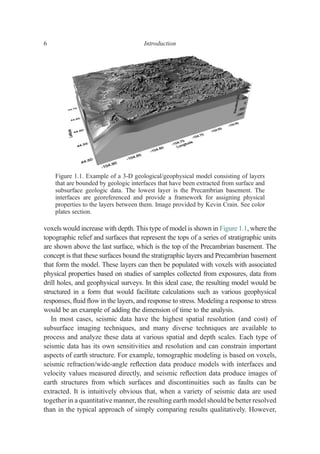
voxels would increase with depth. This type of model is shown in Figure 1.1, where the
topographic relief and surfaces that represent the tops of a series of stratigraphic units
are shown above the last surface, which is the top of the Precambrian basement. The
concept is that these surfaces bound the stratigraphic layers and Precambrian basement
that form the model. These layers can then be populated with voxels with associated
physical properties based on studies of samples collected from exposures, data from
drill holes, and geophysical surveys. In this ideal case, the resulting model would be
structured in a form that would facilitate calculations such as various geophysical
responses, fluid flow in the layers, and response to stress. Modeling a response to stress
would be an example of adding the dimension of time to the analysis.
In most cases, seismic data have the highest spatial resolution (and cost) of
subsurface imaging techniques, and many diverse techniques are available to
process and analyze these data at various spatial and depth scales. Each type of
seismic data has its own sensitivities and resolution and can constrain important
aspects of earth structure. For example, tomographic modeling is based on voxels,
seismic refraction/wide-angle reflection data produce models with interfaces and
velocity values measured directly, and seismic reflection data produce images of
earth structures from which surfaces and discontinuities such as faults can be
extracted. It is intuitively obvious that, when a variety of seismic data are used
together in a quantitative manner, the resulting earth model should be better resolved
than in the typical approach of simply comparing results qualitatively. However,
Figure 1.1. Example of a 3-D geological/geophysical model consisting of layers
that are bounded by geologic interfaces that have been extracted from surface and
subsurface geologic data. The lowest layer is the Precambrian basement. The
interfaces are georeferenced and provide a framework for assigning physical
properties to the layers between them. Image provided by Kevin Crain. See color
plates section.
6 Introduction
proving this inference mathematically is not easy. As constraints from geological
and drilling data and other geophysical techniques are added, the resolution will
improve further, which is also hard to prove mathematically. These extra data also
make it possible to add non-seismic physical properties (e.g., density, electrical
conductivity, magnetic susceptibility) to the model.
Tools for modeling seismic data and honoring independent constraints exist for 2-D
approaches, and an example of some preliminary results from a large experiment in
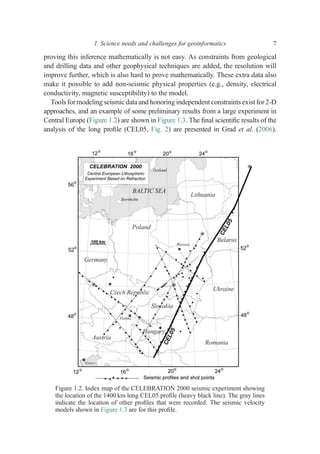
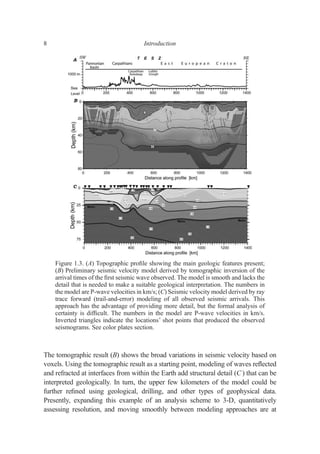
Central Europe (Figure 1.2) are shown in Figure 1.3. The final scientific results of the
analysis of the long profile (CEL05, Fig. 2) are presented in Grad et al. (2006).
Figure 1.2. Index map of the CELEBRATION 2000 seismic experiment showing
the location of the 1400 km long CEL05 profile (heavy black line). The gray lines
indicate the location of other profiles that were recorded. The seismic velocity
models shown in Figure 1.3 are for this profile.
1 Science needs and challenges for geoinformatics 7
The tomographic result (B) shows the broad variations in seismic velocity based on
voxels. Using the tomographic result as a starting point, modeling of waves reflected
and refracted at interfaces from within the Earth add structural detail (C ) that can be
interpreted geologically. In turn, the upper few kilometers of the model could be
further refined using geological, drilling, and other types of geophysical data.
Presently, expanding this example of an analysis scheme to 3-D, quantitatively
assessing resolution, and moving smoothly between modeling approaches are at
Figure 1.3. (A) Topographic profile showing the main geologic features present;
(B) Preliminary seismic velocity model derived by tomographic inversion of the
arrival times of the first seismic wave observed. The model is smooth and lacks the
detail that is needed to make a suitable geological interpretation. The numbers in
the model are P-wave velocities in km/s; (C) Seismic velocity model derived by ray
trace forward (trail-and-error) modeling of all observed seismic arrivals. This
approach has the advantage of providing more detail, but the formal analysis of
certainty is difficult. The numbers in the model are P-wave velocities in km/s.
Inverted triangles indicate the locations’ shot points that produced the observed
seismograms. See color plates section.
8 Introduction
best very challenging. The software tools that do exist for 3-D modeling (e.g., Hole,
1992) need further development, need to be interoperable, and need to facilitate
integrated analysis.
In summary, scientific advances on many fronts face technical barriers that
require a geoinformatics approach if they are to be overcome. In a lot of cases,
there are large volumes of data to examine and mine, and in others, interoperability
between analysis and modeling software is needed. Obviously, providing the “best”
integrated model of earth structure possible with existing data is a goal that we are
far from achieving, except in very special circumstances. Thus, geoscientists and
computer scientists have many interesting and important problems that they can
attack together in the future.
References
Allison, M. L., Snyder, W. S., and Walker, J. D. (2002). Geoinformatics: A nascent
revolution in the earth sciences. GSA Today, 12: 17.
Brocher, T. M. (2005). Empirical relations between elastic wavespeeds and density in the
Earth’s crust. Bulletin of the Seismological Society of America, 95: 2081–2092.
Grad, M., Guterch, A., Keller, G. R. et al. (2006). Lithospheric structure beneath trans-
Carpathian transect from Precambrian platform to Pannonian basin: CELEBRATION
2000 seismic profile CEL05. Journal of Geophysical Research, 111, B03301,
doi:10.1029/2005JB003647.
Hole, J. A. (1992). Nonlinear high-resolution three-dimensional seismic travel time
tomography. Journal of Geophysical Research, 97: 6553–6562.
Maus, S., Barckhausen, U., Berkenbosch, H. et al. (2010). EMAG2: A 2-arc min resolution
Earth Magnetic Anomaly Grid compiled from satellite, airborne, and marine magnetic
measurements. Geochemistry Geophysics Geosystems, 10, Q08005, doi:10.1029/
2009GC002471.
Mavko, G., Mukerji, T., and Dvorkin, J. (1998). The Rock Physics Handbook: Tools for
Seismic Analysis in Porous Media. Cambridge: Cambridge University Press, 329pp.
Perry, H. K. C., Jaupart, C., Mareschal, J.-C., and Shapiro, N. M. (2006). Upper mantle
velocity-temperature conversion and composition determined from seismic refraction
and heat flow. Journal of Geophysical Research, 111, B07301, doi:10.1029/
2005JB003921.
Sinha, A. K., ed. (2006). Geoinformatics: Data to Knowledge. Geological Society of
America, Special Paper 397, 283pp.
1 Science needs and challenges for geoinformatics 9
2
Introduction to IT concepts and challenges
chaitanya baru
Scientific applications have been at the forefront of driving computer and informa-
tion technology since the early days: from the development of early computers for
numerical computing, to the introduction in the USA of the NSFNET (which helped
launch the Internet), and the subsequent invention of the World Wide Web. The
geosciences, in particular, have been a long-standing user of such technologies,
given the importance of applications related to weather, natural resources, natural
hazards, and environmental monitoring. Scientific computing was focused initially
on the need for fast computers to perform larger numbers of complex numerical
calculations. The concerns more recently have turned towards the ability to manage
the very large amounts of data that are being generated by a wide range of sensors
and instruments, sophisticated observing systems, and large-scale simulations on
large computer systems. Data rates of terabytes per day and petabytes per year are
not uncommon (1 petabyte = terabytes) (Hey et al., 2009, p. 9). Yet, computer
science and information technology solutions must deal not only with the size and
scale of data, but also the inherent richness and complexity of scientific data –
especially when data are combined across multiple projects, institutions, and even
multiple science disciplines and subdisciplines. The need to understand complex,
interdependent, natural as well as anthropogenic phenomena has made science a
team sport, requiring collaborations among multidisciplinary teams of scientists to
process, analyze, and integrate extremely heterogeneous data.
The e-Science initiative in Europe and the cyberinfrastructure initiative in the
United States were launched in the early 2000s to tackle these issues, by harnessing
the power of advanced information technologies for scientific research and educa-
tion. Scientific research, it has been suggested, has entered the fourth paradigm
(Hey et al., 2009). The first three being empirical: focused on observations and
descriptions of natural phenomena; theoretical: focused on the development and use
of models and generalization of scientific principles; and, computational: focused
on simulations of complex phenomena using computers. This fourth paradigm is
10
data intensive, focused on building unified theories of complex phenomena, but
based on data exploration and integration using software tools and computer plat-
forms capable of dealing with complex data and large data (Hey et al., 2009, p. 177).
2.1 Cyberinfrastructure and geoinformatics
The study of complex phenomena in earth, ocean, and atmospheric sciences all
require integration of heterogeneous data from a wide variety of sources and
disciplines. As in every area of science, discovery in the geosciences is also driven
by the ease and efficiency with which one is able to do this integration by manip-
ulating and assimilating large, heterogeneous datasets. Remote sensing instrument
and observing systems are able to generate rapidly large amounts of data, while
large-scale computational models are able to generate increasingly large outputs that
require post-processing, visualization, and eventually integration with other simula-
tion, observational, and contextual data. A range of cyberinfrastructure capabilities
is needed to provide such capabilities and to support scientific research and dis-
covery at the frontiers of the earth sciences.
NSF’s Cyberinfrastructure Vision for 21st Century Discovery describes the set of
challenges and opportunities in computing systems, data, information resources,
networking, digitally enabled sensors, instruments, virtual organizations, and obser-
vatories, along with an interoperable suite of software services and tools
(NSF, 2007). As described in the report, this technology is complemented by the
interdisciplinary teams of professionals who are responsible for its development,
deployment, and its use in transformative approaches to scientific and engineering
discovery and learning. The vision also includes attention to the educational and
workforce initiatives necessary for both the creation and effective use of cyber-
infrastructure. Figure 2.1 depicts the set of cyberinfrastructure components, from
hardware platforms, systems software, middleware services, user services/func-
tions, and a portal providing access to this environment.
As mentioned in Chapter 1, geoinformatics is the term used to describe the set
of activities related to the development and use of cyberinfrastructure for the
earth sciences. The area has been making rapid progress since the early 2000s,
with the introduction by NSF of its cyberinfrastructure initiative and, subse-
quently, the geoinformatics program in the Earth Sciences Division (NSF EAR,
2010). Since then, major geosciences professional organizations have also recog-
nized geoinformatics as a special area. Both the American Geophysical Union
(AGU) and the European Geophysical Union have an Earth and Space Science
Informatics focus area (AGU, 2010; EGU, 2010). The Geological Society of
America created a Geoinformatics division, which defined geoinformatics as “the
science discipline that utilizes cyber-products, tools and discovery of data and
2 Introduction to IT concepts and challenges 11
models towards exploring integrative solutions to earth and planetary systems”
(GSA, 2006).
Development and deployment of cyberinfrastructure at the “speed of research,”
so to speak, is an ongoing challenge. While the capabilities provided by information
technology progress rapidly, so does research in the geosciences. The challenge is to
keep the two connected so that the science activities benefit from advances in
information technology while, at the same time, the right type of information
technology is being created to help the science mission. The term cyberinfrastruc-
ture implicitly includes this two-way interaction between the science domains and
computer science and information technology. Similar to internet-scale services
such as, say, email, web search, and street maps that have now become an everyday
phenomenon, the goal of cyberinfrastructure is to make the use of information
technology equally ubiquitous in all aspects of research and education across all
domains of study – natural sciences, engineering, social sciences, humanities, and
medicine. For example, Chapter 3 (Fox and McGuinness) and Chapter 4 (Krishnan
and Madduri) in this book provide overviews of cyberinfrastructure efforts in some
other domains of science.
To achieve this goal, the systems developed must not only be essential to the
mission at hand, but also intuitive and easy to use. An example of effective use of
information technologies is from the exploration industry where, typically, groups
of experts from a wide range of disciplines, e.g., geology, geophysics, engineering,
and economics, meet to interrogate and integrate heterogeneous datasets to make
decisions related to, say, further exploration at a given location. These sessions are
essential to the conduct of business, but cannot happen without sophisticated soft-
ware and visualization systems that help bring together the myriad data types
Figure 2.1. Cyberinfrastructure hardware and software layers.
12 Introduction
needed for analysis in support of decision-making. There is necessarily interplay
here between the technology and the science. Available technologies influence the
nature of the solution – whether using FORTRAN versus C++ for programming;
relational databases versus GIS for spatial data management; or, more recently, web
services versus Grid computing for distributed processing. At the same time, the
demands of the science push technologies – whether in the area of more advanced
sensor systems, larger, 3-D visualization displays, or sophisticated software for 3-D
and 4-D data integration.
2.2 Geoinformatics and IT concepts
Geoinformatics activities run the entire gamut from data acquisition and archiving,
to database creation, data analysis, modeling and simulation, and integration and
visualization. For example, large-scale projects such as EarthScope (2010), as well
as individual PI-led efforts such as the High Lava Plains Experiment (2010) are
engaged in deploying sensors and making field measurements. Established data
archives such as the Incorporated Research Institutes for Seismology (IRIS, 2010),
and UNAVCO (2010) provide repositories for such data. The EarthScope project
has three large components – USArray, Plate Boundary Observatory (PBO), and the
San Andreas Fault Observatory at Depth (SAFOD) – each of which has deployed a
range of sensors (EarthScope Observatories, 2010). These data are made accessible
via an EarthScope Data Portal (2010). Chapter 13 (Casey and Ahern) describes a set
of web services that provide access to seismic data archives maintained by IRIS,
which includes data from USArray. Typically, the sensor data have to be interpreted
in the context of other extant data. Support for such information integration is a key
challenge in geoinformatics.
Extant datasets may be available across a wide variety of databases, some
maintained by independent (large or small) consortiums such as, say, CUAHSI
(2010), NAVDAT (2010), and EarthChem (2010), and others maintained by indi-
vidual groups or researchers, e.g., PGAP (2010) and the PaleoBiology database
(PaleoDB, 2010). Chapter 12 (Zaslavsky and Maidment) describes the CUAHSI
Hydrologic Information System (HIS), which provides access to distributed hydro-
logic data archives. Chapter 14 (Aldouri and Keller) describes a gravity and mag-
netic database that was developed by carefully assembling “primary” data from a
variety of independent sources. Chapter 16 (Crosby et al.) describes a portal-based
system that provides the capability to access and process large remote sensing datasets
for high-resolution topography to a community of users. The datasets themselves are
from other projects that have commissioned the surveys. Chapter 20 (Jackson)
describes an international effort to assemble derived data for a global geologic map.
2 Introduction to IT concepts and challenges 13
Other parts of the geoinformatics community develop software tools that are used
for analysis. This includes complex computational codes that run on supercomputers
and generate many terabytes of data, as well as desktop/laptop-based analysis tools
that might operate on much smaller, though complex, data. The section on “Modeling
software and community codes” (Chapter 5, Gurnis et al.), Chapter 6 (Liu et al.), and
Chapter 7 (Boyden et al.) describes three different projects that are all focused on
development of robust modeling software. Chapter 10 (Sadler and Cervato) describes
tools for interpreting and analysing geologic time-related data. Development and
maintenance of such “community codes” is a major geoinformatics activity.
With large and heterogeneous 3-D and 4-D (three dimensions of space + time)
data, visualization of the data is essential for examining and properly interpreting
the results. Many geoinformatics projects focus on development of such 3-D and 4-D
visualization software as well as combined hardware and software environments for
visualization. Chapter 8 (Chourasia) and Chapter 9 (Wier and Meertens) describe
efforts in developing 3-D and 4-D visualizations of geoscience data. In the former,
the data are from large-scale earthquake simulations conducted by the Southern
California Earthquake Center (SCEC). In the latter, the chapter discusses a specific
software system that supports integrated visualization of heterogeneous earth
science data.
Once databases have been assembled and data archives deployed, there is the
opportunity to provide a number of data access, analysis, and integration services
for these data. A major need in the geosciences is for a data integration environment
that would allow for easy incorporation of a variety of different datasets, represent-
ing different types of geoscience data from different subdisciplines, for a given
spatial region specified by a spatial extent and depth/elevation. Such an integration
environment would not only provide the ability to easily bring in different types of
data, but would also allow for on-the-fly data processing, such as re-filtering or re-
gridding of data, and even running models to evaluate fit between model outputs and
other data derived from sensor or field observations (for example, see Youn, 2005),
which describes a system for generating synthetic seismograms and comparing
these with observed data). Chapter 15 (Altintas et al.) describes scientific workflow
systems whose goal is to provide intuitive and easy-to-use analysis environments
that remove the tedium of having to write a new computer program for each new
analysis task, while providing powerful built-in capabilities such as fault tolerance
and data provenance tracking. More advanced capabilities may be needed to
represent, analyze, and interpret data within and across databases. Chapter 11
(Babaie) discusses the use of knowledge representation techniques, such as ontol-
ogies, for modeling geodynamic processes. Chapter 17 (Gates et al.) describes a
system that provides infrastructure to track how results are derived, thereby helping
users better understand the derived data products.
14 Introduction
Significant geoinformatics activities are also underway at several institutions
around the world. Chapter 18 (Jackson and Hughes) describes activities in the
UK; Chapter 19 (Cloetingh et al.) describes a European project, TOPO-EUROPE,
which is similar to the EarthScope project in the USA; Chapter 21 (Klump et al.)
describes geoinformatics activities in Germany; and Chapter 22 (Subbarao et al.)
describes a geoinformatics project in India. Whether in the USA or elsewhere, the
largest geoscience data holdings are with government agencies. In the USA, that
ranges from the U.S. Geological Survey (USGS) and state geological surveys, to
agencies such as NASA, National Oceanic and Atmospheric Administration
(NOAA), Environmental Protection Agency (EPA), Department of Energy
(DOE), U.S. Department of Agriculture (USDA), U.S. Forest Service (USFS),
and many others. These agencies have also been pursuing a vigorous geoinformatics
agenda with internal initiatives and projects to enable easier discovery, access, and
sharing of digital data. The U.S. Geological Survey and the various state geological
surveys across the USA are also engaged in geoinformatics efforts aimed at easier
discovery and access to their data holdings. Chapter 23 (Allison et al.) describes
efforts at the USGS. Chapter 24 (Richard et al.) describes a DOE-funded effort to
develop a National Geothermal Data System.
2.3 Challenges and the future
An NSF-funded workshop on “Envisioning a National Geoinformatics System for
the United States,” held in Denver, Colorado in March 2007 articulated a vision for
geoinformatics that would facilitate “. . . a future in which someone can sit at a
terminal and have easy access to vast stores of data of almost any kind, with the easy
ability to visualize, analyze and model those data.”
Much progress has been made over the past several years in developing the
cyberinfrastructure that would help realize such a future. Before long, one can
envisage web clients from a web portal that would be able to query federated
metadata catalogs and obtain detailed information about vast collections of
geoscience data and tools. The environment would allow users to access datasets
of their choosing, apply various processing routines to those data – perhaps using a
Cloud computing platform or some other distributed processing platform, such as
the NSF TeraGrid – and bring the data into online environments that would facilitate
interrogation and integration of 3-D and 4-D geoscience data.
However, several challenges still remain in fully realizing this vision. With the
rapid growth in data, the underlying cyberinfrastructure must be scalable and
efficient in dealing with the large scale and wide variety of data. As the cyberin-
frastructure enables access to data from a wide variety of distributed and hetero-
geneous sources, it will also need to assist users in properly interpreting data and
2 Introduction to IT concepts and challenges 15
dealing with data semantics. The suitability and usefulness of a given dataset must
be interpreted in the context of the analysis that the user is attempting to perform.
While standards have emerged for metadata describing resources and for the soft-
ware interfaces to query the corresponding metadata catalogs, more work is needed.
Standardized approaches to describing data collection protocols and data processing
steps, especially for quality assurance and quality control (QA/QC), can facilitate
better data access and sharing. Standards are needed for representing derived
information, e.g., via the use of controlled vocabularies and ontologies, to minimize
ambiguity when communicating data from one researcher (or system) to another.
Indeed, several efforts are underway in the earth science and related disciplines for
arriving at such standards, including the effort to develop a Geosciences Markup
Language (GeoSciML, 2010).
As we make progress in bringing more digital data online and providing more
online environments for processing, integrating, and visualizing these data, the
focus will continue to increase on issues related to data quality, accuracy, data
authenticity, provenance, and a host of related issues. One approach to addressing
these complex issues is via the use of social networking techniques and technolo-
gies. Strategies such as community ranking of datasets can be used to obtain useful
semantic information about datasets. Pre-existing levels of trust among individuals
in a community can be used to evaluate the quality of a dataset or its suitability for a
particular analysis. A user’s comment about a dataset could then be interpreted
within this context. Another key challenge for the cyberinfrastructure is to provide
repeatability, i.e., the ability to repeat a set of processing steps with a given set of
data to reproduce a previously published result. Such repeatability is essential for
users to gain trust in the system. Finally, another major challenge, which is closely
allied to the issue of repeatability, is that of data preservation. What technical,
economic, and business-oriented strategies should be used to ensure that all of the
important digital data that is being produced are preserved for the next generation of
scientists and generations thereafter, so that future generations can correctly
re-produce results from the past, and re-examine results and, perhaps, re-interpret
them in a future context?
References
AGU Earth and Space Science Informatics (2010), http://essi.gsfc.nasa.gov/.
CUAHSI: Consortium of Universities for the Advancement of Hydrologic Science, Inc.
(2010), www.cuahsi.org.
EarthChem (2010), www.earthchem.org.
EarthScope (2010), www.earthscope.org.
EarthScope Data Portal (2010), http://portal.earthscop.org.
EarthScope Observatories (2010), http://earthscope.org/observatories.
16 Introduction
EGU Earth and Space Science Informatics (2010), www.egu.eu/inside-egu/divisions-and-
present-officers/division-earth-and-space-science-informatics/home.html.
GeoSciML Resource Repository (2010), www.geosciml.org.
GSA Geoinformatics Division Bylaws (2006), p. 1, March, www.geoexpertsintl.com/
geoinformatics/pdf/geoinfoBylaws.pdf.
Hey, T., Tansley, S., and Tolle, K. (2009). The Fourth Paradigm: Data-Intensive Scientific
Discovery. Redmond, WA: Microsoft Research.
HLP: High Lava Plains Experiment (2010), www.dtm.ciw.edu/research/HLP/.
IRIS: Incorporated Research Institutes for Seismology (2010), www.iris.edu.
NAVDAT: The Western North American Volcanic and Intrusive Rock Database (2010),
www.navdat.org.
NSF Cyberinfrastructure Vision for 21st Century Discovery, National Science Foundation
report (2007), www.nsf.gov/pubs/2007/nsf0728/index.jsp.
NSF EAR/IF (2010), NSF Earth Sciences Division: Instrumentation and Facilities, www.
nsf.gov/pubs/2005/nsf05587/nsf05587.htm
PaleoDB: The Paleobiology Database (2010), http://paleodb.org.
PGAP: The Paleogeographic Atlas Project (2010), www.geo.arizona.edu/~rees/PGAPhome.
html.
UNAVCO (2010), www.unavco.org.
Youn, C., Kaiser, T., Santini, C., and Seber, D. (2005). Design and implementation of
services for a synthetic seismogram calculation tool on the Grid. In Proceedings of the
5th International Conference (ICCS 2005), Atlanta, GA, USA, May 22–25, 2005. Part
I, LNCS 3514. Berlin: Springer, p. 469.
2 Introduction to IT concepts and challenges 17
Part I
Case studies from other disciplines
3
Semantic cyberinfrastructure: The Virtual
Solar-Terrestrial Observatory
peter fox, deborah l. mcguinness, and the vsto1
team
3.1 Introduction
The utilization of now fairly well established information technology (IT) to provide
access to science data and information is becoming more routine. The present
foundational IT includes hardware services utilizing computers, disks, and networks
along with software systems such as databases, web servers, portals, and so on. At
the same time, scientific data are being collected or generated and maintained in
digital form (repositories) in high volumes by many diverse research projects and
groups. The need for access to, and interoperability between, these repositories is
also growing, as research groups need to access their own increasingly diverse data
collections. As investigations begin to include results from many different sources,
researchers also need to access and utilize other research groups’ data repositories
from within a single discipline or, more interestingly, among multiple disciplines.
Also, it is not simply trained scientists who are interested in accessing scientific
data; nonspecialists are becoming interested in looking at trends in scientific data as
well. Two notable examples are in the areas of natural hazards and environmental
impact assessments. While the promise of true virtual interconnected heterogeneous
distributed international data repositories is being realized in a number of areas there
is still much work to be done. To address ultimate goals such as to provide support
for both specialist and broader nonspecialist usage, including lay people from a rich
set of science and information product, new approaches are being devised. One such
approach is that of Virtual Observatories (VOs: Dalton, 2007). When viewed within
one discipline, VOs are becoming popular and successful. For example, the NASA
Virtual Observatories for Heliophysical Data (VOHD) program currently funds
several VO efforts (King et al., 2007). As these efforts move either beyond their
discipline or to nonspecialist use, vocabulary challenges arise. Often vocabularies
1
Luca Cinquini, Patrick West, Jose Garcia, James Benedict, Tony Darnell, Don Middleton, and Stephen Zednik.
21
differ, some are quite esoteric and jargon laden, sometimes similar terms have
different meanings, and often there are multiple terms with different meanings,
and multiple terms for the same phenomenon or process. These challenges present
barriers to efforts that hope to use existing cyberinfrastructure in support of inter-
disciplinary data query and access, especially when the interdisciplinary applica-
tions must go beyond search and access to actual manipulation and use of the data.
In addition, the user community now has a more diverse level of education and
training and need.
One approach that has now gained acceptance and success in facing the above-
mentioned challenges is that of addressing the semantics of the underlying science
and data representations in a way that can be utilized by existing cyberinfrastructure;
computers and people. Encoding formal semantics in the technical architecture of
virtual observatories and their associated data frameworks is similar to efforts to
add semantics to the Web in general (Berners-Lee et al., 2006), workflow systems
(e.g., Gil et al., 2006; Ludaescher et al., 2006), computational grids (e.g., De Roure
et al., 2005), and data mining frameworks (e.g., Rushing et al., 2005).
In this chapter, we describe the Virtual Solar-Terrestrial Observatory project,
which was funded by the U.S. National Science Foundation Office of Cyberinfras-
tructure (NSF/OCI) to explore the applications of semantic web to VOs in the areas
of solar, solar-terrestrial, and space physics. We include our vision, design, and
semantic web-enabled implementation. We highlight the methodologies and tech-
nologies we utilize and some production environment, which is built upon our
previous cyberinfrastructure that started production in the summer of 2006 and has
been continuously deployed since then.
3.2 New needs driven by use, not by technology
We believe that an essential and distinguishing feature of our approach was to find
out how (and sometimes why) the diverse user base that we wished to support
wanted to find, access, and use data. In particular, we wanted to let them find and use
data and information that they would not normally have access to – due to lack of
familiarity, vocabulary or discipline unfamiliarity, etc. We developed a series of use
cases to reflect a set of diverse requirements (Fox et al., 2007). We quickly
determined, based on the use cases we collected, that the distributed multidisciplin-
ary internet-enabled VSTO virtual observatory required a higher level of semantic
interoperability than what had been previously required by most (if not all) dis-
tributed data systems or discipline-specific virtual observatories. In developing the
use cases, we targeted subject matter experts as end users to elaborate their need to
support the integration of multiple collections. This extended beyond providing
basic access to search interfaces that were typically specialized and idiosyncratic.
22 Part I Case studies from other disciplines
Our initial science domains were those of interest to scientists who study the
Earth’s middle and upper atmosphere, the inner heliosphere, and the Sun. Our initial
interdisciplinary virtual observatory is thus VSTO – the Virtual Solar-Terrestrial
Observatory. Scientists in these areas must utilize a balance of observational data,
theoretical models, analysis, and interpretation to make effective progress. Many
data collections are interdisciplinary. In order to provide a scientific infrastructure
that is usable and extensible, VSTO required contributions concerning semantic
integration and knowledge representation, while requiring depth in a number of
science areas. We chose a technology foundation that was based on a long history of
artificial intelligence (AI) research set in the context of the modern world-wide-web
(WWW) environment (Berners-Lee et al. 2006) because of the promise for a
declarative, extensible, reusable technology platform. The value added by basic
knowledge representation and reasoning is supporting both computer-to-computer
and researcher-to-computer interfaces that find, access, and use data in a more
effective, robust, and reliable way. What arose from this approach were both a
semantic methodology as well as a number of semantic technology components. We
developed and implemented the semantic methodology throughout the effort and
found that it provided consistency as we met user requirements. While individual
technology components might change, this did not affect our ability to deliver a
capability that was useful and usable, especially by a broad range of people, some of
whom will not be trained in all areas of science covered in the collection.
3.3 The pre-existing cyberinfrastructure
VSTO was originally intended to replace at least partly the middleware component
of an existing set of data systems built at the High Altitude Observatory (HAO).
Those data systems accommodated a large number (~15) of distinct data holdings
while serving internal and external user groups ranging in size from 2–5 and up to
thousands of users. In some cases, the pre-existing systems had evolved over
decades (e.g., CEDAR and MLSO; see below) and been updated, especially as
new internet-based technologies became available. A limiting characteristic of
almost all of the previous implementations is that they required a significant amount
of domain knowledge to formulate meaningful and correct queries.
We began with two distinct science communities represented by long-standing
project communities: the Coupled Energetics and Dynamics of Atmospheric
Regions (CEDAR) and the Advanced Coronal Observing System (ACOS) operated
at the Mauna Loa Solar Observatory (MLSO). The CEDAR archive provides an
online database of middle and upper atmospheric, geophysical index, and empirical
and simulation model data. The ACOS/MLSO archive provides an online database
(including many images) of solar atmospheric physics data.
3 The Virtual Solar-Terrestrial Observatory 23
Figure 3.1 shows a schematic of the CEDARWEB architecture around 2005. This
version 3.x was built upon the ION Script (IDL On the Net) language, IDL
(Interactive Data Language from ITT Visual Systems) with the interface content
partly dynamically generated by accessing catalogs stored in a mySQL relational
database. The data access layer used a customized version of the OPeNDAP server
software (Garcia et al., 2008). This version had in turn replaced a two-tier archi-
tecture (version 2.x; 1998–2001) that was developed in Perl using the Common
Gateway Interface (CGI) methodology popular at the time. Version 1 of the CEDAR
database (before it became a web-accessible application) was a single-tier applica-
tion that ran in full screen VT100 mode in a terminal where users needed logins to
the CEDAR computer at NCAR.
The CEDARWEB example of pre-existing capabilities is representative both
within the HAO environment but also at other institutions and disciplines. As
noted above, new needs were being driven by a more diverse set of users and
intentions for the provided data. Our task was then to suitably leverage as much of
the existing cyberinfrastructure as made sense, while reducing duplication and
maintenance, with the goal of enabling more rapid evolution of capabilities and to
CEDAR - current
Page server Portal (ION) services Authentication
Catalog
service
Plot handler
URL (data)
generator
Protocol (http) server
OPeNDAP server
Web pages
CEDAR data file CEDAR data file
Catalog (SQL) User DB
User
Figure 3.1. CEDARWEB version 3.2 architectural layout indicating use of
technologies at the time.
24 Part I Case studies from other disciplines
incorporate and adapt to new technologies. We proceed to describe this process
within the context of the semantic web.
3.4 Toward semantic data frameworks – knowledge encodings
Our approach to the vocabulary challenges mentioned previously was to provide a
virtual observatory implementation (Szalay, 2001) that incorporated suitable back-
ground information about the terms used in the subject matter repositories. The
primary difference between extant virtual observatories and what we developed was
that we encoded this background information about terms and their meanings in
ontologies (Gruber, 2003). We decided what terms to put in the background
ontologies by developing and analysing motivating use cases (Cockburn, 2001).
The ontologies included terms used in the data collections along with machine
parsable formal definitions. Those definitions are then used to enable semantic
search and interoperability. The use cases were drawn from the CEDAR and
MLSO communities (Fox et al., 2007; McGuinness et al. 2007), and these were
used to scope the ontologies. The general form is “retrieve data (from appropriate
collections) subject to (stated and implicit) constraints and display (plot) in a manner
appropriate for the data.” One of the very first examples from the CEDAR commu-
nity was: Retrieve neutral temperature data taken by the Millstone Hill Fabry-Perot
interferometer looking in the non-vertical direction from January 2000 to August
2000 and plot as a time series. This query chose neutral temperature as the
parameter, Millstone Hill Fabry-Perot interferometer as the instrument, and time
series as the data product and places non-vertical direction and a date range as the
constraints. While seemingly very specific, due to the modeling approach required
for the semantic web, i.e., an object design, abstractions or generalizations appeared
very quickly.
Essentially we looked at the variables in the templates above and natural hier-
archies in those areas (such as an instrument hierarchy), and important properties
(such as instrument settings), and restrictions. We also looked for useful simplifica-
tions in areas such as the temporal domain. The CEDAR holdings also relied upon a
controlled vocabulary, including terms related to observatories, instruments, oper-
ating modes, parameters, observations, etc. MLSO holdings also embodied a con-
trolled vocabulary with significant overlap in concepts but with a very different
presentation of data access to an end user from the CEDAR holdings.
Before proceeding to fully develop the ontology model and engineer it, we
searched for existing ontologies in earth and space sciences and identified the
Semantic Web for Earth and Environmental Terminology (SWEET: Raskin and
Pan, 2005) ontology that was gaining acceptance in the earth sciences community,
with sufficient overlap with our domains. SWEET version 1.0 itself was intended to
3 The Virtual Solar-Terrestrial Observatory 25
be a mid-level ontology for earth and environmental science and covered much
more than we needed in breadth, and not enough in depth in multiple places.
SWEET used a conceptual decomposition for the ontologies, i.e., faceted or ortho-
gonal ontologies such as Realm, Physical Property, Physical Process, etc., and
integrative ontologies such as Human Activities. We also used terms from the
ontology as much as possible and added depth in the areas we required.
We focused on domain areas where little or no ontology work had been done,
with an eye towards adding the best leverage using semantics. Interestingly, these
areas also have proven to be leveragable in applications outside of a solar-terrestrial
focus. Our application into the disciplines of volcanic effects on climate has led us to
re-use many of the ontology concepts we developed for VSTO (Fox et al., 2007;
McGuinness et al., 2007). In developing what became known as the VSTO
ontology, the first focus area was instruments. One significant challenge for the
integration of scientific data from multiple instruments is in understanding the
conditions under which the data were collected or generated. Important metadata
may include the geographic location of its observatory installation, its operating
modes and settings, stages of calibration, and so on. For the ontology model these
concepts are added as properties on classes in the ontology and accurate modeling is
needed to ensure that properties are associated on the correct classes at an ontolo-
gically consistent place in any class hierarchy. Scientists, or in our case, software
that mediates the access and use for any user, that need to interpret data may need to
know how an instrument is being used – for example, using an optical instrument
such as a spectrometer as a photometer.2
More specifically among the CEDAR
instruments, the Davis Antarctica Spectrometer is a spectrophotometer and thus has
the capability to observe data that other photometers may collect. An unfamiliar user
would not necessarily know this but the multimodal expressiveness of an ontology
language such as OWL make this easy and consistent. A schematic of part of the
ontology is given in Figure 3.2.
3.5 The VSTO semantic data frameworks – developing
the architecture and choosing technology
In the implementation phase, which occurred in prototype form in the first year of the
project, we had to make design and architectural choices that suitably leveraged parts
of the existing infrastructures. Because we were building semantics into and around the
interfaces in the architecture, VSTO depended on a number of components and tools
developed for the semantic web, including background ontologies, query languages,
triple stores, and reasoners. From a development and maintenance perspective, the
2
http://en.wikip edia.org/wiki/Spectrophotometry.
26 Part I Case studies from other disciplines
technology tools included ontology editors, validators, and plug-ins for code develop-
ment. We limited the ontology design to the expressiveness of the middle “species” of
OWL – OWL-DL (Description Logics). We did this so that we could leverage freely
available reasoners available for OWL-DL, along with their better computational
efficiency. Within OWL-DL, we had the expressiveness we needed for the ontology
with the following three exceptions: support for numerics (representation and compar-
ison), rules, and default values. The implementation for VSTO does not use default
value encoding and the rules and numerical analysis are handled with special purpose
query and comparison code (in Java). It turned out that computational efficiency was
another factor due to the volume of numerical data, meaning that we needed special
purpose handling anyway. Of particular note is the choice we made concerning how
the time coverage was represented and implemented. The quantity of “date” data in the
repositories we were considering was overwhelming. In other words, hundreds of
millions of discrete time records are very common for observational data of this type.
Thus, we chose a very simple representation for date-time and did not encode the time
instances in OWL-DL. Instead, we supported a hybrid solution whereby a metadata
DataProduct
hasDataProduct +
DataArchive
hasMeasuredParameter +
has InstrumentOperatingMode +
Instrument
dataArchiveFor
hasDataArchive +
Optical
Instrument
Photometer Spectrometer
Spectrophotometer
SingleChannel
Photometer
is a is a
is a is a
is a
has
OperatedInstrument +
is OperatedByObservatory
Observatory
Davis Antarctic
Spectrophotometer
Figure 3.2. VSTO ontology fragment showing the expressiveness that is often
required in scientific settings. Here the Spectrophotometer is a subclass of both
Photometer and Spectrometer. The instance of such an instrument is shown in the
dash box – Davis, Antarctica.
3 The Virtual Solar-Terrestrial Observatory 27
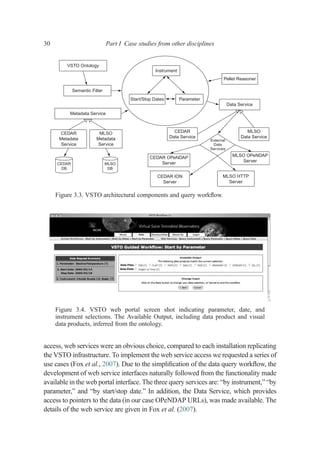
service class was added, so that we had support functions for accessing date and time
records directly from original (mySQL) relational catalogs instead of actually retriev-
ing it into some cached or local triple store. Our solution used semantically enhanced
web services to retrieve the data directly.
3.6 Developing the software and implementation aspects
In the first year, a small, carefully chosen six-person team developed and analyzed the
use cases, built the ontologies, designed the architecture, and implemented an alpha
release. We had our first users within the first eight months with a small ontology
providing access to all of the data resources. Over the next two years, we expanded the
ontology,made the system more robust, and increased domain coverage, developing
two more prototypes before the current production capability was in place.
Early issues that needed attention in design included determining an appropriate
ontology structure and granularity. Our method was to generate iterations initially
done by our lead domain scientist and lead knowledge representation expert, vet the
design through use case analysis and other subject matter experts, as well as the
entire team. We developed minimalist class and property structures capturing all
the concepts into classes and subclass hierarchies, only including associations, and
class value restrictions needed to support reasoning required for the use cases. This
choice was driven by several factors: (a) keeping a simple representation allowed
the scientific domain-literate experts to view and vet the ontology easily; (b)
complex class and property relations, while clear to a knowledge engineer, take
time for a domain expert to comprehend and agree upon. A practical consideration
arose from Protégé with automatic generation of a Java class interface and factory
classes (see Fox et al. 2006 for details).
As we assembled the possible user-query workflows and used the Pellet reason-
ing engine, we built dependencies on properties and their values. If we had
implemented a large number of properties and needed to change them, or moved
properties to different class levels – as a result of adding new classes and, thus,
“evolving” the ontology – the existing code would have had to be substantially
rewritten manually to remove the old dependencies, since an automated refactoring
mechanism/tool does not currently exist. Our approach preserved the existing code,
automatically generating the new classes, and adding incrementally to the existing
code, allowing more rapid development. The deployment cycles and updates to the
ontology are thus released with no changes in the existing data framework, thereby
benefiting both developers and users. Subsequent releases added new data sources,
refinements and corrections to the ontology, and web services access.
We used only open-source free software for the project, which met most of our
needs for ontology editing and reasoning. There were a few occasions when the
28 Part I Case studies from other disciplines
support that is typically provided with commercial software would have been a
benefit, especially in the early stages. However, we were able to garner sufficient
support on mailing lists, and sometimes through personal communications with
software authors/maintainers. Perhaps the most obvious gap in the software tool
support, which persists to the current day, is the lack of a robust, industry-strength
collaborative ontology evolution and source control system. Initially, the ontology
development process was distributed, but collecting and processing the inputs was
centralized because our early environment was fragile in terms of building the
ontology and then generating robust functional Java code based on that. As the
issues concerning the development environment eventually got resolved, our
approach also evolved to the point where ontology development and maintenance
was distributed, using modularization and social conventions.
We used the SWOOP (www.mindswap.org/2004/SWOOP), Protégé (http://
protégé.stanford.edu), and CMap (Cañas et al., 2004) editors for ontology devel-
opment. The definitions in the ontologies were used to generate Java classes and a
Java object model using the Protégé-OWL-Java API (application programming
interface) initially for Protégé version 2.2 and later versions 3.3 and 3.4. We also
used the Jena API and Protégé-Jena plug-ins for triple store management. We built
Java services that use this Java code to access the catalog data services. We used
the PELLET (www.clarkparsia.com/pellet) descriptions logic-reasoning engine to
compute information that is implied, and also to identify contradictions. The user
interface uses the Spring (www.springsource.org) framework for supporting work-
flow and navigation. The choice of Java and the well-integrated and free tools
allowed a rapid prototype, evaluation, redesign, and redeployment cycle that greatly
facilitated both implementing the use cases and involving users in the evaluation of
the interfaces and the knowledge represented in the ontologies.
Figure 3.3 displays a combined schematic of the integrated semantic data frame-
work implemented for VSTO. In the center are the key abstractions in the query
workflow: that of instrument, parameter, and date-time. These are the primary
components on both the web portal and the web service interfaces (which was
developed later in the project). As input to these concepts – in essence populating
the class hierarchies, associated properties and instances – is the VSTO ontology
(upper right) along with possible semantic filters.
Figure 3.4 shows an example of the current VSTO web portal, whereby guided
workflow selection is made available (see caption for details).
3.7 Web services
After the initial web portal implementation, it became clear that other virtual observa-
tories wished to take advantage of VSTO’s query and access capabilities. To enable this
3 The Virtual Solar-Terrestrial Observatory 29
access, web services were an obvious choice, compared to each installation replicating
the VSTO infrastructure. To implement the web service access we requested a series of
use cases (Fox et al., 2007). Due to the simplification of the data query workflow, the
development of web service interfaces naturally followed from the functionality made
available in the web portal interface. The three query services are: “by instrument,” “by
parameter,” and “by start/stop date.” In addition, the Data Service, which provides
access to pointers to the data (in our case OPeNDAP URLs), was made available. The
details of the web service are given in Fox et al. (2007).
Figure 3.4. VSTO web portal screen shot indicating parameter, date, and
instrument selections. The Available Output, including data product and visual
data products, inferred from the ontology.
VSTO Ontology
Semantic Filter
Metadata Service
Start/Stop Dates Parameter
Instrument
CEDAR
Metadata
Service
CEDAR
Data Service
MLSO
Data Service
MLSO OPeNDAP
Server
External
Data
Services
MLSO HTTP
Server
CEDAR ION
Server
Data Service
Pellet Reasoner
CEDAR
DB
MLSO
DB
MLSO
Metadata
Service
CEDAR OPeNDAP
Server
Figure 3.3. VSTO architectural components and query workflow.
30 Part I Case studies from other disciplines
The returned document of a web service call is encoded in OWL-DL using the
VSTO ontology, similar to a query invoked from the VSTO web portal. Any consumer
of such a service, either another service, or client application, may parse the OWL as
XML without semantic meaning or directly (using the background ontology) and use
their own reasoning engine (or VSTO’s) to further work with the returned information.
The current implementation has two mandatory inputs: instrument and start/stop
dates. The remaining choices of parameter class and data product are optional and
are typically called in any order depending on the end use. While one typical use of
the web services interface is to choose instances for instruments, a user may choose
to use a class of instruments allowing more flexibility in the list of options retrieved.
For example, a user may choose OpticalInstrument for an instrument (instead of
choosing a specific optical instrument) and then use the web services to discover the
optical instruments or to retrieve data from multiple optical instruments (subject to
the other constraints in the query). Thus, the web service interface provides a much
greater degree of flexibility for queries. The current portal implementation is pre-
sently being updated to include this level of arbitrary use of services, and order/
combination of constraints.
3.8 Sustaining the developed capability and application extensions
Our ontology was designed to be extensible and, over time, we are finding that the
design is indeed holding up to both extension within our project and reuse in other
projects. We have investigated the reuse of our ontologies in our Semantically-
Enabled Science Data Integration project that addresses virtual observatory needs in
the overlapping areas of climate, volcano, and plate tectonics. We found that while
seismologists use some instruments that solar-terrestrial physicists do not, the basic
properties used to describe the instruments, observatories, and observations are
quite similar.
As a result of our successful implementations, we continue to use and promote
use-case-based design and extensions. When we plan for extensions, we begin with
use cases to identify additional vocabulary and inferences that need to be supported.
We have also used standard naming conventions and have maintained as much
compatibility as possible with terms in existing controlled vocabularies.
Our approach to distributed multiuser collaboration is a combination of social and
technical conventions. This is largely due to the state of the art, where there is no
single best multiuser ontology evolution environment. We have one person in
charge of all VSTO releases and this person maintains a versioned, stable version
at all times. We also maintain an evolving, working version. The ontology is
modular so that different team members can work on different pieces of the ontology
in parallel.
3 The Virtual Solar-Terrestrial Observatory 31
3.9 Benefits
One very important aspect of our developments for VSTO and subsequent projects
was to be clear on what the benefits and advantages of semantic web methods and
technologies were (and are). Fortunately the benefits were significant (McGuinness
et al., 2007) and included the reduction in the number of “clicks” to the data when
using the web portal, formalized syntactic and semantic support (eliminating the
possibility of obtaining an inconsistent query result), and a broader range of users,
especially beyond the immediate field of specialty. We found it extremely helpful to
record baseline capabilities represented in the use case, i.e., metrics, where possible
before we commenced implementation. In a few cases, at least 50%, the use cases
were not implementable with existing (non-semantic) infrastructure without a sub-
stantial amount of one-time design and reprogramming. Perhaps one of the more
surprising benefits was that we were able to unify the query workflows (by instru-
ment, parameter, date-time) across several discipline data holdings. We had
expected that we would build a discipline-specific portal for each discipline/com-
munity, much as the non-semantic virtual observatories were being built. However,
as noted earlier, an unanticipated effect of the ontology modeling was that general-
izations and abstractions of the concepts being modeled, e.g., instrument types,
emerged early, but also the property (and inverse property) relations among them.
The result was that a query workflow designed to begin a structured query with a
complex list of compound concepts (e.g., best, non-vignetted, rectangular coordi-
nate, Mark IV polarization brightness) could be searched using the important terms
first with more accuracy and omitting irrelevant choices or delaying them to the last
stage of query refinement. When coupled with our experiences in developing
semantic web services for VSTO, we concluded that the ability to present facets
of search to a user in any number, order or combination would be a powerful next
step in demonstrating the benefits of semantic web. Interestingly, it was around this
time that the mspace software appeared (Schraefel et al., 2005) and we began to
incorporate its concepts into related work such as for the Earth System Grid
(Middleton et al., 2006) and our follow-on work noted below.
3.10 Summary and ongoing work
The Virtual Solar-Terrestrial Observatory is a production, interdisciplinary virtual
observatory. Semantic web methods and technologies were used to quickly design,
develop, and deploy this integrated, virtual repository of scientific data in the fields
of solar and solar-terrestrial physics. VSTO is being used in ways that the previous
individual systems could not be conveniently used. A key aspect of the semantic
design for VSTO was the balance between expressivity and implementability, i.e.,
32 Part I Case studies from other disciplines
between the level and depth of knowledge representation and what the current and
evolving software and tools could support in a heavily used environment.
We demonstrated that, after a few iterations, we were able to design an extensible,
reusable ontology for solar-terrestrial physics, which is compatible with controlled
vocabularies that are in use in the most widely used relevant data collections.
Potentially much more leveragable, the structure of the ontology was found to be
reusable in multiple virtual observatory projects. We also reviewed the ontology
with respect to needs for the NSF-funded Geosciences Network (GEON: www.
geongrid.org) project, the NASA-funded Semantically-Enabled Science Data
Integration (SESDI: http://tw.rpi.edu/portal/SESDI) project, and the NASA-funded
Semantic Assistant for Mining (SAM: http://tw.rpi.edu/portal/SAM) project.
Our findings around ontology reuse, when developing the VSTO knowledge
encoding, were that the initial SWEETontology suite was simultaneously much too
broad and not deep enough in our subject areas. As a result, we worked with the
SWEET author to provide use cases for restructuring and modularizing the packa-
ging (SWEET 2.0: http://sweet.jpl.nasa.gov/2.0). The overall intent was to be able
to import only the portions of SWEET needed so that we could add appropriate
extensions.
While the VSTO project enjoyed overall success, we encountered numerous
challenges that had to be overcome (e.g., Fox et al., 2009a). The scope of the
ontology is sufficiently broad that it is not possible for any single scientist to have
enough depth in the subject matter to provide all of the concepts/content. Thus, the
project had to be a collaborative effort, which turned out to be a major contribution
to refining the use case and knowledge representation development. Logistically,
smaller sets of experts were identified to be the main contributors to particular
subject areas. Thus, while an ontology could be created by them, to achieve an
extensible, evolving, widely reusable ontology, it was necessary to obtain broad
community buy-in, including vetting and augmentation by the larger scientific
community. Partly from this project, and from experience that we noted in related
fields, we found that to maximize benefit the ontology needs usage from the broad
community and also multiple publication venues.
Our initial implementation used fairly limited inference and supported somewhat
modest use cases. This was intentional, as we wanted an initial implementation that
was simple enough to be usable by the broad community with minimum training but
that demonstrated the benefits of a semantic web approach. After several evalua-
tions and architecture and ontology redesign, it was clear that additional inferential
and query support were desirable. As VSTO evolved, we added those additional
capabilities based on use cases and demonstrated or measureable benefits to users.
Our follow-up on initial informal evaluations in a workshop setting provided both
general and specific answers and comments, as well as more quantitative yes/no or
3 The Virtual Solar-Terrestrial Observatory 33
multiple-choice answers. These results reaffirmed the sense we obtained in the initial
study that our efforts in applying semantic technologies led to an interdisciplinary
virtual observatory that provides significant additional value for a spectrum of end
users. It also provides significant additional value for the developers of both the VSTO
and other federated VOs and data systems wishing to take advantage of the services
that our VO provides. The implementation of newer use cases (e.g., for script/
programming language access, synthesizing models and observations and new plotting
options) continues to drive our knowledge representation and reasoning requirements.
We also commenced work on transparency and provenance within the VSTO
framework in another NSF/OCI funded project entitled Semantic Provenance
Capture in Data Ingest Systems (SPCDIS: Fox et al., 2008; Fox et al., 2009b).
SPCDIS is leveraging the Proof Markup Language (Pinheiro da Silva et al., 2006) –
an Interlingua for representing provenance, information. In this extension, we
capture content such as where the data came from. Once captured in PML, the
Inference web toolkit (McGuinness et al., 2004) is used to display information about
why an answer was generated, where it came from, and how much the information
Figure 3.5. Augmented VSTO architecture with knowledge provenance.
34 Part I Case studies from other disciplines
might be believed and why. Figure 3.5 shows a schematic on the evolution of
semantic capabilities.
Finally, as a result of the aggregate experience with VSTO and the follow-on
projects on data integration and provenance, we have commenced a new effort also
funded by the NSF to bring all of the developed semantic application capabilities
(and more) into a toolkit form to support and advance science. The project, the
Semantic eScience Framework (SESF: http://tw.rpi.edu/portal/SESF) strongly
builds on our methods and technology developments over the last five years. The
intent is to provide a configurable semantic data framework that is deployable in
many disciplines, and especially for nonspecialist use. We look forward to reporting
on the outcomes of this work in the future.
Acknowledgements
The VSTO project was funded by the National Science Foundation, Office of Cyber
Infrastructure under the SEI+II program, grant number 0431153. We thank David
Fulker and Robert Raskin for stimulating conversations related to engaging com-
munity and leveraging existing ontology and CI resources. We also thank the editors
of this volume for the invitation to present the results of our work.
References
Berners-Lee, T., Hall, W., Hendler, J., Shadbolt, N., and Weitzner, J. (2006). Enhanced:
Creating a science of the Web. Science, 313(5788): 769–771, doi:10.1126/
science.1126902.
Cañas, A. J., Hill, G., Carff, R. et al. (2004). CMAPTOOLS: A knowledge modeling and
sharing environment. Concept Maps: Theory, Methodology, Technology. Proceedings
of the First International Conference on Concept Mapping, ed. A. J. Cañas, J. D.
Novak and F. M. González, Pamplona, Spain.
Cockburn, A. (2001). Writing Effective Use Cases. London: Addison-Wesley Professional,
270pp.
Dalton, R. (2007). Geophysicists combine forces. Nature, 447(7148): 1037.
De Roure, D., Jennings, N. R., and Shadbolt, N. R. (2005). The semantic grid: Past, present,
and future. Proceedings of the IEEE, Vol. 93, Issue 3, pp. 669–681, doi:10.1109/
JPROC.2004.842781.
Fox, P., McGuinness, D. L., Middleton, D. et al. (2006). Semantically-enabled large-scale
science data repositories. Proceedings of the 5th International Semantic Web
Conference (ISWC06), ed. I. F. Cruz et al. LNCS 4273. Berlin: Springer, pp. 792–805.
Fox, P., McGuinness, D. L., Cinquini, L. et al. (2007). Use cases for the Virtual Solar
Terrestrial Observatory. Proceedings of the Electronic Geophysical Year, Virtual
Observatories in Geosciences (VOiG), June 2007.
Fox, P., Cinquini, L., McGuinness, D. et al. (2008). Semantic web services for
interdisciplinary scientific data query and retrieval. Proceedings of the Association
for the Advancement of Artificial Intelligence, Semantic e-Science workshop.
3 The Virtual Solar-Terrestrial Observatory 35
Other documents randomly have
different content
This is the same Mishna now in existence among the Jews at this
day. It is written in short sentences and aphorisms, and generally
considered to be in pure Hebrew, with some few exceptions. It
contains full elucidations of the Pentateuch, as admitted by the most
eminent Jewish doctors of all ages, who testify that without such
elucidations the written law would have remained a sealed book to
the world at large.
In the following chapter we shall treat of the Gemara, or
Completion, usually called the Talmud, the same being a
commentary on the Mishna.
For the present, we shall content ourselves by laying before our
readers a succinct account of the contents of the Mishna.
The Mishna is divided into six general heads, called in Hebrew,
Sedoreem, orders or classes. The first is styled Zeroeëm, which
signifies seeds, and is subdivided into eleven sections.
First—Berochout, or Blessings.—This section treats of the laws
directing the order of prayers and thanksgivings for the produce of
the earth, and for all other benefits conferred on man by the
beneficent creator; with the consideration as to time and place when
they are to be said or repeated.
Second—Pyoh, or Corner.—This section treats of those laws which
direct the leaving of the corner of the field, as the portion for the
benefit of the poor, as commanded in the book of Leviticus.
Third—Demai, or Doubtful.—This treats of such things of which
there exists some doubt, as to tithes having been paid for them, the
Israelites not being allowed to eat of anything until it had been
tithed.
Fourth—Terumous, or Oblations.—This section points out such things
of which a portion was to be set apart as devoted to the use of the
priests.
Fifth—Shevingis, or Seventh.—This section explains the laws of the
seventh year, called the Sabbatical year, during which period the
land was to remain at rest, and lie fallow; and during which time all
debts were remitted and obligations canceled.
Sixth—Killayim, or Mixtures.—This portion lays down the laws which
prohibit the mixing or joining of things together of an opposite or
different nature or species; as, the sowing of various kinds of seeds
in one and the same spot of ground; or suffering cattle of different
kinds to engender; or the grafting a scion of one species of plant on
the stock of another of a different character.
Seventh—Mangsire Reeshoun, or First Tithe. This section signifies the
first tithes, and treats of the laws of the said tithes which shall be
apportioned to the Levites.
Eighth—Mangsire Shynee, or Second Tithes. This treats of the laws of
the second tithes, which were to be taken up to Jerusalem, and
there to be eaten, or to be redeemed, and the produce expended at
Jerusalem in peace offerings.
Fifth—Chalah, Loaf, or Cake.—This section speaks of the laws
relative to setting apart a cake of dough for the priests; of the
description of dough the cake should be, and what kind of dough
was prohibited from being used for the purpose.
Tenth—Orlah, or Uncircumcised.—This section explains the law
touching the illegality of eating the fruit of any tree until the fifth
year of its growth. As follows: During the first three years of its
bearing fruit, it must not be eaten; the fourth year it was holy to the
Lord; and on the fifth year, it was permitted to be eaten by the
owner thereof.
Eleventh—Bickureem, or First Ripe Fruits. This section treats of the
manner in which the first ripe fruits were to be offered up in the holy
temple at Jerusalem.
The second general head or class is called Seder Moed, or order of
festivals. It is so denominated because it treats of all those laws
which were made concerning festivals and days of solemn
observance. This second class is divided into twelve sections.
First—Sabbath, or Rest.—This is so called because it treats of all
the laws respecting the Sabbath. This division contains twenty-four
chapters.
Second—Eyruveen, or Mixtures, or Associations.—This section shows
in what manner food might be conveyed from house to house on the
Sabbath day. All the inhabitants of the court or place in which the
association was formed, were allowed so to do. It also explains the
rules laid down for any journey to be made on the Sabbath.
Third—Pesochim, or Passover.—This portion treats of all the laws,
customs, and ceremonies, to be observed at the offering up of the
paschal lamb on the eve of the festival of Passover.
Fourth—Shekoleem, or Shekels.—This treats of the half shekels,
which every Israelite, whether rich or poor, was bound to pay every
year towards defraying the expenses of the daily sacrifices offered
up on the altar in Jerusalem.
Fifth—Youmoh, or Day.—This section treats of the great and solemn
day of atonement; pointing out the ceremonies of the day, and the
duties of the high priest on that holy occasion. It also speaks of the
sacrifices which were to be offered up as expiations for the sins of
the people.
Sixth—Succoh, or Tabernacle.—This portion treats of the feast of
tabernacles. It points out in what manner the tabernacle should be
built; the use of the palm tree, the citron, the myrtle, and the willow
of the brook, which were ordered to be taken and used on the said
festival.
Seventh—Youm Touv, or Festival.—It is called, also, Bytsoh, or Egg,
being the word with which it commences. This section contains the
laws and regulations for the due observance of the festivals of the
Lord. It points out what work may, or may not, be lawfully done on
any of the festivals which are called holy days of convocation, on
which all manual labor or traffic is prohibited.
Eighth—Roush Hashono, or New Year.—This treats of the laws and
solemnities of the sacred day of the new year; such as the sounding
of the shouphar or cornet; of the prayers and regular service of that
holy occasion. It describes, also, the ceremony for the observance at
the appearance of the new moon, by which all the holy days were
regulated by the Sanhedrin during the existence of the second
temple.
Ninth—Tanganees, or Fast.—This division treats of the different fasts
held throughout the year, and the manner in which they are to be
observed by every Israelite. These fasts are held on different
occasions for various reasons, and purposes; such as days of
repentance, humiliation, and of calamity and misfortune which befel
the nation in the several ages of persecution.
Tenth—Megilloh, or Roll of the Book of Esther.—This section treats
of the feast of Purim, and directs how the roll shall be written and
read on this festival. It speaks of many other rules and regulations
to be observed on this feast, which commemorates the miraculous
deliverance of the Jewish people from the hands of the wicked
Haman, who contemplated the destruction of the whole nation. It
also treats of the laws concerning the synagogue, and the reading of
the holy law on the several days of solemn and religious observance
throughout the year.
Eleventh—Moed Koton, or Lesser Festivals. This treats of such work
as may or may not be done during the middle days of the passover
and tabernacle holidays. It is, therefore, called Moed Koton, as the
middle days of the said festivals are considered less holy than the
first and last two days. It contains, also, the laws regulating the
conduct of mourners.
Twelfth—Hagigah, or Festival Offerings. This section specifies the
laws relating to the offerings made on the different festivals; the
description of the persons; how they are to be qualified, and in what
manner they are to appear before the Lord on the three great
festivals in every year, when all the Israelites that possibly could,
were expected to be in attendance at the holy city of Jerusalem.
The third general head, or class, is called Nosheem, or women.
This is subdivided into seven sections.
First—Yevomous, or Marriage.—This section is so called, as it treats
of the laws by which one brother is expected to marry the relict of
his deceased brother. It shows how, and when, the obligation shall
take place; the duties and the ceremonies to be observed at the
performance of the same.
Second—Kesuvous, or Documents.—This speaks of the laws relating
to marriage contracts, and dowries, and of estates, whether real or
personal, which may fall to some married women; how the same
shall be disposed of, by, or allotted to, the said party or parties.
Third—Nedoreem, or Vows.—This treats of such vows which, when
made, become binding, and by what persons such vows shall be
made; how vows are considered null and void, since the husband
has the power of confirming or annulling the vows of his wife. This
law is very particularly specified, as to how such may be done; and
the class of vows which fall under the control of the husband, and
those which do not.
Fourth—Nozeer, or Nazarite.—This section treats of those laws
which guide the different classes of Nazarites who take upon
themselves the vows of abstinence.
Fifth—Sotah, or to turn aside.—This treats of the enactments
relating to trials occasioned through jealousy between man and wife;
the nature of the punishment inflicted on the woman, if it be proved
that she had been guilty of the crime of adultery.
Sixth—Gitten, or Letter of Divorce.—This treats of the laws of
divorce. It explains when, and under what circumstances, a divorce
may be granted. It directs also all the formulæ to be used and
observed in all cases of divorce.
Seventh—Kedusheen, or Betrothing.—This treats of the laws,
customs, and ceremony of betrothing; the forms, rites, and
regulations to be observed at the solemnization of the marriage
according to the laws of Moses and Israel.
The fourth general head, or class, is called Nezeekeen, or
Damages. This class is divided into eight sections; the first of which
is again subdivided into three separate sections, as follow.
First—Bovoh Kamma, or First Gate.—This first section treats of all
such damages, which may be recovered for injuries done, either by
man or beast.
Second—Bovoh Meziah, or Middle Gate.—This treats of the laws of
usury. It explains what is, and what is not, considered an act of
usury. It speaks also on matters of special trust; of letting or hire,
and such like transactions between man and man.
Third—Bovoh Bosroh, or Last Gate.—This treats of the laws relating
to commerce, copartnership, buying and selling; also, the laws of
inheritance, and the right of succession.
The above three sections are called by the Talmud and Mishna,
gates, because, in the East, the courts of law were held within the
gates of the city.
Second—Sanhedreen, or Senate.—This speaks of the great senate, as
also of the minor courts of judicature; of the causes for trial, and the
nature of the punishment inflicted for the several crimes; the four
kinds of death, as the penalty for capital offenses. It describes, also,
very minutely, the mode to be adopted by the Judges in the
examination of witnesses.
Third—Maccous, or Punishment.—This portion treats more especially
of that which may constitute false testimony, or inadmissible
evidence; the laws relative to the forty stripes inflicted on the
delinquent; the reason why the rabbins directed that only thirty-nine
stripes should be inflicted instead of forty, as stated in the bible;
also, the manner in which the said punishment should be
administered. It relates, likewise, the regulations to be observed by
such persons who were compelled to seek shelter in the cities of
refuge.
Fourth—Shevungous, or Oaths.—This section explains the laws to be
observed in the administration of an oath; in what cases an oath
shall or shall not be submitted to the contending parties; who shall
or who shall not be considered qualified to take the oath.
Fifth—Adoyous, Testimonies or Evidences. This treats of the decisions
of the many important cases, collected from the evidence and
testimony of the most eminent and learned rabbins and doctors of
the great Sanhedrin of olden times.
Sixth—Avoudoh Zoroh, or Idolatry.—This section is so called, as it
treats of all manner of idolatry. It is also entitled the "the worship of
the planets." It explains the manner and form of the different modes
of worship, as practised by the idolatrous nations, with the view of
preventing the Israelite from becoming contaminated by them.
Seventh—Ovous, or Fathers.—This section contains the history of
those holy fathers who, in their respective ages, successively
received by tradition the oral law; from the days of Moses, the great
lawgiver, down to the period when it was compiled and committed to
writing by the celebrated rabbinu Hakodesh. It contains, also, many
of the wise sayings, aphorisms, and moral maxims of the learned
men, and is therefore called the "Ethics of the fathers."
Eighth—Houroyous, or Precepts.—This section is so called, because
it treats of the punishment and penalty to be inflicted on those who
should presumptuously act against, or teach anything in opposition
to, the decrees and decisions of the great Sanhedrin at Jerusalem.
The fifth general head, or class, is called Kodosheem, or holy
things. It is subdivided into eleven sections.
First—Zevocheem, or Sacrifices.—This section treats of the order to
be observed in offering up the cattle for sacrifices, and points out
their nature and quality. It also relates the time and the place; and
specifies by whom they were to be killed and brought up as an
offering upon the altar of the Lord.
Second—Minochous, or Meat Offerings.—This portion treats of the
oblations of oil, flour, and wine, proper for each offering; and of the
two waive loaves, which were to be made of fine flour, such as were
offered up, on the festival of pentecost.
Third—Choolin, or Profane.—This section points out that which is
clean, and that which is unclean; what may and what may not be
lawfully eaten; and the law which prohibits the killing of the dam
and its young, both in one day. It also shows the law prohibiting the
eating of the "sinew which shrank;" and the law forbidding the
taking of the dam with its young. It, moreover, embraces the laws
appertaining to the killing of cattle and fowl for domestic use; and
who may, and who may not, be permitted to kill the animals for food
to be eaten by Israelites.
Fourth—Bechourous, or First Born.—This section treats of the laws
relating to the first born of both man and cattle; pointing out in what
manner, and at which period, they were to be redeemed, either with
money, or brought up as an offering to the Lord. It speaks also of
the tithes of all manner of cattle.
Fifth—Eyrachin, or Valuation, or Estimation.—This section treats of
the manner in which things devoted to the Almighty are valued, so
that they may be redeemed and applied to ordinary purposes; as
also how the priest shall value a field, devoted or sacrificed to the
Lord by its owner.
Sixth—Temuroh, or Exchange.—This portion explains how far it may
be lawful to exchange one sacred thing for another; as, whether an
animal which had been consecrated as an offering to be sacrificed to
the Lord might be exchanged. In most cases, where an animal had
been consecrated to the Lord, and then exchanged, both the animal
and its substitute became sacred.
Seventh—Kerisus, or Excisions.—This section relates to offenses
which, if wantonly committed, were punished by the offender being
cut off from among the people, called Kohrice. It points out, at the
same time, what offenders were liable to this punishment. It likewise
explains how those who had offended through accident, had to bring
a sin or trespass offering.
Eighth—Mengeloh, or Trespass.—This portion treats of the nature of
the trespass made by converting such things which have been
consecrated and devoted to holy purposes, to profane or unholy
matters.
Ninth—Tomeed, or Continual Offerings.—Herein are specified the
daily sacrifices, and the description as to how, and in what manner,
they were to be offered upon the altar of the Lord.
Tenth—Middous, or Dimensions.—This book is so called, because it
speaks of the dimensions and proportions of the temple. It describes
the mount on which the temple stood, and the full extent of the
outer court. This was considered requisite to be known; for whoever
had become unclean, from any circumstance whatever, was
prohibited from entering the temple on pain of excision.
Eleventh—Koneem, or Nests.—This section speaks of the birds, such
as pigeons or turtle-doves, which were brought as offerings by the
poor, instead of the more expensive, which they were unable to
bring. The smaller value was equally acceptable to the God of mercy
and kindness.
The sixth general head, or class, is entitled Taharous, or
purifications. It is divided into twelve sections.
First—Kyleem, or Vessels, Utensils.—This book is so called, because
it treats of the pollutions incident to vessels, and how they are to be
purified from such uncleanness. It treats also of the manner in which
garments of every description may be purified, in the event of their
becoming polluted or defiled by uncleanness of any kind.
Second—Oholous, or Tents.—This section treats of the manner in
which houses become polluted; the nature of such pollutions; and
how far those who enter such dwellings may thereby become
contaminated, and how they may be purified.
Third—Negoim, or Plagues, or Diseases.—This book explains all the
laws relative to the plague of leprosy; whether on man or beast,
dwellings or garments. It shows how and in what manner infection
took place; and how the things or persons so afflicted may become
purified.
Fourth—Poroh, or Heifer.—This section speaks of the laws relating
to the red heifer; how the said heifer should be burned to ashes, in
order to make the water for purification; and in what manner all
defilements, contracted by the touch or contact of a dead body,
could be purified by means of the ashes of the red heifer.
Fifth—Taharous, or Purifications.—This portion treats of all those
laws pertaining to such defilements which may be contracted
otherwise than by the touch of a dead body; and of the manner
purification may, and can take place.
Sixth—Mikvoous, or Baths.—This section treats of the laws and
regulations for baths to be used for purification by ablutions; of all
persons who may have from any cause whatever become unclean.
Herein is also specified the manner in which the bath should be
constructed, and the quantity of water required for every ablution.
Seventh—Niddoh, or Separation.—This portion explains all the laws
relating to the pollutions and purifications of women after child-birth,
and on every occasion of uncleanness.
Eighth—Machshereen.—This section explains in what manner seed
or fruit became susceptible of defilement or pollution through the
admixture of liquids.
Ninth—Zobeem, or Issues.—This portion treats of the laws relating to
the impurities arising from the issues of the body; and points out
how and when they are deemed unclean; and how and in what
manner either persons or things may become affected by their
pollution.
Tenth—Tibbul Youm, or Purification of a Day.—This portion speaks of
persons who may become unclean, and require ablution to purify
them; which purification cannot be considered complete until the
setting of the sun on the same day when the purification shall take
place.
Eleventh—Yodoyeem, or Hands.—This section treats of the laws and
regulations for cleansing the hands from any uncleanness; and the
custom and ceremony to be observed in washing the hands on the
different occasions.
Twelfth—Uktseem, or Stalks.—This last section is so called, because
it explains how the touching of the stalks of any sort of fruit may
convey pollution to the fruit itself.
SYNOPSIS OF THE FOREGOING MISHNA.
No. 1.—Seder
Zeroeem contains
11
sections.
No. 2.—Seder Moed
contains
12
sections.
No. 3.—Seder
Nosheem contains
7
sections.
No. 4.—Seder
Nezekeen contains
10
sections.
No. 5.—Seder
Kodosheem contains
11
sections.
No. 6.—Seder
Taharous contains
12
sections.
Total
63
sections.
CHAPTER XIII.ToC
Of the Gemara, or Completion, which is usually styled
Talmud.
In the foregoing chapter we described the manner in which the
Mishna was compiled, together with its contents, from its first
delivery by Moses till the time of its being committed to writing by
Rabbi Judah the Prince. We shall now proceed in regular order to
explain what the Talmud is, and how it was composed by the several
learned men among the Jews both in Jerusalem and in Babylon.
The compilation of the Talmud ranks among the most ancient
Hebrew writings. It consists of two distinct heads—the Mishna and
the Gemara, and both together form the Talmud.
The Mishna, as already explained, chiefly contains the oral or
traditional laws transmitted down to posterity from the time of
Moses the Lawgiver, to that of Rabbi Judah the Prince or Nassi.
The Gemara consists of expositions and comments on the Mishna,
as also various other subjects connected with Jewish literature, and
more especially Jewish theology. It contains also treatises on moral
philosophy, ethics, mathematics, astronomy and chronology, and
many other branches of the different sciences known in those days.
The Gemara or expositions on the Mishna was commenced in the
days of the Rabbins, Gamaliel and Simeon, the two sons of Rabbi
Judah the Holy, about the year 3980 of the creation, and was
completed and compiled into one body by Rav Ashi, President, and
Raviny, Vice President, who are considered the actual compilers of
the Babylonian Talmud. This took place about the year 4260.
The authors of the Talmud in general are styled Amooroim,
dictators, as they dictated the several explications of the Mishna, as
discussed in the different schools, and which are all found in the
Talmud. The comments and expositions are known by the name of
Gemara, which signifies completion, because therein is fully
explained all the traditional doctrines of the Jewish law and its
religion. The Mishna is the text, the Gemara the comment, or
glossary, and both together form the Talmud.
There are two Talmudim. The first is styled Talmud Yerushalmi, or
Jerusalem Talmud. This was compiled by Rabbi Jochanan in five
sedorim or divisions. This Talmud does not contain the whole of the
Mishna. It was completed about the year 4060. The second Talmud
is called Talmud Bably, or Babylonian Talmud, which was completed
about two hundred years after the other Talmud. The Talmud
Yerushalmi is the least esteemed of the two, and consequently less
studied and quoted by the learned among Israel. It is the Babylonian
Talmud which is usually studied and consulted in all points of
jurisprudence, as connected with all religious affairs, both in, and
out, of the synagogue. It is therefore to be understood, that
whenever the Talmud is simply notified, it means the Babylonian
Talmud; as the other Talmud is never quoted, unless particularly and
expressly mentioned.
The Talmud Bably is arranged in the following order. The Mishna
forms the text, and the Gemara is annexed as the comment or
glossary. The same order is observed as with the Mishna, although it
must be observed that the Gemara appears only on thirty-six
sections, whereas the whole of the Mishna contains sixty-three
sections, as explained in the foregoing chapter. The order of the
Talmud is as follows:
No. 1.—Seder
Zeroeem contains
1
section.
No. 2.—Seder Moed
contains
11
sections.
No. 3.—Seder
Nosheem contains
7
sections.
No. 4.—Seder
Nezekeen contains
8
sections.
No. 5.—Seder
Kodosheem contains
8
sections.
No. 6.—Seder
Taharous contains
1
section.
Total
36
sections.
CHAPTER XIV.ToC
APPENDIX.
Having given a brief description of the Mishna and the Talmud,
and their contents, we now direct the attention of the reader to the
following observations, as a summary to the preceding two chapters.
The Pentateuch, or Five Books of Moses, is generally understood
by the term "written law," and the Talmud as the oral or traditional
law. The oral law was handed down from Moses to Joshua, from the
elders to the prophets, and from them to the Great Synod, which
consisted of one hundred and twenty of the most learned men of
the age, and in like manner from time to time, until the days of
Rabbi Judah, already mentioned. This great man, seriously
contemplating the state of his nation as regarded their religious
affairs, and perceiving that those who were learned in the law were
gradually diminishing in number, feared that the knowledge of the
oral law might ultimately be forgotten, and with it the essential
portion of the law of Moses. In the true spirit of devotion and piety,
this Rabbi collected all the doctrines and precepts which had been
taught orally, down to that period, and with the assistance of his
pious colleagues, committed them to writing, and arranged them in
the order of the Mishna, as already described. After the Mishna had
been written, and presented to the nation at large, it was received
by them with a general and unanimous consent. It was universally
approved, and was held by them as an authentic document,
delivered to Moses by the Almighty, while on the mount, as an
explanation of the written law. The prevailing opinion among the
people then was, that the Mishna had been handed down by
tradition, and they were confirmed in such opinion by the conviction
that the same had been taught to them in their youth in the various
schools and academies which were established for such purposes. It
was then considered expedient by the learned in those days, that
some further explanation should be given, in order to render the
Mishna more intelligible to the general class of readers.
With this view, some of the most eminent among the Jewish
doctors, taught in the schools the oral law together with the
signification thereof, and in this way they illustrated all the most
abstruse and difficult passages by useful and instructive
commentaries. These illustrations and glossaries increased from time
to time, which formed the Talmud, such as it is at present in the
possession of the Israelites. It abounds with aphorisms and ethics,
which were introduced by the Rabbins and Doctors who composed
the Talmud, in the course of their discussions. It was in this manner,
that they supported the opinions advanced by them on the various
subjects upon which they treated. These subjects were frequently
illustrated by moral tales and allegories, such being the tutelar
system prevalent among most of the oriental nations in those days.
In the said Talmud the Rabbins taught also the various arts and
sciences, such as known in those times, although it may be
conceded that they may not have reached to such perfection as in
the present enlightened age; nevertheless the principle was known
by the Israelites of old, and practically applied by them as far as
necessity demanded. It is well known that astronomy, geometry,
architecture, physics, natural philosophy, as well as many of the
other sciences, were in high cultivation both before and after the
Babylonian captivity.
The building of the tabernacle in the wilderness—the beautiful
temple of Solomon,—the superb edifice erected by Herod the Great,
may certainly be advanced as specimens of the science of
architecture, in which must naturally be included that of geometry. It
cannot be denied that the Jews were also famous in hydraulics,
aqueducts, etc., military tactics and war implements, engineering,
agriculture, etc.
That astronomy was successfully cultivated by the Israelites of old,
is proved by the perpetual chronological calendar which was formed
and brought to perfection in the days of the Talmudical doctors. This
calendar is composed both of the lunar and solar revolutions.
Though it may not be strictly the province of this chapter to treat
upon this subject, the reader will excuse the digression, in order to
introduce a short extract of this calculation to show the basis upon
which the same is founded, and prove that a knowledge of
astronomy existed in those days, by the teachers of the Talmud.
According to the Mosaic Law, the Israelites are directed to calculate
the year and compute their holy days according to the lunar year.
Twelve lunar, synodical revolutions, i.e. 29 days, 12 hours, 44
minutes and 3 seconds, compose one simple year. Thus we make
sometimes 353, 354, 355 days, allowing for fractions. Yet the
Epactem of 10 days, 21 hours, 11 minutes and 20 seconds, in which
the solar year exceeds the lunar, might be the cause, that the holy
days would be removed from their respective seasons,—which would
be the case, when calculating by the lunar only. So that in a period
of seventeen years the feast of Passover would be in the autumn
instead of the spring, and the feast of tabernacle in spring instead of
the autumn. On this account it was that the Jewish chronologists
took care to remedy this defect, by forming alternately, sometimes
to compose the year of thirteen lunar months, as 383, 384, 385
days, for which reason they adopted a period of 19 years, in which
they formed seven complete years,—as the 3, 6, 8, 11, 14, 17, 19,
complete of thirteen lunar months, and the interval twelve years,
simple, of twelve lunar months only; and in this periodical calculation
of 19 years, according to the above rotation of twelve simple and
seven complete years, the lunar and solar years then agree, without
any variation whatever.[A] Hence it is that the Jewish calculation is
very exactly and astronomically contrived, for it has never failed
since its first introduction, now nearly fifteen centuries. This is a
sufficient proof that the science of astronomy was known to the
ancient Israelites.
We have already stated, that the Talmud contains many allegories,
aphorisms, ethics, etc., which, it must be observed, are not to be
interpreted in their literal sense, but as being intended to convey
some moral and instructive lesson,—such being the system peculiar
to oriental nations. This system not having been clearly understood
by many of the Jews and Gentiles in both ancient and modern times,
has led to the belief that the whole of the Talmud, as it now exists,
is of divine origin. Now in justice to the authors of the Talmud, it
must be stated, that they never intended to convey any such idea;
their object was simply to render their discussions and dissertations
intelligible to their coreligionists of those days, and that it should be
carefully handed down to posterity. With this view it was, that the
compilers of the Talmud left the work in its original and genuine
state, with all the arguments and disputations as given by the
authors in the various ages, so that they might not be charged with
having interpolated it with ideas of their own, foreign to the views
and intentions of the original authors of the work. This is sufficient
to show that the whole of the Talmud never was considered by the
learned, as having a divine origin; but those portions of the Mishna,
illustrative of the written law, as already explained, were received as
divine, having been successively transmitted by oral tradition, from
Moses to Rabbi Judah, the Prince, and by him placed before the
world and handed down unalloyed to succeeding generations. In
coming ages, the learned among Israel, desirous that the study of
the Talmud should not be entirely lost, have added comments and
glossaries, in order to render the work as easy as possible to the
comprehension of the student. The Talmud contains, not, as has
been said, the narrow-minded sentiments of bigots, but the devout
and conscientious discussions of men deeply impressed with the love
of divine providence, and anxious to inculcate that love in others by
precept and observation.
It was wisely remarked by the celebrated Luzzato, "that the
ancient Rabbies were the incorrupt reporters of the ceremonials and
rites of the Jews, and no innovators! that they did not attempt to
grasp a subject they could not comprehend, nor seek to hide by
sophistical arguments, eloquently clothed, a truth that was
apparent." No! for, says the Venetian sage, they spoke of things to
the study of which their whole lives had been devoted, and their
piety gave weight to their opinions.
We are aware, however, that we are open to severe criticisms; but
we trust that our remarks may neither shock the ear of the more
enlightened portion of the Jewish nation, nor incur the displeasure of
those, who still believe it to be a crime to urge a word respecting
this time honored production. Much has been said on this subject.
Whilst some have labored incessantly to enforce the divinity of the
Talmud—others again, either from prejudice or other unholy
motives, have set at nought the entire composition, and condemned
it as useless in the present age. How far the latter may be justified
in the promulgation of such sentiments, may be easily ascertained
by a glance at Judaism at the present, in view of the strife and
contention between the Orthodox and the Reform, with but little
benefit to Judaism in general. The reader will look "on this picture
and on that" and decide for himself.
We might quote many authorities of high standing among the
Jewish literati, such as existed formerly in the schools of Jamnia,
Tiberias, Surah, Pombeditha, etc.; and in subsequent ages, those
unrivalled Luminaries that appeared in Spain and France, Germany
and Poland, who have recommended the study of the Talmud as a
guide to the perfect understanding of the holy writings. On the
present occasion we prefer citing that which has been said of its
merits by other divines, differing from the Jew in faith.
A celebrated Christian divine of the Catholic church who flourished
in the fourth century, Aurelio Augustino, in a work called "The City of
God," makes the following remarks:
"For, indeed, that nation, that people, that state, that republic, the
Israelites, to whom was given the eloquence of God, in no way
confounded the pseudo-prophets with their true prophets. But by a
unanimous consent, and differing in nothing among themselves,
they recognized the latter as the depositaries of the sacred writings,
and considered them the authors. These true prophets were
philosophers, that is, lovers of wisdom: being themselves wise men,
they were theologians, prophets, and teachers of probity and piety.
Whoever therefore lives and grows wise according to their doctrines,
lives and grows wise not according to the doctrines of men, but
according to the doctrines of God, who spoke through them."
"He further states, that as the love of virtue, with which these
philosophers were deeply imbued, is the foundation of true belief,
and the basis of all religion, so their works, coming from so pure, so
enlightened, and so pious a source, are entitled to be received, not
only by Jews, but by men of all creeds, as guides to the true
knowledge of God and to that state of spiritual bliss, which it should
be our sole aim in this life to attain," for which reason, in his first
book, "De Arcanis Catholicæ Veritatis," he strongly urged the
propriety of having the Talmud translated into Latin, that it might be
studied in the schools of Italy.
Peter Galatino, a learned Franciscan monk, who flourished in the
early part of the sixteenth century, was known to be a great
persecutor of the Jews. Yet in speaking of the sacred writings and
Jewish literature in general, he expressed himself nearly in the
following terms: That he regarded the Talmud as a divine work, and
that he considered every part of it as perfect, and adorned with
excellent moral instruction, adapted both for the guidance of our
active and contemplative life, and entitled on account of its inspired
authors, to be regarded as a work of extreme piety and goodness.
The above quotations are worthy of consideration. Let those Jews
then, who would attempt to cast a slur upon the Talmud, look for
one moment at these remarks, and pause while reflecting, that they
were made by Catholics, ere they proceed in their attacks upon a
work which could command such expressions from those whose
religion was so widely different, but whose reason could not refuse
to yield to the cogent proofs the divine book in itself contained.
FOOTNOTES:
[A] See the end of the book for an explanation of the Jewish
months and years.
OF THE JEWISH MONTHS AND YEARS.
Time is the duration of things; it is divided into years, months,
weeks, days, hours, minutes, and seconds. A year is the space of
twelve months, which is the time the sun takes in passing through
the twelve signs of the Zodiac. The Zodiac is a circle showing the
earth's yearly path through the heavens. On this circle are marked
the twelve signs, which are numbers of stars, reduced by the fancy
of men into the form of animals, and from these forms they take
their name. A month is the time the moon occupies in going round
the earth. There are two kinds of months, Lunar and Solar. Lunar
months are calculated by the moon; solar months are reckoned by
the sun. The Hebrews make use of lunar months which consist
Welcome to our website – the perfect destination for book lovers and
knowledge seekers. We believe that every book holds a new world,
offering opportunities for learning, discovery, and personal growth.
That’s why we are dedicated to bringing you a diverse collection of
books, ranging from classic literature and specialized publications to
self-development guides and children's books.
More than just a book-buying platform, we strive to be a bridge
connecting you with timeless cultural and intellectual values. With an
elegant, user-friendly interface and a smart search system, you can
quickly find the books that best suit your interests. Additionally,
our special promotions and home delivery services help you save time
and fully enjoy the joy of reading.
Join us on a journey of knowledge exploration, passion nurturing, and
personal growth every day!
ebookbell.com

Geoinformatics Cyberinfrastructure For The Solid Earth Sciences 1st Edition G Randy Keller
  • 1.
    Geoinformatics Cyberinfrastructure ForThe Solid Earth Sciences 1st Edition G Randy Keller download https://ebookbell.com/product/geoinformatics-cyberinfrastructure- for-the-solid-earth-sciences-1st-edition-g-randy-keller-2490062 Explore and download more ebooks at ebookbell.com
  • 3.
    GEOINFORMATICS Cyberinfrastructure for theSolid Earth Sciences Advanced information technology infrastructure is being employed increasingly in the Earth sciences to provide researchers with efficient access to massive databases and an ability to integrate diversely formatted information from a variety of sources. A range of geoinformatics initiatives are enabling manipulation, modeling, and visualization of Earth Science data and are helping to develop integrated Earth models at various scales, and from the near surface to the deep interior. This book provides a series of case studies that demonstrate the use of cyber- infrastructure across the Earth Sciences. Chapters are grouped thematically into sections that cover data collection and management; modeling and community computational codes; visualization and data representation; knowledge manage- ment and data integration; web services and scientific workflows. Geoinformatics is a fascinating and accessible introduction to this emerging field for readers across the solid Earth sciences and is an invaluable reference for researchers interested in initiating new cyberinfrastructure projects of their own. g. randy keller is a Professor of Geophysics and McCullogh Chair at the Mewbourne College of Earth and Energy, University of Oklahoma. chaitanya baru is a Distinguished Scientist at the San Diego Supercomputer Center, University of California-San Diego. The two editors have collaborated since the emergence of geoinformatics as an organized scientific initiative in the USA in the late 1990s – helping to lead and organize the US Geoinformatics initiative and communicate its potential to collea- gues around the world, both informally and through many appointments to advisory committees. Both Professor Keller and Dr. Baru are also Principal Investigators on the GEON (Geoscience Network) project that is a major effort funded by the National Science Foundation. While early geoinformatics programmes focused on database creation and on the development of highly functional software tools, these have since been merged with other efforts, such as high-performance computing and integrated earth-system modeling, to create a more extensive cyberinfrastructure for the geosciences. Dr. Baru’s work at the San Diego Supercomputer Center has involved cyberinfrastructure activities across a range of scientific subject areas, while Professor Keller’s research has focused on applications specific to the geosciences.
  • 5.
    GEOINFORMATICS Cyberinfrastructure for theSolid Earth Sciences Edited by G. RANDY KELLER University of Oklahoma CHAITANYA BARU University of California-San Diego
  • 6.
    cambridge university press Cambridge,New York, Melbourne, Madrid, Cape Town, Singapore, São Paulo, Delhi, Tokyo, Mexico City Cambridge University Press The Edinburgh Building, Cambridge, CB2 8RU, UK Published in the United States of America by Cambridge University Press, New York www.cambridge.org Information on this title: www.cambridge.org/9780521897150 © Cambridge University Press 2011 This publication is in copyright. Subject to statutory exception and to the provisions of relevant collective licensing agreements, no reproduction of any part may take place without the written permission of Cambridge University Press. First published 2011 Printed in the United Kingdom at the University Press, Cambridge A catalog record for this publication is available from the British Library ISBN 978-0-521-89715-0 Hardback Cambridge University Press has no responsibility for the persistence or accuracy of URLs for external or third-party internet web sites referred to in this publication, and does not guarantee that any content on such web sites is, or will remain, accurate or appropriate.
  • 7.
    Contents List of contributorspage viii Preface xiii Introduction 1 1 Science needs and challenges for geoinformatics g. randy keller 3 2 Introduction to IT concepts and challenges chaitanya baru 10 Part I Case studies from other disciplines 19 3 Semantic cyberinfrastructure: The Virtual Solar-Terrestrial Observatory peter fox, deborah l. mcguinness, and the vsto team 21 4 Cyberinfrastructures for life sciences and biomedicine sriram krishnan and ravi madduri 37 Part II Modeling software and community codes 47 5 Development, verification, and maintenance of computational software in geodynamics michael gurnis, walter landry, eh tan, luis armendariz, leif strand, and michael aivazis 49 6 Parallel finite element modeling of multi-timescale faulting and lithospheric deformation in western USA mian liu, youqing yang, qingsong li, gang luo, and huai zhang 68 7 Next-generation plate-tectonic reconstructions using GPlates james a. boyden, r. dietmar müller, michael gurnis, trond h. torsvik, james a. clark, mark turner, hamish ivey-law, robin j. watson, and john s. cannon 95 v

  • 8.
    Part III Visualizationand data representation 115 8 Visualization of seismic model data amit chourasia 117 9 The UNAVCO GEON Integrated Data Viewer for exploration, analysis, and integration of geoscience data stuart wier and charles meertens 131 Part IV Knowledge management and data integration 143 10 Data and tools for geologic timelines and timescales peter m. sadler and cinzia cervato 145 11 Modeling geodynamic processes with ontologies hassan a. babaie 166 Part V Web services and scientific workflows 191 12 Service orientation in the design of a community hydrologic information system ilya zaslavsky and david r. maidment 193 13 Web services for seismic data archives robert casey and timothy k. ahern 210 14 Development of robust data system for gravity and magnetic anomaly data: A case study of a community-based effort for point data raed aldouri and g. randy keller 224 15 Scientific workflows for the geosciences: An emerging approach to building integrated data analysis systems ilkay altintas, daniel crawl, christopher j. crosby, and peter cornillon 237 16 Online access and processing of LiDAR topography data christopher j. crosby, j ramón arrowsmith, viswanath nandigam, and chaitanya baru 251 17 Use of abstraction to support geoscientists’ understanding and production of scientific artifacts ann q. gates, paulo pinheiro da silva, leonardo salayandia, omar ochoa, aida gandara, and nicholas del rio 266 Part VI Emerging international and other efforts 285 18 It’s not your data, it’s everyone’s: The benefits of a corporate approach to scientific information ian jackson and richard hughes 287 19 TOPO-EUROPE and cyberinfrastructure: Quantifying coupled deep earth – surface processes in 4-D s. a. p. l. cloetingh, h. p. bunge, and the topo-europe working group 292 vi Contents

  • 9.
    20 OneGeology –from concept to global project ian jackson 317 21 Geoinformatics developments in Germany jens klump, joachim wächter, peter löwe, ralf bill, and matthias lendholt 323 22 iGEON: Networking the Indian geosciences community through GEON k. v. subbarao, arun agarwal, rajeev wankar, and chaitanya baru 332 23 Geoinformatics in the public service: Building a cyberinfrastructure across the geological surveys m. lee allison, linda c. gundersen, and stephen m. richard 342 24. Application of the US Geoscience Information Network to deploying a national geothermal data system stephen m. richard, ryan clark, and wolfgang grunberg 350 Index 371 The color plate section can be found between pages 114 and 115. Contents vii
  • 10.
    Contributors Arun Agarwal, UniversityCenter for Earth & Space Sciences, University of Hyderabad, Central University P.O., Hyderabad – 500 046, India Timothy K. Ahern, IRIS Data Management Center, 1408 NE 45 St., Suite 201, Seattle, WA 98105, USA Michael Aivazis, Center for Advanced Computer Research, California Institute of Technology, Pasadena, CA 91125, USA Raed Aldouri, Regional Geospatial Service Center, University of Texas at El Paso, El Paso, TX 79968, USA M. Lee Allison, Arizona Geological Survey, 416 W. Congress St., Suite 100, Tucson, AZ 85701, USA Ilkay Altintas, San Diego Supercomputer Center, University of California-San Diego, La Jolla, CA 92093-0505, USA Luis Armendariz, Computational Infrastructure for Geodynamics, California Institute of Technology, Pasadena, CA 91125, USA J Ramón Arrowsmith, School of Earth and Space Exploration, Arizona State University, Tempe, AZ 85287-1404, USA Hassan Babaie, Department of Geosciences, Georgia State University, P.O. Box 4105, Atlanta, GA 30302-4105, USA Chaitanya Baru, San Diego Supercomputer Center, University of California-San Diego, La Jolla, CA 92093-0505, USA viii
  • 11.
    Ralf Bill, Universityof Rostock, Geodesy and Geoinformatics 18051 Rostock, Germany H. P. Bunge, Department of Earth and Environmental Sciences, Munich University, Theresienstr. 41, 80333 Munich, Germany James A. Boyden, University of Sydney, Madsen Building (F09), Room 410, Sydney, NSW 2006, Australia John S. Cannon, University of Sydney, School of Mathematics and Statistics (F07), Sydney, NSW 2006, Australia Robert Casey, IRIS Data Management Center, 1408 NE 45 St., Suite 201, Seattle, WA 98105, USA Cinzia Cervato, Iowa State University, Department of Geological and Atmospheric Sciences, 253 Science I, Ames, Iowa 50011-3212, USA Amit Chourasia, San Diego Supercomputer Center, University of California-San Diego, La Jolla, CA 92093-0505, USA James A. Clark, University of Sydney, Madsen Building (F09), Room 410, Sydney, NSW 2006, Australia Ryan J. Clark, Arizona Geological Survey, 416 W. Congress St., Suite 100, Tucson, AZ 85701, USA Sierd Cloetingh, Department of Tectonics, Faculty of Earth and Life Sciences, De Boelelaan 1085, 1081 HVAmsterdam, The Netherlands Peter Cornillon, Graduate School of Oceanography, University of Rhode Island, Narragansett, RI 02882, USA Daniel Crawl, San Diego Supercomputer Center, University of California-San Diego, La Jolla, CA 92093-0505, USA Christopher J. Crosby, San Diego Supercomputer Center, University of California-San Diego, La Jolla, CA 92093-0505, USA Nicholas Del Rio, Department of Computer Sciences, University of Texas at El Paso, El Paso, TX 79968, USA List of contributors ix
  • 12.
    Peter Fox, TetherlessWorld Constellation, Rensselaer Polytechnic Institute, 110 8th Street, 2nd floor, Troy, NY 12180, USA Aida Gandara, Department of Computer Sciences, University of Texas at El Paso, El Paso, TX 79968, USA Ann Gates, Cyber-ShARE Center, Department of Computer Sciences, University of Texas at El Paso, El Paso, TX 79968, USA Wolfgang Grunberg, Arizona Geological Survey, 416 W. Congress St., Suite 100, Tucson, Arizona 85701, USA Linda C. Gundersen, U.S. Geological Survey, 12201 Sunrise Valley Drive, MS 911, Reston, VA 20192, USA Michael Gurnis, Seismological Laboratory, California Institute of Technology, Pasadena, CA 91125, USA Richard Hughes, British Geological Survey, Kingsley Dunham Centre, Keyworth, Nottingham, NG12 5GG, UK Hamish Ivey-Law, Institut de Mathématiques de Luminy, Université de la Méditerannée Aix-Marseille II, Marseille, France Ian Jackson, British Geological Survey, Kingsley Dunham Centre, Keyworth, Nottingham, NG12 5GG, UK G. Randy Keller, University of Oklahoma, School of Geology and Geophysics, 100 E. Boyd Norman, OK 73019, USA Jens Klump, Helmholz Centre Potsdam German Research Centre for Geosciences, Telegrafenberg, 14473 Potsdam, Germany Sriram Krishnan, San Diego Supercomputer Center, University of California-San Diego, MC0505, San Diego, CA 92093-0505, USA Walter Landry, Computational Infrastructure for Geodynamics, California Institute of Technology, Pasadena, CA 91125, USA Matthias Lendholt, Helmholtz Centre, Potsdam German Research Centre for Geosciences, Telegrafenberg, 14473 Potsdam, Germany x List of contributors
  • 13.
    Qingsong Li, Lunarand Planetary Institute, Houston, TX 77058, USA Mian Liu, Dept. of Geological Sciences, University of Missouri, Columbia, MO 65211, USA Peter Löwe, Helmholz Centre Potsdam German Research Centre for Geosciences, Telegrafenberg, 14473 Potsdam, Germany Gang Luo, Dept. of Geological Sciences, University of Missouri, Columbia, MO 65211, USA Ravi Madduri, Argonne National Lab, 9700 South Cass Avenue, Building 221, Argonne, IL 60439-4844, USA David R. Maidment, Center for Research in Water Resources, University of Texas at Austin, Austin, TX 78712, USA Deborah L. McGuinness, Tetherless World Constellation, Rensselaer Polytechnic Institute, 110 8th Street, 3rd floor, Troy, NY 12180, USA Charles Meertens, UNAVCO Inc., 6350 Nautilus Drive, Boulder, CO 80301-5554, USA R. Dietmar Müller, University of Sydney, Madsen Building (F09), Room 406, Sydney, NSW 2006, Australia Viswanath Nandigam, San Diego Supercomputer Center, University of California- San Diego, La Jolla, CA 92093-0505, USA Omar Ochoa, Department of Computer Sciences, University of Texas at El Paso, El Paso, TX 79968, USA Paulo Pinheiro da Silva, Cyber-ShARE Center, Department of Computer Sciences, University of Texas at El Paso, El Paso, TX 79968, USA Stephen M. Richard, Arizona Geological Survey, 416 W. Congress St., Suite 100, Tucson, AZ 85701, USA Peter M. Sadler, Department of Earth Sciences, University of California, Riverside, 900 University Ave., Riverside, CA 92521, USA List of contributors xi
  • 14.
    Leonardo Salayandia, Cyber-ShARECenter, University of Texas at El Paso, El Paso, TX 79968, USA Leif Strand, Computational Infrastructure for Geodynamics, California Institute of Technology, Pasadena, CA 91125, USA K. V. Subbarao, University Center for Earth & Space Sciences, University of Hyderabad, Central University P.O., Hyderabad – 500 046, India Eh Tan, Computational Infrastructure for Geodynamics, California Institute of Technology, Pasadena, CA 91125, USA Trond H. Torsvik, PGP, University of Oslo, Physics Building, Sem Selands vei 24, Oslo NO-0316, Norway Mark Turner, Tectonics Observatory, California Institute of Technology, Pasadena, CA 91125 USA Joachim Wächter, Helmholtz Centre, Potsdam German Research Centre for Geosciences, Telegrafenberg, 14473 Potsdam, Germany Rajeev Wankar, Department of Computer and Information Sciences, University of Hyderabad, Central University P.O., Hyderabad – 500 046, India Robin J. Watson, Norwegian Geological Survey, NGU, Postboks 6315 Sluppen, Trondheim NO-7491, Norway Stuart Wier, UNAVC Inc., 6350 Nautilus Drive, Boulder, CO 80301-5554, USA Youqing Yang, Dept. of Geological Sciences, University of Missouri, Columbia, MO 65211, USA Ilya Zaslavsky, San Diego Supercomputer Center, University of California-San Diego, La Jolla, CA 92093-0505, USA Huai Zhang, Laboratory of Computational Geodynamics, Graduate University of the Chinese Academy of Sciences, Beijing 100049, P. R. China xii List of contributors
  • 15.
    Preface The idea forthis book arose out of the development of Geoinformatics as a research emphasis in the Division of Earth Sciences at the U. S. National Science Foundation (NSF) that was fostered by Dr. Herman Zimmerman over a decade ago. This development was coincident with the creation of the Information Technology Research (ITR) for National Priorities program at NSF. Thus, the content of this book features several papers based on research that was inspired and/or funded as a result of these developments. Geoinformatics is certainly not a term or concept that is the invention of the U. S. earth sciences community, and this book also features chapters by authors from nine different countries. In addition, most chapters are the result of research in which geoscientists and computer scientists work together to solve complex scientific questions. This research involves topics such as data systems and models, data integration, advanced computer simulations, visualiza- tion, ontologies, workflows, webservices, and international cooperation. Over most of the past decade, we have been supported by the National Science Foundation to pursue research in Geoinformatics primarily through the GEON (Geosciences Network) project, and we gratefully acknowledge this support. GEON was not created in a vacuum. A number of distributed and grid computing- based projects were in early stages at the time that GEON was originally conceived, including the Grid Physics Network (GriPhyN), funded by the US National Science Foundation and other agencies; the Biomedical Informatics Research Network (BIRN), funded by the National Center for Research Resources (NCRR) at the US National Institutes for Health; and the Southern California Earthquake Consortium’s Common Modeling Environment (CME), which was also funded by an NSF ITR grant. From its inception, GEON recognized the need for “cross training” between earth and computer scientists. Dr. Margaret Leinen, then Assistant Director for Geosciences at NSF, proposed that one way to facilitate such cross training was by organizing summer institutes that would attract students, researchers, and faculty from both groups. This vision was realized, and the 7th xiii
  • 16.
    Cyberinfrastructure Summer Institutefor Geoscientists (CSIG) was held in 2010. In addition, a series of meetings on Geoinformatics have been organized, and the most recent one was held in Potsdam, Germany in 2008; its proceedings are available at http://pubs.usgs.gov/sir/2008/5172. The activities mentioned above have set the stage for programs such as the U.S. Geoscience Information Network (GIN) and OneGeology, which are represented in this book and which are now tackling the organizational issues (as opposed to purely technical ones) surrounding building metadata-based discovery and search across many organizations around the world. Finally, we want to express our appreciation to the 58 authors who contributed to the 24 chapters in this book. Geoinformatics is a vibrant and dynamic field. It has taken over 2 years to finalize the contents of this book, and their patience is greatly appreciated. We also want to acknowledge the staff at Cambridge University Press who were helpful, knowledgeable, and effective at every step along the path that led to publication of this book. xiv Preface
  • 17.
  • 19.
    1 Science needs andchallenges for geoinformatics g. randy keller 1.1 What is geoinformatics? Before we can begin to discuss geoscience informatics needs and challenges, we must first explain our use of the term geoinformatics for the purposes of this book. Over the past decade geoinformatics has become a term that has been independently employed by groups in several geospatial and geoscience fields around the world. In addition, this word appears in the title of several periodical publications. For example, there is an online magazine named GeoInformatics (www.geoinformatics.com) and an International Journal of Geoinformatics (www.j-geoinfo.net) that primarily focus on geospatial data and analysis within a geographic information system (GIS) framework. However, our emphasis in this book is on the data, software tools, and computational infrastructure that are needed to facilitate studies of the structure, dynamics, and evolution of the solid Earth through time, as well as the processes that act upon and within it from the near surface to the core. To approach such challenges, we must not only think and work in 3-D spatially, but we must include a 4th dimension, time. Time in this case ranges from seconds, such as in an earthquake, to millions of years, such as in plate movements over the Earth. Here we have used geoinformatics to describe a variety of efforts to promote collaboration between computer scientists and geoscien- tists to solve complex scientific questions. This book builds on the foundation of a book entitled Geoinformatics: Data to Knowledge (Sinha, 2006) that emphasized databases and their analysis, but here we emphasize topics such as web services, modeling of earth processes, visualization, and international developments. At the U.S. National Science Foundation (NSF), geoinformatics has emerged as an initiative within the Earth Sciences Division to address the growing recognition that Earth functions as a complex system, and that existing information science infrastructure and practice within the geoscience community are inadequate to address the many difficult problems that must be overcome to understand this system (e.g., Allison et al., 2002). In addition, there is now widespread recogni- tion that successfully addressing these problems requires integrative and 3

  • 20.
    innovative approaches toanalyzing, modeling, and developing extensive and diverse datasets. Currently, the geoscience community is awash in data due to many new satellite observingsystems that providedatato studyphenomena such as changesintheEarth’s surface via multi-band remote sensing (e.g., ASTER), the Earth’s gravity field and small changes in it (e.g., GRACE), vertical movements of the Earth’s surface (e.g., inSAR), thetopography of theEarth (SRTM: Shuttle Radar Topography Mission), and the Earth’s magnetic field (Maus et al., 2010). Also, massive amounts of seismological data are being archived in databases around the world. However, a lack of easy-to-use access to modeling and analysis codes are major obstacles for scientists and educators alike who attempt to use these data to their full potential, especially in a highly integratedfashion. However, recentadvancesin fieldssuchascomputational methods, visualization, and database interoperability provide practical means to overcome such problems and some examples are presented in this book. Thus, in addition to the statement above, geoinformatics can be thought of as the field in which geoscientists and computerscientists are working together to provide themeans to address a variety of complex scientific questions using advanced information technologies and inte- grated analysis. This type of activity is also being called cyberinfrastructure. 1.2 Geoinformatics as a scientific tool is data driven Open access to data from satellites is very common but spatial resolution is a limitation for many applications. In many cases, access to land-based or low- altitude measurements and even maps remains an issue in many countries due to government policies, but progress is being made on many fronts (e.g., gravity data, Aldouri et al.; seismic data, Casey and Ahern, this volume). Even though many useful datasets are emerging, discovering and accessing them is difficult if scientists wish to find the very best data for their particular application or research project. However, a very promising example of the development of an advanced data discovery and access system is the Global Earth Observation System of Systems (GEOSS) whose 10-Year Implementation Plan states that the purpose of GEOSS is “to realize a future wherein decisions and actions for the benefit of humankind are informed via coordinated, comprehensive and sustained Earth observations and information.” GEOSS is seen by its participants as an important contribution to meeting United Nations Millennium Development Goals and to furthering the implementation of international treaty obligations (www.earthobservations.org). In an ideal world, geospatial data developed by governmental agencies or by researchers using governmental support would be freely and openly available. However, crafting high-quality, easily accessible databases is expensive, especially if legacy data are to be converted to digital form. Thus in many cases, it is not possible for 4 Introduction
  • 21.
    data to beaccessible free of charge, but costs need to be low enough to make them available to a broad cross-section of users (e.g., Jackson and Hughes, this volume). In order to understand the subsurface of the Earth, one has to be able to correlate known geological features with geophysical data and models. OneGeology (Jackson, this volume) is an example of international geological organizations banding together to produce a geological map of Earth’s surface. Such a product would be invaluable to countless researchers, governmental agencies, environmen- tal protection efforts, and planning efforts to name a few. 1.3 Geoinformatics as a scientific tool seeks to foster the development of community-based software A guiding principle in geoinformatics is fostering community-based development of software that is open source and highly usable (e.g., Gurnis et al., this volume). In the following chapter, Baru discusses the technical issues and developments that affect this and other technical challenges that affect geoinformatics, but below I discuss an example of major scientific need. 1.3.1 Building 3-D models Today, a major research goal in the geosciences is the construction of geologically realistic (i.e., as complex as in nature) 3-D models of earth structure and variations in physical properties such as seismic velocity (P-wave and S-wave), density, and electrical resistivity. The physical basis of many geophysical techniques is inher- ently scale-independent, so it is realistic to aspire to build models that range in scale from the near surface (environmental and groundwater studies), to geologic studies of features such as basins and fault zones, to studies of tectonic plates and their boundaries (e.g., Boyden et al. and Liu et al., this volume), to mantle dynamics, to studies of the core and its boundaries. In order to construct such models, software that enables the integration of a wide range of geological and geophysical data is required. This software should also facilitate the application of empirical and theoretical relationships that provide constraints for integrated modeling via estima- tions of relationships between various physical properties (e.g., P-wave velocity, S-wave velocity, and density; Brocher, 2005), the effects of porosity (e.g., Mavko et al., 1998), and the effects of pressure and temperature (e.g., Perry et al., 2006). One way to conceive of an ideal model would be for it to consist of geological structures and major discontinuities in physical properties that are represented by surfaces that bound layers and within which variations in multiple physical properties are associated with voxels, which need not be cubical in form. Since the resolution of geophysical techniques decreases with depth, it would make sense that the size of the 1 Science needs and challenges for geoinformatics 5
  • 22.
    voxels would increasewith depth. This type of model is shown in Figure 1.1, where the topographic relief and surfaces that represent the tops of a series of stratigraphic units are shown above the last surface, which is the top of the Precambrian basement. The concept is that these surfaces bound the stratigraphic layers and Precambrian basement that form the model. These layers can then be populated with voxels with associated physical properties based on studies of samples collected from exposures, data from drill holes, and geophysical surveys. In this ideal case, the resulting model would be structured in a form that would facilitate calculations such as various geophysical responses, fluid flow in the layers, and response to stress. Modeling a response to stress would be an example of adding the dimension of time to the analysis. In most cases, seismic data have the highest spatial resolution (and cost) of subsurface imaging techniques, and many diverse techniques are available to process and analyze these data at various spatial and depth scales. Each type of seismic data has its own sensitivities and resolution and can constrain important aspects of earth structure. For example, tomographic modeling is based on voxels, seismic refraction/wide-angle reflection data produce models with interfaces and velocity values measured directly, and seismic reflection data produce images of earth structures from which surfaces and discontinuities such as faults can be extracted. It is intuitively obvious that, when a variety of seismic data are used together in a quantitative manner, the resulting earth model should be better resolved than in the typical approach of simply comparing results qualitatively. However, Figure 1.1. Example of a 3-D geological/geophysical model consisting of layers that are bounded by geologic interfaces that have been extracted from surface and subsurface geologic data. The lowest layer is the Precambrian basement. The interfaces are georeferenced and provide a framework for assigning physical properties to the layers between them. Image provided by Kevin Crain. See color plates section. 6 Introduction
  • 23.
    proving this inferencemathematically is not easy. As constraints from geological and drilling data and other geophysical techniques are added, the resolution will improve further, which is also hard to prove mathematically. These extra data also make it possible to add non-seismic physical properties (e.g., density, electrical conductivity, magnetic susceptibility) to the model. Tools for modeling seismic data and honoring independent constraints exist for 2-D approaches, and an example of some preliminary results from a large experiment in Central Europe (Figure 1.2) are shown in Figure 1.3. The final scientific results of the analysis of the long profile (CEL05, Fig. 2) are presented in Grad et al. (2006). Figure 1.2. Index map of the CELEBRATION 2000 seismic experiment showing the location of the 1400 km long CEL05 profile (heavy black line). The gray lines indicate the location of other profiles that were recorded. The seismic velocity models shown in Figure 1.3 are for this profile. 1 Science needs and challenges for geoinformatics 7
  • 24.
    The tomographic result(B) shows the broad variations in seismic velocity based on voxels. Using the tomographic result as a starting point, modeling of waves reflected and refracted at interfaces from within the Earth add structural detail (C ) that can be interpreted geologically. In turn, the upper few kilometers of the model could be further refined using geological, drilling, and other types of geophysical data. Presently, expanding this example of an analysis scheme to 3-D, quantitatively assessing resolution, and moving smoothly between modeling approaches are at Figure 1.3. (A) Topographic profile showing the main geologic features present; (B) Preliminary seismic velocity model derived by tomographic inversion of the arrival times of the first seismic wave observed. The model is smooth and lacks the detail that is needed to make a suitable geological interpretation. The numbers in the model are P-wave velocities in km/s; (C) Seismic velocity model derived by ray trace forward (trail-and-error) modeling of all observed seismic arrivals. This approach has the advantage of providing more detail, but the formal analysis of certainty is difficult. The numbers in the model are P-wave velocities in km/s. Inverted triangles indicate the locations’ shot points that produced the observed seismograms. See color plates section. 8 Introduction
  • 25.
    best very challenging.The software tools that do exist for 3-D modeling (e.g., Hole, 1992) need further development, need to be interoperable, and need to facilitate integrated analysis. In summary, scientific advances on many fronts face technical barriers that require a geoinformatics approach if they are to be overcome. In a lot of cases, there are large volumes of data to examine and mine, and in others, interoperability between analysis and modeling software is needed. Obviously, providing the “best” integrated model of earth structure possible with existing data is a goal that we are far from achieving, except in very special circumstances. Thus, geoscientists and computer scientists have many interesting and important problems that they can attack together in the future. References Allison, M. L., Snyder, W. S., and Walker, J. D. (2002). Geoinformatics: A nascent revolution in the earth sciences. GSA Today, 12: 17. Brocher, T. M. (2005). Empirical relations between elastic wavespeeds and density in the Earth’s crust. Bulletin of the Seismological Society of America, 95: 2081–2092. Grad, M., Guterch, A., Keller, G. R. et al. (2006). Lithospheric structure beneath trans- Carpathian transect from Precambrian platform to Pannonian basin: CELEBRATION 2000 seismic profile CEL05. Journal of Geophysical Research, 111, B03301, doi:10.1029/2005JB003647. Hole, J. A. (1992). Nonlinear high-resolution three-dimensional seismic travel time tomography. Journal of Geophysical Research, 97: 6553–6562. Maus, S., Barckhausen, U., Berkenbosch, H. et al. (2010). EMAG2: A 2-arc min resolution Earth Magnetic Anomaly Grid compiled from satellite, airborne, and marine magnetic measurements. Geochemistry Geophysics Geosystems, 10, Q08005, doi:10.1029/ 2009GC002471. Mavko, G., Mukerji, T., and Dvorkin, J. (1998). The Rock Physics Handbook: Tools for Seismic Analysis in Porous Media. Cambridge: Cambridge University Press, 329pp. Perry, H. K. C., Jaupart, C., Mareschal, J.-C., and Shapiro, N. M. (2006). Upper mantle velocity-temperature conversion and composition determined from seismic refraction and heat flow. Journal of Geophysical Research, 111, B07301, doi:10.1029/ 2005JB003921. Sinha, A. K., ed. (2006). Geoinformatics: Data to Knowledge. Geological Society of America, Special Paper 397, 283pp. 1 Science needs and challenges for geoinformatics 9
  • 26.
    2 Introduction to ITconcepts and challenges chaitanya baru Scientific applications have been at the forefront of driving computer and informa- tion technology since the early days: from the development of early computers for numerical computing, to the introduction in the USA of the NSFNET (which helped launch the Internet), and the subsequent invention of the World Wide Web. The geosciences, in particular, have been a long-standing user of such technologies, given the importance of applications related to weather, natural resources, natural hazards, and environmental monitoring. Scientific computing was focused initially on the need for fast computers to perform larger numbers of complex numerical calculations. The concerns more recently have turned towards the ability to manage the very large amounts of data that are being generated by a wide range of sensors and instruments, sophisticated observing systems, and large-scale simulations on large computer systems. Data rates of terabytes per day and petabytes per year are not uncommon (1 petabyte = terabytes) (Hey et al., 2009, p. 9). Yet, computer science and information technology solutions must deal not only with the size and scale of data, but also the inherent richness and complexity of scientific data – especially when data are combined across multiple projects, institutions, and even multiple science disciplines and subdisciplines. The need to understand complex, interdependent, natural as well as anthropogenic phenomena has made science a team sport, requiring collaborations among multidisciplinary teams of scientists to process, analyze, and integrate extremely heterogeneous data. The e-Science initiative in Europe and the cyberinfrastructure initiative in the United States were launched in the early 2000s to tackle these issues, by harnessing the power of advanced information technologies for scientific research and educa- tion. Scientific research, it has been suggested, has entered the fourth paradigm (Hey et al., 2009). The first three being empirical: focused on observations and descriptions of natural phenomena; theoretical: focused on the development and use of models and generalization of scientific principles; and, computational: focused on simulations of complex phenomena using computers. This fourth paradigm is 10
  • 27.
    data intensive, focusedon building unified theories of complex phenomena, but based on data exploration and integration using software tools and computer plat- forms capable of dealing with complex data and large data (Hey et al., 2009, p. 177). 2.1 Cyberinfrastructure and geoinformatics The study of complex phenomena in earth, ocean, and atmospheric sciences all require integration of heterogeneous data from a wide variety of sources and disciplines. As in every area of science, discovery in the geosciences is also driven by the ease and efficiency with which one is able to do this integration by manip- ulating and assimilating large, heterogeneous datasets. Remote sensing instrument and observing systems are able to generate rapidly large amounts of data, while large-scale computational models are able to generate increasingly large outputs that require post-processing, visualization, and eventually integration with other simula- tion, observational, and contextual data. A range of cyberinfrastructure capabilities is needed to provide such capabilities and to support scientific research and dis- covery at the frontiers of the earth sciences. NSF’s Cyberinfrastructure Vision for 21st Century Discovery describes the set of challenges and opportunities in computing systems, data, information resources, networking, digitally enabled sensors, instruments, virtual organizations, and obser- vatories, along with an interoperable suite of software services and tools (NSF, 2007). As described in the report, this technology is complemented by the interdisciplinary teams of professionals who are responsible for its development, deployment, and its use in transformative approaches to scientific and engineering discovery and learning. The vision also includes attention to the educational and workforce initiatives necessary for both the creation and effective use of cyber- infrastructure. Figure 2.1 depicts the set of cyberinfrastructure components, from hardware platforms, systems software, middleware services, user services/func- tions, and a portal providing access to this environment. As mentioned in Chapter 1, geoinformatics is the term used to describe the set of activities related to the development and use of cyberinfrastructure for the earth sciences. The area has been making rapid progress since the early 2000s, with the introduction by NSF of its cyberinfrastructure initiative and, subse- quently, the geoinformatics program in the Earth Sciences Division (NSF EAR, 2010). Since then, major geosciences professional organizations have also recog- nized geoinformatics as a special area. Both the American Geophysical Union (AGU) and the European Geophysical Union have an Earth and Space Science Informatics focus area (AGU, 2010; EGU, 2010). The Geological Society of America created a Geoinformatics division, which defined geoinformatics as “the science discipline that utilizes cyber-products, tools and discovery of data and 2 Introduction to IT concepts and challenges 11
  • 28.
    models towards exploringintegrative solutions to earth and planetary systems” (GSA, 2006). Development and deployment of cyberinfrastructure at the “speed of research,” so to speak, is an ongoing challenge. While the capabilities provided by information technology progress rapidly, so does research in the geosciences. The challenge is to keep the two connected so that the science activities benefit from advances in information technology while, at the same time, the right type of information technology is being created to help the science mission. The term cyberinfrastruc- ture implicitly includes this two-way interaction between the science domains and computer science and information technology. Similar to internet-scale services such as, say, email, web search, and street maps that have now become an everyday phenomenon, the goal of cyberinfrastructure is to make the use of information technology equally ubiquitous in all aspects of research and education across all domains of study – natural sciences, engineering, social sciences, humanities, and medicine. For example, Chapter 3 (Fox and McGuinness) and Chapter 4 (Krishnan and Madduri) in this book provide overviews of cyberinfrastructure efforts in some other domains of science. To achieve this goal, the systems developed must not only be essential to the mission at hand, but also intuitive and easy to use. An example of effective use of information technologies is from the exploration industry where, typically, groups of experts from a wide range of disciplines, e.g., geology, geophysics, engineering, and economics, meet to interrogate and integrate heterogeneous datasets to make decisions related to, say, further exploration at a given location. These sessions are essential to the conduct of business, but cannot happen without sophisticated soft- ware and visualization systems that help bring together the myriad data types Figure 2.1. Cyberinfrastructure hardware and software layers. 12 Introduction
  • 29.
    needed for analysisin support of decision-making. There is necessarily interplay here between the technology and the science. Available technologies influence the nature of the solution – whether using FORTRAN versus C++ for programming; relational databases versus GIS for spatial data management; or, more recently, web services versus Grid computing for distributed processing. At the same time, the demands of the science push technologies – whether in the area of more advanced sensor systems, larger, 3-D visualization displays, or sophisticated software for 3-D and 4-D data integration. 2.2 Geoinformatics and IT concepts Geoinformatics activities run the entire gamut from data acquisition and archiving, to database creation, data analysis, modeling and simulation, and integration and visualization. For example, large-scale projects such as EarthScope (2010), as well as individual PI-led efforts such as the High Lava Plains Experiment (2010) are engaged in deploying sensors and making field measurements. Established data archives such as the Incorporated Research Institutes for Seismology (IRIS, 2010), and UNAVCO (2010) provide repositories for such data. The EarthScope project has three large components – USArray, Plate Boundary Observatory (PBO), and the San Andreas Fault Observatory at Depth (SAFOD) – each of which has deployed a range of sensors (EarthScope Observatories, 2010). These data are made accessible via an EarthScope Data Portal (2010). Chapter 13 (Casey and Ahern) describes a set of web services that provide access to seismic data archives maintained by IRIS, which includes data from USArray. Typically, the sensor data have to be interpreted in the context of other extant data. Support for such information integration is a key challenge in geoinformatics. Extant datasets may be available across a wide variety of databases, some maintained by independent (large or small) consortiums such as, say, CUAHSI (2010), NAVDAT (2010), and EarthChem (2010), and others maintained by indi- vidual groups or researchers, e.g., PGAP (2010) and the PaleoBiology database (PaleoDB, 2010). Chapter 12 (Zaslavsky and Maidment) describes the CUAHSI Hydrologic Information System (HIS), which provides access to distributed hydro- logic data archives. Chapter 14 (Aldouri and Keller) describes a gravity and mag- netic database that was developed by carefully assembling “primary” data from a variety of independent sources. Chapter 16 (Crosby et al.) describes a portal-based system that provides the capability to access and process large remote sensing datasets for high-resolution topography to a community of users. The datasets themselves are from other projects that have commissioned the surveys. Chapter 20 (Jackson) describes an international effort to assemble derived data for a global geologic map. 2 Introduction to IT concepts and challenges 13
  • 30.
    Other parts ofthe geoinformatics community develop software tools that are used for analysis. This includes complex computational codes that run on supercomputers and generate many terabytes of data, as well as desktop/laptop-based analysis tools that might operate on much smaller, though complex, data. The section on “Modeling software and community codes” (Chapter 5, Gurnis et al.), Chapter 6 (Liu et al.), and Chapter 7 (Boyden et al.) describes three different projects that are all focused on development of robust modeling software. Chapter 10 (Sadler and Cervato) describes tools for interpreting and analysing geologic time-related data. Development and maintenance of such “community codes” is a major geoinformatics activity. With large and heterogeneous 3-D and 4-D (three dimensions of space + time) data, visualization of the data is essential for examining and properly interpreting the results. Many geoinformatics projects focus on development of such 3-D and 4-D visualization software as well as combined hardware and software environments for visualization. Chapter 8 (Chourasia) and Chapter 9 (Wier and Meertens) describe efforts in developing 3-D and 4-D visualizations of geoscience data. In the former, the data are from large-scale earthquake simulations conducted by the Southern California Earthquake Center (SCEC). In the latter, the chapter discusses a specific software system that supports integrated visualization of heterogeneous earth science data. Once databases have been assembled and data archives deployed, there is the opportunity to provide a number of data access, analysis, and integration services for these data. A major need in the geosciences is for a data integration environment that would allow for easy incorporation of a variety of different datasets, represent- ing different types of geoscience data from different subdisciplines, for a given spatial region specified by a spatial extent and depth/elevation. Such an integration environment would not only provide the ability to easily bring in different types of data, but would also allow for on-the-fly data processing, such as re-filtering or re- gridding of data, and even running models to evaluate fit between model outputs and other data derived from sensor or field observations (for example, see Youn, 2005), which describes a system for generating synthetic seismograms and comparing these with observed data). Chapter 15 (Altintas et al.) describes scientific workflow systems whose goal is to provide intuitive and easy-to-use analysis environments that remove the tedium of having to write a new computer program for each new analysis task, while providing powerful built-in capabilities such as fault tolerance and data provenance tracking. More advanced capabilities may be needed to represent, analyze, and interpret data within and across databases. Chapter 11 (Babaie) discusses the use of knowledge representation techniques, such as ontol- ogies, for modeling geodynamic processes. Chapter 17 (Gates et al.) describes a system that provides infrastructure to track how results are derived, thereby helping users better understand the derived data products. 14 Introduction
  • 31.
    Significant geoinformatics activitiesare also underway at several institutions around the world. Chapter 18 (Jackson and Hughes) describes activities in the UK; Chapter 19 (Cloetingh et al.) describes a European project, TOPO-EUROPE, which is similar to the EarthScope project in the USA; Chapter 21 (Klump et al.) describes geoinformatics activities in Germany; and Chapter 22 (Subbarao et al.) describes a geoinformatics project in India. Whether in the USA or elsewhere, the largest geoscience data holdings are with government agencies. In the USA, that ranges from the U.S. Geological Survey (USGS) and state geological surveys, to agencies such as NASA, National Oceanic and Atmospheric Administration (NOAA), Environmental Protection Agency (EPA), Department of Energy (DOE), U.S. Department of Agriculture (USDA), U.S. Forest Service (USFS), and many others. These agencies have also been pursuing a vigorous geoinformatics agenda with internal initiatives and projects to enable easier discovery, access, and sharing of digital data. The U.S. Geological Survey and the various state geological surveys across the USA are also engaged in geoinformatics efforts aimed at easier discovery and access to their data holdings. Chapter 23 (Allison et al.) describes efforts at the USGS. Chapter 24 (Richard et al.) describes a DOE-funded effort to develop a National Geothermal Data System. 2.3 Challenges and the future An NSF-funded workshop on “Envisioning a National Geoinformatics System for the United States,” held in Denver, Colorado in March 2007 articulated a vision for geoinformatics that would facilitate “. . . a future in which someone can sit at a terminal and have easy access to vast stores of data of almost any kind, with the easy ability to visualize, analyze and model those data.” Much progress has been made over the past several years in developing the cyberinfrastructure that would help realize such a future. Before long, one can envisage web clients from a web portal that would be able to query federated metadata catalogs and obtain detailed information about vast collections of geoscience data and tools. The environment would allow users to access datasets of their choosing, apply various processing routines to those data – perhaps using a Cloud computing platform or some other distributed processing platform, such as the NSF TeraGrid – and bring the data into online environments that would facilitate interrogation and integration of 3-D and 4-D geoscience data. However, several challenges still remain in fully realizing this vision. With the rapid growth in data, the underlying cyberinfrastructure must be scalable and efficient in dealing with the large scale and wide variety of data. As the cyberin- frastructure enables access to data from a wide variety of distributed and hetero- geneous sources, it will also need to assist users in properly interpreting data and 2 Introduction to IT concepts and challenges 15
  • 32.
    dealing with datasemantics. The suitability and usefulness of a given dataset must be interpreted in the context of the analysis that the user is attempting to perform. While standards have emerged for metadata describing resources and for the soft- ware interfaces to query the corresponding metadata catalogs, more work is needed. Standardized approaches to describing data collection protocols and data processing steps, especially for quality assurance and quality control (QA/QC), can facilitate better data access and sharing. Standards are needed for representing derived information, e.g., via the use of controlled vocabularies and ontologies, to minimize ambiguity when communicating data from one researcher (or system) to another. Indeed, several efforts are underway in the earth science and related disciplines for arriving at such standards, including the effort to develop a Geosciences Markup Language (GeoSciML, 2010). As we make progress in bringing more digital data online and providing more online environments for processing, integrating, and visualizing these data, the focus will continue to increase on issues related to data quality, accuracy, data authenticity, provenance, and a host of related issues. One approach to addressing these complex issues is via the use of social networking techniques and technolo- gies. Strategies such as community ranking of datasets can be used to obtain useful semantic information about datasets. Pre-existing levels of trust among individuals in a community can be used to evaluate the quality of a dataset or its suitability for a particular analysis. A user’s comment about a dataset could then be interpreted within this context. Another key challenge for the cyberinfrastructure is to provide repeatability, i.e., the ability to repeat a set of processing steps with a given set of data to reproduce a previously published result. Such repeatability is essential for users to gain trust in the system. Finally, another major challenge, which is closely allied to the issue of repeatability, is that of data preservation. What technical, economic, and business-oriented strategies should be used to ensure that all of the important digital data that is being produced are preserved for the next generation of scientists and generations thereafter, so that future generations can correctly re-produce results from the past, and re-examine results and, perhaps, re-interpret them in a future context? References AGU Earth and Space Science Informatics (2010), http://essi.gsfc.nasa.gov/. CUAHSI: Consortium of Universities for the Advancement of Hydrologic Science, Inc. (2010), www.cuahsi.org. EarthChem (2010), www.earthchem.org. EarthScope (2010), www.earthscope.org. EarthScope Data Portal (2010), http://portal.earthscop.org. EarthScope Observatories (2010), http://earthscope.org/observatories. 16 Introduction
  • 33.
    EGU Earth andSpace Science Informatics (2010), www.egu.eu/inside-egu/divisions-and- present-officers/division-earth-and-space-science-informatics/home.html. GeoSciML Resource Repository (2010), www.geosciml.org. GSA Geoinformatics Division Bylaws (2006), p. 1, March, www.geoexpertsintl.com/ geoinformatics/pdf/geoinfoBylaws.pdf. Hey, T., Tansley, S., and Tolle, K. (2009). The Fourth Paradigm: Data-Intensive Scientific Discovery. Redmond, WA: Microsoft Research. HLP: High Lava Plains Experiment (2010), www.dtm.ciw.edu/research/HLP/. IRIS: Incorporated Research Institutes for Seismology (2010), www.iris.edu. NAVDAT: The Western North American Volcanic and Intrusive Rock Database (2010), www.navdat.org. NSF Cyberinfrastructure Vision for 21st Century Discovery, National Science Foundation report (2007), www.nsf.gov/pubs/2007/nsf0728/index.jsp. NSF EAR/IF (2010), NSF Earth Sciences Division: Instrumentation and Facilities, www. nsf.gov/pubs/2005/nsf05587/nsf05587.htm PaleoDB: The Paleobiology Database (2010), http://paleodb.org. PGAP: The Paleogeographic Atlas Project (2010), www.geo.arizona.edu/~rees/PGAPhome. html. UNAVCO (2010), www.unavco.org. Youn, C., Kaiser, T., Santini, C., and Seber, D. (2005). Design and implementation of services for a synthetic seismogram calculation tool on the Grid. In Proceedings of the 5th International Conference (ICCS 2005), Atlanta, GA, USA, May 22–25, 2005. Part I, LNCS 3514. Berlin: Springer, p. 469. 2 Introduction to IT concepts and challenges 17
  • 35.
    Part I Case studiesfrom other disciplines
  • 37.
    3 Semantic cyberinfrastructure: TheVirtual Solar-Terrestrial Observatory peter fox, deborah l. mcguinness, and the vsto1 team 3.1 Introduction The utilization of now fairly well established information technology (IT) to provide access to science data and information is becoming more routine. The present foundational IT includes hardware services utilizing computers, disks, and networks along with software systems such as databases, web servers, portals, and so on. At the same time, scientific data are being collected or generated and maintained in digital form (repositories) in high volumes by many diverse research projects and groups. The need for access to, and interoperability between, these repositories is also growing, as research groups need to access their own increasingly diverse data collections. As investigations begin to include results from many different sources, researchers also need to access and utilize other research groups’ data repositories from within a single discipline or, more interestingly, among multiple disciplines. Also, it is not simply trained scientists who are interested in accessing scientific data; nonspecialists are becoming interested in looking at trends in scientific data as well. Two notable examples are in the areas of natural hazards and environmental impact assessments. While the promise of true virtual interconnected heterogeneous distributed international data repositories is being realized in a number of areas there is still much work to be done. To address ultimate goals such as to provide support for both specialist and broader nonspecialist usage, including lay people from a rich set of science and information product, new approaches are being devised. One such approach is that of Virtual Observatories (VOs: Dalton, 2007). When viewed within one discipline, VOs are becoming popular and successful. For example, the NASA Virtual Observatories for Heliophysical Data (VOHD) program currently funds several VO efforts (King et al., 2007). As these efforts move either beyond their discipline or to nonspecialist use, vocabulary challenges arise. Often vocabularies 1 Luca Cinquini, Patrick West, Jose Garcia, James Benedict, Tony Darnell, Don Middleton, and Stephen Zednik. 21
  • 38.
    differ, some arequite esoteric and jargon laden, sometimes similar terms have different meanings, and often there are multiple terms with different meanings, and multiple terms for the same phenomenon or process. These challenges present barriers to efforts that hope to use existing cyberinfrastructure in support of inter- disciplinary data query and access, especially when the interdisciplinary applica- tions must go beyond search and access to actual manipulation and use of the data. In addition, the user community now has a more diverse level of education and training and need. One approach that has now gained acceptance and success in facing the above- mentioned challenges is that of addressing the semantics of the underlying science and data representations in a way that can be utilized by existing cyberinfrastructure; computers and people. Encoding formal semantics in the technical architecture of virtual observatories and their associated data frameworks is similar to efforts to add semantics to the Web in general (Berners-Lee et al., 2006), workflow systems (e.g., Gil et al., 2006; Ludaescher et al., 2006), computational grids (e.g., De Roure et al., 2005), and data mining frameworks (e.g., Rushing et al., 2005). In this chapter, we describe the Virtual Solar-Terrestrial Observatory project, which was funded by the U.S. National Science Foundation Office of Cyberinfras- tructure (NSF/OCI) to explore the applications of semantic web to VOs in the areas of solar, solar-terrestrial, and space physics. We include our vision, design, and semantic web-enabled implementation. We highlight the methodologies and tech- nologies we utilize and some production environment, which is built upon our previous cyberinfrastructure that started production in the summer of 2006 and has been continuously deployed since then. 3.2 New needs driven by use, not by technology We believe that an essential and distinguishing feature of our approach was to find out how (and sometimes why) the diverse user base that we wished to support wanted to find, access, and use data. In particular, we wanted to let them find and use data and information that they would not normally have access to – due to lack of familiarity, vocabulary or discipline unfamiliarity, etc. We developed a series of use cases to reflect a set of diverse requirements (Fox et al., 2007). We quickly determined, based on the use cases we collected, that the distributed multidisciplin- ary internet-enabled VSTO virtual observatory required a higher level of semantic interoperability than what had been previously required by most (if not all) dis- tributed data systems or discipline-specific virtual observatories. In developing the use cases, we targeted subject matter experts as end users to elaborate their need to support the integration of multiple collections. This extended beyond providing basic access to search interfaces that were typically specialized and idiosyncratic. 22 Part I Case studies from other disciplines
  • 39.
    Our initial sciencedomains were those of interest to scientists who study the Earth’s middle and upper atmosphere, the inner heliosphere, and the Sun. Our initial interdisciplinary virtual observatory is thus VSTO – the Virtual Solar-Terrestrial Observatory. Scientists in these areas must utilize a balance of observational data, theoretical models, analysis, and interpretation to make effective progress. Many data collections are interdisciplinary. In order to provide a scientific infrastructure that is usable and extensible, VSTO required contributions concerning semantic integration and knowledge representation, while requiring depth in a number of science areas. We chose a technology foundation that was based on a long history of artificial intelligence (AI) research set in the context of the modern world-wide-web (WWW) environment (Berners-Lee et al. 2006) because of the promise for a declarative, extensible, reusable technology platform. The value added by basic knowledge representation and reasoning is supporting both computer-to-computer and researcher-to-computer interfaces that find, access, and use data in a more effective, robust, and reliable way. What arose from this approach were both a semantic methodology as well as a number of semantic technology components. We developed and implemented the semantic methodology throughout the effort and found that it provided consistency as we met user requirements. While individual technology components might change, this did not affect our ability to deliver a capability that was useful and usable, especially by a broad range of people, some of whom will not be trained in all areas of science covered in the collection. 3.3 The pre-existing cyberinfrastructure VSTO was originally intended to replace at least partly the middleware component of an existing set of data systems built at the High Altitude Observatory (HAO). Those data systems accommodated a large number (~15) of distinct data holdings while serving internal and external user groups ranging in size from 2–5 and up to thousands of users. In some cases, the pre-existing systems had evolved over decades (e.g., CEDAR and MLSO; see below) and been updated, especially as new internet-based technologies became available. A limiting characteristic of almost all of the previous implementations is that they required a significant amount of domain knowledge to formulate meaningful and correct queries. We began with two distinct science communities represented by long-standing project communities: the Coupled Energetics and Dynamics of Atmospheric Regions (CEDAR) and the Advanced Coronal Observing System (ACOS) operated at the Mauna Loa Solar Observatory (MLSO). The CEDAR archive provides an online database of middle and upper atmospheric, geophysical index, and empirical and simulation model data. The ACOS/MLSO archive provides an online database (including many images) of solar atmospheric physics data. 3 The Virtual Solar-Terrestrial Observatory 23
  • 40.
    Figure 3.1 showsa schematic of the CEDARWEB architecture around 2005. This version 3.x was built upon the ION Script (IDL On the Net) language, IDL (Interactive Data Language from ITT Visual Systems) with the interface content partly dynamically generated by accessing catalogs stored in a mySQL relational database. The data access layer used a customized version of the OPeNDAP server software (Garcia et al., 2008). This version had in turn replaced a two-tier archi- tecture (version 2.x; 1998–2001) that was developed in Perl using the Common Gateway Interface (CGI) methodology popular at the time. Version 1 of the CEDAR database (before it became a web-accessible application) was a single-tier applica- tion that ran in full screen VT100 mode in a terminal where users needed logins to the CEDAR computer at NCAR. The CEDARWEB example of pre-existing capabilities is representative both within the HAO environment but also at other institutions and disciplines. As noted above, new needs were being driven by a more diverse set of users and intentions for the provided data. Our task was then to suitably leverage as much of the existing cyberinfrastructure as made sense, while reducing duplication and maintenance, with the goal of enabling more rapid evolution of capabilities and to CEDAR - current Page server Portal (ION) services Authentication Catalog service Plot handler URL (data) generator Protocol (http) server OPeNDAP server Web pages CEDAR data file CEDAR data file Catalog (SQL) User DB User Figure 3.1. CEDARWEB version 3.2 architectural layout indicating use of technologies at the time. 24 Part I Case studies from other disciplines
  • 41.
    incorporate and adaptto new technologies. We proceed to describe this process within the context of the semantic web. 3.4 Toward semantic data frameworks – knowledge encodings Our approach to the vocabulary challenges mentioned previously was to provide a virtual observatory implementation (Szalay, 2001) that incorporated suitable back- ground information about the terms used in the subject matter repositories. The primary difference between extant virtual observatories and what we developed was that we encoded this background information about terms and their meanings in ontologies (Gruber, 2003). We decided what terms to put in the background ontologies by developing and analysing motivating use cases (Cockburn, 2001). The ontologies included terms used in the data collections along with machine parsable formal definitions. Those definitions are then used to enable semantic search and interoperability. The use cases were drawn from the CEDAR and MLSO communities (Fox et al., 2007; McGuinness et al. 2007), and these were used to scope the ontologies. The general form is “retrieve data (from appropriate collections) subject to (stated and implicit) constraints and display (plot) in a manner appropriate for the data.” One of the very first examples from the CEDAR commu- nity was: Retrieve neutral temperature data taken by the Millstone Hill Fabry-Perot interferometer looking in the non-vertical direction from January 2000 to August 2000 and plot as a time series. This query chose neutral temperature as the parameter, Millstone Hill Fabry-Perot interferometer as the instrument, and time series as the data product and places non-vertical direction and a date range as the constraints. While seemingly very specific, due to the modeling approach required for the semantic web, i.e., an object design, abstractions or generalizations appeared very quickly. Essentially we looked at the variables in the templates above and natural hier- archies in those areas (such as an instrument hierarchy), and important properties (such as instrument settings), and restrictions. We also looked for useful simplifica- tions in areas such as the temporal domain. The CEDAR holdings also relied upon a controlled vocabulary, including terms related to observatories, instruments, oper- ating modes, parameters, observations, etc. MLSO holdings also embodied a con- trolled vocabulary with significant overlap in concepts but with a very different presentation of data access to an end user from the CEDAR holdings. Before proceeding to fully develop the ontology model and engineer it, we searched for existing ontologies in earth and space sciences and identified the Semantic Web for Earth and Environmental Terminology (SWEET: Raskin and Pan, 2005) ontology that was gaining acceptance in the earth sciences community, with sufficient overlap with our domains. SWEET version 1.0 itself was intended to 3 The Virtual Solar-Terrestrial Observatory 25
  • 42.
    be a mid-levelontology for earth and environmental science and covered much more than we needed in breadth, and not enough in depth in multiple places. SWEET used a conceptual decomposition for the ontologies, i.e., faceted or ortho- gonal ontologies such as Realm, Physical Property, Physical Process, etc., and integrative ontologies such as Human Activities. We also used terms from the ontology as much as possible and added depth in the areas we required. We focused on domain areas where little or no ontology work had been done, with an eye towards adding the best leverage using semantics. Interestingly, these areas also have proven to be leveragable in applications outside of a solar-terrestrial focus. Our application into the disciplines of volcanic effects on climate has led us to re-use many of the ontology concepts we developed for VSTO (Fox et al., 2007; McGuinness et al., 2007). In developing what became known as the VSTO ontology, the first focus area was instruments. One significant challenge for the integration of scientific data from multiple instruments is in understanding the conditions under which the data were collected or generated. Important metadata may include the geographic location of its observatory installation, its operating modes and settings, stages of calibration, and so on. For the ontology model these concepts are added as properties on classes in the ontology and accurate modeling is needed to ensure that properties are associated on the correct classes at an ontolo- gically consistent place in any class hierarchy. Scientists, or in our case, software that mediates the access and use for any user, that need to interpret data may need to know how an instrument is being used – for example, using an optical instrument such as a spectrometer as a photometer.2 More specifically among the CEDAR instruments, the Davis Antarctica Spectrometer is a spectrophotometer and thus has the capability to observe data that other photometers may collect. An unfamiliar user would not necessarily know this but the multimodal expressiveness of an ontology language such as OWL make this easy and consistent. A schematic of part of the ontology is given in Figure 3.2. 3.5 The VSTO semantic data frameworks – developing the architecture and choosing technology In the implementation phase, which occurred in prototype form in the first year of the project, we had to make design and architectural choices that suitably leveraged parts of the existing infrastructures. Because we were building semantics into and around the interfaces in the architecture, VSTO depended on a number of components and tools developed for the semantic web, including background ontologies, query languages, triple stores, and reasoners. From a development and maintenance perspective, the 2 http://en.wikip edia.org/wiki/Spectrophotometry. 26 Part I Case studies from other disciplines
  • 43.
    technology tools includedontology editors, validators, and plug-ins for code develop- ment. We limited the ontology design to the expressiveness of the middle “species” of OWL – OWL-DL (Description Logics). We did this so that we could leverage freely available reasoners available for OWL-DL, along with their better computational efficiency. Within OWL-DL, we had the expressiveness we needed for the ontology with the following three exceptions: support for numerics (representation and compar- ison), rules, and default values. The implementation for VSTO does not use default value encoding and the rules and numerical analysis are handled with special purpose query and comparison code (in Java). It turned out that computational efficiency was another factor due to the volume of numerical data, meaning that we needed special purpose handling anyway. Of particular note is the choice we made concerning how the time coverage was represented and implemented. The quantity of “date” data in the repositories we were considering was overwhelming. In other words, hundreds of millions of discrete time records are very common for observational data of this type. Thus, we chose a very simple representation for date-time and did not encode the time instances in OWL-DL. Instead, we supported a hybrid solution whereby a metadata DataProduct hasDataProduct + DataArchive hasMeasuredParameter + has InstrumentOperatingMode + Instrument dataArchiveFor hasDataArchive + Optical Instrument Photometer Spectrometer Spectrophotometer SingleChannel Photometer is a is a is a is a is a has OperatedInstrument + is OperatedByObservatory Observatory Davis Antarctic Spectrophotometer Figure 3.2. VSTO ontology fragment showing the expressiveness that is often required in scientific settings. Here the Spectrophotometer is a subclass of both Photometer and Spectrometer. The instance of such an instrument is shown in the dash box – Davis, Antarctica. 3 The Virtual Solar-Terrestrial Observatory 27
  • 44.
    service class wasadded, so that we had support functions for accessing date and time records directly from original (mySQL) relational catalogs instead of actually retriev- ing it into some cached or local triple store. Our solution used semantically enhanced web services to retrieve the data directly. 3.6 Developing the software and implementation aspects In the first year, a small, carefully chosen six-person team developed and analyzed the use cases, built the ontologies, designed the architecture, and implemented an alpha release. We had our first users within the first eight months with a small ontology providing access to all of the data resources. Over the next two years, we expanded the ontology,made the system more robust, and increased domain coverage, developing two more prototypes before the current production capability was in place. Early issues that needed attention in design included determining an appropriate ontology structure and granularity. Our method was to generate iterations initially done by our lead domain scientist and lead knowledge representation expert, vet the design through use case analysis and other subject matter experts, as well as the entire team. We developed minimalist class and property structures capturing all the concepts into classes and subclass hierarchies, only including associations, and class value restrictions needed to support reasoning required for the use cases. This choice was driven by several factors: (a) keeping a simple representation allowed the scientific domain-literate experts to view and vet the ontology easily; (b) complex class and property relations, while clear to a knowledge engineer, take time for a domain expert to comprehend and agree upon. A practical consideration arose from Protégé with automatic generation of a Java class interface and factory classes (see Fox et al. 2006 for details). As we assembled the possible user-query workflows and used the Pellet reason- ing engine, we built dependencies on properties and their values. If we had implemented a large number of properties and needed to change them, or moved properties to different class levels – as a result of adding new classes and, thus, “evolving” the ontology – the existing code would have had to be substantially rewritten manually to remove the old dependencies, since an automated refactoring mechanism/tool does not currently exist. Our approach preserved the existing code, automatically generating the new classes, and adding incrementally to the existing code, allowing more rapid development. The deployment cycles and updates to the ontology are thus released with no changes in the existing data framework, thereby benefiting both developers and users. Subsequent releases added new data sources, refinements and corrections to the ontology, and web services access. We used only open-source free software for the project, which met most of our needs for ontology editing and reasoning. There were a few occasions when the 28 Part I Case studies from other disciplines
  • 45.
    support that istypically provided with commercial software would have been a benefit, especially in the early stages. However, we were able to garner sufficient support on mailing lists, and sometimes through personal communications with software authors/maintainers. Perhaps the most obvious gap in the software tool support, which persists to the current day, is the lack of a robust, industry-strength collaborative ontology evolution and source control system. Initially, the ontology development process was distributed, but collecting and processing the inputs was centralized because our early environment was fragile in terms of building the ontology and then generating robust functional Java code based on that. As the issues concerning the development environment eventually got resolved, our approach also evolved to the point where ontology development and maintenance was distributed, using modularization and social conventions. We used the SWOOP (www.mindswap.org/2004/SWOOP), Protégé (http:// protégé.stanford.edu), and CMap (Cañas et al., 2004) editors for ontology devel- opment. The definitions in the ontologies were used to generate Java classes and a Java object model using the Protégé-OWL-Java API (application programming interface) initially for Protégé version 2.2 and later versions 3.3 and 3.4. We also used the Jena API and Protégé-Jena plug-ins for triple store management. We built Java services that use this Java code to access the catalog data services. We used the PELLET (www.clarkparsia.com/pellet) descriptions logic-reasoning engine to compute information that is implied, and also to identify contradictions. The user interface uses the Spring (www.springsource.org) framework for supporting work- flow and navigation. The choice of Java and the well-integrated and free tools allowed a rapid prototype, evaluation, redesign, and redeployment cycle that greatly facilitated both implementing the use cases and involving users in the evaluation of the interfaces and the knowledge represented in the ontologies. Figure 3.3 displays a combined schematic of the integrated semantic data frame- work implemented for VSTO. In the center are the key abstractions in the query workflow: that of instrument, parameter, and date-time. These are the primary components on both the web portal and the web service interfaces (which was developed later in the project). As input to these concepts – in essence populating the class hierarchies, associated properties and instances – is the VSTO ontology (upper right) along with possible semantic filters. Figure 3.4 shows an example of the current VSTO web portal, whereby guided workflow selection is made available (see caption for details). 3.7 Web services After the initial web portal implementation, it became clear that other virtual observa- tories wished to take advantage of VSTO’s query and access capabilities. To enable this 3 The Virtual Solar-Terrestrial Observatory 29
  • 46.
    access, web serviceswere an obvious choice, compared to each installation replicating the VSTO infrastructure. To implement the web service access we requested a series of use cases (Fox et al., 2007). Due to the simplification of the data query workflow, the development of web service interfaces naturally followed from the functionality made available in the web portal interface. The three query services are: “by instrument,” “by parameter,” and “by start/stop date.” In addition, the Data Service, which provides access to pointers to the data (in our case OPeNDAP URLs), was made available. The details of the web service are given in Fox et al. (2007). Figure 3.4. VSTO web portal screen shot indicating parameter, date, and instrument selections. The Available Output, including data product and visual data products, inferred from the ontology. VSTO Ontology Semantic Filter Metadata Service Start/Stop Dates Parameter Instrument CEDAR Metadata Service CEDAR Data Service MLSO Data Service MLSO OPeNDAP Server External Data Services MLSO HTTP Server CEDAR ION Server Data Service Pellet Reasoner CEDAR DB MLSO DB MLSO Metadata Service CEDAR OPeNDAP Server Figure 3.3. VSTO architectural components and query workflow. 30 Part I Case studies from other disciplines
  • 47.
    The returned documentof a web service call is encoded in OWL-DL using the VSTO ontology, similar to a query invoked from the VSTO web portal. Any consumer of such a service, either another service, or client application, may parse the OWL as XML without semantic meaning or directly (using the background ontology) and use their own reasoning engine (or VSTO’s) to further work with the returned information. The current implementation has two mandatory inputs: instrument and start/stop dates. The remaining choices of parameter class and data product are optional and are typically called in any order depending on the end use. While one typical use of the web services interface is to choose instances for instruments, a user may choose to use a class of instruments allowing more flexibility in the list of options retrieved. For example, a user may choose OpticalInstrument for an instrument (instead of choosing a specific optical instrument) and then use the web services to discover the optical instruments or to retrieve data from multiple optical instruments (subject to the other constraints in the query). Thus, the web service interface provides a much greater degree of flexibility for queries. The current portal implementation is pre- sently being updated to include this level of arbitrary use of services, and order/ combination of constraints. 3.8 Sustaining the developed capability and application extensions Our ontology was designed to be extensible and, over time, we are finding that the design is indeed holding up to both extension within our project and reuse in other projects. We have investigated the reuse of our ontologies in our Semantically- Enabled Science Data Integration project that addresses virtual observatory needs in the overlapping areas of climate, volcano, and plate tectonics. We found that while seismologists use some instruments that solar-terrestrial physicists do not, the basic properties used to describe the instruments, observatories, and observations are quite similar. As a result of our successful implementations, we continue to use and promote use-case-based design and extensions. When we plan for extensions, we begin with use cases to identify additional vocabulary and inferences that need to be supported. We have also used standard naming conventions and have maintained as much compatibility as possible with terms in existing controlled vocabularies. Our approach to distributed multiuser collaboration is a combination of social and technical conventions. This is largely due to the state of the art, where there is no single best multiuser ontology evolution environment. We have one person in charge of all VSTO releases and this person maintains a versioned, stable version at all times. We also maintain an evolving, working version. The ontology is modular so that different team members can work on different pieces of the ontology in parallel. 3 The Virtual Solar-Terrestrial Observatory 31
  • 48.
    3.9 Benefits One veryimportant aspect of our developments for VSTO and subsequent projects was to be clear on what the benefits and advantages of semantic web methods and technologies were (and are). Fortunately the benefits were significant (McGuinness et al., 2007) and included the reduction in the number of “clicks” to the data when using the web portal, formalized syntactic and semantic support (eliminating the possibility of obtaining an inconsistent query result), and a broader range of users, especially beyond the immediate field of specialty. We found it extremely helpful to record baseline capabilities represented in the use case, i.e., metrics, where possible before we commenced implementation. In a few cases, at least 50%, the use cases were not implementable with existing (non-semantic) infrastructure without a sub- stantial amount of one-time design and reprogramming. Perhaps one of the more surprising benefits was that we were able to unify the query workflows (by instru- ment, parameter, date-time) across several discipline data holdings. We had expected that we would build a discipline-specific portal for each discipline/com- munity, much as the non-semantic virtual observatories were being built. However, as noted earlier, an unanticipated effect of the ontology modeling was that general- izations and abstractions of the concepts being modeled, e.g., instrument types, emerged early, but also the property (and inverse property) relations among them. The result was that a query workflow designed to begin a structured query with a complex list of compound concepts (e.g., best, non-vignetted, rectangular coordi- nate, Mark IV polarization brightness) could be searched using the important terms first with more accuracy and omitting irrelevant choices or delaying them to the last stage of query refinement. When coupled with our experiences in developing semantic web services for VSTO, we concluded that the ability to present facets of search to a user in any number, order or combination would be a powerful next step in demonstrating the benefits of semantic web. Interestingly, it was around this time that the mspace software appeared (Schraefel et al., 2005) and we began to incorporate its concepts into related work such as for the Earth System Grid (Middleton et al., 2006) and our follow-on work noted below. 3.10 Summary and ongoing work The Virtual Solar-Terrestrial Observatory is a production, interdisciplinary virtual observatory. Semantic web methods and technologies were used to quickly design, develop, and deploy this integrated, virtual repository of scientific data in the fields of solar and solar-terrestrial physics. VSTO is being used in ways that the previous individual systems could not be conveniently used. A key aspect of the semantic design for VSTO was the balance between expressivity and implementability, i.e., 32 Part I Case studies from other disciplines
  • 49.
    between the leveland depth of knowledge representation and what the current and evolving software and tools could support in a heavily used environment. We demonstrated that, after a few iterations, we were able to design an extensible, reusable ontology for solar-terrestrial physics, which is compatible with controlled vocabularies that are in use in the most widely used relevant data collections. Potentially much more leveragable, the structure of the ontology was found to be reusable in multiple virtual observatory projects. We also reviewed the ontology with respect to needs for the NSF-funded Geosciences Network (GEON: www. geongrid.org) project, the NASA-funded Semantically-Enabled Science Data Integration (SESDI: http://tw.rpi.edu/portal/SESDI) project, and the NASA-funded Semantic Assistant for Mining (SAM: http://tw.rpi.edu/portal/SAM) project. Our findings around ontology reuse, when developing the VSTO knowledge encoding, were that the initial SWEETontology suite was simultaneously much too broad and not deep enough in our subject areas. As a result, we worked with the SWEET author to provide use cases for restructuring and modularizing the packa- ging (SWEET 2.0: http://sweet.jpl.nasa.gov/2.0). The overall intent was to be able to import only the portions of SWEET needed so that we could add appropriate extensions. While the VSTO project enjoyed overall success, we encountered numerous challenges that had to be overcome (e.g., Fox et al., 2009a). The scope of the ontology is sufficiently broad that it is not possible for any single scientist to have enough depth in the subject matter to provide all of the concepts/content. Thus, the project had to be a collaborative effort, which turned out to be a major contribution to refining the use case and knowledge representation development. Logistically, smaller sets of experts were identified to be the main contributors to particular subject areas. Thus, while an ontology could be created by them, to achieve an extensible, evolving, widely reusable ontology, it was necessary to obtain broad community buy-in, including vetting and augmentation by the larger scientific community. Partly from this project, and from experience that we noted in related fields, we found that to maximize benefit the ontology needs usage from the broad community and also multiple publication venues. Our initial implementation used fairly limited inference and supported somewhat modest use cases. This was intentional, as we wanted an initial implementation that was simple enough to be usable by the broad community with minimum training but that demonstrated the benefits of a semantic web approach. After several evalua- tions and architecture and ontology redesign, it was clear that additional inferential and query support were desirable. As VSTO evolved, we added those additional capabilities based on use cases and demonstrated or measureable benefits to users. Our follow-up on initial informal evaluations in a workshop setting provided both general and specific answers and comments, as well as more quantitative yes/no or 3 The Virtual Solar-Terrestrial Observatory 33
  • 50.
    multiple-choice answers. Theseresults reaffirmed the sense we obtained in the initial study that our efforts in applying semantic technologies led to an interdisciplinary virtual observatory that provides significant additional value for a spectrum of end users. It also provides significant additional value for the developers of both the VSTO and other federated VOs and data systems wishing to take advantage of the services that our VO provides. The implementation of newer use cases (e.g., for script/ programming language access, synthesizing models and observations and new plotting options) continues to drive our knowledge representation and reasoning requirements. We also commenced work on transparency and provenance within the VSTO framework in another NSF/OCI funded project entitled Semantic Provenance Capture in Data Ingest Systems (SPCDIS: Fox et al., 2008; Fox et al., 2009b). SPCDIS is leveraging the Proof Markup Language (Pinheiro da Silva et al., 2006) – an Interlingua for representing provenance, information. In this extension, we capture content such as where the data came from. Once captured in PML, the Inference web toolkit (McGuinness et al., 2004) is used to display information about why an answer was generated, where it came from, and how much the information Figure 3.5. Augmented VSTO architecture with knowledge provenance. 34 Part I Case studies from other disciplines
  • 51.
    might be believedand why. Figure 3.5 shows a schematic on the evolution of semantic capabilities. Finally, as a result of the aggregate experience with VSTO and the follow-on projects on data integration and provenance, we have commenced a new effort also funded by the NSF to bring all of the developed semantic application capabilities (and more) into a toolkit form to support and advance science. The project, the Semantic eScience Framework (SESF: http://tw.rpi.edu/portal/SESF) strongly builds on our methods and technology developments over the last five years. The intent is to provide a configurable semantic data framework that is deployable in many disciplines, and especially for nonspecialist use. We look forward to reporting on the outcomes of this work in the future. Acknowledgements The VSTO project was funded by the National Science Foundation, Office of Cyber Infrastructure under the SEI+II program, grant number 0431153. We thank David Fulker and Robert Raskin for stimulating conversations related to engaging com- munity and leveraging existing ontology and CI resources. We also thank the editors of this volume for the invitation to present the results of our work. References Berners-Lee, T., Hall, W., Hendler, J., Shadbolt, N., and Weitzner, J. (2006). Enhanced: Creating a science of the Web. Science, 313(5788): 769–771, doi:10.1126/ science.1126902. Cañas, A. J., Hill, G., Carff, R. et al. (2004). CMAPTOOLS: A knowledge modeling and sharing environment. Concept Maps: Theory, Methodology, Technology. Proceedings of the First International Conference on Concept Mapping, ed. A. J. Cañas, J. D. Novak and F. M. González, Pamplona, Spain. Cockburn, A. (2001). Writing Effective Use Cases. London: Addison-Wesley Professional, 270pp. Dalton, R. (2007). Geophysicists combine forces. Nature, 447(7148): 1037. De Roure, D., Jennings, N. R., and Shadbolt, N. R. (2005). The semantic grid: Past, present, and future. Proceedings of the IEEE, Vol. 93, Issue 3, pp. 669–681, doi:10.1109/ JPROC.2004.842781. Fox, P., McGuinness, D. L., Middleton, D. et al. (2006). Semantically-enabled large-scale science data repositories. Proceedings of the 5th International Semantic Web Conference (ISWC06), ed. I. F. Cruz et al. LNCS 4273. Berlin: Springer, pp. 792–805. Fox, P., McGuinness, D. L., Cinquini, L. et al. (2007). Use cases for the Virtual Solar Terrestrial Observatory. Proceedings of the Electronic Geophysical Year, Virtual Observatories in Geosciences (VOiG), June 2007. Fox, P., Cinquini, L., McGuinness, D. et al. (2008). Semantic web services for interdisciplinary scientific data query and retrieval. Proceedings of the Association for the Advancement of Artificial Intelligence, Semantic e-Science workshop. 3 The Virtual Solar-Terrestrial Observatory 35
  • 52.
    Other documents randomlyhave different content
  • 53.
    This is thesame Mishna now in existence among the Jews at this day. It is written in short sentences and aphorisms, and generally considered to be in pure Hebrew, with some few exceptions. It contains full elucidations of the Pentateuch, as admitted by the most eminent Jewish doctors of all ages, who testify that without such elucidations the written law would have remained a sealed book to the world at large. In the following chapter we shall treat of the Gemara, or Completion, usually called the Talmud, the same being a commentary on the Mishna. For the present, we shall content ourselves by laying before our readers a succinct account of the contents of the Mishna. The Mishna is divided into six general heads, called in Hebrew, Sedoreem, orders or classes. The first is styled Zeroeëm, which signifies seeds, and is subdivided into eleven sections. First—Berochout, or Blessings.—This section treats of the laws directing the order of prayers and thanksgivings for the produce of the earth, and for all other benefits conferred on man by the beneficent creator; with the consideration as to time and place when they are to be said or repeated. Second—Pyoh, or Corner.—This section treats of those laws which direct the leaving of the corner of the field, as the portion for the benefit of the poor, as commanded in the book of Leviticus. Third—Demai, or Doubtful.—This treats of such things of which there exists some doubt, as to tithes having been paid for them, the Israelites not being allowed to eat of anything until it had been tithed. Fourth—Terumous, or Oblations.—This section points out such things of which a portion was to be set apart as devoted to the use of the priests. Fifth—Shevingis, or Seventh.—This section explains the laws of the seventh year, called the Sabbatical year, during which period the
  • 54.
    land was toremain at rest, and lie fallow; and during which time all debts were remitted and obligations canceled. Sixth—Killayim, or Mixtures.—This portion lays down the laws which prohibit the mixing or joining of things together of an opposite or different nature or species; as, the sowing of various kinds of seeds in one and the same spot of ground; or suffering cattle of different kinds to engender; or the grafting a scion of one species of plant on the stock of another of a different character. Seventh—Mangsire Reeshoun, or First Tithe. This section signifies the first tithes, and treats of the laws of the said tithes which shall be apportioned to the Levites. Eighth—Mangsire Shynee, or Second Tithes. This treats of the laws of the second tithes, which were to be taken up to Jerusalem, and there to be eaten, or to be redeemed, and the produce expended at Jerusalem in peace offerings. Fifth—Chalah, Loaf, or Cake.—This section speaks of the laws relative to setting apart a cake of dough for the priests; of the description of dough the cake should be, and what kind of dough was prohibited from being used for the purpose. Tenth—Orlah, or Uncircumcised.—This section explains the law touching the illegality of eating the fruit of any tree until the fifth year of its growth. As follows: During the first three years of its bearing fruit, it must not be eaten; the fourth year it was holy to the Lord; and on the fifth year, it was permitted to be eaten by the owner thereof. Eleventh—Bickureem, or First Ripe Fruits. This section treats of the manner in which the first ripe fruits were to be offered up in the holy temple at Jerusalem. The second general head or class is called Seder Moed, or order of festivals. It is so denominated because it treats of all those laws which were made concerning festivals and days of solemn observance. This second class is divided into twelve sections.
  • 55.
    First—Sabbath, or Rest.—Thisis so called because it treats of all the laws respecting the Sabbath. This division contains twenty-four chapters. Second—Eyruveen, or Mixtures, or Associations.—This section shows in what manner food might be conveyed from house to house on the Sabbath day. All the inhabitants of the court or place in which the association was formed, were allowed so to do. It also explains the rules laid down for any journey to be made on the Sabbath. Third—Pesochim, or Passover.—This portion treats of all the laws, customs, and ceremonies, to be observed at the offering up of the paschal lamb on the eve of the festival of Passover. Fourth—Shekoleem, or Shekels.—This treats of the half shekels, which every Israelite, whether rich or poor, was bound to pay every year towards defraying the expenses of the daily sacrifices offered up on the altar in Jerusalem. Fifth—Youmoh, or Day.—This section treats of the great and solemn day of atonement; pointing out the ceremonies of the day, and the duties of the high priest on that holy occasion. It also speaks of the sacrifices which were to be offered up as expiations for the sins of the people. Sixth—Succoh, or Tabernacle.—This portion treats of the feast of tabernacles. It points out in what manner the tabernacle should be built; the use of the palm tree, the citron, the myrtle, and the willow of the brook, which were ordered to be taken and used on the said festival. Seventh—Youm Touv, or Festival.—It is called, also, Bytsoh, or Egg, being the word with which it commences. This section contains the laws and regulations for the due observance of the festivals of the Lord. It points out what work may, or may not, be lawfully done on any of the festivals which are called holy days of convocation, on which all manual labor or traffic is prohibited. Eighth—Roush Hashono, or New Year.—This treats of the laws and solemnities of the sacred day of the new year; such as the sounding
  • 56.
    of the shoupharor cornet; of the prayers and regular service of that holy occasion. It describes, also, the ceremony for the observance at the appearance of the new moon, by which all the holy days were regulated by the Sanhedrin during the existence of the second temple. Ninth—Tanganees, or Fast.—This division treats of the different fasts held throughout the year, and the manner in which they are to be observed by every Israelite. These fasts are held on different occasions for various reasons, and purposes; such as days of repentance, humiliation, and of calamity and misfortune which befel the nation in the several ages of persecution. Tenth—Megilloh, or Roll of the Book of Esther.—This section treats of the feast of Purim, and directs how the roll shall be written and read on this festival. It speaks of many other rules and regulations to be observed on this feast, which commemorates the miraculous deliverance of the Jewish people from the hands of the wicked Haman, who contemplated the destruction of the whole nation. It also treats of the laws concerning the synagogue, and the reading of the holy law on the several days of solemn and religious observance throughout the year. Eleventh—Moed Koton, or Lesser Festivals. This treats of such work as may or may not be done during the middle days of the passover and tabernacle holidays. It is, therefore, called Moed Koton, as the middle days of the said festivals are considered less holy than the first and last two days. It contains, also, the laws regulating the conduct of mourners. Twelfth—Hagigah, or Festival Offerings. This section specifies the laws relating to the offerings made on the different festivals; the description of the persons; how they are to be qualified, and in what manner they are to appear before the Lord on the three great festivals in every year, when all the Israelites that possibly could, were expected to be in attendance at the holy city of Jerusalem.
  • 57.
    The third generalhead, or class, is called Nosheem, or women. This is subdivided into seven sections. First—Yevomous, or Marriage.—This section is so called, as it treats of the laws by which one brother is expected to marry the relict of his deceased brother. It shows how, and when, the obligation shall take place; the duties and the ceremonies to be observed at the performance of the same. Second—Kesuvous, or Documents.—This speaks of the laws relating to marriage contracts, and dowries, and of estates, whether real or personal, which may fall to some married women; how the same shall be disposed of, by, or allotted to, the said party or parties. Third—Nedoreem, or Vows.—This treats of such vows which, when made, become binding, and by what persons such vows shall be made; how vows are considered null and void, since the husband has the power of confirming or annulling the vows of his wife. This law is very particularly specified, as to how such may be done; and the class of vows which fall under the control of the husband, and those which do not. Fourth—Nozeer, or Nazarite.—This section treats of those laws which guide the different classes of Nazarites who take upon themselves the vows of abstinence. Fifth—Sotah, or to turn aside.—This treats of the enactments relating to trials occasioned through jealousy between man and wife; the nature of the punishment inflicted on the woman, if it be proved that she had been guilty of the crime of adultery. Sixth—Gitten, or Letter of Divorce.—This treats of the laws of divorce. It explains when, and under what circumstances, a divorce may be granted. It directs also all the formulæ to be used and observed in all cases of divorce. Seventh—Kedusheen, or Betrothing.—This treats of the laws, customs, and ceremony of betrothing; the forms, rites, and regulations to be observed at the solemnization of the marriage according to the laws of Moses and Israel.
  • 58.
    The fourth generalhead, or class, is called Nezeekeen, or Damages. This class is divided into eight sections; the first of which is again subdivided into three separate sections, as follow. First—Bovoh Kamma, or First Gate.—This first section treats of all such damages, which may be recovered for injuries done, either by man or beast. Second—Bovoh Meziah, or Middle Gate.—This treats of the laws of usury. It explains what is, and what is not, considered an act of usury. It speaks also on matters of special trust; of letting or hire, and such like transactions between man and man. Third—Bovoh Bosroh, or Last Gate.—This treats of the laws relating to commerce, copartnership, buying and selling; also, the laws of inheritance, and the right of succession. The above three sections are called by the Talmud and Mishna, gates, because, in the East, the courts of law were held within the gates of the city. Second—Sanhedreen, or Senate.—This speaks of the great senate, as also of the minor courts of judicature; of the causes for trial, and the nature of the punishment inflicted for the several crimes; the four kinds of death, as the penalty for capital offenses. It describes, also, very minutely, the mode to be adopted by the Judges in the examination of witnesses. Third—Maccous, or Punishment.—This portion treats more especially of that which may constitute false testimony, or inadmissible evidence; the laws relative to the forty stripes inflicted on the delinquent; the reason why the rabbins directed that only thirty-nine stripes should be inflicted instead of forty, as stated in the bible; also, the manner in which the said punishment should be administered. It relates, likewise, the regulations to be observed by such persons who were compelled to seek shelter in the cities of refuge. Fourth—Shevungous, or Oaths.—This section explains the laws to be observed in the administration of an oath; in what cases an oath
  • 59.
    shall or shallnot be submitted to the contending parties; who shall or who shall not be considered qualified to take the oath. Fifth—Adoyous, Testimonies or Evidences. This treats of the decisions of the many important cases, collected from the evidence and testimony of the most eminent and learned rabbins and doctors of the great Sanhedrin of olden times. Sixth—Avoudoh Zoroh, or Idolatry.—This section is so called, as it treats of all manner of idolatry. It is also entitled the "the worship of the planets." It explains the manner and form of the different modes of worship, as practised by the idolatrous nations, with the view of preventing the Israelite from becoming contaminated by them. Seventh—Ovous, or Fathers.—This section contains the history of those holy fathers who, in their respective ages, successively received by tradition the oral law; from the days of Moses, the great lawgiver, down to the period when it was compiled and committed to writing by the celebrated rabbinu Hakodesh. It contains, also, many of the wise sayings, aphorisms, and moral maxims of the learned men, and is therefore called the "Ethics of the fathers." Eighth—Houroyous, or Precepts.—This section is so called, because it treats of the punishment and penalty to be inflicted on those who should presumptuously act against, or teach anything in opposition to, the decrees and decisions of the great Sanhedrin at Jerusalem. The fifth general head, or class, is called Kodosheem, or holy things. It is subdivided into eleven sections. First—Zevocheem, or Sacrifices.—This section treats of the order to be observed in offering up the cattle for sacrifices, and points out their nature and quality. It also relates the time and the place; and specifies by whom they were to be killed and brought up as an offering upon the altar of the Lord. Second—Minochous, or Meat Offerings.—This portion treats of the oblations of oil, flour, and wine, proper for each offering; and of the two waive loaves, which were to be made of fine flour, such as were offered up, on the festival of pentecost.
  • 60.
    Third—Choolin, or Profane.—Thissection points out that which is clean, and that which is unclean; what may and what may not be lawfully eaten; and the law which prohibits the killing of the dam and its young, both in one day. It also shows the law prohibiting the eating of the "sinew which shrank;" and the law forbidding the taking of the dam with its young. It, moreover, embraces the laws appertaining to the killing of cattle and fowl for domestic use; and who may, and who may not, be permitted to kill the animals for food to be eaten by Israelites. Fourth—Bechourous, or First Born.—This section treats of the laws relating to the first born of both man and cattle; pointing out in what manner, and at which period, they were to be redeemed, either with money, or brought up as an offering to the Lord. It speaks also of the tithes of all manner of cattle. Fifth—Eyrachin, or Valuation, or Estimation.—This section treats of the manner in which things devoted to the Almighty are valued, so that they may be redeemed and applied to ordinary purposes; as also how the priest shall value a field, devoted or sacrificed to the Lord by its owner. Sixth—Temuroh, or Exchange.—This portion explains how far it may be lawful to exchange one sacred thing for another; as, whether an animal which had been consecrated as an offering to be sacrificed to the Lord might be exchanged. In most cases, where an animal had been consecrated to the Lord, and then exchanged, both the animal and its substitute became sacred. Seventh—Kerisus, or Excisions.—This section relates to offenses which, if wantonly committed, were punished by the offender being cut off from among the people, called Kohrice. It points out, at the same time, what offenders were liable to this punishment. It likewise explains how those who had offended through accident, had to bring a sin or trespass offering. Eighth—Mengeloh, or Trespass.—This portion treats of the nature of the trespass made by converting such things which have been
  • 61.
    consecrated and devotedto holy purposes, to profane or unholy matters. Ninth—Tomeed, or Continual Offerings.—Herein are specified the daily sacrifices, and the description as to how, and in what manner, they were to be offered upon the altar of the Lord. Tenth—Middous, or Dimensions.—This book is so called, because it speaks of the dimensions and proportions of the temple. It describes the mount on which the temple stood, and the full extent of the outer court. This was considered requisite to be known; for whoever had become unclean, from any circumstance whatever, was prohibited from entering the temple on pain of excision. Eleventh—Koneem, or Nests.—This section speaks of the birds, such as pigeons or turtle-doves, which were brought as offerings by the poor, instead of the more expensive, which they were unable to bring. The smaller value was equally acceptable to the God of mercy and kindness. The sixth general head, or class, is entitled Taharous, or purifications. It is divided into twelve sections. First—Kyleem, or Vessels, Utensils.—This book is so called, because it treats of the pollutions incident to vessels, and how they are to be purified from such uncleanness. It treats also of the manner in which garments of every description may be purified, in the event of their becoming polluted or defiled by uncleanness of any kind. Second—Oholous, or Tents.—This section treats of the manner in which houses become polluted; the nature of such pollutions; and how far those who enter such dwellings may thereby become contaminated, and how they may be purified. Third—Negoim, or Plagues, or Diseases.—This book explains all the laws relative to the plague of leprosy; whether on man or beast, dwellings or garments. It shows how and in what manner infection took place; and how the things or persons so afflicted may become purified.
  • 62.
    Fourth—Poroh, or Heifer.—Thissection speaks of the laws relating to the red heifer; how the said heifer should be burned to ashes, in order to make the water for purification; and in what manner all defilements, contracted by the touch or contact of a dead body, could be purified by means of the ashes of the red heifer. Fifth—Taharous, or Purifications.—This portion treats of all those laws pertaining to such defilements which may be contracted otherwise than by the touch of a dead body; and of the manner purification may, and can take place. Sixth—Mikvoous, or Baths.—This section treats of the laws and regulations for baths to be used for purification by ablutions; of all persons who may have from any cause whatever become unclean. Herein is also specified the manner in which the bath should be constructed, and the quantity of water required for every ablution. Seventh—Niddoh, or Separation.—This portion explains all the laws relating to the pollutions and purifications of women after child-birth, and on every occasion of uncleanness. Eighth—Machshereen.—This section explains in what manner seed or fruit became susceptible of defilement or pollution through the admixture of liquids. Ninth—Zobeem, or Issues.—This portion treats of the laws relating to the impurities arising from the issues of the body; and points out how and when they are deemed unclean; and how and in what manner either persons or things may become affected by their pollution. Tenth—Tibbul Youm, or Purification of a Day.—This portion speaks of persons who may become unclean, and require ablution to purify them; which purification cannot be considered complete until the setting of the sun on the same day when the purification shall take place. Eleventh—Yodoyeem, or Hands.—This section treats of the laws and regulations for cleansing the hands from any uncleanness; and the
  • 63.
    custom and ceremonyto be observed in washing the hands on the different occasions. Twelfth—Uktseem, or Stalks.—This last section is so called, because it explains how the touching of the stalks of any sort of fruit may convey pollution to the fruit itself. SYNOPSIS OF THE FOREGOING MISHNA. No. 1.—Seder Zeroeem contains 11 sections. No. 2.—Seder Moed contains 12 sections. No. 3.—Seder Nosheem contains 7 sections. No. 4.—Seder Nezekeen contains 10 sections. No. 5.—Seder Kodosheem contains 11 sections. No. 6.—Seder Taharous contains 12 sections. Total 63 sections. CHAPTER XIII.ToC Of the Gemara, or Completion, which is usually styled Talmud.
  • 64.
    In the foregoingchapter we described the manner in which the Mishna was compiled, together with its contents, from its first delivery by Moses till the time of its being committed to writing by Rabbi Judah the Prince. We shall now proceed in regular order to explain what the Talmud is, and how it was composed by the several learned men among the Jews both in Jerusalem and in Babylon. The compilation of the Talmud ranks among the most ancient Hebrew writings. It consists of two distinct heads—the Mishna and the Gemara, and both together form the Talmud. The Mishna, as already explained, chiefly contains the oral or traditional laws transmitted down to posterity from the time of Moses the Lawgiver, to that of Rabbi Judah the Prince or Nassi. The Gemara consists of expositions and comments on the Mishna, as also various other subjects connected with Jewish literature, and more especially Jewish theology. It contains also treatises on moral philosophy, ethics, mathematics, astronomy and chronology, and many other branches of the different sciences known in those days. The Gemara or expositions on the Mishna was commenced in the days of the Rabbins, Gamaliel and Simeon, the two sons of Rabbi Judah the Holy, about the year 3980 of the creation, and was completed and compiled into one body by Rav Ashi, President, and Raviny, Vice President, who are considered the actual compilers of the Babylonian Talmud. This took place about the year 4260. The authors of the Talmud in general are styled Amooroim, dictators, as they dictated the several explications of the Mishna, as discussed in the different schools, and which are all found in the Talmud. The comments and expositions are known by the name of Gemara, which signifies completion, because therein is fully explained all the traditional doctrines of the Jewish law and its religion. The Mishna is the text, the Gemara the comment, or glossary, and both together form the Talmud.
  • 65.
    There are twoTalmudim. The first is styled Talmud Yerushalmi, or Jerusalem Talmud. This was compiled by Rabbi Jochanan in five sedorim or divisions. This Talmud does not contain the whole of the Mishna. It was completed about the year 4060. The second Talmud is called Talmud Bably, or Babylonian Talmud, which was completed about two hundred years after the other Talmud. The Talmud Yerushalmi is the least esteemed of the two, and consequently less studied and quoted by the learned among Israel. It is the Babylonian Talmud which is usually studied and consulted in all points of jurisprudence, as connected with all religious affairs, both in, and out, of the synagogue. It is therefore to be understood, that whenever the Talmud is simply notified, it means the Babylonian Talmud; as the other Talmud is never quoted, unless particularly and expressly mentioned. The Talmud Bably is arranged in the following order. The Mishna forms the text, and the Gemara is annexed as the comment or glossary. The same order is observed as with the Mishna, although it must be observed that the Gemara appears only on thirty-six sections, whereas the whole of the Mishna contains sixty-three sections, as explained in the foregoing chapter. The order of the Talmud is as follows: No. 1.—Seder Zeroeem contains 1 section. No. 2.—Seder Moed contains 11 sections. No. 3.—Seder Nosheem contains 7 sections. No. 4.—Seder Nezekeen contains 8 sections. No. 5.—Seder Kodosheem contains 8 sections. No. 6.—Seder Taharous contains 1 section.
  • 66.
    Total 36 sections. CHAPTER XIV.ToC APPENDIX. Having givena brief description of the Mishna and the Talmud, and their contents, we now direct the attention of the reader to the following observations, as a summary to the preceding two chapters. The Pentateuch, or Five Books of Moses, is generally understood by the term "written law," and the Talmud as the oral or traditional law. The oral law was handed down from Moses to Joshua, from the elders to the prophets, and from them to the Great Synod, which consisted of one hundred and twenty of the most learned men of the age, and in like manner from time to time, until the days of Rabbi Judah, already mentioned. This great man, seriously contemplating the state of his nation as regarded their religious affairs, and perceiving that those who were learned in the law were gradually diminishing in number, feared that the knowledge of the oral law might ultimately be forgotten, and with it the essential portion of the law of Moses. In the true spirit of devotion and piety, this Rabbi collected all the doctrines and precepts which had been taught orally, down to that period, and with the assistance of his pious colleagues, committed them to writing, and arranged them in the order of the Mishna, as already described. After the Mishna had
  • 67.
    been written, andpresented to the nation at large, it was received by them with a general and unanimous consent. It was universally approved, and was held by them as an authentic document, delivered to Moses by the Almighty, while on the mount, as an explanation of the written law. The prevailing opinion among the people then was, that the Mishna had been handed down by tradition, and they were confirmed in such opinion by the conviction that the same had been taught to them in their youth in the various schools and academies which were established for such purposes. It was then considered expedient by the learned in those days, that some further explanation should be given, in order to render the Mishna more intelligible to the general class of readers. With this view, some of the most eminent among the Jewish doctors, taught in the schools the oral law together with the signification thereof, and in this way they illustrated all the most abstruse and difficult passages by useful and instructive commentaries. These illustrations and glossaries increased from time to time, which formed the Talmud, such as it is at present in the possession of the Israelites. It abounds with aphorisms and ethics, which were introduced by the Rabbins and Doctors who composed the Talmud, in the course of their discussions. It was in this manner, that they supported the opinions advanced by them on the various subjects upon which they treated. These subjects were frequently illustrated by moral tales and allegories, such being the tutelar system prevalent among most of the oriental nations in those days. In the said Talmud the Rabbins taught also the various arts and sciences, such as known in those times, although it may be conceded that they may not have reached to such perfection as in the present enlightened age; nevertheless the principle was known by the Israelites of old, and practically applied by them as far as necessity demanded. It is well known that astronomy, geometry, architecture, physics, natural philosophy, as well as many of the other sciences, were in high cultivation both before and after the Babylonian captivity.
  • 68.
    The building ofthe tabernacle in the wilderness—the beautiful temple of Solomon,—the superb edifice erected by Herod the Great, may certainly be advanced as specimens of the science of architecture, in which must naturally be included that of geometry. It cannot be denied that the Jews were also famous in hydraulics, aqueducts, etc., military tactics and war implements, engineering, agriculture, etc. That astronomy was successfully cultivated by the Israelites of old, is proved by the perpetual chronological calendar which was formed and brought to perfection in the days of the Talmudical doctors. This calendar is composed both of the lunar and solar revolutions. Though it may not be strictly the province of this chapter to treat upon this subject, the reader will excuse the digression, in order to introduce a short extract of this calculation to show the basis upon which the same is founded, and prove that a knowledge of astronomy existed in those days, by the teachers of the Talmud. According to the Mosaic Law, the Israelites are directed to calculate the year and compute their holy days according to the lunar year. Twelve lunar, synodical revolutions, i.e. 29 days, 12 hours, 44 minutes and 3 seconds, compose one simple year. Thus we make sometimes 353, 354, 355 days, allowing for fractions. Yet the Epactem of 10 days, 21 hours, 11 minutes and 20 seconds, in which the solar year exceeds the lunar, might be the cause, that the holy days would be removed from their respective seasons,—which would be the case, when calculating by the lunar only. So that in a period of seventeen years the feast of Passover would be in the autumn instead of the spring, and the feast of tabernacle in spring instead of the autumn. On this account it was that the Jewish chronologists took care to remedy this defect, by forming alternately, sometimes to compose the year of thirteen lunar months, as 383, 384, 385 days, for which reason they adopted a period of 19 years, in which they formed seven complete years,—as the 3, 6, 8, 11, 14, 17, 19, complete of thirteen lunar months, and the interval twelve years, simple, of twelve lunar months only; and in this periodical calculation of 19 years, according to the above rotation of twelve simple and
  • 69.
    seven complete years,the lunar and solar years then agree, without any variation whatever.[A] Hence it is that the Jewish calculation is very exactly and astronomically contrived, for it has never failed since its first introduction, now nearly fifteen centuries. This is a sufficient proof that the science of astronomy was known to the ancient Israelites. We have already stated, that the Talmud contains many allegories, aphorisms, ethics, etc., which, it must be observed, are not to be interpreted in their literal sense, but as being intended to convey some moral and instructive lesson,—such being the system peculiar to oriental nations. This system not having been clearly understood by many of the Jews and Gentiles in both ancient and modern times, has led to the belief that the whole of the Talmud, as it now exists, is of divine origin. Now in justice to the authors of the Talmud, it must be stated, that they never intended to convey any such idea; their object was simply to render their discussions and dissertations intelligible to their coreligionists of those days, and that it should be carefully handed down to posterity. With this view it was, that the compilers of the Talmud left the work in its original and genuine state, with all the arguments and disputations as given by the authors in the various ages, so that they might not be charged with having interpolated it with ideas of their own, foreign to the views and intentions of the original authors of the work. This is sufficient to show that the whole of the Talmud never was considered by the learned, as having a divine origin; but those portions of the Mishna, illustrative of the written law, as already explained, were received as divine, having been successively transmitted by oral tradition, from Moses to Rabbi Judah, the Prince, and by him placed before the world and handed down unalloyed to succeeding generations. In coming ages, the learned among Israel, desirous that the study of the Talmud should not be entirely lost, have added comments and glossaries, in order to render the work as easy as possible to the comprehension of the student. The Talmud contains, not, as has been said, the narrow-minded sentiments of bigots, but the devout and conscientious discussions of men deeply impressed with the love
  • 70.
    of divine providence,and anxious to inculcate that love in others by precept and observation. It was wisely remarked by the celebrated Luzzato, "that the ancient Rabbies were the incorrupt reporters of the ceremonials and rites of the Jews, and no innovators! that they did not attempt to grasp a subject they could not comprehend, nor seek to hide by sophistical arguments, eloquently clothed, a truth that was apparent." No! for, says the Venetian sage, they spoke of things to the study of which their whole lives had been devoted, and their piety gave weight to their opinions. We are aware, however, that we are open to severe criticisms; but we trust that our remarks may neither shock the ear of the more enlightened portion of the Jewish nation, nor incur the displeasure of those, who still believe it to be a crime to urge a word respecting this time honored production. Much has been said on this subject. Whilst some have labored incessantly to enforce the divinity of the Talmud—others again, either from prejudice or other unholy motives, have set at nought the entire composition, and condemned it as useless in the present age. How far the latter may be justified in the promulgation of such sentiments, may be easily ascertained by a glance at Judaism at the present, in view of the strife and contention between the Orthodox and the Reform, with but little benefit to Judaism in general. The reader will look "on this picture and on that" and decide for himself. We might quote many authorities of high standing among the Jewish literati, such as existed formerly in the schools of Jamnia, Tiberias, Surah, Pombeditha, etc.; and in subsequent ages, those unrivalled Luminaries that appeared in Spain and France, Germany and Poland, who have recommended the study of the Talmud as a guide to the perfect understanding of the holy writings. On the present occasion we prefer citing that which has been said of its merits by other divines, differing from the Jew in faith. A celebrated Christian divine of the Catholic church who flourished in the fourth century, Aurelio Augustino, in a work called "The City of
  • 71.
    God," makes thefollowing remarks: "For, indeed, that nation, that people, that state, that republic, the Israelites, to whom was given the eloquence of God, in no way confounded the pseudo-prophets with their true prophets. But by a unanimous consent, and differing in nothing among themselves, they recognized the latter as the depositaries of the sacred writings, and considered them the authors. These true prophets were philosophers, that is, lovers of wisdom: being themselves wise men, they were theologians, prophets, and teachers of probity and piety. Whoever therefore lives and grows wise according to their doctrines, lives and grows wise not according to the doctrines of men, but according to the doctrines of God, who spoke through them." "He further states, that as the love of virtue, with which these philosophers were deeply imbued, is the foundation of true belief, and the basis of all religion, so their works, coming from so pure, so enlightened, and so pious a source, are entitled to be received, not only by Jews, but by men of all creeds, as guides to the true knowledge of God and to that state of spiritual bliss, which it should be our sole aim in this life to attain," for which reason, in his first book, "De Arcanis Catholicæ Veritatis," he strongly urged the propriety of having the Talmud translated into Latin, that it might be studied in the schools of Italy. Peter Galatino, a learned Franciscan monk, who flourished in the early part of the sixteenth century, was known to be a great persecutor of the Jews. Yet in speaking of the sacred writings and Jewish literature in general, he expressed himself nearly in the following terms: That he regarded the Talmud as a divine work, and that he considered every part of it as perfect, and adorned with excellent moral instruction, adapted both for the guidance of our active and contemplative life, and entitled on account of its inspired authors, to be regarded as a work of extreme piety and goodness. The above quotations are worthy of consideration. Let those Jews then, who would attempt to cast a slur upon the Talmud, look for one moment at these remarks, and pause while reflecting, that they
  • 72.
    were made byCatholics, ere they proceed in their attacks upon a work which could command such expressions from those whose religion was so widely different, but whose reason could not refuse to yield to the cogent proofs the divine book in itself contained. FOOTNOTES: [A] See the end of the book for an explanation of the Jewish months and years. OF THE JEWISH MONTHS AND YEARS. Time is the duration of things; it is divided into years, months, weeks, days, hours, minutes, and seconds. A year is the space of twelve months, which is the time the sun takes in passing through the twelve signs of the Zodiac. The Zodiac is a circle showing the earth's yearly path through the heavens. On this circle are marked the twelve signs, which are numbers of stars, reduced by the fancy of men into the form of animals, and from these forms they take their name. A month is the time the moon occupies in going round the earth. There are two kinds of months, Lunar and Solar. Lunar months are calculated by the moon; solar months are reckoned by the sun. The Hebrews make use of lunar months which consist
  • 73.
    Welcome to ourwebsite – the perfect destination for book lovers and knowledge seekers. We believe that every book holds a new world, offering opportunities for learning, discovery, and personal growth. That’s why we are dedicated to bringing you a diverse collection of books, ranging from classic literature and specialized publications to self-development guides and children's books. More than just a book-buying platform, we strive to be a bridge connecting you with timeless cultural and intellectual values. With an elegant, user-friendly interface and a smart search system, you can quickly find the books that best suit your interests. Additionally, our special promotions and home delivery services help you save time and fully enjoy the joy of reading. Join us on a journey of knowledge exploration, passion nurturing, and personal growth every day! ebookbell.com