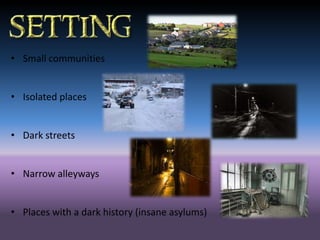
• Small communities
• Isolated places
• Dark streets
• Narrow alleyways
• Places with a dark history (insane asylums)
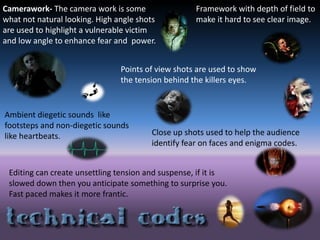
Camerawork- The camera work is some
what not natural looking. High angle shots
are used to highlight a vulnerable victim
and low angle to enhance fear and power.
Points of view shots are used to show
the tension behind the killers eyes.
Framework with depth of field to
make it hard to see clear image.
Ambient diegetic sounds like
footsteps and non-diegetic sounds
like heartbeats. Close up shots used to help the audience
identify fear on faces and enigma codes.
Editing can create unsettling tension and suspense, if it is
slowed down then you anticipate something to surprise you.
Fast paced makes it more frantic.
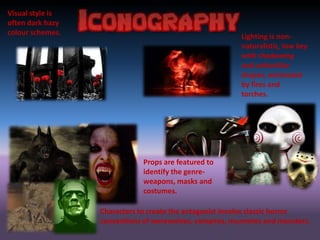
Visual style is
often dark hazy
colour schemes.
Lighting is non-
naturalistic, low key
with shadowing
and unfamiliar
shapes, motivated
by fires and
torches.
Props are featured to
identify the genre-
weapons, masks and
costumes.
Characters to create the antagonist involve classic horror
conventions of werewolves, vampires, mummies and monsters.
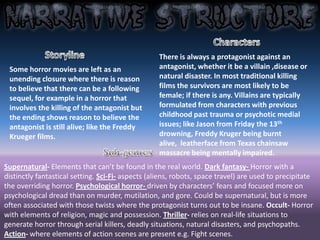
Some horror movies are left as an
unending closure where there is reason
to believe that there can be a following
sequel, for example in a horror that
involves the killing of the antagonist but
the ending shows reason to believe the
antagonist is still alive; like the Freddy
Krueger films.
There is always a protagonist against an
antagonist, whether it be a villain ,disease or
natural disaster. In most traditional killing
films the survivors are most likely to be
female; if there is any. Villains are typically
formulated from characters with previous
childhood past trauma or psychotic medial
issues; like Jason from Friday the 13th
drowning, Freddy Kruger being burnt
alive, leatherface from Texas chainsaw
massacre being mentally impaired.
Supernatural- Elements that can’t be found in the real world. Dark fantasy- Horror with a
distinctly fantastical setting. Sci-Fi- aspects (aliens, robots, space travel) are used to precipitate
the overriding horror. Psychological horror- driven by characters’ fears and focused more on
psychological dread than on murder, mutilation, and gore. Could be supernatural, but is more
often associated with those twists where the protagonist turns out to be insane. Occult- Horror
with elements of religion, magic and possession. Thriller- relies on real-life situations to
generate horror through serial killers, deadly situations, natural disasters, and psychopaths.
Action- where elements of action scenes are present e.g. Fight scenes.
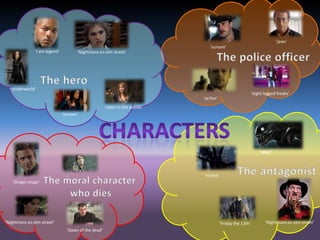
‘I am legend’ ‘Nightmare on elm street’
‘underworld’
‘scream’
‘cabin in the woods’
‘Ginger snaps’
’
‘Nightmare on elm street’
‘Dawn of the dead’
‘scream’
‘jaws’
‘se7en’
‘eight legged freaks’
‘Nightmare on elm street’
‘alien’
‘mama’
‘Friday the 13th’
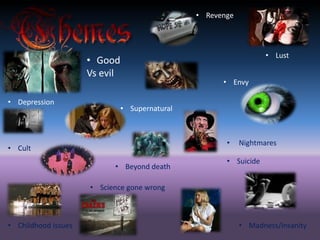
• Good
Vs evil
• Depression
• Cult
• Childhood issues
• Science gone wrong
• Supernatural
• Beyond death
• Madness/insanity
• Suicide
• Nightmares
• Envy
• Lust
• Revenge

Genre

  • 2.
    • Small communities •Isolated places • Dark streets • Narrow alleyways • Places with a dark history (insane asylums)
  • 3.
    Camerawork- The camerawork is some what not natural looking. High angle shots are used to highlight a vulnerable victim and low angle to enhance fear and power. Points of view shots are used to show the tension behind the killers eyes. Framework with depth of field to make it hard to see clear image. Ambient diegetic sounds like footsteps and non-diegetic sounds like heartbeats. Close up shots used to help the audience identify fear on faces and enigma codes. Editing can create unsettling tension and suspense, if it is slowed down then you anticipate something to surprise you. Fast paced makes it more frantic.
  • 4.
    Visual style is oftendark hazy colour schemes. Lighting is non- naturalistic, low key with shadowing and unfamiliar shapes, motivated by fires and torches. Props are featured to identify the genre- weapons, masks and costumes. Characters to create the antagonist involve classic horror conventions of werewolves, vampires, mummies and monsters.
  • 5.
    Some horror moviesare left as an unending closure where there is reason to believe that there can be a following sequel, for example in a horror that involves the killing of the antagonist but the ending shows reason to believe the antagonist is still alive; like the Freddy Krueger films. There is always a protagonist against an antagonist, whether it be a villain ,disease or natural disaster. In most traditional killing films the survivors are most likely to be female; if there is any. Villains are typically formulated from characters with previous childhood past trauma or psychotic medial issues; like Jason from Friday the 13th drowning, Freddy Kruger being burnt alive, leatherface from Texas chainsaw massacre being mentally impaired. Supernatural- Elements that can’t be found in the real world. Dark fantasy- Horror with a distinctly fantastical setting. Sci-Fi- aspects (aliens, robots, space travel) are used to precipitate the overriding horror. Psychological horror- driven by characters’ fears and focused more on psychological dread than on murder, mutilation, and gore. Could be supernatural, but is more often associated with those twists where the protagonist turns out to be insane. Occult- Horror with elements of religion, magic and possession. Thriller- relies on real-life situations to generate horror through serial killers, deadly situations, natural disasters, and psychopaths. Action- where elements of action scenes are present e.g. Fight scenes.
  • 6.
    ‘I am legend’‘Nightmare on elm street’ ‘underworld’ ‘scream’ ‘cabin in the woods’ ‘Ginger snaps’ ’ ‘Nightmare on elm street’ ‘Dawn of the dead’ ‘scream’ ‘jaws’ ‘se7en’ ‘eight legged freaks’ ‘Nightmare on elm street’ ‘alien’ ‘mama’ ‘Friday the 13th’
  • 7.
    • Good Vs evil •Depression • Cult • Childhood issues • Science gone wrong • Supernatural • Beyond death • Madness/insanity • Suicide • Nightmares • Envy • Lust • Revenge