Download to read offline
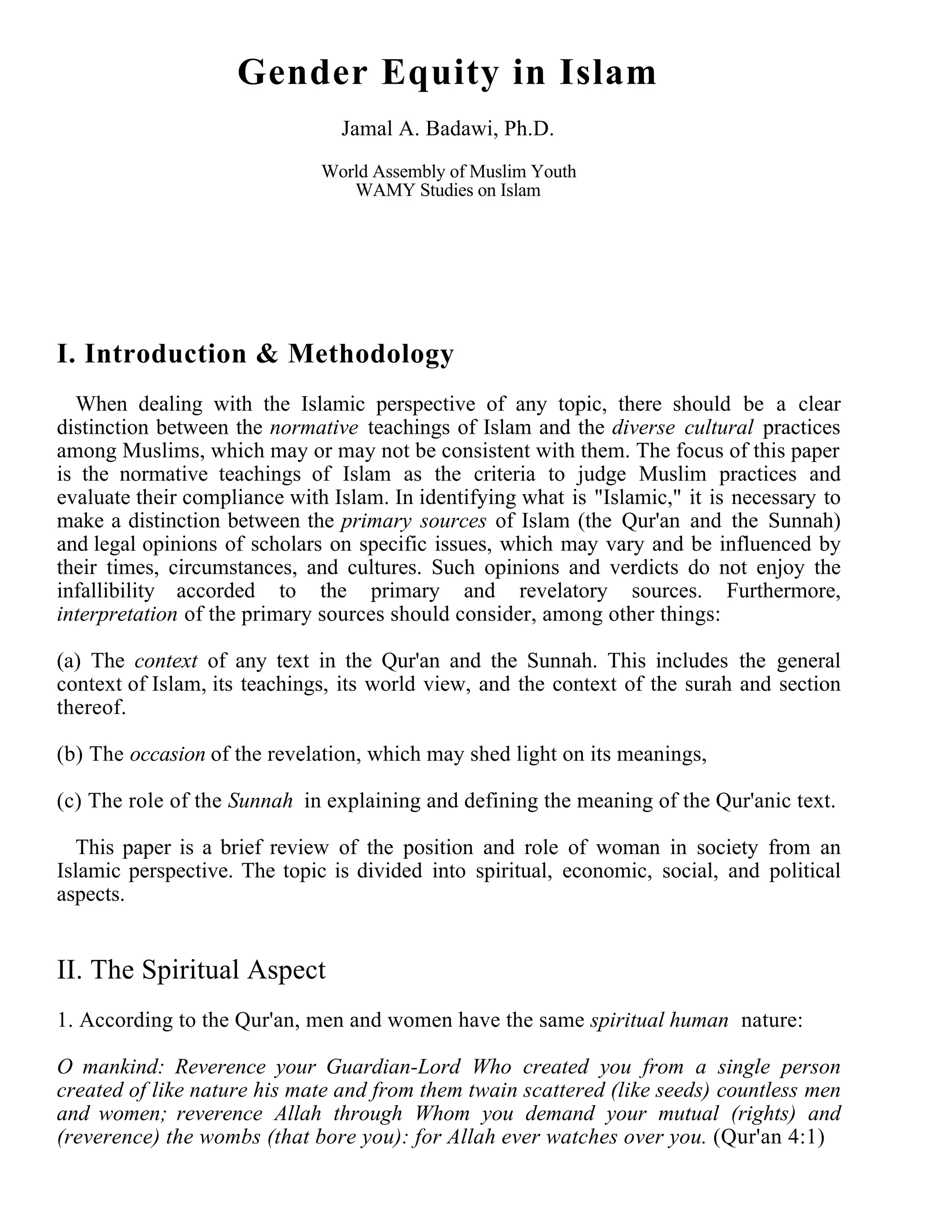
![It is He who created you from a single person and made his mate of like nature in order
that he might dwell with her (in love). When they are united she bears a light burden
and carries it about (unnoticed). When she grows heavy they both pray to Allah their
Lord (saying): "If You give us a goodly child we vow we shall (ever) be grateful."
(Qur'an 7:189)
(He is) the Creator of the heavens and the earth: He has made for you pairs from among
yourselves and pairs among cattle: by this means does He multiply you: there is nothing
whatever like unto Him and Her is the One that hears and sees (all things.) (Qur'an
42:11))
2. Both genders are recipients of the "divine breath" since they are created with the
same human and spiritual nature (nafsin-waahidah):
But He fashioned him in due proportion and breathed into him something of His spirit.
And He gave you (the faculties of) hearing and sight and feeling (and understanding):
little thanks to you give (Qur'an 15:29)
3. Both genders are dignified and are trustees of Allah on earth.
We have honored the children of Adam, provided them with transport on land and sea;
given them for sustenance things good and pure; and conferred on them special favors
above a great part of Our Creation. (Qur'an 17:70)
Behold your Lord said to the angels: "I will create a vicegerent on earth." They said
"Will you place therein one who will make mischief therein and shed blood? Whilst we
do celebrate Your praises and glorify Your holy (name)?" He said: "I know what you
do not." (Qur'an 2:30)
4. According to the Qur'an, woman is not blamed for the "fall of man." Pregnancy and
childbirth are not seen as punishments for "eating from the forbidden tree." On the
contrary, the Qur'an considers them to be grounds for love and respect due to mothers.
In narrating the story of Adam and Eve, the Qur'an frequently refers to both of
them, never singling out Eve for the blame:
O Adam! Dwell you and your wife in the garden and enjoy (its good things) as you
[both] wish: but approach not this tree or you [both] run into harm and transgression.
Then began Satan to whisper suggestions to them bringing openly before their minds all
their shame that was hidden from them (before): he said "Your Lord only forbade you
this tree lest you [both] should become angels or such beings as live forever." And he
swore to them both that he was their sincere adviser. So by deceit he brought about
their fall: when they tasted of the tree their shame became manifest to them and they
began to sew together the leaves of the garden over their bodies. And their Lord called
unto them: "Did I not forbid you that tree and tell you that Satan was an avowed enemy
unto you?" They said: "Our Lord! We have wronged our own souls: if you forgive us
not and bestow not upon us Your mercy we shall certainly be lost." (Allah) said: "Get
you [both] down with enmity between yourselves. On earth will be your dwelling-place](https://image.slidesharecdn.com/genderequityinislam-181118004429/75/Gender-equity-in_islam-2-2048.jpg)
![and your means of livelihood for a time." He said: "Therein shall you [both] live and
therein shall you [both] die; and from it shall you [both] be taken out (at last)." O you
children of Adam! We have bestowed raiment upon you to cover your shame as well as
to be an adornment to you but the raiment of righteousness that is the best. Such are
among the signs of Allah that they may receive admonition! O you children of Adam!
Let not Satan seduce you in the same manner as he got your parents out of the garden
stripping them of their raiment to expose their shame: for he and his tribe watch you
from a position where you cannot see them: We made the evil ones friends (only) to
those without faith. (Qur'an 7:19-27)
On the question of pregnancy and childbirth, the Qur'an states:
And We have enjoined on the person (to be good) to his/her parents: in travail upon
travail did his/her mother bear his/her and in years twain was his/her weaning: (hear
the command) "Show gratitude to Me and to your parents: to Me is (your final) Goal.
(Qur'an 31:14)
We have enjoined on the person kindness to his/her parents: in pain did his/her mother
bear him/her and in paid did she give him/her birth. The carrying of the (child) to
his/her weaning is ( a period of) thirty months. At length when he/she reaches the age
of full strength and attains forty years he/she says "O my Lord! Grant me that I may be
grateful for Your favor which You have bestowed upon me and upon both my parents
and that I may work righteousness such as You may approve; and be gracious to me in
my issue.Truly have I turned to You and truly do I bow (to You) in Islam
[submission]." (Qur'an 46:15)
5. Men and women have the same religious and moral duties and responsibilities. They
both face the consequences of their deeds:
And their Lord has accepted of them and answered them: "Never will I suffer to be los
the work of any of you be it male or female: you are members of one another ..."
(Qur'an 3:195)
If any do deeds of righteousness be they male or female and have faith they will enter
paradise and not the least injustice will be done to them. (Qur'an 4:124)
For Muslim men and women and for believing men and women, for devout men and
women, for true men and women, for men and women who are patient and constant,
for men and women who humble themselves, for men and women who give in charity,
for men and women who fast (and deny themselves), for men and women who guard
their chastity, and for men and women who engage much in Allah's praise, for them has
Allah prepared forgiveness and great reward. (Qur'an 33:35)
One Day shall you see the believing men and the believing women how their Light runs
forward before them and by their right hands: (their greeting will be): "Good news for
you this Day! Gardens beneath which flow rivers! To dwell therein for ever! This is
indeed the highest Achievement!" (Qur'an 57:12)](https://image.slidesharecdn.com/genderequityinislam-181118004429/75/Gender-equity-in_islam-3-2048.jpg)

![2. The Qur'an went further to rebuke the unwelcoming attitudes among some parents
upon hearing the news of the birth of a baby girl, instead of a baby boy:
When news is brought to one of them of (the birth of) a female (child) his face darkens
and he is filled with inward grief! With shame does he hide himself from his people
because of the bad news he has had! Shall he retain her on (sufferance and) contempt or
bury her in the dust? Ah! what an evil (choice) they decide on! (Qur'an 16:58-59)
3. Parents are duty bound to support and show kindness and justice to their daughters.
Prophet Muhammad said:
"Whosoever has a daughter and he does not bury her alive, does not insult her, and does
not favor his son over her, Allah will enter him into Paradise." [Ahmad]
"Whosoever supports two daughters til they mature, he and I will come in the day of
judgment as this (and he pointed with his two fingers held together)." [Ahmad]
4. Education is not only a right but also a responsibility of all males and females.
Prophet Muhammad said:
"Seeking knowledge is mandatory for every Muslim ("Muslim" is used here in the
generic meaning which includes both males and females).
Second: As a Wife
1. Marriage in Islam is based on mutual peace, love, and compassion, not just the
satisfaction of man's needs:
And among His Signs is that He created for you mates from among yourselves that you
may well in tranquillity with them and He has put live and mercy between your
(hearts); verily in that are signs for those who reflect. (Qur'an 30:21)
(He is) the Creator of the heavens and the earth: He has made for you pairs from among
yourselves and pairs among cattle: by this means does He multiply you: there is nothing
whatever like unto Him and He is the One that hears and sees (all things). (Qur'an
42:11)
2. The female has the right to accept or reject marriage proposals. Her consent is
prerequisite to the validity of the marital contract according to the Prophet's teaching.
It follows that if by "arranged marriage" is meant marrying the girl without her
consent, then such a marriage is nullifiable is she so wished.
"Ibn Abbas reported that a girl came to the Messenger of God, Muhammad, and she
reported that her father had forced her to marry without her consent. The Messenger of
God gave her the choice ... (between accepting the marriage or invalidating it)."
(Ahmad, Hadeeth no. 2469). In another version, the girl said: "Actually I accept this
marriage but I wanted to let women know that parents have no right to force a husband
on them." [Ibn Majah]](https://image.slidesharecdn.com/genderequityinislam-181118004429/75/Gender-equity-in_islam-5-2048.jpg)
![3. The husband is responsible for the maintenance, protection, and overall headship of
the family (qiwamah) within the framework of consultation and kindness. The mutual
dependency and complementary of the roles of males and females does not mean
"subservience" by either party to the other. Prophet Muhammad helped in household
chores in spite of his busy schedule.
The mothers shall give suck to their offspring for two whole years if the father desires
to complete the term. But he shall bear the cost of their food and clothing on equitable
terms. No soul shall have a burden laid on it greater than it can bear. No mother shall
be treated unfairly on account of her child nor father on account of his child. An heir
shall be chargeable in the same way if they both decide on weaning by mutual consent
and after due consultation there is no blame on them. If you decide on a foster-mother
for your offspring there is no blame on you provided you pay (the mother) what you
offered on equitable terms. But fear Allah and know that Allah sees well what you do.
(Qur'an 2:233)
The Qur'an urges husbands to be kind and considerate to heir wives even if they do not
like them.
O you who believe! You are forbidden to inherit women against their will. Nor should
you treat them with harshness that you may take away part of the marital gift you have
given them except where they have been guilty of open lewdness; on the contrary live
with them on a footing of kindness and equity. If you take a dislike to them it may be
that you dislike a thing and Allah brings about though it a great deal of good. (Qur'an
4:19)
Prophet Muhammad taught:
" I command you to be kind to women ..."
"The best of you is the best to his family (wife) ..."
Marital disputes are to be handled privately between the parties whenever possible,
in steps (without excesses or cruelty). If disputes are not resolved then family mediation
can be resorted to.
Divorce is seen as the last resort, which is permissible but not encouraged. Under no
circumstances does the Qur'an encourage, allow or condone family violence or physical
abuse and cruelty. The maximum allowed in extreme cases is a gentle tap that does not
even leave a mark on the body while saving the marriage from collapsing.
5. Forms of marriage dissolution include mutual agreement, the husband's initiative, the
wife's initiative (if part of her marital contract, court decision on the wife's initiative
(for a cause), and the wife's initiative without a "cause" provided that she returns the
marital gift to her husband (khul' [divestiture]).
6. Priority for custody of young children (up to the age of about seven) is given to the
mother. A child later chooses between his mother and father (for custody purposes).](https://image.slidesharecdn.com/genderequityinislam-181118004429/75/Gender-equity-in_islam-6-2048.jpg)


![b) As defined by the Hadeeth, it is not permissible to strike anyone's face, cause any
bodily harm or even be harsh. What the Hadeeth qualified as dharban ghayra mubarrih
or light beating was interpreted by early jurists as a (symbolical) use of the miswak (a
small natural toothbrush).
They further qualified permissible "beating" as beating that leaves no mark on the
body. It is interesting that this latter fourteen centuries old qualifier is the criterion used
in contemporary American law to separate a light and harmless tap or strike from
"abuse" in the legal sense. This makes it clear that even this extreme, last resort and
"lesser of the two evils" measure that may save the marriage does not meet the
definitions of "physical abuse," "family violence," of "wife battering" in the twentieth
century laws in liberal democracies, where such extremes are commonplace that they
are seen as national concerns.
c) Permissibility of such symbolical expression of the seriousness of continued
refraction does not imply its desirability. In several Ahadeeth, Prophet Muhammad
discouraged this measure. Among his sayings: "Do not beat the female servants of
Allah," "Some (women visited my family complaining about their husbands (beating
them). These (husbands) are not the best of you," "[Is it not a shame that], one of you
beats his wife like [an unscrupulous person] beats a slave and maybe he sleeps with her
at the end of the day." See Riyad Al Saliheen, op cit., pp. 130-140. In another Hadeeth,
the Prophet said:
"How does anyone of you beat his wife as he beats the stallion camel and then he may
embrace (sleep with) her?" Shaheeh Al Bukhari, op. cit., vol. 8, Hadeeth no. 68, pp.
42-43.
d) True following of the Sunnah is to follow the example of the Prophet Muhammad,
who never resorted to that measure regardless of the circumstances.
e) Islamic teachings are universal in nature. They respond to the needs and
circumstances of diverse times, cultures, and circumstances but unnecessary in others.
Some measures may work in some cases, cultures, or with certain persons but may not
be effective in others. By definition a "permissible" it is neither required encouraged,
or forbidden. In fact, it may be better to spell out the extent of permissibility such as in
the issue at hand, than leaving it unrestricted and unqualified or ignoring it all together.
In the absence of strict qualifiers, persons may interpret the matter in their own way
lending to excesses and real abuse.
f) Any excess, cruelty, family violence, or abuse committed by any "Muslim" can
never be traced, honestly, to any revelatory text (Qur'an and Hadeeth). Such excesses
and violations are to be blamed on the person(s) himself as it shows that he is paying lip
service to Islamic teachings and injunctions and is failing to follow the true sunnah of
the Prophet.](https://image.slidesharecdn.com/genderequityinislam-181118004429/75/Gender-equity-in_islam-14-2048.jpg)


This document discusses gender equity in Islam from a spiritual, economic, social, and political perspective based on primary Islamic sources of the Quran and Sunnah. Spiritually, men and women are considered equal in their human nature and religious duties. Economically, women have full property and inheritance rights and are entitled to financial support. Socially, harmful pre-Islamic practices against women were prohibited and women have rights as daughters, wives and mothers. Politically, there are no restrictions on women in leadership roles if qualified, though historically women have not been prophets due to the physical demands of that role.


![Easter sunday 2013 [compatibility mode]](https://cdn.slidesharecdn.com/ss_thumbnails/eastersunday2013compatibilitymode-130513062108-phpapp02-thumbnail.jpg?width=640&height=640&fit=bounds)


