Gas Turbines
&
Jet Propulsion
Introduction
• A gas turbine is a machine delivering
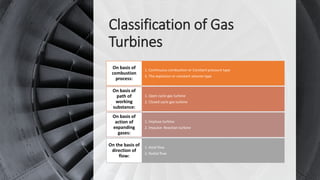
mechanical power or thrust. It does this using a
gaseous working fluid. The mechanical power
generated can be used by, for example, an
industrial device. The outgoing gaseous fluid can
be used to generate thrust. In the gas turbine,
there is a continuous flow of the working fluid.
• This working fluid is initially compressed in the
compressor. It is then heated in the combustion
chamber. Finally, it goes through the turbine.
• The turbine converts the energy of the gas into
mechanical work. Part of this work is used to
drive the compressor. The remaining part is
known as the net work of the gas turbine.
How does Gas Turbine
Works?
Gas turbine functions in
the same way as the
Compressed Ignition
Engine. It sucks in air from
the atmosphere,
compresses it.
The fuel is injected and
ignited. The gases expand
doing work and finally
exhausts outside.
The only difference is
instead of the
reciprocating motion, gas
turbine uses a rotary
motion throughout.
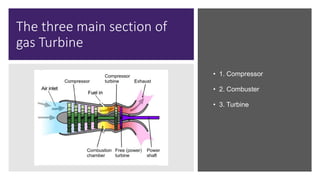
The three main section of
gas Turbine
• 1. Compressor
• 2. Combuster
• 3. Turbine
1. Continuous combustion or Constant pressure type
2. The explosion or constant volume type
On basis of
combustion
process:
1. Open cycle gas turbine
2. Closed cycle gas turbine
On basis of
path of
working
substance:
1. Impluse turbine
2. Impulse- Reaction turbine
On basis of
action of
expanding
gases:
1. Axial flow
2. Radial flow
On the basis of
direction of
flow:
Classification of Gas
Turbines
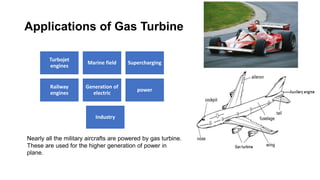
Applications of Gas Turbine
Turbojet
engines
Marine field Supercharging
Railway
engines
Generation of
electric
power
Industry
Nearly all the military aircrafts are powered by gas turbine.
These are used for the higher generation of power in
plane.
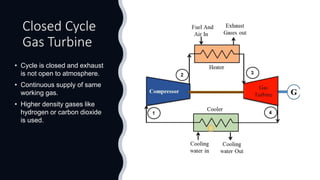
Closed Cycle
Gas Turbine
• Cycle is closed and exhaust
is not open to atmosphere.
• Continuous supply of same
working gas.
• Higher density gases like
hydrogen or carbon dioxide
is used.
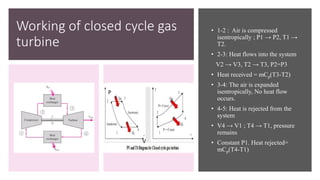
Working of closed cycle gas
turbine
• 1-2 : Air is compressed
isentropically ; P1 → P2, T1 →
T2.
• 2-3: Heat flows into the system
V2 → V3, T2 → T3, P2=P3
• Heat received = mCp(T3-T2)
• 3-4: The air is expanded
isentropically, No heat flow
occurs.
• 4-5: Heat is rejected from the
system
• V4 → V1 ; T4 → T1, pressure
remains
• Constant P1. Heat rejected=
mCp(T4-T1)
P
V
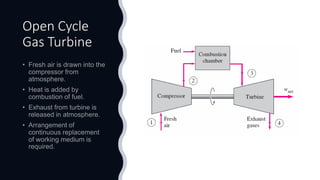
Open Cycle
Gas Turbine
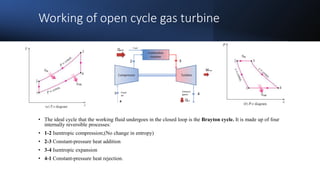
Working of open cycle gas turbine
• The ideal cycle that the working fluid undergoes in the closed loop is the Brayton cycle. It is made up of four
internally reversible processes:
• 1-2 Isentropic compression;(No change in entropy)
• 2-3 Constant-pressure heat addition
• 3-4 Isentropic expansion
• 4-1 Constant-pressure heat rejection.
Method to improve thermal
efficiency of gas turbine
Intercooling Reheating Regeneration
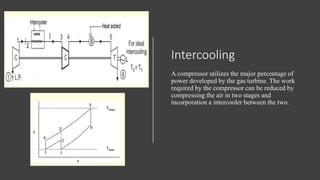
Intercooling
A compressor utilizes the major percentage of
power developed by the gas turbine. The work
required by the compressor can be reduced by
compressing the air in two stages and
incorporation a intercooler between the two.
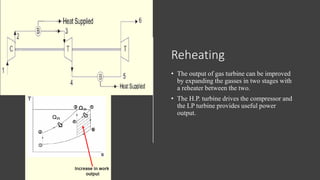
Reheating
• The output of gas turbine can be improved
by expanding the gasses in two stages with
a reheater between the two.
• The H.P. turbine drives the compressor and
the LP turbine provides useful power
output.
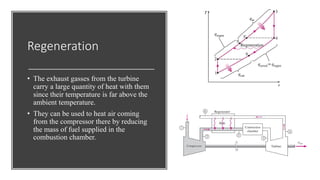
Regeneration
• The exhaust gasses from the turbine
carry a large quantity of heat with them
since their temperature is far above the
ambient temperature.
• They can be used to heat air coming
from the compressor there by reducing
the mass of fuel supplied in the
combustion chamber.
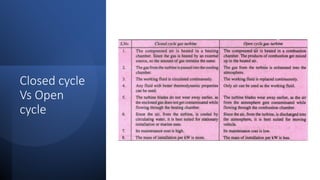
Closed cycle
Vs Open
cycle
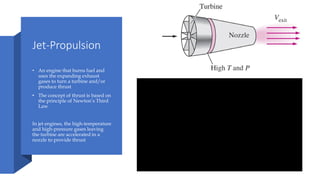
Jet-Propulsion
• An engine that burns fuel and
uses the expanding exhaust
gases to turn a turbine and/or
produce thrust
• The concept of thrust is based on
the principle of Newton’s Third
Law
In jet engines, the high-temperature
and high-pressure gases leaving
the turbine are accelerated in a
nozzle to provide thrust
Principles
of jet
propulsion
It is based on Newton's first and third law of
motion.
A jet engine is an engine that discharges a
fast moving jet of fluid to generate thrust in
accordance with Newton's third law of
motion.
An engine that burns fuel and uses the
expanding exhaust gases to turn a turbine
and/or produce thrust
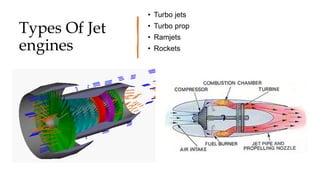
Types Of Jet
engines
• Turbo jets
• Turbo prop
• Ramjets
• Rockets
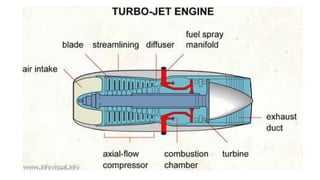
Turbo jet
engines
Working principle:
jet engines are also called as gas
turbines. The engine sucks air in at
the front with a fan. A compressor
raises the pressure of the air. The
compressed air is then sprayed with
fuel and an electric spark lights the
mixture. The burning gases expand
and blast out through the nozzle, at
the back of the engine. As the jets of
gas shoot backward, the engine and
the aircraft are thrust forward.
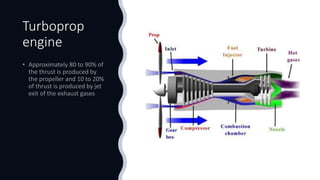
Turboprop
engine
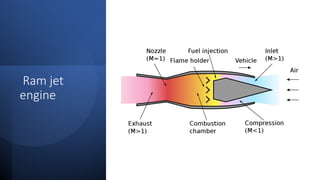
Ram jet
engine
Rocket
Principles
Rocket thrust is the reaction force produced by
expelling particles at high velocity from a
nozzle opening.
•High pressure/temperature/velocity exhaust
gases provided through combustion and
expansion through nozzle of suitable fuel and
oxidizer mixture.
•A rocket carries both the fuel and oxidizer
onboard the vehicle whereas an air-breather
engine takes in its oxygen supply from the
atmosphere.
Solid
Propellants
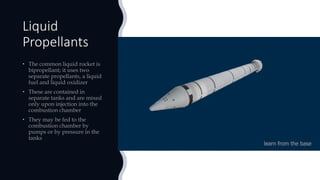
Liquid
Propellants
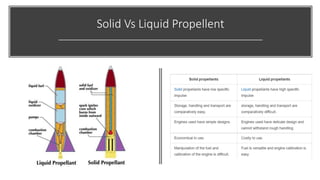
Solid Vs Liquid Propellent
Thank You

Gas turbine.pdf

  • 1.
  • 2.
    Introduction • A gasturbine is a machine delivering mechanical power or thrust. It does this using a gaseous working fluid. The mechanical power generated can be used by, for example, an industrial device. The outgoing gaseous fluid can be used to generate thrust. In the gas turbine, there is a continuous flow of the working fluid. • This working fluid is initially compressed in the compressor. It is then heated in the combustion chamber. Finally, it goes through the turbine. • The turbine converts the energy of the gas into mechanical work. Part of this work is used to drive the compressor. The remaining part is known as the net work of the gas turbine.
  • 3.
    How does GasTurbine Works? Gas turbine functions in the same way as the Compressed Ignition Engine. It sucks in air from the atmosphere, compresses it. The fuel is injected and ignited. The gases expand doing work and finally exhausts outside. The only difference is instead of the reciprocating motion, gas turbine uses a rotary motion throughout.
  • 4.
    The three mainsection of gas Turbine • 1. Compressor • 2. Combuster • 3. Turbine
  • 5.
    1. Continuous combustionor Constant pressure type 2. The explosion or constant volume type On basis of combustion process: 1. Open cycle gas turbine 2. Closed cycle gas turbine On basis of path of working substance: 1. Impluse turbine 2. Impulse- Reaction turbine On basis of action of expanding gases: 1. Axial flow 2. Radial flow On the basis of direction of flow: Classification of Gas Turbines
  • 6.
    Applications of GasTurbine Turbojet engines Marine field Supercharging Railway engines Generation of electric power Industry Nearly all the military aircrafts are powered by gas turbine. These are used for the higher generation of power in plane.
  • 7.
    Closed Cycle Gas Turbine •Cycle is closed and exhaust is not open to atmosphere. • Continuous supply of same working gas. • Higher density gases like hydrogen or carbon dioxide is used.
  • 8.
    Working of closedcycle gas turbine • 1-2 : Air is compressed isentropically ; P1 → P2, T1 → T2. • 2-3: Heat flows into the system V2 → V3, T2 → T3, P2=P3 • Heat received = mCp(T3-T2) • 3-4: The air is expanded isentropically, No heat flow occurs. • 4-5: Heat is rejected from the system • V4 → V1 ; T4 → T1, pressure remains • Constant P1. Heat rejected= mCp(T4-T1) P V
  • 9.
  • 10.
    Working of opencycle gas turbine • The ideal cycle that the working fluid undergoes in the closed loop is the Brayton cycle. It is made up of four internally reversible processes: • 1-2 Isentropic compression;(No change in entropy) • 2-3 Constant-pressure heat addition • 3-4 Isentropic expansion • 4-1 Constant-pressure heat rejection.
  • 11.
    Method to improvethermal efficiency of gas turbine Intercooling Reheating Regeneration
  • 12.
    Intercooling A compressor utilizesthe major percentage of power developed by the gas turbine. The work required by the compressor can be reduced by compressing the air in two stages and incorporation a intercooler between the two.
  • 13.
    Reheating • The outputof gas turbine can be improved by expanding the gasses in two stages with a reheater between the two. • The H.P. turbine drives the compressor and the LP turbine provides useful power output.
  • 14.
    Regeneration • The exhaustgasses from the turbine carry a large quantity of heat with them since their temperature is far above the ambient temperature. • They can be used to heat air coming from the compressor there by reducing the mass of fuel supplied in the combustion chamber.
  • 15.
  • 16.
    Jet-Propulsion • An enginethat burns fuel and uses the expanding exhaust gases to turn a turbine and/or produce thrust • The concept of thrust is based on the principle of Newton’s Third Law In jet engines, the high-temperature and high-pressure gases leaving the turbine are accelerated in a nozzle to provide thrust
  • 17.
    Principles of jet propulsion It isbased on Newton's first and third law of motion. A jet engine is an engine that discharges a fast moving jet of fluid to generate thrust in accordance with Newton's third law of motion. An engine that burns fuel and uses the expanding exhaust gases to turn a turbine and/or produce thrust
  • 18.
    Types Of Jet engines •Turbo jets • Turbo prop • Ramjets • Rockets
  • 20.
    Turbo jet engines Working principle: jetengines are also called as gas turbines. The engine sucks air in at the front with a fan. A compressor raises the pressure of the air. The compressed air is then sprayed with fuel and an electric spark lights the mixture. The burning gases expand and blast out through the nozzle, at the back of the engine. As the jets of gas shoot backward, the engine and the aircraft are thrust forward.
  • 21.
  • 22.
  • 23.
    Rocket Principles Rocket thrust isthe reaction force produced by expelling particles at high velocity from a nozzle opening. •High pressure/temperature/velocity exhaust gases provided through combustion and expansion through nozzle of suitable fuel and oxidizer mixture. •A rocket carries both the fuel and oxidizer onboard the vehicle whereas an air-breather engine takes in its oxygen supply from the atmosphere.
  • 24.
  • 25.
  • 26.
    Solid Vs LiquidPropellent
  • 27.