5
                                               10x10


Gaming for Behavior
Change

— Adam Dole,
  Design Researcher


Learning to Play the Game
The success of a new product or service relies on
more than just new features and functions, bells and
whistles, or a creative campaign—these fail to deliver
long term brand loyalty because they do not create
behavior change over time. Games, however, engage
consumers and build value around products and
services. How can design principles leverage game-
like mechanics to create greater value for products
and services?


Method


method.com
Gaming for Behavior Change                                            — Adam Dole, Design Researcher


  Behavioral Change: The New Competitive Advantage                      Game-Changing Benefits

  It is becoming harder and harder to predict what factors will         An estimated 3 billion hours are currently spent on gaming
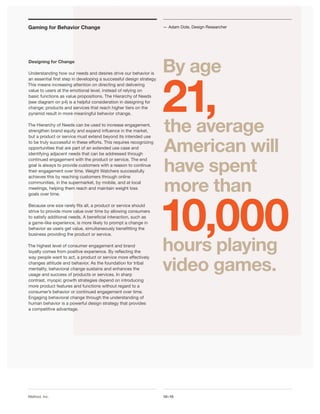
  drive the success of a new product or service, as consumers           every week. By age 21, the average American will have spent
  face more and more choices these days. Success is contingent          more than 10,000 hours playing video games — the equivalent
  upon more than just engineering-driven features and functions,        to 5 years of work at a full time job! The total amount of time
  new product bells and whistles, or a creative campaign.               that World of Warcraft has been played is 5.93 million years.
  Ultimately, none of these factors by themselves ensure market         Game designer and researcher Jane McGonigal makes the
  success because they cannot predict consumer behavior                 case in her 2010 TED talk that games inspire people the way
  or reaction. Despite a sense of short term achievement and            real life does not, raising the question: what is it about games
  perhaps stimulating initial consumer interest, they fail to deliver   that enables this extraordinary degree of engagement?
  long term brand loyalty.
                                                                        Several studies have sought to unlock the psychological
  Instead, successful products and services identify and                attrac-tion of game play, but what is abundantly clear is that
  understand our deeply seated natural tendencies and the ways          the whole gaming industry has been growing rapidly. Casual
  in which they can be used to change our behavior. By leveraging       gaming company Zynga recently surpassed 100 million unique
  game-like mechanisms to satisfy these needs and tendencies,           monthly visitors with the release of their viral hits Mafia Wars
  we can create behavioral change across a broad spectrum of            and Farmville, giving them an estimated valuation rumored to


                                                                                                                                           Psychological Attraction
  pressing issues, from healthcare and finances to philanthropy         be $4 billion.
  and conservation. Games engage consumers and build
  value around products and services, creating a powerful
  competitive advantage.


                                                                                                                                           and
                                                                                                                                           Leveraging Game-like Mechanics


— Jane McGonigal,
  Game Designer and Researcher


  Method, Inc.                                                          10x10
Gaming for Behavior Change                                            — Adam Dole, Design Researcher


Designing for Change

                                                                      By age

                                                                      21,
Understanding how our needs and desires drive our behavior is
an essential first step in developing a successful design strategy.
This means increasing attention on directing and delivering
value to users at the emotional level, instead of relying on
basic functions as value propositions. The Hierarchy of Needs
(see diagram on p4) is a helpful consideration in designing for
change; products and services that reach higher tiers on the
pyramid result in more meaningful behavior change.

The Hierarchy of Needs can be used to increase engagement,
strengthen brand equity and expand influence in the market,           the average
                                                                      American will
but a product or service must extend beyond its intended use
to be truly successful in these efforts. This requires recognizing
opportunities that are part of an extended use case and
identifying adjacent needs that can be addressed through


                                                                      have spent
continued engagement with the product or service. The end
goal is always to provide customers with a reason to continue
their engagement over time. Weight Watchers successfully


                                                                      more than
achieves this by reaching customers through online
communities, in the supermarket, by mobile, and at local
meetings, helping them reach and maintain weight loss


                                                                      10,000
goals over time.

Because one size rarely fits all, a product or service should
strive to provide more value over time by allowing consumers
to satisfy additional needs. A beneficial interaction, such as
a game-like experience, is more likely to prompt a change in
behavior as users get value, simultaneously benefitting the
business providing the product or service.

The highest level of consumer engagement and brand
loyalty comes from positive experience. By reflecting the             hours playing
                                                                      video games.
way people want to act, a product or service more effectively
changes attitude and behavior. As the foundation for tribal
mentality, behavioral change sustains and enhances the
usage and success of products or services. In sharp
contrast, myopic growth strategies depend on introducing
more product features and functions without regard to a
consumer’s behavior or continued engagement over time.
Engaging behavioral change through the understanding of
human behavior is a powerful design strategy that provides
a competitive advantage.


Method, Inc.                                                          10x10
Gaming for Behavior Change       — Adam Dole, Design Researcher


                                                        Hierarchy
                                                        of Needs

                                                                                         3/4/5


                                             5
                                                                                         Design that identifies opportunities
                                                                                         to support extended, adjacent, and
                                                                                         orthogonal needs and desires.
                                                                                         Creates ongoing engagement with
                                                                                         the product/service.
Hierarchy of Needs


                                                        4
                                                    3
                                                                                                      1/2
                                                                                                      Design based on specific and
and


                                                                                                      underlying needs and desires.
                                                                                                      This still leaves opportunity
                                                                                                      on the table.


                                                                    1
Designing for Change


                       Method, Inc.                     10x10
Gaming for Behavior Change                                            — Adam Dole, Design Researcher


                                      Expression of Beliefs


                                                                                                                                                       Designing for Engagement
                                      Self-Improvement
Examples of Success


                             Value


                                      Economic Benefits


                                      Improved Performance


                                      Intended Use


                                                                                                                                                       Designing for Needs
and


                                                                                  Elapsed Time
Designing for Change


                       Playing with Money

                       There are several examples of successful products and services        to a total financial score. Users identify financially responsible
                       that use or have used gaming principles to achieve market             behaviors (the right behavior) and avoid financially irresponsible
                       success. One example is Mint.com, a financial management              behaviors (the wrong behaviors) to maximize points received
                       tool that leverages gaming principles to successfully capture         while competing with others with similar goals. Visual feedback
                       and expand its market. Following its launch in 2007, Mint.com         informs users on how to improve their financial performance,


                                                                                                                  4
                       fundamentally changed the experience of financial management,         and ultimately achieve their financial goals.
                       by making the tracking of personal finances fun. In so doing,
                       Mint.com created a new market, targeting people who viewed            While other companies tried to compete with more sophisti-
                       financial management as a formidable task without ever                cated features and the latest financial add-ons, Mint.com beat
                       achieving tangible results.                                           the competition by creating a product based on understanding
                                                                                             human behavior and changing that behavior. Intuit, themakers
                       The service rewards users for activities that keep their “financial   of Quicken, recognized that they were losing their competitive
                       fitness” in check, similar to how gamers earn achievements in         advantage to a start-up targeting a new and growing demo-
                       video games. By saving money, avoiding bank fees, or coming in        graphic and acquired Mint.com for $170 million in 2009.
                       under budget, the user collects Mint points that contribute


                       Method, Inc.                                                          10x10
Gaming for Behavior Change                                           — Adam Dole, Design Researcher


4 Critical Attributes
Design Attributes For Creating Behavioral Change

Using gaming principles to change people’s behavior is not limited to any one sector. Creating new products and services
that enable positive behavioral change applies to all industries. However, it requires a thorough understanding of that sector’s
Hierarchy of Needs. In order to maximize consumer engagement and achieve brand loyalty in any industry, utilizing gaming
elements to change behavior relies on 4 critical design attributes: entertaining, competitive, visual, and rewarding.


1. Entertaining                                                      2. Competitive
Make it fun and entertaining. What if your health insurance          Make it competitive for users. Nike+ is a small device that re-
company decided to use gaming principles to create a health-         cords the distance and pace of a walk or run. Nike+ also allows
care experience that was actually fun? Nintendo’s Wii console        runners to meet and challenge other runners, ask questions,
engages people in exercise through a new and entertaining            and give feedback. The corresponding Nike+ website includes
game experience. Exercise is a by-product of the experience,         a user-generated challenge gallery, a route naming tool, iPod
which is perceived as play rather than work. Nintendo effectively    compatibility, a distance-traveled club, and fastest 5K club.
converted “no pain, no gain” into “have fun, will exercise.” The     Imagine the impact if utilities giant PG&E used their smart
American Heart Association and Nintendo recently announced           meters to create neighborhood competitions that incentivized
a first-of-its-kind strategic partnership designed to help people    lower energy consumption, where competing households
create healthy lifestyles through physically active play.            could earn discounts on their monthly bill?


3. Visual                                                            4. Rewarding
Make it visual. When Toyota began visualizing fuel consu-            Make it rewarding. Research shows that financial rewards are
mption for drivers in their Prius models, they created a “fuel       not effective at encouraging sustained, long-term behavior change.
economy game,” allowing the driver to minimize gas usage with        Rewards that create social value tied to a meaningful cause are
real time information. The phenomenon is known as the Prius          more effective over the long term and have a greater likelihood of
Effect. How might household appliance manufacturers, such as         encouraging others to do the same. RecycleBank is a web-based
GE, tap into such insights from the auto-industry to not only sell   service designed to promote recycling. Families accrue points
more products but help promote environmental consciousness           based on the weekly amount of materials recycled; these points
while doing so?                                                      can be redeemed for discounts at over 1500 national businesses.
                                                                     Freerice.com is an online trivia game that donates rice to the United
                                                                     Nations World Food Program for each correctly answered question,
                                                                     and has donated over 80 billion grains in just 3 years.


                                                                     Well Played

                                                                     Inspiring positive behavioral change is a key driver of
                                                                     customer engagement, brand loyalty, and sustained market
                                                                     growth. The explosive growth of social gaming is well timed
                                                                     to intersect with the need for new platforms that incorporate
                                                                     behavioral change into design strategy. Designing products,
                                                                     services, and business models for behavioral change is
                                                                     the new competitive advantage. Gaming has the power to
                                                                     instigate behavioral change, and the potential to impact
                                                                     the solutions to some of the world’s most pressing social
                                                                     problems, such as healthcare and philanthropy.


Method, Inc.                                                         10x10
5
                                           Gaming for Behavior Change
                                             Learning to Play the Game
                                           By By Adam Dole, Design Researcher
                                              Adam Dole, Design Researcher


                                           About the Author
                                             About the Author
                                           Adam is text
                                              need a design researcher based out of
                                           Method’s San Francisco studio. He brings a
                                           hybrid background in psychology and design
                                           strategy to his work in identifying opportunities
                                           for new products, services and businesses.
                                           Most recently, Adam has been pursuing his
                                           interest in redefining the perception of healthcare
                                           through design. You can follow @adamdole
                                           on twitter, where he actively discusses designing
                                           for positive behavior change.


                                           About 10x10
                         More to
                                           2010 marks Method’s 10 year anniversary,
                                           and we are only looking forward. Written by
                                           our own industry leaders, the 10x10 series
                                           focuses on game-changing topics that
The Consumer


                                              About 10x10
                                           fundamentally impact today’s brands and
as King(pin)


                                           their search forMethod’s 10 year anniver-
                                              2010 marks new revenue streams.
                                              sary, and we are only looking forward.
                                              Written by our own industry leaders, we
                                              are launching the 10x10 series, which will
                                              focus on game changing topics that will
                         come
                                              fundamentally impact today’s brands and
                                   1          their search for new revenue streams.
                                           Cable’s Lost Generation

                                   2       Unlocking the Infinite Library

                                   3       Entertain Me Now
                                   1         Cable’s Lost Generation
                                   4       Place, Space and the Mobile Interface
                                   2         Unlocking the Infinite Library
                                   5       Gaming for Behavior Change
      next


                                   3         Entertain Me Now
                                   6       The Consumer as King(pin)
                                   4         Place, Space and the Mobile Interface
                                   7       Retail Convergence
                                   5         Mind the Gap
                                   8       Wrap It, Pack It, and Stack It
                                   6         Parenting 101
                                   9       Power to the People
                                   7         The Consumer as King(pin)
 Fifth Issue
 This is the


                                   10      Welcome to the Metaverse
                                   8        Wrap It, Pack It, and Stack It

                                   9         Power to the People

                                   10        Welcome to the Metaverse


          Method, Inc.             10x10
10x10


  About Method

  Method is a brand experience agency with offices
  based in San Francisco, New York and London. Our
  clients are best described as owners of progressive,
  era-defining brands, and include Google, Comcast,
  Nordstrom, Sony, Samsung, Nokia, Microsoft, Time
  Warner, Intel, and BBC. Collaboratively, we help them
  create products, services and businesses that are
  smart, beautiful and extendable.

  For more information visit www.method.com.


  Method
  Locations

  San Francisco
  New York
  London


  Contact

  Lindsay Liu
  Marketing Manager
  lindsay@method.com
  646.825.5242


method.com

Gaming For Behavior Change

  • 1.
    5 10x10 Gaming for Behavior Change — Adam Dole, Design Researcher Learning to Play the Game The success of a new product or service relies on more than just new features and functions, bells and whistles, or a creative campaign—these fail to deliver long term brand loyalty because they do not create behavior change over time. Games, however, engage consumers and build value around products and services. How can design principles leverage game- like mechanics to create greater value for products and services? Method method.com
  • 2.
    Gaming for BehaviorChange — Adam Dole, Design Researcher Behavioral Change: The New Competitive Advantage Game-Changing Benefits It is becoming harder and harder to predict what factors will An estimated 3 billion hours are currently spent on gaming drive the success of a new product or service, as consumers every week. By age 21, the average American will have spent face more and more choices these days. Success is contingent more than 10,000 hours playing video games — the equivalent upon more than just engineering-driven features and functions, to 5 years of work at a full time job! The total amount of time new product bells and whistles, or a creative campaign. that World of Warcraft has been played is 5.93 million years. Ultimately, none of these factors by themselves ensure market Game designer and researcher Jane McGonigal makes the success because they cannot predict consumer behavior case in her 2010 TED talk that games inspire people the way or reaction. Despite a sense of short term achievement and real life does not, raising the question: what is it about games perhaps stimulating initial consumer interest, they fail to deliver that enables this extraordinary degree of engagement? long term brand loyalty. Several studies have sought to unlock the psychological Instead, successful products and services identify and attrac-tion of game play, but what is abundantly clear is that understand our deeply seated natural tendencies and the ways the whole gaming industry has been growing rapidly. Casual in which they can be used to change our behavior. By leveraging gaming company Zynga recently surpassed 100 million unique game-like mechanisms to satisfy these needs and tendencies, monthly visitors with the release of their viral hits Mafia Wars we can create behavioral change across a broad spectrum of and Farmville, giving them an estimated valuation rumored to Psychological Attraction pressing issues, from healthcare and finances to philanthropy be $4 billion. and conservation. Games engage consumers and build value around products and services, creating a powerful competitive advantage. and Leveraging Game-like Mechanics — Jane McGonigal, Game Designer and Researcher Method, Inc. 10x10
  • 3.
    Gaming for BehaviorChange — Adam Dole, Design Researcher Designing for Change By age 21, Understanding how our needs and desires drive our behavior is an essential first step in developing a successful design strategy. This means increasing attention on directing and delivering value to users at the emotional level, instead of relying on basic functions as value propositions. The Hierarchy of Needs (see diagram on p4) is a helpful consideration in designing for change; products and services that reach higher tiers on the pyramid result in more meaningful behavior change. The Hierarchy of Needs can be used to increase engagement, strengthen brand equity and expand influence in the market, the average American will but a product or service must extend beyond its intended use to be truly successful in these efforts. This requires recognizing opportunities that are part of an extended use case and identifying adjacent needs that can be addressed through have spent continued engagement with the product or service. The end goal is always to provide customers with a reason to continue their engagement over time. Weight Watchers successfully more than achieves this by reaching customers through online communities, in the supermarket, by mobile, and at local meetings, helping them reach and maintain weight loss 10,000 goals over time. Because one size rarely fits all, a product or service should strive to provide more value over time by allowing consumers to satisfy additional needs. A beneficial interaction, such as a game-like experience, is more likely to prompt a change in behavior as users get value, simultaneously benefitting the business providing the product or service. The highest level of consumer engagement and brand loyalty comes from positive experience. By reflecting the hours playing video games. way people want to act, a product or service more effectively changes attitude and behavior. As the foundation for tribal mentality, behavioral change sustains and enhances the usage and success of products or services. In sharp contrast, myopic growth strategies depend on introducing more product features and functions without regard to a consumer’s behavior or continued engagement over time. Engaging behavioral change through the understanding of human behavior is a powerful design strategy that provides a competitive advantage. Method, Inc. 10x10
  • 4.
    Gaming for BehaviorChange — Adam Dole, Design Researcher Hierarchy of Needs 3/4/5 5 Design that identifies opportunities to support extended, adjacent, and orthogonal needs and desires. Creates ongoing engagement with the product/service. Hierarchy of Needs 4 3 1/2 Design based on specific and and underlying needs and desires. This still leaves opportunity on the table. 1 Designing for Change Method, Inc. 10x10
  • 5.
    Gaming for BehaviorChange — Adam Dole, Design Researcher Expression of Beliefs Designing for Engagement Self-Improvement Examples of Success Value Economic Benefits Improved Performance Intended Use Designing for Needs and Elapsed Time Designing for Change Playing with Money There are several examples of successful products and services to a total financial score. Users identify financially responsible that use or have used gaming principles to achieve market behaviors (the right behavior) and avoid financially irresponsible success. One example is Mint.com, a financial management behaviors (the wrong behaviors) to maximize points received tool that leverages gaming principles to successfully capture while competing with others with similar goals. Visual feedback and expand its market. Following its launch in 2007, Mint.com informs users on how to improve their financial performance, 4 fundamentally changed the experience of financial management, and ultimately achieve their financial goals. by making the tracking of personal finances fun. In so doing, Mint.com created a new market, targeting people who viewed While other companies tried to compete with more sophisti- financial management as a formidable task without ever cated features and the latest financial add-ons, Mint.com beat achieving tangible results. the competition by creating a product based on understanding human behavior and changing that behavior. Intuit, themakers The service rewards users for activities that keep their “financial of Quicken, recognized that they were losing their competitive fitness” in check, similar to how gamers earn achievements in advantage to a start-up targeting a new and growing demo- video games. By saving money, avoiding bank fees, or coming in graphic and acquired Mint.com for $170 million in 2009. under budget, the user collects Mint points that contribute Method, Inc. 10x10
  • 6.
    Gaming for BehaviorChange — Adam Dole, Design Researcher 4 Critical Attributes Design Attributes For Creating Behavioral Change Using gaming principles to change people’s behavior is not limited to any one sector. Creating new products and services that enable positive behavioral change applies to all industries. However, it requires a thorough understanding of that sector’s Hierarchy of Needs. In order to maximize consumer engagement and achieve brand loyalty in any industry, utilizing gaming elements to change behavior relies on 4 critical design attributes: entertaining, competitive, visual, and rewarding. 1. Entertaining 2. Competitive Make it fun and entertaining. What if your health insurance Make it competitive for users. Nike+ is a small device that re- company decided to use gaming principles to create a health- cords the distance and pace of a walk or run. Nike+ also allows care experience that was actually fun? Nintendo’s Wii console runners to meet and challenge other runners, ask questions, engages people in exercise through a new and entertaining and give feedback. The corresponding Nike+ website includes game experience. Exercise is a by-product of the experience, a user-generated challenge gallery, a route naming tool, iPod which is perceived as play rather than work. Nintendo effectively compatibility, a distance-traveled club, and fastest 5K club. converted “no pain, no gain” into “have fun, will exercise.” The Imagine the impact if utilities giant PG&E used their smart American Heart Association and Nintendo recently announced meters to create neighborhood competitions that incentivized a first-of-its-kind strategic partnership designed to help people lower energy consumption, where competing households create healthy lifestyles through physically active play. could earn discounts on their monthly bill? 3. Visual 4. Rewarding Make it visual. When Toyota began visualizing fuel consu- Make it rewarding. Research shows that financial rewards are mption for drivers in their Prius models, they created a “fuel not effective at encouraging sustained, long-term behavior change. economy game,” allowing the driver to minimize gas usage with Rewards that create social value tied to a meaningful cause are real time information. The phenomenon is known as the Prius more effective over the long term and have a greater likelihood of Effect. How might household appliance manufacturers, such as encouraging others to do the same. RecycleBank is a web-based GE, tap into such insights from the auto-industry to not only sell service designed to promote recycling. Families accrue points more products but help promote environmental consciousness based on the weekly amount of materials recycled; these points while doing so? can be redeemed for discounts at over 1500 national businesses. Freerice.com is an online trivia game that donates rice to the United Nations World Food Program for each correctly answered question, and has donated over 80 billion grains in just 3 years. Well Played Inspiring positive behavioral change is a key driver of customer engagement, brand loyalty, and sustained market growth. The explosive growth of social gaming is well timed to intersect with the need for new platforms that incorporate behavioral change into design strategy. Designing products, services, and business models for behavioral change is the new competitive advantage. Gaming has the power to instigate behavioral change, and the potential to impact the solutions to some of the world’s most pressing social problems, such as healthcare and philanthropy. Method, Inc. 10x10
  • 7.
    5 Gaming for Behavior Change Learning to Play the Game By By Adam Dole, Design Researcher Adam Dole, Design Researcher About the Author About the Author Adam is text need a design researcher based out of Method’s San Francisco studio. He brings a hybrid background in psychology and design strategy to his work in identifying opportunities for new products, services and businesses. Most recently, Adam has been pursuing his interest in redefining the perception of healthcare through design. You can follow @adamdole on twitter, where he actively discusses designing for positive behavior change. About 10x10 More to 2010 marks Method’s 10 year anniversary, and we are only looking forward. Written by our own industry leaders, the 10x10 series focuses on game-changing topics that The Consumer About 10x10 fundamentally impact today’s brands and as King(pin) their search forMethod’s 10 year anniver- 2010 marks new revenue streams. sary, and we are only looking forward. Written by our own industry leaders, we are launching the 10x10 series, which will focus on game changing topics that will come fundamentally impact today’s brands and 1 their search for new revenue streams. Cable’s Lost Generation 2 Unlocking the Infinite Library 3 Entertain Me Now 1 Cable’s Lost Generation 4 Place, Space and the Mobile Interface 2 Unlocking the Infinite Library 5 Gaming for Behavior Change next 3 Entertain Me Now 6 The Consumer as King(pin) 4 Place, Space and the Mobile Interface 7 Retail Convergence 5 Mind the Gap 8 Wrap It, Pack It, and Stack It 6 Parenting 101 9 Power to the People 7 The Consumer as King(pin) Fifth Issue This is the 10 Welcome to the Metaverse 8 Wrap It, Pack It, and Stack It 9 Power to the People 10 Welcome to the Metaverse Method, Inc. 10x10
  • 8.
    10x10 AboutMethod Method is a brand experience agency with offices based in San Francisco, New York and London. Our clients are best described as owners of progressive, era-defining brands, and include Google, Comcast, Nordstrom, Sony, Samsung, Nokia, Microsoft, Time Warner, Intel, and BBC. Collaboratively, we help them create products, services and businesses that are smart, beautiful and extendable. For more information visit www.method.com. Method Locations San Francisco New York London Contact Lindsay Liu Marketing Manager lindsay@method.com 646.825.5242 method.com