Lesson 23

NYS COMMON CORE MATHEMATICS CURRICULUM

6•1

Lesson 23:Problem Solving Using Rates, Unit Rates, and
Conversions


If work is being done at a constant rate by one person at a different constant rate by another person, both
rates can be converted to their unit rates then compared directly.



Work can be jobs done in a certain time period, or even running or swimming rates, etc.

Classwork
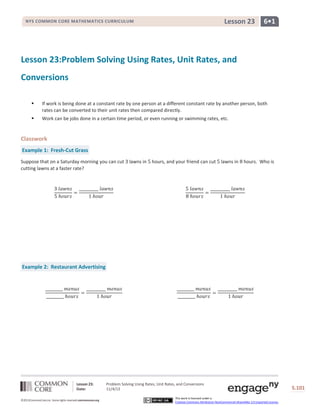
Example 1: Fresh-Cut Grass
Suppose that on a Saturday morning you can cut
cutting lawns at a faster rate?

lawns in

hours, and your friend can cut

lawns in

hours. Who is

Example 2: Restaurant Advertising

Lesson 23:
Date:
©2013CommonCore,Inc. Some rights reserved.commoncore.org

Problem Solving Using Rates, Unit Rates, and Conversions
11/4/13
This work is licensed under a
Creative Commons Attribution-NonCommercial-ShareAlike 3.0 Unported License.

S.101
Lesson 23

NYS COMMON CORE MATHEMATICS CURRICULUM

6•1

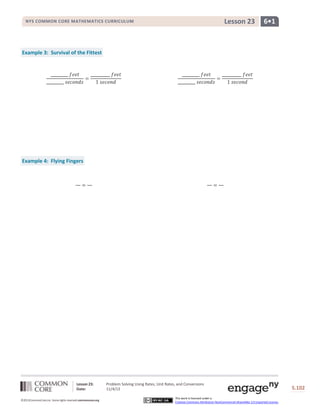
Example 3: Survival of the Fittest

Example 4: Flying Fingers

Lesson 23:
Date:
©2013CommonCore,Inc. Some rights reserved.commoncore.org

Problem Solving Using Rates, Unit Rates, and Conversions
11/4/13
This work is licensed under a
Creative Commons Attribution-NonCommercial-ShareAlike 3.0 Unported License.

S.102
Lesson 23

NYS COMMON CORE MATHEMATICS CURRICULUM

6•1

Lesson Summary


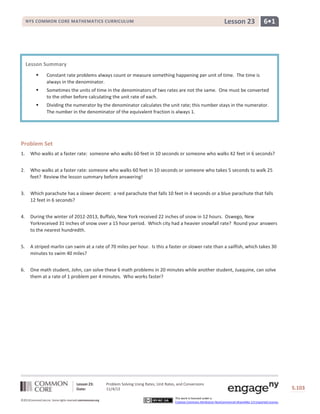
Constant rate problems always count or measure something happening per unit of time. The time is
always in the denominator.



Sometimes the units of time in the denominators of two rates are not the same. One must be converted
to the other before calculating the unit rate of each.



Dividing the numerator by the denominator calculates the unit rate; this number stays in the numerator.
The number in the denominator of the equivalent fraction is always 1.

Problem Set
1.

Who walks at a faster rate: someone who walks 60 feet in 10 seconds or someone who walks 42 feet in 6 seconds?

2.

Who walks at a faster rate: someone who walks 60 feet in 10 seconds or someone who takes 5 seconds to walk 25
feet? Review the lesson summary before answering!

3.

Which parachute has a slower decent: a red parachute that falls 10 feet in 4 seconds or a blue parachute that falls
12 feet in 6 seconds?

4.

During the winter of 2012-2013, Buffalo, New York received 22 inches of snow in 12 hours. Oswego, New
Yorkreceived 31 inches of snow over a 15 hour period. Which city had a heavier snowfall rate? Round your answers
to the nearest hundredth.

5.

A striped marlin can swim at a rate of 70 miles per hour. Is this a faster or slower rate than a sailfish, which takes 30
minutes to swim 40 miles?

6.

One math student, John, can solve these 6 math problems in 20 minutes while another student, Juaquine, can solve
them at a rate of 1 problem per 4 minutes. Who works faster?

Lesson 23:
Date:
©2013CommonCore,Inc. Some rights reserved.commoncore.org

Problem Solving Using Rates, Unit Rates, and Conversions
11/4/13
This work is licensed under a
Creative Commons Attribution-NonCommercial-ShareAlike 3.0 Unported License.

S.103

G6 m1-c-lesson 23-s

  • 1.
    Lesson 23 NYS COMMONCORE MATHEMATICS CURRICULUM 6•1 Lesson 23:Problem Solving Using Rates, Unit Rates, and Conversions  If work is being done at a constant rate by one person at a different constant rate by another person, both rates can be converted to their unit rates then compared directly.  Work can be jobs done in a certain time period, or even running or swimming rates, etc. Classwork Example 1: Fresh-Cut Grass Suppose that on a Saturday morning you can cut cutting lawns at a faster rate? lawns in hours, and your friend can cut lawns in hours. Who is Example 2: Restaurant Advertising Lesson 23: Date: ©2013CommonCore,Inc. Some rights reserved.commoncore.org Problem Solving Using Rates, Unit Rates, and Conversions 11/4/13 This work is licensed under a Creative Commons Attribution-NonCommercial-ShareAlike 3.0 Unported License. S.101
  • 2.
    Lesson 23 NYS COMMONCORE MATHEMATICS CURRICULUM 6•1 Example 3: Survival of the Fittest Example 4: Flying Fingers Lesson 23: Date: ©2013CommonCore,Inc. Some rights reserved.commoncore.org Problem Solving Using Rates, Unit Rates, and Conversions 11/4/13 This work is licensed under a Creative Commons Attribution-NonCommercial-ShareAlike 3.0 Unported License. S.102
  • 3.
    Lesson 23 NYS COMMONCORE MATHEMATICS CURRICULUM 6•1 Lesson Summary  Constant rate problems always count or measure something happening per unit of time. The time is always in the denominator.  Sometimes the units of time in the denominators of two rates are not the same. One must be converted to the other before calculating the unit rate of each.  Dividing the numerator by the denominator calculates the unit rate; this number stays in the numerator. The number in the denominator of the equivalent fraction is always 1. Problem Set 1. Who walks at a faster rate: someone who walks 60 feet in 10 seconds or someone who walks 42 feet in 6 seconds? 2. Who walks at a faster rate: someone who walks 60 feet in 10 seconds or someone who takes 5 seconds to walk 25 feet? Review the lesson summary before answering! 3. Which parachute has a slower decent: a red parachute that falls 10 feet in 4 seconds or a blue parachute that falls 12 feet in 6 seconds? 4. During the winter of 2012-2013, Buffalo, New York received 22 inches of snow in 12 hours. Oswego, New Yorkreceived 31 inches of snow over a 15 hour period. Which city had a heavier snowfall rate? Round your answers to the nearest hundredth. 5. A striped marlin can swim at a rate of 70 miles per hour. Is this a faster or slower rate than a sailfish, which takes 30 minutes to swim 40 miles? 6. One math student, John, can solve these 6 math problems in 20 minutes while another student, Juaquine, can solve them at a rate of 1 problem per 4 minutes. Who works faster? Lesson 23: Date: ©2013CommonCore,Inc. Some rights reserved.commoncore.org Problem Solving Using Rates, Unit Rates, and Conversions 11/4/13 This work is licensed under a Creative Commons Attribution-NonCommercial-ShareAlike 3.0 Unported License. S.103