AN ASSIGNMENT SUBMITTED TO THE DEPARTMENT OF CIVIL
ENGINEERING, BAYERO UNIVERSITY, KANO STATE.
ZAINAB SANI SHEHU
SPS/21/MCE/00033
CIV8331 (ADVANCE TRANSPORTATION ENGINEERING)
ASSIGNMENT TO IDENTIFY THE RANGE OF THRESHOLD FOR
FUZZY INPUT IN TRAFFIC FLOW
28TH
NOVEMBER, 2023
INTRODUCTION
Fuzzy input refers to the use of fuzzy logic to model and interpret imprecise or uncertain
information related to traffic conditions. Fuzzy logic allows for the representation of traffic
parameters such as traffic speed, volume and density in linguistics terms rather than precise
numerical value
Determining the threshold values, for input in traffic flow relies on a variety of factors. Is typically
established by analyzing historical data, seeking expert knowledge or conducting simulation
studies. Fuzzy logic plays a pivotal role in managing traffic flow by incorporating a range of
thresholds that govern decision-making processes. These thresholds, defining the nuanced degrees
of conditions such as speed, congestion, and safety, are crucial in creating a flexible and adaptive
system capable of handling the dynamic nature of traffic. In this introduction, we'll explore how
these threshold ranges in fuzzy logic contribute to optimizing traffic flow and enhancing overall
transportation efficiency. Fuzzy logic theory is based on a premise that the key elements of human
thinking are not numbers, but rather labels of fuzzy sets. In other words, the pervasiveness of
fuzziness in human thought processes suggests that much of the logic behind human reasoning is
not the traditional two or multivalued logic, but a logic with fuzzy truths, fuzzy connectives and
fuzzy rules of inference (Zadeh 1973).
1.1 Aim of the study
The aim of the study is to optimize the fuzzy logic system's performance by identifying the most
effective range of input values that accurately represent the dynamic nature of traffic conditions.
This helps enhance the system's ability to make precise decisions and control mechanisms,
contributing to improved traffic management and flow.
1.2 Objectives of fuzzy input model
1) Capturing and representing uncertainty, imprecision, and vagueness in information,
enabling effective decision making in situations with incomplete or ambiguous data.
2) Improving traffic control and management by handling uncertainty, Fuzzy models help
account for unpredictable factors like varying traffic conditions, weather, and driver
behavior.
3) Fuzzy logic can enhance traffic signal timing by considering real-time data, reducing
congestion, and improving overall traffic flow.
4) Fuzzy models allow systems to adapt to changing traffic situations, providing dynamic
and context-aware control.
5) Reducing Congestion by incorporating fuzzy logic into traffic management, models can
respond to congestion in a more nuanced way, helping to alleviate traffic jams.
6) Fuzzy models aid in decision-making by considering imprecise inputs, making traffic
control systems more robust and responsive.
7) Fuzzy logic enables the development of intelligent systems that optimize traffic efficiency,
considering factors such as vehicle density, speed, and environmental conditions.
1.3 Problems of the study
Identifying fuzzy input thresholds for traffic flow is challenging due to subjective definitions,
dynamic conditions, data variability, and sensitivity to input changes, and the complex
interactions among traffic variables, requiring adaptive, data-driven approaches for effective
traffic management.
1.4 Current research in the area
Current research in determining thresholds for fuzzy input in traffic flow involves advanced
machine learning techniques, real-time data integration, and adaptive models. Researchers are
exploring dynamic approaches to account for changing conditions, optimizing fuzzy logic
parameters through automated learning, and leveraging artificial intelligence for accurate
threshold identification, publications and academic databases.
LITERATURE REVIEW
In understanding and developing an optimal transport network with efficient movement of
traffic and minimal traffic congestion (Wardrop 1952). It is considered that efficient movement
of traffic is achieved through the following goals: keep traffic flowing, slow down traffic
before known congestion areas and reduce risk of accidents (Krause, von Altrock, and Fuzzy
logic was first time proposed by Lotti Zadeh in 1965. Before Zadeh many efforts were done in
this field by many researchers like Plato, Hegel, Marx,Lukasiewicz etc. Some of them gave
three valued logic and some of them gave four valued or five valued logic, which are the
extension of Boolean logic, which accepts only two values true or false (0 or 1).
Lotti Zadeh in his work "Fuzzy sets" described mathematics as fuzzy sets and fuzzy logic.
Before the introduction of fuzzy logic, mathematics is confined only to two conclusions that is
true or false (0 or 1). But fuzzy logic has extended this range to the real numbers (0, 1).
Traffic flow theory dates back to the early fifties when Wardrop (1952) described traffic flow
using mathematical and statistical ideas. Traffic flow theory studies the interactions between
travelers (pedestrians, cyclists, drivers and their vehicles) and infrastructure (highways,
signage and traffic control devices). It aims Pozybill 1996). For this cause, the scientific field
of traffic engineering defines three main properties of the traffic stream (Immers and Logghe
2008), including density, flow and mean speed. These parameters are commonly known as
macroscopic traffic variables (vehicles are not seen as separate entities) and can be calculated
for every location, at any point of time and for every measurement interval.
Various traffic flow control methods are employed to manage and optimize traffic in urban
areas. Here are some common approaches:
1. Traffic Signal Control:
•Fixed Timing Signals: Predetermined signal timings based on average traffic patterns.
•Adaptive Traffic Signals: Adjust signal timings dynamically based on real-time traffic
conditions.
2. Traffic Signs and Markings:
• Clear Signage: Well-designed signs indicating speed limits, lane changes, and directions.
• Road Markings: Clearly marked lanes, crosswalks, and symbols to guide drivers.
3. Roundabouts:
•Circular intersections that promote a continuous flow of traffic, reducing the need for
complete stops.
4. Intelligent Transportation Systems (ITS):
•Traffic Surveillance: Real-time monitoring using cameras and sensors to assess traffic
conditions.
• Dynamic Message Signs: Providing real-time information to drivers about traffic
conditions and alternative routes.
5. Variable Speed Limits:
• Adjusting speed limits based on real-time traffic conditions to maintain a smoother flow.
2.1 Fuzzy Model Threshold
In fuzzy logic, a fuzzy input threshold is a value used to determine the membership of a variable
in a fuzzy set. It helps define the degree to which an element belong to a particular set, allowing
for more nuanced and flexible reasoning in systems with uncertainty. The threshold is used to
assess the extent to which an input falls within the boundaries of a fuzzy set, assigning it a degree
of membership. Traffic management key fuzzy parameters often include density, volume, and
speed. These parameters are crucial for modelling and controlling traffic flow, especially in
situations where imprecision and uncertainty are prevalent.
2.1.1 Vehicle Density; It refers to the number of vehicles present within a specific length of
roadway at a given time. It is usually measured in vehicles per unit distance, such as vehicle per
kilometer or vehicles per mile. Fuzzy logic describe traffic density with terms like low, moderate,
and high. Membership functions model the gradual transition between these categories, capturing
the imprecision in density measurement .For example if we consider a certain traffic flow like
congestion.
Congestion; It refers to a condition on roadways where the demand for the use of
transportation network exceeds its capacity, leading to a significant reduction in the speed of
vehicles. Vehicles often experiences slower speeds, longer travel times, and sometimes complete
standstill. The threshold can be based on the desired levels of congestion such as free flow, light
congestion, moderate congestion, heavy congestion or very heavy congestion. The fuzzy threshold
will be defined based on the characteristic, factors, and goal of the traffic management system.
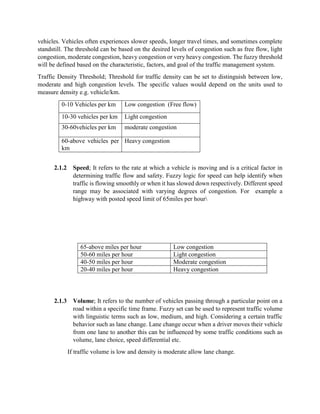
Traffic Density Threshold; Threshold for traffic density can be set to distinguish between low,
moderate and high congestion levels. The specific values would depend on the units used to
measure density e.g. vehicle/km.
0-10 Vehicles per km Low congestion (Free flow)
10-30 vehicles per km Light congestion
30-60vehicles per km moderate congestion
60-above vehicles per
km
Heavy congestion
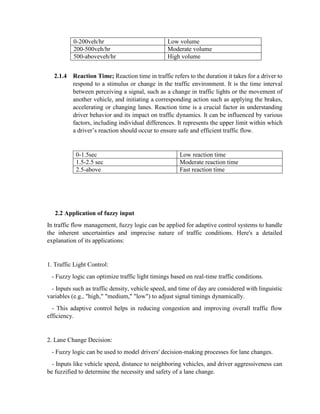
2.1.2 Speed; It refers to the rate at which a vehicle is moving and is a critical factor in
determining traffic flow and safety. Fuzzy logic for speed can help identify when
traffic is flowing smoothly or when it has slowed down respectively. Different speed
range may be associated with varying degrees of congestion. For example a
highway with posted speed limit of 65miles per hour
65-above miles per hour Low congestion
50-60 miles per hour Light congestion
40-50 miles per hour Moderate congestion
20-40 miles per hour Heavy congestion
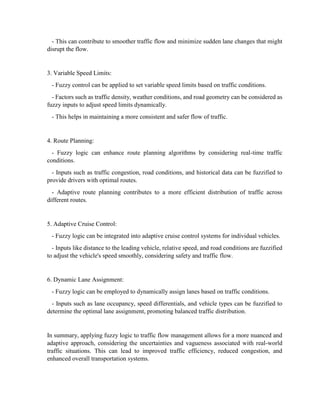
2.1.3 Volume; It refers to the number of vehicles passing through a particular point on a
road within a specific time frame. Fuzzy set can be used to represent traffic volume
with linguistic terms such as low, medium, and high. Considering a certain traffic
behavior such as lane change. Lane change occur when a driver moves their vehicle
from one lane to another this can be influenced by some traffic conditions such as
volume, lane choice, speed differential etc.
If traffic volume is low and density is moderate allow lane change.
0-200veh/hr Low volume
200-500veh/hr Moderate volume
500-aboveveh/hr High volume
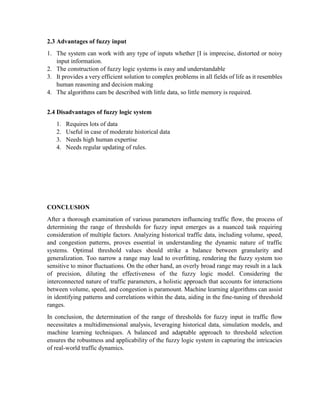
2.1.4 Reaction Time; Reaction time in traffic refers to the duration it takes for a driver to
respond to a stimulus or change in the traffic environment. It is the time interval
between perceiving a signal, such as a change in traffic lights or the movement of
another vehicle, and initiating a corresponding action such as applying the brakes,
accelerating or changing lanes. Reaction time is a crucial factor in understanding
driver behavior and its impact on traffic dynamics. It can be influenced by various
factors, including individual differences. It represents the upper limit within which
a driver’s reaction should occur to ensure safe and efficient traffic flow.
0-1.5sec Low reaction time
1.5-2.5 sec Moderate reaction time
2.5-above Fast reaction time
2.2 Application of fuzzy input
In traffic flow management, fuzzy logic can be applied for adaptive control systems to handle
the inherent uncertainties and imprecise nature of traffic conditions. Here's a detailed
explanation of its applications:
1. Traffic Light Control:
- Fuzzy logic can optimize traffic light timings based on real-time traffic conditions.
- Inputs such as traffic density, vehicle speed, and time of day are considered with linguistic
variables (e.g., "high," "medium," "low") to adjust signal timings dynamically.
- This adaptive control helps in reducing congestion and improving overall traffic flow
efficiency.
2. Lane Change Decision:
- Fuzzy logic can be used to model drivers' decision-making processes for lane changes.
- Inputs like vehicle speed, distance to neighboring vehicles, and driver aggressiveness can
be fuzzified to determine the necessity and safety of a lane change.
- This can contribute to smoother traffic flow and minimize sudden lane changes that might
disrupt the flow.
3. Variable Speed Limits:
- Fuzzy control can be applied to set variable speed limits based on traffic conditions.
- Factors such as traffic density, weather conditions, and road geometry can be considered as
fuzzy inputs to adjust speed limits dynamically.
- This helps in maintaining a more consistent and safer flow of traffic.
4. Route Planning:
- Fuzzy logic can enhance route planning algorithms by considering real-time traffic
conditions.
- Inputs such as traffic congestion, road conditions, and historical data can be fuzzified to
provide drivers with optimal routes.
- Adaptive route planning contributes to a more efficient distribution of traffic across
different routes.
5. Adaptive Cruise Control:
- Fuzzy logic can be integrated into adaptive cruise control systems for individual vehicles.
- Inputs like distance to the leading vehicle, relative speed, and road conditions are fuzzified
to adjust the vehicle's speed smoothly, considering safety and traffic flow.
6. Dynamic Lane Assignment:
- Fuzzy logic can be employed to dynamically assign lanes based on traffic conditions.
- Inputs such as lane occupancy, speed differentials, and vehicle types can be fuzzified to
determine the optimal lane assignment, promoting balanced traffic distribution.
In summary, applying fuzzy logic to traffic flow management allows for a more nuanced and
adaptive approach, considering the uncertainties and vagueness associated with real-world
traffic situations. This can lead to improved traffic efficiency, reduced congestion, and
enhanced overall transportation systems.
2.3 Advantages of fuzzy input
1. The system can work with any type of inputs whether [I is imprecise, distorted or noisy
input information.
2. The construction of fuzzy logic systems is easy and understandable
3. It provides a very efficient solution to complex problems in all fields of life as it resembles
human reasoning and decision making
4. The algorithms cam be described with little data, so little memory is required.
2.4 Disadvantages of fuzzy logic system
1. Requires lots of data
2. Useful in case of moderate historical data
3. Needs high human expertise
4. Needs regular updating of rules.
CONCLUSION
After a thorough examination of various parameters influencing traffic flow, the process of
determining the range of thresholds for fuzzy input emerges as a nuanced task requiring
consideration of multiple factors. Analyzing historical traffic data, including volume, speed,
and congestion patterns, proves essential in understanding the dynamic nature of traffic
systems. Optimal threshold values should strike a balance between granularity and
generalization. Too narrow a range may lead to overfitting, rendering the fuzzy system too
sensitive to minor fluctuations. On the other hand, an overly broad range may result in a lack
of precision, diluting the effectiveness of the fuzzy logic model. Considering the
interconnected nature of traffic parameters, a holistic approach that accounts for interactions
between volume, speed, and congestion is paramount. Machine learning algorithms can assist
in identifying patterns and correlations within the data, aiding in the fine-tuning of threshold
ranges.
In conclusion, the determination of the range of thresholds for fuzzy input in traffic flow
necessitates a multidimensional analysis, leveraging historical data, simulation models, and
machine learning techniques. A balanced and adaptable approach to threshold selection
ensures the robustness and applicability of the fuzzy logic system in capturing the intricacies
of real-world traffic dynamics.
RECOMMENDATION
For a balanced and adaptable threshold range, it is important to fine-tune these thresholds based
on location conditions, the goal of the traffic management, and any specific requirements of
the application. Further adjustment may be included to ensure the fuzzy logic system responds
effectively to changing traffic conditions. Also, a multidimensional analysis, leveraging
historical data, simulation models, and machine learning techniques should be in cooperated
in the development of threshold range.
REFERENCE
1. Aftabuzzaman, M. 2007. “Measuring Tra"c Congestion - A Critical Review.” 30th
Australasian Transport Research Forum. Accessed 30 November 2018.
https://scholar.google.com/scholar?
as_q=Measuring+tra"c+congestion%3A+A+critical+review&as_occt=title&hl=en&
as_sdt=0%2C31 [Google Scholar]
2. D’Este, G., R. Zito, and M. Taylor. 1999. “Using GPS to Measure Tra"c System
Performance.” Computer - Aided Civil and Infrastructure Engineering. 14 (4): 255– 265.
doi:10.1111/0885-9507.00146. [Crossref], [Google Scholar]
3. Downs, A. 2004. “Why Tra"c Congestion Is Here to Stay … and Will Get Worse.” ACCESS
Magazine 1 (25): 19–25. Accessed 30 November 2018.
https://escholarship.org/uc/item/3sh9003x [Google Scholar]
4. Fullér, R., and H. Zimmermann. 1993. “Fuzzy Reasoning for Solving Fuzzy Mathematical
Programming Problems.” Fuzzy Sets and Systems 60 (3): 121–133. Accessed 30 November
2018. https://pdfs.semanticscholar.org/0ca9/bb36a2b7917f2652ac1062ad25c37dacc97
b.pdf [Crossref], [Google Scholar]
5. Herrera, J.,Work, D. B., Herring, R., Ban, X. J., Jacobson, Q., and Bayen, A. M. 2010.
“Evaluation of Tra"c Data Obtained via GPS-enabled Mobile Phones: The Mobile Century
Field Experiment. Transportation Research Part C: Emerging Technologies.” Pergamon 18 (4):
568–583. doi:10.1016/J.TRC.2009.10.006. [Crossref], [Google Scholar]
6. Immers, L., and S. Logghe. 2008. “Multi-class Kinematic Wave Theory of Tra"c Flow.
Transportation Research Part B: Methodological.” Pergamon 42 (6): 523–541.
doi:10.1016/J.TRB.2007.11.001. [Crossref], [Google Scholar]
7. Kockelman, K. 2004. “Tra"c Congestion.” In Handbook of Transportation Engineering
Chapter 12: Tra!c Congestion, edited by K. Myer. pp. 1-20.
8. DLR and contributors: Sumo homepage (2013). Avaliable athttp://sumo.
dlr.de/wiki/Main_Page
9. Duret A, Ahn S, Buisson C (2009) Spatio-temporal analysis of impacts of lane changing
consistent with wave propagation. In: Transportation Research Board 87th
Annual Meeting,
Compendium of papers,
Washington, D.C. pp 16–p
10. Frejo JRD, Núñez A, De Schutter B, Camacho EF (2014) Hybrid model predictive
control for freeway traffic using discrete speed limit signals. Transp Res C Emerg Technol
46:309–325
11 .Gipps P (1981) A behavioural car-following model for computer simulation. Transp Res
B Methodol 15(2):105–111
12. Grumert E (2014) Cooperative variable speed limit systems : Modeling and evaluation
using microscopic traffic simulation. Licentiate thesis, Linköping University. Linköping
University Press, Sweden. No. 1670

Fuzzy logic

  • 1.
    AN ASSIGNMENT SUBMITTEDTO THE DEPARTMENT OF CIVIL ENGINEERING, BAYERO UNIVERSITY, KANO STATE. ZAINAB SANI SHEHU SPS/21/MCE/00033 CIV8331 (ADVANCE TRANSPORTATION ENGINEERING) ASSIGNMENT TO IDENTIFY THE RANGE OF THRESHOLD FOR FUZZY INPUT IN TRAFFIC FLOW 28TH NOVEMBER, 2023
  • 2.
    INTRODUCTION Fuzzy input refersto the use of fuzzy logic to model and interpret imprecise or uncertain information related to traffic conditions. Fuzzy logic allows for the representation of traffic parameters such as traffic speed, volume and density in linguistics terms rather than precise numerical value Determining the threshold values, for input in traffic flow relies on a variety of factors. Is typically established by analyzing historical data, seeking expert knowledge or conducting simulation studies. Fuzzy logic plays a pivotal role in managing traffic flow by incorporating a range of thresholds that govern decision-making processes. These thresholds, defining the nuanced degrees of conditions such as speed, congestion, and safety, are crucial in creating a flexible and adaptive system capable of handling the dynamic nature of traffic. In this introduction, we'll explore how these threshold ranges in fuzzy logic contribute to optimizing traffic flow and enhancing overall transportation efficiency. Fuzzy logic theory is based on a premise that the key elements of human thinking are not numbers, but rather labels of fuzzy sets. In other words, the pervasiveness of fuzziness in human thought processes suggests that much of the logic behind human reasoning is not the traditional two or multivalued logic, but a logic with fuzzy truths, fuzzy connectives and fuzzy rules of inference (Zadeh 1973). 1.1 Aim of the study The aim of the study is to optimize the fuzzy logic system's performance by identifying the most effective range of input values that accurately represent the dynamic nature of traffic conditions. This helps enhance the system's ability to make precise decisions and control mechanisms, contributing to improved traffic management and flow. 1.2 Objectives of fuzzy input model 1) Capturing and representing uncertainty, imprecision, and vagueness in information, enabling effective decision making in situations with incomplete or ambiguous data. 2) Improving traffic control and management by handling uncertainty, Fuzzy models help account for unpredictable factors like varying traffic conditions, weather, and driver behavior. 3) Fuzzy logic can enhance traffic signal timing by considering real-time data, reducing congestion, and improving overall traffic flow. 4) Fuzzy models allow systems to adapt to changing traffic situations, providing dynamic and context-aware control. 5) Reducing Congestion by incorporating fuzzy logic into traffic management, models can respond to congestion in a more nuanced way, helping to alleviate traffic jams. 6) Fuzzy models aid in decision-making by considering imprecise inputs, making traffic control systems more robust and responsive. 7) Fuzzy logic enables the development of intelligent systems that optimize traffic efficiency, considering factors such as vehicle density, speed, and environmental conditions.
  • 3.
    1.3 Problems ofthe study Identifying fuzzy input thresholds for traffic flow is challenging due to subjective definitions, dynamic conditions, data variability, and sensitivity to input changes, and the complex interactions among traffic variables, requiring adaptive, data-driven approaches for effective traffic management. 1.4 Current research in the area Current research in determining thresholds for fuzzy input in traffic flow involves advanced machine learning techniques, real-time data integration, and adaptive models. Researchers are exploring dynamic approaches to account for changing conditions, optimizing fuzzy logic parameters through automated learning, and leveraging artificial intelligence for accurate threshold identification, publications and academic databases. LITERATURE REVIEW In understanding and developing an optimal transport network with efficient movement of traffic and minimal traffic congestion (Wardrop 1952). It is considered that efficient movement of traffic is achieved through the following goals: keep traffic flowing, slow down traffic before known congestion areas and reduce risk of accidents (Krause, von Altrock, and Fuzzy logic was first time proposed by Lotti Zadeh in 1965. Before Zadeh many efforts were done in this field by many researchers like Plato, Hegel, Marx,Lukasiewicz etc. Some of them gave three valued logic and some of them gave four valued or five valued logic, which are the extension of Boolean logic, which accepts only two values true or false (0 or 1). Lotti Zadeh in his work "Fuzzy sets" described mathematics as fuzzy sets and fuzzy logic. Before the introduction of fuzzy logic, mathematics is confined only to two conclusions that is true or false (0 or 1). But fuzzy logic has extended this range to the real numbers (0, 1). Traffic flow theory dates back to the early fifties when Wardrop (1952) described traffic flow using mathematical and statistical ideas. Traffic flow theory studies the interactions between travelers (pedestrians, cyclists, drivers and their vehicles) and infrastructure (highways, signage and traffic control devices). It aims Pozybill 1996). For this cause, the scientific field of traffic engineering defines three main properties of the traffic stream (Immers and Logghe 2008), including density, flow and mean speed. These parameters are commonly known as macroscopic traffic variables (vehicles are not seen as separate entities) and can be calculated for every location, at any point of time and for every measurement interval. Various traffic flow control methods are employed to manage and optimize traffic in urban areas. Here are some common approaches: 1. Traffic Signal Control: •Fixed Timing Signals: Predetermined signal timings based on average traffic patterns.
  • 4.
    •Adaptive Traffic Signals:Adjust signal timings dynamically based on real-time traffic conditions. 2. Traffic Signs and Markings: • Clear Signage: Well-designed signs indicating speed limits, lane changes, and directions. • Road Markings: Clearly marked lanes, crosswalks, and symbols to guide drivers. 3. Roundabouts: •Circular intersections that promote a continuous flow of traffic, reducing the need for complete stops. 4. Intelligent Transportation Systems (ITS): •Traffic Surveillance: Real-time monitoring using cameras and sensors to assess traffic conditions. • Dynamic Message Signs: Providing real-time information to drivers about traffic conditions and alternative routes. 5. Variable Speed Limits: • Adjusting speed limits based on real-time traffic conditions to maintain a smoother flow. 2.1 Fuzzy Model Threshold In fuzzy logic, a fuzzy input threshold is a value used to determine the membership of a variable in a fuzzy set. It helps define the degree to which an element belong to a particular set, allowing for more nuanced and flexible reasoning in systems with uncertainty. The threshold is used to assess the extent to which an input falls within the boundaries of a fuzzy set, assigning it a degree of membership. Traffic management key fuzzy parameters often include density, volume, and speed. These parameters are crucial for modelling and controlling traffic flow, especially in situations where imprecision and uncertainty are prevalent. 2.1.1 Vehicle Density; It refers to the number of vehicles present within a specific length of roadway at a given time. It is usually measured in vehicles per unit distance, such as vehicle per kilometer or vehicles per mile. Fuzzy logic describe traffic density with terms like low, moderate, and high. Membership functions model the gradual transition between these categories, capturing the imprecision in density measurement .For example if we consider a certain traffic flow like congestion. Congestion; It refers to a condition on roadways where the demand for the use of transportation network exceeds its capacity, leading to a significant reduction in the speed of
  • 5.
    vehicles. Vehicles oftenexperiences slower speeds, longer travel times, and sometimes complete standstill. The threshold can be based on the desired levels of congestion such as free flow, light congestion, moderate congestion, heavy congestion or very heavy congestion. The fuzzy threshold will be defined based on the characteristic, factors, and goal of the traffic management system. Traffic Density Threshold; Threshold for traffic density can be set to distinguish between low, moderate and high congestion levels. The specific values would depend on the units used to measure density e.g. vehicle/km. 0-10 Vehicles per km Low congestion (Free flow) 10-30 vehicles per km Light congestion 30-60vehicles per km moderate congestion 60-above vehicles per km Heavy congestion 2.1.2 Speed; It refers to the rate at which a vehicle is moving and is a critical factor in determining traffic flow and safety. Fuzzy logic for speed can help identify when traffic is flowing smoothly or when it has slowed down respectively. Different speed range may be associated with varying degrees of congestion. For example a highway with posted speed limit of 65miles per hour 65-above miles per hour Low congestion 50-60 miles per hour Light congestion 40-50 miles per hour Moderate congestion 20-40 miles per hour Heavy congestion 2.1.3 Volume; It refers to the number of vehicles passing through a particular point on a road within a specific time frame. Fuzzy set can be used to represent traffic volume with linguistic terms such as low, medium, and high. Considering a certain traffic behavior such as lane change. Lane change occur when a driver moves their vehicle from one lane to another this can be influenced by some traffic conditions such as volume, lane choice, speed differential etc. If traffic volume is low and density is moderate allow lane change.
  • 6.
    0-200veh/hr Low volume 200-500veh/hrModerate volume 500-aboveveh/hr High volume 2.1.4 Reaction Time; Reaction time in traffic refers to the duration it takes for a driver to respond to a stimulus or change in the traffic environment. It is the time interval between perceiving a signal, such as a change in traffic lights or the movement of another vehicle, and initiating a corresponding action such as applying the brakes, accelerating or changing lanes. Reaction time is a crucial factor in understanding driver behavior and its impact on traffic dynamics. It can be influenced by various factors, including individual differences. It represents the upper limit within which a driver’s reaction should occur to ensure safe and efficient traffic flow. 0-1.5sec Low reaction time 1.5-2.5 sec Moderate reaction time 2.5-above Fast reaction time 2.2 Application of fuzzy input In traffic flow management, fuzzy logic can be applied for adaptive control systems to handle the inherent uncertainties and imprecise nature of traffic conditions. Here's a detailed explanation of its applications: 1. Traffic Light Control: - Fuzzy logic can optimize traffic light timings based on real-time traffic conditions. - Inputs such as traffic density, vehicle speed, and time of day are considered with linguistic variables (e.g., "high," "medium," "low") to adjust signal timings dynamically. - This adaptive control helps in reducing congestion and improving overall traffic flow efficiency. 2. Lane Change Decision: - Fuzzy logic can be used to model drivers' decision-making processes for lane changes. - Inputs like vehicle speed, distance to neighboring vehicles, and driver aggressiveness can be fuzzified to determine the necessity and safety of a lane change.
  • 7.
    - This cancontribute to smoother traffic flow and minimize sudden lane changes that might disrupt the flow. 3. Variable Speed Limits: - Fuzzy control can be applied to set variable speed limits based on traffic conditions. - Factors such as traffic density, weather conditions, and road geometry can be considered as fuzzy inputs to adjust speed limits dynamically. - This helps in maintaining a more consistent and safer flow of traffic. 4. Route Planning: - Fuzzy logic can enhance route planning algorithms by considering real-time traffic conditions. - Inputs such as traffic congestion, road conditions, and historical data can be fuzzified to provide drivers with optimal routes. - Adaptive route planning contributes to a more efficient distribution of traffic across different routes. 5. Adaptive Cruise Control: - Fuzzy logic can be integrated into adaptive cruise control systems for individual vehicles. - Inputs like distance to the leading vehicle, relative speed, and road conditions are fuzzified to adjust the vehicle's speed smoothly, considering safety and traffic flow. 6. Dynamic Lane Assignment: - Fuzzy logic can be employed to dynamically assign lanes based on traffic conditions. - Inputs such as lane occupancy, speed differentials, and vehicle types can be fuzzified to determine the optimal lane assignment, promoting balanced traffic distribution. In summary, applying fuzzy logic to traffic flow management allows for a more nuanced and adaptive approach, considering the uncertainties and vagueness associated with real-world traffic situations. This can lead to improved traffic efficiency, reduced congestion, and enhanced overall transportation systems.
  • 8.
    2.3 Advantages offuzzy input 1. The system can work with any type of inputs whether [I is imprecise, distorted or noisy input information. 2. The construction of fuzzy logic systems is easy and understandable 3. It provides a very efficient solution to complex problems in all fields of life as it resembles human reasoning and decision making 4. The algorithms cam be described with little data, so little memory is required. 2.4 Disadvantages of fuzzy logic system 1. Requires lots of data 2. Useful in case of moderate historical data 3. Needs high human expertise 4. Needs regular updating of rules. CONCLUSION After a thorough examination of various parameters influencing traffic flow, the process of determining the range of thresholds for fuzzy input emerges as a nuanced task requiring consideration of multiple factors. Analyzing historical traffic data, including volume, speed, and congestion patterns, proves essential in understanding the dynamic nature of traffic systems. Optimal threshold values should strike a balance between granularity and generalization. Too narrow a range may lead to overfitting, rendering the fuzzy system too sensitive to minor fluctuations. On the other hand, an overly broad range may result in a lack of precision, diluting the effectiveness of the fuzzy logic model. Considering the interconnected nature of traffic parameters, a holistic approach that accounts for interactions between volume, speed, and congestion is paramount. Machine learning algorithms can assist in identifying patterns and correlations within the data, aiding in the fine-tuning of threshold ranges. In conclusion, the determination of the range of thresholds for fuzzy input in traffic flow necessitates a multidimensional analysis, leveraging historical data, simulation models, and machine learning techniques. A balanced and adaptable approach to threshold selection ensures the robustness and applicability of the fuzzy logic system in capturing the intricacies of real-world traffic dynamics.
  • 9.
    RECOMMENDATION For a balancedand adaptable threshold range, it is important to fine-tune these thresholds based on location conditions, the goal of the traffic management, and any specific requirements of the application. Further adjustment may be included to ensure the fuzzy logic system responds effectively to changing traffic conditions. Also, a multidimensional analysis, leveraging historical data, simulation models, and machine learning techniques should be in cooperated in the development of threshold range.
  • 10.
    REFERENCE 1. Aftabuzzaman, M.2007. “Measuring Tra"c Congestion - A Critical Review.” 30th Australasian Transport Research Forum. Accessed 30 November 2018. https://scholar.google.com/scholar? as_q=Measuring+tra"c+congestion%3A+A+critical+review&as_occt=title&hl=en& as_sdt=0%2C31 [Google Scholar] 2. D’Este, G., R. Zito, and M. Taylor. 1999. “Using GPS to Measure Tra"c System Performance.” Computer - Aided Civil and Infrastructure Engineering. 14 (4): 255– 265. doi:10.1111/0885-9507.00146. [Crossref], [Google Scholar] 3. Downs, A. 2004. “Why Tra"c Congestion Is Here to Stay … and Will Get Worse.” ACCESS Magazine 1 (25): 19–25. Accessed 30 November 2018. https://escholarship.org/uc/item/3sh9003x [Google Scholar] 4. Fullér, R., and H. Zimmermann. 1993. “Fuzzy Reasoning for Solving Fuzzy Mathematical Programming Problems.” Fuzzy Sets and Systems 60 (3): 121–133. Accessed 30 November 2018. https://pdfs.semanticscholar.org/0ca9/bb36a2b7917f2652ac1062ad25c37dacc97 b.pdf [Crossref], [Google Scholar] 5. Herrera, J.,Work, D. B., Herring, R., Ban, X. J., Jacobson, Q., and Bayen, A. M. 2010. “Evaluation of Tra"c Data Obtained via GPS-enabled Mobile Phones: The Mobile Century Field Experiment. Transportation Research Part C: Emerging Technologies.” Pergamon 18 (4): 568–583. doi:10.1016/J.TRC.2009.10.006. [Crossref], [Google Scholar] 6. Immers, L., and S. Logghe. 2008. “Multi-class Kinematic Wave Theory of Tra"c Flow. Transportation Research Part B: Methodological.” Pergamon 42 (6): 523–541. doi:10.1016/J.TRB.2007.11.001. [Crossref], [Google Scholar] 7. Kockelman, K. 2004. “Tra"c Congestion.” In Handbook of Transportation Engineering Chapter 12: Tra!c Congestion, edited by K. Myer. pp. 1-20. 8. DLR and contributors: Sumo homepage (2013). Avaliable athttp://sumo. dlr.de/wiki/Main_Page 9. Duret A, Ahn S, Buisson C (2009) Spatio-temporal analysis of impacts of lane changing consistent with wave propagation. In: Transportation Research Board 87th Annual Meeting, Compendium of papers, Washington, D.C. pp 16–p 10. Frejo JRD, Núñez A, De Schutter B, Camacho EF (2014) Hybrid model predictive control for freeway traffic using discrete speed limit signals. Transp Res C Emerg Technol 46:309–325 11 .Gipps P (1981) A behavioural car-following model for computer simulation. Transp Res B Methodol 15(2):105–111
  • 11.
    12. Grumert E(2014) Cooperative variable speed limit systems : Modeling and evaluation using microscopic traffic simulation. Licentiate thesis, Linköping University. Linköping University Press, Sweden. No. 1670