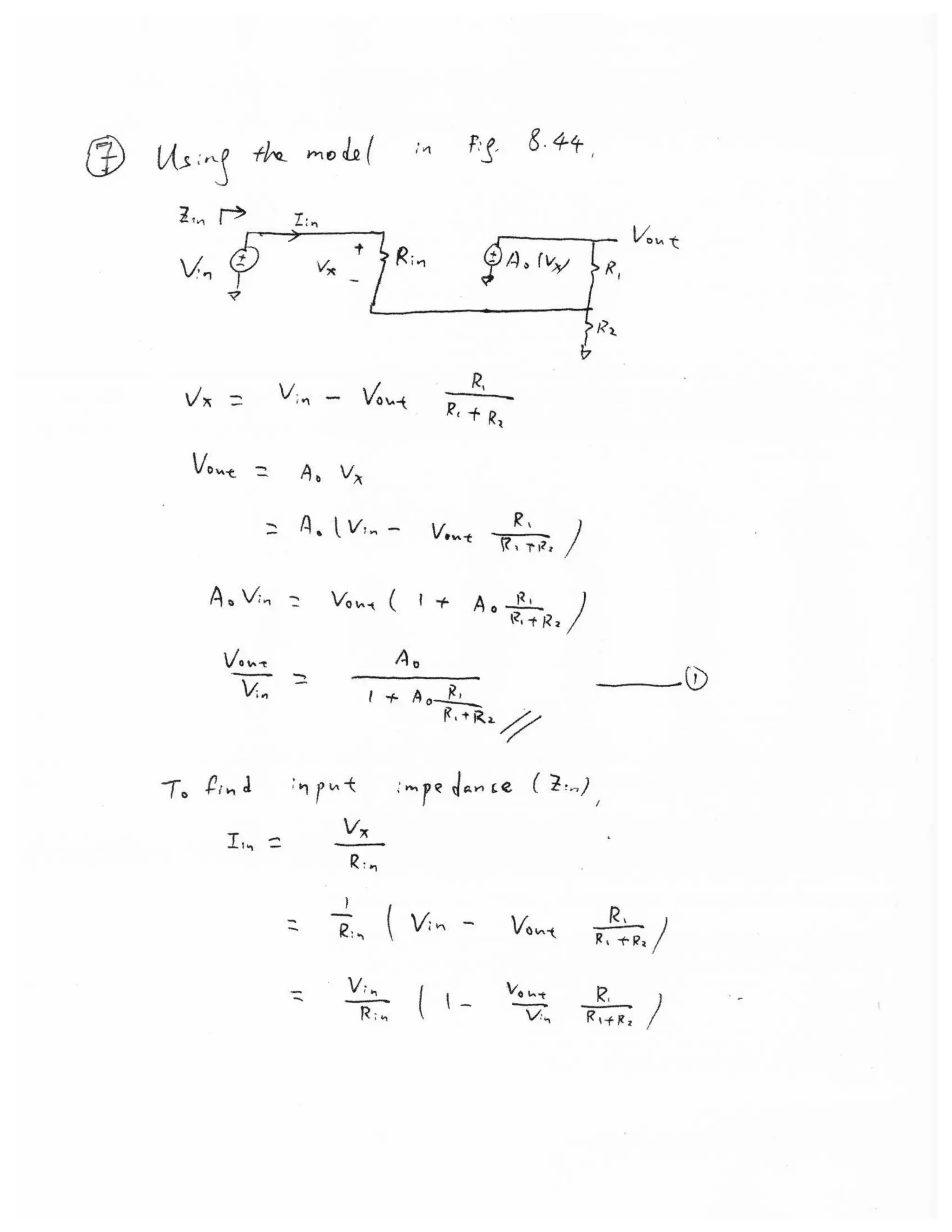
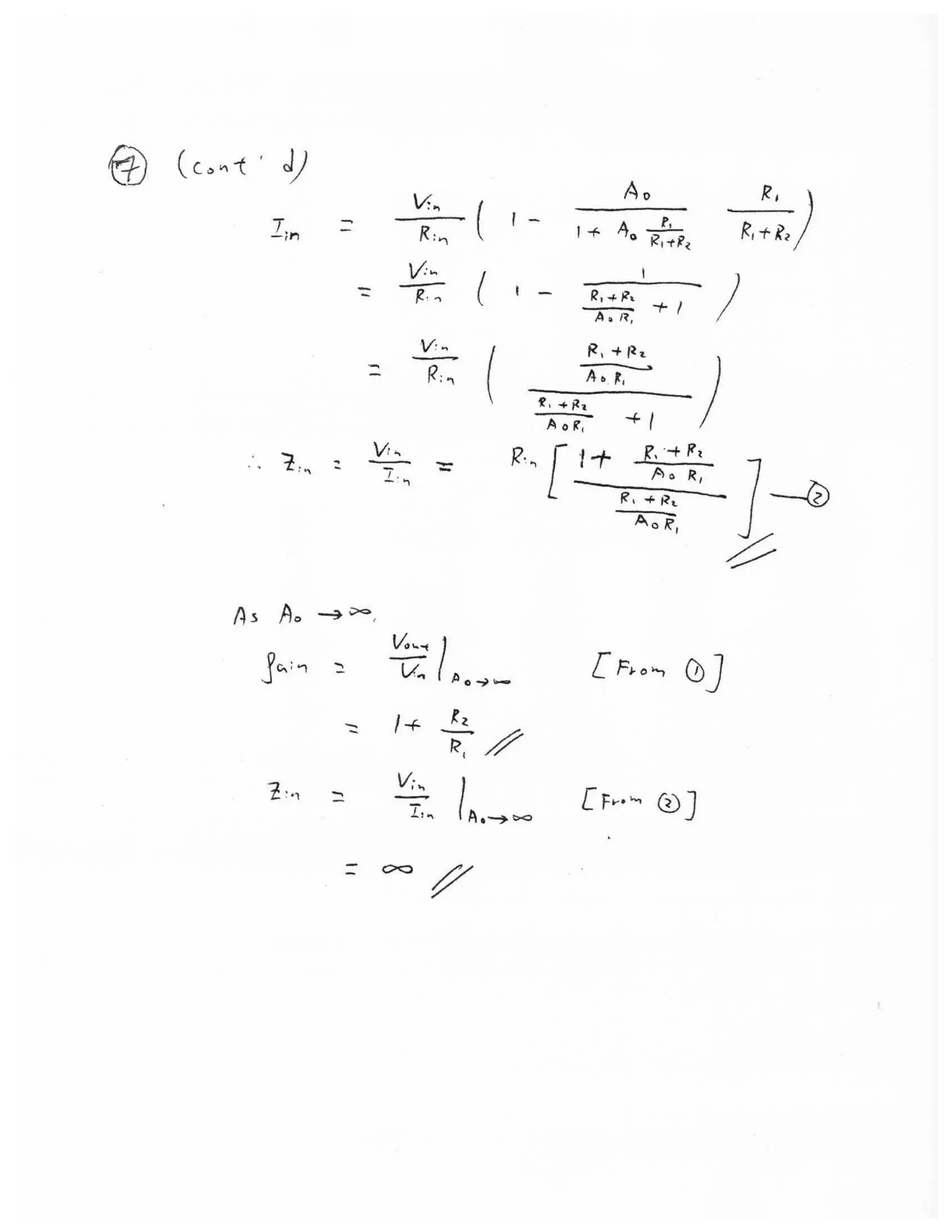
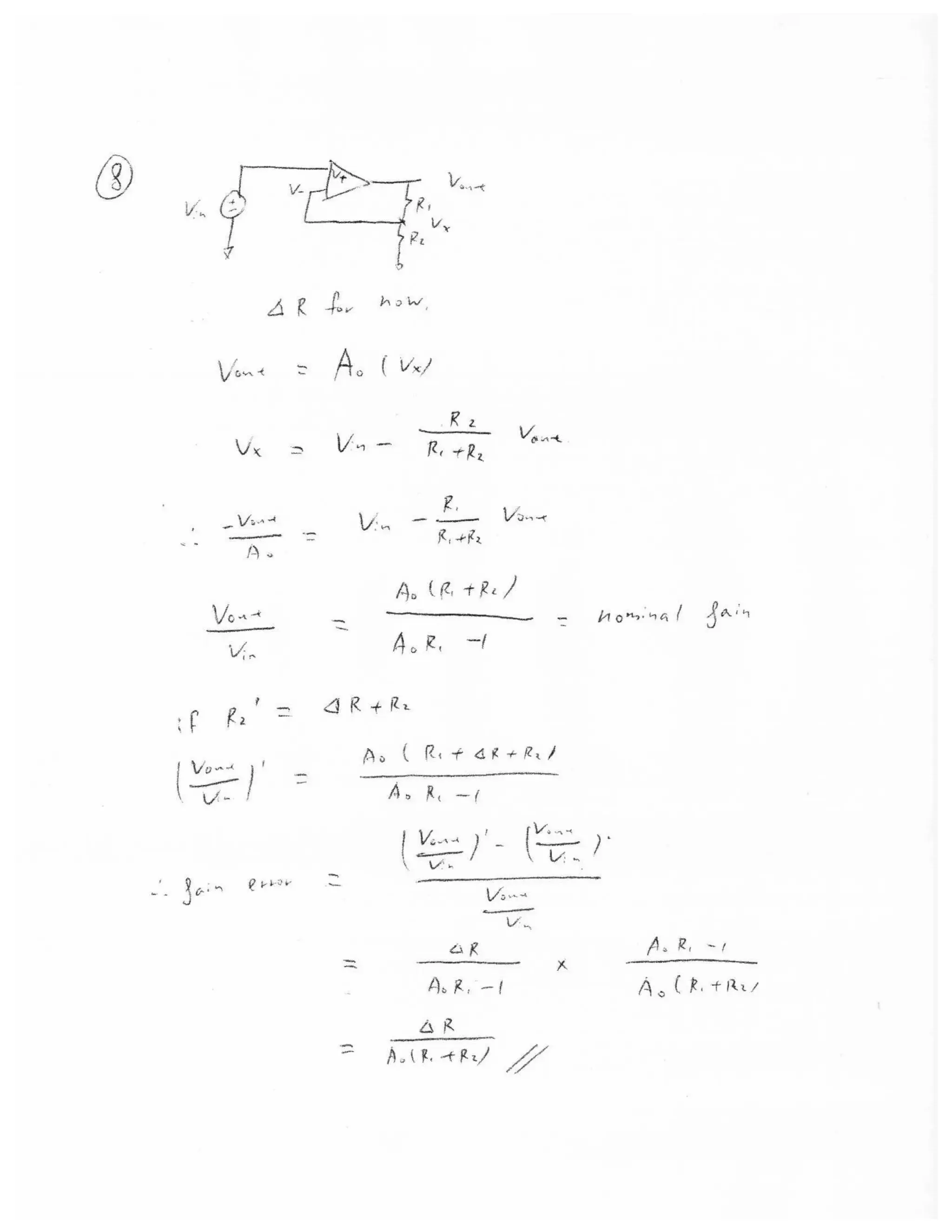
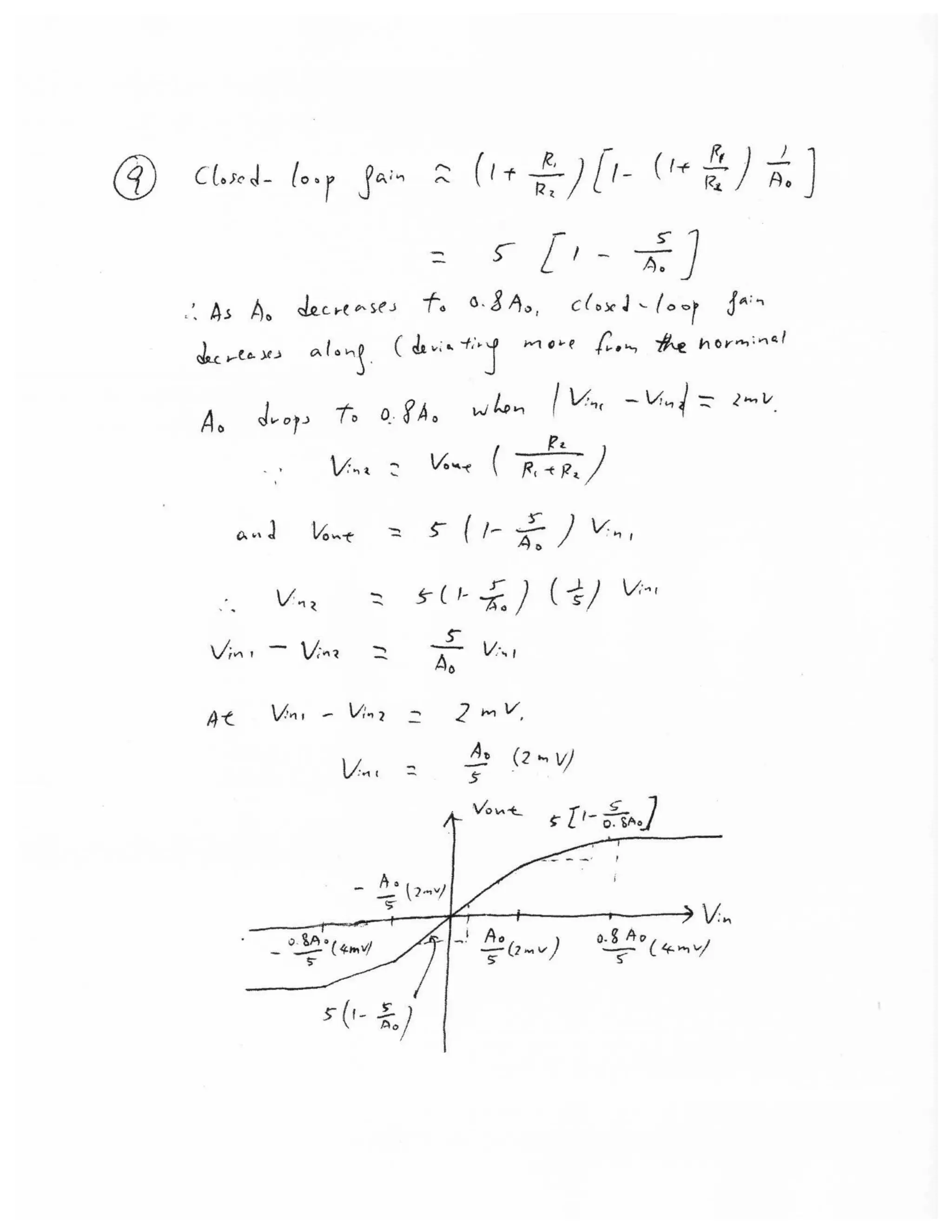
Fundamentals of Microelectronics 2nd Edition Razavi Solutions Manual
1.
Fundamentals of Microelectronics2nd Edition
Razavi Solutions Manual download
https://testbankfan.com/product/fundamentals-of-
microelectronics-2nd-edition-razavi-solutions-manual/
Visit testbankfan.com today to download the complete set of
test bank or solution manual
2.
We have selectedsome products that you may be interested in
Click the link to download now or visit testbankfan.com
for more options!.
RF Microelectronics 2nd Edition Razavi Solutions Manual
https://testbankfan.com/product/rf-microelectronics-2nd-edition-
razavi-solutions-manual/
Fundamentals of Communication Systems 2nd Edition Proakis
Solutions Manual
https://testbankfan.com/product/fundamentals-of-communication-
systems-2nd-edition-proakis-solutions-manual/
Fundamentals Of Corporate Finance 2nd Edition Berk
Solutions Manual
https://testbankfan.com/product/fundamentals-of-corporate-finance-2nd-
edition-berk-solutions-manual/
M Economics The Basics 3rd Edition Mandel Test Bank
https://testbankfan.com/product/m-economics-the-basics-3rd-edition-
mandel-test-bank/
3.
Managerial Accounting CanadianCanadian 10th Edition
Garrison Test Bank
https://testbankfan.com/product/managerial-accounting-canadian-
canadian-10th-edition-garrison-test-bank/
General Organic and Biological Chemistry Structures of
Life 5th Edition Timberlake Test Bank
https://testbankfan.com/product/general-organic-and-biological-
chemistry-structures-of-life-5th-edition-timberlake-test-bank/
Introduction to Audiology 13th Edition Martin Solutions
Manual
https://testbankfan.com/product/introduction-to-audiology-13th-
edition-martin-solutions-manual/
Weaving It Together 4 4th Edition Broukal Solutions Manual
https://testbankfan.com/product/weaving-it-together-4-4th-edition-
broukal-solutions-manual/
Social Media Marketing 3rd Edition Tuten Test Bank
https://testbankfan.com/product/social-media-marketing-3rd-edition-
tuten-test-bank/
4.
Chemistry The CentralScience 14th Edition Brown Test Bank
https://testbankfan.com/product/chemistry-the-central-science-14th-
edition-brown-test-bank/
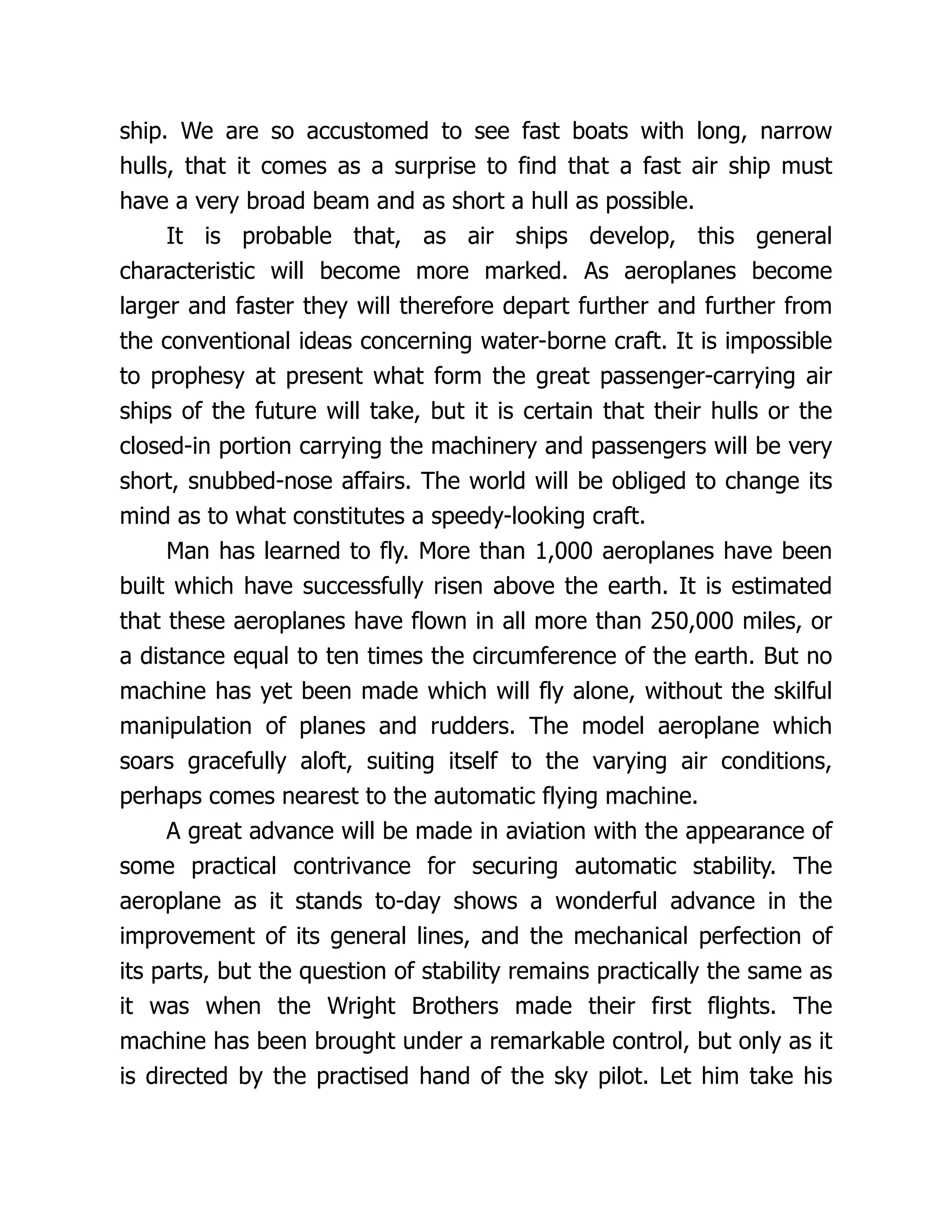
Two of theearlier Peoli models
A great deal has been learned of the action of the air upon
aeroplanes by photographing the air currents. The smallest eddies of
the air have been made visible by taking instantaneous photographs
of thin smoke as it passes obstacles of various size and form. It has
been found that a square object causes a great deal of disturbance
when in an air current. The air is compressed in front of it and
eddies for some distance in its wake before finally coming to rest. An
elliptical object causes less disturbance, but the air continues to
splash in its wake for some distance. Even a perfectly spherical
object offers a surprising amount of resistance to the air. In the case
of a long narrow ellipse the disturbance is considerably reduced. A
curved surface however, such as is used for the planes of an
aeroplane, cuts the air with practically no resistance, and the air
flows smoothly about and joins behind it with very little wake or
splashing. A form which suits the air in this way or a "stream line"
19.
body as itis called is obviously just the right design for the wings of
an aeroplane.
Even the experts in aeronautics differ so widely, however, that it
is impossible to lay down any definite rules. One of the greatest
authorities on the science of aviation, Mr. Horatio Philips, of England,
believes that aeroplanes gain more support from the entering edges
of their planes than from the rest of their surface. He argues that it
is this edge, meeting the air currents, which serves to hold the
aeroplane suspended.
This theory is founded on the experiments made with a machine
of original design flown by Mr. Philips as far back as 1890. It
consisted of a series of planes mounted one above the other at
regular intervals, much the same as the strips of a Venetian blind.
The lifting power of this model in proportion to its surface and the
power exerted was enormous. This theory is borne out in part by the
success of the model aeroplanes with very narrow wings which have
been flown with great success during the year. The beautiful model
built by Stewart Easter, for instance, which is illustrated on another
page, depends for its support on planes which are no wider than
ordinary window blinds.
There is an immense difference of opinion again as regards skin
friction. Some writers believe the air has a tendency to stick to
certain materials more than to others, and that this difference is so
great as to materially retard some machines in their passage
through the air. A complicate series of tables has been worked out in
great detail to show the exact amount of this friction on various
bodies. Some aviators go to great pains to make every part of their
aeroplanes as slippery as possible. This is done by polishing the
20.
surfaces exposed tothe air and in some cases enclosing the
foreward part of the aeroplane, like a ship's prow, to diminish
friction.
On the other hand we find some of the greatest authorities on
aviation disregarding this question almost entirely. In the Wright
machines, for instance, the surface of the wings is usually left
comparatively rough, and the sticks and wires are placed without
any attention to diminishing friction. This is true as well of the
Delegrange, Voison and Farman machines. Still other aviators design
every detail of their machines to cut down this so-called skin friction.
The uprights, for instance, are made elliptical in shape, with the
sharp edges turned forward so that they will cut their way the more
smoothly through the air.
Several interesting attempts have been made to design a prow
for an aeroplane which will cut the air with the least possible amount
of friction. It is noticeable in these designs that the prows are very
blunt, like the prow of a canal boat, and not as might be expected,
sharp and narrow like that of a racing craft. The blunt-nosed prow is
considered best for the air ship, because the air being one eight
hundredth as dense as water offers very little resistance to its
entrance. It is so much easier, in other words, to push an air ship
through the air than a boat through water that there is no object in
sharpening its nose.
The air, however, in flowing along the sides of a rapidly moving
body sticks to it, and retards its progress relatively more than water
retards a boat. It is important, therefore, that the body of the
aeroplane be made very short, so that the sides will offer as little
friction as possible. This reverses the proportions of a water-borne
21.
ship. We areso accustomed to see fast boats with long, narrow
hulls, that it comes as a surprise to find that a fast air ship must
have a very broad beam and as short a hull as possible.
It is probable that, as air ships develop, this general
characteristic will become more marked. As aeroplanes become
larger and faster they will therefore depart further and further from
the conventional ideas concerning water-borne craft. It is impossible
to prophesy at present what form the great passenger-carrying air
ships of the future will take, but it is certain that their hulls or the
closed-in portion carrying the machinery and passengers will be very
short, snubbed-nose affairs. The world will be obliged to change its
mind as to what constitutes a speedy-looking craft.
Man has learned to fly. More than 1,000 aeroplanes have been
built which have successfully risen above the earth. It is estimated
that these aeroplanes have flown in all more than 250,000 miles, or
a distance equal to ten times the circumference of the earth. But no
machine has yet been made which will fly alone, without the skilful
manipulation of planes and rudders. The model aeroplane which
soars gracefully aloft, suiting itself to the varying air conditions,
perhaps comes nearest to the automatic flying machine.
A great advance will be made in aviation with the appearance of
some practical contrivance for securing automatic stability. The
aeroplane as it stands to-day shows a wonderful advance in the
improvement of its general lines, and the mechanical perfection of
its parts, but the question of stability remains practically the same as
it was when the Wright Brothers made their first flights. The
machine has been brought under a remarkable control, but only as it
is directed by the practised hand of the sky pilot. Let him take his
22.
hand even fora moment from the levers, which control the planes
and rudders, and there is danger of a bad spill, perhaps a fatal
accident. Practically nothing has been accomplished in building
machines which will fly unaided.
It has been pointed out, elsewhere in this volume, that the
experiments with the model aeroplanes are certain to have an
important influence upon the development of aeronautics as a
whole, because they address themselves particularly to this problem
of stability.
It is believed by many aviators that the problem of automatic
stability will be solved by some form of the gyroscope. A great many
experiments are being made with various forms of the gyroscope,
although no machine has as yet been actually fitted and flown with
such a device. The general principle of the gyroscope is very simple.
It consists of a wheel which is made to revolve at very high speed.
When such a wheel turns fast enough it will remain in a fixed
position. Every one is familiar for instance with the gyroscope top.
You wind it up and place it at any angle, and it will support itself and
retain the position until it has run down.
The gyroscope has been applied for instance to railroad trains
and has worked, experimentally at least, with remarkable success.
By installing a gyroscope on a car running on a single track the car
may be kept upright by the stabilizing force exerted by the revolving
wheel. The same principle has been applied to steamships to
prevent their rolling in heavy seas. The tipping of a car running on a
single track, or of a ship at sea, is of course very much like the
rolling of an aeroplane in flight; and it would seem that such a
stabilizing device might solve the problem. The gyroscope has a
23.
serious disadvantage, however.Since it revolves at enormous speed
any breakage would tend to throw the detached part to one side
with dangerous force. In the case of the gyroscope used to steady
ships at sea this force would be sufficient to send a piece of metal
through the hull. On so delicate a craft as an aeroplane such an
accident might readily prove disastrous.
It has been found again in experiments with gyroscopes on
steamers that the frames have been seriously strained, even when
the gyroscope worked smoothly. When a ship rolls and pitches to the
motion of the waves, it is of course under a great strain but this
balances itself. When it is held in a rigid horizontal position the
pitching and rolling exert an exaggerated strain on the hull. In one
instance a vessel actually broke its back under such a strain and was
lost. An air ship, being at best a very frail structure, could scarcely
be expected to stand the strain which has wrecked a steel ship. At
the recent Paris Aeronautical show several extremely ingenious
combinations of the pendulum and gyroscope principles were
illustrated. It is of course possible that some modified form of the
gyroscope may solve the problem.
A remarkable series of tests has been made this year in France
with an automatic stability device based upon an entirely new
principle. The rudders are operated automatically, in this case by a
vertical fin opposed to the wind. As the pressure of the air varies,
the rudder is forced up or down, thus bringing the aeroplane to an
even keel without the assistance of the aviator. It is reported that
model aeroplanes equipped with this device have been flown in
three hundred experiments without a single accident.
24.
The day isapproaching when the air conditions will be observed
and announced for the benefit of aviators exactly as the weather is
foretold to-day. An aviator who is about to start on a cross-country
flight will thus be able to study the conditions of the air lanes and lay
out his route just as an automobilist looks up good-roads maps. In
crossing a particular piece of country he will therefore know whether
to take a low or a high air lane, that is, one of few hundred feet
above the earth or the one several thousand feet aloft. The pressure
of the air on the regular air lines will be announced as well. In this
way aviation will be made much safer than it is to-day, when the
aviator must venture without any knowledge of conditions aloft
except those he may gain from the ground surface weather maps.
During the year 1910, fully a score of lives might have been saved
had aviators had such information.
The first of these observation stations is actually in operation in
Germany to-day. Each of these stations is supplied with a number of
rubber balloons equipped with automatic apparatus for recording
atmospheric conditions in the upper air lanes. The stations also
contain the proper apparatus for measuring the ascensional force of
the balloons, with the gas generators used for inflating the balloons.
When the balloons are sent up for great heights their altitude will be
measured by means of the theodolite.
The soundings of the air are taken twice daily at eight o'clock in
the morning and two in the afternoon whenever the weather
permits. In the summer the morning observations are made much
earlier. The movements of the balloons are then carefully observed
at various altitudes until they are lost. These observations are then
25.
telegraphed to thecentral station at Lindenberg and sent out much
the same as the regular weather forecast.
26.
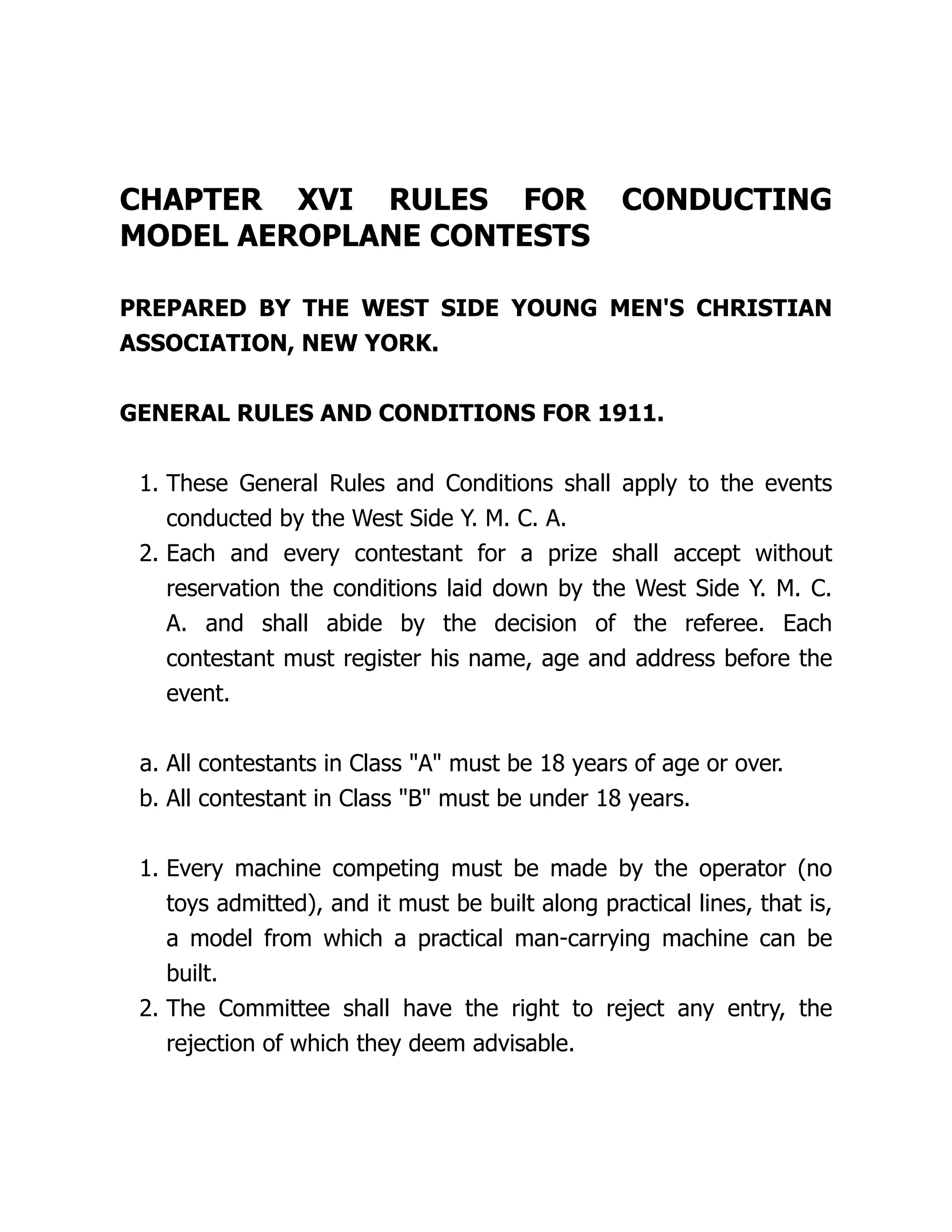
CHAPTER XVI RULESFOR CONDUCTING
MODEL AEROPLANE CONTESTS
PREPARED BY THE WEST SIDE YOUNG MEN'S CHRISTIAN
ASSOCIATION, NEW YORK.
GENERAL RULES AND CONDITIONS FOR 1911.
1. These General Rules and Conditions shall apply to the events
conducted by the West Side Y. M. C. A.
2. Each and every contestant for a prize shall accept without
reservation the conditions laid down by the West Side Y. M. C.
A. and shall abide by the decision of the referee. Each
contestant must register his name, age and address before the
event.
a. All contestants in Class "A" must be 18 years of age or over.
b. All contestant in Class "B" must be under 18 years.
1. Every machine competing must be made by the operator (no
toys admitted), and it must be built along practical lines, that is,
a model from which a practical man-carrying machine can be
built.
2. The Committee shall have the right to reject any entry, the
rejection of which they deem advisable.
27.
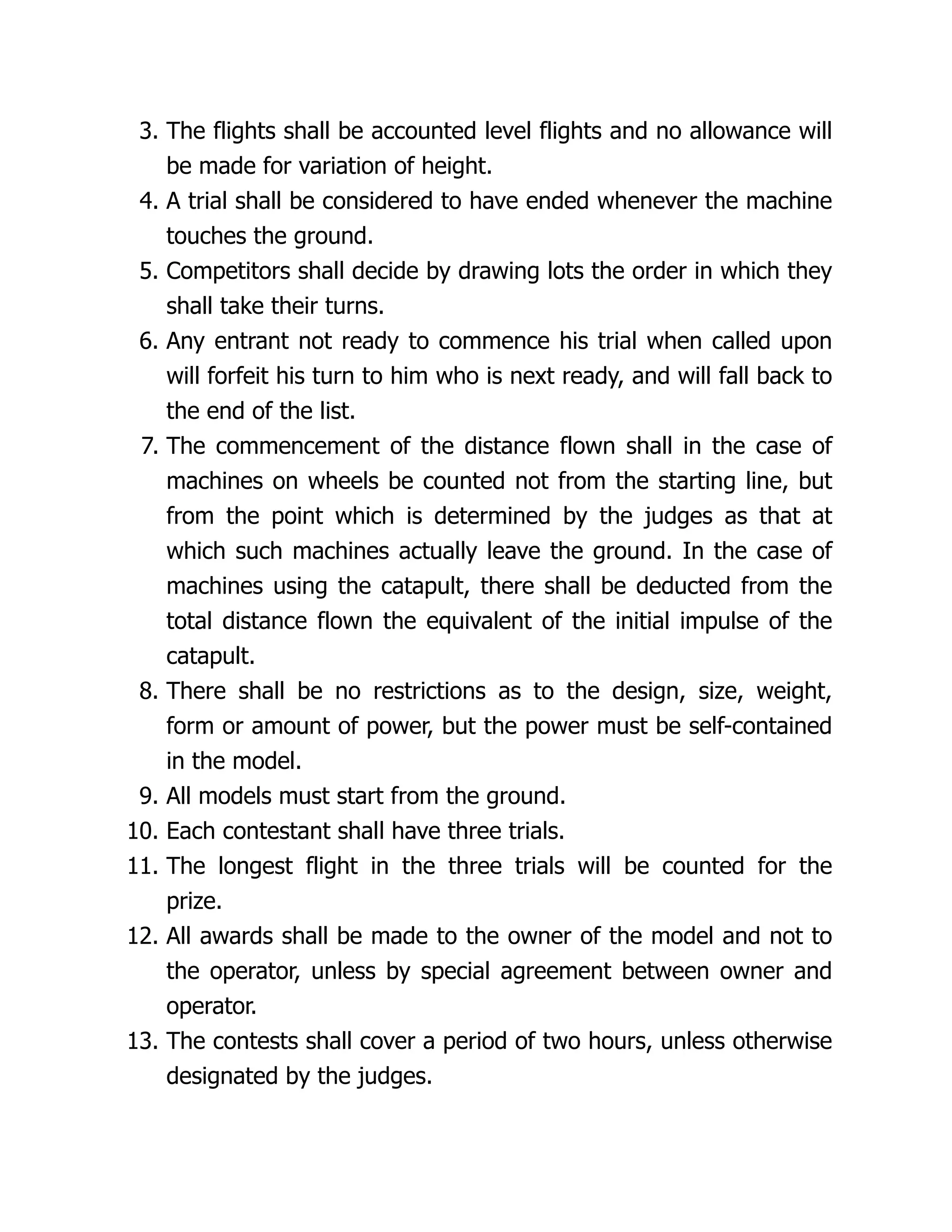
3. The flightsshall be accounted level flights and no allowance will
be made for variation of height.
4. A trial shall be considered to have ended whenever the machine
touches the ground.
5. Competitors shall decide by drawing lots the order in which they
shall take their turns.
6. Any entrant not ready to commence his trial when called upon
will forfeit his turn to him who is next ready, and will fall back to
the end of the list.
7. The commencement of the distance flown shall in the case of
machines on wheels be counted not from the starting line, but
from the point which is determined by the judges as that at
which such machines actually leave the ground. In the case of
machines using the catapult, there shall be deducted from the
total distance flown the equivalent of the initial impulse of the
catapult.
8. There shall be no restrictions as to the design, size, weight,
form or amount of power, but the power must be self-contained
in the model.
9. All models must start from the ground.
10. Each contestant shall have three trials.
11. The longest flight in the three trials will be counted for the
prize.
12. All awards shall be made to the owner of the model and not to
the operator, unless by special agreement between owner and
operator.
13. The contests shall cover a period of two hours, unless otherwise
designated by the judges.
28.
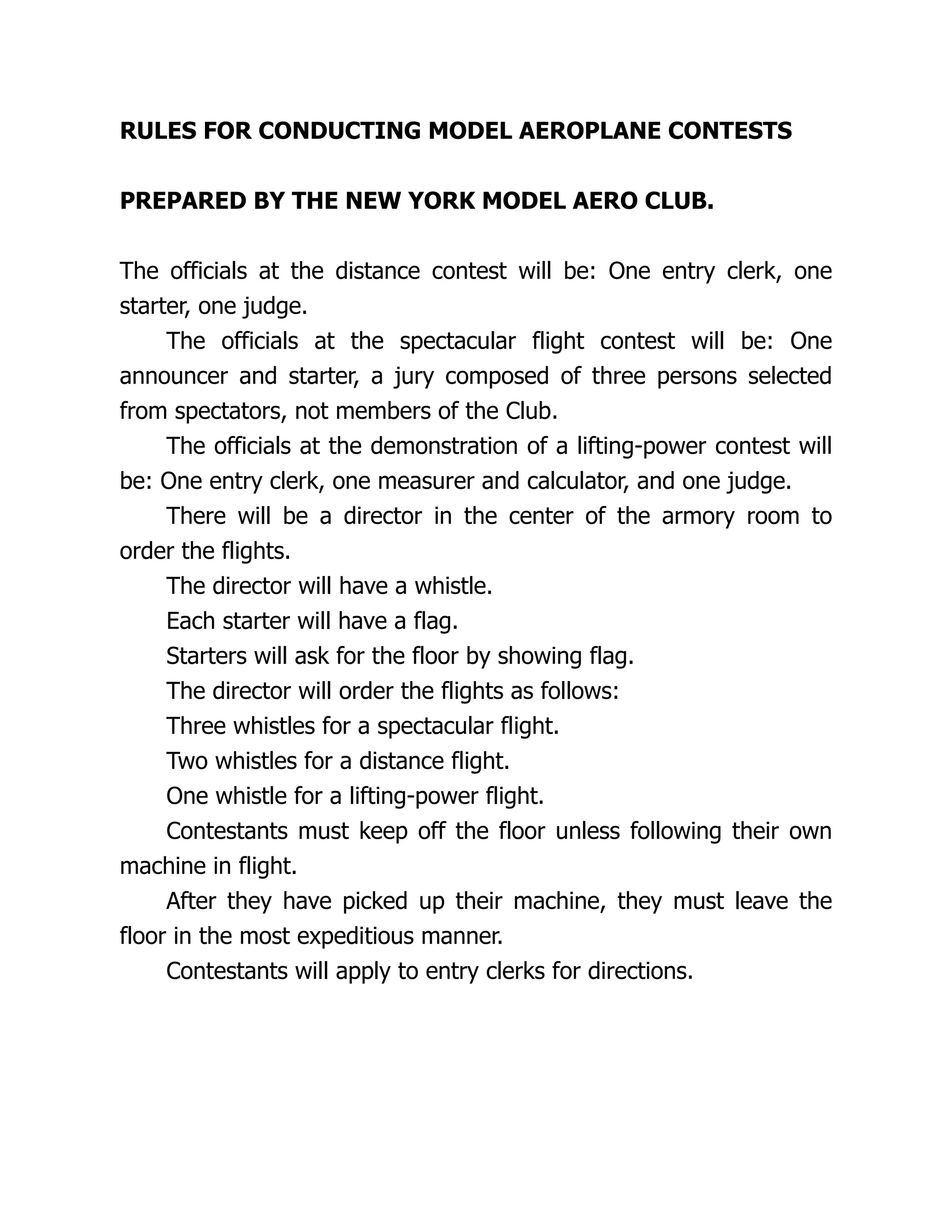
RULES FOR CONDUCTINGMODEL AEROPLANE CONTESTS
PREPARED BY THE NEW YORK MODEL AERO CLUB.
The officials at the distance contest will be: One entry clerk, one
starter, one judge.
The officials at the spectacular flight contest will be: One
announcer and starter, a jury composed of three persons selected
from spectators, not members of the Club.
The officials at the demonstration of a lifting-power contest will
be: One entry clerk, one measurer and calculator, and one judge.
There will be a director in the center of the armory room to
order the flights.
The director will have a whistle.
Each starter will have a flag.
Starters will ask for the floor by showing flag.
The director will order the flights as follows:
Three whistles for a spectacular flight.
Two whistles for a distance flight.
One whistle for a lifting-power flight.
Contestants must keep off the floor unless following their own
machine in flight.
After they have picked up their machine, they must leave the
floor in the most expeditious manner.
Contestants will apply to entry clerks for directions.
29.
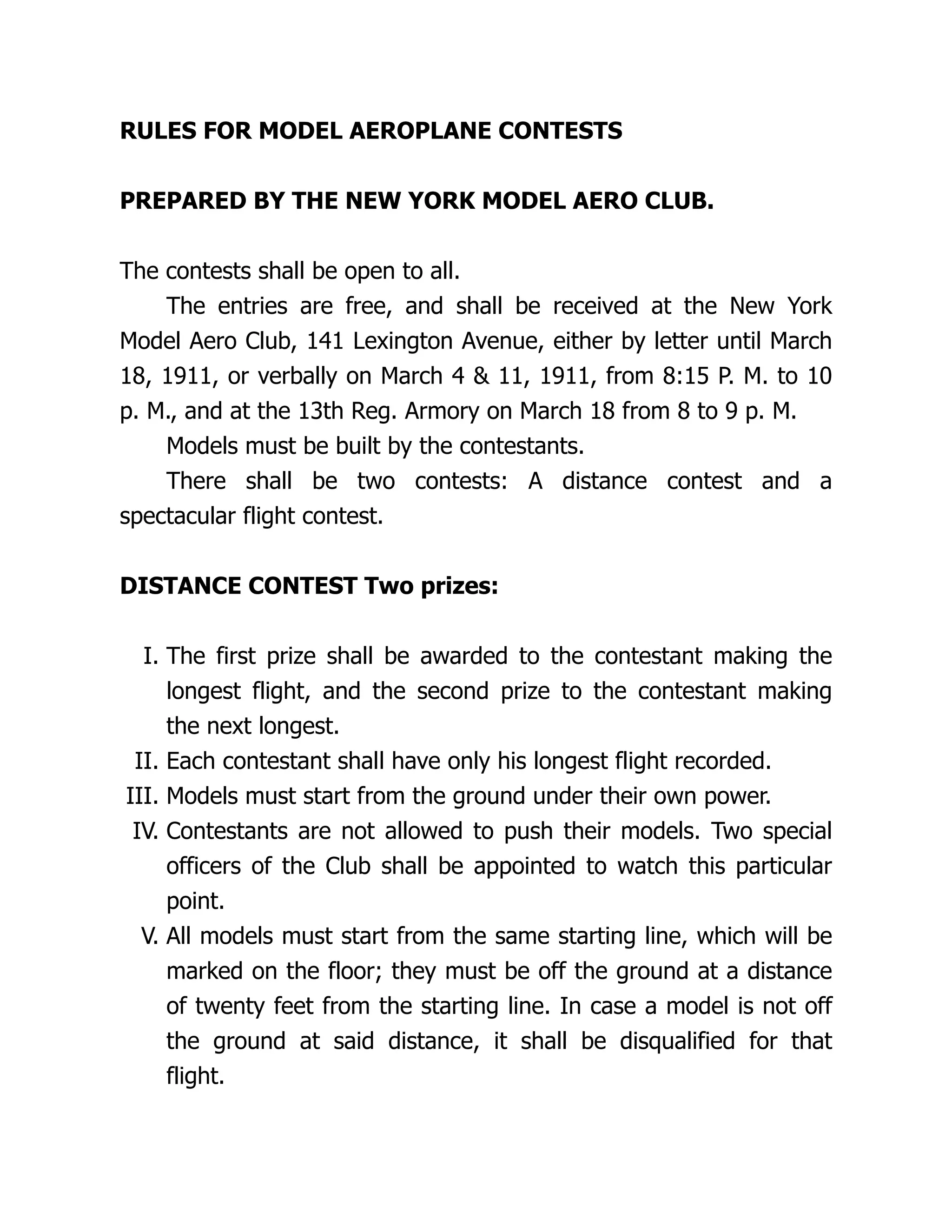
RULES FOR MODELAEROPLANE CONTESTS
PREPARED BY THE NEW YORK MODEL AERO CLUB.
The contests shall be open to all.
The entries are free, and shall be received at the New York
Model Aero Club, 141 Lexington Avenue, either by letter until March
18, 1911, or verbally on March 4 & 11, 1911, from 8:15 P. M. to 10
p. M., and at the 13th Reg. Armory on March 18 from 8 to 9 p. M.
Models must be built by the contestants.
There shall be two contests: A distance contest and a
spectacular flight contest.
DISTANCE CONTEST Two prizes:
I. The first prize shall be awarded to the contestant making the
longest flight, and the second prize to the contestant making
the next longest.
II. Each contestant shall have only his longest flight recorded.
III. Models must start from the ground under their own power.
IV. Contestants are not allowed to push their models. Two special
officers of the Club shall be appointed to watch this particular
point.
V. All models must start from the same starting line, which will be
marked on the floor; they must be off the ground at a distance
of twenty feet from the starting line. In case a model is not off
the ground at said distance, it shall be disqualified for that
flight.
30.
VI. Flights shallbe measured from the starting line to the point of
landing.
VII. A one-quarter-inch rope shall be laid on the ground without
being fastened at either end, at a distance of 20 feet from the
starting line.
VIII. Models must measure at least two feet in length and two feet in
spread.
SPECTACULAR FLIGHT CONTEST One prize:
I. The cup shall be awarded to the contestant making the most
spectacular flight as previously announced.
II. A jury of five persons, selected from the spectators, shall decide
upon the most spectacular flight.
III. Power shall be optional.
IV. Models must measure at least two feet in length and two feet in
spread.
V. Models must be fitted with a landing device by which, if proper
speed was obtained, the machine would leave the ground.
VI. Each contestant, before launching his model, must announce
the object of his flight. The announcement will be made to the
public.
VII. Contestants are at liberty to fly their models from the ground or
from the hand, and start wherever they wish.
Non observance of any of the above rules shall disqualify any flight.
31.
CONSTITUTION AND BY-LAWSOF A MODEL
AEROPLANE CLUB
COURTESY OF NEW YORK MODEL AERO CLUB
CONSTITUTION
ART. I
This association shall be called the . . . . . . . . . . . . . . . . . . . . . . . .
. . . . .
The object of this Club shall be to popularize and study the
Science and Art of Aviation through models.
ART. II
Membership. There shall be two classes of members: 1st.—Senior
Members, who have been elected as such by the Admission and
Membership Committee; who are qualified to represent the Club at
all competitions, and shall have a vote at all meetings in the conduct
of the affairs of the Club; 2nd.—Junior Members, comprising all such
that have not qualified as seniors, and who shall have no vote.
Any person may become a member of this Club who is passed
upon by a majority of the Admission and Membership Committee, to
whom all applications, either made directly or through a member of
the Club, must be submitted.
32.
All applicants acceptedshall at once become Junior Members,
and shall remain so until elected Senior Members by the Admission
and Membership Committee.
ART. III
Officers. The Officers of this Club shall be a President, two Vice-
Presidents, a Secretary-Treasurer, and a Board of Governors, to
consist of said officers and the Chairman of the Patent Bureau and
Contest Committee.
The President and Second Vice-President shall constitute an
Executive Committee of the Board of Governors, with full power to
act for them in the affairs of the Club.
ART. IV
Dues and Assessments. The dues shall be 25c (twenty-five cents)
per month for Junior and Senior Members alike, to be collected at
the first business meeting of each month.
ART. V
Standing Committees. There shall be the following Standing
Committees, to consist of four members each:
1st.—Patent Bureau. The Patent Bureau shall investigate and
pass upon claims for any feature of a member's own contrivance,
and register and insure to members the exclusive use thereof in the
Club.
33.
2nd.—Contest Committee. TheContest Committee shall arrange
details of, attend and record all competitions held by the Club. They
shall also attend and report on any other competition at the request
of the Board of Governors.
3rd.— Admission and Membership Committee. The Admission
and Membership Committee shall examine all applicants for
membership, with full power to accept or reject them, and shall
further examine the Junior Members who wish to qualify as Senior
Members.
The Committees shall convene regularly at every business
meeting and besides, as often as their duties may require.
ART. VI
Special Committees. Special Committees may be appointed at any
time, by motion or resolution, to take into consideration and report
upon special matters. Unless otherwise provided for, they shall be
appointed by the presiding officer.
Art. VII
Meetings. Regular meetings shall be held every Saturday. The first
Saturday in October and the first Saturday in April shall be semi-
annual election and business meetings. Following these, every first
and third Saturday of each month shall be a business meeting.
All other meeting nights shall be called Social meetings. At the
social meetings no regular order of business shall be observed.
34.
ART. VIII
Elections. Theofficers and members of the standing committees
shall be elected by written ballot.
The President and First Vice-President shall be elected at the
first business meeting in October, to serve for one year; the Second
Vice-President and the Secretary-Treasurer shall be elected at the
first business meeting in April, to serve for one year.
Two members of each of the standing committees shall be
elected at the first business meeting in October, to serve for one
year; the two other members of each of the standing committees
shall be elected at the first business meeting in April, to serve for
one year.
ART. IX
Amendment. This Constitution may be amended by a two-thirds vote
at any regular business meeting; but, no amendment shall be
entertained unless it shall have been proposed in writing at the
previous business meeting.
By-laws may be altered, suspended, annulled or amended by
the majority action of the members present at any meeting.
35.
BY-LAWS
ART. I
Duties ofPresident and Vice-Presidents. The President shall preside
at all meetings of the Club and of the Board of Governors, and
perform such other duties as usually pertain to that office.
The Vice-President, in the absence of the President, shall in his
stead perform such duties.
ART. II
Duties of Secretary-Treasurer. The Secretary-Treasurer shall keep a
record of all meetings of the Club and of the Board of Governors;
issue notices to members of all special meetings, and perform such
other duties as may be assigned him by the Constitution, by the
Club, or by the Board of Governors.
The Secretary-Treasurer shall keep the accounts of the Club;
receive all moneys, fees, dues, etc.; pay all bills approved by the
Board of Governors, and preserve all proper vouchers for such
disbursements. He shall, at each regular meeting of the Board of
Governors, make a statement of the financial condition of the Club;
and shall, at the semi-annual meetings, submit a report, approved
by the Board of Governors, of the financial transactions of the
preceding fiscal half year.
36.
ART. III
Enforcement ofRules by the Board of Governors. The Board of
Governors shall have full power to expel or suspend any member
whose conduct shall be pronounced, by a two-third vote of the
members present at a meeting, to have endangered the welfare,
interests or character of the Club.
ART. IV
Liabilities. The Board of Governors shall have no power to make the
Club liable for any debts exceeding in total the amount of five
dollars, unless authorized to do so by a recorded vote of a meeting
of the Club.
ART. V
Meetings of the Board of Governors. The Board of Governors shall
hold regular meetings on the last Saturday of each month.
ART. VI
Non-Attendance at Governors' Meetings. A member of the Board of
Governors who, without satisfactory explanation, shall fail to attend
two consecutive meetings of that body, shall be deemed to have
resigned.
37.
ART. VII
Colors. TheClub colors are Sky Blue and Red.
ART. VIII
Arrears. A member one month in arrears shall not have a vote at the
meetings, nor hold office in the Club.
ART. IX
Order of Business.
1. Reading of Business.
2. Reports of Officers and Committees.
3. Unfinished Business.
4. Election of Officers.
5. New Business.
38.
DICTIONARY OF AERONAUTICALTERMS
A
Aerodrome.
A tract of land selected for flying purposes.
Aerodynamics.
The science of aviation, literally the study of the influence of air
in motion.
Aerofoil.
A flat or flexed plane which lends support to an aeroplane.
Aeronaut.
One engaged in navigating the air.
Aeronautics.
The science of navigating the air.
Aeroplane.
A heavier than air machine supported by one or more fixed
planes.
Aerostatics.
The science of aerostation, or of buoyancy caused by
displacement, ballooning.
Aerostation.
The science of lighter than air or gas-born machines.
Aileron.
39.
The outer edgeor tip of a plane, usually adjustable, used to
balance or stabilize.
Airship.
Commonly used to denote both heavier and lighter than air
machines; correctly a dirigible balloon.
Angle Of Incidence.
The angle of the plane with the line of travel.
Area.
In the case of planes, the extent of surface measured on both
the upper and lower sides. An area of one square foot
comprises the actual surface of two square feet.
Aspect Ratio.
The relation of a surface crossing the direction of flight with that
paralleling the line of flight.
Automatic Stability.
Stability secured by fins, the angle of the planes and similar
devices.
Aviator.
One engaged in aviation.
Aviation.
The science of heavier than air machines.
B
Balancer.
A plane or other part intended for lateral equilibrium.
40.
Biplane.
An aeroplane withtwo supporting surfaces one above the other.
Body.
The main framework supporting the plane and the machinery.
C
Camber.
The curve measured from the cord to the highest point of the
plane.
Carriage.
The part on which the main body is supported on land or water.
Center Of Gravity.
The point at which the aeroplane balances.
Center Of Pressure.
The imaginary line beneath the plane at which the pressure
balances.
D
Deck.
The main surface of a biplane or multiplane.
Directional Control.
The ability to determine the direction of the flight of an
aeroplane.
Dirigible.
41.
A balloon drivenby power.
Down Wind.
With the wind.
Drift.
The resistance of the plane to the forward movement.
E
Elevator.
The plane or wing intended to control the vertical flight of the
machine.
Engineer.
One who controls the power, driving the machinery.
Entering Edge.
Front edge of the forward plane of an aeroplane.
Equilibrator.
A plane or other contrivance which makes for stability.
F
Flexed.
A plane is said to be flexed when it curves upward forming an
arc of a circle.
Fin.
A fixed vertical plane.
Flying Machine.
42.
Literally a formof lighter than air craft; a gas-born airship.
Following Edge.
The rear edge of the plane or wing of an aeroplane.
Fusilage.
The body or framework of an aeroplane.
G
Glider.
An aeroplane without motor power.
Guy.
A brace, usually a wire or cord used for tuning up the
aeroplane.
Gross Weight.
The weight of the aircraft comprising fuel, lubricating oils, and
the pilot.
Gyroscope.
A rotating mechanism for maintaining equilibrium.
H
Hanger.
A shed for housing an aeroplane.
Harbor.
A shelter for aircrafts.
Heavier Than Air.
43.
A machine weighingmore than the air it displaces.
Helicopter.
A flying machine driven upward by rotary screws on vertical
shafts.
Helmsman.
One in charge of the steering device.
L
Lateral Stability.
Stability which prevents side motion.
Loading.
The gross weight divided by the supporting area measured in
square feet.
Longitudinal Stability.
Stability which prevents fore and after motion or pitching.
M
Mast.
A perpendicular stick holding the stays or struts which keep the
planes rigid.
Model Aeroplane.
A toy aeroplane, reproducing a man-carrying machine.
Monoplane.
44.
An aeroplane orheavier than air machine supported by a single
main plane which may be formed of two wings extending from a
central body.
Motor.
A contrivance for generating driving power.
Multiplane.
An aeroplane with more than three main planes one above
another.
N
Nacelle.
The car of a dirigible balloon, literally a cradle.
Net Weight.
Complete weight of the machine without pilot, fuel or oil.
O
Ornithopter.
A machine supported and propelled by planes moving in
imitation of birds; a flapping wing machine.
Orthogonal.
A flight maintained by flapping wings.
P
Plane.
45.
A surface orwing, either plain or flexed, employed to support or
control an aeroplane.
Pilot.
One directing an aeroplane in flight.
Pitch.
Theoretical distance covered by a propeller in making one
revolution.
Pylon.
Correctly, a structure housing a falling weight used for starting
an aeroplane, commonly a turning point in aeroplane flights.
Propeller.
The screw used for driving an aeroplane, plane.
R
Rudder.
A plane or group of planes used to steer an aeroplane.
Runner.
Strip beneath an aeroplane used for a skid.
S
Scale Model.
A miniature aeroplane exactly reproducing the proportions of an
original.
Spar.
46.
Welcome to ourwebsite – the perfect destination for book lovers and
knowledge seekers. We believe that every book holds a new world,
offering opportunities for learning, discovery, and personal growth.
That’s why we are dedicated to bringing you a diverse collection of
books, ranging from classic literature and specialized publications to
self-development guides and children's books.
More than just a book-buying platform, we strive to be a bridge
connecting you with timeless cultural and intellectual values. With an
elegant, user-friendly interface and a smart search system, you can
quickly find the books that best suit your interests. Additionally,
our special promotions and home delivery services help you save time
and fully enjoy the joy of reading.
Join us on a journey of knowledge exploration, passion nurturing, and
personal growth every day!
testbankfan.com