CS-349
Operating System-Lab
Instructor : Muhammad Waseem
Agenda
• Keywords and Identifiers
• Variables and Constants
• Data Types
• Inputs and Outputs
• Operations
• C Flow Control
• Loops
Character set
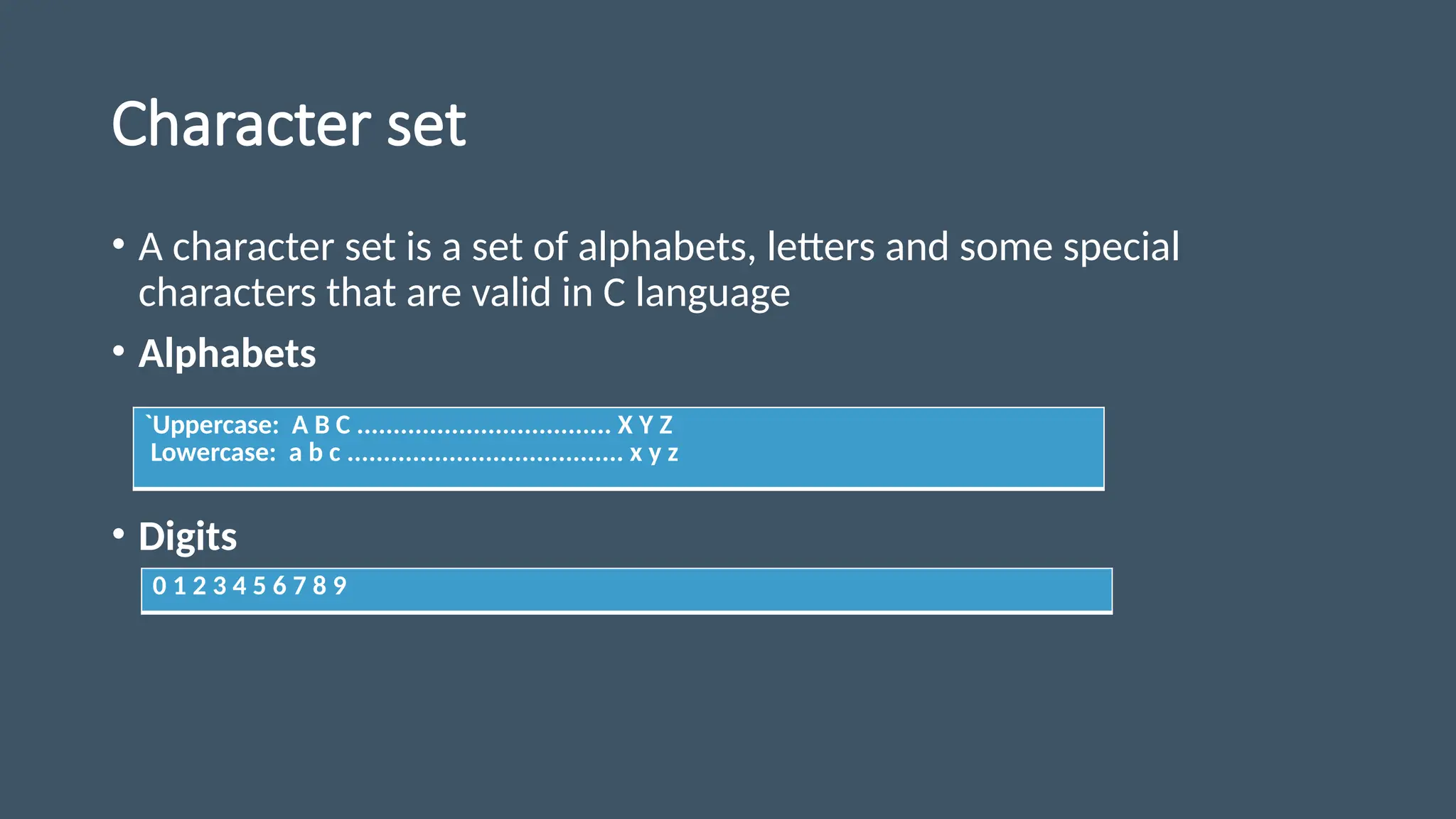
• A character set is a set of alphabets, letters and some special
characters that are valid in C language
• Alphabets
• Digits
`Uppercase: A B C ................................... X Y Z
Lowercase: a b c ...................................... x y z
0 1 2 3 4 5 6 7 8 9
Special Characters
, < > . _
( ) ; $ :
% [ ] # ?
' & { } "
^ ! * / |
-  ~ +
C Keywords
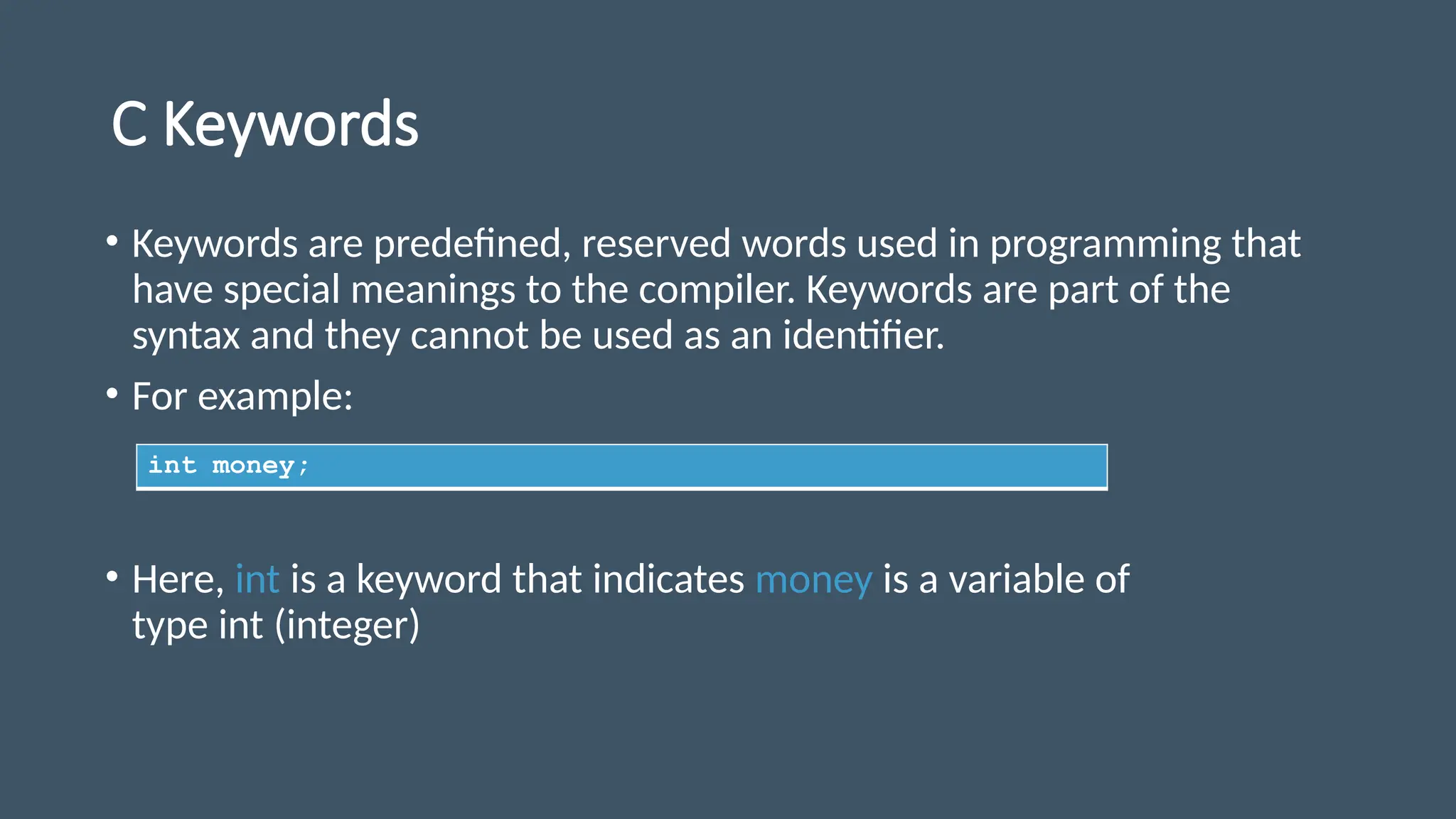
• Keywords are predefined, reserved words used in programming that
have special meanings to the compiler. Keywords are part of the
syntax and they cannot be used as an identifier.
• For example:
• Here, int is a keyword that indicates money is a variable of
type int (integer)
int money;
Keywords
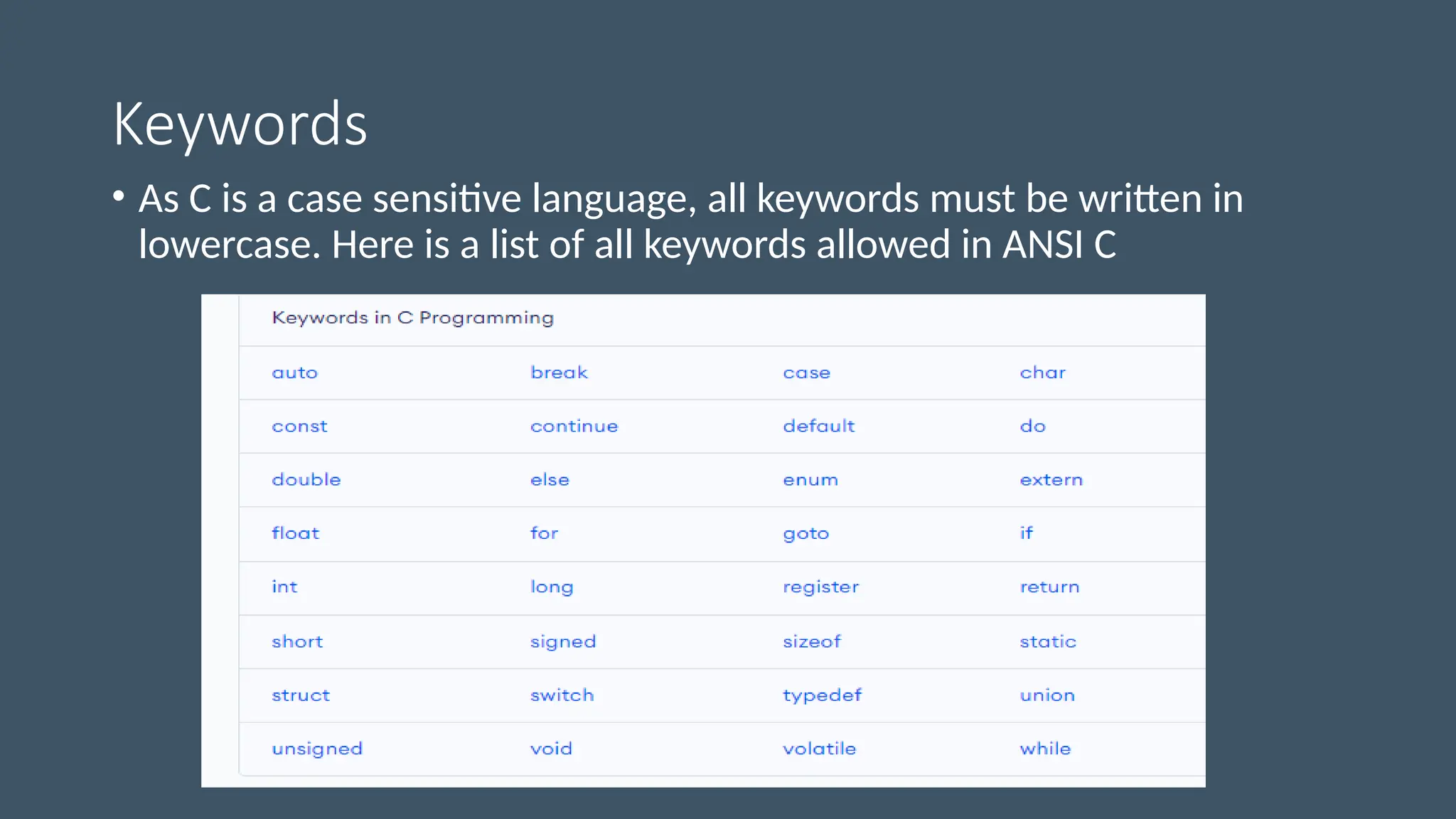
• As C is a case sensitive language, all keywords must be written in
lowercase. Here is a list of all keywords allowed in ANSI C
C Identifiers
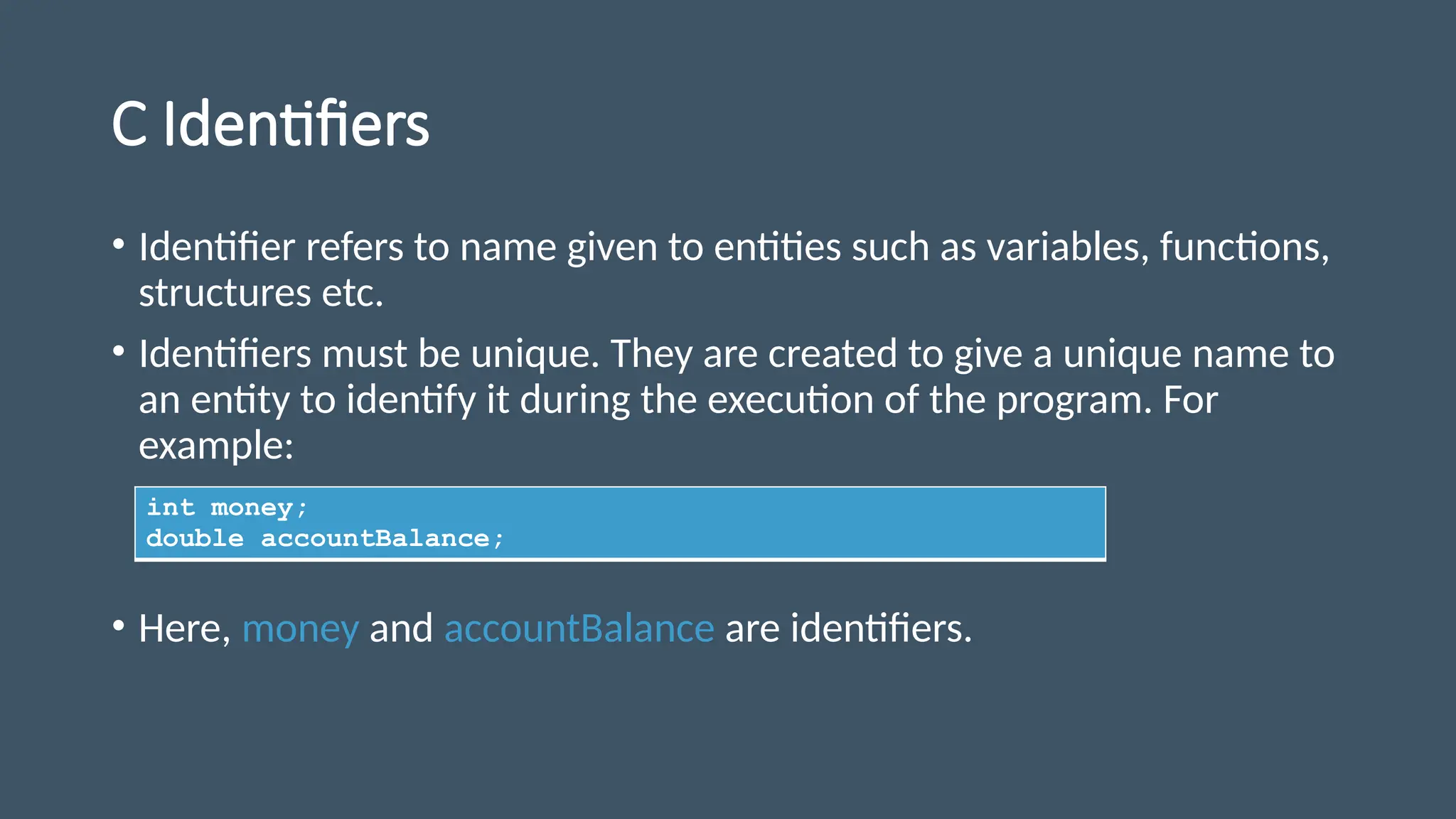
• Identifier refers to name given to entities such as variables, functions,
structures etc.
• Identifiers must be unique. They are created to give a unique name to
an entity to identify it during the execution of the program. For
example:
• Here, money and accountBalance are identifiers.
int money;
double accountBalance;
Rules for naming identifiers
• A valid identifier can have letters (both uppercase and lowercase
letters), digits and underscores.
• The first letter of an identifier should be either a letter or an
underscore.
• You cannot use keywords as identifiers.
• There is no rule on how long an identifier can be. However, you may
run into problems in some compilers if the identifier is longer than 31
characters.
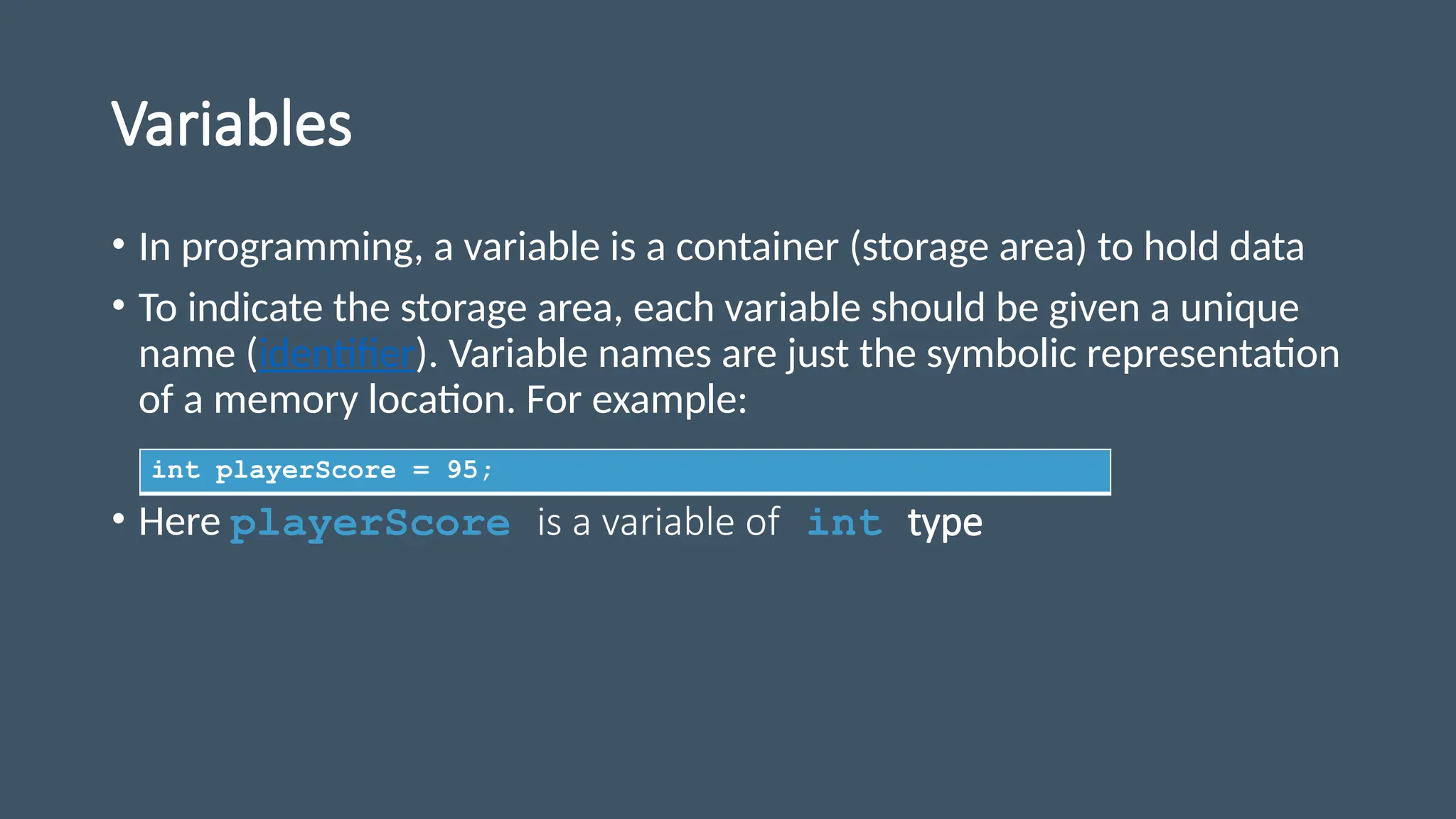
Variables
• In programming, a variable is a container (storage area) to hold data
• To indicate the storage area, each variable should be given a unique
name (identifier). Variable names are just the symbolic representation
of a memory location. For example:
• Here playerScore is a variable of int type
int playerScore = 95;
Rules for naming a variable
• A variable name can only have letters (both uppercase and lowercase
letters), digits and underscore.
• The first letter of a variable should be either a letter or an underscore.
• There is no rule on how long a variable name (identifier) can be.
However, you may run into problems in some compilers if the variable
name is longer than 31 characters.
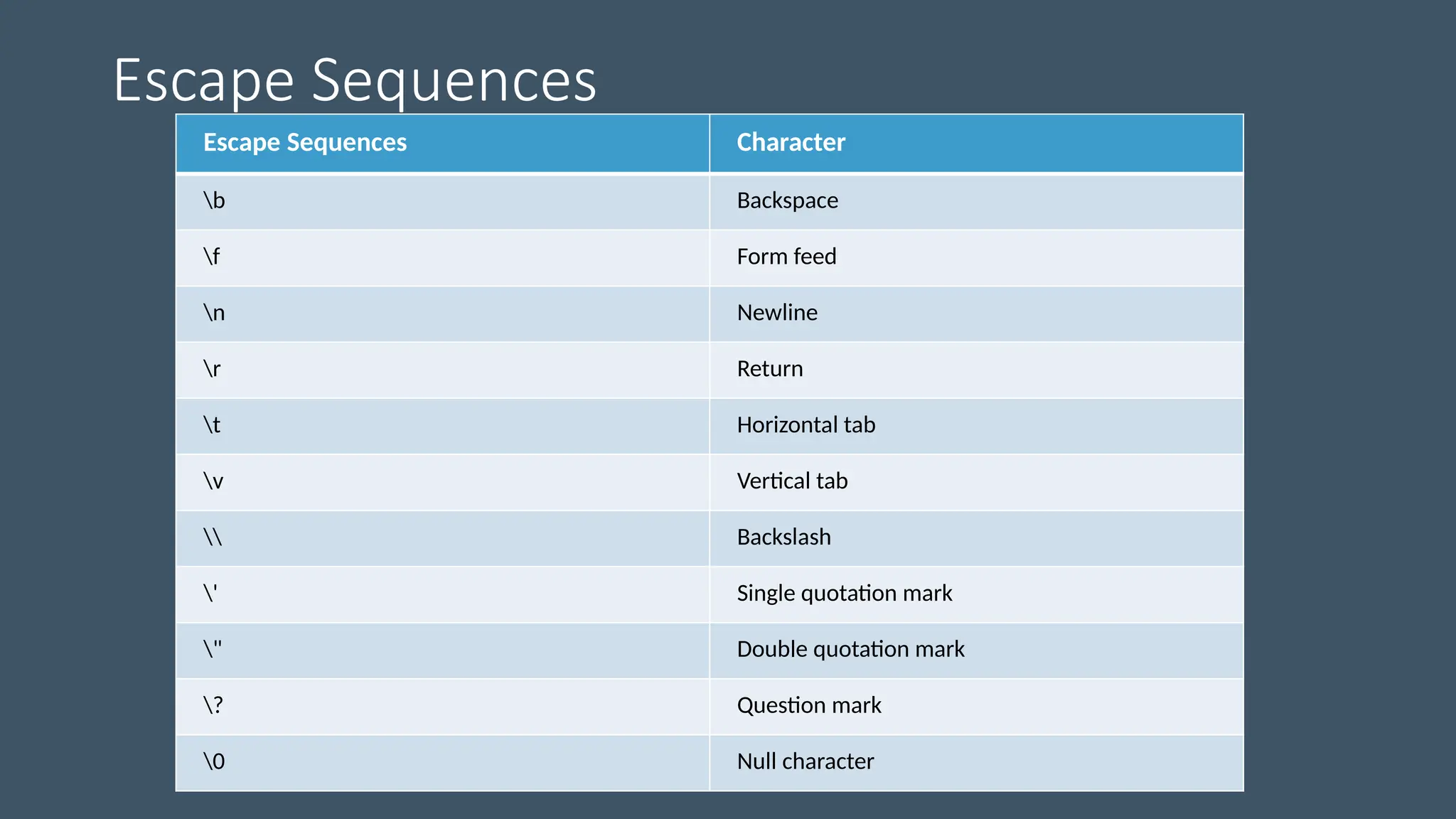
Escape Sequences
• Sometimes, it is necessary to use characters that cannot be typed or
has special meaning in C programming. For example: newline(enter),
tab, question mark etc
Escape Sequences
Escape Sequences Character
b Backspace
f Form feed
n Newline
r Return
t Horizontal tab
v Vertical tab
 Backslash
' Single quotation mark
" Double quotation mark
? Question mark
0 Null character
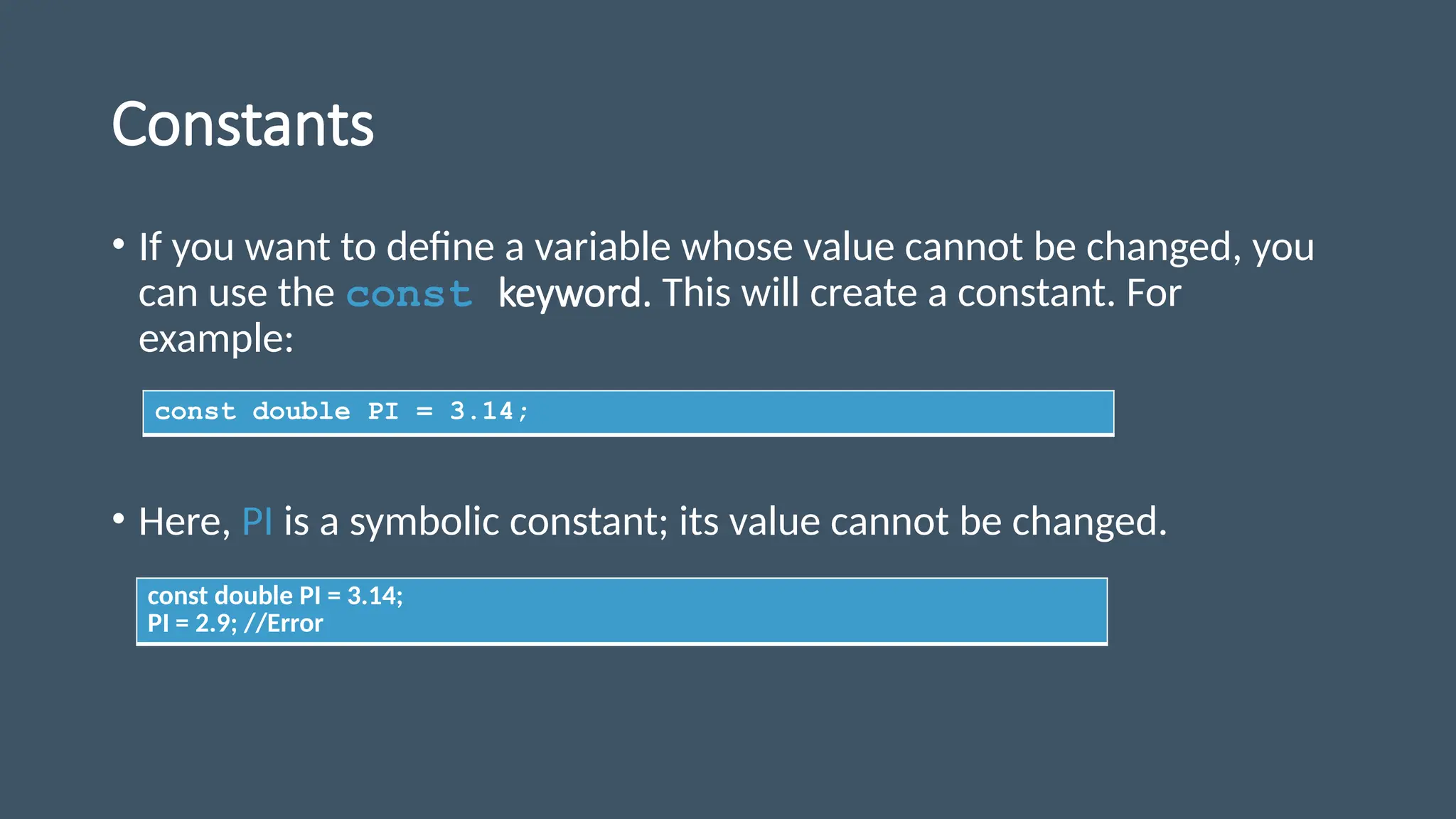
Constants
• If you want to define a variable whose value cannot be changed, you
can use the const keyword. This will create a constant. For
example:
• Here, PI is a symbolic constant; its value cannot be changed.
const double PI = 3.14;
PI = 2.9; //Error
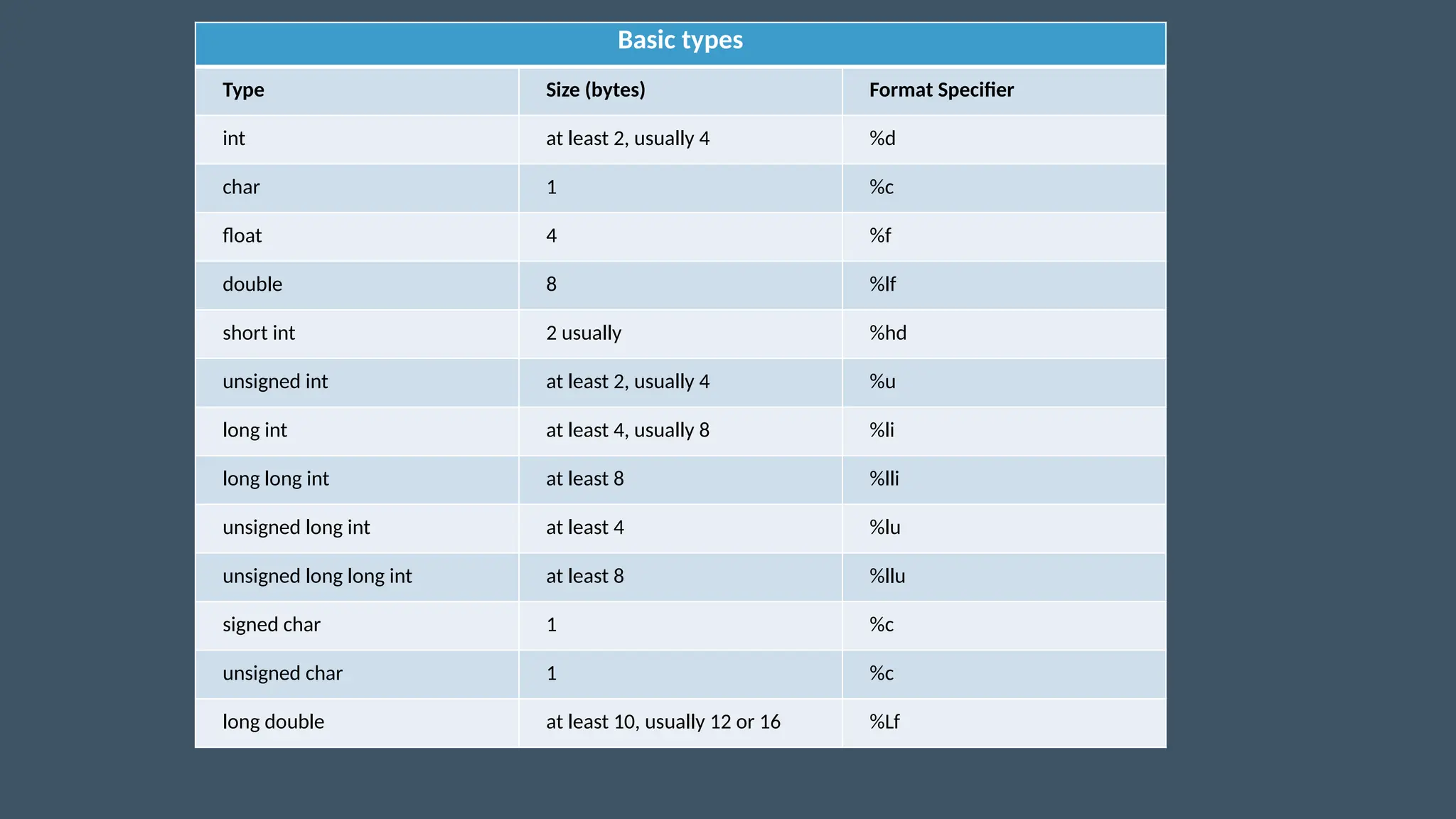
Basic types
Type Size (bytes) Format Specifier
int at least 2, usually 4 %d
char 1 %c
float 4 %f
double 8 %lf
short int 2 usually %hd
unsigned int at least 2, usually 4 %u
long int at least 4, usually 8 %li
long long int at least 8 %lli
unsigned long int at least 4 %lu
unsigned long long int at least 8 %llu
signed char 1 %c
unsigned char 1 %c
long double at least 10, usually 12 or 16 %Lf
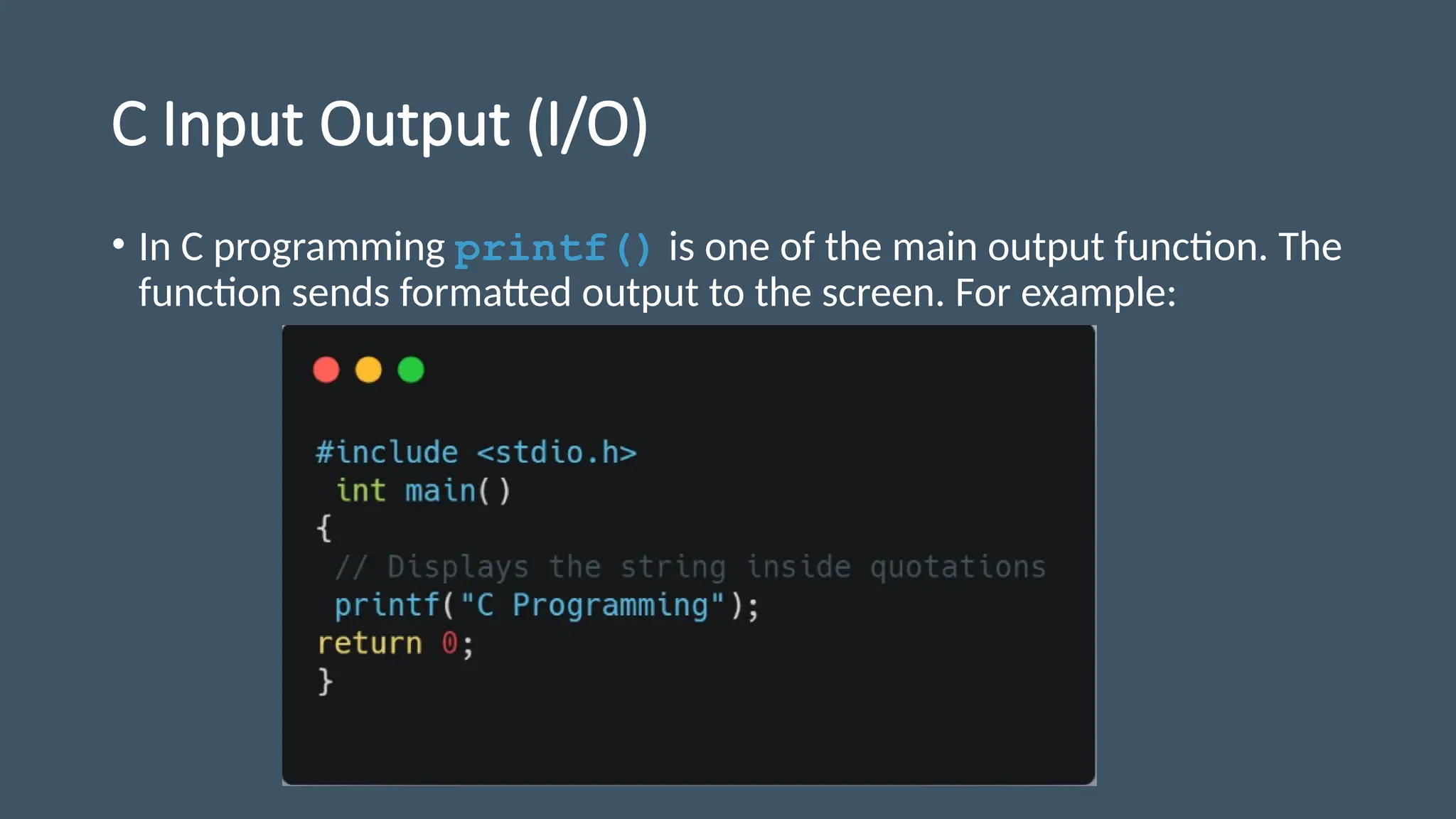
C Input Output (I/O)
• In C programming printf() is one of the main output function. The
function sends formatted output to the screen. For example:
How does this program work?
• All valid C programs must contain the main() function. The code
execution begins from the start of the main() function.
• The printf() is a library function to send formatted output to the
screen. The function prints the string inside quotations.
• To use printf() in our program, we need to include stdio.h header file
using the #include <stdio.h> statement.
• The return 0; statement inside the main() function is the "Exit status"
of the program. It's optional.
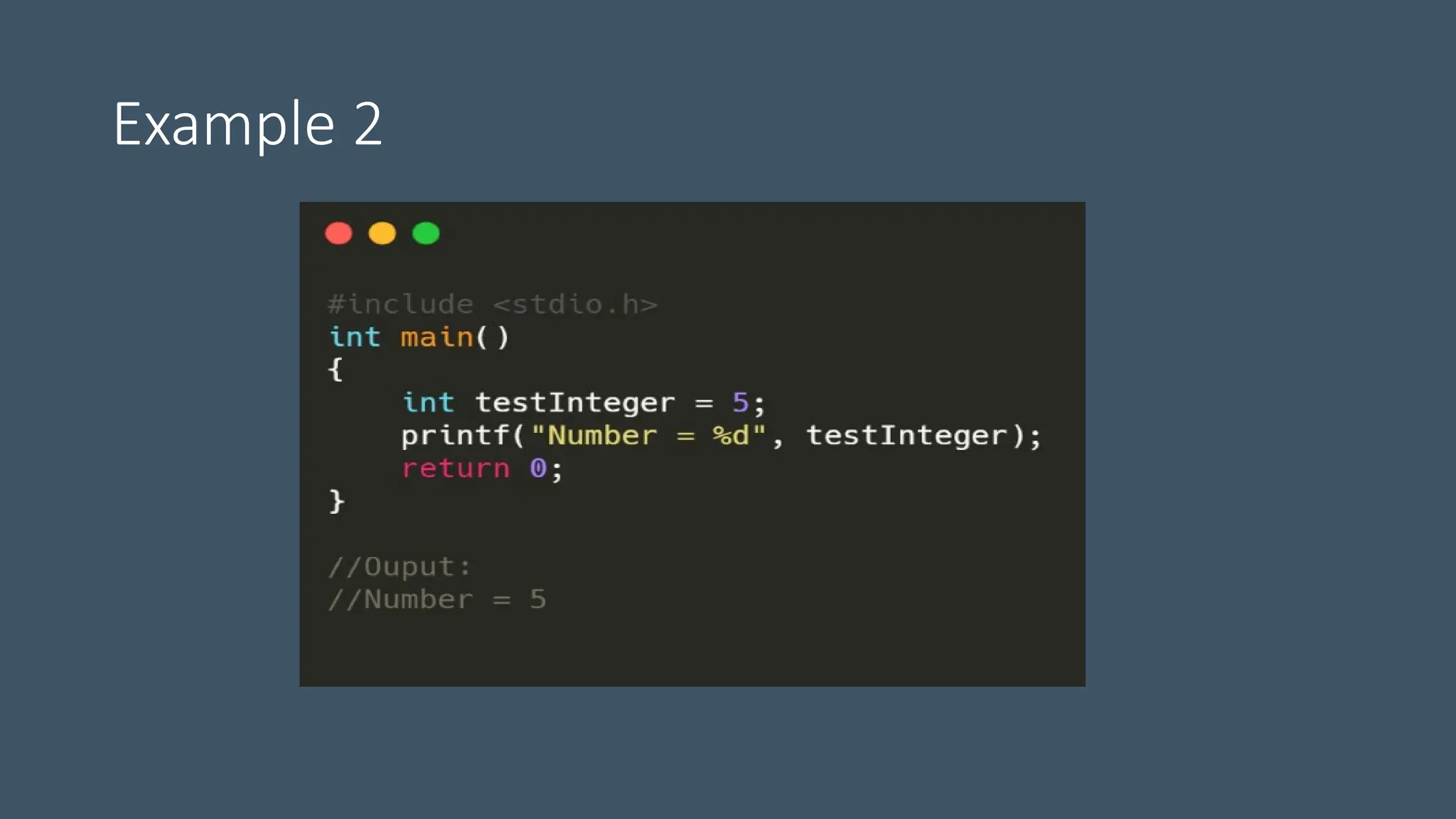
Example 2
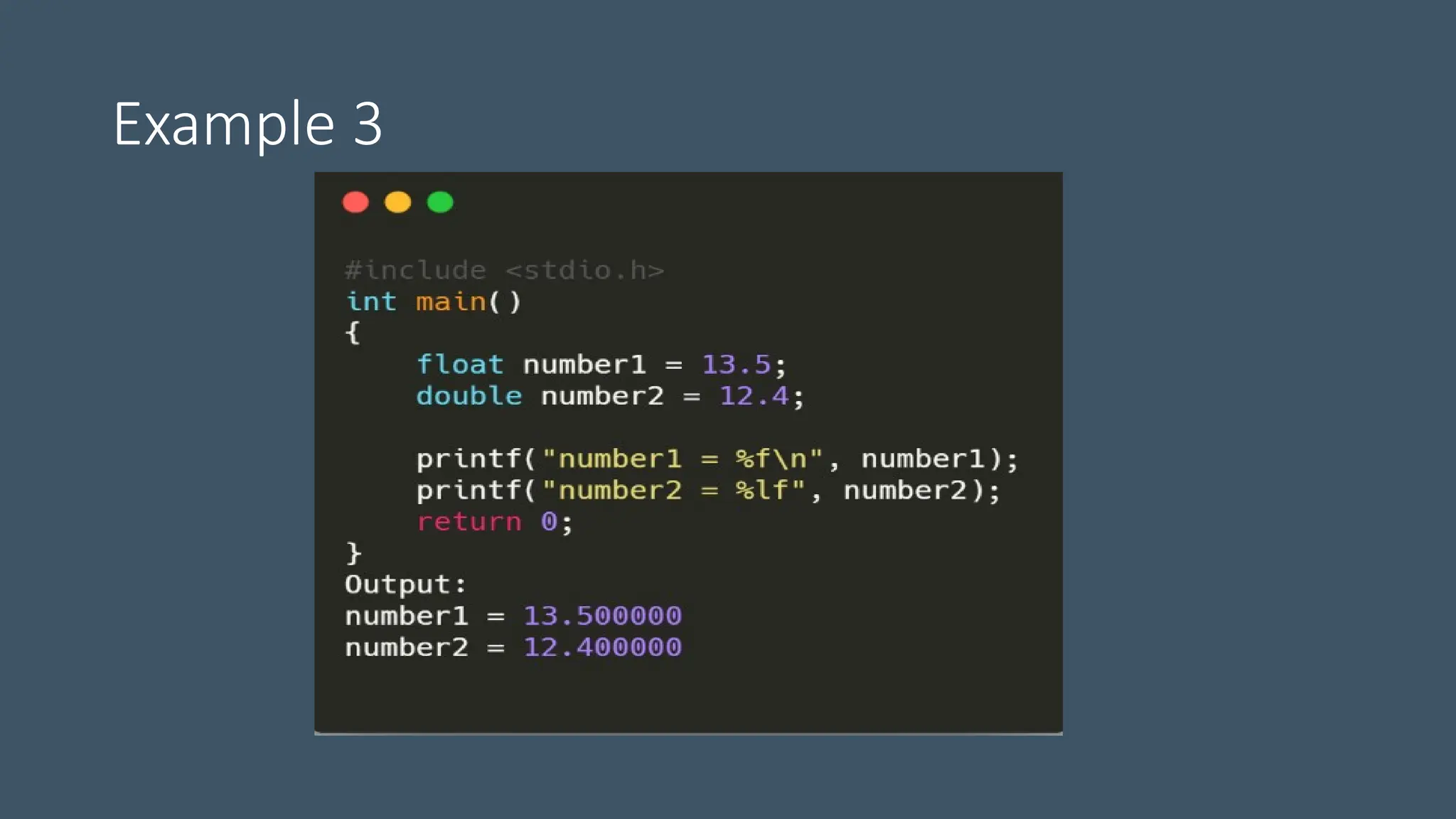
Example 3
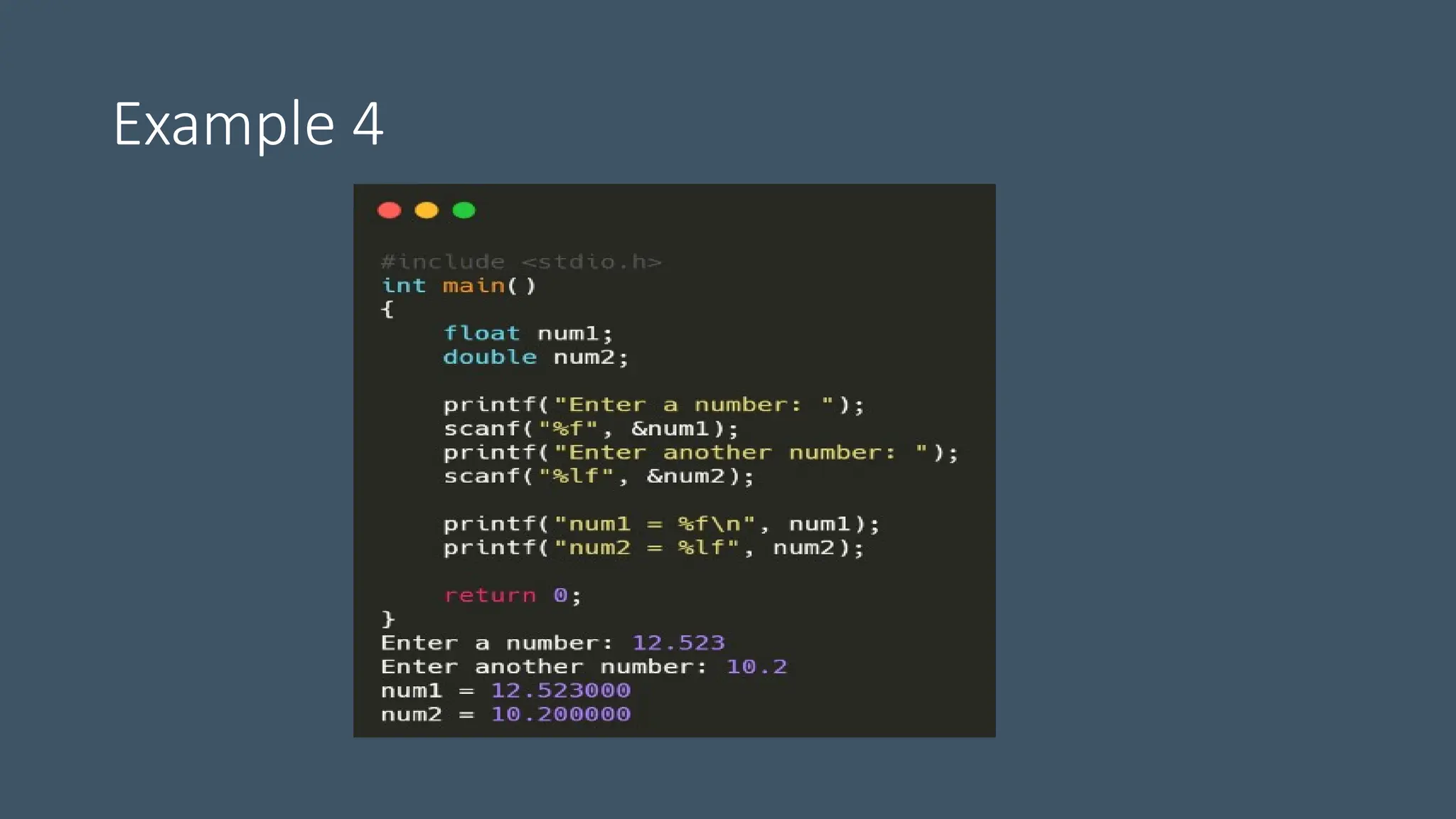
Example 4
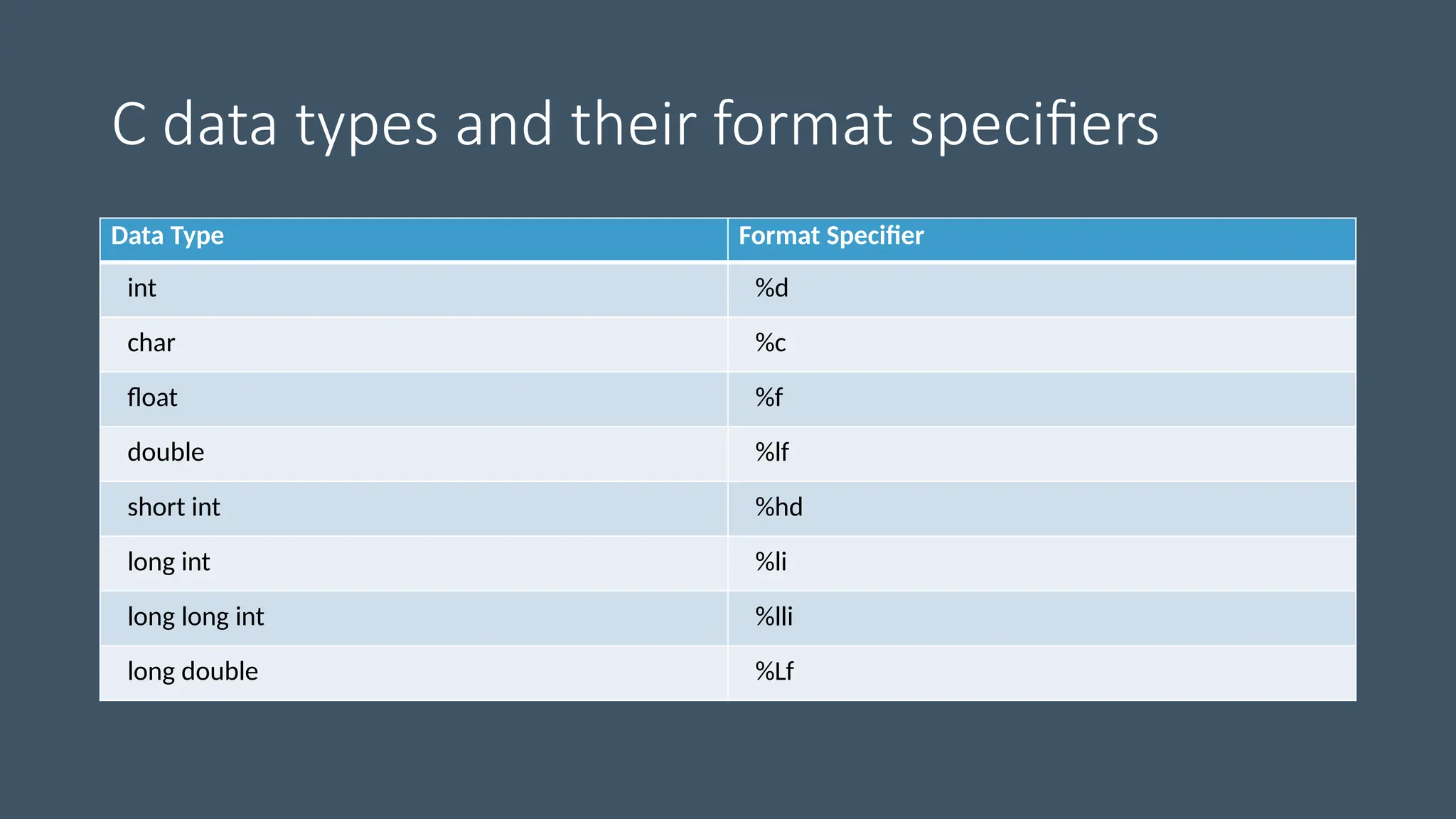
C data types and their format specifiers
Data Type Format Specifier
int %d
char %c
float %f
double %lf
short int %hd
long int %li
long long int %lli
long double %Lf
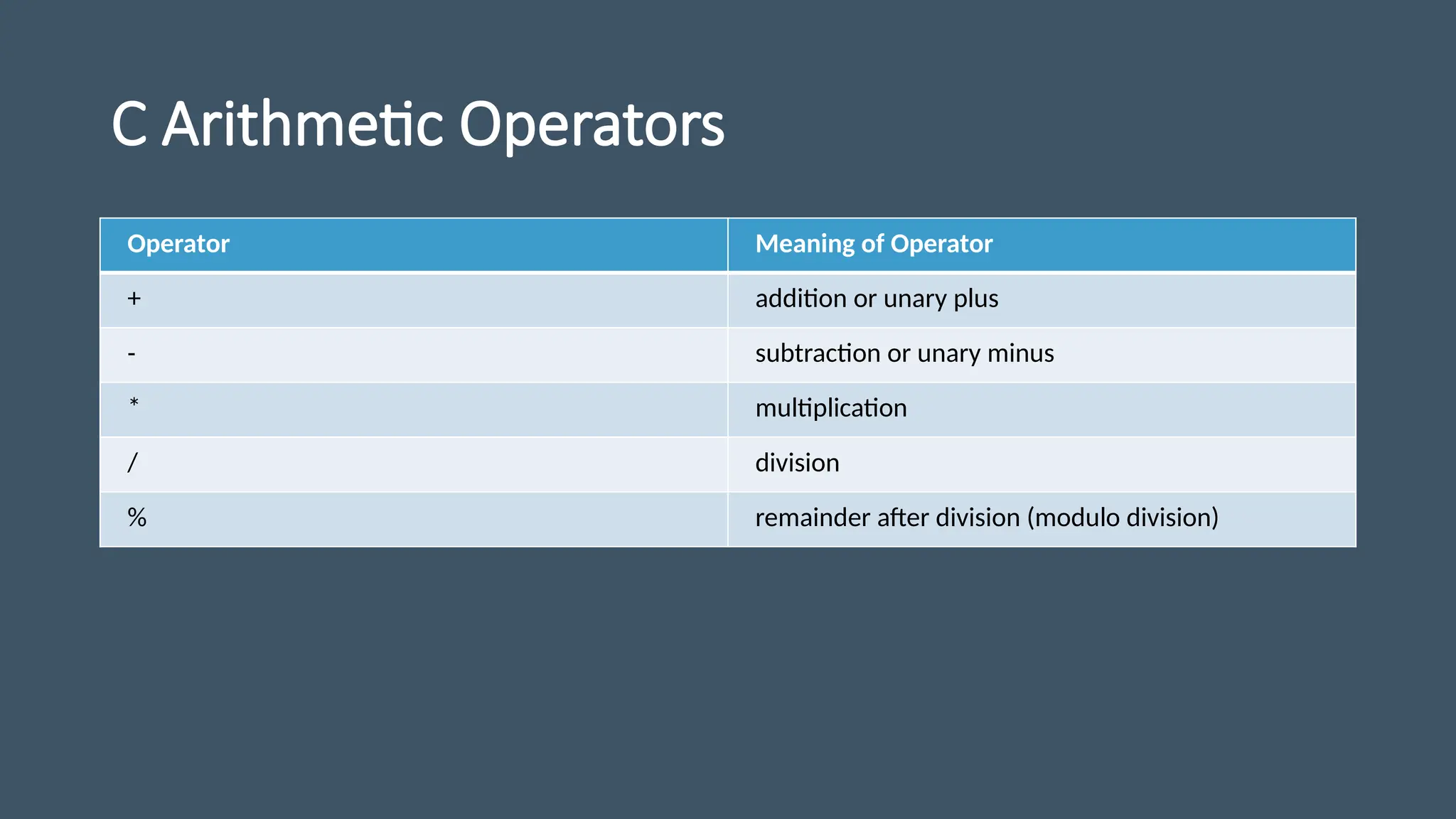
C Arithmetic Operators
Operator Meaning of Operator
+ addition or unary plus
- subtraction or unary minus
* multiplication
/ division
% remainder after division (modulo division)
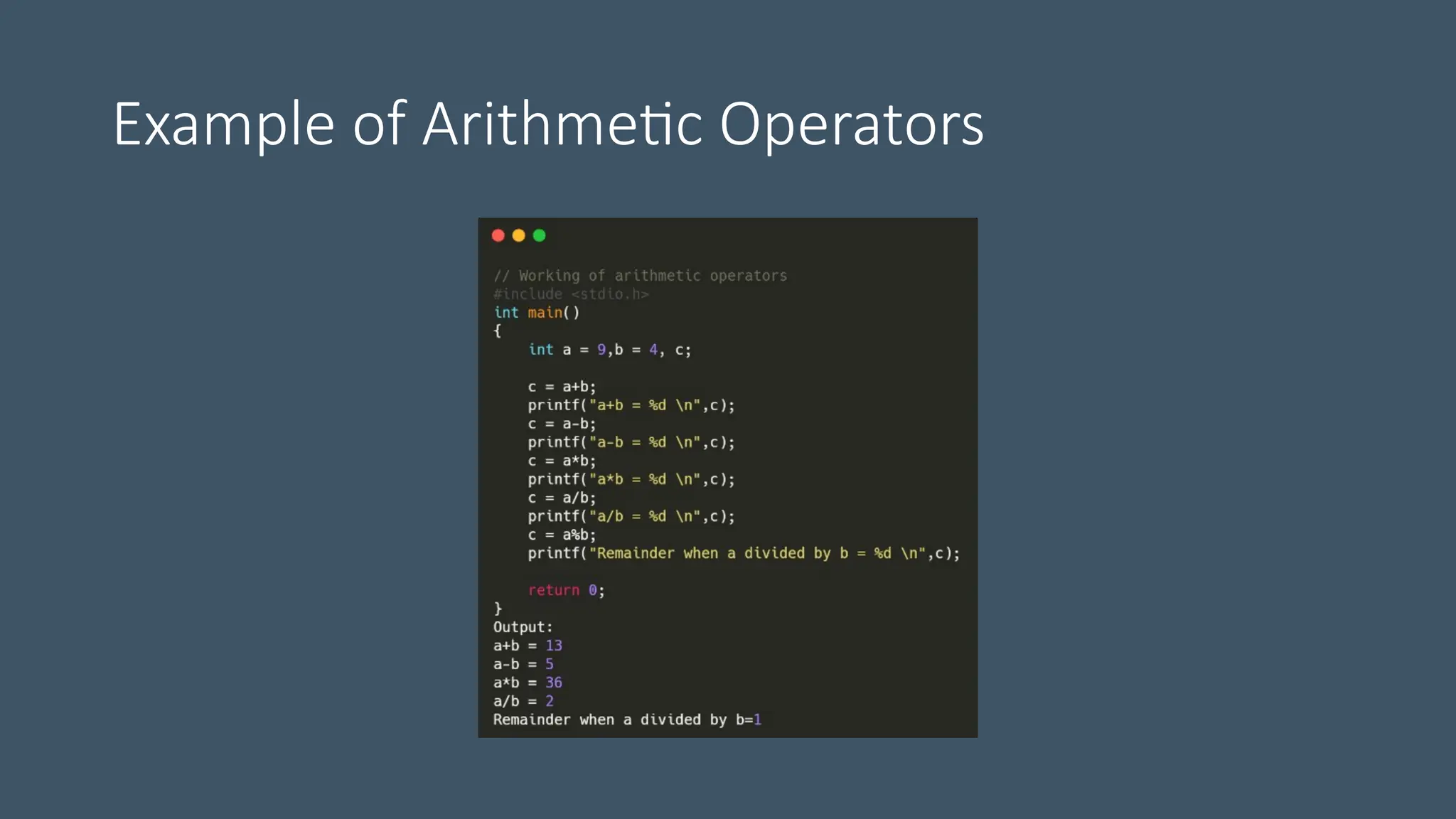
Example of Arithmetic Operators
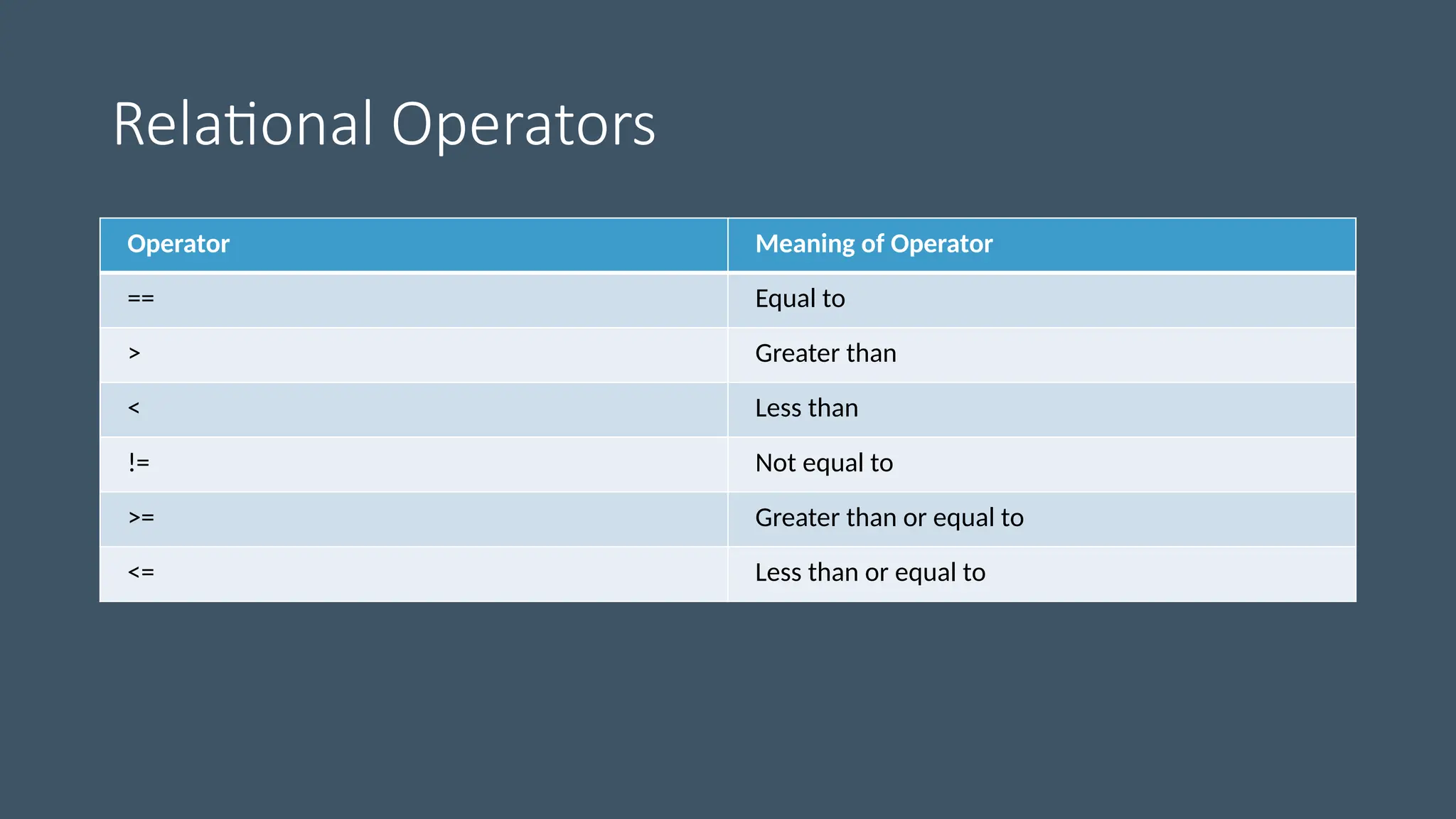
Relational Operators
Operator Meaning of Operator
== Equal to
> Greater than
< Less than
!= Not equal to
>= Greater than or equal to
<= Less than or equal to
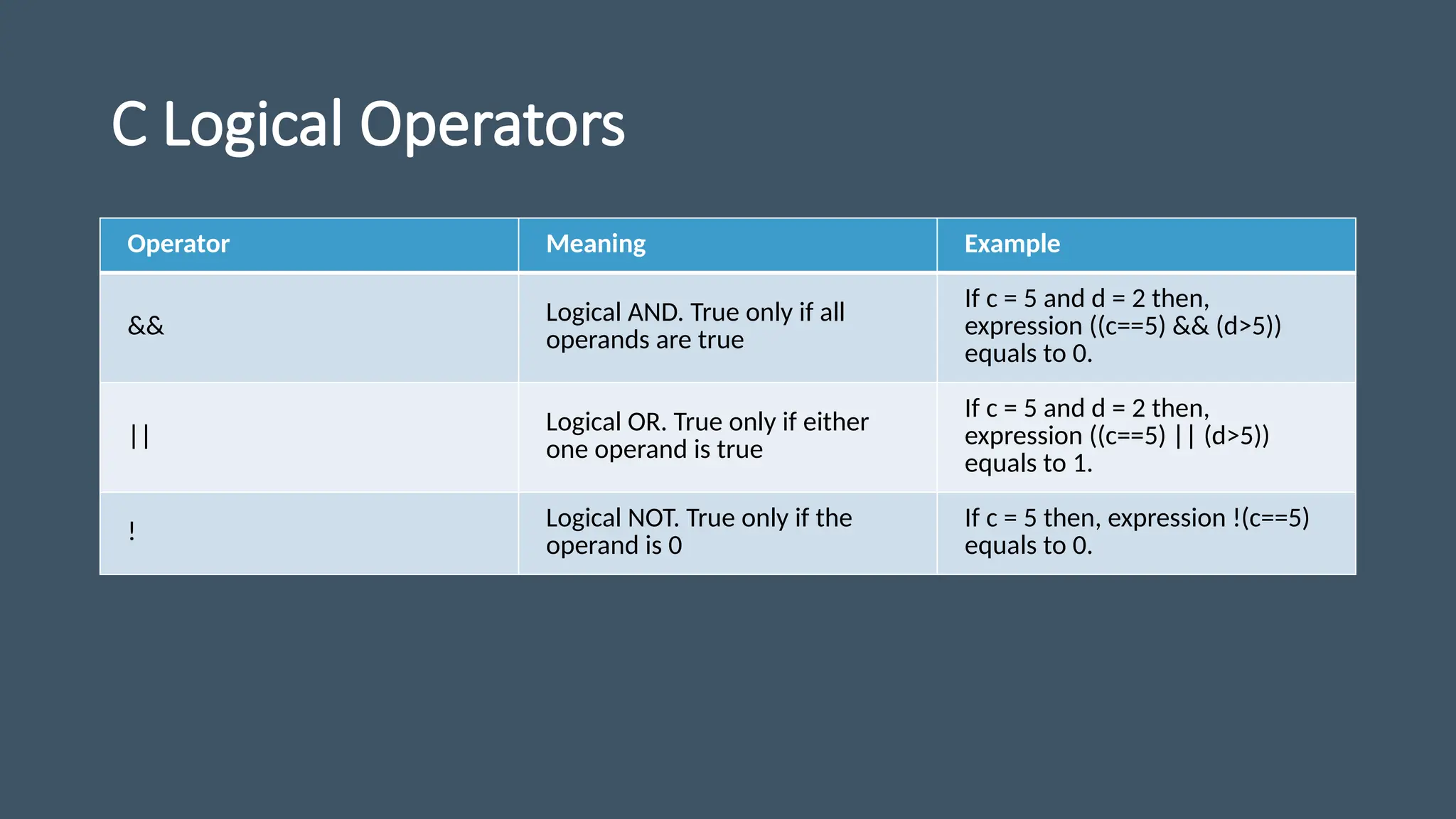
C Logical Operators
Operator Meaning Example
&&
Logical AND. True only if all
operands are true
If c = 5 and d = 2 then,
expression ((c==5) && (d>5))
equals to 0.
||
Logical OR. True only if either
one operand is true
If c = 5 and d = 2 then,
expression ((c==5) || (d>5))
equals to 1.
! Logical NOT. True only if the
operand is 0
If c = 5 then, expression !(c==5)
equals to 0.
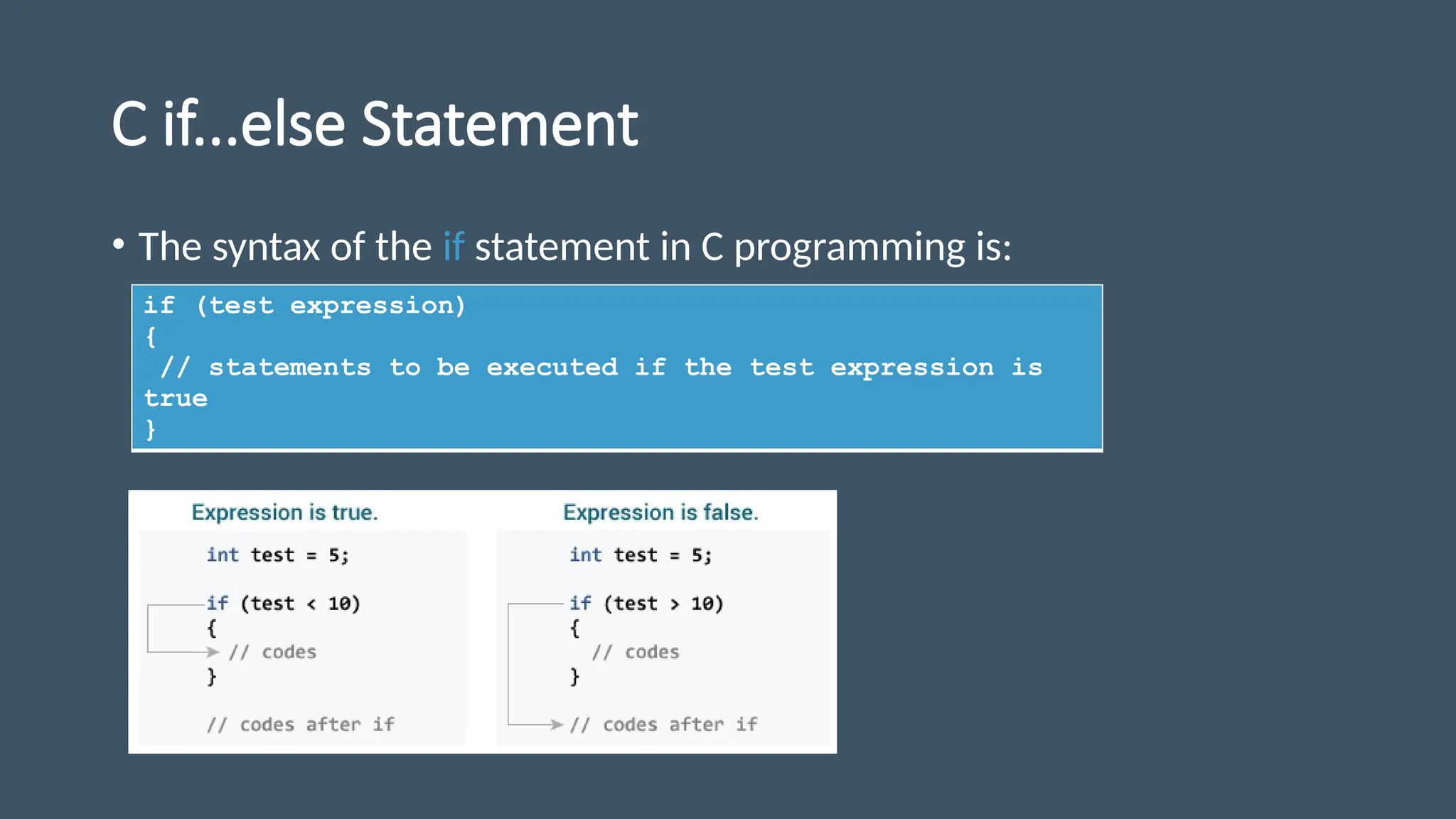
C if...else Statement
• The syntax of the if statement in C programming is:
if (test expression)
{
// statements to be executed if the test expression is
true
}
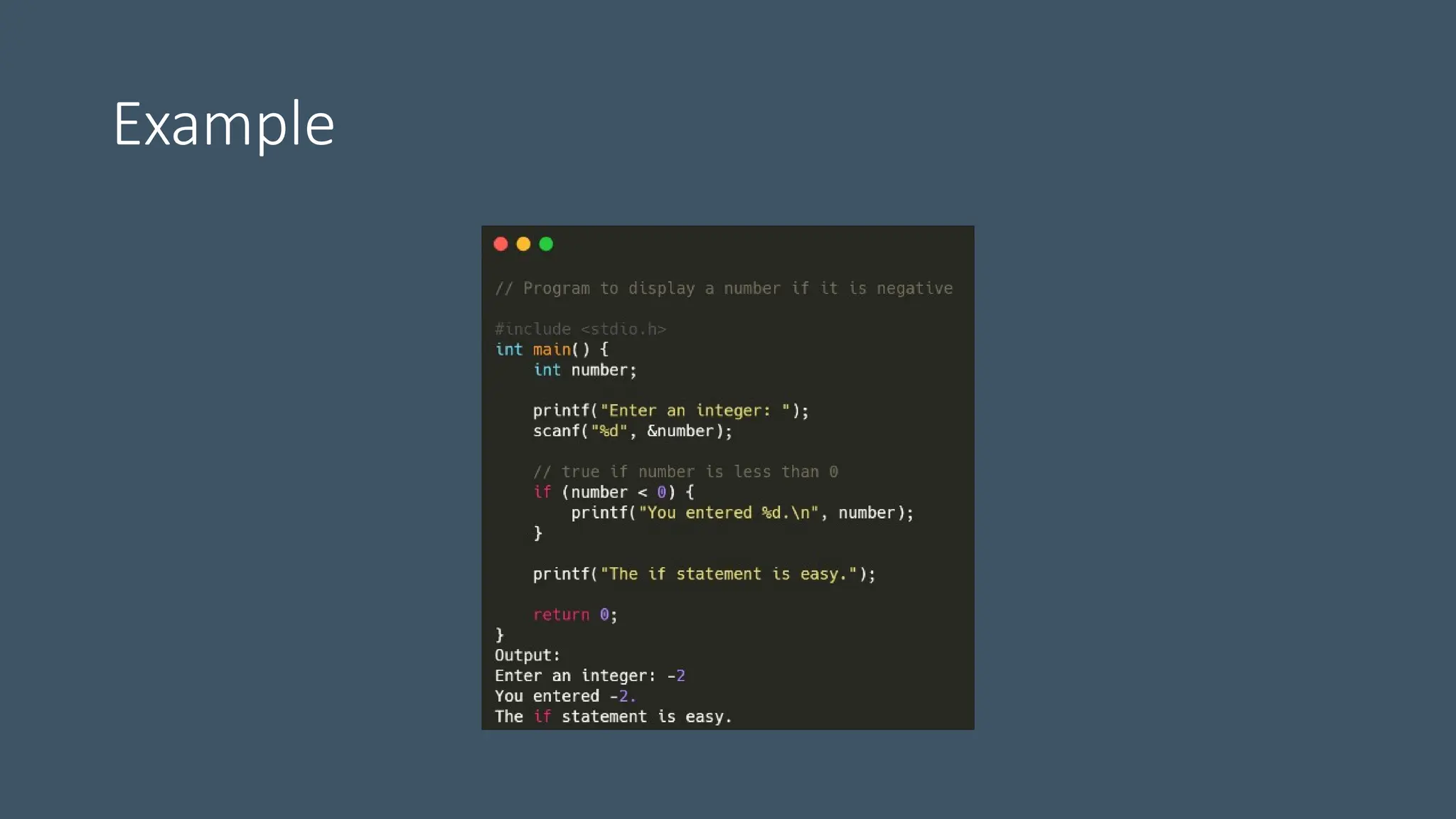
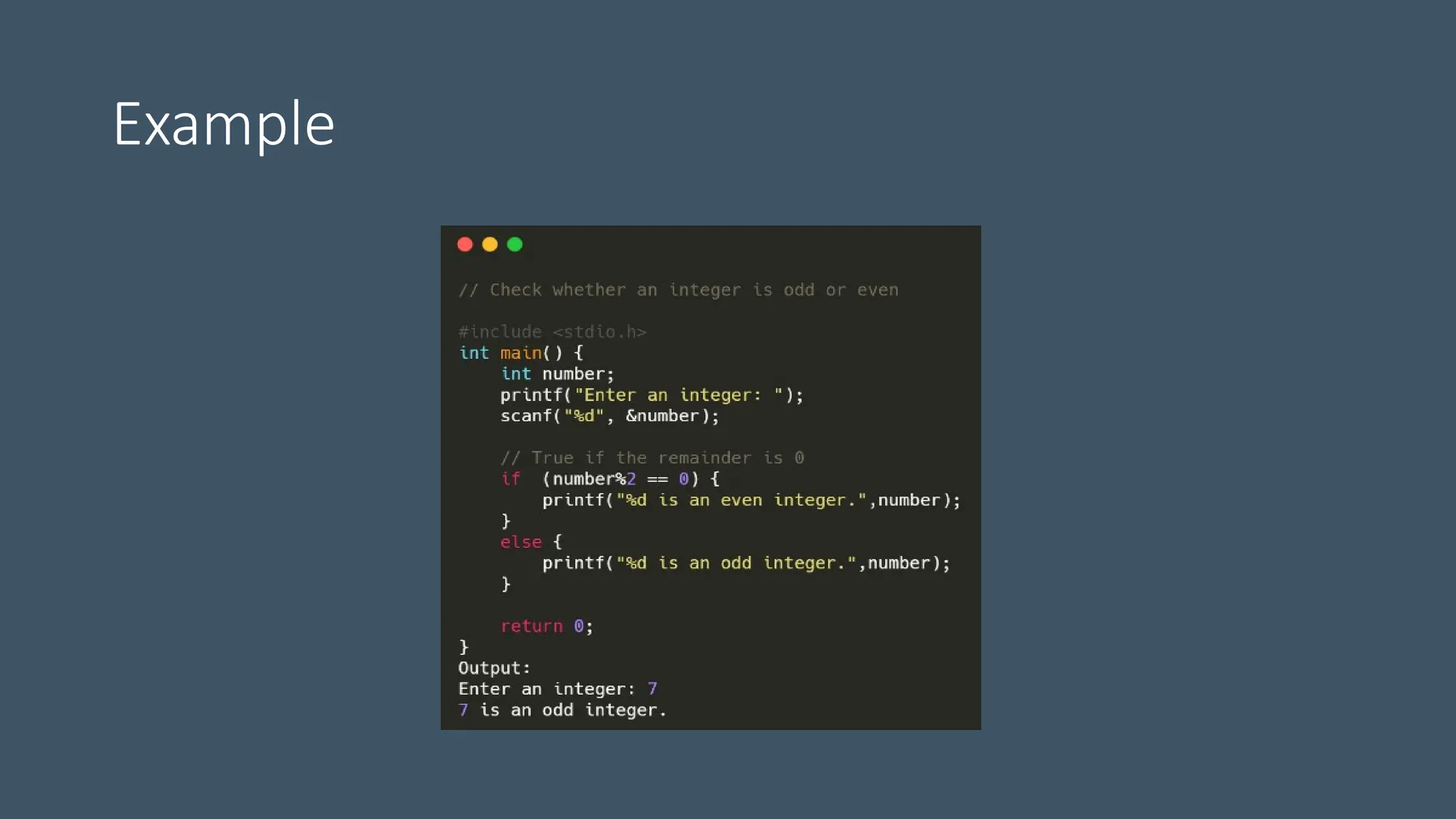
Example
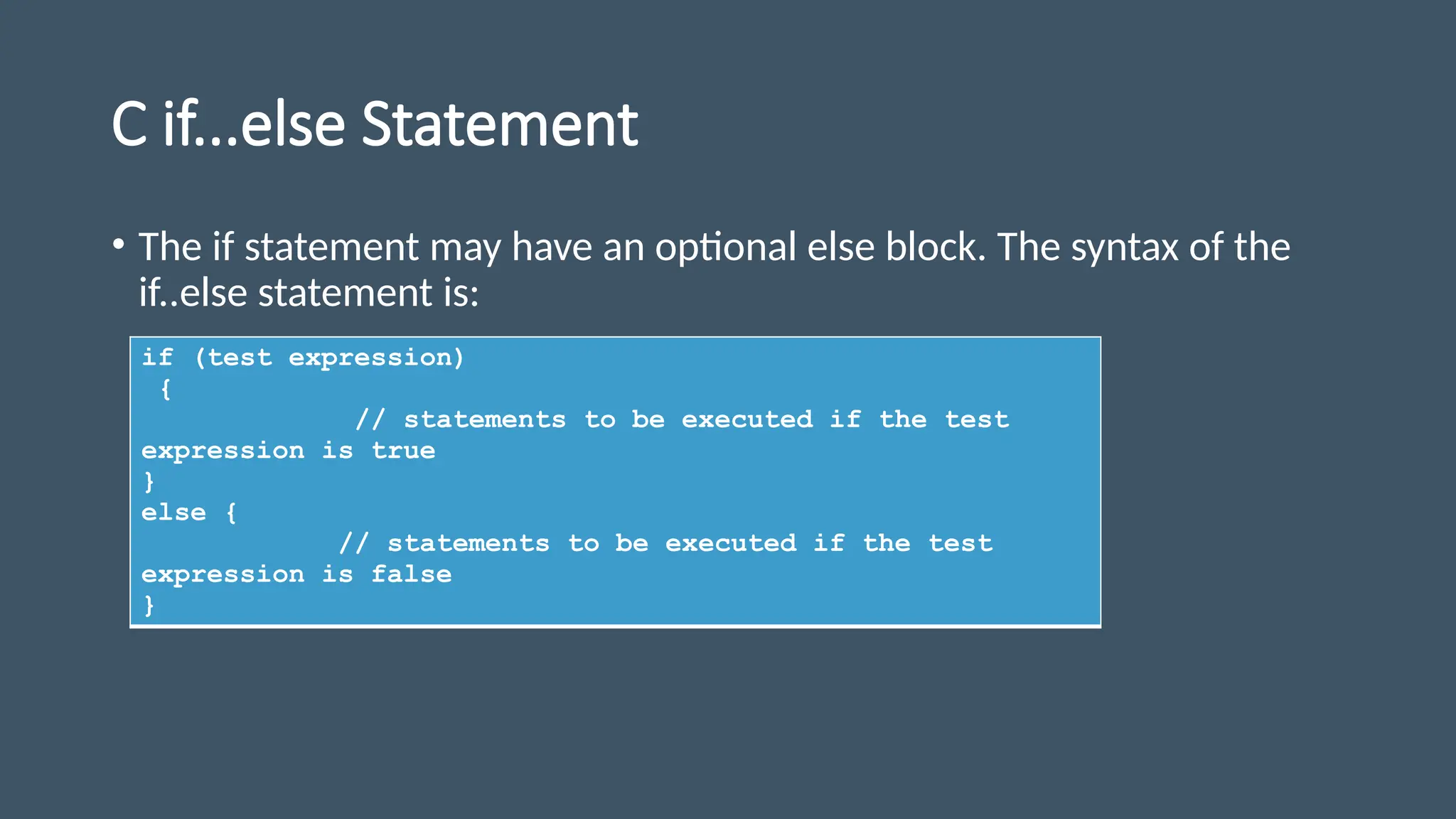
C if...else Statement
• The if statement may have an optional else block. The syntax of the
if..else statement is:
if (test expression)
{
// statements to be executed if the test
expression is true
}
else {
// statements to be executed if the test
expression is false
}
Example
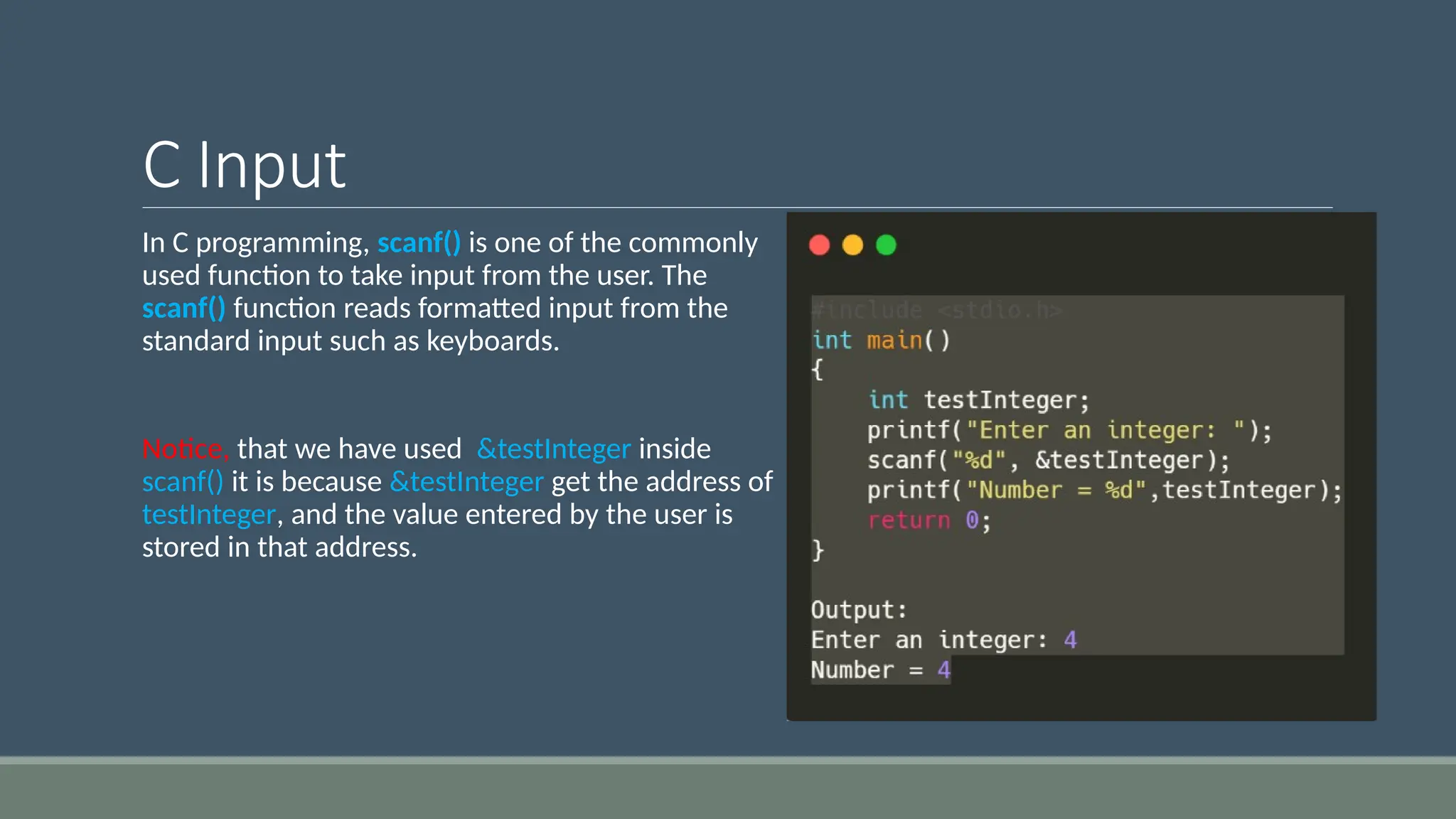
C Input
In C programming, scanf() is one of the commonly
used function to take input from the user. The
scanf() function reads formatted input from the
standard input such as keyboards.
Notice, that we have used &testInteger inside
scanf() it is because &testInteger get the address of
testInteger, and the value entered by the user is
stored in that address.
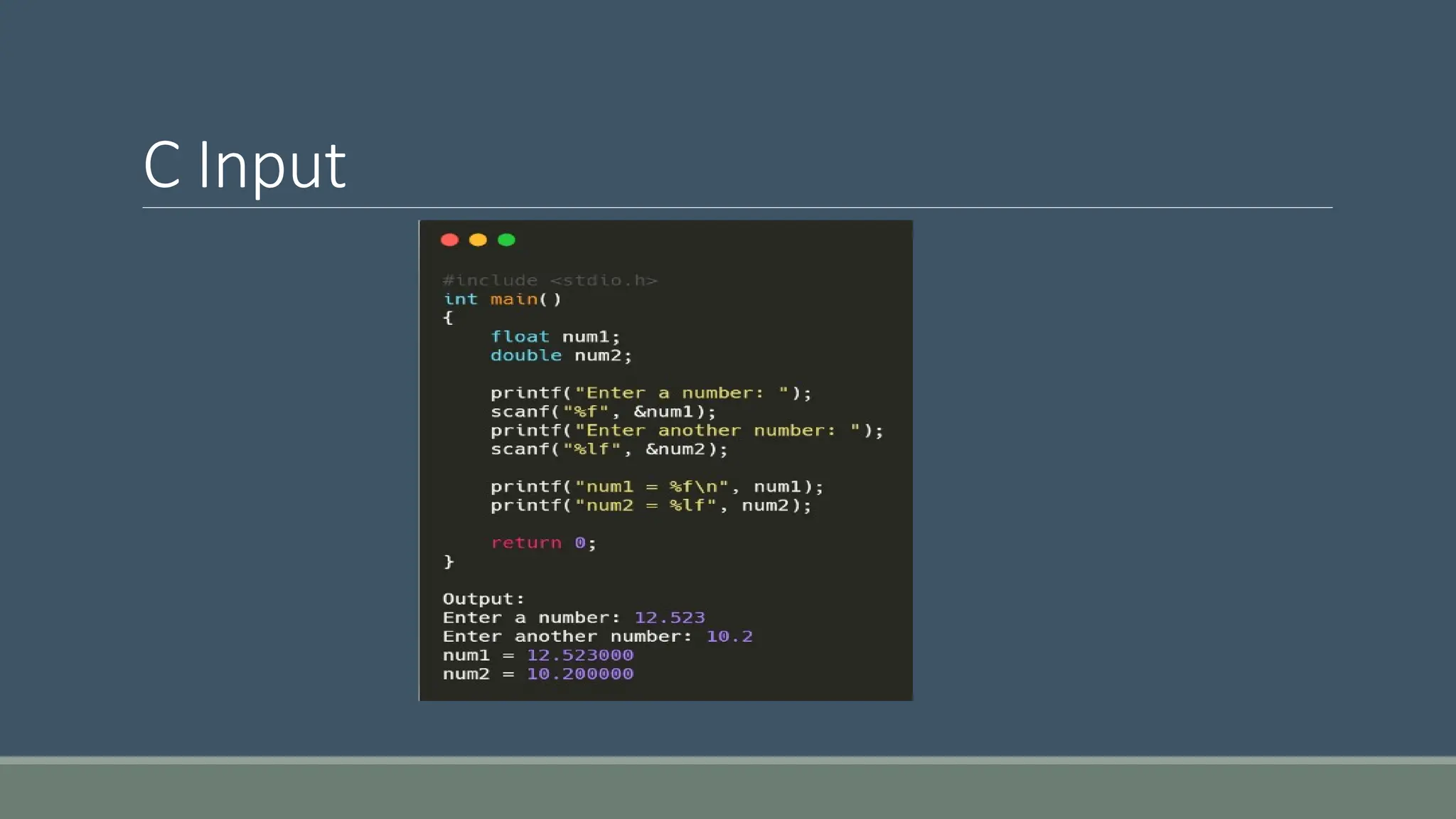
C Input
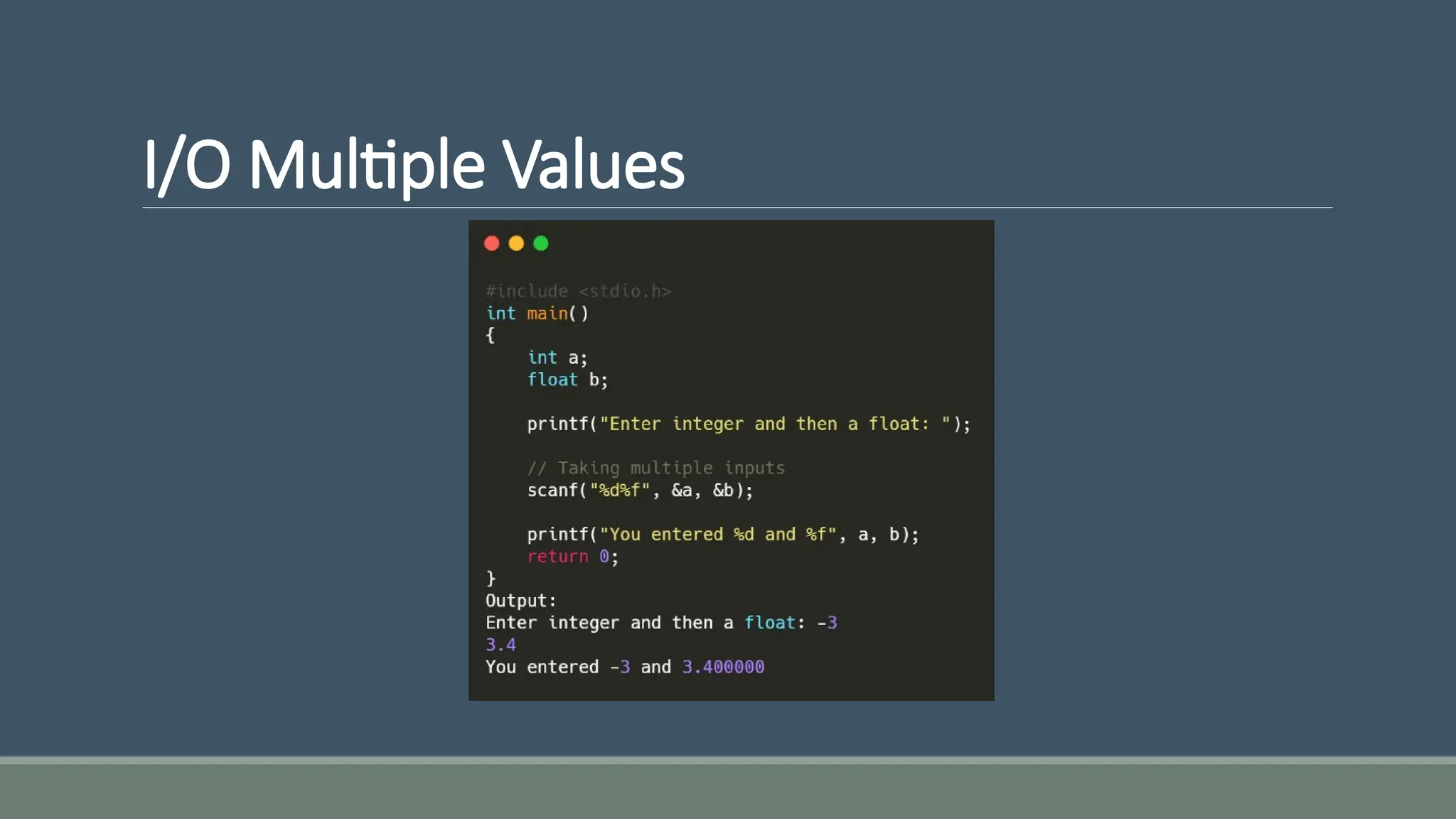
I/O Multiple Values
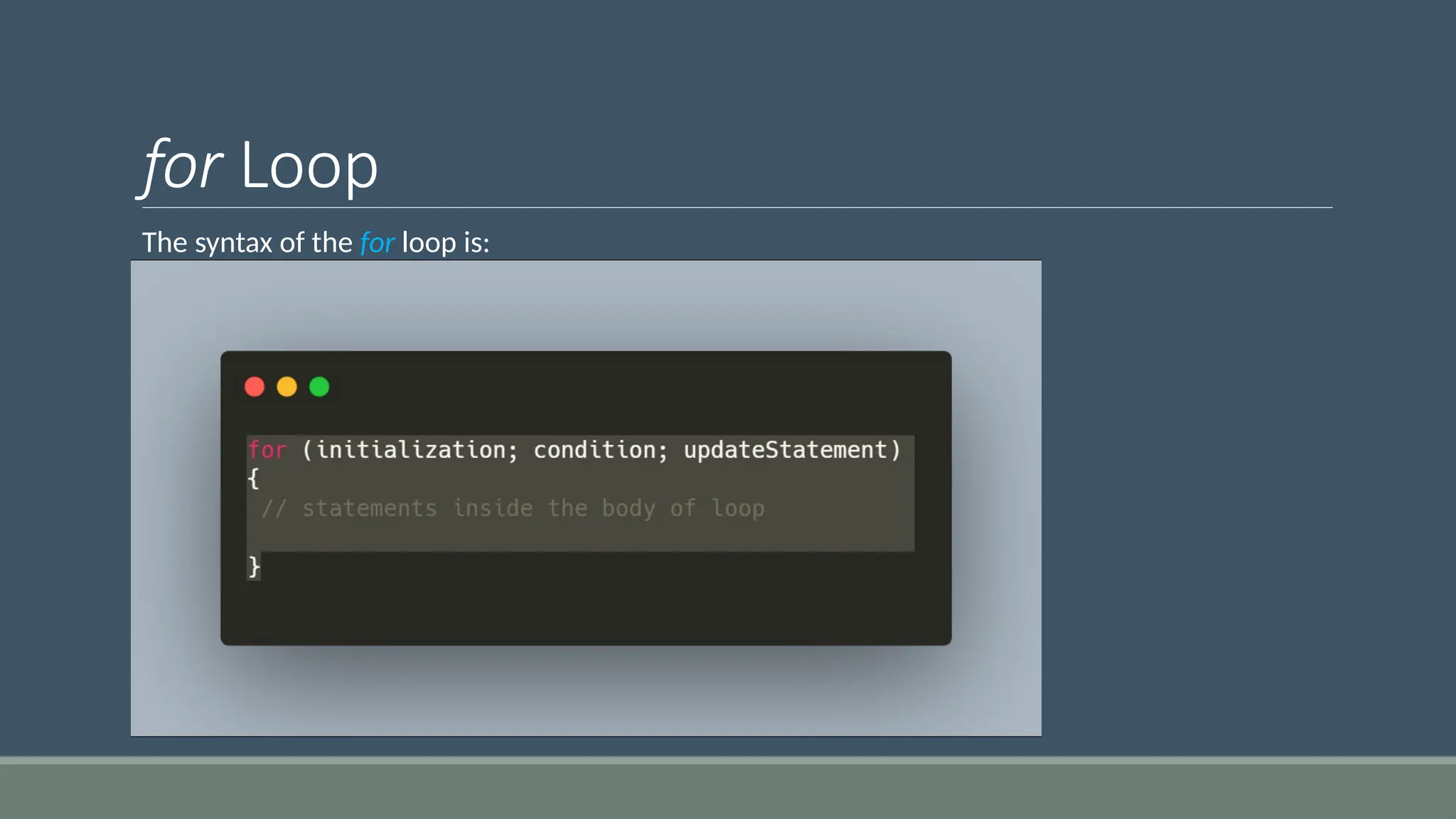
for Loop
The syntax of the for loop is:
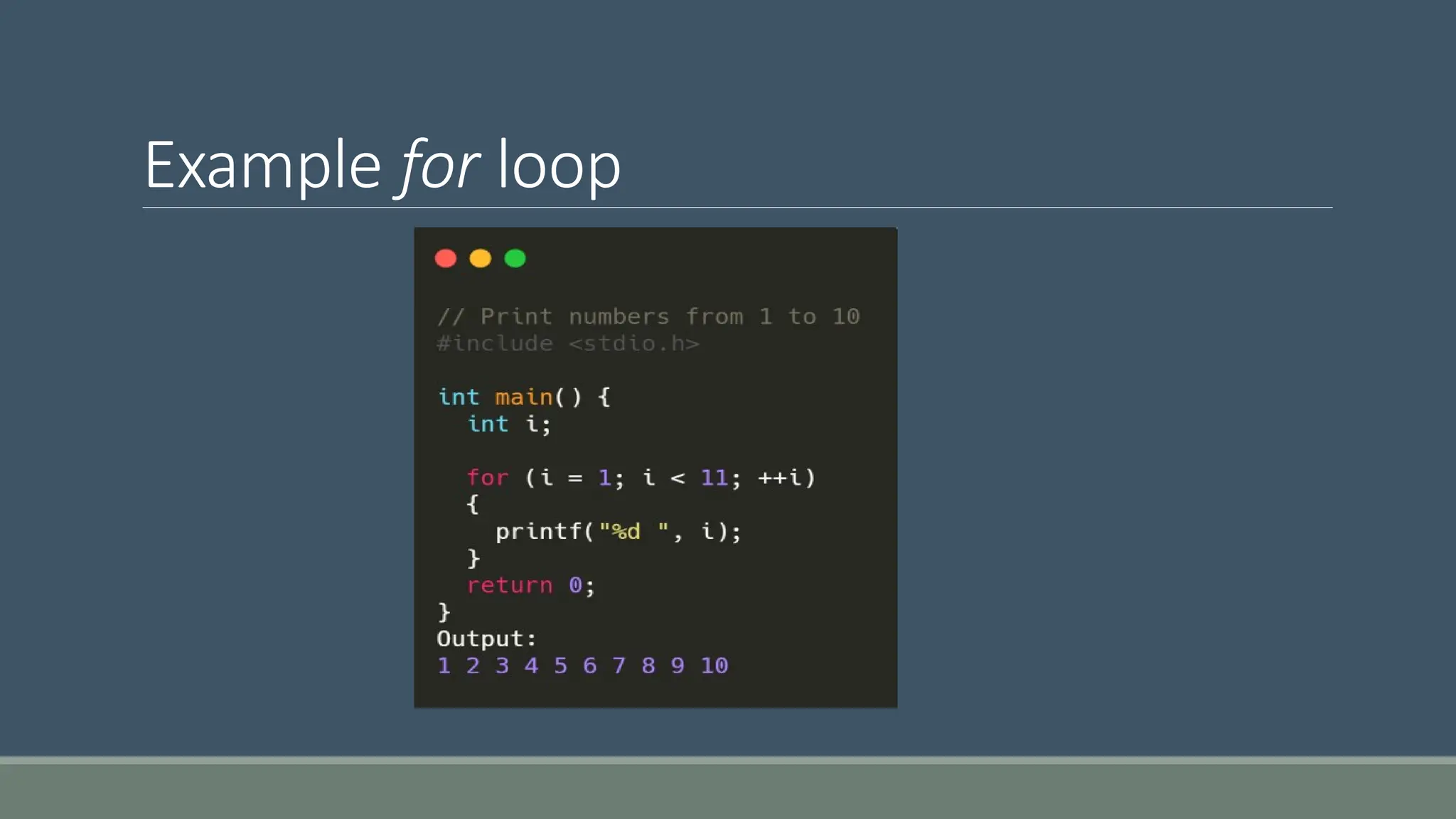
Example for loop
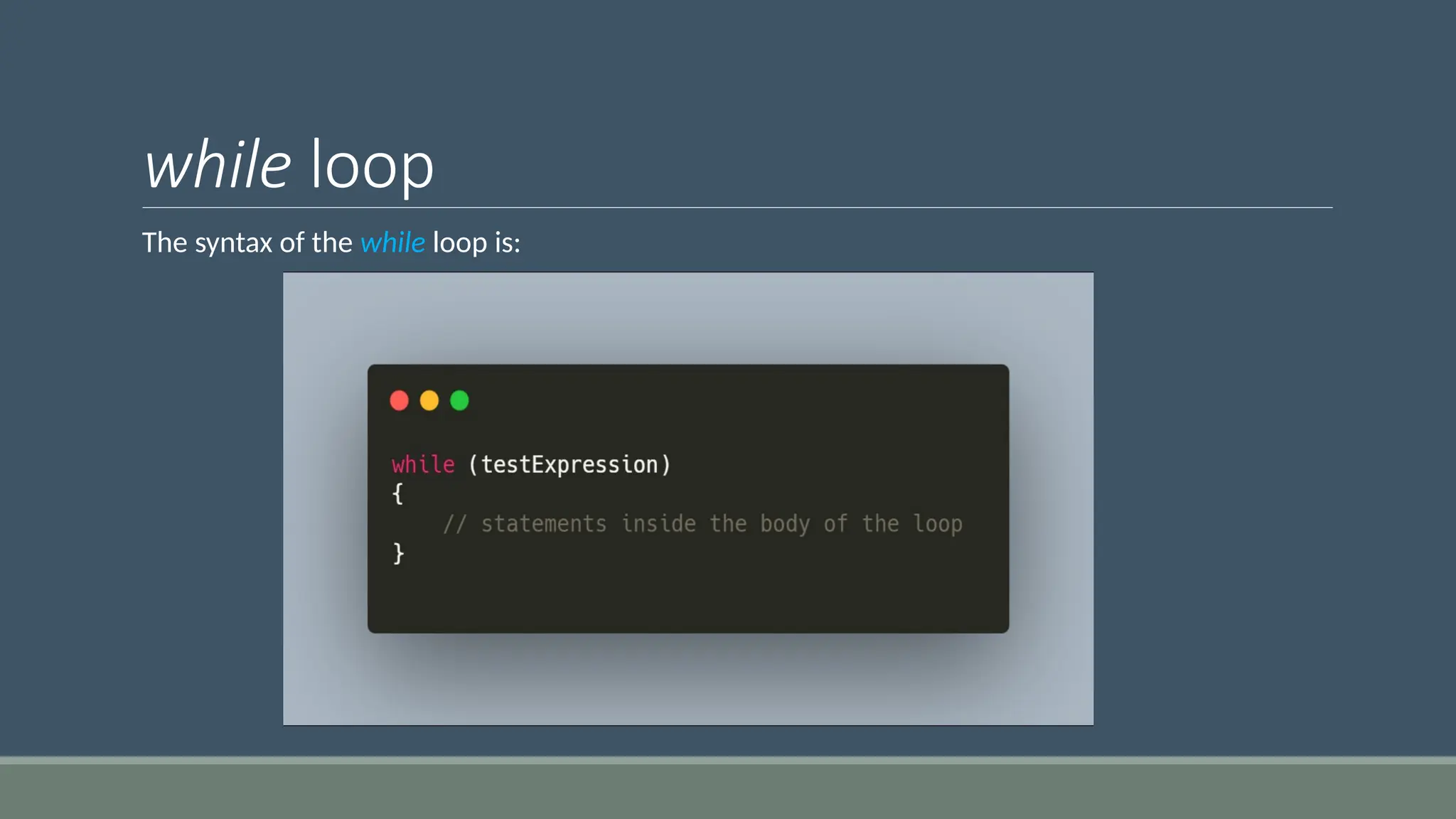
while loop
The syntax of the while loop is:
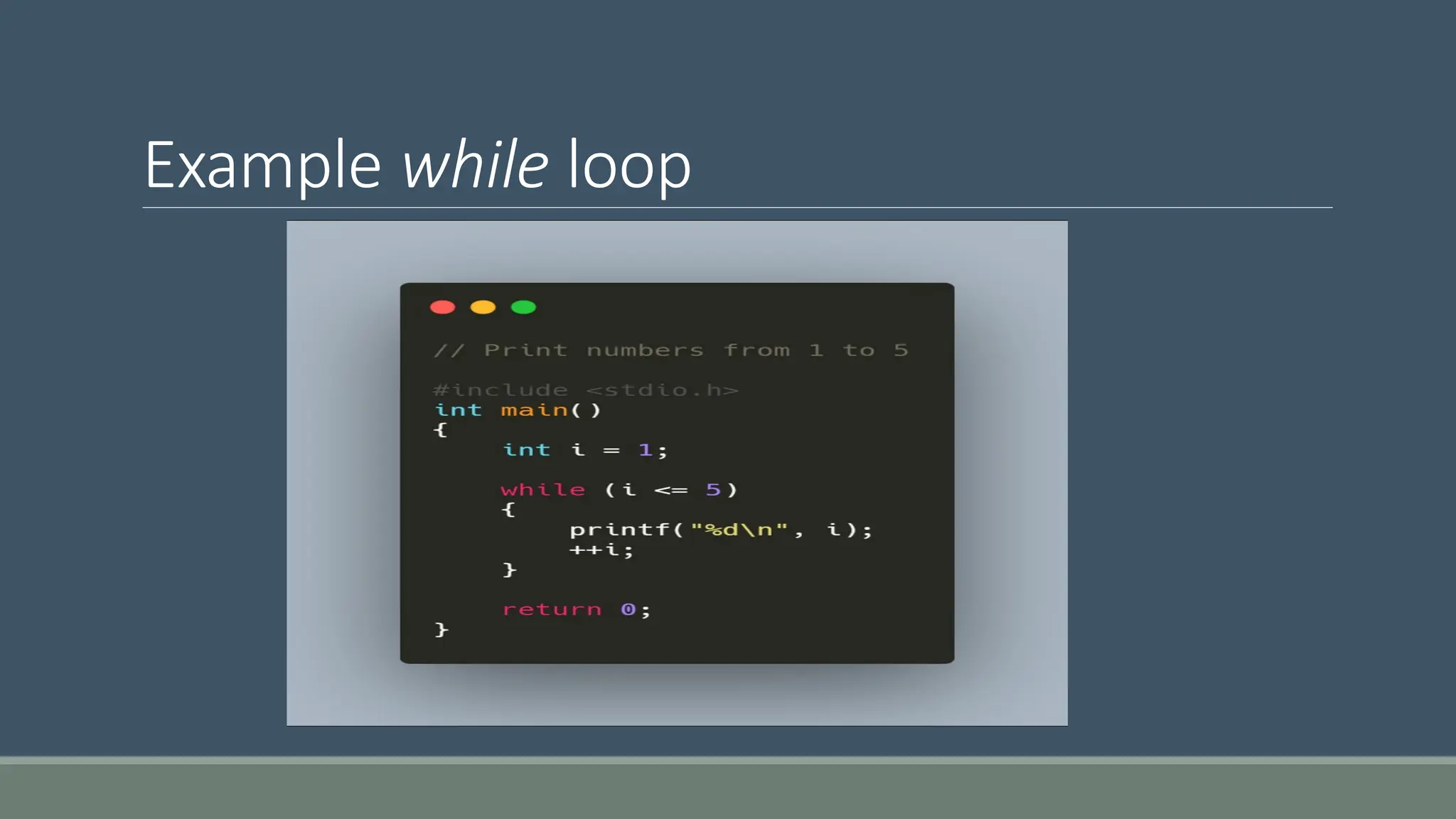
Example while loop
do...while loop
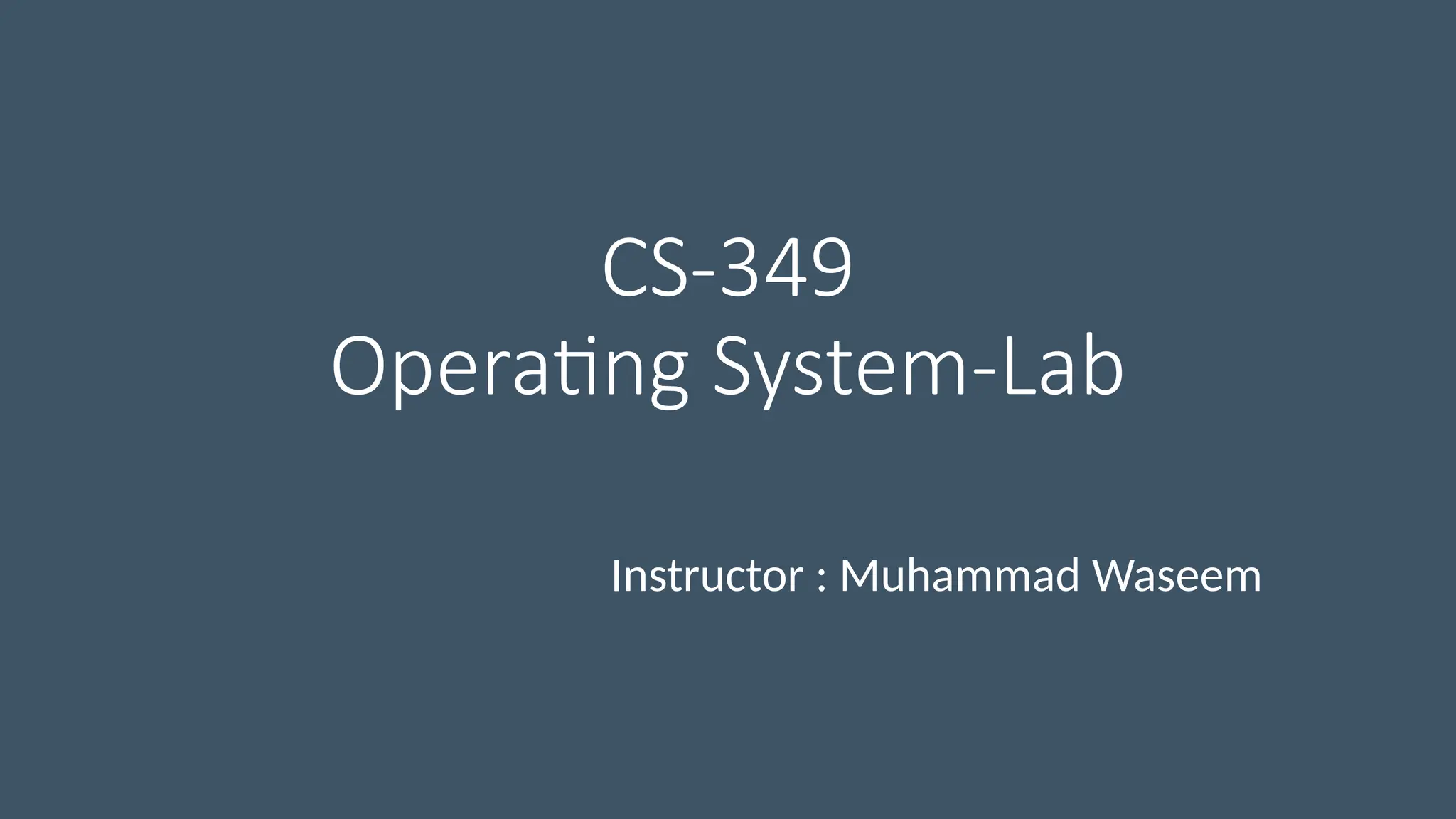
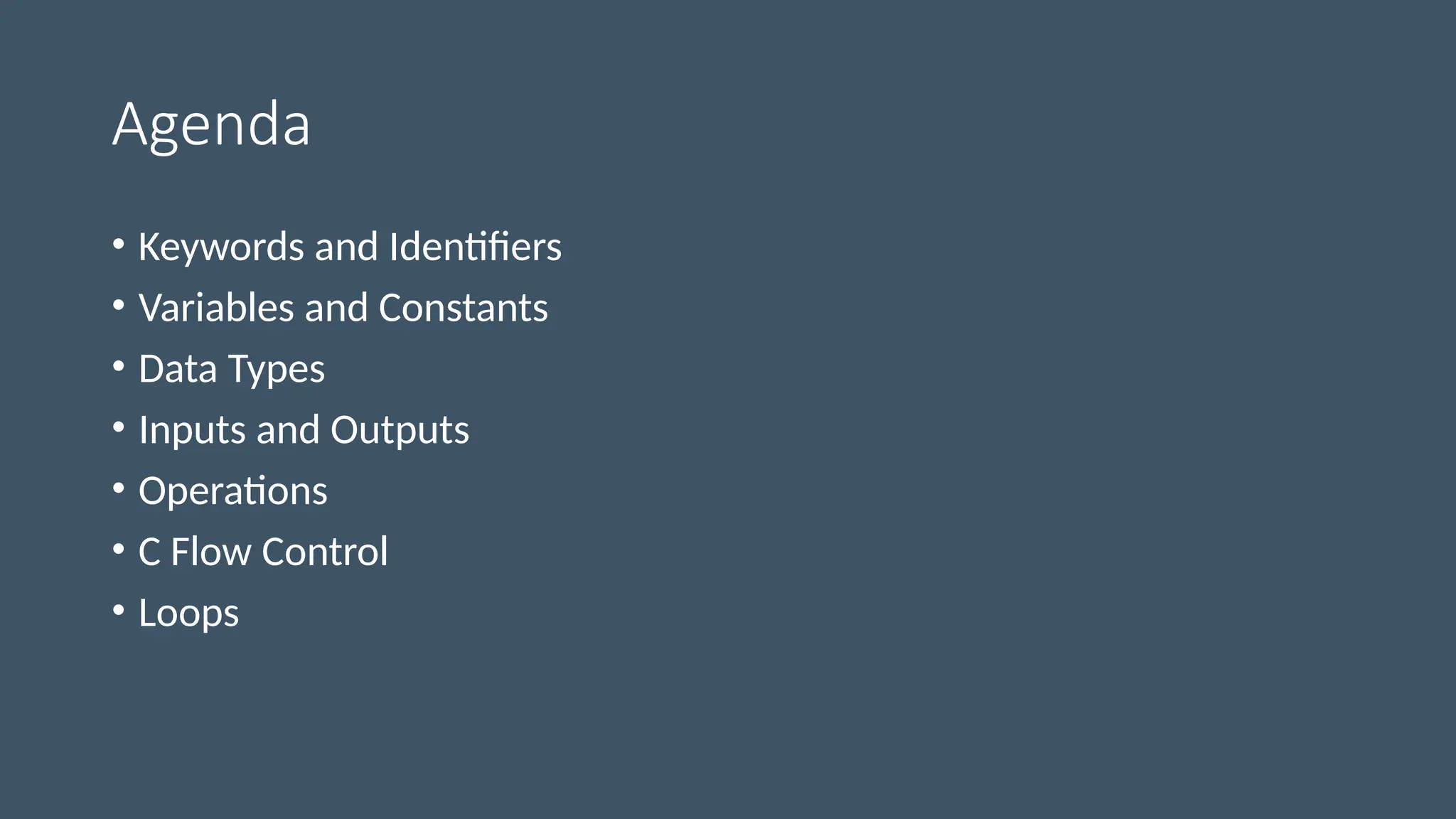
The do..while loop is similar to the while loop with one important difference. The body of
do...while loop is executed at least once. Only then, the test expression is evaluated.
Syntax :
Example do..while loop

Fundamentals of C,Data types, Decision Structure and Loops.pptx

  • 1.
  • 2.
    Agenda • Keywords andIdentifiers • Variables and Constants • Data Types • Inputs and Outputs • Operations • C Flow Control • Loops
  • 3.
    Character set • Acharacter set is a set of alphabets, letters and some special characters that are valid in C language • Alphabets • Digits `Uppercase: A B C ................................... X Y Z Lowercase: a b c ...................................... x y z 0 1 2 3 4 5 6 7 8 9
  • 4.
    Special Characters , <> . _ ( ) ; $ : % [ ] # ? ' & { } " ^ ! * / | - ~ +
  • 5.
    C Keywords • Keywordsare predefined, reserved words used in programming that have special meanings to the compiler. Keywords are part of the syntax and they cannot be used as an identifier. • For example: • Here, int is a keyword that indicates money is a variable of type int (integer) int money;
  • 6.
    Keywords • As Cis a case sensitive language, all keywords must be written in lowercase. Here is a list of all keywords allowed in ANSI C
  • 7.
    C Identifiers • Identifierrefers to name given to entities such as variables, functions, structures etc. • Identifiers must be unique. They are created to give a unique name to an entity to identify it during the execution of the program. For example: • Here, money and accountBalance are identifiers. int money; double accountBalance;
  • 8.
    Rules for namingidentifiers • A valid identifier can have letters (both uppercase and lowercase letters), digits and underscores. • The first letter of an identifier should be either a letter or an underscore. • You cannot use keywords as identifiers. • There is no rule on how long an identifier can be. However, you may run into problems in some compilers if the identifier is longer than 31 characters.
  • 9.
    Variables • In programming,a variable is a container (storage area) to hold data • To indicate the storage area, each variable should be given a unique name (identifier). Variable names are just the symbolic representation of a memory location. For example: • Here playerScore is a variable of int type int playerScore = 95;
  • 10.
    Rules for naminga variable • A variable name can only have letters (both uppercase and lowercase letters), digits and underscore. • The first letter of a variable should be either a letter or an underscore. • There is no rule on how long a variable name (identifier) can be. However, you may run into problems in some compilers if the variable name is longer than 31 characters.
  • 11.
    Escape Sequences • Sometimes,it is necessary to use characters that cannot be typed or has special meaning in C programming. For example: newline(enter), tab, question mark etc
  • 12.
    Escape Sequences Escape SequencesCharacter b Backspace f Form feed n Newline r Return t Horizontal tab v Vertical tab Backslash ' Single quotation mark " Double quotation mark ? Question mark 0 Null character
  • 13.
    Constants • If youwant to define a variable whose value cannot be changed, you can use the const keyword. This will create a constant. For example: • Here, PI is a symbolic constant; its value cannot be changed. const double PI = 3.14; const double PI = 3.14; PI = 2.9; //Error
  • 14.
    Basic types Type Size(bytes) Format Specifier int at least 2, usually 4 %d char 1 %c float 4 %f double 8 %lf short int 2 usually %hd unsigned int at least 2, usually 4 %u long int at least 4, usually 8 %li long long int at least 8 %lli unsigned long int at least 4 %lu unsigned long long int at least 8 %llu signed char 1 %c unsigned char 1 %c long double at least 10, usually 12 or 16 %Lf
  • 15.
    C Input Output(I/O) • In C programming printf() is one of the main output function. The function sends formatted output to the screen. For example:
  • 16.
    How does thisprogram work? • All valid C programs must contain the main() function. The code execution begins from the start of the main() function. • The printf() is a library function to send formatted output to the screen. The function prints the string inside quotations. • To use printf() in our program, we need to include stdio.h header file using the #include <stdio.h> statement. • The return 0; statement inside the main() function is the "Exit status" of the program. It's optional.
  • 17.
  • 18.
  • 19.
  • 20.
    C data typesand their format specifiers Data Type Format Specifier int %d char %c float %f double %lf short int %hd long int %li long long int %lli long double %Lf
  • 21.
    C Arithmetic Operators OperatorMeaning of Operator + addition or unary plus - subtraction or unary minus * multiplication / division % remainder after division (modulo division)
  • 22.
  • 23.
    Relational Operators Operator Meaningof Operator == Equal to > Greater than < Less than != Not equal to >= Greater than or equal to <= Less than or equal to
  • 24.
    C Logical Operators OperatorMeaning Example && Logical AND. True only if all operands are true If c = 5 and d = 2 then, expression ((c==5) && (d>5)) equals to 0. || Logical OR. True only if either one operand is true If c = 5 and d = 2 then, expression ((c==5) || (d>5)) equals to 1. ! Logical NOT. True only if the operand is 0 If c = 5 then, expression !(c==5) equals to 0.
  • 25.
    C if...else Statement •The syntax of the if statement in C programming is: if (test expression) { // statements to be executed if the test expression is true }
  • 26.
  • 27.
    C if...else Statement •The if statement may have an optional else block. The syntax of the if..else statement is: if (test expression) { // statements to be executed if the test expression is true } else { // statements to be executed if the test expression is false }
  • 28.
  • 29.
    C Input In Cprogramming, scanf() is one of the commonly used function to take input from the user. The scanf() function reads formatted input from the standard input such as keyboards. Notice, that we have used &testInteger inside scanf() it is because &testInteger get the address of testInteger, and the value entered by the user is stored in that address.
  • 30.
  • 31.
  • 32.
    for Loop The syntaxof the for loop is:
  • 33.
  • 34.
    while loop The syntaxof the while loop is:
  • 35.
  • 36.
    do...while loop The do..whileloop is similar to the while loop with one important difference. The body of do...while loop is executed at least once. Only then, the test expression is evaluated. Syntax :
  • 37.