Functions of
Management:
Staffing
Mr. Michael C. Pagaduan, LPT
Organization and Management Subject Teacher
Your
Logo
Here
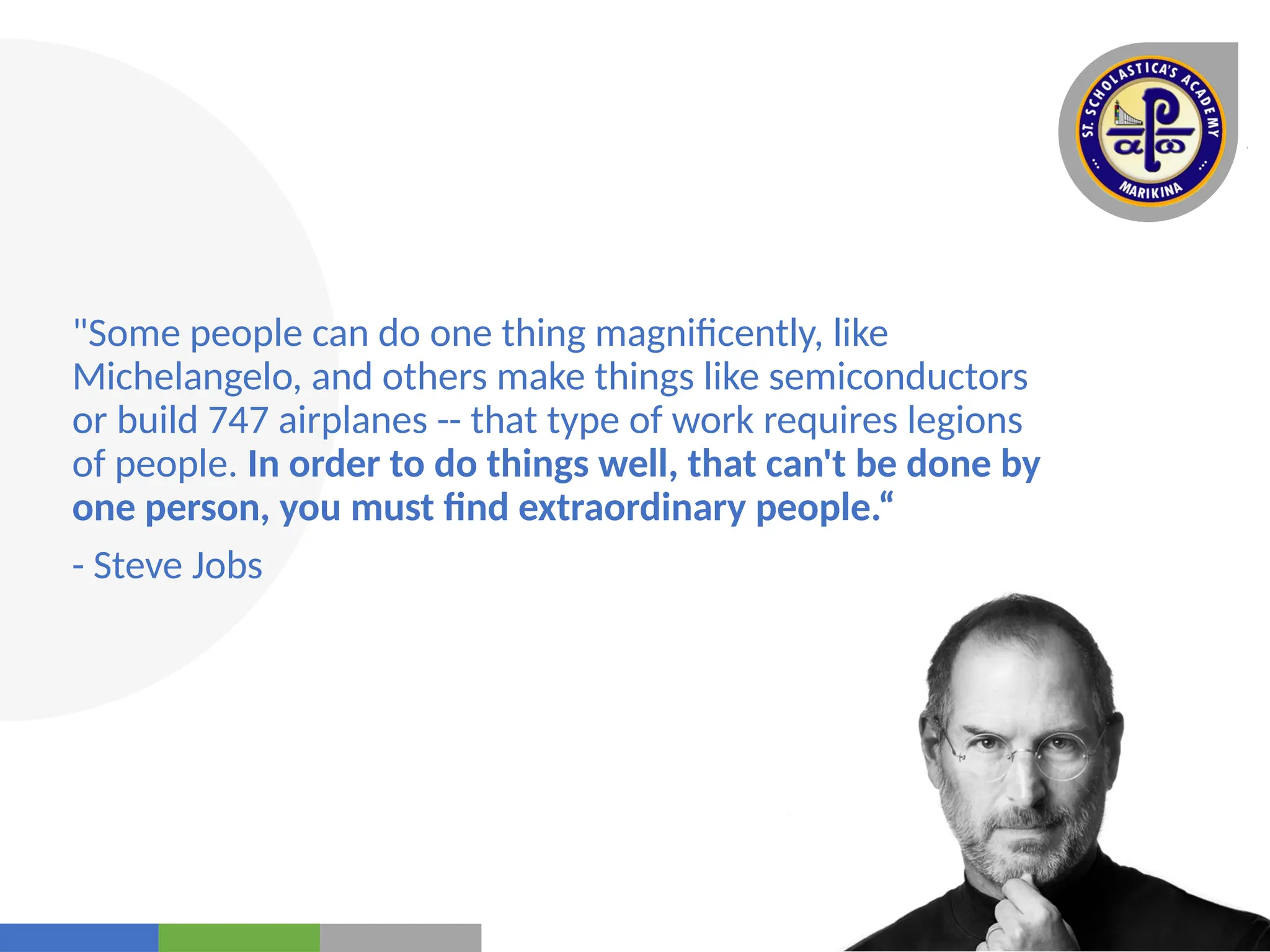
"Some people can do one thing magnificently, like
Michelangelo, and others make things like semiconductors
or build 747 airplanes -- that type of work requires legions
of people. In order to do things well, that can't be done by
one person, you must find extraordinary people.“
- Steve Jobs
Your
Logo
Here
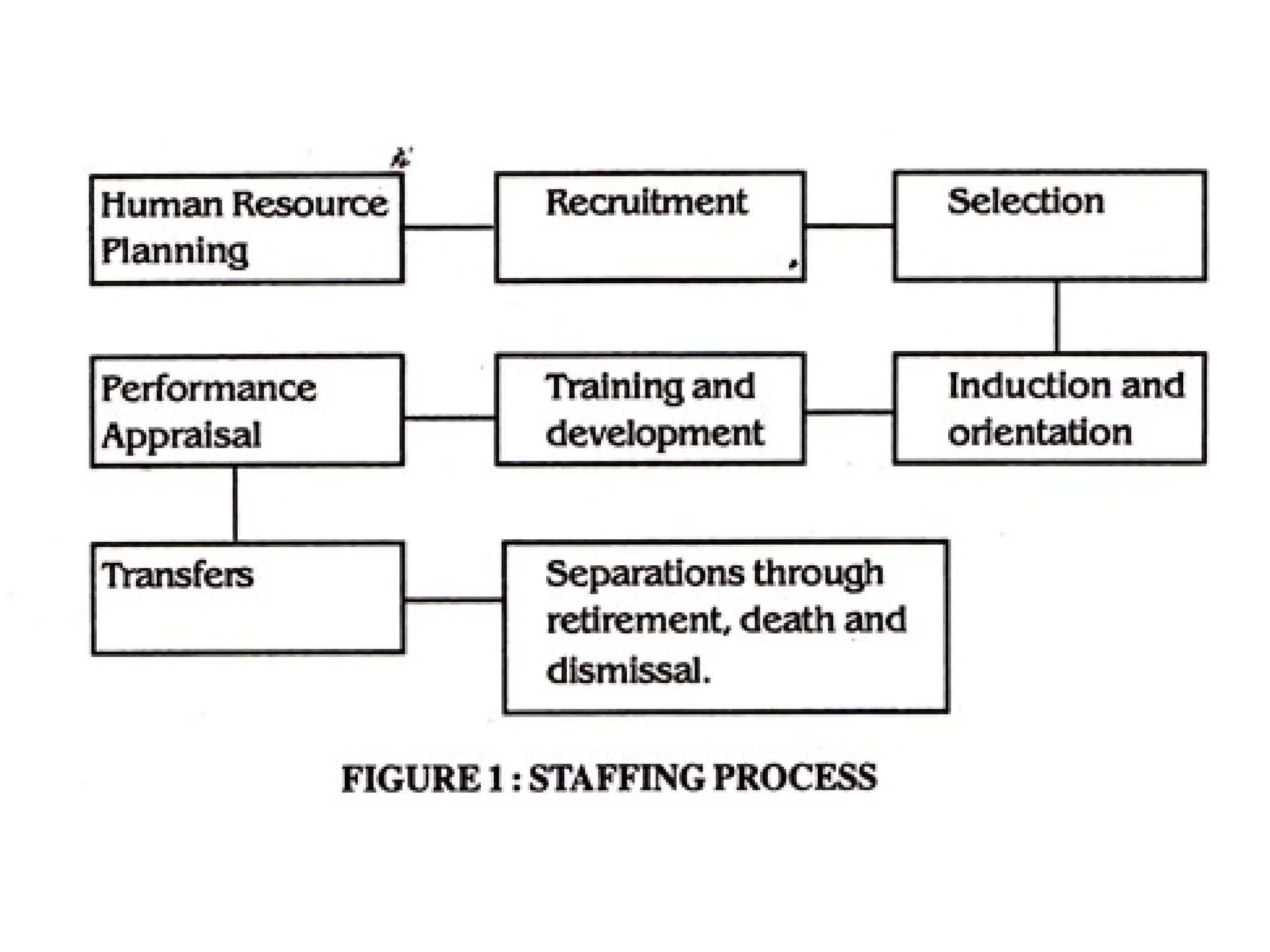
Staffing
refers to the continuous process of
finding, selecting evaluating and
developing a working relationship
with current or future employees.
Your
Logo
Here
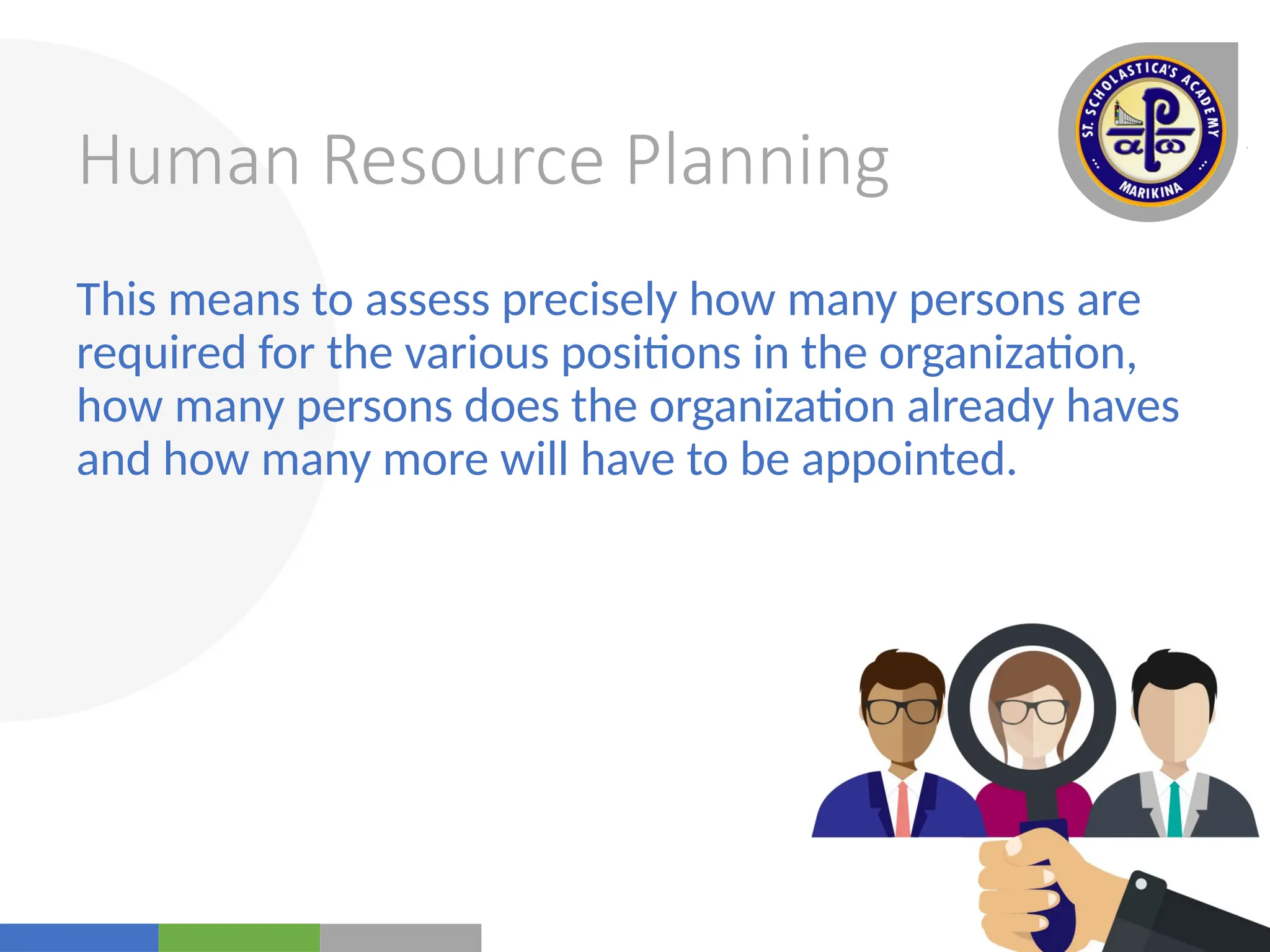
Human Resource Planning
This means to assess precisely how many persons are
required for the various positions in the organization,
how many persons does the organization already haves
and how many more will have to be appointed.
Your
Logo
Here
Human Resource Planning
• Environmental Scanning – What are the
factors affecting the labor market?
• Forecasting and estimating the firms
manpower complement – How many
are the regular and contractual
employees?
• Gap analysis – determine if there is a
gap or difference between demand and
supply in human resources.
Your
Logo
Here
Job Analysis
• is the procedure for determining the duties and
skill requirements for a job or position. The ff.
information can be collected through this analysis.
1. Specific tasks and activities
2. Required behavior
3. Required job standards
4. Knowledge, tools and equipment
used
5. Work conditions
6. Personal characteristics and
requirements
Your
Logo
Here
Recruitment
• it means to search the prospective
candidates to be considered for
employment
• it examines the different sources of
manpower supply, assesses their
suitability, chooses the proper source
or sources and invites applications
from the prospective candidate for
different jobs in the enterprises
Your
Logo
Here
Sources of Applicants
• Internal applicants – are company
employees who are considered for
promotion to higher positions.
Your
Logo
Here
Sources of Applicants
• External applicants – are individuals
who are recruited by the company or
directly apply or join the company.
Your
Logo
Here
Sources of Applicants
• Referrals
• Newspaper Ads
• Job websites
• School placement office
• Job fairs
• Private employment agencies
Your
Logo
Here
Equal Employment
Opportunity
• a concept that emphasis that opportunities in
employment should be freely available to all
citizens irrespective of a person’s ethnic origin,
political association, religion, sex, race, color,
gender, pregnancy, spirituality, belief, disability,
military status, genetic information and age that
has no bearing on his qualification, performance,
and ability.
Your
Logo
Here
Selection
• the process through which
unsuitable candidate are
rejected and the suitable ones
are chosen.
Your
Logo
Here
Selection
• Mental Ability (IQ)Test
• Aptitude Test
• Personality Test
Your
Logo
Here
Placement and Induction
Induction (onboarding) means that the manager
orients the newly appointed employee to his job
and to the whole organization in general.
Your
Logo
Here
Placement and Induction
The purpose of induction or orientation of the
newly appointed employee should be to:
• Give him a bird’s eye view of the
organization;
• Familiarize him with the important spots of
the organization;
• Apprise him of the expectations from him;
and
• Ensure him that he will get full support for
the constructive purposes.
Your
Logo
Here
Placement and
Induction
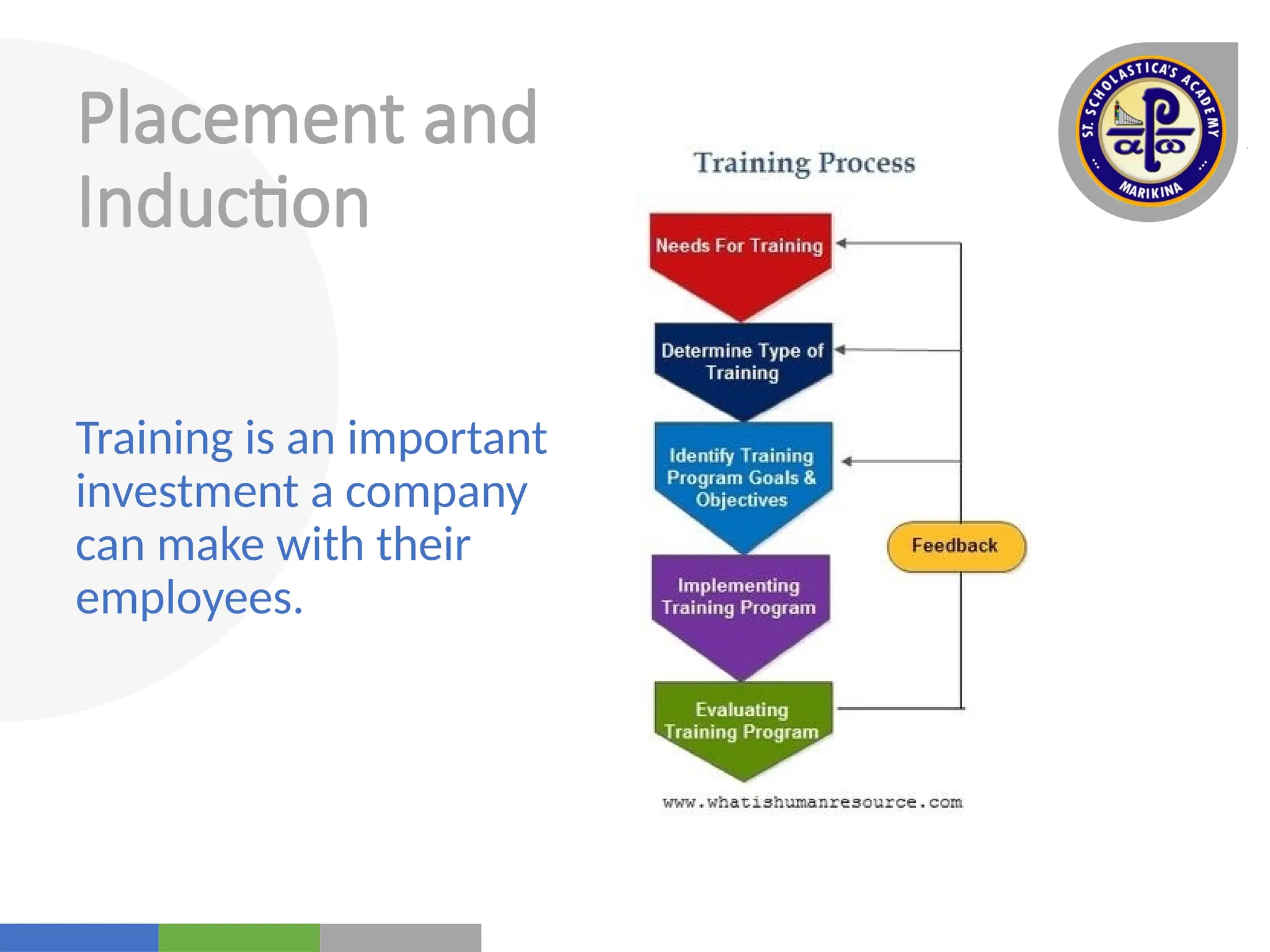
Training is an important
investment a company
can make with their
employees.
Your
Logo
Here
Compensation and Wages
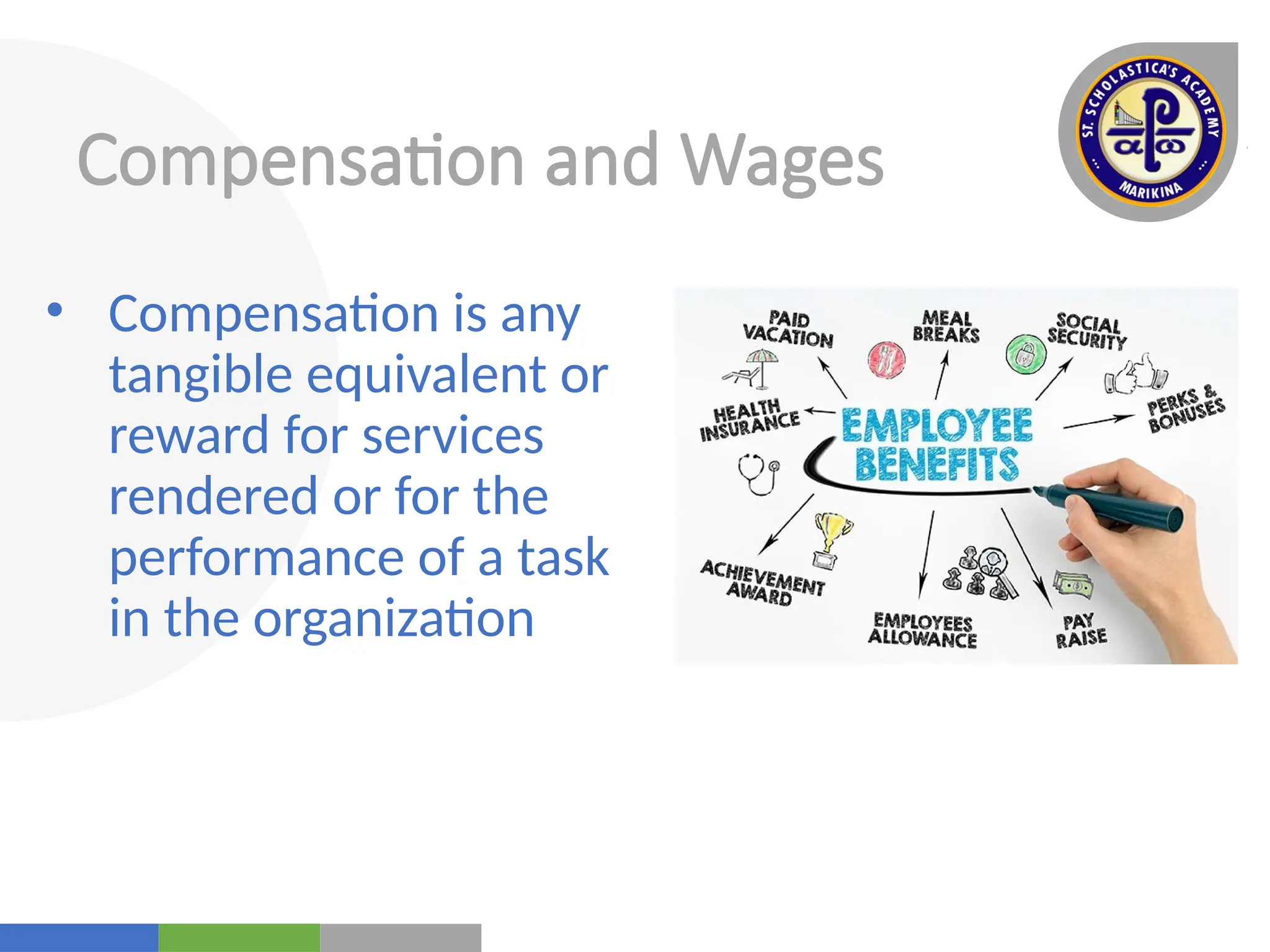
• Compensation is any
tangible equivalent or
reward for services
rendered or for the
performance of a task
in the organization
Your
Logo
Here
Compensation and Wages –
Common Modes of Payment
• Payment for time worked
• Flat rates
• Compensation through incentives
• Merit Pay – this is given in recognition of outstanding
performance and result of a performance evaluation
• Piece rate pay – given to employees who are paid a
fixed rate per product
• Compensation through incentives
• Commission – this is compensation based on achieved sales
quota
• Group Incentives
Your
Logo
Here
Compensation and Wages –
Common Modes of Payment
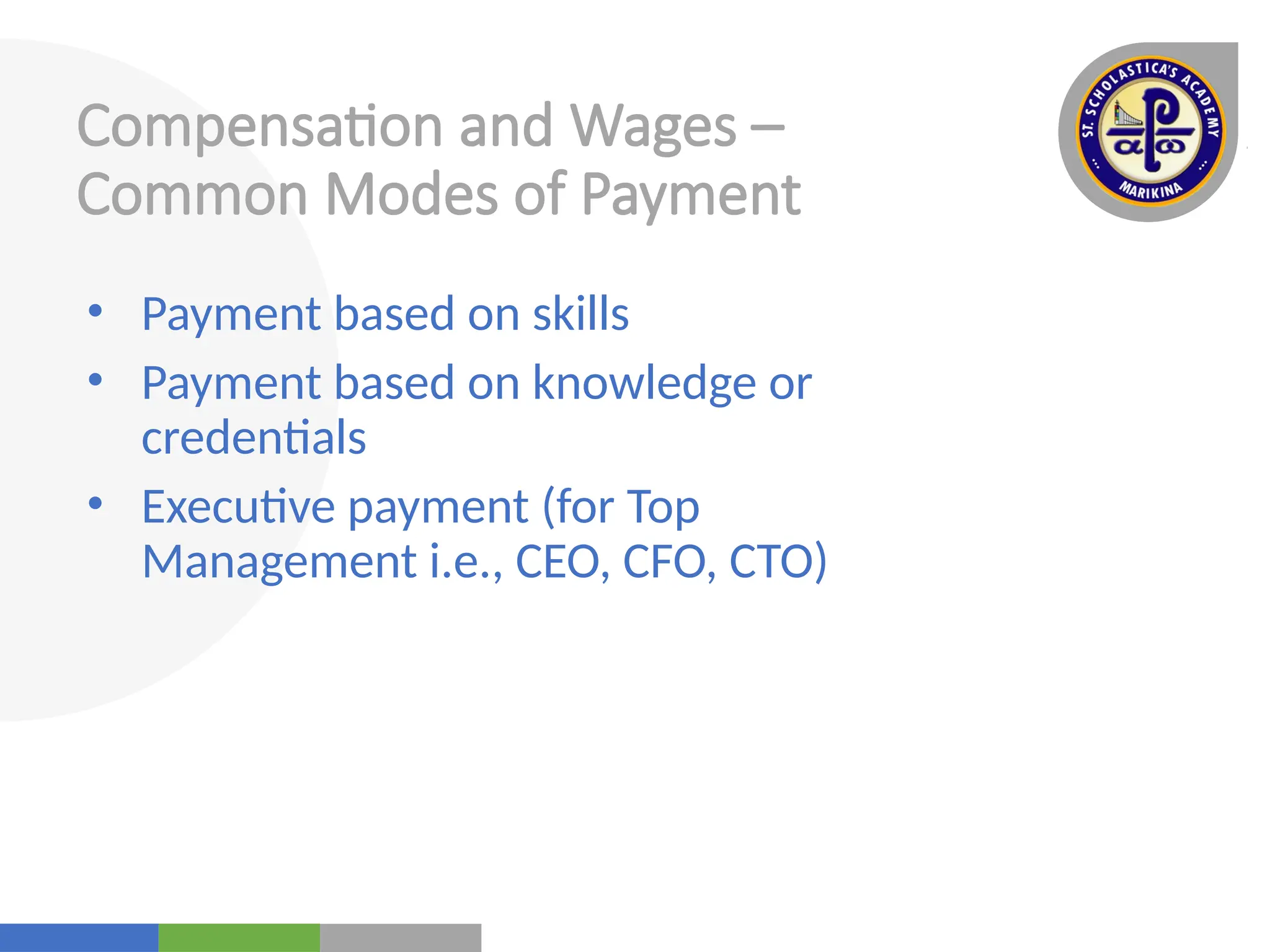
• Payment based on skills
• Payment based on knowledge or
credentials
• Executive payment (for Top
Management i.e., CEO, CFO, CTO)
Your
Logo
Here
Compensation and Wages –
Common Modes of Payment
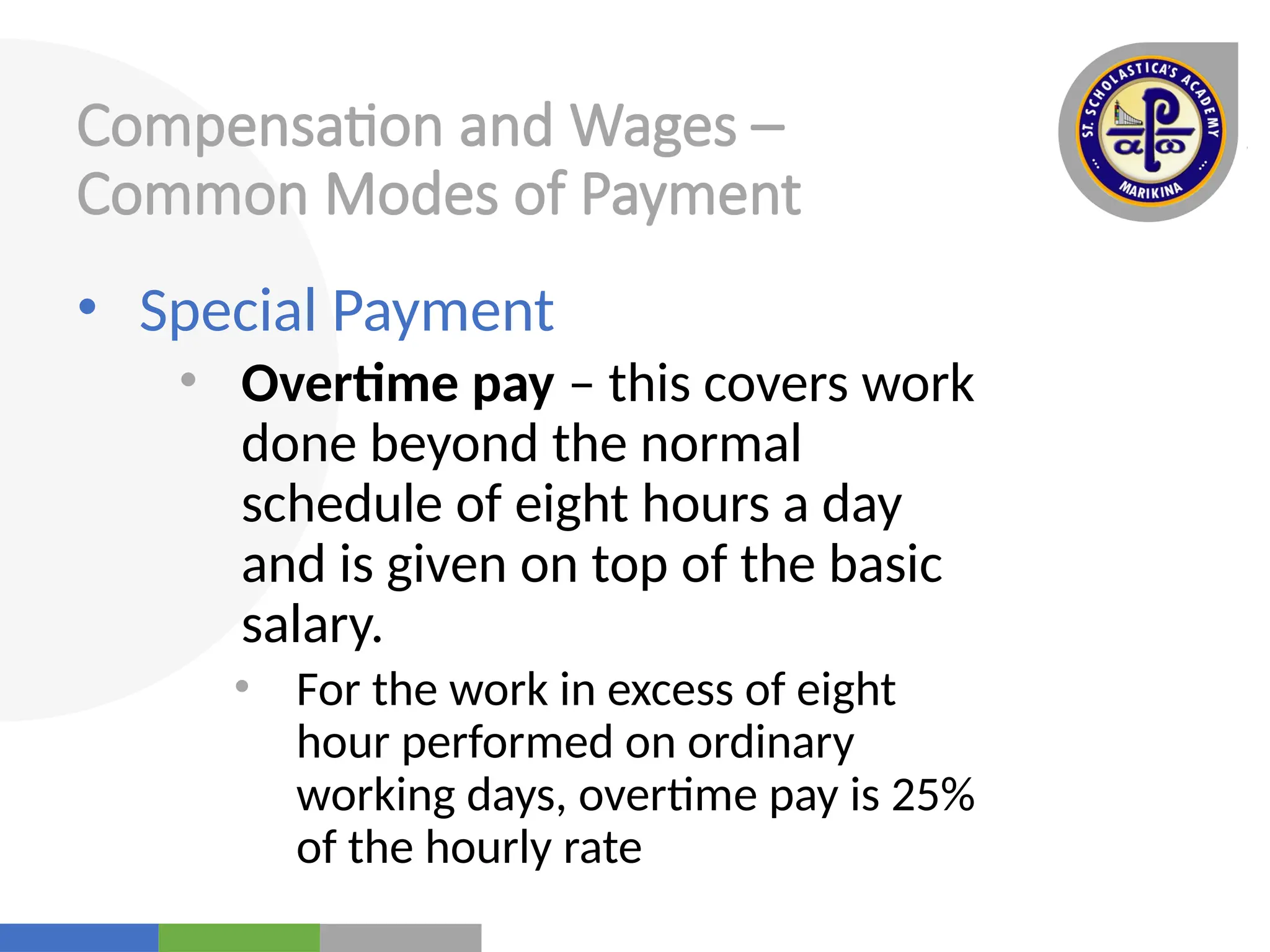
• Special Payment
• Overtime pay – this covers work
done beyond the normal
schedule of eight hours a day
and is given on top of the basic
salary.
• For the work in excess of eight
hour performed on ordinary
working days, overtime pay is 25%
of the hourly rate
Your
Logo
Here
Compensation and Wages –
Common Modes of Payment
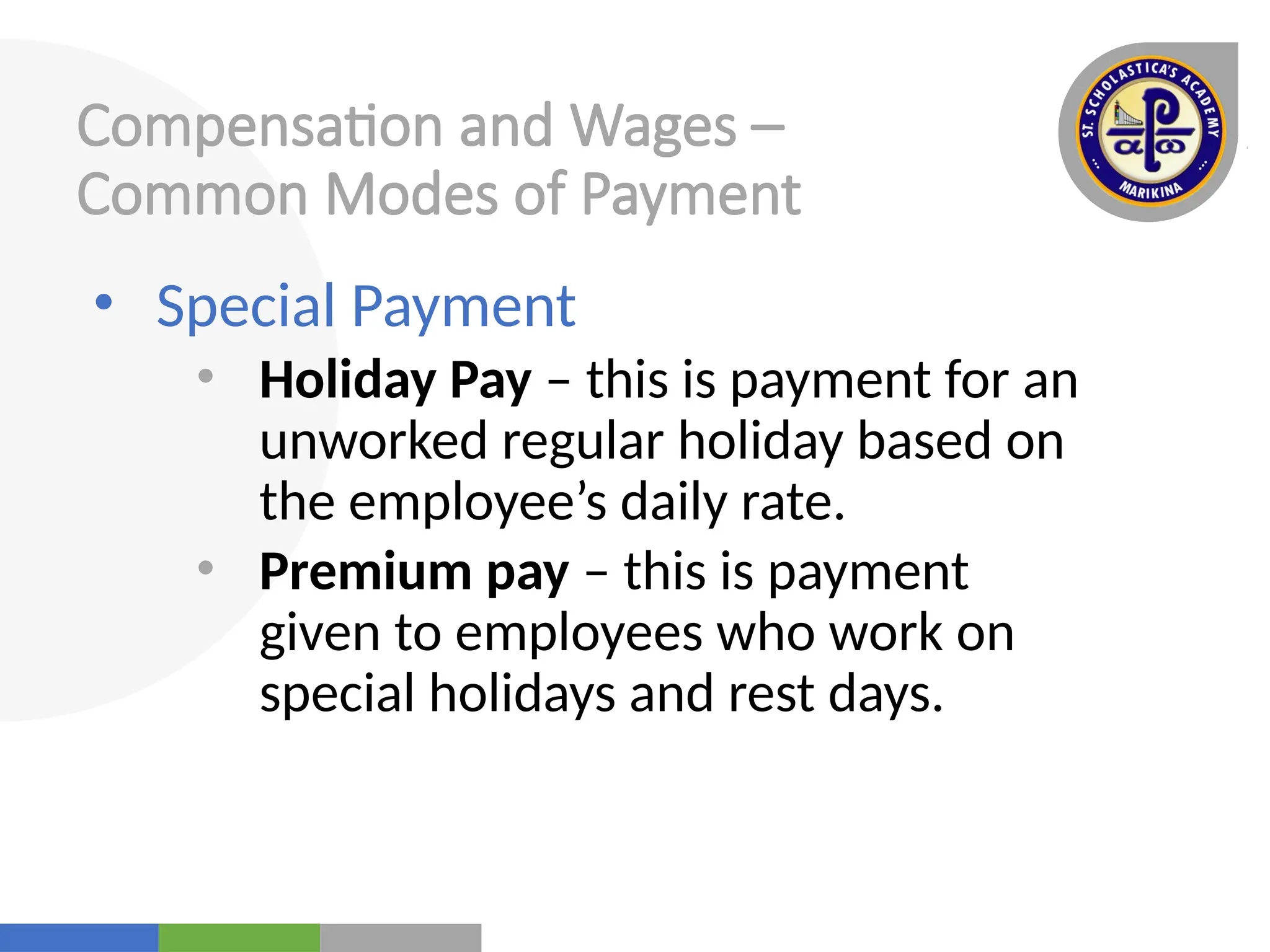
• Special Payment
• Holiday Pay – this is payment for an
unworked regular holiday based on
the employee’s daily rate.
• Premium pay – this is payment
given to employees who work on
special holidays and rest days.
Your
Logo
Here
Compensation and Wages –
Common Modes of Payment
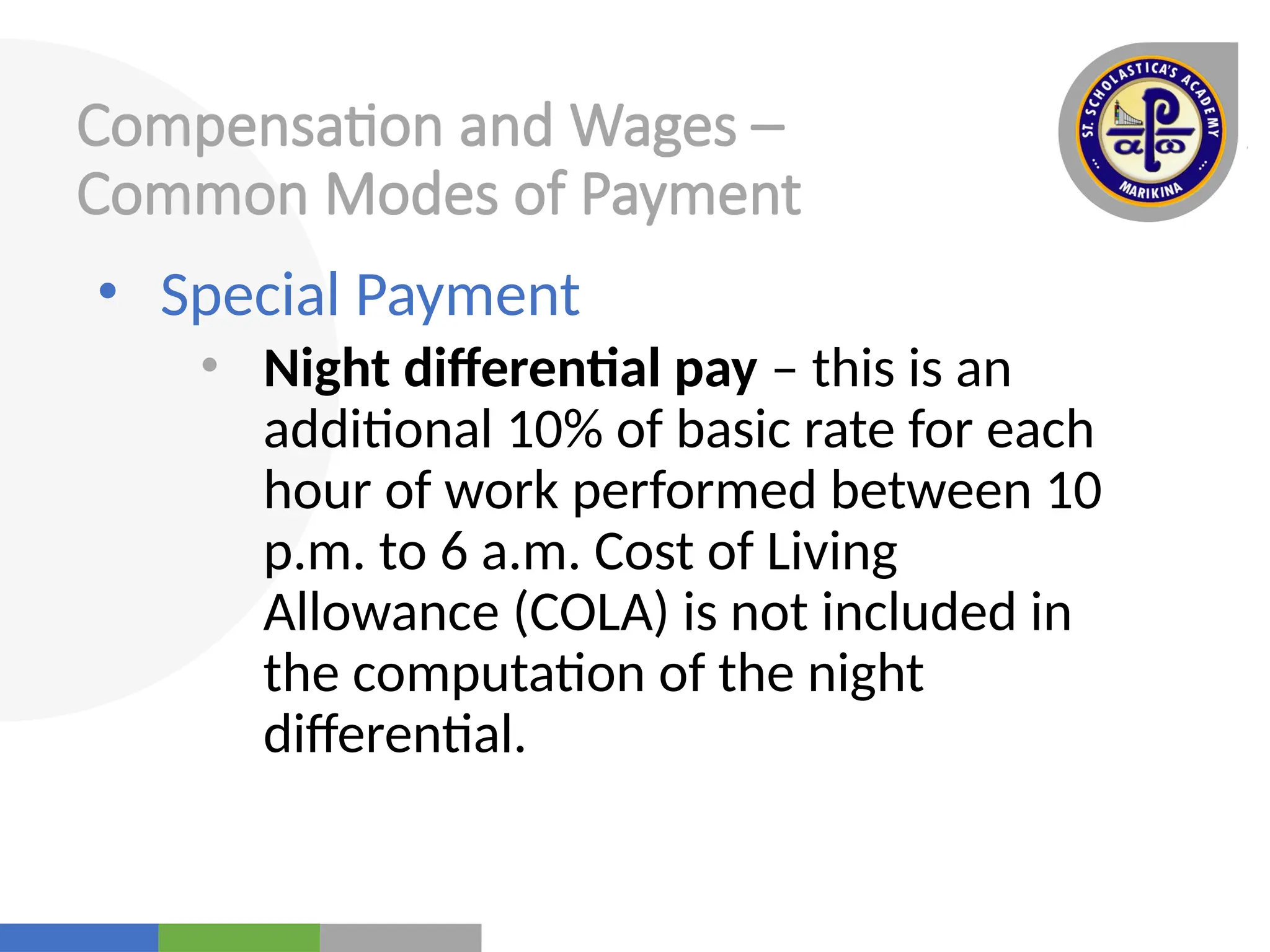
• Special Payment
• Night differential pay – this is an
additional 10% of basic rate for each
hour of work performed between 10
p.m. to 6 a.m. Cost of Living
Allowance (COLA) is not included in
the computation of the night
differential.
Your
Logo
Here
Compensation and Wages –
Common Modes of Payment
• Special Payment
• Service Charge (i.e., tips)
• Severance or Separation Pay – pay
given to employees who are
terminated with authorized cause
• Retrenchment
• Closure of the business
• Illness that may affect performance
Your
Logo
Here
Compensation and Wages –
Common Modes of Payment
• Special Payment
• Retirement Pay
• 13th
/14th
Month Pay
Your
Logo
Here
Employee Benefits
• Statutory benefits – “statute” or
provided by a law
• SSS/GSIS – Loans, Pensions,
Disability, Death, and Funeral Benefits
• PAGIBIG Fund – Loans (Multi-
purpose, Housing, etc.)
• PhilHealth
• Maternity/Paternity/Solo Parents
Benefits
• Service Incentives
Your
Logo
Here
Employee Benefits
• Voluntary benefits
• Vacation leaves
• Sick leaves
• Emergency leaves
• Outings/Vacation
• Sportsfest
• Rice allowance
• Meal subsidy
• Shuttle service
• HMO/Hospitalization
• Bonuses
• Group Life Insurance
• Profit Sharing
• Stock options
• Cash bonuses
Your
Logo
Here
Performance Appraisal
• refers to the process where employee
performance is documented and evaluated.
This is also known as performance review
or performance evaluation.
Your
Logo
Here
Performance Appraisal
• Evaluation is an important aspect of a
company’s performance management system
as it provides concrete information based on
the over-all performance of the company can
be assessed.
Your
Logo
Here
Why Performance Appraisal is
needed?
• Needs assessment
• Employee movements
• Basis for merit increases
• Legal concerns
• Development
• Channel of communication
• Source of motivation
Your
Logo
Here
Performance Appraisal Methods
• Objective methods
• Measures of actual output – ex. No. of Sales or No. of
Orders Processed
• Performance Test
• Judgmental methods
• Ranking Technique – a method where employees are
compared to other employees
• Rating Technique – an appraisal method that
compares an employee to a fixed standard.
Your
Logo
Here
Employee Movements
• Vertical movement – entails the movement
of an employee from a lower position to a
higher one.
• Horizontal movement – involves transfer of
an employee to another department or
position.
Your
Logo
Here
Vertical Movements
• Promotion – is a movement to a higher
level or position (as a result of a favorable
performance evaluation)
• Demotion – is a movement to a lower
position (as a result of a negative
performance evaluation)
Your
Logo
Here
Horizontal Movements
• Transfer – is a movement to another
position but with the same level or
scope of responsibility (e.g. one
department/unit to another)
Your
Logo
Here
Employee Movements
• Resignation – an employee’s voluntary departure
from the organization.
• Separation with authorized cause – company’s
decision to terminate employees due to business
reasons
• Separation with just cause – termination of
employee due to serious offenses.
• Retirement – end of workers’ employment due to
illness, sickness or old age.

Functions of Management_Staffing_OrgMANG

  • 1.
    Functions of Management: Staffing Mr. MichaelC. Pagaduan, LPT Organization and Management Subject Teacher
  • 2.
    Your Logo Here "Some people cando one thing magnificently, like Michelangelo, and others make things like semiconductors or build 747 airplanes -- that type of work requires legions of people. In order to do things well, that can't be done by one person, you must find extraordinary people.“ - Steve Jobs
  • 3.
    Your Logo Here Staffing refers to thecontinuous process of finding, selecting evaluating and developing a working relationship with current or future employees.
  • 5.
    Your Logo Here Human Resource Planning Thismeans to assess precisely how many persons are required for the various positions in the organization, how many persons does the organization already haves and how many more will have to be appointed.
  • 6.
    Your Logo Here Human Resource Planning •Environmental Scanning – What are the factors affecting the labor market? • Forecasting and estimating the firms manpower complement – How many are the regular and contractual employees? • Gap analysis – determine if there is a gap or difference between demand and supply in human resources.
  • 7.
    Your Logo Here Job Analysis • isthe procedure for determining the duties and skill requirements for a job or position. The ff. information can be collected through this analysis. 1. Specific tasks and activities 2. Required behavior 3. Required job standards 4. Knowledge, tools and equipment used 5. Work conditions 6. Personal characteristics and requirements
  • 8.
    Your Logo Here Recruitment • it meansto search the prospective candidates to be considered for employment • it examines the different sources of manpower supply, assesses their suitability, chooses the proper source or sources and invites applications from the prospective candidate for different jobs in the enterprises
  • 9.
    Your Logo Here Sources of Applicants •Internal applicants – are company employees who are considered for promotion to higher positions.
  • 10.
    Your Logo Here Sources of Applicants •External applicants – are individuals who are recruited by the company or directly apply or join the company.
  • 11.
    Your Logo Here Sources of Applicants •Referrals • Newspaper Ads • Job websites • School placement office • Job fairs • Private employment agencies
  • 12.
    Your Logo Here Equal Employment Opportunity • aconcept that emphasis that opportunities in employment should be freely available to all citizens irrespective of a person’s ethnic origin, political association, religion, sex, race, color, gender, pregnancy, spirituality, belief, disability, military status, genetic information and age that has no bearing on his qualification, performance, and ability.
  • 13.
    Your Logo Here Selection • the processthrough which unsuitable candidate are rejected and the suitable ones are chosen.
  • 14.
    Your Logo Here Selection • Mental Ability(IQ)Test • Aptitude Test • Personality Test
  • 15.
    Your Logo Here Placement and Induction Induction(onboarding) means that the manager orients the newly appointed employee to his job and to the whole organization in general.
  • 16.
    Your Logo Here Placement and Induction Thepurpose of induction or orientation of the newly appointed employee should be to: • Give him a bird’s eye view of the organization; • Familiarize him with the important spots of the organization; • Apprise him of the expectations from him; and • Ensure him that he will get full support for the constructive purposes.
  • 17.
    Your Logo Here Placement and Induction Training isan important investment a company can make with their employees.
  • 18.
    Your Logo Here Compensation and Wages •Compensation is any tangible equivalent or reward for services rendered or for the performance of a task in the organization
  • 19.
    Your Logo Here Compensation and Wages– Common Modes of Payment • Payment for time worked • Flat rates • Compensation through incentives • Merit Pay – this is given in recognition of outstanding performance and result of a performance evaluation • Piece rate pay – given to employees who are paid a fixed rate per product • Compensation through incentives • Commission – this is compensation based on achieved sales quota • Group Incentives
  • 20.
    Your Logo Here Compensation and Wages– Common Modes of Payment • Payment based on skills • Payment based on knowledge or credentials • Executive payment (for Top Management i.e., CEO, CFO, CTO)
  • 21.
    Your Logo Here Compensation and Wages– Common Modes of Payment • Special Payment • Overtime pay – this covers work done beyond the normal schedule of eight hours a day and is given on top of the basic salary. • For the work in excess of eight hour performed on ordinary working days, overtime pay is 25% of the hourly rate
  • 22.
    Your Logo Here Compensation and Wages– Common Modes of Payment • Special Payment • Holiday Pay – this is payment for an unworked regular holiday based on the employee’s daily rate. • Premium pay – this is payment given to employees who work on special holidays and rest days.
  • 23.
    Your Logo Here Compensation and Wages– Common Modes of Payment • Special Payment • Night differential pay – this is an additional 10% of basic rate for each hour of work performed between 10 p.m. to 6 a.m. Cost of Living Allowance (COLA) is not included in the computation of the night differential.
  • 24.
    Your Logo Here Compensation and Wages– Common Modes of Payment • Special Payment • Service Charge (i.e., tips) • Severance or Separation Pay – pay given to employees who are terminated with authorized cause • Retrenchment • Closure of the business • Illness that may affect performance
  • 25.
    Your Logo Here Compensation and Wages– Common Modes of Payment • Special Payment • Retirement Pay • 13th /14th Month Pay
  • 26.
    Your Logo Here Employee Benefits • Statutorybenefits – “statute” or provided by a law • SSS/GSIS – Loans, Pensions, Disability, Death, and Funeral Benefits • PAGIBIG Fund – Loans (Multi- purpose, Housing, etc.) • PhilHealth • Maternity/Paternity/Solo Parents Benefits • Service Incentives
  • 27.
    Your Logo Here Employee Benefits • Voluntarybenefits • Vacation leaves • Sick leaves • Emergency leaves • Outings/Vacation • Sportsfest • Rice allowance • Meal subsidy • Shuttle service • HMO/Hospitalization • Bonuses • Group Life Insurance • Profit Sharing • Stock options • Cash bonuses
  • 28.
    Your Logo Here Performance Appraisal • refersto the process where employee performance is documented and evaluated. This is also known as performance review or performance evaluation.
  • 29.
    Your Logo Here Performance Appraisal • Evaluationis an important aspect of a company’s performance management system as it provides concrete information based on the over-all performance of the company can be assessed.
  • 30.
    Your Logo Here Why Performance Appraisalis needed? • Needs assessment • Employee movements • Basis for merit increases • Legal concerns • Development • Channel of communication • Source of motivation
  • 31.
    Your Logo Here Performance Appraisal Methods •Objective methods • Measures of actual output – ex. No. of Sales or No. of Orders Processed • Performance Test • Judgmental methods • Ranking Technique – a method where employees are compared to other employees • Rating Technique – an appraisal method that compares an employee to a fixed standard.
  • 32.
    Your Logo Here Employee Movements • Verticalmovement – entails the movement of an employee from a lower position to a higher one. • Horizontal movement – involves transfer of an employee to another department or position.
  • 33.
    Your Logo Here Vertical Movements • Promotion– is a movement to a higher level or position (as a result of a favorable performance evaluation) • Demotion – is a movement to a lower position (as a result of a negative performance evaluation)
  • 34.
    Your Logo Here Horizontal Movements • Transfer– is a movement to another position but with the same level or scope of responsibility (e.g. one department/unit to another)
  • 35.
    Your Logo Here Employee Movements • Resignation– an employee’s voluntary departure from the organization. • Separation with authorized cause – company’s decision to terminate employees due to business reasons • Separation with just cause – termination of employee due to serious offenses. • Retirement – end of workers’ employment due to illness, sickness or old age.

Editor's Notes

  • #2 Class Exercise: Interview Session
  • #4 The goal of an interview is to determine whether the candidate will be outstanding in the job, and that means evaluating the skills and attitude required for that job. When you answer this question, connect the dots on your resume so the interviewer understands not just what you've done, but also why.
  • #17 The staffing also ensures that the right kind of people is to be placed at the right job
  • #18 If there are shortage of workers, the firm may opt to allow or encourage overtime work or hire contractual/temporary workers. If there are surplus of employees due to redundancy or implementation of labor-saving devices, offering early retirement or laying off employees are some of the options. Emphasize here that although these methods are allowed by law, the company must create other opportunities to prevent these from happening and if it is really necessary, proper consultation and negotiation must be made.
  • #19 Specific tasks and activities – essential tasks required for a position. The purpose of each task, how they are done, and specific time to complete them Required behavior – workplace behavior and ethics Required job standards – performance levels and standards, basis for employee performance evaluation Knowledge, tools and equipment used – specific knowledge on usage of tools and equipment, knowledge on procedures, laws, applications etc. Work conditions – work schedule and physical environment (ex. Call Center Agents servicing International Customers are bound by time zone differences, field agents are required to work beyond the confines of the physical office) Personal characteristics and requirements – attitudes, values, personality type, experience, background, training, characteristics (physical, psychological etc.)
  • #20 his implies that recruitment examines the different sources of manpower supply, assesses their suitability, chooses the proper source or sources and invites applications from the prospective candidate for different jobs in the enterprises.
  • #21 The staffing also ensures that the right kind of people is to be placed at the right job
  • #22 The staffing also ensures that the right kind of people is to be placed at the right job
  • #23 The staffing also ensures that the right kind of people is to be placed at the right job
  • #24 The equal employment opportunity does not guarantee to hire a potential employee; instead, the purpose is that no one is rejected based on any discrimination.
  • #25 his implies that recruitment examines the different sources of manpower supply, assesses their suitability, chooses the proper source or sources and invites applications from the prospective candidate for different jobs in the enterprises.
  • #26 his implies that recruitment examines the different sources of manpower supply, assesses their suitability, chooses the proper source or sources and invites applications from the prospective candidate for different jobs in the enterprises.
  • #27 his implies that recruitment examines the different sources of manpower supply, assesses their suitability, chooses the proper source or sources and invites applications from the prospective candidate for different jobs in the enterprises.
  • #28 his implies that recruitment examines the different sources of manpower supply, assesses their suitability, chooses the proper source or sources and invites applications from the prospective candidate for different jobs in the enterprises.
  • #29 Pre training assessment Designing the training program Training implementation Training evaluation.
  • #30 Pre training assessment Designing the training program Training implementation Training evaluation.
  • #31 Pre training assessment Designing the training program Training implementation Training evaluation.
  • #32 Pre training assessment Designing the training program Training implementation Training evaluation.
  • #33 Pre training assessment Designing the training program Training implementation Training evaluation.
  • #34 Pre training assessment Designing the training program Training implementation Training evaluation.
  • #35 Pre training assessment Designing the training program Training implementation Training evaluation.
  • #36 Pre training assessment Designing the training program Training implementation Training evaluation.
  • #37 Pre training assessment Designing the training program Training implementation Training evaluation.
  • #38 Pre training assessment Designing the training program Training implementation Training evaluation.
  • #39 Pre training assessment Designing the training program Training implementation Training evaluation.
  • #40 Pre training assessment Designing the training program Training implementation Training evaluation.
  • #41 Pre training assessment Designing the training program Training implementation Training evaluation.
  • #42 Pre training assessment Designing the training program Training implementation Training evaluation.
  • #43 Pre training assessment Designing the training program Training implementation Training evaluation.
  • #44 Pre training assessment Designing the training program Training implementation Training evaluation.
  • #45 Pre training assessment Designing the training program Training implementation Training evaluation.
  • #46 Pre training assessment Designing the training program Training implementation Training evaluation.
  • #47 Pre training assessment Designing the training program Training implementation Training evaluation.