Functional Testing- All
you need to know
What is Functional Testing?
Functional testing is a critical aspect of quality assurance in software development,
focusing on evaluating the functionality of a software application. This testing
process involves verifying that each function of the software application operates in
conformance with the requirement specifications. It ensures that the output of a
function is as expected, given certain inputs, and that the system's integration and
user interface behave as intended.
Functional testing consist of six steps-
1. The identification of functions that the software is expected to perform.
2. The creation of input data set based on the function's specifications.
3. The determination of output based on the function's specifications.
4. The execution of the test case.
5. The comparison of actual and expected output.
6. To check whether the application works as per the customer's need.
Types of Functional Testing-
Unit Testing- Developers carry out unit testing by writing scripts to check if the various
parts or units of an application adhere to the specifications. Writing tests that invoke each
unit's methods and validate them when they return values compliant with the requirements
is typically required for this.
Smoke Testing- After every build is released, smoke testing is carried out to make sure
that the program is stable and free of abnormalities.
Sanity testing- Usually done after smoke testing, this checks that all of an application's
primary features operate flawlessly both on their own and in concert with other
components.
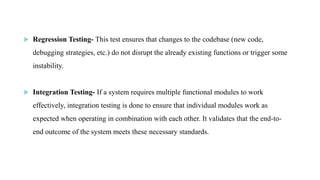
 Regression Testing- This test ensures that changes to the codebase (new code,
debugging strategies, etc.) do not disrupt the already existing functions or trigger some
instability.
 Integration Testing- If a system requires multiple functional modules to work
effectively, integration testing is done to ensure that individual modules work as
expected when operating in combination with each other. It validates that the end-to-
end outcome of the system meets these necessary standards.
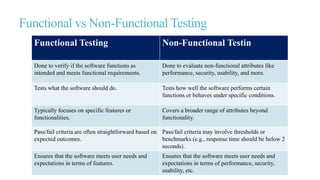
Functional vs Non-Functional Testing
Functional Testing Non-Functional Testin
Done to verify if the software functions as
intended and meets functional requirements.
Done to evaluate non-functional attributes like
performance, security, usability, and more.
Tests what the software should do. Tests how well the software performs certain
functions or behaves under specific conditions.
Typically focuses on specific features or
functionalities.
Covers a broader range of attributes beyond
functionality.
Pass/fail criteria are often straightforward based on
expected outcomes.
Pass/fail criteria may involve thresholds or
benchmarks (e.g., response time should be below 2
seconds).
Ensures that the software meets user needs and
expectations in terms of features.
Ensures that the software meets user needs and
expectations in terms of performance, security,
usability, etc.
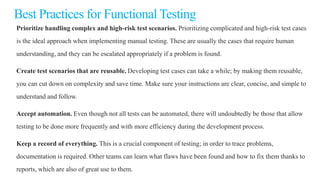
Best Practices for Functional Testing
Prioritize handling complex and high-risk test scenarios. Prioritizing complicated and high-risk test cases
is the ideal approach when implementing manual testing. These are usually the cases that require human
understanding, and they can be escalated appropriately if a problem is found.
Create test scenarios that are reusable. Developing test cases can take a while; by making them reusable,
you can cut down on complexity and save time. Make sure your instructions are clear, concise, and simple to
understand and follow.
Accept automation. Even though not all tests can be automated, there will undoubtedly be those that allow
testing to be done more frequently and with more efficiency during the development process.
Keep a record of everything. This is a crucial component of testing; in order to trace problems,
documentation is required. Other teams can learn what flaws have been found and how to fix them thanks to
reports, which are also of great use to them.
Thank you
548 Market St #795256,
San Francisco, California, US 94104
support@ghostqa.com
+1 (805) 776-3451
www.ghostqa.com

Functional Testing- All you need to know (2).pptx

  • 1.
  • 2.
    What is FunctionalTesting? Functional testing is a critical aspect of quality assurance in software development, focusing on evaluating the functionality of a software application. This testing process involves verifying that each function of the software application operates in conformance with the requirement specifications. It ensures that the output of a function is as expected, given certain inputs, and that the system's integration and user interface behave as intended.
  • 3.
    Functional testing consistof six steps- 1. The identification of functions that the software is expected to perform. 2. The creation of input data set based on the function's specifications. 3. The determination of output based on the function's specifications. 4. The execution of the test case. 5. The comparison of actual and expected output. 6. To check whether the application works as per the customer's need.
  • 4.
    Types of FunctionalTesting- Unit Testing- Developers carry out unit testing by writing scripts to check if the various parts or units of an application adhere to the specifications. Writing tests that invoke each unit's methods and validate them when they return values compliant with the requirements is typically required for this. Smoke Testing- After every build is released, smoke testing is carried out to make sure that the program is stable and free of abnormalities. Sanity testing- Usually done after smoke testing, this checks that all of an application's primary features operate flawlessly both on their own and in concert with other components.
  • 5.
     Regression Testing-This test ensures that changes to the codebase (new code, debugging strategies, etc.) do not disrupt the already existing functions or trigger some instability.  Integration Testing- If a system requires multiple functional modules to work effectively, integration testing is done to ensure that individual modules work as expected when operating in combination with each other. It validates that the end-to- end outcome of the system meets these necessary standards.
  • 6.
    Functional vs Non-FunctionalTesting Functional Testing Non-Functional Testin Done to verify if the software functions as intended and meets functional requirements. Done to evaluate non-functional attributes like performance, security, usability, and more. Tests what the software should do. Tests how well the software performs certain functions or behaves under specific conditions. Typically focuses on specific features or functionalities. Covers a broader range of attributes beyond functionality. Pass/fail criteria are often straightforward based on expected outcomes. Pass/fail criteria may involve thresholds or benchmarks (e.g., response time should be below 2 seconds). Ensures that the software meets user needs and expectations in terms of features. Ensures that the software meets user needs and expectations in terms of performance, security, usability, etc.
  • 7.
    Best Practices forFunctional Testing Prioritize handling complex and high-risk test scenarios. Prioritizing complicated and high-risk test cases is the ideal approach when implementing manual testing. These are usually the cases that require human understanding, and they can be escalated appropriately if a problem is found. Create test scenarios that are reusable. Developing test cases can take a while; by making them reusable, you can cut down on complexity and save time. Make sure your instructions are clear, concise, and simple to understand and follow. Accept automation. Even though not all tests can be automated, there will undoubtedly be those that allow testing to be done more frequently and with more efficiency during the development process. Keep a record of everything. This is a crucial component of testing; in order to trace problems, documentation is required. Other teams can learn what flaws have been found and how to fix them thanks to reports, which are also of great use to them.
  • 8.
    Thank you 548 MarketSt #795256, San Francisco, California, US 94104 support@ghostqa.com +1 (805) 776-3451 www.ghostqa.com