Welcome to
Madagascar
PAST SIMPLE
@friendly_english_online
The simple past tense allows us to talk about actions and events that
happened in the past. It is a key tool for expressing past experiences,
narrating stories, and discussing past habits or routines.
Expressing Completed Actions
Example: "I visited my grandparents in Africa last year."
Talking about Past Habits or Routines
Example: "I used to work every Saturday."
Narrating Past Events
Example: "Once upon a time, there was a beautiful queen."
Describing Past States or Conditions
Example: "She was tired after a long day at work."
USES OF THE SIMPLE PAST TENSE:
• The simple past tense can be formed in two main ways,
depending on whether the verb is regular or irregular.
STRUCTURE
• The simple past tense can be formed in two main ways,
depending on whether the verb is regular or irregular.
REGULAR VERBS
For regular verbs, we add "-ed" to the base
form of the verb. Let's take a look at some
examples:
Skate → Skated
Cook → Cooked
Open → Opened
Example: He cooked a chicken for dinner
yesterday.
Spelling Regular Verbs
Most verbs: Add "-ed" to the base form of the verb.
Walk → Walked
Verbs ending in "e": Add "-d" to the base form of the verb.
Dance → Danced
Verbs ending in a consonant + "y": Change the "y" to "i" and add "-ed."
Carry → Carried
Verbs ending in a vowel + a consonant: Double the final consonant and add "-ed".
Stop → Stopped
IRREGULAR VERBS
Irregular verbs have unique forms for the simple
past tense that must be memorized individually.
Here are some examples:
Go → Went
Eat → Ate
Drink → Drank
Example: He drank a bottle of water.
PAST TIME EXPRESSIONS
Yesterday
Example: "We went to the cinema yesterday."
Last (day/week/month/year)
Example: "She traveled to Paris last summer."
In (year/decade/century)
A week (two days/three months/a year ago
The day before yesterday
Example: "I saw the teacher the day before yesterday."
To form a negative sentence in the simple past tense, we use the auxiliary verb "did" and
add the word "not" before the main verb. Here's the structure:
Subject + did not (didn't) + base form of the main verb
For example:
She didn't go to the party.
She didn't watch the movie.
NEGATIVE FORM
To form an interrogative sentence in the simple past tense, we use the auxiliary verb "did"
before the subject. Here's the structure:
Did + Subject + base form of the main verb?
For example:
Did you go to the party?
Did you take your vitamins?
INTERROGATIVE FORM
PRACTICE
Alex and his friends (leave) the zoo last year.
Alex and his friends left the zoo last year.
The pinguins (help) them.
The pinguins helped them.
The animals (to be) happy.
The animals were happy.
They (swim) in the sea.
They swam in the sea.
The animals saw an island.
The animals (see) an island.
Wild animals (live) there.
Wild animals lived there.
The King Julian (meet) them.
The King Julian met them.
The friends (drive) by car.
The friends drove by car.
They (have) a party.
They had a party.
Julian (to be) crazy ?
Was Julian crazy ?
The pinguins (hide) in the bushes .
The pinguins hid in the bushes.
Alex (smile) every day ?
Did Alex smile every day ?
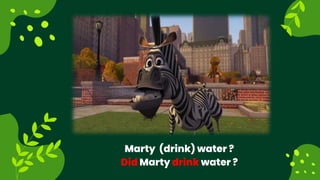
Marty (drink) water ?
Did Marty drink water ?
The pinguins (not draw). They (read).
The pinguins didn’t draw. They read.
The friends (not fight) .
The friends didn’t fight.
They (eat) a cake.
They ate a cake.
Gloria (fall) in love with Marty ?
Did Gloria fall in love with Marty ?
They (run) in the jungle.
They ran in the jungle.
The animals (take) a photo.
The animals took a photo.
The pinguins (find) an egg.
The pinguins found an egg.
Marty (fly) ?
Did Marty fly ?
Alex (not work) at school.
Alex didn’t work at school.
The old woman (beat) Alex.
The old woman beat Alex.
Moto Moto (give) a flower.
Moto Moto gave a flower.
Melman (win) a prize.
Melman won a prize.
Julian (travel) a year ago.
Julian travelled a year ago.
Julian (watch) the stars ?
Did Julian watch the stars ?
The pinguins (light) the city.
The pinguins lit the city.
Mort (not to be) angry. He (to be) nice.
Mort wasn’t angry. He was nice.
Gloria (wear) a skirt.
Gloria wore a skirt.
The monkey (not build) a ship.
The monkey didn’t build a ship.
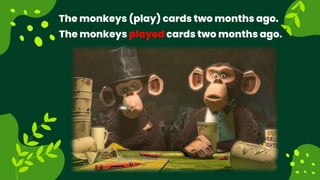
The monkeys (play) cards two months ago.
The monkeys played cards two months ago.

Full Presentation about Past_Simple-1.pptx

  • 1.
  • 2.
    The simple pasttense allows us to talk about actions and events that happened in the past. It is a key tool for expressing past experiences, narrating stories, and discussing past habits or routines. Expressing Completed Actions Example: "I visited my grandparents in Africa last year." Talking about Past Habits or Routines Example: "I used to work every Saturday." Narrating Past Events Example: "Once upon a time, there was a beautiful queen." Describing Past States or Conditions Example: "She was tired after a long day at work." USES OF THE SIMPLE PAST TENSE:
  • 3.
    • The simplepast tense can be formed in two main ways, depending on whether the verb is regular or irregular. STRUCTURE • The simple past tense can be formed in two main ways, depending on whether the verb is regular or irregular. REGULAR VERBS For regular verbs, we add "-ed" to the base form of the verb. Let's take a look at some examples: Skate → Skated Cook → Cooked Open → Opened Example: He cooked a chicken for dinner yesterday.
  • 4.
    Spelling Regular Verbs Mostverbs: Add "-ed" to the base form of the verb. Walk → Walked Verbs ending in "e": Add "-d" to the base form of the verb. Dance → Danced Verbs ending in a consonant + "y": Change the "y" to "i" and add "-ed." Carry → Carried Verbs ending in a vowel + a consonant: Double the final consonant and add "-ed". Stop → Stopped
  • 5.
    IRREGULAR VERBS Irregular verbshave unique forms for the simple past tense that must be memorized individually. Here are some examples: Go → Went Eat → Ate Drink → Drank Example: He drank a bottle of water.
  • 6.
    PAST TIME EXPRESSIONS Yesterday Example:"We went to the cinema yesterday." Last (day/week/month/year) Example: "She traveled to Paris last summer." In (year/decade/century) A week (two days/three months/a year ago The day before yesterday Example: "I saw the teacher the day before yesterday."
  • 7.
    To form anegative sentence in the simple past tense, we use the auxiliary verb "did" and add the word "not" before the main verb. Here's the structure: Subject + did not (didn't) + base form of the main verb For example: She didn't go to the party. She didn't watch the movie. NEGATIVE FORM
  • 8.
    To form aninterrogative sentence in the simple past tense, we use the auxiliary verb "did" before the subject. Here's the structure: Did + Subject + base form of the main verb? For example: Did you go to the party? Did you take your vitamins? INTERROGATIVE FORM
  • 9.
  • 10.
    Alex and hisfriends (leave) the zoo last year. Alex and his friends left the zoo last year.
  • 11.
    The pinguins (help)them. The pinguins helped them.
  • 12.
    The animals (tobe) happy. The animals were happy.
  • 13.
    They (swim) inthe sea. They swam in the sea.
  • 14.
    The animals sawan island. The animals (see) an island.
  • 15.
    Wild animals (live)there. Wild animals lived there.
  • 16.
    The King Julian(meet) them. The King Julian met them.
  • 17.
    The friends (drive)by car. The friends drove by car.
  • 18.
    They (have) aparty. They had a party.
  • 19.
    Julian (to be)crazy ? Was Julian crazy ?
  • 20.
    The pinguins (hide)in the bushes . The pinguins hid in the bushes.
  • 21.
    Alex (smile) everyday ? Did Alex smile every day ?
  • 22.
    Marty (drink) water? Did Marty drink water ?
  • 23.
    The pinguins (notdraw). They (read). The pinguins didn’t draw. They read.
  • 24.
    The friends (notfight) . The friends didn’t fight.
  • 25.
    They (eat) acake. They ate a cake.
  • 26.
    Gloria (fall) inlove with Marty ? Did Gloria fall in love with Marty ?
  • 27.
    They (run) inthe jungle. They ran in the jungle.
  • 28.
    The animals (take)a photo. The animals took a photo.
  • 29.
    The pinguins (find)an egg. The pinguins found an egg.
  • 30.
    Marty (fly) ? DidMarty fly ?
  • 31.
    Alex (not work)at school. Alex didn’t work at school.
  • 32.
    The old woman(beat) Alex. The old woman beat Alex.
  • 33.
    Moto Moto (give)a flower. Moto Moto gave a flower.
  • 34.
    Melman (win) aprize. Melman won a prize.
  • 35.
    Julian (travel) ayear ago. Julian travelled a year ago.
  • 36.
    Julian (watch) thestars ? Did Julian watch the stars ?
  • 37.
    The pinguins (light)the city. The pinguins lit the city.
  • 38.
    Mort (not tobe) angry. He (to be) nice. Mort wasn’t angry. He was nice.
  • 39.
    Gloria (wear) askirt. Gloria wore a skirt.
  • 40.
    The monkey (notbuild) a ship. The monkey didn’t build a ship.
  • 41.
    The monkeys (play)cards two months ago. The monkeys played cards two months ago.