Download the Full Version of textbook for Fast Typing at textbookfull.com
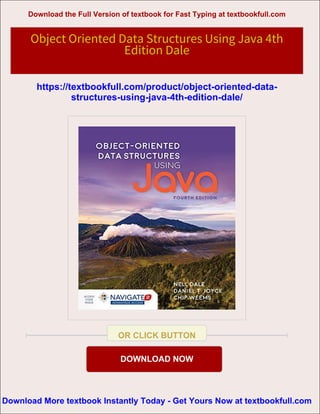
Object Oriented Data Structures Using Java 4th
Edition Dale
https://textbookfull.com/product/object-oriented-data-
structures-using-java-4th-edition-dale/
OR CLICK BUTTON
DOWNLOAD NOW
Download More textbook Instantly Today - Get Yours Now at textbookfull.com
Recommended digital products (PDF, EPUB, MOBI) that
you can download immediately if you are interested.
Object Orientation Abstraction and Data Structures Using
Scala Second Edition Lacher
https://textbookfull.com/product/object-orientation-abstraction-and-
data-structures-using-scala-second-edition-lacher/
textboxfull.com
A Functional Approach to Java: Augmenting Object-Oriented
Java Code with Functional Principles 1st Edition Ben
Weidig
https://textbookfull.com/product/a-functional-approach-to-java-
augmenting-object-oriented-java-code-with-functional-principles-1st-
edition-ben-weidig/
textboxfull.com
Practical object-oriented design: an agile primer using
Ruby Second Edition Metz
https://textbookfull.com/product/practical-object-oriented-design-an-
agile-primer-using-ruby-second-edition-metz/
textboxfull.com
Swift 3 Object Oriented Programming Gaston C. Hillar
https://textbookfull.com/product/swift-3-object-oriented-programming-
gaston-c-hillar/
textboxfull.com
Introduction to Java Programming and Data Structures
Comprehensive Version Y Daniel Liang
https://textbookfull.com/product/introduction-to-java-programming-and-
data-structures-comprehensive-version-y-daniel-liang/
textboxfull.com
Problem Solving in Data Structures & Algorithms Using C
First Edition Jain
https://textbookfull.com/product/problem-solving-in-data-structures-
algorithms-using-c-first-edition-jain/
textboxfull.com
Programming In C Object Oriented Features 1st Edition
Laxmisha Rai
https://textbookfull.com/product/programming-in-c-object-oriented-
features-1st-edition-laxmisha-rai/
textboxfull.com
Advanced Object-Oriented Programming in R: Statistical
Programming for Data Science, Analysis and Finance 1st
Edition Thomas Mailund
https://textbookfull.com/product/advanced-object-oriented-programming-
in-r-statistical-programming-for-data-science-analysis-and-
finance-1st-edition-thomas-mailund/
textboxfull.com
Think Data Structures: Algorithms and Information
Retrieval in Java 1st Edition Allen B. Downey
https://textbookfull.com/product/think-data-structures-algorithms-and-
information-retrieval-in-java-1st-edition-allen-b-downey/
textboxfull.com
Java™
Fourth Edition
Nell Dale
University of Texas, Austin
Daniel T. Joyce
Villanova University
Chip Weems
University of Massachusetts,
Amherst
Java
using
Object-Oriented
Data Structures
World Headquarters
Jones & Bartlett Learning
5 Wall Street
Burlington, MA 01803
978-443-5000
info@jblearning.com
www.jblearning.com
Jones & Bartlett Learning books and products are available through most bookstores and online booksellers. To contact Jones & Bartlett
Learning directly, call 800-832-0034, fax 978-443-8000, or visit our website, www.jblearning.com.
Substantial discounts on bulk quantities of Jones & Bartlett Learning publications are available to corporations, professional associa-
tions, and other qualified organizations. For details and specific discount information, contact the special sales department at Jones &
Bartlett Learning via the above contact information or send an email to specialsales@jblearning.com.
Copyright © 2018 by Jones & Bartlett Learning, LLC, an Ascend Learning Company
All rights reserved. No part of the material protected by this copyright may be reproduced or utilized in any form, electronic or mechani-
cal, including photocopying, recording, or by any information storage and retrieval system, without written permission from the copyright
owner.
The content, statements, views, and opinions herein are the sole expression of the respective authors and not that of Jones & Bartlett Learn-
ing, LLC. Reference herein to any specific commercial product, process, or service by trade name, trademark, manufacturer, or otherwise
does not constitute or imply its endorsement or recommendation by Jones & Bartlett Learning, LLC and such reference shall not be used for
advertising or product endorsement purposes. All trademarks displayed are the trademarks of the parties noted herein. Object-Oriented Data
Structures Using Java, Fourth Edition is an independent publication and has not been authorized, sponsored, or otherwise approved by the
owners of the trademarks or service marks referenced in this product.
09820-4
Production Credits
VP, Executive Publisher: David D. Cella
Acquisitions Editor: Laura Pagluica
Editorial Assistant: Taylor Ferracane
Director of Vendor Management: Amy Rose
Marketing Manager: Amy Langlais
VP, Manufacturing and Inventory Control: Therese Connell
Composition and Project Management: S4Carlisle Publishing Services
Cover Design: Kristin E. Parker
Text Design: Scott Moden
Rights & Media Specialist: Merideth Tumasz
Media Development Editor: Shannon Sheehan
Cover Image: © Ake13bk/Shutterstock
Printing and Binding: Edwards Brothers Malloy
Cover Printing: Edwards Brothers Malloy
Library of Congress Cataloging-in-Publication Data
Names: Dale, Nell (Nell B.), author. | Joyce, Daniel T., author. | Weems,
Chip., author.
Title: Object-oriented data structures using Java / Nell Dale, Daniel T.
Joyce, Chip Weems.
Description: Fourth edition. | Burlington, MA : Jones & Bartlett Learning,
[2017]
Identifiers: LCCN 2016025145 | ISBN 9781284089097 (casebound)
Subjects: LCSH: Object-oriented programming (Computer science) | Data
structures (Computer science) | Java (Computer program language)
Classification: LCC QA76.64 .D35 2017 | DDC 005.13/3--dc23 LC record available at
https://lccn.loc.gov/2016025145
6048
Printed in the United States of America
20 19 18 17 16 10 9 8 7 6 5 4 3 2 1
To Alfred G. Dale
ND
To Kathy, Tom, and Julie, thanks for the love and support
DJ
To Lisa, Charlie, and Abby, thank you . . .
CW
©
Ake13bk/Shutterstock
Welcome to the fourth edition of Object-Oriented Data Structures Using Java™. This book pres-
ents the algorithmic, programming, and structuring techniques of a traditional data structures
course in an object-oriented context. You’ll find the familiar topics of linked lists, recursion,
stacks, queues, collections, indexed lists, trees, maps, priority queues, graphs, sorting, searching,
and complexity analysis, all covered from an object-oriented point of view using Java. We stress
software engineering principles throughout, including modularization, information hiding, data
abstraction, stepwise refinement, the use of visual aids, the analysis of algorithms, and software
verification methods.
To the Student
You know that an algorithm is a sequence of unambiguous instructions for solving a problem.
You can take a problem of moderate complexity, design a small set of classes/objects that work
together to solve the problem, code the method algorithms needed to make the objects work, and
demonstrate the correctness of your solution.
Algorithms describe actions. These actions manipulate data. For most interesting problems
that are solved using computers, the structure of the data is just as important as the structure
of the algorithms used to manipulate the data. Using this text you will discover that the way
you structure data affects how efficiently you can use the data; you will see how the nature of
the problem you are attempting to solve dictates your structuring decisions; and you will learn
about the data structures that computer scientists have developed over the years to help solve
problems.
Object-Oriented Programming with Java
Our primary goal is to present both the traditional and modern data structure topics with an
emphasis on problem solving and software design. Using the Java programming language as a
vehicle for problem solutions, however, presents an opportunity for students to expand their
Preface
Preface v
familiarity with a modern programming language and the object-oriented paradigm. As our data
structure coverage unfolds, we introduce and use the appropriate Java constructs that support our
primary goal. Starting early and continuing throughout the text, we introduce and expand on the
use of many Java features such as classes, objects, generics, polymorphism, packages, interfaces,
library classes, inheritance, exceptions, and threads. We also use Universal Modeling Language
(UML) class diagrams throughout to help model and visualize our objects, classes, interfaces,
applications, and their interrelationships.
Features
Data Abstraction In this text we view our data structures from three different perspectives:
their specification, their application, and their implementation. The specification describes the
logical or abstract level—what the logical relationships among the data elements are and what
operations can be performed on the structure. The application level, sometimes called the client
level, is concerned with how the data structure is used to solve a problem—why the operations
do what they do. The implementation level involves the coding details—how the structures
and operations are implemented. In other words we treat our data structures as abstract data
types (ADTs).
Efficiency Analysis In Chapter 1 we introduce order of growth efficiency analysis using a unique
approach involving the interaction of two students playing a game. Time and space analysis is
consistently applied throughout the text, allowing us to compare and contrast data structure
implementations and the applications that use them.
Recursion Treatment Recursion is introduced early (Chapter 3) and used throughout the re-
mainder of the text. We present a design and analysis approach to recursion based on answering
three simple questions. Answering the questions, which are based on formal inductive reasoning,
leads the programmer to a solid recursive design and program.
Interesting Applications Eight primary data structures (stacks, queues, collections, indexed
lists, trees, maps, priority queues, and graphs) are treated in separate chapters that include their
definition, several implementations, and one or more interesting applications based on their use.
Applications involve, for example, balanced expressions, postfix expressions, image generation
(new!), fractals (new!), queue simulation, card decks and games (new!), text analysis (new!), tree
and graph traversals, and big integers.
Robust Exercises We average more than 40 exercises per chapter. The exercises are organized by
chapter sections to make them easier for you to manage. They vary in level of difficulty, including
short and long programming problems (marked with “programming-required” icons—one icon
to indicate short exercises and two icons for projects), the analysis of algorithms, and problems
to test students’ understanding of abstract concepts. In this edition we have streamlined the
previous exercises, allowing us to add even more options for you to choose from. In particular
we have added several larger programming exercises to many of the chapters.
Input/Output Options It is difficult to know what background the students using a data struc-
tures text will have in Java I/O. To allow all the students using our text to concentrate on the
vi Preface
primary topic of data structures, we use the simplest I/O approach we can, namely a command
line interface. However, to support those teachers and students who prefer to work with graphi-
cal user interfaces (GUIs), we provide GUIs for many of our applications. Our modular approach
to program design supports this approach—our applications separate the user interface code,
problem solution code, and ADT implementation code into separate classes.
Concurrency Coverage We are pleased to be one of the only data structures texts to address the
topics of concurrency and synchronization, which are growing in importance as computer systems
move to using more cores and threads to obtain additional performance with each new generation.
We introduce this topic in Section 4.9, “Concurrency, Interference, and Synchronization,” where
we start with the basics of Java threads, continue through examples of thread interference and
synchronization, and culminate in a discussion of efficiency concerns.
New to the Fourth Edition
This edition represents a major revision of the text’s material, although the philosophy and style
that our loyal adopters have grown to appreciate remain unchanged. We removed material we
felt was redundant or of lesser/outdated importance to the core topic of data structures, added
new key material, and reworked much of the material that we kept. Although the length of the
textbook was reduced by about 10%, the coverage of data structures has been expanded. We
believe this new edition is a great improvement over previous editions and hope you do, too.
Major changes include:
• Simplified Architecture: We continue to use the Java interface construct to
define the abstract view of our ADTs, but we have reduced the number of levels
of inheritance, simplifying the architecture and making it easier to understand
and use.
• New Chapters: Chapter 5, “The Collection ADT,” and Chapter 8, “The Map ADT,” are
brand new. The Collection ADT material introduces the idea of a data structure as
a repository and concentrates on storage and retrieval of data based on key attri-
butes. The Map ADT has become increasingly important with the rise in popularity
of scripting languages with built-in associative arrays.
• New Section: Section 1.6, “Comparing Algorithms: Order of Growth Analysis,” was
completely rewritten and features an introduction to efficiency analysis driven by
a game played between two students, plus analysis of sequential search, binary
search, and sequential sort algorithms.
• New Sections: In response to reader’s suggestions, Chapter 3, “Recursion,” features
two new sections: Section 3.3, “Recursive Processing of Arrays,” is devoted to recur-
sive processing of arrays and Section 3.4, “Recursive Processing of Linked Lists,” is
devoted to recursive processing of linked lists. These new sections provide practical
examples of the use of recursion, before the reader moves on to the less practical
but nevertheless popular Towers of Hanoi example covered in Section 3.5, “Towers.”
• New Section: Fractals! A fun section related to recursively generating fractal-based
images now wraps up the examples of Chapter 3, “Recursion.”
Preface vii
• New Sections: We added “Variations” sections to the Stack, Queue, Collection, List,
Tree, and Map chapters. In the primary exposition of each of these ADTs we record
design decisions and specify the operations to be supported by the ADT. We also
develop or at least discuss various implementation approaches, in most cases high-
lighting one array-based approach and one reference/linked-list-based approach.
The “Variations” section discusses alternate approaches to defining/implementing
the ADT and in most cases reviews the ADT counterparts available in the standard
Java Library. Some of these sections also introduce related ADTs, for example, in the
“Variations” section of the Collection chapter we define and discuss both the Set
and Bag ADTs.
• Glossary: The text’s glossary has always been available online. With this edition we
make it available as Appendix E. Throughout the text we highlight important terms
that might be unfamiliar to the student in green, the first time they are featured, to
indicate that their definition can be found in the glossary.
Prerequisite Assumptions
In this book, we assume that readers are familiar with the following Java constructs:
• Built-in simple data types and the array type
• Control structures while, do, for, if, and switch
• Creating and instantiating objects
• Basic user-defined classes:
■ variables and methods
■ constructors, method parameters, and the return statement
■ visibility modifiers
• Commonly used Java Library Classes: Integer, Math, Random, Scanner, String,
and System
Chapter Content
Chapter 1 is all about Getting Organized. An overview of object orientation stresses mecha-
nisms for organizing objects and classes. The Java exception handling mechanisms, used to
organize response to unusual situations, are introduced. Data structures are previewed and the
two fundamental language constructs that are used to implement those structures, the array
and the reference (link/pointer), are discussed. The chapter concludes with a look at efficiency
analysis—how we evaluate and compare algorithms.
Chapter 2 presents The Stack ADT. The concept of abstract data type (ADT) is introduced.
The stack is viewed from three different levels: the abstract, application, and implementation
levels. The Java interface mechanism is used to support this three-tiered view. We also investigate
using generics to support generally usable ADTs. The Stack ADT is implemented using both arrays
and references. To support the reference-based approach we introduce the linked list structure.
Sample applications include determining if a set of grouping symbols is well formed and the
evaluation of postfix expressions.
viii Preface
Chapter 3 discusses Recursion, showing how recursion can be used to solve programming
problems. A simple three-question technique is introduced for verifying the correctness of re-
cursive methods. Sample applications include array processing, linked list processing, the classic
Towers of Hanoi, and fractal generation. A detailed discussion of how recursion works shows how
recursion can be replaced with iteration and stacks.
Chapter 4 presents The Queue ADT. It is also first considered from its abstract perspective,
followed by a formal specification, and then implemented using both array-based and reference-
based approaches. Example applications include an interactive test driver, a palindrome checker,
and simulating a system of real-world queues. Finally, we look at Java’s concurrency and synchro-
nization mechanisms, explaining issues of interference and efficiency.
Chapter 5 defines The Collection ADT. A fundamental ADT, the Collection, supports storing
information and then retrieving it later based on its content. Approaches for comparing objects
for equality and order are reviewed. Collection implementations using an array, a sorted array,
and a linked list are developed. A text processing application permits comparison of the imple-
mentation approaches for efficiency. The “Variations” section introduces two more well-known
ADTs: the Bag and the Set.
Chapter 6 follows up with a more specific Collection ADT, The List ADT. In fact, the following
two chapters also develop Collection ADTs. Iteration is introduced here and the use of anonymous
inner classes to provide iterators is presented. As with the Collection ADT we develop array, sorted
array, and linked-list–based implementations. The “Variations” section includes an example of
how to “implement” a linked list within an array. Applications include a card deck model plus
some card games, and a Big Integer class. This latter application demonstrates how we sometimes
design specialized ADTs for specific problems.
Chapter 7 develops The Binary Search Tree ADT. It requires most of the chapter just to
design and create our reference-based implementation of this relatively complex structure. The
chapter also discusses trees in general (including breadth-first and depth-first searching) and the
problem of balancing a binary search tree. A wide variety of special-purpose and self-balancing
trees are introduced in the “Variations” section.
Chapter 8 presents The Map ADT, also known as a symbol table, dictionary, or associative
array. Two implementations are developed, one that uses an ArrayList and the other that uses a
hash table. A large part of the chapter is devoted to this latter implementation and the important
concept of hashing, which provides a very efficient implementation of a Map. The “Variations”
section discusses a map-based hybrid data structure plus Java’s support for hashing.
Chapter 9 introduces The Priority Queue ADT, which is closely related to the Queue but with
a different accessing protocol. This short chapter does present a sorted array-based implementa-
tion, but most of the chapter focuses on a clever, interesting, and very efficient implementation
called a Heap.
Chapter 10 covers The Graph ADT, including implementation approaches and several
important graph-related algorithms (depth-first search, breadth-first search, path existence,
shortest paths, and connected components). The graph algorithms make use of stacks, queues,
and priority queues, thus both reinforcing earlier material and demonstrating the general us-
ability of these structures.
Preface ix
Chapter 11 presents/reviews a number of Sorting and Searching Algorithms. The sorting
algorithms that are illustrated, implemented, and compared include straight selection sort, two
versions of bubble sort, insertion sort, quick sort, heap sort, and merge sort. The sorting algo-
rithms are compared using efficiency analysis. The discussion of algorithm analysis continues in
the context of searching. Previously presented searching algorithms are reviewed and new ones
are described.
Organization
Chapter Goals Sets of knowledge and skill goals are presented at the beginning of each chapter
to help the students assess what they have learned.
Sample Programs Numerous sample programs and program segments illustrate the abstract
concepts throughout the text.
Feature Sections Throughout the text these short sections highlight topics that are not directly
part of the flow of material but nevertheless are related and important.
Boxed Notes These small boxes of information scattered throughout the text highlight, supple-
ment, and reinforce the text material, perhaps from a slightly different point of view.
Chapter Summaries Each chapter concludes with a summary section that reviews the most im-
portant topics of the chapter and ties together related topics. Some chapter summaries include a
UML diagram of the major interfaces and classes developed within the chapter.
Appendices The appendices summarize the Java reserved word set, operator precedence, primitive
data types, the ASCII subset of Unicode, and provide a glossary of important terms used in the text.
Website http://go.jblearning.com/oods4e
This website provides access to the text’s source code files for each chapter. Additionally, regis-
tered instructors are able to access selected answers to the text’s exercises, a test item file, and
presentation slides. Please contact the authors if you have material related to the text that you
would like to share with others.
x Preface
Acknowledgments
We would like to thank the following people who took the time to review this text: Mark
Llewellyn at the University of Central Florida, Chenglie Hu at Carroll College, Val Tannen
at the University of Pennsylvania, Chris Dovolis at the University of Minnesota, Mike Coe at
Plano Senior High School, Mikel Petty at University of Alabama in Huntsville, Gene Sheppard
at Georgia Perimeter College, Noni Bohonak at the University of South Carolina–Lancaster,
Jose Cordova at the University of Louisiana–Monroe, Judy Gurka at the Metropolitan State
College of Denver, Mikhail Brikman at Salem State University, Amitava Karmaker at University
of Wisconsin–Stout, Guifeng Shao at Tennessee State University, Urska Cvek at Louisiana State
University at Shreveport, Philip C. Doughty Jr. at Northern Virginia Community College, Jeff
Kimball at Southwest Baptist University, Jeremy T. Lanman at Nova Southeastern University,
Rao Li at University of South Carolina Aiken, Larry Thomas at University of Toledo, and Karen
Works at Westfield State University. A special thanks to Christine Shannon at Centre College, to
Phil LaMastra at Fairfield University, to Allan Gottlieb of New York University, and to J. William
Cupp at Indiana Wesleyan University for specific comments leading to improvements in the
text. A personal thanks to Kristen Obermyer, Tara Srihara, Sean Wilson, Christopher Lezny, and
Naga Lakshmi, all of Villanova University, plus Kathy, Tom, and Julie Joyce for all of their help,
support, and proofreading expertise.
A virtual bouquet of roses to the editorial and production teams who contributed so much,
especially Laura Pagluica, Taylor Ferracane, Amy Rose, and Palaniappan Meyyappan.
ND
DJ
CW
©
Ake13bk/Shutterstock
1 Getting Organized 1
1.1 Classes, Objects, and Applications 2
Classes 2
The Unified Method 7
Objects 8
Applications 10
1.2 Organizing Classes 12
Inheritance 12
Packages 19
1.3 Exceptional Situations 22
Handling Exceptional Situations 22
Exceptions and Classes: An Example 23
1.4 Data Structures 27
Implementation-Dependent Structures 28
Implementation-Independent Structures 29
What Is a Data Structure? 31
1.5 Basic Structuring Mechanisms 32
Memory 32
References 34
Arrays 38
1.6 Comparing Algorithms: Order of Growth Analysis 43
Measuring an Algorithm’s Time Efficiency 44
Complexity Cases 45
Size of Input 46
Comparing Algorithms 47
Order of Growth 49
Contents
xii Contents
Selection Sort 50
Common Orders of Growth 53
Summary 54
Exercises 55
2 The Stack ADT 67
2.1 Abstraction 68
Information Hiding 68
Data Abstraction 69
Data Levels 70
Preconditions and Postconditions 71
Java Interfaces 72
Interface-Based Polymorphism 76
2.2 The Stack 78
Operations on Stacks 79
Using Stacks 79
2.3 Collection Elements 81
Generally Usable Collections 81
2.4 The Stack Interface 84
Exceptional Situations 85
The Interface 88
Example Use 89
2.5 Array-Based Stack Implementations 90
The ArrayBoundedStack Class 91
Definitions of Stack Operations 93
The ArrayListStack Class 99
2.6 Application: Balanced Expressions 101
The Balanced Class 102
The Application 107
The Software Architecture 111
2.7 Introduction to Linked Lists 111
Arrays Versus Linked Lists 111
The LLNode Class 113
Operations on Linked Lists 115
2.8 A Link-Based Stack 121
The LinkedStack Class 122
The push Operation 124
The pop Operation 127
The Other Stack Operations 129
Comparing Stack Implementations 131
2.9 Application: Postfix Expression Evaluator 132
Discussion 132
Evaluating Postfix Expressions 133
Contents xiii
Postfix Expression Evaluation Algorithm 134
Error Processing 136
The PostFixEvaluator Class 137
The PFixCLI Class 139
2.10 Stack Variations 142
Revisiting Our Stack ADT 142
The Java Stack Class and the Collections Framework 143
Summary 145
Exercises 147
3 Recursion 161
3.1 Recursive Definitions, Algorithms, and Programs 162
Recursive Definitions 162
Recursive Algorithms 163
Recursive Programs 166
Iterative Solution for Factorial 167
3.2 The Three Questions 167
Verifying Recursive Algorithms 168
Determining Input Constraints 169
Writing Recursive Methods 169
Debugging Recursive Methods 170
3.3 Recursive Processing of Arrays 170
Binary Search 170
3.4 Recursive Processing of Linked Lists 174
Recursive Nature of Linked Lists 175
Traversing a Linked List 175
Transforming a Linked List 178
3.5 Towers 182
The Algorithm 182
The Method 184
The Program 186
3.6 Fractals 186
A T-Square Fractal 187
Variations 190
3.7 Removing Recursion 191
How Recursion Works 191
Tail Call Elimination 195
Direct Use of a Stack 196
3.8 When to Use a Recursive Solution 197
Recursion Overhead 198
Inefficient Algorithms 198
Clarity 200
xiv Contents
Summary 202
Exercises 202
4 The Queue ADT 217
4.1 The Queue 218
Operations on Queues 219
Using Queues 219
4.2 The Queue Interface 220
Example Use 222
4.3 Array-Based Queue Implementations 223
The ArrayBoundedQueue Class 223
The ArrayUnboundedQueue Class 230
4.4 An Interactive Test Driver 234
The General Approach 234
A Test Driver for the ArrayBoundedQueue Class 235
Using the Test Driver 235
4.5 Link-Based Queue Implementations 237
The Enqueue Operation 238
The Dequeue Operation 239
A Circular Linked Queue Design 241
Comparing Queue Implementations 242
4.6 Application: Palindromes 244
The Palindrome Class 244
The Applications 246
4.7 Queue Variations 248
Exceptional Situations 248
The GlassQueue 248
The Double-Ended Queue 251
Doubly Linked Lists 252
The Java Library Collection Framework Queue/Deque 255
4.8 Application: Average Waiting Time 257
Problem Discussion and Example 258
The Customer Class 259
The Simulation 262
Testing Considerations 268
4.9 Concurrency, Interference, and Synchronization 268
The Counter Class 270
Java Threads 271
Interference 274
Synchronization 275
A Synchronized Queue 277
Concurrency and the Java Library Collection Classes 282
Contents xv
Summary 283
Exercises 284
5 The Collection ADT 297
5.1 The Collection Interface 298
Assumptions for Our Collections 299
The Interface 299
5.2 Array-Based Collection Implementation 301
5.3 Application: Vocabulary Density 305
5.4 Comparing Objects Revisited 308
The equals Method 308
The Comparable Interface 314
5.5 Sorted Array-Based Collection Implementation 315
Comparable Elements 316
The Implementation 317
Implementing ADTs “by Copy” or “by Reference” 319
Sample Application 323
5.6 Link-Based Collection Implementation 325
The Internal Representation 325
The Operations 326
Comparing Collection Implementations 329
5.7 Collection Variations 330
The Java Collections Framework 330
The Bag ADT 331
The Set ADT 333
Summary 336
Exercises 337
6 The List ADT 345
6.1 The List Interface 346
Iteration 346
Assumptions for Our Lists 348
The Interface 348
6.2 List Implementations 350
Array-Based Implementation 350
Link-Based Implementation 355
6.3 Applications: Card Deck and Games 361
The Card Class 361
The CardDeck Class 363
Application: Arranging a Card Hand 366
Application: Higher or Lower? 369
Application: How Rare Is a Pair? 370
xvi Contents
6.4 Sorted Array-Based List Implementation 373
The Insertion Sort 374
Unsupported Operations 375
Comparator Interface 376
Constructors 377
An Example 378
6.5 List Variations 380
Java Library Lists 380
Linked List Variations 381
A Linked List as an Array of Nodes 381
6.6 Application: Large Integers 386
Large Integers 386
The Internal Representation 387
The LargeIntList class 388
The LargeInt Class 393
Addition and Subtraction 395
The LargeIntCLI Program 404
Summary 408
Exercises 410
7 The Binary Search Tree ADT 421
7.1 Trees 423
Tree Traversals 426
7.2 Binary Search Trees 429
Binary Trees 429
Binary Search Trees 431
Binary Tree Traversals 433
7.3 The Binary Search Tree Interface 435
The Interface 436
7.4 The Implementation Level: Basics 439
7.5 Iterative Versus Recursive Method Implementations 443
Recursive Approach to the size Method 444
Iterative Approach to the size Method 446
Recursion or Iteration? 448
7.6 The Implementation Level: Remaining Observers 448
The contains and get Operations 449
The Traversals 452
7.7 The Implementation Level: Transformers 455
The add Operation 455
The remove Operation 460
7.8 Binary Search Tree Performance 466
Text Analysis Experiment Revisited 466
Insertion Order and Tree Shape 468
Contents xvii
Balancing a Binary Search Tree 469
7.9 Application: Word Frequency Counter 471
The WordFreq Class 472
The Application 473
7.10 Tree Variations 479
Application-Specific Variations 479
Balanced Search Trees 482
Summary 485
Exercises 487
8 The Map ADT 499
8.1 The Map Interface 501
8.2 Map Implementations 506
Unsorted Array 506
Sorted Array 507
Unsorted Linked List 507
Sorted Linked List 508
Binary Search Tree 508
An ArrayList-Based Implementation 508
8.3 Application: String-to-String Map 512
8.4 Hashing 516
Collisions 518
8.5 Hash Functions 524
Array Size 524
The Hash Function 525
Java’s Support for Hashing 529
Complexity 530
8.6 A Hash-Based Map 530
The Implementation 531
Using the HMap class 538
8.7 Map Variations 539
A Hybrid Structure 540
Java Support for Maps 542
Summary 542
Exercises 543
9 The Priority Queue ADT 551
9.1 The Priority Queue Interface 552
Using Priority Queues 552
The Interface 553
9.2 Priority Queue Implementations 554
Unsorted Array 554
xviii Contents
Sorted Array 554
Sorted Linked List 556
Binary Search Tree 556
9.3 The Heap 556
9.4 The Heap Implementation 562
A Nonlinked Representation of Binary Trees 562
Implementing a Heap 564
The enqueue Method 567
The dequeue Method 569
A Sample Use 574
Heaps Versus Other Representations of Priority Queues 575
Summary 576
Exercises 576
10 The Graph ADT 583
10.1 Introduction to Graphs 584
10.2 The Graph Interface 588
10.3 Implementations of Graphs 591
Array-Based Implementation 591
Linked Implementation 596
10.4 Application: Graph Traversals 597
Depth-First Searching 598
Breadth-First Searching 602
10.5 Application: The Single-Source Shortest-Paths Problem 605
Summary 611
Exercises 612
11 Sorting and Searching Algorithms 621
11.1 Sorting 622
A Test Harness 623
11.2 Simple Sorts 625
Selection Sort 625
Bubble Sort 631
Insertion Sort 635
11.3 O(N log2N) Sorts 638
Merge Sort 639
Quick Sort 646
Heap Sort 652
11.4 More Sorting Considerations 658
Testing 658
Efficiency 658
Objects and References 660
Contents xix
Comparing Objects 661
Stability 661
11.5 Searching 662
Sequential Searching 663
High-Probability Ordering 663
Sorted Collections 664
Hashing 665
Summary 666
Exercises 667
Appendix A: Java Reserved Words 673
Appendix B: Operator Precedence 674
Appendix C: Primitive Data Types 675
Appendix D: ASCII Subset of Unicode 676
Glossary 677
Index 683
CHAPTER
Getting Organized
Knowledge Goals
Youshouldbeableto
 describe some benefits of object-oriented programming
 describe the genesis of the Unified Method
 explain the relationships among classes, objects, and applications
 explain how method calls are bound to method implementations with respect to inheritance
 describe, at an abstract level, the following structures: array, linked list, stack, queue, list, tree, map, and graph
 identify which structures are implementation dependent and which are implementation independent
 describe the difference between direct addressing and indirect addressing
 explain the subtle ramifications of using references/pointers
 explain the use of O notation to describe the amount of work done by an algorithm
 describe the sequential search, binary search, and selection sort algorithms
Skill Goals
Youshouldbeableto
 interpret a basic UML class diagram
 design and implement a Java class
 create a Java application that uses the Java class
 use packages to organize Java compilation units
 create a Java exception class
 throw Java exceptions from within a class and catch them within an application that uses the class
 predict the output of short segments of Java code that exhibit aliasing
 declare, initialize, and use one- and two-dimensional arrays in Java, including both arrays of a primitive type and arrays of objects
 given an algorithm, identify an appropriate size representation and determine its order of growth
 given a section of code determine its order of growth
1
©
Ake13bk/Shutterstock
2 Chapter 1 Getting Organized
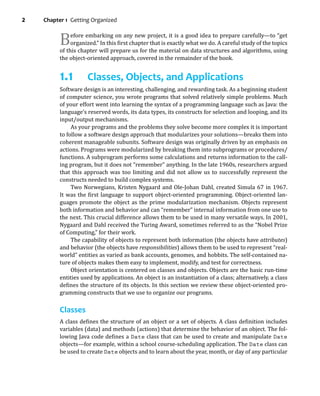
Before embarking on any new project, it is a good idea to prepare carefully—to “get
organized.” In this irst chapter that is exactly what we do. A careful study of the topics
of this chapter will prepare us for the material on data structures and algorithms, using
the object-oriented approach, covered in the remainder of the book.
1.1 Classes, Objects, and Applications
Software design is an interesting, challenging, and rewarding task. As a beginning student
of computer science, you wrote programs that solved relatively simple problems. Much
of your effort went into learning the syntax of a programming language such as Java: the
language’s reserved words, its data types, its constructs for selection and looping, and its
input/output mechanisms.
As your programs and the problems they solve become more complex it is important
to follow a software design approach that modularizes your solutions—breaks them into
coherent manageable subunits. Software design was originally driven by an emphasis on
actions. Programs were modularized by breaking them into subprograms or procedures/
functions. A subprogram performs some calculations and returns information to the call-
ing program, but it does not “remember” anything. In the late 1960s, researchers argued
that this approach was too limiting and did not allow us to successfully represent the
constructs needed to build complex systems.
Two Norwegians, Kristen Nygaard and Ole-Johan Dahl, created Simula 67 in 1967.
It was the irst language to support object-oriented programming. Object-oriented lan-
guages promote the object as the prime modularization mechanism. Objects represent
both information and behavior and can “remember” internal information from one use to
the next. This crucial difference allows them to be used in many versatile ways. In 2001,
Nygaard and Dahl received the Turing Award, sometimes referred to as the “Nobel Prize
of Computing,” for their work.
The capability of objects to represent both information (the objects have attributes)
and behavior (the objects have responsibilities) allows them to be used to represent “real-
world” entities as varied as bank accounts, genomes, and hobbits. The self-contained na-
ture of objects makes them easy to implement, modify, and test for correctness.
Object orientation is centered on classes and objects. Objects are the basic run-time
entities used by applications. An object is an instantiation of a class; alternatively, a class
deines the structure of its objects. In this section we review these object-oriented pro-
gramming constructs that we use to organize our programs.
Classes
A class deines the structure of an object or a set of objects. A class deinition includes
variables (data) and methods (actions) that determine the behavior of an object. The fol-
lowing Java code deines a Date class that can be used to create and manipulate Date
objects—for example, within a school course-scheduling application. The Date class can
be used to create Date objects and to learn about the year, month, or day of any particular
3
1.1 Classes, Objects, and Applications
Date object.1
The class also provides
methods that return the Lilian Day Num-
ber of the date (the code details have been
omitted—see the feature section on Lilian
Day Numbers for more information) and
return a string representation of the date.
//----------------------------------------------------------------------
// Date.java by Dale/Joyce/Weems Chapter 1
//
// Defines date objects with year, month, and day attributes.
//----------------------------------------------------------------------
package ch01.dates;
public class Date
{
protected int year, month, day;
public static final int MINYEAR = 1583;
// Constructor
public Date(int newMonth, int newDay, int newYear)
{
month = newMonth; day = newDay; year = newYear;
}
// Observers
public int getYear() { return year; }
public int getMonth() { return month; }
public int getDay(){ return day; }
public int lilian()
{
// Returns the Lilian Day Number of this date.
// Algorithm goes here. Code is included with the program files.
// See Lilian Day Numbers feature section for details.
}
@Override2
public String toString()
1
The Java library includes a Date class, java.util.Date. However, the familiar properties of dates make them a natural
example to use in explaining object-oriented concepts. Here we ignore the existence of the library class, as if we must design
our own Date class.
2
The purpose of @Override is discussed in Section 1.2“Organizing Classes.”
Authors’ Convention
Java-reserved words (when used as such), user-defined
identifiers, class and file names, and so on, appear in
this font throughout the entire text.
4 Chapter 1 Getting Organized
// Returns this date as a String.
{
return(month + / + day + / + year);
}
}
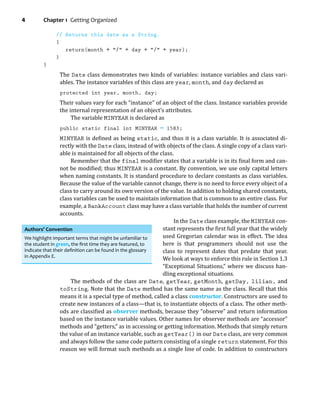
The Date class demonstrates two kinds of variables: instance variables and class vari-
ables. The instance variables of this class are year, month, and day declared as
protected int year, month, day;
Their values vary for each “instance” of an object of the class. Instance variables provide
the internal representation of an object’s attributes.
The variable MINYEAR is declared as
public static final int MINYEAR = 1583;
MINYEAR is deined as being static, and thus it is a class variable. It is associated di-
rectly with the Date class, instead of with objects of the class. A single copy of a class vari-
able is maintained for all objects of the class.
Remember that the final modiier states that a variable is in its inal form and can-
not be modiied; thus MINYEAR is a constant. By convention, we use only capital letters
when naming constants. It is standard procedure to declare constants as class variables.
Because the value of the variable cannot change, there is no need to force every object of a
class to carry around its own version of the value. In addition to holding shared constants,
class variables can be used to maintain information that is common to an entire class. For
example, a BankAccount class may have a class variable that holds the number of current
accounts.
In the Date class example, the MINYEAR con-
stant represents the irst full year that the widely
used Gregorian calendar was in effect. The idea
here is that programmers should not use the
class to represent dates that predate that year.
We look at ways to enforce this rule in Section 1.3
“Exceptional Situations,” where we discuss han-
dling exceptional situations.
The methods of the class are Date, getYear, getMonth, getDay, lilian, and
toString. Note that the Date method has the same name as the class. Recall that this
means it is a special type of method, called a class constructor. Constructors are used to
create new instances of a class—that is, to instantiate objects of a class. The other meth-
ods are classiied as observer methods, because they “observe” and return information
based on the instance variable values. Other names for observer methods are “accessor”
methods and “getters,” as in accessing or getting information. Methods that simply return
the value of an instance variable, such as getYear() in our Date class, are very common
and always follow the same code pattern consisting of a single return statement. For this
reason we will format such methods as a single line of code. In addition to constructors
Authors’ Convention
We highlight important terms that might be unfamiliar to
the student in green, the first time they are featured, to
indicate that their definition can be found in the glossary
in Appendix E.
5
1.1 Classes, Objects, and Applications
and observers, there is another general category of method, called a transformer. As you
probably recall, transformers change the object in some way; for example, a method that
changes the year of a Date object would be classiied as a transformer.
You have undoubtedly noticed the use of the access modiiers protected and public
within the Date class. Let us review the purpose and use of access modiiers. This dis-
cussion assumes you recall the basic ideas behind inheritance and packages. Inheritance
supports the extension of one class, called the superclass, by another class, called the sub-
class. The subclass “inherits” properties (data and actions) from the superclass. We say that
the subclass is derived from the superclass. Packages let us group related classes together
into a single unit. Inheritance and packages are both discussed more extensively in the next
section.
Java allows a wide spectrum of access control, as summarized in Table 1.1. The public
access modiier used with the methods of Date makes them “publicly” available; any code
that can “see” an object of the class can use its public methods. We say that these methods
are “exported” from the class. Additionally, any class that is derived from the Date class us-
ing inheritance inherits its public methods and variables.
Public access sits at one end of the access spectrum, allowing open access. At the other
end of the spectrum is private access. When you declare a class’s variables and methods as
private, they can be used only inside the class itself and are not inherited by subclasses.
You should routinely use private (or protected) access within your classes to hide their
data. You do not want the data values to be changed by code that is outside the class. For
example, if the month instance variable in our Date class was declared to be public,
then the application code could directly set the value of a Date object’s month to strange
numbers such as −12 or 27.
An exception to this guideline of hiding data within a class is shown in the Date ex-
ample. Notice that the MINYEAR constant is publicly accessible. It can be accessed directly
by the application code. For example, an application could include the statement
if (myYear  Date.MINYEAR) ...
Because MINYEAR is a inal constant, its value cannot be changed by the application. Thus,
even though it is publicly accessible, no other code can change its value. It is not necessary
Table 1.1 Java Access Control Modifiers
Access Is Allowed
Within
the Class
Within
the Package
Within
Subclasses Everywhere
public X X X X
protected X X X
package X X
private X
6 Chapter 1 Getting Organized
to hide it. The application code above also shows how to access a public class variable
from outside the class. Because MINYEAR is a class variable, it is accessed through the
class name, Date, rather than through an object of the class.
Private access affords the strongest protection. Access is allowed only within the
class. However, if you plan to extend your classes using inheritance, you may want to use
protected access instead.
The protected access modiier used in
Date provides visibility similar to private access,
only slightly less rigid. It “protects” its data from
outside access, but allows the data to be accessed
from within its own package or from any class
derived from its class. Therefore, the methods within the Date class can access year,
month, and day, and if, as we will show in Section 1.2 “Organizing Classes,” the Date class
is extended, the methods in the extended class can also access those variables.
The remaining type of access is called package access. A variable or method of a class
defaults to package access if none of the other three modiiers are used. Package access
means that the variable or method is accessible to any other class in the same package.
1582 1582
OCTOBER
SUN
31
17
24
MON
1
18
25
TUE
2
19
26
WED
3
20
27
THU
4
21
28
FRI
15
22
29
SAT
16
23
30
Coding Convention
We use protected access extensively for instance
variables within our classes in this text.
Lilian Day Numbers
Various approaches to numbering days have been proposed. Most choose a particular day in history
as day 1, and then number the actual sequence of days from that day forward with the numbers 2,
3, and so on. The Lilian Day Number (LDN) system uses October 15, 1582, as day 1, or LDN 1.
Our current calendar is called the Gregorian calendar. It was established in 1582 by Pope Greg-
ory XIII. At that time 10 days were dropped from the month of October, to make up for small errors
that had accumulated throughout the years. Thus, the day following October 4, 1582, in the Gre-
gorian calendar is October 15, 1582, also known as LDN 1 in the Lilian day numbering scheme. The
scheme is named after Aloysius Lilius, an advisor to Pope Gregory and one of the principal instigators
of the calendar reform.
Originally, Catholic European countries adopted the Gregorian calendar. Many Protestant na-
tions, such as England and its colonies, did not adopt the Gregorian calendar until 1752, at which
1582 1582
OCTOBER
SUN
31
17
24
MON
1
18
25
TUE
2
19
26
WED
3
20
27
THU
4
21
28
FRI
15
22
29
SAT
16
23
30
Lilian Day Numbers
Various approaches to numbering days have been proposed. Most choose a particular day in history
as day 1, and then number the actual sequence of days from that day forward with the numbers 2,
3, and so on. The Lilian Day Number (LDN) system uses October 15, 1582, as day 1, or LDN 1.
Our current calendar is called the Gregorian calendar. It was established in 1582 by Pope Greg-
ory XIII. At that time 10 days were dropped from the month of October, to make up for small errors
that had accumulated throughout the years. Thus, the day following October 4, 1582, in the Gre-
gorian calendar is October 15, 1582, also known as LDN 1 in the Lilian day numbering scheme. The
scheme is named after Aloysius Lilius, an advisor to Pope Gregory and one of the principal instigators
of the calendar reform.
Originally, Catholic European countries adopted the Gregorian calendar. Many Protestant na-
tions, such as England and its colonies, did not adopt the Gregorian calendar until 1752, at which
7
1.1 Classes, Objects, and Applications
The Unified Method
The object-oriented approach to programming is based on implementing models of real-
ity. But how do you go about this? Where do you start? How do you proceed? The best plan
is to follow an organized approach called a methodology.
In the late 1980s, many people proposed object-oriented methodologies. By the mid-
1990s, three proposals stood out: the Object Modeling Technique, the Objectory Process,
and the Booch Method. Between 1994 and 1997, the primary authors of these proposals
got together and consolidated their ideas. The resulting methodology was dubbed the
Uniied Method. It is now, by far, the most popular organized approach to creating object-
oriented systems.
The Uniied Method features three key elements:
1. It is use-case driven. A use-case is a description of a sequence of actions performed
by a user within the system to accomplish some task. The term “user” here should be
interpreted in a broad sense and could represent another system.
2. It is architecture-centric. The word “architecture” refers to the overall structure of the
target system, the way in which its components interact.
time they also “lost” 11 days. Today, most countries use the Gregorian calendar, at least for official
international business. When comparing historical dates, one must be careful about which calendars
are being used.
In our Date class implementation, MINYEAR is 1583, representing the first full year during
which the Gregorian calendar was in operation. We assume that programmers will not use the
Date class to represent dates before that time, although this rule is not enforced by the class. This
assumption simplifies calculation of day numbers, as we do not have to worry about the phantom
10 days of October 1582.
To calculate LDNs, one must understand how the Gregorian calendar works. Years are usually
365 days long. However, every year evenly divisible by 4 is a leap year, 366 days long. This aligns the
calendar closer to astronomical reality. To fine-tune the adjustment, if a year is evenly divisible by
100, it is not a leap year but, if it is also evenly divisible by 400, it is a leap year. Thus 2000 was a
leap year, but 1900 was not.
Given a date, the lilian method of the Date class counts the number of days between that
date and the hypothetical date 1/1/0—that is, January 1 of the year 0. This count is made under the
assumption that the Gregorian reforms were in place during that entire time period. In other words,
it uses the rules described in the previous paragraph. Let us call this number the Relative Day Number
(RDN). To transform a given RDN to its corresponding LDN, we just need to subtract the RDN of
October 14, 1582, from it. For example, to calculate the LDN of July 4, 1776, the method first cal-
culates its RDN (648,856) and then subtracts from it the RDN of October 14, 1582 (578,100), giving
the result of 70,756.
Code for the lilian method is included with the program code files.
time they also “lost” 11 days. Today, most countries use the Gregorian calendar, at least for official
international business. When comparing historical dates, one must be careful about which calendars
are being used.
In our Date class implementation, MINYEAR is 1583, representing the first full year during
which the Gregorian calendar was in operation. We assume that programmers will not use the
Date class to represent dates before that time, although this rule is not enforced by the class. This
assumption simplifies calculation of day numbers, as we do not have to worry about the phantom
10 days of October 1582.
To calculate LDNs, one must understand how the Gregorian calendar works. Years are usually
365 days long. However, every year evenly divisible by 4 is a leap year, 366 days long. This aligns the
calendar closer to astronomical reality. To fine-tune the adjustment, if a year is evenly divisible by
100, it is not a leap year but, if it is also evenly divisible by 400, it is a leap year. Thus 2000 was a
leap year, but 1900 was not.
Given a date, the lilian method of the Date class counts the number of days between that
date and the hypothetical date 1/1/0—that is, January 1 of the year 0. This count is made under the
assumption that the Gregorian reforms were in place during that entire time period. In other words,
it uses the rules described in the previous paragraph. Let us call this number the Relative Day Number
(RDN). To transform a given RDN to its corresponding LDN, we just need to subtract the RDN of
October 14, 1582, from it. For example, to calculate the LDN of July 4, 1776, the method first cal-
culates its RDN (648,856) and then subtracts from it the RDN of October 14, 1582 (578,100), giving
the result of 70,756.
Code for the lilian method is included with the program code files.
8 Chapter 1 Getting Organized
3. It is iterative and incremental. The Uniied Method involves a series of development
cycles, with each one building upon the foundation established by its predecessors.
One of the main beneits of the Uniied Method is improved communication among the
people involved in the project. The Uniied Method includes a set of diagrams for this
purpose, called the Uniied Modeling Language (UML).3
UML diagrams have become a
de facto industry standard for modeling software. They are used to specify, visualize, con-
struct, and document the components of a software system. We use UML class diagrams
throughout this text to model our classes and their interrelationships.
A diagram representing the Date class is shown in Figure 1.1. The diagram follows
the standard UML class notation approach. The name of the class appears in the top sec-
tion of the diagram, the variables (attributes) appear in the next section, and the meth-
ods (operations) appear in the inal section. The diagram includes information about the
nature of the variables and method parameters; for example, we can see at a glance that
year, month, and day are all of type int. Note that the variable MINYEAR is underlined;
this indicates that it is a class variable rather than an instance variable. The diagram also
indicates the visibility or protection associated with each part of the class (+ = public, #
= protected).
Objects
Objects are created from classes at run time. They can contain and manipulate data. Mul-
tiple objects can be created from the same class deinition. Once a class such as Date has
been deined, a program can create and use objects of that class. The effect is similar to
expanding the language’s set of standard types to include a Date type. To create an object
in Java we use the new operator, along with the class constructor, as follows:
Date myDate = new Date(6, 24, 1951);
Date yourDate = new Date(10, 11, 1953);
Date ourDate = new Date(6, 15, 1985);
Figure 1.1 UML class diagram for the Date class
Date
#year:int
#month:int
#day:int
+MINYEAR:int = 1583
+Date(newMonth:int,newDay:int,newYear:int)
+getYear():int
+getMonth():int
+getDay():int
+lilian():int
+toString():String
3
The official definition of the UML is maintained by the Object Management Group. Detailed information can be found at
http://www.uml.org/.
Random documents with unrelated
content Scribd suggests to you:
hajszolt vad. Dühös rémüldözések közben, minden utcasarkon
jobbra-balra sanditott merénylő diák után.
Mire az osztályba lépett, már nem ő volt a támadó. Várta az
eseményeket; ugy igyekezett menteni az irháját, hogy a tegnap este
történtekről egy árva kukkot se szólott, eltitkolta a veszélyt és a
három gonosztevőn keresztülnézett… Ronda kényszeritette magát,
hogy férfiasan viselkedjék. Nem sejtette, hogy micsoda félelmet áll ki
a három diák: Kieselsack, Ertzum és Lohmann; de azok se sejtették
az ő félelmét.
Az órák után, akárcsak a diákok, Ronda is visszanyerte
bátorságát. Lohmannt azonban nem szabad kiszalasztani a körmünk
közül! Távol kell tartani Frölich kisasszonytól; ez hatalmi kérdés volt
Ronda számára és az önérzete nagyon megerősödött volna azáltal,
hogyha keresztülviszi. De hogy csinálja? – »De holnap ujra el kell
jönnie« – mondta a szinésznő.
Más megoldás nincs; Ronda ezt belátta és ekkor megijedt. Az
ijedelmében azonban volt valami édes.
Nem tudott vacsorázni, annyira izgatott volt és a gazdasszonya
intelme ellenére elment hazulról, hogy elsőnek érkezzen a dutyiba,
Frölich Róza öltözőjébe. Az a Lohmann ne kukoricázzék és ne
borozzon ott: ez lázadás, ezt már nem türheti Ronda.
A többi motivumnak még nem volt tudatában.
Amint sietve a »Kék angyal«-hoz surrant, észre sem vette a
kapun a szines szinlapot s pár percig fejevesztve kereste…
Hálaisten, ott volt a szinlap. Szóval Frölich szinmüvésznő nem
utazott el, nem szökött meg, nem tünt el a föld szinéről, mert
szegény Ronda ilyesmitől tartott. Még énekelt, még cifrállott, még
csiklandozta az emberek szivét kéjes tekintetével. És miután ezzel a
megállapitással megelégedett, egy uj tanulságot vont le belőle.
Annak a Lohmannak el kell takarodnia onnan, ez azonban még nem
elég: ő maga, Ronda akar ott ülni Frölich szinmüvésznőnél… Az uj
tanulság azonban nyomban elsötétedett megint.
A terem még üres volt, majdnem sötét, barátságtalanul kongó;
számtalan piszkosfehér szék és asztal állott zavart
összevisszaságban. A kályha mellett egy kis pléhlámpánál ült a
gazda két férfival; kártyáztak.
Ronda azt akarván, hogy ne lássák, az árnyékos fal mentén
rebbent be, mint egy denevér. Amikor a müvész-szobába akart
surrani, megszólalt a gazda dörgedelmes hangon:
– Jó estét, tanár ur, örülök, hogy megint szerencséltet.
– Én csak – izé – Frölich szinmüvésznőt.
– Csak kerüljön beljebb és várja meg, már hétre jár. Mindjárt
hozok sört is.
– Köszönöm, – szólt Ronda – ezuttal nem óhajtok italt
fogyasztani… De – és kinyujtotta a fejét az ajtóból – később
valószinüleg több dolgot rendelek.
Ekkor betette az ajtót és az öltöző éjébe topogott. Mikor üggyel-
bajjal világot gyujtott, füzőket és harisnyákat vett le egy székről, leült
az asztal mellé, amely olyan volt, mint tegnap; a kabátja zsebéből
kihuzta a noteszét s a diákok neve mellé irt jegyekből az évvégi
kalkulust próbálta kiókumlálni. Mikor az »E«-hez ért, hirtelen átugrott
az »M«-re, mint reggel az osztályban. Később gondolkozott,
visszatért és Ertzum nevét toporzékoló undorral nézte; Kieselsack
jött sorra, azután Lohmann. A szoba néma és nyugodt volt és Ronda
szája lekonyult a boszuvágytól.
Kisvártatva már szállingóztak az első vendégek. Ronda
nyugtalankodott. Bejött a tegnapi kövér hölgy, egy viharvert fekete
kalapot viselt és igy szólt:
– A tanár ur? Csak nem aludt itt az éjszaka?
– Tisztelt asszonyom, én bizonyos fontos ügyek elintézése végett
jöttem.
– Tudjuk, micsoda ügyek azok.
A nő levetette a boáját és a bluzát.
– Ugye megengedi, hogy levessem a bluzom.
Ronda valamit dadogott és félrenézett. A nő sötétfehér
fésülködőköpenyben jött vissza és a tanár ur vállára vert.
– Annyit mondhatok, tanár ur, cseppet sem csodálkozom, hogy
visszajött. Róza minden vendége igy tesz. Aki egyszer megismeri,
az meg is szereti, ugy bizony. Hiába, csuda gusztusos egy leány.
– E, e, e – jól jegyezzük meg – csakugyan, tisztelt asszonyom,
de én nem azért…
– Persze. Hanem a szive miatt. Mert szive az van. Az aztán van!
A nő a tátongó fésülködőköpeny alatt a szivére szoritotta a kezét.
Nyafogott és a tokája lóbálódzott a meghatottságtól.
– Olyan leány ez, hogy a légynek se vét. Az apja is betegápoló
volt. Akár hiszi, akár nem, ez a leány roppant szereti az öreges
urakat. És nemcsak ezért. – Összedörzsölte a hüvelyk- és a
mutatóujját. – Hanem mert a szive is erre viszi. Mert az öreg uraknak
szüksége van egy ilyen jó leányra… Sokszor olyan jókedvü, hogy
már a rendőrség is megsokalja. Ilyen kicsi korátul ismerem.
Mindenkinek ajánlhatom.
A nő rátehénkedett az asztal peremére, Rondát rengeteg
személye és a széktámla közé préselte, egészen lefoglalta s
elkábitotta azzal, amit mesélt.
– Alig volt még a lelkem tizenhat éveske, már akkor is eljárt a
panoptikumba, meg az artisták közé, hiába, müvészvér… Na aztán
akadt egy öreg ur, aki tanittatni akarta. Hát ezt már tudjuk, mit jelent.
Mikor aztán Rózácska bajba jutott, szaladt ám hozzám és bömbölt a
nyakamon. Mondtam neki persze: no most aztán nem eresztjük az
öreget, te még csak két és fél hét mulva töltöd be a tizenhatodik
évedet, a vén zsivány fizetni fog, mint a köles. Csakhogy Róza nem
akarta. Hallott már ilyesmit? Sajnálta az öreget. Nem lehetett
rávenni, hogy pénzt kérjen tőle. Hanem ujra elment hozzá, a maga
jószántából; ebből láthatja, hogy micsoda leány. Egyszer mutatta
nekem az öreg urat az utcán, na hát: hálni járt belé a lélek. A kis
körme hegyéig se érhetne fel magának, higyje el, tanár ur!
Két ujjával egyenesen Ronda arcába bökött. Mivel pedig ugy
látta, hogy a tanár ur még nincs eléggé felizgatva, ismételte a
mondottakat:
– A kis körme hegyéig se, én mondom önnek! És különben is
undok fráter volt. Nemsokára meghalt és találja el, mit testált
Rózára? A fényképét egy diszkréten elzárt tokban. Na, kint voltunk a
vizből! Már egy zsenerózus ur, aki még csak nem is szegény, aztán
a lányt is szereti, az nem viselkedhet ilyen piszkosan.
– Természetesen, ámbátor – Ronda szerette volna valahogy
másra terelni a beszédet – ez nekem egészen mindegy, – nemde
ugyebár, – azonban…
Zavart mosolya dühösnek látszott.
–… belátja, hogy fiatal fiuknak, akikből egyrészt a szellemi
képességek, másrészt a kedély frissesége nem veszett ki teljesen, –
hogy ugy mondjam…
Az asszony élénken vágott Ronda szavába.
– Annyi baj legyen! A fiukkal már ugyis torkig van Róza, elhiheti,
ha én mondom!
Erősen megrázta Ronda vállát, hogy testileg is éreztesse vele az
igazságot. Azután letottyant az asztalról és igy szólt:
– Hogy elpletykáltam az időt. De most már aztán ideje, hogy a
dolgom után lássak. Tisztelt tanár ur, legközelebbi alkalommal
megint szivesen állok rendelkezésére.
Otthagyta Rondát, letelepedett a toalett-tükör elé és bedörzsölte
zsirral az egész képét.
– Ne nézzen ide.
Ronda engedelmesen félrenézett. Hallotta, hogy a zongorán
valaki megüt néhány billentyüt. A terem tompán morajlott, mintha
félig lenne emberekkel.
– A maga diákjai – vetette oda az asszony, valami tárgyat
szorongatva a fogai között – ugyis hiába dugják ide a pofájukat.
Ronda önkéntelenül az ablak felé tekintett. A vörös függöny
mögött csakugyan fejek árnyéka imbolygott.
A teremből hosszan elnyujtott »hohohohó« kiáltás hallatszott be.
Frölich Róza lépte át a küszöböt. A müvésznő nyomában Kiepert, az
artista széles termete zárta el a kijárást. Mikor mindketten bent
voltak az öltözőben, Kiepert odaorditotta Rondának:
– Nagyon hizelgő ránk nézve, tanár ur, hogy ön ismét megjelent!
Frölich kisasszony ezt mondta:
– Csakugyan eljött! Na hál’ Istennek.
– Talán csodálkozik? – dadogta Ronda.
– Eszemágába sincs – felelte a müvésznő. – Segitsen inkább
kibujni a kabátomból.
– Hogy látogatásom oly gyors egymásutánban következett be…
– folytatta Ronda a megkezdett beszédet.
– No bizony mehetnék Kukutyinba zabot hegyezni, ha a
gavallérjaimat nem tudnám visszacsalogatni.
Karjait fülesfazék módjára feltartotta és nagy, vöröstollas
kalapjából egyre-másra szedegette ki a kalaptüket, közben huncutul
nevetett felfelé Rondára.
– Hiszen – szükölt Ronda – ön maga mondotta, hogy
leghelyesebb, ha ujra eljövök.
– Na hát – tört ki Róza kisasszonyból, fogta vörös kalapját és
mint egy tüzes kereket többször megforgatta a levegőben – ilyen jót
még nem nevettem!… Maga azt hiszi, öregem, hogy én csak ugy
könnyelmüen elszalasztom az urakat? Szépen!
Amig beszélt, kezét csipejére biggyesztette és ugy hajlongott
Ronda képibe.
Ronda megrémült, mint a gyerek, aki azt látja, hogy fönn a
szinpadon a tündér hamis haja a földre pottyan.
Frölich kisasszony rögtön észrevette a hatást és sietve hátrált.
Néhányat sóhajtott, fejét oldalt hajtotta és ezt mondta:
– Azért ne értsen félre, én nem ugy gondoltam. Nagyon téved, ha
azt hiszi. Éppen ellenkezőleg, mindig mondtam Gusztlnak: Mégis
csak doktor és mégis csak tanár; és én szegény tudatlan fiatal leány
vagyok, mit adhatok én neki… Mondja, Kiepertné, nem igaz, hogy
ezt mondtam magának?
A kövér asszonyság erősitgette, hogy ugy van.
– De Gusztl – mondta Frölich kisasszony és ártatlanul vonogatta
hozzá a vállát – mindig mondta, hogy ön el fog jönni… És csakugyan
eljött!
Az artista a sarokból, ahol átöltözött, illetlen hangokat eregetett
kifelé. A felesége jelekkel próbálta elhallgattatni.
– Különben is ki tudja, – folytatta Róza kisasszony – hogy ön az
én kedvemért jön-e… Hiszen még a kabátomat se akarja
lesegiteni… Hátha csak azok miatt a vacak kölykök miatt jön, akiket
nyársra akar huzni?
Ronda elvörösödve, segitségért kapkodva felelt a vádra:
– Elsősorban – hiszen ez csak természetes – nemde ugyebár –
tulajdonképpen…
Róza fájdalmasan ingatta a fejét.
A kövér nő felállt a toalett-asztal mellől, hogy közelebbről
avatkozhasson a beszélgetésbe. Kivágott piros bluzt vett magára. Ki
volt készitve. A képe ugyanugy fénylett, mint tegnap.
– Hát miért nem segiti le őnagysága kabátját – szólt oda
Rondának. – Na maga is tudja, mi illik.
Ronda ráncigálni kezdte a müvésznő kabátjának az egyik ujját, a
kabát nem jött le, ellenben Róza kisasszony a ráncigálás közben
hirtelen Ronda karjaiba tántorgott; a tanár ur rémülten hagyta abba a
segitést.
– Igy huzza – oktatta Rondát a kövér nő. Férje, az artista, közben
nesztelenül előlépett. Már trikóban volt, köröskörül a csipején a
kövérségtől huskolbász tekergőzött, mint valami kigyó, nyakán pedig
egy szőrös szemölcs diszlett. Egy egészen kis darab ujságpapirt
tartott Ronda szeme elé.
– Olvassa csak ezt, tanár ur, ez ugyancsak megmondja annak a
piszok bandának.
Ronda azonnal magára öltötte fontoskodó arckifejezését, mellyel
minden nyomtatott betüt fogadott. Rájött, hogy a helybeli
szociáldemokrata párt lapjából való a papir.
– Lássuk csak, – mondta – hogy mit tudnak ezek.
– Épp a tanárok fizetéséről irnak – mondta az artista. – Hát nem
tegnap emlegettem?
– Ugyan hagyd! – szólt a felesége és kivette Ronda kezéből az
ujságot. – Fizetése van neki elég, valami másra volna inkább
szüksége. Ez nem a te dolgod, eredj inkább ki azokhoz a
marhákhoz.
A teremben tulröfögték, tulorditozták és tulfütyülték a zongora
bömbölését. Kiepert engedelmeskedett. Hirtelen magára öltötte az
öntelt arckifejezést, mellyel már tegnap is csodálatba ejtette Rondát
és kilibegett a terembe, mely lármásan fogadta magába.
– Ez elkotródott – mondta a kövér hölgy. – Jöjjön, tanár ur,
segitsük gyorsan Rózára a ruhákat, mig vissza nem jön.
– De szabad neki is segiteni? – kérdezte Frölich kisasszony.
– Nem ujság az neki, hogyan vetkőznek, vagy öltöznek a nők. Ki
tudja, hátha még hasznát veheti egyszer az életben.
– Hát ha ugy tetszik – mondta Frölich kisasszony és lebocsátotta
a szoknyáját. A füzője már nyitva volt és Ronda bizonyos rémülettel
vette észre, hogy a ruha alatt mindenhol fekete és fénylik. De még
rettenetesebb volt számára az a felfedezés, hogy a müvésznőn
nincs alsószoknya, csak egy bő, fekete bugyogó. Róza őnagysága
nem igen látszott ezzel törődni, egész szelid képet vágott hozzá.
Ronda azonban ugy érezte, minttha először bizsergetnék meg
ismeretlen misztériumok és fontos dolgok tünnének fel, a felszin alól,
a jó polgári felszin alól s ekkor látta, hogy az élet tele van rendőri
kihágásokkal. És Ronda félelemmel teli büszkeséget érzett.
Odakünn Kiepernek óriási sikere volt és belekezdett valami uj
számba.
– Most mégis talán el kellene fordulnia, – vélte Róza kisasszony
– most mindent ledobok magamról.
– Ugyan, kis csacsi, hiszen a tanár ur okos és komoly férfi, mit
árthat az neki.
Csakhogy Ronda mégis megfordult. Feszülten fülelt a ruhák
suhogására. Amint ott állt a sarokban, a kövér hölgy hamarosan a
markába nyomott valamit.
– Itt van, fogja.
Ronda elvette, anélkül, hogy tudná, micsoda.
Valami feketeség volt, egész kicsire össze lehetett gyürni és
roppantul meleg volt. Olyan meleg volt, mint valami állat. Egyszerre
csak hirtelenül kicsuszott Ronda kezei közül, mert felfedezte, miért
oly meleg; a szinmüvésznő fekete bugyogója volt!
Közben Ronda felszedte a földről a furcsa jószágot és ijedtében
csöndesen meglapult a sarokban.
Gusztl és a müvésznő munka közben sietve néhány szinpadi
szakkifejezést váltottak egymással. Kiepert elkészült a számával.
– Most ki kell mennem – mondta a kövér nő – segitsen maga
Rózának az öltözködésben.
És mivel Ronda nem mozdult, folytatta:
– Megsiketült?
Ronda felriadt. »Elaludt«, mint a diákjai szokták, ha hosszura
nyulik valamelyik óra. Azután türelmesen megfogta a füzőzsinórokat.
Frölich kisasszony a vállán keresztül mosolygott fel rá.
– Mért forditott hátat egész idő alatt? Hiszen már régen fel
vagyok öltözve.
Narancsszinü alsószoknyában állott Ronda előtt.
– Különben is – folytatta azután – csak Gusztl miatt mondtam az
elfordulást. Engem nem bánt, amugy is szeretném tudni, hogy
tetszik magának a termetem?
Ronda egy árva kukkot sem felelt és Róza kisasszony
türelmetlenül forditotta el tőle a fejét.
– Jól huzza össze!… De ügyetlen. Adja csak ide, sokat kell még
magának tanulni.
A müvésznő maga füzte össze magát. És mert látta, hogy Ronda
tétlen kezét még mindig esetlenül kinyujtva tartja maga elé, igy szólt:
– Hát sehogy sem tetszem magának?
– Oh hogyne, természetesen – dadogta Ronda megrettenve.
Azután végül nagynehezen kinyögte, hogy a fekete öltözetben – a
feketében – még csinosabbnak találta.
– Kis malac – mondta neki Frölich Róza szinmüvésznő.
A füzőkérdés rendbejött… Gusztlnak is óriási sikere volt a
férjével egyetemben.
– Most azonban én jövök – mondta Frölich Róza kisasszony. –
Csak a képemet kell még kicsit rendbehozni.
A tükör elé ült, lázasan babrált egy csomó tégely, üveg és
festékrudacska között. Ronda egyebet nem látott, csak vékony
karjait, amint folytonosan a levegőt szántották és elhomályosult
szemei előtt valami ködös játék keringett. Rózsaszinü, halványsárga
vonalak keletkeztek, váltakoztak és mindegyiket, mielőtt eltünt volna,
máris másik váltotta fel. Rondának ismeretlen tárgyakat kellett az
asztalról elhoznia. A müvésznőnek szédületes munkája közben még
arra is maradt ideje, hogy lábával dobbantson, ha Ronda nem azt
vette fel az asztalról, amire szükség volt és tekintetével
megcsiklandozta Rondát, ha a kért tárgyat hozta. Bizonyos, hogy a
kisasszony szemei egyre jobban tüzeltek. Végül Ronda világosan
látta, hogy mindezt csak a tégelyek müvelik, melyeket ő nyujtogatott
át neki és melyekkel a nő bedörzsölte a szeme alját. Azok a piros
pettyek okozzák mindezt a szeme szögletében, a szemöldök fölött
azok a vörös vonalak és az a fekete zsir, amit szempillájára dörzsölt.
– Na még csak a szájam festem ki – mondta Róza.
És egyszerre csak Ronda maga előtt látta Frölich kisasszony
tegnapi szines arcát. Az igazi, a tulajdonképpeni Frölich Róza csak
most jelent meg előtte. Ronda látta, hogyan alakult ki és csak most
jött rá a nyitjára. Bepillanthatott egy percre abba a
boszorkánykonyhába, ahol a szépséget, a vidámságot és a lelket
készitik. Csalódottnak és beavatottnak érezte magát. Ezeket
gondolta gyors egymásutánban:
– Ennyi az egész?
És azután:
– Óriási!
A szive hangosan dobogott. Közben pedig a müvésznő egy
ronggyal törülgette le a kezéről a szines zsirt, ami Ronda szivét
megdobogtatta.
Azután Róza feltette a tegnapi elgörbült diadémot a fejére… A
teremben tombolni kezdett a nép. A müvésznő vonogatta a vállát és
szemöldökeit morcolva, megkérdezte Rondát:
– Tetszik magának itt?
Ronda egy betüt se hallott.
– Na most mindjárt csudát lát. Tudniillik ma valami rémitő
bánatos nótát danolok, annak a tiszteletére huzok hosszu szoknyát
is magamra… Adja csak ide azt a zöldet!
Ronda előbb jobbra és balra lendült a ruhák között, ugy hogy a
kabátja szárnyai csak ugy röpdöstek. Végre is meglelte a kért zöld
vacakot és egy szempillantás alatt máris ott állott előtte Róza
egybeszabott, elomló tündérruhában, csak az ölén és a combján
huzódott körül egy rózsafüzér… Felnézett Rondára, Ronda egy szót
se szólt; de a lány meg volt elégedve az arckifejezésével és utána
nagystilü mozdulatokkal lépegetett az ajtó felé. Kevéssel a küszöbön
innen megfordult, mert eszébe jutott, hogy hátul két zsirpecsét van a
ruháján és most Ronda látja azokat.
– Ezt nem kell azoknak a majmoknak mutogatnom, nincs
igazam? – mondta mélységes megvetéssel. Azután
méltóságteljesen megjelent a tágra nyitott ajtó küszöbén. Ronda
elugrott, még megláthatná valaki.
Az ajtó félig nyitva maradt. Ott künn orditoztak:
– Boldog Isten! – meg: Zöld selyemruha van rajta! – és: – De lóg
a szoknyája!
Némelyek kuncogtak is.
A zongora valami pityergős dalba kezdett. Diszkantban nedves
volt a zokogástól, basszusban pedig krákogott és tüszkölt.
Ronda hallotta Róza kisasszonyt énekelni:
Ragyog a hold s a csillagoknak ezre
Figyelj a halk ezüsttavon,
Bolygó szerelmed sir fel epedezve.
A hangok ugy bugyborékoltak az énekesnő bubánatos lelkéből,
mint bágyadt fényü gyöngyszemek fekete örvényben.
Ronda ezt gondolta magában:
– Igen ám!… Ugy bizony!…
Enyhe és bus érzések fogták el. A réshez lopódzkodott és látta,
hogy a lámpák között miként keletkeznek és simulnak el ismét
Frölich Róza kisasszony zöld ruhájának a ráncai… A müvésznő
hátravetette a fejét; Ronda látta a nő rozsdavörös figuráját, rajta az
elgörbült diadémot, kifestett arcát s magasra szökkenő fekete
szemöldökét. Az elülső asztalok egyikénél kék gyapjukabátban
elragadtatott hangon lelkesült egy tagbaszakadt vidéki pasas.
– Jézusom, de gyönyörü! Nahát, elmegy a kedvem a
feleségemtől, ha ilyet látok.
Ronda fitymáló jóindulattal nézte végig a vidékit; ezt gondolta
magában:
– Igen ám… Ugy bizony…
Ez nem volt ott, amig a müvésznő készült! Ez nem tudta, hogy
miből van a szépsége, nem volt hivatva fölötte itéletet mondani. Ugy
kellett vennie, ahogy kapta és még örülhet rajta, hogyha a
gyönyörüséges Róza kisasszony elvette a gusztusát a saját
feleségétől.
A versszak panaszosan végződött:
A csónak ring bus ritmusán nevednek,
Szivem zokog, a csillagok nevetnek.
Csakhogy odalenn a hallgatóság között megint elröhögte valaki
magát. A hangulatából kiszakitott Ronda hiába kutatta a tettest. A
müvésznő ujra nekikezdett a második strófának: »Ragyog a hold«…
A refrénnél: »a csillagok nevetnek« már hatan vagy heten nevettek.
Egyik valahol a középen ugy kodácsolt, mint valami néger. Ronda
felfedezte: csakugyan néger volt! Ez a fekete megmételyezte az
egész környezetét, Ronda több nevetésre torzuló arcot pillantott
meg. Ellenállhatatlan vágy fogta el, hogy ezeket az elferdült nevető
izmokat ismét helyükre rángassa. Hol az egyik, hol a másik lábára
állott, szenvedett…
Frölich kisasszony harmadszor jelentette ki:
Ragyog a hold…
– Ezt már tudjuk – mondta valaki szélesen és határozottan.
Néhányan a jobbindulatuak közül csillapitgatták a folyton erősbödő
nyugtalanságot. De a fekete rontó vigyorgása elharapódzott az
egész teremben. Ronda egész sor tátongó szájüreget látott sárga
agyarakkal, vagy félholdszerü fehér, egyik fültől a másikig huzódó
fogsorokkal; körszakállas, vagy felkunkorodó bajuszkás férfiakat.
Ronda felismerte a kereskedőtanoncot, tavalyi diákját, aki tegnap a
kikötő felé vivő meredek utca járdáján az arcába röhögött és aki
most Frölich kisasszony tiszteletére akkorára tátotta a száját, hogy
egy szekér is megfordulhatott volna benne. És Ronda érezte, mint
száll fejébe a vére, a félelemtől hajszolt zsarnok dühe. Frölich
kisasszony most már az ő magánügyévé vált! Helyt állt érette, a
kulisszák mögül leste, hogy jól csinálja-e a dolgát, végleg össze volt
vele kozmásodva és védőjének érezte magát! Személyes sértésnek
vette, ha valaki gátolni merészkedett őnagysága érvényesülését! Az
ajtóba kapaszkodott, mert attól félt, hogy nem tudja magát
türtőztetni, kirohan és fenyegetésekkel, lökésekkel és egyéb
fenyitésekkel figyelemre kényszeriti az iskolakerülő diákok seregét.
Lassanként ötöt-hatot lelt közülök. A terem tömve volt régi
tanévek elvetemült diákjaival! A vastag Kiepert és a vastag Gusztl
körüljárták a termet, kocintottak a vendégekkel, barátkoztak. Ronda
lenézte őket, a romlás lejtőjén haladnak, Frölich kisasszony azonban
tisztult magasságban áll fölöttük, zöld selyemruhájában, elgörbült
diadémmal a fején: csakhogy senki se volt rá kiváncsi!
– Elég! Hagyja abba!
És Ronda tehetetlenül állott velük szemben! Rettenetes volt!
Bekergethette a diákokat a dutyiba, feladatokat adhatott fel nekik »át
nem vett« tárgyakról, parancsolhatott nekik, a szellemüket
elnyomhatta és ha valamelyik gondolni próbált valamit, rájuk
ripakodhatott: »Maga ne gondoljon semmit!« De arra nem
kényszerithette őket, hogy szépnek tartsák azt, amit ő szépnek tart.
Ez volt az elvetemültségük utolsó mentsvára. Ronda zsarnoki
ösztöne a végső megpróbáltatásokat állta…
Alig birta magát türtőztetni. Levegő után kapadozott. Menekülni
akart ebből az ájulatos izgalomból, vonaglott a vágytól, hogy egy
ilyen koponyát egyszer felszakithasson és a szépérzéket meggörbült
ujjakkal benne helyreigazithassa.
Csodálta Róza kisasszony önbizalmát, aki vidám tudott maradni
és a kiabálások és pisszegések közben még kezével csókokat is
dob a közönségnek! Még a vereségében is óriási ez a nő… Ebben a
pillanatban Róza félig elfordult a közönségtől és leszólt valamit a
zongorásank. És fegyelmezett és szolgálatkész arca egyszerre
váratlanul, keserüen és kajánul elfintorodott egyetlen ránditással,
mint valami moziképen. Rondának ugy tetszett, hogy a zongorához
való lebeszélgetés kissé tovább tart a kelleténél és az elfordulás a
lehetőséghez képest tulságosan sok. Tovább már nem szabadna
folytatni; a zsirfoltok a müvésznő hátulsó részén érvényre jutnának…
Egyszerre megint vidáman a magasba lendült Róza, összefogta zöld
selyemruháját, magasra vetette narancsvörös alsószoknyáját és
tiszta szivből elkezdett trillázni:
Mert szüz vagyok, kis gyenge szüz…
A közönség honorálta a müvésznő vidámságát, tapsoltak és
ujráztatni akarták. Róza, az ajtót bevágva, visszament az öltözőbe,
rövideket lélegzett és ezt kérdezte:
– Na, mit szól hozzá? Kivágtam magam, mi?
A dolog rendbejött, mindenki meg volt elégedve, csak egészen
hátul a teremben, a fal mellett, a kijárat közelében, Lohmann
támaszkodott meg, fakó és messze tekintetét összekulcsolt karjára
szögezte és azon gondolkozott, hogy versei, az ő szegény versei,
amelyek a közönséges emberek kacajától sötét utcákba menekültek,
most az éjjeli levegőhullámokon elindultak egy hálószoba ablaka
felé, halkan megkopogtatják majd az ablakot és bent senki se
hallja…
A kövér Gusztl meg Kiepert bejöttek az öltözőbe. Frölich
kisasszony fejét nyakába huzta és sértődötten mondotta:
– Csak dumálja még egyszer a fülembe, hogy azt a vacakot
énekeljem, amit az a hülye kölyök firkált!
Ronda hallotta ezt, de nem gondolt semmit mellette.
– Fiacskám, – magyarázta a kövér asszonyság – a közönségben
nem lehet bizni, azt mindenki tudja. Ha nem lett volna itt az a pocsék
néger, akkor bőgnek és nem nevetnek.
– Különben fütyülök rá, – mondta Frölich kisasszony – főként ha
a tanár ur hozat valami jót inni. Mi jót hozat a tanár ur inni?
És két ujját, ugyanugy, mint tegnap, egészen könnyedén az álla
alá biggyesztette Rondának.
– Bort? – tanácsolta Ronda.
– Helyes – szólt elismeréssel a kisasszony. – De milyet?
Ronda nem volt járatos a borokban. Segitségért könyörgött a
szemeivel, mint a diák, aki belesül a leckéjébe. Kiepert és nője
feszült izgalommal lesték a szavait.
– P-vel kezdődik – mondta felvidulva Róza kisasszony.
– Palugyai – jegyezte meg Ronda és beléizzadott. Ő nem volt
modern filológus s igy nem is tartozott tudni, mi áll a borlapon.
Ismételte:
– Palugyai.
– Azt csak igya maga ki – rimelt rá Róza. – P után e következik.
Ronda nem tudta, mi lehet az.
– Azután jön zs, utána g és ő… Na, maga se jön rá semmire.
Igazán furcsa, hogy semmire a világon nem jön rá!
Ronda képe egyszerre felderült a naiv boldogságtól. Kitalálta:
– Pezsgő.
– Na, hál’ Istennek – mondta a müvésznő. Gusztl és Kiepert is
helyeselték a megoldást. Az artista elment, hogy megrendelje. Mikor
visszafelé jött a termen keresztül, a vendéglős maga cipelt előtte egy
nagy hütővödröt, amiből két nyak kandikált kifelé. Kiepert trikóban
volt. Felfujta a pofáját, a közönség vihogott körülötte.
A müvész-szobában lassacskán ugyancsak felvidámodtak.
Ronda minden pohárnál ezt gondolta: – ez az én borom, ebbe
semmi beleszólása Lohmannak. Frölich kisasszony is éppen ezt
mondta:
– Pezsgőt bizony még egyszer se fizettek a maga drága diákjai.
Róza hevesebben kezdte szemével csiklandozni Rondát.
– Törődöm is én ővelük.
És mivel Ronda nem értette el a célzást, egyet sóhajtott. Kiepert
felemelte a poharát.
– Éljen a szerelem! Tanár ur!
És kettejükre hunyorgatott. Őnagysága boszusan mormolta a
fogai között:
– Nehéz egy ember.
A kövér hölgynek át kellett öltöznie a legközelebbi számhoz, mert
az ének után megint akrobatamutatványok jöttek sorra.
– De azt már mégse szabad meglátnia, – mondta – hogyan bujok
bele a trikóba. Neem, olyan jóba még nem vagyunk.
Három széket egymás hegyébe rakott, a támláit elfüggönyözte
szoknyákkal és mögéjük bujt. Fölfelé elég magas volt a fal, de
szélességében bizony Gusztl teste tulterjedt rajta. A többiek
minduntalan megpillanthattak egy-egy kibuggyanó darabkát husából
és ilyenkor egyet rikkantottak. Róza kisasszony végigdőlt az
asztalon, ugy kacagott és sikerült Rondát a kicsapongásban annyira
magával ragadnia, hogy többször nyujtogatta a nyakát és
bekacsintgatott Gusztl rejtekébe. Gusztl vihogott, Ronda
visszatorpant és azután ujra pedzette a félszeg tréfát.
A müvésznő fáradtan felkelt. Visszatartotta a lélekzetét és ezt
mondta:
– Biztos vagyok, hogy velem ilyet nem merne megtenni.
Azután fujt egyet.
A terem uj müvészi attrakciót kivánt, lármázott, a zongora már
nem elégitette ki. A kövér házaspár kiment.
Rondával együtt maradván, minden erejét összeszedte
őnagysága. Ronda zavartan izgett-mozgott. Egy pillanatig csend volt
az öltözőben, künn kornyikáltak. A nő fanyalogva mondta:
– Már megint az a vacak hazafias dal. Jaj de utálom!… De lássa,
maga észre se vette, micsoda változás történt itt tegnap óta.
– Itt a dutyiban? Itt? – dadogott Ronda.
– Ne is érdeklődjék, maga semmit se vesz észre… Mi volt tegnap
a tükrön, jobbról és balról?
– Igen, igen… hogyne, természetesen… két virágcsokor.
– S maga hálátlan észre se veszi, hogy a maga tiszteletére mind
a kettőt tüzrevetettem.
A müvésznő duzzogott, foghegyről beszélt. Ronda a kályha felé
bandzsitott és belevörösödött az örömbe; mert Frölich szinmüvésznő
őnagysága feltüzelte Lohmann csokrait. Ronda nyugtalankodni
kezdett; az az ötlete támadt, hogy Lohmann két csokra helyett másik
két csokrot hoz, melyeket ő maga ad át majd a müvésznőnek…
Megállapitotta, hogy a vörös függöny mögött nincs senki. És
Lohmannal mindenáron vetélkedni akart.
– Kedves – hogyne, természetesen – kisasszony, tegnap –
nemde ugyebár – még érintkezett a diákokkal?
– Miért ment el oly korán? Mit csináljak, hogyha, se szó, se
beszéd, bejönnek… De megmondtam nekik, különösen az
egyiknek…
– Ez szép magától… És mikor ma este ide jött a vendéglőbe –
nemde ugyebár – találkozott a három diákkal?
– Képzelheti, hogy örültem nekik.
– Kedves kisasszony, ha nem tud lemondani a virágról és a
pezsgőről, akkor hozzám forduljon és ne hozzájuk. Nem tudom
eléggé kárhoztatni azt, hogy a diákokat ide csábitja.
És Ronda fülig vörösödött, felvidult, minden tehetsége
csodálatosan meghatványozódott és most már egész világosan
látta, hogy azt a vacak dalt, amit őnagysága megvetéssel vett le a
programmról, azt a dalt Lohmann irta. Ronda hozzátette:
– És azt a dalt se énekelje többet. Egyáltalán sohase énekelje
Lohmann dalait.
– És ha nem tudnék róla lemondani, – kérdezte a szinésznő
mosolyogva – irna nekem maga?
Ronda erre nem volt elkészülve, de azért megnyugtatta:
– No, majd meglátjuk.
– Próbálja meg! És különben is mit fél? Csak el kell kezdeni.
A nő összecsücsöritette a száját és az arcát feléje emelte.
De Rondát nem vette rá a lelke. Gyámoltalanul, tétova
bizalmatlansággal nézett rá. A nő megsokalta:
– Akkor mért van itt?
– Mert a diákoknak nem szabad – hebegte.
– Jó, jó. – És kikapcsolta a ruháját. – Át kell öltöznöm. Segitsen.
Ronda segitett. A kövér házaspár szomjasan érkezett vissza, a
diadaltól mámorosan. Az egyik üvegben volt még egy pohárkára
való. Kiepert késznek nyilatkozott még egy üveg pezsgőt hozni.
Ronda szépen megkérte rá. Róza kisasszony gyorsan töltött, mert
énekelnie kellett. A dicsőség szólitotta. A pezsgő egyre édesebb lett,
Ronda egyre boldogabb. Az artista most kézen mászott ki a
szinpadra és határtalan tetszést aratott. Ettől kezdve igy mutatkozott
a közönségnek.
Róza temperamentuma minden számnál villanyosabb lett s a
közönség mindig jobban és jobban elismerte. Ronda gondolni se
mert arra, hogy egyszer fel kell kelnie erről a székről. Már az utolsó
vendégek is szállingóztak. Róza az örömtől sugárzott és igy szólt:
– Édes tanárkám! Vasárnaponkint itt még cifrábban megy.
És erre csuklani kezdett. Ronda csodálkozva nézte a mámor
fátyolán keresztül, amint a nő az orrát az asztalon heverő két kezébe
dugta és elgörbült diadémja rángatózott.
– Bizony azért ez az élet se fenékig tejföl – fakadt ki Róza. –
Cifra nyomoruság.
A nő még egy verset jajgatott. Ronda kinosan erőlködött, hogy
megvigasztalja. Közben kivülről bejött Kiepert, felemelte Rondát a
székről és kijelentette, hogy kikiséri. Az ajtóban eszébe jutott neki
valami. Megfordult, a keze hadonászott a levegőben és Róza felé
erőlködött, aki már aludt és ezt motyogta a fülébe:
– No, majd megpróbálunk valamit tenni.
Ezt a tanárok a vizsga előtt szokták mondani annak a diáknak,
akit át akarnak csusztatni, aki iránt rokonszenvet éreznek. Ronda
azonban ezt még egyetlen egy diáknak se mondta, egy diák iránt se
érzett rokonszenvet.
Welcome to our website – the ideal destination for book lovers and
knowledge seekers. With a mission to inspire endlessly, we offer a
vast collection of books, ranging from classic literary works to
specialized publications, self-development books, and children's
literature. Each book is a new journey of discovery, expanding
knowledge and enriching the soul of the reade
Our website is not just a platform for buying books, but a bridge
connecting readers to the timeless values of culture and wisdom. With
an elegant, user-friendly interface and an intelligent search system,
we are committed to providing a quick and convenient shopping
experience. Additionally, our special promotions and home delivery
services ensure that you save time and fully enjoy the joy of reading.
Let us accompany you on the journey of exploring knowledge and
personal growth!
textbookfull.com

Full download Object Oriented Data Structures Using Java 4th Edition Dale pdf docx

  • 1.
    Download the FullVersion of textbook for Fast Typing at textbookfull.com Object Oriented Data Structures Using Java 4th Edition Dale https://textbookfull.com/product/object-oriented-data- structures-using-java-4th-edition-dale/ OR CLICK BUTTON DOWNLOAD NOW Download More textbook Instantly Today - Get Yours Now at textbookfull.com
  • 2.
    Recommended digital products(PDF, EPUB, MOBI) that you can download immediately if you are interested. Object Orientation Abstraction and Data Structures Using Scala Second Edition Lacher https://textbookfull.com/product/object-orientation-abstraction-and- data-structures-using-scala-second-edition-lacher/ textboxfull.com A Functional Approach to Java: Augmenting Object-Oriented Java Code with Functional Principles 1st Edition Ben Weidig https://textbookfull.com/product/a-functional-approach-to-java- augmenting-object-oriented-java-code-with-functional-principles-1st- edition-ben-weidig/ textboxfull.com Practical object-oriented design: an agile primer using Ruby Second Edition Metz https://textbookfull.com/product/practical-object-oriented-design-an- agile-primer-using-ruby-second-edition-metz/ textboxfull.com Swift 3 Object Oriented Programming Gaston C. Hillar https://textbookfull.com/product/swift-3-object-oriented-programming- gaston-c-hillar/ textboxfull.com
  • 3.
    Introduction to JavaProgramming and Data Structures Comprehensive Version Y Daniel Liang https://textbookfull.com/product/introduction-to-java-programming-and- data-structures-comprehensive-version-y-daniel-liang/ textboxfull.com Problem Solving in Data Structures & Algorithms Using C First Edition Jain https://textbookfull.com/product/problem-solving-in-data-structures- algorithms-using-c-first-edition-jain/ textboxfull.com Programming In C Object Oriented Features 1st Edition Laxmisha Rai https://textbookfull.com/product/programming-in-c-object-oriented- features-1st-edition-laxmisha-rai/ textboxfull.com Advanced Object-Oriented Programming in R: Statistical Programming for Data Science, Analysis and Finance 1st Edition Thomas Mailund https://textbookfull.com/product/advanced-object-oriented-programming- in-r-statistical-programming-for-data-science-analysis-and- finance-1st-edition-thomas-mailund/ textboxfull.com Think Data Structures: Algorithms and Information Retrieval in Java 1st Edition Allen B. Downey https://textbookfull.com/product/think-data-structures-algorithms-and- information-retrieval-in-java-1st-edition-allen-b-downey/ textboxfull.com
  • 6.
    Java™ Fourth Edition Nell Dale Universityof Texas, Austin Daniel T. Joyce Villanova University Chip Weems University of Massachusetts, Amherst Java using Object-Oriented Data Structures
  • 7.
    World Headquarters Jones &Bartlett Learning 5 Wall Street Burlington, MA 01803 978-443-5000 info@jblearning.com www.jblearning.com Jones & Bartlett Learning books and products are available through most bookstores and online booksellers. To contact Jones & Bartlett Learning directly, call 800-832-0034, fax 978-443-8000, or visit our website, www.jblearning.com. Substantial discounts on bulk quantities of Jones & Bartlett Learning publications are available to corporations, professional associa- tions, and other qualified organizations. For details and specific discount information, contact the special sales department at Jones & Bartlett Learning via the above contact information or send an email to specialsales@jblearning.com. Copyright © 2018 by Jones & Bartlett Learning, LLC, an Ascend Learning Company All rights reserved. No part of the material protected by this copyright may be reproduced or utilized in any form, electronic or mechani- cal, including photocopying, recording, or by any information storage and retrieval system, without written permission from the copyright owner. The content, statements, views, and opinions herein are the sole expression of the respective authors and not that of Jones & Bartlett Learn- ing, LLC. Reference herein to any specific commercial product, process, or service by trade name, trademark, manufacturer, or otherwise does not constitute or imply its endorsement or recommendation by Jones & Bartlett Learning, LLC and such reference shall not be used for advertising or product endorsement purposes. All trademarks displayed are the trademarks of the parties noted herein. Object-Oriented Data Structures Using Java, Fourth Edition is an independent publication and has not been authorized, sponsored, or otherwise approved by the owners of the trademarks or service marks referenced in this product. 09820-4 Production Credits VP, Executive Publisher: David D. Cella Acquisitions Editor: Laura Pagluica Editorial Assistant: Taylor Ferracane Director of Vendor Management: Amy Rose Marketing Manager: Amy Langlais VP, Manufacturing and Inventory Control: Therese Connell Composition and Project Management: S4Carlisle Publishing Services Cover Design: Kristin E. Parker Text Design: Scott Moden Rights & Media Specialist: Merideth Tumasz Media Development Editor: Shannon Sheehan Cover Image: © Ake13bk/Shutterstock Printing and Binding: Edwards Brothers Malloy Cover Printing: Edwards Brothers Malloy Library of Congress Cataloging-in-Publication Data Names: Dale, Nell (Nell B.), author. | Joyce, Daniel T., author. | Weems, Chip., author. Title: Object-oriented data structures using Java / Nell Dale, Daniel T. Joyce, Chip Weems. Description: Fourth edition. | Burlington, MA : Jones & Bartlett Learning, [2017] Identifiers: LCCN 2016025145 | ISBN 9781284089097 (casebound) Subjects: LCSH: Object-oriented programming (Computer science) | Data structures (Computer science) | Java (Computer program language) Classification: LCC QA76.64 .D35 2017 | DDC 005.13/3--dc23 LC record available at https://lccn.loc.gov/2016025145 6048 Printed in the United States of America 20 19 18 17 16 10 9 8 7 6 5 4 3 2 1
  • 8.
    To Alfred G.Dale ND To Kathy, Tom, and Julie, thanks for the love and support DJ To Lisa, Charlie, and Abby, thank you . . . CW
  • 9.
    © Ake13bk/Shutterstock Welcome to thefourth edition of Object-Oriented Data Structures Using Java™. This book pres- ents the algorithmic, programming, and structuring techniques of a traditional data structures course in an object-oriented context. You’ll find the familiar topics of linked lists, recursion, stacks, queues, collections, indexed lists, trees, maps, priority queues, graphs, sorting, searching, and complexity analysis, all covered from an object-oriented point of view using Java. We stress software engineering principles throughout, including modularization, information hiding, data abstraction, stepwise refinement, the use of visual aids, the analysis of algorithms, and software verification methods. To the Student You know that an algorithm is a sequence of unambiguous instructions for solving a problem. You can take a problem of moderate complexity, design a small set of classes/objects that work together to solve the problem, code the method algorithms needed to make the objects work, and demonstrate the correctness of your solution. Algorithms describe actions. These actions manipulate data. For most interesting problems that are solved using computers, the structure of the data is just as important as the structure of the algorithms used to manipulate the data. Using this text you will discover that the way you structure data affects how efficiently you can use the data; you will see how the nature of the problem you are attempting to solve dictates your structuring decisions; and you will learn about the data structures that computer scientists have developed over the years to help solve problems. Object-Oriented Programming with Java Our primary goal is to present both the traditional and modern data structure topics with an emphasis on problem solving and software design. Using the Java programming language as a vehicle for problem solutions, however, presents an opportunity for students to expand their Preface
  • 10.
    Preface v familiarity witha modern programming language and the object-oriented paradigm. As our data structure coverage unfolds, we introduce and use the appropriate Java constructs that support our primary goal. Starting early and continuing throughout the text, we introduce and expand on the use of many Java features such as classes, objects, generics, polymorphism, packages, interfaces, library classes, inheritance, exceptions, and threads. We also use Universal Modeling Language (UML) class diagrams throughout to help model and visualize our objects, classes, interfaces, applications, and their interrelationships. Features Data Abstraction In this text we view our data structures from three different perspectives: their specification, their application, and their implementation. The specification describes the logical or abstract level—what the logical relationships among the data elements are and what operations can be performed on the structure. The application level, sometimes called the client level, is concerned with how the data structure is used to solve a problem—why the operations do what they do. The implementation level involves the coding details—how the structures and operations are implemented. In other words we treat our data structures as abstract data types (ADTs). Efficiency Analysis In Chapter 1 we introduce order of growth efficiency analysis using a unique approach involving the interaction of two students playing a game. Time and space analysis is consistently applied throughout the text, allowing us to compare and contrast data structure implementations and the applications that use them. Recursion Treatment Recursion is introduced early (Chapter 3) and used throughout the re- mainder of the text. We present a design and analysis approach to recursion based on answering three simple questions. Answering the questions, which are based on formal inductive reasoning, leads the programmer to a solid recursive design and program. Interesting Applications Eight primary data structures (stacks, queues, collections, indexed lists, trees, maps, priority queues, and graphs) are treated in separate chapters that include their definition, several implementations, and one or more interesting applications based on their use. Applications involve, for example, balanced expressions, postfix expressions, image generation (new!), fractals (new!), queue simulation, card decks and games (new!), text analysis (new!), tree and graph traversals, and big integers. Robust Exercises We average more than 40 exercises per chapter. The exercises are organized by chapter sections to make them easier for you to manage. They vary in level of difficulty, including short and long programming problems (marked with “programming-required” icons—one icon to indicate short exercises and two icons for projects), the analysis of algorithms, and problems to test students’ understanding of abstract concepts. In this edition we have streamlined the previous exercises, allowing us to add even more options for you to choose from. In particular we have added several larger programming exercises to many of the chapters. Input/Output Options It is difficult to know what background the students using a data struc- tures text will have in Java I/O. To allow all the students using our text to concentrate on the
  • 11.
    vi Preface primary topicof data structures, we use the simplest I/O approach we can, namely a command line interface. However, to support those teachers and students who prefer to work with graphi- cal user interfaces (GUIs), we provide GUIs for many of our applications. Our modular approach to program design supports this approach—our applications separate the user interface code, problem solution code, and ADT implementation code into separate classes. Concurrency Coverage We are pleased to be one of the only data structures texts to address the topics of concurrency and synchronization, which are growing in importance as computer systems move to using more cores and threads to obtain additional performance with each new generation. We introduce this topic in Section 4.9, “Concurrency, Interference, and Synchronization,” where we start with the basics of Java threads, continue through examples of thread interference and synchronization, and culminate in a discussion of efficiency concerns. New to the Fourth Edition This edition represents a major revision of the text’s material, although the philosophy and style that our loyal adopters have grown to appreciate remain unchanged. We removed material we felt was redundant or of lesser/outdated importance to the core topic of data structures, added new key material, and reworked much of the material that we kept. Although the length of the textbook was reduced by about 10%, the coverage of data structures has been expanded. We believe this new edition is a great improvement over previous editions and hope you do, too. Major changes include: • Simplified Architecture: We continue to use the Java interface construct to define the abstract view of our ADTs, but we have reduced the number of levels of inheritance, simplifying the architecture and making it easier to understand and use. • New Chapters: Chapter 5, “The Collection ADT,” and Chapter 8, “The Map ADT,” are brand new. The Collection ADT material introduces the idea of a data structure as a repository and concentrates on storage and retrieval of data based on key attri- butes. The Map ADT has become increasingly important with the rise in popularity of scripting languages with built-in associative arrays. • New Section: Section 1.6, “Comparing Algorithms: Order of Growth Analysis,” was completely rewritten and features an introduction to efficiency analysis driven by a game played between two students, plus analysis of sequential search, binary search, and sequential sort algorithms. • New Sections: In response to reader’s suggestions, Chapter 3, “Recursion,” features two new sections: Section 3.3, “Recursive Processing of Arrays,” is devoted to recur- sive processing of arrays and Section 3.4, “Recursive Processing of Linked Lists,” is devoted to recursive processing of linked lists. These new sections provide practical examples of the use of recursion, before the reader moves on to the less practical but nevertheless popular Towers of Hanoi example covered in Section 3.5, “Towers.” • New Section: Fractals! A fun section related to recursively generating fractal-based images now wraps up the examples of Chapter 3, “Recursion.”
  • 12.
    Preface vii • NewSections: We added “Variations” sections to the Stack, Queue, Collection, List, Tree, and Map chapters. In the primary exposition of each of these ADTs we record design decisions and specify the operations to be supported by the ADT. We also develop or at least discuss various implementation approaches, in most cases high- lighting one array-based approach and one reference/linked-list-based approach. The “Variations” section discusses alternate approaches to defining/implementing the ADT and in most cases reviews the ADT counterparts available in the standard Java Library. Some of these sections also introduce related ADTs, for example, in the “Variations” section of the Collection chapter we define and discuss both the Set and Bag ADTs. • Glossary: The text’s glossary has always been available online. With this edition we make it available as Appendix E. Throughout the text we highlight important terms that might be unfamiliar to the student in green, the first time they are featured, to indicate that their definition can be found in the glossary. Prerequisite Assumptions In this book, we assume that readers are familiar with the following Java constructs: • Built-in simple data types and the array type • Control structures while, do, for, if, and switch • Creating and instantiating objects • Basic user-defined classes: ■ variables and methods ■ constructors, method parameters, and the return statement ■ visibility modifiers • Commonly used Java Library Classes: Integer, Math, Random, Scanner, String, and System Chapter Content Chapter 1 is all about Getting Organized. An overview of object orientation stresses mecha- nisms for organizing objects and classes. The Java exception handling mechanisms, used to organize response to unusual situations, are introduced. Data structures are previewed and the two fundamental language constructs that are used to implement those structures, the array and the reference (link/pointer), are discussed. The chapter concludes with a look at efficiency analysis—how we evaluate and compare algorithms. Chapter 2 presents The Stack ADT. The concept of abstract data type (ADT) is introduced. The stack is viewed from three different levels: the abstract, application, and implementation levels. The Java interface mechanism is used to support this three-tiered view. We also investigate using generics to support generally usable ADTs. The Stack ADT is implemented using both arrays and references. To support the reference-based approach we introduce the linked list structure. Sample applications include determining if a set of grouping symbols is well formed and the evaluation of postfix expressions.
  • 13.
    viii Preface Chapter 3discusses Recursion, showing how recursion can be used to solve programming problems. A simple three-question technique is introduced for verifying the correctness of re- cursive methods. Sample applications include array processing, linked list processing, the classic Towers of Hanoi, and fractal generation. A detailed discussion of how recursion works shows how recursion can be replaced with iteration and stacks. Chapter 4 presents The Queue ADT. It is also first considered from its abstract perspective, followed by a formal specification, and then implemented using both array-based and reference- based approaches. Example applications include an interactive test driver, a palindrome checker, and simulating a system of real-world queues. Finally, we look at Java’s concurrency and synchro- nization mechanisms, explaining issues of interference and efficiency. Chapter 5 defines The Collection ADT. A fundamental ADT, the Collection, supports storing information and then retrieving it later based on its content. Approaches for comparing objects for equality and order are reviewed. Collection implementations using an array, a sorted array, and a linked list are developed. A text processing application permits comparison of the imple- mentation approaches for efficiency. The “Variations” section introduces two more well-known ADTs: the Bag and the Set. Chapter 6 follows up with a more specific Collection ADT, The List ADT. In fact, the following two chapters also develop Collection ADTs. Iteration is introduced here and the use of anonymous inner classes to provide iterators is presented. As with the Collection ADT we develop array, sorted array, and linked-list–based implementations. The “Variations” section includes an example of how to “implement” a linked list within an array. Applications include a card deck model plus some card games, and a Big Integer class. This latter application demonstrates how we sometimes design specialized ADTs for specific problems. Chapter 7 develops The Binary Search Tree ADT. It requires most of the chapter just to design and create our reference-based implementation of this relatively complex structure. The chapter also discusses trees in general (including breadth-first and depth-first searching) and the problem of balancing a binary search tree. A wide variety of special-purpose and self-balancing trees are introduced in the “Variations” section. Chapter 8 presents The Map ADT, also known as a symbol table, dictionary, or associative array. Two implementations are developed, one that uses an ArrayList and the other that uses a hash table. A large part of the chapter is devoted to this latter implementation and the important concept of hashing, which provides a very efficient implementation of a Map. The “Variations” section discusses a map-based hybrid data structure plus Java’s support for hashing. Chapter 9 introduces The Priority Queue ADT, which is closely related to the Queue but with a different accessing protocol. This short chapter does present a sorted array-based implementa- tion, but most of the chapter focuses on a clever, interesting, and very efficient implementation called a Heap. Chapter 10 covers The Graph ADT, including implementation approaches and several important graph-related algorithms (depth-first search, breadth-first search, path existence, shortest paths, and connected components). The graph algorithms make use of stacks, queues, and priority queues, thus both reinforcing earlier material and demonstrating the general us- ability of these structures.
  • 14.
    Preface ix Chapter 11presents/reviews a number of Sorting and Searching Algorithms. The sorting algorithms that are illustrated, implemented, and compared include straight selection sort, two versions of bubble sort, insertion sort, quick sort, heap sort, and merge sort. The sorting algo- rithms are compared using efficiency analysis. The discussion of algorithm analysis continues in the context of searching. Previously presented searching algorithms are reviewed and new ones are described. Organization Chapter Goals Sets of knowledge and skill goals are presented at the beginning of each chapter to help the students assess what they have learned. Sample Programs Numerous sample programs and program segments illustrate the abstract concepts throughout the text. Feature Sections Throughout the text these short sections highlight topics that are not directly part of the flow of material but nevertheless are related and important. Boxed Notes These small boxes of information scattered throughout the text highlight, supple- ment, and reinforce the text material, perhaps from a slightly different point of view. Chapter Summaries Each chapter concludes with a summary section that reviews the most im- portant topics of the chapter and ties together related topics. Some chapter summaries include a UML diagram of the major interfaces and classes developed within the chapter. Appendices The appendices summarize the Java reserved word set, operator precedence, primitive data types, the ASCII subset of Unicode, and provide a glossary of important terms used in the text. Website http://go.jblearning.com/oods4e This website provides access to the text’s source code files for each chapter. Additionally, regis- tered instructors are able to access selected answers to the text’s exercises, a test item file, and presentation slides. Please contact the authors if you have material related to the text that you would like to share with others.
  • 15.
    x Preface Acknowledgments We wouldlike to thank the following people who took the time to review this text: Mark Llewellyn at the University of Central Florida, Chenglie Hu at Carroll College, Val Tannen at the University of Pennsylvania, Chris Dovolis at the University of Minnesota, Mike Coe at Plano Senior High School, Mikel Petty at University of Alabama in Huntsville, Gene Sheppard at Georgia Perimeter College, Noni Bohonak at the University of South Carolina–Lancaster, Jose Cordova at the University of Louisiana–Monroe, Judy Gurka at the Metropolitan State College of Denver, Mikhail Brikman at Salem State University, Amitava Karmaker at University of Wisconsin–Stout, Guifeng Shao at Tennessee State University, Urska Cvek at Louisiana State University at Shreveport, Philip C. Doughty Jr. at Northern Virginia Community College, Jeff Kimball at Southwest Baptist University, Jeremy T. Lanman at Nova Southeastern University, Rao Li at University of South Carolina Aiken, Larry Thomas at University of Toledo, and Karen Works at Westfield State University. A special thanks to Christine Shannon at Centre College, to Phil LaMastra at Fairfield University, to Allan Gottlieb of New York University, and to J. William Cupp at Indiana Wesleyan University for specific comments leading to improvements in the text. A personal thanks to Kristen Obermyer, Tara Srihara, Sean Wilson, Christopher Lezny, and Naga Lakshmi, all of Villanova University, plus Kathy, Tom, and Julie Joyce for all of their help, support, and proofreading expertise. A virtual bouquet of roses to the editorial and production teams who contributed so much, especially Laura Pagluica, Taylor Ferracane, Amy Rose, and Palaniappan Meyyappan. ND DJ CW
  • 16.
    © Ake13bk/Shutterstock 1 Getting Organized1 1.1 Classes, Objects, and Applications 2 Classes 2 The Unified Method 7 Objects 8 Applications 10 1.2 Organizing Classes 12 Inheritance 12 Packages 19 1.3 Exceptional Situations 22 Handling Exceptional Situations 22 Exceptions and Classes: An Example 23 1.4 Data Structures 27 Implementation-Dependent Structures 28 Implementation-Independent Structures 29 What Is a Data Structure? 31 1.5 Basic Structuring Mechanisms 32 Memory 32 References 34 Arrays 38 1.6 Comparing Algorithms: Order of Growth Analysis 43 Measuring an Algorithm’s Time Efficiency 44 Complexity Cases 45 Size of Input 46 Comparing Algorithms 47 Order of Growth 49 Contents
  • 17.
    xii Contents Selection Sort50 Common Orders of Growth 53 Summary 54 Exercises 55 2 The Stack ADT 67 2.1 Abstraction 68 Information Hiding 68 Data Abstraction 69 Data Levels 70 Preconditions and Postconditions 71 Java Interfaces 72 Interface-Based Polymorphism 76 2.2 The Stack 78 Operations on Stacks 79 Using Stacks 79 2.3 Collection Elements 81 Generally Usable Collections 81 2.4 The Stack Interface 84 Exceptional Situations 85 The Interface 88 Example Use 89 2.5 Array-Based Stack Implementations 90 The ArrayBoundedStack Class 91 Definitions of Stack Operations 93 The ArrayListStack Class 99 2.6 Application: Balanced Expressions 101 The Balanced Class 102 The Application 107 The Software Architecture 111 2.7 Introduction to Linked Lists 111 Arrays Versus Linked Lists 111 The LLNode Class 113 Operations on Linked Lists 115 2.8 A Link-Based Stack 121 The LinkedStack Class 122 The push Operation 124 The pop Operation 127 The Other Stack Operations 129 Comparing Stack Implementations 131 2.9 Application: Postfix Expression Evaluator 132 Discussion 132 Evaluating Postfix Expressions 133
  • 18.
    Contents xiii Postfix ExpressionEvaluation Algorithm 134 Error Processing 136 The PostFixEvaluator Class 137 The PFixCLI Class 139 2.10 Stack Variations 142 Revisiting Our Stack ADT 142 The Java Stack Class and the Collections Framework 143 Summary 145 Exercises 147 3 Recursion 161 3.1 Recursive Definitions, Algorithms, and Programs 162 Recursive Definitions 162 Recursive Algorithms 163 Recursive Programs 166 Iterative Solution for Factorial 167 3.2 The Three Questions 167 Verifying Recursive Algorithms 168 Determining Input Constraints 169 Writing Recursive Methods 169 Debugging Recursive Methods 170 3.3 Recursive Processing of Arrays 170 Binary Search 170 3.4 Recursive Processing of Linked Lists 174 Recursive Nature of Linked Lists 175 Traversing a Linked List 175 Transforming a Linked List 178 3.5 Towers 182 The Algorithm 182 The Method 184 The Program 186 3.6 Fractals 186 A T-Square Fractal 187 Variations 190 3.7 Removing Recursion 191 How Recursion Works 191 Tail Call Elimination 195 Direct Use of a Stack 196 3.8 When to Use a Recursive Solution 197 Recursion Overhead 198 Inefficient Algorithms 198 Clarity 200
  • 19.
    xiv Contents Summary 202 Exercises202 4 The Queue ADT 217 4.1 The Queue 218 Operations on Queues 219 Using Queues 219 4.2 The Queue Interface 220 Example Use 222 4.3 Array-Based Queue Implementations 223 The ArrayBoundedQueue Class 223 The ArrayUnboundedQueue Class 230 4.4 An Interactive Test Driver 234 The General Approach 234 A Test Driver for the ArrayBoundedQueue Class 235 Using the Test Driver 235 4.5 Link-Based Queue Implementations 237 The Enqueue Operation 238 The Dequeue Operation 239 A Circular Linked Queue Design 241 Comparing Queue Implementations 242 4.6 Application: Palindromes 244 The Palindrome Class 244 The Applications 246 4.7 Queue Variations 248 Exceptional Situations 248 The GlassQueue 248 The Double-Ended Queue 251 Doubly Linked Lists 252 The Java Library Collection Framework Queue/Deque 255 4.8 Application: Average Waiting Time 257 Problem Discussion and Example 258 The Customer Class 259 The Simulation 262 Testing Considerations 268 4.9 Concurrency, Interference, and Synchronization 268 The Counter Class 270 Java Threads 271 Interference 274 Synchronization 275 A Synchronized Queue 277 Concurrency and the Java Library Collection Classes 282
  • 20.
    Contents xv Summary 283 Exercises284 5 The Collection ADT 297 5.1 The Collection Interface 298 Assumptions for Our Collections 299 The Interface 299 5.2 Array-Based Collection Implementation 301 5.3 Application: Vocabulary Density 305 5.4 Comparing Objects Revisited 308 The equals Method 308 The Comparable Interface 314 5.5 Sorted Array-Based Collection Implementation 315 Comparable Elements 316 The Implementation 317 Implementing ADTs “by Copy” or “by Reference” 319 Sample Application 323 5.6 Link-Based Collection Implementation 325 The Internal Representation 325 The Operations 326 Comparing Collection Implementations 329 5.7 Collection Variations 330 The Java Collections Framework 330 The Bag ADT 331 The Set ADT 333 Summary 336 Exercises 337 6 The List ADT 345 6.1 The List Interface 346 Iteration 346 Assumptions for Our Lists 348 The Interface 348 6.2 List Implementations 350 Array-Based Implementation 350 Link-Based Implementation 355 6.3 Applications: Card Deck and Games 361 The Card Class 361 The CardDeck Class 363 Application: Arranging a Card Hand 366 Application: Higher or Lower? 369 Application: How Rare Is a Pair? 370
  • 21.
    xvi Contents 6.4 SortedArray-Based List Implementation 373 The Insertion Sort 374 Unsupported Operations 375 Comparator Interface 376 Constructors 377 An Example 378 6.5 List Variations 380 Java Library Lists 380 Linked List Variations 381 A Linked List as an Array of Nodes 381 6.6 Application: Large Integers 386 Large Integers 386 The Internal Representation 387 The LargeIntList class 388 The LargeInt Class 393 Addition and Subtraction 395 The LargeIntCLI Program 404 Summary 408 Exercises 410 7 The Binary Search Tree ADT 421 7.1 Trees 423 Tree Traversals 426 7.2 Binary Search Trees 429 Binary Trees 429 Binary Search Trees 431 Binary Tree Traversals 433 7.3 The Binary Search Tree Interface 435 The Interface 436 7.4 The Implementation Level: Basics 439 7.5 Iterative Versus Recursive Method Implementations 443 Recursive Approach to the size Method 444 Iterative Approach to the size Method 446 Recursion or Iteration? 448 7.6 The Implementation Level: Remaining Observers 448 The contains and get Operations 449 The Traversals 452 7.7 The Implementation Level: Transformers 455 The add Operation 455 The remove Operation 460 7.8 Binary Search Tree Performance 466 Text Analysis Experiment Revisited 466 Insertion Order and Tree Shape 468
  • 22.
    Contents xvii Balancing aBinary Search Tree 469 7.9 Application: Word Frequency Counter 471 The WordFreq Class 472 The Application 473 7.10 Tree Variations 479 Application-Specific Variations 479 Balanced Search Trees 482 Summary 485 Exercises 487 8 The Map ADT 499 8.1 The Map Interface 501 8.2 Map Implementations 506 Unsorted Array 506 Sorted Array 507 Unsorted Linked List 507 Sorted Linked List 508 Binary Search Tree 508 An ArrayList-Based Implementation 508 8.3 Application: String-to-String Map 512 8.4 Hashing 516 Collisions 518 8.5 Hash Functions 524 Array Size 524 The Hash Function 525 Java’s Support for Hashing 529 Complexity 530 8.6 A Hash-Based Map 530 The Implementation 531 Using the HMap class 538 8.7 Map Variations 539 A Hybrid Structure 540 Java Support for Maps 542 Summary 542 Exercises 543 9 The Priority Queue ADT 551 9.1 The Priority Queue Interface 552 Using Priority Queues 552 The Interface 553 9.2 Priority Queue Implementations 554 Unsorted Array 554
  • 23.
    xviii Contents Sorted Array554 Sorted Linked List 556 Binary Search Tree 556 9.3 The Heap 556 9.4 The Heap Implementation 562 A Nonlinked Representation of Binary Trees 562 Implementing a Heap 564 The enqueue Method 567 The dequeue Method 569 A Sample Use 574 Heaps Versus Other Representations of Priority Queues 575 Summary 576 Exercises 576 10 The Graph ADT 583 10.1 Introduction to Graphs 584 10.2 The Graph Interface 588 10.3 Implementations of Graphs 591 Array-Based Implementation 591 Linked Implementation 596 10.4 Application: Graph Traversals 597 Depth-First Searching 598 Breadth-First Searching 602 10.5 Application: The Single-Source Shortest-Paths Problem 605 Summary 611 Exercises 612 11 Sorting and Searching Algorithms 621 11.1 Sorting 622 A Test Harness 623 11.2 Simple Sorts 625 Selection Sort 625 Bubble Sort 631 Insertion Sort 635 11.3 O(N log2N) Sorts 638 Merge Sort 639 Quick Sort 646 Heap Sort 652 11.4 More Sorting Considerations 658 Testing 658 Efficiency 658 Objects and References 660
  • 24.
    Contents xix Comparing Objects661 Stability 661 11.5 Searching 662 Sequential Searching 663 High-Probability Ordering 663 Sorted Collections 664 Hashing 665 Summary 666 Exercises 667 Appendix A: Java Reserved Words 673 Appendix B: Operator Precedence 674 Appendix C: Primitive Data Types 675 Appendix D: ASCII Subset of Unicode 676 Glossary 677 Index 683
  • 26.
    CHAPTER Getting Organized Knowledge Goals Youshouldbeableto describe some benefits of object-oriented programming describe the genesis of the Unified Method explain the relationships among classes, objects, and applications explain how method calls are bound to method implementations with respect to inheritance describe, at an abstract level, the following structures: array, linked list, stack, queue, list, tree, map, and graph identify which structures are implementation dependent and which are implementation independent describe the difference between direct addressing and indirect addressing explain the subtle ramifications of using references/pointers explain the use of O notation to describe the amount of work done by an algorithm describe the sequential search, binary search, and selection sort algorithms Skill Goals Youshouldbeableto interpret a basic UML class diagram design and implement a Java class create a Java application that uses the Java class use packages to organize Java compilation units create a Java exception class throw Java exceptions from within a class and catch them within an application that uses the class predict the output of short segments of Java code that exhibit aliasing declare, initialize, and use one- and two-dimensional arrays in Java, including both arrays of a primitive type and arrays of objects given an algorithm, identify an appropriate size representation and determine its order of growth given a section of code determine its order of growth 1 © Ake13bk/Shutterstock
  • 27.
    2 Chapter 1Getting Organized Before embarking on any new project, it is a good idea to prepare carefully—to “get organized.” In this irst chapter that is exactly what we do. A careful study of the topics of this chapter will prepare us for the material on data structures and algorithms, using the object-oriented approach, covered in the remainder of the book. 1.1 Classes, Objects, and Applications Software design is an interesting, challenging, and rewarding task. As a beginning student of computer science, you wrote programs that solved relatively simple problems. Much of your effort went into learning the syntax of a programming language such as Java: the language’s reserved words, its data types, its constructs for selection and looping, and its input/output mechanisms. As your programs and the problems they solve become more complex it is important to follow a software design approach that modularizes your solutions—breaks them into coherent manageable subunits. Software design was originally driven by an emphasis on actions. Programs were modularized by breaking them into subprograms or procedures/ functions. A subprogram performs some calculations and returns information to the call- ing program, but it does not “remember” anything. In the late 1960s, researchers argued that this approach was too limiting and did not allow us to successfully represent the constructs needed to build complex systems. Two Norwegians, Kristen Nygaard and Ole-Johan Dahl, created Simula 67 in 1967. It was the irst language to support object-oriented programming. Object-oriented lan- guages promote the object as the prime modularization mechanism. Objects represent both information and behavior and can “remember” internal information from one use to the next. This crucial difference allows them to be used in many versatile ways. In 2001, Nygaard and Dahl received the Turing Award, sometimes referred to as the “Nobel Prize of Computing,” for their work. The capability of objects to represent both information (the objects have attributes) and behavior (the objects have responsibilities) allows them to be used to represent “real- world” entities as varied as bank accounts, genomes, and hobbits. The self-contained na- ture of objects makes them easy to implement, modify, and test for correctness. Object orientation is centered on classes and objects. Objects are the basic run-time entities used by applications. An object is an instantiation of a class; alternatively, a class deines the structure of its objects. In this section we review these object-oriented pro- gramming constructs that we use to organize our programs. Classes A class deines the structure of an object or a set of objects. A class deinition includes variables (data) and methods (actions) that determine the behavior of an object. The fol- lowing Java code deines a Date class that can be used to create and manipulate Date objects—for example, within a school course-scheduling application. The Date class can be used to create Date objects and to learn about the year, month, or day of any particular
  • 28.
    3 1.1 Classes, Objects,and Applications Date object.1 The class also provides methods that return the Lilian Day Num- ber of the date (the code details have been omitted—see the feature section on Lilian Day Numbers for more information) and return a string representation of the date. //---------------------------------------------------------------------- // Date.java by Dale/Joyce/Weems Chapter 1 // // Defines date objects with year, month, and day attributes. //---------------------------------------------------------------------- package ch01.dates; public class Date { protected int year, month, day; public static final int MINYEAR = 1583; // Constructor public Date(int newMonth, int newDay, int newYear) { month = newMonth; day = newDay; year = newYear; } // Observers public int getYear() { return year; } public int getMonth() { return month; } public int getDay(){ return day; } public int lilian() { // Returns the Lilian Day Number of this date. // Algorithm goes here. Code is included with the program files. // See Lilian Day Numbers feature section for details. } @Override2 public String toString() 1 The Java library includes a Date class, java.util.Date. However, the familiar properties of dates make them a natural example to use in explaining object-oriented concepts. Here we ignore the existence of the library class, as if we must design our own Date class. 2 The purpose of @Override is discussed in Section 1.2“Organizing Classes.” Authors’ Convention Java-reserved words (when used as such), user-defined identifiers, class and file names, and so on, appear in this font throughout the entire text.
  • 29.
    4 Chapter 1Getting Organized // Returns this date as a String. { return(month + / + day + / + year); } } The Date class demonstrates two kinds of variables: instance variables and class vari- ables. The instance variables of this class are year, month, and day declared as protected int year, month, day; Their values vary for each “instance” of an object of the class. Instance variables provide the internal representation of an object’s attributes. The variable MINYEAR is declared as public static final int MINYEAR = 1583; MINYEAR is deined as being static, and thus it is a class variable. It is associated di- rectly with the Date class, instead of with objects of the class. A single copy of a class vari- able is maintained for all objects of the class. Remember that the final modiier states that a variable is in its inal form and can- not be modiied; thus MINYEAR is a constant. By convention, we use only capital letters when naming constants. It is standard procedure to declare constants as class variables. Because the value of the variable cannot change, there is no need to force every object of a class to carry around its own version of the value. In addition to holding shared constants, class variables can be used to maintain information that is common to an entire class. For example, a BankAccount class may have a class variable that holds the number of current accounts. In the Date class example, the MINYEAR con- stant represents the irst full year that the widely used Gregorian calendar was in effect. The idea here is that programmers should not use the class to represent dates that predate that year. We look at ways to enforce this rule in Section 1.3 “Exceptional Situations,” where we discuss han- dling exceptional situations. The methods of the class are Date, getYear, getMonth, getDay, lilian, and toString. Note that the Date method has the same name as the class. Recall that this means it is a special type of method, called a class constructor. Constructors are used to create new instances of a class—that is, to instantiate objects of a class. The other meth- ods are classiied as observer methods, because they “observe” and return information based on the instance variable values. Other names for observer methods are “accessor” methods and “getters,” as in accessing or getting information. Methods that simply return the value of an instance variable, such as getYear() in our Date class, are very common and always follow the same code pattern consisting of a single return statement. For this reason we will format such methods as a single line of code. In addition to constructors Authors’ Convention We highlight important terms that might be unfamiliar to the student in green, the first time they are featured, to indicate that their definition can be found in the glossary in Appendix E.
  • 30.
    5 1.1 Classes, Objects,and Applications and observers, there is another general category of method, called a transformer. As you probably recall, transformers change the object in some way; for example, a method that changes the year of a Date object would be classiied as a transformer. You have undoubtedly noticed the use of the access modiiers protected and public within the Date class. Let us review the purpose and use of access modiiers. This dis- cussion assumes you recall the basic ideas behind inheritance and packages. Inheritance supports the extension of one class, called the superclass, by another class, called the sub- class. The subclass “inherits” properties (data and actions) from the superclass. We say that the subclass is derived from the superclass. Packages let us group related classes together into a single unit. Inheritance and packages are both discussed more extensively in the next section. Java allows a wide spectrum of access control, as summarized in Table 1.1. The public access modiier used with the methods of Date makes them “publicly” available; any code that can “see” an object of the class can use its public methods. We say that these methods are “exported” from the class. Additionally, any class that is derived from the Date class us- ing inheritance inherits its public methods and variables. Public access sits at one end of the access spectrum, allowing open access. At the other end of the spectrum is private access. When you declare a class’s variables and methods as private, they can be used only inside the class itself and are not inherited by subclasses. You should routinely use private (or protected) access within your classes to hide their data. You do not want the data values to be changed by code that is outside the class. For example, if the month instance variable in our Date class was declared to be public, then the application code could directly set the value of a Date object’s month to strange numbers such as −12 or 27. An exception to this guideline of hiding data within a class is shown in the Date ex- ample. Notice that the MINYEAR constant is publicly accessible. It can be accessed directly by the application code. For example, an application could include the statement if (myYear Date.MINYEAR) ... Because MINYEAR is a inal constant, its value cannot be changed by the application. Thus, even though it is publicly accessible, no other code can change its value. It is not necessary Table 1.1 Java Access Control Modifiers Access Is Allowed Within the Class Within the Package Within Subclasses Everywhere public X X X X protected X X X package X X private X
  • 31.
    6 Chapter 1Getting Organized to hide it. The application code above also shows how to access a public class variable from outside the class. Because MINYEAR is a class variable, it is accessed through the class name, Date, rather than through an object of the class. Private access affords the strongest protection. Access is allowed only within the class. However, if you plan to extend your classes using inheritance, you may want to use protected access instead. The protected access modiier used in Date provides visibility similar to private access, only slightly less rigid. It “protects” its data from outside access, but allows the data to be accessed from within its own package or from any class derived from its class. Therefore, the methods within the Date class can access year, month, and day, and if, as we will show in Section 1.2 “Organizing Classes,” the Date class is extended, the methods in the extended class can also access those variables. The remaining type of access is called package access. A variable or method of a class defaults to package access if none of the other three modiiers are used. Package access means that the variable or method is accessible to any other class in the same package. 1582 1582 OCTOBER SUN 31 17 24 MON 1 18 25 TUE 2 19 26 WED 3 20 27 THU 4 21 28 FRI 15 22 29 SAT 16 23 30 Coding Convention We use protected access extensively for instance variables within our classes in this text. Lilian Day Numbers Various approaches to numbering days have been proposed. Most choose a particular day in history as day 1, and then number the actual sequence of days from that day forward with the numbers 2, 3, and so on. The Lilian Day Number (LDN) system uses October 15, 1582, as day 1, or LDN 1. Our current calendar is called the Gregorian calendar. It was established in 1582 by Pope Greg- ory XIII. At that time 10 days were dropped from the month of October, to make up for small errors that had accumulated throughout the years. Thus, the day following October 4, 1582, in the Gre- gorian calendar is October 15, 1582, also known as LDN 1 in the Lilian day numbering scheme. The scheme is named after Aloysius Lilius, an advisor to Pope Gregory and one of the principal instigators of the calendar reform. Originally, Catholic European countries adopted the Gregorian calendar. Many Protestant na- tions, such as England and its colonies, did not adopt the Gregorian calendar until 1752, at which 1582 1582 OCTOBER SUN 31 17 24 MON 1 18 25 TUE 2 19 26 WED 3 20 27 THU 4 21 28 FRI 15 22 29 SAT 16 23 30 Lilian Day Numbers Various approaches to numbering days have been proposed. Most choose a particular day in history as day 1, and then number the actual sequence of days from that day forward with the numbers 2, 3, and so on. The Lilian Day Number (LDN) system uses October 15, 1582, as day 1, or LDN 1. Our current calendar is called the Gregorian calendar. It was established in 1582 by Pope Greg- ory XIII. At that time 10 days were dropped from the month of October, to make up for small errors that had accumulated throughout the years. Thus, the day following October 4, 1582, in the Gre- gorian calendar is October 15, 1582, also known as LDN 1 in the Lilian day numbering scheme. The scheme is named after Aloysius Lilius, an advisor to Pope Gregory and one of the principal instigators of the calendar reform. Originally, Catholic European countries adopted the Gregorian calendar. Many Protestant na- tions, such as England and its colonies, did not adopt the Gregorian calendar until 1752, at which
  • 32.
    7 1.1 Classes, Objects,and Applications The Unified Method The object-oriented approach to programming is based on implementing models of real- ity. But how do you go about this? Where do you start? How do you proceed? The best plan is to follow an organized approach called a methodology. In the late 1980s, many people proposed object-oriented methodologies. By the mid- 1990s, three proposals stood out: the Object Modeling Technique, the Objectory Process, and the Booch Method. Between 1994 and 1997, the primary authors of these proposals got together and consolidated their ideas. The resulting methodology was dubbed the Uniied Method. It is now, by far, the most popular organized approach to creating object- oriented systems. The Uniied Method features three key elements: 1. It is use-case driven. A use-case is a description of a sequence of actions performed by a user within the system to accomplish some task. The term “user” here should be interpreted in a broad sense and could represent another system. 2. It is architecture-centric. The word “architecture” refers to the overall structure of the target system, the way in which its components interact. time they also “lost” 11 days. Today, most countries use the Gregorian calendar, at least for official international business. When comparing historical dates, one must be careful about which calendars are being used. In our Date class implementation, MINYEAR is 1583, representing the first full year during which the Gregorian calendar was in operation. We assume that programmers will not use the Date class to represent dates before that time, although this rule is not enforced by the class. This assumption simplifies calculation of day numbers, as we do not have to worry about the phantom 10 days of October 1582. To calculate LDNs, one must understand how the Gregorian calendar works. Years are usually 365 days long. However, every year evenly divisible by 4 is a leap year, 366 days long. This aligns the calendar closer to astronomical reality. To fine-tune the adjustment, if a year is evenly divisible by 100, it is not a leap year but, if it is also evenly divisible by 400, it is a leap year. Thus 2000 was a leap year, but 1900 was not. Given a date, the lilian method of the Date class counts the number of days between that date and the hypothetical date 1/1/0—that is, January 1 of the year 0. This count is made under the assumption that the Gregorian reforms were in place during that entire time period. In other words, it uses the rules described in the previous paragraph. Let us call this number the Relative Day Number (RDN). To transform a given RDN to its corresponding LDN, we just need to subtract the RDN of October 14, 1582, from it. For example, to calculate the LDN of July 4, 1776, the method first cal- culates its RDN (648,856) and then subtracts from it the RDN of October 14, 1582 (578,100), giving the result of 70,756. Code for the lilian method is included with the program code files. time they also “lost” 11 days. Today, most countries use the Gregorian calendar, at least for official international business. When comparing historical dates, one must be careful about which calendars are being used. In our Date class implementation, MINYEAR is 1583, representing the first full year during which the Gregorian calendar was in operation. We assume that programmers will not use the Date class to represent dates before that time, although this rule is not enforced by the class. This assumption simplifies calculation of day numbers, as we do not have to worry about the phantom 10 days of October 1582. To calculate LDNs, one must understand how the Gregorian calendar works. Years are usually 365 days long. However, every year evenly divisible by 4 is a leap year, 366 days long. This aligns the calendar closer to astronomical reality. To fine-tune the adjustment, if a year is evenly divisible by 100, it is not a leap year but, if it is also evenly divisible by 400, it is a leap year. Thus 2000 was a leap year, but 1900 was not. Given a date, the lilian method of the Date class counts the number of days between that date and the hypothetical date 1/1/0—that is, January 1 of the year 0. This count is made under the assumption that the Gregorian reforms were in place during that entire time period. In other words, it uses the rules described in the previous paragraph. Let us call this number the Relative Day Number (RDN). To transform a given RDN to its corresponding LDN, we just need to subtract the RDN of October 14, 1582, from it. For example, to calculate the LDN of July 4, 1776, the method first cal- culates its RDN (648,856) and then subtracts from it the RDN of October 14, 1582 (578,100), giving the result of 70,756. Code for the lilian method is included with the program code files.
  • 33.
    8 Chapter 1Getting Organized 3. It is iterative and incremental. The Uniied Method involves a series of development cycles, with each one building upon the foundation established by its predecessors. One of the main beneits of the Uniied Method is improved communication among the people involved in the project. The Uniied Method includes a set of diagrams for this purpose, called the Uniied Modeling Language (UML).3 UML diagrams have become a de facto industry standard for modeling software. They are used to specify, visualize, con- struct, and document the components of a software system. We use UML class diagrams throughout this text to model our classes and their interrelationships. A diagram representing the Date class is shown in Figure 1.1. The diagram follows the standard UML class notation approach. The name of the class appears in the top sec- tion of the diagram, the variables (attributes) appear in the next section, and the meth- ods (operations) appear in the inal section. The diagram includes information about the nature of the variables and method parameters; for example, we can see at a glance that year, month, and day are all of type int. Note that the variable MINYEAR is underlined; this indicates that it is a class variable rather than an instance variable. The diagram also indicates the visibility or protection associated with each part of the class (+ = public, # = protected). Objects Objects are created from classes at run time. They can contain and manipulate data. Mul- tiple objects can be created from the same class deinition. Once a class such as Date has been deined, a program can create and use objects of that class. The effect is similar to expanding the language’s set of standard types to include a Date type. To create an object in Java we use the new operator, along with the class constructor, as follows: Date myDate = new Date(6, 24, 1951); Date yourDate = new Date(10, 11, 1953); Date ourDate = new Date(6, 15, 1985); Figure 1.1 UML class diagram for the Date class Date #year:int #month:int #day:int +MINYEAR:int = 1583 +Date(newMonth:int,newDay:int,newYear:int) +getYear():int +getMonth():int +getDay():int +lilian():int +toString():String 3 The official definition of the UML is maintained by the Object Management Group. Detailed information can be found at http://www.uml.org/.
  • 34.
    Random documents withunrelated content Scribd suggests to you:
  • 35.
    hajszolt vad. Dühösrémüldözések közben, minden utcasarkon jobbra-balra sanditott merénylő diák után. Mire az osztályba lépett, már nem ő volt a támadó. Várta az eseményeket; ugy igyekezett menteni az irháját, hogy a tegnap este történtekről egy árva kukkot se szólott, eltitkolta a veszélyt és a három gonosztevőn keresztülnézett… Ronda kényszeritette magát, hogy férfiasan viselkedjék. Nem sejtette, hogy micsoda félelmet áll ki a három diák: Kieselsack, Ertzum és Lohmann; de azok se sejtették az ő félelmét. Az órák után, akárcsak a diákok, Ronda is visszanyerte bátorságát. Lohmannt azonban nem szabad kiszalasztani a körmünk közül! Távol kell tartani Frölich kisasszonytól; ez hatalmi kérdés volt Ronda számára és az önérzete nagyon megerősödött volna azáltal, hogyha keresztülviszi. De hogy csinálja? – »De holnap ujra el kell jönnie« – mondta a szinésznő. Más megoldás nincs; Ronda ezt belátta és ekkor megijedt. Az ijedelmében azonban volt valami édes. Nem tudott vacsorázni, annyira izgatott volt és a gazdasszonya intelme ellenére elment hazulról, hogy elsőnek érkezzen a dutyiba, Frölich Róza öltözőjébe. Az a Lohmann ne kukoricázzék és ne borozzon ott: ez lázadás, ezt már nem türheti Ronda. A többi motivumnak még nem volt tudatában. Amint sietve a »Kék angyal«-hoz surrant, észre sem vette a kapun a szines szinlapot s pár percig fejevesztve kereste… Hálaisten, ott volt a szinlap. Szóval Frölich szinmüvésznő nem utazott el, nem szökött meg, nem tünt el a föld szinéről, mert szegény Ronda ilyesmitől tartott. Még énekelt, még cifrállott, még csiklandozta az emberek szivét kéjes tekintetével. És miután ezzel a megállapitással megelégedett, egy uj tanulságot vont le belőle. Annak a Lohmannak el kell takarodnia onnan, ez azonban még nem elég: ő maga, Ronda akar ott ülni Frölich szinmüvésznőnél… Az uj tanulság azonban nyomban elsötétedett megint.
  • 36.
    A terem mégüres volt, majdnem sötét, barátságtalanul kongó; számtalan piszkosfehér szék és asztal állott zavart összevisszaságban. A kályha mellett egy kis pléhlámpánál ült a gazda két férfival; kártyáztak. Ronda azt akarván, hogy ne lássák, az árnyékos fal mentén rebbent be, mint egy denevér. Amikor a müvész-szobába akart surrani, megszólalt a gazda dörgedelmes hangon: – Jó estét, tanár ur, örülök, hogy megint szerencséltet. – Én csak – izé – Frölich szinmüvésznőt. – Csak kerüljön beljebb és várja meg, már hétre jár. Mindjárt hozok sört is. – Köszönöm, – szólt Ronda – ezuttal nem óhajtok italt fogyasztani… De – és kinyujtotta a fejét az ajtóból – később valószinüleg több dolgot rendelek. Ekkor betette az ajtót és az öltöző éjébe topogott. Mikor üggyel- bajjal világot gyujtott, füzőket és harisnyákat vett le egy székről, leült az asztal mellé, amely olyan volt, mint tegnap; a kabátja zsebéből kihuzta a noteszét s a diákok neve mellé irt jegyekből az évvégi kalkulust próbálta kiókumlálni. Mikor az »E«-hez ért, hirtelen átugrott az »M«-re, mint reggel az osztályban. Később gondolkozott, visszatért és Ertzum nevét toporzékoló undorral nézte; Kieselsack jött sorra, azután Lohmann. A szoba néma és nyugodt volt és Ronda szája lekonyult a boszuvágytól. Kisvártatva már szállingóztak az első vendégek. Ronda nyugtalankodott. Bejött a tegnapi kövér hölgy, egy viharvert fekete kalapot viselt és igy szólt: – A tanár ur? Csak nem aludt itt az éjszaka? – Tisztelt asszonyom, én bizonyos fontos ügyek elintézése végett jöttem. – Tudjuk, micsoda ügyek azok.
  • 37.
    A nő levetettea boáját és a bluzát. – Ugye megengedi, hogy levessem a bluzom. Ronda valamit dadogott és félrenézett. A nő sötétfehér fésülködőköpenyben jött vissza és a tanár ur vállára vert. – Annyit mondhatok, tanár ur, cseppet sem csodálkozom, hogy visszajött. Róza minden vendége igy tesz. Aki egyszer megismeri, az meg is szereti, ugy bizony. Hiába, csuda gusztusos egy leány. – E, e, e – jól jegyezzük meg – csakugyan, tisztelt asszonyom, de én nem azért… – Persze. Hanem a szive miatt. Mert szive az van. Az aztán van! A nő a tátongó fésülködőköpeny alatt a szivére szoritotta a kezét. Nyafogott és a tokája lóbálódzott a meghatottságtól. – Olyan leány ez, hogy a légynek se vét. Az apja is betegápoló volt. Akár hiszi, akár nem, ez a leány roppant szereti az öreges urakat. És nemcsak ezért. – Összedörzsölte a hüvelyk- és a mutatóujját. – Hanem mert a szive is erre viszi. Mert az öreg uraknak szüksége van egy ilyen jó leányra… Sokszor olyan jókedvü, hogy már a rendőrség is megsokalja. Ilyen kicsi korátul ismerem. Mindenkinek ajánlhatom. A nő rátehénkedett az asztal peremére, Rondát rengeteg személye és a széktámla közé préselte, egészen lefoglalta s elkábitotta azzal, amit mesélt. – Alig volt még a lelkem tizenhat éveske, már akkor is eljárt a panoptikumba, meg az artisták közé, hiába, müvészvér… Na aztán akadt egy öreg ur, aki tanittatni akarta. Hát ezt már tudjuk, mit jelent. Mikor aztán Rózácska bajba jutott, szaladt ám hozzám és bömbölt a nyakamon. Mondtam neki persze: no most aztán nem eresztjük az öreget, te még csak két és fél hét mulva töltöd be a tizenhatodik évedet, a vén zsivány fizetni fog, mint a köles. Csakhogy Róza nem akarta. Hallott már ilyesmit? Sajnálta az öreget. Nem lehetett rávenni, hogy pénzt kérjen tőle. Hanem ujra elment hozzá, a maga
  • 38.
    jószántából; ebből láthatja,hogy micsoda leány. Egyszer mutatta nekem az öreg urat az utcán, na hát: hálni járt belé a lélek. A kis körme hegyéig se érhetne fel magának, higyje el, tanár ur! Két ujjával egyenesen Ronda arcába bökött. Mivel pedig ugy látta, hogy a tanár ur még nincs eléggé felizgatva, ismételte a mondottakat: – A kis körme hegyéig se, én mondom önnek! És különben is undok fráter volt. Nemsokára meghalt és találja el, mit testált Rózára? A fényképét egy diszkréten elzárt tokban. Na, kint voltunk a vizből! Már egy zsenerózus ur, aki még csak nem is szegény, aztán a lányt is szereti, az nem viselkedhet ilyen piszkosan. – Természetesen, ámbátor – Ronda szerette volna valahogy másra terelni a beszédet – ez nekem egészen mindegy, – nemde ugyebár, – azonban… Zavart mosolya dühösnek látszott. –… belátja, hogy fiatal fiuknak, akikből egyrészt a szellemi képességek, másrészt a kedély frissesége nem veszett ki teljesen, – hogy ugy mondjam… Az asszony élénken vágott Ronda szavába. – Annyi baj legyen! A fiukkal már ugyis torkig van Róza, elhiheti, ha én mondom! Erősen megrázta Ronda vállát, hogy testileg is éreztesse vele az igazságot. Azután letottyant az asztalról és igy szólt: – Hogy elpletykáltam az időt. De most már aztán ideje, hogy a dolgom után lássak. Tisztelt tanár ur, legközelebbi alkalommal megint szivesen állok rendelkezésére. Otthagyta Rondát, letelepedett a toalett-tükör elé és bedörzsölte zsirral az egész képét. – Ne nézzen ide.
  • 39.
    Ronda engedelmesen félrenézett.Hallotta, hogy a zongorán valaki megüt néhány billentyüt. A terem tompán morajlott, mintha félig lenne emberekkel. – A maga diákjai – vetette oda az asszony, valami tárgyat szorongatva a fogai között – ugyis hiába dugják ide a pofájukat. Ronda önkéntelenül az ablak felé tekintett. A vörös függöny mögött csakugyan fejek árnyéka imbolygott. A teremből hosszan elnyujtott »hohohohó« kiáltás hallatszott be. Frölich Róza lépte át a küszöböt. A müvésznő nyomában Kiepert, az artista széles termete zárta el a kijárást. Mikor mindketten bent voltak az öltözőben, Kiepert odaorditotta Rondának: – Nagyon hizelgő ránk nézve, tanár ur, hogy ön ismét megjelent! Frölich kisasszony ezt mondta: – Csakugyan eljött! Na hál’ Istennek. – Talán csodálkozik? – dadogta Ronda. – Eszemágába sincs – felelte a müvésznő. – Segitsen inkább kibujni a kabátomból. – Hogy látogatásom oly gyors egymásutánban következett be… – folytatta Ronda a megkezdett beszédet. – No bizony mehetnék Kukutyinba zabot hegyezni, ha a gavallérjaimat nem tudnám visszacsalogatni. Karjait fülesfazék módjára feltartotta és nagy, vöröstollas kalapjából egyre-másra szedegette ki a kalaptüket, közben huncutul nevetett felfelé Rondára. – Hiszen – szükölt Ronda – ön maga mondotta, hogy leghelyesebb, ha ujra eljövök. – Na hát – tört ki Róza kisasszonyból, fogta vörös kalapját és mint egy tüzes kereket többször megforgatta a levegőben – ilyen jót
  • 40.
    még nem nevettem!…Maga azt hiszi, öregem, hogy én csak ugy könnyelmüen elszalasztom az urakat? Szépen! Amig beszélt, kezét csipejére biggyesztette és ugy hajlongott Ronda képibe. Ronda megrémült, mint a gyerek, aki azt látja, hogy fönn a szinpadon a tündér hamis haja a földre pottyan. Frölich kisasszony rögtön észrevette a hatást és sietve hátrált. Néhányat sóhajtott, fejét oldalt hajtotta és ezt mondta: – Azért ne értsen félre, én nem ugy gondoltam. Nagyon téved, ha azt hiszi. Éppen ellenkezőleg, mindig mondtam Gusztlnak: Mégis csak doktor és mégis csak tanár; és én szegény tudatlan fiatal leány vagyok, mit adhatok én neki… Mondja, Kiepertné, nem igaz, hogy ezt mondtam magának? A kövér asszonyság erősitgette, hogy ugy van. – De Gusztl – mondta Frölich kisasszony és ártatlanul vonogatta hozzá a vállát – mindig mondta, hogy ön el fog jönni… És csakugyan eljött! Az artista a sarokból, ahol átöltözött, illetlen hangokat eregetett kifelé. A felesége jelekkel próbálta elhallgattatni. – Különben is ki tudja, – folytatta Róza kisasszony – hogy ön az én kedvemért jön-e… Hiszen még a kabátomat se akarja lesegiteni… Hátha csak azok miatt a vacak kölykök miatt jön, akiket nyársra akar huzni? Ronda elvörösödve, segitségért kapkodva felelt a vádra: – Elsősorban – hiszen ez csak természetes – nemde ugyebár – tulajdonképpen… Róza fájdalmasan ingatta a fejét. A kövér nő felállt a toalett-asztal mellől, hogy közelebbről avatkozhasson a beszélgetésbe. Kivágott piros bluzt vett magára. Ki
  • 41.
    volt készitve. Aképe ugyanugy fénylett, mint tegnap. – Hát miért nem segiti le őnagysága kabátját – szólt oda Rondának. – Na maga is tudja, mi illik. Ronda ráncigálni kezdte a müvésznő kabátjának az egyik ujját, a kabát nem jött le, ellenben Róza kisasszony a ráncigálás közben hirtelen Ronda karjaiba tántorgott; a tanár ur rémülten hagyta abba a segitést. – Igy huzza – oktatta Rondát a kövér nő. Férje, az artista, közben nesztelenül előlépett. Már trikóban volt, köröskörül a csipején a kövérségtől huskolbász tekergőzött, mint valami kigyó, nyakán pedig egy szőrös szemölcs diszlett. Egy egészen kis darab ujságpapirt tartott Ronda szeme elé. – Olvassa csak ezt, tanár ur, ez ugyancsak megmondja annak a piszok bandának. Ronda azonnal magára öltötte fontoskodó arckifejezését, mellyel minden nyomtatott betüt fogadott. Rájött, hogy a helybeli szociáldemokrata párt lapjából való a papir. – Lássuk csak, – mondta – hogy mit tudnak ezek. – Épp a tanárok fizetéséről irnak – mondta az artista. – Hát nem tegnap emlegettem? – Ugyan hagyd! – szólt a felesége és kivette Ronda kezéből az ujságot. – Fizetése van neki elég, valami másra volna inkább szüksége. Ez nem a te dolgod, eredj inkább ki azokhoz a marhákhoz. A teremben tulröfögték, tulorditozták és tulfütyülték a zongora bömbölését. Kiepert engedelmeskedett. Hirtelen magára öltötte az öntelt arckifejezést, mellyel már tegnap is csodálatba ejtette Rondát és kilibegett a terembe, mely lármásan fogadta magába. – Ez elkotródott – mondta a kövér hölgy. – Jöjjön, tanár ur, segitsük gyorsan Rózára a ruhákat, mig vissza nem jön.
  • 42.
    – De szabadneki is segiteni? – kérdezte Frölich kisasszony. – Nem ujság az neki, hogyan vetkőznek, vagy öltöznek a nők. Ki tudja, hátha még hasznát veheti egyszer az életben. – Hát ha ugy tetszik – mondta Frölich kisasszony és lebocsátotta a szoknyáját. A füzője már nyitva volt és Ronda bizonyos rémülettel vette észre, hogy a ruha alatt mindenhol fekete és fénylik. De még rettenetesebb volt számára az a felfedezés, hogy a müvésznőn nincs alsószoknya, csak egy bő, fekete bugyogó. Róza őnagysága nem igen látszott ezzel törődni, egész szelid képet vágott hozzá. Ronda azonban ugy érezte, minttha először bizsergetnék meg ismeretlen misztériumok és fontos dolgok tünnének fel, a felszin alól, a jó polgári felszin alól s ekkor látta, hogy az élet tele van rendőri kihágásokkal. És Ronda félelemmel teli büszkeséget érzett. Odakünn Kiepernek óriási sikere volt és belekezdett valami uj számba. – Most mégis talán el kellene fordulnia, – vélte Róza kisasszony – most mindent ledobok magamról. – Ugyan, kis csacsi, hiszen a tanár ur okos és komoly férfi, mit árthat az neki. Csakhogy Ronda mégis megfordult. Feszülten fülelt a ruhák suhogására. Amint ott állt a sarokban, a kövér hölgy hamarosan a markába nyomott valamit. – Itt van, fogja. Ronda elvette, anélkül, hogy tudná, micsoda. Valami feketeség volt, egész kicsire össze lehetett gyürni és roppantul meleg volt. Olyan meleg volt, mint valami állat. Egyszerre csak hirtelenül kicsuszott Ronda kezei közül, mert felfedezte, miért oly meleg; a szinmüvésznő fekete bugyogója volt! Közben Ronda felszedte a földről a furcsa jószágot és ijedtében csöndesen meglapult a sarokban.
  • 43.
    Gusztl és amüvésznő munka közben sietve néhány szinpadi szakkifejezést váltottak egymással. Kiepert elkészült a számával. – Most ki kell mennem – mondta a kövér nő – segitsen maga Rózának az öltözködésben. És mivel Ronda nem mozdult, folytatta: – Megsiketült? Ronda felriadt. »Elaludt«, mint a diákjai szokták, ha hosszura nyulik valamelyik óra. Azután türelmesen megfogta a füzőzsinórokat. Frölich kisasszony a vállán keresztül mosolygott fel rá. – Mért forditott hátat egész idő alatt? Hiszen már régen fel vagyok öltözve. Narancsszinü alsószoknyában állott Ronda előtt. – Különben is – folytatta azután – csak Gusztl miatt mondtam az elfordulást. Engem nem bánt, amugy is szeretném tudni, hogy tetszik magának a termetem? Ronda egy árva kukkot sem felelt és Róza kisasszony türelmetlenül forditotta el tőle a fejét. – Jól huzza össze!… De ügyetlen. Adja csak ide, sokat kell még magának tanulni. A müvésznő maga füzte össze magát. És mert látta, hogy Ronda tétlen kezét még mindig esetlenül kinyujtva tartja maga elé, igy szólt: – Hát sehogy sem tetszem magának? – Oh hogyne, természetesen – dadogta Ronda megrettenve. Azután végül nagynehezen kinyögte, hogy a fekete öltözetben – a feketében – még csinosabbnak találta. – Kis malac – mondta neki Frölich Róza szinmüvésznő. A füzőkérdés rendbejött… Gusztlnak is óriási sikere volt a férjével egyetemben.
  • 44.
    – Most azonbanén jövök – mondta Frölich Róza kisasszony. – Csak a képemet kell még kicsit rendbehozni. A tükör elé ült, lázasan babrált egy csomó tégely, üveg és festékrudacska között. Ronda egyebet nem látott, csak vékony karjait, amint folytonosan a levegőt szántották és elhomályosult szemei előtt valami ködös játék keringett. Rózsaszinü, halványsárga vonalak keletkeztek, váltakoztak és mindegyiket, mielőtt eltünt volna, máris másik váltotta fel. Rondának ismeretlen tárgyakat kellett az asztalról elhoznia. A müvésznőnek szédületes munkája közben még arra is maradt ideje, hogy lábával dobbantson, ha Ronda nem azt vette fel az asztalról, amire szükség volt és tekintetével megcsiklandozta Rondát, ha a kért tárgyat hozta. Bizonyos, hogy a kisasszony szemei egyre jobban tüzeltek. Végül Ronda világosan látta, hogy mindezt csak a tégelyek müvelik, melyeket ő nyujtogatott át neki és melyekkel a nő bedörzsölte a szeme alját. Azok a piros pettyek okozzák mindezt a szeme szögletében, a szemöldök fölött azok a vörös vonalak és az a fekete zsir, amit szempillájára dörzsölt. – Na még csak a szájam festem ki – mondta Róza. És egyszerre csak Ronda maga előtt látta Frölich kisasszony tegnapi szines arcát. Az igazi, a tulajdonképpeni Frölich Róza csak most jelent meg előtte. Ronda látta, hogyan alakult ki és csak most jött rá a nyitjára. Bepillanthatott egy percre abba a boszorkánykonyhába, ahol a szépséget, a vidámságot és a lelket készitik. Csalódottnak és beavatottnak érezte magát. Ezeket gondolta gyors egymásutánban: – Ennyi az egész? És azután: – Óriási! A szive hangosan dobogott. Közben pedig a müvésznő egy ronggyal törülgette le a kezéről a szines zsirt, ami Ronda szivét megdobogtatta.
  • 45.
    Azután Róza feltettea tegnapi elgörbült diadémot a fejére… A teremben tombolni kezdett a nép. A müvésznő vonogatta a vállát és szemöldökeit morcolva, megkérdezte Rondát: – Tetszik magának itt? Ronda egy betüt se hallott. – Na most mindjárt csudát lát. Tudniillik ma valami rémitő bánatos nótát danolok, annak a tiszteletére huzok hosszu szoknyát is magamra… Adja csak ide azt a zöldet! Ronda előbb jobbra és balra lendült a ruhák között, ugy hogy a kabátja szárnyai csak ugy röpdöstek. Végre is meglelte a kért zöld vacakot és egy szempillantás alatt máris ott állott előtte Róza egybeszabott, elomló tündérruhában, csak az ölén és a combján huzódott körül egy rózsafüzér… Felnézett Rondára, Ronda egy szót se szólt; de a lány meg volt elégedve az arckifejezésével és utána nagystilü mozdulatokkal lépegetett az ajtó felé. Kevéssel a küszöbön innen megfordult, mert eszébe jutott, hogy hátul két zsirpecsét van a ruháján és most Ronda látja azokat. – Ezt nem kell azoknak a majmoknak mutogatnom, nincs igazam? – mondta mélységes megvetéssel. Azután méltóságteljesen megjelent a tágra nyitott ajtó küszöbén. Ronda elugrott, még megláthatná valaki. Az ajtó félig nyitva maradt. Ott künn orditoztak: – Boldog Isten! – meg: Zöld selyemruha van rajta! – és: – De lóg a szoknyája! Némelyek kuncogtak is. A zongora valami pityergős dalba kezdett. Diszkantban nedves volt a zokogástól, basszusban pedig krákogott és tüszkölt. Ronda hallotta Róza kisasszonyt énekelni: Ragyog a hold s a csillagoknak ezre
  • 46.
    Figyelj a halkezüsttavon, Bolygó szerelmed sir fel epedezve. A hangok ugy bugyborékoltak az énekesnő bubánatos lelkéből, mint bágyadt fényü gyöngyszemek fekete örvényben. Ronda ezt gondolta magában: – Igen ám!… Ugy bizony!… Enyhe és bus érzések fogták el. A réshez lopódzkodott és látta, hogy a lámpák között miként keletkeznek és simulnak el ismét Frölich Róza kisasszony zöld ruhájának a ráncai… A müvésznő hátravetette a fejét; Ronda látta a nő rozsdavörös figuráját, rajta az elgörbült diadémot, kifestett arcát s magasra szökkenő fekete szemöldökét. Az elülső asztalok egyikénél kék gyapjukabátban elragadtatott hangon lelkesült egy tagbaszakadt vidéki pasas. – Jézusom, de gyönyörü! Nahát, elmegy a kedvem a feleségemtől, ha ilyet látok. Ronda fitymáló jóindulattal nézte végig a vidékit; ezt gondolta magában: – Igen ám… Ugy bizony… Ez nem volt ott, amig a müvésznő készült! Ez nem tudta, hogy miből van a szépsége, nem volt hivatva fölötte itéletet mondani. Ugy kellett vennie, ahogy kapta és még örülhet rajta, hogyha a gyönyörüséges Róza kisasszony elvette a gusztusát a saját feleségétől. A versszak panaszosan végződött: A csónak ring bus ritmusán nevednek, Szivem zokog, a csillagok nevetnek. Csakhogy odalenn a hallgatóság között megint elröhögte valaki magát. A hangulatából kiszakitott Ronda hiába kutatta a tettest. A
  • 47.
    müvésznő ujra nekikezdetta második strófának: »Ragyog a hold«… A refrénnél: »a csillagok nevetnek« már hatan vagy heten nevettek. Egyik valahol a középen ugy kodácsolt, mint valami néger. Ronda felfedezte: csakugyan néger volt! Ez a fekete megmételyezte az egész környezetét, Ronda több nevetésre torzuló arcot pillantott meg. Ellenállhatatlan vágy fogta el, hogy ezeket az elferdült nevető izmokat ismét helyükre rángassa. Hol az egyik, hol a másik lábára állott, szenvedett… Frölich kisasszony harmadszor jelentette ki: Ragyog a hold… – Ezt már tudjuk – mondta valaki szélesen és határozottan. Néhányan a jobbindulatuak közül csillapitgatták a folyton erősbödő nyugtalanságot. De a fekete rontó vigyorgása elharapódzott az egész teremben. Ronda egész sor tátongó szájüreget látott sárga agyarakkal, vagy félholdszerü fehér, egyik fültől a másikig huzódó fogsorokkal; körszakállas, vagy felkunkorodó bajuszkás férfiakat. Ronda felismerte a kereskedőtanoncot, tavalyi diákját, aki tegnap a kikötő felé vivő meredek utca járdáján az arcába röhögött és aki most Frölich kisasszony tiszteletére akkorára tátotta a száját, hogy egy szekér is megfordulhatott volna benne. És Ronda érezte, mint száll fejébe a vére, a félelemtől hajszolt zsarnok dühe. Frölich kisasszony most már az ő magánügyévé vált! Helyt állt érette, a kulisszák mögül leste, hogy jól csinálja-e a dolgát, végleg össze volt vele kozmásodva és védőjének érezte magát! Személyes sértésnek vette, ha valaki gátolni merészkedett őnagysága érvényesülését! Az ajtóba kapaszkodott, mert attól félt, hogy nem tudja magát türtőztetni, kirohan és fenyegetésekkel, lökésekkel és egyéb fenyitésekkel figyelemre kényszeriti az iskolakerülő diákok seregét. Lassanként ötöt-hatot lelt közülök. A terem tömve volt régi tanévek elvetemült diákjaival! A vastag Kiepert és a vastag Gusztl körüljárták a termet, kocintottak a vendégekkel, barátkoztak. Ronda lenézte őket, a romlás lejtőjén haladnak, Frölich kisasszony azonban
  • 48.
    tisztult magasságban állfölöttük, zöld selyemruhájában, elgörbült diadémmal a fején: csakhogy senki se volt rá kiváncsi! – Elég! Hagyja abba! És Ronda tehetetlenül állott velük szemben! Rettenetes volt! Bekergethette a diákokat a dutyiba, feladatokat adhatott fel nekik »át nem vett« tárgyakról, parancsolhatott nekik, a szellemüket elnyomhatta és ha valamelyik gondolni próbált valamit, rájuk ripakodhatott: »Maga ne gondoljon semmit!« De arra nem kényszerithette őket, hogy szépnek tartsák azt, amit ő szépnek tart. Ez volt az elvetemültségük utolsó mentsvára. Ronda zsarnoki ösztöne a végső megpróbáltatásokat állta… Alig birta magát türtőztetni. Levegő után kapadozott. Menekülni akart ebből az ájulatos izgalomból, vonaglott a vágytól, hogy egy ilyen koponyát egyszer felszakithasson és a szépérzéket meggörbült ujjakkal benne helyreigazithassa. Csodálta Róza kisasszony önbizalmát, aki vidám tudott maradni és a kiabálások és pisszegések közben még kezével csókokat is dob a közönségnek! Még a vereségében is óriási ez a nő… Ebben a pillanatban Róza félig elfordult a közönségtől és leszólt valamit a zongorásank. És fegyelmezett és szolgálatkész arca egyszerre váratlanul, keserüen és kajánul elfintorodott egyetlen ránditással, mint valami moziképen. Rondának ugy tetszett, hogy a zongorához való lebeszélgetés kissé tovább tart a kelleténél és az elfordulás a lehetőséghez képest tulságosan sok. Tovább már nem szabadna folytatni; a zsirfoltok a müvésznő hátulsó részén érvényre jutnának… Egyszerre megint vidáman a magasba lendült Róza, összefogta zöld selyemruháját, magasra vetette narancsvörös alsószoknyáját és tiszta szivből elkezdett trillázni: Mert szüz vagyok, kis gyenge szüz… A közönség honorálta a müvésznő vidámságát, tapsoltak és ujráztatni akarták. Róza, az ajtót bevágva, visszament az öltözőbe, rövideket lélegzett és ezt kérdezte:
  • 49.
    – Na, mitszól hozzá? Kivágtam magam, mi? A dolog rendbejött, mindenki meg volt elégedve, csak egészen hátul a teremben, a fal mellett, a kijárat közelében, Lohmann támaszkodott meg, fakó és messze tekintetét összekulcsolt karjára szögezte és azon gondolkozott, hogy versei, az ő szegény versei, amelyek a közönséges emberek kacajától sötét utcákba menekültek, most az éjjeli levegőhullámokon elindultak egy hálószoba ablaka felé, halkan megkopogtatják majd az ablakot és bent senki se hallja… A kövér Gusztl meg Kiepert bejöttek az öltözőbe. Frölich kisasszony fejét nyakába huzta és sértődötten mondotta: – Csak dumálja még egyszer a fülembe, hogy azt a vacakot énekeljem, amit az a hülye kölyök firkált! Ronda hallotta ezt, de nem gondolt semmit mellette. – Fiacskám, – magyarázta a kövér asszonyság – a közönségben nem lehet bizni, azt mindenki tudja. Ha nem lett volna itt az a pocsék néger, akkor bőgnek és nem nevetnek. – Különben fütyülök rá, – mondta Frölich kisasszony – főként ha a tanár ur hozat valami jót inni. Mi jót hozat a tanár ur inni? És két ujját, ugyanugy, mint tegnap, egészen könnyedén az álla alá biggyesztette Rondának. – Bort? – tanácsolta Ronda. – Helyes – szólt elismeréssel a kisasszony. – De milyet? Ronda nem volt járatos a borokban. Segitségért könyörgött a szemeivel, mint a diák, aki belesül a leckéjébe. Kiepert és nője feszült izgalommal lesték a szavait. – P-vel kezdődik – mondta felvidulva Róza kisasszony. – Palugyai – jegyezte meg Ronda és beléizzadott. Ő nem volt modern filológus s igy nem is tartozott tudni, mi áll a borlapon.
  • 50.
    Ismételte: – Palugyai. – Aztcsak igya maga ki – rimelt rá Róza. – P után e következik. Ronda nem tudta, mi lehet az. – Azután jön zs, utána g és ő… Na, maga se jön rá semmire. Igazán furcsa, hogy semmire a világon nem jön rá! Ronda képe egyszerre felderült a naiv boldogságtól. Kitalálta: – Pezsgő. – Na, hál’ Istennek – mondta a müvésznő. Gusztl és Kiepert is helyeselték a megoldást. Az artista elment, hogy megrendelje. Mikor visszafelé jött a termen keresztül, a vendéglős maga cipelt előtte egy nagy hütővödröt, amiből két nyak kandikált kifelé. Kiepert trikóban volt. Felfujta a pofáját, a közönség vihogott körülötte. A müvész-szobában lassacskán ugyancsak felvidámodtak. Ronda minden pohárnál ezt gondolta: – ez az én borom, ebbe semmi beleszólása Lohmannak. Frölich kisasszony is éppen ezt mondta: – Pezsgőt bizony még egyszer se fizettek a maga drága diákjai. Róza hevesebben kezdte szemével csiklandozni Rondát. – Törődöm is én ővelük. És mivel Ronda nem értette el a célzást, egyet sóhajtott. Kiepert felemelte a poharát. – Éljen a szerelem! Tanár ur! És kettejükre hunyorgatott. Őnagysága boszusan mormolta a fogai között: – Nehéz egy ember.
  • 51.
    A kövér hölgynekát kellett öltöznie a legközelebbi számhoz, mert az ének után megint akrobatamutatványok jöttek sorra. – De azt már mégse szabad meglátnia, – mondta – hogyan bujok bele a trikóba. Neem, olyan jóba még nem vagyunk. Három széket egymás hegyébe rakott, a támláit elfüggönyözte szoknyákkal és mögéjük bujt. Fölfelé elég magas volt a fal, de szélességében bizony Gusztl teste tulterjedt rajta. A többiek minduntalan megpillanthattak egy-egy kibuggyanó darabkát husából és ilyenkor egyet rikkantottak. Róza kisasszony végigdőlt az asztalon, ugy kacagott és sikerült Rondát a kicsapongásban annyira magával ragadnia, hogy többször nyujtogatta a nyakát és bekacsintgatott Gusztl rejtekébe. Gusztl vihogott, Ronda visszatorpant és azután ujra pedzette a félszeg tréfát. A müvésznő fáradtan felkelt. Visszatartotta a lélekzetét és ezt mondta: – Biztos vagyok, hogy velem ilyet nem merne megtenni. Azután fujt egyet. A terem uj müvészi attrakciót kivánt, lármázott, a zongora már nem elégitette ki. A kövér házaspár kiment. Rondával együtt maradván, minden erejét összeszedte őnagysága. Ronda zavartan izgett-mozgott. Egy pillanatig csend volt az öltözőben, künn kornyikáltak. A nő fanyalogva mondta: – Már megint az a vacak hazafias dal. Jaj de utálom!… De lássa, maga észre se vette, micsoda változás történt itt tegnap óta. – Itt a dutyiban? Itt? – dadogott Ronda. – Ne is érdeklődjék, maga semmit se vesz észre… Mi volt tegnap a tükrön, jobbról és balról? – Igen, igen… hogyne, természetesen… két virágcsokor.
  • 52.
    – S magahálátlan észre se veszi, hogy a maga tiszteletére mind a kettőt tüzrevetettem. A müvésznő duzzogott, foghegyről beszélt. Ronda a kályha felé bandzsitott és belevörösödött az örömbe; mert Frölich szinmüvésznő őnagysága feltüzelte Lohmann csokrait. Ronda nyugtalankodni kezdett; az az ötlete támadt, hogy Lohmann két csokra helyett másik két csokrot hoz, melyeket ő maga ad át majd a müvésznőnek… Megállapitotta, hogy a vörös függöny mögött nincs senki. És Lohmannal mindenáron vetélkedni akart. – Kedves – hogyne, természetesen – kisasszony, tegnap – nemde ugyebár – még érintkezett a diákokkal? – Miért ment el oly korán? Mit csináljak, hogyha, se szó, se beszéd, bejönnek… De megmondtam nekik, különösen az egyiknek… – Ez szép magától… És mikor ma este ide jött a vendéglőbe – nemde ugyebár – találkozott a három diákkal? – Képzelheti, hogy örültem nekik. – Kedves kisasszony, ha nem tud lemondani a virágról és a pezsgőről, akkor hozzám forduljon és ne hozzájuk. Nem tudom eléggé kárhoztatni azt, hogy a diákokat ide csábitja. És Ronda fülig vörösödött, felvidult, minden tehetsége csodálatosan meghatványozódott és most már egész világosan látta, hogy azt a vacak dalt, amit őnagysága megvetéssel vett le a programmról, azt a dalt Lohmann irta. Ronda hozzátette: – És azt a dalt se énekelje többet. Egyáltalán sohase énekelje Lohmann dalait. – És ha nem tudnék róla lemondani, – kérdezte a szinésznő mosolyogva – irna nekem maga? Ronda erre nem volt elkészülve, de azért megnyugtatta: – No, majd meglátjuk.
  • 53.
    – Próbálja meg!És különben is mit fél? Csak el kell kezdeni. A nő összecsücsöritette a száját és az arcát feléje emelte. De Rondát nem vette rá a lelke. Gyámoltalanul, tétova bizalmatlansággal nézett rá. A nő megsokalta: – Akkor mért van itt? – Mert a diákoknak nem szabad – hebegte. – Jó, jó. – És kikapcsolta a ruháját. – Át kell öltöznöm. Segitsen. Ronda segitett. A kövér házaspár szomjasan érkezett vissza, a diadaltól mámorosan. Az egyik üvegben volt még egy pohárkára való. Kiepert késznek nyilatkozott még egy üveg pezsgőt hozni. Ronda szépen megkérte rá. Róza kisasszony gyorsan töltött, mert énekelnie kellett. A dicsőség szólitotta. A pezsgő egyre édesebb lett, Ronda egyre boldogabb. Az artista most kézen mászott ki a szinpadra és határtalan tetszést aratott. Ettől kezdve igy mutatkozott a közönségnek. Róza temperamentuma minden számnál villanyosabb lett s a közönség mindig jobban és jobban elismerte. Ronda gondolni se mert arra, hogy egyszer fel kell kelnie erről a székről. Már az utolsó vendégek is szállingóztak. Róza az örömtől sugárzott és igy szólt: – Édes tanárkám! Vasárnaponkint itt még cifrábban megy. És erre csuklani kezdett. Ronda csodálkozva nézte a mámor fátyolán keresztül, amint a nő az orrát az asztalon heverő két kezébe dugta és elgörbült diadémja rángatózott. – Bizony azért ez az élet se fenékig tejföl – fakadt ki Róza. – Cifra nyomoruság. A nő még egy verset jajgatott. Ronda kinosan erőlködött, hogy megvigasztalja. Közben kivülről bejött Kiepert, felemelte Rondát a székről és kijelentette, hogy kikiséri. Az ajtóban eszébe jutott neki valami. Megfordult, a keze hadonászott a levegőben és Róza felé erőlködött, aki már aludt és ezt motyogta a fülébe:
  • 54.
    – No, majdmegpróbálunk valamit tenni. Ezt a tanárok a vizsga előtt szokták mondani annak a diáknak, akit át akarnak csusztatni, aki iránt rokonszenvet éreznek. Ronda azonban ezt még egyetlen egy diáknak se mondta, egy diák iránt se érzett rokonszenvet.
  • 55.
    Welcome to ourwebsite – the ideal destination for book lovers and knowledge seekers. With a mission to inspire endlessly, we offer a vast collection of books, ranging from classic literary works to specialized publications, self-development books, and children's literature. Each book is a new journey of discovery, expanding knowledge and enriching the soul of the reade Our website is not just a platform for buying books, but a bridge connecting readers to the timeless values of culture and wisdom. With an elegant, user-friendly interface and an intelligent search system, we are committed to providing a quick and convenient shopping experience. Additionally, our special promotions and home delivery services ensure that you save time and fully enjoy the joy of reading. Let us accompany you on the journey of exploring knowledge and personal growth! textbookfull.com