CCoonnssuummppttiioonn aanndd IInnvveessttmmeenntt 
CChhaapptteerr 2211 
Professor Steve Cunningham 
Intermediate Macroeconomics 
ECON 219
2 
KKeeyynneessiiaann TThheeoorryy 
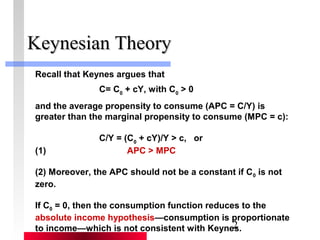
Recall that Keynes argues that 
C= C0 + cY, with C0 > 0 
and the average propensity to consume (APC = C/Y) is 
greater than the marginal propensity to consume (MPC = c): 
C/Y = (C0 + cY)/Y > c, or 
(1) APC > MPC 
(2) Moreover, the APC should not be a constant if C0 is not 
zero. 
If C0 = 0, then the consumption function reduces to the 
absolute income hypothesis—consumption is proportionate 
to income—which is not consistent with Keynes.
3 
EEmmppiirriiccaall VVeerriiffiiccaattiioonn?? 
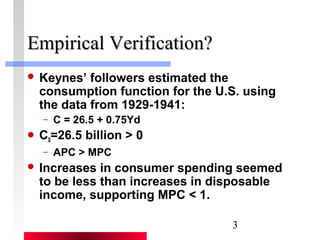
 Keynes’ followers estimated the 
consumption function for the U.S. using 
the data from 1929-1941: 
– C = 26.5 + 0.75Yd 
 C0=26.5 billion > 0 
– APC > MPC 
 Increases in consumer spending seemed 
to be less than increases in disposable 
income, supporting MPC < 1.
KKuuzznneettss’’ CCoonnssuummppttiioonn DDaattaa 
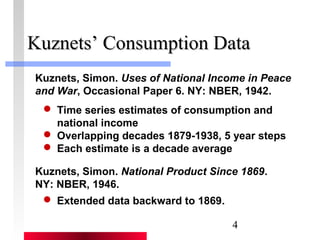
Kuznets, Simon. Uses of National Income in Peace 
and War, Occasional Paper 6. NY: NBER, 1942. 
 Time series estimates of consumption and 
national income 
 Overlapping decades 1879-1938, 5 year steps 
 Each estimate is a decade average 
Kuznets, Simon. National Product Since 1869. 
NY: NBER, 1946. 
 Extended data backward to 1869. 
4
5 
KKuuzznneettss’’ SSttuuddyy ((11)) 
 Assumptions: 
– Personal taxes and transfer payments are 
small (in this period) 
– Therefore, it is reasonable to use total income 
(GNP) as a proxy for disposable income. 
– If a relationship between consumption and 
disposable income exists, there should also be 
a relationship between consumption and GNP.
6 
KKuuzznneettss’’ SSttuuddyy ((22)) 
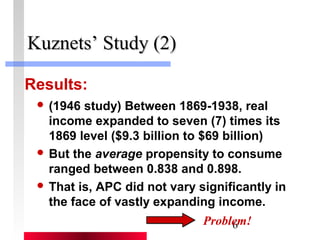
Results: 
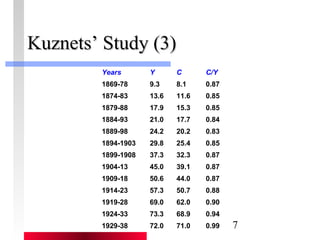
 (1946 study) Between 1869-1938, real 
income expanded to seven (7) times its 
1869 level ($9.3 billion to $69 billion) 
 But the average propensity to consume 
ranged between 0.838 and 0.898. 
 That is, APC did not vary significantly in 
the face of vastly expanding income. 
Problem!
7 
KKuuzznneettss’’ SSttuuddyy ((33)) 
Years Y C C/Y 
1869-78 9.3 8.1 0.87 
1874-83 13.6 11.6 0.85 
1879-88 17.9 15.3 0.85 
1884-93 21.0 17.7 0.84 
1889-98 24.2 20.2 0.83 
1894-1903 29.8 25.4 0.85 
1899-1908 37.3 32.3 0.87 
1904-13 45.0 39.1 0.87 
1909-18 50.6 44.0 0.87 
1914-23 57.3 50.7 0.88 
1919-28 69.0 62.0 0.90 
1924-33 73.3 68.9 0.94 
1929-38 72.0 71.0 0.99
8 
SSeeccoonndd FFaaiilluurree 
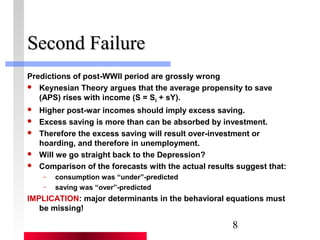
Predictions of post-WWII period are grossly wrong 
 Keynesian Theory argues that the average propensity to save 
(APS) rises with income (S = S0 + sY). 
 Higher post-war incomes should imply excess saving. 
 Excess saving is more than can be absorbed by investment. 
 Therefore the excess saving will result over-investment or 
hoarding, and therefore in unemployment. 
 Will we go straight back to the Depression? 
 Comparison of the forecasts with the actual results suggest that: 
– consumption was “under”-predicted 
– saving was “over”-predicted 
IMPLICATION: major determinants in the behavioral equations must 
be missing!
LLiiffee CCyyccllee HHyyppootthheessiiss ((LLCCHH)) 
 Franco Modgliani, Albert Ando, and 
Richard Bloomberg 
 Assumes that each representative agent 
will die, and knows: 
– when he/she will die, how many periods T 
he/she will live, and 
– How much his/her life-time income will be. 
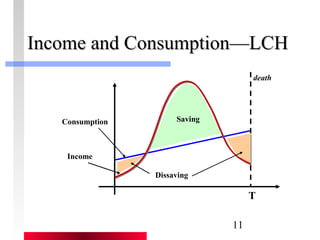
 The consumer smooths consumption 
expenditure over his/her life, spending 1/T 
of his/her life-time income each period. 
9
10 
LLCCHH ((22)) 
The consumption function implied by 
this logic is: 
C = 1 1 + ( -1) 1 + 
[ e 
] t 
t t Y N Y A 
T 
with the aggregate estimable 
consumption function look like this: 
t 
1 
e 
C bY b Y t t 2 
b3A 
1 
1 = + +
Income aanndd CCoonnssuummppttiioonn——LLCCHH 
11 
death 
T 
Consumption 
Income 
Saving 
Dissaving
12 
TTeessttiinngg tthhee LLCCHH 
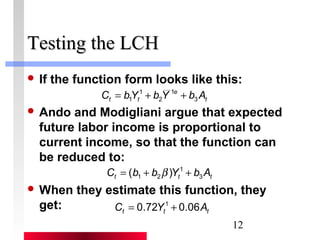
 If the function form looks like this: 
1 
1 
t t C bY b Y b3A 
t 
e 
= + + 
1 2 
 Ando and Modigliani argue that expected 
future labor income is proportional to 
current income, so that the function can 
be reduced to: 
1 
1 2 = ( + b ) + 
t t t C b b Y b3A 
When they estimate this function, they 
get: 
t t t C = 0.72Y1 + 0.06A
13 
CCrriittiicciissmmss ooff LLCCHH 
 The households, at all times, have a definite, 
conscious vision of: 
– The family’s future size and composition, including the 
life expectancy of each member, 
– The entire lifetime profile of the labor income of each 
member—after the applicable taxes, 
– The present and future extent and terms of any credit 
available, and 
– The future emergencies, opportunities, and social 
pressures which might affect its consumption spending. 
 It does not take into account liquidity constraints.
PPoolliiccyy IImmpplliiccaattiioonnss ooff LLCCHH 
 Changes in current income have a strong effect 
on current consumption ONLY if they affect 
expected lifetime income. 
 In Q2 1975, a one-time tax rebate of $8 billion was 
paid out to taxpayers to stimulate AD. 
14 
– The rebate had little effect. 
 Maybe George W. hadn’t heard about this? 
 The only way there can be a significant effect is if 
there is a strong liquidity constraint operating. 
 This has implications for monetary policy.
Permanent IInnccoommee HHyyppootthheessiiss ((PPIIHH)) 
 Milton Friedman 
 Assumes economic agents live forever. 
 Consumption is proportional to permanent 
income, C=kYp. 
 Permanent income is the expected average long-term 
income from both human and nonhuman 
15 
wealth. 
 Y = Yp + Yt 
 Only the permanent component of income affects 
consumption. Transitory changes to income do 
not affect consumption.
16 
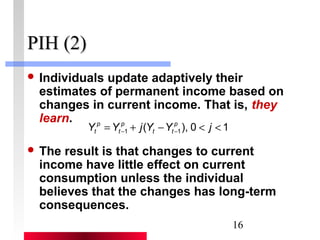
PPIIHH ((22)) 
 Individuals update adaptively their 
estimates of permanent income based on 
changes in current income. That is, they 
learn. 
Y p 
= Y p 
+ j ( - 1 Y Y p ), 0 < j 
< 1 t 
t 
- t t 
- 1  The result is that changes to current 
income have little effect on current 
consumption unless the individual 
believes that the changes has long-term 
consequences.
17 
IInnvveessttmmeenntt SSppeennddiinngg 
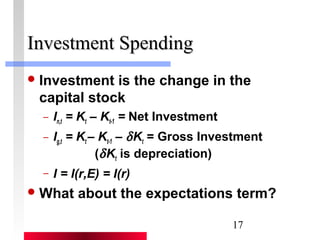
Investment is the change in the 
capital stock 
– In,t = Kt – Kt-1 = Net Investment 
– Ig,t = Kt – Kt-1 – dKt = Gross Investment 
(dKt is depreciation) 
– I = I(r,E) = I(r) 
What about the expectations term?
TThhee AAcccceelleerraattoorr MMooddeell ((11)) 
Attempts to capture some measure 
of current business conditions 
(growth of the economy or lack of it), 
and use that to explain the level of 
investment. 
18
19 
AAcccceelleerraattoorr MMooddeell ((22)) 
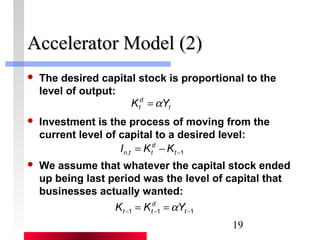
 The desired capital stock is proportional to the 
level of output: 
d 
t K =aY 
t 
 Investment is the process of moving from the 
current level of capital to a desired level: 
d 
n t t I K K 
, -1 = - t 
 We assume that whatever the capital stock ended 
up being last period was the level of capital that 
businesses actually wanted: 
d 
t t K K aY 
-1 -1 -1 = = t
, 1 1 1( ) 
I K K Y Y Y Y 
= - = a - a = a 
- t - t t - t t 
- 
a 
20 
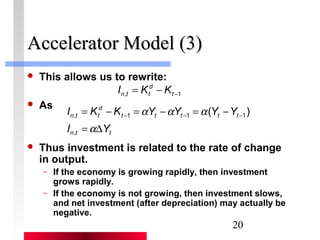
AAcccceelleerraattoorr MMooddeell ((33)) 
 This allows us to rewrite: 
 As 
d 
n t t I K K 
, -1 = - t 
d 
n t t 
I = D 
Y 
, 
n t t 
 Thus investment is related to the rate of change 
in output. 
– If the economy is growing rapidly, then investment 
grows rapidly. 
– If the economy is not growing, then investment slows, 
and net investment (after depreciation) may actually be 
negative.
21 
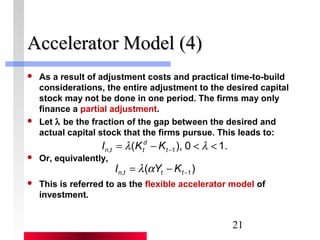
AAcccceelleerraattoorr MMooddeell ((44)) 
 As a result of adjustment costs and practical time-to-build 
considerations, the entire adjustment to the desired capital 
stock may not be done in one period. The firms may only 
finance a partial adjustment. 
 Let l be the fraction of the gap between the desired and 
actual capital stock that the firms pursue. This leads to: 
n t t I K K 
 Or, equivalently, 
d 
( ), 0 1. , 1 = - < < - l l t 
( ) , -1 = - n t t t I l aY K 
 This is referred to as the flexible accelerator model of 
investment.
22 
CCoosstt ooff CCaappiittaall AApppprrooaacchh 
 MEC all over again? 
 Recall that Keynes argued that business 
decision makers compare the expected 
revenue stream from the new capital to the 
cost of capital. 
 The user cost of capital is the total cost to 
the firm of employing an additional unit of 
capital for one period. 
– The new capital might be funded by borrowing, 
selling stock shares, retained earnings, etc.
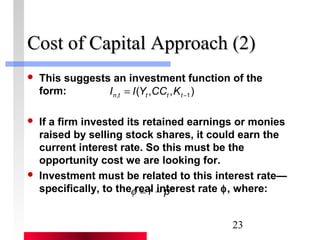
CCoosstt ooff CCaappiittaall AApppprrooaacchh ((22)) 
 This suggests an investment function of the 
form: 
 If a firm invested its retained earnings or monies 
raised by selling stock shares, it could earn the 
current interest rate. So this must be the 
opportunity cost we are looking for. 
 Investment must be related to this interest rate— 
specifically, to the real interest rate f, where: 
23 
( , , ) , -1 = n t t t t I I Y CC K 
f = r - p e
CCoosstt ooff CCaappiittaall AApppprrooaacchh ((33)) 
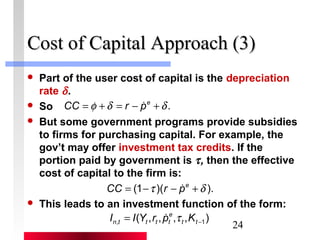
 Part of the user cost of capital is the depreciation 
rate d . 
 So 
 But some government programs provide subsidies 
to firms for purchasing capital. For example, the 
gov’t may offer investment tax credits. If the 
portion paid by government is t , then the effective 
cost of capital to the firm is: 
 This leads to an investment function of the form: 
24 
CC =f +d = r - p e +d . 
CC = (1-t )(r - p e +d ). 
e 
( , , , , ) , -1 = t t 
n t t t t I I Y r p t K

Froyen21

  • 1.
    CCoonnssuummppttiioonn aanndd IInnvveessttmmeenntt CChhaapptteerr 2211 Professor Steve Cunningham Intermediate Macroeconomics ECON 219
  • 2.
    2 KKeeyynneessiiaann TThheeoorryy Recall that Keynes argues that C= C0 + cY, with C0 > 0 and the average propensity to consume (APC = C/Y) is greater than the marginal propensity to consume (MPC = c): C/Y = (C0 + cY)/Y > c, or (1) APC > MPC (2) Moreover, the APC should not be a constant if C0 is not zero. If C0 = 0, then the consumption function reduces to the absolute income hypothesis—consumption is proportionate to income—which is not consistent with Keynes.
  • 3.
    3 EEmmppiirriiccaall VVeerriiffiiccaattiioonn??  Keynes’ followers estimated the consumption function for the U.S. using the data from 1929-1941: – C = 26.5 + 0.75Yd  C0=26.5 billion > 0 – APC > MPC  Increases in consumer spending seemed to be less than increases in disposable income, supporting MPC < 1.
  • 4.
    KKuuzznneettss’’ CCoonnssuummppttiioonn DDaattaa Kuznets, Simon. Uses of National Income in Peace and War, Occasional Paper 6. NY: NBER, 1942.  Time series estimates of consumption and national income  Overlapping decades 1879-1938, 5 year steps  Each estimate is a decade average Kuznets, Simon. National Product Since 1869. NY: NBER, 1946.  Extended data backward to 1869. 4
  • 5.
    5 KKuuzznneettss’’ SSttuuddyy((11))  Assumptions: – Personal taxes and transfer payments are small (in this period) – Therefore, it is reasonable to use total income (GNP) as a proxy for disposable income. – If a relationship between consumption and disposable income exists, there should also be a relationship between consumption and GNP.
  • 6.
    6 KKuuzznneettss’’ SSttuuddyy((22)) Results:  (1946 study) Between 1869-1938, real income expanded to seven (7) times its 1869 level ($9.3 billion to $69 billion)  But the average propensity to consume ranged between 0.838 and 0.898.  That is, APC did not vary significantly in the face of vastly expanding income. Problem!
  • 7.
    7 KKuuzznneettss’’ SSttuuddyy((33)) Years Y C C/Y 1869-78 9.3 8.1 0.87 1874-83 13.6 11.6 0.85 1879-88 17.9 15.3 0.85 1884-93 21.0 17.7 0.84 1889-98 24.2 20.2 0.83 1894-1903 29.8 25.4 0.85 1899-1908 37.3 32.3 0.87 1904-13 45.0 39.1 0.87 1909-18 50.6 44.0 0.87 1914-23 57.3 50.7 0.88 1919-28 69.0 62.0 0.90 1924-33 73.3 68.9 0.94 1929-38 72.0 71.0 0.99
  • 8.
    8 SSeeccoonndd FFaaiilluurree Predictions of post-WWII period are grossly wrong  Keynesian Theory argues that the average propensity to save (APS) rises with income (S = S0 + sY).  Higher post-war incomes should imply excess saving.  Excess saving is more than can be absorbed by investment.  Therefore the excess saving will result over-investment or hoarding, and therefore in unemployment.  Will we go straight back to the Depression?  Comparison of the forecasts with the actual results suggest that: – consumption was “under”-predicted – saving was “over”-predicted IMPLICATION: major determinants in the behavioral equations must be missing!
  • 9.
    LLiiffee CCyyccllee HHyyppootthheessiiss((LLCCHH))  Franco Modgliani, Albert Ando, and Richard Bloomberg  Assumes that each representative agent will die, and knows: – when he/she will die, how many periods T he/she will live, and – How much his/her life-time income will be.  The consumer smooths consumption expenditure over his/her life, spending 1/T of his/her life-time income each period. 9
  • 10.
    10 LLCCHH ((22)) The consumption function implied by this logic is: C = 1 1 + ( -1) 1 + [ e ] t t t Y N Y A T with the aggregate estimable consumption function look like this: t 1 e C bY b Y t t 2 b3A 1 1 = + +
  • 11.
    Income aanndd CCoonnssuummppttiioonn——LLCCHH 11 death T Consumption Income Saving Dissaving
  • 12.
    12 TTeessttiinngg tthheeLLCCHH  If the function form looks like this: 1 1 t t C bY b Y b3A t e = + + 1 2  Ando and Modigliani argue that expected future labor income is proportional to current income, so that the function can be reduced to: 1 1 2 = ( + b ) + t t t C b b Y b3A When they estimate this function, they get: t t t C = 0.72Y1 + 0.06A
  • 13.
    13 CCrriittiicciissmmss ooffLLCCHH  The households, at all times, have a definite, conscious vision of: – The family’s future size and composition, including the life expectancy of each member, – The entire lifetime profile of the labor income of each member—after the applicable taxes, – The present and future extent and terms of any credit available, and – The future emergencies, opportunities, and social pressures which might affect its consumption spending.  It does not take into account liquidity constraints.
  • 14.
    PPoolliiccyy IImmpplliiccaattiioonnss ooffLLCCHH  Changes in current income have a strong effect on current consumption ONLY if they affect expected lifetime income.  In Q2 1975, a one-time tax rebate of $8 billion was paid out to taxpayers to stimulate AD. 14 – The rebate had little effect.  Maybe George W. hadn’t heard about this?  The only way there can be a significant effect is if there is a strong liquidity constraint operating.  This has implications for monetary policy.
  • 15.
    Permanent IInnccoommee HHyyppootthheessiiss((PPIIHH))  Milton Friedman  Assumes economic agents live forever.  Consumption is proportional to permanent income, C=kYp.  Permanent income is the expected average long-term income from both human and nonhuman 15 wealth.  Y = Yp + Yt  Only the permanent component of income affects consumption. Transitory changes to income do not affect consumption.
  • 16.
    16 PPIIHH ((22))  Individuals update adaptively their estimates of permanent income based on changes in current income. That is, they learn. Y p = Y p + j ( - 1 Y Y p ), 0 < j < 1 t t - t t - 1  The result is that changes to current income have little effect on current consumption unless the individual believes that the changes has long-term consequences.
  • 17.
    17 IInnvveessttmmeenntt SSppeennddiinngg Investment is the change in the capital stock – In,t = Kt – Kt-1 = Net Investment – Ig,t = Kt – Kt-1 – dKt = Gross Investment (dKt is depreciation) – I = I(r,E) = I(r) What about the expectations term?
  • 18.
    TThhee AAcccceelleerraattoorr MMooddeell((11)) Attempts to capture some measure of current business conditions (growth of the economy or lack of it), and use that to explain the level of investment. 18
  • 19.
    19 AAcccceelleerraattoorr MMooddeell((22))  The desired capital stock is proportional to the level of output: d t K =aY t  Investment is the process of moving from the current level of capital to a desired level: d n t t I K K , -1 = - t  We assume that whatever the capital stock ended up being last period was the level of capital that businesses actually wanted: d t t K K aY -1 -1 -1 = = t
  • 20.
    , 1 11( ) I K K Y Y Y Y = - = a - a = a - t - t t - t t - a 20 AAcccceelleerraattoorr MMooddeell ((33))  This allows us to rewrite:  As d n t t I K K , -1 = - t d n t t I = D Y , n t t  Thus investment is related to the rate of change in output. – If the economy is growing rapidly, then investment grows rapidly. – If the economy is not growing, then investment slows, and net investment (after depreciation) may actually be negative.
  • 21.
    21 AAcccceelleerraattoorr MMooddeell((44))  As a result of adjustment costs and practical time-to-build considerations, the entire adjustment to the desired capital stock may not be done in one period. The firms may only finance a partial adjustment.  Let l be the fraction of the gap between the desired and actual capital stock that the firms pursue. This leads to: n t t I K K  Or, equivalently, d ( ), 0 1. , 1 = - < < - l l t ( ) , -1 = - n t t t I l aY K  This is referred to as the flexible accelerator model of investment.
  • 22.
    22 CCoosstt ooffCCaappiittaall AApppprrooaacchh  MEC all over again?  Recall that Keynes argued that business decision makers compare the expected revenue stream from the new capital to the cost of capital.  The user cost of capital is the total cost to the firm of employing an additional unit of capital for one period. – The new capital might be funded by borrowing, selling stock shares, retained earnings, etc.
  • 23.
    CCoosstt ooff CCaappiittaallAApppprrooaacchh ((22))  This suggests an investment function of the form:  If a firm invested its retained earnings or monies raised by selling stock shares, it could earn the current interest rate. So this must be the opportunity cost we are looking for.  Investment must be related to this interest rate— specifically, to the real interest rate f, where: 23 ( , , ) , -1 = n t t t t I I Y CC K f = r - p e
  • 24.
    CCoosstt ooff CCaappiittaallAApppprrooaacchh ((33))  Part of the user cost of capital is the depreciation rate d .  So  But some government programs provide subsidies to firms for purchasing capital. For example, the gov’t may offer investment tax credits. If the portion paid by government is t , then the effective cost of capital to the firm is:  This leads to an investment function of the form: 24 CC =f +d = r - p e +d . CC = (1-t )(r - p e +d ). e ( , , , , ) , -1 = t t n t t t t I I Y r p t K