TThhee KKeeyynneessiiaann SSyysstteemm IIVV:: 
AAggggrreeggaattee SSuuppppllyy aanndd DDeemmaanndd 
CChhaapptteerr 99 
Professor Steve Cunningham 
Intermediate Macroeconomics 
ECON 219
2 
CCoonnssttrruuccttiinngg AADD 
The AD curve can be constructed 
from the IS-LM apparatus. 
Recall that the price level is 
established outside the IS-LM model. 
We construct AD by observing the 
how changes in the price level affect 
the IS-LM model.
3 
LM(P0) 
IS 
LM(P2) r 
LM(P1) 
r2 
r1 
r0 
Y2 Y1 Y0 Y 
Y2 Y1 Y0 
AD 
P2 
P1 
P0 
AADD ffrroomm IISS--LLMM 
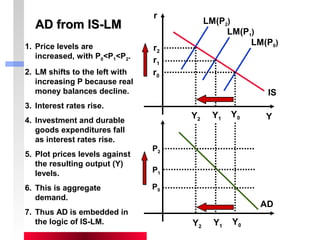
1. Price levels are 
increased, with P0<P1<P2. 
2. LM shifts to the left with 
increasing P because real 
money balances decline. 
3. Interest rates rise. 
4. Investment and durable 
goods expenditures fall 
as interest rates rise. 
5. Plot prices levels against 
the resulting output (Y) 
levels. 
6. This is aggregate 
demand. 
7. Thus AD is embedded in 
the logic of IS-LM.
4 
CCoonnssttrruuccttiinngg AASS 
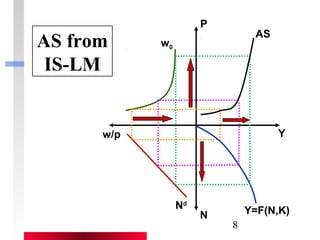
To do this we go back to our 
classical model and observe the 
effects of having a fixed nominal 
wage. 
A less extreme view is to consider 
nominal wages as being “sticky”— 
meaning they adjust relatively 
slowly.
SSoouurrcceess ooff WWaaggee RRiiggiiddiittyy ((11)) 
 General wage changes vs. relative wage 
changes 
 General wage changes 
– If real wages (w/P) decline because of inflation 
(P­), then everyone suffers the same. This is a 
general real wage decline, and all workers are 
equally affected. 
– Thus workers are do not react as strongly to 
this. Even if they did, there is little that they 
could do about it. 
5
SSoouurrcceess ooff WWaaggee RRiiggiiddiittyy ((22)) 
6 
Relative wage change 
– If an employer reduces the wages of an 
individual worker, the worker’s relative 
wage and buying power are affected. 
– The worker may permanently have to 
live decreased relative buying power. 
– The worker may become disgruntled, 
and labor supply may become reduced.
SSoouurrcceess ooff WWaaggee RRiiggiiddiittyy ((33)) 
7 
Institutional factors: 
– Workers often accept explicit or implicit 
contracts for employment, accepting 
that they will not be re-evaluated for 
nominal wage changes for an extended 
period. 
– This leads to a contractual view of the 
labor market.
8 
AS 
Y 
Nd Y=F(N,K) 
w0 
P 
w/p 
N 
AS from 
IS-LM
9 
AS 
AD2 
Y 
Nd Y=F(N,K) 
w0 
P 
w/p 
N 
AD0 
AD1 
N­ 
Y­ 
AD­ 
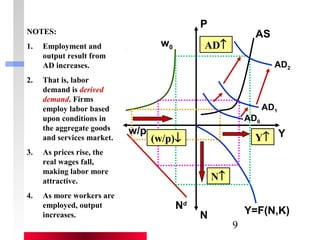
NOTES: 
1. Employment and 
output result from 
AD increases. 
2. That is, labor 
demand is derived 
demand. Firms 
employ labor based 
upon conditions in 
the aggregate goods 
and services market. 
3. As prices rise, the 
real wages fall, 
making labor more 
attractive. 
4. As more workers are 
employed, output 
increases. 
(w/p)¯
r LM 
10 
IS 
Y 
AS 
Y 
Y=F(N,K) 
w0 P 
Nd 
w/p 
N 
AD 
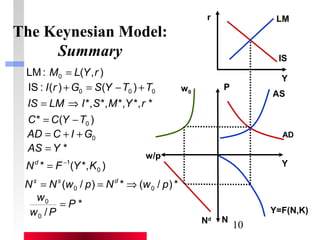
The Keynesian Model: 
Summary 
LM: ( , ) M0 = L Y r 
0 0 0 IS : I(r ) +G = S(Y -T ) +T 
IS = LM Þ I*,S*,M*,Y*,r * 
* ( ) C = C Y -T0 
AD = C + I +G0 
AS =Y * 
Nd = F-1 Y K 
* ( *, ) 0 
( / ) * ( / ) * N N w0 p N w0 p s = s = d Þ 
* 
w = 
0 P 
/ 0 
w P
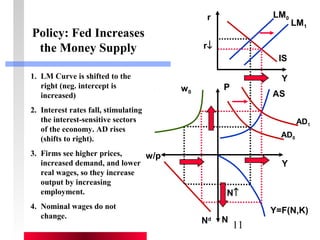
r LM0 
11 
IS 
Y 
AS 
Y 
LM1 
Y=F(N,K) 
w0 P 
Nd 
w/p 
N 
AD0 
AD1 
r¯ 
N­ 
Policy: Fed Increases 
the Money Supply 
1. LM Curve is shifted to the 
right (neg. intercept is 
increased) 
2. Interest rates fall, stimulating 
the interest-sensitive sectors 
of the economy. AD rises 
(shifts to right). 
3. Firms see higher prices, 
increased demand, and lower 
real wages, so they increase 
output by increasing 
employment. 
4. Nominal wages do not 
change.
r LM 
12 
IS0 
Y 
AS 
Y 
Y=F(N,K) 
w0 P 
Nd 
w/p 
N 
AD0 
AD1 
r­ 
N­ 
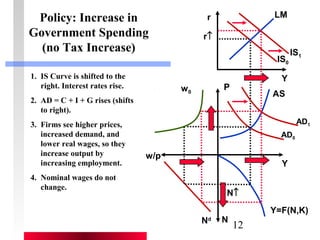
Policy: Increase in 
Government Spending 
(no Tax Increase) 
1. IS Curve is shifted to the 
right. Interest rates rise. 
2. AD = C + I + G rises (shifts 
to right). 
3. Firms see higher prices, 
increased demand, and 
lower real wages, so they 
increase output by 
increasing employment. 
4. Nominal wages do not 
change. 
IS1
r LM0 
13 
IS 
Y 
AS 
Y 
LM1 
Y=F(N,K) 
w0 P 
Nd 
w/p 
N 
AD0 
r¯ 
N¯ 
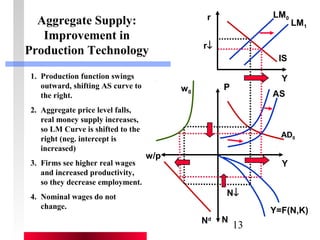
Aggregate Supply: 
Improvement in 
Production Technology 
1. Production function swings 
outward, shifting AS curve to 
the right. 
2. Aggregate price level falls, 
real money supply increases, 
so LM Curve is shifted to the 
right (neg. intercept is 
increased) 
3. Firms see higher real wages 
and increased productivity, 
so they decrease employment. 
4. Nominal wages do not 
change.
14 
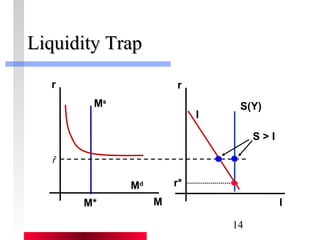
LLiiqquuiiddiittyy TTrraapp 
I 
r 
I 
M 
r 
Md r* 
Ms 
M* 
rˆ 
S(Y) 
S > I
15 
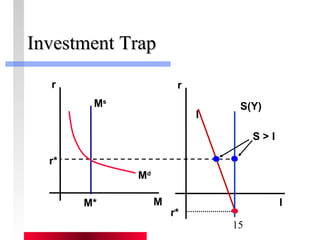
IInnvveessttmmeenntt TTrraapp 
I 
r 
I 
M 
r 
r* 
Md 
Ms 
M* 
S(Y) 
r* 
S > I
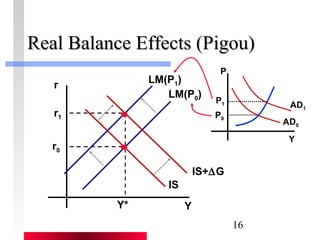
RReeaall BBaallaannccee EEffffeeccttss ((PPiiggoouu)) 
16 
LM(P0) 
IS 
Y 
r 
r0 
Y* 
P1 
IS+DG 
LM(P1) 
r1 
AD1 
Y 
P 
AD0 
P0
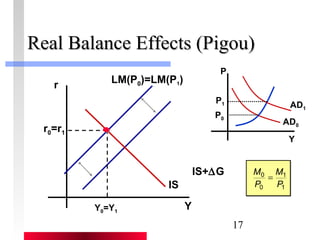
RReeaall BBaallaannccee EEffffeeccttss ((PPiiggoouu)) 
17 
IS 
Y 
r 
r0=r1 
Y0=Y1 
P1 
IS+DG 
LM(P0)=LM(P1) 
AD1 
Y 
P 
AD0 
P0 
M 
1 
1 
M 0 
= 
0 
P 
P

Froyen09

  • 1.
    TThhee KKeeyynneessiiaann SSyysstteemmIIVV:: AAggggrreeggaattee SSuuppppllyy aanndd DDeemmaanndd CChhaapptteerr 99 Professor Steve Cunningham Intermediate Macroeconomics ECON 219
  • 2.
    2 CCoonnssttrruuccttiinngg AADD The AD curve can be constructed from the IS-LM apparatus. Recall that the price level is established outside the IS-LM model. We construct AD by observing the how changes in the price level affect the IS-LM model.
  • 3.
    3 LM(P0) IS LM(P2) r LM(P1) r2 r1 r0 Y2 Y1 Y0 Y Y2 Y1 Y0 AD P2 P1 P0 AADD ffrroomm IISS--LLMM 1. Price levels are increased, with P0<P1<P2. 2. LM shifts to the left with increasing P because real money balances decline. 3. Interest rates rise. 4. Investment and durable goods expenditures fall as interest rates rise. 5. Plot prices levels against the resulting output (Y) levels. 6. This is aggregate demand. 7. Thus AD is embedded in the logic of IS-LM.
  • 4.
    4 CCoonnssttrruuccttiinngg AASS To do this we go back to our classical model and observe the effects of having a fixed nominal wage. A less extreme view is to consider nominal wages as being “sticky”— meaning they adjust relatively slowly.
  • 5.
    SSoouurrcceess ooff WWaaggeeRRiiggiiddiittyy ((11))  General wage changes vs. relative wage changes  General wage changes – If real wages (w/P) decline because of inflation (P­), then everyone suffers the same. This is a general real wage decline, and all workers are equally affected. – Thus workers are do not react as strongly to this. Even if they did, there is little that they could do about it. 5
  • 6.
    SSoouurrcceess ooff WWaaggeeRRiiggiiddiittyy ((22)) 6 Relative wage change – If an employer reduces the wages of an individual worker, the worker’s relative wage and buying power are affected. – The worker may permanently have to live decreased relative buying power. – The worker may become disgruntled, and labor supply may become reduced.
  • 7.
    SSoouurrcceess ooff WWaaggeeRRiiggiiddiittyy ((33)) 7 Institutional factors: – Workers often accept explicit or implicit contracts for employment, accepting that they will not be re-evaluated for nominal wage changes for an extended period. – This leads to a contractual view of the labor market.
  • 8.
    8 AS Y Nd Y=F(N,K) w0 P w/p N AS from IS-LM
  • 9.
    9 AS AD2 Y Nd Y=F(N,K) w0 P w/p N AD0 AD1 N­ Y­ AD­ NOTES: 1. Employment and output result from AD increases. 2. That is, labor demand is derived demand. Firms employ labor based upon conditions in the aggregate goods and services market. 3. As prices rise, the real wages fall, making labor more attractive. 4. As more workers are employed, output increases. (w/p)¯
  • 10.
    r LM 10 IS Y AS Y Y=F(N,K) w0 P Nd w/p N AD The Keynesian Model: Summary LM: ( , ) M0 = L Y r 0 0 0 IS : I(r ) +G = S(Y -T ) +T IS = LM Þ I*,S*,M*,Y*,r * * ( ) C = C Y -T0 AD = C + I +G0 AS =Y * Nd = F-1 Y K * ( *, ) 0 ( / ) * ( / ) * N N w0 p N w0 p s = s = d Þ * w = 0 P / 0 w P
  • 11.
    r LM0 11 IS Y AS Y LM1 Y=F(N,K) w0 P Nd w/p N AD0 AD1 r¯ N­ Policy: Fed Increases the Money Supply 1. LM Curve is shifted to the right (neg. intercept is increased) 2. Interest rates fall, stimulating the interest-sensitive sectors of the economy. AD rises (shifts to right). 3. Firms see higher prices, increased demand, and lower real wages, so they increase output by increasing employment. 4. Nominal wages do not change.
  • 12.
    r LM 12 IS0 Y AS Y Y=F(N,K) w0 P Nd w/p N AD0 AD1 r­ N­ Policy: Increase in Government Spending (no Tax Increase) 1. IS Curve is shifted to the right. Interest rates rise. 2. AD = C + I + G rises (shifts to right). 3. Firms see higher prices, increased demand, and lower real wages, so they increase output by increasing employment. 4. Nominal wages do not change. IS1
  • 13.
    r LM0 13 IS Y AS Y LM1 Y=F(N,K) w0 P Nd w/p N AD0 r¯ N¯ Aggregate Supply: Improvement in Production Technology 1. Production function swings outward, shifting AS curve to the right. 2. Aggregate price level falls, real money supply increases, so LM Curve is shifted to the right (neg. intercept is increased) 3. Firms see higher real wages and increased productivity, so they decrease employment. 4. Nominal wages do not change.
  • 14.
    14 LLiiqquuiiddiittyy TTrraapp I r I M r Md r* Ms M* rˆ S(Y) S > I
  • 15.
    15 IInnvveessttmmeenntt TTrraapp I r I M r r* Md Ms M* S(Y) r* S > I
  • 16.
    RReeaall BBaallaannccee EEffffeeccttss((PPiiggoouu)) 16 LM(P0) IS Y r r0 Y* P1 IS+DG LM(P1) r1 AD1 Y P AD0 P0
  • 17.
    RReeaall BBaallaannccee EEffffeeccttss((PPiiggoouu)) 17 IS Y r r0=r1 Y0=Y1 P1 IS+DG LM(P0)=LM(P1) AD1 Y P AD0 P0 M 1 1 M 0 = 0 P P